Monthly Archives: November 2010

Top Gear – Lancia Thesis

Lancia was founded by Vincenzo Lancia in 1906 and was run by his wife, son and Vittorio Jano upon Vincenzo’s death in 1937. The company was taken over by Fiat in 1969 and has been run as a Premier Fiat brand ever since.

The Thesis was powered by a variety of straight 5 and V6 engines with horsepower ranging from 170hp to 230hp, the top speed of the 230hp V6 is around 150 mph.

Lancia ceased trading in the UK in 1984 after their Ferrari powered Thema failed to sell beyond double figures, so it is always a surprise to see a contemporary Lancia in the UK. The Thesis was in production from 2002 – 2009.

Amongst Lancia trademarks is the use of the letters of the Greek alphabet for the names of it’s models. Lancia like Alfa Romeo also make a variety of commercial vehicles rarely seen outside Italy.

Innovations introduced by Lancia include the first mass manufactured monocoque vehicle which dispensed with the separate chassis a type of construction prevalent in the motor industry today, they also introduced V6 and V4 engines along with the first 5 speed gear box’s as options for their vehicles.

I was surprised to learn when researching the Lancia Thesis that Lancia was named the greatest car company of all time by the presenters of the 14th series ‘Top Gear’ a motoring TV show produced by Britain’s impartial public broadcaster the BBC.

I’d like to thank everyone from the Rowdy and Cadillac Forums who visited and made the last couple of days here bumper events. Thanks for popping by Gettin’ a lil’ psycho on tyres, don’t forget to come back now !

Share

Standard of the World – 1978 Cadillac Coupe Deville

Rounding out a couple of days looking at Cadillac Coupe de Villes is this 1978 model which appears with number plates suggesting that it was registered before August 1976. Cadillac was born out of the Henry Ford Company on August 22nd, 1902, when mechanic & entrepreneur Henry M. Leland put forward to the investors in the company that continued manufacture was a more profitable than factory liquidation.

In 1977 the Coupe de Ville was downsized 9.8 inches saving 750 lbs in weight over its immediate ancestor, the new package was powered by a 7 litre 425 cui V8.

Leland named the new company Cadillac after his ancestor Antoine de la Mothe Cadillac the founder of Detroit. General Motors acquired Cadillac in 1909. Cadillac appears to have been responsible for setting the V8 as the standard configuration in the US Motor Industry.

This particular model can be identified as a 1978 version by the small vertical tail light insets a feature that would remain with the de Ville until 1999.

Cadillac was twice awarded the Dewar Trophy by the Royal Automobile Club (RAC) in England for advancement of the automobile industry first in 1909 for developing models with full parts interchangeability in 1908, and again in 1913 for developing the electric starter (thank heavens, that saved an a lot of sweat and probably a few broken arms) and electric lights (hallelujhah, imagine if we were all still driving around by naked flame candle light or propane powered lights ?). These successes led to Cadillac adopting the strap line “Standard of the World”.

Slightly off topic, after an amazing Cup race in Texas, kudos to Dangerous Denny Hamlin, there are still three guys in with a chance to win it all, I am glad Happy Harvick managed to pull a 6th place out of the bag, before the last pit stops it looked like he would be lucky to finish in the top 20. It’s looking like the only way to keep his championship hopes alive will be two straight win’s. I hope Happy over turns the record books and pulls them off, should be a little easier after the #48 pit crew was benched mid race by the Evil Genius Knaus in favour of the #24 crew when they became available.

Hope you enjoyed your visit, thanks for dropping by, wishing every one a mellow Monday, don’t forget to come back now !

Share

The conspicuous underdog – ‘Petit Pataud’ Replica 2/2

Today I’ll be sharing some details about John Aibels fabulous ‘Petit Pataud’ Replica 1950 Series 61 Cadillac Coupe, if you missed the story about the original here is a link to yesterdays post.

John found his bottom of the range Series 61 Cadillac with the correct Petit Pataud 121″ wheel base in Iowa, it did not have the optional power windows, amazing I had no idea they had even been thought of in 1950, but Johns car was originally fitted with a Hydra – Matic automatic transmission and he went to considerable trouble to locate a correct manual one as used at Le Mans, an item difficult to find because it is also the transmission of choice amongst hot rodders.

Being a volunteer at CAM (The Collier Collection) John was given access to the original and correctly identified the Marchal driving lights, GI two way radio among many other parts, and noted how and where they were correctly installed. It took around a year to meticulously hunt down these items on E-Bay and to collect all the bits and pieces prior to the car being sent to a restoration shop for a three year restoration.

The car is fitted with a roll bar and five point harness though John is a little sceptical about the capability of the drum brakes to handle serious competition, I am not sure he has the Alfin drums and additional brake ducting
Cunningham had fitted to the original.

Apparently the Cunnigham ‘Petit Pataud’ was used as both a tow car and shop vehicle after its sturdy service at Le Mans, evidence of this can be seen in this link to a photo of the restored original where a chrome tow hitch cover is plain to see under the bumper, also the original no longer has the 35 gallon long range fuel tank and filler as can be clearly seen on the passenger side of Johns car just behind the C pillar.

He says of his car “You are right everytime we drive the car we get the thumbs up and smiles from a lot of people. It also drives great, it is very comfortable, it just soaks up the bumbs on the roads. She rolls like a ship in the turns, but holds very well.”

I’d like to thank John for sharing his photo’s and thoughts on his marvellous motor car, a reminder of a golden age of optimism, a time when with a few good connections a showroom car fitted with a double barrel carburettor, some French springs, a long range fuel tank and GI two way radio you could compete in one of, if not the most romantic race in the world.

Thanks also again to Chief 187 who so thoughtfully set these last two blogs up for me.

Hope you have enjoyed this weekends extraordinary vehicle, new followers and comments are always appreciated and a useful tool to help me source more for you in future, thanks for dropping by don’t forget to come back now !

Slightly off topic, today is a big day for all three contenders in the post season NASCAR Chase for the Cup, covered by less than 40 points the only strategy to win the cup now has to be to win the next three races, looking forward to seeing if Kevin Harvick can step up to the plate and pull it off. Go Harvick ! Go #29 ! Go Happy !

10/11/10 Erratum, I got the model types a bit mixed up and have removed all ‘de Ville’ references from the text above, the Series 61 shown here is the shorter model known as Type 61 Coupe, not Coupe de Ville which was the Type 62. Apologies for any confusion.

Share

The conspicuous underdog – ‘Petit Pataud’ Replica 1/2

It’s a great honour to feature on ‘Gettin’ a lil’ psycho on tyres’ a ‘Petit Pataud’ replica belonging to John Aibel. This will be another two part blog starting today with the history of the real ‘Petit Pataud’ finishing tomorrow with some of the fascinating details about this faithful replica.

The ‘Petit Pataud’ legend starts with an invitation from 1949 Le Mans winner Luigi Chinnetti to facilitate an entry in the 1950 Le Mans entry for Briggs Cunningham.

Seeking advice from a well respected mechanic Bill Frick, Cunningham made a false start building a hot rod like device by dropping a Cadillac V8 into a Ford body and dubbed a Fordillac. If any one knows of any pics of this ‘device’ please leave a message below.

The Le Mans organisers deemed the Fordillac ineligible so Briggs bought two showroom 1950 Series 61 Cadillac Coupes one was given an open aluminium body devised by employees of the Grumman aircraft manufacturer and dubbed ‘Le Monstre’ by the French press, the other was more modestly prepared for endurance racing by Frick – Tappett Motors and dubbed with typical French irony ‘Petit Pataud’ ‘little clumsy’ a name I believe usually referring to new born pups.

The Cunningham team were surprised to find ‘Petit Pataud’ the more or less stock underdog of the stable driven by Miles and Sam Collier proved quicker than the heavily modified ‘Le Monstre’ straight out of the box. Though this was rectified during the course of practice for the race.

The 24 hours of Le Mans had an unusual start procedure, drivers stood on the opposite side of the track from the car and at the drop of the flag sprinted across the track and jumped in to their cars fired them up and drove off, in a piece of comedy reminiscent of a ‘Herbie’ film ‘Petit Pataud’s’ doors were found to be locked after it’s driver sprinted across the track at the start, fortunately the window was open so he reached inside to unlock the door from the inside !

Miles Collier who raced in the 1939 Le Mans race advised Briggs to equip his cars with fold away shovels in case either car found itself buried in the famously unforgiving artificial sand banks installed to prevent the more wayward vehicles from venturing too far from the notoriously fast and dangerous circuit.

Briggs rejected the advice and paid the price on lap 2 of the race when he found himself trapped in the sand bank at the end of the 4 mile long Mulsanne straight, Briggs probably wasted several minuets borrowing a shovel from a spectator and wasting half an hour successfully digging his car out and resuming the race.

‘Petit Pataud’ meanwhile as to be expected from a land yacht was sailing along at a nice and steady pace reaching 120 mph on the Mulsanne and running 1,956 miles to average 81.5 mph for 24 hours and finish in a commendable 10th place overall, 2nd in class behind a Cadillac powered Allard.

Briggs and Phil Walters brought ‘Le Monstre’ in one lap down, about the time it would have taken to borrow a shovel, on ‘Petit Pataud’, a small victory for the clumsy team underdog perhaps but just the stuff of legends that makes Le Mans such a fascinating race.

Tomorrow I’ll continue with details about Johns fabulous replica and some surprising differences with the restored original which make Johns car today arguably closer to the original Le Mans spec as raced in 1950.

Thanks to Chief 187 who set up my connection with John Aibel, and thanks to John, unfortunately I was not able to visit Florida to take these magnificent pics which he kindly sent to me.

Thanks for stopping by wishing everyone a wonderful weekend, don’t forget to come back now !

10/11/10 Erratum, I got the model types a bit mixed up and have removed all ‘de Ville’ references from the text above, the Series 61 shown here is the shorter model known as Type 61 Coupe, not Coupe de Ville which was the Type 62. Apologies for any confusion.

Share

The father of BMW, Jaguar, Bristol and Lotus cars – Austin 7 Part 2/2.

Today I’ll be looking at the legacy left by the humble little Austin 7 on the European Automotive industry, if you missed my introduction to the Austin 7 here is a link to yesterdays post.

The Austin 7 deserves it’s place in British automotive history simply for being it’s first mass produced car, but it’s real standing becomes clear when one considers the Austin 7 was manufactured under licence by the Automobilwerk Eisenbach car factory.
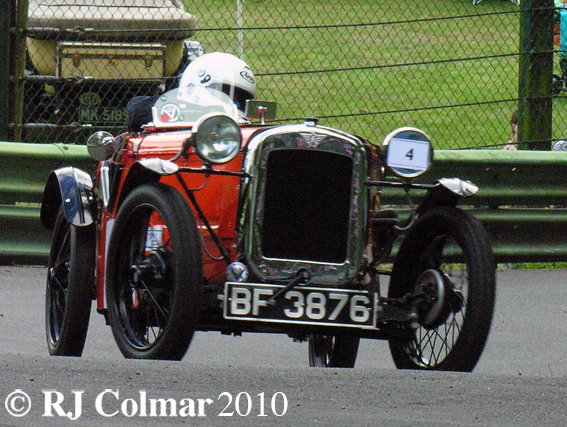
Above Joe Tisdall, 1930, Austin 7 Ulster, VSCC Prescott,

Their Dixi variant of the Austin 7 supplied in kit form initially in 1927 was so successful that within a year BMW bought the company after its own primogenitor vehicles proved less than viable. So the Ausitn 7 saved BMW from ruin as its aeroplane engine manufacturing business began to fail after shady dealings with the USSR came to light.
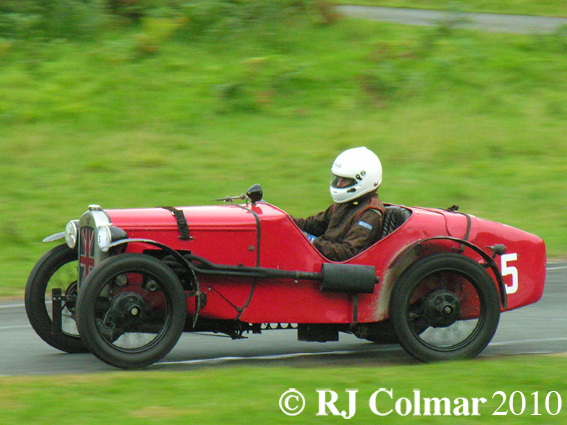
Above Mark Groves, 1930, Austin 7 Ulster, VSCC Loton Park.

This next bit traces the development of engines if you stick with it you’ll see the blood line from Austin 7 through BMW to Bristol.

In 1932 BMW used the 4 cylinder 747 cc / 45 cui Austin 7/ Dixi engine as the starting point for their own 4 cylinder 788cc / 48 cui motor used in their first all in house designed BMW 3/20

By 1933 BMW built a 1182 cc / 72 cui six cylinder version of the 3/20 engine called the M78 for their 303 model.

In 1934 a larger 1,490 cc 90.9 CUI six cylinder engine was developed from the M78 for use in the BMW 315/319 series of vehicles, which was superseded in 1936 by the hemi head 1971 cc / 120.3 cui six cylinder engine for the 328 model of 1936.
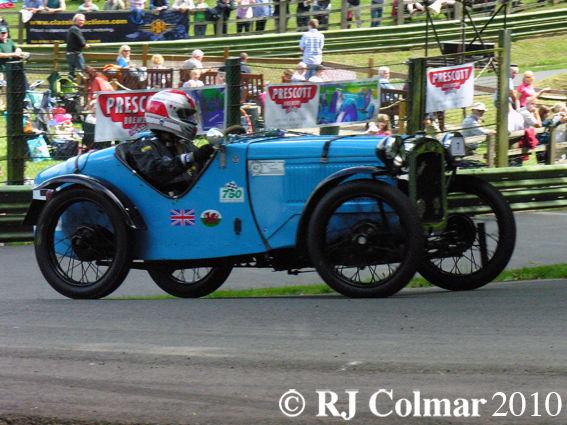
Above Miss Katherine Everett, 1930, Austin 7 Ulster, Prescott.

The plans for the 328’s engine first built in 1936 were appropriated as war reparations by HJ Adlington who was both in the British Army and Managing director of BAC Cars in 1947. The 328 engines designer Fritz Fiedler was also persuaded to move to England where he continued to develop the engine for the Bristol Aeroplane Company cars sold under the new ‘Bristol’ brand, thus the Austin 7 747 cc / 45 cui engine can be seen to be of the great, great, grand father of the Bristol marque which used hemi head 6 cylinder engines derived from the 1936 BMW 328 from 1947 to 1961.

I hope that wasn’t too convoluted or painful.
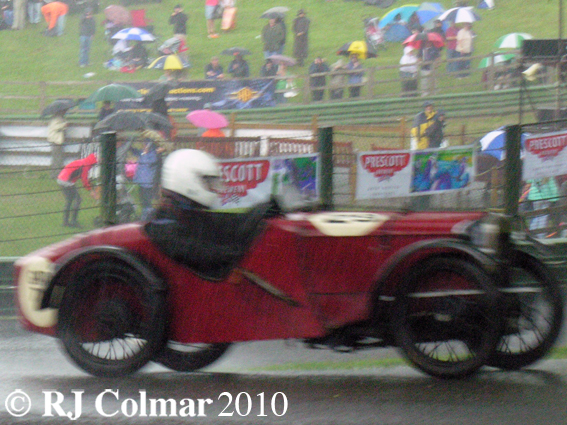
Above Edward Williams, 1930 Austin 7 Rolt Ulster, Supercharged, VSCC Prescott.

Rewinding back to 1927, Sir William Lyons took the basic Austin 7 and made a high end body for it which sold as the Austin Seven Swallow, moving the Swallow Sidecar Company from side car manufacture into motor car manufacture. In 1945 the Swallow Sidecar Company was renamed the Jaguar Car Company.
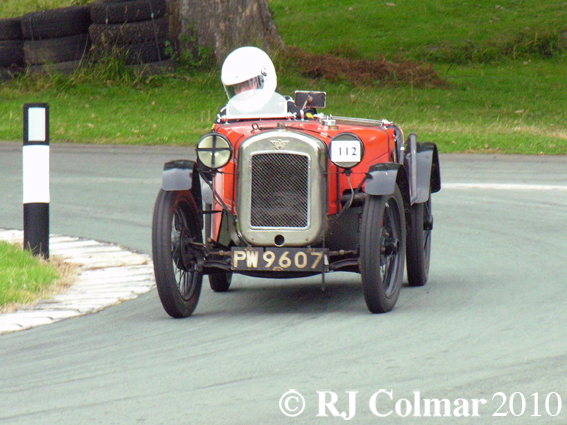
Mark Lance, 1930 Austin 7 Ulster TT Replica, VSCC Loton Park.

After WW2 many Austin 7’s were converted into specials as there were not enough new cars to meet demand in England. One of those converting an Austin 7 into a special was Colin Chapman who gave his special a now popular and familiar name Lotus Mk1.
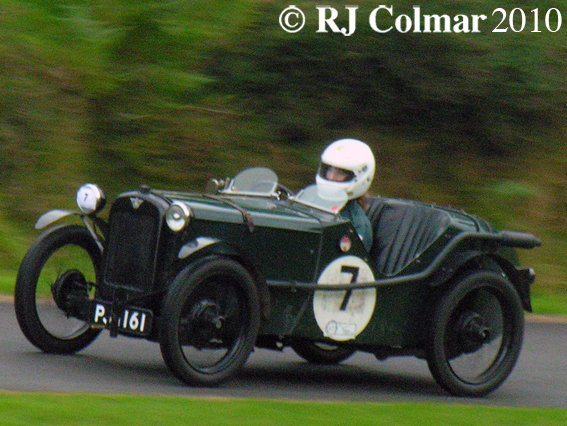
Above Ms Penny Jones, 1931, Austin 7 Ulster Replica, VSCC Loton Park.

The Austin 7 leant it’s name to another influential vehicle the original Austin Mini in 1959 which was originally marketed as the ‘Austin Seven’ and ‘Morris Mini Minor’.
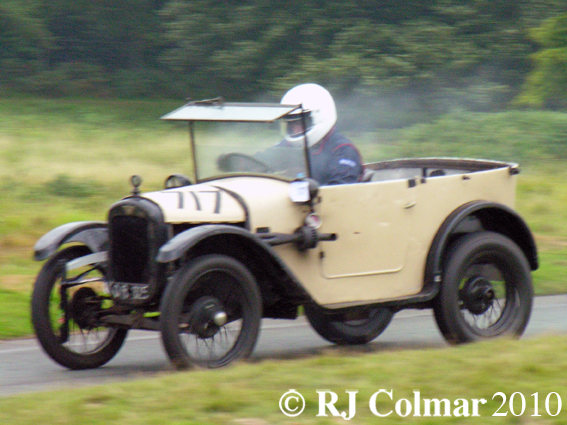
Above Benjamin MARCHANT, 1928 Austin 7 Chummy, supercharged, VSCC Loton Park.

I respectfully suggest that the humble little Austin Seven, which the Austin board only reluctantly agreed to back, became, through it’s role in the development of four prestige automotive manufacturers, one of the most influential vehicles of all time.

Thanks to Roger French and Julian Hunt at TNF for their help identifying a couple of these vehicles, to Tim Murray for his assistance identifying the Chummy and to everyone else for their time and patience, tomorrow I have the first instalment of another two part blog about an absolutely stunning replica of a vehicle which shines in one of my favourite stories about Le Mans, debutantes & underdogs, wishing everyone a fabulous Friday, don’t forget to come back now ! Class Dismissed 🙂

Share

The father of BMW, Jaguar, Bristol and Lotus cars – Austin 7 Part 1/2.

The father of BMW, Jaguar, Bristol and Lotus cars – Austin 7 Part 1/2.

Above, Chris Smith, 1925 Austin Brooklands Replica, Loton Park.

Today I’d like to introduce a very special little vehicle, the Austin 7 in my humble opinion the influence of this vehicle is so far reaching that I am going to make this my very first two part blog, I hope you’ll bear with me and consider the time and space I have dedicated to this model well spent. I’ll start today by introducing the model and tomorrow I’ll consider it’s bewilderingly far reaching legacy on European automotive history

Above, Ms Hannah Enticknap, 1928, Austin 7 Ulster Special, Loton Park.

The truth is so much stranger than fiction. Consider the humble little Austin 7 with a 6’ft 3″ wheel base and track of 3’6″ powered by a 10hp 747 cc / 45 cui sidevalve engine that complete weighed less than half that of a Model T Ford when it hit the streets in 1922 with rear brakes operated by foot and front brakes operated by hand !

Above, Frank Hernandez, 1928 Austin 7 Brooklands Streamline, Loton Park.

Sir Herbert Austin acting against the wishes of his own board threatened to take the ‘7’ concept to rivals Wolseley before putting his own money into the development of the ‘7’ which was completed with draughts man Stanley Edge at Sir Herberts home Lickey Grange.

Above Matt Johnson, 1928, Austin 7 Ulster Supercharged Special, Loton Park, 2010.

Investment repayments and royalties on Sir Austin’s patents arising from the Austin 7’s innovations amounted to £ 2.10 on every vehicle sold on what emerged to be Britain’s first mass production car.

Above Doug Bukin, 1929 – 1932, Austin 7 Ulster Special, Prescott, 2010.

Over the 14 years the Austin 7 was in production 40 different body styles were introduced including 2 and 4 seaters using aluminium, fabric and steel in tourer, saloon, cabriolet. sports, vans and a Coupe style.

Above Tom Hardman, 1929, Austin 7 Ulster B & Q Special, Loton Park, 2010.

In 1923 2500 Austin 7’s were built, small fry in terms of the numbers of Model T’s built and when production ceased in 1939 the 290,000 units built was hardly hot potatoes in terms of numbers against Detroit’s finest yet the Austin 7 deserves it’s place in British motoring history for being Britain’s first mass production car.

Above Gary Bishop, 1929, Austin 7, Blaue Maus Special, Prescott, 2010.

Thanks for popping by, look forward to sharing Part 2 on the Austin 7’s legacy and it’s tomorrow, don’t forget to come back now !

Share

Satellite of affectionate derision – Trabant 601

Continuing on yesterdays East European theme here are a couple of pics of a Trabant 601 Station wagon. The Trabant name meaning satellite was inspired by the Russian Sputnik space programme.

The 601 was third air cooled 2 stroke model to come from VEB Sachsenring in Zwickau East Germany. In from production from 1965 – 1990 it is powered by a 27 hp 600 cc / 36 cui two cylinder, two stroke engine, which was relatively easy to maintain, to get to the underside of the car for instance, two people could easily lay the car on its side !

The Trabant body work is made of Duraplast the first to use recycled material mostly wool and cotton waste from the Soviet Union and phenol resins from the East German dye industry. Early examples had no fuel gauge but used a dipstick to determine the volume of fuel in the tank which sat atop the engine. Since the car had no fuel pump other than gravity to feed the carburettor.

Though seen with affectionate derision these cars are still used as daily drivers and still used in competition, a Trabant was also the star of a film called Go Trabi Go !

Thanks for dropping by, don’t forget to come back now !

Share
