All Adjectives Used To Define Exquisite – Marin Sanoma Concours d’ Elegance

Among the hand chosen, to require all the “Adjectives Used To Define Exquisite”, participants gathered at Marin Sanoma Concours d’Elegance for the May weekend 18th – 20th was GALPOT’s Geoffrey Horton and his pristine Jaguar XK 140 FHC SE/MC.
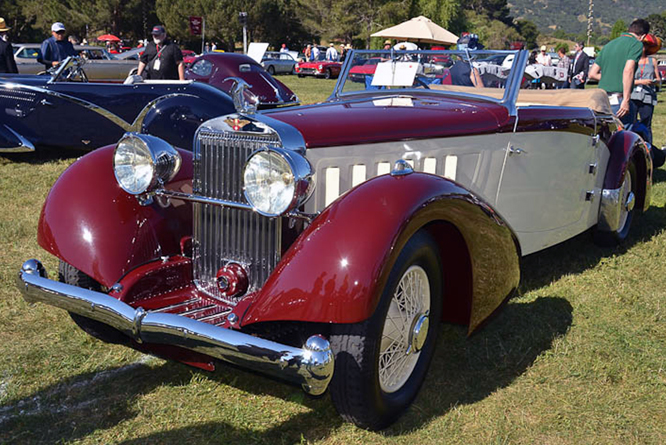
Hispano Suiza K6, Mairn Sanoma Concours d'Elegance

So far as I can tell the vehicle above is a Hispano Suiza K6 built somewhere between 1934 and 1937 with bodywork by Pourtout. 204 K6’s were built in France before hostilities in Spain forced the manufacturer to abandon motor vehicle manufacture focus on the production of aircraft engines.
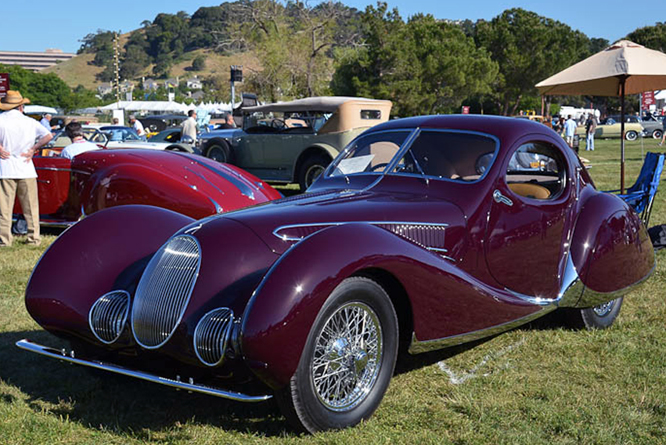
Talbot Lago T 150 C SS Goutte d'Eau, Marin Sanoma C d'E

Consecutive three time Le Mans winner, driving Bentleys, Woolf Baranto ordered the Talbot Lago T150C SS with “Goutte d’Eau”, water drop, bodywork by Figoni & Falaschi in 1938. The car belongs to the Mullin Automotive Collection which celebrates the art deco movement at the Mullin Automotive Museum located in Oxnard California.
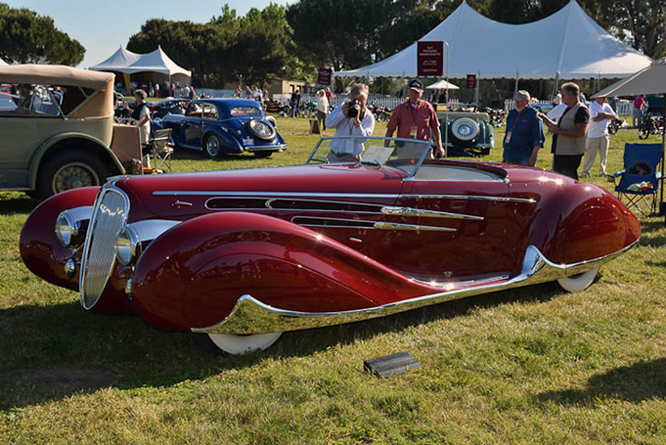
Delahaye Type 165 Cabriolet, Marin Sanoma C d'E

Judged to require all the adjectives to define exquisite at the 2012 Marin Sanoma Concours d’Elegance was the 1939 Delahaye Type 165 Cabriolet again with bodywork by Figoni et Falaschi and belonging to the Mullin Automotive Museum !
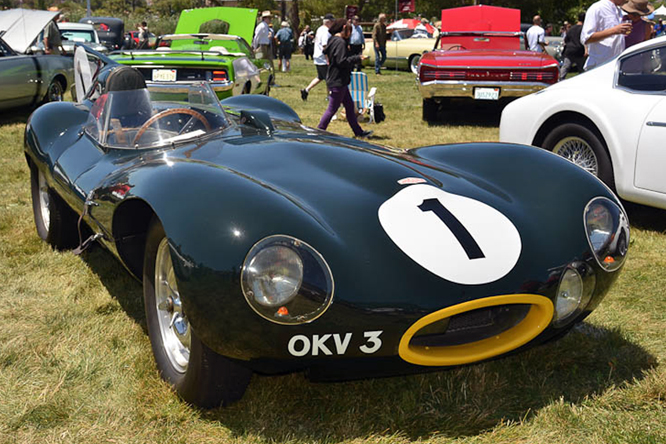
Jaguar D-Type, Marin Sanoma C d'E

D-Type Jaguar chassis XKC#404 registered OKV 3 was part of a three car works team at Le Mans in 1954 where it retired with gearbox failure, at Rheims Peter Whitehead and Ken Wharton were able to make the car last 12 hours and crossed the line first. The car was acquired by John Love in 1959 and he drove it two victories before Neville Austin bought it drove it to two further victories, giving the car at least four known victories on the African continent.
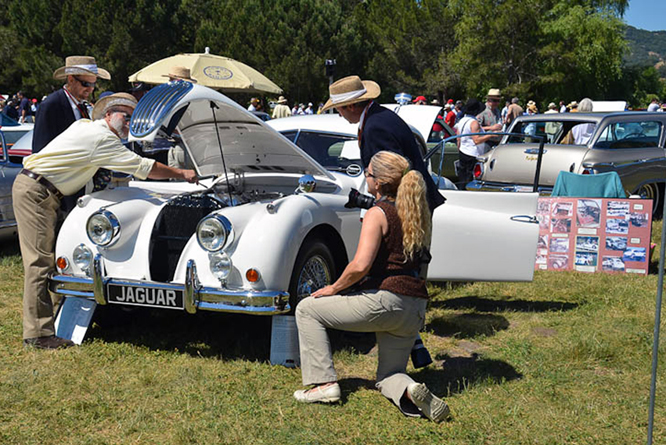
Jaguar XK 140 FHC SE/MC, Marine Sanoma C d'E

Geoffrey Horton’s 1955 XK140 can be seen getting thoroughly inspected by the Concours d’Elegance judges above, he was awarded second place in the Imports to over $3,500 1946 through 1962 class.
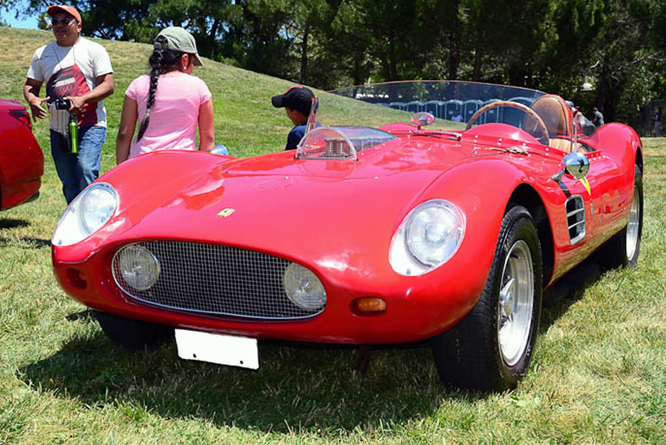
Ferrari 330 GT TR Replica, Marin Sanoma C d'E

The Ferrari above started life as a silver Ferrari 330 GT which appears to have been sold new to the German importer Auto Becker Gmbh & Co in 1965. Somewhere between 1965 and 2002 the body was replaced with a TR 59/60 replica as seen here.
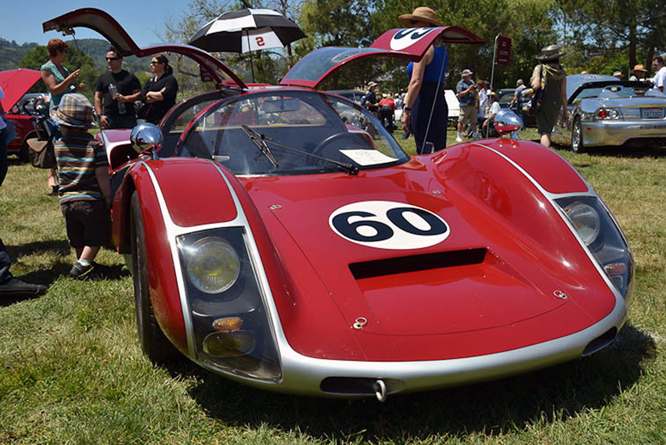
Porsche 906, Marin Sanoma C d'E

The 1966 Porsche 906 above is credit with numerous class wins from 1966 to 1977 in the hands of drivers 1966 E-modified champion Don Wester, Lew Florence from 1967 – 68, Milt Minter and John Morton in 1970/71 and Harald Kirberg from 1971 to 1977 when the car appeared with a different body in the rejuvinated Can Am series.
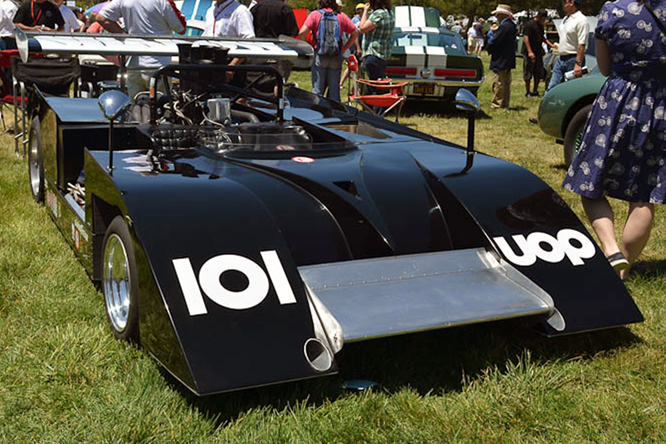
Shadow Mk II, Marin Sanoma C d'E

Looking a tad workman like in the company outlined above was the Shadow Mk II above. A one off built for Jackie Oliver to drive in the 1971 Cam Am series. Powered by a 8.1 litre / 494 cui Chaparral prepared Chevrolet V8 Jackie scored a best third place finish at Edmonton when the car appeared painted white with black lettering on all the upward facing surfaces except the rear wing. This car now belonging to Mr Losher won the Closed Wheel Sports Racing Cars class of the Marin Sanoma Concours d’Elegance.

I hope you will join me in congratulating Geoffrey on his second place class award and thanking him for sharing his photographs.

Thanks for joining me on this “All Adjectives Used To Define Exquisite” edition of “Gettin’ a li’l psycho on tyres” and that you will join me again tomorrow when I shall be visiting Middle Barton Garage which is celebrating it’s 25th Anniversary. Don’t forget to come back now !

Share

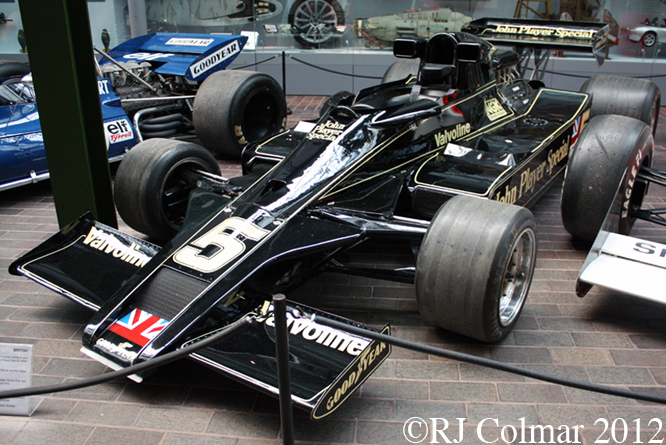
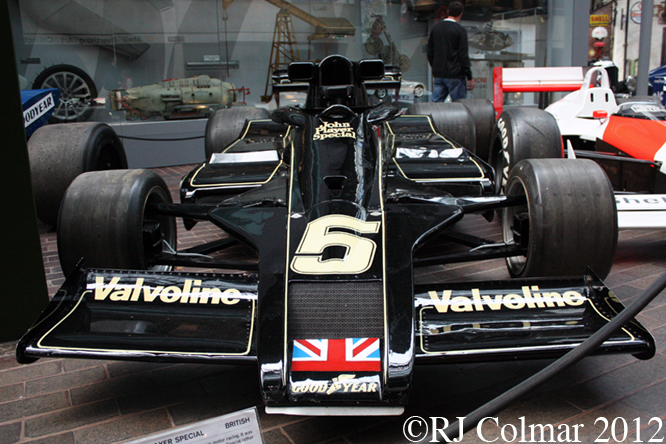
Original Wing Car – Lotus Ford 78 #78/R2

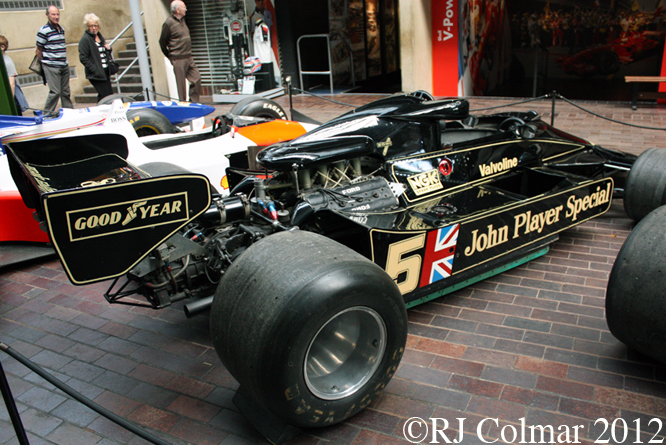
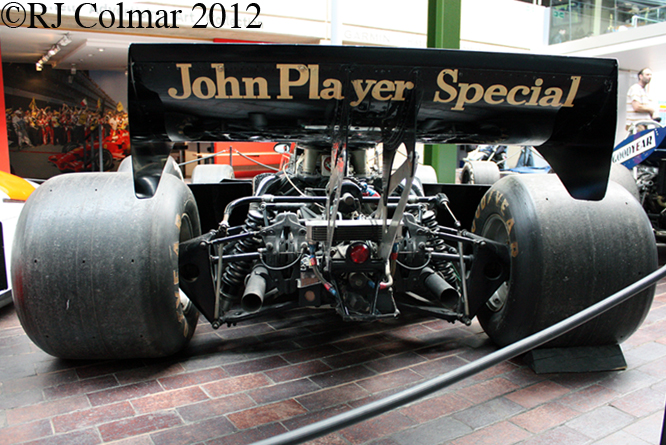
After the mixed fortunes of the Lotus 76 with it’s twin wings and electric clutch and the Lotus 77 with it’s fully adjustable suspension Colin Chapman introduced an aerodynamic innovation for the Lotus 78 featured today.

Lotus Ford 78, National Motor Museum, Beaulieu

Like the ’77 the Lotus 78 was built around a narrow monocoque with an oil radiator in the nose,

Lotus Ford 78, National Motor Museum, Beaulieu

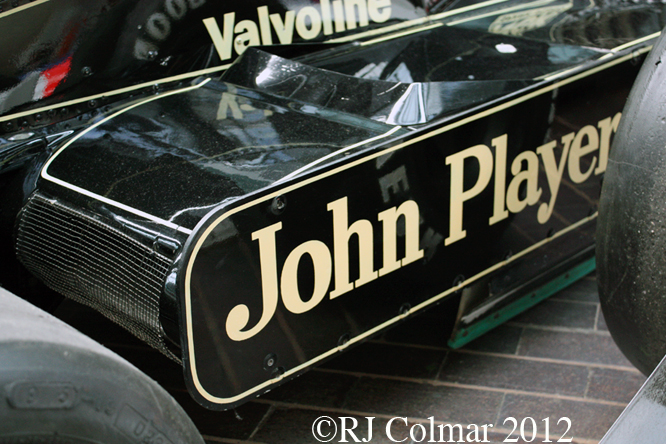
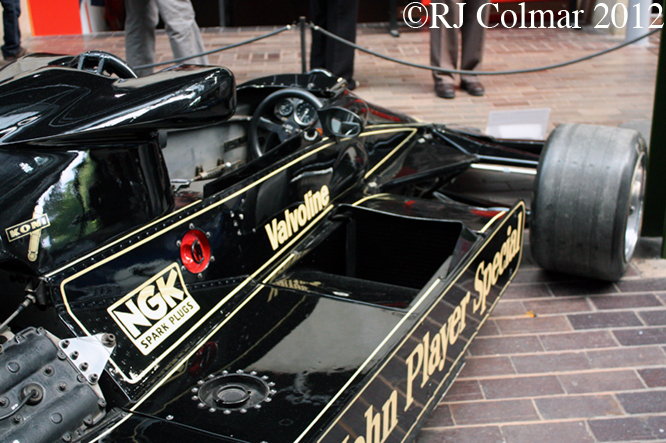
but with much larger sidepods than any Grand Prix car seen before.

Lotus Ford 78, National Motor Museum, Beaulieu

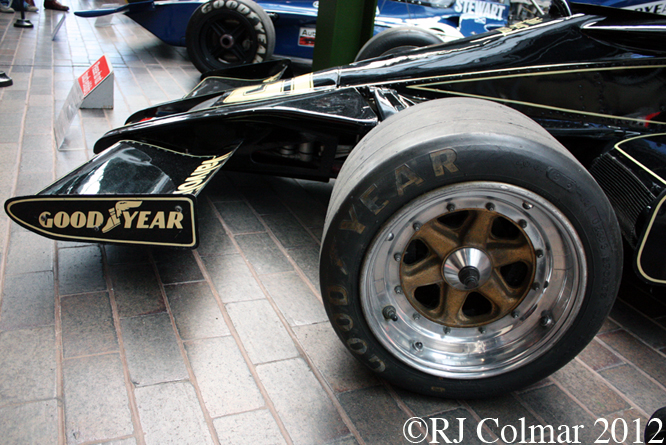
The front wings were used, in conjunction with the rear wing, to trim the aerodynamic balance of the car.

Lotus Ford 78, National Motor Museum, Beaulieu

Using an idea first modeled at BRM by Tony Rudd and Peter Wright the side pods closely resembled the upturned inner wing of a de Havilland Mosquito which Chapman had studied and written a detailed account of.

Lotus Ford 78, National Motor Museum, Beaulieu

Tony Rudd and Peter Wright joined Ralph Bellamy and Martin Ogilvie at Lotus to design the car and its side pods which produced prodigious down force to increase the speed at which it could go around corners without loosing grip.

While conducting wind tunnel tests for the Lotus 78 design at Imperial College London Peter Wright found that as predicted by Bernoulli’s principle of fluid dynamics which states that the flow speed of an ideal fluid with no friction will increase simultaneously with a decrease in pressure. Meaning in the case of the Lotus 78 the faster it went the more down force was generated by the side pods and so the better the car stuck to the road.

Lotus Ford 78, National Motor Museum, Beaulieu

The Lotus 78’s, known as John Player Special III’s by Lotus and their sponsors, were ready to race midway through 1976, but Chapman wisely vetoed their use until 1977 so as not to give rival teams the chance to figure out what Chapman and his team had come up with and copy during the off season.

Lotus Ford 78, National Motor Museum, Beaulieu

Starting the 1977 season Lotus had a huge advantage with the 78’s affording Mario Andretti 5 victories and his team mate Gunnar Nilsson with one more. However the unreliability of the Nicholson McLaren built motors played into the hands of Niki Lauda who, having more or less fully recovered from his near fatal accident in 1976, took only three victories and a string of podium places to claim the championship.

The car seen here at the National Motor Museum, Beaulieu is chassis #78/R2 which Mario Andretti used to start the 1977 season before it was entrusted to Gunnar Nilsson who won the Belgian Grand Prix driving it. In 1978 before the even more radical Lotus 79 was introduced, Lotus returnee, Ronnie Peterson drove the car and snatched a thrilling victory with one lap to go in South Africa.

Mexican Hector Rebaque acquired the car at the end of 1978 season and used it along Lotus 78/R1 which he had been using since the beginning of the 1978 season.

Sadly Ronnie Peterson lost his life after an accident at the start of the 1978 Italian GP where he was driving the back up Lotus #78/R3.

Thanks for joining me on this “Original Wing Car” edition of “Gettin’ a li’l psycho on tyres”, I hope you will join me again tomorrow when, thanks to some photographs from Geoffrey Horton, I’ll be looking at some of the vehicles in attendance at the Marin Samoma Concour’s d’Elegance. Don’t forget to come back now !
Share

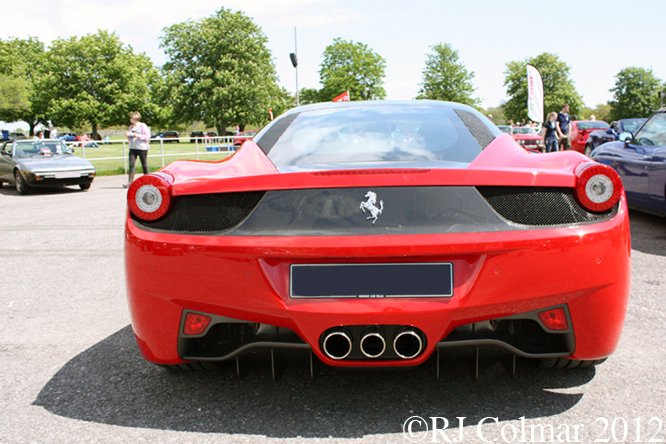
Naturally Aspirated Production Engine World Record – Ferrari 458 Italia

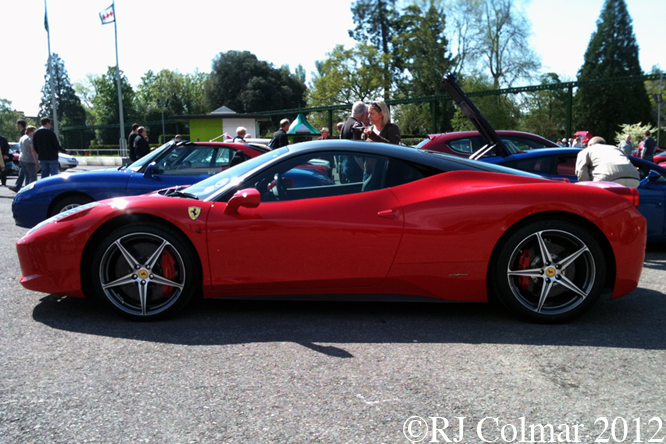
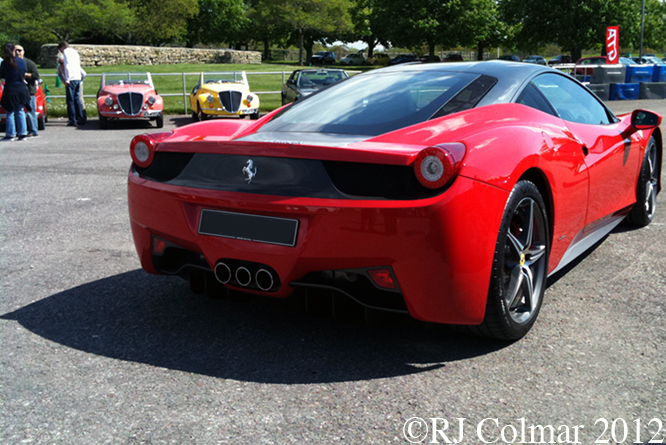
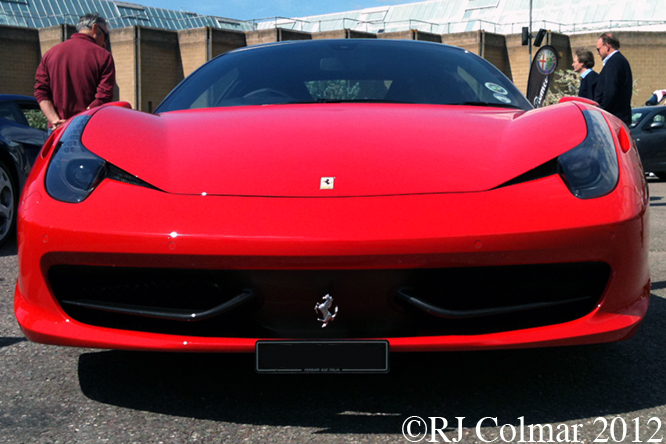
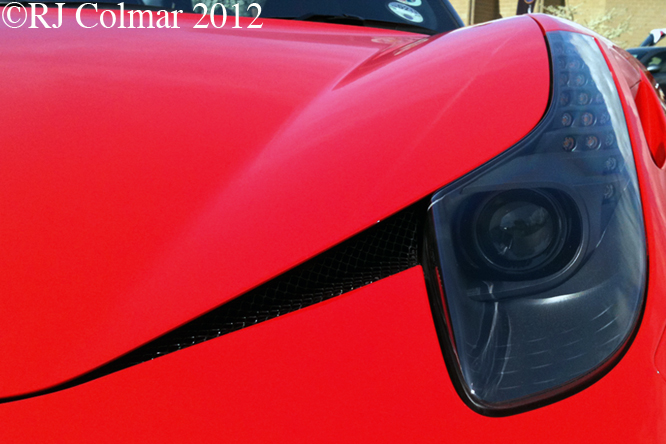
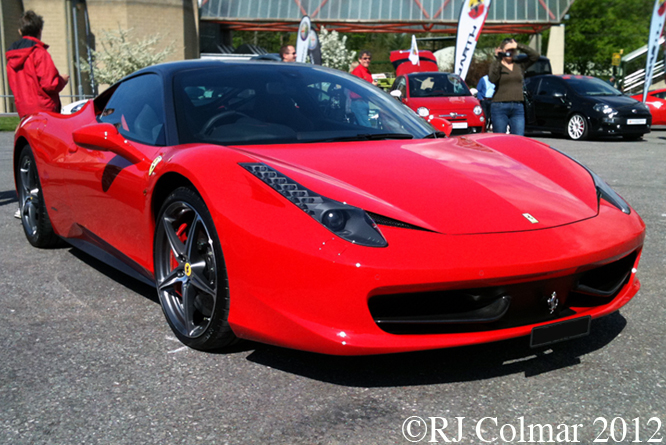
The Ferrari 458 Italia is an entirely new design that replaced the F430 in all of it’s guises, sports car track car and race car.

Ferrari 458 Italia, Simply Italian Beaulieu

The body, one of the most graceful Ferrari’s ever in my opinion, was designed by Pininfarina, it generates 140 kgs / 308 lbs of down force when traveling at 124 mph.

Ferrari 458 Italia, Simply Italian Beaulieu

Launched in 2009 the 458 Italia features many technologies carried over from recent Ferrari Formula One programmes.

Ferrari 458 Italia, Simply Italian Beaulieu

These include the steering wheel which incorporates a number of controls that are familiar to Formula One drivers.

Ferrari 458 Italia, Simply Italian Beaulieu

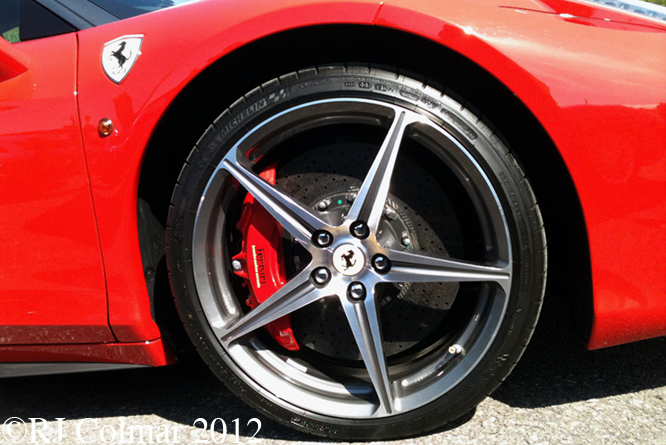
The brake calipers are designed to return the pads into close proximity with the brake discs after lifting off in order to reduce the delay the next time they are used, this has helped reduce breaking distances to 32.5 meters / 35.6 meters when decelerating to rest from 62 mph.

Ferrari 458 Italia, Simply Italian Beaulieu

With 562 hp from its 4.5 litre / 274.6 cui V8 the 458 Italia holds the current world record for power per litre / cui from a naturally aspirated production engine.

Ferrari 458 Italia, Simply Italian Beaulieu

Traditional manual transmission is not an option on the 458 Italia relies on a paddle shift on the steering wheel to operate the dual-clutch and seven speed gearbox, again technology which is derived from current Formula One practice.

Ferrari 458 Italia, Simply Italian Beaulieu

The roll out of the 458 Italia has been interrupted by a poor choice of adhesive used in the rear wheel arch assemblies which proved lacking in heat resistance which caused several wheel arch assemblies to distort and catch fire when coming too close to the exhaust. Ferrari recalled 1,248 458 Italia’s to have the rear wheel arch assemblies replaced with new ones using conventional fasteners. Several owners will also have cars damaged by fire replaced.

Ferrari 458 Italia, Simply Italian Beaulieu

It is claimed, by Ferrari, that from rest a 458 Italia will reach 62mph in 3.4 mph and a top speed of over 202 mph and that it will return 21.2 mpg (imperial) and 17.7 mpg (us).

Thanks for joining me on this “Naturally Aspirated Production Engine World Record” edition of “Gettin’ a li’l psycho on tyres” I hope you will join me again tomorrow when I be looking at an unreliable but still championship contending Lotus. Don’t forget to come back now !
Share

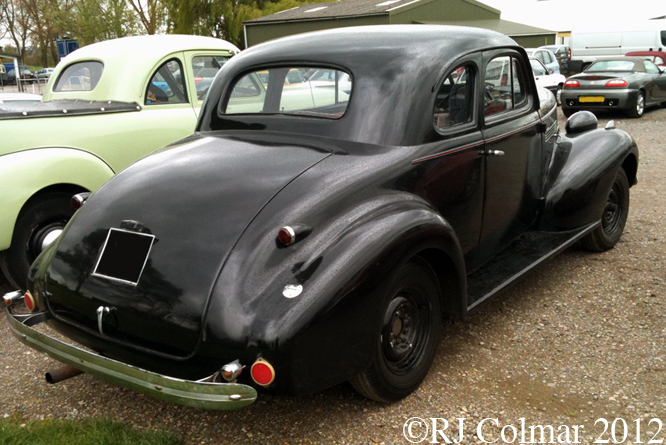
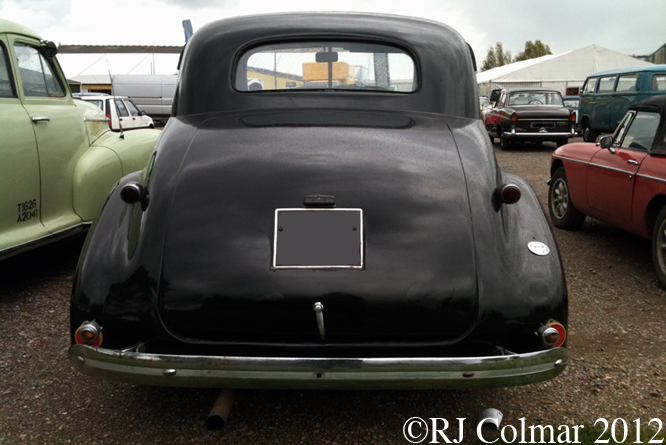
5900 Miles To Fame And Fortune – Chevrolet Master 85 Coupé

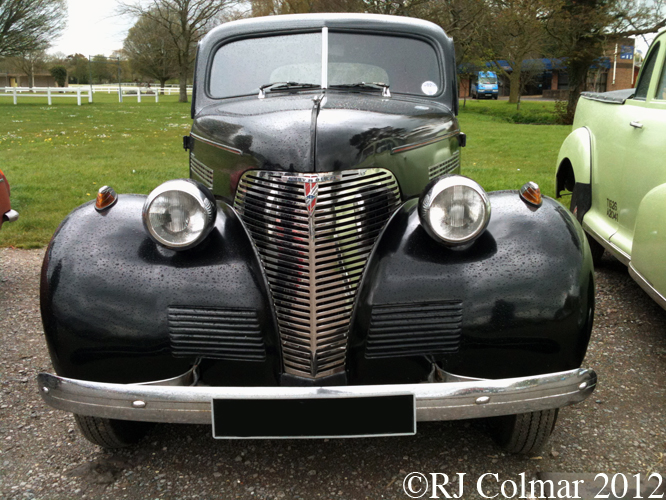
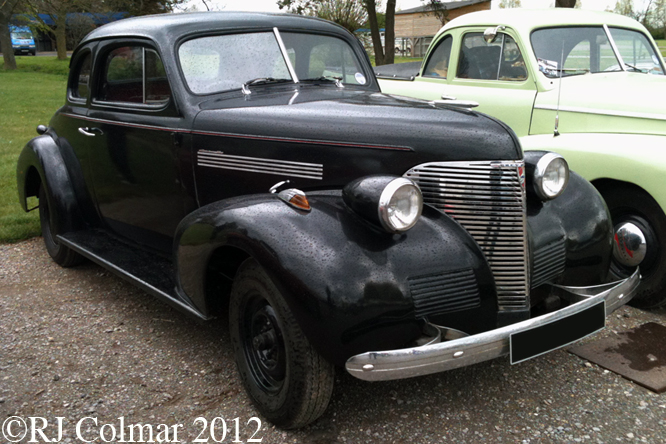
The origins of the Chevrolet Master 85 Coupé can be traced back to 1928 when Chevrolet started to switch from building four cylinder motors to six cylinder motors.

Chevrolet Master 85 Coupé, Bristol Classic Car Show

The introduction of this innovation played to Chevrolet’s advantage as coincidentally Fords experienced a downturn in fortunes as it belatedly switched production from the Model T to the Model A.

Chevrolet Master 85 Coupé, Bristol Classic Car Show

In 1933 the Master series was introduced as an above base (Standard) range of vehicles and in 1937 this series received an 85 hp 3.5 litre / 216 cui six cylinder motor from which the marketing department added the 85 to the Master Series name.

Chevrolet Master 85 Coupé, Bristol Classic Car Show

A ‘tiptoe-matic’ diaphragm spring clutch aided smooth changes between the three forward gears in the gearbox.

Chevrolet Master 85 Coupé, Bristol Classic Car Show

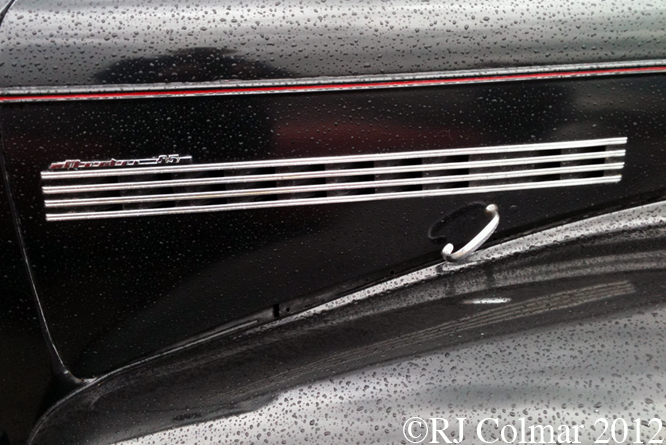
In 1939 the sealed Dubonnet inspired ‘Knee Action’ independent front suspension was abandoned in favour of coil springs and wishbones.

Chevrolet Master 85 Coupé, Bristol Classic Car Show

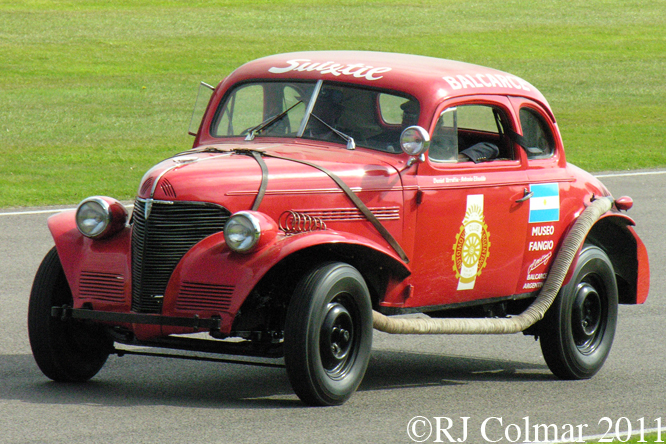
In 1940 a little known 29 year old Argentinian Juan Manuel Fangio, who had started making a name for himself racing a Ford Model A, and his friends modified a Chevrolet Master 85 Coupé for the demands of a 5900 mile race from Buenos Aires, Argentina to Lima, Peru and back.

Chevrolet Master 85 Coupé, Goodwood Revival

Juan managed to average 53.5 miles per hour on some of the worlds roughest roads traversing some of the worlds most isolated regions to win the race. He backed up the performance with back to back Turismo Carretera Series championship wins in 1940 and 1941 which was enough to secure backing from the Argentinian government in 1948 for a trip to Europe that would herald the arrival of the worlds first 5 time World Champion.

The copper pipe clearly seen on the wing / fender of Juan’s Master 85 above acts as an oil cooler.

Thanks for joining me on this ‘5900 miles to Fame And Fortune edition of “Gettin’ a li’l psycho on tyres”, I hope you will join me again tomorrow when GALPOT will feature a Ferrari 458. Don’t forget to come back now !
Share

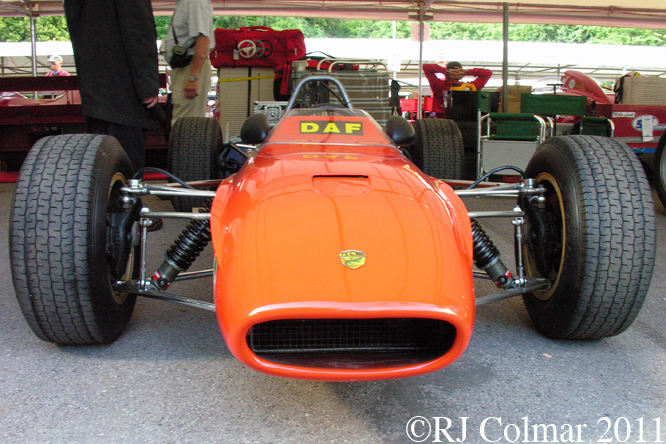
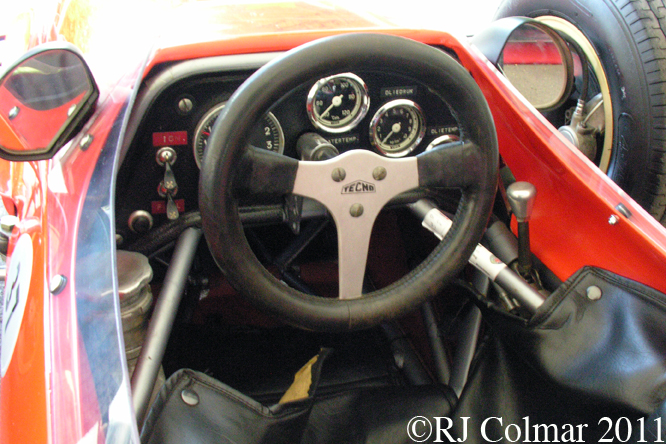
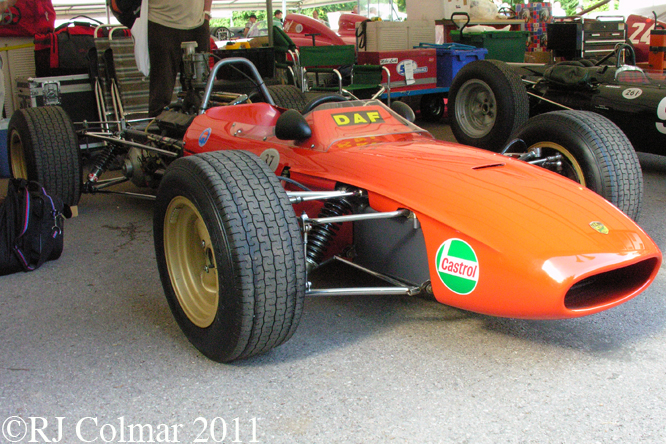
Two Pedal Open Wheeler – Tecno DAF

In 1961 the Pederzani brother sought to diversify their Tecno company from the manufacture of hydraulic pumps and take advantage of the expanding market for karts. After building the first offset sidewinder karts powered by Parilla motors their karts won the World Championships in 1964, ’65 and ’66.

Techno DAF, Goodwood Festival Of Speed

In 1966 the company started building Formula 3 cars and in 1968 Francois Cevert, Ronnie Peterson and Franco Bernabei won the French, Swedish and Italian Formula 3 championships respectively, driving cars similar to the one featured here.

Techno DAF, Goodwood Festival Of Speed

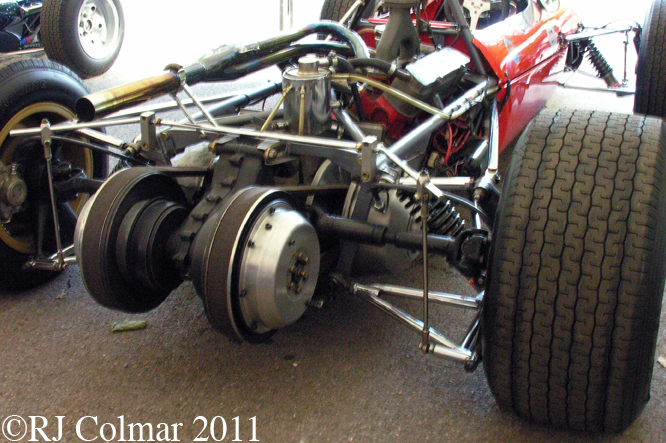
In 1965 DAF, wanting to prove the value of their Variomatic transmission system first seen in the 1959 DAF 600, bought an Alexis Formula 3 car to which they fitted a variomatic transmission but found the drive belts designed for road use could not cope with the additional stresses found on the race Techno DAF, Goodwood Festival Of Speedtrack.

Techno DAF, Goodwood Festival Of Speed

With better belts DAF returned in 1966 with a Brabham chassis for Mike Beckwith with which he scored points and a third place during the season. In 1967 the London Checkered Flag Team ran Gemini chassis for Beckwith and Gijs van Lennep and both scored victories despite the fact that it was becoming clear that the Variomatic was absorbing more power than a conventional gearbox.

Techno DAF, Goodwood Festival Of Speed

For 1968 DAF acquired a couple of Techno’s for Racing Team Halland to run, of which today’s featured car is one, with which Beckwith won his heat at the Monte Carlo F3 meeting with van Lennep following him in second. Beckwith scored a couple of more second places during the season and at the end of the year the team led the final race before the team mates Beckwith and van Lennep took each other out. DAF retired from Formula 3 having made their point.

Techno DAF, Goodwood Festival Of Speed

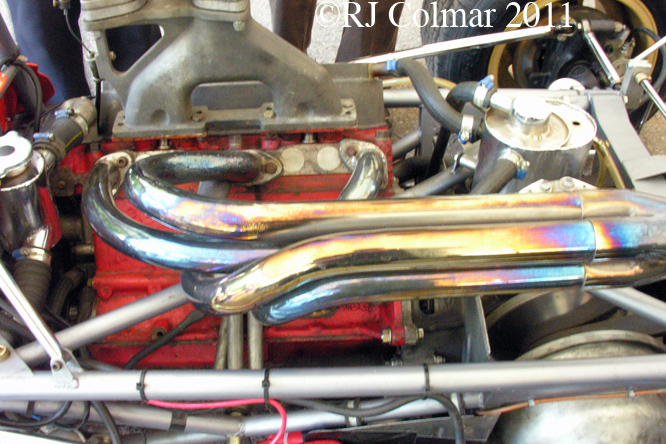
The DAF Techno’s were powered by 1 litre / 61 cui 4 cylinder Ford MAE motors that could be tuned to develop 120 hp.

Techno DAF, Goodwood Festival Of Speed

The Continuously Variable Transmission (CVT), the earliest concept of which Leornado da Vinchi is credited with, seen here is almost identical to that seen on later Volvo 300 series cars. By the 1990’s CVT belt technology had advanced to completely overcome the power absorption that had been highlighted by the DAF F3 programme. When David Coultard tested a CVT system in 1993 it was immediately so fast that the governing body of Formula One specifically banned CVT for the 1994 season before it was used on the track.

CVT also had a successful competition record in European Rallycross when mounted first in a DAF 66 Marathon Coupé and then in a Volvo 343.

Continuously Variable Transmission is available in a variety of cars today including automatic versions of the Jeep Patriot, Mitsubishi Lancer and SEAT Exeo.

Techno went on to build a championship winning Formula 2 car for Clay Regazonni in 1970 before becoming involved in a Martini Rossi sponsored F1 project for which they designed and built a flat 12 motor with cheap materials that was powerful but too heavy. The car made it’s debut in 1972 in 1973 Chris Amon scored the teams only World Championship point before the haphazardly chaotically organised team folded.

DAF Cars was taken over by Volvo in the mid 1970’s and Volvo became part of the Ford empire at the turn of the century. The Dutch NedCar factory founded in a partnership between Volvo, Mitsubishi and the Dutch Government in 1991 passed wholly in to the hands of Mitsubishi in 2001.

Mike Beckwith, who made a single non championship Formula One start in 1963, made several starts in Formula 2 and a variety of sports car races up until the end of 1970, last photo I can find of him competing was in a Citroen XM production car in 1972.

Gijs van Lennep made 8 Grand Prix starts which included two sixth place finishes including his last GP start in the 1975 German GP. 1972 proved to be van Lennep’s most successful season when he won the British F5000 championship driving a Surtees and also won the Le Mans 24 Hours sharing a Porsche 917 with Helmut Marko covering 5335 kms / 3315 miles a record that stood for 38 years.

Sharing a Porsche 911 RSR with Herbert Muller Gijs won the last Targa Florio in 1973 and in 1976 Gijs won Le Mans for the second time in his last professional race sharing a Porsche 936 with Jacky Ickx.

Thanks for joining me on this ‘Two Pedal Open Wheel’ edition of “Gettin’ a li’l psycho on tyres’ I hope you will join me again tomorrow. Don’t forget to come back now.

Share

Silver Plated Steering Wheel Boss – MG 18/80 Mk II Prototype

In 1928 MG moved away from it’s original remit of giving Morris Bullnose products wider appeal which culminated in the MG 14/40 and started to manufacture it’s own chassis and engine blocks.

MG 18/80 Mk II Prototype, Bristol Classic Car Show

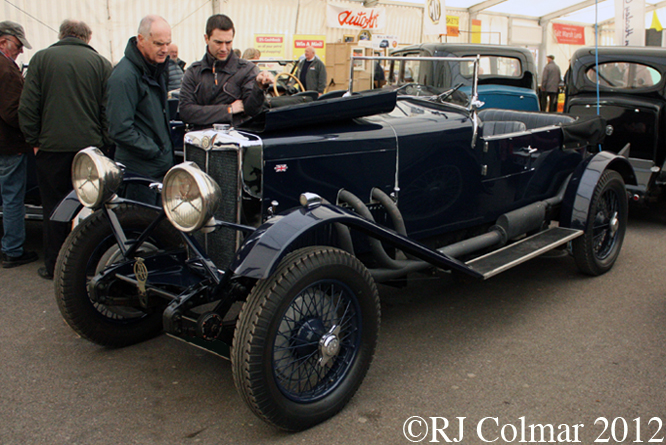
The new 18/80 model featured both a unique MG chassis and engine block both of which had been developed from lessons learned from a Morris Light Six Saloon that never went into production. The new distinctive radiator design would be maintained all the way through to the T Series.

MG 18/80 Mk II Prototype, Bristol Classic Car Show

The 18/80 also featured unique to MG front and rear axles with Rudge Whitworth centre lock wheels an either tourer or saloon body styles.

MG 18/80 Mk II Prototype, Bristol Classic Car Show

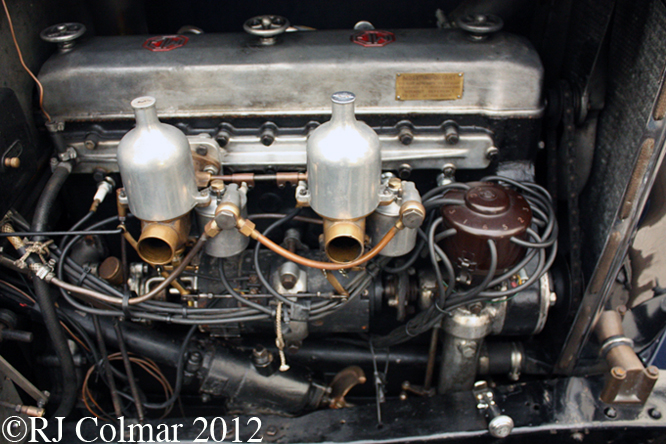
The twin carburetor six cylinder motor featured a four bearing crankshaft with a Duplex chain, see behind the radiator on the right, which drives the camshaft, distributor, water pump, oil pump and dynamo. The MG 80 hp rated six gave the 18/80 enough power to reach 100 mph. The motor seen here has been upgraded with a MK III cylinder head and ignition and drives through a Rover SD1 clutch in place of the original cork in oil unit.

MG 18/80 Mk II Prototype, Bristol Classic Car Show

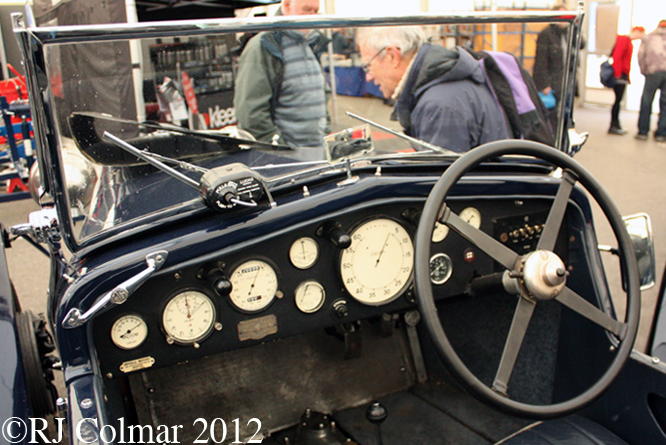
The 1929 chassis of the vehicle featured today was originally built as a prototype for the MK II saloon in 1929 however by the early 80’s the body was in such a poor state that it was replaced with a Mk III 18/100 ‘Tigress’ style body. Note the unique silver plated steering wheel boss from the original Mk II Prototype has been retained, but the dash and instrumentation are from a Mk III Tigress.

MG 18/80 Mk II Prototype, Bristol Classic Car Show

As a result of underwhelming track performance, only five ready to race Mk III ‘Tigress’ vehicles, styled after the contemporary Bentley competion models, were built in period.

Thanks for joining me on this “Silver Plated Steering Wheel Boss” edition of “Gettin’ a li’l psycho on tyres” I hope you will join me again tomorrow when I’ll be featuring a Techno DAF. Don’t forget to come back now !
Share

Automobilists Cave – National Motor Museum Beaulieu

Beaulieu Abbey was built on land bequeathed by King John to a group of Cistercian monks, more strict in their vows of Poverty, Chastity and Obedience than Benedict monks, in 1204. The newly self appointed defender of the faith and head of the Church of England, King Henry the VIII, dissolved the abbey and had it destroyed in the 1530’s and the Beaulieu estate passed into the hands of secularist Thomas Wriothesley in 1538 who converted the monastry Great Gatehouse into a dwelling now known as the Palace House. His ancestor the present Lord Montagu created a Motor Museum in 1956 as a tribute to his father the Motoring pioneer John, Second Baron Montagu of Beaulieu.

Ferrari F310, NMM Bealieu

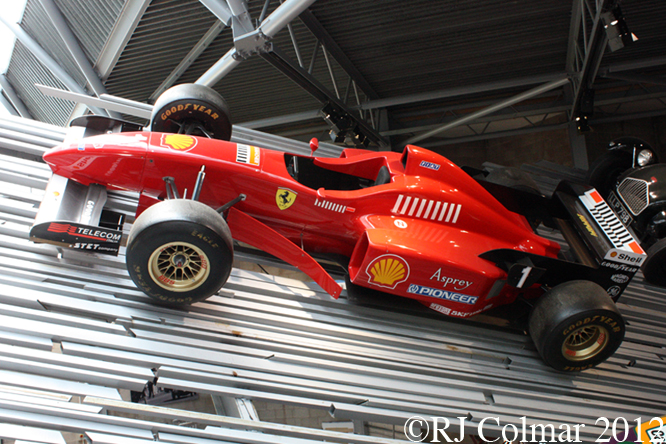
The last, only, time I visited Beaulieu was on a rainy day in June 1974, I remember reading about Niki Lauda’s first victory driving a Ferrari 312 B3, at the Spanish Grand Prix, in Motor Sport Magazine in the back of the car on the way down. This time my trip was fueled by the Simply Italian parade featured on GALPOT yesterday and a need to replenish my stock of Ferrari images which are getting low. The only Ferrari in the National Motor Museum last Sunday was this replica 1996 F310, interestingly the nose is of the earlier type than the replica F310 that sits in the Haynes International Museum. This low nose replica matches the form of the nose that was fitted to Micheal Schumachers F310 when he won the 1996 Spanish Grand Prix, his first victory in a Ferrari.

Bugatti T15, NMM Bealieu

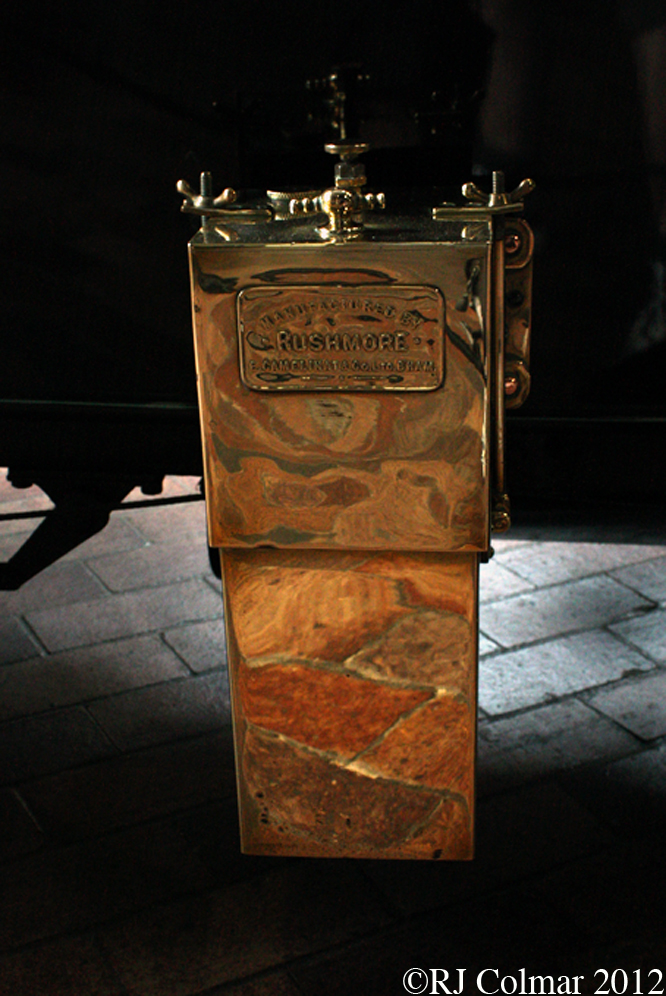
Seems like every time I leave the house on some motor related expedition I come back with far more questions than answers. This cool piece of brass work, I presume it’s brass, was attached to the side of a 1910 Bugatti T15. The top looks a tad sophisticated for this to be a simple motor oil or motor spirit receptacle, if you have any idea’s what it is please chime in below.

Bluebird Norris Proteus CN7, NMM Bealieu

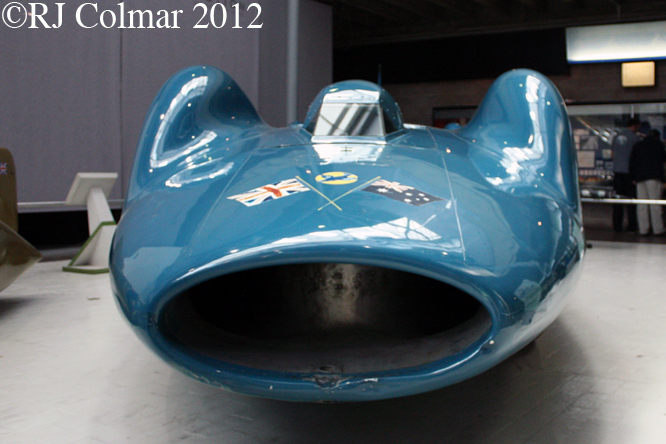
My earliest flights of imagination into unadulterated raw speed were undoubtedly inspired by the exploits of Donald Campbell to reach 500 mph in the 4,450hp Bluebird Norris Proteus CN7 in the early 1960’s, being a terrible tease I’ll save the outcome of his attempt for a future blog.

Bloody Mary, NMM Bealieu

Thanks to GALPOT reader Tim Murray I have been enjoying a book called Special by John Bolster, John built ‘various devices’ himself including Bloody Mary seen here, a successful JAP powered ‘device’ built in the early 1930’s. I’ll save full details for another occasion save to say John was the only one who had the confidence in his own work and was brave enough to take this device to victory lane in sprint and hillclimb event’s !

Austin A40 Countryman, NMM Bealieu

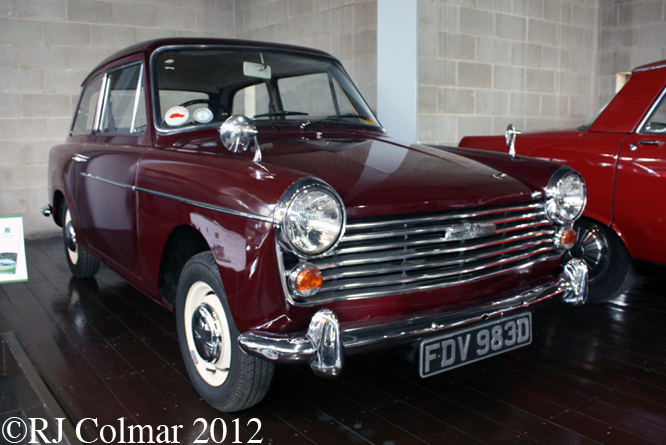
Like all worthwhile publicly supported institutions the National Motor Museum consumes cash by the case load in order to keep it’s exhibits in good order, and runs a sponsorship scheme for individual vehicles,you can find out more about sponsoring a vehicle at the National Motor Museum on this link. I’d like to thank those who sponsored this 1966 Austin A40 Farina Countryman, known as Tubby, on behalf of Maurice Wycliff Timmins. One just like it called Daisy played a huge role in my own formative years.

AC Shelby Cobra, NMM Bealieu

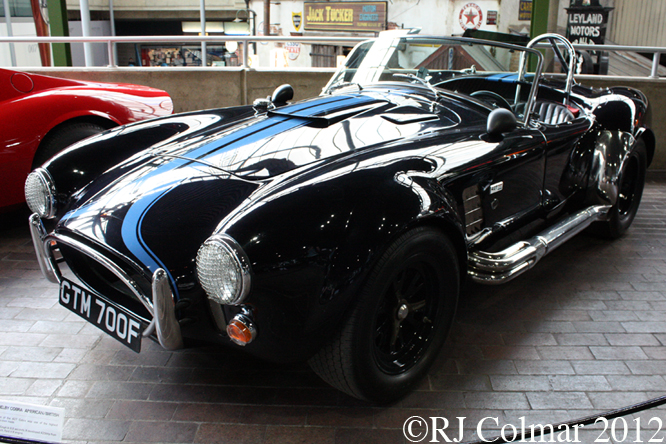
It was sad to learn of the passing of Carroll Shelby last week, among his many achievements was the bringing together of a little AC roadster and a huge 7 litre / 427 Ford V8 which became known as the AC Shelby Cobra. Today original versions of these much copied vehicles can fetch over a US$ 1,000,000. The restored 1965 vehicle seen here was fitted with the cheaper 7.01 litre 428 cui Ford V8 was once the property of part time circuit and drag racer John Woolfe who had two such cars, the left hand drive above also seen in this link and a right hand drive registered GTM777F which can be seen about to get whipped by a much smaller engined dragster “Hustler” driven by ‘Tex’ Blake in the photo linked here. Any one interested in learning about the UK drag scene will find this link to the John Woolfe Racing site quite fascinating.

Chitty Chitty Bang Bang, NMM Bealieu

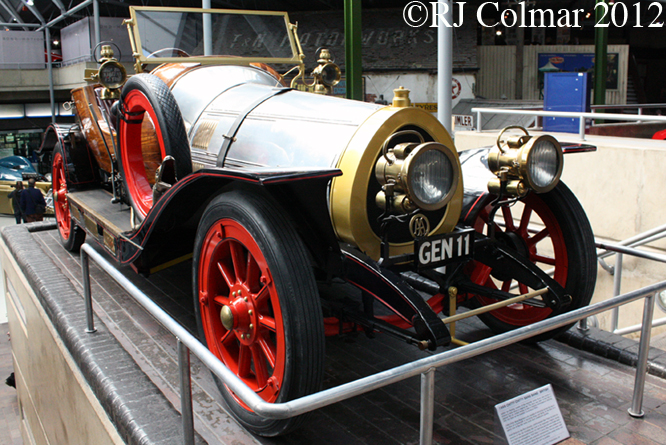
In one of my more romantic moments I once proposed to some one after seeing the most fantasmagorical Chitty Chitty Bang Bang on television, we are no longer together but we remain friends. This is one of several film stars at Beaulieu I’ll be covering some of them in more detail next Sunday. Apparently the “GEN 11” registration is now to be found on a 2011 Honda Jazz.

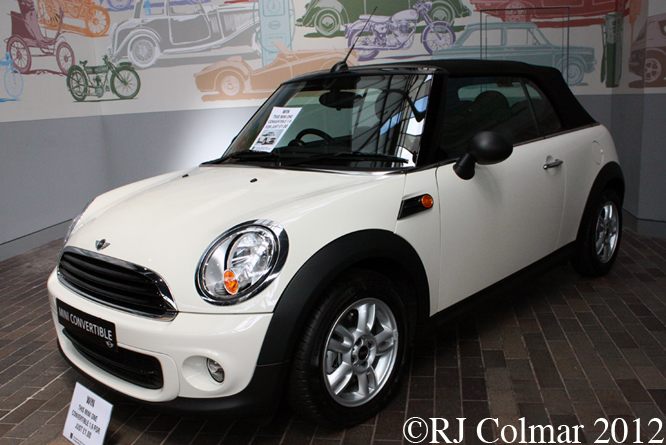
Mini Convertible, NMM Bealieu

I’m not a big time gambler but I am now the proud owner of a raffle ticket to win this Mini Convertible, I also hold tickets to win a Morgan, and Triumph SE one day my number is bound to come up 🙂

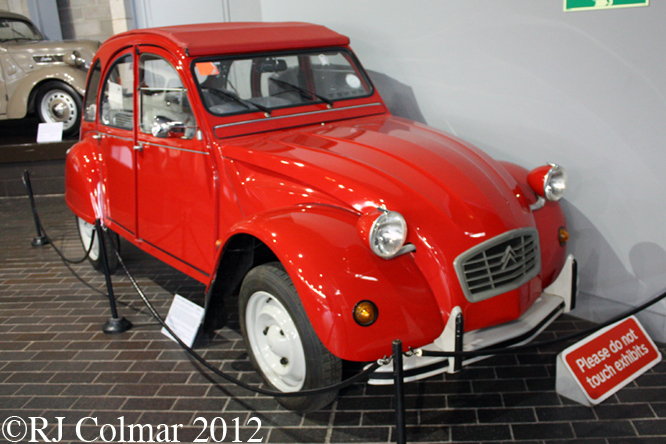
Citroën 2CV6 Special, NMM Bealieu

I’ll end today’s over view of the National Motor Museum with this Citroën 2CV6 Speciale, I have probably had more fun and adventures in this type of vehicle than any other. This 1986 2CV6 Speciale, just 24 miles on the clock, is barely out of it’s wrapping with delivery stickers and protective wax still on the windows, was put straight into storage after it was purchased.

The Second Baron of Beaulieu John Montagu in 1906 predicted ‘Europe in a few years time will become for the motorist one vast Holiday area’. How right he was and how lucky we automobilists are that his son Edward The 3rd Baron Montagu of Beaulieu founded the National Motor Museum, a fascinating part of that tapestry.

Thanks for joining me on this ‘Automobilists Cave edition of “Gettin’ a li’l psycho on tyres”. I hope you will join me tomorrow when I’ll be featuring a vintage MG. Don’t forget to come back now !
PS Many thanks to Allan Lupton at The Nostalgia Forum for informing me the receptacle I asked about above is a Rushmore acetylene generator for the acetylene lamps that proved more reliable than electric lamps of the period.

Share