Thirty Years Ago #2 – Group C

On May the 16th 1982 I awoke excitied to catch my first glimpse of a new endurance sports car series at Silverstone. The Group C series was born out of the GT Prototype class which had hitherto run only at Le Mans for closed cockpit 2 seat cars with just safety features, some overall limits on dimensions and a limited amount of fuel for rules. Here is a summary of a few Group C cars I saw that day.
Porsche 956, Silverstone

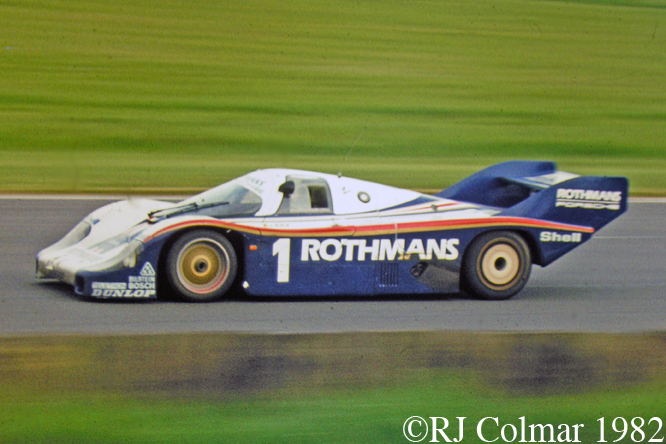
It took three years for the series to really take off with support from three manufacturers but for that first year in 1982 Porsche were prepared in particularly overkill fashion with the Porsche 956 which used a 650 hp twin turbo charged 2.65 litre / 156 cui flat 6 motor that had originally been conceived for the banned 1980 Interscope Porsche Indy Car.

The motor was successfully tested in preparation for Group C in the back of two Porsche 936’s at Le Mans in 1981, Ickx and Bell scoring an emphatic win by 14 laps. Featuring an aluminium monocoque the 956 was designed to take full advantage of ‘ground effect’ aerodynamic technology that had been developing in Formula One since 1976.

Uniquely among the first generation of Group C cars the 956 had been tested in exactly the same way as all Porsche road car designs meaning it alone among it’s competitors could negotiate potted and cobbled streets with out any noticeable detriment to the integrity of the chassis or performance of the motor. Like the Porsche 935 and 936 models it replaced the 956 was utterly dominant in the first 3 years of Group C, sweeping aside a puny effort from Lancia who competed with the Ferrari powered Lancia LC 2 from 1983 to 1985, not having any real competition until the arrival of Jaguar in 1985. Quite simply the 956 nearly killed the series as in 1983 the first of 28 customer 956’s started to fill out the grid.

However Porsche did not have it quite their own way, in 1982, as Lancia sort to wrest the World Sports Car Drivers Championship from Porsche drivers by entering a couple of cars built to the old open top regulations, which had one year left to run, these open Group 6 cars did not need to adhere to the fuel consumption regulations of Group C. Lancia won three races outright including the Porsche 956’s debut race at Silverstone. However Lancia driver Ricardo Patrese was eight points short of winning the title which went to Jacky Ickx who shared the #1 956 seen at Silverstone above with Derek Bell. At Le Mans in 1982 the works Porsche team led by Ickx and Bell took 1,2,3 victory.

Chassis #001 driven here by Icks and Bell easily qualified on pole but constrained by the fuel allowance in the race meant they finished 3 laps behind the race winning Group 6 Lancia LC1. #001 was used on two further occasions, as a test car at Le Mans and in the 200 mile Norisring German Racing Championship (DRM) race which it won with Jochen Mass at the wheel, before it was retired.

In 1983 Ickx retained his World Endurance Drivers title, before handing it over to team mate Stefan Bellof in in 1984. Ickx retired from racing in 1986 after a fatal accident involving Bellof now driving for the private Brun Team at Spa in 1986.

Derek Bell shared the World Endurance Drivers title in 1986 and 1987 driving Porsche 962’s with team mate Hans-Joachim Stuck on both occasions.
Porsche 936C, Silverstone

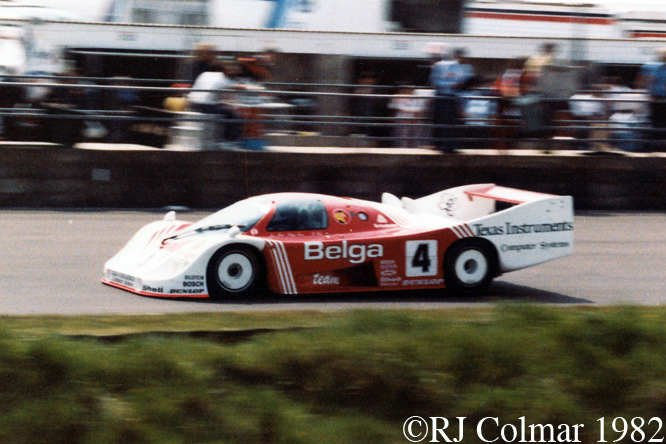
While Porsche customer teams like Joest and Kremer had to wait until 1983 before being able to purchase customer Porsche 956’s with which to compete in the new series, neither sat idle in 1982 both teams building Group C cars of their own devising using Porsche engines.

Of the two the Joest team car was the first to compete, built around a Joest built Porsche 936 chassis #JR005 with a smaller 2.1 litre / 128 cui twin turbo flat 6 motor. The 936C driven by Frenchman Bob Wollek, and the Belgian Martin brothers, Jean-Michell and Philippe, finished third on it’s debut at Silverstone and continued to be a top ten finisher in Group C events until the end of 1986 when it was effectively outlawed by new footwell regulations.

Joest would become the Porsche factories team of choice whenever the works team was not present at the track. Joest cars won Le Mans in the absence of the factory team in 1984 and 1985 with the same 956B chassis #117, one of the few chassis to win the 24 hour marathon twice. Joest repeated the feat in 1996/1997 winning with Le Mans with the same TWR/Porsche. Joest Racing then became with the über successful Audi and Bentley campaigns that have dominated Le Mans since the turn of the century.

Bob Wollek never won the Le Mans 24 hour race but he did win the Daytona 24 hour race four times. Three of them driving the 956 successor Porsche 962’s.
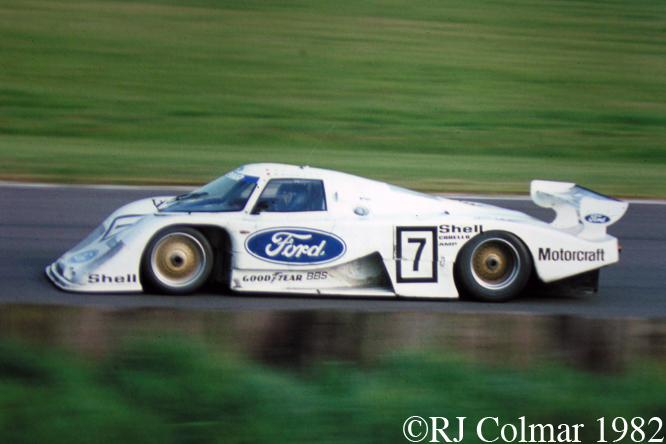
Ford C100, Silverstone

Fords involvement in the series proved a little half hearted despite the involvement of Len Terry in the design and a Cosworth V8 DFL motor based on the 3 litre / 183 cui DFV but now stretched to 4 litres / 244 cui. The larger motors sounded frankly awful and suffered from excessive vibrations that hindered reliability.

Manfred Winklehock and Klaus Ludwig, who is seen at the wheel here, qualified 4th but could only finish eighth in the race. The C100’s only wins were recorded by Klaus Ludwig in the German DRM championship and by the end of 1982 Ford called a halt to it’s Group C programme.

Peer Motorsport acquired the two time DRM winning C100 chassis #04 for 1983, it was mostly raced in the British Thundersport Series where it recorded one further victory in the hands of Irishman David Kennedy and Scotsman Jim Crawford at Donington Park.

Klaus Ludwig would go on to join the Joest Team and won the 1984 and 1985 Le Mans driving the 956B chassis 117 sharing the driving with Henri Pescarolo in 1984 and Paolo Barilla and ‘John Winter’ in 1985.

WM P82, Silverstone

WM was founded by two Peugeot design studio employees in 1969 Gerard Welter and Michel Meunier in 1969 who in their spare time built two cool coupe’s the first WM P69 was based on a Peugeot 204 Cabriolet platform and the second WM P70 was a mid engined design.

Their next effort the WM P76 was built to the Le Mans GTP regulations first announced in 1976 was powered by a Peugeot/Renault/Volvo (PRV) V6 stock block. Over the next 13 years they built 7 distinct models adding twin turbo’s the PRV motors in 1977. In 1980 they scored a best 4th place and first in GTP at Le Mans.

The WM P82 took part in 5 Group C races, Roger Dorchy, Jean Daniel Raulet and Michel Pignard driven car is seen above on the WM teams second ever outing abroad, it qualified 39th and finished 11th. The WM teams best 1982 result was on it’s first trip abroad to Monza where it qualified 11th and came in 6th. The teams natural reliance on the PRV block was probably it’s down fall for all though eventually tuned to give over 900 hp in 1988 it was actually designed to initially produce 150 to 200 hp.

Sensing that a win at Le Mans was not in their grasp by 1987 WM focused on becoming the first team to reach 400 km/h on the legendary 3.1 mile Mulsanne straight during the 24 hour race. With the engine producing 950 hp and all the cooling blanked off and special Michelin tyres the WM P88 of Roger Dorchy was timed at 405 km/h / 253 mph at 9pm in the evening of the 1988 race. This record will probably stand for all time given that in 1990 2 chicanes were added to the straight to slow the cars down. Rogers car unsurprisingly retired from the race with overheating issues.

WM made way for for an official Peugeot Works team in 1990, in 199O Gerard Welter took over the team completelu renaming it WR (Welter Racing), which scored a class win at Le Mans in 1993 and sensationally locked out the front row of the grid at Le Mans in 1995.
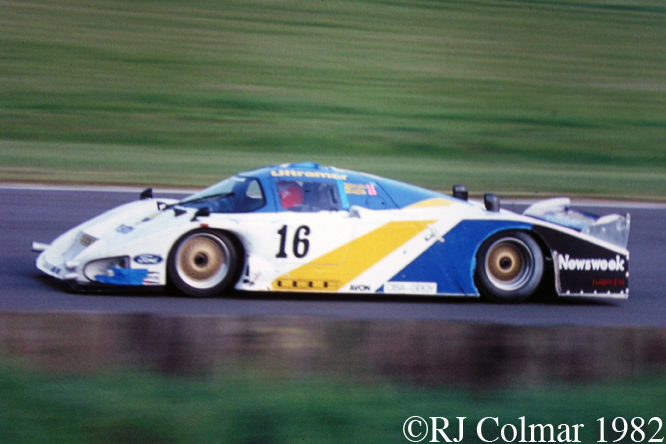
Lola T610, Silverstone

Lola’s involvement with Le Mans dates back to a contract with Ford to develop the fabled GT40, racing under it’s own name it has never won Le Mans. The T610 was powered by the same 4 litre / 244 cui Ford Cosworth DFL as the Ford C100, but proved even more unreliable, despite qualifying 8th at Silverstone, Guy Edwards and Rupert Keegan who is seen in the car here could manage only a 16th place finish.

The T610’s best result of the season was a 7th place finish at Brands Hatch. Lola would hook up with Nissan to produce several Group C Le Mans challengers at the end of the 1980’s including the outright qualifying lap record holding Nissan R90CK which held the record at 3m 27 secs from 1990 until 2008.

Guy Edwards would become a mover and shaker in Group C when he lent his considerable sponsorship finding talents towards the Jaguar Group C project run by Tom Walkinshaw Racing.
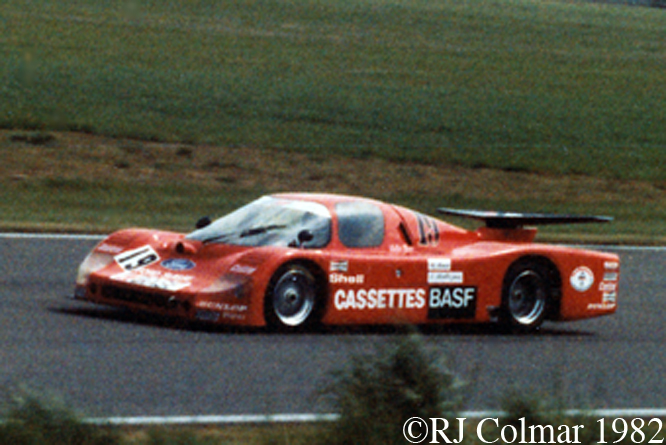
Sauber SHS C6, Silverstone

The Sauber SHS C6 was another Ford powered Group C contender and predictably unreliable Walter Brun and Seigfried Muller Jr qualified 12th and finished 13th after loosing the rear wing. The teams best result, a 4th place finish came during a DRM race at Hockenheim. The an SHS6 running in the privateer C2 class appeared in the Group series until 1986.

Peter Sauber hooked up with Mercedes Benz unofficially in 1986 and by 1987 started getting works support leading to a victory at Le Mans and the World Sportscar Championship in 1989. Sauber went on to become a Mercedes Powered Formula One constructor returning the famous manufacturer to the top tier of the sport in 1993 after a 38 year break.

In 1983 Walter Brun ended up taking over the GS Sport Company that had been operating in partnership with Sauber in 1982. His operation eventually became a Porsche customer team running 956’s and then the replacement 962’s with which Brun Motorsport won the 1986 World Sports Prototype Championship. By 1992 the team folded after a dabbling in the disastrous EuroBrun Formula One project and attempting to build his own Judd powered Le Mans challenger.
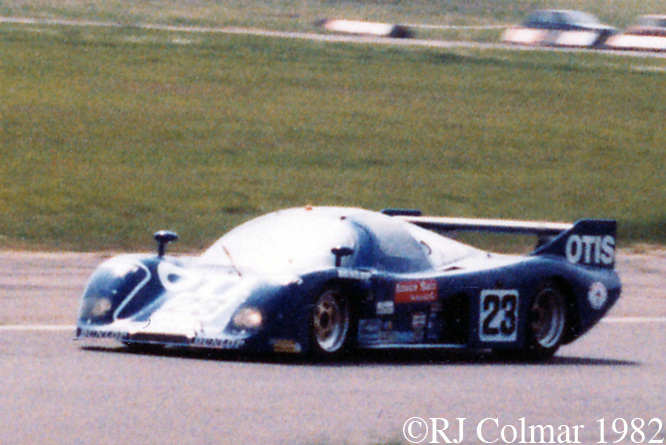
Rondeau M382, Silverstone

Le Mans based Group C team Rondeau like WM started out competing at the 24 hour classic in the GTP class in 1976 winning the GTP class in both 1976 and 1977 under the Inaltera name.

In 1978 the team which always used 3 litre 183 cui Ford Cosworth V8 motors now raced under the founder, Jean, Rondeau’s own name. Jean Rondeau with Bernard Darniche and Jacky Haran scored his second Le Mans GTP class victory with an M378 and in 1979 the team won the unlimited sports prototype class at Le Mans going one better in 1980 with and overall Le Mans victory for Jean Rondeau and Jean-Pierre Jaussaud.

Another Le Mans GTP class victory, 2nd overall, followed in 1981 for Haran, Phillipe Streif and Jean Louis Schlesser

Like Ford, Lola and Sauber, Rondeau plumped for the Cosworth DFL but somehow found some reliability where others had failed Pescarolo and Gorgio Francia indeed won the first ever Group C race, at Monza, with a Rondeau M382. Pescarolo and Gordon Spice seen above at Silverstone qualified 9th and finished 5th.

This same car won it’s class, 2nd overall, at the Nurburgring with Pescarolo and Rolf Stommelen at the wheel.
Rondeau M482, Silverstone

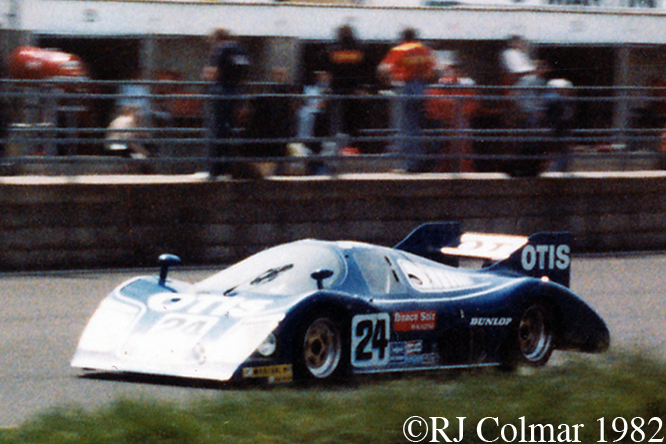
While the #23 M382 Rondeau was based on a design that could trace it’s origins back to the 1976 Inaltera the Rondeau team fielded a second design which should have taken advantage of the prevailing ground effect technology of the period unfortunately on it’s debut at Silverstone Jean Rondeau and Francois Migault could only qualify 27th and failded to finish after bodywork and suspension breakages. The car failed to appear at Le Mans and when it appeared in 1983 it was with heavily revised bodywork.

The Rondeau scored more points in Group C than any other team in 1982 but Porsche were allowed to have points accumulated by a car running in a lower GT class added to their points tally and were declared 1982 World Endurance Champions, Rondeau’s sponsor OTIS announced it’s immediate withdrawal from the team in disgust.

With no significant sponsorship Rondeau concentrated all of it’s efforts on Le Mans for 1983 all three DFL powered revised M482’s retired with motor related issues an only the Christian Bussi teams car recorded a finish, a lack luster 19th.

Rondeau’s team folded at the end of 1983 and Jean was killed by a train in a bizarre accident while following police car over a level crossing in 1985. Rondeau cars continued to appear in Group C races at Le Mans and elsewhere until 1987.
Nimrod NRA/C2, Silverstone

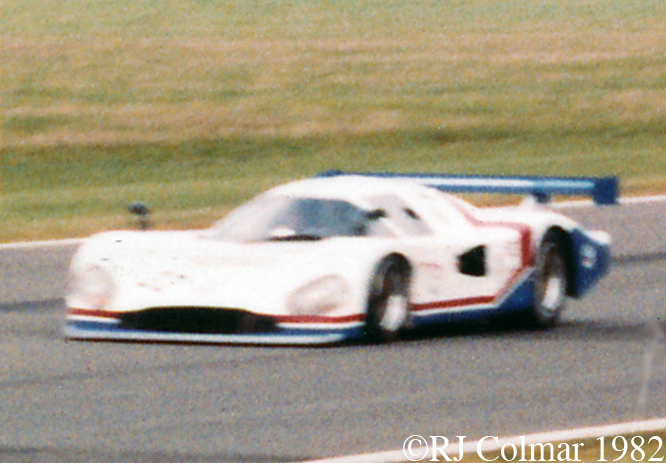
Finally while certainly not the last of the Group C cars that appeared at Silverstone in May 1982 the Nimrod NRA/C2 is notable because it featured an Aston Martin Tickford V8 motor, from the Vantage V8 model, which sounded fantastic in comparison with the Cosworth DFL V8 and the flat 6 Porsche. The private #32 Viscount Downe entry seen here driven by Ray Mallock and Mike Salamon qualified three places better than the works entry in 11th and finished 6th while the works car retired.

Through out 1982 the Viscount Downe entry out qualified the works entry usually by three places and manged a finish which the works entry never did. The Aston Martin Owners Club president Viscount Downe Team finishes secured a third place finish for Nimrod Aston Martin in the 1982 World Endurance Championship behind Porsche and Rondeau, with the more successful Lancia running in the old Group 6 class it was ineligible to score points in the manufacturers championship.

Both Nimrod teams continued into 1984 with the works team running AJ Foyt, Darrel Waltrip and Guillermo Maldonado in a Pepsi Challenger liveried example in the Daytona 24 Hours. However with ever more Porsche 956’s filling the grid and a distinct lack of reliability the works team folded in 1983 and the Viscount Downe team in 1984.

Ray Mallock would eventually run the Ecurie Ecosse team in the lower Group C2 class taking the class title in 1986 before overseeing the return, to Group C, of a fully works backed Aston Martin project in 1989. For 1990 Ray was involved with the Nissan R90CK project. His team has won numerous touring car titles with Vauxhall, Nissan and Chevrolet for whom he currently runs the successful works World Touring Car Championships cars.

Due to a concerted attempt to become an adult and various unavoidable associated commitments, weddings, graduation and such like it would be three years before I attended another Group C race, when I came back Group C was really taking off with Jaguar entering the fray and efforts from other teams like Toyota and Mercedes (Sauber) beginning to gather momentum. By the end of 1992 I had attended more than a dozen Group C races and seen some fantastic battles all of which will have to wait for future editions of GALPOT.

Thanks for joining me on this “Thirty Years Ago #2” edition of ‘Gettin’ a li’l psycho on tyres’ I hope you will join me again tomorrow when I’ll be looking at the Simply Italian parade at the National Museum as originally promised yesterday. Don’t forget to come back now !

Share

The Adjustacar – Lotus Ford 77 #R2

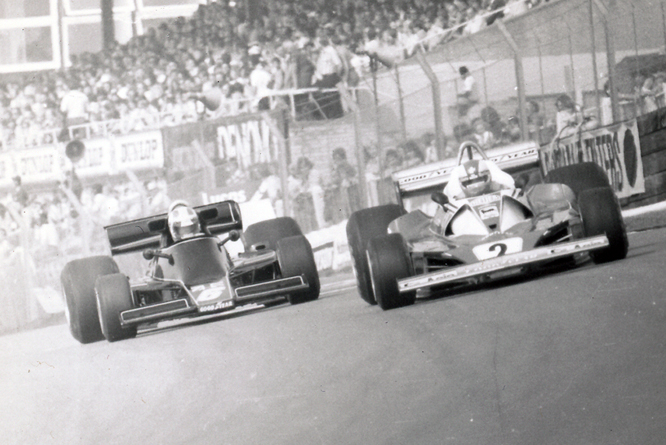
Like the photo’s featured in the Ferrari T2 post a couple of months ago today’s photo’s come courtesy of my school friend Sven Platt and were taken at the 1976 British Grand Prix.

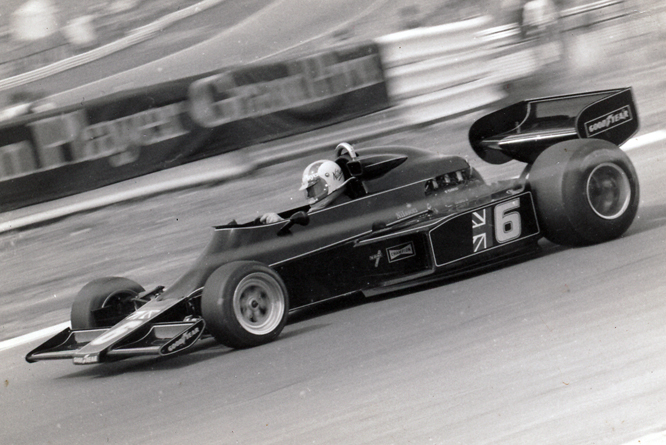
The 1976 Lotus 77 was a second attempt at replacing the Lotus 72 after the underwhelming Lotus 76 was abandoned in 1974. Like the 76 the 77 featured an extremely narrow chassis, but with Lotus 72 style side pods which extended back to the leading edge of the rear wheels for the radiators.

British Grand Prix, Brands Hatch

Novel features for the Lotus 77 when it was first seen included air intakes that ran the length of the cockpit, in board brakes, that were mounted between a pencil thin chisel nose and the front wheels, and rocker arm suspension that was fully adjustable to meet the requirements of any track.

By the start of the European season non championship races the cockpit side air intakes for the motor were blanked off and replaced with a conventional airbox. The ‘adjustacar’ suspension proved difficult to set up but was retained, while by the Belgian GP the inboard front brakes were abandoned. At the Dutch Grand Prix an oil cooler was mounted in the nose to move some weight forward of the front axle line.

Lotus 77, Brands Hatch

At the start of the 1976 season drivers came and went like a game of musical chairs, Ronnie Peterson was the incumbent #1 driver and Mario Andretti returned for a one off guest drive, after a six year break in the second car. After qualifying 16th and retiring with accident damage Ronnie swapped places with new boy & countryman Gunnar Nilsson who had been scheduled to drive for the March team. Andretti returned to Vels Parnelli team just in time for it to fold after the 1976 US Grand Prix West. British Formula 5000 champion Bob Evans was given two Grand Prix races at Team Lotus while Nilsson made his Grand Prix debut in South Africa. After failing to qualify for the US GP West Evans was dropped from the team and after trying out the Wolf Williams FWO5 in a non championship race freshly out of work Mario Andretti signed on as the Lotus #1 driver !

After Andretti rejoined the team Nilsson scored a couple of thirds during his rookie year while Andretti went a little better scoring two thirds and winning the thrilling final race of the season run in a monsoon that decided the championship between Niki Lauda and James Hunt that should make a thrilling climax to Ron Howard’s current film project ‘Rush‘.

The three Lotus 77’s, never known as John Player Special II’s as the sponsors might have hoped, were retired from top line competition at the end of 1977, however that was not quite the end of the story as once again David Render, swapping his Lotus 76, and getting hold of Andretti’s Japanese GP chassis, #R1, and using it as an effective hillclimb and sprint machine.

Thanks for joining me on this “The Adjustacar’ edition of “Gettin’ a li’l psycho on tyres” I hope you will join me again tomorrow when I’ll be reviewing last weekends Simply Italian event at the National Motor Museum in which a GALPOT regular won a prize ! Don’t forget to come back now !

Share

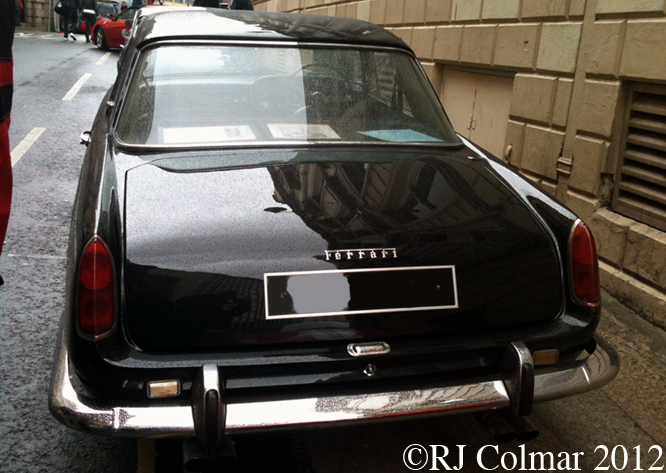
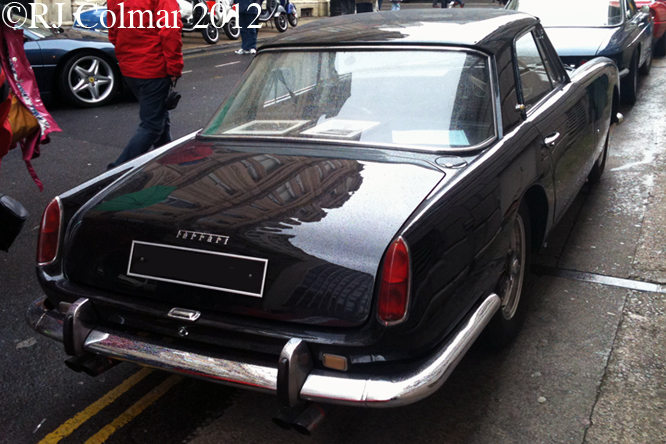
Financial Stabiliser – Ferrari 250 GT Pinin Farina Coupé #1083GT

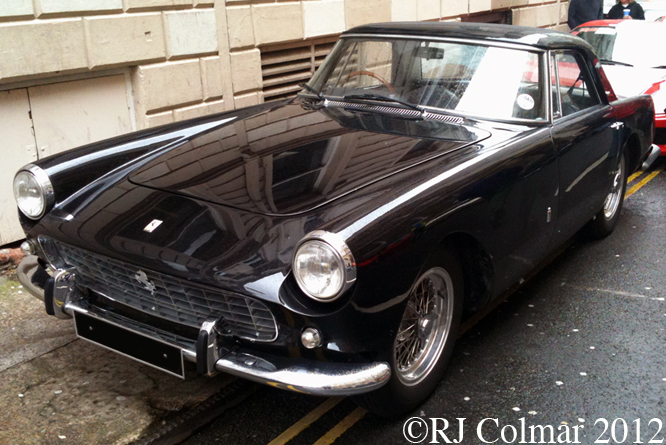
In the late 1950’s in order to stabilise the company finances Enzo Ferrari commissioned Pinin Farina to design a coupé suitable for series production.

Ferrari 250 GT Pininfarina Coupé, BIAMF

The 250 GT Pininfarina Coupé was launched at the 1958 Milan Motor Show with the last, featuring a superfast tail being shown at the 1961 London Motor Show.

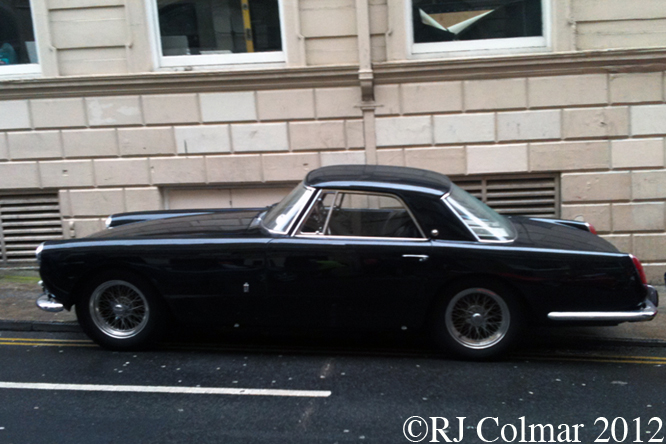
Ferrari 250 GT Pininfarina Coupé, BIAMF

Ferrari 250 GT Pinin Farina (PF) Coupé boasted 240 hp at 7000 rpm from it’s 3 litre / 183 cui V12 which was connected to a four speed gearbox and a live rear axle with semi elliptic leaf sprung suspension. The 250 GT Coupé was capable of 150 mph and rest to 60 mph in less than 7 seconds.

Ferrari 250 GT Pininfarina Coupé, BIAMF

The independent front suspension comprised double wishbones and coil springs and telescopic shock absorbers. Until 1959 drum brakes were used on all four wheels.

Ferrari 250 GT Pininfarina Coupé, BIAMF

This particular car was one of two delivered from the factory to Tourist Trophy Garages in Farnham Surrey who displayed it at the 1958 London Motor Show at Earls Court.

Ferrari 250 GT Pininfarina Coupé, BIAMF

Tourist Trophy Garages belonged to the Hawthorn family who’s son Mike became the first British World Champion driver, driving for Ferrari, in 1958.

Ferrari 250 GT Pininfarina Coupé, BIAMF

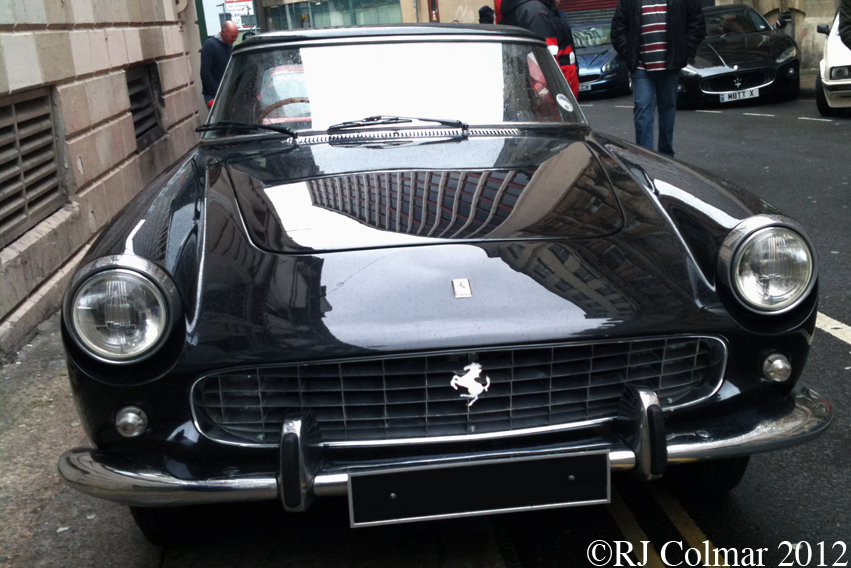
The car seen here was sold to an Irish land owner in 1958 and turned up in a sorry state of repair in the 1980’s at Maranello Concessionaires, which took over the UK Ferrari Franchise after Mike Hawthorn’s death in 1959, who had the car restored. The car has belonged to it’s current owner since 1993.

Ferrari 250 GT Pininfarina Coupé, BIAMF

It is thought just over 350 of these cars were built, most of the steel bodies were fitted at a factory purpose built by Pinin Farina, in Ferrari’s terms going into series production for the first time proved a huge success.

Ferrari 250 GT Pininfarina Coupé, BIAMF

Due to the phenomenal depreciation rates of these cars, many were subsequently cannibalised for parts and some even turned into replica’s of more sought after models, it is thought only half of the production run has survived.

Thanks for joining me on this ‘Financial Stabiliser’ edition of “Gettin’ a li’l psycho on tyres’ I hope you will join me again tomorrow when I’ll be featuring a Lotus 77 Grand Prix car. Don’t forget to come back now !

Share

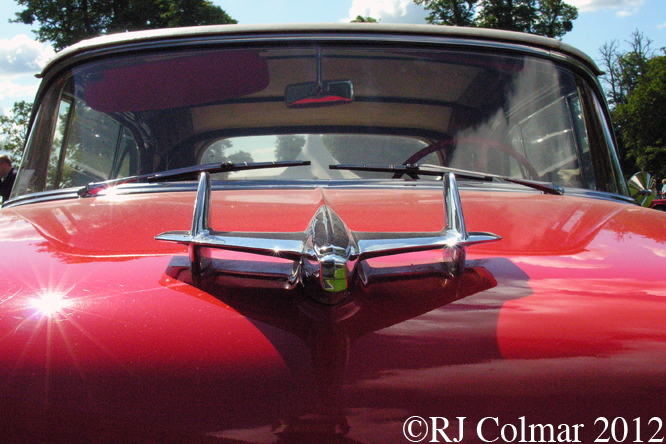
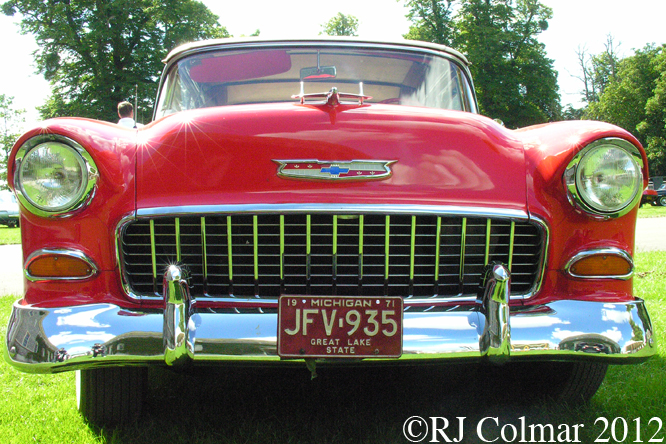
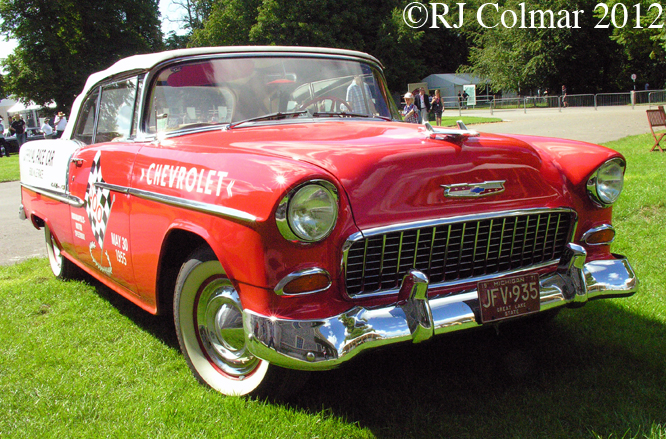
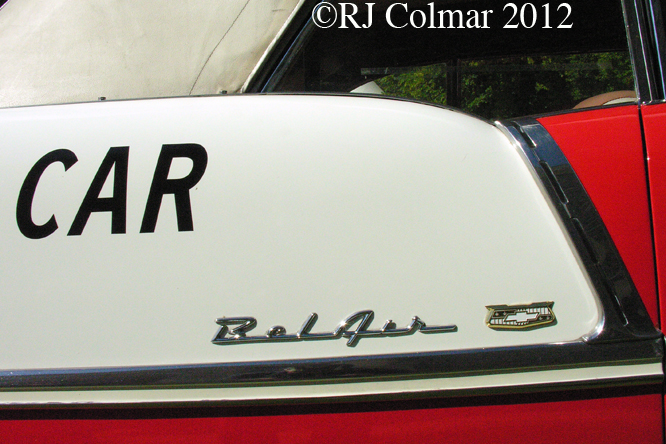
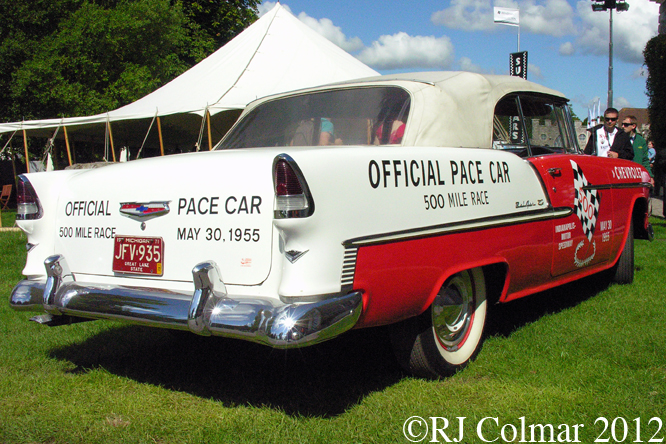
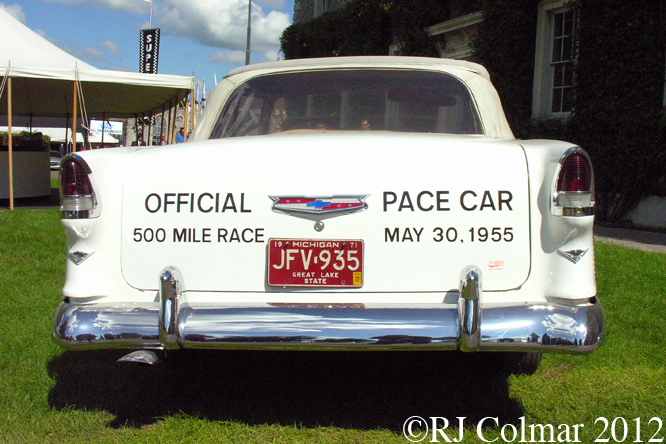
Hot One Of Fifteen – 1955 Chevrolet Bel Air Indy Pace Car

For 1955 Chevrolet launched it’s second generation full size Bel Air range, to replace the almost entirely new 1954 Bel Air. with two tone paintwork and for the first time a new 4.3 litre 265 cui V8 ‘small block’ engine option that would remain part of General Motors product mix with many improvements over several decades.

Chevrolet Bel Air, Goodwood FoS

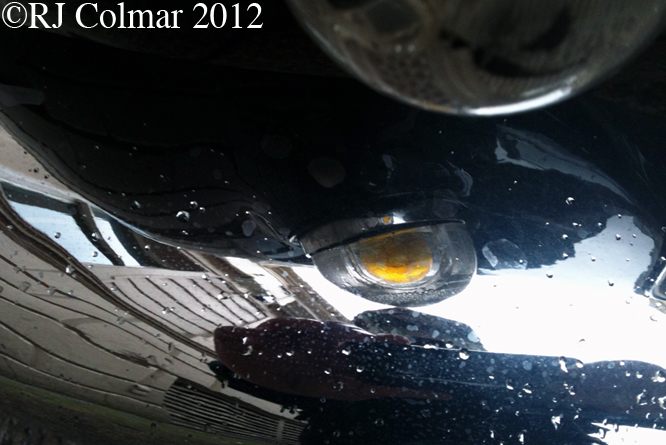
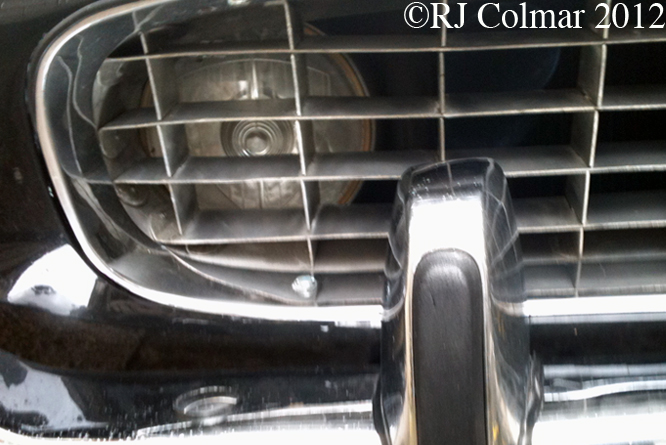
The crisp clean styling of the 1955 Bel Air was set off by a Ferrari inspired chrome square potato chip grill as seen on the car below photographed at last years Goodwood Festival of Speed.

Chevrolet Bel Air, Goodwood FoS

Alongside two straight six motor options the new ‘small block’ came tuned with either a 162 hp Turbo-Fire with twin barrel carburetor, 180 hp Power Pack Super Turbo – Fire with four barrel carburetor or towards the end of the model year a 195 hp competition option with a high compression motor.

Chevrolet Bel Air, Goodwood FoS

Being selected to perform pace car duties for the 1955 Indy 500 is reckoned to have given Chevrolet’s Bel Air marketing campaign a terrific boost, it is said that a fleet of 15 two tone Red & White Bel Airs were in attendance at what proved to be an unforgettable race.

Chevrolet Bel Air, Goodwood FoS

Chevrolet Sales Manager Thomas H Keating was given the honour of pacing the field for the Indy 500 on May 30th 1955 and he can be seen at the wheel of what Keating claimed to be a 180 hp vehicle, on this linked photo, sitting beside him is thought to be Indianapolis Motor Speedway owner Tony Hulman. The linked photo is telling for what it does not show, namely it is quite clearly not about to pace the Indy 500 and as we shall see it might not even be the actual vehicle used to pace the event.

Chevrolet Bel Air, Goodwood FoS

The give away as to which vehicle paced the event can be seen at 13m 37 secs into this linked clip when the pace car that actually led the field away can be clearly seen to be carrying a movie camera in the boot / trunk necessitating a rather large slit to afford the camera rearward vision and to accommodate the upper film reel. No one knows for sure what happened to that particular car after the event.

Chevrolet Bel Air, Goodwood FoS

Bill Vukovich looked to be on course for a third straight Indy victory in 1955 with a 17 second lead on the 57th lap, of 200, when he ran into someone else’s accident and ended flying over the back stretch perimeter fence and coming to rest up turned and on fire giving the two time defending champion no chance of survival. Bob Sweikert who had worked his way up from 14th on the grid, and was second in the John Zink Special at the time of the accident crossed the line 3 hours 53 mins and 59 secinds after the Bel Air pace car had entered pit road to start the race.

Bob took home one of the fifteen Bel Air pace cars with his wife and their kids, he went on to win the 1955 AAA big car championship and Midwest Sprint Car Championship, becoming the only winner of what is known cumulatively as the American Motor Sports Triple Crown. The following year Sweikert was killed in a sprint car accident at Salem Speedway racing Ed Elisan whom he had raced as a teenager in his home town of East Bay California.

Thanks for joining me on this ‘Hot One Of Fifteen’ edition of ‘Gettin’ a li’l psycho on tyres’ I hope you will join me again tomorrow. Don’t forget to come back now !

Share

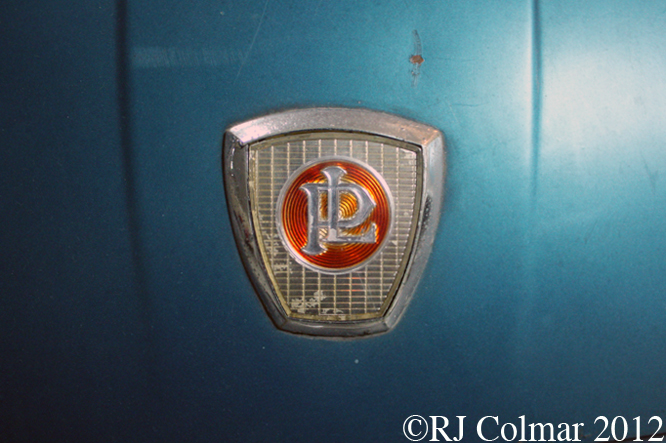
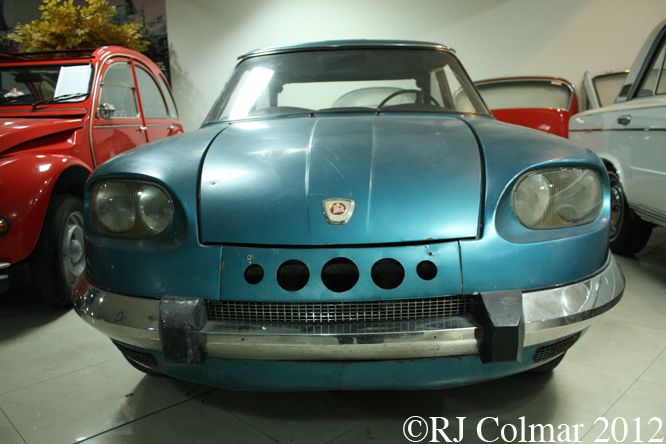
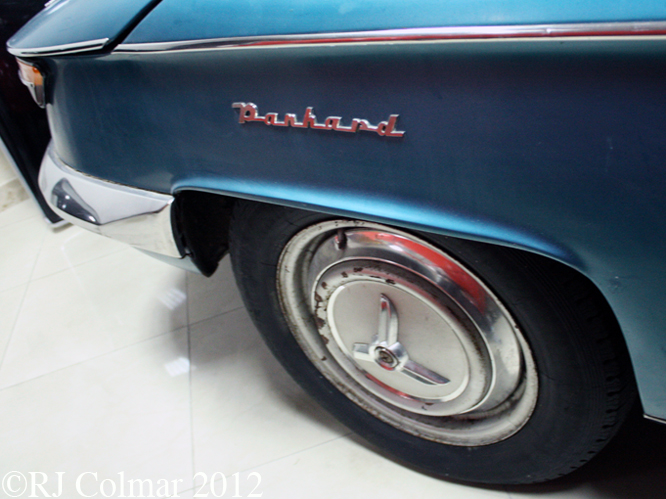
Au Revoir P et L – Panhard 24 bt

In 1887 French Engineers René Panhard and Émile Levassor founded Panhard et Levassor to manufacture motor cars and using a Daimler motor manufactured under license offered their first car in 1890. All of their early cars were one off designs as they introduced a string of improvements on successive models. In 1891 they built a vehicle with a front mounted motor and rear wheel drive that would become ubiquitous in the motor industry for over half a century.

Panhard 24 bt, Malta Classic Car Collection

After a 48 hour 48 min drive Émile Levassor crossed the finish line first in the first mass start motor race, the 1,178 km / 731 mile which in 1895 Paris Bordeaux Paris. Panhard et Levassor was not awarded the win because the race was intended for vehicles with 4 seats and Levassor’s car only had two as did the Panhard et Levassor which came second.

Panhard 24 bt, Malta Classic Car Collection

Recording many race victories Panhard et Levassor became one of the largest automotive manufacturers prior to the Great War of 1914/18. Between the two World Wars Panhard et Levassor diversified into new areas including, like Bugatti, into rail buses.

Panhard 24 bt, Malta Classic Car Collection

After the 2nd World War Panhard focused on making light cars with two horizontally opposed cylinder motors and front wheel drive. Unofficial support for racing car manufacturers like Deutsch et Bonnet led to many success at Le Mans in the Index of Efficiency classifications during the 1950’s and 1960’s.

Panhard 24 bt, Malta Classic Car Collection

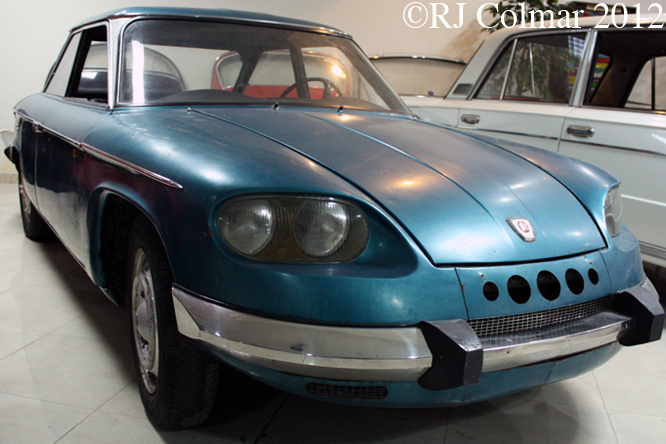
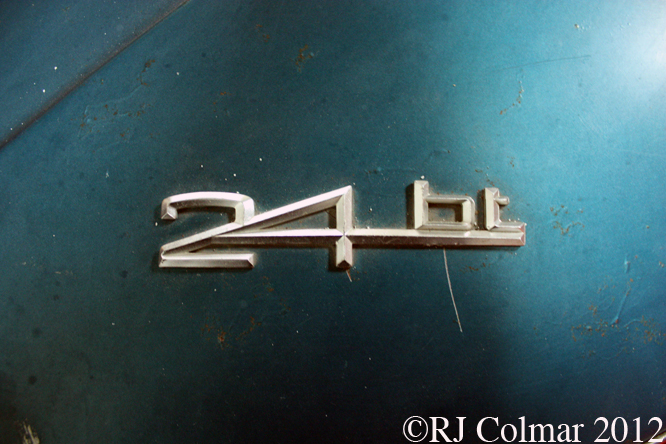
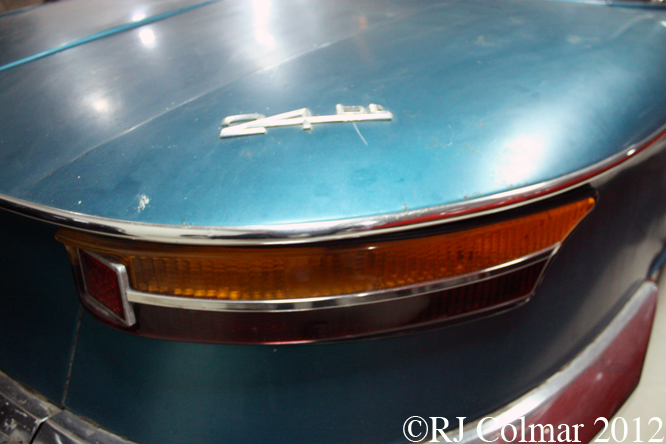
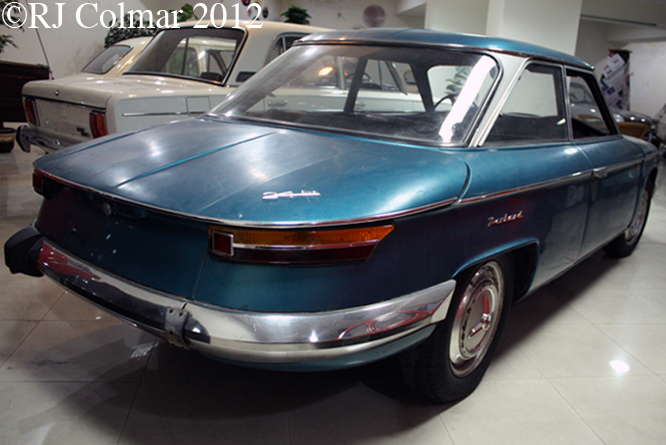
The Panhard 24 bt like the one seen here at the Malta Classic Car Collection was launched in 1964 featuring and air cooled 848 cc / 51.7 cui two cylinder engine, with origins dating back to the late 1940’s, driving the front wheels which allowed for the exceptionally low bonnet line which results in exceptional aerodynamic efficiency.

Panhard 24 bt, Malta Classic Car Collection

In 1965 Panhard was absorbed by Citroen during a period of rationalisation that was rampant throughout the European motor industry, so as not to compete with Citroen’s de luxe four door, four seater AMI 6 Citroén kept the spec of the 24 bt high and vetoed the development of a four door version.

Panhard 24 bt, Malta Classic Car Collection

Like, among many others, numerous BMW’s, the NSU Prinz, Stingray Corvette and Corvair from Chevrolet the Panhard 24 bt had a distinctive chromed trimmed midrift.

Panhard 24 bt, Malta Classic Car Collection

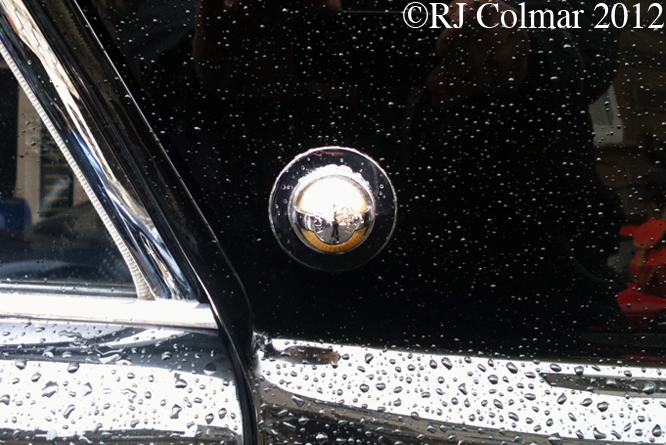
Saloon / Sedan 24 bt’s and the Coupé 24 ct‘s were amongst the earliest vehicles to feature integrated front and rear bumpers which gives the cars an efficient and stylish appearance which is taken for granted on new models these days but was well ahead of the curve even when production of the 24 bt ceased in 1967 marking the end of Panhard as a passenger vehicle manufacturer.

Thanks for joining me on this “Au Revoir P et L” edition of ‘Gettin’ a li’l psycho on tyres’ I hope you will join me again tomorrow when I’ll be looking the 1955 Indianapolis Pace Car on Americana Thursday. Don’t forget to come back now !
Share

Imshi Chassis – MG 14/28

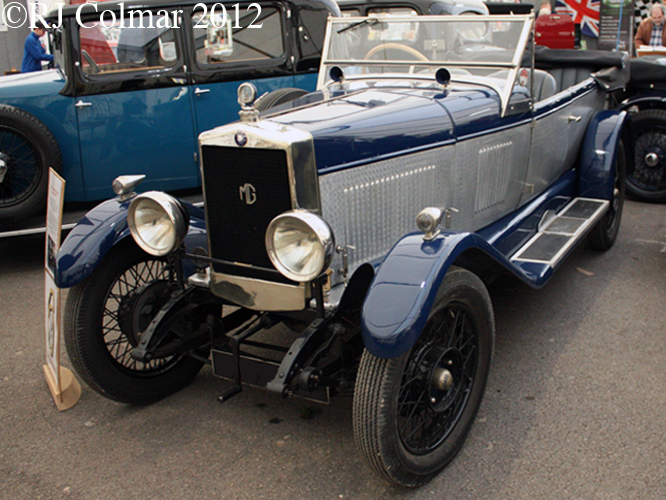
The history of the foundation of MG cars as a manufacturer is closely linked to the development of a vehicle, by Cecil Kimber of Morris dealer Morris Garages in 1923, based on a 14/28 Morris Oxford chassis purchased directly from the Morris Factory. In 1927 Morris Garages started registering their cars for the road with the local council as MG’s advertising one such car as being based on the ‘Imshi chassis’. Imshi, Arabic for ‘get a move on’, refers to a news paper journalists six month expedition through Europe and North Africa in a 14/28 Morris Oxford.

MG 14/28 Classic Car Show, Bristol Classic Car Show

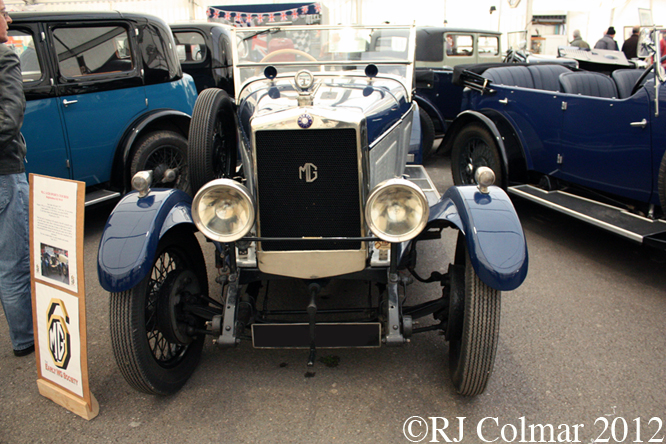
MG badges did not appear on the cars with MG bodies and modifications to Morris chassis and motors until 1928 and the blue radiator badge on the 1927 14/28 seen here bears the ‘Morris Oxford’ name. The car, seen here at the Bristol Classic Car Show, belonging to an Early MG Society member, is one of just 10 of the later 290 flat radiator 14/28’s built, the original 14/28 maintained the bull nose radiator from the original 14/28 Morris Oxford chassis.

MG 14/28 Classic Car Show, Bristol Classic Car Show

This car was found in 1989 and the current owner acquired it in 1996 and since proceeded with a restoration to bring the 65 mph car, which cost £350 new, to it’s current condition.

Thanks for joining me on this ‘Imshi Chassis’ edition of ‘Gettin’ a li’l psycho on tyres, I hope you will join me again tomorrow when I’ll be featuring a Panhard. Don’t forget to come back now !
Share

Di Claudio’s Day – Motors TV Live Race Day

The weather gods decided to give the billed Mini Invasion at Castle Combe an unrelentingly endless variation of track conditions on for the 12 races held on Bank Holiday Monday. Regrettably I missed the opening GadgetHelpline.com Castle Combe Classic race which appears to have been comfortably won by Nick Stagg from pole.

Mini Se7en & Miglia, MTVL, Castle Combe, Race 2

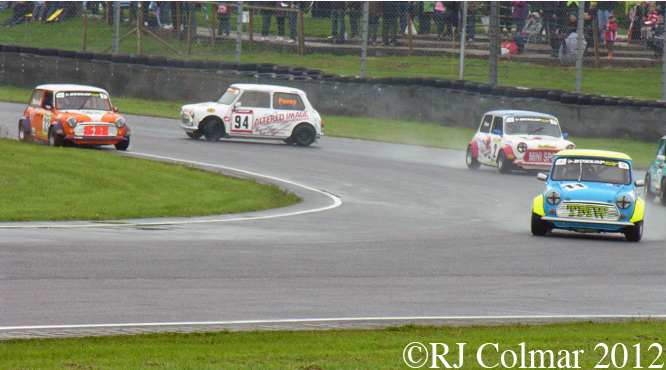
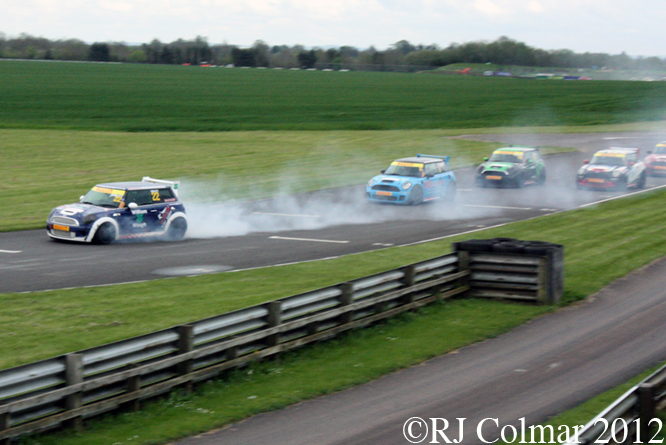
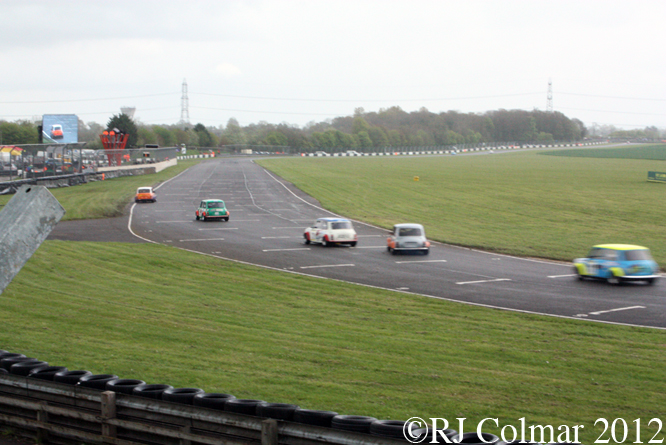
Having parked in a waterlogged field and donned my trusty green wellies I made my way to Quarry Corner in time to catch the 1st of two entertaining Mini Se7en / Miglia races. Kane Astin in the #11 who dropped several places off the line battled through the slippery conditions from 3rd on the grid to take the win in the the larger 1300cc / 79 cui Mini Miglia Class while a 15th place for Gareth Hunt secured a win in the 1000 cc / 61 cui Mini Se7en class. Above Robert Pavey was by no means the first to get caught out by the treacherous conditions at Quarry in the #94 Se7en as he was being lapped by Miglias of Astin #11, Dave Drew #2 and Peter Baldwin #33.

Startline FF1600, MTVL, Castle Combe, Race 3

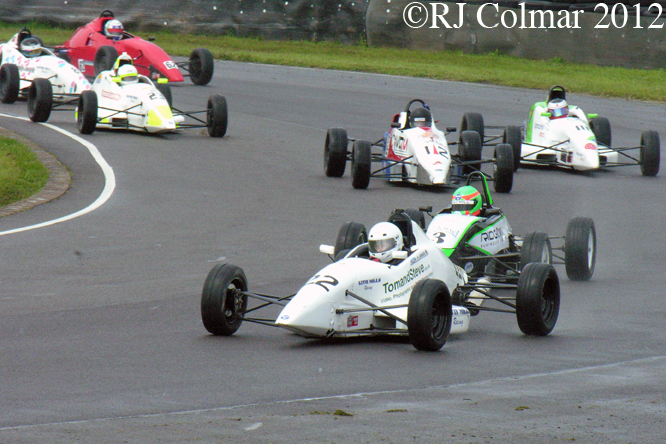
As ever the 1st of the two Ford Kent powered Formula Ford races proved unpredictable on a drying track Steven Jensen in the #22 Spectrum 011b made the best of a forth place start to take the lead from pole starter Roger Ogree in the #3 Van Diemien RF00 while fellow front row starter Natham Ward in the #23 Spectrum 011c was swamped on the line and came through in 6th on the opening lap. As the race progressed Ogree, with an eye on a good points finish, was content to hold station behind Jensen while Ward made amends for his poor start and ended up out fumbling first Ogree and then Jensen to take a well earned victory by just over a second.

Mini Challenge, MTVL, Castle Combe, Race 4

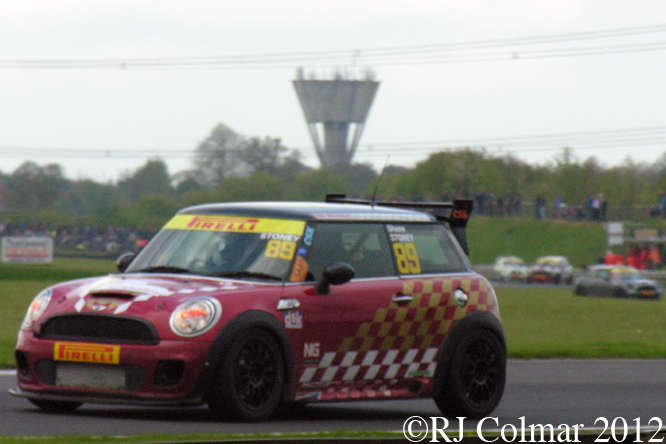
As the Mini Challenge cars went to the assembly area the track conditions were still damp and all of the cars were on intermediate tyres however sensing a dry spell Shane Stoney’s crew elected to pull their driver from a scheduled 8th place start in his John Cooper Works Class #89 Mini Cooper S R56 in order to fit slicks and start from the pits. Inspired or wise the choice was the correct one as it soon became apparent that Shanes car was the class of the field lapping around 2 seconds a lap faster than anybody else it was only a matter of time before he picked off the entire field and took the flag nearly 10 seconds to the good from Sam Osborne, back in 14th place Jonathon Brown won the Club class.

Volkswagen Golf TDI, MTVL, Castle Combe, Race 5

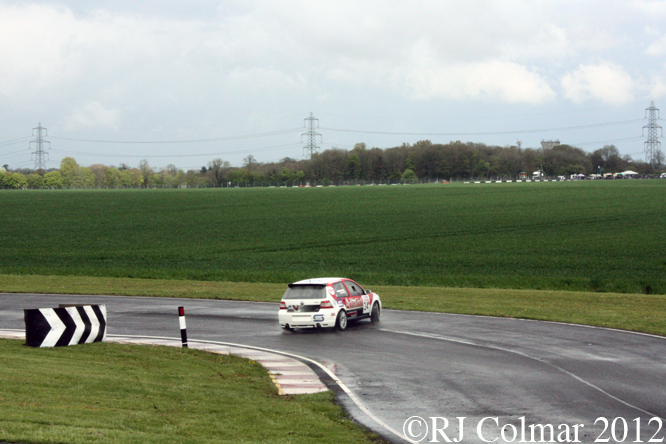
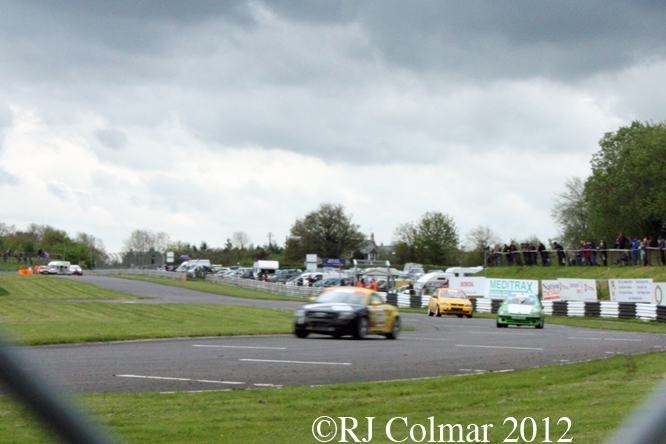
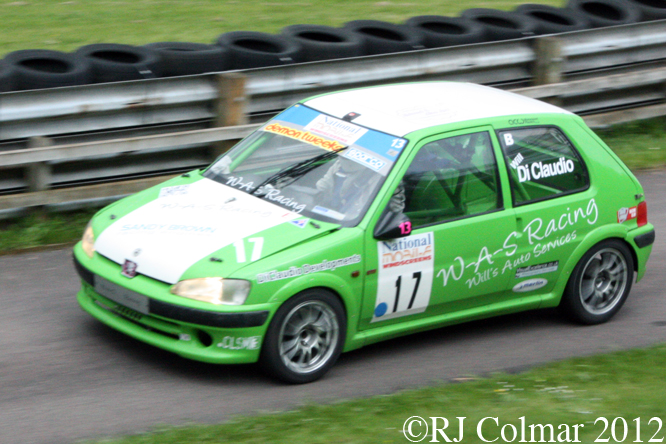
Having recently become the owner of a VW Golf IV it was an easy pick to root for Lloyd Allard a member of the well known motoring Allard family who was driving an Allard Motor Sport Golf IV TDi in the National Mobile Windscreens Saloon Car race. Unfortunately despite qualifying well in seventh the conditions got the better of him and his race was effectively ended when he got caught out on an oil slick at the Bobbies chicane which sent him into a tank slapper that ended in the infield wheat crop. To his credit Lloyd regained the track to make an unclassified finish. The race run on a sodden and later oily track was won by pole sitter Tony Hutchings in an Audi TT from Mark Wyatt driving a Vauxhall Astra and Mark Funnel’s Mini Cooper S, Will Claudio in a Peugeot 106 GTi took class B honours with a 4th place overall and Russel Ackers driving a Vauxhall Astra in 6th overall won class C.

VADABAR Sports & GT, MTVL, Castle Combe, Race 6

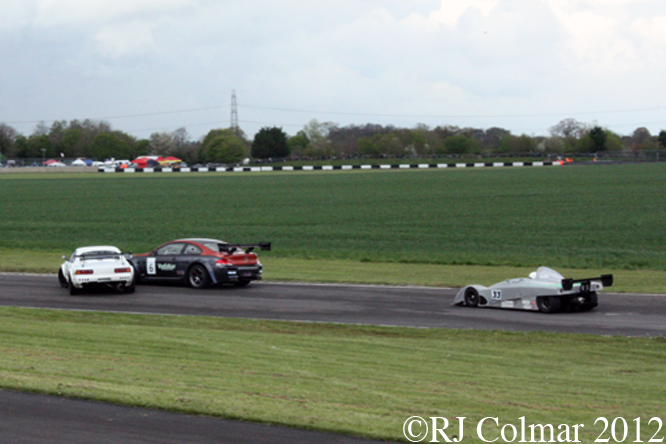
With the track still very wet rain tyres were the only option for the start of the of the VADABAR Sports & GT Championship. Starting from pole in his all wheel drive Mitsubishi Evo Gary Prebble must have fancied his chances for taking a second win in the series and he made the most of it with a good get away to take a comfortable early lead, but as I saw several times last year this Championship is Simon Tilling’s to loose and after a poor start from third the drying track played to the strengths of his #23 Radical SR3long enough for Simon to take the lead. While he was searching for the few remaining wet patches on the drying racing surface Simon was nearly caught by Martin Baker in another Radical who finished just one tenth of a second behind Tilling. Above George Micheal did his best to save his #27 Toyota MR2 from a lurid spin at Bobbies, but ran out of talent and clobbered Douglas Watson series sponsors VADABAR BMW E36 M6.

750MC Toyota MR2, MTVL, Castle Combe, Race 7

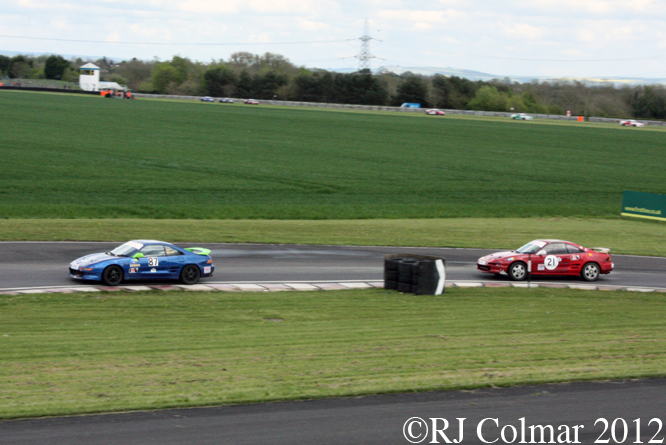
George Robinson made the best of a pole position start to lead the early going from fellow front row starter Ben Rowe driving the #21 MR2, in the non championship Toyota MR2 race, a series that was on a day trip from its usual venue at Brands Hatch. However starting from forth Matthew Palmer was soon within striking distance of the pair of them in his #87 MR2. Several laps in Robinson tripped up and Matthew seized the lead and held it to the end with Rowe finishing second and a crest fallen Robinson coming home third. Jim Davies brought his MR2 Mk3 in forth to claim the class win for the newer cars with smaller motors.

Startline FF1600, MTVL, Castle Combe Race 8

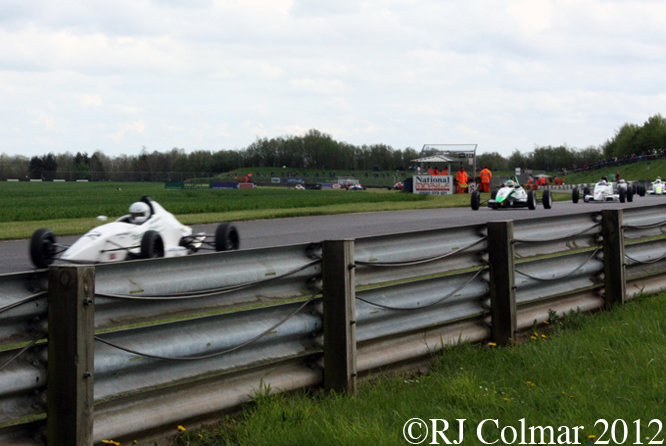
Nathan Ward in the #22 Specrum 011c made no mistakes from pole position on his second start of the day, but it was Ben Norton in the #111 Spectrum, seen in third place behind Roger Ogree above, who came through from a fifth place start to take the win in a race where seven vehicles left the track in separate incidents that necessitated the use of the safety car to clear up some of the mess.

Mini Challenge, MTVL, Castle Combe, Race 9

With the first six starting in reverse order that they finished in the first Mini Challenge race and a dry track there was no luxury of a tyre gamble for Shane Storey who started sixth this time round. With just over three tenths of a second covering the top three finishers 3rd place starter Lee Allen got the better of 2nd place starter Lee Patterson leaving pole sitter Martin Depper to claim the last place on the podium unchallenged after the #22 of Chris Smiley, above, completed a whole 1.86 mile lap with a cut tyre in forth place before it finally blew out and sent him into the barriers without any substantial further damage. Henry Gilbert claimed 12th overall and the Club Class win.

National Mobile Windscreen Saloon Cars, MTVL, Castle Combe, Race 10

The second National Mobile Windscreen Saloon Car Race proved to be the race of the day as William Di Claudio in his little green Peugeot 106 GTi sensationally hounded the more powerful Audi TT ‘saloon/sedan’ (?) of Tony Hutchings over the first 8 laps of the race forcing Hutching’s to go lawn mowing of the outside of Camp on the last but one lap which gave William just enough momentum to seize an unassailable lead as they crossed the line going into the last lap. Mark Wyatt finished a further 4 seconds down the road in third, my man Lloyd Allard managed to keep his Golf TDi on the black stuff second time round starting 34th he came in a well deserved 7th !

Mini Se7en & Miglia Race 2, MTVL Castle Combe, Race 11

The Mini Miglia and Mini Se7en combined race was another close fought affair with rain and the safety car interrupting the entertainment, above Peter Baldwin who started 3rd took the win taking the lead on the last lap from the #22 of pole sitter Richard Casey and early leader David Drew in the #2.

VADABAR Sports & GT, MTVL, Castle Combe, Race 12

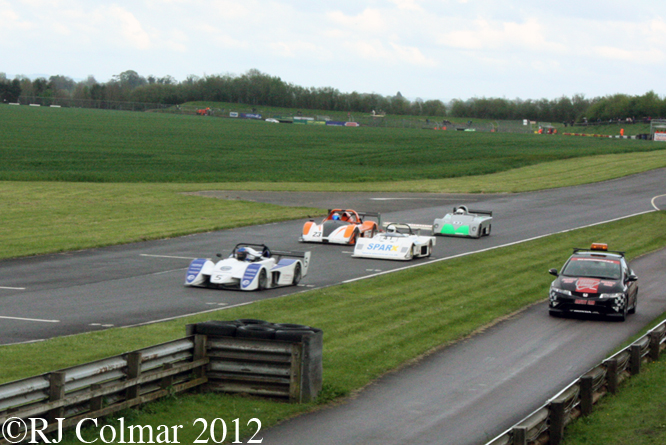
The twelfth and final event of the day held on drying track proved highly entertaining before the start when coming off pit road pole sitter Gary Prebble when straight into the corn field as his slick shod 4 wheel drive failed to find any grip. Prebble fell so far behind the field that he was still weaving through the field to his pole position on the warm up lap ! Craig Flemming starting second in the white and blue #5 Juno TR250 got the jump on Prebble and held the lead for 8 of the 9 laps. An incident requiring the safety car on lap 5 nearly destroyed the race having incorrectly picked up a hard charging Simon Tilling, in the distinctive orange #23 Radical, as the leader when he was still actually only in second place. Fortunately the incident was spotted and Simon was waved through with 3 laps to go and recovered his lost lap to set up a one lap shoot out. As the safety car came in Simon was marooned behind the lapped #41 Spar Jertona 85/09 of Jeremy Irwin while Flemming made the most of his opportunity to get away from the patient Tilling who waited until he crossed the finish line going into the last lap before blasting past the lapped Irwin as though he was standing still. Tilling then set about catching Flemming in what remained of the last lap. Incredibly Simon turned a 1,7 second lap to go disadvantage into a 0.7 second advantage as he crossed the line in a thrilling finish to the days action packed racing. Simon Tilling was the only driver to win both of his events at Castle Combe on Bank Holiday Monday.

William Di Claudio, Peugeot 106 GTi, MTVL, Castle Combe

William Di Claudio’s giant killing effort in the second saloon car race earned him the Driver of the Day award. As I headed back to the waterlogged car park the sun came out for what turned out to be a mild evening.

Thanks for joining me on this ‘Di Claudio’s day edition of “Gettin’ a li’l psycho on tyres’ I hope you will join me again tomorrow. Don’t forget to come back now !
Share