Tag Archives: 500

When Everything Went Wrong – Dave MacDonald and Eddie Sachs

Indy64 9s

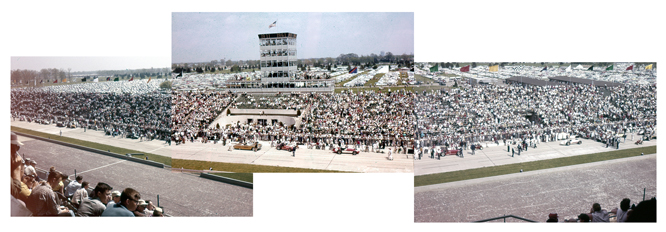
The Indianapolis 500 run in 1964 will be for ever remembered as one of those days where everything that could go wrong, did go wrong, not just in front of the 250,000 spectators at the track , including the late Ed Arnaudin who took took today’s photos from the exit of turn 4, but also on live close circuit cinema broadcasts through out the United States.

The out come of everything going wrong was a fireball and the instant death of Eddie Sachs and a couple of hours later, as a result of his injuries, the death of Dave MacDonald.

Eddie Sachs was known as the ‘Clown Prince of Auto Racing’. Born May 28th 1927 in Allentown, PA, Eddie won the 1958 USAC Midwest Sprint Car Championship.

From 65 AAA and USAC starts Eddie won 8 USAC Championship races, he started twice from pole at Indianapolis in 1960 and ’61. With three laps to go in ’61 Eddie made a pit stop from the lead to replace a delaminating tyre finishing second saying afterwards “I’d sooner finish second than be dead.” This was to be his best career result in the ‘Indy 500’.

In 1963 Eddie was running 4th behind Parnelli Jones and Jim Clark in the Indy 500, when Parnelli’s oil tank split spilling oil on the track allegedly causing Eddie to spin into retirement with 9 laps to go. After the race Eddie got into a fist fight with Parnelli over the issue and earned himself a year on probation from USAC.

Dick Sommers Eddie’s team owner at the race has been quoted since as saying “I’ve often regretted not having yelled and screamed at the USAC board that day in the hope that Eddie would follow suit. He probably would have been suspended for a year and might be still around.”

Dave MacDonald known as the ‘Master of Oversteer’ was born in July 23rd 1936 in El Monte, CA, Dave’s start in motor sport was on the Drag Strips of California and proceeded on to road courses with Don Steven’s Corvettes usually numbered ’00’. Scoring a remarkable 26 wins from 57 races in three seasons brought Dave to the attention of Carroll Shelby in 1963.

Shelby’s faith in Dave was rewarded with 17 further outright and class wins including the first wins recorded in the 260, 289 and Shelby Daytona Cobra’s. Daves last victory was at the wheel of a King Cobra at the USRCC event at Kent Washington on May 10th 1964. From 101 races Dave managed a remarkable 44 victories.

Also severely injured in the aftermath of the 2nd lap incident at Indy in 1964 was Ronnie Duman who’s car caught fire after a secondary collision causing injuries from which it took two and a half months to recover.

Indy64 10s

As if to emphasis just how difficult it was to learn the lessons of the fireball at Indy in 1964 Bobby Marshmam, who started in the middle of the front row at Indy that year, went tire testing at Phoenix at the end of the season, he was wearing jeans and a T-shirt when his fuel tank ruptured in an accident. A week later Bobby died of the burns sustained in the accident.

My thanks to Steve Arnaudin for the scans of his Dad’s photographs.

Join me again tomorrow for another edition of ‘Getting a lil’ psycho on tyres’. Don’t forget to come back now !

Share

Stock Block – Thompson Buick/Chevrolet

In 1961 legendary American speed king Mickey Thompson employed british Dolphin Engineering designer John Crosthwaite to design and build three challengers for the 1962 Indianapolis 500.

Aided by Fritz Voigt and his crew the challengers were transformed from blank sheet of paper into drawings and three complete cars in just 120 days.

Indy62 002s

(Photo by Ed Arnaudin)

Dan Gurney, possibly seen sitting in the vehicle above, had a lot riding on the 1962 Indy 500, at his own expense he invited Colin Chapman the genius behind Lotus Cars over to see the 1962 Indy 500 with a view to getting a deal done for Lotus to hook up with Ford and himself for a proper shot at the 500 in 1963.

Whatever else happened in 1962 Dan had to look good. Dan had originally agreed to drive the gas turbine powered #52 John Zink Trackburner, however the characteristics of the power plant did not sit comfortably with Dan who was racing on an oval for the first time, so he switched to drive Mickey Thompsons all aluminium Buick V8 stock block powered #34 Thompson instead.

Dan made a wise move, qualifying 8th and retiring with a seized rear end in 20th, the move looked doubly good for Dan when one of two drivers who drove the #52 John Zink Trackburner after Dan had left, veteran Bill Cheesbourg, followed Dan and drove the #35 Harvey Aluminium Special also a Thompson – Buick.

Cheesbourg like the previous incumbent Chuck Daigh failed to qualify the #35.

A third #33 Thompson Buick, belonging to Jim Kimberly, who the year earlier had owned and run the Kimberly Cooper Climax, was driven by Porky Rachwitz, Jack Fairman who both failed to qualify.

Indy63 001s

(Photo by Ed Arnaudin)

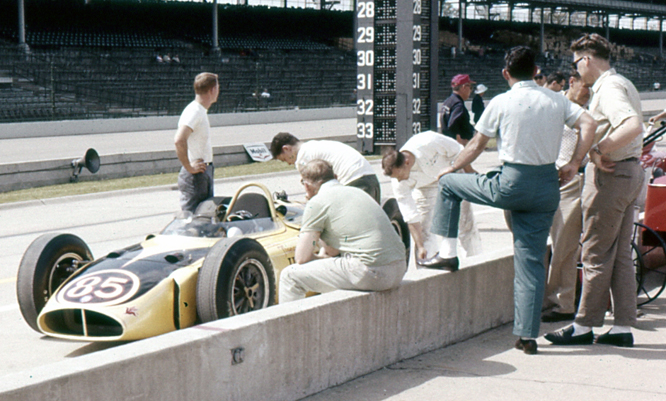
For 1963 Thompson took four cars to Indianapolis all now powered by Chevrolet stock blocks, the # 85 shown here with, possibly Micky Thompson standing on the extreme right behind the pit wall, is one of the original 1962 cars, driven in 1963 by Bill Cheesbourg until he wrecked the car in practice before qualifying had even started.

Cheesbourg who seems to have made a career out of driving novel designs at Indy failed to qualify a conventional #27 Watson for the race in 1963 while the #85 is not recorded as having taken any further part in the ’63 race after it was wrecked.

My thanks to Steve Arnaudin who kindly scanned his Dad’s photo’s for me to share and to Tom, FB84, Michael, Jim, EB, Amphicar, Tim and Tom G over at TNF who have helped me identify the cars and stories attached to them.

Hope you have enjoyed today’s Stock Block edition of ‘Gettin’ a lil psyco on tyres’ and that you will join me again tomorrow. Don’t forget to come back now !
Share

1962 DNQ – John Zink Trackburner

The other day I caught a bit of a radio programme about interview questions asked of potential Oxbridge (Oxford & Cambridge) university students, one of which was “If you are not in California how do you know it exists ?”

This got me thinking about if one was not at a particular race how could one know what happened ?

Looking into the story behind today’s photograph by Ed Arnaudin several ‘beliefs’ I have long held were ‘corrected’, namely that after the appearance of Jack Brabham’s Cooper Coventry Climax T54 the next car with an engine in the back to appear at Indianapolis was Jim Clark’s #92 Lotus Ford 29 in 1963.

Much to my surprise I found out that there were two rear engine vehicle types at Indianapolis in 1962 !

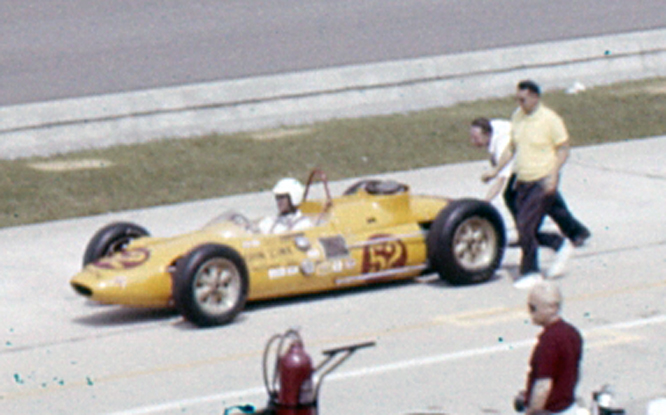
John Zink Trackburner, Indianapolis

The John Zink Trackburner, above, and Mickey Thompson’s Harvey Aluminium Special, remarkably they were both driven by Dan Gurney who invited Colin Chapman of Lotus over, all expenses paid, for the 1962 Indy 500 in an attempt to secure a deal with Lotus & Ford to have a winning shot at the race in 1963 !

The history of running turbines in Indy cars goes back to 1955 when a Kurtis Kraft 3000 chassis was fitted with a 175 hp Gas Turbine with the support of USAF General Curtis Le May. This vehicle known as the SAC Fireboid, see images at the bottom of this link, was used for testing by Firestone and for a demonstration at Indy in 1955.

In 1958 a Mr Williams of the Boeing Aircraft Company approached Frank Kurtis in 1958 to design a purpose made turbine powered vehicle, allegedly Frank drew up plans for a vehicle with the engine at the rear, primarily do deal with the 1000º F plus exhaust gas temperatures. However the powers that be at USAC were not sufficiently timely or co-operative to get the project up and running.

For 1962 the 1955 and ’56 winning owner John Zink had his Chief Mechanic Denny Moore build a rear engine chassis to take a Boeing Turbine.

Prior to the Indy 500 the car was tested and crashed by John ‘Jack’ Zink at his own private 5/8ths mile circuit which included 11º banking ! After repairs the car was taken to Indianapolis where the rookie road racer Dan Gurney tried it after passing his Rookie test in a front engine Roadster.

Gurney managed to run at 143 mph not fast enough to qualify in the gas turbine Trackburner and felt that though more speed was achievable throttle lag in traffic would present insurmountable problems during the race. Dan ended up qualifying and racing Thompson’s Buick stock block, under, powered Harvey Aluminium Special instead.

Indy veteran Duane Carter was next to run in the Gas Turbine Trackburner, Carter ran slower in the corners but faster on the straights than Gurney recording a best time of 142 mph.

John Zink Trackburner, Indianapolis

Duane qualified for the ’62 Indy 500 in a conventional roadster belonging to Zink and Bill Cheesebourg, most likely the driver seen in the car here, had a shot at running in the turbine Trackburner he managed a best time of 145 mph but like Gurney fancied his chances in a Buick stock block powered Thompson, unlike Gurney he could not get up to qualifying speed before crashing.

Finally Duane Carter in danger of being bumped off the grid had one more shot at qualifying in the turbine Trackburner but he could not record a time faster than 143 mph. It was concluded that despite running nearly a full race distance during qualification for the 500 the combination of throttle lag, high track side temperatures, and inconsistencies born out of the three different drivers who spent time in the cockpit led to the cars failure to qualify.

My thanks to Steve Arnadin for scanning his Dad’s photograph, to Tom, E.B, Michael, Tim, at The Nostalgia Forum, for filling a large gap in my knowledge.

Hope you have enjoyed today’s belief changing edition of ‘Gettin’ a lil’ psycho on tyres’ and that you’ll join me again tomorrow. Don’t forget to come back now !
Share

Sign of things to come – Kimberly Cooper Special

Today’s blog, on the 50th anniversary running of the ‘ Indy 500’ in 1961, comes courtesy of photographs by Ed Arnaudin and Phillippe de Lespinay.

01 Copyright Ed Arnaudin 1961_61s

Photo by Ed Arnaudin.

AJ Foyt recorded his first of four victories at Indy in 1961 driving the Bowes Seal Fast Special, a Trevis Roadster, outrunning Ed Sachs and Roger Ward both driving Watson Roadsters.

Cooper T54, Jack Brabham, Indy 500

Photo by Ed Arnaudin.

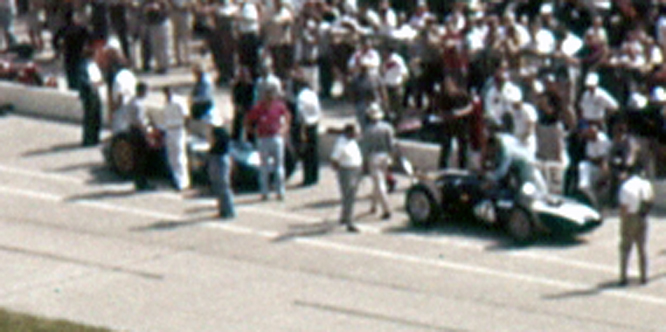
Also on the grid of the 1961 Indy 500 was a small car built in England driven by an Australian who started 13th and came in 9th, perhaps not a stunning performance but none the less a significant marker for the future designs that would appear at Indianapolis.

Cooper Climax T54, Kimberely Cooper Special, Indianapolis Motor Speedway

Photo by Ed Arnaudin.

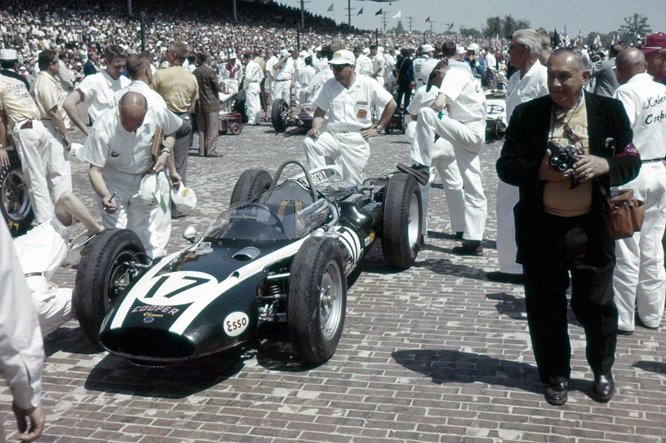
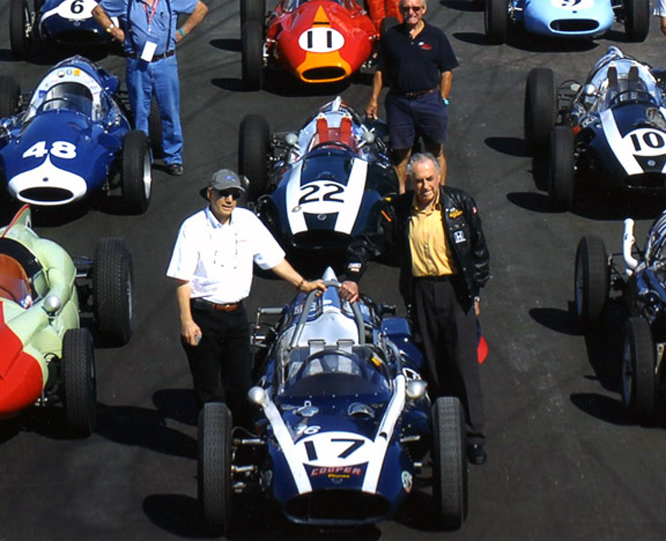
The #17 Kimberly Cooper Special, was the smallest car in the field powered by the smallest engine a 270 HP 2750 cc / 167 cui 4 cylinder Coventry Climax which gave away around 150 HP to it’s Offenhauser powered opposition. Uniquely that day in May the Cooper had it’s Coventry Climax engine mounted behind the driver.

Despite it’s power disadvantage which showed in straight line speed the Coopers lighter weight and rear engine configuration gave two time, reigning, World Champion,Jack Brabham a superior handling car going round the corners.

Had the team not made an unscheduled third stop, spending over 8 minutes stationary over three stops ‘Black Jack’ wound have been in a competitive position at the end of the race.

Cooper never returned to Indianapolis. The marker they had put down with the rear engine layout was taken up by others and by 1969 all Indy 500 qualifiers had engines mounted in the back, a development that was met with some resistance by both organizers and fellow competitors, who were less than thrilled by all manner of new comers turning up and eventually sweeping up the victory spoils.

In 1963 owner Kjell Kvale, believing some hopelessly optimistic performance figures for a 6 cylinder Aston Martin engine had Joe Huffaker install it in ‘Black Jacks’ 1961 Cooper T54 for Pedro Rodriguez to drive. Due to poor straight line speed Pedro Rodriguez was bumped in qualifying for the 1963 Indy 500.

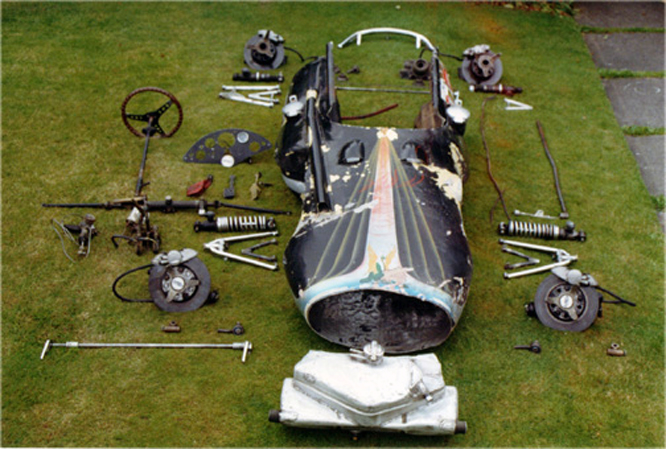
The unique T54 then passed through 3 hands and by 1977 it had morphed into a Chevrolet powered sprint car. Fortunately many of the original parts that had been replaced in the morphing process had been kept.

Cooper T54, Philippe de Lespinay

Photograph courtesy of Philippe de Lespinay

In 1990 Philippe de Lespinay and Robert G Arnold managed to purchase over 70% of the parts belonging to the T54, along with it’s original equally storied engine, giving Thomas Beauchamp, Gene Crowe and Quincy Epperly the task of restoring the Cooper back to it’s 1961 specification using as all of the recovered original parts, including all of the surviving body panels.

Cooper T54,  Jack Brabham

Photograph courtesy of Philippe de Lespinay

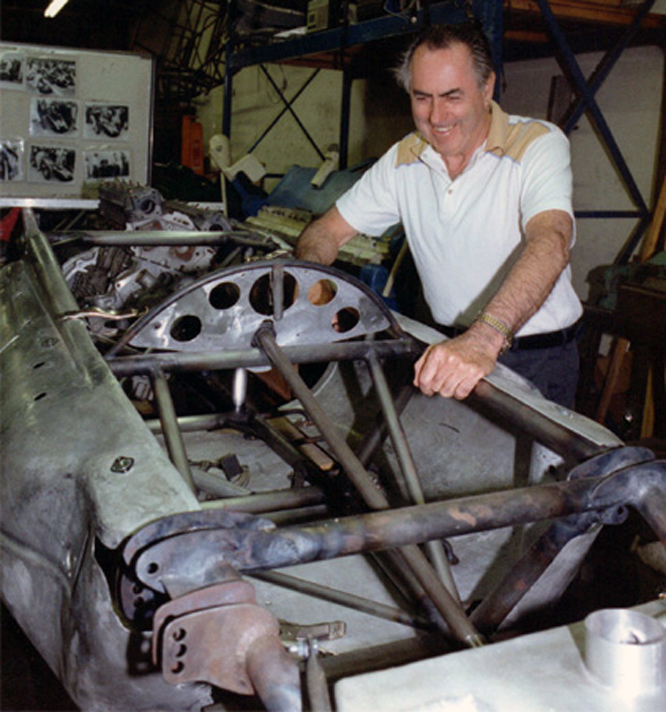
During the restoration Jack Brabham found time to visit the shop in California and inspect the work in progress.

Cooper T54,  Jack Brabham

Photograph courtesy of Philippe de Lespinay Monterey 2006

Thirty years after first driving the T54 at Indianapolis Jack Brabham took a belated fairy tale victory to win the 1991 Monterey Cup.

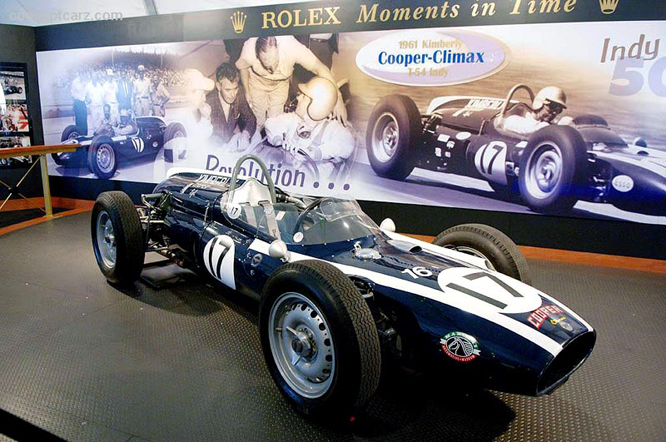
Cooper T54, Rolex Moments in Time.

Photograph courtesy of Philippe de Lespinay

Since then the T54 has appeared at the Petersen Automotive Museum, the Marconi Automotive Museum, Pebble Beach Concours d’Elegance and in 2006 was selected as the star of the 2006 Rolex display at Monterey.

In July Philippe will be bring the Kimberly Cooper Special also known as the Cooper Coventry Climax T54 to Goodwood Festival of Speed, where I look forward to seeing the car for the first time in the flesh and meeting Philippe.

My thanks to Steve Arnaudin for scanning and sending his Dad’s photos, to Phillipe de Lespinay for permission to use his photos more of which along with the complete story on the restoration of the T54 may be seen here.

Hope you have enjoyed today’s rear engine edition of ‘Gettin’ a lil’ psycho on tyres’, and that you will join me again tomorrow. Don’t forget to come back now !
Correction in an earlier edit of this blog I incorrectly stated Pedro Rodrigueuz had crashed the Cooper Aston Martin, this was definitely not the case and a case of labelling error by a third party, apologies for any confusion caused.

Share

Trading Places – 1960 Watson Roadsters

Thanks to Ed Arnadin‘s photos today we will be continuing our 100th anniversary of the first running of the Indianapolis 500 by having a behind the scenes look at Indianapolis in 1960.

Watson, Indy 1960

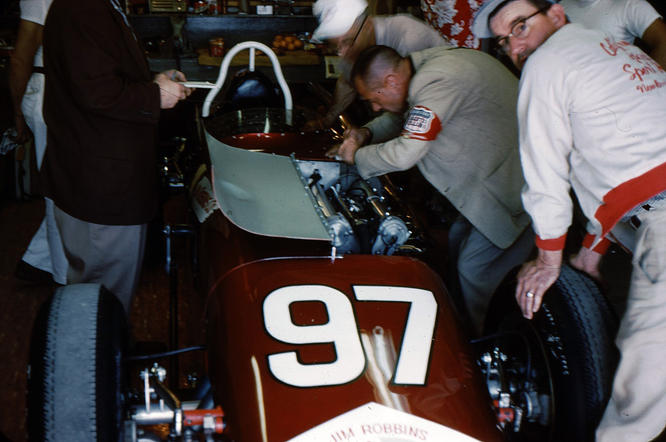
Our story begins with an invitation from a mutual friend of Ed Arnaudin and the Indy car owner Jim Robbins to visit the garage of the #97 Jim Robbins Special, where a Watson Roadster powered by an upright 4178 cc / 255 cui twin overhead cam Offenhauser is being prepared.

AJ Watson shares the record for building the most cars that won the ‘Indy 500’s’, seven, with Roger S Penske. Watson built his first car ‘City of Glendale’ in 1950, Dick Rathmann qualified 18th on the grid driving the ‘City of Glendale and retired from the race with a stalled motor after 25 laps. After working on aircraft assembly lines for Lockheed Watson was hired as Chief Mechanic by John Zink in 1954.

Watson modified Zinks Kurtis KK500C roadster and Bob Swiekert duly won the 1955 Indy 500 with it, in 1956 AJ built the first of 23 Watson Roadsters for John Zink, these iconic vehicles were to win a further six Indy 500’s in 9 years.

The Watson chassis was narrower than the Kurtis, featured extensive use of 4130 chromoly tubing in place of the steel used by Kurtis, innovative use of magnesium in the drive line and body panels saved further weight. The Offenhauser engine was mounted upright on the left side of the chassis to increase weight bias on the corners of the car closest to the inside of the track rather than tilting the engine at 36 degrees as Kurtis had done and later Eperly / Salih would do with engines 18 degrees off horizontal.

With a 220 lb weight saving the 1,640 lb Watson Roadster design remained fundamentally unchanged from 1956 until 1963, AJ Foyt drove a Watson into Victory Lane at Indianapolis for the last time in 1964.

The car, seen being worked on above was one of three entered in the race owned by Safety Belt manufacturer Jim Robbin’s, the #97 was driven by the man who first put a Watson on the grid of the Indy 500 in ’53, Dick Rathmann. In 1960 Dick qualified for fourth spot on the grid and retired from the race in 31st place after 42 laps with defective brakes.

Dick Rathmann had a varied career spanning 1949 – 1964 encompassing the AAA Championship, NASCAR (13 wins, all in Hudsons, from 128 starts) and latterly the USAC Championship. He started from the Indy pole in 1958 but was collected in an accident on the opening lap by fellow front row starter Ed Elisan, the ensuing 15 car pile up cost Pat O’Conner his life.

As a result of that fatal accident Dick Rathmann became the first man to start from pole not to complete a lap of the race, a stat that has since been emulated by Roberto Guerrero and Scott Sharp. Rathmann’s best Indy 500 finish was 4th in 1956.

Now this story enters the racing twighlight zone, ever since races were organised teams and drivers have made it there business to pull the wool over organisers eye’s. ‘Dick’ Rathmann was actually born James. James had a brother, younger by four years, called Richard and when underage Richard wanted to go racing in 1946 James and Richard simply swapped names, James became ‘Dick’ and Richard became ‘Jim’ a change that ended up sticking for life.

Indy 500, 1960

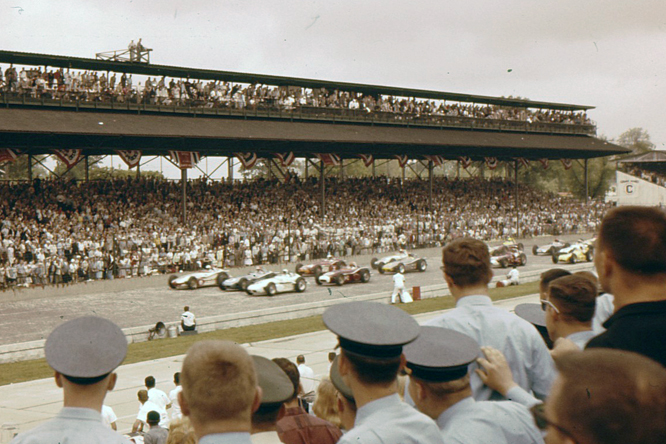
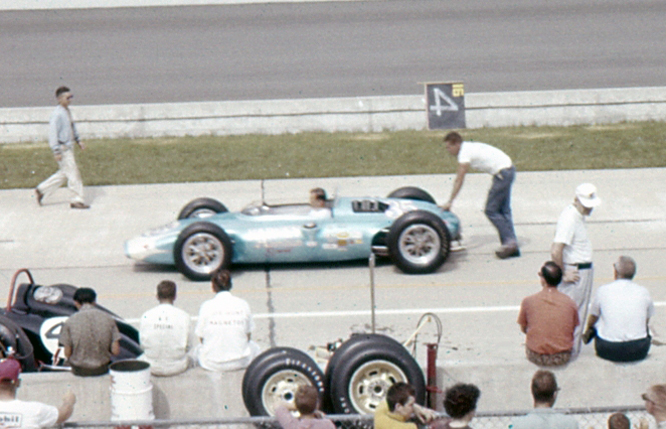
In 1960 Jim Rathmann was the driver of the #4 Ken Paul Special a Watson Offenhauser Roadster MK2, Jim qualified 2nd and can be seen in the blue car in the middle of the front row as the cars cross the 100 yards of bricks at the start of the 1960 Indy 500 above, his brother ‘Dick’ in the #97 is on the inside of the second row.

Rathman and Sachs, Indy 500, 1960

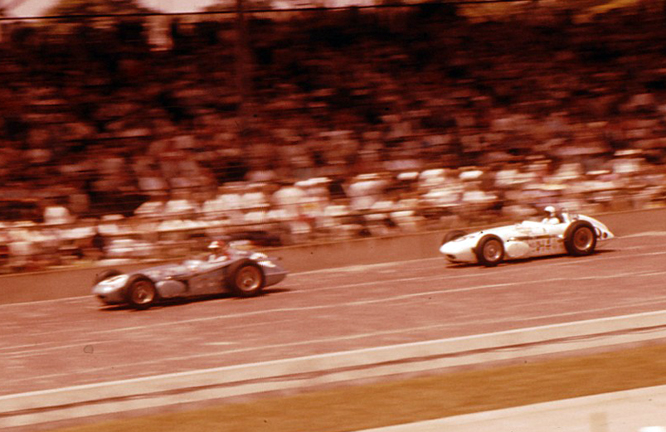
Jim seen here battling with Eddie Sachs went on to win the 1960 Indy 500, a race memorable because the lead changed a record 29 times. Last year (2010) Jim became the sixth Indy 500 winner to celebrate their 50th Anniversary of the Indy 500 win, Ray Harroun, Jules Goux, Rene Thomas, Peter DePaolo and Louis Meyer were the others.

Three time Indy winner Johnny Rutherford presented Jim with a trophy to commemorate the 50th anniversary of his win, Rutherford who was present at Indy as a spectator for the first time in 1960 remembered the race thus ” We had seats in the North grandstands of the infield on the backstretch. The duel between Jim and Rodger [Ward winner of the 1959 Indy 500] was one for the record books. Little did we know that some 50 years later [the 29 lead changes] would still be an Indy 500 record.”

Jim said of the 1960 Indy 500 “That was a great duel with Rodger. Ward was one of the toughest drivers out there and beating him meant a lot to me, and winning the Indy 500 changed my entire life. Winning the ‘500’ was and still is the all-time highlight of my racing career. To win that day, in that race against Ward means so much to me.”

Slightly off topic after retirement Jim became a Cadillac dealer in Melbourne, Florida and is credited with convincing GM president Ed Cole that GM should set up a deal to supply his friends the astronauts on the NASA space programmes with a pair of new cars each year.

My thanks to Steve Arnaudin for the scans of his Dad’s slides, to B² and Indycar Nation for additional information.

Hope you have enjoyed today’s 1960 edition of ‘Gettin’ a lil psycho on tyres’ and that you will join me again for a celebration of the 50th anniversary of the first running of the Indianapolis 500. Don’t forget to come back now !
Share

Winning in the rain – Wynn’s Friction Proofing Special

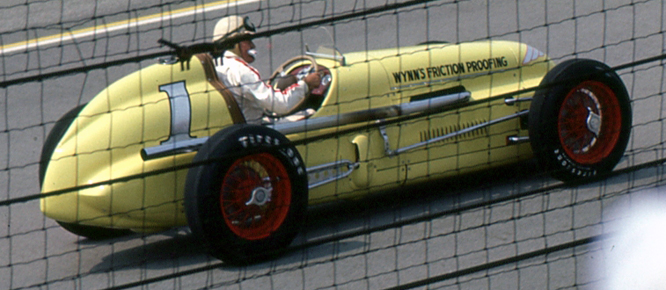
To accommodate Ferrari Friday I got a little out of sequence with my posts celebrating the Centenary of the first running of the Indianapolis 500, today we are looking at the 1950 Wynn’s Friction Proofing Special, thanks to a photograph taken by Ed Arnaudin in 1980.

Indy80 016s

Frank Kurtis the designer of extremely successful midget, 1/4 midget, sports and sprint cars also designed and built some 120 Champ cars for the Indianapolis 500, marketed and manufactured under the Kurtis Kraft name.

His creations took five victories between 1950 to 1955, so it is no stretch to say Kurtis dominated at Indianapolis in the first half of the 1950’s.

The first Indy 500 winner Kurtis Kraft built was the Wynn’s Friction Proofing Special seen in today’s photograph, the car was powered with a ubiquitous, for the period, 4,424 cui / 270 cui 4 cylinder twin overhead cam Offenhauser motor.

Driving the Wynn’s Friction Special in 1950 was Johnnie Parsons who won the rain shortened ‘Indy 500’ on just his second attempt. Due to an engravers error, Johnnie’s name was spelt incorrectly on the Borg Warner trophy, an error that was not corrected until the trophy was refurbished in 1991. Until then I am sure Johnnie’s son Johnny probably enjoyed having his name on the trophy even though it was next to his Dad’s face.

Johnnie took part in 10 Indy 500’s from 1949 – 1958, his best finishes beside the win were 2nd in 1949 and 4th in 1956. Parsons also won the Turkey Night Grand Prix for midgets in 1955, a race won more recently by NASCAR drivers Jason Lefler in 1999 and Tony Stewart in 2000.

My thanks to Steve Arnaudin for scanning his Dads photograph.

Hope you have enjoyed today’s rained out edition of ‘Gettin’ a lil’ psycho on tyres’ and that you will join me again tomorrow. Don’t forget to come back now !
29 05 11 Errata, thanks to evidence provided by Tim Murray it turns out that as of 2005 the Johnny Parsons spelling error had not been corrected. Apologies for any confusion caused.

Share

Fearless Freddy and the Cummins Diesel Special

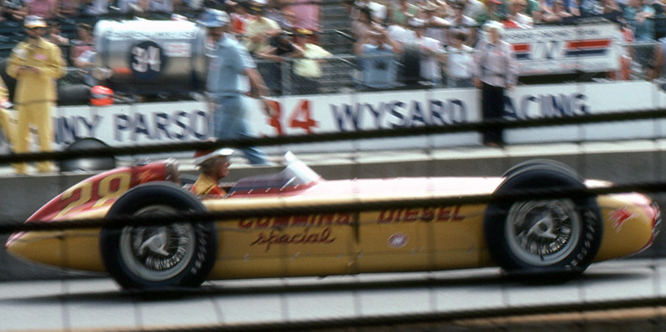
Staying with the 1952 Indy 500 which I started to look at yesterday today we are looking at the Cummins Diesel Special, thanks to a photograph taken by Ed Arnaudin in 1982.

Cummins Special, Indianapolis Motor Speedway

The history of Cummins the diesel engine manufacturer dates back to 1919 Clessie Cummins set out to exploit the hitherto unrealised commercial potential of Rudolf Diesels high compression thermal engine which takes it’s name from it’s inventor the diesel engine.

Based in Colombus Indiana Cummins a self taught engineer was also quick to spot opportunities to promote his products through events like the Indy 500 and in 1931 entered a car built around a Duesenberg road car chassis fitted with an 85 hp Cummins deisel marine engine which started last but thanks to it’s fuel economy came home 13th and in the process became the first car ever to complete the Indy 500 without making a pitstop.

This car was subsequently prepared for use on the road and used by Cummins and his marketing manager WG Irwin on a promotional tour of Europe.

In 1934 Cummins returned with a two car entry the #5 powered by a two stroke diesel which went the distance coming in 12th and the #6 by a 4 stroke diesel which retired with transmission failure.

In 1950 Cummins returned to the Brickyard with the #61 Cummins Deisel ‘Green Hornet’ a 340 hp supercharged diesel sitting in a Kurtis Kraft chassis driven by Jimmy Jackson who started 32nd and retired after 50 laps of the rain shortened race. The Green Hornet would take the diesel land speed record at Bonneville after it was timed at 165 mph on the famous salt flats.

For 1952 Cummins held nothing back from their Indy 500 programme working again with Kurtis Kraft the chassis now accommodated a 380 hp 6.6 litre / 401 cui six cylinder turbocharged engine, mandated at twice the size of the gasoline powered vehicles in the race.

The motor featured an aluminium block and head with a magnesium crank case, this unit was lain 5 degrees off flat which gave the #28 three advantages, reduced centre of gravity, reduce the frontal area and thanks to the offset engine some of it’s weight could be distributed so that the car was heavier on the left (inside) wheels.

Fearless Fred Agabashian was hired to drive the Cummins Diesel Special on the recommendation of Kurtis. After the car was tested for the first time the team, comprising almost entirely regular Cummins employees who worked as engineers and mechanics apart from the driver, knew they had a veritable ‘Rocketship’ on their hands.

Fred sandbagged for much of the month of May until Pole day by lifting off on the back straight one lap cruising through a turn on another never completing a whole lap under full power so as not to draw attention to the ‘Rocketship’ capability of the car and risk having the rules changed.

Come 5:45 pm on pole day Fred and the heavy, 3,100 lb, Cummins Diesel Special fitted with a fresh engine made their mark on the world of motor sport by setting an individual lap record of 139 mph and a record 4 lap average of 138 mph.

Qualifying over 1 mph faster than the next nearest competitor in one of the most famous races in the world with a vehicle powered by what was in essence a truck engine subsequently repaid Cummins investment many times over in the volume of publicity this feat generated.

Having shredded their tyres in qualifying the Cummins team needed a different strategy in the race and planned to run a half a tank of diesel and make one pit stop for fuel and tyres. The heavy Cummins Diesel Special was in good company with Ascari and his heavy Ferrari, both cars bogged down at the start but climbed through the field.

Agabashain in the Cummins was running as high as fifth when the car probably claimed a world first, retirement due to…. turbo failure after 71 laps, the air intake for the turbocharger, placed low in the nose, had sucked up debris into the turbine housing damaging the blades.

Cummins however were not in the least disappointed they remain the only manufacturer of truck engines to have recorded an Indy 500 pole. An achievement possibly only eclipsed recently by the 4 victories Audi Diesels in the Le Mans 24 hours since 2006, interrupted by a Peugeot Diesel victory in 2009.

A small post script allegedly in 1953 a spark plug manufacturer was advertising its wares, in the 1953 Indy 500 programe, with a picture of the 1952 Cummins Diesel Special, the only car in the 1952 field without need of them.

My thanks to Steve Arnaudin for scanning and forwarding his Dad’s photograph.

Hope you have enjoyed today’s “Fearless Freddy” edition of ‘Gettin’ a lil, psycho on tyres’ and that you will join me again tomorrow. Don’t forget to come back now !
Share