Tag Archives: BMW

What’s cookin’ ? – DAX Tojeiro

Continuing the theme of self builds started with the unique scratch built Rhodes Ridley on Monday today we are looking at a DAX Tojeiro.

DJ Sportscars International Ltd under the DAX brand have been building kits replicating the AC Cobra requiring no special tools, welding or Glassfibre Reinforced Plastic work for over 25 years.

Their Tojeiro kits currently marketed under the ‘427’ name can be supplied to take a huge variety of motors small block to big block US V8’s Rover V8’s Jaguar sixes & V12’s, currently DAX have a demonstrator with a 500 hp 8.2 litre 502 cui V8 capable of accelerating from rest to 60 mph in 4 seconds and on to over 180 mph.

After trying one at Brands Hatch ex Formula One driver Jonathon Palmer described the big block Chevy DAX demonstrator as ‘just staggering’ not bad for a vehicle that when complete should comply with Single Vehicle Approval (SVA) standards necessary for registering a vehicle on the road.

Any one interested in finding out more might like to visit Simon Johns DAX factory in Harlow Essex for an open day on Good Friday April 22nd, see link for contact details, if I am in the area I’ll make a point of being there myself.

Thanks to the unknown PistonHead who brought this sinuous vehicle to Januarys Sunday Service at the BMW Plant, Cowley.

Hope you have enjoyed today’s Detroit muscle powered edition of ‘Gettin’ a lil’ psycho on tyres’ and that you will join me again when we up the ante with a whirl wind 427 cui powered kit car. Don’t forget to came back now !

Share

Bavarian Coupé – BMW 3.0 CS Automatic

Soon after we got our first black and white TV in 1967 I remember seeing a Karmann built BMW 2000 CS on a report from a motor show, possibly Geneva, thinking that was one cool futuristic car, I must have been 8 at the time.

The next time I remember seeing a BMW Coupe was on the cover of one of the earliest copies of Motor Sport I bought in the summer of 1973, it was a white works CSL being yomped through the Eifel Forest on the Nurburgring by Hans Joachim Stuck Jr, the magazine must have been a sell out because the following year a near identical picture appeared on the cover Motor Sport from the 1974 6 hour race at the Nurburgring this time with Hans driving a black works CSL.

In 1968 the 2 litre Karmann built BMW Coupé’s evolved into the BMW 2800 CS based on the E9 platform, unfortunately ditching the very cool faired in headlights lights for the familiar US spec twin round headlights.

BMW was thought stand for British Motor Works in the USA around the time this car was built, BMW engaged in a works backed US Motorsports programme using the ‘Batmobile CSLs’ to correct that perception, to Bavarian Motor Works, in 1975.

In 1971 the E9 platform was fitted with a 3 litre / 183 cui 6 cylinder motor which when equipped with twin carburettors produced 180 hp.

This vehicle, according to the registration plates, was first registered in London around 1973/4.

I never did get what performance cars and automatics were all about, which is probably why I never became a auto marketing executive, but 30 plus years on an ‘automatic’ badge shows us the relative aspirations of the original owner and utilitarianism of the time when the car was manufactured.

There is something about vehicles designed around a simple horizontal midriff I find extremely alluring.

IMHO one of the few cars that looks as good in standard street form as in fully equipped racing form.

Like to thank every one who pops into ‘Getting a lil’ psycho on tyres’ at some point during the night this blog had it’s 10,000th page hit not exactly close to the 10 billion hits achieved by Apple Store but if you’d asked me if this was possible a year ago I would have wondered what on earth you were talking about, thanks again.

Hope you have enjoyed today’s Bayerische Motoren Werke edition of ‘Gettin a lil psycho on tyres and that you’ll join me again tomorrow for Ferrari Friday in the Bonham’s auction house for a look at a vehicle once owned by a dreamer who imagined all the people living in the world as one. Don’t forget to come back now !

Share

Comfortable presence or large and in charge – Bentley Azure

This was the first time I saw and indeed heard of a Bentley Azure, though all I heard when I first became acquainted with this one was a faint whisper of a seemingly far off air conditioning unit, I was surprised when I turned around and found this gargantuan vehicle pulling up right next to me.

Since 1998 Volkswagen have been the owners of the Bentley marque having purchased it from Vickers and in the process separated Bentley from, former owner since 1931, Rolls Royce which was sold to the Bavarian Motor Works.

This second generation (2006 – 2009) Azure is powered by a 450 hp 6,750 cc / 411 cui, twin turbo V8, with origins that can be traced to the V8’s used in the Rolls Royce Silver Cloud II, Phantom V and Bentley S2 of 1959. The power is transmitted to the rear wheels with the aid of a 6 speed automatic gearbox made for this model only.

Handling of this 2,801 kg / 6,175 lb vehicle is said to be free of pitch and roll.

The engine is capable of propelling the Azure up to 60 mph from rest in just 5.6 seconds, and on to 168 mph. Unsurprisingly the Azures fuel consumption is amongst the worst on record at between 9 – 15 miles per US gallon, if you need to ask these figures I guess you do not own the requisite oil field or two to keep the Bentley Azure in motion anyway.

This vehicle is longer wider and obviously taller than an Audi R10 TDI Le Mans race car in fact it is larger than several mini buses with an overall length of 5.342 m / 210 inches, a width of 2.057 m / 81 inches, and wheelbase of 3.061 m / 120 inches. More than comfortable for four adults and their luggage to waft down to the South of France for a weekend on the beach.

Hope you have enjoyed today’s XXXL edition of Gettin’ a lil psycho on tyres and that you’ll join me for a look at a slightly more modest black model built in the foot hills of the Zhiguli Height mountains in Toliatti tomorrow. Don’t forget to come back now !

Share

Perfection In Seven Weeks – Morgan Aero SuperSports

The Morgan Aero Super Sports was launched in 2009, it is a targa version of the limited edition AeroMax I looked at in yesterdays blog.

It takes seven weeks to build a SuperSport starting with the aluminium (clipped British pronunciation) frame.

The 4.8 litre / 293 CUI BMW V8 can be specified with either automatic or six speed manual gearbox. At each stage of assembly only one person is responsible for and works on each vehicle, ensuring job satisfaction for the employee and ‘perfection’ for the customer.

Notice in the assembly process of the Aero SuperSport how the BMW cam cover will magically disappear.

The body panels are super formed and then finished by hand.

The aluminium body panels are bonded around an ash frame, this type of construction is both extremely light and also meets all the global crash standards required of a 21st century vehicle.

Morgan offer customers a choice of 40,000 colours for their hand painted vehicles, if they don’t already have the colour you want they will make it.

The eight vehicles seen here in the Aero SuperSports assembly area will represent an income of over £800,000 pounds / US$ 1.28 million. Seventy percent of Morgans are exported.

As if by magic the BMW cam cover disappears !

Close to complete every detail is double checked to perfection in the Aero SuperSports finishing area.

The next stop for this Aero SuperSports will be either the customer hand over area in the factory or to a dealer.

Chairman Charles Morgan says of this particular model of perfection “ The Morgan Aero SuperSports is a luxurious flamboyant sports car which also remains true to Morgan’s philosophy of lightweight minimalist simplicity. It is a celebration of our love of cars and the romance of travel and is a fitting model to announce during Morgan’s Centenary year.”

Hope you enjoyed today’s trip around the Morgan Motor Company following the production of the Aero SuperSport, tomorrow I hope you’ll join me in looking at the production of classic Roadsters, don’t forget to come back now !

Share

The Boss’s Car – Morgan AeroMax

A couple of weeks ago I was fortunate enough to go on a guided tour of the Morgan Motor Company. To arrange the tour I visited the Morgan website two weeks in advance and made a booking. As I hope you shall see over the next couple of days I had a fabulous time.

The Morgan Motor Company was founded in 1909 by HFS Morgan in Malvern Worcestershire and is the oldest British motor manufacturer in continuous private ownership. Today the company is run by the Grandson of HFS, Charles Morgan and as luck would have it this is his personal one of a limited edition of just one hundred AeroMax models.

The Aeromax is capable of 0 – 60 mph in 4.5 seconds and will take you on to a 170mph.

Every detail of a Morgan is a testament to the genius of craftsmen, as we shall see there are power tools in the factory but there is no mechanised assembly line or machines stamping out parts.

Power for the AeroMax comes courtesy of a BMW V8, so far as I know Morgan has always used proprietary motors.

From the trunk of the Aeromax allegedly is large enough for a couple of Golf bags.

In 1991 the Britain’s first reality TV businessman Sir John Harvey Jones was horrified to find Morgan with a seven year backlog of orders were still crafting their vehicles by hand in the Troubleshooter TV series, he advised Peter Morgan to modernise, increase production and prices. Bravely Morgan ignored this advice and the TV coverage led to the waiting list for new Morgans to extend from 7 years to 10 years. Sir John says he is pleased that Peter Morgan stuck to his guns and ignored his advice.

Hope you enjoyed my introduction to the Morgan Car Company, tomorrow I’ll take you inside the factory to see how these cars are made, wishing everyone a sunny day, don’t forget to come back now !

Share

The father of BMW, Jaguar, Bristol and Lotus cars – Austin 7 Part 2/2.

Today I’ll be looking at the legacy left by the humble little Austin 7 on the European Automotive industry, if you missed my introduction to the Austin 7 here is a link to yesterdays post.

The Austin 7 deserves it’s place in British automotive history simply for being it’s first mass produced car, but it’s real standing becomes clear when one considers the Austin 7 was manufactured under licence by the Automobilwerk Eisenbach car factory.
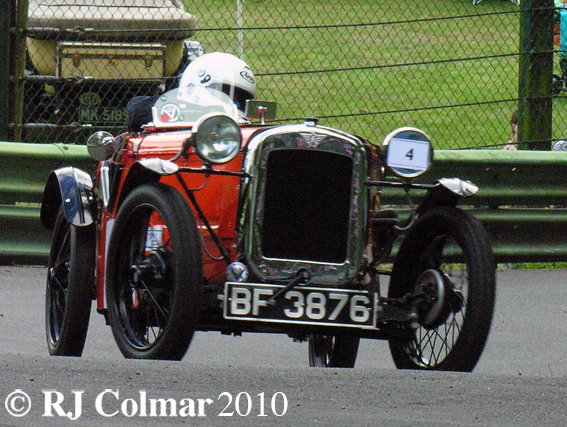
Above Joe Tisdall, 1930, Austin 7 Ulster, VSCC Prescott,

Their Dixi variant of the Austin 7 supplied in kit form initially in 1927 was so successful that within a year BMW bought the company after its own primogenitor vehicles proved less than viable. So the Ausitn 7 saved BMW from ruin as its aeroplane engine manufacturing business began to fail after shady dealings with the USSR came to light.
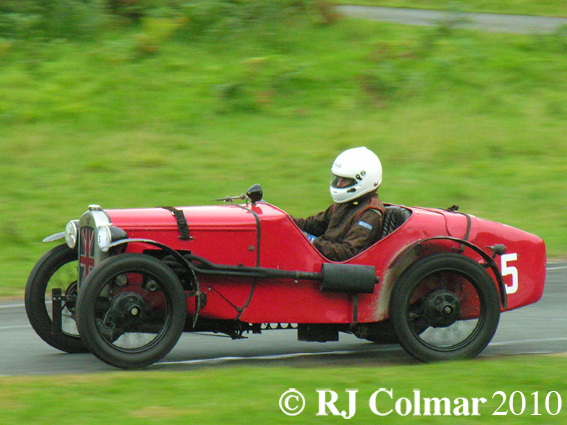
Above Mark Groves, 1930, Austin 7 Ulster, VSCC Loton Park.

This next bit traces the development of engines if you stick with it you’ll see the blood line from Austin 7 through BMW to Bristol.

In 1932 BMW used the 4 cylinder 747 cc / 45 cui Austin 7/ Dixi engine as the starting point for their own 4 cylinder 788cc / 48 cui motor used in their first all in house designed BMW 3/20

By 1933 BMW built a 1182 cc / 72 cui six cylinder version of the 3/20 engine called the M78 for their 303 model.

In 1934 a larger 1,490 cc 90.9 CUI six cylinder engine was developed from the M78 for use in the BMW 315/319 series of vehicles, which was superseded in 1936 by the hemi head 1971 cc / 120.3 cui six cylinder engine for the 328 model of 1936.
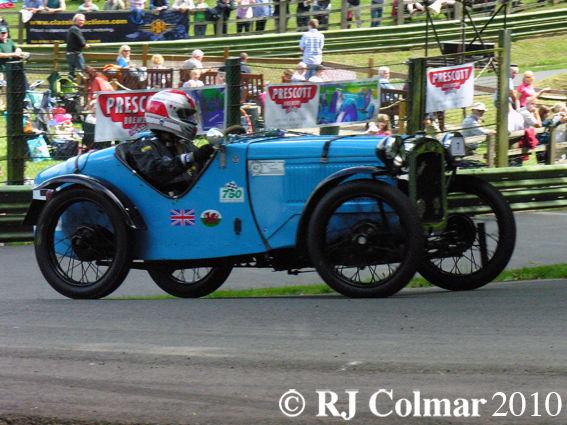
Above Miss Katherine Everett, 1930, Austin 7 Ulster, Prescott.

The plans for the 328’s engine first built in 1936 were appropriated as war reparations by HJ Adlington who was both in the British Army and Managing director of BAC Cars in 1947. The 328 engines designer Fritz Fiedler was also persuaded to move to England where he continued to develop the engine for the Bristol Aeroplane Company cars sold under the new ‘Bristol’ brand, thus the Austin 7 747 cc / 45 cui engine can be seen to be of the great, great, grand father of the Bristol marque which used hemi head 6 cylinder engines derived from the 1936 BMW 328 from 1947 to 1961.

I hope that wasn’t too convoluted or painful.
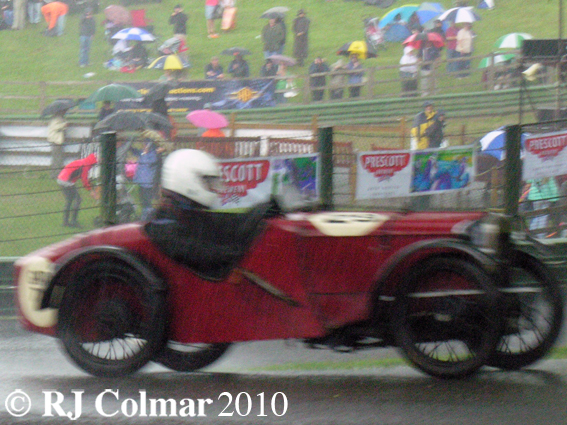
Above Edward Williams, 1930 Austin 7 Rolt Ulster, Supercharged, VSCC Prescott.

Rewinding back to 1927, Sir William Lyons took the basic Austin 7 and made a high end body for it which sold as the Austin Seven Swallow, moving the Swallow Sidecar Company from side car manufacture into motor car manufacture. In 1945 the Swallow Sidecar Company was renamed the Jaguar Car Company.
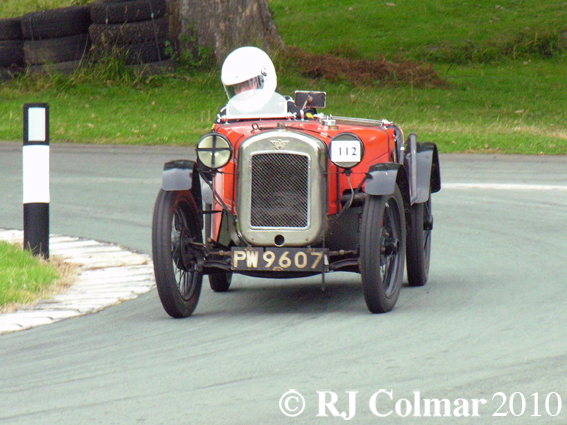
Mark Lance, 1930 Austin 7 Ulster TT Replica, VSCC Loton Park.

After WW2 many Austin 7’s were converted into specials as there were not enough new cars to meet demand in England. One of those converting an Austin 7 into a special was Colin Chapman who gave his special a now popular and familiar name Lotus Mk1.
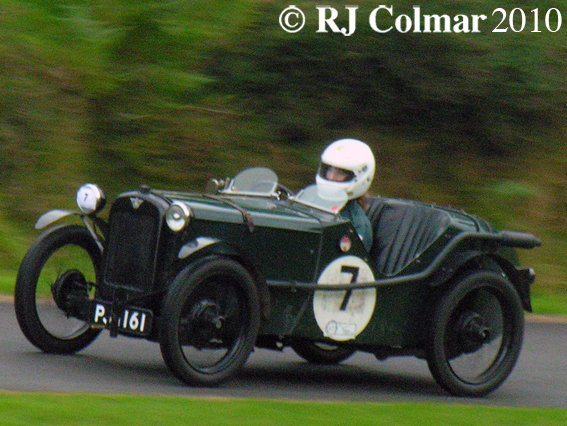
Above Ms Penny Jones, 1931, Austin 7 Ulster Replica, VSCC Loton Park.

The Austin 7 leant it’s name to another influential vehicle the original Austin Mini in 1959 which was originally marketed as the ‘Austin Seven’ and ‘Morris Mini Minor’.
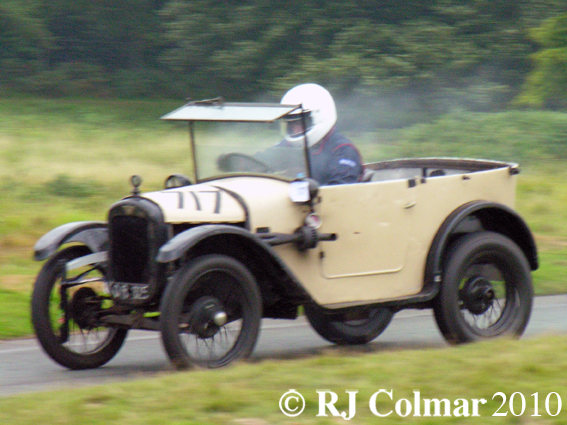
Above Benjamin MARCHANT, 1928 Austin 7 Chummy, supercharged, VSCC Loton Park.

I respectfully suggest that the humble little Austin Seven, which the Austin board only reluctantly agreed to back, became, through it’s role in the development of four prestige automotive manufacturers, one of the most influential vehicles of all time.

Thanks to Roger French and Julian Hunt at TNF for their help identifying a couple of these vehicles, to Tim Murray for his assistance identifying the Chummy and to everyone else for their time and patience, tomorrow I have the first instalment of another two part blog about an absolutely stunning replica of a vehicle which shines in one of my favourite stories about Le Mans, debutantes & underdogs, wishing everyone a fabulous Friday, don’t forget to come back now ! Class Dismissed 🙂
Share

The father of BMW, Jaguar, Bristol and Lotus cars – Austin 7 Part 1/2.

The father of BMW, Jaguar, Bristol and Lotus cars – Austin 7 Part 1/2.

Above, Chris Smith, 1925 Austin Brooklands Replica, Loton Park.

Today I’d like to introduce a very special little vehicle, the Austin 7 in my humble opinion the influence of this vehicle is so far reaching that I am going to make this my very first two part blog, I hope you’ll bear with me and consider the time and space I have dedicated to this model well spent. I’ll start today by introducing the model and tomorrow I’ll consider it’s bewilderingly far reaching legacy on European automotive history

Above, Ms Hannah Enticknap, 1928, Austin 7 Ulster Special, Loton Park.

The truth is so much stranger than fiction. Consider the humble little Austin 7 with a 6’ft 3″ wheel base and track of 3’6″ powered by a 10hp 747 cc / 45 cui sidevalve engine that complete weighed less than half that of a Model T Ford when it hit the streets in 1922 with rear brakes operated by foot and front brakes operated by hand !

Above, Frank Hernandez, 1928 Austin 7 Brooklands Streamline, Loton Park.

Sir Herbert Austin acting against the wishes of his own board threatened to take the ‘7’ concept to rivals Wolseley before putting his own money into the development of the ‘7’ which was completed with draughts man Stanley Edge at Sir Herberts home Lickey Grange.

Above Matt Johnson, 1928, Austin 7 Ulster Supercharged Special, Loton Park, 2010.

Investment repayments and royalties on Sir Austin’s patents arising from the Austin 7’s innovations amounted to £ 2.10 on every vehicle sold on what emerged to be Britain’s first mass production car.

Above Doug Bukin, 1929 – 1932, Austin 7 Ulster Special, Prescott, 2010.

Over the 14 years the Austin 7 was in production 40 different body styles were introduced including 2 and 4 seaters using aluminium, fabric and steel in tourer, saloon, cabriolet. sports, vans and a Coupe style.

Above Tom Hardman, 1929, Austin 7 Ulster B & Q Special, Loton Park, 2010.

In 1923 2500 Austin 7’s were built, small fry in terms of the numbers of Model T’s built and when production ceased in 1939 the 290,000 units built was hardly hot potatoes in terms of numbers against Detroit’s finest yet the Austin 7 deserves it’s place in British motoring history for being Britain’s first mass production car.

Above Gary Bishop, 1929, Austin 7, Blaue Maus Special, Prescott, 2010.

Thanks for popping by, look forward to sharing Part 2 on the Austin 7’s legacy and it’s tomorrow, don’t forget to come back now !

Share
