Tag Archives: Brooklands

Rambo Lambo – Lamborghini LM002

The origins of the Lamborghini LM002 permanent all wheel pick up lie in a prototype rear engined Chrysler powered Armored Reconnaissance Scout Vehicle built by FMC Corporation (Food Machinery and Chemical Corporation) called the XR311. Under the direction of Lamborghini’s new owners Georges-Henri Rossetti and René Leimer Lamborghini took on a contract to develop a Armored Reconnaissance Scout Vehicle for Mobility Technology International (MTI) who, unknown to Lamborghini, passed on plans for the new vehicle that “borrowed” heavily from the prototype FMC XR311.

Lamborghini LM002, Auto Italia, Brooklands

When the prototype Lamborghini Cheetah with a larger Chrysler motor in the back was announced in 1977 it immediately triggered legal action from FMC against MTI and Lamborgini and the project was abandoned after it had been demonstrated but before it was submitted to the US Military for testing. The US Military contract for which the Cheetah was built to compete for was won by AM General and their M998 Series High Mobility Multi-Purpose Wheeled Vehicle or HMMWV also known as Humvee which would find a civilian application known as the Hummer.
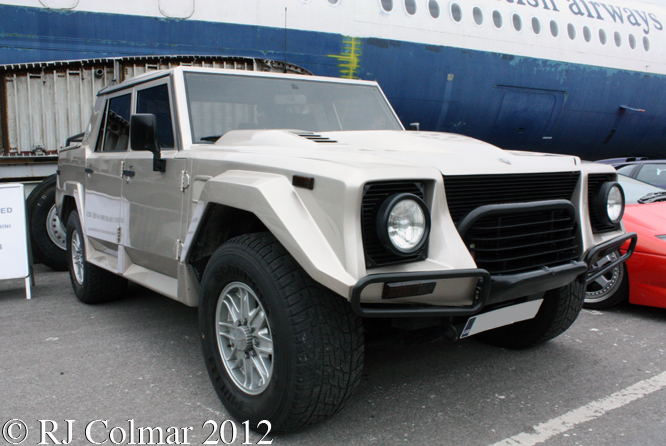
Lamborghini LM002, Auto Italia, Brooklands

Lamborghini meanwhile went bankrupt in 1978 and was put into the care of Swiss food entrepreneurs Jean-Claude and Patrick Mimran by the Italian courts in 1980. Under their stewardship a second all wheel drive prototype LM001 was developed in 1981 now powered by a rear mounted AMC motor. It was soon realised this had the same handling issues as the Cheetah and so a front engined LMA002 (Lamborghini Militaria Anteriore) powered by 370hp V12 from the Countach super car.
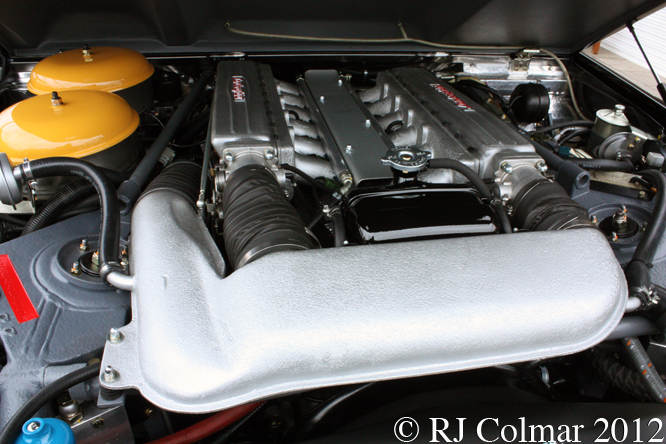
Lamborghini LM002, Auto Italia, Brooklands

By the time the LM002 went into production, in 1986 just before Lamborghini was acquired by Chrysler, it was fitted with a 450 hp version of the Countach V12 complete with 4 valve heads as seen above in this 1991 version. Later a even more powerful version of Lamborghini’s offshore powerboat marine V12 could also be specified.
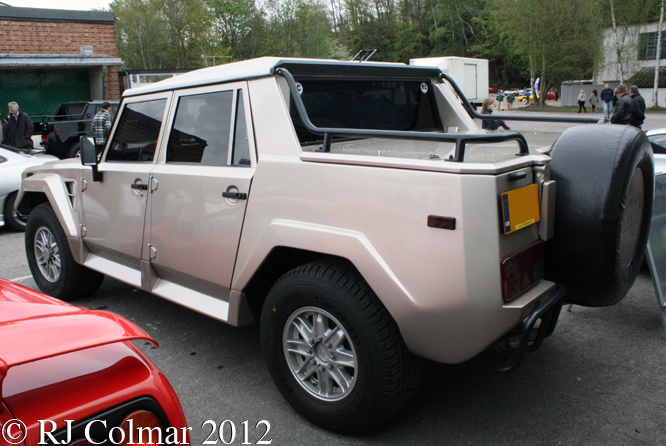
Lamborghini LM002, Auto Italia, Brooklands

Nickmaned the “Rambo Lambo” the only tyres on which the vehicle of this weight and performance can run were specially commissioned by Lamborghini from Pirelli and are marketed as Pirelli Scorpions which have a run flat capability. 328 LM200’s with air conditioning and leather interiors were built between 1986 and 1993 with none being sold for military service.

Thanks for joining me on this “Rambo Lambo” edition of “Gettin’ a li’l psycho on tyres” I hope you will join me again tomorrow when I shall be looking at a Countach the last in this series celebrating 50 years of Lamborghini car production. Don’t forget to come back now !

Brighton Speed Trials Under Threat of Permanent Cancellation !

In their infinite wisdom, Brighton & Hove City Council are seeking to ban the Brighton Speed Trials from 2014.

If you care about speed and or motorsport history, please sign this linked petition to save Brighton Speed Trials in 2014 and beyond.

It’s a faf to Register before signing, but relatively painless compared to loosing the event which has been run with few interruptions since 1905.

You do not need to be resident in Brighton or even the UK to sign.

Thanks and please spread the word through whatever social media you have at your disposal.

Share

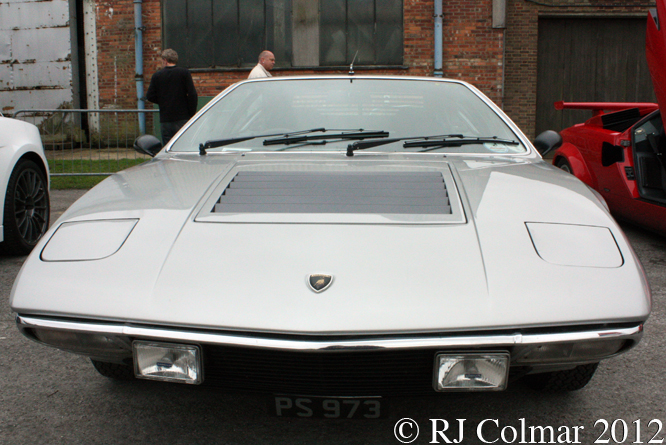
It’s a Lamborghini Philistine – Lamborghini Urraco 3000

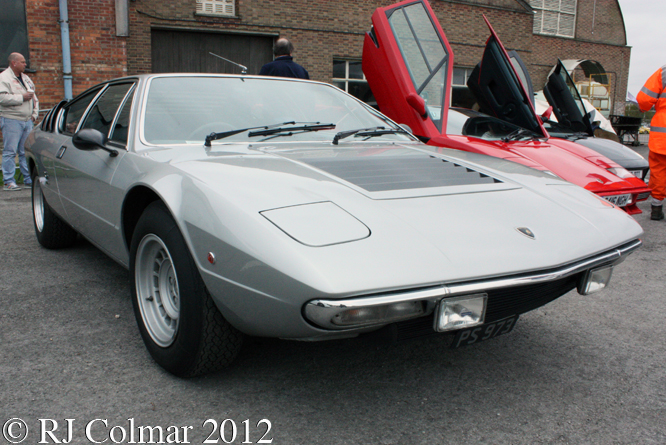
Named after a small breed of fighting bull the 2+2 Lamborghini Urraco Coupé was Lamborghini’s first V8 powered car, built to compete with the Ferrari Dino 308 GT4.

Lamborghini Urraco, Auto Italia, Brooklands

The Urraco was first shown to the public in 1970, but was not available for sale to the public until 1973 when the Dino 308 GT4 also went on sale.

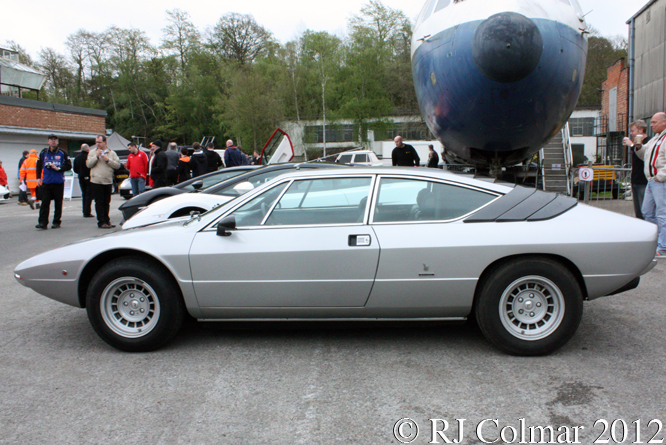
Lamborghini Urraco, Auto Italia, Brooklands

The transverse mounted V8 motor was available in 3 sizes P200 2 litre / 122 cui with 180 hp, P250 2.5 litre / 147 cui with 217 hp and P300 3 litre / 183 cui with 247 hp.

Lamborghini Urraco, Auto Italia, Brooklands

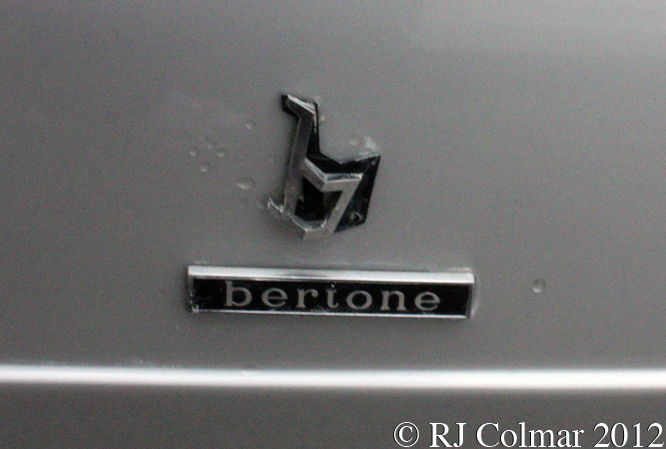
Like the Dino 308 GT 4 the Urraco carries Bertone bodywork designed by Marcello Gandini

Lamborghini Urraco, Auto Italia, Brooklands

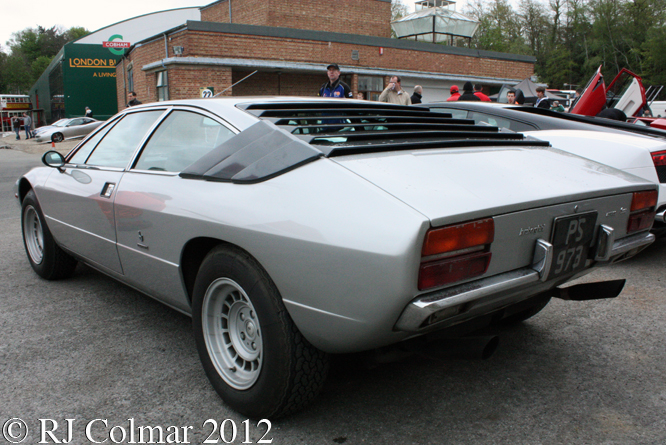
The top end P300 model as seen here at Auto Italia Brooklands was capable of reaching 62 mph from rest in 5.6 seconds and a top speed of 162 mph.

Lamborghini Urraco, Auto Italia, Brooklands

Allegedly when James May tested one of these cars for the Top Gear TV program he was heard to tell a passer by “It’s a Lamboghini” and muttered under his breath “Philistine”.

Lamborghini Urraco, Auto Italia, Brooklands

Of the 797 Urracos built between 1973 and 1979 66 were P200s, 520 were P250s, 190 were P300s and 21 US spec P250 Type 111s.

Thanks for joining me on this “It’s a Lamborghini Philistine” edition of “Gettin’ a li’l psycho on tyres”, I hope you will join me again tomorrow when I’ll be a successful Special built and raced in Zambia. Don’t forget to come back now ! Wishing all GALPOT readers and contributors seasons greetings and best wishes for the new year.

Brighton Speed Trials Under Threat of Permanent Cancellation !

In their infinite wisdom, Brighton & Hove City Council are seeking to ban the Brighton Speed Trials from 2014.

If you care about speed and or motorsport history, please sign this linked petition to save Brighton Speed Trials in 2014 and beyond.

It’s a faf to Register before signing, but relatively painless compared to loosing the event which has been run with few interruptions since 1905.

You do not need to be resident in Brighton or even the UK to sign.

Thanks and please spread the word through whatever social media you have at your disposal.
Share

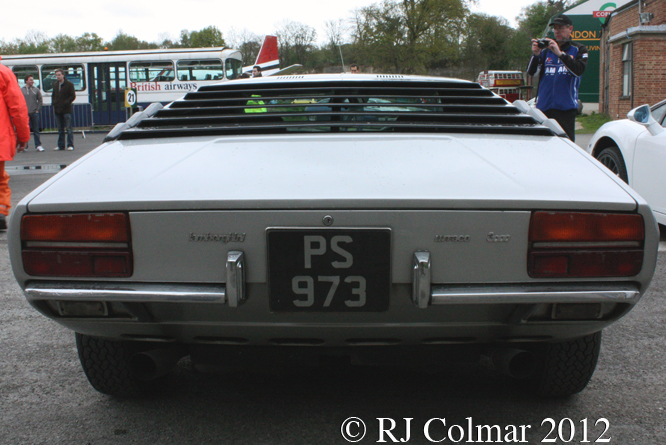
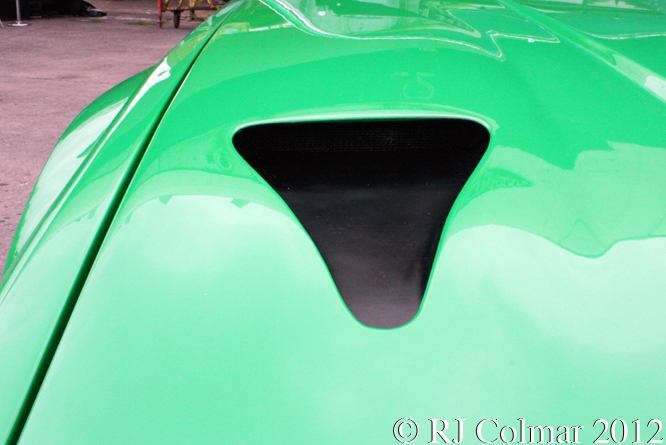
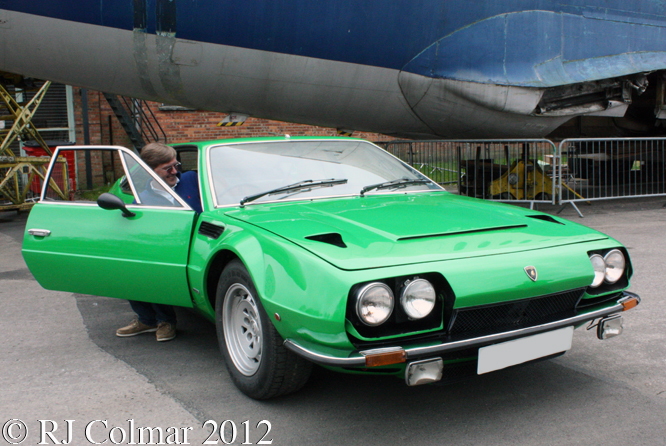
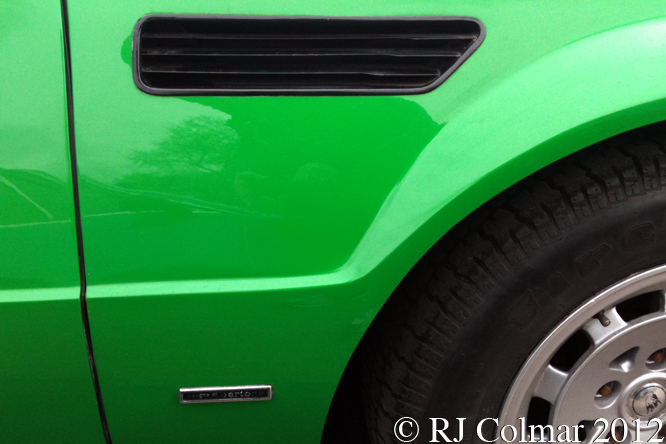
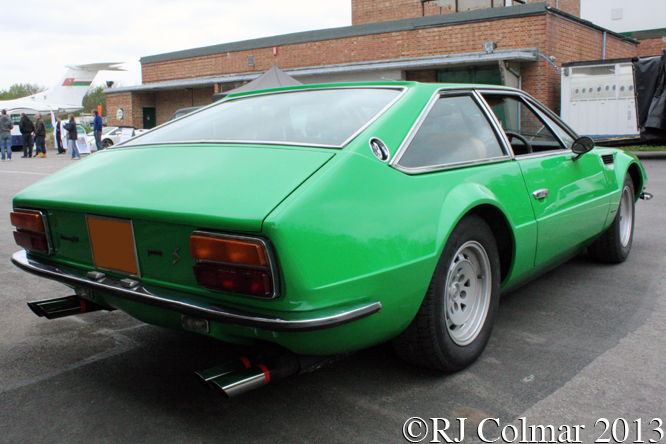
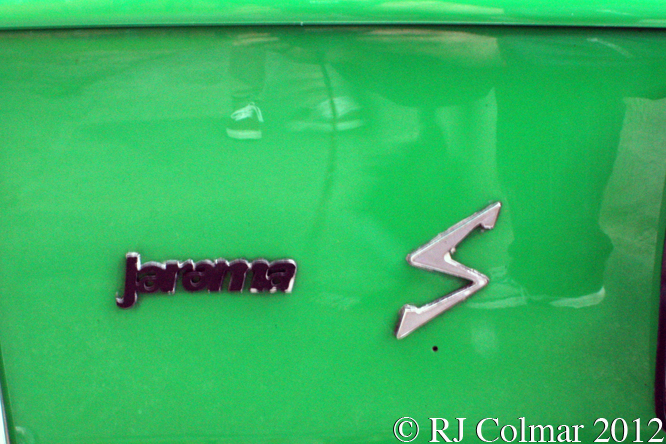
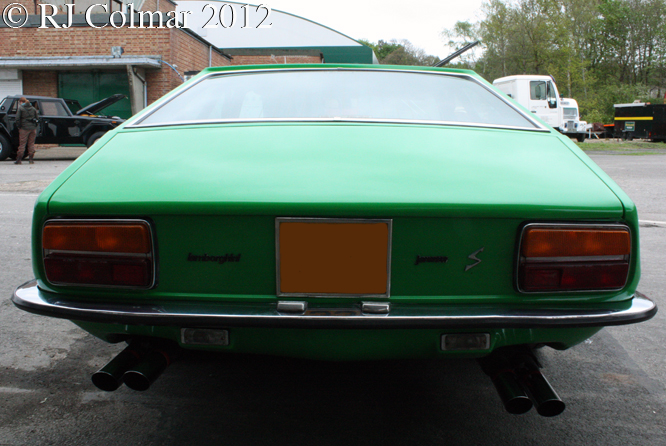
Short Sword – Lamborghini Jarama S

When Lamborghini found their Islero model would no longer meet US safety and emissions regulations mandated from 1970 they used the opportunity to develop today’s featured model the Jarama.

Lamborghini Jarama S. Auto Italia, Brooklands

The Jarama sports Coupé was designed around a shortened Lamborghini Espada platform.

02 Lamborghini Jarama S 6208sc

The bodywork was designed by Marcello Gandini working for Bertone.

Lamborghini Jarama S. Auto Italia, Brooklands

Interestingly the headlight covers do not pop up but instead fold down into a recess below the light units.

Lamborghini Jarama S. Auto Italia, Brooklands

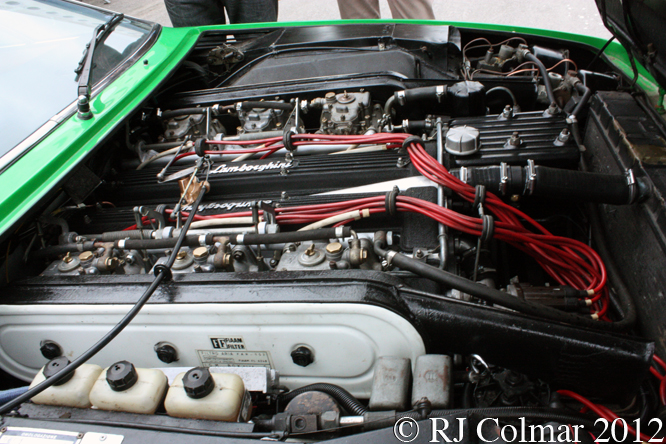
Like the Espada the original incarnation of the Jarama was powered by the same 350 hp version of the 4 litre / 244 cui Lamborghini V12 motor.

Lamborghini Jarama S. Auto Italia, Brooklands

From some angles the Jarama looks similar to another Gandini design, the slightly less aggressive ISO Lele which was launched the year before the Jarama in 1969.

Lamborghini Jarama S. Auto Italia, Brooklands

In 1973 revisions were introduced which included a 365 hp version of the V12 and options including removable roof panels, power steering, automatic transmission were available with the model now known as the Jarama S.

Lamborghini Jarama S. Auto Italia, Brooklands

The Jarama name was not taken from the race track outside Madrid, rather the Jarama Bull fighting region.

Lamborghini Jarama S. Auto Italia, Brooklands

From 1970 to 1973 Lamborghini built 176 original variants of the Jarama and from 1973 to 1976 152 Jarama S models as seen in these photograph’s taken at last years Auto Italia held at Brooklands.

Thanks for joining me on this Short Sword edition of “Gettin’ a li’l psycho on tyres” I hope you will join me again tomorrow when I’ll be looking at a Pikes Peak Special. Don’t forget to come back now !

Share

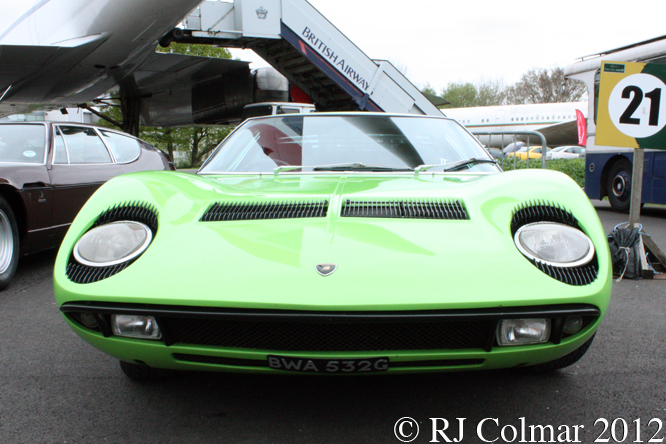
After Hours Bull – Lamborghini Muira S

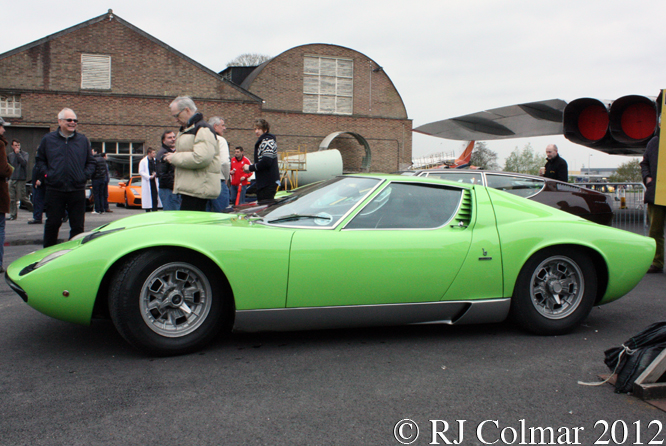
Gian Paolo Dallara, Paolo Stanzani, and Bob Wallace put in the hours to develop the mid engined P400 chassis that would form the basis of the Lamborghini Muira on after hours because Ferruccio Lamborghini had expressed his preference for considerably more sedate front engined GT cars his company had started manufacturing in 1963.

01 Lamborghini Miura S 6267sc

The bare prototype P400 chassis with it’s transverse V12 engine and gearbox mounted ahead of the rear wheels received a stellar reception at the 1965 Turin Motor Show and Ferruccio Lamborghini saw the value of allowing the vehicle to be developed as nothing more than a potential marketing tool.
02 Lamborghini Miura S 1415sc

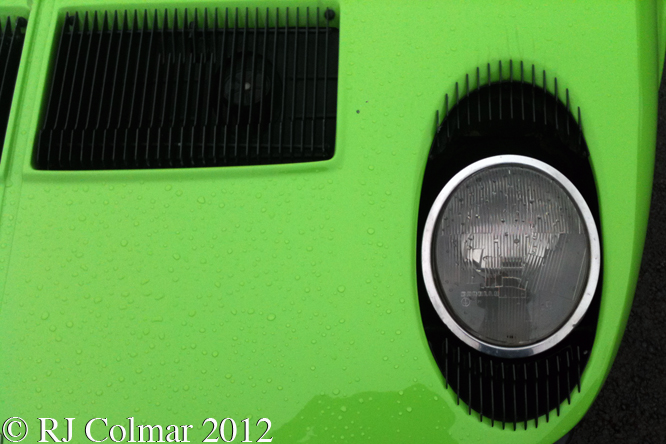
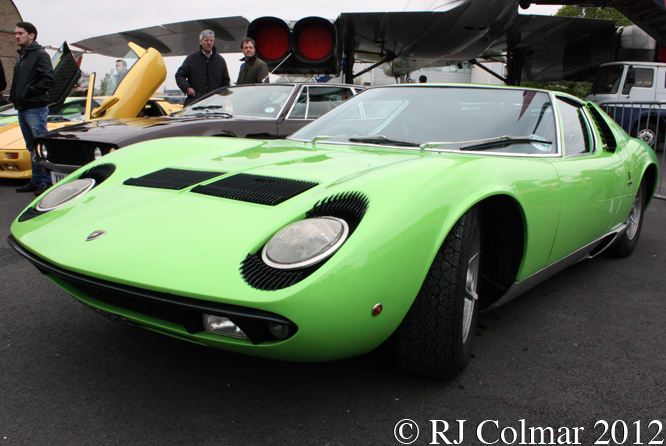
By the 1966 Geneva Motor Show Marcello Gandini at Bertone had just completed the sleek lined body that marked the P400 out as an icon of it’s time, to my eye’s it is the kind of shape the Ford GT and later GT40 might have become, had it been built in Italy rather than Slough under the influence of Dearborn. Notably the P400’s body had been finalised so late that it appeared in Geneva with ballast in place of the engine, as no one was sure the engine would fit under the super slim body.
03 Lamborghini Miura S 6268sc

The P400 was ready for sale later in 1966 and 275 of the original 375 hp versions were made up until 1969.

04 Lamborghini Miura S 6269sc

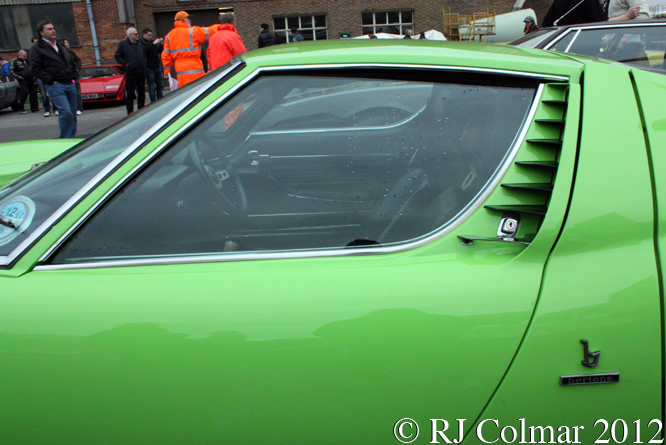
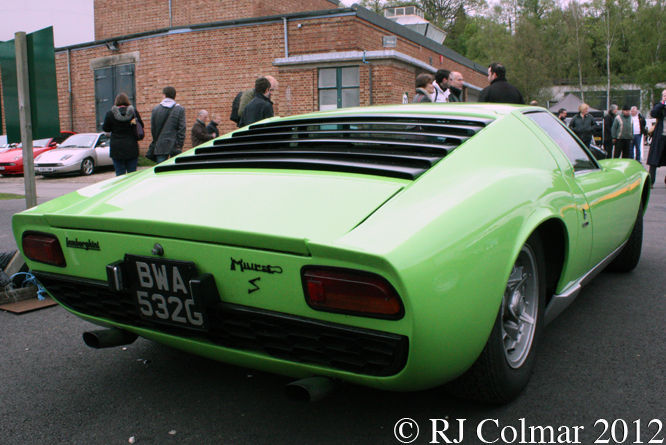
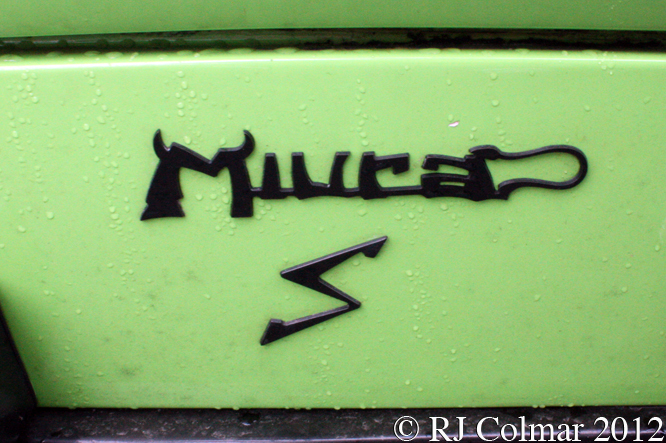
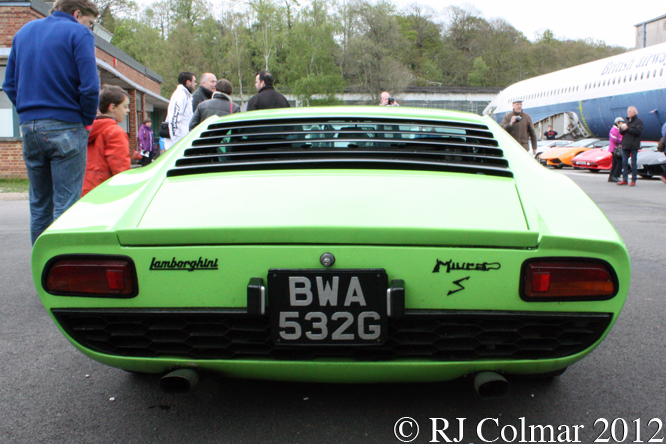
In November 1968 a second type P400S also known as the Miura S was launched featuring 20 hp more and a variety of external and internal trim differences including chrome trim, electric windows, new rocker control switches and small improvements to the luggage capacity.

05 Lamborghini Miura S 6270sc

Muira S owners included Frank Sinatra and Miles Davis, the jazz legend crashed his under the influence of cocaine which resulted in him breaking both his ankles in 1972, coincidentally the year the last of the 762 Muira’s of all types was built.

06 Lamborghini Miura S 6265sc

The 1969 film The Italian Job depicts a Muira being driven at high speed into a dark tunnel inside which a Mafioso operated front end loader was waiting to catch the car and occupant which was then unceremoniously dumped down a ravine.

07 Lamborghini Miura S 6266sc

Today’s featured car, seen at Auto Italia Brooklands last year, was built as a white P400, seen in this link with singer Sandie Shaw, but converted to an Apple Green Muira S spec for the owner Justin de Villenueve who turns out to be model Twiggy’s manager Nigel Davis.

08 Lamborghini Miura S 6264sc

Later on the car is said to have belonged to one Bernard Charles Ecclestone of Formula One fame. In 1990 the center of the car was badly damaged by fire while the car was disassembled. The whole lot was returned to Saint Agata and returned to factory specifications. The current owners family bought the car in 2000 and he says that while it is not the easiest vehicle in the world to drive for someone of his stature the “vista ahead is to die for.”

Thanks for joining me on this “After Hours Bull” edition of “Gettin’ a li’l psycho on tyres” I hope you will join me again tomorrow for a trip to Gordano Services on the M5 for a little competitive classic motorsport. Don’t forget to come back now !

Share

Bertone With A Hint Of Michelotti – ISO Rivolta IR

Welcome to the first December 2013 edition of “Gettin’ a li’l psycho on tyres”. This months Sunday posts will feature five ISO Rivolta’s to celebrate the 60th Anniversary of the first ISO Rivolta cars the first of which was the Isetta perhaps the best known examples of which were manufactured under licence by BMW.

ISO Rivolta IR, Auto Italia, Brooklands,

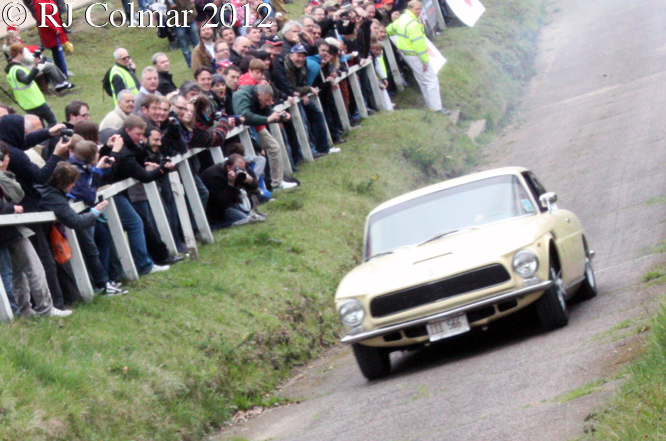
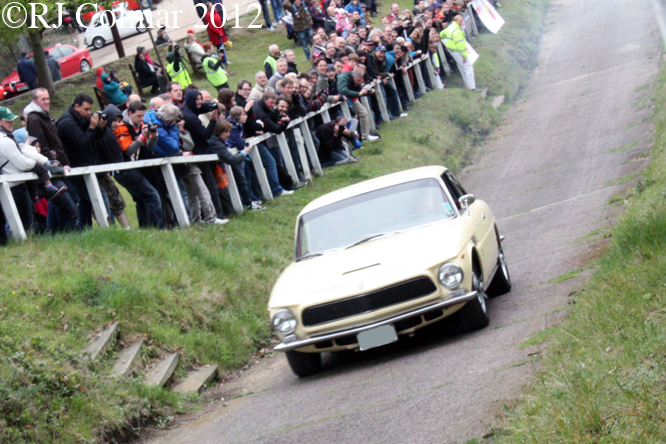
By the 1960’s Renzo Rivolta set his ambitions a little higher and decided to build a vehicle which would compete against the FIAT 2300 Coupé> Rivolta commissioned Bertone to design a body which would enclose independent front suspension, a de Dion rear axle and a Chevrolet Corvette V8 motor which over the years of production from 1962 to 1970 would produce between 300 – 350 hp.

ISO Rivolta IR, Auto Italia, Brooklands,

The recirculating ball steering required five turns lock to lock on the car which had a, large, turning circle of 12.5 m / 41ft. The car was fitted with a leather interior which included a standard floor mounted 4 speed manual gear stick.

 ISO Rivolta IR, Auto Italia, Brooklands,

The stylish IR touring car appears to owe a nod of inspiration to the three Vignale built Ferrari Coupes; 212 Inter, 375 America and 250 Europa who’s design was credited to Giovanni Michelotti.

Dependent on the engine tuning option the rest to 60 mph time for an IR, like the one seen here at Auto Italia Brooklands, was in the 8 second range with a top speed of over 140mph quoted for the most powerful models.

Thanks for joining me on this “Bertone With A Hint Of Michelotti” edition of “Gettin’ a li’l psycho on tyres” I hope you will join me again tomorrow when I’ll be looking at a cute li’l pick up from France. Don’t forget to come back now !

Share

Cubic Inches – Bentley Speed Six #HM2689

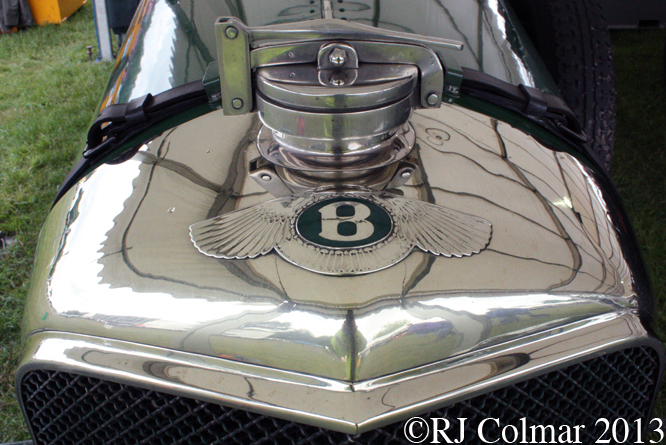
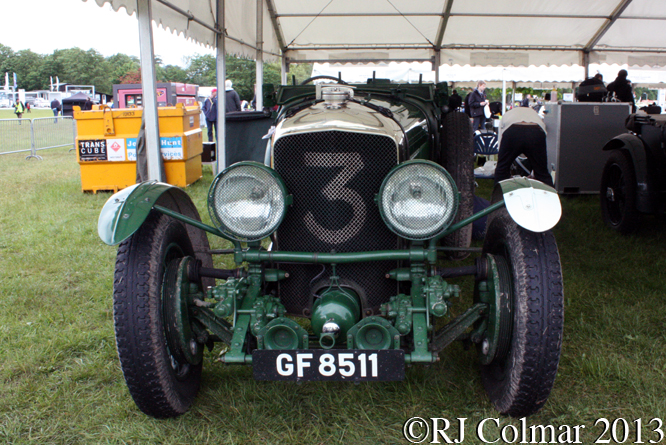
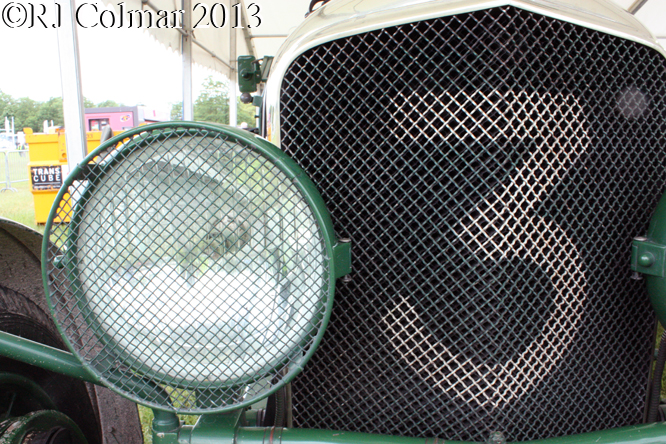
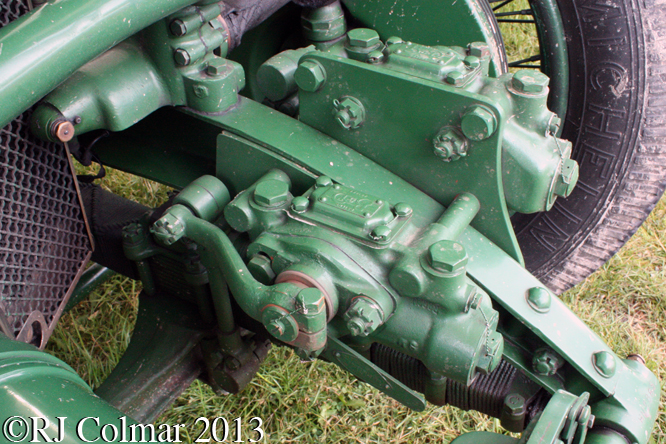
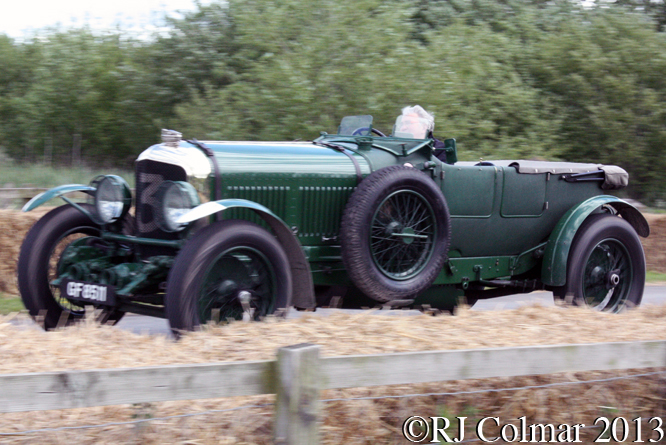
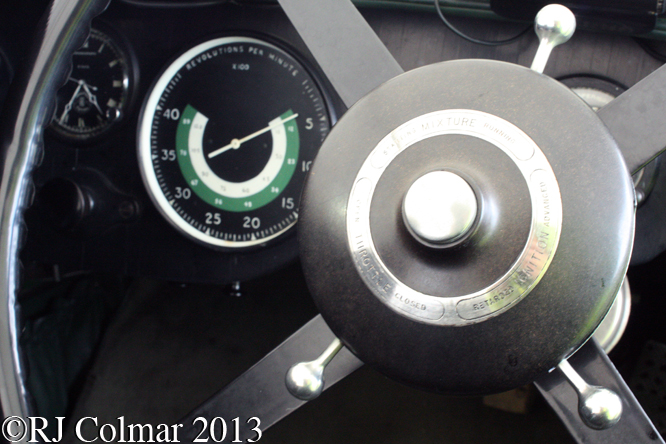
At the weekend I popped up to the Cholmondeley Pageant of Power where several Bentley’s were present that have taken part in Le Mans 24 hour races including today’s featured example chassis #HM2869 which was driven by Sammy Davis and Clive Dunfee in the 1930 race.

Bentley Speed Six, Cholomondeley Pageant Of Power

The Bentley Speed Six was the high performance version of the Bentley 6 1/2 litre first seen in 1926. The 6 1/2 litre was conceived to challenge the Rolls Royce Phantom as a preeminent limousine.

Bentley Speed Six, Cholomondeley Pageant Of Power

Launched in 1928 the Speed Six used the same 24 valve twin cam, twin spark 6,597 cc / 402.6 cui six cylinder motor as the Bentley 6 1/2 litre but tuned to give 160 – 180 hp, up from the standard 147 hp. This motor was considered the jewel in the crown of W.O. Bentley’s portfolio.

Bentley Speed Six, Cholomondeley Pageant Of Power

The Speed Six of Woolf Barnato “Old Number One” is one of a handful of cars to have won the Le Mans 24 hour race twice. In 1929 Barnato shared the driving with “Tim” Birkin leading home three Bentley 4 1/2 litre cars. The following year Baranto and Glen Kidston led home a Speed Six one-two finish with Frank Clement and Richard Watney at the wheel of the second placed car.

Bentley Speed Six, Cholomondeley Pageant Of Power

Driving a Mulliner Saloon bodied Speed Six Barnato also won a bet with his pals that he could arrive at his club in London faster than Le Train Bleu could cover the distance between Cannes on the French Riviera and the cross channel port of Calais in Northern France. With his secretary Dale Burn as relief driver he won the bet of £100 by four mins, but was heavily fined by French authorities for racing on public roads.

Bentley Speed Six, Cholomondeley Pageant Of Power

The Mulliner Saloon Speed Six with which Barnato won the bet is often incorrectly depicted and confused with a Gurney Nutting Sportsman Coupé Speed Six which Barnato named the Blue Train Special to commemorate his feat. The Mulliner Saloon body on the car Barnato and Burn drove the 570 miles from Cannes to London has recently been restored to the original chassis by it’s current owners Bruce and Jolene McCaw, who also own the Barnato’s Gurney Nutting Coupé.

Bentley Speed Six, Cholomondeley Pageant Of Power

Despite proving W.O’s maxim “that there is no substitute for cubic inches” over the 4 1/2 litre super charged Blower Bentley it is the faster but less reliable latter car that is the better known instantly recognisable “icon” of it’s day.

Clive Dunfee crashed #HM2689 out of the 1930 Le Mans 24 hours on laps 22, the month before Le Mans race Clive and Sammy drove the car car to a 2nd place finish in the Brooklands Double Twelve. “Tim” Birkin and Jack Barclay shared #HM2689 at the Brooklands Double Twelve in 1931 but retired with engine failure.

#HM2689 has been owned by Peter Neumark for the last twenty years and he assured me “it is not going anywhere” in the future when I spoke to him on Saturday.

Thanks for joining me on this “Cubic Inches” edition of “Gettin’ a li’l psycho on tyres” I hope you will join me again tomorrow when I’ll be looking at the 1978 Le Mans winner. Don’t forget to come back now !

Share

Forced Induction Push – Bentley 4 1/2 litre #DS3573

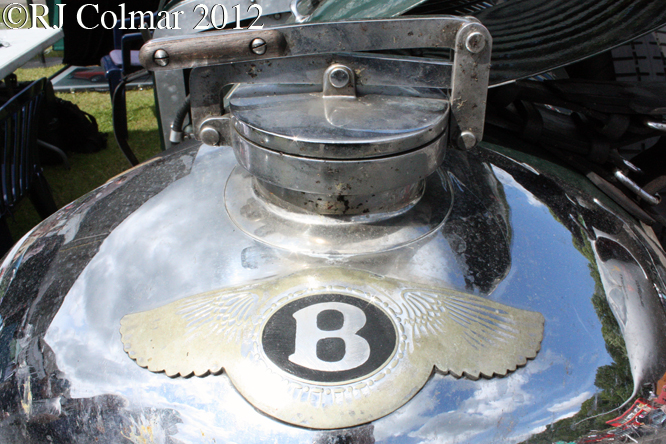
Following the disappointments of it’s Le Mans appearances from 1925 to 1926, after the success with the 3 litre / 183 cui cars in 1924 Bentley employed his maxim ‘there is no substitute for cubic inches’ to his new prototype Le Mans challenger, known as “Old Mother Gun”, for 1927 by fitting it with a 4 1/2 litre / 319.5 cui motor.

Bentley 4 1/2 litre, Brooklands Double 12

During the 1927 running of the endurance classic there was a six car pileup involving five of the leading cars; two Théophile Schneiders, an Ariés two three litre Bentleys and the 4 1/2 litre Old Mother Gun which Leslie Callingham rolled into a ditch having chosen to avoid a head on collision.

Bentley 4 1/2 litre, Brooklands Double 12

With the 4 1/2 litre car out of the running the race was won by the 3 litre Bentley of Dr. Dudley Benjafield and Sammy Davis, the last car to arrive at the scene of the accident, after repairs had been effected that included the judicious use of string to hold one of the front wings and the team used a pocket torch to replace the damaged head light !

Bentley 4 1/2 litre, Brooklands Double 12

“Old Mother Gun” was subsequently repaired and Woolf Barnato driving with Bernard Rubin came out winners of the 1928 Le Mans 24 hours after a race long duel with the more powerful 8 cylinder Stutz DV16 Blackhawk driven by F Éduoard Brisson and Robert Bloch.

Bentley 4 1/2 litre, Brooklands Double 12

By this time Sir Henry “Tim” Birkin” who shared the forth placed 4 1/2 litre Bentley with Jean Chassagne at Le Mans in 1928 was convinced the way forward was to build light cars with super chargers. With the tacit agreement of Bentley’s chairman Woolf Barnato and independent finance from Dorothy Paget. Birkin set about building 55 supercharged four cylinder 4 1/2 litre Bentley’s, commonly referred to as Blower Bentleys, against the wishes of designer W.O. Bentley who simultaneously built a new Speed Six model for 1929 complete with straight six cylinder 6 1/2 litre 396.5 cui motor.

Bentley 4 1/2 litre, Brooklands Double 12

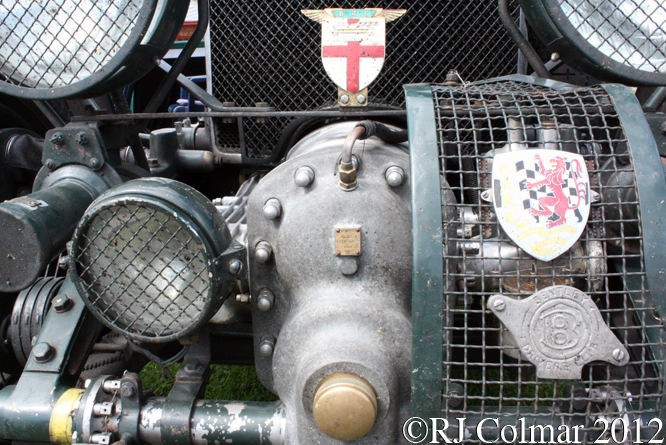
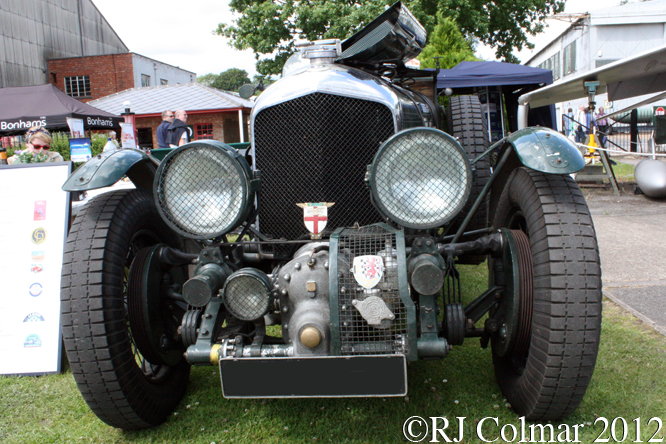
Such was W.O. Bentley’s opposition to the idea of supercharging, which had been tried on a 3 litre Bentley built 1926/7, that he refused to countenance the modification of the Bentley 4 1/2 litre motor in any way that would allow Birkin to mount the supercharger along side the 4 cylinder block with the result that the only place the superchager could be fitted was ahead of the front axle line so that it could be driven from the front of the crankshaft.

Bentley 4 1/2 litre, Brooklands Double 12

This mounting position and it’s attendant weight adversely affect the cars propensity to understeer / push where as the new Speed Six had all the weight of it’s motive power mounted between the axles.

Bentley 4 1/2 litre, Brooklands Double 12

Ironically the Speed Six model was ready before the Blower Bentley and Tim Birkin shared a Speed Six, known as Old Number One, with Woolf Barnato to easily win the 1929 Le Mans 24 hours ahead of three unsupercharged 4 1/2 litre Bentley’s.

Bentley 4 1/2 litre, Brooklands Double 12

The Bentley Blowers were ready for 1930 and three cars were entered by the Hon. Miss Dorothy Paget, including one for Sir Tim co driving with Jean Chassagne in the 1930 Le Mans 24 hours, but none were running at the finish. Woolf Barnato now sharing the Speed Six Old Number One with Glen Kidston meanwhile led home a Speed Six one two finish. Strategically playing the hare for the highly fancied supercharged 7.1 litre / 433 cui Mercedes Benz of Rudolf Caracciola and Christian Werner to catch and forcing the German car to run at a faster pace than would have been ideal, Birkins Bentley Blower contribute to the Mercedes Benz premature retirement and indirectly to Barnato and Kidston’s victory.

Bentley 4 1/2 litre, Brooklands Double 12

At the end of 1930 Dorothy Paget withdrew her support for Birkin’s Blowers and in 1931 despite 4 consecutive Le Mans Wins and 5 wins since 1923 Bentley was forced to sell out to Rolls Royce. This however was not quite the end of the Bentley Blower story as a special single seater Blower Bentley that Birkin has built in 1929, chassis HB3402 was just hitting it’s stride at Brooklands leaving the lap record at 137.96 mph in 1932.

Bentley 4 1/2 litre, Brooklands Double 12

In 1931 Sir Tim returned to Le Mans to co drive Lord Howe’s Alfa Romeo 8C 2300 LM and together they became the first drivers to win the 24 hour race with a supercharged car comfortably beating the much larger supercharged 7.1 litre Mercedes Benz SSK driven by Boris Ivanowski and Henri Stoffel by seven laps.

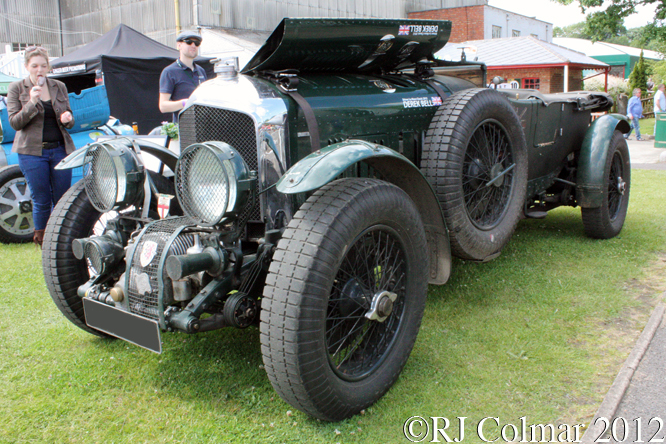
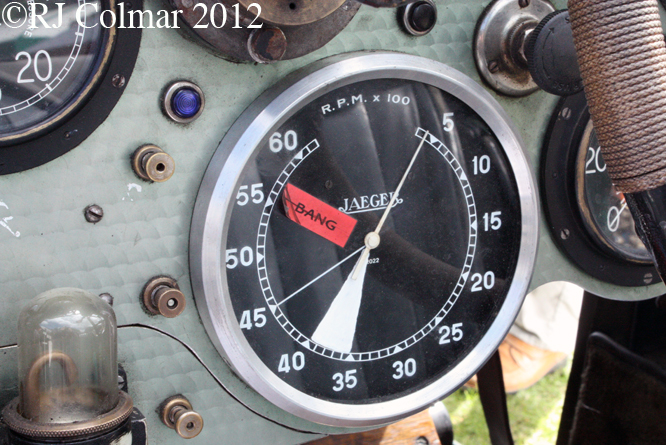
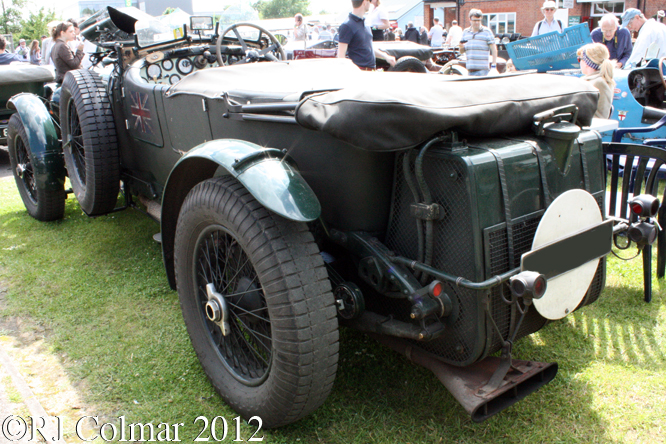
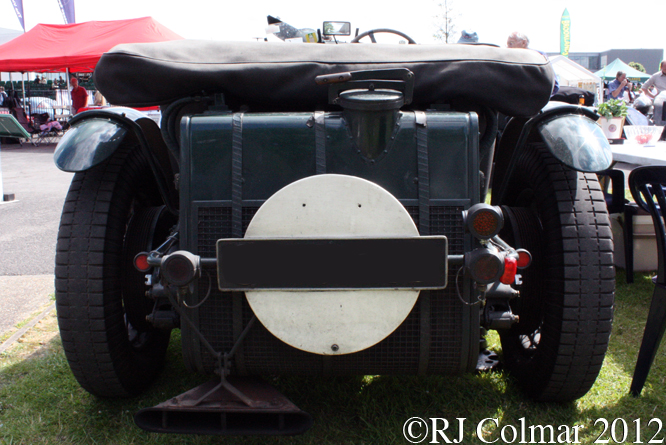
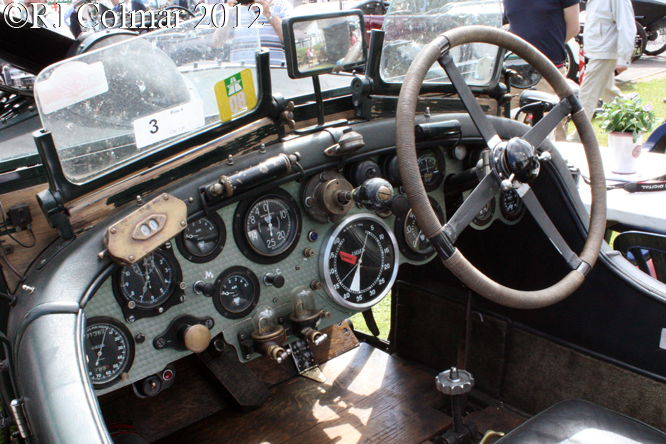
Today’s featured car looks and sounds like a Bentley Blower, but was supplied new in 1929 to Sir L.Lyle with a saloon / sedan body by HJ Mulliner with an unsupercharged 4 1/2 litre motor. The car was rebuilt with an open tourer body as seen today in 1973 when #DS3573 competed in the Scottish Weekend Whit Rally with flying colours.

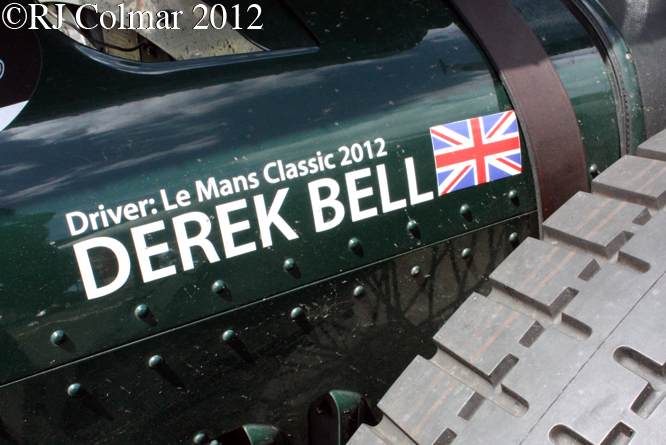
The supercharger appears to have been first seen on chassis #DS3573 in 2005. Just after these photo’s were taken at Brooklands last year, five time Le Mans winner, Derek Bell drove the car at the Le Mans Classic with owner Martin Overington supported by a three man pit crew, comprising three ex service men injured in combat, on behalf of the Misson Motorsport charity.

Thanks for joining me on this “Forced Induction Push” edition of “Gettin’ a li’l psycho on tyres” which happens to be the 1000th GALPOT posting. My thanks to all those who have contributed and stayed with me on this journey, especially those who have liked and spread the word on their social media pages. I hope you will join me for the first of the next 1000 GALPOT posts again tomorrow. Don’t forget to come back now !

Share