Tag Archives: Car

Magnesium DFV – Cosworth

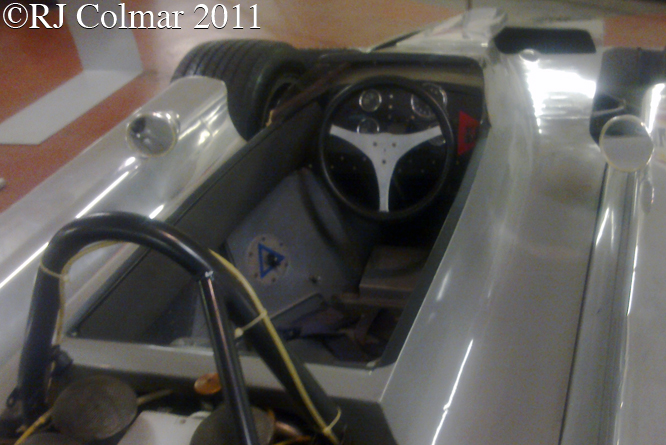
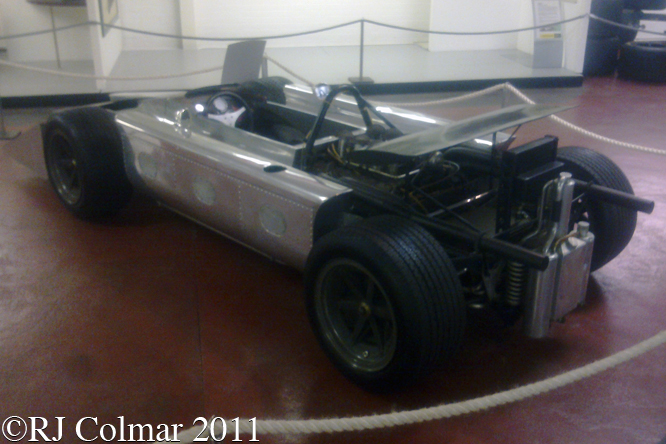
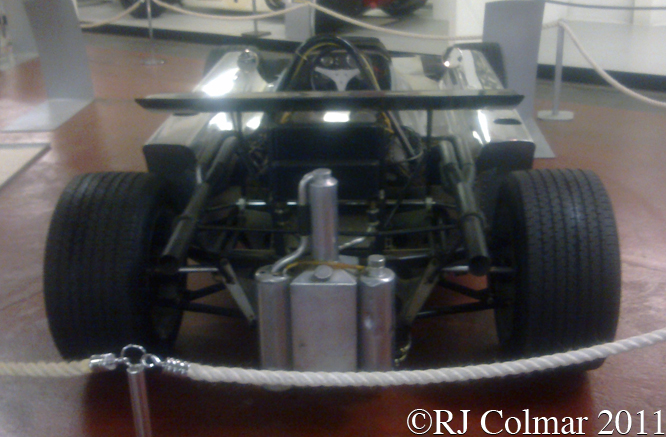
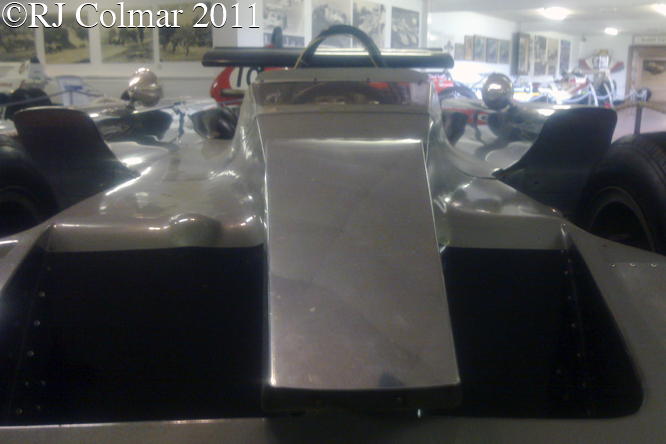
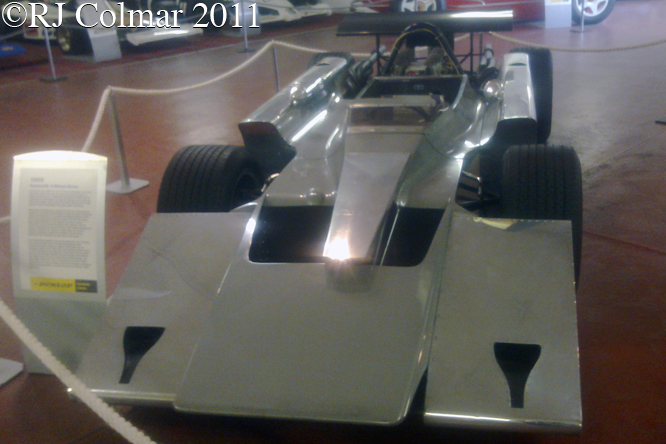
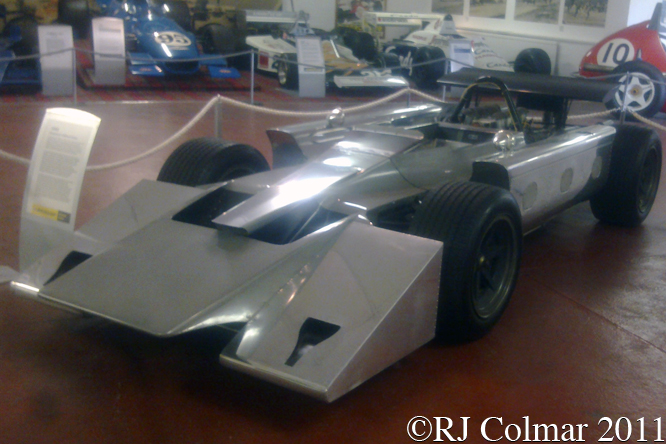
Looking like a cross between a 1923 Grand Prix Voisin Labatoire and a 1954 Lancia D50 the Cosworth Formula Car designed by Robin Herd.

Cosworth, Donington, Park Museum

Mike Costin and Keith Duckworth, the geniuses behind the Ford Cosworth DFV Formula One engine that dominated Formula One from 1968 to 1982, decided to engage former McLaren designer Robin Herd build a car which would maximise the advantages of their powerful DFV V8 in 1968.

Cosworth, Donington, Park Museum

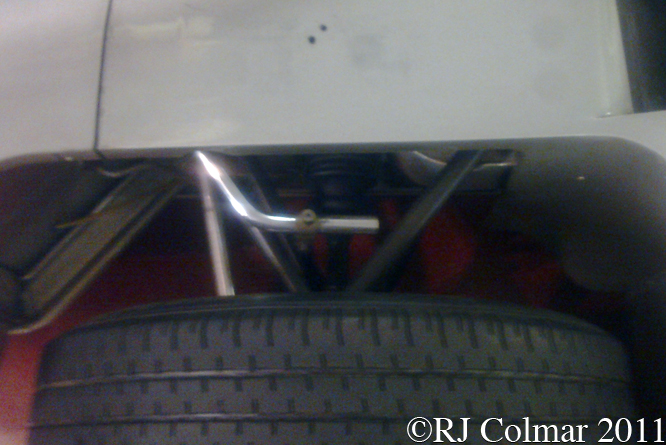
Herd took a more radical approach to the application of all wheel drive to Formula One than either Colin Chapman’s Lotus 63 or Jo Marquart’s McLaren M9A, although no where near as radical as the V12 powered MATRA MS 11 all wheel drive with hydraulic drive to all four wheels.

Cosworth, Donington, Park Museum

In order to keep the driver’s seat low and accommodate the drive shaft running from the motor and gearbox in the rear to the wheels at the front the driver was slightly offset from a central seating position.

Cosworth, Donington, Park Museum

The Cosworth was tested by Mike Costin, the ‘Cos’ in ‘Cosworth’, Brian Redman, Trevor Taylor and Jackie Stewart.

Cosworth, Donington, Park Museum

Trevor Taylor was penciled in to debut the Cosworth at the 1969 British Grand Prix, however as the testing had shown the car worked best with little or no drive to the front wheels the entry was withdrawn.

Cosworth, Donington, Park Museum

While the Cosworth shared the same 3 lite / 183 cui DFV motor design there was one essential difference between the Cosworth works unit and those supplied to Lotus and McLaren, the block was cast in magnesium to save weight over the aluminium cast DFVs supplied to Cosworth’s customers.

Cosworth, Donington, Park Museum

The Cosworth never did race, as BRM’s Tony Rudd had predicted after BRM’s experience with the all wheel drive BRM P67 all wheel drive would never work in Formula One, and after being demonstrated at the British Grand Prix at Brands Hatch in 1970 it found it’s way to the Donington Park Museum where it is seen in these photographs.

Thanks for joining me on this “Magnesium DFV” edition of “Gettin’ a li’l psycho on tyres”, I hope you will join me again tomorrow. Don’t forget to come back now !

Share

Musical Spares – Porsche 962C #006

The Porsche 962 was built in two specs, the original was the 1984 IMSA GTP spec which was a variation of the dominant Group C Porsche 956 sports car first seen in 1982. The 962 differed in two important aspects from it’s Group C cousin. First the 962 had a longer wheel base so that the drivers feet were behind the center line of the front axle and second IMSA mandated a single turbo while the Group C 956 ran more powerful twin turbo’s.
Porsche 962C, Le Mans, France

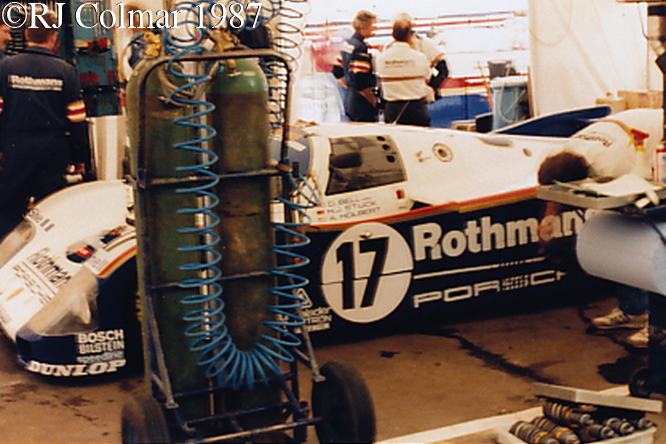
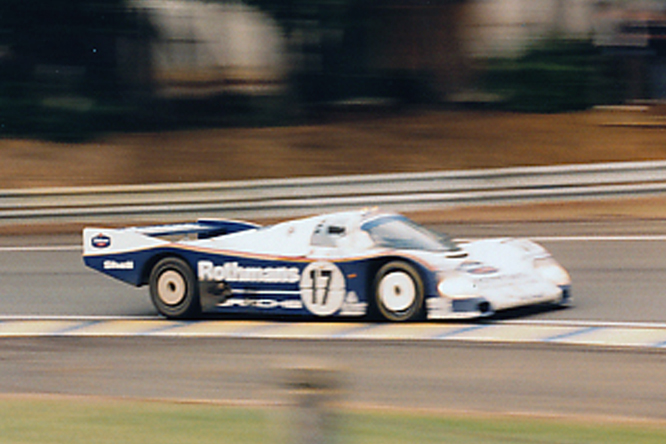
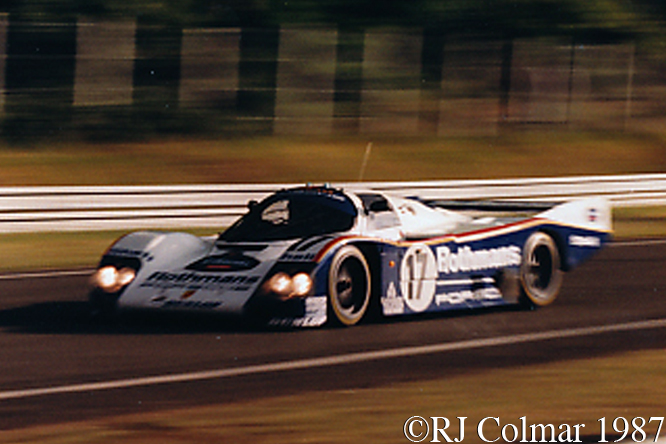
For 1986 the FIA mandated that Group C cars should follow the lead set by IMSA and have the drivers feet behind the the center line of the front axle line while making no changes to the engine regulations so the more powerful Porsche 962C came into being sweeping all before it much as the 956 and 956B had done. Derek Bell became the first driver to successfully defend his World Sports Car Drivers Championship won driving a 956B in ’85 and 962C in ’86. In 1986 Derek also won the Le Mans 24 hours for the forth time sharing his 962C with Hans Joachim Stuck and Al Holbert, Derek was also awarded the MBE for services to motorsport, a Royal honour which even Porsche AG noted on the door of Dereks #17 car as seen above at Le Mans in 1987.
Porsche 962C, Le Mans, France

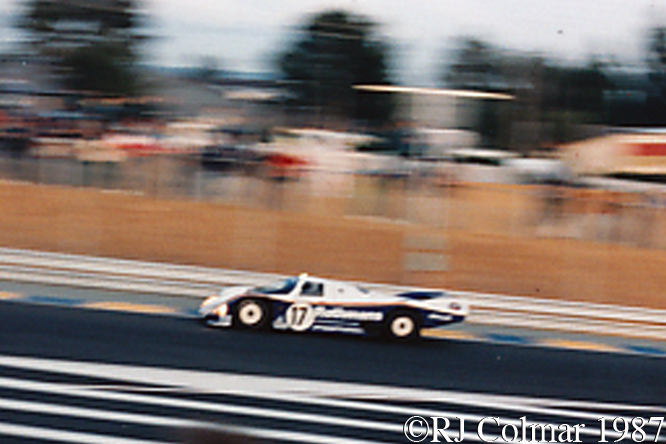
Going into Le Mans 1987 Derek Bell and Al Holbert were on a roll of three consecutive 24 hour race wins going back to Daytona ’86 where they shared an IMSA GTP 962 with Al Unser Jr. As mentioned above Bell and Holbert followed that up at Le Mans winning with Hans Stuck and made it a three peat of 24 hour victories at Daytona sharing Holberts Löwenbrau Porsche 962 with Unser Jr and Chip Robinson. Only a complete idiot would have bet against Bell, Stuck and Holbert claiming victory at Le Mans in 1987. The #17 chassis #006 seen in the rain above qualified 2nd on the grid by Hans Stuck next to the #18 chassis #008 which Bob Wollek qualified on pole.
Derek Bell, Hans Joachim Stuck, Le Mans, France

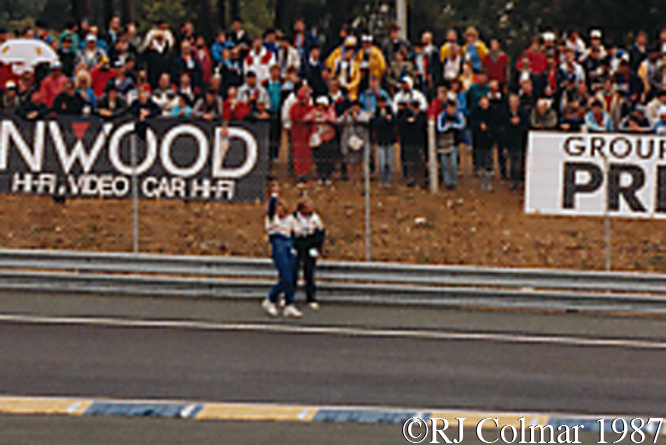
But the fourpeat of consecutive 24 hour victories very nearly did not happen, things started to go wrong for the works Porsche team a week before the race when Hans Stuck tested all the Le Mans cars at Porsche’s Weisach test facility. Stuck experienced a puncture while driving the car designated for his team mates Jochen Mass and Brilliant Bob Wollek. As a consequence Mass and Wollek were given the car designated as the race car for Stuck, Bell and Holbert chassis #008 while the ’86 winning trio took over the car designated for Vern Schuppan, Kees Nierop and Price Cobb chassis #006, today’s featured car, and the Schuppan, Nierop, Cobb combination were given the older chassis #002 which had been designated as a spare. Bell and Stuck are seen above returning from the new chicane an hour before the start of the race.
Porsche 962C, Le Mans, France

The next problem for the Porsche team occurred in practice when Price Cobb had an accident which wrote chassis #002 off during the first day of practice so that there were now only two works entered cars to challenge for the win, but as designer Norbert Singer observed ‘only one of them can win’. Schuppan, Nierop and Cobb all found rides in other cars.
Porsche 962C, Le Mans, France

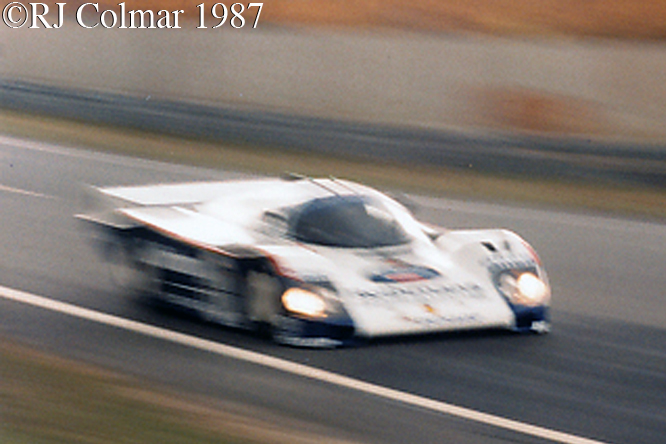
An hour into the 1987 race it looked as if Jaguar who were at least 3 seconds slower than the lead Porsche in practice might pull off a remarkable win as they held first third and fifth. The Porsche cars were falling like a chain of domino’s with engine failures, something in the fuel was causing the latest in Bosch (ECU) electronic management systems to run the Porsche engines much too lean which resulted in engine failures for the pole sitting works car; 2 Joest Porsche 962C’s and a Kremer 962C.
Porsche 962C, Le Mans, France

Fortunately the #17 had managed to get into the pits to change to an older ECU before any permanent damage was done and 2nd placed Bell, Stuck and Holbert proceeded to pursue the lead Jaguar at break neck speed until midnight when it took the lead for the final time as the four 7 litre / 427 cui V12 Jaguar XJR 8LM’s started to fall by the wayside with a puncture, an accident, a cracked cylinder head and a missed gear change respectively.
Porsche 962C, Le Mans, France

The punctured #5 Jaguar driven by Win Percy had required an 80 minuet safety car period to clear up the debris in the dead of night as the Jaguar had been pitched at 200 mph into the barriers of the Mulasanne straight ripping off the gearbox and engine, Win Percy unlike his helmet was completely unscratched. The relentless pace at which the #17 Porsche had been chasing the Jaguars meant that Bell, Stuck and Holbert were way over their fuel allowance as the safety car period started but right back on schedule once the mess created by the Jaguar had been cleaned up.

By the end of the race Bell, Stuck and Holbert were 20 laps to the good; from the private Primagaz Competition 962C of Juergen Lässig, Pierre Yver and Bernard de Dryver; as they recorded their fifth, second and third Le Mans wins respectively, their second consecutively as a winning Le Mans trio and Bell and Holberts 4th consecutive 24 Hour race win. Porsche also recorded their seventh consecutive Le Mans win in 1987.

The following year things would not be so easy as Jaguar, who won the 1987 World Sports Car Championship and who’s driver Raul Bosel won the 1987 World Sports Car Drivers Championship took the fight even more convincingly to Porsche at Le Mans.

Chassis #006 was driven at Spa in 1986 by Jochen Mass and Bob Wollek on it’s debut where it was qualified third and finished 7th it’s only other race start was at Fuji where Holbert and Pescarolo started from 12th and retired with transmission problems. Prior to the Le Mans 24 hours #006 had primarily been used as a spare car at Jarama, Jerez, Monza and Silverstone in 1987. #006 was driven by Bob Wollek and Canadian Kees Nierop for the ’87 Le Mans test weekend where carrying the #17 it recorded the 2nd fastest time. After the 24 hour win in ’87 #006 returned to Le Mans in 1988 as a spare that was briefly used by Micheal Andretti in practice before it was retired for good.

Thanks for joining me on this “Musical Spares” edition of “Gettin’ a li’l psycho on tyres” I hope you will join me again tomorrow. Don’t forget to come back now !
Share

Fiberglass Body – Ferrari 250 LM #8165

This November sees the 50th anniversary of the unveiling of the Ferrari 250 LM which to date was the last Ferrari to cross the finishing line first at Le Mans in 1965.

Today’s featured car chassis #8165, the last 250 LM to be built, was sold new to Scuderia Filipentti and entered by them in the 1966 1000kms race at the Nurburgring for Willy Mairesse and Herbert Mueller who finished 9th.

Ferrari 250LM, Goodwood Revival

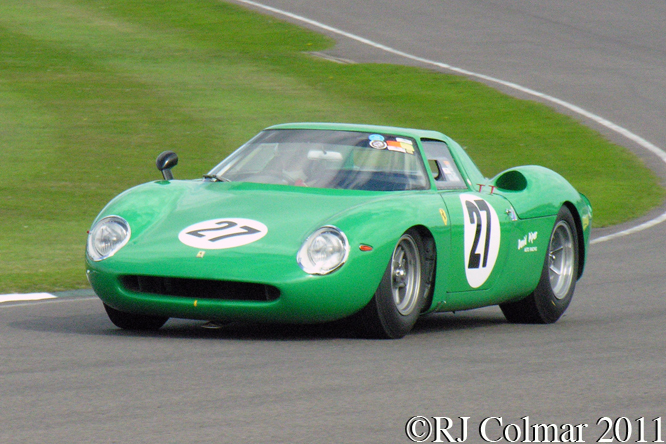
The car was then sold to David Piper and in June 1966 David fitted fiber glass body panels front and rear and painted #8165 BP Green. Subsequently David is known to have driven the car to victories at Brands Hatch, Oulton Park and the 1000kms Paris at Monthlery in 1966 sharing the car with Mike Parkes in the latter.

In 1967 David won at Silverstone and entered the #8165 for Hugh Dibley and Roy Pierpoint for the 1000kms at Brands Hatch where they finished 10th overall and first in class. At Monthlery Richard Attwood and Brian Redman came 6th overall and first in class.

Ferrari 250LM, Goodwood Revival

In 1968 Pedro Rodriguez joined Roy Pierpoint in #8165 for the 1000 kms at Brands Hatch where they finished 5th but only 3rd in class. #8165’s last ‘in period’ appearance was in the 1968 Le Mans 24 hours where Piper and Attwood qualified 28th and came through to a seventh place finish.

David Piper is seen driving #8165 in these photo’s in practice for the Whitsun Trophy at the Goodwood Revival a couple of years ago. David finished the race in 27th place.

My thanks to Athanase and Miurasv for clarifying the early ownership of this car over at FerrariChat.com.

Thanks for joining me on this “Fiberglass Body” edition of “Gettin’ a li’l psycho on tyres” I hope you will join me again tomorrow. Don’t forget to come back now !
Share

It’s Not A Pick Up Truck – Ferrari 150° Italia

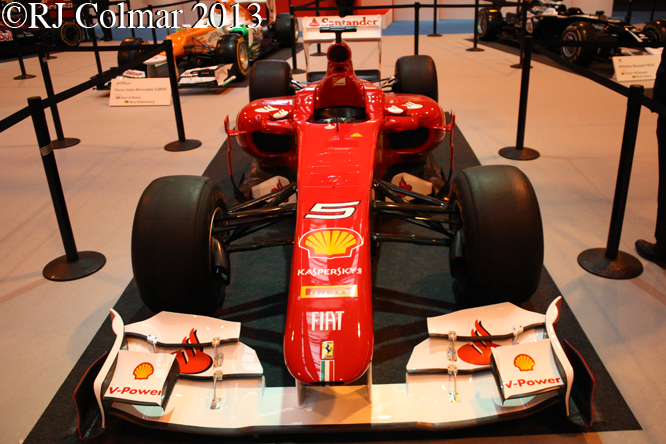
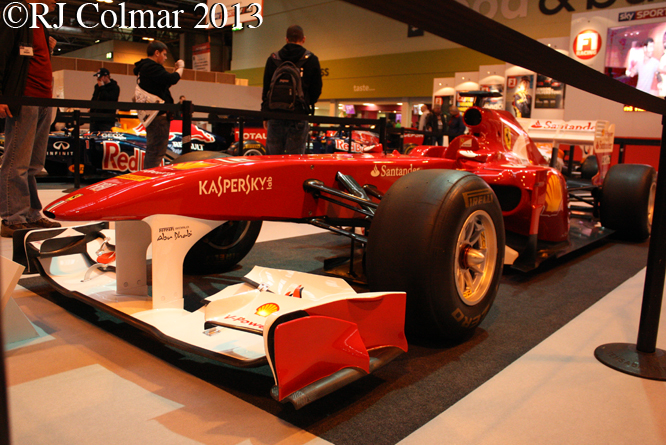
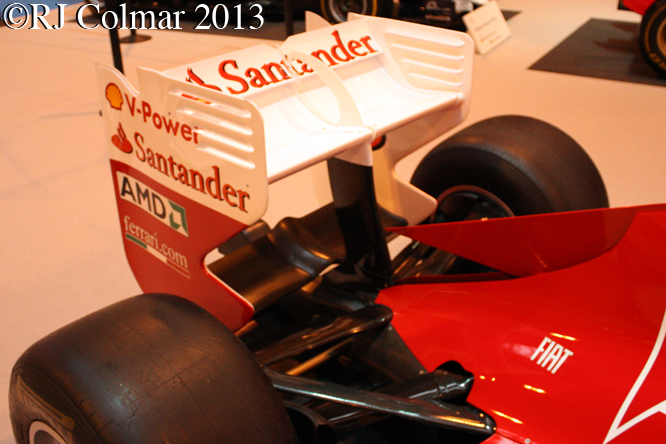
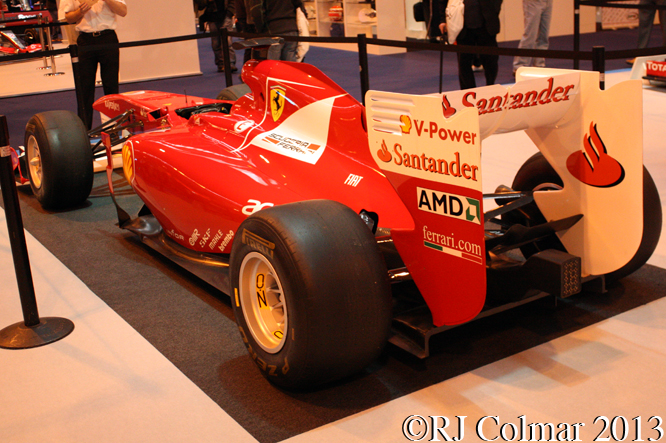
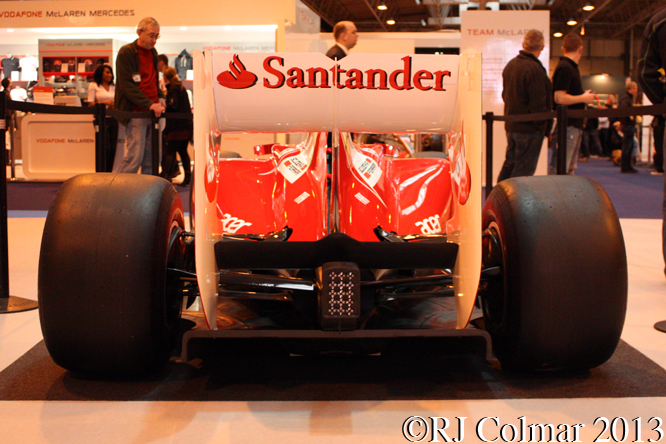
Having snatched World Drivers Championship defeat from the jaws of Victory at the Abu Dahbi Grand Prix in 2010, where Fernando Alonso went into the last race of the season with a 15 point lead over third placed Sebastian Vettel but left 4 points in arrears to the German in the final Championship standings, Ferrari regrouped for 2011 building a new vehicle with the design credited to Aldo Costa and Nicholas Tombazis which was known at its launch as the F150 in celebration of Italy’s 150th unification anniversary.

Ferrari 150° Italia, Autosport International, NEC, Birmingham

Formula One attracts controversy like flies to jam and a large number of jokes by even the most technical minded Formula One anoraks aside it was not long before Ford objected to Ferrari’s use of the trade marked F150 name and eventually Ferrari settled on the 150° Italia in which the ‘°’ stands for the ordinal cento cinquantesimo or one hundred and fiftieth in English.

Ferrari 150° Italia, Autosport International, NEC, Birmingham

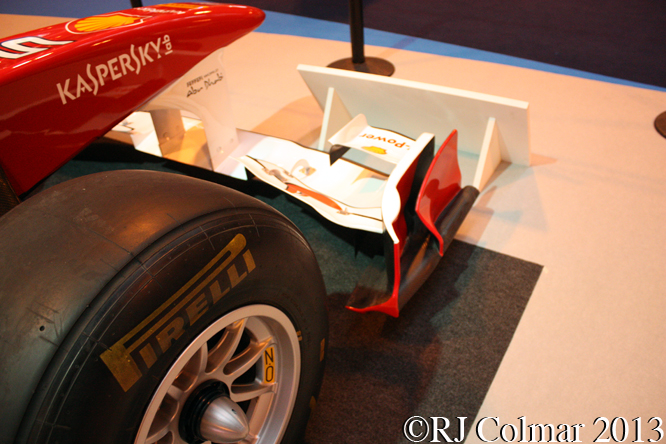
Technically Ferrari’s 2011 2.4 litre/146 cui V8 powered challenger was caught on the hop having failed to spot the potential handling benefits of off throttle blown diffusers, a failure which echoed Enzo Ferrari’s assertion that aerodynamics are for teams that cannot build engines.

Ferrari 150° Italia, Autosport International, NEC, Birmingham

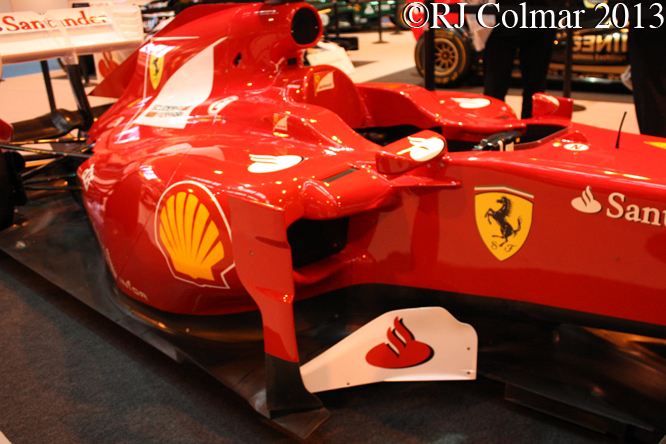
As a consequence Alonso was rarely in contention for podium finishes as Red Bull and McLaren who had refined their off throttle blown diffusers, won the opening 8 races of the 2011 season with Sebastian Vettel in the Red Bull winning 6 and Lewis Hamilton and Jenson Button driving McLarens winning the remaining two.

Ferrari 150° Italia, Autosport International, NEC, Birmingham

For the ninth race of the season the British Grand Prix Ferrari had managed to persuade all the teams that they should run without off throttle blown diffusers, which basically hooked up an electronic engine programme to wind up the engine speed when the driver was off throttle to force hot air through the exhaust into the diffusers which produced additional downforce when running off throttle through the corners.

Ferrari 150° Italia, Autosport International, NEC, Birmingham

In the prevalent wet conditions which dried through the race Alonso, starting third, managed to beat the Lewis Hamilton driving a McLaren and Sebastian Vettel in his Red Bull to score the Ferrari teams only victory in 2011.

Ferrari 150° Italia, Autosport International, NEC, Birmingham

By the next race the teams despite objections from Ferrari and the Ferrari powered Sauber team reverted to running off throttle blown diffusers in anticipation of a ban on these devices for 2012.

Ferrari 150° Italia, Autosport International, NEC, Birmingham

Ferrari ended up a distant third in the manufactures championship behind Red Bull who scored six further victories to take their 2011 total to 12 and McLaren who scored four further victories in the 19 race season.

Fernando finished the 2011 championship 4th behind Vettel, Jenson Button and Mark Webber who scored just one point ahead of the Spaniard. De facto Ferrari number 2 driver Felipe Massa was lucky to keep his Ferrari seat for 2012 after he finished 6th in the championship 99 points behind Lewis Hamilton having failed finish any higher the 5th all season.

Thanks for joining me on this “It’s Not A Pick Up Truck” edition of “Gettin’ a li’l psycho on tyres” I hope you will join me again tomorrow. Don’t forget to come back now !
Share

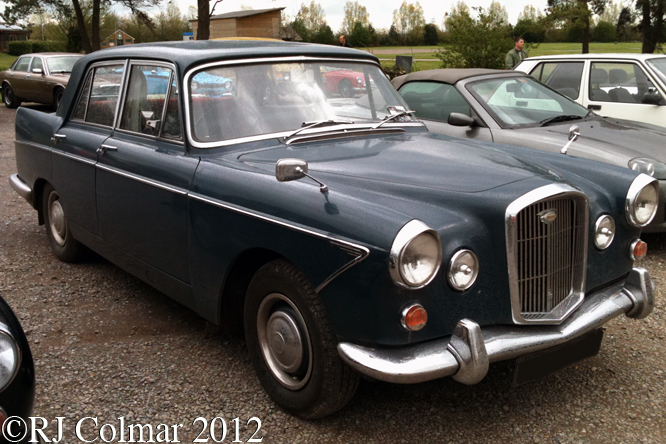
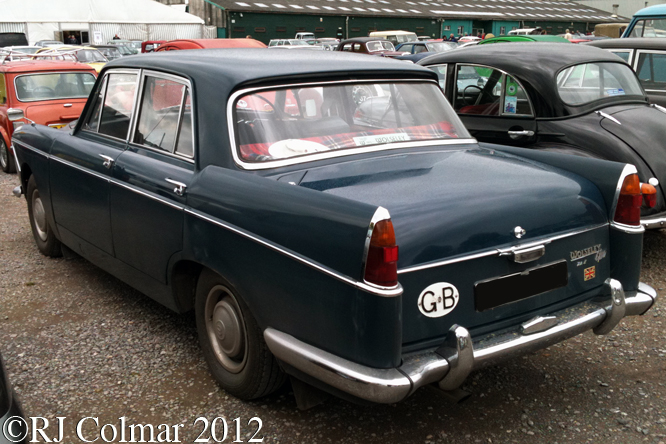
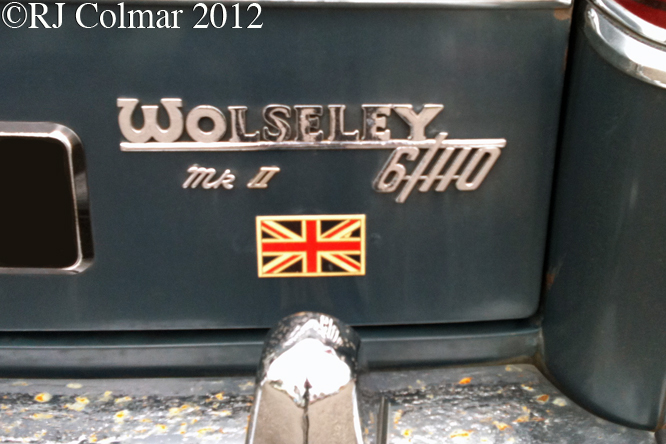
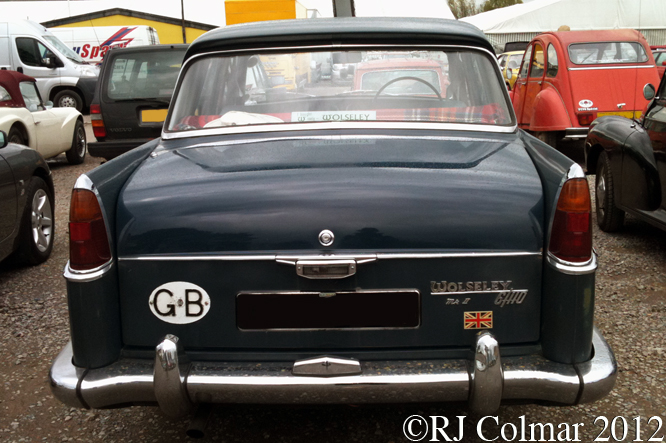
Prick Up Your Ears – Wolseley 6/110 Mk II (ADO53)

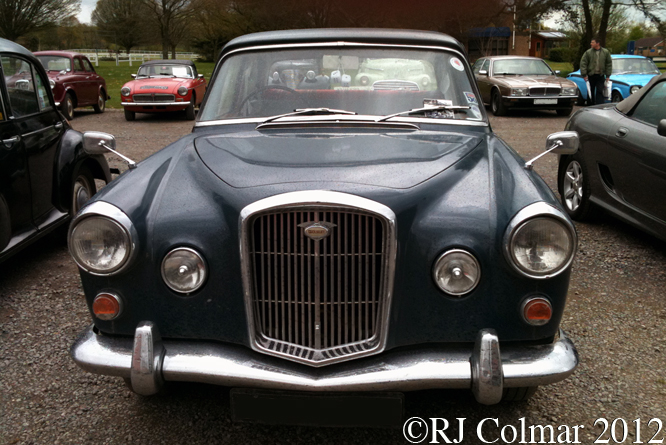
The Wolseley 6/110 replaced the similarly Farina bodied 6/99 in 1961 externally the two models are identical except the 6/110 has a two inch longer wheel base while internally the gear selection mechanism, for the 3 speed gearbox, moved from the steering column to the floor.

Wolseley 6/110 Mk II, Bristol Classic Car Show, Shepton Mallet

The 2.9 litre / 177 cui C series straight six shared with the similarly bodied BMC Austin A110 Westminster and Van den Plas Princess 3-litre Mk II, Austin Healey 3000 and MG C was tuned to give 120hp.

Wolseley 6/110 Mk II, Bristol Classic Car Show, Shepton Mallet

In 1964 a MK II version of the 6/110 was introduced similar to the 1966 model seen here at last years, Bristol Classic Car Show at Shepton Mallet. The only external difference being the smaller 13″ wheels that carried wider tyres than it’s predecessor the Pinin Farina styled body work was left alone completely as it had been in 1961.

Wolseley 6/110 Mk II, Bristol Classic Car Show, Shepton Mallet

Internally the 6/110 Mk II featured telescopic dampers which replaced the previous lever arm units, thicker disc brakes, a new exhaust system and a 4 speed gearbox which could be fitted with an optional overdrive for more economical motoring at speed on Britain’s emerging motorway network.

04 IMG_0949sc

Like the Wolseley 6/80 I looked at a couple of weeks ago the 6/110 in Mk I and Mk II form was a popular choice of police car with both film makers and television producers the 6/110 Mk II’s film credits include The Mind of Mr. Soames (1970), Prick Up Your Ears (1987) and The Bank Job (2008).

Wolseley 6/110 Mk II, Bristol Classic Car Show, Shepton Mallet

13,301 Woseley 6/110 Mk II’s were manufactured between 1964 and 1968 when it was replaced in the British Leyland range by the Austin 3 litre (Land Lobster) whose sales were so far off target that Wolseley and Van den Plas variants never got beyond the prototype stage.

Thanks for joining me on this “Prick Up Your Ears” edition of “Gettin’ a li’l psycho on tyres” I hope you will join me tomorrow for a trip to Marin Sanoma California. Don’t forget to come back now !

Ralph Colmar on Formula One – Homeboy Rosberg Runs the Tables at the Grand Prix of Monaco today at Motorsports Unplugged.

Share

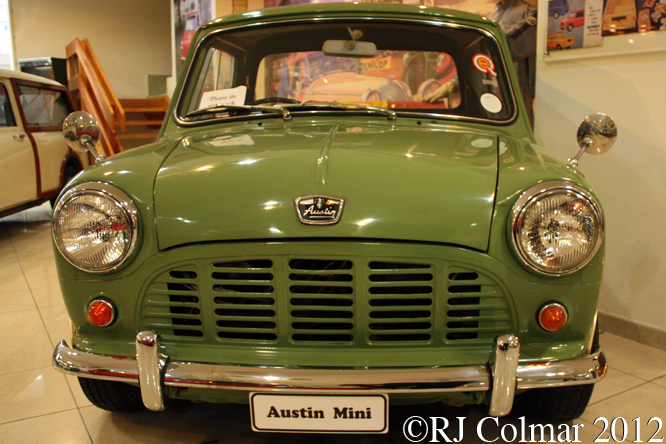
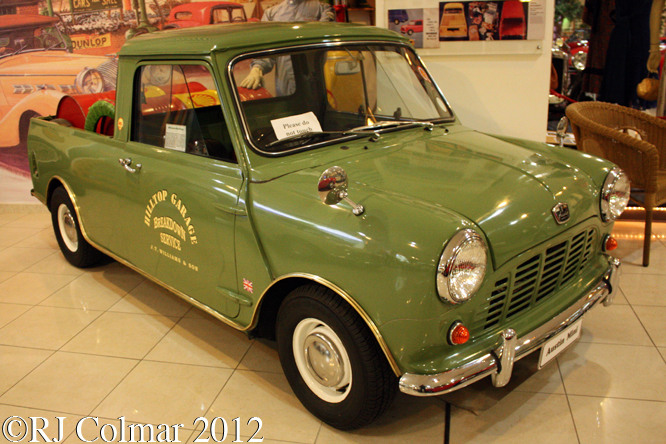
Slick & Economical – Austin Mini Pick Up

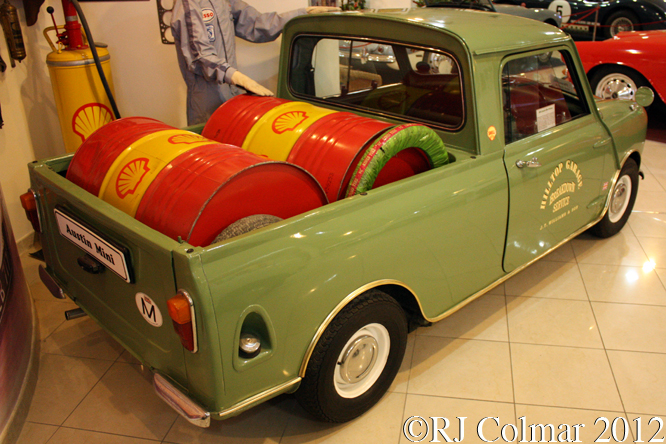
Between 1961 and 1982 there were very few changes to the Austin Mini Pick-Up except in 1978 when the model was marketed as the Mini 95.

Austin Mini - Pick-up, Malta Classic Car Museum, Qwara

The 1961 Sales brochure reads “The slickest and most economical means ever of transporting a 5-cwt.(254-kg.) load!

Austin Mini - Pick-up, Malta Classic Car Museum, Qwara

Ingenious design and practical body styling have been successfully co-ordinated to produce this revolutionary runabout, ideally suited to the needs of the smaller business.

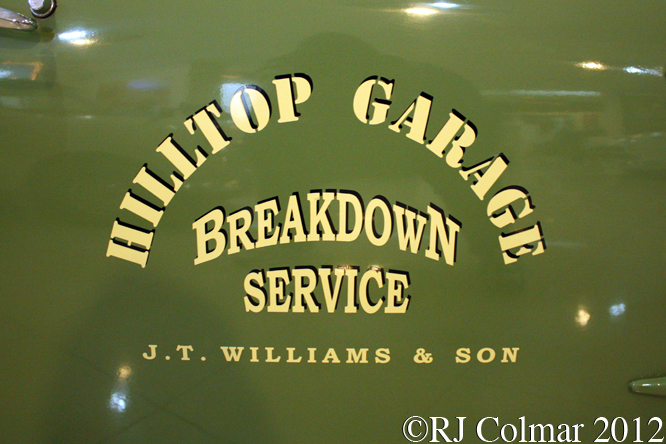
Austin Mini - Pick-up, Malta Classic Car Museum, Qwara

Such tradesman as plumbers, builders, painters or nurserymen will find that within the compact proportions of the Austin Mini 1/4-ton Pick-up are approximately 19 3/4 sq. ft, (1.83m.²) of floor space and a totally enclosed cab with saloon car comfort for two people.”

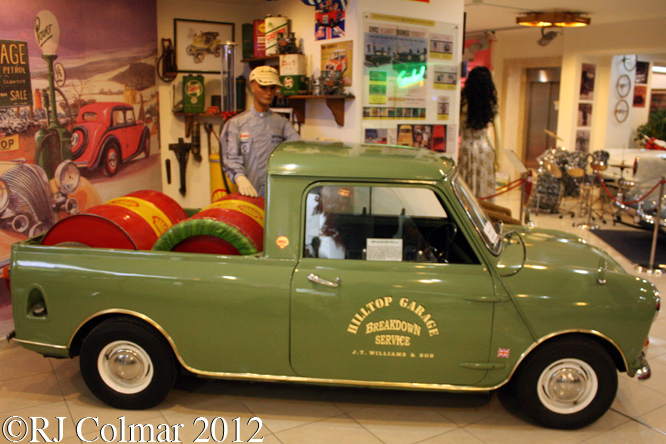
Austin Mini - Pick-up, Malta Classic Car Museum, Qwara

The portion of the brochure devoted to the van went on “Similar to the world-beating, incredible Austin Mini Saloon, both of these new light commercials have all the identical features for ultra-safe, speedy and dependable delivery service.

Austin Mini - Pick-up, Malta Classic Car Museum, Qwara

Over the 21 years of it’s production life an estimated 58,179 Mini Pick-ups were built with the Austin, Morris and after 1976 Leyland badges.

Today’s featured example is on display at the Malta Classic Car Museum in Qwara.

Thanks for joining me on this “Slick and Economical edition of “Gettin’ a li’l psycho on tyres” I hope you will join me agian tomorrow for a look at the last of this month’s Tuesday featured Wolseley cars. Don’t forget to come back now !

Share

2ZZ-GE – Lotus Exige Series 2

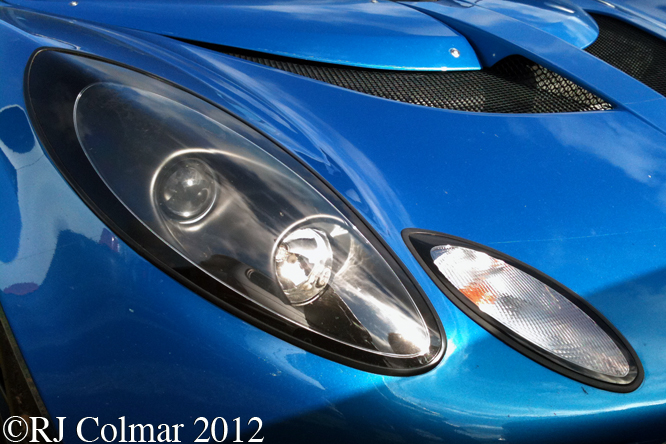
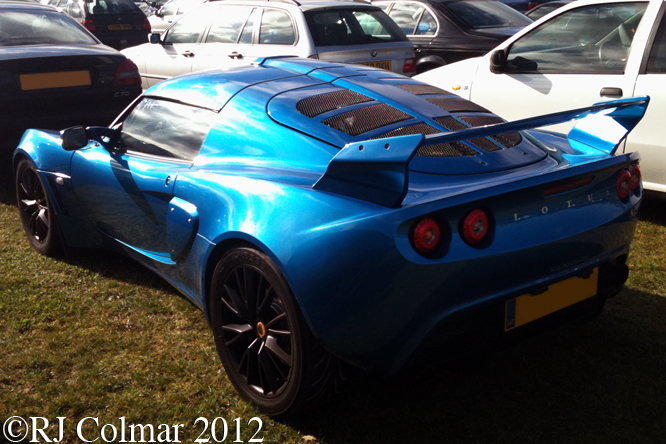
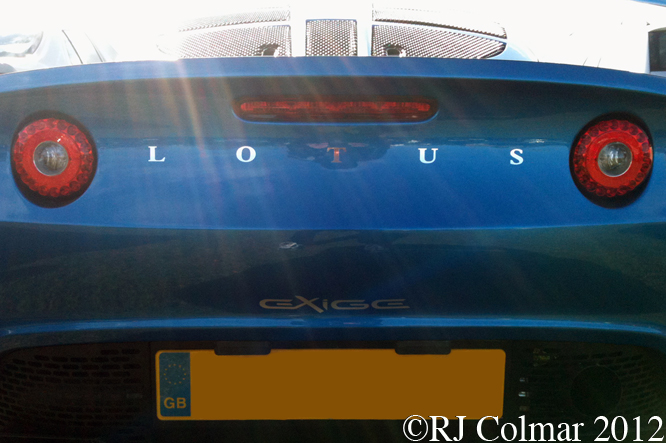
While the Lotus Elise had to be updated to Series 2 spec to meet in order to safety requirements in 2000, the Lotus Exige Series 2 was not updated until 2004.

Lotus Exige Series 2, Race Retro, Stoneleigh

The Exige Series 2’s combination of air splitter, hard (fibreglass) top, engine cover and rear spoiler are enough to give the car 100lbs of aerodynamic down force when travelling at 100 mph as opposed to just 13lbs of aerodynamic down force for the soft top Elise Series 2 at the same speed.

Lotus Exige Series 2, Race Retro, Stoneleigh

The big mechanical difference between the Exige Series 1 and Series 2 is that the Rover K Series motor has been replaced by a 190 hp 2ZZ-GE motor designed by Yamaha and built by Toyota which provides power for the rear wheels through a close ratio 6 speed gearbox.

 Lotus Exige Series 2, Race Retro, Stoneleigh

From rest an Exige like the 2006 example seen here at last years Race Retro will accelerate to 60 mph in 4.7 seconds, reach 100 mph in 12.9 seconds and has a top spedd of 147 mph.

Lotus Exige Series 2, Race Retro, Stoneleigh

Since 2006 several supercharged variants of the Exige S2 have been manufactured topped by the 158 mph 265E which has an engine mapped to run on 85% ethanol.

Thanks for joining me on this “2ZZ-GE” edition of “Gettin’ a li’l psycho on tyres” I hope you will join me again tomorrow. Don’t forget to come back now !
Share