Tag Archives: Castle Combe

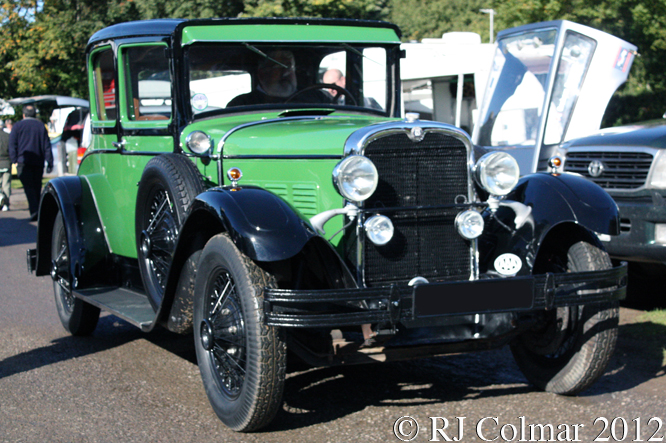
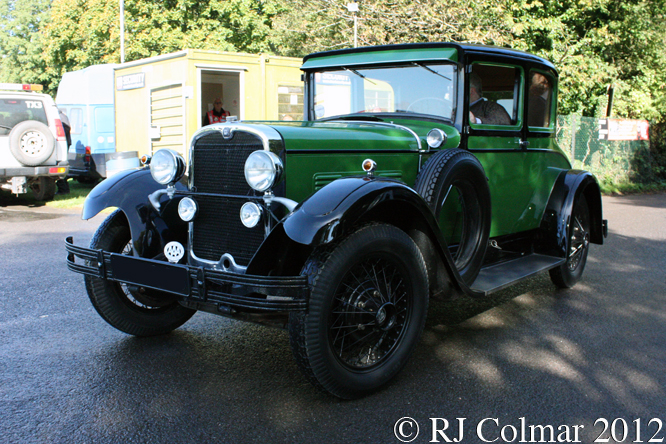
DB Six – Dodge Brothers Senior Six Opera Coupé

Five years after the Dodge Brothers, Horace and John, died unexpectedly due to unrelated causes their widows sold the company to Dillon, Read & Co in, up to the time, the largest ever cash transaction involving some US$ 146 million. At the end of 1925 Dillon, Read & Co also acquired a majority in Graham Inc and the three Graham brothers worked for Dodge Brothers until 1927 when Dodge introduced it’s first 3.6 litre / 244 cui six cylinder models.

Dodge Brothers, Senior Six Opera Coupe, VSCC, Castle Combe

The L head six produced 60 hp and complemented the 40 hp Fast four in the Dodge range which was loosing market share falling from second largest manufacturer in 1920 to 7th place by 1927 prior to Chrysler’s acquisition of Dodge Brothers in 1928.

Dodge Brothers, Senior Six Opera Coupe, VSCC, Castle Combe

Identifying the exact age of today’s Senior Six Opera Coupé, seen at Castle Combe a couple of years ago, has proved extremely difficult officially it’s listed as a 1929 model however I have only been able to match it to models with the distinctive horizontal bonnet / hood vents dated 1927 and 1928.

If you know the exact years the horizontal vent Sixes were in production please do not hesitate to chime in below.

Thanks for joining me on this “DB Six” edition of “Gettin’ a li’l psycho on tyres” I hope you will join me again tomorrow. Don’t forget to come back now !

Share

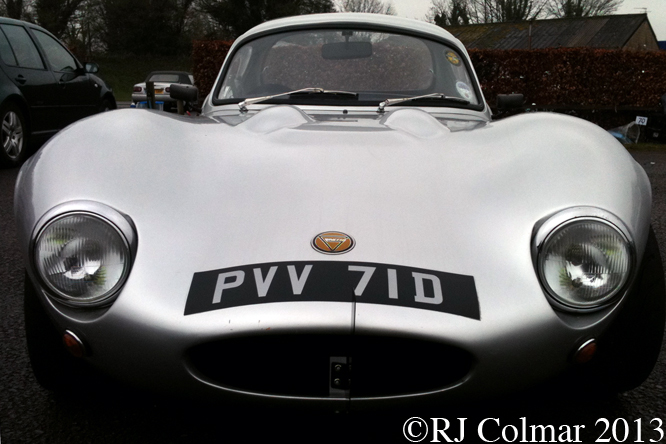
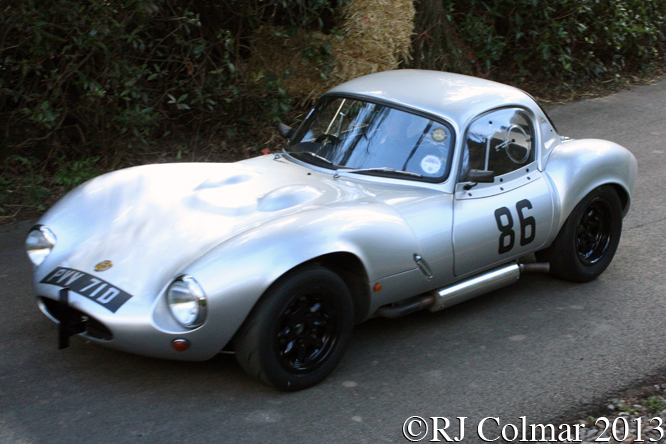
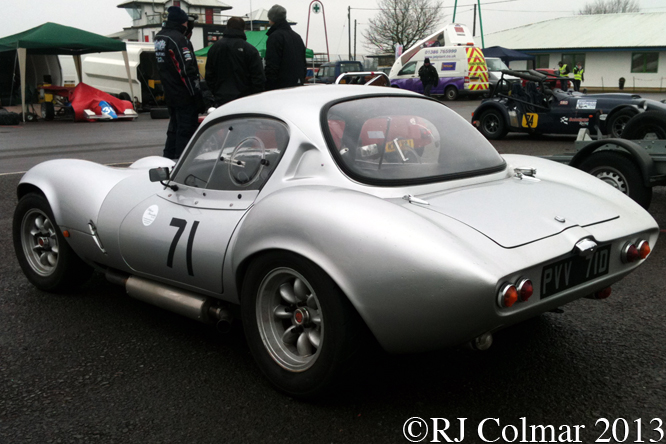
Race On Sunday Work On Monday – Ginetta G4 Coupé by DARE

In 1958 brothers Bob, Ivor, Trevers and Douglas Walkett built their first car the Ginetta G1 based on a pre 1939 Wolsey Hornet in 1958, the car never went into production but a range of successive road/race vehicles, both turn key and self builds, gained a reputation for sporting prowess that has continued to this day despite the original company failing after the Walketts retired in 1989.

Ginetta G4 By DARE, Castle Combe

One of the companies most successful models was the race on Sunday work on Monday Ginetta G4 which was launched 1961 powered by a 1 litre / 61 cui motor sourced from the Ford 105E Anglia, of the type recently made famous by the Harry Potter films.

Coote, Ginetta Zetec G4 By DARE, Wiscombe Park

G4 production continued in both Roadster and, from 1963, Coupé forms until 1968. The Series III variant introduced in 1966 featured pop-up headlights, powered by a 1500cc / 90.5 cui motor a G4 was capable of 120 mph.

Ginetta Zetec G4 By DARE, Castle Combe

In 1981 a slightly longer and wider Series VI Ginetta G4 was launched. After the company had been sold in 1989 to Martin Phaff and moved to Scunthorpe it appears that continued demand for the G4 persuaded DARE UK a company based in Colchester Essex to take up production of the G4 in the mid 1990’s.

Ginetta Zetec G4 By DARE, Castle Combe

Today’s featured G4 was built by DARE UK in 2000 and is powered by a 1796cc / 109 cui Ford Zetec engine which will produce a minimum of 165 hp. The car is seen in the paddock at Castle Combe and returning to the paddock at Wiscombe Park with Exeter’s Roger Coote at the wheel.

Thanks for joining me on this “Race On Sunday Work On Monday” edition of “Gettin’ a li’l psycho on tyres” I hope you will join me again tomorrow when I’ll be looking at a Bristol. Don’t forget to come back now !

Share

Slightly Reduced Boost – Ford F-150 Supercharged Harley Davidson

Those watching the 1996 Super Bowl on TV will have been among the first to be introduced to the 1997 Ford F-150 in a catchy commercial featuring Jack Palance in which his F-150 is depicted as being strong enough to pull the two sides of the Grand Canyon together.

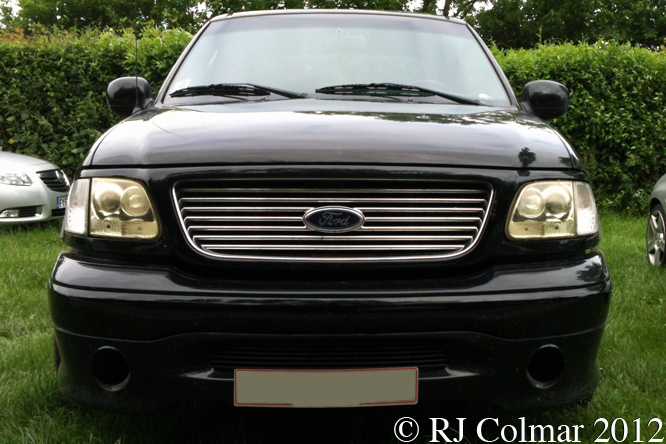
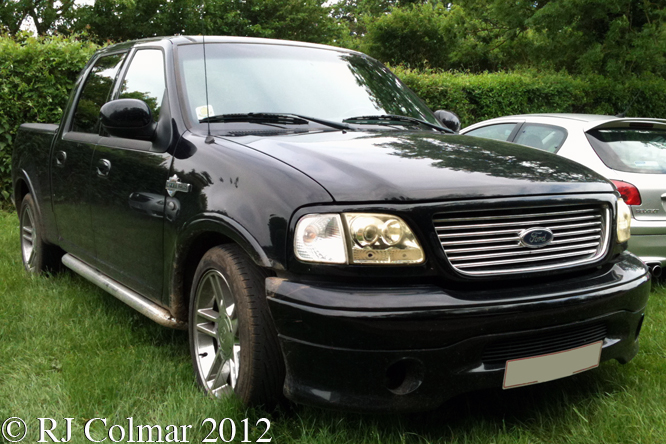
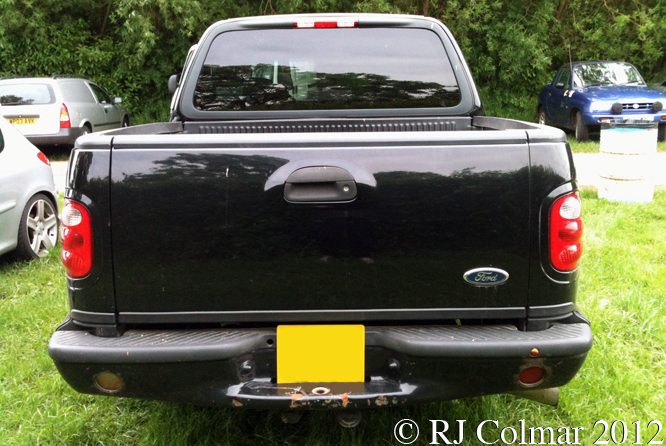
Ford F150 Supercharged Harley Davidson Edition, Castle Combe

Featuring improved aerodynamics, larger interior and improved fuel economy powered by either Taurus/Windstar V6 or Crown Victoria V8 motors, the tenth generation Ford F-150 went on sale in late 1996, it was the first all new ground up design for the model since 1980

Ford F150 Supercharged Harley Davidson Edition, Castle Combe

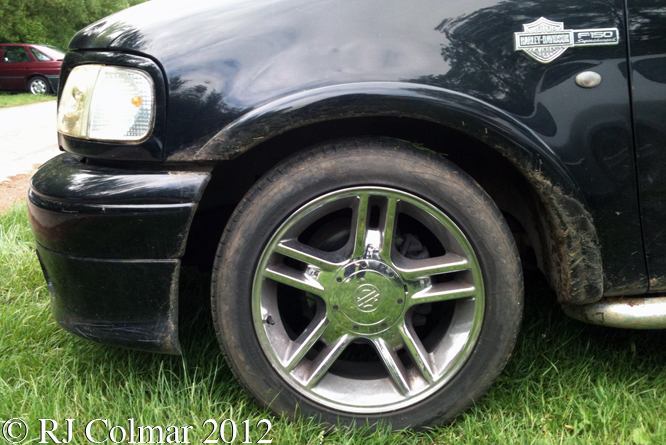
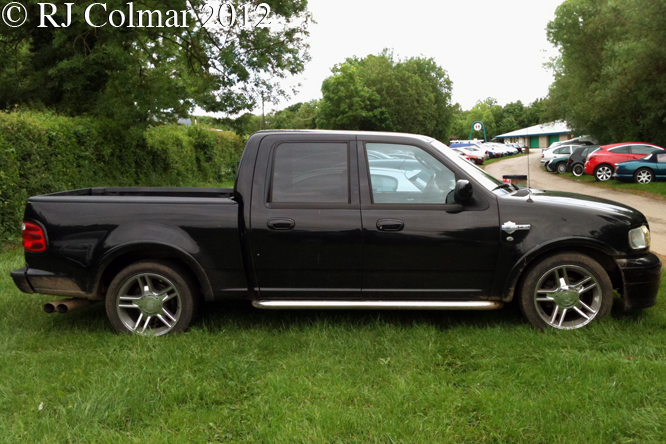
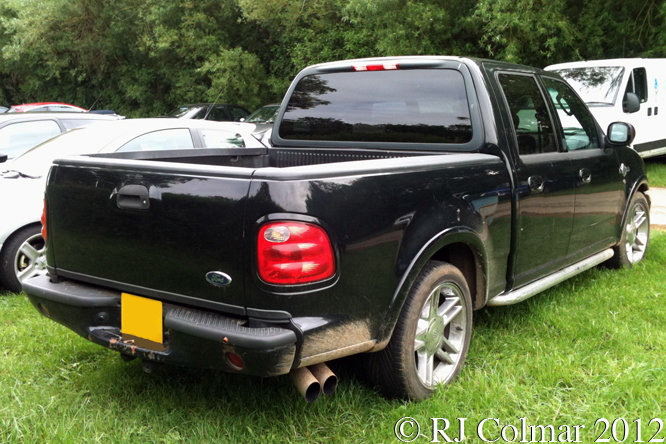
Ford introduced the Harley Davidson Edition in 2000 with a four door SuperCab and standard bed, the following year the Harley Davidson Edition featured a longer SuperCrew cab and shorter bed.

Ford F150 Supercharged Harley Davidson Edition, Castle Combe

In 2002 a slightly detuned 340 hp version of the Triton Supercharged V8 used in the 380 hp F-150 SVT Lightening was added to the Harley Davidson Edition.

Ford F150 Supercharged Harley Davidson Edition, Castle Combe

The detuning was achieved by adding a slightly larger pulley to the supercharger which slightly reduced the boost pressure.

Ford F150 Supercharged Harley Davidson Edition, Castle Combe

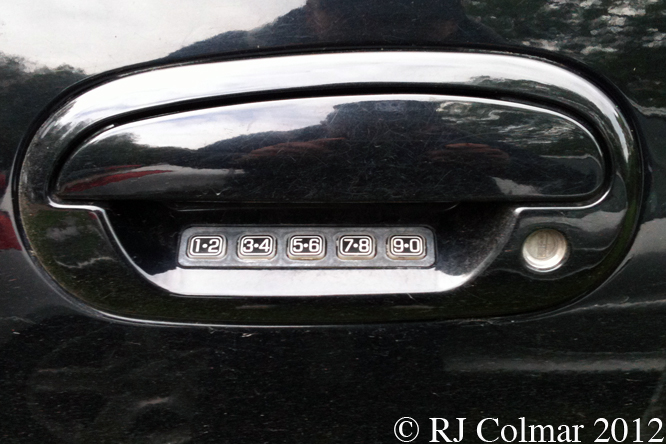
Keypad entry systems date at least back to the 1981 Lincoln Town Car, I don’t recall ever seeing one before on vehicle in the UK before, so it was a surprise to find this on a 2002 model.

Ford F150 Supercharged Harley Davidson Edition, Castle Combe

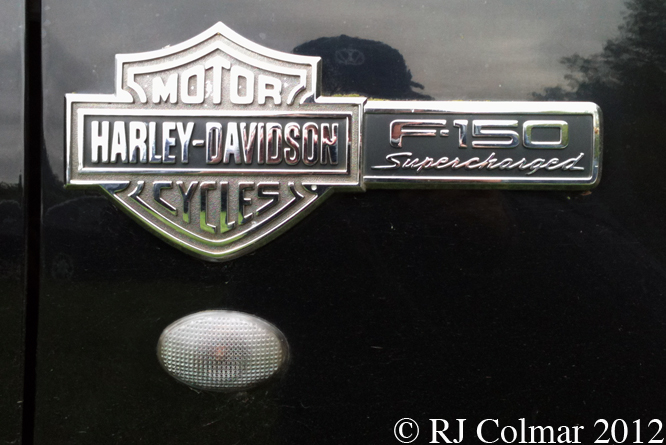
Aside from the external badging, front fog lamps and chrome side bars the Harley Davidson Edition F-150 came with black or dark shadow grey paint, accented by an orange pinstripe, leather interior trim and chrome 20 inch wheels.

Ford F150 Supercharged Harley Davidson Edition, Castle Combe

Interior Harley Davidson Edition features also include chrome steering column stalks door releases and seat leavers, unique Harley Davidson spun metal instrument cluster with 130 mph speedometer and a sequenced VIN plate on the center console.

Ford F150 Supercharged Harley Davidson Edition, Castle Combe

Harley Davidson Editions are said to have accounted for 1 to 2 percent of F-150 sales and the model seems to have divided opinions, F-150 and Harley Davidson owners had their opinions of the brands was reaffirmed, some HD owners switched from Chevy to Ford Pick Ups while some Ford owners who were not bikers thought the Harley Davidson Edition was a cheesy gimmick, that the tie between the two brands lasted twelve years is a testament to the fact both brands on balance benefited.

Thanks for joining me on this “Slightly Reduced Boost” edition of “Gettin’ a li’l psycho on tyres” I hope you will join me again tomorrow when I’ll be looking at a veteran design by Ferdinand Porsche. Don’t forget to come back now.

Brighton Speed Trials Under Threat of Permanent Cancellation !

In their infinite wisdom, Brighton & Hove City Council are seeking to ban the Brighton Speed Trials from 2014.

If you care about speed and or motorsport history, please sign this linked petition to save Brighton Speed Trials in 2014 and beyond.

It’s a faf to Register before signing, but relatively painless compared to loosing the event which has been run with few interruptions since 1905.

You do not need to be resident in Brighton or even the UK to sign.

Share

The Lotus Clan – Clan Crusader

In the late 1960’s early 1970’s at least three sports cars went to market using the all aluminium Coventry Climax derived Hillman Imp / Singer Chamois engine including the Ginetta G15, Davrian Imp and today’s featured vehicle the Clan Crusader.

In 1969 three Lotus Engineers, Paul Haussauer, John Frayling and Brian Luff left the company after an unspecified disagreement with Colin Chapman and founded the Clan Motor Company in Washington, Co Durham, England.

Clan Crusader, Castle Combe

Their one and only model styled by Frayling, employed a steel reinforced monocoque designed by Luff with Imp / Chamois suspension. The handling of the Clan, with a top speed of 100 mph, was said to be superior to that of both the cheaper Ginetta G15 and Davrian Imp.

From late 1971 until the introduction of crippling taxes the car was manufactured in self build or complete forms, with the self builds dropped the Crusader successfully completed independent crash tests in mid 1972. By the end of 1973 production ceased with over 300 complete cars and kits built, despite a healthy order book, due to component supply and financial difficulties.

Clan Crusader, Castle Combe

In 1974 much of the Clan stock and body moulds were shipped to Cyprus, however due to the Turkish military invasion later the same year production never got underway on the Mediterranean island.

Brian Luff made a new set of moulds from an existing car and built some more Crusaders mostly for competition use. Crusaders competition successes included a second place on it’s debut the 1972 Manx International Rally with Andy Dawson and John Foden, 1972 Tour of Mull Rally win for Alan Conley and Crawford Dunn along with two production car trials championships for Mike Hinde in 1973 and Bill Moffat in 1993.

Clan Crusader, Castle Combe

After acquiring Luff’s moulds in 1982 Peter McCandless founded Clan Cars Ltd in Northern Ireland and recommenced production of the a variant of the Crusader now simply known as the Clan which featured a new nose with pop up head lights. Around 120 so called Irish Clans were built for the road and a further 10 for competition.

A Clan Clover model, powered by an Alfa Romeo engine mounted ahead of the rear axle was also built, more than 20 of these cars are thought to have been built before the receivers were called in to Clan Cars in 1987.

Today’s featured 1972 Crusader was seen at Castle Combe a couple of years ago.

Thanks for joining me on this “Lotus Clan” edition of “Gettin’ a li’l psycho on tyres” I hope you will join me again tomorrow when I’ll be looking at a 1948 Bentley called Blue Velvet. Don’t forget to come back now !

Share

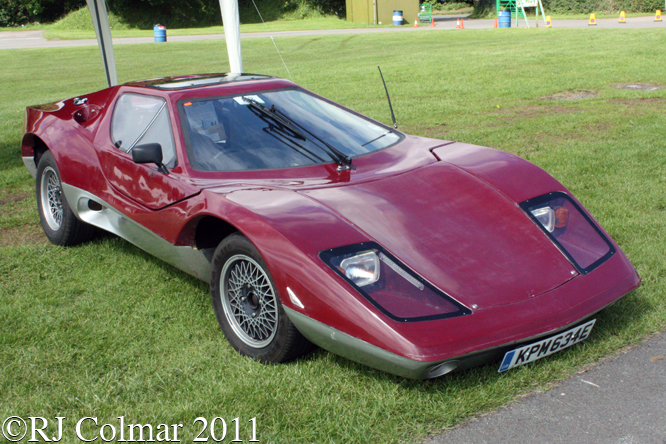
Mind Where You Step – Nova Volkswagen

The late 60’s and early pre fuel crisis 1970’s will be remembered for the launch of all manor of “Super Cars” loaded with oodles of show and go in equal measure from the likes of de Tomaso, Lamborghini, Maserati and Ferrari, to name a few, who followed Ford into building monstrously powerful rear engined street sports cars with 2 seats and little more luggage capacity than a golf bag if that.

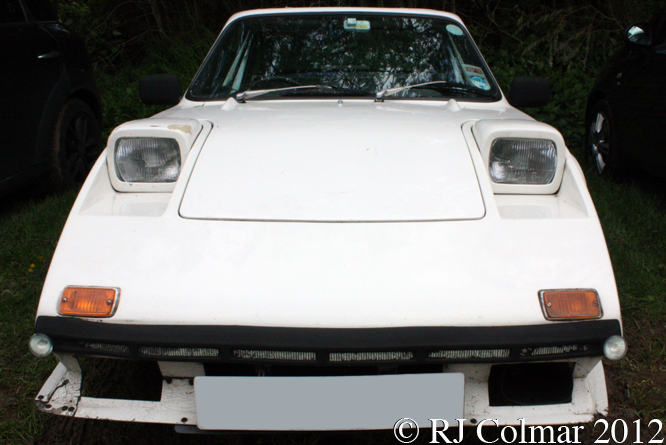
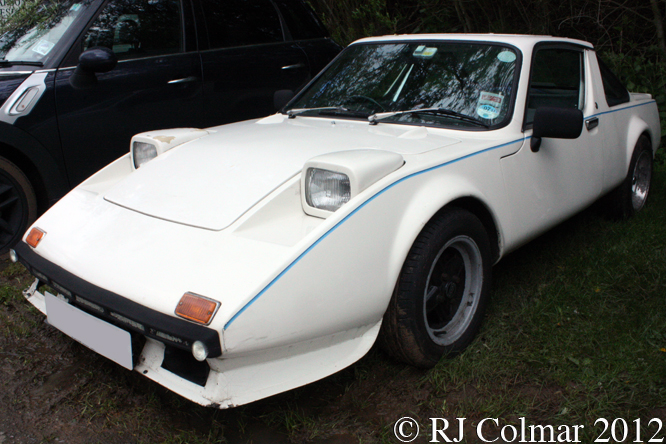
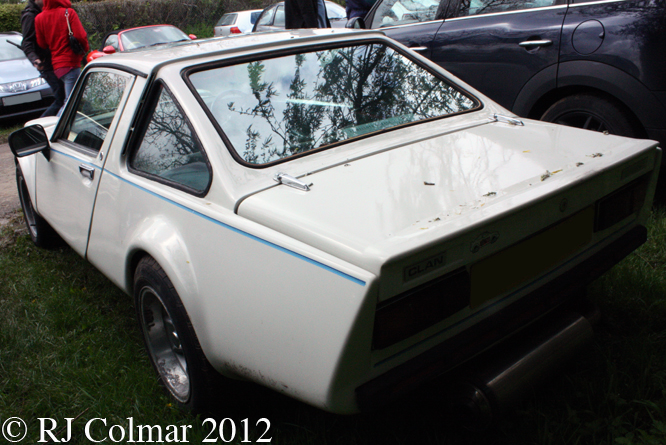
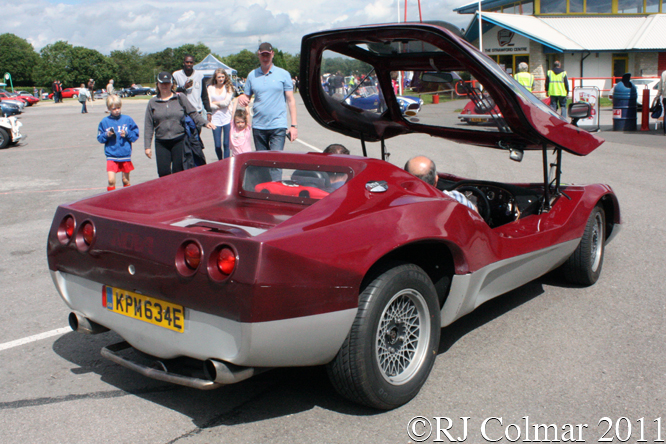
Nova VW, Bristol Motor Club Family Clubs Day, Castle Combe

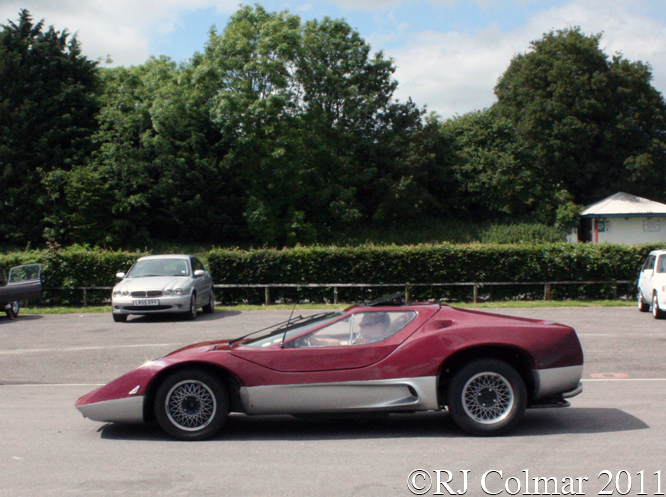
Another such less familiar vehicle with plenty of super car show if somewhat more humble go was the Volkswagen Beetle powered self build Nova from Automotive Design and Development (ADD) which first seen in 1971.

Nova VW, Bristol Motor Club Family Clubs Day, Castle Combe

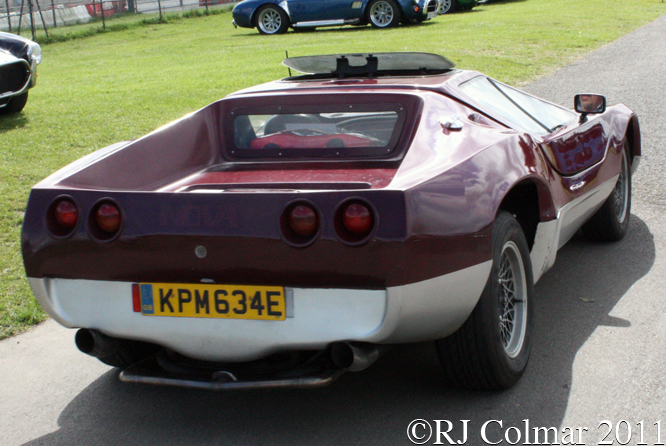
Based on a Volkswagen chassis pan, the donor car for today’s featured Nova dates back to 1967, motor and running gear the Nova’s fibreglass body was styled by Richard Oakes with engineering by Phil Sayers, unlike the usual suspects from Italy the Nova’s motor was behind the rear axle instead of ahead of it.

Nova VW, Bristol Motor Club Family Clubs Day, Castle Combe

ADD based initially in Southampton and later in Accrington Lancashire folded in 1975, but the production rights were bought by Vic Elam who founded Nova Cars and continued production from premises in Mirfield West Yorkshire from 1978 to 1990.

Nova VW, Bristol Motor Club Family Clubs Day, Castle Combe

Production then moved to Cornwall under Nova Developments in the 1990’s before the design was taken over by Aerotec Nova owned by Shashi Dvyas in 1997.
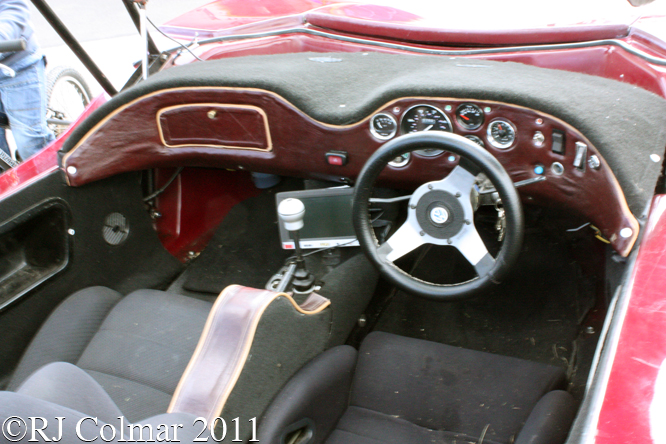
Nova’s in the USA have been manufactured by Sterling Kit Cars who have built over 800 examples. One of the cool features of the Nova is the hydraulically operated roof which requires a deal of patience not seen with a hinged door.

Nova VW, Bristol Motor Club Family Clubs Day, Castle Combe

Unfortunately entry through the roof is a tad impractical unless one always enters the car from a pristine garage floor because one cannot avoid stepping on the seats in order to sit in the car, a problem the Nova shares with the seriously outlandish Adams Probe 16.

Nova VW, Bristol Motor Club Family Clubs Day, Castle Combe

Amazingly while the GT40 MKIII, Mangusta, Muira, Bora and Berlinetta Boxer have long been out of production the Nova was revived last year as India’s first sports car for the masses. The SuperNovaEV with a variety of zero emissions power trains are all quoted to give a zero to 62 mph time of 9.9 seconds and up to 180 mile range.

Thanks for joining me on this “Mind Where You Step” edition of “Gettin’ a li’l psycho on tyres” I hope you will join me again tomorrow when I’ll be looking at a Bentley. Don’t forget to come back now !

Share

Typ 148 RHD – Volkswagen Caddy

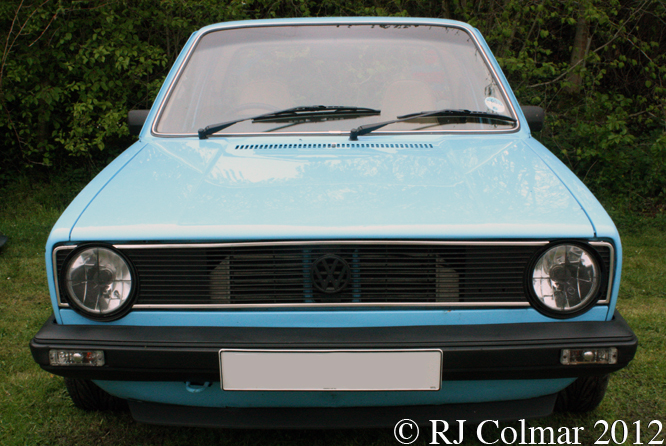
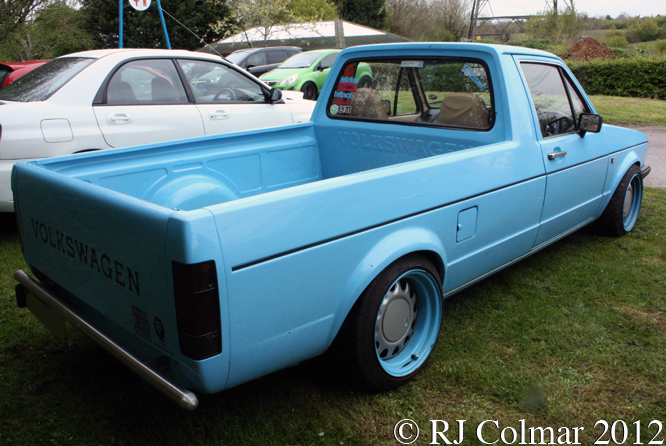
Strangely the Volkswagen Caddy is unknown by that name in the USA the country which gave the initial momentum to the model thanks to Volkwagen of America’s in interest in a prototype pick up version of the Golf Mk 1 Hatchback built in Germany.

Volkswagen Caddy, Spring Performance Car Action Day, Castle Combe

The Typ 14 or more correctly Typ 147-LHD (Left Hand Drive) was first built at VW’s Westmoreland County, PA plant and sold in the US as the Rabbit Pick Up in 1979, so far as I have been able to determine production at Westmoreland ceased in 1982 and was switched to Sarajevo, Bosnia and Herzegovina where production of the European Typ 147-LHD and 148 Right Hand Drive variants continued until 1992. Production of Caddy’s continued in South Africa until 2007 alongside Mk 1 Golf’s which them selves were in production up until 2009.

Volkswagen Caddy, Spring Performance Car Action Day, Castle Combe

European Typ 14’s were only ever marketed as Volkswagen Caddy’s where confusion of the name with supersize 5000lb 500 cui V8 US land yachts was less likely.

Volkswagen Caddy, Spring Performance Car Action Day, Castle Combe

The Typ 14 Caddy is not to be confused with later variants, Typ 9K Polo Mk III based Caddy, Typ 9U Škoda Felicia pick-up or Typ Golf Mk 5 based Volkswagen Touran.

Volkswagen Caddy, Spring Performance Car Action Day, Castle Combe

Today’s 1989 Caddy seen last year at the Spring Performance Car Action Day at Castle Combe appears to be powered by the high end 70 hp petrol motor.

Thanks for joining me on this “Typ 148 RHD” edition of “Gettin’ a li’l psycho on tyres” I hope you will join me again tomorrow. Don’t forget to come back now !

Share

Autumn Classic – Castle Combe

Castle Combe Circuits second Autumn Classic closed the racing season at the Wiltshire circuit for the second year running a couple of weeks ago and it proved again proved a big hit with the spectators more of whom used the event to dress up 30’s to 50’s costume than I remember last year.
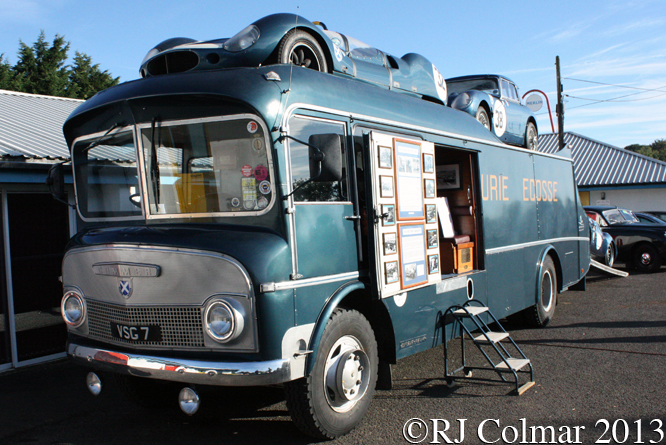
Ecurie Ecosse, Commer, Autumn Classic, Castle Combe

After arriving I made my way to the paddock for a Big Boys Breakfast while the practice sessions were getting underway. Above the 1959 Ecurie Ecosse 2 stroke diesel powered Commer Transporter and many ex Ecurie Ecosse team cars, including the 1960 Cooper T49 Monaco, 1961 Sebring Austin Healey Sprite and the rear engined 1962 Tojeiro-Buick Coupé will all be coming up for auction at Bonhams in December.
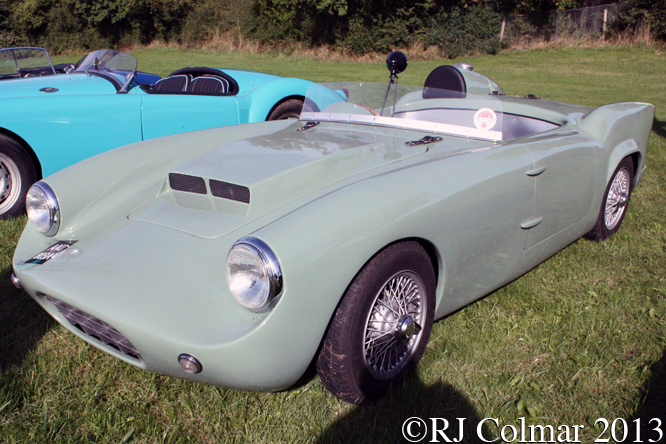
Triumph Special, Autumn Classic, Castle Combe

There were many interesting vehicles in the car park including this sports car about which I know nothing apart from the fact it said “Triumph” on the tax disc, if you know more please do not hesitate to chime on below.
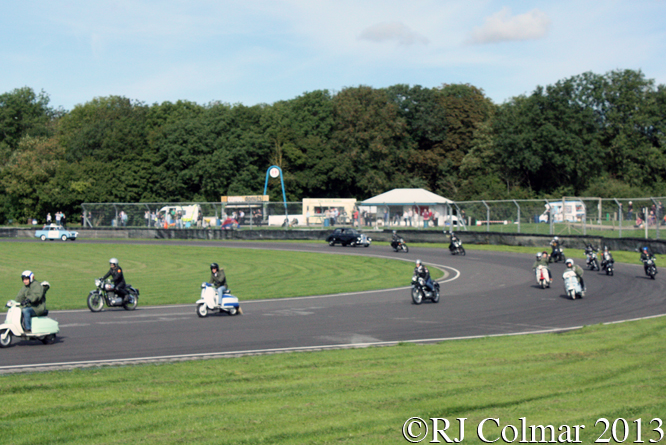
Mods, Rockers & Cops, Autumn Classic, Castle Combe

After practice and before racing commenced there were several demonstrations including the one seen above featuring a selection of “mods” on their scooters and “rockers” on their motorcycles with “rozers” in hot pursuit aboard a Wolseley and Triumph Herald squad cars.
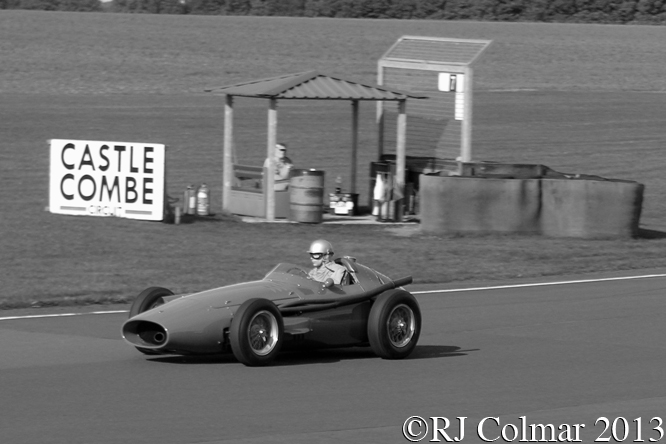
Maserati 250F, Autumn Classic, Castle Combe

Nick Mason’s Maserati 250F arrived a later than intended and sadly sans Nick, but it made a welcome appearance on the track, unfortunately the PA was a little weak at Old Paddock when I took this photo so I’m not sure who was at the wheel, if you know chime in below.
Aston Martin DB3, Autumn Classic, Castle Combe

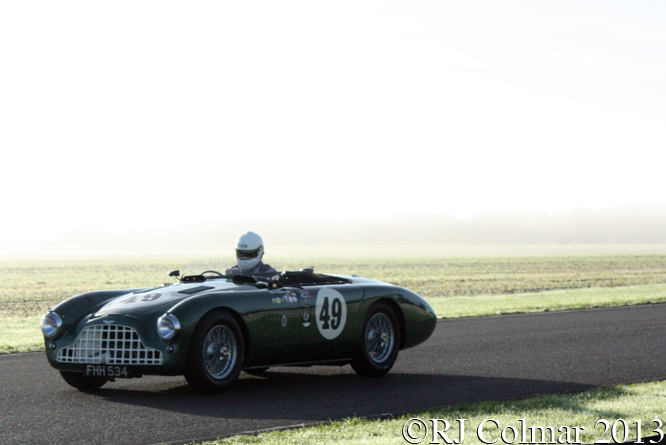
The Historic Aston Martins got the afternoons racing underway, Martin Hunt driving a Fraser Nash Le Mans Replica did well to lead from second on the grid for the opening lap but it was Chris Woodgate, seen above qualifying his Aston Martin DB3 #DB3/6 on pole in the early morning mist, who led from lap 2 until the finish, while Hunt fell back to finish an eventual fifth.
Norman Dewis Trophy, Autumn Classic, Castle Combe

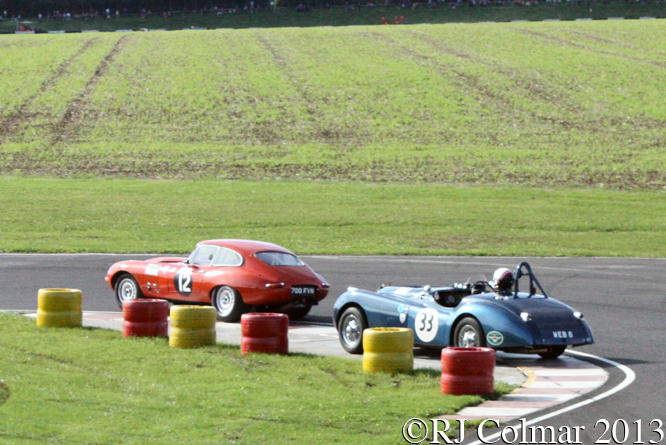
Grahame Bull and Anthony Reid locked out the front row for the Norman Dewis Trophy for Jaguars with the #12 E Type and #33 XK120 respectively. Reid made a great race of it taking the lead on lap 2 and then again from lap six to 18 until he was slowed by a puncture which left Bull with an unassailable lead.
Big Healey Challenge, Autumn Classic, Castle Combe

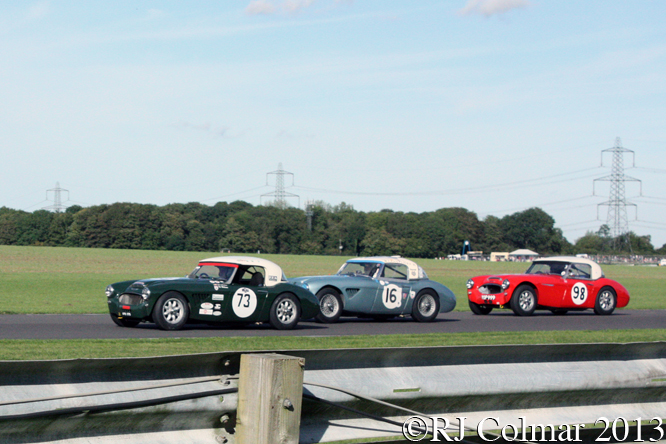
The Big Healey’s provided the second biggest grid of the day and by far the fiercest competition which saw five competitors trying to go unsuccessfully line abreast into the Bobbies chicane at one point ! Above the #73 Chris Clarkson / Ted Williams, #16 Eric Wolley / Dan Cox and #98 Nils-Fredrick Nyblaeus / Jeremy Welch cars fight over blagging rights for the best entry line into Tower Corner. David Grace and Anders Schildt were declared the winners after Dan Cox driving the fastest car in the race went backwards into the barriers, without injury, at Tower.
VSCC Pre War Sports Cars, Autumn Classic, Castle Combe

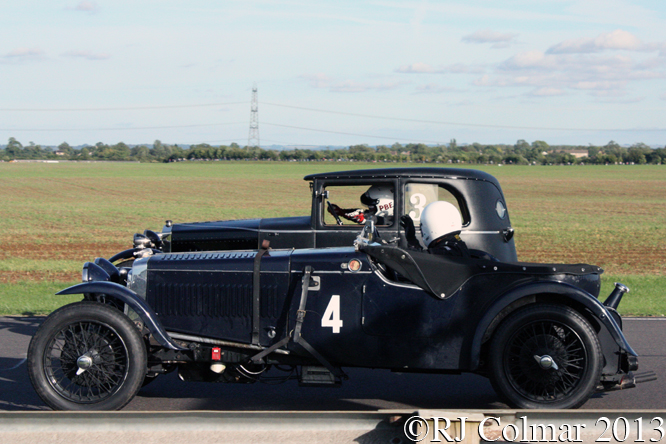
The rather more leisurely VSCC Pre War Sports Cars race was won by Frederic Wakeman from pole abourd his Fraser Nash Super Sports but only after past a fast starting HRG driven by Andrew Mitchel who led the opening three laps. The brothers Blakeney-Edwards provided the scrap of the race Simon in the #4 Fraser Nash Shelsey got the better of Patrick in the #3 Fraser Nash Owlet Saloon to home 3rd. The brothers are seen congratulating each other on their return to the pits.
FISCAR, 50's Inter Marque, Autumn Classic, Castle Combe

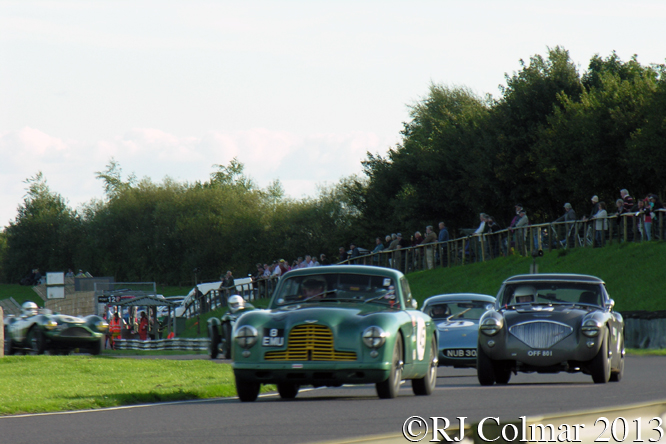
Andrew Sharp, seen leading in his #45 Aston Martin DB2 a above, from third on the grid managed to lead every lap of The FISCAR 50’s Inter Marque, but only after he had managed to build up a big enough to make his compulsory pit stop 5 mins before the end of the race. Nike Thorn and Johnny Todd driving the #44 Austin Healey 100S did well to finish just 0.07 seconds behind Sharp, from second on the grid, on a thrilling closing lap.
Miller Oils Formula Junior, Autumn Classic, Castle Combe

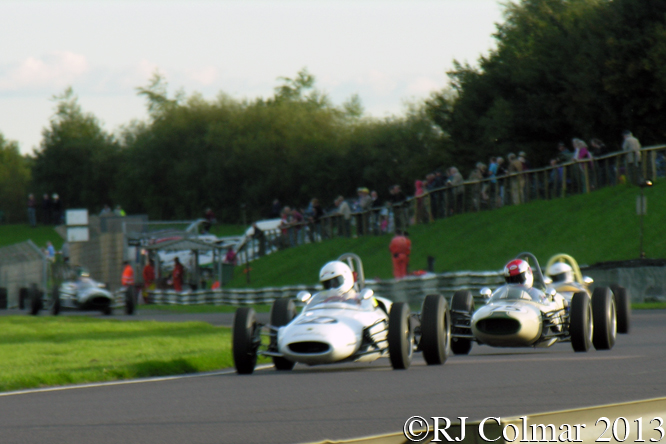
The biggest grid of the day was provided by the Miller Oils Formula Junior Championship competitors. Jack Woodhouse qualified on pole in his #84 Lotus 20/22 and won the close fought race by half a second from Peter Morton who started alongside him in the rare #75 Lightning Envoyette seen above on the opening lap.
50's Lightweight Sports Racing Cars, Autumn Classic, Castle Combe

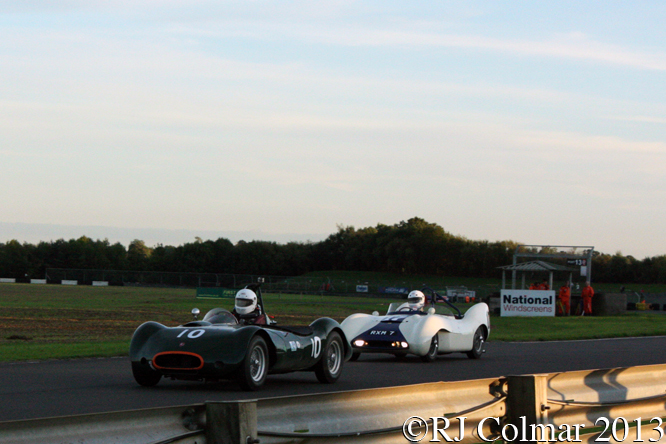
The final race of the day was for 50’s Lightweight Sports Racing Cars had eight entries of which just seven took the start. But it only takes two cars to make a race and Alex Quattlebaum proved it by taking the win from 4th on the grid in his #10 Leco MG after a race long battle with 2nd place starter Brian Arculus in his #17 Lotus IX. Brian might have won the race had he not switched his lights on which appeared to have an adverse effect on the smooth running of his motor. Alex is seen making his final pass on Brian 2 laps from home above.

And so the 2013 season of Motorsport that began with the sad loss of circuit saviour Howard Strawford, drew to a close at Castle Combe in Wiltshire, roll on 2014 !

Thanks for joining me on this Autumn Classic edition of “Gettin’ a li’l psycho on tyres” I hope you will join me again tomorrow for a look at a 1990 Thunderbird. Don’t forget to come back now !
Share