Tag Archives: Classic

More Strength & Softer Springs – MG 18/80 Six Saloon Mk II

MG 18/80 Six Mk 1, Bristol Classic Car Show

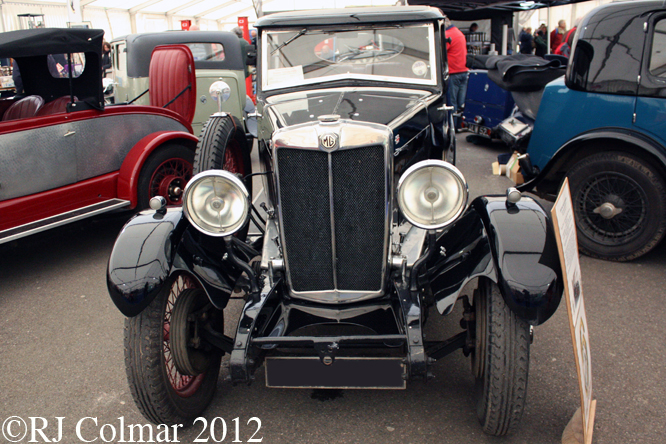
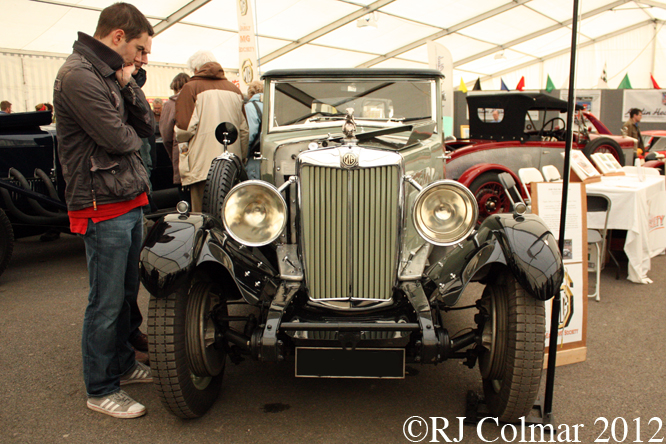
Rather confusingly MG marketed both the MG 18/80 Six Mk I, featured a couple of weeks ago, and Mk II, featured today, simultaneously from 1929 to 1931.
MG 18/80 Six Mk 1, Bristol Classic Car Show

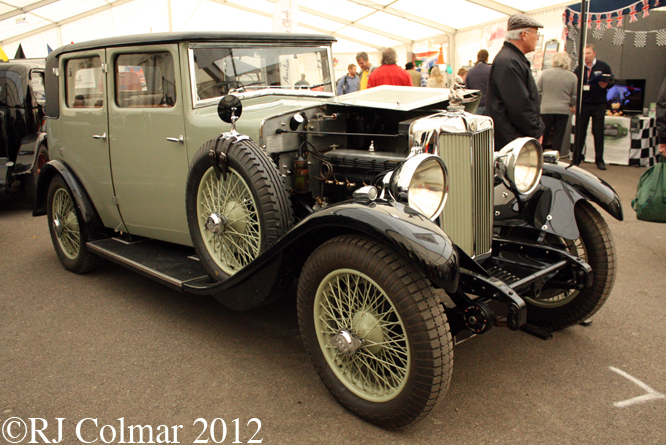
The 18/80 Six Mk 1 was developed from the still born Morris Light Six project, with a much sturdier chassis, the first to be designed by MG rather than inherited from Morris.
MG 18/80 Six Mk 1, Bristol Classic Car Show

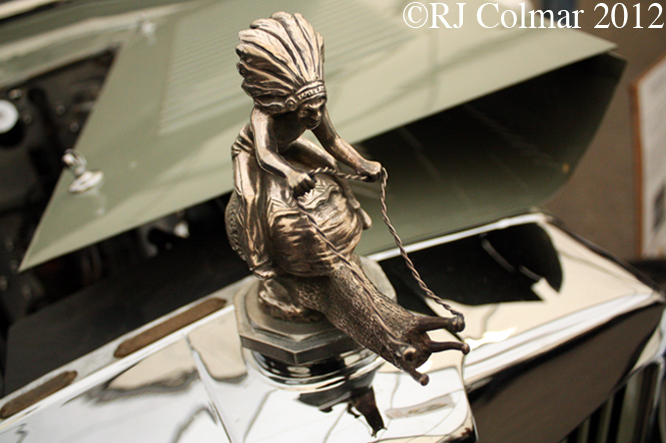
Unfortunately many of the painstaking chassis details like the MG motifs set into the aluminium bulkhead brackets were lost once the bodies had been affixed.
MG 18/80 Six Mk 1, Bristol Classic Car Show

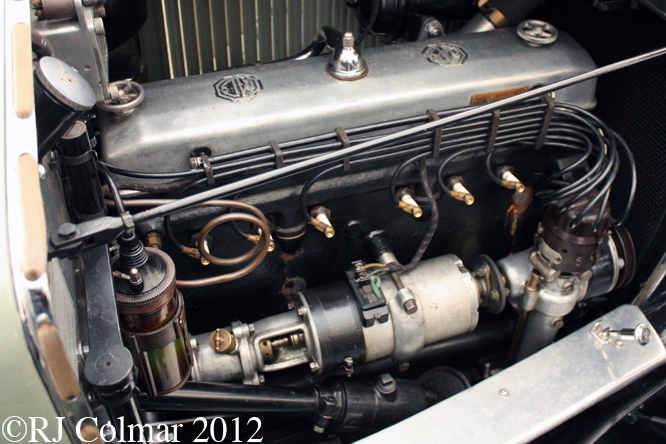
The motor was derived from the failed Morris Light Six but featured a new all in one crank case and cylinder block casting with a separate cylinder head. The motor made use of the then new shell type big end and main bearings for smooth and quiet running.
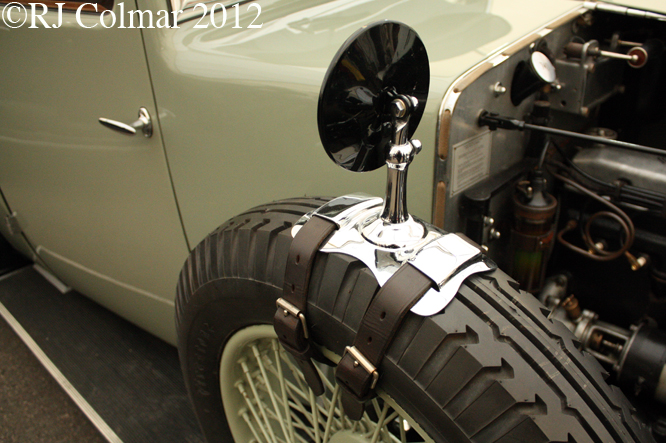
MG 18/80 Six Mk 1, Bristol Classic Car Show

The 60 hp 18/80 Six Mk 1 is said to have been capable of out accelerating comparable models with good racing reputations from both Lagonda and Alvis, however the performance advantage was lost on the 18/80 Mk II which was built on an even sturdier chassis with a wider track that added weight which was not made up by any improvement in engine performance.
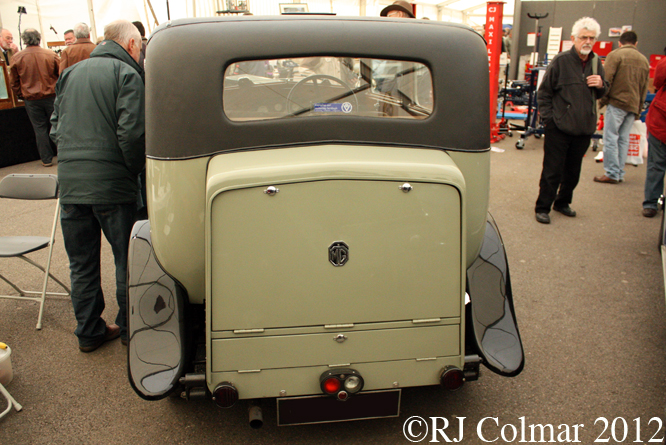
MG 18/80 Six Mk 1, Bristol Classic Car Show

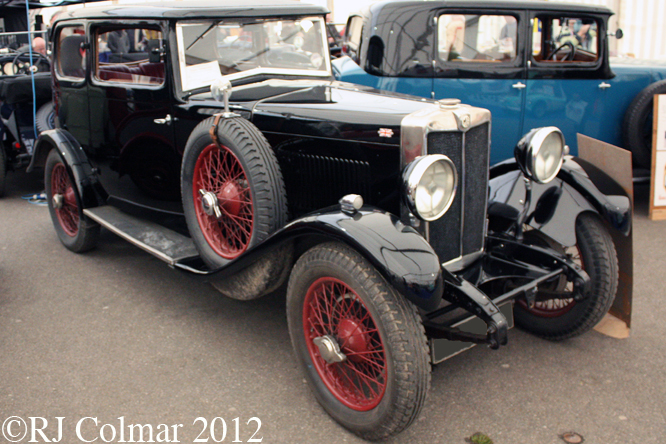
The Mk I was £100 cheaper than the Mk II which made the latter car all the harder to sell despite it’s four speed gearbox, sturdier construction and softer springs. The 1930 model seen here is thought to be one of just 3 MK II’s known to have survived.

Thanks for joining me on this “More Strength & Softer Springs” edition of “Gettin’ a li’l psycho on tyres”, I hope you will join me for an independence day edition again tomorrow. Don’t forget to come back now !

The 1930 model seen here is one of

Share

Dino Evolution – Ferrari 166/206 #0834

Enzo Ferrari was a man who believed that to remain competitive he needed to start with a good car and then continually seek to improve it’s performance with modifications.

The Ferrari 166/206, following the footsteps of the Ferrari Dino 196S and it’s similarly Dino V6 powered Formula siblings the front engined ‘246’ and rear engined Shark Nose ‘Dino 156‘, perfectly exemplifies his Enzo’s continual modification philosophy.

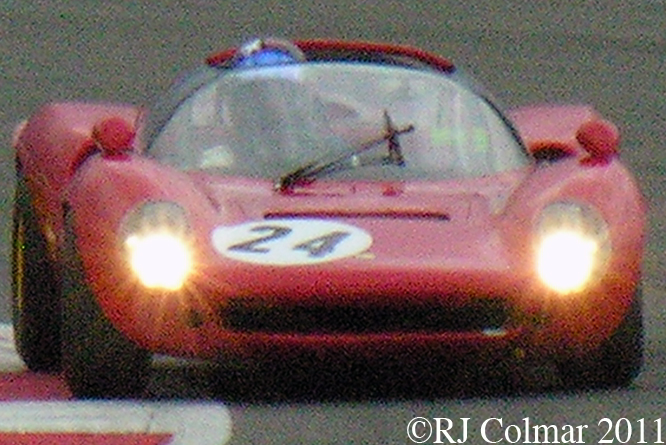
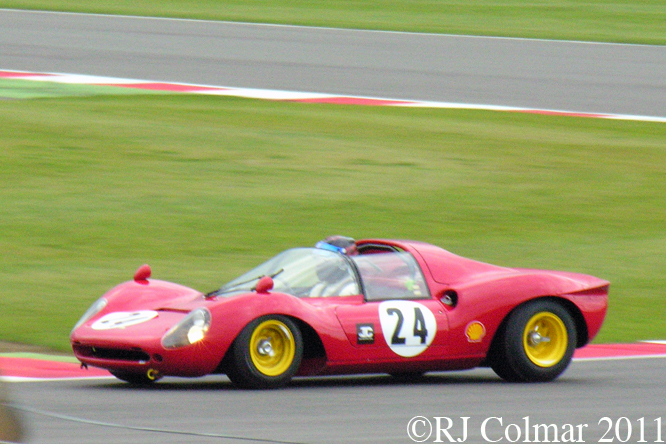
Ferrari 166/206, Silverstone Classic

The original Dino 166/P specification of chassis #0834 seen, in these photo’s at Silverstone Classic last year, was built around a new 185hp variant of the Dino V6 with twin overhead cam shafts per bank, quad cam, and twin plug ignition and a capacity of 1592 cc / 97.2 cui.

The original body was a closed coupé style, similar to that of a bigger V12 powered Ferrari P2 and can be seen on this link.

Despite it’s good handling, in this form the car driven by Giancarlo Baghetti and Giampiero Biscaldi retired from the 1965 1000 kms at Monza after one lap with engine failure, then Lorenzo Bandini drove it to victory at the Vallelunga GP.

However the 166/P’s biggest success against much stronger opposition was at the 1965 Nürburgring 1000 kms where Bandini and Nino Vaccarella came home 4th behind two Ferrari P/2’s and a Porsche 904/8 all with larger motors. This performance was thought so unlikely the events scruitineers had the motor stripped to confirm it’s capacity.

At the 1965 Le Mans 24 hours Baghetti and Mario Casoni only lasted 21 minutes before it retired with a broken valve.

Ferrari 166/206, Silverstone Classic

Two months after Le Mans chassis #0834 was upgraded to 206 S/P specification with a 218hp 1986 cc / 121.2 cui Dino V6 motor and a low cut open top Spyder body, which can be seen on this link.

Ludovico Scarfiotti used the car in this form to win the European Hillclimb championship setting new course records in all of the remaining 1965 championship rounds.

In 1967 the car appeared in the Targa Florio with a third, 206 S, body configuration, similar to the one seen in today’s photographs, where it finished 4th with Jonathan Williams and Vittorio Venturi at the wheel.

Two years later Leandro Terra and Turillo Barbuscia drove #0834 still in 2 litre / 122 cui spec to a 25th place finish in the 1969 Targa Florio.

#0834 is currently owned by Harry Leventis who shares the driving with Gregor Fisken on a regular basis in the The Italian Historic Car Cup.

There is an interesting observation about the “Dino 206” cars by the highly esteemed journalist Doug Nye on this link, makes one wonder what Ing. Forghieri may have come up with on a good day !

Thanks for joining me on this “Dino Evolution” edition of “Gettin’ a li’l psycho on tyres”. I hope you will join me again tomorrow. Don’t forget to come back now !

Share

Fritz’s Kabinenroller – Messerschmitt KR200

Unlike Bristol Aeroplane Company which chose to prepare for and switch from aircraft production to car production after the ’39-’45 war Messerschmitt was temporarily banned from aircraft production after the cessation of hostilities and had little choice but to switch to automobile manufacture in order to survive.

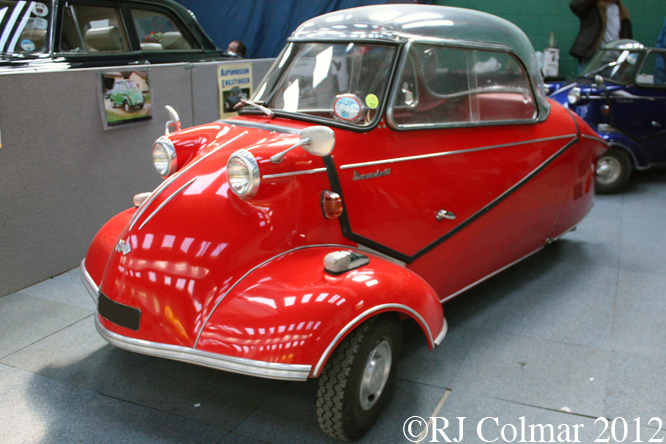
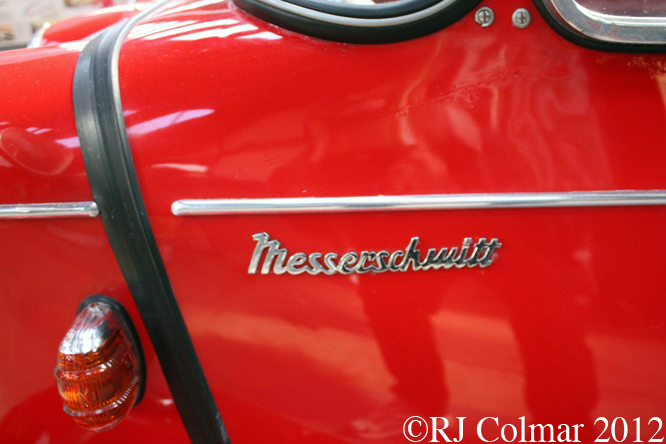
Messerschmitt KR200, Bristol Classic Car Show

In 1952 Fritz Fend showed Messerschmitt his idea for a three wheeled motor scooter, Kabinenroller, based on the design of an earlier invalid vehicle which found a market among non invalids desperate for cheap transport alike.

Messerschmitt KR200, Bristol Classic Car Show

The KR175 was produced from 1952 to 1955 when it was substantially redesigned around the original frame.

Messerschmitt KR200, Bristol Classic Car Show

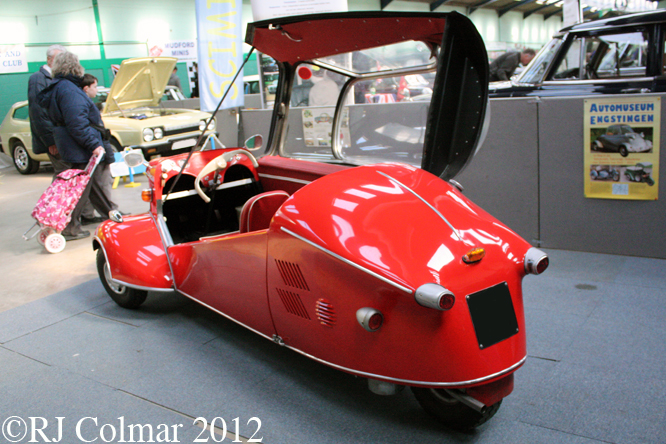
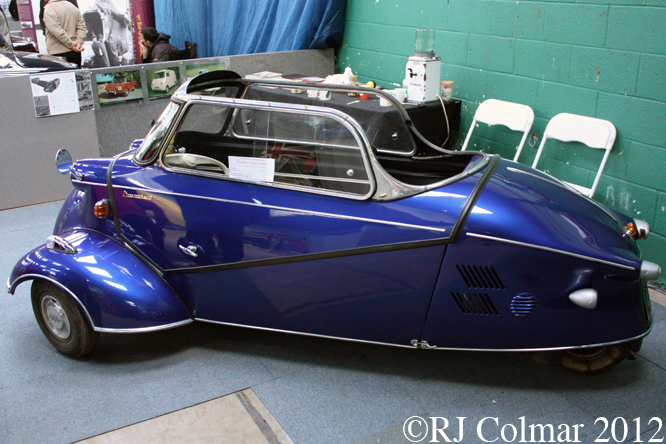
The new KR200 as seen here at the Bristol Classic Car Show featured cut outs in the wheel wings / fenders.

Messerschmitt KR200, Bristol Classic Car Show

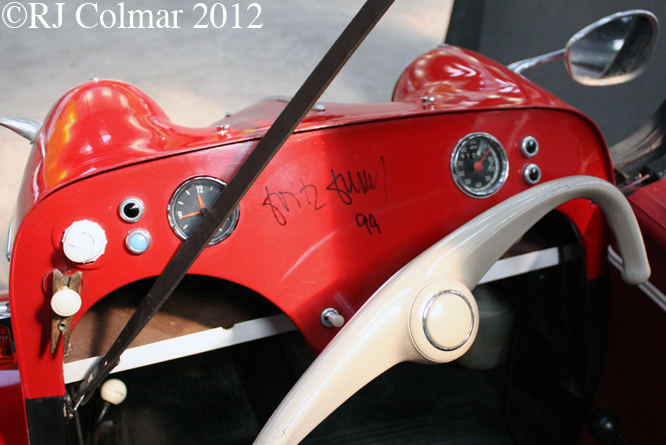
Note this car was driven to Regensburg in 1999 where the designer Fritz Fend signed the dash.

Messerschmitt KR200, Bristol Classic Car Show

Other improvements on the KR200 included improved canopy design, larger wheels and suspension improvements attributed to the introduction of hydraulic shock absorbers.

Messerschmitt KR200, Bristol Classic Car Show

The larger 10 hp 200 cc / 12.2 cui 2 stroke motor gave the KR200 a top speed of 56 mph and because it was a two stroke it could be reversed by pressing a button which reversed the direction in which the motor spun.

Messerschmitt KR200, Bristol Classic Car Show

To prove the viability of the KR200 a single seat low drag body version was taken to the Hockenheimring in 1955 where it set 22 international class records including an average speed of 64 mph for 24 hours.

Messerschmitt KR200, Bristol Classic Car Show

The KR200 was a huge success such that when Messerschmitt resumed aircraft manufacturing in 1956 Fend was allowed to purchase the assets needed to carry on with car production and carry on using the Messerschmitt brand name.

Messerschmitt KR200, Bristol Classic Car Show

In all 40,000 KR200’s were manufactured up until 1964 including a KR201 roadster. A 4 wheel version was also developed along with a variety of 3 wheel utility vehicles.

Fritz Fend is also credited with inventing the alarm system that goes off when one pulls the key out of the ignition of a vehicle after one forgets to turn the light off.

Thanks for joining me on this “Fritz’s Kaninenroller” edition of “Gettin’ a li’l psycho on tyres” I hope you will join me again tomorrow when I’ll be looking at a Swinger that suffered repeated damage when being parked in the Bay area. Don’t forget to come back now !

Share

Continental Tourer – MG 18/80 Six Saloonette Mk I

Today’s featured MG 18/80 Six was through University Motors of, the then very fashionable, Park Lane, London W1 in 1931 for £625 painted black and cream.

MG 18/80 Six Salonette MkI, Bristol Classic Car Show

Technically this car is similar to the Tigress bodied 18/80 featured a couple of weeks ago with a 2468cc / 150 cui six cylinder motor that gives an 80 mph potential.

MG 18/80 Six Salonette MkI, Bristol Classic Car Show

The history of this particular car is unknown between its original sale and the 1960’s when it resurfaced several times as it changed ownership. Since it’s restoration in the 1970’s it has been used for touring in the UK and on the Continent.

Thanks for joining me on this “Continental Tourer” edition of “Gettin’ a li’l psycho on tyres”, I hope you will loin me tomorrow when I’ll be looking at a classic Messerschmitt. Don’t forget to get to come back now !

Share

Thirty Year Restoration – Lotus Mark 6 #JZ 7890

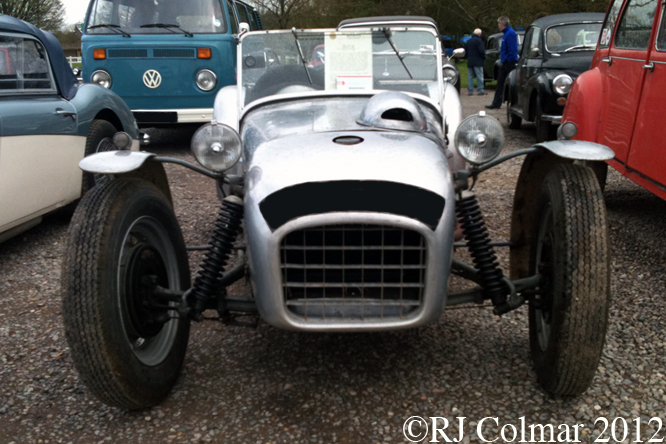
The Lotus Mark 6 represented Colin Chapman’s first attempt at building a vehicle which customers could purchase in kit form.

Lotus VI, Bristol Classic Car Show

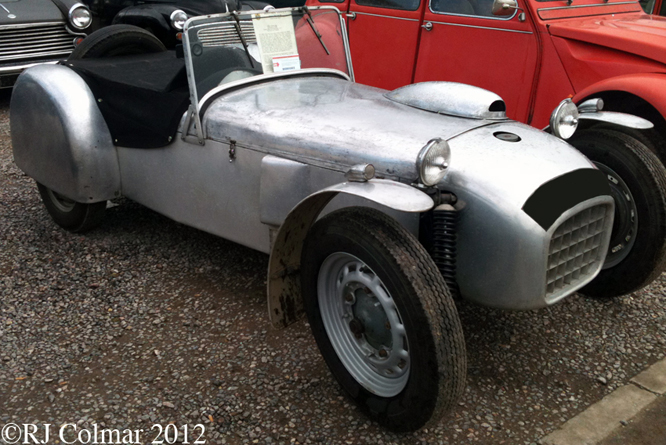
Chassis #JZ 7890 was one of the first eight built, therefore one of the first 13 Lotus cars ever built. The car was originally assembled with a 4 cylinder Ford Consul motor and Austin Gearbox by Patrick Stevens for owner Denis Wilkins. Wilkins competed in the car at numerous events in England during 1953 and in 1954 took the car to Ireland where he shared it with Ian Titterington. It’s best result that I could find is a third place at Kirkistown in an Open Handicap Final in June 1954 with Wilkins at the wheel. In 1955 the car returned to England and competed in the hands of George Pitt, Rodney Bloor and Ken Coffey before being sold, in 1963, to an owner in Bristol who intended to fit a six cylinder motor from a Ford Zephyr.

Lotus Mark 6, Bristol Classic Car Show

Despite the original engine and gearbox being stripped out and sold on the conversion was never completed and the current owner bought the engineless remains in 1976 and then spent thirty years piecing it together with another Ford Consul engine and an MG TC gearbox. A couple of months after returning it to the road in 2006 he drove it to Le Mans in France.

Lotus VI, Bristol Classic Car Show

110 Lotus Mark 6 kits were eventually sold, including a one off trials version, scoring many competition victories and establishing Lotus as a specialist vehicle manufacturer.

Thanks for joining me on this “Thirty Year Restoration” edition of “Gettin’ a li’l psycho on tyres”, I hope you will join me for a Drag edition tomorrow. Don’t forget to come back now !

Share

“Tender At Heart” – Ford V8 30 Saloon

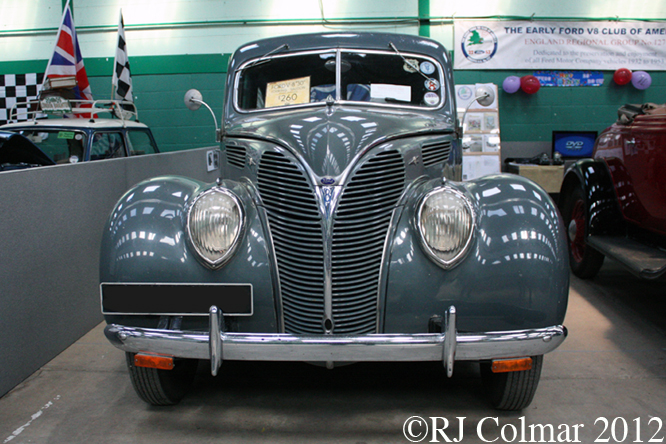
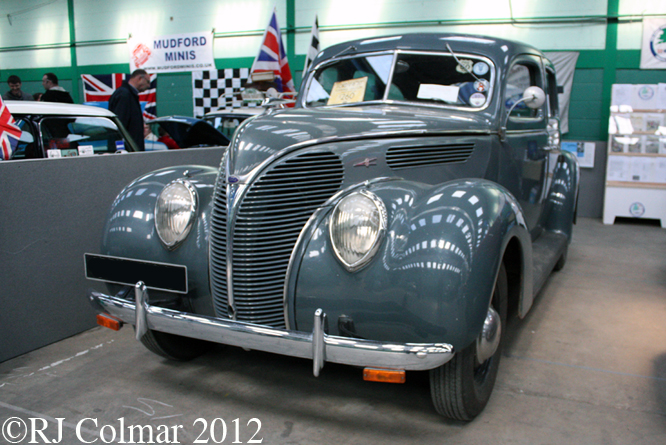
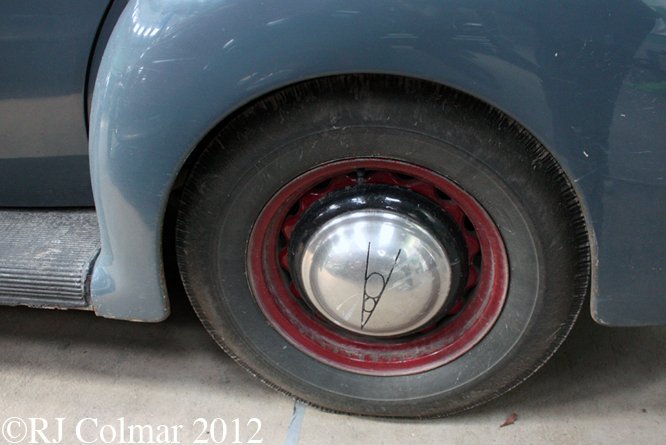
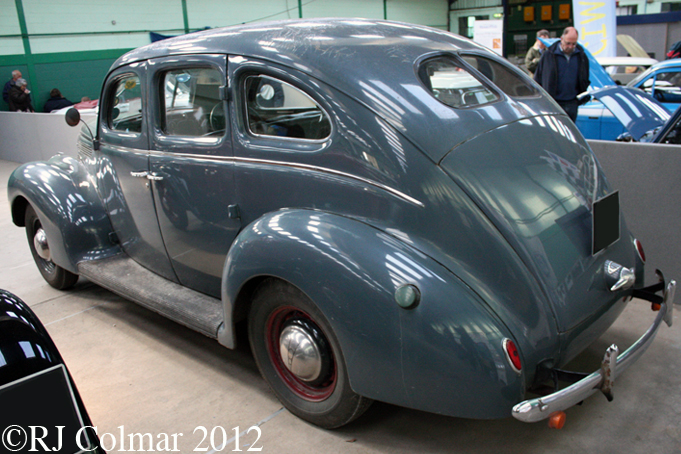
The 1938 Ford V8 30 Saloon appears to be a 1938 Ford de Luxe Sedan built for the British market complete with right hand drive.

Ford V8 30 Saloon, Bristol Classic Car Show

Like the Deluxe the V8 30 was powered by a ‘flathead’ V8 with either 60hp or 85hp options.

Ford V8 30 Saloon, Bristol Classic Car Show

New for 1938 was the distinctive heart shaped grill which is easily distinguished from the V shape grill of the 1937 models.

Ford V8 30 Saloon, Bristol Classic Car Show

The remaining panels were identical to the earlier 1937 models, not even a new dash with recessed controls for safety could do much to stimulate sales. After the 1939/45 war the British built Ford V8 30 updated and given a brief new lease of life in the UK, marketed as the Ford Pilot.

Ford V8 30 Saloon, Bristol Classic Car Show

In September 1939 Lenham, in Kent, Auxiliary Fire Station had a budget of £60 to acquire a Fire Tender and a Mr Hulland managed to acquire a Ford V8 30 hp Saloon for £30 and spent the remainder on having it converted. The depreciation from the new value of the vehicle at £230 in 1938 showing how desperate the times were at the commencement of the 1939/45 war.

Thanks for joining me on this “Tender At Heart” edition of “Gettin’ a li’l psycho on tyres”, I hope you will join me again tomorrow. Don’t forget to come back now !

Share

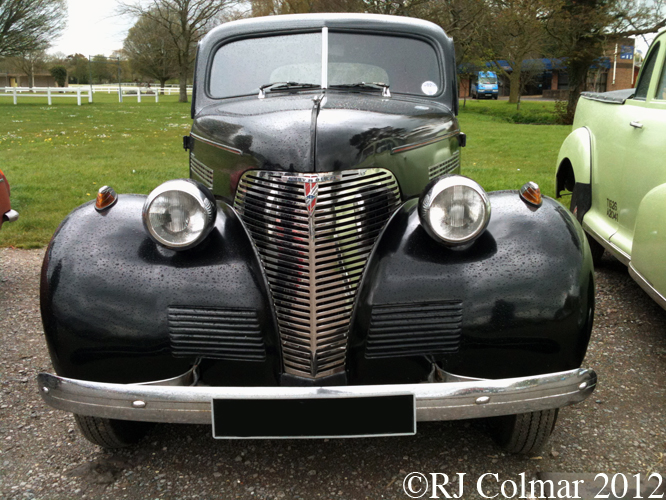
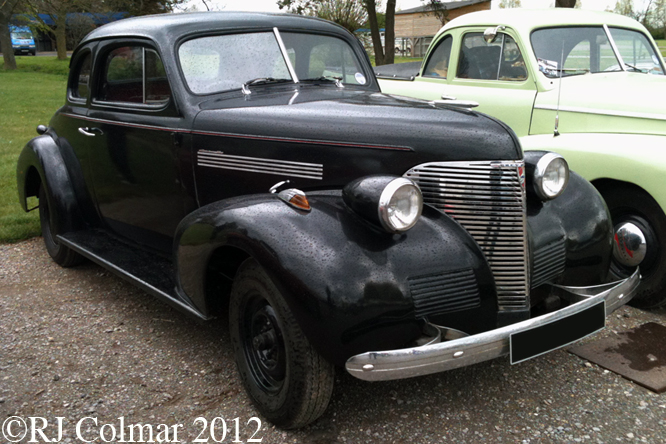
5900 Miles To Fame And Fortune – Chevrolet Master 85 Coupé

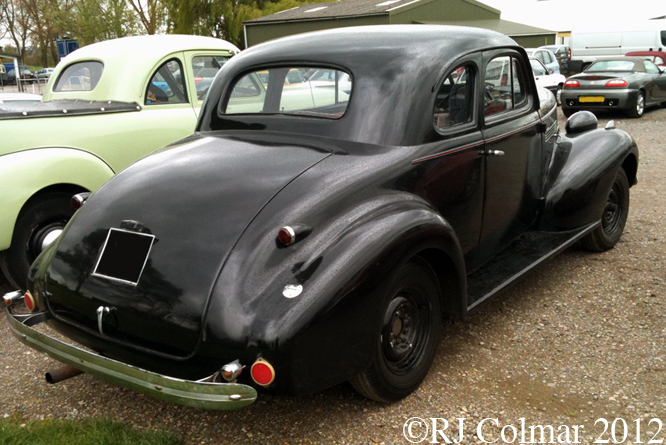
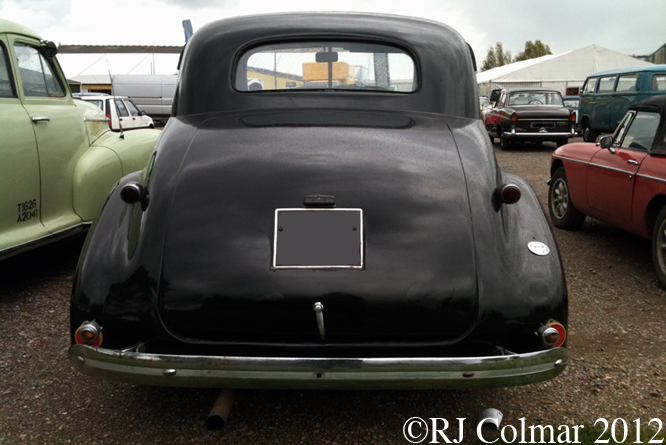
The origins of the Chevrolet Master 85 Coupé can be traced back to 1928 when Chevrolet started to switch from building four cylinder motors to six cylinder motors.

Chevrolet Master 85 Coupé, Bristol Classic Car Show

The introduction of this innovation played to Chevrolet’s advantage as coincidentally Fords experienced a downturn in fortunes as it belatedly switched production from the Model T to the Model A.

Chevrolet Master 85 Coupé, Bristol Classic Car Show

In 1933 the Master series was introduced as an above base (Standard) range of vehicles and in 1937 this series received an 85 hp 3.5 litre / 216 cui six cylinder motor from which the marketing department added the 85 to the Master Series name.

Chevrolet Master 85 Coupé, Bristol Classic Car Show

A ‘tiptoe-matic’ diaphragm spring clutch aided smooth changes between the three forward gears in the gearbox.

Chevrolet Master 85 Coupé, Bristol Classic Car Show

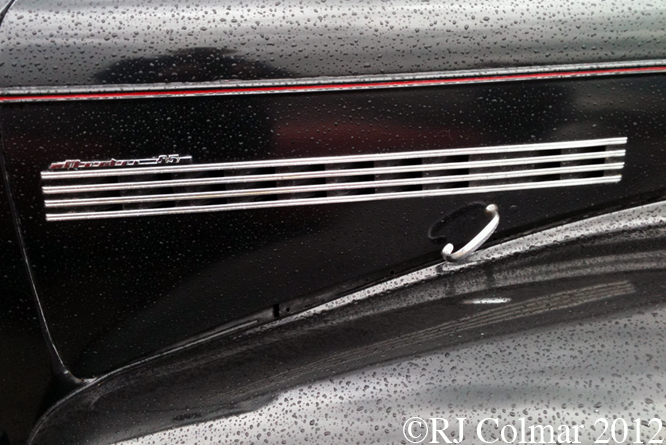
In 1939 the sealed Dubonnet inspired ‘Knee Action’ independent front suspension was abandoned in favour of coil springs and wishbones.

Chevrolet Master 85 Coupé, Bristol Classic Car Show

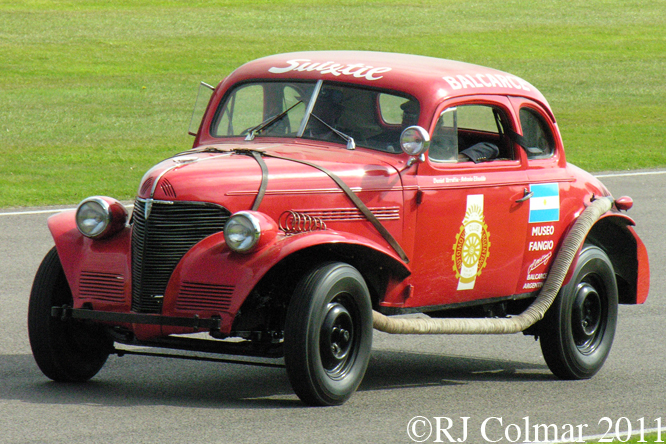
In 1940 a little known 29 year old Argentinian Juan Manuel Fangio, who had started making a name for himself racing a Ford Model A, and his friends modified a Chevrolet Master 85 Coupé for the demands of a 5900 mile race from Buenos Aires, Argentina to Lima, Peru and back.

Chevrolet Master 85 Coupé, Goodwood Revival

Juan managed to average 53.5 miles per hour on some of the worlds roughest roads traversing some of the worlds most isolated regions to win the race. He backed up the performance with back to back Turismo Carretera Series championship wins in 1940 and 1941 which was enough to secure backing from the Argentinian government in 1948 for a trip to Europe that would herald the arrival of the worlds first 5 time World Champion.

The copper pipe clearly seen on the wing / fender of Juan’s Master 85 above acts as an oil cooler.

Thanks for joining me on this ‘5900 miles to Fame And Fortune edition of “Gettin’ a li’l psycho on tyres”, I hope you will join me again tomorrow when GALPOT will feature a Ferrari 458. Don’t forget to come back now !

Share