Tag Archives: Colmar

Importing A Ladder – Maserati 250F #2530/32

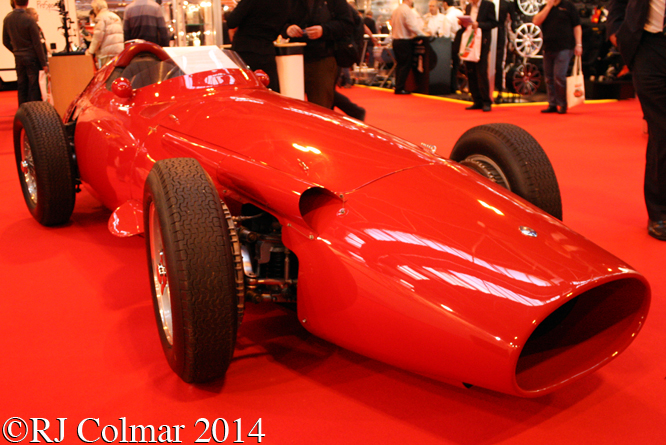
Somewhere around 1980 Pink Floyd Drummer Nick Mason entered into negotiations to purchase ERA 10B and found that he could only buy the car on condition that he bought a Maserati 250F, today’s featured car, as part of the package.

Maserati 250F, Rob Hall, Cholmondeley Pageant Of Power

Nick bought both cars and found that the 250F had a 1957 lightweight chassis which turned out to be #2530 to which people had fitted numerous incorrect parts including a Chevrolet V8.

Maserati 250F, Autosport International, NEC Birmingham

Nick described the car as a “basket case” and recalls the car being described as a ladder for import purposes.

Maserati 250F, Rob Hall, Cholmondeley Pageant Of Power

#2530 was originally fitted with a V12 motor but never raced with it, later in 1958 #2530 was fitted with a six cylinder motor and sent to South America. It appeared in the 1960 Argentinian Grand Prix with the chassis number #2532 where Gino Munaron drove the car to a 13th place finish.

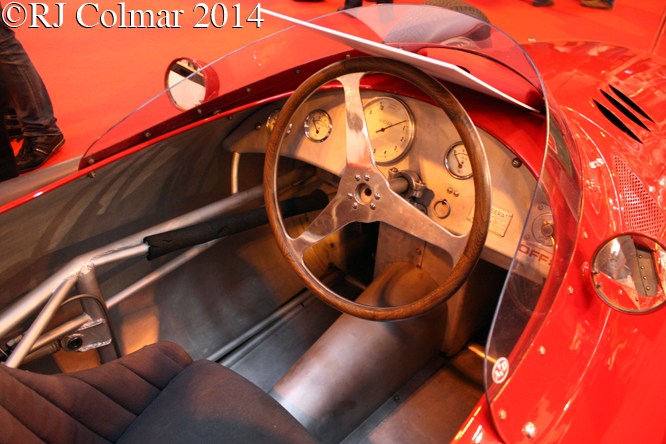
Maserati 250F, Autosport International, NEC Birmingham

To keep you on your toes Antonio Creus drove another 250F in the 1960 Argetinian Grand Prix this was chassis #2526 which carried the #2530 ID tag ! Antonio retired from with driver fatigue.

Maserati 250F, Autosport International, NEC Birmingham

Towards the end of 1960 Brazilian Rugeno Peruzzi bought the car and between 1962/64, according to David McKinney’s Maserati 250F, it appears to have been raced by Camillo Cristofaro with a Chevrolet V8 in the engine bay.

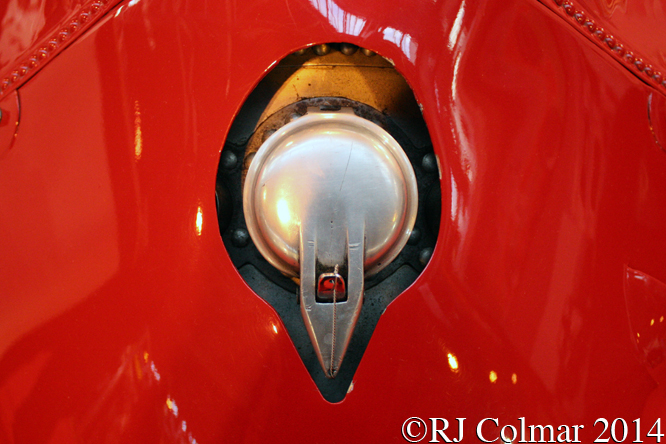
Maserati 250F, Autosport International, NEC Birmingham

Colin Crabbe found the car with out any identity in the early 1970’s and Nick had the frame replaced by a new one to the correct 1957 lightweight specification.

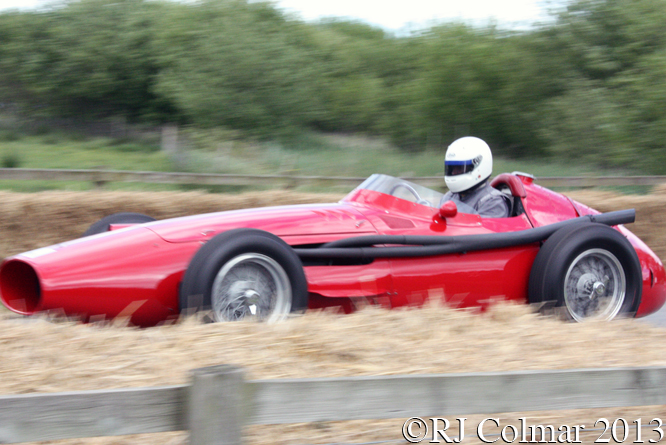
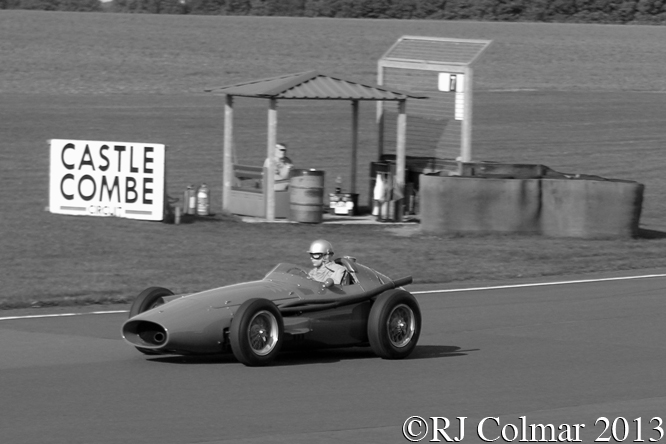
Maserati 250F,  Autumn Classic, Castle Combe

Rob Hall is seen yumping #2530 at Cholmondeley Pageant Of Power at the top of the post while Charles Knill-Jones, a member of the Ten Tenths team which looks after Nick Mason’s many cars, is seen in period attire hustling Nicks 250F around Castle Combe at last years Autumn Classic meeting.

My thanks to Castle Combe historian Pete Stowe for letting me know who was driving #2530 at Castle Combe.

Thanks for joining me on this “Importing A Ladder” edition of “Gettin’ a li’l psycho on tyres” I hope you will join me again tomorrow for a look at a vintage Bugatti. Don’t forget to come back now !

Share

Rubery Owens Last Stand – BRM P201/01-R

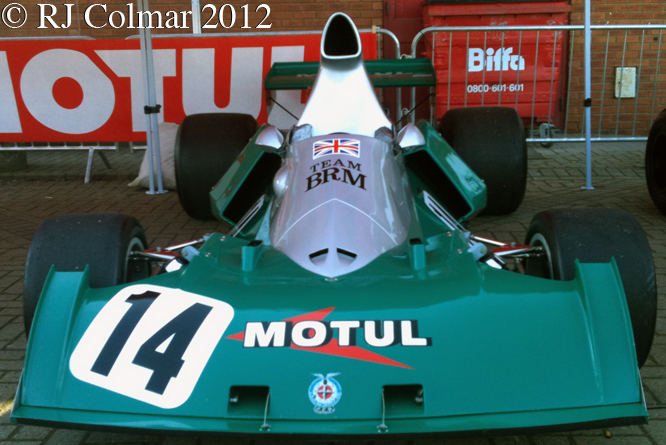
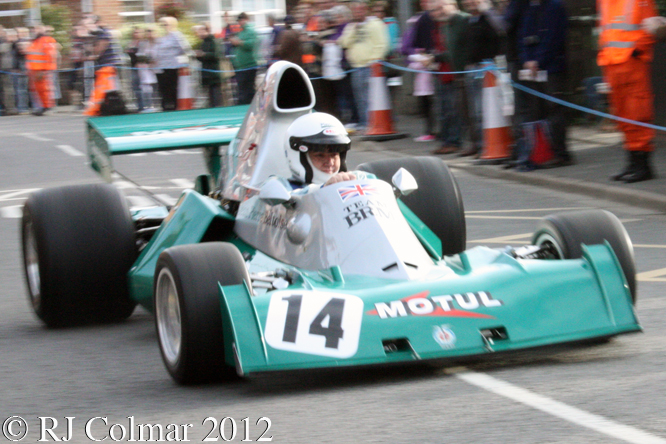
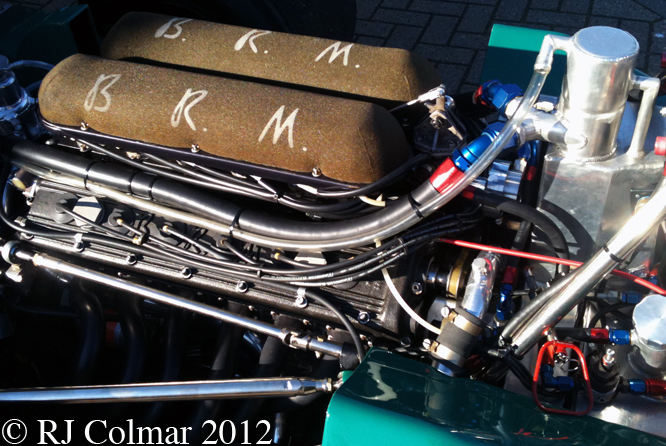
After a dismal 1973 season in which BRM did not even mange to clock up a non championship victory the team lost their primary sponsor, Philip Morris, to McLaren.

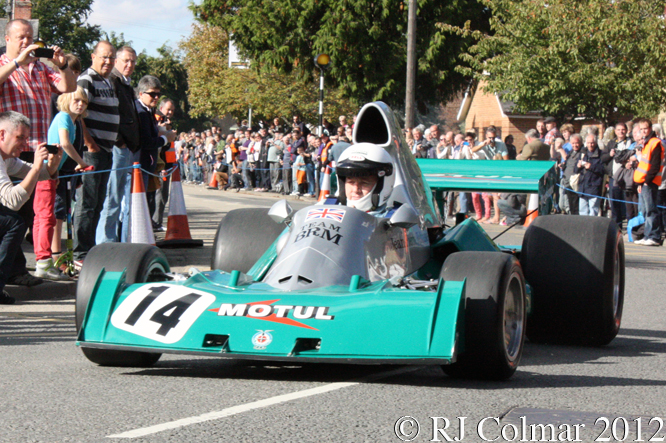
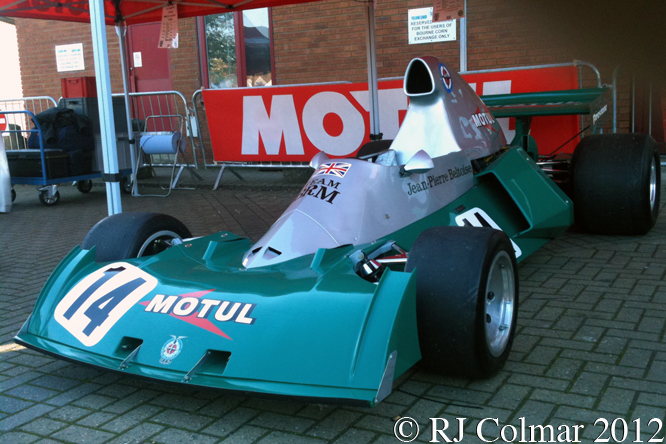
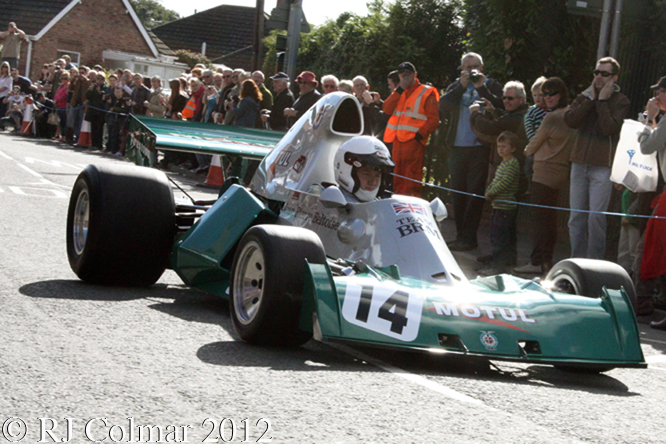
However Louis Stanley who managed the team for longtime BRM backers Rubery Owen managed to put a deal together for Frenchman Jean Pierre Beltoise, Henri Pescarolo and Francois Migault to drive for BRM in 1974 with backing from the French oil company Motul.

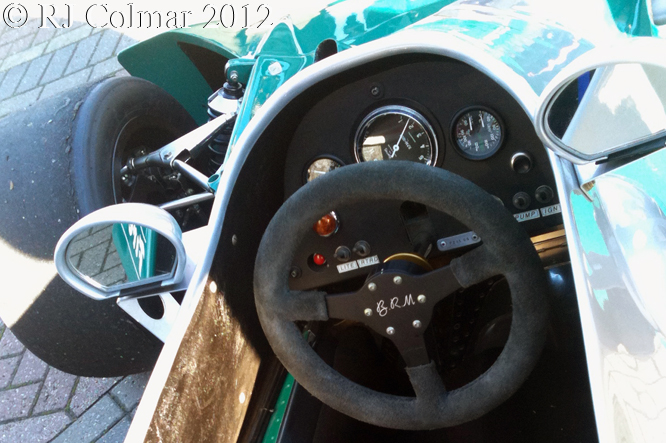
BRM P201, BRM Day, Bourne

The Motul deal was interesting because all three drivers were also members of Matra’s dominant sports car team which won at Le Mans and the 1974 World Sports Car Championship who were sponsored by rival company Shell.

Not only that but in agreeing to finance three drivers at BRM Motul reneged on a deal that was to have brought Ron Dennis and Niel Trundle into Formula One as team owners of Rondel Racing. The Rondel car was sold on to become first the Token and later the Safir while Dennis and Trundle eventually teamed up to take over McLaren in 1981.

BRM P201, BRM Day, Bourne

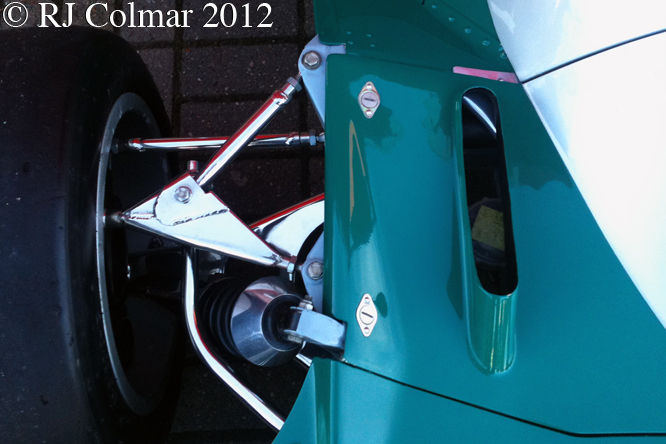
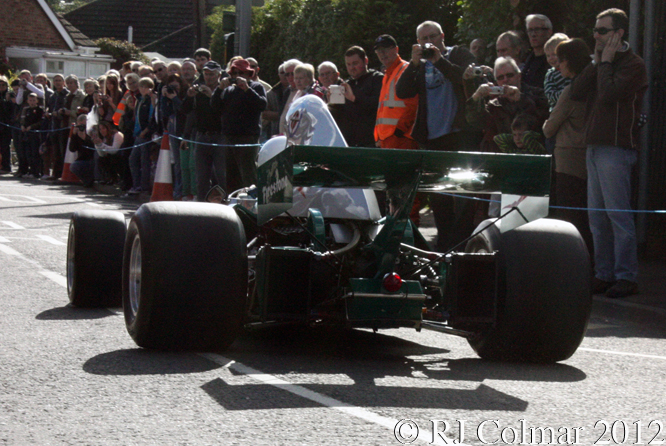
Plans for the 1974 BRM challenger were started in 1974 when Bourne resident Mike Pilbeam was entrusted with the design of the new car which shows a combination of influences including the triangulated cross section of the monocoque as first seen in Gordon Murray’s 1973 Brabham BT42, side radiators and all round inboard brakes as first seen on the 1970 Lotus 72 and an airbox that might not have looked out of place on the 1973 Championship winning Tyrrell 006.

While in no obvious way original the striking P201 did differ from all of those that influenced it’s design in one important aspect namely in the engine bay where a revamped BRM V12 with new narrow angle 48 valve heads was to be found said to capable of 460hp at 11,000rpm in place of the Cosworth DFV which powered the rest of the field apart from Ferrari.

BRM P201, BRM Day, Bourne

Jean Pierre Beltoise was the first to be allowed to dump his aging P160 to give the P201 it’s debut in the 1974 South African Grand Prix where he qualified a respectable 11th and lasted the distance in a race noted for a high rate of attrition to finish a credible 2nd 33 seconds down on Carlos Reutemann who won the first race of his career aboard the Brabham BT44.

BRM went on to score just two more points in it’s long and turbulent history at the Belgian Grand Prix where Beltoise came home 5th. The rest of the year was a disaster for BRM with Pescarolo scoring a best tenth place finish at the German Grand Prix in his 201 which did not appear until Swedish Grand Prix.

BRM P201, BRM Day, Bourne

Francois Migault only had two starts in the P201 in Holland and Italy retiring from both races. The Italian Grand Prix the only one in which 3 P201’s started marked a particularly low point for the team as all three cars were out by the end of the fourth lap.

The Italian Grand Prix marked the last appearance for both Henri Pescarolo and Francois Migault for BRM at the season ending Canadian and US Grand Prix they were replaced by Chris Amon who’s own 1974 programme had come to a halt with a failure to qualify in Italy.

BRM P201, BRM Day, Bourne

The Canadian Grand Prix neither car covered sufficient distance to be classified with Amon starting from the back of the grid lasting ten laps longer the Beltoise who started 17th and retired on lap 60.

At the US Grand Prix Beltoise disgraced himself in qualifying by trying to go to quickly too soon damaging his car and injuring himself on what proved to be his final run in a World Championship Grand Prix while Chris qualified 12th and finished 9th two laps down on Carlos Reutemann’s winning Brabham BT44.

BRM P201, BRM Day, Bourne

At the end of 1974 Rubery Owen pulled the plug on BRM, after initial BRM backer Alfred Owen had died earlier in the year. This should have meant the end of BRM but some how Louis Stanley managed to save the team going into the 1975 season.

Mike Wilds with an independent backer sponsoring him got the single Stanely BRM entry for the two early season South American races but retired his P201 from both.

1974 European Formula 5000 champion Bob Evans was then given the drive achieving a best 6th place finish in the non Championship Race of Champions before the Stanley BRM’s 1975 season fizzled out prematurely at the Italian Grand Prix.

BRM P201, BRM Day, Bourne

Not knowing how to disappear gracefully the Stanely BRM P201 appeared at the 1976 Brazilian Grand Prix with 1973 European Formula 5000 champion Ian Ashley at the wheel after qualifying 21st Ashley retired with oil pump failure after 2 laps. Allegedly this entry was made simply to continue BRM’s record of entry each year since 1950.

For 1977 the Stanely BRM fiasco continued with a new model the P207 which was packed into a crate to big to be air freighted to the Argentinian Grand Prix, after retiring from the Brazilian Grand Prix in the new P207 Larry Perkins was given a run a P201 for the 1977 South African Grand Prix qualifying 22nd Larry brought the P201 in 15th on what would be the models final World Championship Grand Prix appearance.

BRM P201, BRM Day, Bourne

Stanley BRM soldiered on for the remainder for the remainder of the season until disappearing for good from the World Championship circuit at the Italian Grand Prix.

Most of Stanley BRM were acquired by cereal millionaire John Jordan in 1978, and a new car the Jordan BRM P230 was built for British Championship events with the P207 also appearing in the same series.

BRM P201, BRM Day, Bourne

Today’s featured car BRM P201/1 seen at BRM Day in Bourne a couple of years ago is owned by Bruce McCaw, the driver was listed as TBA and his identity has yet to be established though we can say it is definitely not Bruce.

Thanks for joining me on this “Rubery Owens Last Stand” edition of “Gettin’ a li’l psycho on tyres” I hope you will join me again tomorrow when I’ll be looking at another Maserati 250F. Don’t forget to come back now !

Share

Lightweight – Buckler Daimler DD2

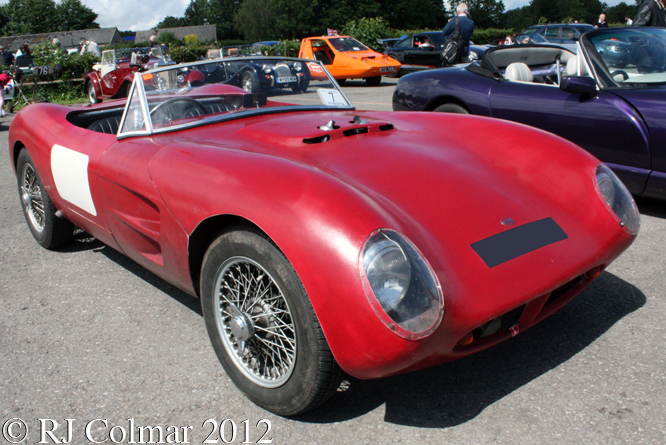
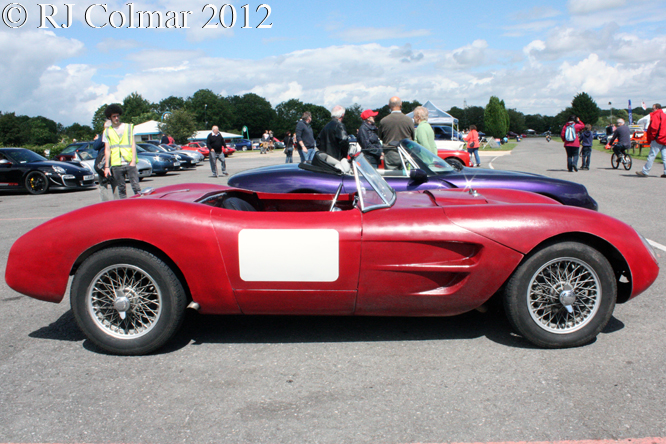
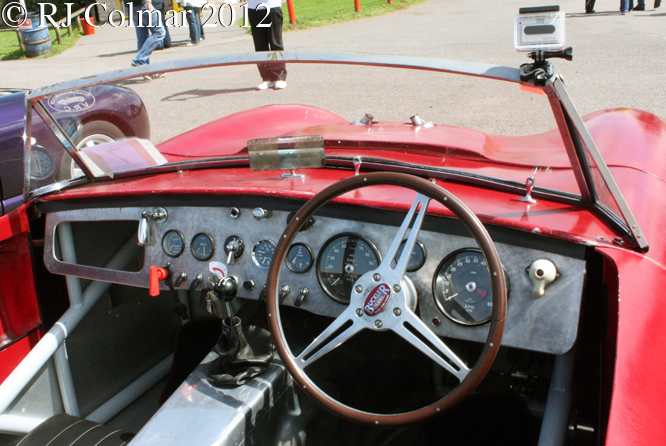
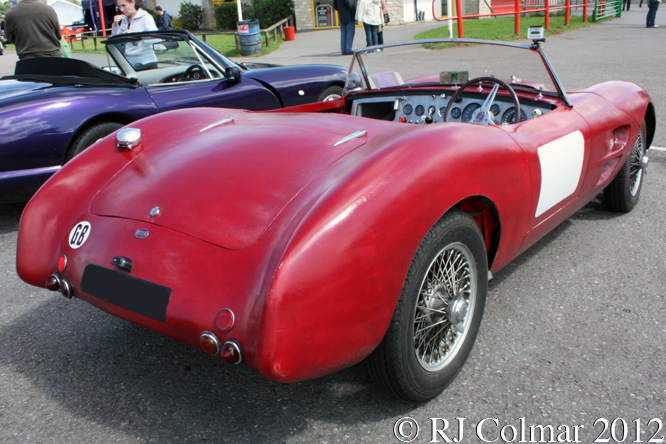
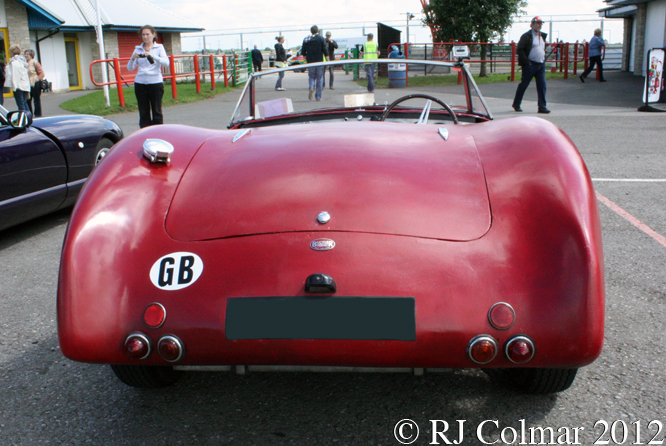
In 1957 Buckler started manufacturing frames for it’s DD2 model like the 1958 example seen here at the Bristol Motor Club’s Family Club Day at Castle Combe.

Buckler Daimler DD2, BMC Family Club Day, Castle Combe

This was built as a “lightweight” at the Buckler works for Les Hall.

Buckler Daimler DD2, BMC Family Club Day, Castle Combe

DD2’s were fitted with a variety of motors including Ford, Daimler , MG and in one instance a Vincent V twin from a motorcycle.

Buckler Daimler DD2, BMC Family Club Day, Castle Combe

It is thought Les Hall’s car originally had a Morris motor fitted.

Buckler Daimler DD2, BMC Family Club Day, Castle Combe

DD2’s were fitted with a variety of proprietary fiberglass bodies, today’s car is fitted with a Mistral body, others were made by Falcon, Convair and AKS to name a few.

Buckler Daimler DD2, BMC Family Club Day, Castle Combe

At some point today’s car was acquired by Malcolm Buckler, son of founder Derek, and shipped to the Isle of Isle of Man sans motor on top of a cargo of building stone.

Buckler Daimler DD2, BMC Family Club Day, Castle Combe

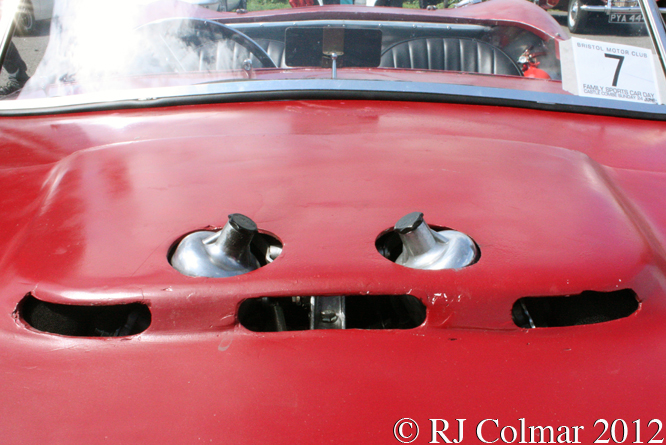
Later the car was acquired by Malcom’s brother in law Kieth Ambrose and his son Simon credited with putting the car back on the road with a Daimler V8.

Buckler Daimler DD2, BMC Family Club Day, Castle Combe

It is thought that a journalist Mr (Alan ?) Burgess may have been the first person to fit a SP250 Daimler V8 to a DD2, it thought this car might have been used for drag racing, but evidence in the form of a race programme or photographs have yet to surface to confirm this.

If you have any information to support this hypothesis please do not hesitate to chime in below.

Thanks for joining me on this “Lightweight” edition of “Gettin’ a li’l psycho on tyres” I hope you will join me again tomorrow when I’ll be looking at a BRM. Don’t forget to come back now !

Share

Breaking Into The Top Ten – Plymouth Model U

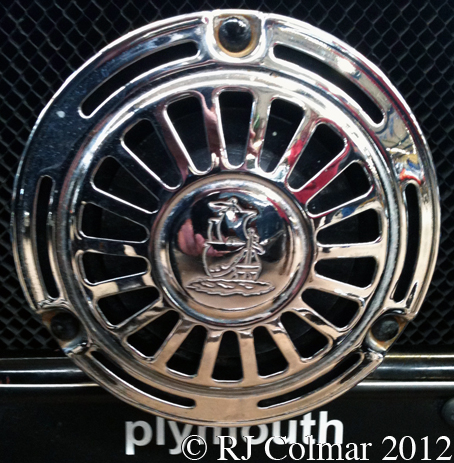
When Chrysler were looking to break into the lower price end of the automobile market Joseph W. Frazer suggested to Walter P. Chrysler that he name the car after Plymouth Binder Twine well known to the farming community and Walter agreed to “give them a name they’re familiar with.”

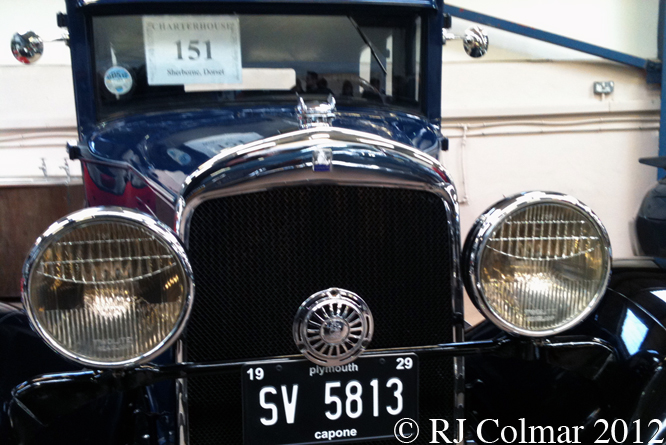
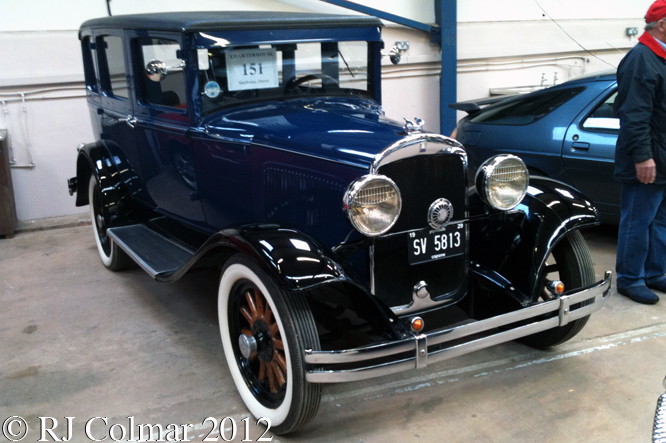
Plymouth Model U, Chaterhouse Auctions, Bristol Classic Motor Show, Shepton Mallet

On launching the new brand in 1928 Chrylser announced “We have named it the Plymouth because this new product of Chrysler engineering and craftsmanship so accurately typifies the endurance and strength, the rugged honesty, the enterprise, the determination of achievement and the freedom from old limitations of that Pilgrim band who were the first American colonists.”

Plymouth Model U, Chaterhouse Auctions, Bristol Classic Motor Show, Shepton Mallet

The first Plymouth was the model Q launched in 1928 and it’s appeal led it to rank 15th in the US Automobile sales charts for 1929 Plymouth evolved the Model Q into the Model U featured today.

Plymouth Model U, Chaterhouse Auctions, Bristol Classic Motor Show, Shepton Mallet

The Model U was powered by a 2.2 litre / 134 cui Silver Dome motor produced around 45 hp which could propel a Model U up to 60 mph, unlike it’s cheaper rivals from Willy’s and Ford the Model U was equipped with hydraulic brakes.

Plymouth Model U, Chaterhouse Auctions, Bristol Classic Motor Show, Shepton Mallet

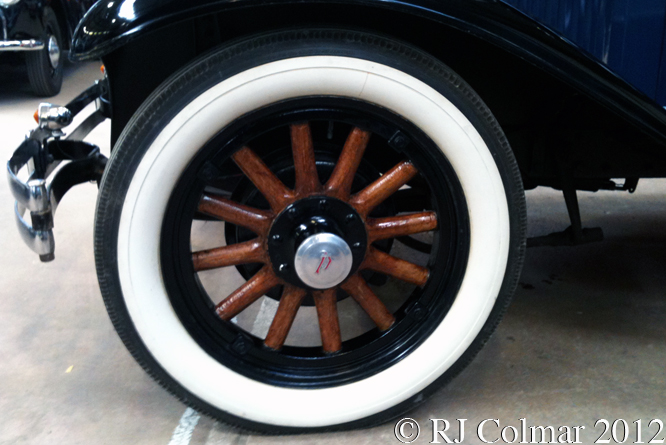
At $725 with standard 19 inch wooden wheels the Model U came in tenth in the US automotive sales ratings and the models success saw Plymouth production move to the, at the time, worlds largest car manufacturing plant which covered some 23 acres of floor space on at Lynch Road in Detroit.

Thanks for joining me on this “Breaking Into The Top Ten” edition of “Gettin a li’l psycho on tyres” I hope you will join me again tomorrow. Don’t forget to come back now.

Share

Classic Europeans – Desert Classic Concours d’Elegance

Last week I looked at some of the classic American vehicles at the Desert Classic Concours d’Elegance, today it is the turn of some of the Classic Europeans thanks to Geoffrey Horton who kindly shared his photographs.

Jaguar, de Tomaso, Ferrari, Desert Classics, Concours d'Elegance

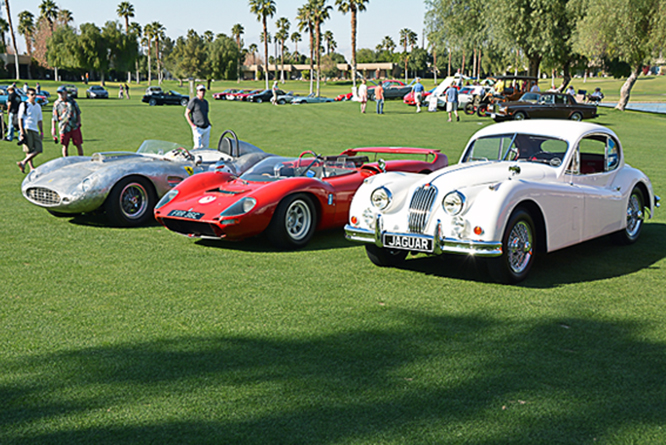
Geoffrey’s Jaguar XK140 FHC SE/MC is seen above parked alongside the unique De Tomaso Sport 5000 which was raced once and retired from the 1966 Grand Prix di Mugello and the Replica Ferrari Testa Rossa I looked at on Friday.

Delage D8 Letourneur et Marchand, Desert Classics, Concours d'Elegance

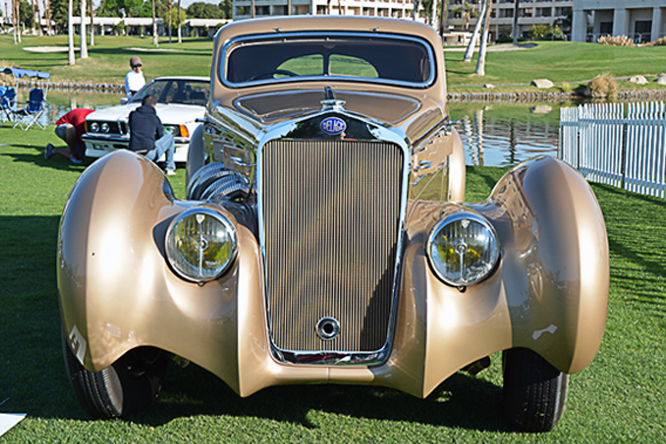
In 1935 Louis Delage had to liquidate the Delage company he founded in 1905 and sold the marque to Delahaye. The first Delage of the Delahaye era 4.7 liter / 286 cui straight eight powered D8-120 twelve chassis of which were sent to LeTourneur et Marchand where stunning 18′ Aerosport Coupe Coachwork was fitted, the 1937 example above is one of eight known to remain.

SIATA Daina Gran Sport, Desert Classics, Concours d'Elegance

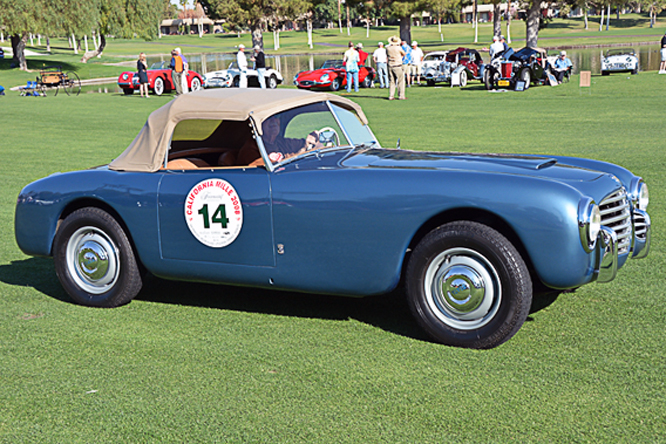
For some reason my blog on the SIATA 208S proved one of the most popular I have ever written to date, the 1951 SIATA Daina Gran Sport above was a FIAT based Special predecessor of the 208 powered by a modified FIAT motor with a unique to model overhead camshaft and twin carburetors which increased the power from 60hp to 72hp.

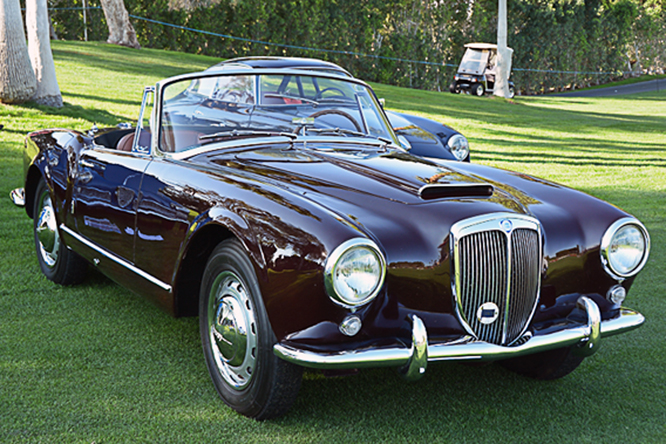
Lancia Aurelia B24 Convertible, Desert Classics, Concours d'Elegance

Lancia manufactured the Aurelia from 1950 through to 1958, from 1956 Lancia built just 521 B24 Convertibles like the 1957 example seen above.

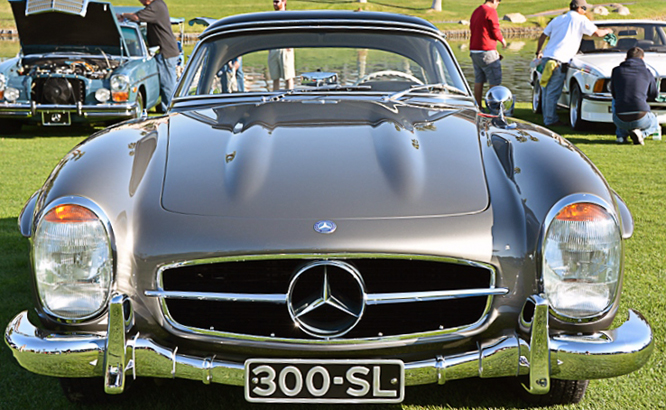
Mercedes Benz 300 SL Coupé, Desert Classics, Concours d'Elegance

In 1963 Mercedes Benz was winding down production of it 300 SL Coupé derived 300SL Roadster building just 26 of the latter, above is one of just seven 1963 300 SL Roadsters thought to have been built for the European market.

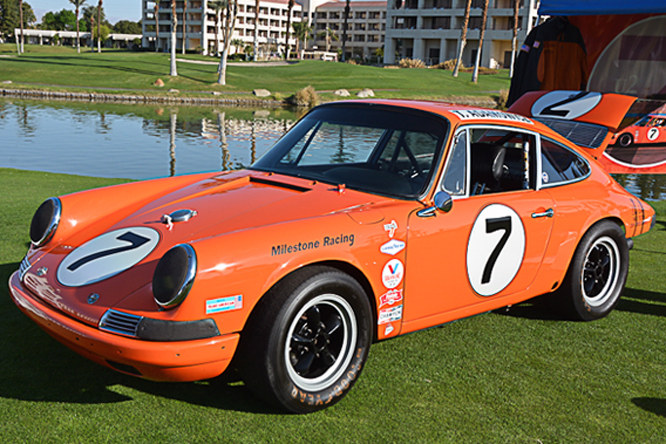
Porsche 911 Adamowicz Trans Am Tribute, Desert Classics, Concours d'Elegance

Tony Adamowicz dominated the up to 2 litre / 122 cui class of the 1968 Trans Am series winning eight out of ten races to seal the championship, above is a Porsche 911 Adamowicz Trans Am Tribute car built by the same team who built the original.

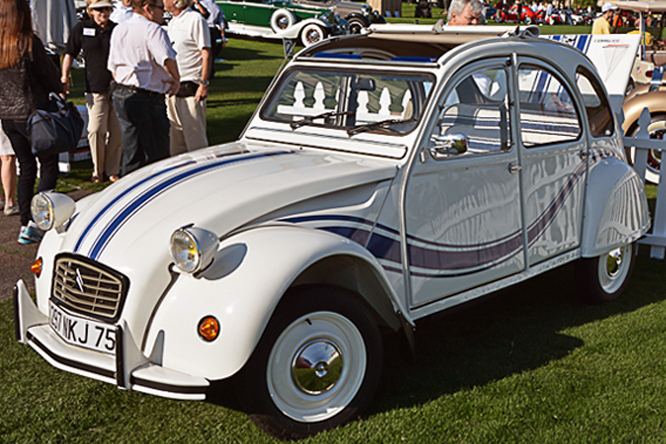
Citroen 2CV6 Beachcomber, Desert Classics, Concours d'Elegance

In 1990 I was driving through a small town in Surrey when I spotted A 1983 Citroen 2CV6 Beachcomber for sale in a drive. Having bought and sold several of these cars I had no hesitation in pulling over to check it out. It was not in the same condition as the one seen above but I bought it there and then anyway and over the next couple of years drove it 36,OOO miles extremely happy miles across Europe.

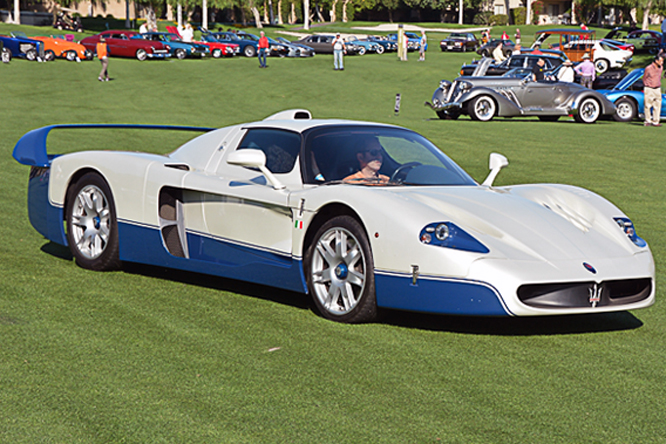
Maserati MC12 Stradale, Desert Classics, Concours d'Elegance

On the 1st of December 1914 the Maserati brothers, Alfieri, Bindo, Carlo, Ettore, and Ernesto established the company, featured on this blog every Monday, bearing their name. FIAT became the current owners of the company in 1993 and in 2004 after an official 4 decade absence from racing Maserati returned to the tracks with the MC12 Corsa. The MC12 Stradale is the road going version heavily based on the running gear of the faster Ferrari Enzo. Like the Enzo all 50 MC12s were pre sold.

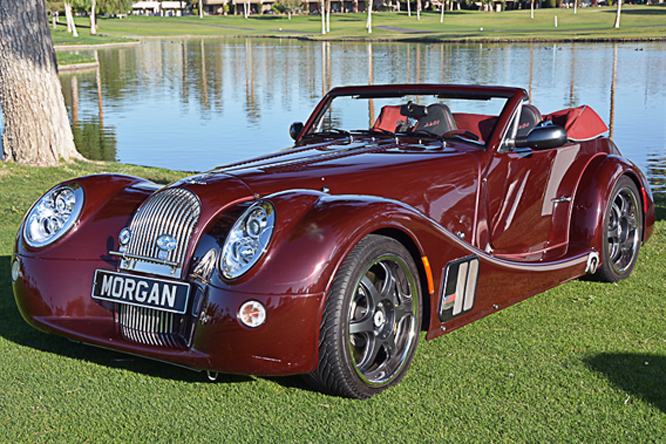
Morgan Aero 8, Desert Classics, Concours d'Elegance

Finally a sad tale soon after this photo of a Morgan Aero was taken it was involved in a collision with a truck. Fortunately no one was hurt but the Morgan was left much the worse for wear.

My thanks to Geoffrey Horton for sharing his photographs.

Thanks for joining me on this “Classic Europeans” edition of “Gettin’ a li’l psycho on tyres” I hope you join me again tomorrow when I’ll be looking at a vintage Plymouth. Don’t forget to come back now !

Share

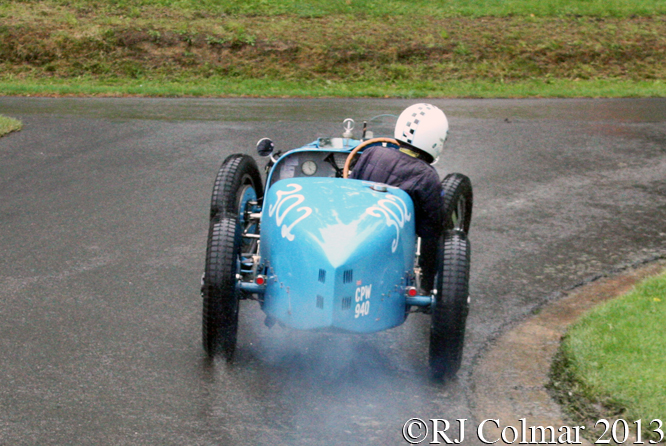
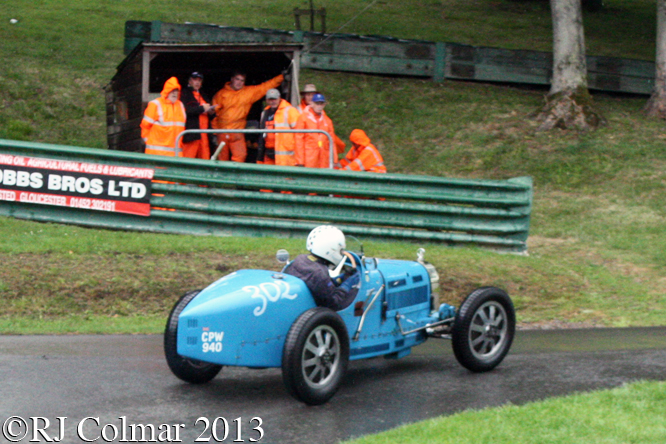
Ettore’s Magnus Opus – Bugatti Type 35B

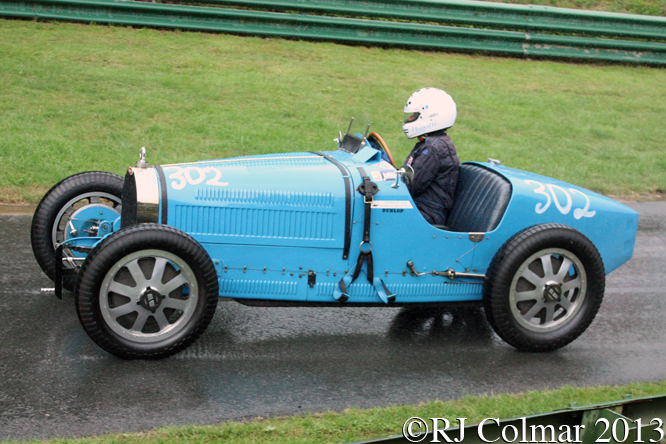
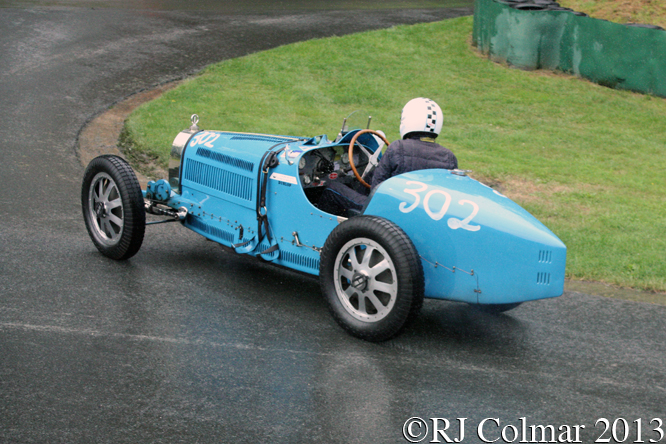
In 1924 Ettore Bugatti’s masterpiece the Bugatti Type 35 was seen for the first time at the Grand Prix de Lyon where five of the new cars were entered. Two of them, driven by France Jean Chassagne and Ernest Friderich, came home 7th and 8th on the same lap, but 40 mins behind the winning Alfa Romeo of Giuseppe Campari after 7 hours of racing.

Bugatti Type 35B, Marshall, VSCC, Prescott

Despite the inauspicious start the Type 35, in various guises powered by variations of a development of the 2 litre 8 cylinder 24 valve motor seen on the Type 30, would go on to dominate the top echelons of European racing for nearly 10 years clocking up somewhere between 1000 and 2000 outright victories which at one point were being recorded at 14 per week !

Bugatti Type 35B, Marshall, VSCC, Prescott

Like W.O Bentley, Ettore Bugatti was not a big fan of superchargers but after supercharging 2 litre Type 35C the ultimate form of the Type 35 was the 1927 Type 35B powered by a 2.262 litre, 138 cui 8 cylinder motor, first seen in the Type 35T but supercharged to produce 138 hp.

Bugatti Type 35B, Marshall, VSCC, Prescott

One of the reasons for the success of the Type 35 racing variants was the unusual use of 5 main bearings, at the time three was considered enough by most, that were of the ball bearing type, as against the more common roller type which allowed the motors to revolve at higher rpm than had been hitherto possible.

Bugatti Type 35B, Marshall, VSCC, Prescott

The list of victories that fell to the Type 35B, like the 1927 example featured today driven by Mike Marshall at Prescott Hillclimb, includes the 1928 Targa Florio won by Albert Divo, the first Monaco and 23rd French Grand Prix both won in 1929 by, future British Special Operations Executive agent, William Grover-Williams.

Bugatti Type 35B, Marshall, VSCC, Prescott

Of the 343 Type 35’s, of all versions built, 45 were type 35B’s which like all forced induction Type 35’s featured a radiator mounted closer to the front axle than the normally aspirated variants to accommodate the supercharger.

Thanks for joining me on this “Ettore’s Magnus Opus” edition of “Gettin’ a li’l psycho on tyres”, I hope you will join me again tomorrow. Don’t forget to come back now !

Share

Ringmeister – Maserati 250F T2 #2529

For the 1957 season Maserati manufactured 3 lightweight versions of the 250F to keep pace with the Lancia Ferrari D50’s which Juan Manuel Fangio drove to his fourth World Drivers Championship title in 1956.

Third of the three T2’s was chassis #2529 which was shared during 1957 between Stirling Moss, Harry Schell and the returning ‘Old Man’ Fangio who despite his success was not overly enamoured by his time at Maranello.
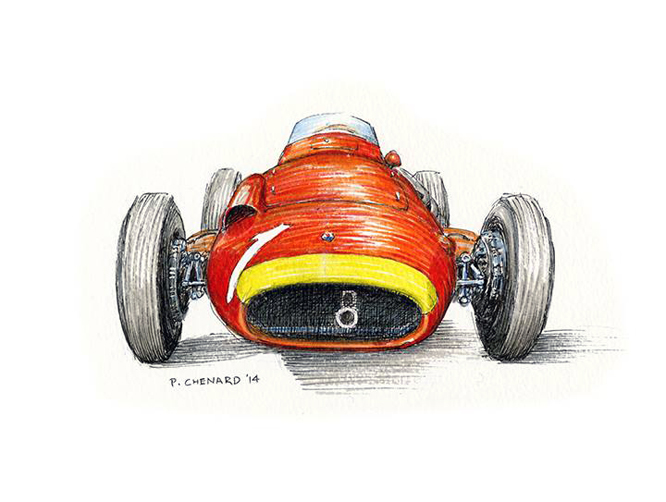
Maserati 250F, by Paul Chenard


Pen&ink and markers on watercolour paper 9″x 7″ © Paul Chenard 2014

Fangio won the opening two championship races of the 1957 season at home in Argentina and in Monaco, the third race of the Championship season was the Indy 500 for which only Giuseppe Farina of the regular World Drivers Championship contenders was entered.

Farina did not start the ’57 Indy 500 which was won by Sam Hanks in the Epperly Special. Fangio then drove today’s featured 250F T2 chassis #2529 to victory in the 1957 French Grand Prix.
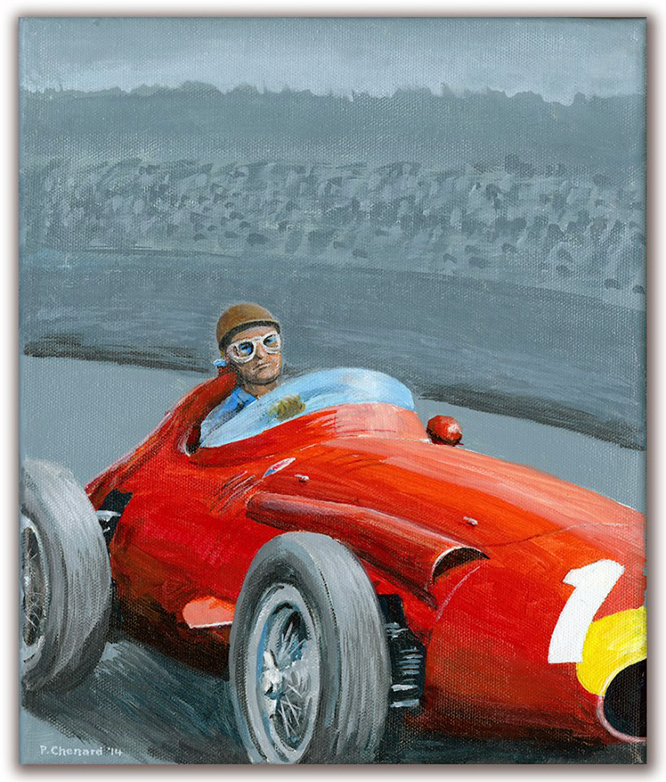
Maserati 250F, by Paul Chenard

Acrylic on canvas 10″x 12″ © Paul Chenard 2014

At the British Grand Prix Fangio retired #2529 with an engine problem leaving Tony Brooks and Stirling Moss to share the first championship Grand Prix victory for Vanwall.

Fangio qualified #2529 on pole, with a time 16 seconds faster than he had driving a Lancia Ferrari 1956, for the 1957 German Grand Prix alongside him Mike Hawthorn qualified 2nd in his Lancia Ferrari with the lightweight 250F T2 of Jean Behra and Lancia Ferrari of Peter Collins filling out the front row of the grid.
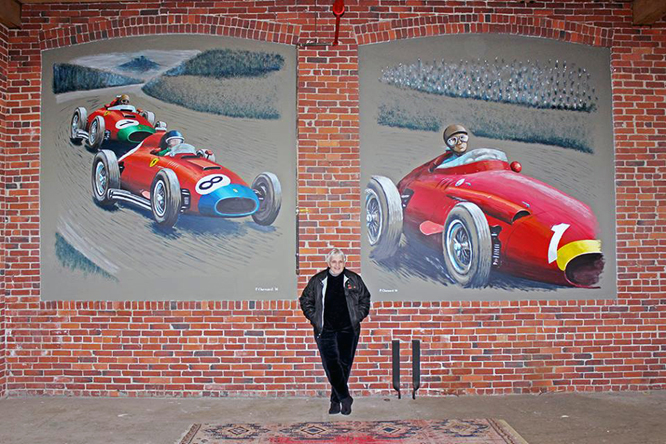
Maserati 250F, Denise McCluggage by Paul Chenard

1957 German Grand Prix Mural @ 9′ x 18′ © Paul Chenard 2014, with Denise McCluggage at European Motorsports, Lawrence, MA

On a hot day at the Nurburgring on August 4th 1957 the Ferrari’s of Hawthorn and Collins set off into an immediate lead of the 311 mile German Grand Prix, but by lap 3 Fangio had passed both and unbeknown to the Englishmen sailed off into the distance in order to make a large enough lead to enable him to make a scheduled pit stop, having started the race like Behra in fourth on half empty tanks.

During his pit stop Behra lost time when he broke his filler cap off while climbing back into the car. Fangio was even less fortunate spending 54 seconds in the pits after a mechanic had lost a wheel nut. Fangio rejoined the race in third place 48 seconds behind the battling Howthorn and Collins.
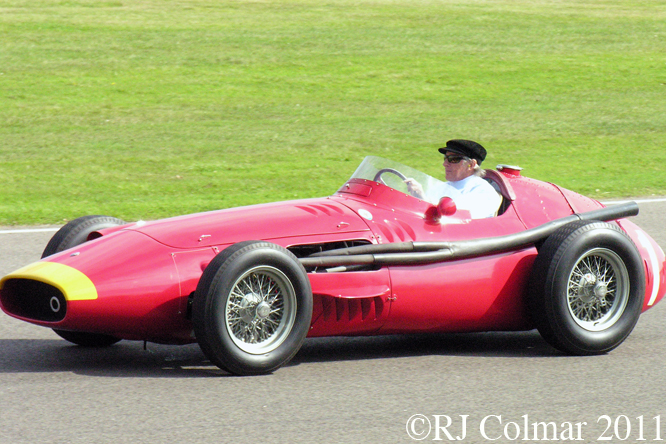
Maserati 250F, SIr Jackie Stewart, Goodwood Revival

Over the next 10 laps Fangio broke the Nurburgring lap record nine times seven times in succession passing Hawthorn for the lead on the penultimate lap with two wheels on the grass to record possibly the greatest Grand Prix victory ever, enough to secure “El Maestro” his fifth and final World Championship Victory.

Fangio noted after the race “I have never driven that quickly before in my life and I don’t think I will ever be able to do it again”, and later admitted “Nürburgring was my favourite track. I fell totally in love with it and I believe that on that day in 1957 I finally managed to master it. It was as if I had screwed all the secrets out of it and got to know it once and for all. . . For two days I couldn’t sleep, still making those leaps in the dark on those curves where I had never before had the courage to push things so far.”

As it turned out Fangio would not win any more championship Grand Prix races before retiring mid way through 1958, meaning the car #2529, seen driven by Sir Jackie Stewart at Goodwood Revival above, was the won in which possibly the greatest driver of all time won his last two Grand Prix victories.

Unusually unlike many of the other Maserati 250F’s it’s number was never used on any other chassis nor did it ever carry any other chassis number. Fangio drive #2529 to second place finishes championship races at Pescara and Monza with Harry Schell taking the car over for the GP Modena where he finished 3rd.

Fangio drove the car to 4th with fastest lap in the non championship 1957 GP du Maroc and 4th in the opening round of the 1958 Championship in Argentina. The car was then sold on to Scuderia Sudamericana who entered #2529 for Giorgio Scarlatti and Jo Bonnier who achieved little by way of success apart from a win for Bonnier in a non championship Formula Libre race at Watkins Glen.

Scuderia Ugolini entered the #2529 again for Giorgio Scarlatti in 1959 it’s final championship appearance being in the 1960 Argentinian Grand Prix from which Scarlatti retired with overheating issues.

After spending time in the Briggs Cunningham museum #2529 was bought by Hartmut Ibing in 1988 in a silent auction.

I did not realise it at the time I took the photograph but having Sir Jackie Stewart drive Fangio’s ’57 German Grand Prix winning car at Goodwood was particularly pertinent because Sir Jackie also took a famous win at the Nurburgring, but this time in the rain in the German Grand Prix of 1968.

My thanks to Paul Chenard for kindly allowing me to use reproductions of his artwork in today’s post.

Thanks for joining me on this “Ringmeister” edition of “Gettin’ a li’l psycho on tyres” I hope you will join me again tomorrow when for a look at a Bugatti. Don’t forget to come back now !

PS in a fitting tribute to David McKinney who wrote the definitive “Maserati 250F” last weeks featured 250F #2522/16/23/26 now owned by Graham Adelman was present at Davids funeral last week. My thanks to Tim Murray for forwarding this information.
Share