Tag Archives: Colmar

Three Wheels On My Wagon – Ford GT Prototype Roadster #GT/111

In 1965 Ford’s open check book approach to winning the Le Mans 24 hours was in full swing when today’s car, first appeared in public at the Le Mans Test weekend where it was driven by John Whitmore and Richard Attwood to a 6th fastest time.

In all four steel chassis Ford GT Prototype Roadsters were built, #GT/108 and #GT/109 were sent straight from Ford Advanced Vehicles in Slough, England to Carrol Shelby for testing #GT/108 never raced and #GT/109 made a single race appearance, entered by Ford France at Le Mans in 1965 where Maurice Trintignant and Guy Ligier retired with gearbox problems. Additionally a fifth roadster was built with an aluminium chassis #GT110 this car was developed by Bruce McLaren and Howden Ganely and is known as the GT X1 which was further differentiated from it’s siblings by the use of a Ford Galaxie derived 7 litre / 427 cui motor and a Hewland gearbox all of which resulted in a car 1000 lbs lighter than the original Ford GT Prototypes.

#GT/111 and #GT112 were the last of 12 Ford GT prototypes to be built in Slough and the pair took part in just three races entered by Ford Advanced Vehicles run by John Wyer. Wyer had been team manager at Aston Martin when Roy Salvadori and Carrol Shelby drove the Aston Martin DBR1 to victory in Le Mans in 1959.

Carrol Shelby now running his own race shop and contracted to enter some of Ford’s GT cars persuaded Ford to run the heavier more powerful iron block 4.7 litre 289 cui V8 from the Cobra racing programme in place of the original GT Spec 4.2 litre / 256 cui Windsor derived motor, apart from X1 all the GT Roadsters appear to have been fitted with Shelby’s Cobra 289 cui V8’s.

Newall, Ford GT Roadster, Goodwood Revival

#GT/111 was painted white and fitted with wire wheels for it’s first public appearance was at Le Mans, a month later #GT/111 was painted a curious shade of Green, a gesture to the chassis and entrants British heritage, it was also fitted with Shelby magnesium wheels for the Targa Florio.

John, now Sir John, Whitmore and Bob Bondurant were chosen as Ford’s sole representatives in #GT111 which was to compete against three works Ferrari 275P/2’s fitted with the latest 3.3 litre / 201 cui 4 cam V12 motors.

A couple of months ago I went to a talk by Sir John organised by the Club Lotus Avon, in which he related how he was speeding along when the left front wheel came adrift forcing him to stop, Sir John replaced the wheel with the mandatory spare and secured it with the original hub nut which had been returned to him by a policeman and continued on his way, contemporary reports tell how the loose wheel took down some overhead railway power lines !

On lap 8 of the 10 lap race, each lap being run over a 44 mile 72 km closed (narrow) road circuit, Bob Bondurant crashed after sliding on gravel into a wall and then bouncing into a water trough which tore off a front wheel and it’s suspension. The 1965 Targa Florio was won in 7 hours and 1 min by local hero Nino Vacarrela and Lorenzo Bandini driving a Ferrari 275P/2.

The damage to #GT/111 was never repaired and a similarly painted #GT112 appeared in it’s only works entered appearance for the 1000 km race at the Nurburgring driven by Attwood and Whitmore who retired with an engine mounting failure having started from 6th on the grid.

Of all the GT Roadsters the aluminium light weight #GT110 X1 had the longest works supported career having been entered in 4 races by Bruce McLaren for Chris Amon in 1965 who scored a best 5th place finish in the 200 mile race at Riverside. The following season X1 appeared with original GT Roadster type bodywork in the Sebring 12 hours entered by Shelby American for Ken Miles and Lloyd Ruby who won the race from 5th on the grid. X1 was subsequently ordered destroyed by customs officials.

At he end of 1965 Ford moved it’s entire GT racing developemnt programme out of Ford Advanced Vehicles in Slough to Shelby and Kar Kraft in the United States, #GT/112 was sold to Peter Sutcliffe who raced the car in 1966 and scored a couple of season high second place finishes one in South Africa and the other in France during the 1967 season. For 1968 Bob Vincent acquired the car and appears to have won second time out in an open class race run at Aintree.

The damaged #GT/111 was scheduled to be scrapped, however the scrap yard saved the chassis which was acquired by the present owner, in 2006, after Ford GT expert Ronnie Spain verified #GT/111’s identity. The car seen in this photo driven by Andrew Newall at the Goodwood revival a couple of years ago, has been restored by Glescoe Motorsport and is to appear at RM auctions in May 2014.

Thanks for joining me on this “Three Wheels On My Wagon” edition of “Gettin’ a li’l psycho on tyres”, I hope you will join me again for Ferrari Friday tomorrow. Don’t forget to come back now !

Share

Out Of Disagreement – Lamborghini 350GT

With his back against the wall and desperate for cash to keep Ferrari afloat in 1962 Enzo Ferrari fell out with many who crossed his path including potential saviours Ford, which led directly to Ford initiating it’s GT40 competition program, Count Giovanni Volpi di Misurata who promptly employed Ferrari’s recently departed designer Giotto Bizzarrini to develop and build the legendary Ferrari 250 Breadvan, and agricultural machinery magnate Ferruccio Lamborghini, the latter who allegedly fell out over the shade of red his car was to be painted.

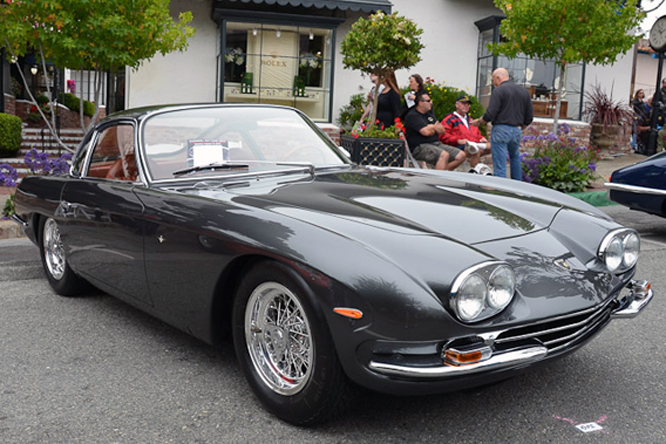
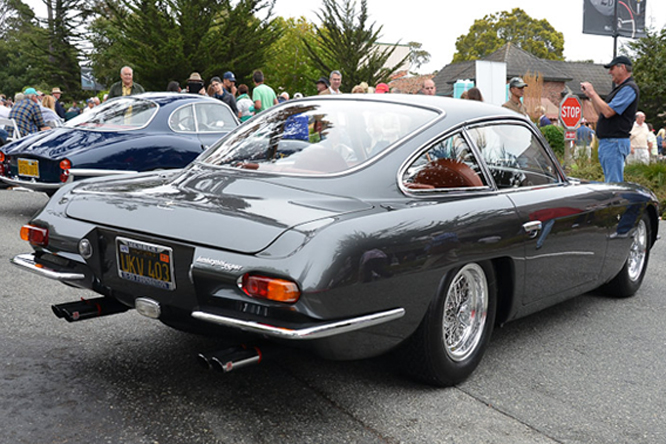
Lamborghini 350GT, Carmel Concours By The Sea

Ferruccio Lamborghini, undertook to build a GT car to compete with the best Ferrari could build and employed Giotto Bizzarrini to design the motor and chassis.

Bizzarrini moved on to ISO Rivolta before the design was ready for production and Gian Paolo Dallara working with Paolo Stanzani and Bob Wallace were employed to complete the task.

The first Lamborghini, GTV, appeared at the Turin Motor show in October 1963 and went into production the following year by which time the substantially redesigned for the road model was known as the 350 GT powered by the Bizzarrini inspired 4 cam V12 which could easily be tuned to give 400hp.

Lamborghini 350GT, Carmel Concours By The Sea

With just 270hp the 350 GT was capable of nearly 160 mph. The bodies were built by Touring of Turin, the chassis by Marchesi and the motors in Lamborghini’s own factory in Sant’Agata, Bolognese.

It is thought 135 350 GT’s, like the one seen here at Carmel Conours by The Sea, were built of which 85 are believed to have survived.

This particular car was found in France by the current owner and is in preserved original condition having only been serviced and cleaned.

I believe the 350GT would originally have been fitted with oblong headlights which may have been changed to the current quad round set up to meet US regulations.

My thanks to Geoffrey Horton for sharing his photographs of today’s featured car.

Thanks for joining me on this ‘Out Of Disagreement’ edition of “Gettin’ a li’l psycho on tyres” I hope you will join me again tomorrow when I’ll be looking at an extraordinary special built by the equally extraordinary John Bolster. Don’t forget to come back now !

Share

Slough Pickup – Citroën 2CV SAP Pickup

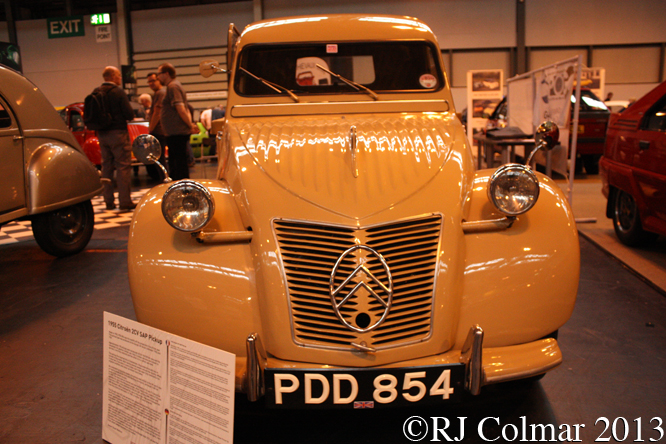
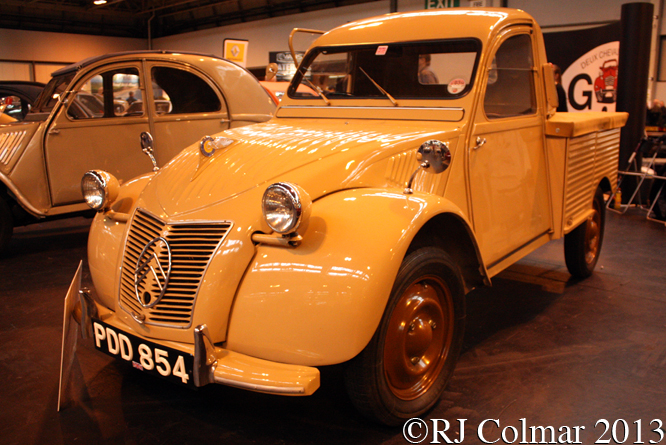
Citroën 2CV’s are usually thought of as more French than Croissant, but in fact not all 2CV’s were built in France, the last were built in Portugal and for a period in the 1950’s and 1960’s a number were also produced in Slough some of which like today’s featured 1955 Pickup were unique to the UK market.

Citroën 2CV SAP Pickup, Classic Motor Show, NEC, Birmingham

Although the model did not prove a huge success with the British agricultural community at which it was aimed, in 1957 the Royal Navy saw the potential of the vehicle because it was both light enough to be lifted by the fleets largest helicopters and rugged enough to useful in the Malaysian jungle where an armed conflict; known as the Malaysian Emergency, where the Australian and British forces of the British Commonwealth were engaged against the insurgent Malayan National Liberation Army – the military arm of the Malaysian Communist Party, from 1948 – 1960.

Citroën 2CV SAP Pickup, Classic Motor Show, NEC, Birmingham

Two batches making 65 2CV pickups in total were dispatched in 1959 and 1960 aboard HMS Albion and HMS Bulwark and deployed with the aid of the aforementioned helicopters in the Malaysian jungle.

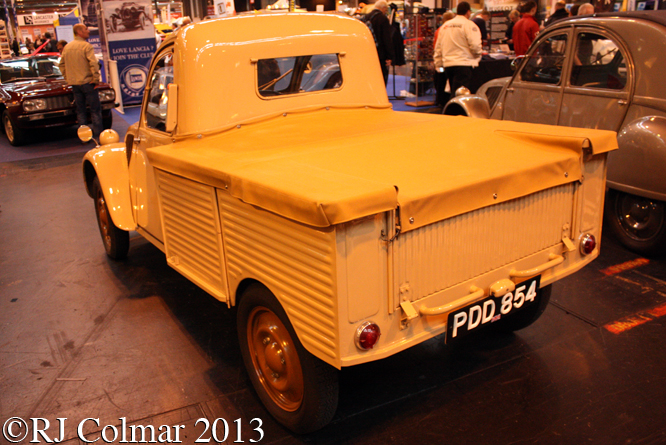
Citroën 2CV SAP Pickup, Classic Motor Show, NEC, Birmingham

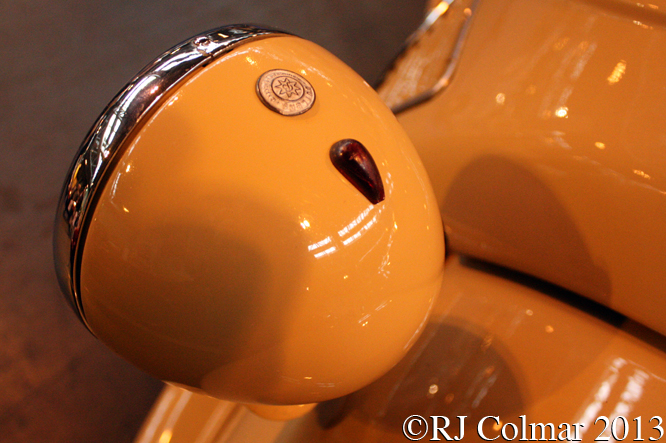
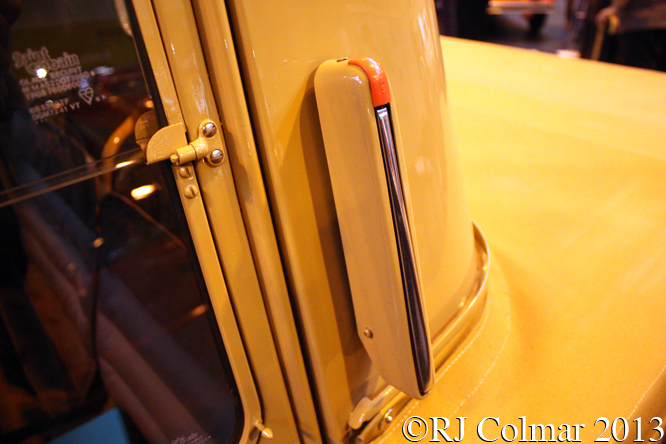
Unique features of the 2CV pickups included the Butler head lights and Lucas sourced semaphore indicators and tail lights.

Citroën 2CV SAP Pickup, Classic Motor Show, NEC, Birmingham

The dash had a unique British spec centrally mounted speedometer which could only be seen at night with the aid of a roof mounted interior light.

Citroën 2CV SAP Pickup, Classic Motor Show, NEC, Birmingham

The original factory, as seen on this model at the Classic Motor Show at the NEC in Birmingham, colour options were also unique to the British built 2CV’s. From 1953 to 1962 just 130 of civilian and military 2CV pickups were built and just 2 civilian ones are in road worthy condition with a third in urgent need of restoration.

Thanks for joining me on this “Slough Pickup” edition of “Gettin’ a li’l psycho on tyres” I hope you will join me again tomorrow for the start of GALPOT’s celebration of the 50th year of Lamborghini car production. Don’t forget to come back now !

Share

Bertone With A Hint Of Michelotti – ISO Rivolta IR

Welcome to the first December 2013 edition of “Gettin’ a li’l psycho on tyres”. This months Sunday posts will feature five ISO Rivolta’s to celebrate the 60th Anniversary of the first ISO Rivolta cars the first of which was the Isetta perhaps the best known examples of which were manufactured under licence by BMW.

ISO Rivolta IR, Auto Italia, Brooklands,

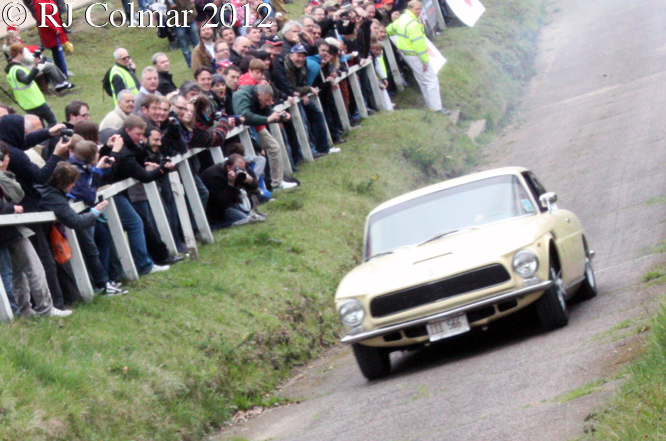
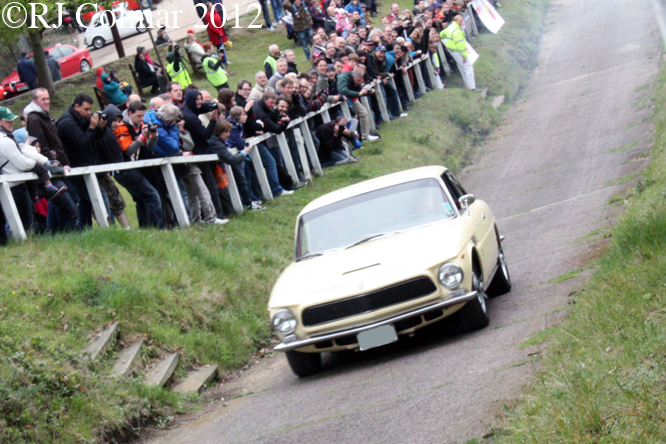
By the 1960’s Renzo Rivolta set his ambitions a little higher and decided to build a vehicle which would compete against the FIAT 2300 Coupé> Rivolta commissioned Bertone to design a body which would enclose independent front suspension, a de Dion rear axle and a Chevrolet Corvette V8 motor which over the years of production from 1962 to 1970 would produce between 300 – 350 hp.

ISO Rivolta IR, Auto Italia, Brooklands,

The recirculating ball steering required five turns lock to lock on the car which had a, large, turning circle of 12.5 m / 41ft. The car was fitted with a leather interior which included a standard floor mounted 4 speed manual gear stick.

 ISO Rivolta IR, Auto Italia, Brooklands,

The stylish IR touring car appears to owe a nod of inspiration to the three Vignale built Ferrari Coupes; 212 Inter, 375 America and 250 Europa who’s design was credited to Giovanni Michelotti.

Dependent on the engine tuning option the rest to 60 mph time for an IR, like the one seen here at Auto Italia Brooklands, was in the 8 second range with a top speed of over 140mph quoted for the most powerful models.

Thanks for joining me on this “Bertone With A Hint Of Michelotti” edition of “Gettin’ a li’l psycho on tyres” I hope you will join me again tomorrow when I’ll be looking at a cute li’l pick up from France. Don’t forget to come back now !

Share

Double Trouble – MG-B

In April 2009 I had the good fortune to win a pair of tickets to the Aarons 499 run at Talladega Superspeedway a mere 12,000 mile round trip from Bristol, UK, but a race fan has to do what a race fan has to do, after all everything else is just waiting and I had been waiting 20 years since my last visit to a touring car race at Brands Hatch !

My tickets came courtesy of the much missed Rowdy.com where I had made many friends who helped me out with details like a tent in which to stay, a pair of headphones to listen into the pit crew radio and all important lifts from Atlanta to the track a couple of hours to the East. Rowdy friend Sweetdreams picked my up in her Durango and with in half an hour it was raining cats ‘n’ dogs and getting dark.

MG-B, Aarons 499, Talladega Superspeedway

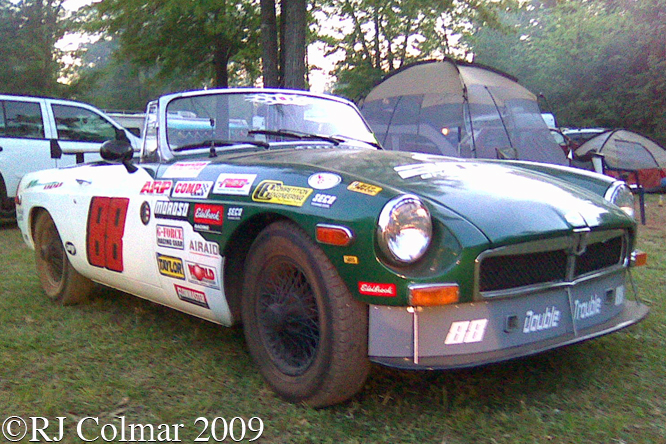
After stopping at a Wallmart the size of a small English village somewhere outside Birmingham, AL we got into the campsite and followed a long route round to a spot where, if I remember correctly, there was no camping charge. As Sweetdreams headlights swept through the campsite I thought I espied what looked like a #88 Mountain Dew MG B which for some reason took away any anxieties I had about the trip.

MG-B, Aarons 499, Talladega Superspeedway

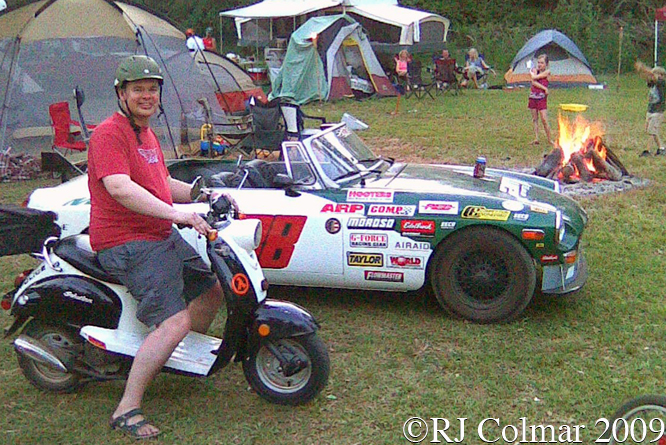
A couple of day’s later I borrowed Sweetdreams partner John’s moped and retraced our steps into the campsite to get some digital verification of what I thought I had seen a couple of days before and indeed there it was a #88 Mountain Dew MG B complete with Car of Tomorrow splitter and spoiler called Double Trouble. After making enquiries about the car I met the owner and was invited to some Alabama hospitality in the form of a beer and a chat during which we had a good laugh about the fact I had traveled quarter way round the globe to see an MG built less than an hours drive away from where I lived.

My thanks to Sweetdreams and John Spartan who did so much to make me feel at home on the wrong side of the Daryl Waltrip Way fence.

Thanks for joining me on this “Double Trouble” edition of “Gettin’ a li’l psycho on tyres” I hope you will join me again tomorrow when I’ll start a five week celebration of the 60th Anniversary of the Italian Manufacturer ISO Rivolta. Don’t forget to come back now !

Share

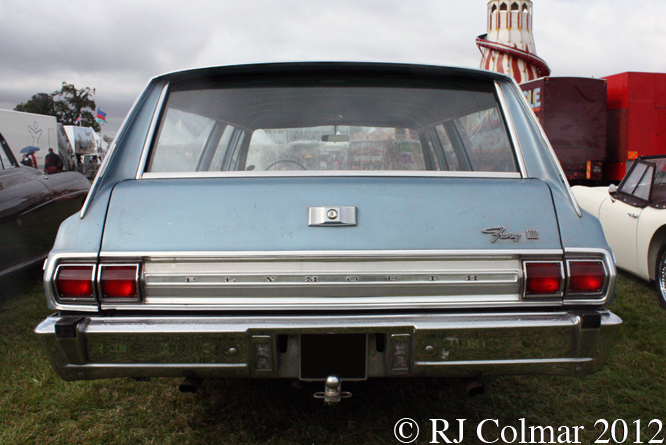
Back To Sheet Metal By The Acre – Plymouth Fury III Station Wagon

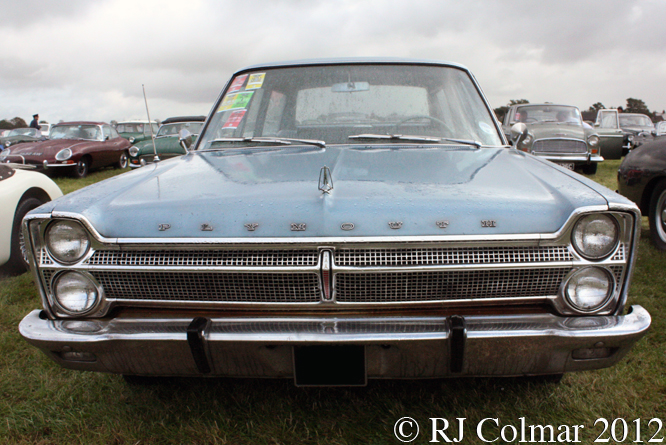
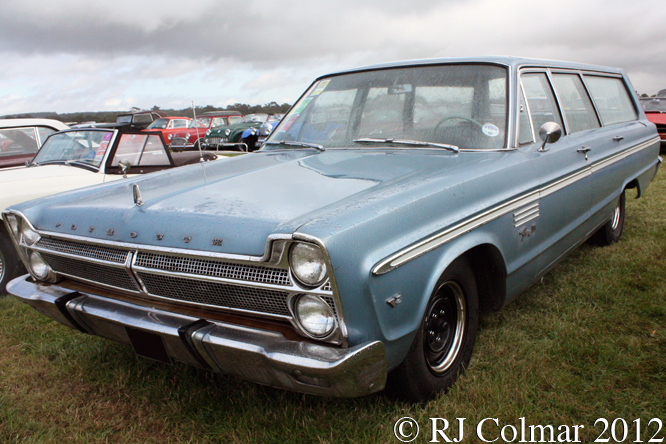
Two years the launch of the mid size 1962 Chryslers, Plymouths and Dodges that were born of a misunderstood overheard conversation that Chevrolet were about to exit the full size car market, Chrysler swallowed it’s pride and losses and went back into the business of selling sheet metal by the acre. On of the products of the policy U turn was today’s featured car the full size fourth generation 1965 Plymouth Fury Station Wagon.

Plymouth Fury III, Goodwood Revival

The ’65 Furys were available with 5 engine options up to 440 cui / 7.2 liters, today’s featured car is listed with the smallest small block Chrysler A 318 cui / 5.2 liter V8 such as used by Bristol to power the 408 MkII, 409 and 410 models up until 1969.

Plymouth Fury III, Goodwood Revival

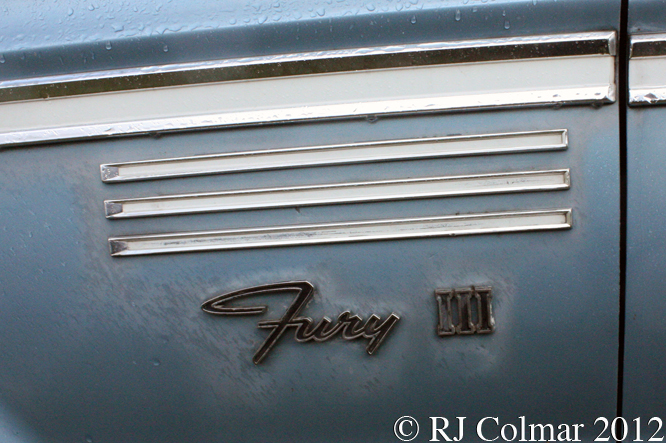
Fourth generation Furys were available with 3 option packages, basic Fury Is were used by the police and taxi cab companies, in 1966 the Fury III was topped by the VIP (Very Important Plymouth) option package.

Plymouth Fury III, Goodwood Revival

Automatic transmissions, air conditioning, power windows and seats were available on top of the option packages.

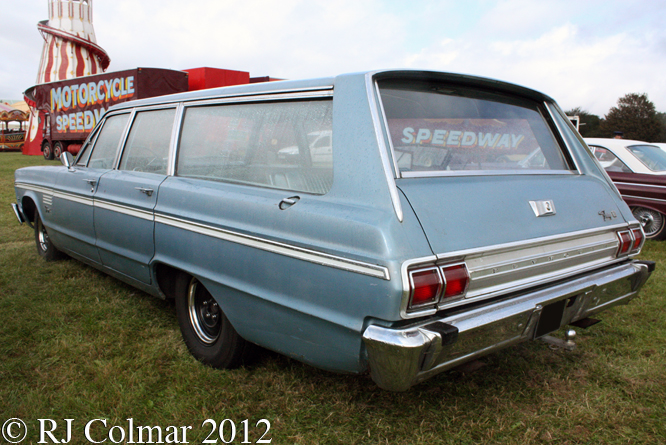
Plymouth Fury III, Goodwood Revival

Only Fury II and Fury III Station Wagon’s could be ordered with a third row of seats to bring the seating up to 9 from the regular 6.

Plymouth Fury III, Goodwood Revival

Production of the fourth generation Fury came to an end in 1968, although a right hand drive Australian version of the fourth generation Fury, known as the Dodge Phoenix, continued uninterrupted form 1965 to 1973.

Thanks for joining me on this “Back To Sheet Metal By The Acre” edition of “Gettin’ a li’l psycho on tyres” I hope you will join me again tomorrow. Don’t forget to come back now !
Share

Coffee, Croissant & Cars #11/13 – Avenue Drivers Club

Earlier this month I managed to pop down to the Avenue Drivers Club where an ever unpredictable smorgasbord of vehicles turned up.

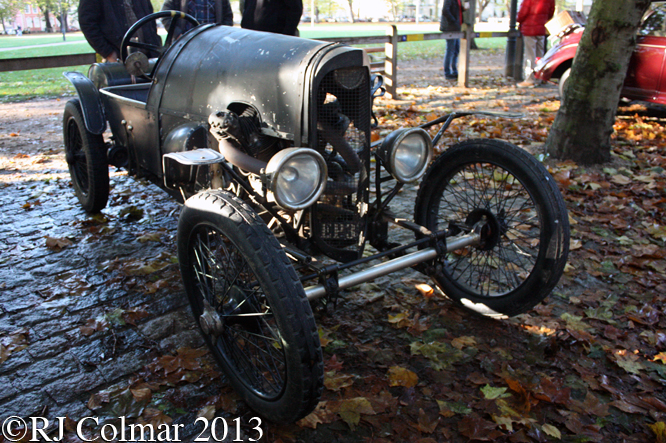
GN, Avenue Drivers Club, Queen Square, Bristol

Well known chain drive enthusiast Duncan Pittaway brought his two cylinder 1921 GN along which I first saw a couple of years ago when I was competing in the Cross Trophy.

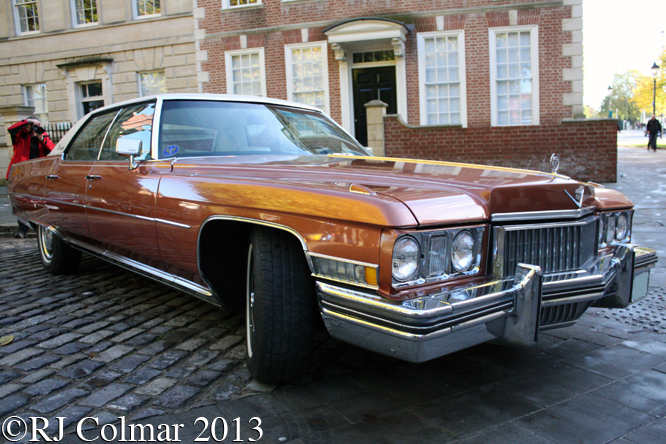
Cadillac Sedan de Ville, Avenue Drivers Club, Queen Square, Bristol

Another familiar vehicle present, that is also familiar to these pages, was the magnificent 1973 Cadillac Sedan de Ville above.

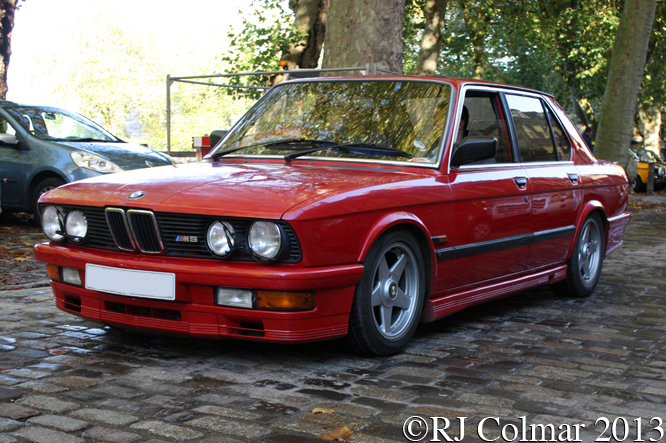
BMW M5, Avenue Drivers Club, Queen Square, Bristol

I have only owned one BMW and it was a red M5 not too dissimilar to the one above, I gave mine up in favour of a much older and sedate Volvo 244DL, before I was tempted to loose my driving licence.

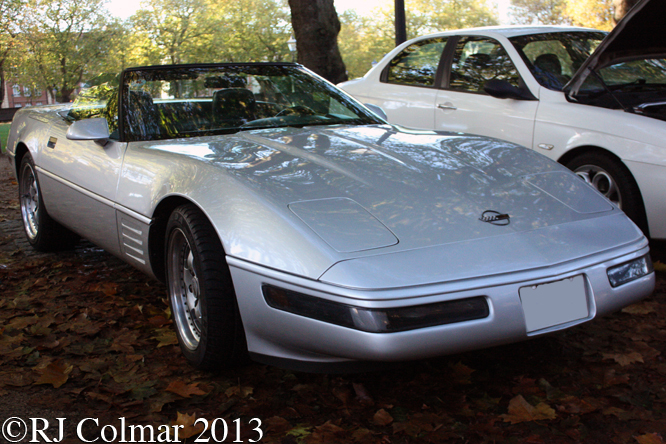
 Chevrolet Corvette, Avenue Drivers Club, Queen Square, Bristol

The owner of this C4 Corvette is also our motor club social secretary at the time of writing he had already traded the Corvette in for a Ford Mustang fourth generation Mustang.

Ford SVT Lightening, Avenue Drivers Club, Queen Square, Bristol

Fords second generation SVT Lightening Pick Up is based on the F-150 but with lowered suspension, a supercharged motor giving 380 hp when the model above was built and a 4 speed automatic transmission sourced from the V10/diesel Super Duty pick-up.

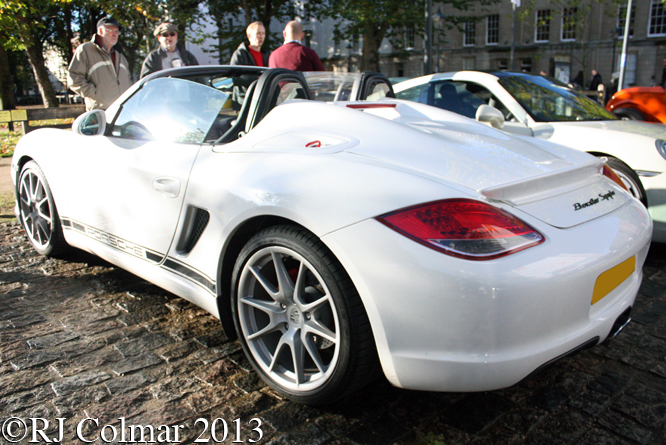
Porsche Boxter Speedster, Avenue Drivers Club, Queen Square, Bristol

Finally my friend Ted who started the year with a Porsche GT2 swapped it for an Aston Martin has now bought this fabulous Porsche Boxster Speedster.

Thanks for joining me on this “Coffee, Croissant & Cars #11/13” edition of “Gettin’ a li’l psycho on cars, I hope you will join me again tomorrow when I be looking at a Plymouth Fury Station Wagon. Don’t forget to come back now !
Share