Tag Archives: Colmar

Ford’s Only CanAm Race Winner – Lola Ford T70 Mk II #SL71/34

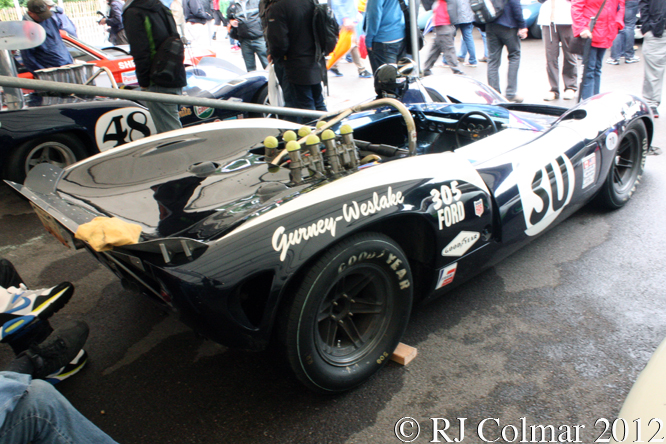
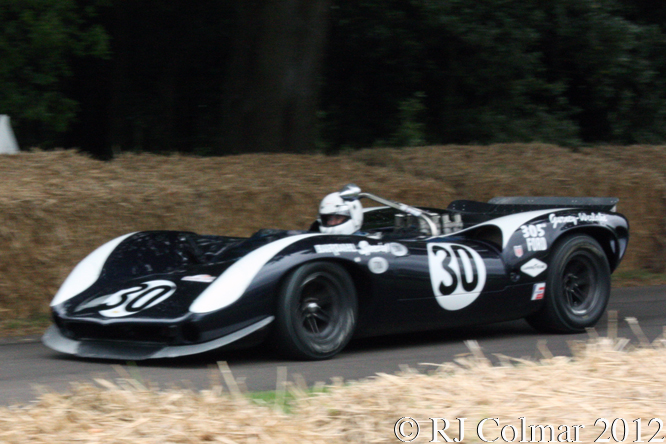
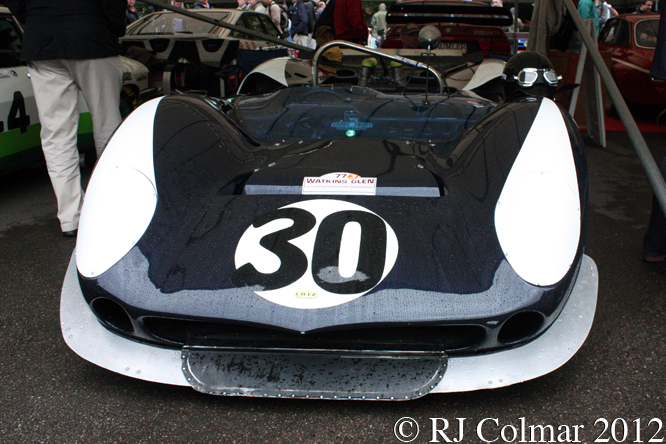
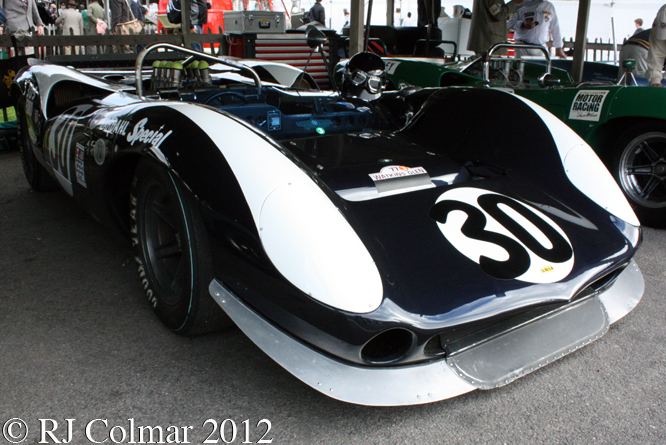
For the up coming inaugural 1966 Canadian American Challenge All American Racers took delivery of a new Lola T70 Mk II chassis #SL71/34 for which was powered by a 5 litre / 305 cui Ford Westlake V8 motor. The car was driven by Dan Gurney alongside the team’s 1965 Lola T70 Mk I chassis #SL70/10 which was run for Jerry Grant.

Lola Ford T70 Mk II, Goodwood Revival

After qualifying 9th for the inaugural Can Am race at St.Jovite Dan’s challenge got off to a poor start, because he did not start due to engine problems which manifested themselves during practice.

Lola Ford T70 Mk II, Goodwood Revival

At the next round held at Bridgehampton things improved with a start from pole position which Dan translated into, what turned out to be, the only win for a Ford powered car in the entire history of Can Am. Extraordinary given Ford’s persistence in tackling and winning Indy, Le Mans and an eventual decade and a half of dominance in Formula One.

Lola Ford T70 Mk II, Goodwood Festival of Speed

Dan started the following race at Mosport from pole but retired with ignition problems, at Laguna Seca Dan started 4th but retired with a cracked engine block. Dan’s bad luck continued at Riverside where he qualified 6th but retired with a clutch issue. At the Challenge finale held at Stardust international Raceway in Las Vegas Dan qualified 9th and retired with a broken fuel tank.

Lola Ford T70 Mk II, Goodwood Festival of Speed

It is probably just as well Dan did not follow Jerry Grant’s lead by emptying the contents of a revolver into the car at the seasons end.

Thanks for joining me on this “Ford’s Only CanAm Race Winner” edition of “Gettin’ a li’l psycho on tyres”, I hope you will join me again tomorrow when I’ll be looking at a US built vehicle that took part in the 1966 Can Am Challenge. Don’t forget to come back now !

Share

Jim’s Favourite – Chaparral Chevrolet 2E

To celebrate the 40th anniversary of my introduction to the wonders of The Canadian American Challenge Cup in something approximating real time mediated through the pages of ‘Motor Sport’ magazine, for the remainder of the month I’ll be featuring a selection of Group 7 race cars; on Saturday’s, Sunday’s, Mondays and the last two Thursdays of the types used in the Can Am Championships run from 1966 to 1973 or European “Intersiere” races run from 1970.

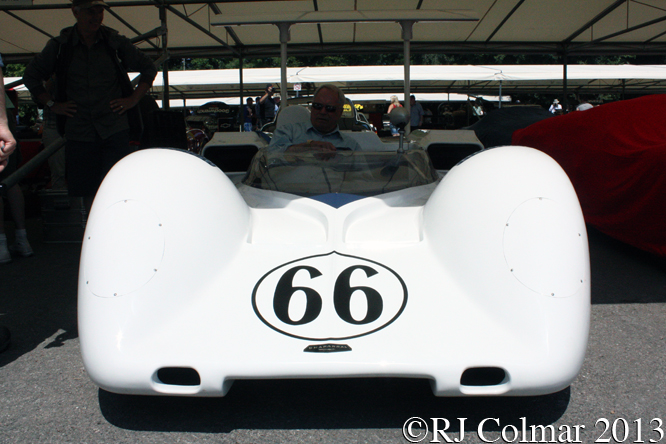
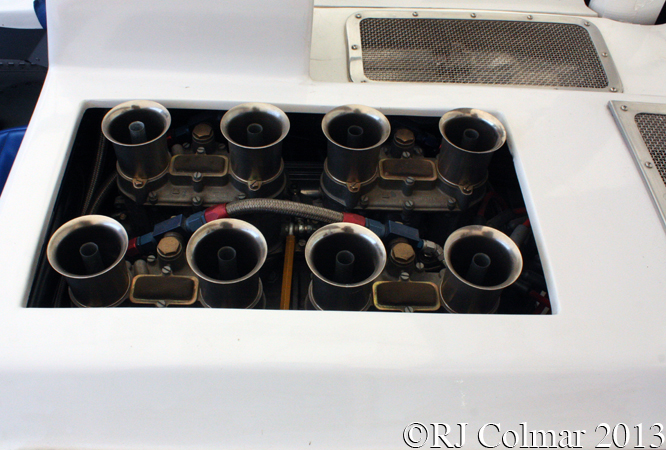
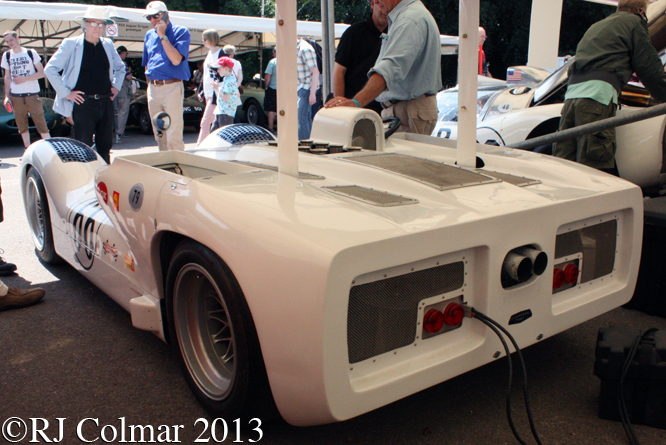
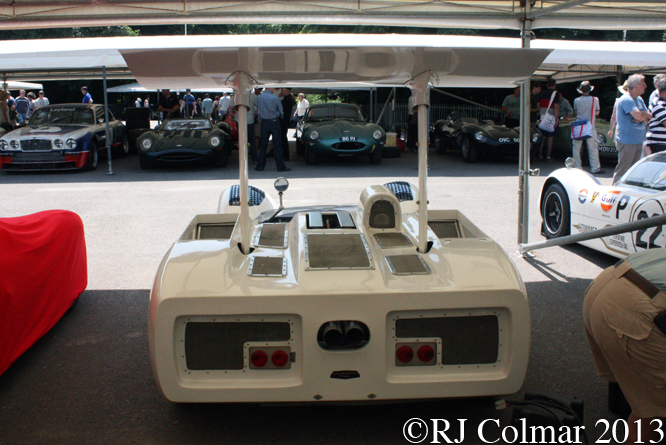
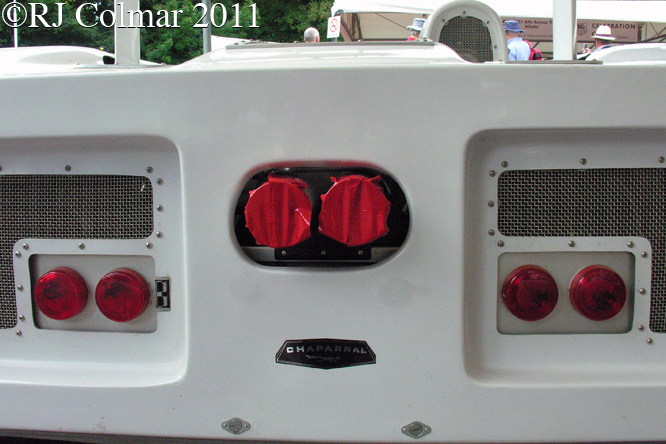
Chaparral 2E, Goodwood Festival Of Speed

The inaugural 1966 “Can Am” Challenge race was run at St.Jovite on 11th September 1966 and won by 1965 World Drivers Champion John Surtees driving a Team Surtees Lola T 70 Spyder.

Chaparral 2E, Goodwood Festival Of Speed

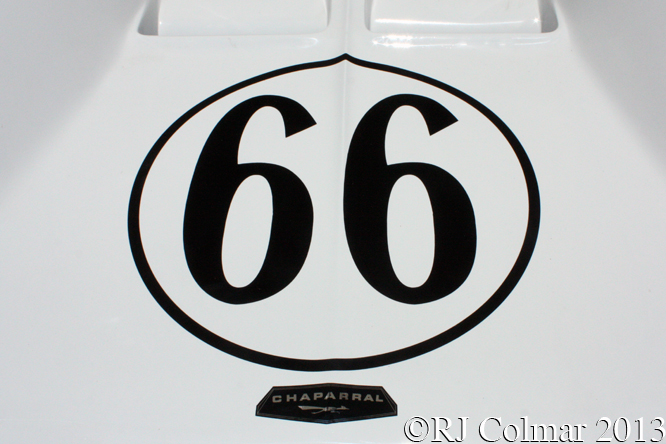
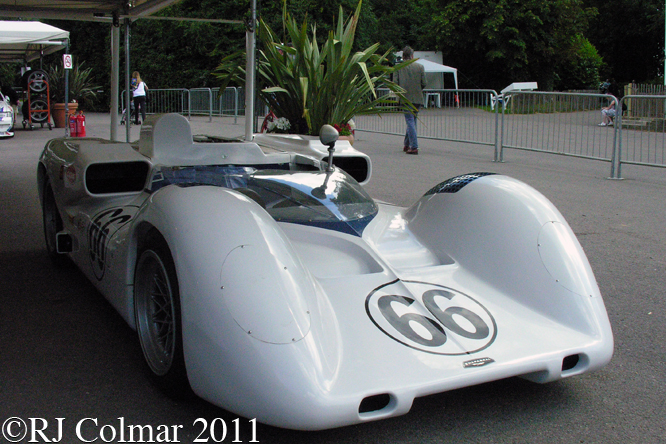
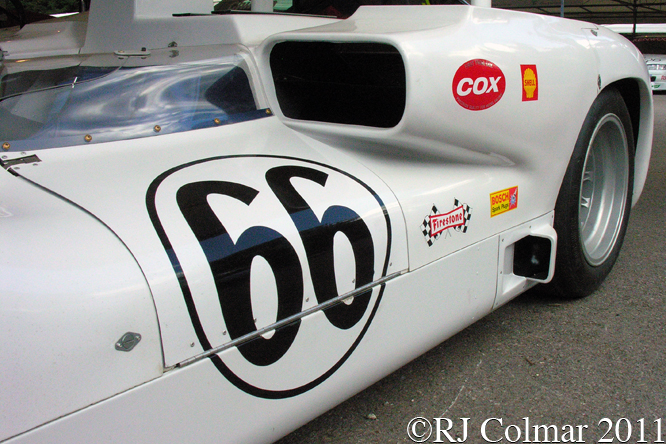
Texas Oilman and innovative engineer Jim Hall and his Chaparral team made their debut in the Series at Bridgehampton the following week where Hall was to drive the #66 Chaparral 2E chassis #2E001 with 1961 World Champion Phil Hill in the identical sister #65 chassis #2E002.

Chaparral 2E, Goodwood Festival Of Speed

Come the start of the event it was Phil Hill who found himself at the seat of chassis #2E001 starting fourth, after Hill’s intended car developed chassis problems during practice and Jim handed the world champion Phil his own car.

Chaparral 2E, Goodwood Festival Of Speed

Phil finished the race in 4th place behind the Lola Ford T70 of Dan Gurney, the McLaren Elva Mark II Chevrolet driven by Chris Amon and the Mark IIb McLaren Elva Chevrolet driven by Bruce McLaren.

Chaparral 2E, Goodwood Festival Of Speed

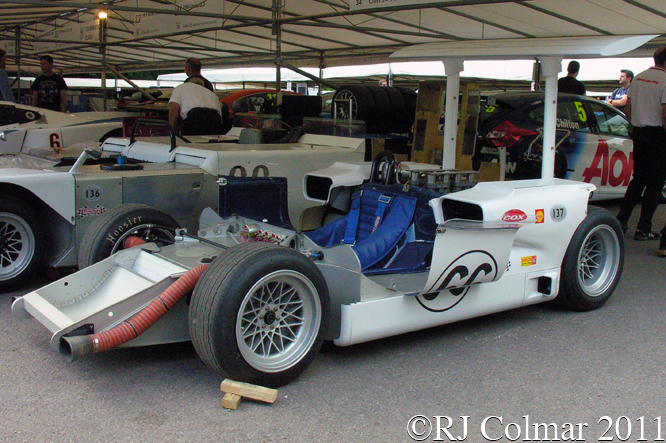
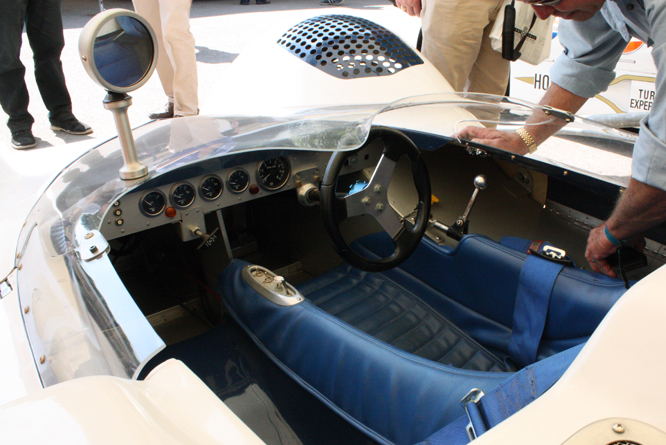
Like most vehicles of the time the Chaparral 2E featured three pedals, unlike most, the pedals operated the accelerator and brakes while the third operated a front spoiler beneath the nose and rear wing to adjust the amount of drag created to maximise the vehicles performance around the corners and along the straights of a circuit.

Chaparral 2E, Goodwood Festival Of Speed

Two unusual features of the drive train were, first the 450 hp aluminium alloy block 5.4 litre / 327 cui Chevrolet V8 chosen in favour of the more powerful and heavier 5.9 litre iron block Chevrolet Motor used by John Surtees in the Lola, and second the Chaparrals were uniquely equipped automatic transmissions.

Chaparral 2E, Goodwood Festival Of Speed

Although similar aerodynamic devices had been attached to competition vehicles before, notably by Mercedes Benz who attached a wing to the roof of their 300 SL during practice for Le Mans in 1952 and by Fritz von Opel who attached wings to the sides of his 1928 solid rocket fueled Opel RAK 2, when activated to give down force at the expense of increased drag and decreased forward speed the Chaparral 2E’s aerofoil shaped wing transmitted down force directly through the rear suspension, while a spoiler under the nose acted similarly to increase down force on the front suspension, which together improved the handling in the corners.

Chaparral 2E, Goodwood Festival Of Speed

The Challenge returned to Canada one week later again on September 24th 1966 for the ‘6th Canadian Grand Prix for the Pepsi-Cola Trophy’ run Mosport Park. Hall qualified 9th and Hill 11th with Hill finishing second to Mark Donohue in a Penske run Lola Chevrolet T70. Jim retired at 1/3 rd distance with an engine problem.

Chaparral 2E, Goodwood Festival Of Speed

Nearly a month later on October 16th 1968 Jim Hall started the Monterey Grand Prix run at Laguna Seca from pole position in his #66 2E and alongside him on the grid was Phil Hill in the #65. After 2 hours at the wheel during which he covered 106 laps Phil Hill crossed the line first ahead of team owner Jim Hall to score a remakable team 1-2 finish.

Chaparral 2E, Goodwood Festival Of Speed

Jim qualified 3rd behind, John Surtees in the Lola, at Riverside in California. John and Jim both moved up a place after pole sitter Bruce McLaren retired with an ignition problem. Phil Hill could only qualify 8th and retired after seven laps with fuel pressure issues.

Going into the final round of the Challenge Phil Hill was tied on points with John Surtees with 5 other drivers including Jim Hall capable of winning the championship depending on a variety of finishing scenarios. Jim qualified on pole for the final round at Las Vegas but after a few laps his wing started flapping uncontrollably due to fatigue failure in the control mechanism causing his retirement from second after Surtees took a dominant lead from the start. Hill damaged his car and ran much of the race scraping over 4th place until his wing also failed. Surtees easily won the race and the Inaugural Can Am title ahead of Mark Donohue with Hill finishing out of the points his championnship chances were shot.

A Chaparral 2E chassis 2E002 was entered in three events at the 13th Bahamas National Speed Weeks for Jim Halls Chaparral Cars Inc partner Hap Sharp. Hap won the Governor’s Trophy & Nassau Tourist Trophy from pole, finished 5th in the Nassau Classic Race and a non running 4th, again from pole in the Nassau Trophy Race in which Hap had an accident.

In 2005 Jim Hall teamed up with Jim Musser, who had contributed to the design of the 2E, known to be Hall’s favourite, to build a ‘limited number’ of continuation Chaparral 2E’s for use by classic racers. More on the continuation cars can be seen on this link to the Chaparral Official Website.

My thanks to Kayemod Rob, Tony 2F-001 Pashley, Supersox and Allen Brown Duc-man and mariner at The Nostalgia Forum for helping me to conclude that the car featured today maybe the surviving original 2E but is most likely one of two continuation models.

Thanks for joining me on this Jim’s Favourite edition of “Gettin a li’l psycho on tyres”, I hope you will join me again tomorrow when I’ll be looking at a Can Am Lola T70 Spyder. Don’t forget to come back now !

Share

It’s Friday – Palo Alto Concours d’Elegance

Marking the return of Ferrari Friday GALPOT returns to Palo Alto Concours d’Elegance thanks to more photographs from Geoffrey Horton.

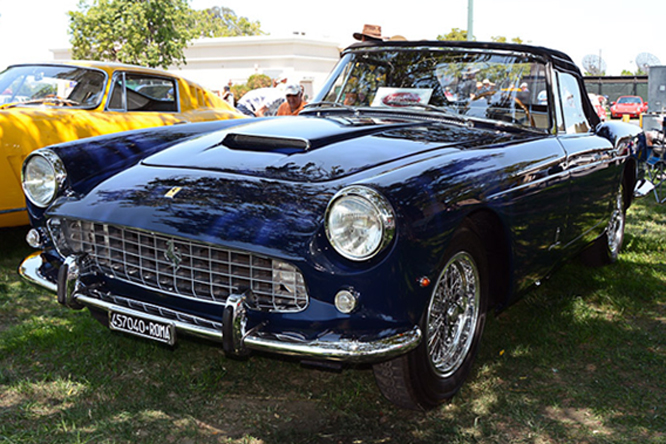
Ferrari 250 GT Pininfarina Cabriolet Series 2, Palo Alto Concours d'Elegance

The 212 Ferrari 250 GT Pininfarina Cabriolet Series 2‘s built are most easily identified from the 36 Series 1 models by the vent window in the door and the absence of side vents in the front wing/fender.

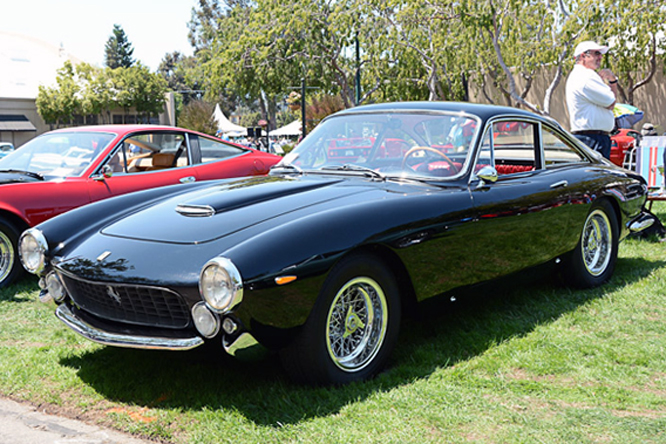
Ferrari 250 GT Lusso, Palo Alto Concours d'Elegance

The 375 Ferrari 250 GT Lusso’s built between 1963 and 1964 all featured steel bodywork designed by Pininfarina and built by Scaglietti, with a top speed of 150 mph they were amongst the fastest production cars of their day.

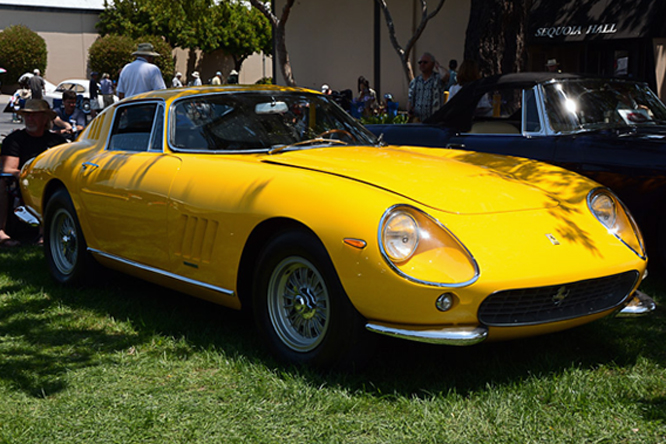
Ferrari 275 GTB, Palo Alto Concours d'Elegance

I’m not totally sure if the Ferrari 275 above is a two cam GTB version built from 1964 to 1966 or the 165mph 4 cam GTB/4 version built from 1966 to 1968, the wire wheels suggest the former because the GTB/4 was the first Ferrari not to be offered with wire wheels, which may have been fitted retrospectively.

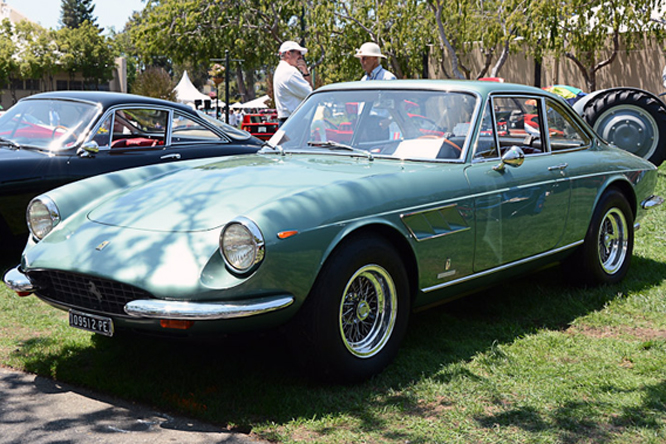
Ferrari 330 GTC, Palo Alto Concours d'Elegance

Sharing the same chassis, motor and independent suspension as the Ferrari 275 GTB is the Ferrari 330 GTC, a refined 2+2 which was said to be the first Ferrari in which one might “enjoy the radio”.

Ferrari 365 GTB/4, Palo Alto Concours d'Elegance

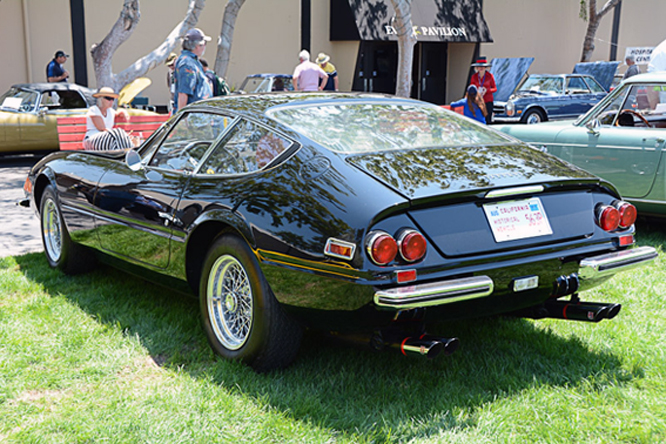
Replacing the 275 series cars in 1968 was the Ferrari 365 GTB/4 better known as the Daytona model.

Ferrari Dino 246 GT, Palo Alto Concours d'Elegance

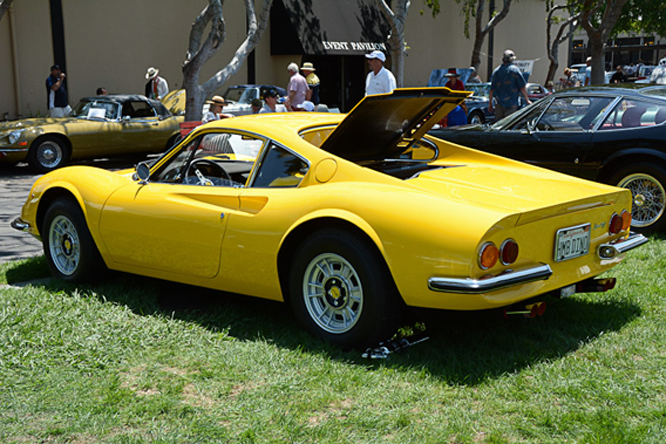
Ferrari first installed a V6 motor, inspired by his son Dino in 1957 and the following year one of many variations appeared in a two seat sports racing car, however it was not until 1969 that a V6 was fitted to a Ferrari 246 GT Dino like the one above. The Dino was the first of the mid engined Ferrari’s to be built for the road, despite misgivings that Enzo had about his customers being able to cope with the handling of such a configuration.

My thanks to Geoffrey Horton for sharing his photo’s more of which will appear next Thursday with a review of the Hillborough Concours d’Elegance.

Thanks for joining me on this “It’s Friday edition of “Gettin’ a li’l psycho on tyres” I hope you will join me again tomorrow. Don’t forget to come back now !

Share

Americana – Palo Alto Concours d’Elegance

At the back end of June Geoffrey Horton attended the Palo Alto Concours d’Elegance, apparently there was some confusion during the prize giving thanks what appears to have been a break down in communication between the judges and marshalls which left Geoffrey unsure if he and his Jaguar XK 140 had won a prize, if so which one, or not.

Packard, Palo Alto Concours d'Elegance

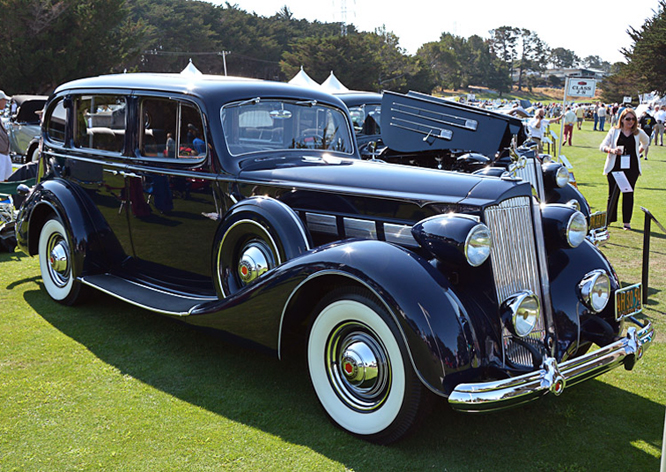
Among the photo’s Geoffrey kindly sent me were several of US built machines, above a Packard which I believe might be a 1936 One-Twenty though I’ll gladly take a second opinion the top mounted wipers appear to be the most useful clue as to the date.

Cadillac, Palo Alto Concours d'Elegance

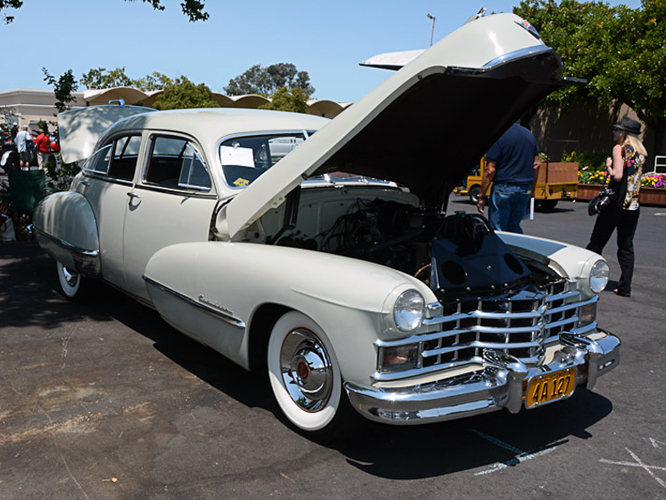
The script above the front fender trim on this Cadillac combined with the old school tail dating back to pre 1939/45 war makes this a 1947 model year and I’ll hazard a guess it’s big enough to be a Cadillac 62, if you know different do not hesitate to chime in below.

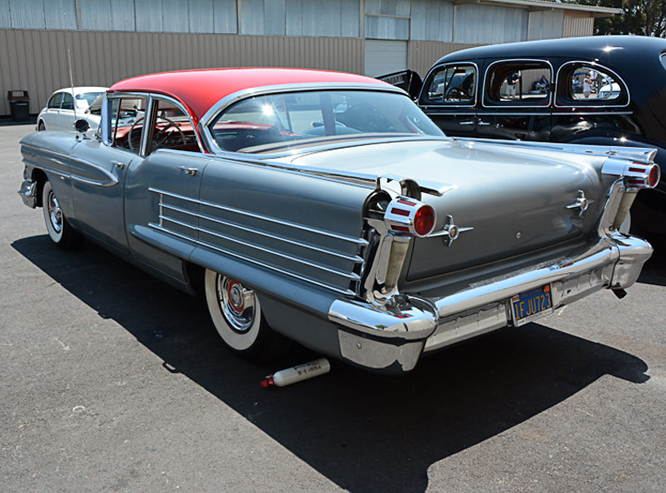
Oldsmobile Eighty Eight, Palo Alto Concours d'Elegance

The squarish liberally chrome decorated 1958 Oldsmobile Eighty Eight is relatively simple to identify, not the James Bond gadget like fuel filler hidden by the tail light.

Buick Le Sabre, Palo Alto Concours d'Elegance

Above a fine example of a 1959 Buick Le Sabre basks in the sun, unfathomably, with the roof up !

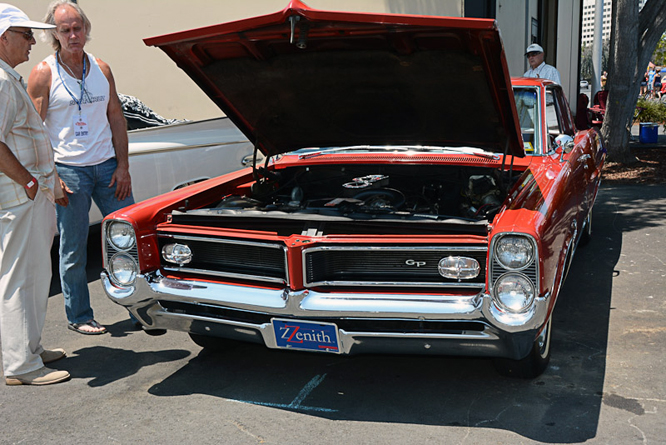
Pontiac Grand Prix, Palo Alto Concours d'Elegance

Finally the windscreen of the 1964 Pontiac Grand Prix above displayed a certificate confirming that at least 90% of this vehicle remains within it’s factory new originality, finish and condition.

My thanks to Geoffrey for sharing today’s photographs.

Thanks for joining me on today’s “Americana” edition of “Gettin’ a li’l psycho on tyres”, I hope you will join me again tomorrow when I’ll be looking at some of the Ferrari’s at Palo Alto. Don’t forget to come back now !

Share

VSCC University – VSCC Prescott Speed Hillclimb

Apologies to all for the absence of any blogs over the last week, unfortunately this was unavoidable after a moment of absent mindedness. Over the weekend I popped over to Prescott with regular GALPOT contributer Tim for the VSCC Speed Hillclimb.

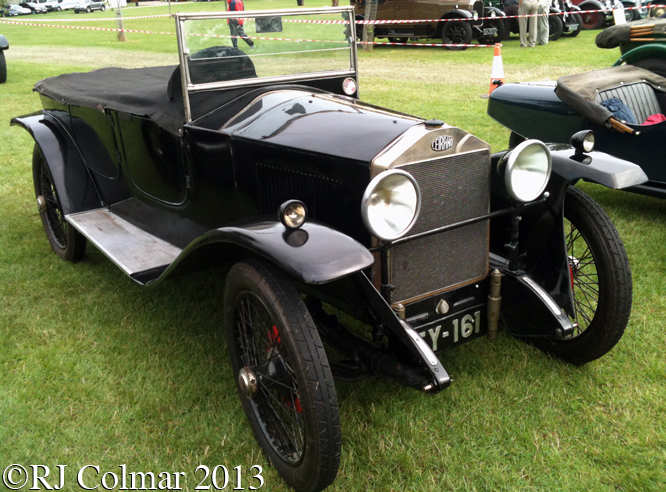
Ceirano S, VSCC Prescott

As ever the days education started in the car park where among several manufacturers, brands and models I’d not heard of before was this 1925 Ceirano built in Turin by SCAT (Societa Ceirano Automobili Torino) some years after founder Giovanni Ceirano, a prime mover behind the formation of FIAT in 1903, had died. Ceirano cars are best known for winning back to back victories in the Mille Miglia in 1911 and 1912.

Vauxhall Prince Henry, VSCC Prescott

The paddock was of course equally full of unusual delights above the nose of a Roland Duce’s 1913 Vauxhall Prince Henry.

Lees, Vauxhall Viper Special, VSCC Prescott

Another 1913 Vauxhall was Tony Lees Vauxhall Viper Special powered by a 200hp, 12 litre/732 cui Wolseley Viper aircraft motor of the type more usually found in late versions of the Royal Aircraft Factory SE5a and Avro 522.

Scaldwell, GN/JAP Grand Prix, VSCC Prescott

Among the fastest ladies present was Anne Scaldwell driving the GN JAP Grand Prix which was featured on this blog a couple of years ago.

Collings, Mercedes Simplex 60 HP, VSCC Prescott

Another familiar car was Ben Collings 1903 Mercedes Simplex 60hp.

Martin, Morgan Special, VSCC Prescott

Displaying maximum attack skills on the hill, what ever the conditions, was Charlie Martin in the fabric bodied Morgan Special entered by CJ Maeers.

Cobden, Riley Falcon Special, VSCC Prescott

Robert Cobden seen above driving the Riley Falcon Special did well to keep his car on the road after executing an unintentional 180° spin coming out of the Pardon hairpin.

Hulbert, ERA 4D, VSCC Prescott

Fastest time of the day was keenly contested with Mac Hulbert taking the honours and The Mays-Berthon Trophy 0.36 seconds from James Baxter, both driving ERA’s. Mac is seen in the 1938 ERA R4D which appropriately enough way not only conceived by Raymond Mays and Peter Peter Berthon but also driven to many post war hill climb victories by Mays.

Grafton, VSCC Prescott

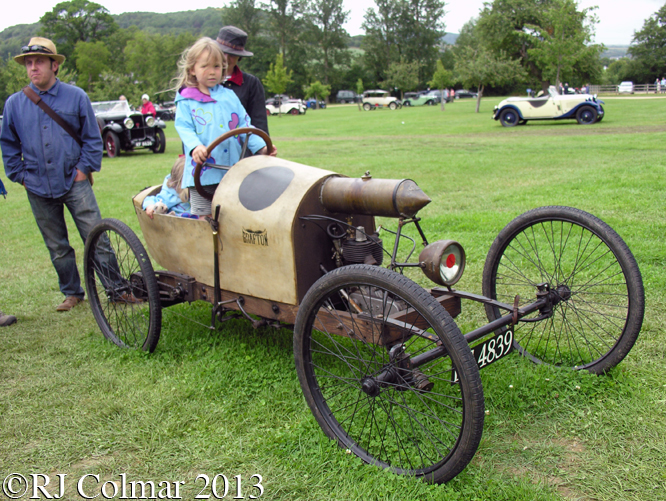
On the way back through the car park we stumbled across the JAP powered Grafton cycle car, the vehicle was built by Tim Gunn, seen on the left, of the Gunn Cyclecar Co in 2001 using a timber frame and an assortment of vintage parts.

Thanks for joining me on this “VSCC University” edition of “Gettin’ a li’l psycho on tyres” I hope you will join me again tomorrow for Americana Thursday. Don’t forget to come back now !

Share

Where Do We Go Now ? – Silverstone Classic

Last Saturday it was back to Silverstone for the third time in a month, but this time for the Silverstone Classic a three day event.
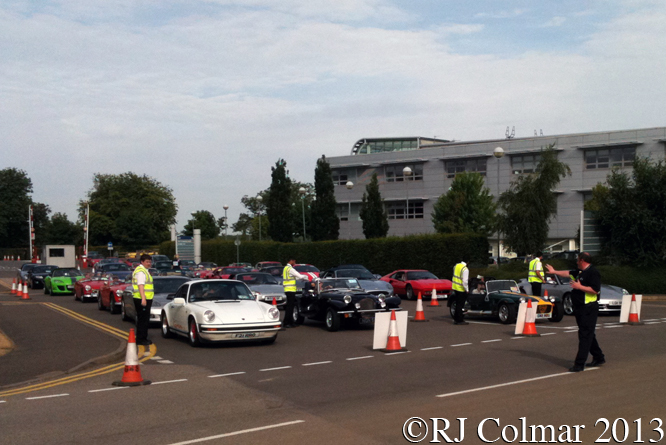
Silverstone Classic

Silverstone Classic is billed as the largest participant motorsports event in the United Kingdom.
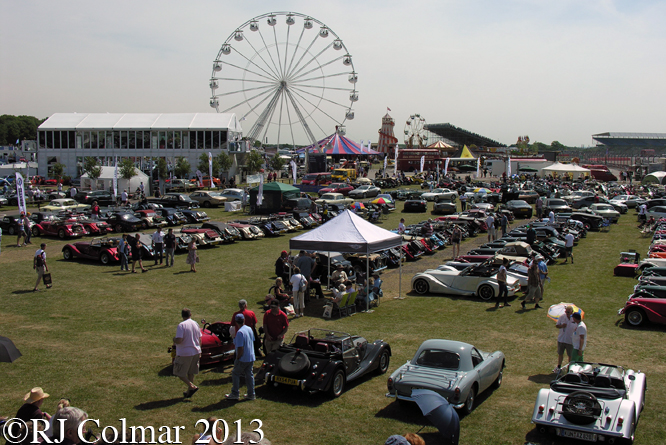
Silverstone Classic

Sponsors of the event BMW brought a long a big wheel, unfortunately I get vertigo on a step ladder so I was not able to sample the, by all accounts, spectacular view from the top.
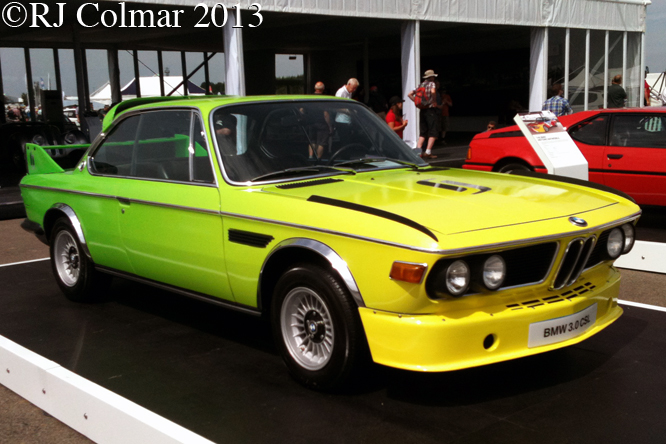
BMW 3.0 CSL, Silverstone Classic

I’m not too sure when the fad for lurid paint scheme’s started on road cars in Germany, but I do remember it quite vividly when I visited the country in 1974, above this particularly cool post July 1973 ‘Batmobile’ BMW 3.0 CSL was on display outside the BMW hospitality unit.
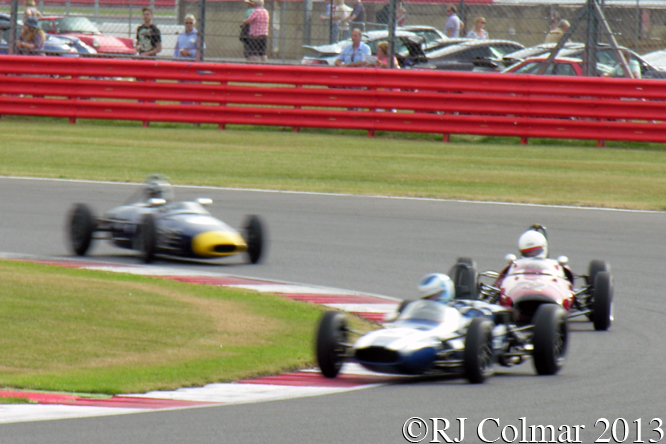
Wilson, Lotus 20/22, Hibberd, Lotus 22, Silverstone Classic

Racing got underway promptly at 9 am with the Formula Juniors who were racing for the Peter Arundell Trophy. The race was hotly contested between the #53 Lotus 20/22 of Sam Wilson and #79 of Andrew Hibberd, after trading places many times, Andy won the 9 lap race by just over half a second.
Formula Ford, Silverstone Classic

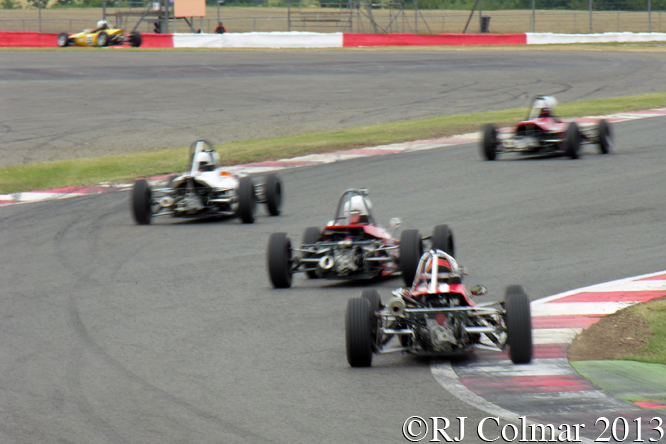
Callum Macleod won the Balvenie Trophy for Historic Formula Fords by nearly five seconds, above a gaggle of Formula Fords exits Maggotts Corner and heads for Beckett’s corner in a scrap more typical of the class.
Smith, Ward, Costin, Lister, Silverstone Classic

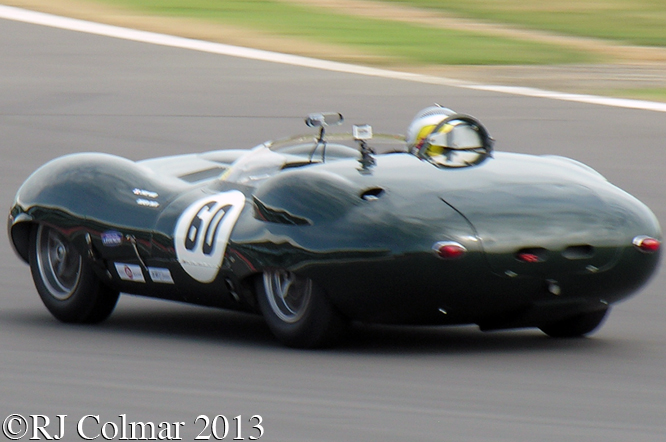
Gary Pearson led the opening laps of the Stirling Moss Trophy for Pre ’61 sports cars in his knobbly Lister Jaguar, but Oliver Bryant in a Lotus 15 soon chased him down for the lead and an eventual victory shared with Grahame Bryant. Meanwhile Chris Ward and Andrew Smith came through the field from 11th to finish second 2 seconds adrift in the lush Costin bodied Jaguar powered Lister seen above.
Ford Ranchero, Silverstone Classic

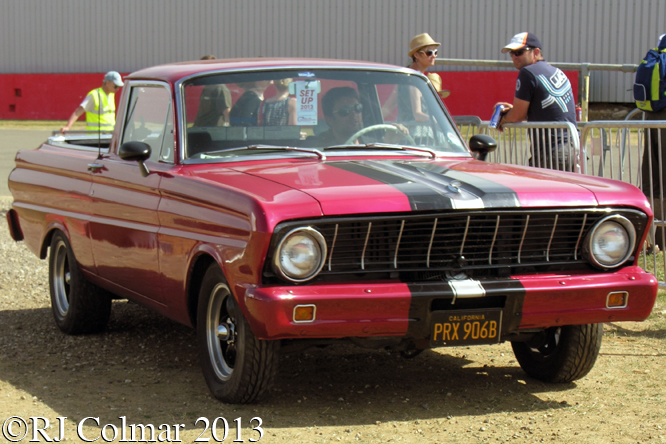
Out on the old Hanger Straight UK Street Machines were holding a shootout in which this ’64 Ford Ranchero was taking part.
Priaulx, Solomons, BMW1800Ti, Silverstone Classic

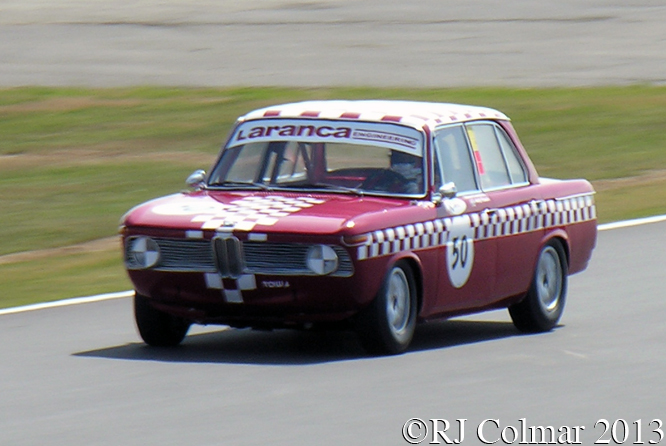
Former British Hillclimb Champion and three time World Touring Champion Andy Priaulx led the opening stages of the Sir John Whitmore Trophy for Under 2 Litre Touring Cars in this BMW 1800Ti, but it was Leo Voyazides aided by former Merzario engineer Simon Hadfield that came through to win in a Lotus Cortina. Priaulx sharing with Richard Solomons came home fifth.
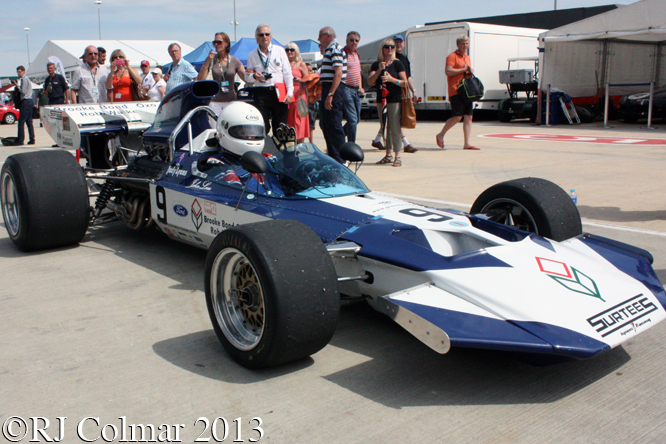
Lyons, Surtees, TS9, Silverstone Classic

Judy Lyons in her Surtees TS9 gives us a wave as she prepares to take part in the FIA Masters Historic Formula One race for which she qualified 3rd from last and finished last three laps down. Judy’s husband Frank finished 16th driving a Hesketh 308E while her son Michael won the race driving a former Longhorn Indycar chassis now in Williams FW07 spec as raced by Rupert Keegan in 1980.
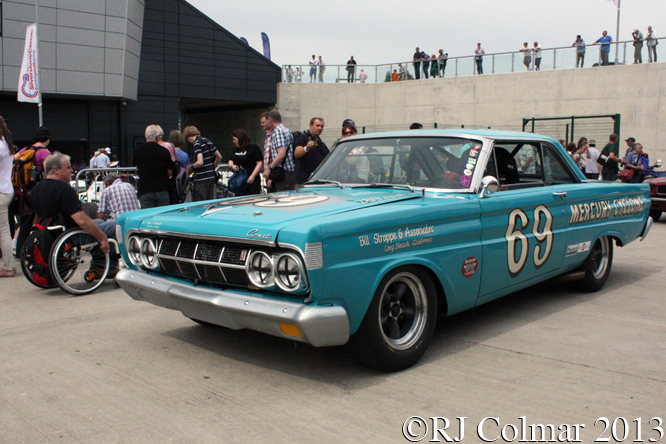
Wills, Panayiotou, Mercury, Comet, Cyclone, Silverstone Classic

Leo Voyazides and Simon Hadfield won the Trans-Atlantic Touring Car Trophy, by over 16 seconds, sharing a Ford Falcon. The Mercury Comet Cyclone above was shared by Roger Wills and Chris Panayiotou who finished 6th.
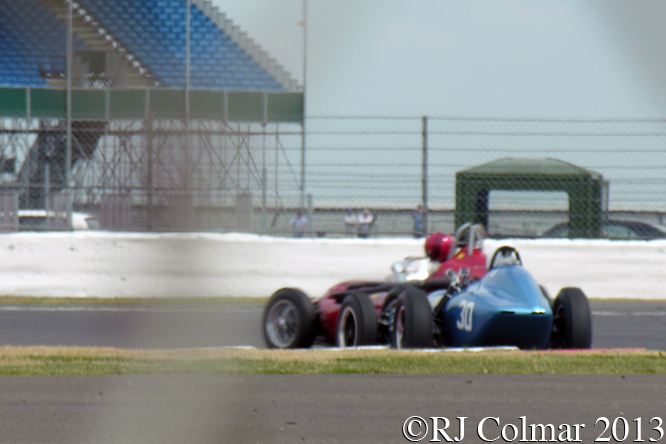
Wood, Tec Mec, Bronson, Scarab, Silverstone Classic

Tony Wood qualified the #27 Tec Mec Maserati on pole for the Froilan Gonzalez Trophy for HGPCA Pre’61 Grand Prix Cars, but Julian Bronson sitting alongside Wood on the grid in the #30 Offy powered Scarab made a great race of it and came through to score the open wheel Scarabs second ever victory, having won a similar race at Pau in France a couple of weeks ago.
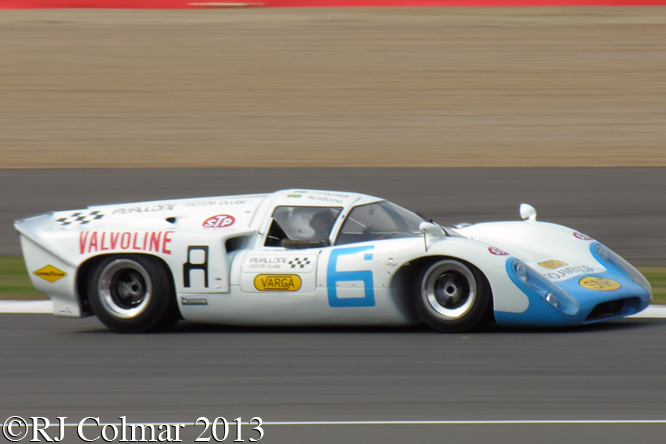
Voyazides, Hadfield, Lola T70, Mk IIIb, Silverstone Classic

The #6 Lola T70 Mk IIIb chassis #SL76/153 won the FIA Masters Historic Sports Cars race giving Leo Voyazides and Simon Hadfield their third victory of the day. The car appears in the colours used by Carlos Avallone in South America.
Lola T400, Silverstone Classic

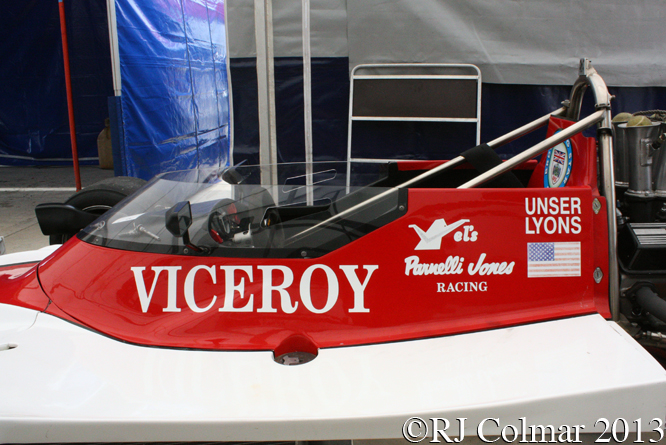
Michael Lyons second victory of the day came when he drove this ex Vels Parnelli Lola T400 chassis #HU7 a to dominant victory in the Peter Gethin Trophy for Formula 5000 and Formula 2 cars.
Wood, Cologne, Ford, Capri, Silverstone Classic

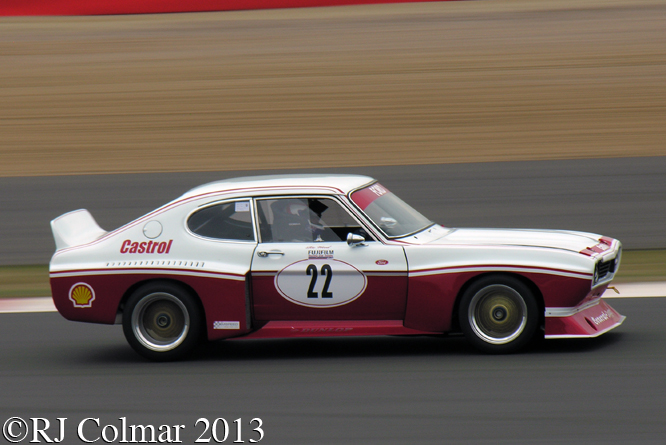
Neil Smith driving an ALFA Romeo 156 won the Super Touring Car Trophy by just over 2/10ths of a second from Frank Wrathall driving a Vauxhall Cavalier, above is the circa 1974 Ford RS3100 of Ric Wood which came in 13th overall winning class G and setting fastest lap in class.
Minshaw, Brabham, BT4, Hughes, Cooper, T53, Silverstone Classic

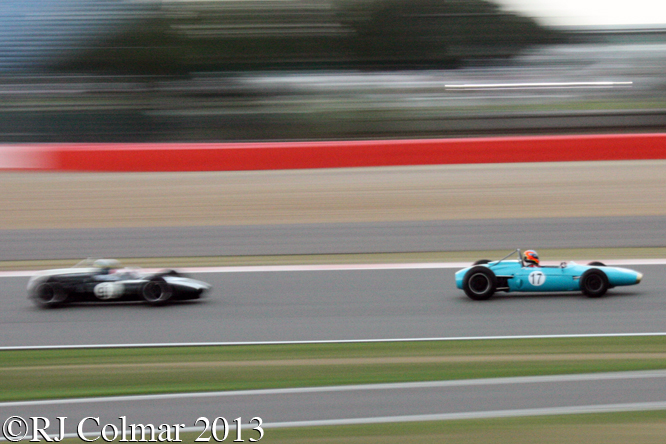
The skies turned dark as the pre 1966 1.5 litre / 91 cui Grand Prix cars came out to play for the Jim Clark Trophy. Jason Minshaw is seen above driving his Branham BT4 being chased by Jonathon Hughes in his Cooper T53. Jason crossed the line first on lap 4 after which the race had to be abandoned as a summer storm dropped huge quantities of water on the track.
Heidsieck, Trophy, Silverstone, Classic

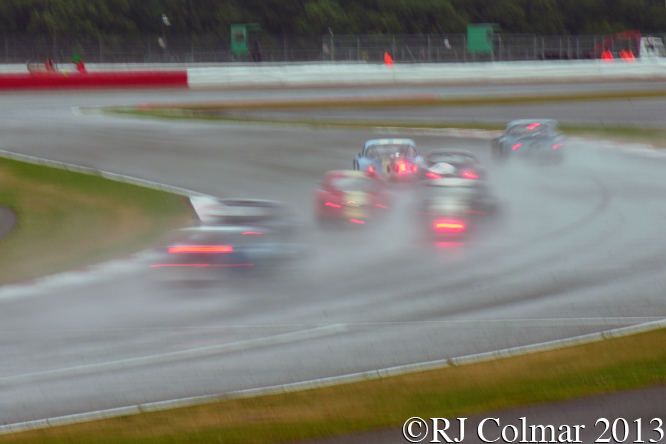
After nearly an hour the storm had passed and the marshalls had swept most of the excess water away. However as the Piper Heidsieck International Trophy for pre’66 GT Cars came out rain started again, but we got a start after the grid had followed the pace car around for a couple of laps. The TVR’s of Mike Whittaker and Owen O’Neil lead the field through Farm, above as the race gets underway. Conditions got progressively worse and the race was called after 45 mins of the scheduled 60 mins had run. John and Gary Pearson were declared the winners in their E-type Jaguar from Leo Voyazides and Simon Hadfield who missed a fourth victory of the day by 13 seconds in their AC Cobra.

Unfortunately, but completely understandably, the one race for Group C Sportscars I had got up for at 5 am specifically to see scheduled to run at sundown, had to be scratched as the rain in Spain continued to teem down mainly on Northamptonshire, England.

Exhausted by a day full of close racing, as I headed back to the car, I heard the familiar Guns ‘n’ Roses lyric “Where do we go now” wafting across from the stage where The Guns and Roses Experience were playing, to which my answer was unequivocal, “A warm and safe place”.

Thanks for joining me on this “Where Do We Go Now ?” edition of “Gettin’ a li’l psycho on tyres”, I hope you will join me again tomorrow. Don’t forget to come back now !
Share

In Law’s Instrumental Help – Ligier Matra JS17

At the end of 1978 Chrysler Europe was taken over by Peugeot and almost immediately rebranded the French Simca and British Hillman models as Talbot’s resurrecting a name that had last appeared in Formula One in 1951.

In 1972 MATRA, who were taken over by Simca, withdrew from Formula One to concentrate on a successful sports car program which was itself discontinued at the end of 1974 after MATRA had won three consecutive Le Mans 24 Hour races and two World sports Car Championships under the direction of Gerard Ducarouge.

Laffite, Ligier MATRA JS 17, British Grand Prix, Silverstone

Ducarouge went to work for Ligier to design a Matra powered Formula One car in 1976, the JS5 was quite successful for a new comer and the following year Jaques Laffite won the 1977 Swedish Grand Prix driving a MATRA V12 powered Ligier JS7. MATRA stopped developing their V12 in 1978 and Ligier suffered a consequent dip in their fortunes.

For 1979 and 1980 Ligier opted for the popular Cosworth DFV V8’s and immediately returned to victory lane with two surprising wins for Laffite in Argentina and Brazil with the JS11 model, but the team lost it’s direction did not present the anticipated championship challenge. In 198O Laffite won just one race but the team scored enough points to finish second in the constructors championship.

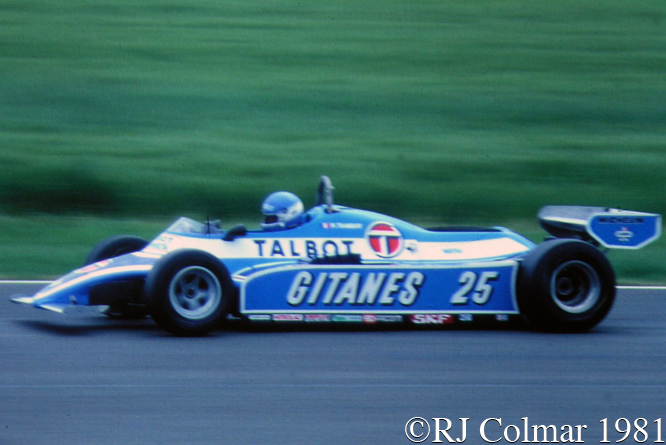
Tambay, Ligier MATRA JS 17, British Grand Prix, Silverstone

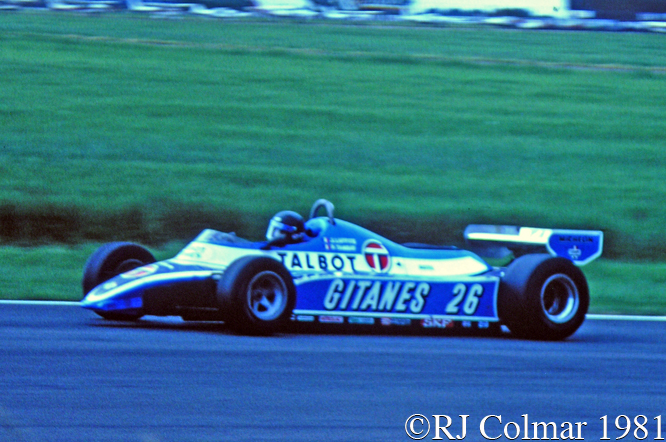
By 1981 Peugeot returned the Talbot name to Formula One by teaming up with Ligier and an updated version of the MATRA V12 was used to power the JS17’s featured today. Laffite was to be teamed up with brother in law, ex Renault refugee, Jean Pierre Jabouille who was recovering from injuries sustained when he crashed his Renault Turbo in the 1980 Canadian Grand Prix.

Jean Pierre Jarrier stood in for Jabouille for the first two races but when Jabouille returned to the cockpit he failed to qualify for two races in five attempts so he was replaced by Patrick Tambay seen at the wheel of the #25 here for the second half of the season, but crucially Jabouille remained with the team acting as an engineer. Patrick qualified for all of the remaining races but did not finish any of them.

Ligier MATRA JS 17, Test Day, Donington Park

Laffite meantime scored a couple of 2nd place finishes in Spain and Sweden along with 3 third place finishes in Monaco, Britain and Germany. Just before the French Grand Prix Gerard Ducarouge was fired by Guy Ligier.

At the Austrian Grand Prix Jabouille was instrumental in helping Laffite choose the correct tyre to suit both the Ligier and the track which resulted in the car qualifying 4th behind two turbo charged Renaults and Villenueve’s turbocharged Ferrari.

Ligier MATRA JS 17, Test Day, Donington Park

During the race after passing Villeneuve and his quick off the grid Ferrari team mate Didier Pironi, Jaques chased down the leading Renaults. Alain Prost in the lead car retired with collapsed suspension before Jacques passed the second Renault for the lead and eventual victory when René Arnoux hesitated over taking a pair of back markers.

Jacques then retired in Holland and Italy before bouncing back with a win from 10th on the grid in Canada to put him 3rd in the championship table, 6 points off the leader, with a slim chance of winning the 1981 Drivers Championship going into the Caesers Palace Grand Prix held in Las Vegas. In the event Jacques qualified just 12th behind Championship leader Carlos Reutemann who was on pole in his Williams and 2nd in standings Nelson Piquet who was 4th in his Brabham.

Reutemann inexplicably choked under the championship pressure during the race to finish 7th out of the points while Piquet salvaged a fifth place finish, one spot ahead of Jacques, enough to win the Championship. Alan Jones won the race in his Williams thereby depriving Jacques of a third place finish in the Championship, so for the third consecutive time Jacques Laffite recorded what would be his career best 4th place finish in the final championship standings.
With only the #26 scoring any points all season Ligier finished the season 4th in the Constructors Championship.

Thanks for joining me on this “In Law’s Instrumental Help” edition of “Gettin’ a li’l psycho on tyres” I hope you will join me again tomorrow. Don’t forget to come back now !
Share