Tag Archives: Cosworth

Spanish Sadness – Parnelli Cosworth VPJ4

The 1974 Canadian Grand Prix saw the debut not only of the Penske PC1 which I looked at last week but also of the also the Vels Miletich and Parnelli Jones team Parnelli VPJ4 a car that unlike the Penske PC1 was built in the United States.

The Cosworth DFV powered Parnelli was designed by Maurice Phillipe and on it’s debut in Canada Andretti qualified 16th and finished a respectable 7th just one spot short of a championship point.

At the following US Grand Prix an electrical issue intervened which saw the cars late arrival on grid and disqualification after 4 laps.

For 1975 the team lost one of it’s main backers Firestone who withdrew from Formula One at the end of the 1974 season. However the Goodyears on which the car was forced to run did not seem to hinder the Parnelli’s performance. At the non championship International Trophy run at Silverstone Mario brought the Parnelli home in third.
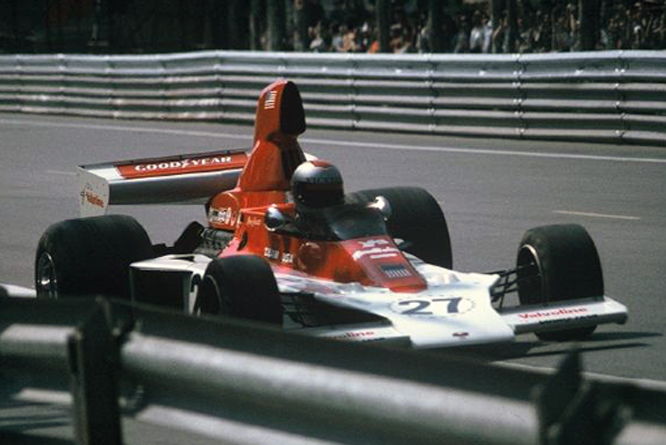
Andretti, Panelli Cosworth VPJ4, Spanish Grand Prix, Montjuich Park

At the Spanish Grand Prix, where today’s photograph was taken by Carles Bosch, Mario qualified 4th. Mario was involved in an opening lap fracas inadvertently pushing pole starting Niki Lauda in to the path of his team mate Clay Regazzoni while John Watson crashed his Surtees into the back of Andretti.

Mario emerged in second place from the melee behind James Hunt, who was unscathed, with a crabbing car with a bent suspension. Hunt in the Hesketh led until spinning off on oil leaving Mario in the lead ahead of John Watson’s Surtees.

Mario led for ten laps before the suspension finally gave way leading to his retirement. The race, which only started after the teams mechanics had spent Saturday morning ensuring all the barriers around the Montjuich street cuircuit were properly secured, was stopped prematurely after Rolf Stommelen who inherited the lead from Andretti left the road when the rear wing collapsed on his Embassy Hill. Stommelen’s car ended up taking down a lamp post and some fencing which killed a marshal and four spectators and injured several more.

Mario managed two points finishes, fourth in Sweden and fifth in France during the remainder of the 1975 season. With the team running out of funds Mario finished sixth in the 1976 South African Grand Prix, at the inaugural US GP West held at Long Beach Mario retired before the team folded and concentrated on it’s US Formula 5000 and USAC programs. Mario eventually rejoined Lotus for the remainder of the 1976 season and won the season’s finale Japanese Grand Prix.

I have tried unsuccessfully to contact Carles Bosch who took today’s photograph if you know him please do not hesitate to get in touch below.

Thanks for joining me on this “Spanish Sadness” edition of “Gettin’ a li’l psycho on tyres”, I hope you will join me again tomorrow. Don’t forget to come back now !

Share

French Built Championship Winner – MATRA Ford MS80 #MS80/3

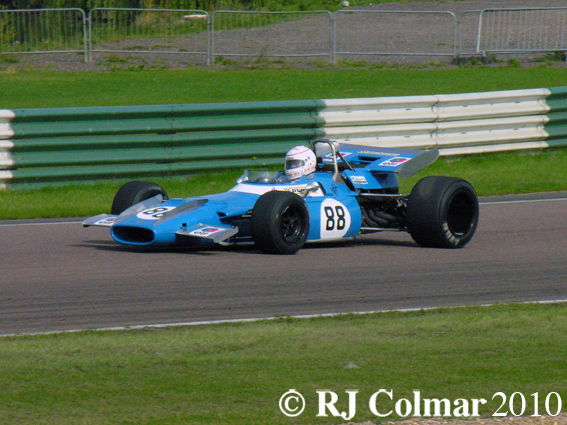
For 1969 MATRA CEO Jean-Luc Lagardère took a gamble to try and win the 1969 Drivers and Manufacturers Championships by suspending the entry of MATRA V12 powered cars by the works MATRA team and putting all of the teams efforts behind Ken Tyrrells Ford DFV powered MATRA International team cars.

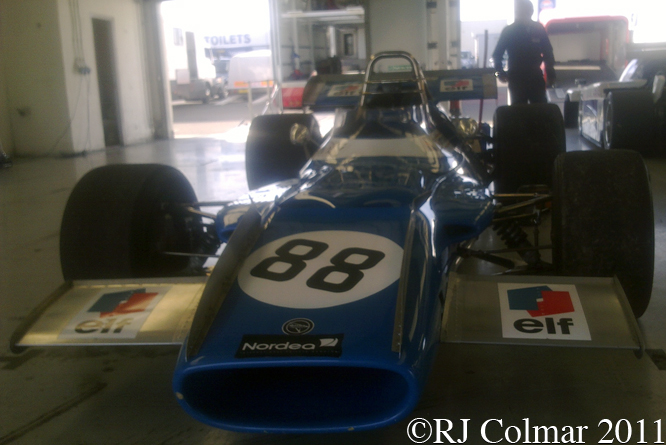
MATRA MS80, Silverstone Classic, Press Day

Even with all the focus being on the MATRA International Team cars the 1969 MS80 was not ready for the start of the season, fortunately the old Ford Powered MATRA MS10 was still good enough for Jackie Stewart to win the championship opening South African Grand Prix.

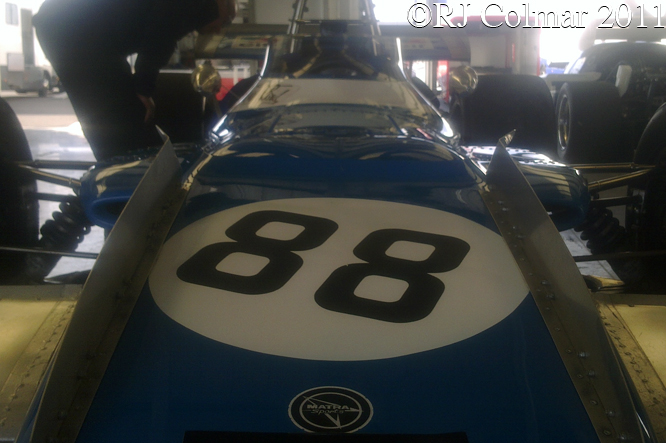
MATRA MS80, Silverstone Classic, Press Day

The MS80 made it’s public debut at the non Championship Race of Champions from the Lotus 49 of Graham Hill. At the Spanish Grand prix run around the streets of Barcelona at Montjuich Park Stewart won again starting from starting from forth on the grid after the faster Lotus 49’s of Rindt and Hill retired at the same spot a few laps apart as a result of crashes caused by wing failures, and Chris Amon who lead Stewart by over 30 seconds retired with a seized motor after half distance.

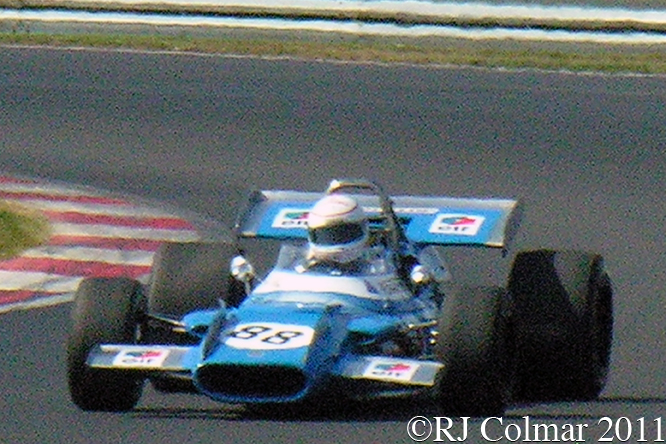
Maydon, MATRA MS80, Silverstone Classic, Press Day

At Monaco Stewart retired but then went on to win in Holland, France, backed up by team mate Jean Pierre Beltoise who finished second and Great Britain. In the German Grand Prix Stewart finished second to Jacky Ickx driving a Brabham before winning the Itallian Grand Prix at Monza.

MATRA MS80, Silverstone Classic, Press Day

Stewart retired from both the Canadian and US Grand Prix by which time Ickx who won in Canada was too far back in the points standings to catch the Scot. Stewart finished 4th in Mexico to round out the season in which he won his first drivers Championship and MATRA International their only World Manufacturers title.

Maydon, MATRA MS80, Test Day, Mallory Park

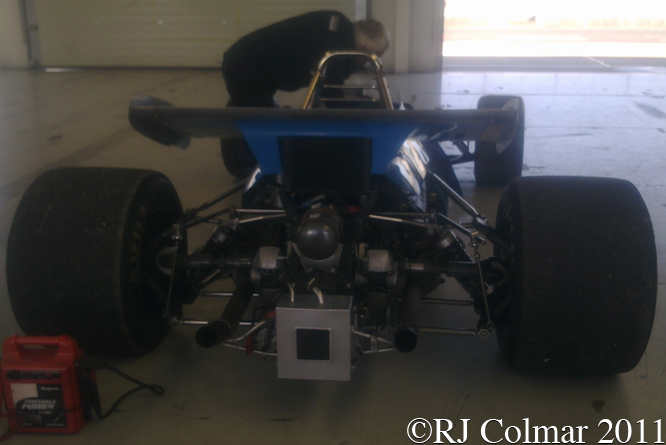
Only two MS80’s were completed for the 1969 season, a Ford Cosworth all wheel drive MS84 was also built but this featured MS80 suspension and a unique space frame chassis and was used originally as a spare car to replace the older MATRA MS10’s.

MATRA MS80, Silverstone Classic, Press Day

It is a credit to the determination of MATRA CEO Jean-Luc Lagardère to win both drivers and manufacturers championships that he sanctioned the building of the MS80 which featured fuel tanks that were integral to the monocoque that was reinforced inside by a number of transverse bulkheads, effectively splitting the fuel tank in many small interconnected cells.

Maydon, MATRA MS80, Silverstone Classic, Press Day

It had been announced well before 1969 that for 1970 rubber bag fuel tanks would be mandated that precluded the use of many interconnected fuel cells, so effectively the MS80 was restricted to being a one season challenger at the end of which it was outlawed.

MATRA MS80, Silverstone Classic, Press Day

At the end of 1969 Stewart and Tyrrell decided that they wanted to use the Ford Cosworth DFV in 1970 and MATRA who had been taken over by French manufacturer Simca, a French Chrysler subsidiary, were adamant they wanted to return to V12 power for 1970. To date the MATRA MS80 remains the only car built in France to win the World manufacturers championship. Note: the Renault’s driven by Fernando Aonso to Drivers and Manufacturers Championship success in 2005 and 2006 were built in Enstone, UK in the same premises that are now home to the Lotus F1 Team.

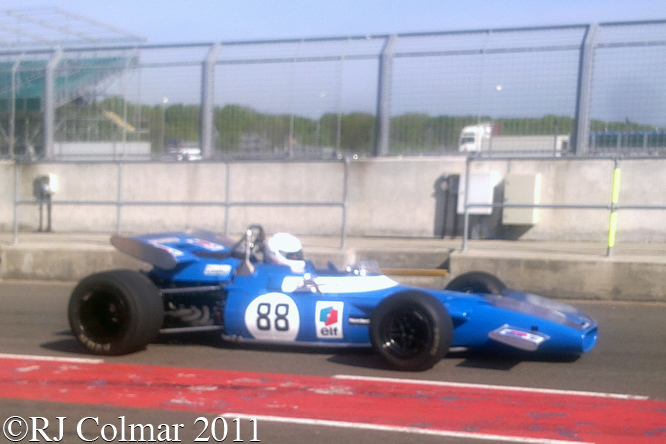
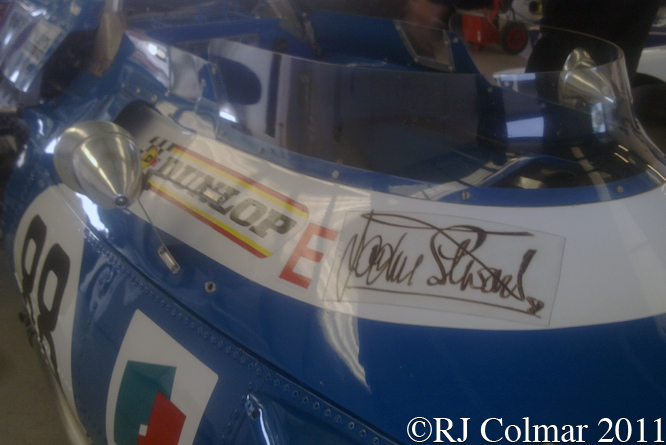
Chassis #MS80/3 seen in today’s photographs was built up from an unused spare tub for owner/driver Ray Maydon, who is seen driving the car at a Silverstone Classic test day top and bottom and at a Mallory Park test day in the middle.

My thanks to Walter Melissen of the The Nostalgia Forum and Ultimatecarpage.com for his assistance in identifying the chassis number and owner driver of today’s featured model.

Thanks for joining me on this “French Built Championship Winner” edition of “Gettin’ a li’l psycho on tyres” I hope you will join me again tomorrow. Don’t forget to come back now !

Share

Showboating – March Cosworth 2-4-0

The story of March racing cars presence in Formula One was one of a meteoric rise in a blaze of publicity and a slow decline, the company founded in October 1969 had built six of the 22 cars that started the 1970 British Grand Prix, thanks to Ken Tyrrell who bought three March cars for 1970, after his split with Matra, a March driven by reigning Driver Champion Jackie Stewart started on pole position at the first race of the 1970 season and won the Spanish Grand Prix, the second race of the season.

In 1971 Ronnie Peterson joined the works team and finished second in the drivers championship with no wins but 4 second place finishes. It was not until 1975 that the works March team won it’s first championship Grand Prix when Vittorio Brambilla crossed the line first at the prematurely concluded 1975 Austrian Grand Prix and promptly crashed into the crash barrier on the slowing down lap. For 1976 Ronnie Peterson rejoined the March team and won the Italian Grand Prix which proved to be the team and manufacturers final championship Grand Prix victory.

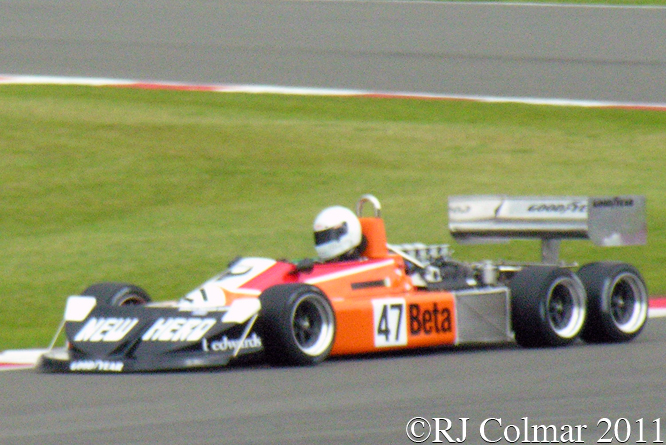
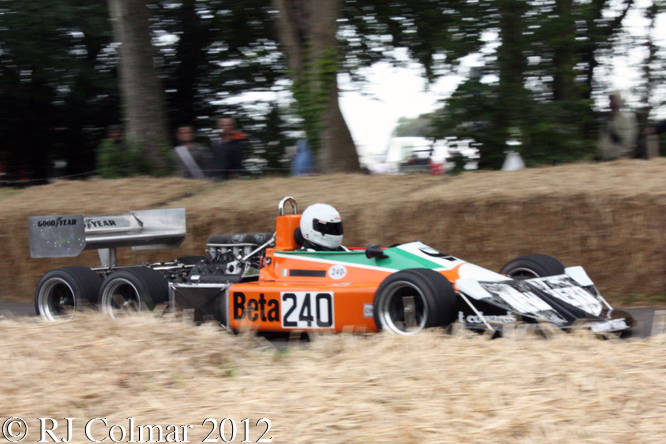
March Cosworth 2-4-0, Silverstone Classic

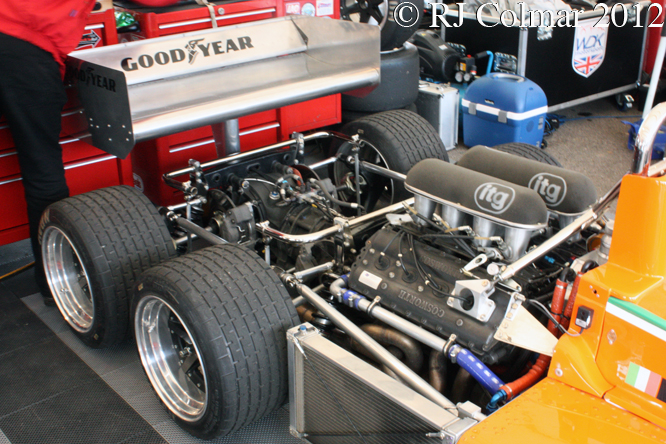
Looking forward to 1977 the team was short of cash when designer Robin Herd, who had designed the all wheel drive Cosworth in 1969 after he left McLaren, came up with the idea of building a six wheel car with four driven rear wheels as a way to improve on the mildly successful 6 wheel, 4 steering wheels at the front, Tyrrell P3/4. Team co-founder Max Moseley was instantly sold on the idea realising a six wheel March would be an excellent vehicle to generate some publicity and attract potential sponsors.

The shortage of cash meant the team focused on building the 4 wheel drive train and attendant suspension and attaching it to the back of a 1976 March 761, according to the best sources available to me this was chassis #761/1 which after several accidents was on it’s third monocoque tub and renumbered 761/10 for it’s press launch in early 1977 where a white prototype was shown. Turns out that only two of the rear wheels were driven at the press launch because not all of the internal components of the drive train had been finished in time to be installed.

March Cosworth 2-4-0, Silverstone Classic

When all the parts were ready they were attached to the back of chassis #761/2 and Howden Ganley was employed to test the car with a strange mix of old body panels including a nose clearly marked Doug Sherison Racing that probably came from a March 76A Formula 5000 car.

Howden commented on his experience “I tested the 6-wheeler three or four times. I think once at Goodwood and the other times at Silverstone. There were a few teething problems with the transmission – but eventually it all worked OK. I do not recall Max ever asking me to go easy on the power. In fact the last test in the pouring rain at Silverstone I used full acceleration without encountering any traction problems. Quite impressive.”

March Cosworth 2-4-0, Silverstone Classic

The concept did indeed attract a lot of attention and in March 1977 Rothmans held a press day at Silverstone at which they announced they would sponsor Ian Scheckter who tested the all wheel drive system now attached to a much older chassis, painted in Rothmans colours, that started life in 1974 as a March 741 #741/1 was renumbered to become #751/4 in 1975 and renumbered again to become #761/5 in 1976.

Regrettably after testing the concept the March team decided to revert to running a conventional 4 wheel 2 wheel drive layout for their 761’s which were updated to 761B spec for the start of the 1977 season. Around this time a well known picture began circulating of Alex Ribeiro sitting in his Hollywood sponsored car fitted with the 4 wheel drive transmission and a third set of rear wheels, as can be seen in this link young Brazilian F3 pilot Nelson Piquet can hardly keep a straight face in the prank photo.

At the end of the season March folded it’s F1 operation, although it was continuing to make good money on the 2-4-0 from the Scalextric model rights and from a show car for which there was much demand. Despite the fact that the 6 wheel March 2-4-0 was never raced, so far as I know Robin Herd remains the only man to have designed two four wheel drive formula one cars neither of which raced, in period, a couple of years later Roy Lane managed to acquire the 4 wheel drive axles and fitted them to his March 771 which he used in the 1979 British Hillclimb Championship.

Roy won a round of the championship at Wiscombe Park but found that the advantages of the system in wet conditions were out weighed by the performance of the lighter 2 wheel drive in the dry and ended up converting his car back to a conventional layout during the course of the season in which he failed in his attempt to recapture the British Hillclimb Championship.

The car featured today was built up by Anthony and Jeremy Smith with one of the two original 4 wheel drive transmissions built and a chassis who’s in period identity has not been established. Jeremy is seen at the wheel of the car at Silverstone top and Goodwood middle. By complete coincidence this March 2-4-0, there is another at the Louwman Museum, is currently for sale at Speedmaster Cars in Wetherby.

My thanks to James Hanson at Speedmaster Cars who kindly answered my questions about the chassis of today’s featured car and to members of The Nostalgia Forum, not least Tony “Giraffe” Gallagher, who posted pieces of the March 2-4-0 jigsaw puzzle seen on this linked thread.

Thanks for joining me on this “Showboating” edition of “Gettin’ a li’l psycho on tyres” I hope you will join me again tomorrow. Don’t forget to come back now !

PS Anyone planning on going to next weeks Silverstone Classic please remember this year will be advanced ticket only available on this link.

Share

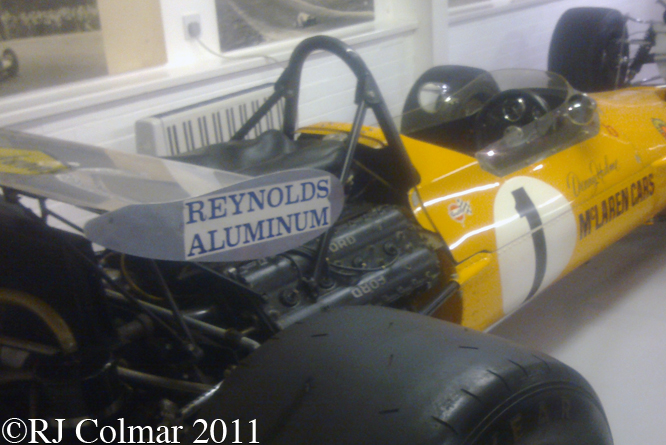
More Fuel – McLaren Ford M14A #M14/2

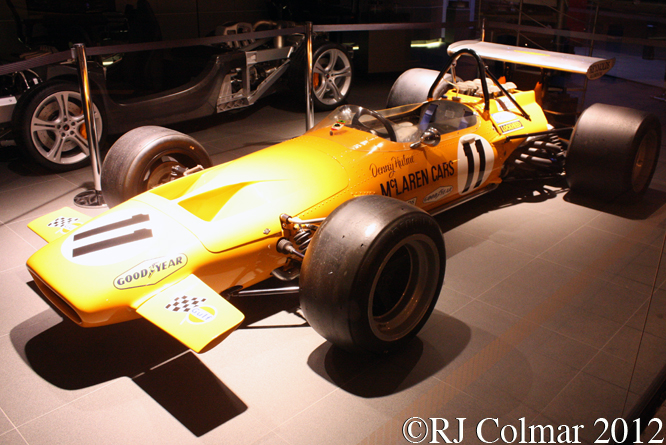
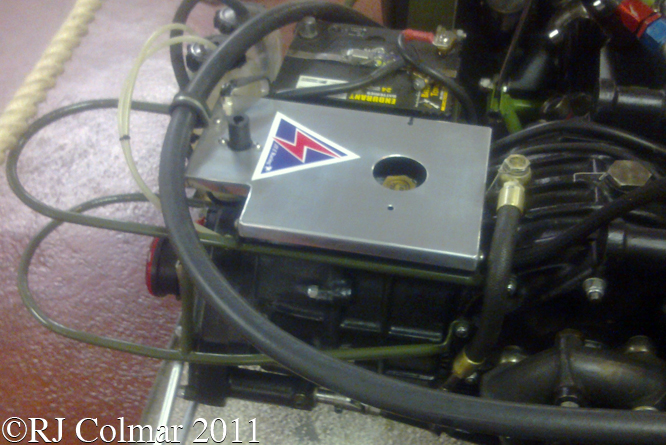
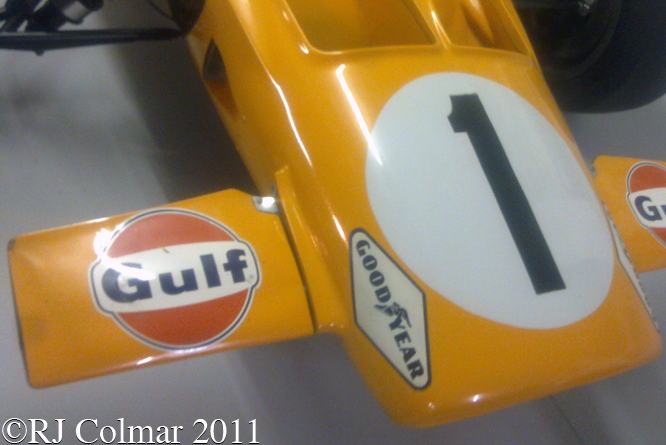
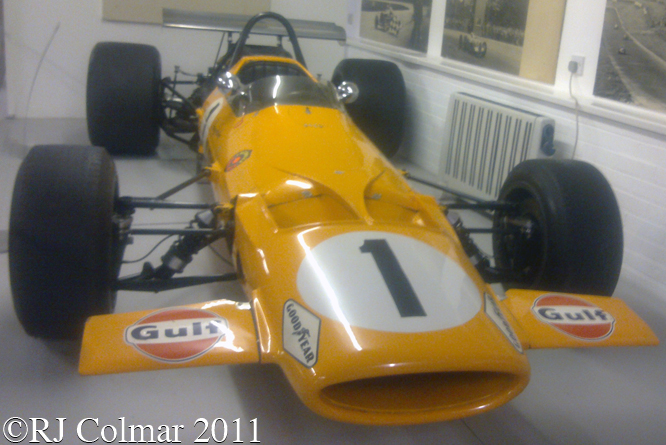
Going into 1970 things were looking up as McLaren Cars entered their seventh year. The team had won three consecutive Can Am Championships, 2 for Bruce McLaren and one for Denny Hulme, the inaugural European Formula F5000 championship with Peter Gethin and four championship Formula One races one for Bruce McLaren and three, including the last race of 1969, for Denny Hulme.

In addition to these racing programs for 1970 McLaren were to embark on an Indy program with the new turbocharged McLaren Offy M15 and were contracted to run an Alfa Romeo V8 powered car alongside their new Ford powered M14A Formula One car.

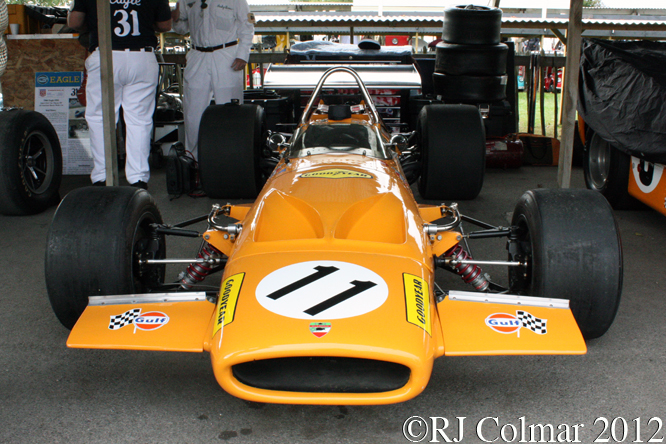
McLaren Ford M14A, Goodwood Revival

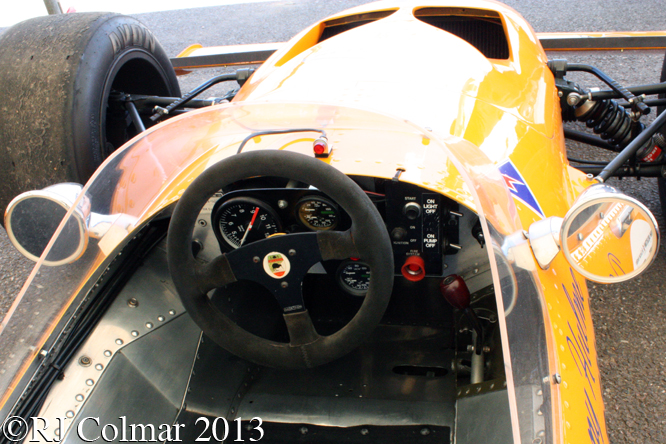
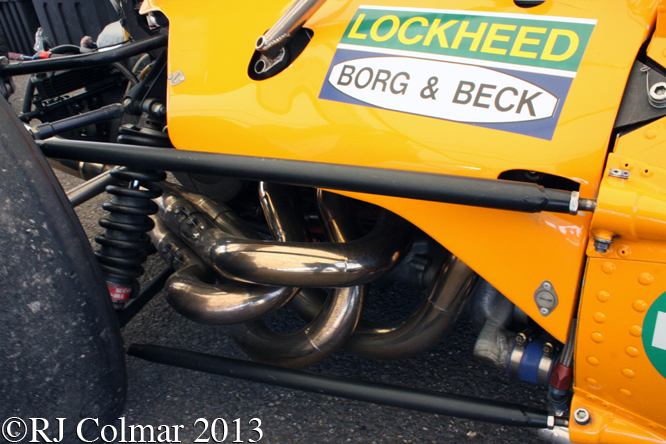
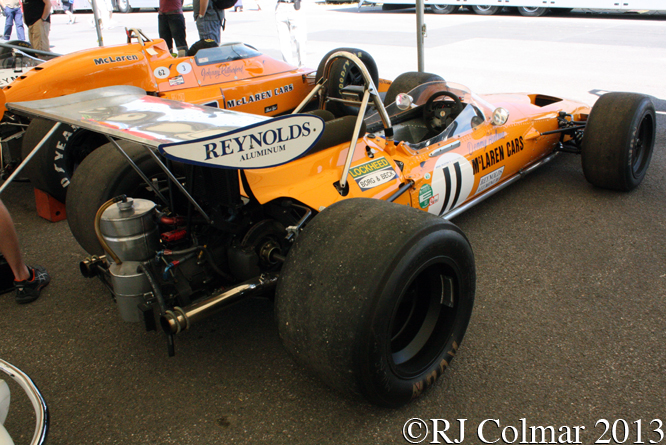
The new M14A was an improvement of the 1969 McLaren M7C, itself based on a Formula F5000 M10A chassis with McLaren M7A Grand Prix winning suspension.

The main feature of the new car was the narrower internal dimensions of the monocoque which were necessary to accommodate larger fuel tanks required by the ever more powerful and thirsty Ford Cosworth DFV V8’s.

McLaren Ford M14A, McLaren Manchester, Knutsford

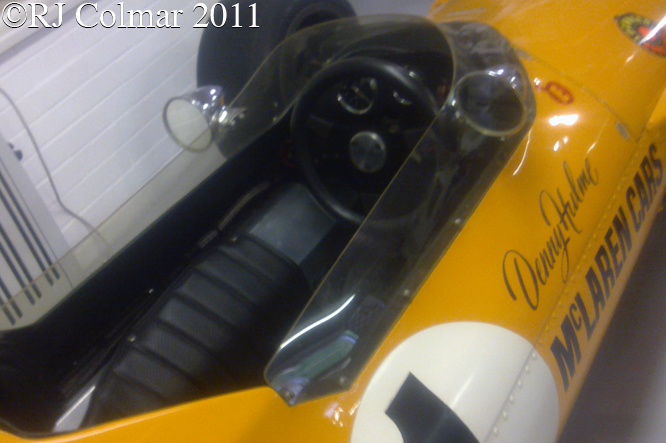
The McLaren M14A was used in all but one race in the 1970 Formula One championship season. It’s best result was on it’s debut in South Africa where Denny Hulme finished second, driving I believe today’s featured car. Bruce McLaren matched that in Spain where he also finished second. After the Monaco Grand Prix where Denny finished forth disaster struck as first Denny was badly burned after his car caught fire in testing at Indianapolis and then a couple of weeks later Bruce was killed while testing the M8D Can Am car at Goodwood.

The team consequently missed the Belgian GP and reappeared at the Dutch Grand Prix with Dan Gurney driving the lead car #M14/1 and 1969 European Formula 5000 champion Peter Gethin making his Formula One championship debut driving today’s featured chassis, both cars retired. Denny Hulme still suffering from burned hands was back in time for the French Grand Prix alongside Dan Gurney and the pair came in 4th and 6th respectively.

#M14/2 is seen at the McLaren Manchester show room in Knutsford above.

McLaren Ford M14A, Goodwood Festival Of Speed

Dan Gurney retired from Formula One after retiring from the British Grand Prix where Hulme finished a remarkable 3rd. Peter Gethin was back in the team for the German Grand Prix where Denny again finished 3rd. Denny retired from the Austrian GP but at Monza for the Italian Grand Prix he came home 4th. Peter Gethin scored his first World Championship point at the Canadian Grand Prix where he finished 6th and Denny rounded out a painful year with a third in the Mexican Grand Prix finishing 4th in the Formula One Championship points table.

Incredibly despite his injuries Denny had also won 6 of the 10 Can Am Championship rounds enough to win the 1970 Chamionship his second Can Am Crown and McLaren Cars 4th consecutive championship aided by a further win from Peter Gethin who also won a second consecutive European Formula 5000 title driving a McLaren. The US, New Zealand and South African Formula 5000 thousand championships were won by John Cannon, Graham McRae and Bob Olthof respectively all also driving McLarens.

McLaren Ford M14A, Goodwood Festival Of Speed

For 1971 #M14/2 was driven by Peter Gethin to two second place finishes in non championship races at Oulton Park and Brands Hatch, the best championship result Peter had from 3 championship start in the car was 8th in the 1971 Spanish Grand Prix.

Jackie Oliver joined McLaren for the British Grand Prix where he qualified #M14/2 22nd but a bungled flag drop saw Jackie crash into Graham Hill at the start causing instant retirement for both and a £50 fine for Jackie. The cars final works appearance was at the 1971 Italian Grand Prix where Jackie qualified 13th and finished 7th in a close fought race won by Peter Gethin now driving a BRM.

McLaren Ford M14A, Goodwood Festival Of Speed

#M14/2 next appeared with a Formula 5000 Chevy stock block V8 motor in the hands of Tony Dean who’s best result was a 10th place finish in his first start in the car at Mondello Park. On his seventh and final attempt, which included retirements from races at Elkhart Lake and Brainerd, to race the car Tony failed to qualify for the non championship 1972 John Player Challenge Trophy at Brands Hatch.

In 1973 at the same venue Willie Wood failed to qualify #M14/2 for the Formula F5000 race or non championship Race of Champions and was not classified in a further appearance at Oulton Park. Allan Kayes then bought #M14/2 was also unclassified at Brands Hatch, finished 11th at Oulton Park and then retired, failed to qualify or failed to start in 12 further races most of which were rounds of the 1974 European Formula 5000 championship.

Thanks for joining me on this “More Fuel” edition of “Gettin’ a li’l psycho on tyres” I hope you will join me again tomorrow. Don’t forget to come back now !

Share

Magnesium DFV – Cosworth

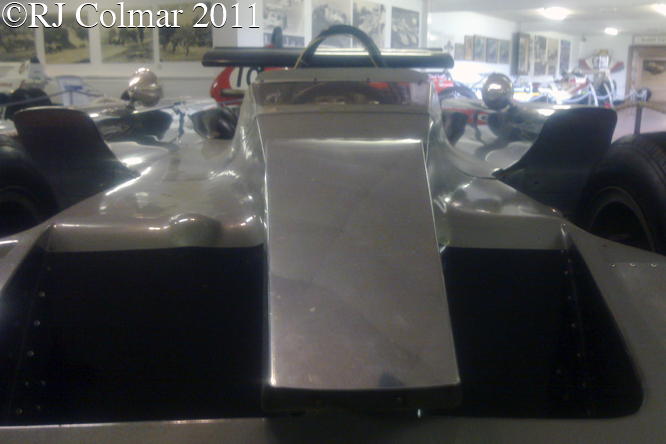
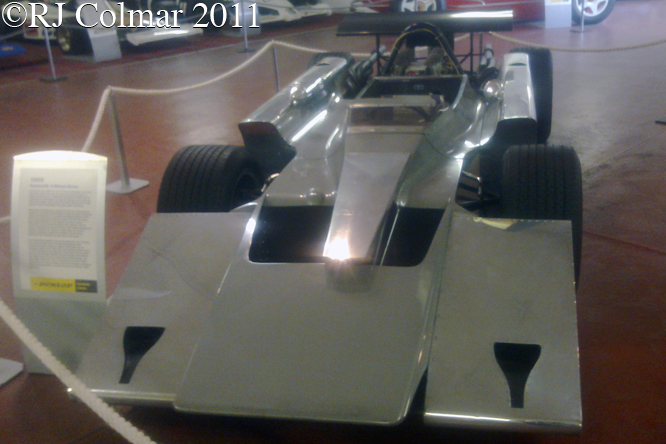
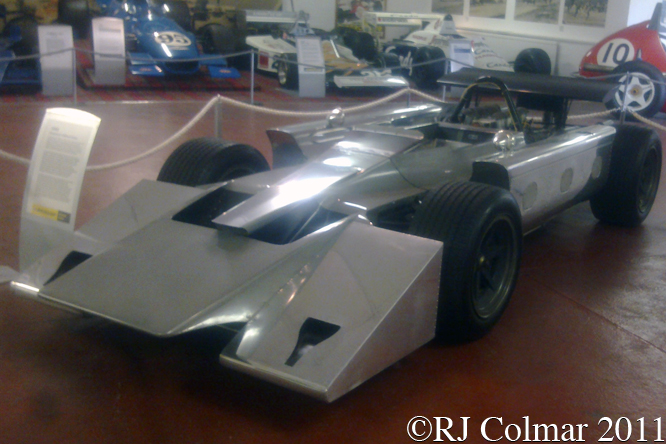
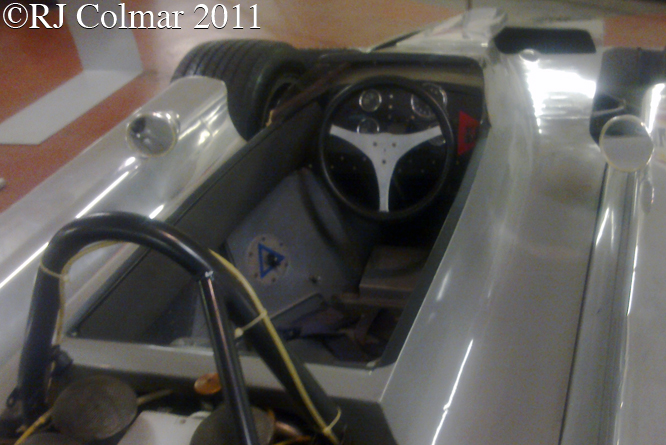
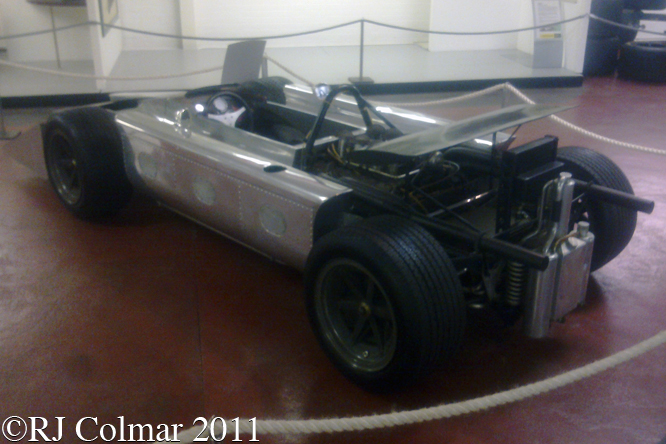
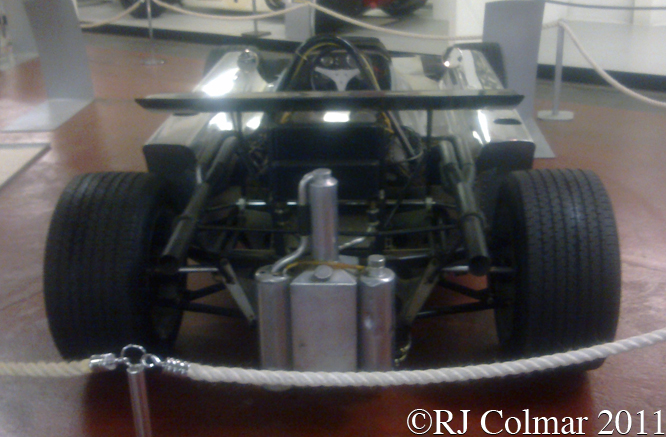
Looking like a cross between a 1923 Grand Prix Voisin Labatoire and a 1954 Lancia D50 the Cosworth Formula Car designed by Robin Herd.

Cosworth, Donington, Park Museum

Mike Costin and Keith Duckworth, the geniuses behind the Ford Cosworth DFV Formula One engine that dominated Formula One from 1968 to 1982, decided to engage former McLaren designer Robin Herd build a car which would maximise the advantages of their powerful DFV V8 in 1968.

Cosworth, Donington, Park Museum

Herd took a more radical approach to the application of all wheel drive to Formula One than either Colin Chapman’s Lotus 63 or Jo Marquart’s McLaren M9A, although no where near as radical as the V12 powered MATRA MS 11 all wheel drive with hydraulic drive to all four wheels.

Cosworth, Donington, Park Museum

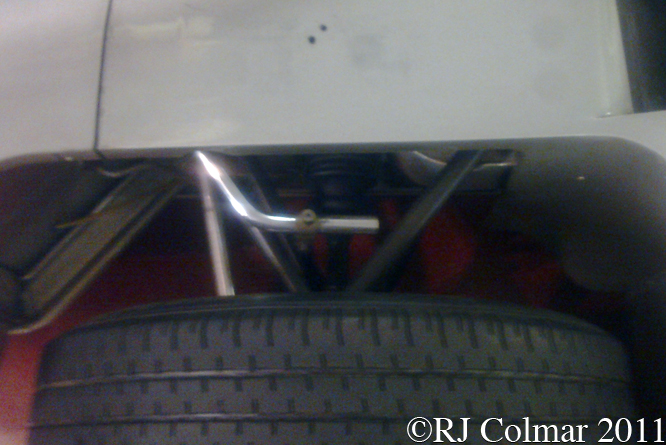
In order to keep the driver’s seat low and accommodate the drive shaft running from the motor and gearbox in the rear to the wheels at the front the driver was slightly offset from a central seating position.

Cosworth, Donington, Park Museum

The Cosworth was tested by Mike Costin, the ‘Cos’ in ‘Cosworth’, Brian Redman, Trevor Taylor and Jackie Stewart.

Cosworth, Donington, Park Museum

Trevor Taylor was penciled in to debut the Cosworth at the 1969 British Grand Prix, however as the testing had shown the car worked best with little or no drive to the front wheels the entry was withdrawn.

Cosworth, Donington, Park Museum

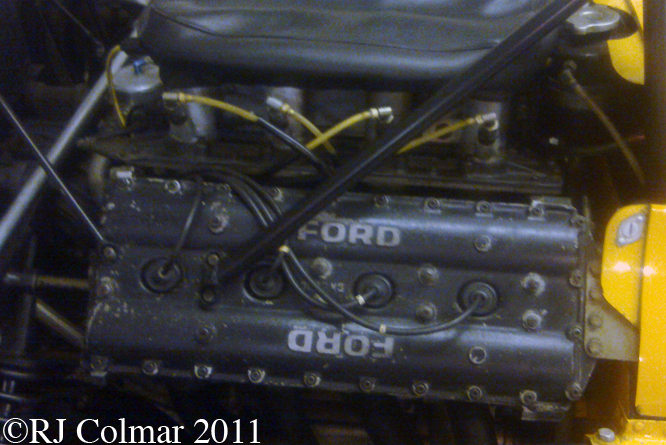
While the Cosworth shared the same 3 lite / 183 cui DFV motor design there was one essential difference between the Cosworth works unit and those supplied to Lotus and McLaren, the block was cast in magnesium to save weight over the aluminium cast DFVs supplied to Cosworth’s customers.

Cosworth, Donington, Park Museum

The Cosworth never did race, as BRM’s Tony Rudd had predicted after BRM’s experience with the all wheel drive BRM P67 all wheel drive would never work in Formula One, and after being demonstrated at the British Grand Prix at Brands Hatch in 1970 it found it’s way to the Donington Park Museum where it is seen in these photographs.

Thanks for joining me on this “Magnesium DFV” edition of “Gettin’ a li’l psycho on tyres”, I hope you will join me again tomorrow. Don’t forget to come back now !
Share

Primer Car – MATRA Ford MS9

For 1968 Ken Tyrrell joined McLaren and Lotus by electing to buy a supply of Ford Cosworth DFV engines and did a deal with MATRA, who’s chassis he had run in Formula 2, to supply Formula One chassis for Jackie Stewart. While finishing the new MS10 challenger MATRA built the MS9 as an interim development car featuring a shortened MS7 Formula 2 monocoque which was adapted to take the DFV as a stressed member.

MATRA MS9, Donington Museum

The interim car was fitted with suspension adapted from it’s sports car programme to acommodate the larger Formula One wheels. The car was painted in a zinc or other chromate pigmented primer usually found in the aerospace business, MATRA’s prime business, to protect aluminium alloy.

MATRA MS9, Donington Museum

Jackie liked the car in testing and elected to race the primer test car in the 1968 South African Grand Prix in favour of the new MS10. Apparently a late attempt was made to paint the car French blue but the paint chosen did not adhere to the primer.

MATRA MS9, Donington Museum

Finance for the new MATRA International Team was provided by a new natianalised French oil brand Elf, which took over a large number of French Caltex retail outlets in 1968 that were subject to a carefully orchestrated overnight nationwide rebranding program.

MATRA MS9, Donington Museum

Having qualified an impressive third with only the Lotus 49’s of Jim Clark and Graham Hill ahead of him, Jackie Stewart stepped into the MS9 to start the race knowing he did not have enough fuel on board to complete the race without a pit stop.

MATRA MS9, Donington Museum

However on lap 43 the car had to retire with a broken valve spring and dropped valve.

MATRA MS9, Donington Museum

This car was then replaced by the MS10 for the remainder of the season. Note the curved grey bar is part of a subframe that links the rear suspension and gearbox directly to the chassis which kept the rear suspension and gearbox in place when the engine was removed.

Thanks for joining me on this primer car edition of “Gettin’ a li’l psycho on tyres” I hope you will join me again tomorrow. Don’t forget to come back now !
Share

Third Time Lucky – McLaren Ford M7A

After the disappointments of the Ford Indy derived V8 and Serenissima V8 used in the 1966 McLaren M2B, the interim BRM V8 Formula 2 based McLaren M4B and BRM V12 powered M5A of 1967 Bruce Mclaren bought 5 Ford Cosworth DFV motors for the 1968 season which were used as in the integral structure of the McLaren M7A designed by Robin Herd, Gordon Coppuck and Bruce himself.

McLaren M7A, Donington Park Museum

The M7A’s and 3 derivatives, M7B, M7C, and Alfa Romeo powered M7D were entered by the works team from 1968 to 1970. For 1968 the works Formula One McLaren’s were sponsored  by Shell while the McLaren Can Am Cars were sponsored by Gulf.

McLaren M7A, Donington Park Museum

Reigning World Champion Denny Hulme left Brabham to join McLaren in 1968 and on the M7A’s debut at the non Championship Race of Champions at Brands Hatch Bruce came first and team mate Denny Third. The M7A’s came in first and second at the non Championship International Trophy at Silverstone with Denny Hulme came edging the team founder.

McLaren M7A, Donington Park Museum

On their third championship appearance, after Spain and Monaco, Bruce McLaren became the second man to win a Grand Prix bearing his own name crossing the line first to win the 1968 Belgian Grand Prix. It would prove to be his forth and final Grand Prix victory.

McLaren M7A, Donington Park Museum

Denny Hulme won the Italian and Canadian Grand Prix towards the end of the season and finished third in the World Drivers Championship behind Graham Hill and Jackie Stewart, Bruce finished fifth in points standings. McLaren finished second in the constructors Championship behind Lotus but ahead of the Ken Tyrrell entered Matra driven by Jackie Stewart all three constructors used Ford Cosworth DFV motors.

McLaren M7A, Donington Park Museum

In 1969 Bruce only drove an M7A in South Africa where he finished fifth before focusing on the M7C, which will be the subject of a future blog, which featured a more substantial monocoque. Denny meanwhile continued driving the M7A throughout the 1969 season winning the season finale in Mexico. Denny finished the season 6th in points with Bruce 3rd, the Mclaren team finished 4th and last of the Ford Cosworth DFV powered teams in the constructors championship.

The M7B fitted with outrigged panier fuel tanks made only one works championship appearance at the 1969 South African Grand Prix where Bruce Mclaren finished 5th. He later sold the car to Colin Crabbe who’s Antique Automobiles team entered it in four races for Vic Elford who finished a best fifth in the 1969 Dutch Grand Prix.

In 1970 McLaren adapted an M7 to take a non stressed Alfa Romeo V8 which became known as the M7D the car recorded three DNQ’s, did not qualify, a not classified finish in France and a DNS, did not start, in the 1970 British Grand Prix. After the first four events Nanni Galli took over the M7D from Andrea de Adamich, recording the cars third DNQ at the Italian Grand Prix.

Privately entered M7A were driven in three races by Dan Gurney for All American Racers in 1968, best finish forth in the US Grand Prix, and Basil van Rooyen for Team Lawson in the 1969 South African Grand Prix where he retired with brake problems after completing 12 laps.

Thanks for joining me on this “Third Time Lucky” edition of ‘Gettin’ a lil’ psycho on tyres’ I hope you will join me again tomorrow. Don’t forget to come back now !
06/07/13 Errata as Tim has pointed out below Bruce finished the 1960 season second in the World Drivers Championship and so his 3rd place in points in 1969 did not equal his career best as originally stated. Apologies for any confusion.

Share