Tag Archives: Ferrari

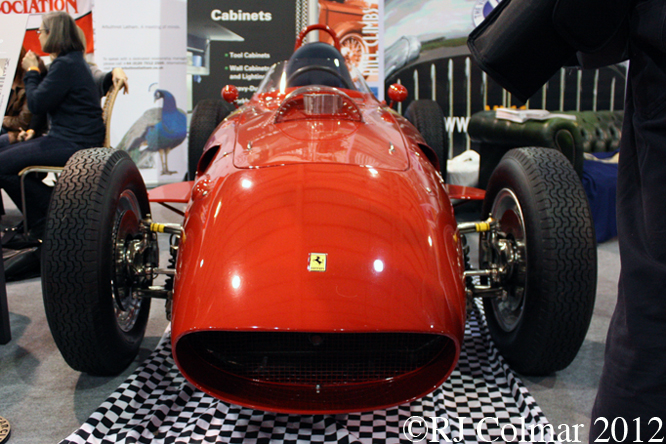
Static Show Car – Ferrari F310

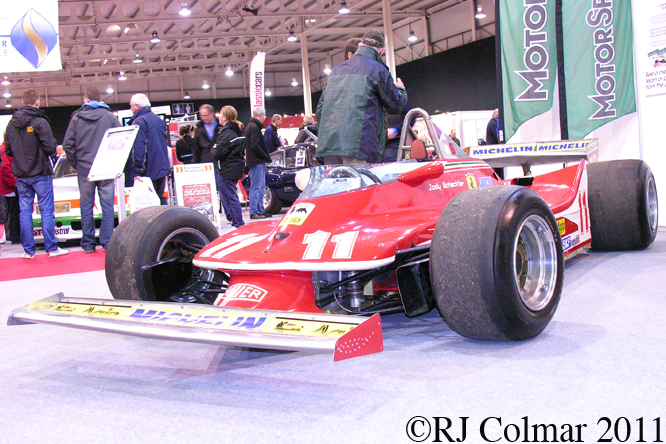
Coming off two championship wins with Benetton in 1994 powered by Ford and 1995 powered by Renault Micheal Schumacher named his price, allegedly of the order of $30 million per year, and joined Ferrari in order to take up the challenge of attempting to become the first driver to win the World Drivers Championship in a Ferrari since Jody Scheckter in 1979.
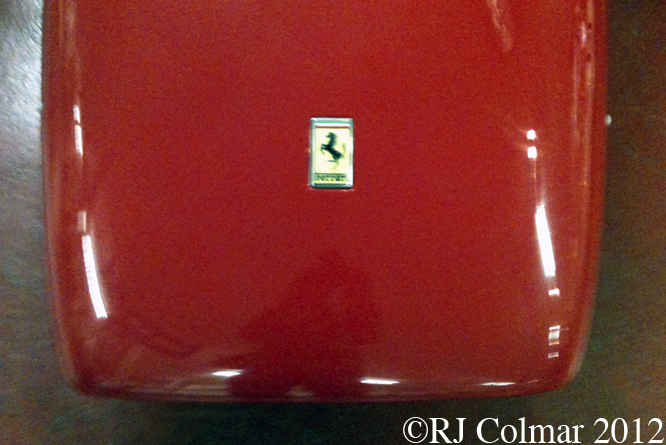
Ferrari F310, Haynes IMM

John Barnard who’s designs include the Indy 500 winning Chaparral 2K and Grand Prix Winning McLaren MP4/1 and subsequent championship winning McLarens was responsible of the design of the F310 with which Schumacher was to win races in in 1996 and challenge for the championship in 1997.
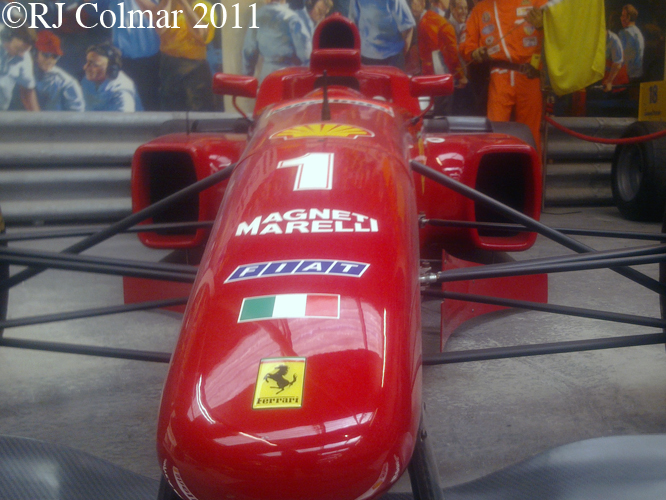
Ferrari F310, Haynes IMM

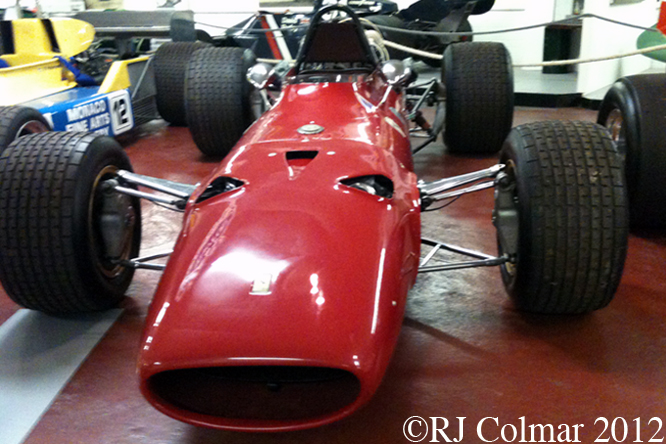
The original version of the F310 featured the only low nose in the field …
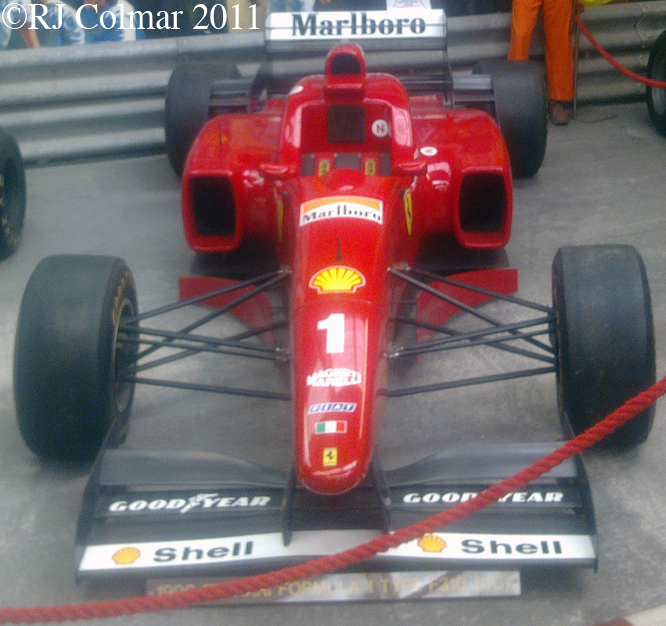
Ferrari F310, Haynes IMM

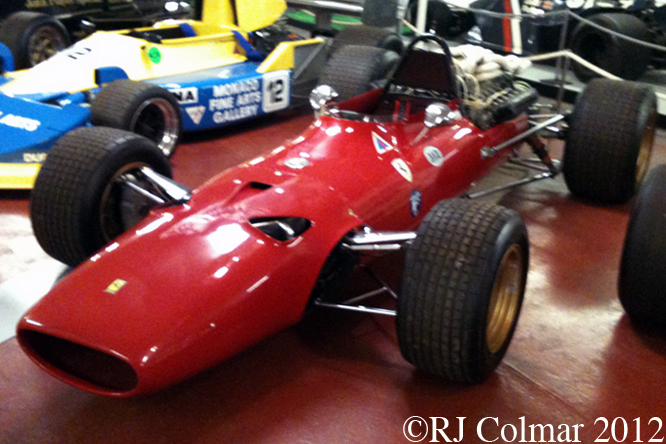
but by the half way mark a high nose as pioneered by Dr Harvey Postlethwaite and Jean-Claude Migeot at Tyrrell in 1990 was permanently adopted by the Ferrari Team in order to maximize the use of airflow beneath the car to the advantage of the cars handling. It is curious that Jean-Claude Migeot did not introduce the feature during his spell at Ferrari in 1992.
Ferrari F310, Haynes IMM

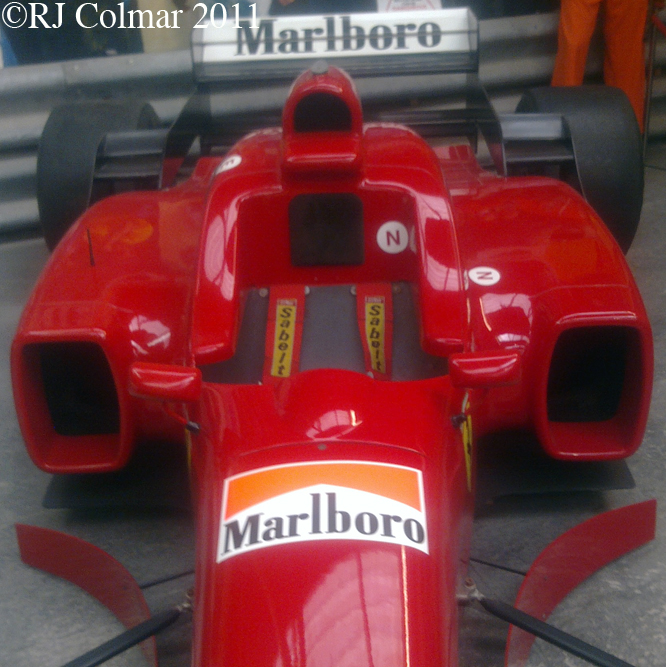
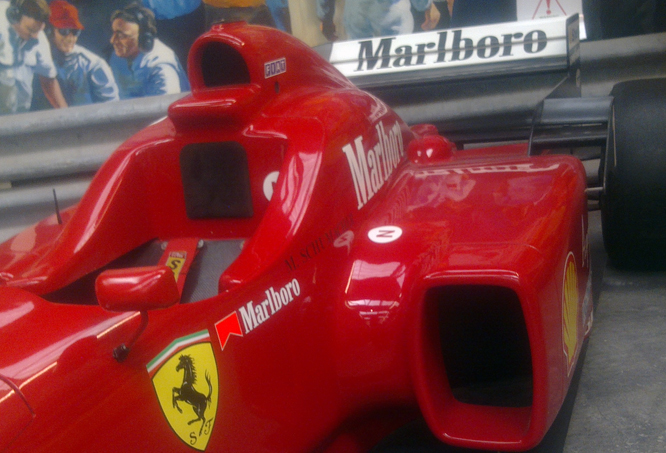
The design if the F310’s side pods with a separate…

Ferrari F310, Haynes IMM

‘floor’ beneath harks back to the Ferrari F92A a design that proved so recalcitrant that it led to designers Jean-Claude Migeot and Steve Nichols replacement by John Barnard !
Ferrari F310, Haynes IMM

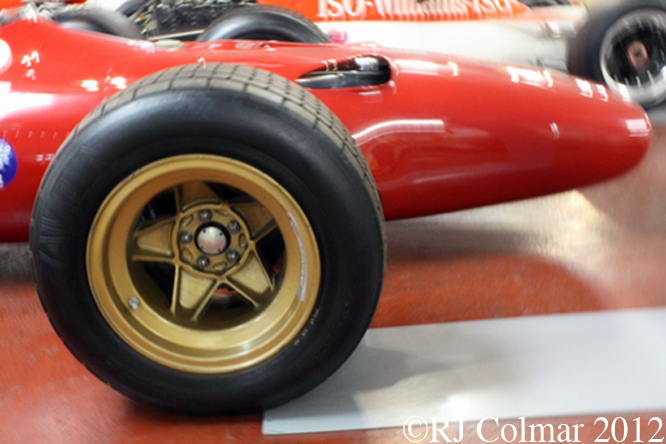
The F310 was the first Ferrari to feature a 3 litre / 183 cui V10 motor, although this static show car seen at the Haynes International Motor Museum probably does not even have a mock engine, again following pioneers Renault and Honda who had opted for this unusual yet successful layout in 1989. Reliability was an issue for these V10 motors though that did not stop Micheal winning 3 races in 1996 and challenging, albeit controversially, for the championship with the F310B in 1997.

Thanks for joining me on this ‘Static Show Car’ edition of ‘Gettin’ a li’l psycho on tyres’ I hope you will join me again tomorrow when I’ll be looking at a Lotus 41. Don’t forget to come back now !

Share

Kiwi Adventures – Ferrari 246 #0007

A couple of weeks ago at Race Retro I caught up with the last front engined car to win a Grand Prix again. This car was originally given the chassis number #0007 and driven by Wolfgang von Trips, Oliver Gendebien, and Phil Hill in 1958 recording just one 5th place finish in Portugal with ‘Taffy’ von Trips at the wheel.

Ferrari 246, Race Retro

The following season it driven by Dan Gurney in 4 Grand Prix recording a best finish of 2nd on aggregate at Avus in the 1959 German Grand Prix.

Ferrari 246, Race Retro

In 1960 #0007 was wheeled out for Phil Hill again for five more Grand Prix appearing for the last time at the Italian Grand Prix which Phil Hill won, in a clean sweep of the podium for the Italian marque, ahead of Richie Ginther and the Belgian Willy Marisse who was a lap down.

Ferrari 246, Race Retro

The significance of the win the last ever in a championship Grand Prix recorded by a car with the engine in the front was a matter of complete indifference to Ferrari as evidenced by the fact that before the year was out the trusty 2.5 litre Dino V6 motor had been swapped for V12 250 TR motor by the factory. The whole car, renumbered at Maranello as chassis #0788, had been entrusted to New Zealander Pat Hoare who won in 1961 at Waimate and the 1962 New Zealand Gold Star Championship with it.

Ferrari 246, Race Retro

After the car proved no longer competitive and Pat Hoare had retired from racing Pat converted the single seater into a closed two seat GTO coupé replica which can be seen in this link.

Ferrari 246, Race Retro

The car was acquired by respected historic racer Neil Corner in 1978 and restored to it’s V12 open wheel chassis spec.

Ferrari 246, Race Retro

Today the car is owned and rock manager Tony Smith, who had a had a replica Dino V6 motor installed, raced #0007 at Goodwood Revival last year when I first saw it.

14/05/12 Ammended to read ‘and restored to it’s V12 open wheel chassis spec’ and ‘, who had a replica V6 motor installed, in the light of Charles Hollands comments below.

Share

Losing Momentum – Ferrari 126C3 #066

Entering the final two races of the 1983 World Championshp season Alain Prost driving for Renault had 51 points, René Arnoux seen here in the #28 Ferrari had 49 points and Nelson Piquet driving for Brabham had 47 points. Of the three René had all the momentum with him coming off a four race streak which included 2 wins in Germany and Holland driving chassis #066 seen here and 2nd places in Austria and Italy.

Ferrari 126 C3, European Grand Prix, Brands Hatch

At the European Grand Prix held at Brands Hatch Piquet qualified 4th, Arnoux, seen during qualifying above and below, 5th and Prost 8th. The race was won by Piquet now with 56 points, Prost came home 2nd bringing his total to 57 points while René failed to score with a 9th place finish. At the final race of the season Piquet secured his second championship with a third place finish while Prost and Arnoux both lost all momentum and recorded retirements.

Ferrari 126 C3, European Grand Prix, Brands Hatch

Ferrari easily won the constructors championship thanks largely to the woe full finishing record the 2nd drivers employed by Renault and Brabham who both scored more retirements than finishes through the course of the season while Ferrari’s nominal number 1 driver Patrick Tambay managed to win one race and secure 8 points paying finishes.

My memory of this event was that I started the week sunning myself by the Tyrrhenian Sea south of Naples in Italy and hitched hiked back to the UK via Wolfsburg in Northern Germany. I caught a train for the last part of the journey to Belgium which broke down meaning I missed my pre booked ferry and had to borrow the ferry fare from an incredibly cute girl from Nottingham. The ferry we caught was then trapped in a storm and instead of crossing the English channel it anchored off the Belgium coast until the storm blew itself out.

I made it back to the UK just in time to catch a nights rest before spending 6 hours in a 20 mile traffic jam trying to get into Brands Hatch, missing morning practice completely but just catching the last half hour of the final practice session when I took today’s photographs.

Thanks for joining me on this ‘Losing Momentum

Share

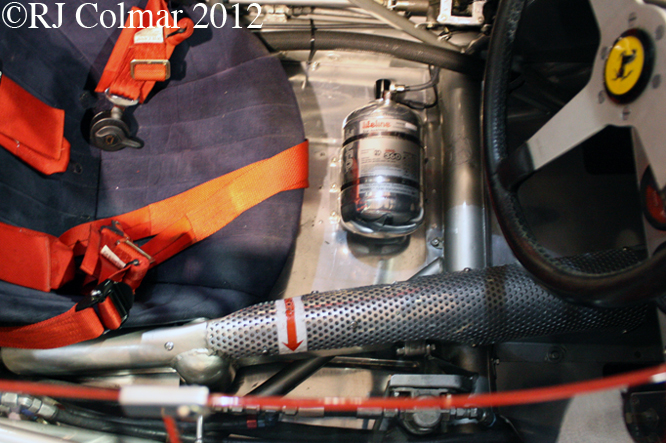
Just What the Doctor Ordered – Ferrari 126 C2 #061 & #060

Ferrari’s first attempt at designing a turbo powered Grand Prix car was described by lead driver Gilles Villeneuve in 1981 as handling like ‘a big red Cadillac‘.

Ferrari 126 C2, Brands Hatch

For the 1982 Ferrari hired Dr Harvey Poslethwaite, who had designed Grand Prix winning cars for both Hesketh and Wolf, to design the 126 C2 which would prove to be the class of the field or as Mario Andretti described it ‘the bomb’.

Ferrari 126 C2, Brands Hatch

Despite a lack luster start to the 1982 season for round 4 the San Remo Grand Prix Ferrari had got their act together and cruised to a comfortable One Two victory except for team leader Gilles Villeneuve there was a problem, he had been out fumbled by his team mate Didier Pironi which so enraged the Canadian he promised never to speak to Pironi again.

Ferrari 126 C2, Brands Hatch

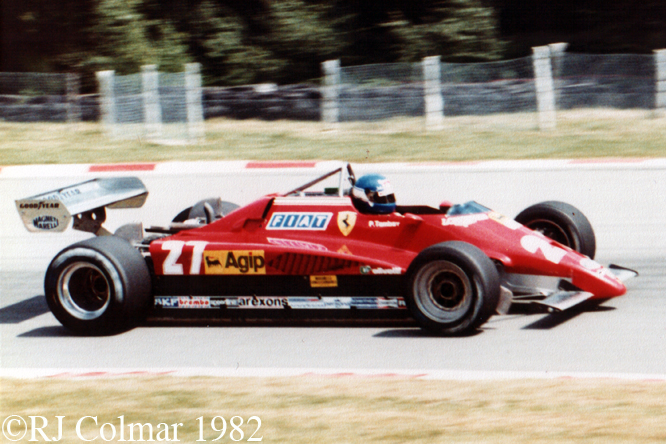
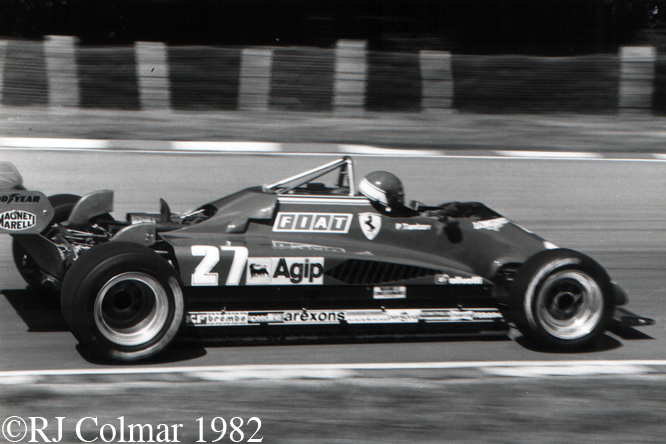
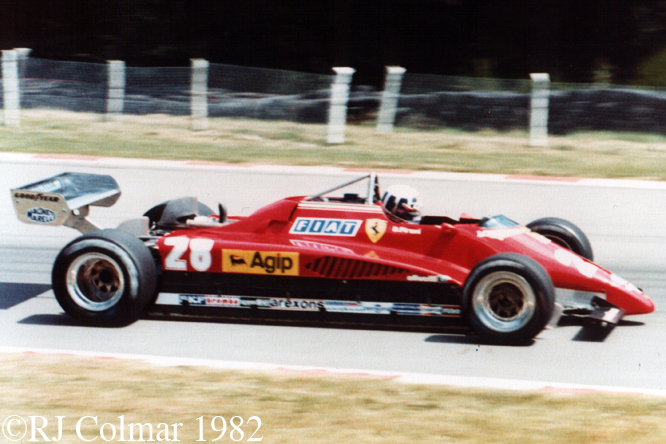
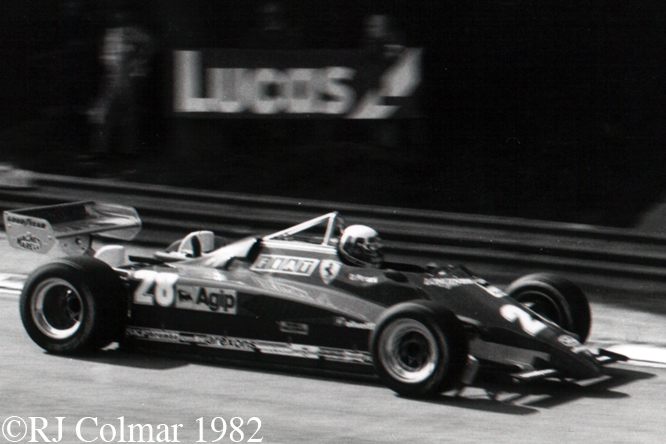
Two weeks later at the Belgium Grand Prix Gilles met his death after a practice accident, seemingly leaving Pironi seen in the #28 chassis #060 at Brands Hatch above, to win the 1982 Championship but then three weeks after these photographs were taken Didier Pironi was seriously injured an accident during practice for the German Grand Prix in chassis #060. Didier although eventually recovering never entered a Grand Prix car again and died in power boat racing accident in 1986.

Ferrari 126 C2, Brands Hatch

Patrick Tambay, seen in the #27 chassis 061 at Brands Hatch at the top of this post, took the place of Gilles for the remainder of the 1982 season wining the 1982 German Grand Prix. While Mario Andretti replaced Didier Pironi scoring a pole position and and third place first time out at Monza and ended his Grand Prix career at Caesers Palace with a retirement driving the chassis #061 seen in Tambay’s hands above.

Ferrari with three wins won the constructors championship from McLaren who had 4 wins but appalling reliability in between. The World Drivers Championship was won by Keke Rosberg driving a non turbocharged Williams Cosworth against all expectations with just a single win and a string of podium (top three) finishes.

Thanks for joining me on this ‘Just What The Doctor Ordered’ edition of ‘Gettin’ a li’l psycho on tyres’, I hope you will join me again tomorrow. Don’t forget to come back now !
Share

On Luck – Ferrari 312 #0007

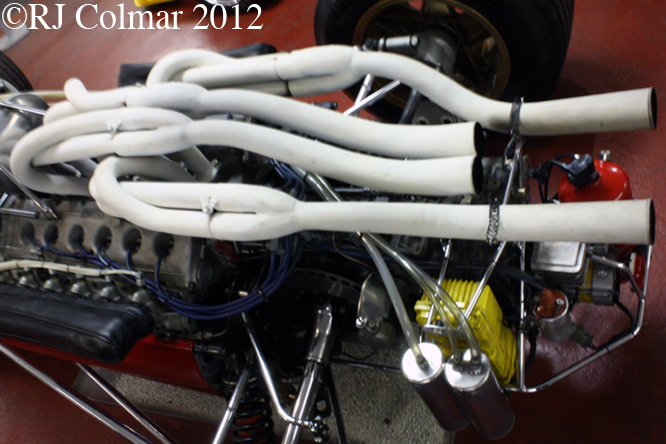
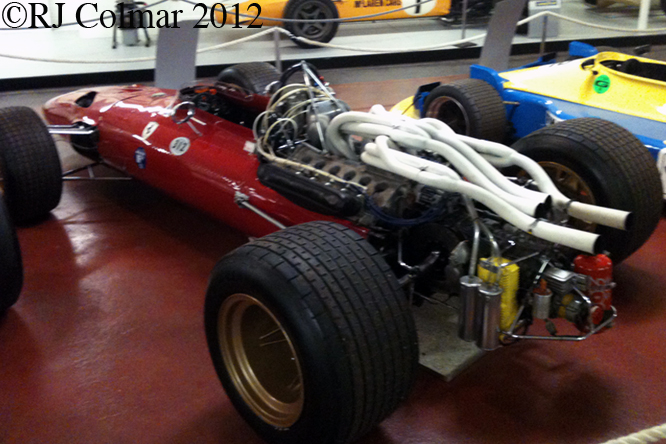
With the introduction of the 3 litre / 183 cui Formula One regulations in 1966 Ferrari not only found themselves unprepared they were also desperately underfunded in part due to Enzo’s withdrawal from a deal with Ford and in part because Ferrari had to spend a lot of money on his sports car programme to try in vane to stop a Ford steamroller from whipping him off the Le Mans scoreboard.

Ferrari 312/67, Donington Grand Prix Collection

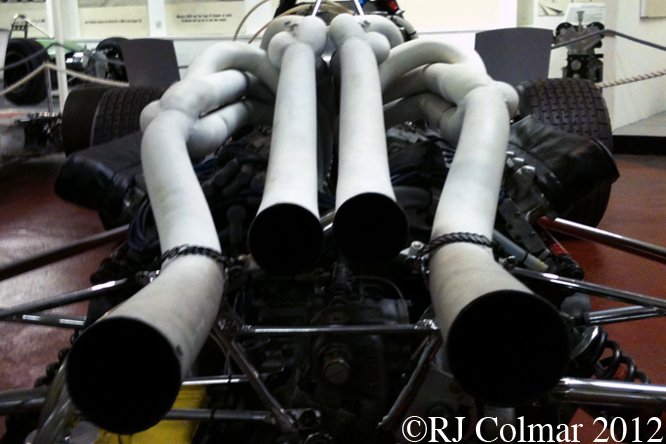
In order to maintain a presence in Formula One under the new 3 litre rules a 24 valve 3.3 litre 201 cui V12 design from the Ferrari 275P2 sports car programme was modified to the meet lower 3 litre / 183 cui engine capacity regulations and installed into the first of a long line of Grand Prix Ferrari’s designed by Mauro Forghieri.

Ferrari 312/67, Donington Grand Prix Collection

Despite the heavy old sports car engine in the back Ferrari were one of the few teams to have an engine of the correct size when the 1966 season got under way many teams were giving away between 45 cui and 90 cui in engine capacity just to make the grid.

Ferrari 312/67, Donington Grand Prix Collection

1964 World Champion John Surtees started and 1966 as Ferrari’s team leader but he fell out with Ferrari’s management after winning the Belgian Grand Prix and before starting the Le Mans 24 hours, however Ferrari still finished the season a respectable 2nd in the Constructors Championship thanks to a win in Italy and a couple of second place finishes, beating John Surtees new Cooper Maserati team by a single point despite missing a couple of races.

Ferrari 312/67, Donington Grand Prix Collection

For 1967 the 1966 cars were improved and chassis 0007, seen here recently at the Donington Grand Prix collection, was the last of 4 new Grand Prix cars Ferrari built in 1967, Chris Amon was hired to drive alongside Lorenzo Bandini, at Monaco Bandini qualified 2nd but an fiery accident during the race proved fatal and Chris Amon could only manage a string of four seasons best 3rd place finishes on the way to fifth in the championship for himself and his team, before taking over chassis #0007 towards the end of the season.

Ferrari 312/67, Donington Grand Prix Collection

In 1968 0007 was used again by Chris Amon and he won pole positions in Belgium and Holland with it but the season was a disaster for the driver who only succeeded in cementing his reputation as the unluckiest driver in Grand Prix racing with a seasons best 2nd place finish, in a newer ’68 spec 312, and a string of 7 retirements from 11 starts.

Ferrari 312/67, Donington Grand Prix Collection

1966 Le Mans winner, with Bruce McLaren in a Ford, Chris Amon never did win a Grand Prix despite starting 5 of his 108 Grand Prix from pole position, he has always maintained that he was lucky simply to have survived what is generally considered to have been the most dangerous period in racing, a point starkly backed up by the stat that 8 of the 24 starters in the 1963 Belgian Grand Prix where Chris made his debut did not see out the decade thanks to accidents at the wheel of racing cars.

Ferrari 312/67, Donington Grand Prix Collection

The last person to drive 0007 in period was future sports car giant Derek Bell who started the non Championship Gold Cup and championship United States Grand Prix in this chassis but did not finish either event.

Thanks for joining me on the ‘On Luck’ edition of ‘Gettin’ a li’l psycho on tyres’, I hope you will join me again tomorrow. Don’t forget to come back now !

Share

Annus Horribilis – Ferrari 312 T5 #044 & #045

After winning the 1979 World Championship with the cobbled to together Ferrari T4 I looked at last week Ferrari made a decision to change direction, in view of the fact that the recently discovered ground effects which manipulated air passing under the car to create aerodynamic down force with little cost in favored vehicles with narrow motors. During the 1979 season Ferrari had run with the 180 degree V12 the widest motor in the field and were also running the only transverse gearbox which further compromised the aerodynamics.

Ferrari T5, Brands Hatch

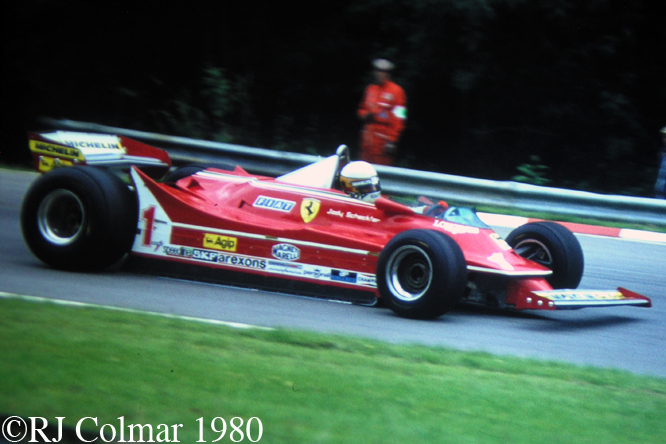
Ferrari took the decision to build a V6 turbocharged motor but it would not be ready until the 1981 season so in the interim they scaled down the bodywork of the Ferrari T5 in order to try and improve straight line speed which had been lacking in the T4 and also made a narrower version of the 180 degree V12 which had dire consequences on hitherto rock solid reliability. Jody Scheckter, who by his own admission had already achieved his goal in 1979 and decided to retire at the end of 1980 had a simply dire year trying to defend his championship scoring just two points in Long Beach and failing to even qualify for his last but one Grand Prix in Canada completely.

Ferrari T5, Brands Hatch

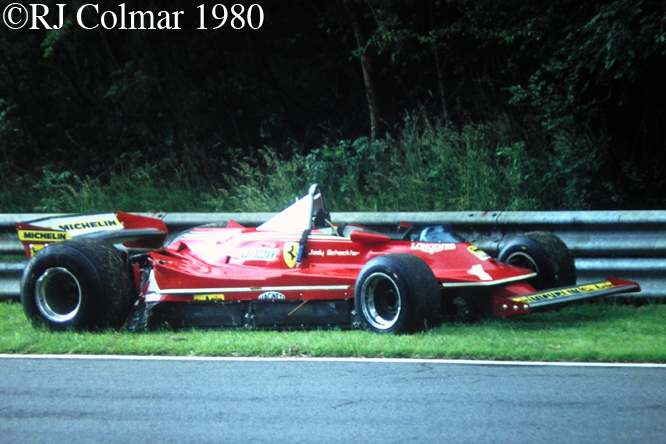
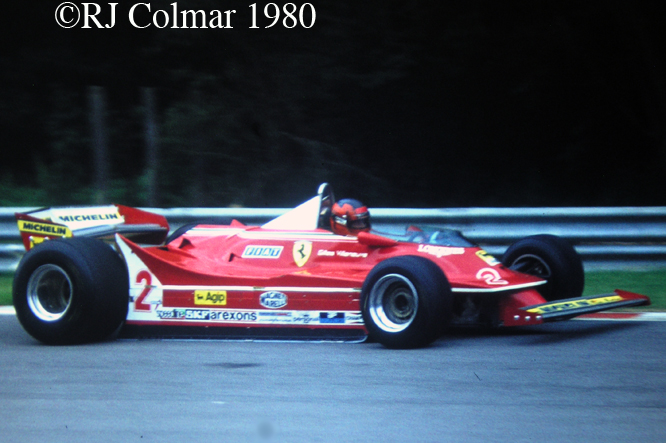
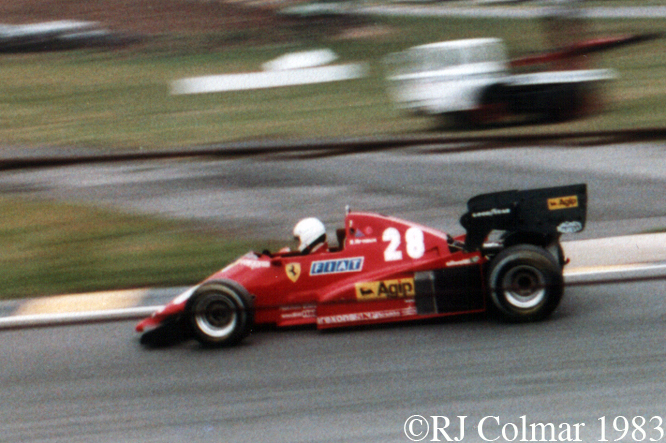
The #1 seen in both photo’s above during practice for the 1980 British Grand Prix is chassis #044 which was mostly taken to races as a spare car in the 1980 season both Jody Scheckter and Gilles Villeneuve raced the car with Gilles scoring the chassis best finish a 5th place in Canada.

Ferrari T5, Brands Hatch

Gilles Villeneuve managed to score a total of six points in 1980, the eight points total scored by Ferrari equaled a tenth place finish in the Championship, an all time low scoring only on point more in 14 races than in the 11 race in 1969 season when they finished 6th in the championship. The chassis above is #045 in which Gilles scored a best 5th place in Monaco and a further 6th place in Belgium. At the 1980 Canadian GP Gilles Villeneuve took the first attempt to start in #045 above but was involved in a first corner meleé which eliminated seven cars from the race. He then jumped in to chassis #044, which Jody crashed at during practice for the British Grand Prix, see middle photo and came home 5th.

Thanks for joining me on the ‘Annus Horribilis’ edition of ‘Gettin’ a li’l psycho on tyres’, I hope you will join me again tomorrow. Don’t forget to come back now !
Share

Driving For Italy – Ferrari 312 T4 #040 & #038

The 1979 season was one of two halves in the first half the french Ligier team came out of nowhere with a fast car that took three wins from the first five races, Ferrari then muscled in with four race wins from five races and Renault scored what would turn out to be a one off win at the half way mark and the second half of the season was dominated by the Williams team who scored 5 wins in the last seven races with the Ferrari drivers Jody Scheckter and Gilles Villeneuve picking up the pieces and each scoring a win. Jody through his better consistency beat Gilles to the 1979 World Championship.

Ferrari T4, Race Retro

The car that Jody and Gilles used in 1979 was the Ferrari 312 T4 an improvised ground effect design by Mauro Forghieri that was compromised by the powerful 180 degree 3 litre / 183 cui V12 motor that got in the way of the under body aerodynamics that were an essential element for giving the car improved aerodynamic grip and cornering adhesion.

Ferrari T4, Race Retro

By their own admission early season runaway leaders Ligier had no idea why their car was working so well in Argentina and Brazil, and when a slight change was made to the material specifications of their ground effects design they had no idea why it continued to work so badly. Meantime Ferrari had just the right balance of mechanical power and reliability coupled with just enough aerodynamic grip to capitalize on Ligiers misfortune and first Gilles, in South Africa then Long Beach and then Jody, in Belgium then Monaco, took two wins a peace interrupted by third and final win for the Ligier driven by Patrick Depailler in Spain.

Ferrari T4, Race Retro

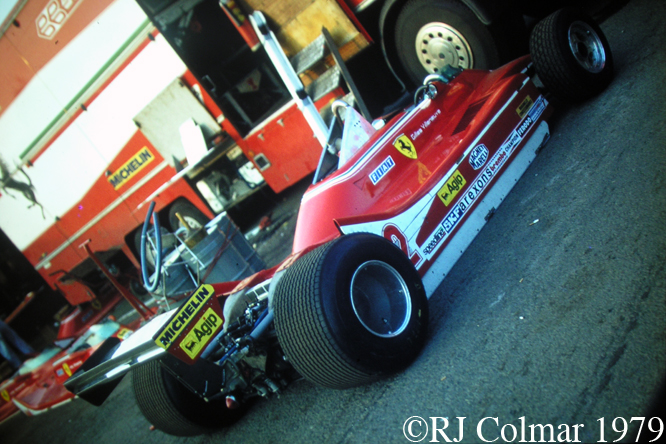
During the second half of the season Frank Williams team after many seasons operating out of a GPO telephone box on a shoe string budget finally juggled all the balls in the right order and came up trumps with a clean design that once it had become reliable was the class of the field for the second half of 1979 with five wins from seven races in Britain, Germany, Austria, Holland & Canada . Only Jody and Gilles spoiled the Williams party Scheckter securing the drivers championship with a win in Italy to become the first, and so far only South African Drivers World Champion. Jody, who once observed that when he was racing for Ferrari he was driving for Italy, took all three of his championship wins driving chassis #040 seen above at last years Race Retro.

Ferrari T4, Silverstone

Gilles Villeneuve came second in the 1979 championship his season being primarily remembered for one of the all time great dices in the history of Grand Prix when he pulled off an amazing second place finish racing wheel to wheel over several laps with third place Rene Arnoux in the French GP at Dijon.

Gilles chassis #038 seen above in the pits at Silverstone, where the Ferrari’s were uncharacteristically completely out classed, is known to have been driven to second place finishes by Scheckter in South Africa and Long Beach and a third second pace finish with Villeneuve at the wheel in the 1979 Italian GP.

It would be 21 long years before another Ferrari driver would win a World Championship though as we shall see in the coming weeks Ferrari did manage to win a couple of constructors championships in the 1980’s.

If your into organic food Jody Scheckter today runs an organic farm produce from which can be ordered from www.laverstokepark.co.uk

Thanks for joining me on this ‘Driving for Italy’ edition of ‘Gettin’ a li’l psycho on tyres’

Share