Tag Archives: Ferrari

Monterey Classic Meets Woodstock – Silverstone Classic 2011

Berliet, Silverstone Classic PD

A couple of weeks ago I was looking around Silverstone regarding a film project while several teams representing over 100 years of the automobile history were fettling their vehicles for the forth comingSilverstone Classic 2011 meeting which runs from July 22nd to 24th.

Chevrolet AK Pick Up, Silverstone Classic PD

If your into powered transport be it steam, diesel, petrol, 2 wheeled, 3 wheeled, 4 wheeled or more you will probably find something of interest during the day and if your camping there will be 2 nights of music headlined by the likes of tribute bands Legend, Queen On Fire and The Rolling Stoned on the first night, followed by Suzy Quattro, 10cc, Wishbone Ash on the second night topped off with an afternoon of classical music from Tetra Electra, Tenors Unlimited and the 40 strong Amadeus Orchestra.

Ferrari 512M, Silverstone Classic PD

What has really helped this event grow in stature is the participation of numerous owners clubs, the Jaguar Owners clubs have chosen this event to officially celebrate the 50th Anniversary of the E-Type and hope to gather over 1,000 of the 70,000 plus E -types built together at the same time, a race for E-types will be held with 58 entries.

Ford Galaxie 500XL, Silverstone Classic PD

Other marques including Porsche who also intend to gather in similar numbers, with smaller marques like Bristol being represented by the Bristol Owners Club.

Hesketh 308B, Silverstone Classic PD

Silverstone Auctions the event sponsors will be holding an auction at the Silverstone Classic on July 23rd that will include the sale of the last truely privately built and entered Formula One Car to win a Grand Prix.
HWM Jaguar, Silverstone Classic PD

For those less inclined to the racing which will include classic saloons, sports cars and Grand Prix cars there will be a fun fair, arial displays and gathering of steam powered traction engines to keep you entertained during the daylight hours while you wait for the music to start.

My thanks to Jonathon Gill who facilitated this fascinating day at Silverstone, I look forward to visiting the event in July and sharing more details of some of the vehicles I saw during preparations for it in the weeks ahead.

Thanks for joining me on this Silverstone Classic edition of ‘Gettin’ a lil’ psycho on tyres’, I hope you will join me again tomorrow when I’ll be sharing some photos of a fascinating workshop in Warrington. Don’t forget to come back now !

Share

The Pawn – Ferrari 637

Ever since Renault turned up on the grid of the British Grand Prix in 1977 with a 1500cc / 91.5 CUI the stability and hegemony that had been born out of the 500hp 3 litre / 183 cui Ford sponsored Cosworth V8 as the dominant force in Grand Prix racing in 1966 had been under attack. By 1985 power output of the little turbocharged motors had risen from 525 hp in 1977 to 1200 hp in qualifying trim, expensive motors were being built simply to last a couple of qualifying laps a situation that could not last indefinitely.

To get a grip on the situation for 1987 the FIA the ruling body of Grand Prix racing mandated a limit of 4 bar / 58 psi on turbochargers which was reduced for 1988 to just 2.5 bar / 36 psi in 1988 when 3.5 litre / 213.5 cui normally aspirated motors would be allowed to take part in preparation for a completely normally aspirated formula 3.5 litre formula in 1989.

These normally aspirated motors were originally intended to be of a mandated V8 configuration, and this detail upset Enzo Ferrari, who wanted to build a V12 for the new regulations, so badly that he set in motion the design of the Ferrari 637 to compete in the Indianapolis 500.

Consultation with Goodyear led to the leading Truesports team and their March 85C complete with driver Bobby Rahal conducting tests in Italy with Ferrari Grand Prix driver Michele Alboreto.

Ferrari 637

Photographer Unknown image will be credited or removed upon request.

After the tests Ferrari took the March apart and with the lessons learned Gustav Brunner designed this pretty Championship racing car seen here with Michele Alboreto at the wheel.

Unlike the still born Lotus 96 which was built entirely out of carbon fibre for Al Unser Jnr to drive for Winkleman racing in 1985, the Ferrari 637’s monocoque was manufactured from a carbon fibre lower half and a conventional aluminium top half.

Between the announcement of the Ferrari Indycar project and its first tests the FIA relented and removed the stipulated V8 configuration for the 1989 Formula One regulations.

In consequence Ferrari built a mildly successful V12 engine which was completely usurped by the V10 engines of first Honda, Renault and Ilmor Mercedes which won most of the drivers and constructors Championships from 1989 to 2000 interrupted ironically only by the Ford V8 which Michael Schumacher used in his Benetton to win his first World Drivers Championship in 1994.

In 1989 Alfa Romeo part of the same FIAT automotive empire as Ferrari announced it’s own still born Indy Car programme with an engine designed completely from scratch, unrelated to the Ferrari engine tested in 1986, which was fitted to a proprietary March chassis. At the press launch of the programme journalist Doug Nye spotted an all white vehicle that was clearly not a March chassis with an ALFA Romeo logo on it that nobody from ALFA Romeo was prepared to talk about, it turns out that ALFA may have considered using the chassis of the Ferrari 637 as a test hack for their new motor.

Thanks for joining me for this Ferrari Friday edition of ‘Gettin’ a lil’ psycho on tyres’, I hope you will join me again tomorrow for AJ Foyt Day tomorrow. Don’t forget to come back now !

Share

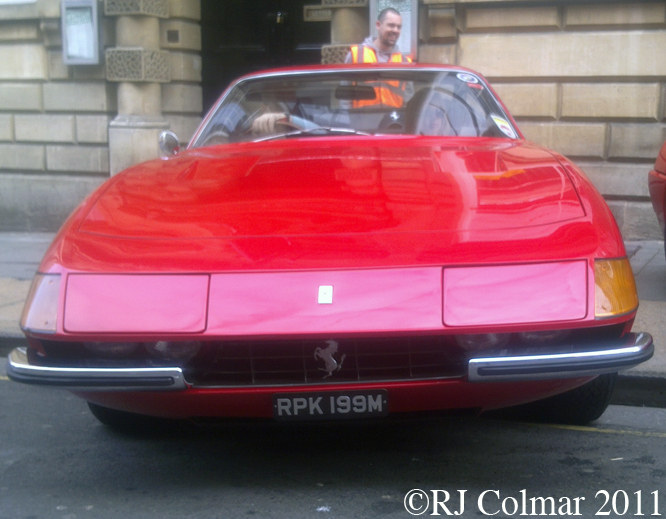
Outlaw Racer – Ferrari 365 GTB/4

01 Image3178sc

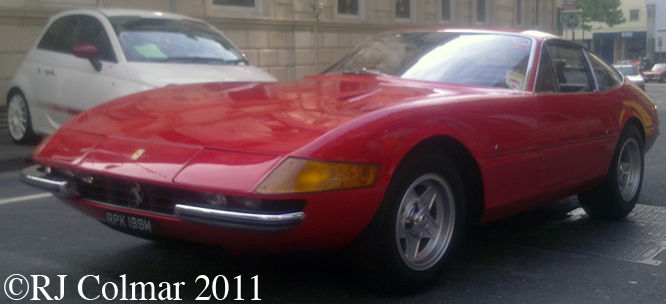
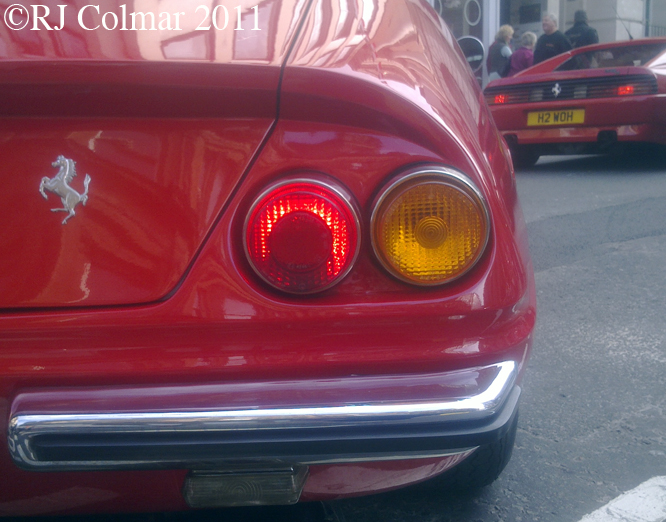
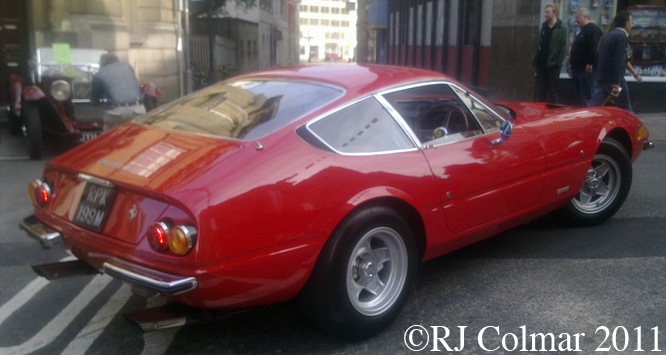
Launched in 1968 the Ferrari 365 GTB/4 replaced the Ferrari 275 GTB/4 and to this writers mind represents the pinnacle of front engine rear wheel drive fastback GT cars. Until outlawed by US legislation in 1971 the 365 GTB/4 came with headlights mounted behind acrylic glass covers.

02 Image3126sc

This most stylish of vehicles is powered by a 347 hp Lamperdi inspired twin overhead cam 60º V12 stretched to 4390 cc / 268 cui motor, each cylinder with a volume of 365 cc from which the model gets its name.

03 Image3128sc

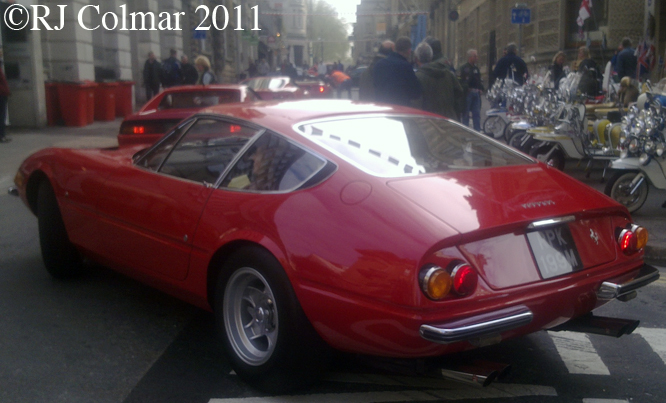
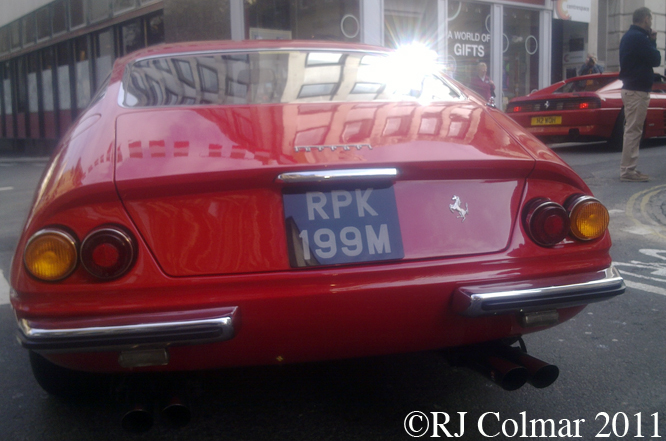
To optimise the weight balance and handling the gearbox is mounted as part of a transaxle just in front of the rear wheels.

04 Image3127sc

As one would of expect of a vehicle this cool to look at it has performance to match being capable of reaching 60 mph from rest in 5.4 seconds with a top speed of 174 mph.

05 Image3129sc

Competition versions of the 365 GTB/4 run by privateers with up to 450 hp counted amongst their successes a GT class winning 5th overall at Le Mans in 1971 along with GT Class wins in the same race in ’72, ’73, and ’74 scoring 1st to 5th in class in ’72, and five years after production of the model had ceased an amazing 2nd overall in the Daytona 24 hour race.

Dan Gurney and Brock Yates also drove a 365 GTB/4 2,876 miles from New York to Los Angeles averaging 80.1 mph to win the inaugural Cannonball Baker Sea-To-Shining-Sea Memorial Trophy Dash in 1971.

06 Image3130sc

It is thought just 1,406 of these cars designed by Leonardo Fiorvanti of Pininfarina and built by Scaglietti including 122 Spiders and 15 lightweight competition vehicles. The high desirability of the rare Spiders has led to several Berlinetta models being converted and several companies have made Spider replicas with a variety of engines.

The 365GTB/4 was replaced by the rear engined 365 GT4 Berlinetta Boxer.

I hope you have enjoyed today’s Outlaw Racer edition of ‘Gettin’ a lil’ psycho on tyres’ and that you will join me again tomorrow. Don’t forget to come back now !

Share

A Big Red Cadillac – Ferrari 126 CK

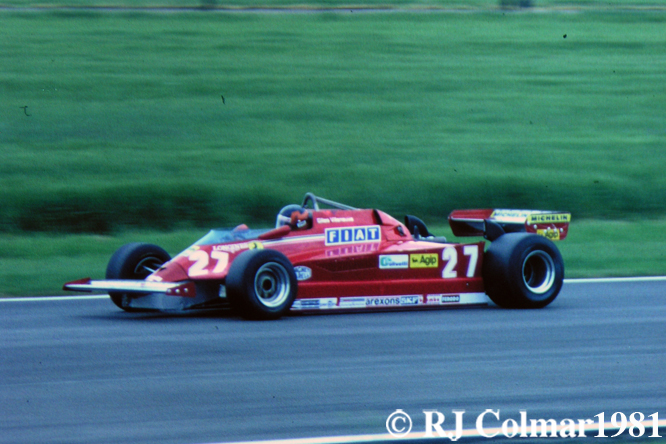
Taking a one day break from GALPOT’s Indy 500 celebrations, for Ferrari Friday today we are celebrating the life of Gilles Villeneuve, father of 1995 Indy 500 winner and 1998 World Champion Jaques Villeneuve, and Gilles Ferrari 126 CK seen here during practice for the 1981 British GP at Silverstone.

81 07 17 #27 126 CK 054 01sc

The Ferrari 126 CK was a development of Ferrari’s first turbocharged Grand Prix car which was launched in 1980. Featuring a fire breathing 600 hp 1,496 cc / 91 cui 120º V6 twin turbo charged motor and six speed gearbox Villeneuve described this car as a ‘big red Cadillac’ because the chronic turbo lag, ferocious power curve combined with ground effect aerodynamics made this car a real handful to keep under control.

Despite it’s wayward characteristics Gilles pulled off two of the most entertaining victories this writer has ever seen on TV, the first at Monaco (apologies commentary in German) came after Champion elect Nelson Piquet spun off after leading for 51 laps and reigning Champion Alan Jones experienced a fuel feed problem which allowed Gilles to steal a late victory on the one circuit least suited to his cars few strengths.

Two weeks later Gilles pulled off an even more unlikely victory at the equally tight and unsuited Jarama Circuit this time Villeneuve took the lead after 14 laps when reigning Champion Jones spun off. Gilles kept a four car train behind him for the rest of this exciting race by using the Ferrari’s brutal power on the straights to pull away out of the corners, going round the corners his pursuers bunched up time after time but did not have the brute strength to get an edge on the straights.

The finish of the 1981 Spanish Grand Prix was one of the closest in history with the first five cars being separated by 1.24 seconds. Sadly this would be the last time Gilles would take the checkered flag.

By the time Ferrari arrived in Britain they were developing a way to minimise turbo lag by injecting fuel into the red hot turbo exhaust pipe when the throttle was off, as the fuel ignited in the turbo exhaust pipe the pressure difference created between the burning fuel in the exhaust and the turbine wheel mounted upstream caused the turbine wheel to spin faster which in turn increased the turbo boost to the motor so that when the throttle was depressed more power was readily available. In this form whenever the 126 CK was off throttle a lick of flame would appear out of the exhausts.

At some point this system was banned, it being successfully argued by teams using naturally aspirated motors that the turbo afterburner constituted a second engine, when the rules clearly stated only one motor was allowed.

At the British Grand Prix, apologies Austrian commnetary, Gilles qualified 8th and made up five places on the opening lap before loosing it on the apex of the last corner of the first lap. Notice in the clip that despite his totaled car Gilles somehow manages to squeeze another 1/4 lap out of the car before retiring, this guy just did not know how to stop when the chips were down.

Another memorable performance that emphasised Gilles never say die attitude came at the 1981 Canadian Grand Prix where despite his damaged front wing obscuring his vision and adversely affecting the already poor handing of his Ferrari for numerous laps, Gilles kept his car on the black stuff to record an amazing third place finish.

Gilles was killed in an accident during practice for the Belgian Grand Prix, May 8th 1982

Salute Gilles RIP.

Hope you will join me for another edition of ‘Gettin’ a lil’ psycho on tyres’ tomorrow. Don’t forget to come back now !

Share

Grant Piston Ring Special – Ferrari 375 No: 2

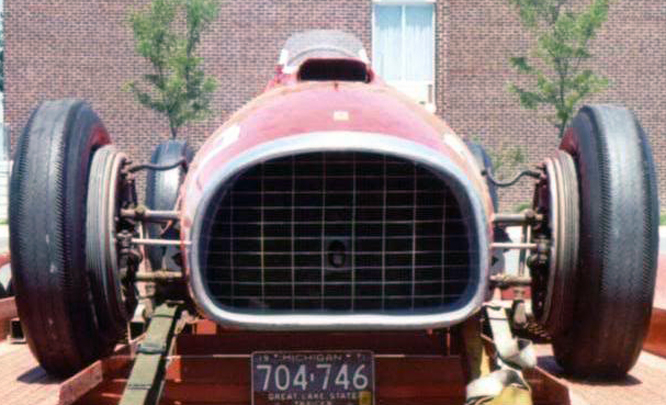
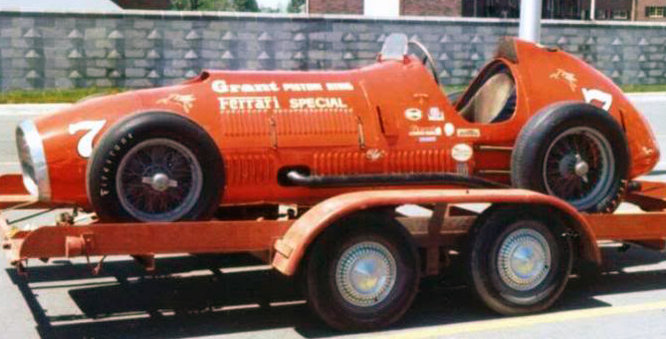
For Ferrari Friday I hope readers of my Indianapolis series will forgive me getting a little out of sequence by a year or two in order to present the 1952 Grant Piston Ring Special, a Ferrari 375 captured in these photographs by my Nostalgia Forum acquaintance B² from Indiana who saw this vehicle in a Holiday Inn car park Dearborn, MI around 1971.
Ferrari 375, Holiday Inn, Dearborn, MI

The Ferrari 375 was originally conceived as a Formula One car to take advantage of the normally aspirated engine regulations that allowed for engines up to 4.5 litres / 274.6 cui as opposed to the maximum 1.5 litres /91.5 cui maximum capacity allowed for supercharged engines.

The 375 evolved through three stages, the first stage was the 275 which featured a new Lampredi designed 3322cc / 202 cui V12 which made its debut in Jume 1950, in July 1950 the 340 made its debut with a longer wheel base de Dion rear suspension and a 4101cc / 240 cui version of the Lambredi V12.

Finally in September 1950 the 375 with a 335 hp 4493 cc / 274 cui made its debut at Monza, by 1951 Jose Froilan Gonzalez driving a 375 scored Ferrari’s first formula one Grand Prix victory in Britain to begin cementing Ferrari’s place in the top echelon of motor racing.

There were so few contenders in races run to formula one regulations that in 1952 and 1953 the World Drivers Championship was run to Formula 2, 2 litre / 122 cui regulations both won by Alberto Ascari driving a nine race winning streak for Ferrari, making the 375 essentially obsolete. When the World Championship returned to a championship for drivers of formula one regulations the maximum mandated 2.5 litre 152 cui normally aspirated engines and the large Lamperdi V12’s were consigned to being
used in sports cars only.
Ferrari 375, Holiday Inn, Dearborn, MI

With the Ferrari 375 being obsolete in the top echelon of European racing allegedly US importer Luigi Chinetti convinced Enzo Ferrari to develop the car further with a stronger longer chassis.

Ferrari was represented at the 1952 ‘Indy 500’ by four cars 1 works and 3 customers, No: 1 ‘Ferrari Special’ for his works driver Alberto Ascari, No: 2 Grant Piston Ring Special for drivers Jonnie Parsons and Danny Oakes, No: 3 ‘Kennedy Tank Special’ for driver Johnny Mauro, and No: 4 ‘Mobil Special’ for driver Bobby Ball.

Outwardly the Ferraris appearance at Indianapolis in 1952 showed Ferrari lacking finesse preparing their cars for oval racing and that the ‘Yanks’ had little idea of how to coax the most out of what was essentially a beefed up road course car at Indianapolis.

However in his description of the 1952 race (scroll half way down), fuel injection manufacturer Stuart Hilborn shows that at the very least Ferraris disdain of many things American and his legendary machiavellian gamesmanship had come into play.

In brief Hilborn discovered that the #38 Mobil Specials cylinder head fuel inlet ports had been tampered with resulting in the ports being undersize, thus reducing the power output and it was found that the power output had been further reduced by Ferrari not fitting the high compression pistons which had been specified by Hilborn during a meeting at the Ferrari factory and presumably paid for owner Howard Keck ! (Note only one Ferrari qualified for the 1952 race not two as Hilborn asserts.)

The four 375’s were around 200 lbs over weight in part due to the drum brakes being too large and more suited to road course racing.

Despite these problems Ascari drove some of the smoothest and most consistent qualifying laps ever seen at Indianapolis, which unusually possibly due to incorrect gearing, included changing down a gear for both the first and third corners to secure 19th place on the grid.

Parsons in the second 375, even after trying magnesium wheels, opted for a more powerful Offy powered vehicle and well known midget racer Danny Oakes also failed to qualify the Grant Piston Ring Special.

Mauro allegedly really only wanted his 375 for the Pikes Peak hill climb and did not take the ‘500’ seriously and never got near a qualifying time, his car today resides in the IMS Hall of Fame now painted red.

Bobby Ball like Parsons also opted for an Offy powered machine after he had tried the forth car with Hilbourn fuel injection in place of the usual Weber carburetion. This car was restored in the 80’s destroying it’s original patina and is now thought to be in the care of a New York collector.

Ascari fancied his chances in the race switching, pre race, from a one stop strategy to a three stop strategy to accommodate higher than expected tyre wear. During the race Ascari planned to keep the revs low for the first two segments in order to benefit from the tendency of his US competitors ‘win or bust’ strategies.

Due to his weight handicap Ascari got a slow start but rose from 21st to 7th when on lap 41 the right rear wire wheel collapsed causing his instant retirement. Ascari is generally acknowledged to have given a good account of himself with a possible race contending performance up to the point of his retirement.

The No: 1 375 appeared at the 1953 ‘500’ with a 3 litre 183 cui engine, new body and side tanks but was withdrawn from the race. In 1954 it appeared again with original body and 4.5 litre 274 cui engine but failed to qualify. Ascaris 375 is currently thought to reside in Hong Kong.

Which brings us back to the car in the photograph which is thought to be the No.2 Grant Piston Ring Special unsuccessfully qualified by Parsons and Oakes,

This car was seen around 1970 on former owner Lindley Bothwell’s estate in 1970. By 1998 this 375 belonged to a Brazilian Carlos Monteverde who allowed Ludovic Lindsey to demonstrate it at Imola in Italy. During the demonstration the car suffered heavy broadside impact with a track side wall which wrote off two Borani wheels, smashed the respective brake drums, and destroyed the differential casing.
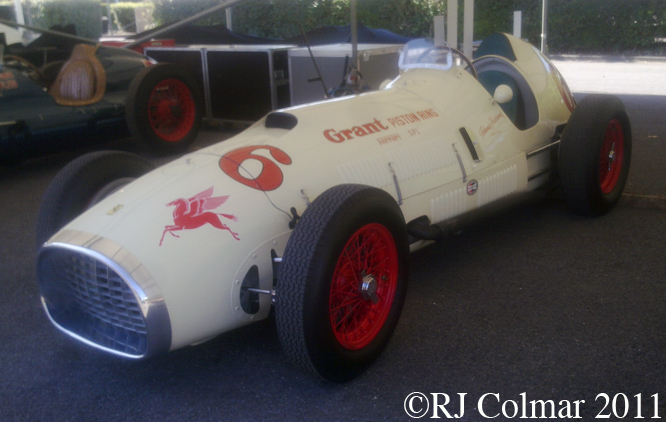
Ferrari 375, Goodwood, Festival of Speed

In August 2000 the No.2 375 now repaired was purchased by a Dutch owner and has been displayed in it’s white 1952 #6 Grant Piston Ring livery in the Netherlands at the Louwiman Museum and at festivals, above at Goodwood Festival of Speed in 2006, ever since.

My thanks to B² for todays photographs, and to everyone on the Ferrari 375 Indycar thread at Ferrari Chat for additional information.

There is some mystery alluding to the chameleon nature of the paint work of the Grant King Piston Ring website shows period photo’s of this car in white with cockpit wrap around screen with Johnny Parsons at the wheel and also a photo of Danny Oakes at the wheel of a red car with small screen,
if you know the correct sequence of colours and dates this car has appeared in, when it left the factory, ran in the hands of Parsons and Oakes and when it was returned to it’s current livery please do not hesitate to chime in below.

Hope you have enjoyed Ferrari Friday Indy Special edition of Gettin’ a lil’ psycho on tyres’ and that you’ll join me again tomorrow. Don’t forget to come back now !
Share

Grazin’ Arizona – Ferrari 166 MM #0052M

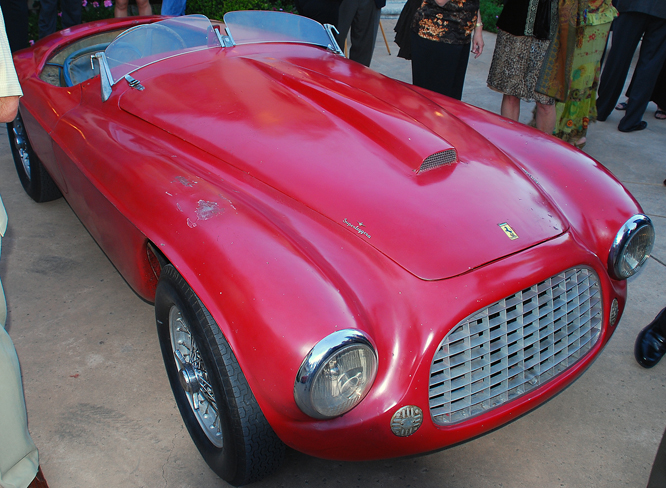
Thanks to more photographs from Geoffrey Horton today we are looking at possibly one of oldest and most original known Ferrari race cars, one which regular eagle eyed reader Racer 187 spotted in my blog last week on the Phil Hill XK120.

Ferrari 166 MM, Danville Cd'E

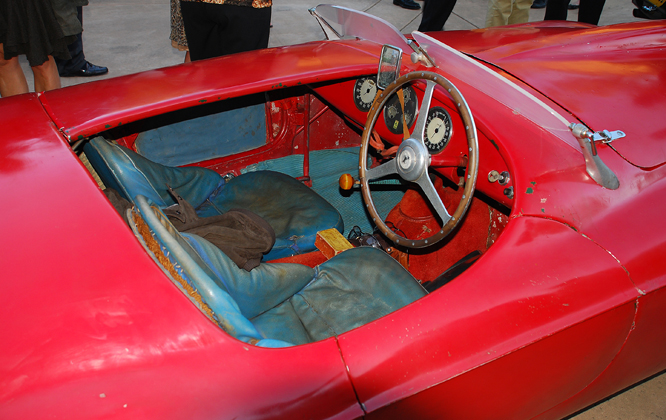
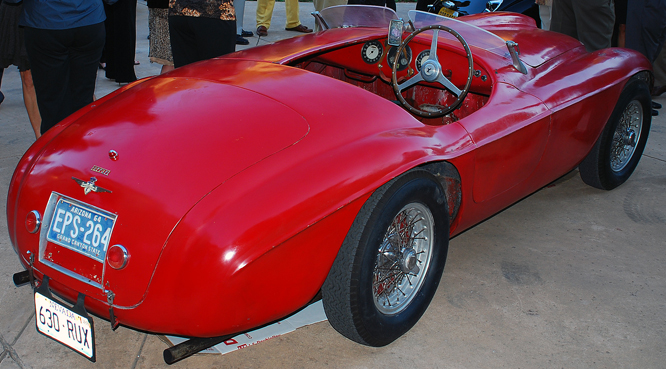
This is a Ferrari 166 MM chassis #0052M shown here at the 2007 Danville Concours d’Elegance some 3 years after it was credited as having been identified by Ferrari Expert Marcel Massini in Arizona in 2004 where, it had been grazing in a barn for forty five years.

An unusual right hand drive model this 166 MM appears to have been delivered to Chinetti & Plisson in Paris and originally purchased by the 1949 Le Mans 24 hour winner, who famously won aboard another 166 MM #0008M after driving for just 20 mins, Lord Selsdon. Selsdon, real name Peter Mitchell-Thomson, raced #0052 at Le Mans in 1950 with Jean Lucas, a race from which the car retired after accident damage.

The car then was turned over to Luigi Chinetti and Jean Lucas who won the Paris 12 hours race. It came second in the 1950 Daily Express Trophy race at Silverstone driven by Dorino Serafini before Chinetti took the wheel and drove it to some 2 litre class speed records at Monthlery in France.

In 1952 owner TASO Mathieson finished 8th in the Targa Florio driving this car and in 1954 the car was fitted with a larger 2.3 litre / 142 cui Colombo V12 from the 195 S model. In 1955 the car was converted back to 166MM spec with a 140 hp 2 litre / 121 cui V12 by the factory.

Ferrari 166 MM, Danville Cd'E

By 1958 this Touring Superleggera bodied car was known to be owned in Switzerland and in 1959 a couple of owners later it was with Chinetti Motors in New York, Chinetti sold it to a Mr RL Litton of Scottsdale, AZ and despite being registered for road use in Arizona in 1964 it apparently was never seen on the road in his hands.

When the car was found in 2004 it transpired that the engine was not an original 166MM type rather a 2 litre V12 more commonly found in a Ferrari Formula 2 open wheel racer, while it is not unusual for Ferrari racers of this period to swap engines, as indeed has been recorded for this vehicle it is still a mystery as to why this car should have an engine common to an open wheel Ferrari.

Under the stewardship of Manny del Arroz the car was preserved and returned to working condition and won the Preservation Award at Pebble Beach in 2007.

#0052M is last known to have transferred ownership in Germany to Mr J Pawluk of Poland in 2008 for a reputed € 3.5 million, approx £ 3 million or US$ 5 million at todays prices.

Ferrari 166 MM, Danville Cd'E

Readers of my 2009 Rowdy posts might remember the freshly restored 166 MM chassis #0040M Reg YPY 333 belonging to the Mason – Styrrons at Goodwood.

This is a clear case where, in my humble opinion, the preserved bucket of rust is worth far more than the restored brand new machine. More photo’s of #0052 M, as it was found by Marcel Massini, in Arizona can be seen on this excellent thread at Ferrari Chat, you will probably have to sign up to see the thread.

My thanks to Geoffrey for today’s photo’s, to Michael Platzer for the chassis number and to every one who posted on Marcel Massinis Ferrari Chat thread.

Hope you have enjoyed another original patina edition of ‘Gettin’ a lil’ psycho on tyres’ and that you will join me again tomorrow. Don’t forget to come back now !

Share

Too Dangerous To Race – Ferrari GTO

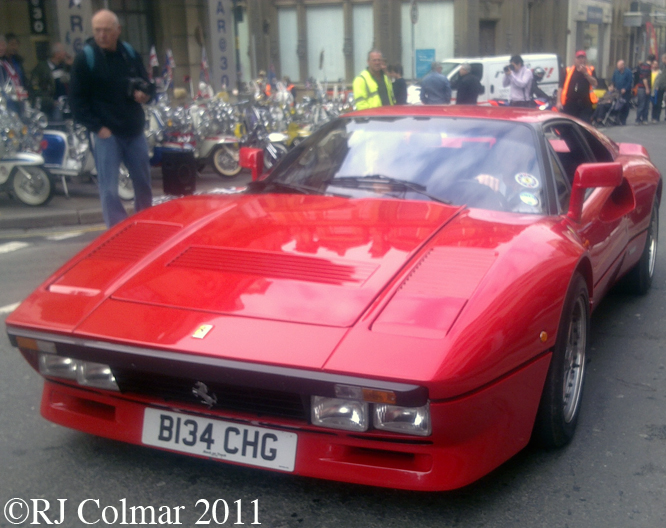
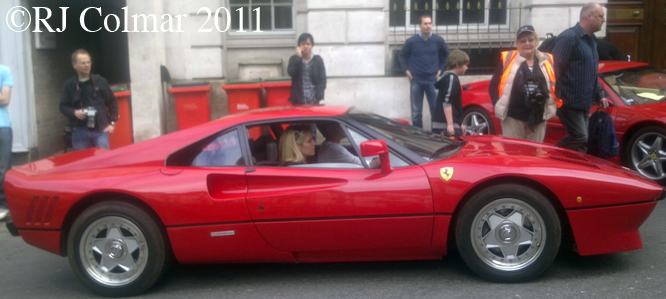
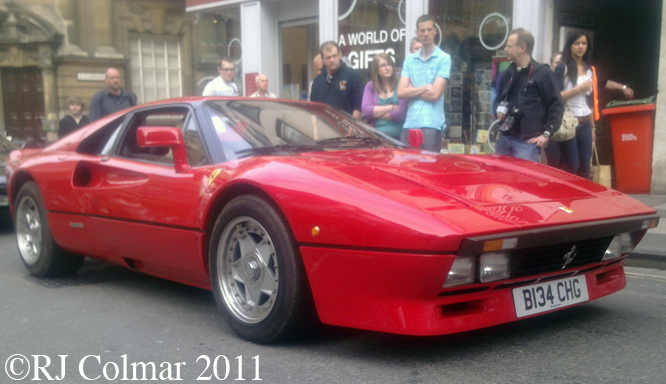
The Ferrari (288) GTO was designed to meet the 4 litre Group B regulations for rallying and racing sports cars which came into effect in 1982 .

01 Image3256sc

To be homologated, granted approval, to compete in the liberal loose Group B classes of rallys and races 200 identical examples of a model had to be manufactured.

02 Image3257sc

From 1984 – 1986 272 examples of the Ferrari 288 GTO were manufactured with a view to competing against the similar, albeit fitted with 4 wheel drive, Porsche 959/961.

04 Image3285sc

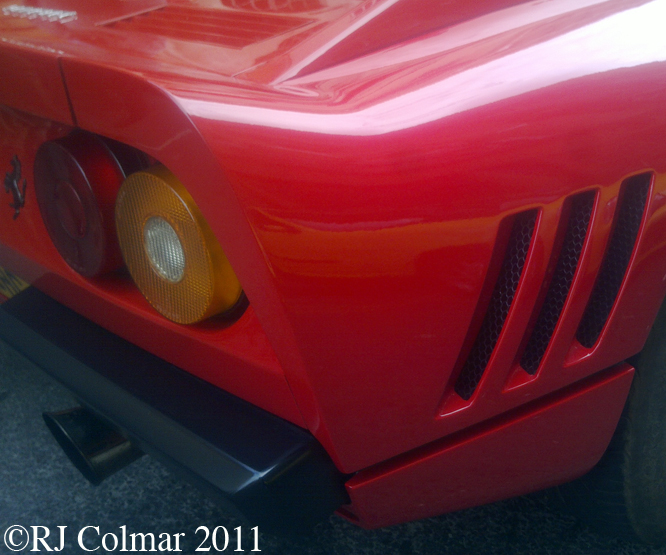
The 288 GTO was loosely based on the Ferrari 308 GTB though the rear bodywork was extended to incorporate the engine which was now longitudinally mounted rather than transversely mounted as in the 308 GTB.

05 Image3263sc

Pininfarina designed body panels for the 288 GTO were manufactured from a combination of fibreglass, aluminium and F1 technology Kevlar however in the interests of safety the door panels were made of steel.

06 Image3262sc

With four hundred horsepower available, in road trim, from the twin turbo charged 2855 cc / 174 cui V8 it is regrettable that the 288 GTO never saw any competitive action as a result of the Group B regulations being deemed to dangerous for competition after a number of fatalities in Group B rally events during 1986. By 1987 the Group B regulations and even more lax Group S regulations had been suspended in the interests of safety.

This 1985 model, known officially as a Ferrari GTO but often called 288 GTO to distinguish it from other Ferrari GTO models, is seen at the recent Italian Auto Moto Festival in Bristol.

Hope you have enjoyed today’s homologation edition of ‘Gettin’ a lil psycho on tyres’ and that you will join me again tomorrow. Don’t forget to come back now !

Share