Tag Archives: Festival of Speed

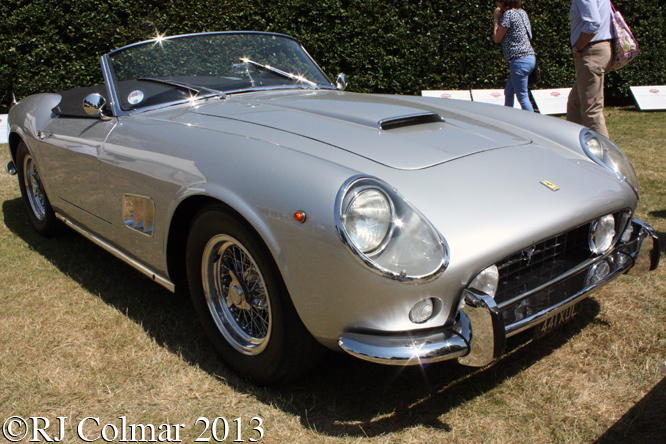
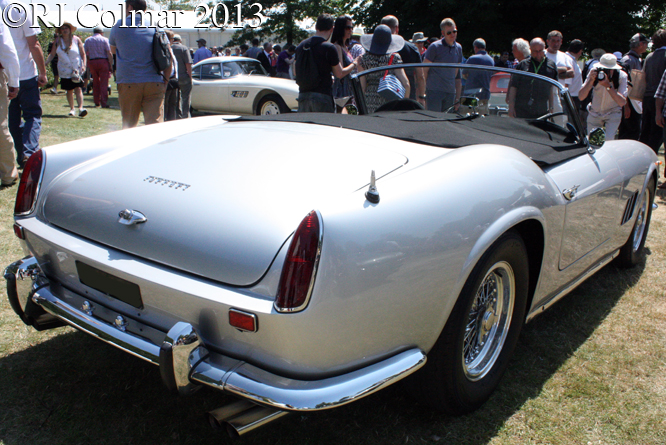
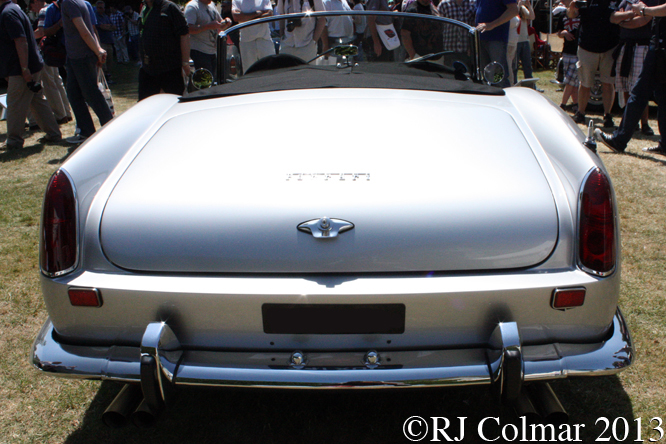
8 Inches Shorter – Ferrari 250 GT California Spyder SWB #2891 GT

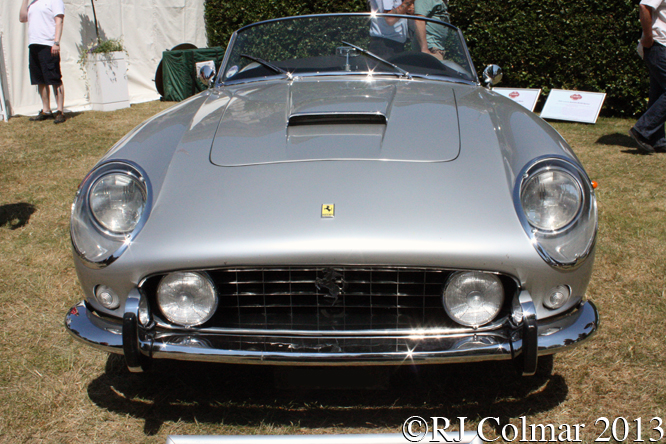
Sharing the same chassis as the Ferrari 250 GT Berlinetta SWB, the short wheel base (SWB) Ferrari 250 California Spyder was a fraction under 8 inches shorter than the original Long Wheel Base Ferrari 250 GT California Spyder of which 49 examples had been built 1957 and 1960.

Ferrari 250 GT California Spyder SWB, Goodwood, Festival of Speed

Of the 55 SWB California Spyder bodies designed by Pininfarina and built by Scaglietti 37 had faired in headlights.

Ferrari 250 GT California Spyder SWB, Goodwood, Festival of Speed

First seen at Geneva Motor Show in 1960 the California Spyder was powered by a 276hp version of the 3 litre / 183 cui V12 motor designed by Gioacchino Colombo.

Ferrari 250 GT California Spyder SWB, Goodwood, Festival of Speed

Along with the additional power the SWB California was fitted with hydraulic disc brakes in place of the drum brakes of originally fitted to the older long wheel base model.

Ferrari 250 GT California Spyder SWB, Goodwood, Festival of Speed

At the time of writing it is not known who first purchased chassis #2891 in 1961, but it’s three known subsequent owners all lived in Europe, so this car appears to have never seen the California sunshine for which it was built.

Thanks for joining me on this “8 Inches Shorter” edition of “Gettin a li’l psycho on tyres” I hope you will join me again tomorrow when I’ll for the start of GALPOT’S 50th Anniversary of the Porsche 911 celebration. Don’t forget to come back now !

Share

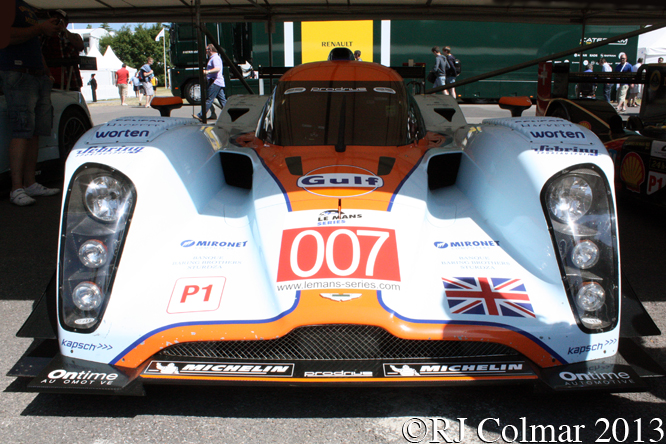
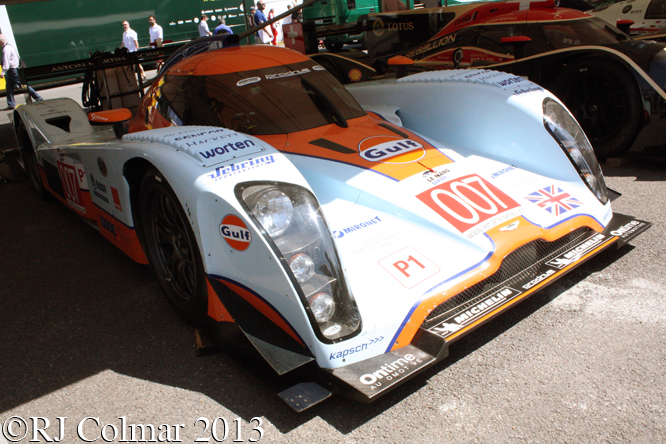
“LMS Series Winner” – Lola Aston Martin DBR 1-2

With the announcement of the discontinuation of Group C, from 1991 on, at the end of 1989 Aston Martin decided to withdraw it’s AMR1 V8 Prototype from the top line Sports Car series with immediate effect as they had no engine to with which to compete under the proposed new rules mandating 3.5 litre / 213 cui motors.

Lola Aston Martin  DBR 1-2, Goodwood Festival Of Speed

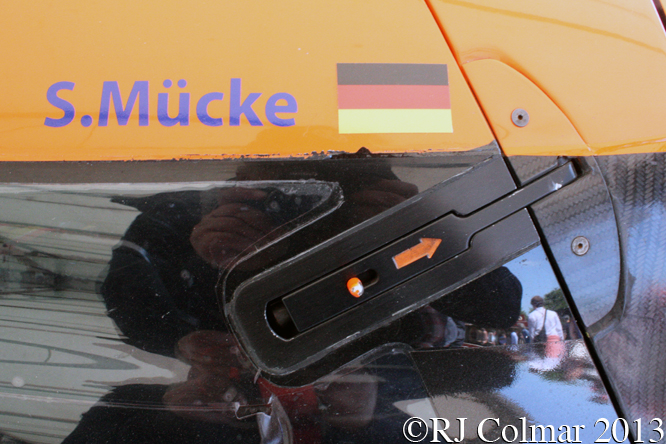
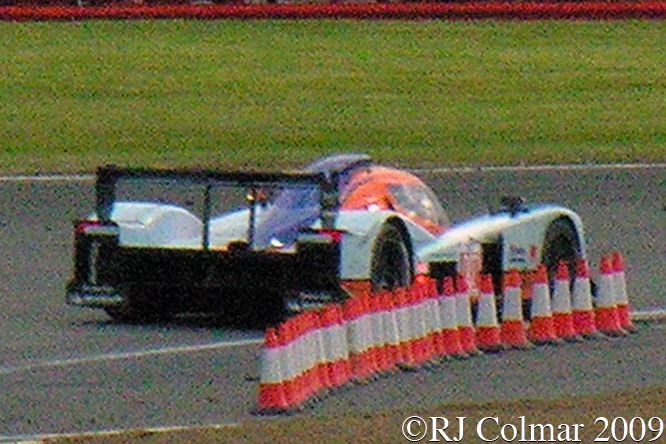
In 2008 the Aston Martin name appeared in the top Le Mans Prototype category with a pair of Lola B08/60’s powered by the 6 litre / 366 cui Aston Martin V12 that had been used in Aston Martin’s class winning DBR9 GT programme. The Lola Aston Martins were run in a collaboration between Prodrive and the Czech Charouz Racing System with Jan Charouz, Tomas Enge and Stefan Mücke sharing the driving of a single entry per race.

Lola Aston Martin  DBR 1-2, Goodwood Festival Of Speed

Charouz and Mücke finished season high 2nd in the Silverstone 1000kms. The following year one car chassis HU01 was sold to Speedy Racing who continue to race the car now under the Rebellion banner having used a motors from Aston Martin, Rebelion V10 and most recently Toyota.

Lola Aston Martin  DBR 1-2, Goodwood Festival Of Speed

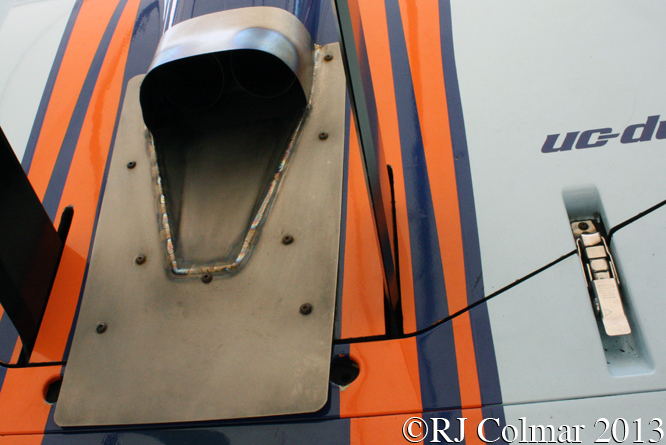
For 2009 Aston Martin increased their involvement in the Le Mans Prototype (LMP) class using Lola chassis again both the second Charouz Racing B08/60 HU02 and newer B09/60 types all fitted with updated body work. Gulf Oil sponsored, two cars entered by Aston Martin Racing, and an occasional single AMR Eastern Europe entry. All three cars are known as Lola Aston Martin DBR1-2’s and are again powered by DBR9 V12 variants producing around 650hp.

Lola Aston Martin DBR 1-2, Goodwood Festival Of Speed

Jan Charouz, Tomáš Enge and Stefan Mücke driving the #007 got the 2009 Le Mans Series off to a fine start with a win in the Catalunya 1000 kms, though the #009 of Harold Primat, Miguel Ramos and Darren Turner retired. At Spa the team finished 3rd and 5th in numerical order, while at Le Mans the team were out classed by the works diesel powered Peugeots and Audi’s, which did not take part in the rest of the Le Mans series races.

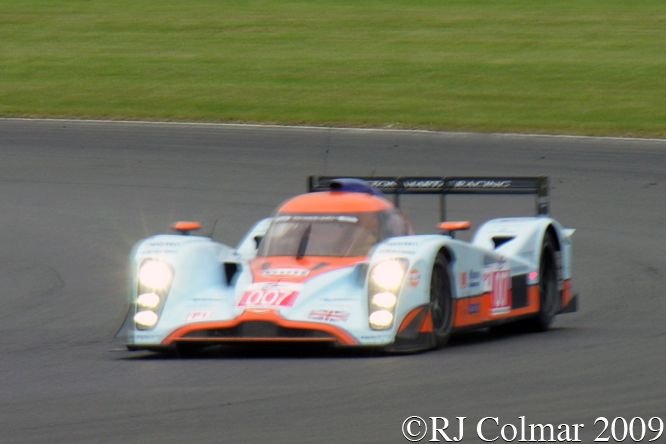
Lola Aston Martin  DBR 1-2, Silverstone 1000kms

The #007 salvaged a 4th place while the #008 driven by Turner, Anthony Davidson and Jos Verstappen finished 13th and the #009 driven by Primat, Stuart Hall and Peter Kox crashed out while lying 3rd. For some reason the Le Mans 24 Hours was not however part of the Series to which it lent it’s name.

Lola Aston Martin DBR 1-2, Goodwood Festival Of Speed

#007 and #009 next competed at Algarve where the original driver line ups finished 3rd and 5th in numerical order, at the Nurburgring #007 won a 1-2-3 finish followed by the #009 and #008 driven by Stuart Hall, Chris Buncombe and Miguel Ramos the latter had been scheduled to drive the #009.

Lola Aston Martin  DBR 1-2, Silverstone 1000kms

Three cars were again entered at Silverstone, where today’s on track photo’s were taken, and third place for the #007 was enough to clinch the LMS drivers championship for Jan Charouz, Tomáš Enge and Stefan Mücke, the #009 in 4th helped seal the Teams championship for Aston Martin Racing and the Manufacturers Championship for Aston Martin.

Lola Aston Martin  DBR 1-2, Goodwood Festival Of Speed

Over the following two years Aston Martin Racing sent cars to events on an apparently as hoc basis to events in Asia and Europe often joined by a chassis that had been acquired by Signature Racing. No more wins were recorded in 2010, but in 2011 the Aston Martin Racing team now sponsored by Muscle Milk driven by Klaus Graf and Lucas Luhr won at Mosport while a Gulf sponsored AMR 1-2 won at Laguna Seca driven by Harold Primat, Stefan Mücke and Adrian Fernandez.

Lola Aston Martin DBR 1-2, Silverstone 1000kms

At the end of the 2011 seasons the DBR 1-2’s were retired and scheduled to be replaced by the ill feted AMR-One.

Thanks for joining me on the “LMS winner” edition of “Gettin’ a li’l psycho on tyres” I hope you will join me again tomorrow. Don’t forget to come back now !

Share

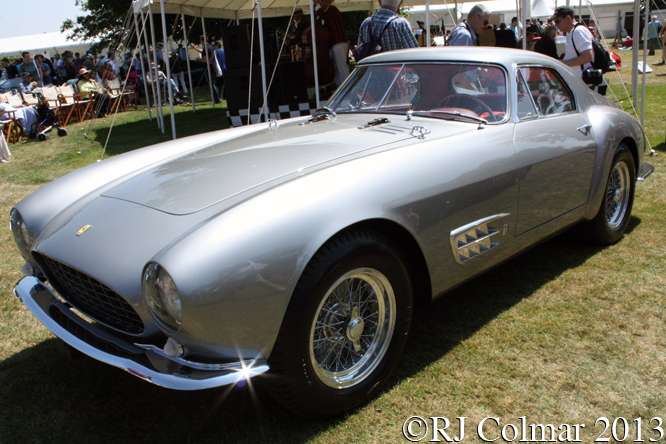
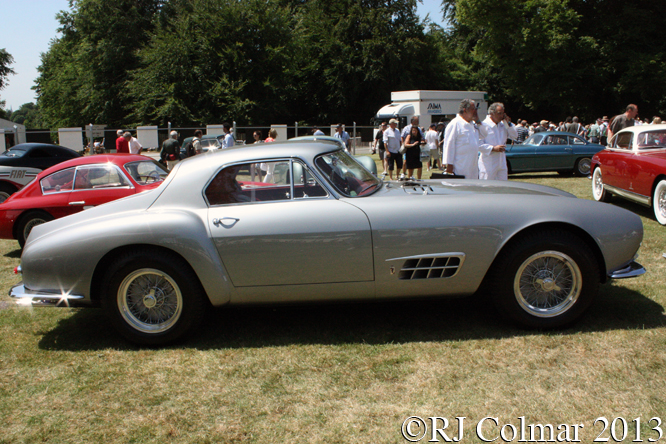
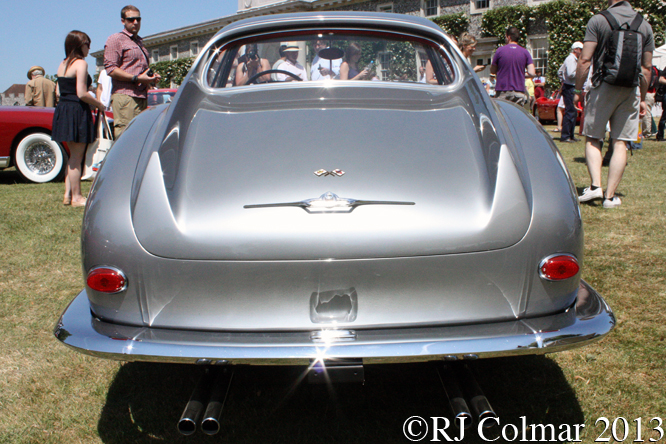
Grigio Ingrid – Ferrari 250 GT Competition Berlinetta Speciale #0403

Unbelievably, thanks to the continuing support from you dear reader the “Gettin’ a li’l psycho on tyres adventure today enters it’s fourth year. To mark the occasion I have selected, in my humble opion, one of the finest Ferrari’s known to humanity.

Ferrari 250 GT PF Speciale, Goodwood Festival of Speed

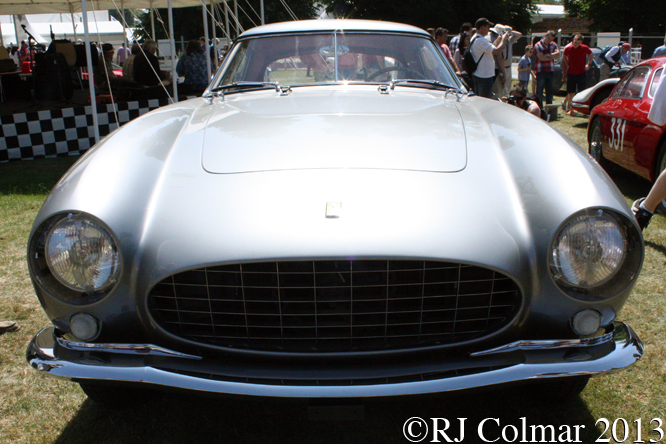
Chassis #O403 has a one off body by Pinin Farina that was to have been given to Swedish actress Ingrid Bergman in 1956 who was, at the time married to Italian film director Roberto Rosselini.

Ferrari 250 GT PF Speciale, Goodwood Festival of Speed

For reasons that are not clear to me, Ingrid never took delivery of the car, possibly because her relationship with Rosselini whom she would divorce in 1957 was drawing to a close.

Ferrari 250 GT PF Speciale, Goodwood Festival of Speed

The car ended up being sold to American James Gerard Murray who lived in Modena and Pittsburg.
In 1986 #0403, painted red since 1983, was being offered at a knockdown price of $145,000, down from 175,000 by the same vendor.

Ferrari 250 GT PF Speciale, Goodwood Festival of Speed

#0403 changed hands for 1.6 million dollars in 1989, but by 1999 it was bought for ‘just’ $945,000.The following year it was restored to it’s original Grigio Ingrid, a colour mixed just to suit Ingrid Bergman, that had first been seen on a pair of custom Ferrari 375 MM’s built for Rosselini and Bergman in 1954.

Ferrari 250 GT PF Speciale, Goodwood Festival of Speed

When Sergio Pininfarina saw the elegant #0403 at Pebble Beech in 2004 he commented that it was one of his favourite.

Thanks for joining me on this third birthday “Grigio Ingrid” edition of “Gettin’ a li’l psycho on tyres”, thanks also for sticking with the blog, if you have not done so before do not be afraid to like the “Gettin’ a li’l psycho on tyres’ facebook page, to share the page with your friends or leave a comment below. I’ll be continuing the series commemorating the 100th Anniversary of Aston Martin tomorrow with another car that has a Scandinavian connection. Don’t forget to come back now !

Share

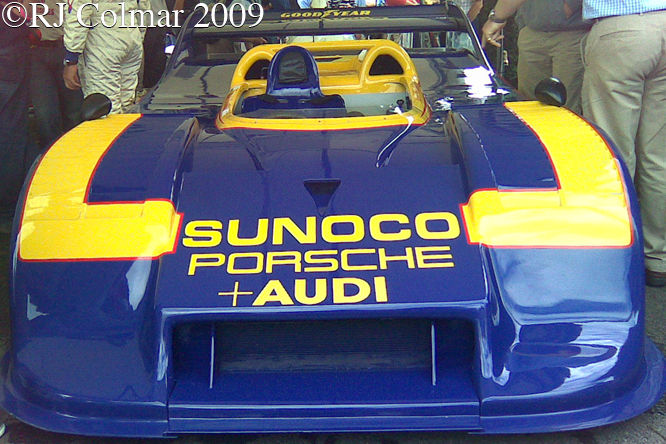
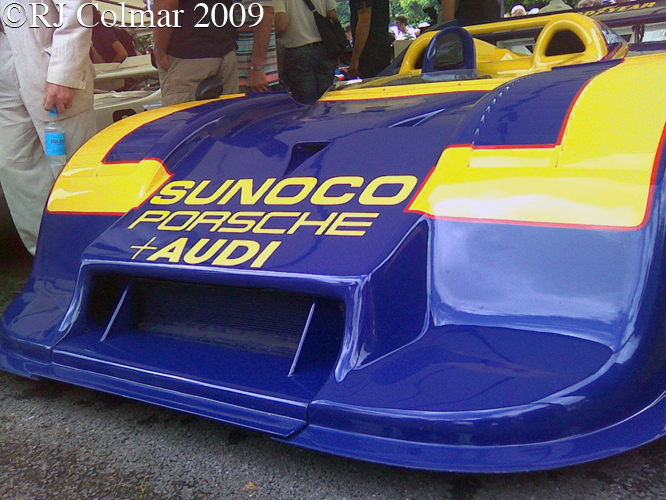
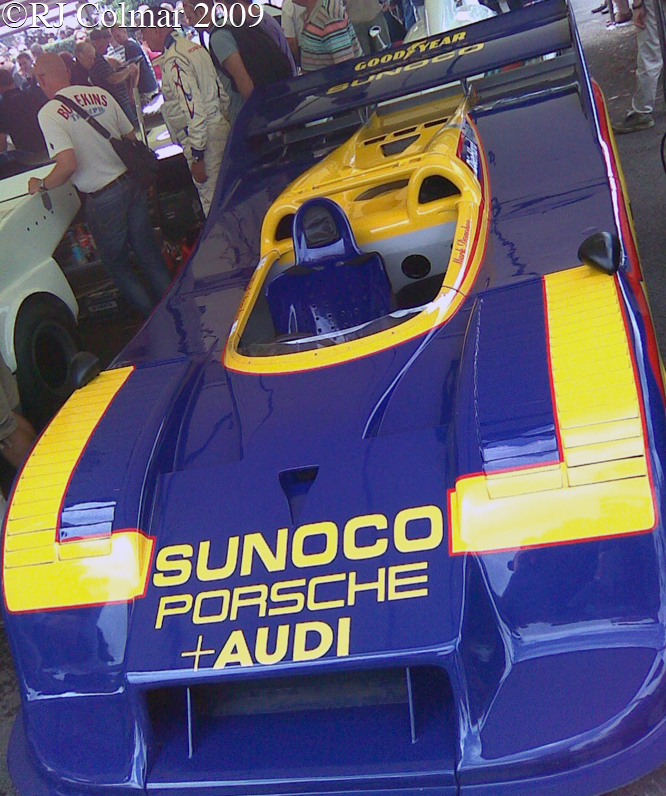
Unlimited Perfection – Porsche 917/30 #002

There are some cars that stand head and shoulders above all others in terms of their achievements in their particular fields of endeavour even though their period of dominance is short lived. One such is the Porsche 917/30 as perfected into the ultimate race car for the 1973 Can Am Challenge for Group 7 unlimited sportscars by Porsche AG, Roger Penske and his driver Mark Donohue.

Porsche 917/30, Goodwood Festival of Speed

The origins of the space frame chassis and flat 12 motor that power this model lie in the Porsche 917 Endurance Sports Car programme that got underway after an unexpected change in sports car regulations designed to prolong the competitive viability of the Ford GT40’s and Lola T70 Coupé’s powered by 5 litre / 302 cui motors. The change in the regulations mandating vehicles of which at least 25 examples had been built with up to 5 litre / 302 cui motors were seen as an open opportunity by the engineers at Porsche to build a car with a competitive life limited to just three seasons of endurance racing from 1969 to to 1971. In that time Porsche and it’s preferred teams transformed the 917 from an initial limp biscuit into a preeminent sports car that conquered almost every race in which it took part laying the foundation of Porsche’s endurance racing reputation that was unrivaled until sister company Audi took up the mantel at the beginning of the 21st century. The Porsche 917’s achievements included back to back Le Mans wins in 1970 and 1971, back to back World Sports Car Championships in the same years and celluloid immortalisation by none other than the undisputed celluloid King of Cool Steve McQueen thanks to his film Le Mans.

Porsche 917/30, Goodwood Festival of Speed

Porsche’s first foray into the world of unlimited Can Am racing came in 1970 with a couple of 917 predecessors in the form of the 3 litre / 183 cui flat 8 powered 908 Spyders for Swiss driver Jo Siffert and Britain’s Tony Dean. Siffert was soon given a Porsche 917 PA Spyder fitted with a 4.5 litre / 274 cui flat 12 motor with which he finished a season high 3rd for the marque at Bridgehampton on his way to 4th place in the 1969 Can Am Challenge. The following season Tony Dean in his 908 was the only regular Porsche representative and he took an unlikely but popular win at Road Atlanta on his way to 6th in the 1970 Can Am Challenge standings.

Porsche 917/30, Goodwood Festival of Speed

Several of the closed cockpit 917K’s taking part in the 1970 Watkins Glen 6 hour race took part in the following days Can Am race at the same circuit and Siffert with a 5 litre / 302 cui flat 12 motor finished second to Denny Hulme’s Chevy 7 litre / 427 cui powered McLaren M8D.

Porsche 917/30, Goodwood Festival of Speed

Vasek Polak Racing acquired Siffert’s 917 PA for Milt Minter in 1971 while Siffert had a new 917/10 with updated bodywork that included a large rear wing but was still running a 5 litre / 302 cui normally aspirated motor. Siffert scored two season high second places and finished 4th in the 1971 Can Am Challenge two spots ahead of Minter.

Porsche 917/30, Goodwood Festival of Speed

In 1972 Roger Penske became the works Porsche representative in Can Am with a pair of Porsche 917/10’s, now fitted with turbocharged 5 litre / 302 cui flat 12 motor’s Donohue finished 2nd in the opening round at Mosport but then broke a leg in a testing accident at Road Atlanta where George Follmer was hired at short notice to replace Mark. George won the race and four more that season to clinch the 1972 Can Am Challenge. Mark recovered to win a single race upon his return at the end of the season to finish 4th in the Challenge, behind Milt Minter who still had the old 917 PA fitted with the latest 917/10 body work and a variety of turbocharged and normally aspirated engines during the course of the season.

Porsche 917/30, Goodwood Festival of Speed

For 1973 Porsche, Penske and Mark worked on the definitive ultimate 917, today’s featured 917/30, which featured a longer wheel base and a turbocharged 5.4 litre / 329 cui flat twelve fitted with 2 spark plugs per cylinder that produced a conservative 1100hp, or up to 1500hp in qualifying trim with 39 psi / 2.7 bar of boost from the twin turbochargers.

Mark qualified on pole for all 8 races in the 1973 Can Am Challenge. In the first race at Mosport he finished a season low seventh, after tripping over a back maker which allowed Charlie Kemp to win driving the previous years Penske 917/10 model for Rinzler Racing. At Road Atlanta Mark experienced a fuel filler leak while leading forcing him to pit for the leak to be fixed. Mark rejoined the race to finish second to the other Rinzler Racing ex Penske 917/10 being driven by George Follmer.

Thereafter Mark won the remaining six races as he pleased to become the first Can Am Challenge winner to score points in all the challenge races. In 1974 the hitherto unlimited Group 7 cars were given their first restriction when the SCCA mandated a 3 miles per gallon fuel limit, this did not outlaw the 917/30 as is widely believed, in fact Roger Penske entered one of the 917/30’s for Brian Redman to drive at Mid Ohio.

Under strict instructions to use only the top three, of four, gears in order to minimise fuel consumption Brian qualified on pole and came home second, behind Jackie Oliver driving a Shadow DN4, after understeering, pushing, off the circuit during the race.

In 1975 Mark Donohue returned to the cockpit of a CAM2 sponsored 917/30 now fitted with twin inter coolers to raise the world closed circuit lap record from the 217 mph set by AJ Foyt, in his open wheel USAC Coyote, to 221 mph at Talladega Superspeedway. The record which was set in less than optimal dry conditions stood for two decades.

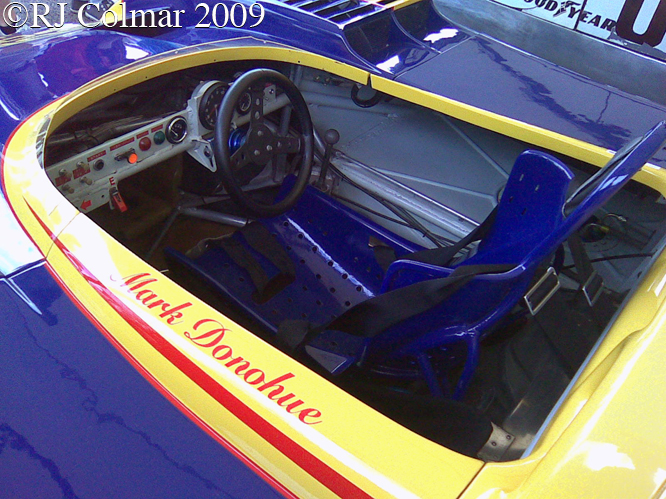
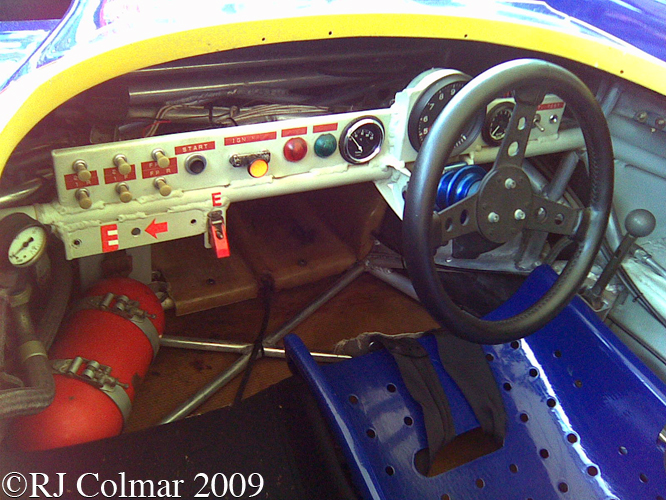
Today’s featured car seen at Goodwood Festival of Speed a couple of years ago is chassis 917/30 #002 which appears to have served primarily served as Mark Donohue’s spare for the 1973 season. Contemporary reports in Motor Sport suggest it was only raced at Watkins Glen after a suspension failure on Marks regular chassis #003 required #002 to be wheeled out for race duty, which included winning pole and leading from flag to flag to secure a 42 second victory over David Hobbs Carling Black Label Roy Woods Racing 1972 Mclaren Chevrolet M20.

917/30 #002, one of six 917/30’s built of which only three saw in period competition, now belongs to the Porsche Museum.

Thanks for joining me on this “Ultimate Perfection” edition of “Gettin’ a li’l psycho on tyres” I hope you will join me again tomorrow. Don’t forget to come back now !

Share

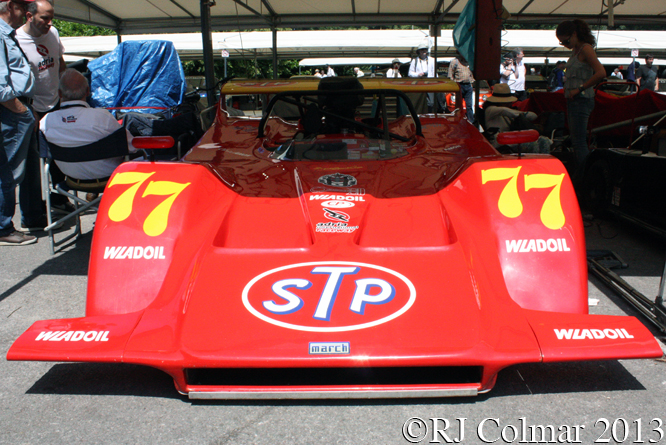
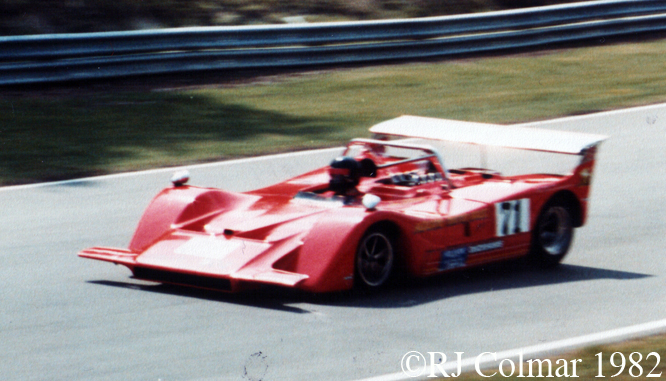
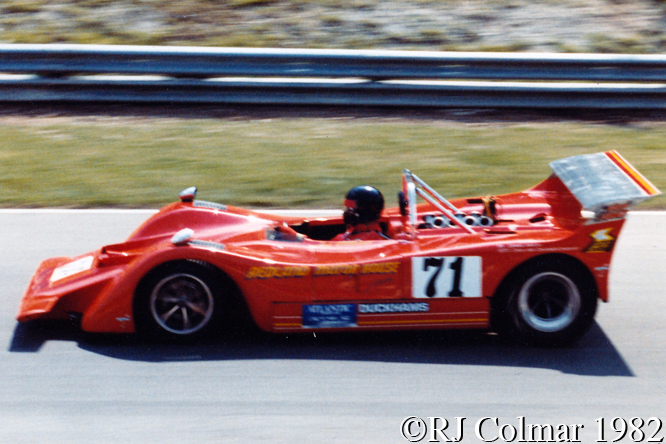
93″ Wide – March Chevrolet 707 #707/2 and #707/3

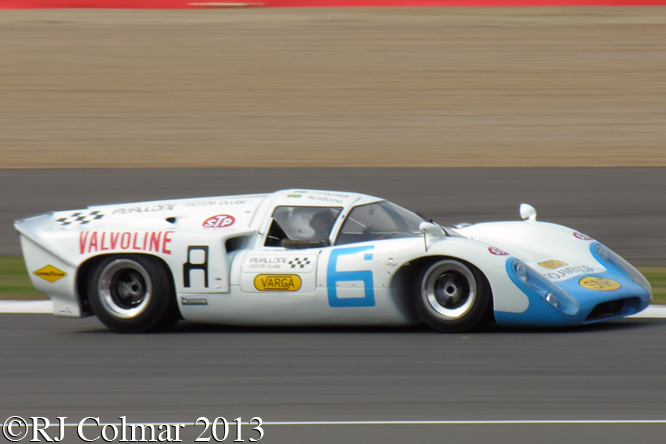
For 1970 the ambitious March Cars embarked on a programme to build customer racing cars for every major open wheel category from Formula One to Formula Ford and included a 93″ wide two seat closed wheel Group 7 Can Am car for good measure.

March 707, Goodwood Festival Of Speed

Two March 707’s were completed one was run in the 1970 Can Am Challenge by the factory with sponsorship from STP for New Zealander Chris Amon, while the first of the two completed chassis was sold to German Helmut Kelleners who was sponsored by the Deutsche Auto Zeitung periodical in the inaugural Interserie Championship.

March 707, Goodwood Festival Of Speed

Of the two drivers Kelleners had the most success winning Intersiere races at Croft and Hockenheimring, any championship challenge was however halted by a couple of clutch failures and a disqualification from the first Hockenheim race after missing a chicane. Helmut won three non further non championship races in 1970 before he had March #707/1 upgraded to 717 spec for 1971, with new bodywork and the chassis number #717/1 being the most obvious difference.

Williams, March 707, Brands Hatch

The revised car was not so competitive and still having transmission problems winning no races in 1971.Austrian Stefan Skelnar bought the car in 1972 and raced #717/1 without any success until at least 1974 eventually refitting the original 707 type bodywork.

Williams, March 707, Brands Hatch

The works #707/2 built for Chris Amon was not ready for the opening races of the 1970 Can Am Challenge but qualified a respectable third on it’s debut at Donnybrooke, where Chris finished 5th. At Laguna Seca and Riverside Chris qualified 5th and finished 4th. There after there is no evidence of the car taking part in contemporary events.

March 707, Goodwood Festival Of Speed

March built a spare chassis tub #707/3 and it would appear to have been purchased by Canadian Gordon Dewar and raced in 5 events in the 1971 Can Am challenge after 4 retirements due to transmission and fuel pump issues Gordon is listed as retiring from the fifth due to illness.

In the early 1980’s Ted Williams acquired #707/3 and he is seen driving the car at Brands Hatch where he experienced handling problems due to a low ride height in qualifying and then low fuel pressure during the race. Later in the 80’s Ted survived a chassis shortening accident in #707/3/.

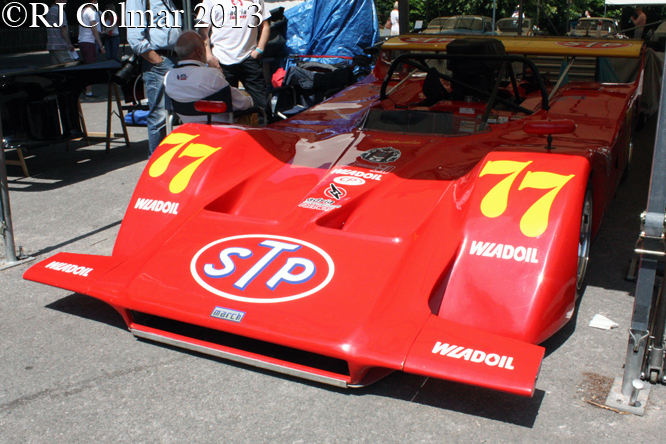
The #77 is so far as I have been able to ascertain Chris Amon’s chassis #707/2 which was being run at the recent Goodwood Festival of Speed for Matteo Maria Tullio.

My thanks to Alan Raine, Simon Lewis and Tim Murray at The Nostalgia Forum for help identifying the #71 chassis number, driver and providing race reports.

Thanks for joining me on this “93” Wide” edition of “Gettin’ a li’l psycho on tyres” I hope you’ll join me again tomorrow when I’ll be looking at a Can Am McLaren. Don’t forget to come back now !

Share

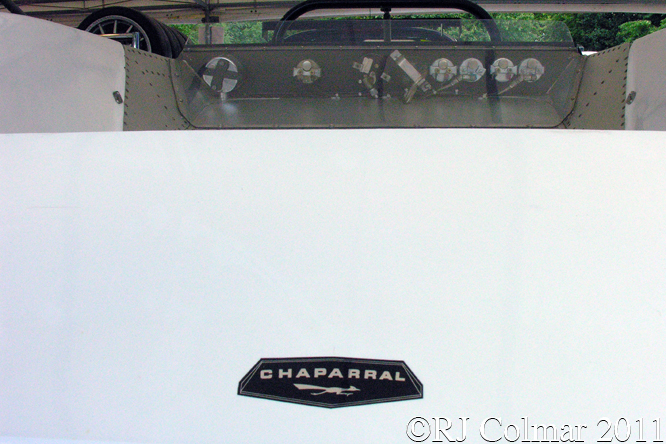
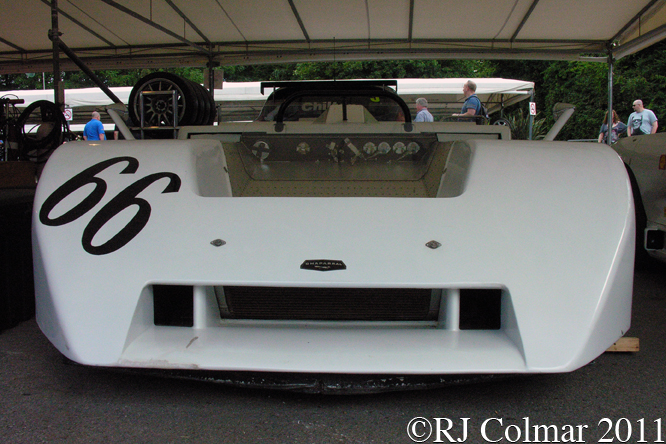
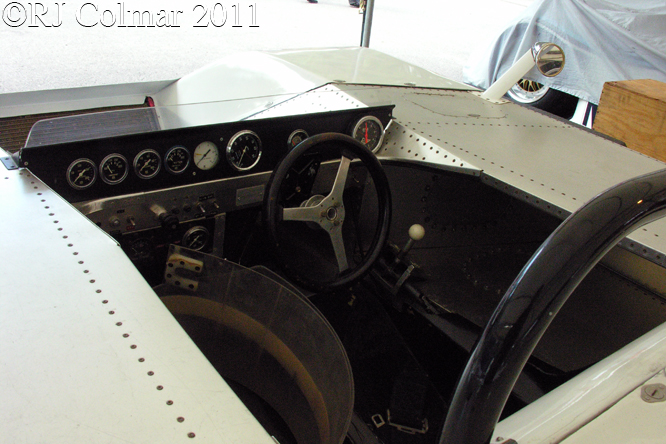
The Sucker Car – Chaparral Chevrolet 2J #2J001

The Chaparral 2J powered by a conventional 680hp aluminium block V8 with an unconventional, but race proven automatic transmission is one of the most fabled in all of motor racing, despite the fact that from just four starts it recorded just one sixth place finish at Road America with Vic Elford at the wheel in September 1970.

Chaparral Chevrolet 2J, Goodwood Festival Of Speed

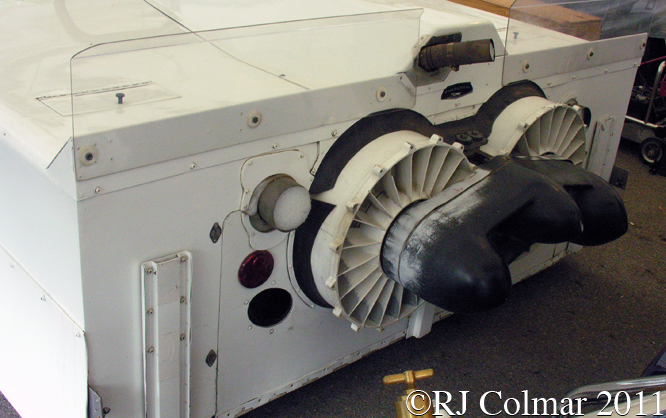
The reason the Chaparral 2J, even today, draws so much attention is that it’s only point of reference is a hover craft, unlike a hover craft, which floats on a cushion of air, the 2J’s aerodynamics are configured to suck it to the ground. All though I do not believe it was ever put to the test, it is said that the 2000lb 2J, when stationary can generate enough down force that it could, in theory, stick it’s self to the ceiling.

Chaparral Chevrolet 2J, Goodwood Festival Of Speed

The first person to race the 2J in 1970 was none other than 1969 World Champion Jackie Stewart who qualified 3rd for the Watkins Glen Can Am race, but retired with brake failure. The team skipped the next couple of races and then turned up at Road America where Vic Elford qualified on pole and scored the cars only finish 6th place.

Chaparral Chevrolet 2J, Goodwood Festival Of Speed

Missing a couple of more races Vic then qualified on pole at Laguna Seca where the engine broke during the warm up causing a non start. Then at Riverside Vic qualified on pole again but the key to the cars aerodynamics the 55hp two cylinder two stroke Rockwell motor broke so that the pair of fans it drove, which sucked the air out from beneath the car to improve the road handling, were no longer operative causing Vic to retire from the race.

Chaparral Chevrolet 2J, Goodwood Festival Of Speed

The Chaparrals clever aerodynamics were a full six to eight years ahead of anything seen in Formula One, often considered the very apex of the engineering envelope. Unfortunately the 2J’s days were numbered thanks to a number of high profile wing failures in Formula One which had led the governing body of the sport, the FIA in Paris, banning all ‘movable aerodynamic’ devices.

It was clear despite Jim Hall’s Chaparral partner Hap Sharp insisting “If I can come up with a better mousetrap that is within the regulations, I ought to be allowed to use it”, that the fans on the back of the car were aerodynamic devices which permanently sucked the car to the ground, so long as the Rockwell motor was working, and so the concept behind the 2J was duly outlawed at the end of 1970 with it’s full potential completely unrealised.

Thanks for joining me on this “The Sucker Car” edition of “Gettin’ a li’l psycho on tyres” I hope you will join me again for Ferrari Friday tomorrow. Don’t forget to come back now !

Share

Dan’s McLeagle – McLaren Chevrolet M6B # 50-10 (Trojan)

The inaugural Can Am Challenge run in 1966 had been a huge successes with four different drivers winning the six races, two of them world champions, and Lola winning 5 of the races with Chaparral winning the other. For 1967 the complexion of the series would change completely as what became known as the Bruce and Denny steamroller gathered momentum with the Traffic Yellow McLaren M6’s.

Denny Hulme won the opening 3 races of the series leading team owner Bruce McLaren home in the second and third. Bruce then won the forth and fifth rounds by which time Bruce and Denny had secured first and second places in the championship. At the last race of the 1967 Can Am season the Traffic Yellow steam roller came to a temporary if grinding halt when Bruce and Denny both retired to leave 1966 Can Am champ John Surtees to take a consolation victory in his one year old Lola T70 MkII.

For 1968 Bruce McLaren stepped his team up another gear with the McLaren M8, while offering a production version of the previous years winner known as the M6B which was manufactured by Trojan, the same company that had once built bubble cars under licence from Heinkel and taken over the Elva racing car business, prior to building production versions of the Mclaren M1.
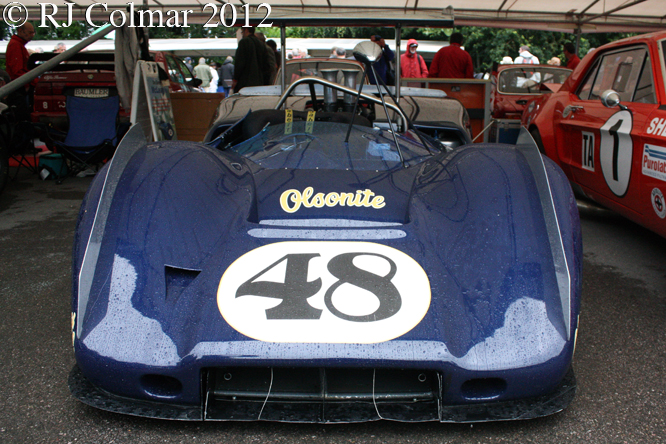
McLaren Chevrolet M6B, Goodwood Festival of Speed

Dan Gurney, who won the second race in the inaugural 1966 Can Am Challenge with his Ford Powered Lola T70 MkII, decided to replace the aging car with a McLaren M6B for himself and a Lola T160 for his team mate Swede Savage, both cars remained Ford small block (under) powered running with Westlake heads for the 1968 season.

To try and beat both the works Chevrolet powered McLaren M8’s and the customer M6B’s run by Penske for Mark Donohue with Chevrolet Power and the Ford 427 cui big block powered Shelby McLaren M6B of Peter Revson and the Motschenbacher Racing Enterprises example driven by Lothar Motschenbacher Dan’s All American Racers (AAR) team embarked on a continuous programme of development centered mostly on the M6B #50-10 featured today.

As well as lightening the M6B with exotic materials as used in the Eagle Formula One programme they continually upgraded the body work.
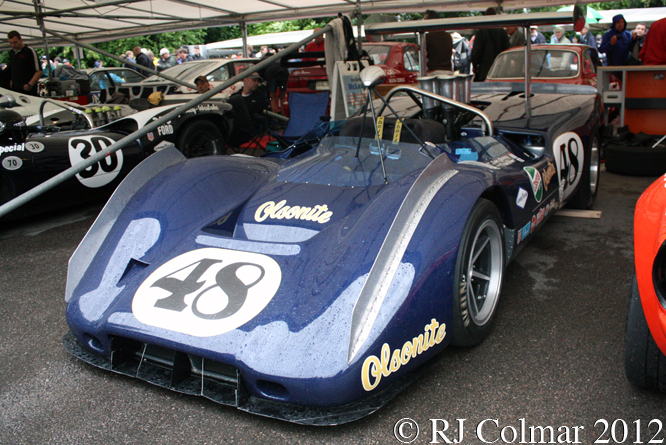
McLaren Chevrolet M6B, Goodwood Festival of Speed

AAR missed the opening round of the 1968 Can Am challenge where 1967 World Champion Denny Hulme led his countryman and team mate Bruce McLaren home in yet another Traffic Light Yellow walk over. At the following race run at Bridgehampton Denny and Bruce both retired with broken motors having started 1st and 2nd on the grid leaving Mark Donohue to win in his Chevrolet powered Penske M6B from Jim Hall in his Chaparral 2G.

Motschenbacher came home third in his Ford powered M6B ahead of Swede Savage in the small block Ford powered AAR Lola T160 which had started just 17th. Dan qualified 6th and finished 6th on his debut in the M6B. The Bridgehampton result would remain the teams best finish of the season as AAR experienced a variety of ills including chronic unreliability from the underpowered Gurney Westlake developed motors for the remainder of the 1968 season, Gurney and Savage even swapped cars for the last two races of the 1968 season with no appreciable difference in the results.

Denny and Bruce McLaren again topped the points standings this time Denny was Champion with three wins to the single win for Bruce. Mark Donohue finished the season third with one win. Canadian John Cannon won at Laguna Seca to score the only Can Am win in the now three year old McLaren M1B model at Laguna Seca.
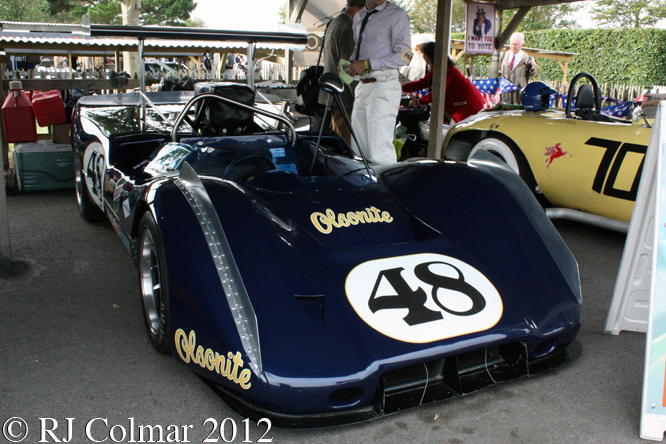
McLaren Chevrolet M6B, Goodwood Revival

For 1969 Dan persevered with just the #M6B-50-10 which was by now so heavily modified it became known as the McLeagle, the reliability of his motors did not improve and midway through the season he missed a couple of races in order to install a big block Traco Chevrolet. Ironically when Dan returned to the fold with his M6B at Michigan his Bow Tie power developed an oil leak in practice and he ended up taking Jack Brabham’s intended drive in a third works McLaren M8B alongside Denny and Bruce.

Having failed to set a time in practice Dan started from the back of the field and finished third behind Bruce and Denny in a 1-2-3 finish for the McLaren team. At Laguna Seca Dan was back in his own car in which he qualified 4th but retired with a blown piston. Dan’s best ever result driving #50-10 after nearly two seasons of trying came at Riverside where he qualified fifth and came home 4th.

Dan skipped the last round of the 1969 Challenge at Texas motor speedway and ended the season equal 11th in the standings with Mario Andretti who had driven a Holman Moody entered M6B powered by a big block 427 Ford. The Challenge title went to Bruce McLaren who won six races of the expanded 11 race series with team mate Denny Hulme winning the remaining five races in what had been another Traffic Yellow wash for McLaren.
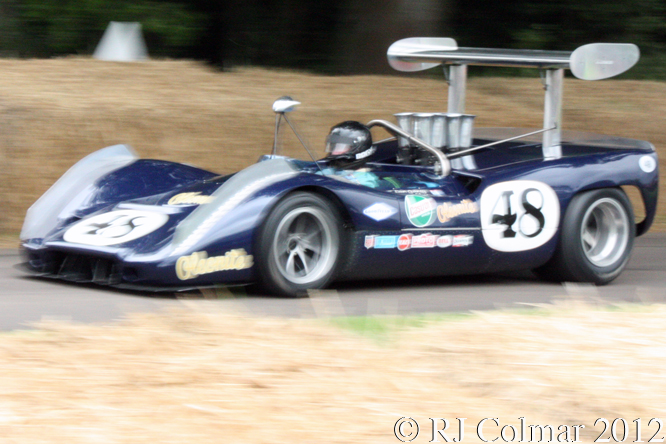
McLaren Chevrolet M6B, Goodwood Festival of Speed

Dan sold the #50-10 to Bob Brown for the 1970 Can Am Challenge, Bob also scored a couple of 4th place finishes which with 3 other minor points finishes in the further modified car was enough to secure 9th in the Challenge table.

With the death of Bruce McLaren in a testing accident at Goodwood, before the 1970 Can Am challenge got under way, Dan was drafted into replace the McLaren team founder and ended up winning the first two races of the season while Denny Hulme was driving with severely burned hands received while practicing for the Indy 500. Denny went on to win six of the remaining 1970 Can Am races to secure his second Can Am title and Mclaren’s third consecutive title.

By 1971 Dan had retired from race car driving, while Bob Brown soldiered on in #50-10 scoring a season high 6th place finish at Mosport. Bob sold the car onto RS Enterprises for the 1972 season during which Frank Riemann and Dave Causey were entered into at least three events Causey finishing a best 16th in the Can Am round held at Donnybrooke.

#50-10 is known to have been driven by Jigger Sirois in the Can Am race at Road America in 1973 and by Bob Svast at Road Atlanta in a US Champions event in 1974, from which the car was retired on both occasions. The car has been restored to it’s high wing 1969 spec as seen in these photo’s, taken at Goodwood last year, with owner Andy Boone at the wheel.

My thanks to TNF’ers raceanouncer2003 Vince H, for enlightening me about the development of today’s M6B and Gurney’s Lola T160 and to kayemod Rob for showing me a tin of the Traffic Yellow 11040 LR Rylands Polyester Colour Paste used to pigment the works McLaren fiber glass body work.

Thanks for joining me on this “Dan’s McLeagle” edition of “Gettin’ a li’l psycho on tyres” I hope you will join me again tomorrow for a look at a McLaren M8 C/D. Don’t forget to come back now !
Share