Tag Archives: Festival of Speed

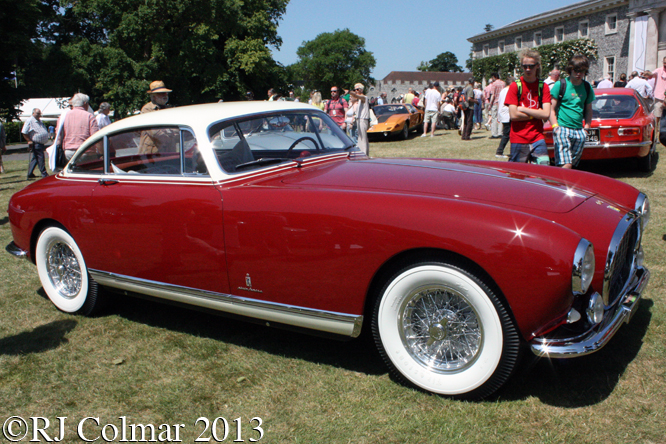
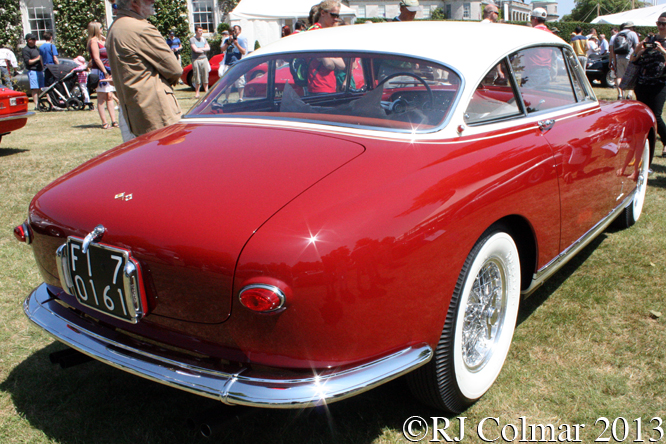
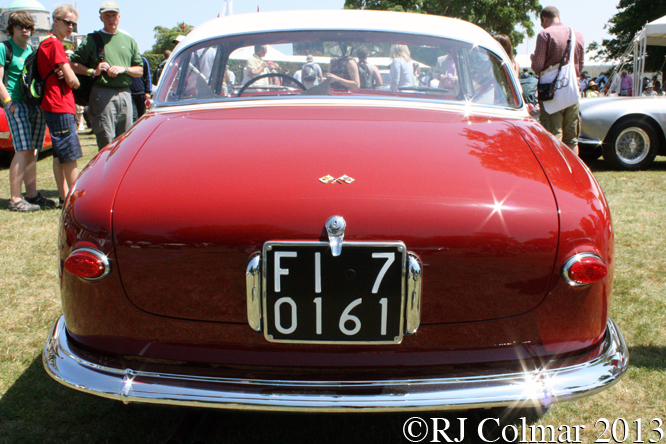
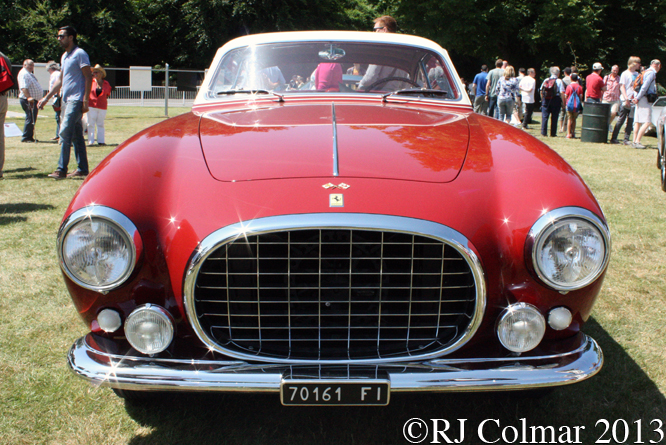
Burgandy & Cream – Ferrari 250 Europa Coupé Pininfarina #0305EU

After a meeting between Batista Farina, in 1961 to become Batista Pininfarina, and Enzo Ferrari at a restaurant in Tortona, a small town halfway between Turin and Modena, Batista drove home an told his son Sergio “From now on you’ll be looking after Ferrari, from A to Z. Design, engineering, technology, construction—the lot!”. Sergia says he was over the moon with happiness and one of the fruits of that conversation is today’s featured Ferrari 250 Europa Coupé chassis #0305EU delivered in late September 1953.

Ferrari 250 PF Europa Coupé, Goodwood Festival Of Speed

According to the blurb about this car seen at Goodwood, #0305EU was originally commissioned by a friend of Batista Farina called Latino Magnolfi, given the PF job number 12531 chassis #0305EU features unique to the 250 Europa Coupé model 3/4 windows a shorter windscreen and larger grill than the other 250 Europa’s. Magnolfi used to enter the car in Concours d’Elegance events before he sold the car.

Ferrari 250 PF Europa Coupé, Goodwood Festival Of Speed

The exact history of the #0305EU after the sale is not known to me but it ended up in the USA and after the repair of the 3 litre / 183 cui V12 motor became uneconomic the motor and gearbox was swapped for a Chevrolet V8 and and associated transmission.

Ferrari 250 PF Europa Coupé, Goodwood Festival Of Speed

In 2006 current owner Jan de Reu acquired the car which has been fully restored to its white wall tyre two tone Burgundy and Cream splendor, with a correct Colombo designed Ferrari V12 motor, by Ferrari Classiche.

Ferrari 250 PF Europa Coupé, Goodwood Festival Of Speed

As some of my regular readers may remember the Ferrari 250 Europa is closely related to the Ferrari 375 America, the later of which is powered by a larger 4.5 litre 274 cui Aurelio Lambredi designed long block V12.

Thanks for joining me on this “Burgandy & Cream” edition of “Gettin’ a li’l psycho on tyres” I hope you will join me again tomorrow when I be looking at Dan Gurney’s Can Am McLeagle. Don’t forget to come back now !

Share

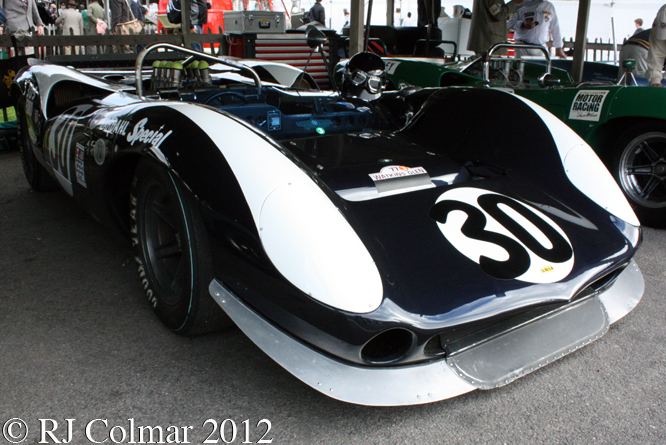
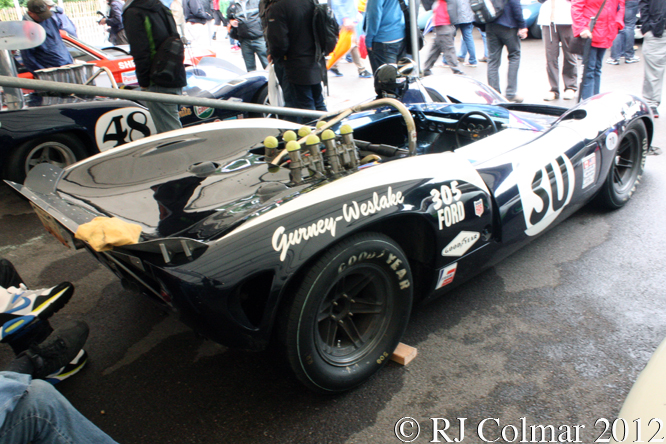
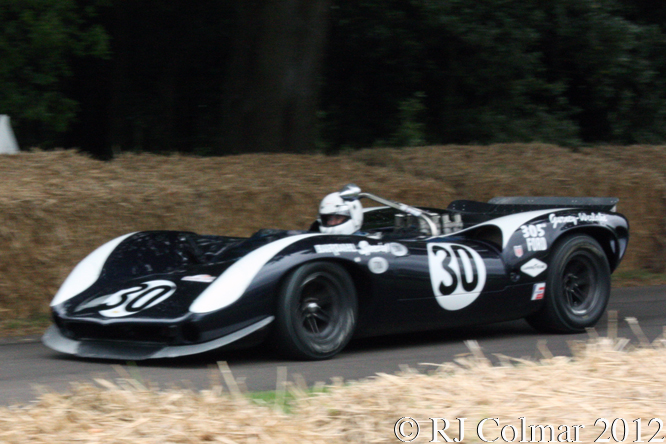
Ford’s Only CanAm Race Winner – Lola Ford T70 Mk II #SL71/34

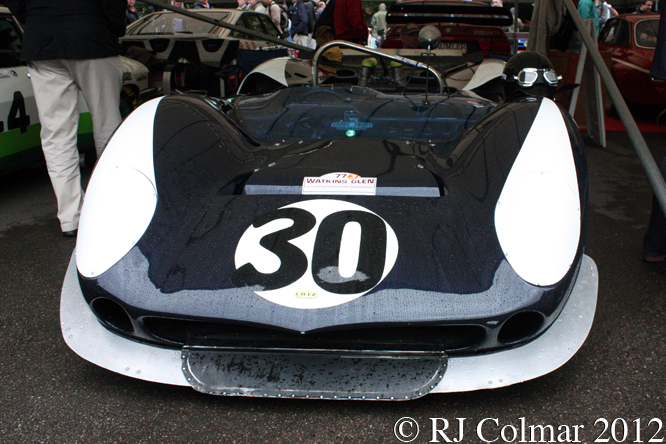
For the up coming inaugural 1966 Canadian American Challenge All American Racers took delivery of a new Lola T70 Mk II chassis #SL71/34 for which was powered by a 5 litre / 305 cui Ford Westlake V8 motor. The car was driven by Dan Gurney alongside the team’s 1965 Lola T70 Mk I chassis #SL70/10 which was run for Jerry Grant.

Lola Ford T70 Mk II, Goodwood Revival

After qualifying 9th for the inaugural Can Am race at St.Jovite Dan’s challenge got off to a poor start, because he did not start due to engine problems which manifested themselves during practice.

Lola Ford T70 Mk II, Goodwood Revival

At the next round held at Bridgehampton things improved with a start from pole position which Dan translated into, what turned out to be, the only win for a Ford powered car in the entire history of Can Am. Extraordinary given Ford’s persistence in tackling and winning Indy, Le Mans and an eventual decade and a half of dominance in Formula One.

Lola Ford T70 Mk II, Goodwood Festival of Speed

Dan started the following race at Mosport from pole but retired with ignition problems, at Laguna Seca Dan started 4th but retired with a cracked engine block. Dan’s bad luck continued at Riverside where he qualified 6th but retired with a clutch issue. At the Challenge finale held at Stardust international Raceway in Las Vegas Dan qualified 9th and retired with a broken fuel tank.

Lola Ford T70 Mk II, Goodwood Festival of Speed

It is probably just as well Dan did not follow Jerry Grant’s lead by emptying the contents of a revolver into the car at the seasons end.

Thanks for joining me on this “Ford’s Only CanAm Race Winner” edition of “Gettin’ a li’l psycho on tyres”, I hope you will join me again tomorrow when I’ll be looking at a US built vehicle that took part in the 1966 Can Am Challenge. Don’t forget to come back now !

Share

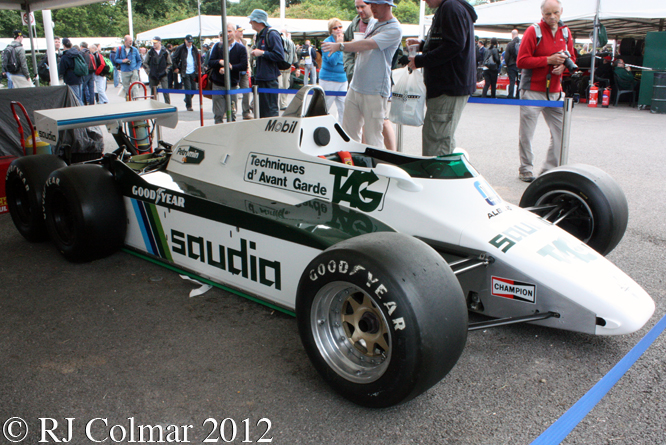
6 Wheel 4WD Final Call – Williams FW08B

Going into the 1982 season Williams had won not only a drivers Championship with Alan Jones in 1980, but two consecutive constructors Championships on which the team openly has always prided it’s self on more than any drivers championship.

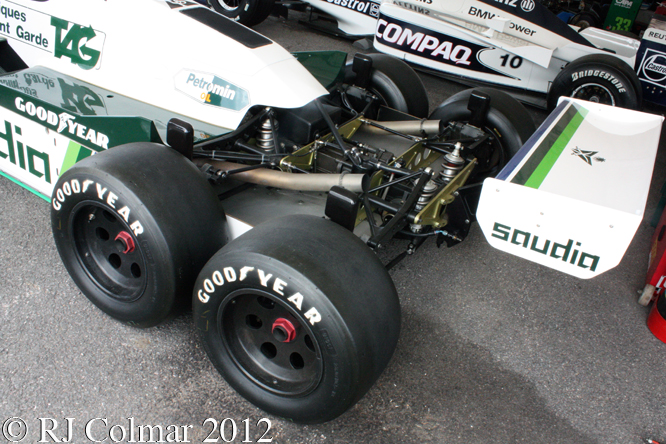
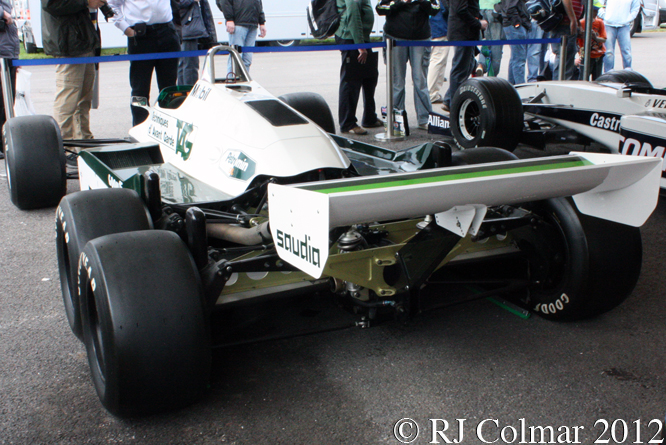
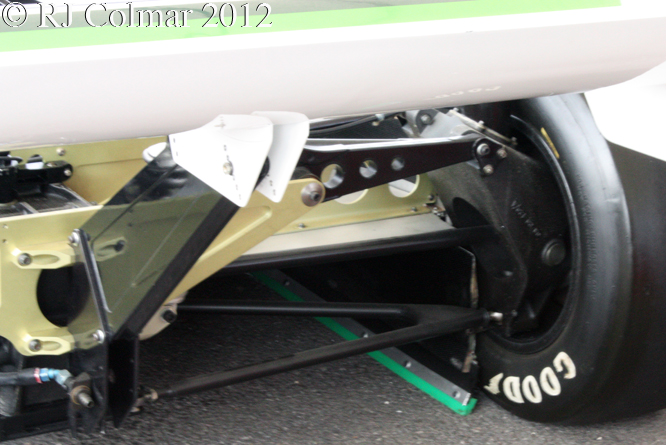
At the end of 1981 Williams designer Patrick Head and aerodynamicist Frank Dernie revisited the idea of running a six wheel formula one car with four driven wheels as Robin Herd at March had done during the winter of 1976/77 with the March 2-4-0.

Williams, Cosworth, FW08B, Goodwood Festival of Speed

Unlike March the Williams team were not interested in the publicity from the concept but, already having sufficient financial backing to see the concept through, they were interested in the results and specifically a third consecutive constructors championship which the concept might be able to deliver.

Williams, Cosworth, FW08B, Goodwood Festival of Speed

The rear 4 wheel drive transmission was tried out first on a 1981 FW07C chassis #FW07C/11 which became D spec with the additional driving wheels. Alan Jones tested the car before heading off into ‘temporary’ retirement in Australia.

Williams, Cosworth, FW08B, Goodwood Festival of Speed

With Jones team mate Carlos Reutemann also considering retirement after blowing an opportunity to win the 1981 World Drivers Championship at the last race in 1981, Fittipaldi refugee, Keke Rosberg was taken on to test both the FW07D, the new two wheel drive FW08 and four wheel drive FW08B as seen in these photographs.

Williams, Cosworth, FW08B, Goodwood Festival of Speed

In January 1982 it was reported in Motor Sport that “Patrick Head is pressing on with his experimental six wheeled Williams….”, by February 1982 Motor Sport reported that “Williams will not be racing the six wheeler…” without any further reasons being given leading one to conclude the 4 wheel 2 wheel drive FW08 had proved sufficiently superior not to proceed with the FW08B.

Although Patrick Head has said that at a meeting of the Formula One teams others were horrified at the increased expense of the system and prospect of the chaos that would ensue during pitstops. The FIA eventually also put a restriction on the number of wheels for a Formula One car limited to just 4 of which 2 maybe driven.

Despite being reliant on the venerable, but reasonably reliable Cosworth DFV motor when all around them the turbo charged motors were showing ever more horsepower Keke Rosberg managed to win the 1982 drivers championship with the FW08, winning just one race in the sixteen race series but scoring enough points from his remaining placings to beat his turbocharged competitors.

The constructors championship was won by Ferrari and had not Gilles Villeneuve been killed and Didier Pironi injured during the season a Ferrari driver might well have won the 1982 championship.

Thanks for joining me on this “6 Wheel 4WD Final Call” edition of “Gettin’ a li’l psycho on tyres”, I hope you will join me again tomorrow. Don’t forget to come back now.

Share

Forward With Fragrance – McLaren Cosworth M19C

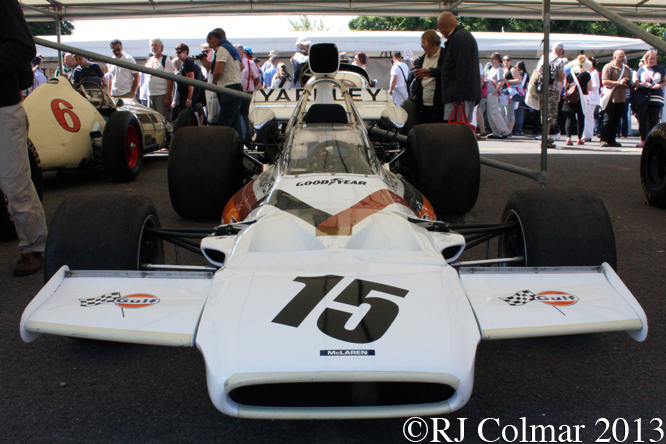
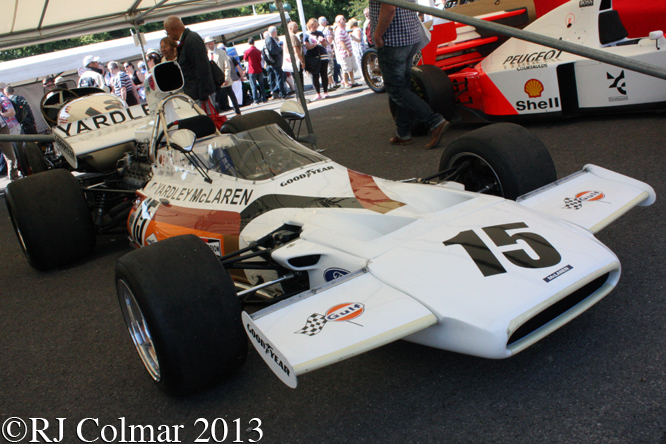
Mimicing the general out line of the 1969 Championship Matra MS80, as did many others including the Tyrrell’s 001-004, the McLaren M19A was designed by Ralph Bellamy for the 1971 season. It’s original rising rate suspension was soon abandoned in favour of the conventional McLaren M14A suspension.

After coming within a few laps of winning the 1971 South African Grand Prix with Denny Hulme at the wheel the cars best championship result came at the 1971 Canadian Grand Prix where Mark Donohue finished third in a privately entered example entered by Roger Penske.

McLaren Cosworth M19C, Goodwood Festival Of Speed

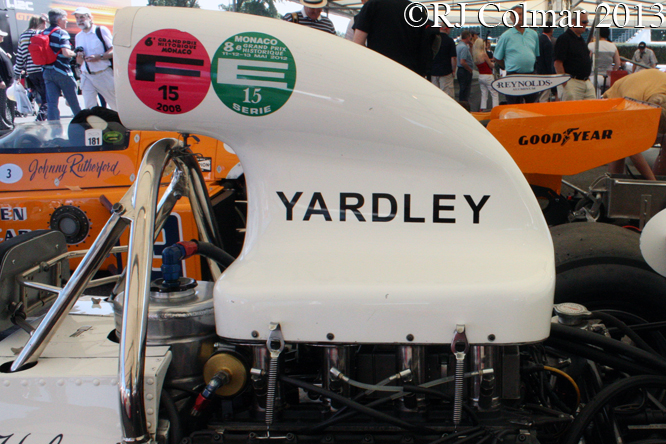
For 1972 McLaren found sponsorship from Yardley cosmetics who were less than impressed with the way BRM, whom they sponsored in 1970 and 1971, went about their business. On only their second world championship appearance in 1972 Denny Hulme won the South African Grand prix from 5th on the grid.

The M19 was given a diet in time for the 1972 Monaco Grand Prix where one car appeared in C spec with lightened front chassis bulkhead fabrication and numerous other weight saving modifications.

McLaren Cosworth M19C, Goodwood Festival Of Speed

Denny Hulme finished second in the 1972 Austrian Grand Prix ahead of team mate Peter Revson both driving M19C’s a seasons best for the ‘C’ spec cars that was matched at the 1972 Canadian Grand Prix where Revson finished ahead of Denny.

McLaren Cosworth M19C, Goodwood Festival Of Speed

In early 1973 Peter Revson finished second in the South African Grand Prix driving a Ford Cosworth DFV powered M19C on the models last championship appearance.

McLaren Cosworth M19C, Goodwood Festival Of Speed

The M19C’s were replaced by the McLaren M23 model, one of which Denny drove on it’s debut in the 1973 South African recording pole position and a fifth place finish.

Thanks for joining me on this “Forward With Fragrance” edition of “Gettin’ a li’l psycho on tyres”, I hope you will join me again tomorrow. Don’t forget to come back now !

PS My thanks to Tim Murray for pointing out Denny’s 1972 South African Grand Prix victory which I omitted from the original text.

Share

Wrong Footed By Safety Car – Ferrari F10

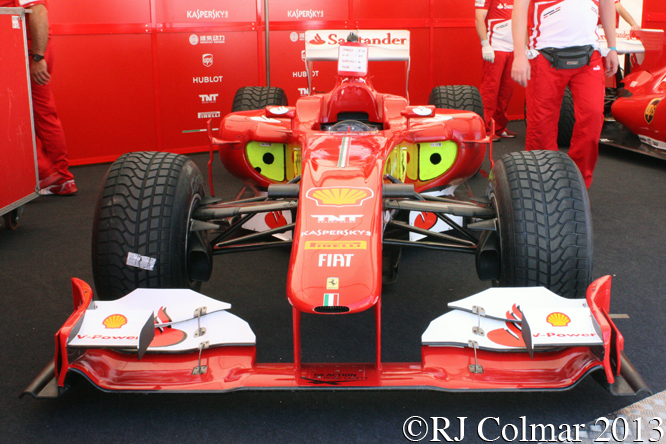
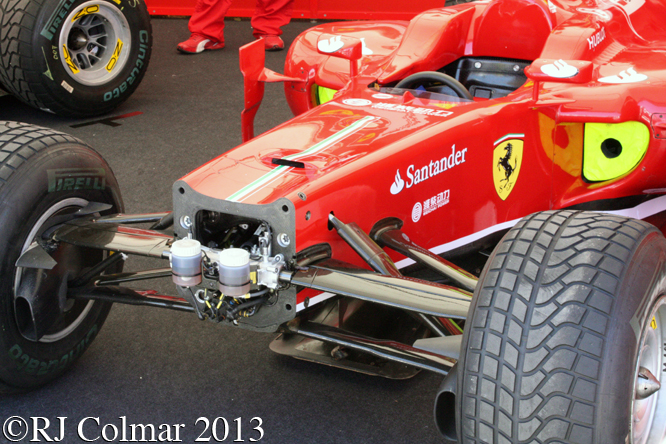
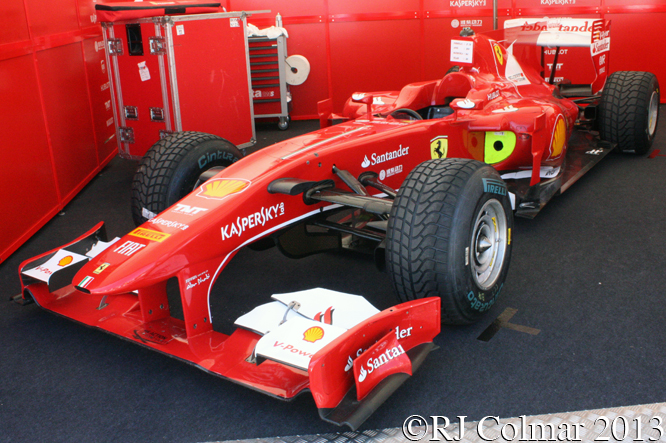
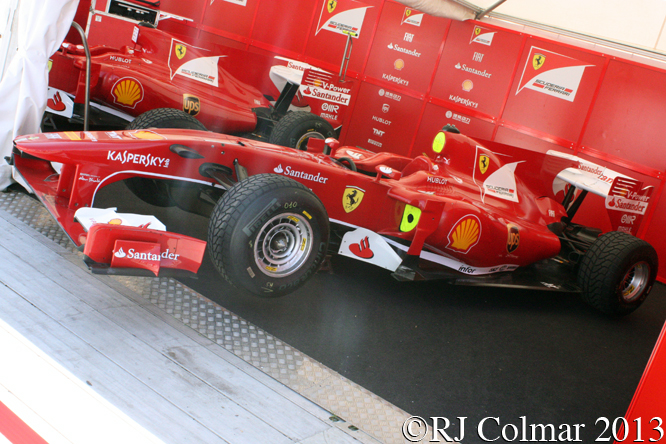
For 2010 Ferrari produced it’s 56th World Championship challenger the Ferrari F10, seen here earlier this month at the Goodwood Festival of Speed, that was driven by incumbent number two Felipe Massa and Kimi Räikkönen’s replacement Fernando Alonso in the de facto number one Ferrari seat.

Ferrari F10, Goodwood Festival Of Speed

The credits for the design of the Ferrari F10 are attributed to Technical Director Aldo Costa, Engine and Electronics Director Luca Marmoni, Chief Designer Nicholas Tombazis …

Ferrari F10, Goodwood Festival Of Speed

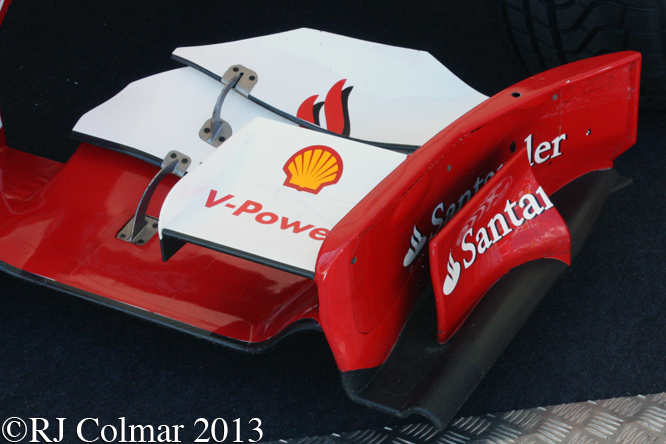
and Chief Aerodynamicist Marco de Luca. A team of several dozen will have worked on constantly improving the design and performance of the front wing alone.

Ferrari F10, Goodwood Festival Of Speed

The independent front torsion bar suspension is activated by the diagonal elements that rise from the bottom of the wheel hubs to a position within the chassis above the wishbones. The semi-automatic, electronically controlled sequential gearbox has seven forward speeds plus a mandatory reverse.

Ferrari F10, Goodwood Festival Of Speed

800 hp is claimed from the 2.4 litre / 146 cui V8 which is restricted to 18,000 rpm. The motor is mounted at 3.5° to horizontal to improve the airflow under the car that generates much of the cars downforce.

Ferrari F10, Goodwood Festival Of Speed

The 2010 season proved a success for Ferrari, team leader Fernando Alonso won
5 races in Bahrain, Germany, Italy, Singapore and Korea. Going into the last race of the 2010 season Alonso only had to finish 4th to claim the championship.

An unforced team error when the team failed to call Fernando in during a safety car period meant that Fernando was on the wrong tyres at the wrong time unable to challenge Vitaly Petrov for fourth place while rival Sebastian Vettel won the race and the championship driving a Red Bull.

Felipe Massa finished 6th in the championship having been robbed of his only opportunity to win the German Grand Prix by team orders directing him to let Fernando Alonso through to win the race. The one-two result stood despite a US$100,000 fine which Ferrari attracted for the team order call which were expressly forbidden at the time.

Ferrari finished third in the manufacturers championship behind Red Bull and McLaren.

Thanks for joining me on this “Wrong Footed By Safety Car” edition of ‘Getting a li’l psycho on tyres”, I hope you will join me again tomorrow. Don’t forget to come back now !

Share

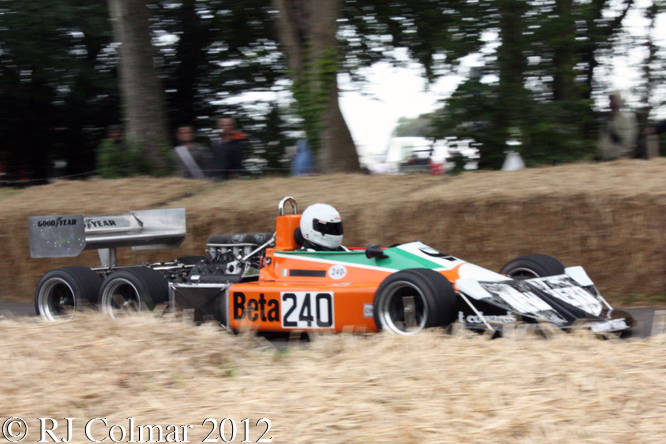
Showboating – March Cosworth 2-4-0

The story of March racing cars presence in Formula One was one of a meteoric rise in a blaze of publicity and a slow decline, the company founded in October 1969 had built six of the 22 cars that started the 1970 British Grand Prix, thanks to Ken Tyrrell who bought three March cars for 1970, after his split with Matra, a March driven by reigning Driver Champion Jackie Stewart started on pole position at the first race of the 1970 season and won the Spanish Grand Prix, the second race of the season.

In 1971 Ronnie Peterson joined the works team and finished second in the drivers championship with no wins but 4 second place finishes. It was not until 1975 that the works March team won it’s first championship Grand Prix when Vittorio Brambilla crossed the line first at the prematurely concluded 1975 Austrian Grand Prix and promptly crashed into the crash barrier on the slowing down lap. For 1976 Ronnie Peterson rejoined the March team and won the Italian Grand Prix which proved to be the team and manufacturers final championship Grand Prix victory.

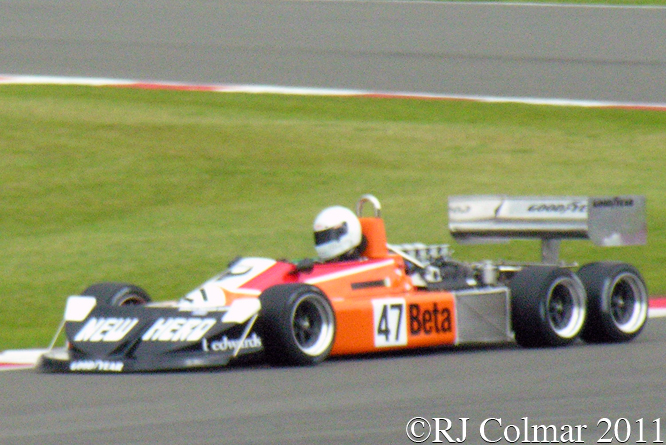
March Cosworth 2-4-0, Silverstone Classic

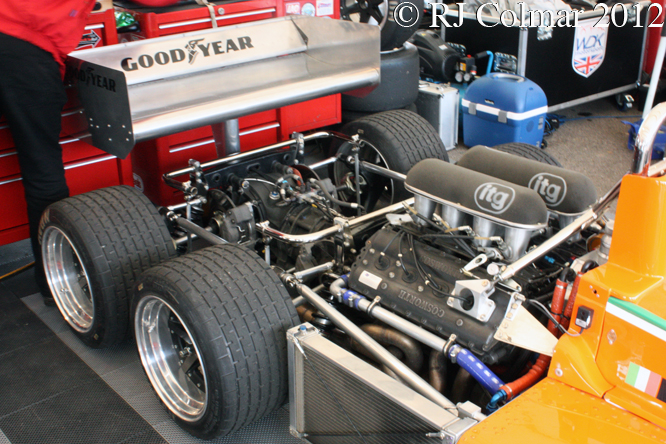
Looking forward to 1977 the team was short of cash when designer Robin Herd, who had designed the all wheel drive Cosworth in 1969 after he left McLaren, came up with the idea of building a six wheel car with four driven rear wheels as a way to improve on the mildly successful 6 wheel, 4 steering wheels at the front, Tyrrell P3/4. Team co-founder Max Moseley was instantly sold on the idea realising a six wheel March would be an excellent vehicle to generate some publicity and attract potential sponsors.

The shortage of cash meant the team focused on building the 4 wheel drive train and attendant suspension and attaching it to the back of a 1976 March 761, according to the best sources available to me this was chassis #761/1 which after several accidents was on it’s third monocoque tub and renumbered 761/10 for it’s press launch in early 1977 where a white prototype was shown. Turns out that only two of the rear wheels were driven at the press launch because not all of the internal components of the drive train had been finished in time to be installed.

March Cosworth 2-4-0, Silverstone Classic

When all the parts were ready they were attached to the back of chassis #761/2 and Howden Ganley was employed to test the car with a strange mix of old body panels including a nose clearly marked Doug Sherison Racing that probably came from a March 76A Formula 5000 car.

Howden commented on his experience “I tested the 6-wheeler three or four times. I think once at Goodwood and the other times at Silverstone. There were a few teething problems with the transmission – but eventually it all worked OK. I do not recall Max ever asking me to go easy on the power. In fact the last test in the pouring rain at Silverstone I used full acceleration without encountering any traction problems. Quite impressive.”

March Cosworth 2-4-0, Silverstone Classic

The concept did indeed attract a lot of attention and in March 1977 Rothmans held a press day at Silverstone at which they announced they would sponsor Ian Scheckter who tested the all wheel drive system now attached to a much older chassis, painted in Rothmans colours, that started life in 1974 as a March 741 #741/1 was renumbered to become #751/4 in 1975 and renumbered again to become #761/5 in 1976.

Regrettably after testing the concept the March team decided to revert to running a conventional 4 wheel 2 wheel drive layout for their 761’s which were updated to 761B spec for the start of the 1977 season. Around this time a well known picture began circulating of Alex Ribeiro sitting in his Hollywood sponsored car fitted with the 4 wheel drive transmission and a third set of rear wheels, as can be seen in this link young Brazilian F3 pilot Nelson Piquet can hardly keep a straight face in the prank photo.

At the end of the season March folded it’s F1 operation, although it was continuing to make good money on the 2-4-0 from the Scalextric model rights and from a show car for which there was much demand. Despite the fact that the 6 wheel March 2-4-0 was never raced, so far as I know Robin Herd remains the only man to have designed two four wheel drive formula one cars neither of which raced, in period, a couple of years later Roy Lane managed to acquire the 4 wheel drive axles and fitted them to his March 771 which he used in the 1979 British Hillclimb Championship.

Roy won a round of the championship at Wiscombe Park but found that the advantages of the system in wet conditions were out weighed by the performance of the lighter 2 wheel drive in the dry and ended up converting his car back to a conventional layout during the course of the season in which he failed in his attempt to recapture the British Hillclimb Championship.

The car featured today was built up by Anthony and Jeremy Smith with one of the two original 4 wheel drive transmissions built and a chassis who’s in period identity has not been established. Jeremy is seen at the wheel of the car at Silverstone top and Goodwood middle. By complete coincidence this March 2-4-0, there is another at the Louwman Museum, is currently for sale at Speedmaster Cars in Wetherby.

My thanks to James Hanson at Speedmaster Cars who kindly answered my questions about the chassis of today’s featured car and to members of The Nostalgia Forum, not least Tony “Giraffe” Gallagher, who posted pieces of the March 2-4-0 jigsaw puzzle seen on this linked thread.

Thanks for joining me on this “Showboating” edition of “Gettin’ a li’l psycho on tyres” I hope you will join me again tomorrow. Don’t forget to come back now !

PS Anyone planning on going to next weeks Silverstone Classic please remember this year will be advanced ticket only available on this link.

Share

More Fuel – McLaren Ford M14A #M14/2

Going into 1970 things were looking up as McLaren Cars entered their seventh year. The team had won three consecutive Can Am Championships, 2 for Bruce McLaren and one for Denny Hulme, the inaugural European Formula F5000 championship with Peter Gethin and four championship Formula One races one for Bruce McLaren and three, including the last race of 1969, for Denny Hulme.

In addition to these racing programs for 1970 McLaren were to embark on an Indy program with the new turbocharged McLaren Offy M15 and were contracted to run an Alfa Romeo V8 powered car alongside their new Ford powered M14A Formula One car.
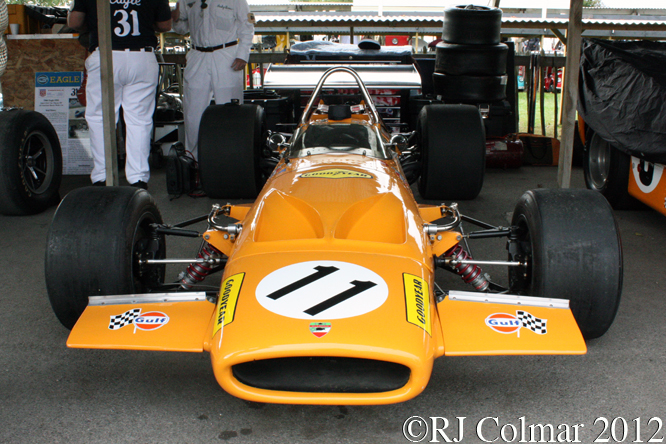
McLaren Ford M14A, Goodwood Revival

The new M14A was an improvement of the 1969 McLaren M7C, itself based on a Formula F5000 M10A chassis with McLaren M7A Grand Prix winning suspension.

The main feature of the new car was the narrower internal dimensions of the monocoque which were necessary to accommodate larger fuel tanks required by the ever more powerful and thirsty Ford Cosworth DFV V8’s.
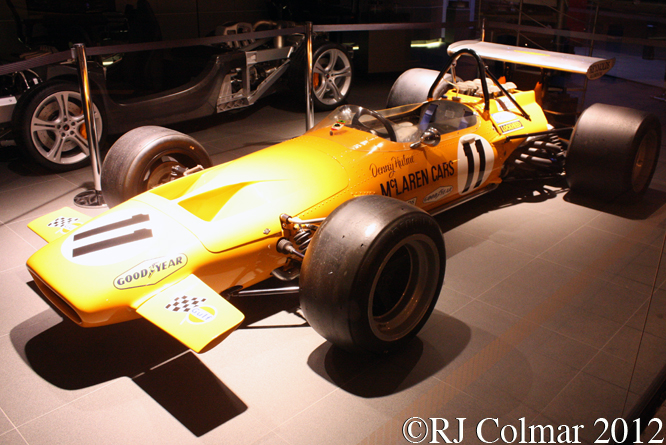
McLaren Ford M14A, McLaren Manchester, Knutsford

The McLaren M14A was used in all but one race in the 1970 Formula One championship season. It’s best result was on it’s debut in South Africa where Denny Hulme finished second, driving I believe today’s featured car. Bruce McLaren matched that in Spain where he also finished second. After the Monaco Grand Prix where Denny finished forth disaster struck as first Denny was badly burned after his car caught fire in testing at Indianapolis and then a couple of weeks later Bruce was killed while testing the M8D Can Am car at Goodwood.

The team consequently missed the Belgian GP and reappeared at the Dutch Grand Prix with Dan Gurney driving the lead car #M14/1 and 1969 European Formula 5000 champion Peter Gethin making his Formula One championship debut driving today’s featured chassis, both cars retired. Denny Hulme still suffering from burned hands was back in time for the French Grand Prix alongside Dan Gurney and the pair came in 4th and 6th respectively.

#M14/2 is seen at the McLaren Manchester show room in Knutsford above.
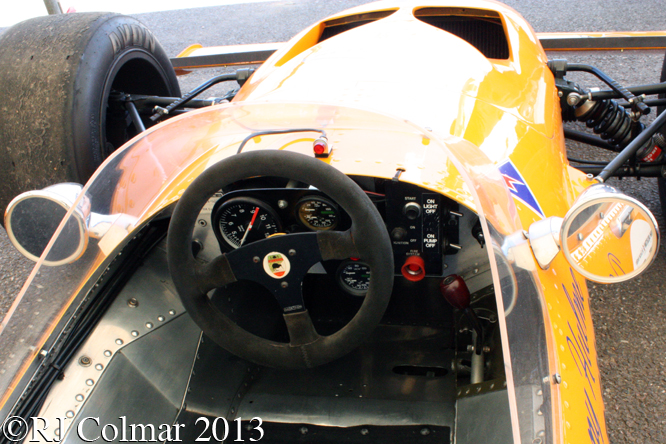
McLaren Ford M14A, Goodwood Festival Of Speed

Dan Gurney retired from Formula One after retiring from the British Grand Prix where Hulme finished a remarkable 3rd. Peter Gethin was back in the team for the German Grand Prix where Denny again finished 3rd. Denny retired from the Austrian GP but at Monza for the Italian Grand Prix he came home 4th. Peter Gethin scored his first World Championship point at the Canadian Grand Prix where he finished 6th and Denny rounded out a painful year with a third in the Mexican Grand Prix finishing 4th in the Formula One Championship points table.

Incredibly despite his injuries Denny had also won 6 of the 10 Can Am Championship rounds enough to win the 1970 Chamionship his second Can Am Crown and McLaren Cars 4th consecutive championship aided by a further win from Peter Gethin who also won a second consecutive European Formula 5000 title driving a McLaren. The US, New Zealand and South African Formula 5000 thousand championships were won by John Cannon, Graham McRae and Bob Olthof respectively all also driving McLarens.
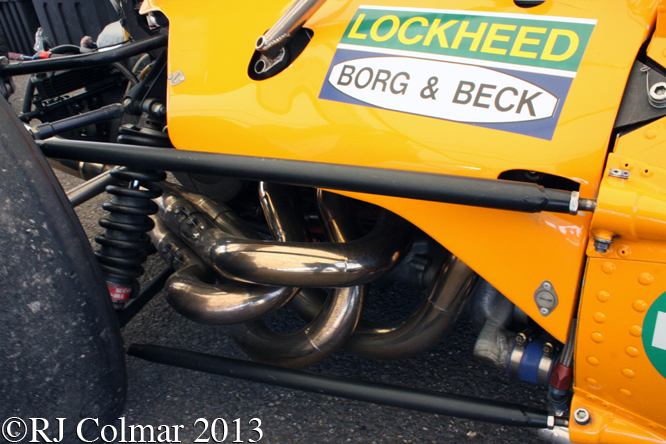
McLaren Ford M14A, Goodwood Festival Of Speed

For 1971 #M14/2 was driven by Peter Gethin to two second place finishes in non championship races at Oulton Park and Brands Hatch, the best championship result Peter had from 3 championship start in the car was 8th in the 1971 Spanish Grand Prix.

Jackie Oliver joined McLaren for the British Grand Prix where he qualified #M14/2 22nd but a bungled flag drop saw Jackie crash into Graham Hill at the start causing instant retirement for both and a £50 fine for Jackie. The cars final works appearance was at the 1971 Italian Grand Prix where Jackie qualified 13th and finished 7th in a close fought race won by Peter Gethin now driving a BRM.
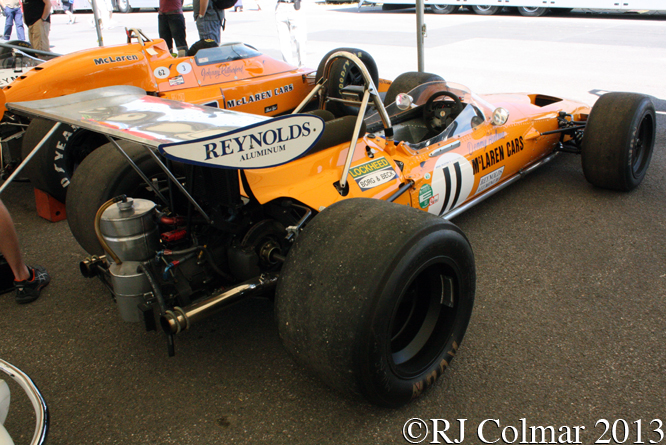
McLaren Ford M14A, Goodwood Festival Of Speed

#M14/2 next appeared with a Formula 5000 Chevy stock block V8 motor in the hands of Tony Dean who’s best result was a 10th place finish in his first start in the car at Mondello Park. On his seventh and final attempt, which included retirements from races at Elkhart Lake and Brainerd, to race the car Tony failed to qualify for the non championship 1972 John Player Challenge Trophy at Brands Hatch.

In 1973 at the same venue Willie Wood failed to qualify #M14/2 for the Formula F5000 race or non championship Race of Champions and was not classified in a further appearance at Oulton Park. Allan Kayes then bought #M14/2 was also unclassified at Brands Hatch, finished 11th at Oulton Park and then retired, failed to qualify or failed to start in 12 further races most of which were rounds of the 1974 European Formula 5000 championship.

Thanks for joining me on this “More Fuel” edition of “Gettin’ a li’l psycho on tyres” I hope you will join me again tomorrow. Don’t forget to come back now !
Share