Tag Archives: Festival of Speed

20th Anniversary – Goodwood Festival Of Speed

Last weekend saw the 20th Anniversary celebrations of the Goodwood Festival of Speed. According to tea total journalist Doug Nye the event only got off the ground because he was present at a rather drunken evening at which Lord March and some friends were fantasising about an event which might attract a few thousand motor enthusiasts. Next morning when Doug reminded the Lord of what had been said they decided to act and so was born the Goodwood Festival Of Speed which has become one of the highlights of the British Motoring Season.
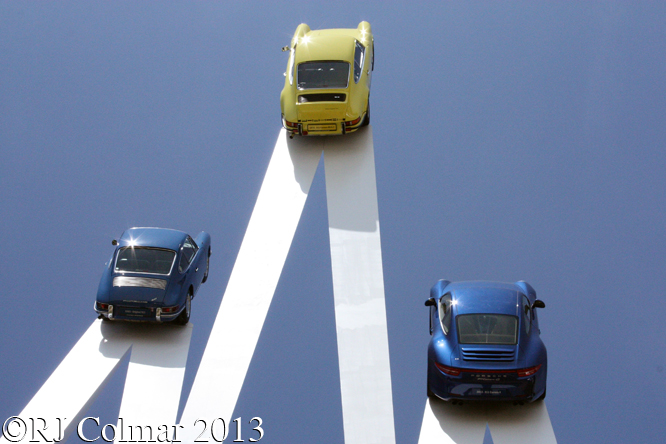
Goodwood, Festival Of Speed

The event has become so big that it sells out on both the Saturday and Sunday and an extra day has been added on the Thursday, called the “Moving Motor Show” on which the hill climb track is turned over to corporate sponsors who entertain their guests with rides up the hill. It was on the Thursday that I went with my parents after my Dad found a free ticket offer in the “Daily Telegraph“. Many anniversaries besides Goodwood’s 20th were being celebrated, the three Porsche’s above formed the tip of a sculpture by Gerry Judah celebrating the 50th Anniversary of the Porsche 911 featuring a 1963 911 on the left, a ’73 Carrera RS in the middle and a 2013 Carrera 4 on the right.
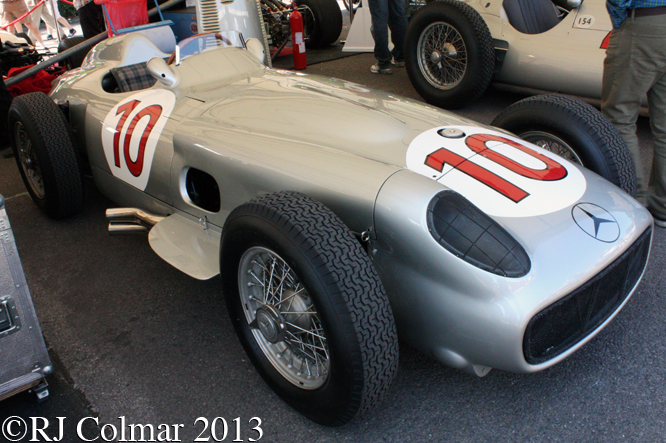
Mercedes W196, Goodwood, Festival Of Speed

On the Friday a 1954 Mercedes Benz W196 similar to the one pictured here was sold at the Bonham’s Festival of Speed Auction for US$ 29.6 million to become the most expensive car ever sold at auction. John Lennon’s Blue ’64 Ferrari 330GT fetched US$ 543,750 setting a new record for the 330 GT 2+2 model.
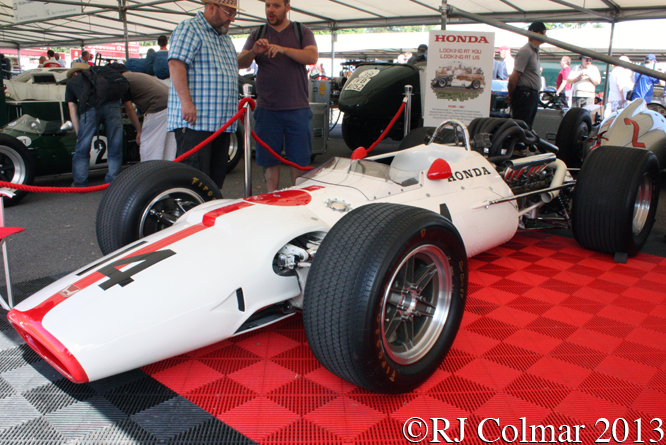
Honda RA300, Goodwood, Festival Of Speed

In the autumn of 1967 my folks purchased their first television, a black and white model, one of my earliest memories of it was a news cast featuring the 1967 Italian Grand Prix which was won by John Surtees driving this very V12 Honda RA300, a car that was very easy to distinguish from the rest of the field because it was white and all the others were various shades of grey.
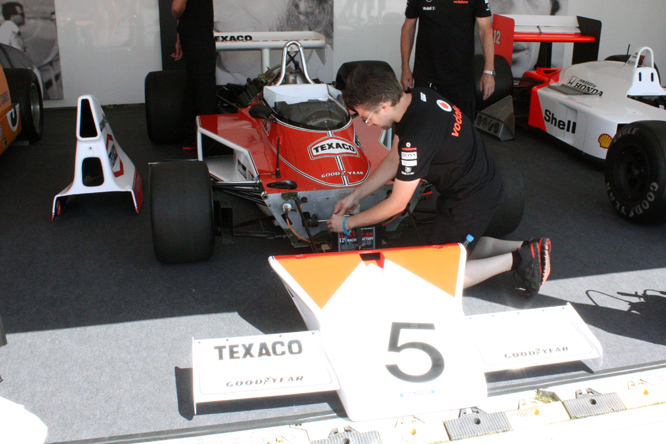
McLaren M23, Goodwood, Festival Of Speed

Emerson Fittipaldi moved from Lotus to join the McLaren team which had relieved BRM of Marlboro sponsorship and Lotus of Texaco sponsorship for the 1974 season. Emerson driving a Marlboro Team Texaco McLaren M23 ended up winning a very open World Drivers Championship by just 3 points from Clay Regazzoni driving a Ferrari 312 B3.
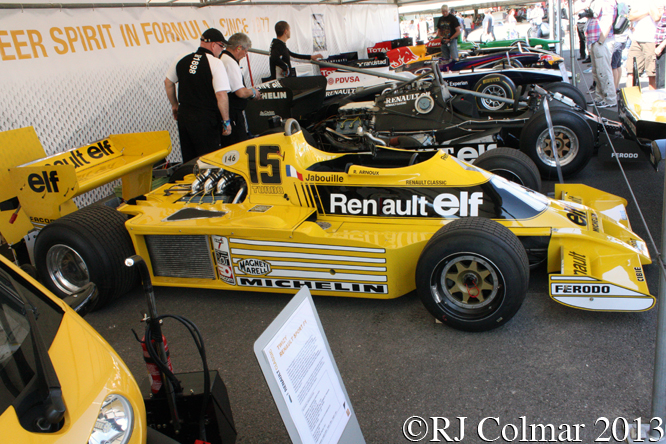
Renault RS01, Goodwood, Festival Of Speed

Having won Le Mans in 1978 Renault put all of it’s effort into winning the Formula One Drivers and Constructors championships with the first turbocharged Formula One car. Above is the 1978 RS01 which proved fast on occasion, particularly at altitude, but fragile.
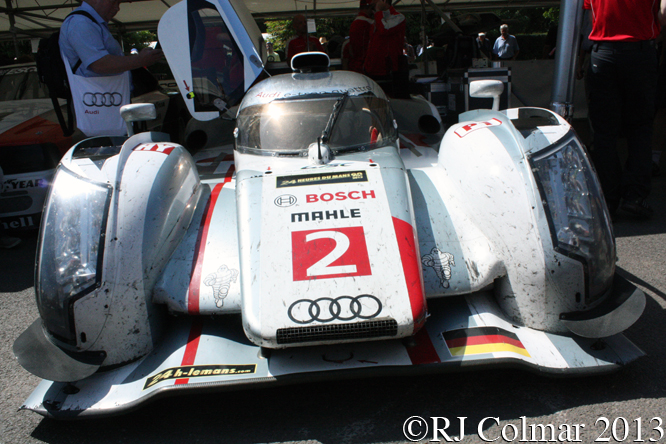
Audi R18 E-tron Quattro, Goodwood, Festival Of Speed

Fresh from victory lane, and looking several thousand miles the worse for wear, in the 90th Anniversary edition of the Le Mans 24 hours was the Audi R18 E-tron Quattro driven by Tom Kristensen, Alan McNish and Loic Duval.
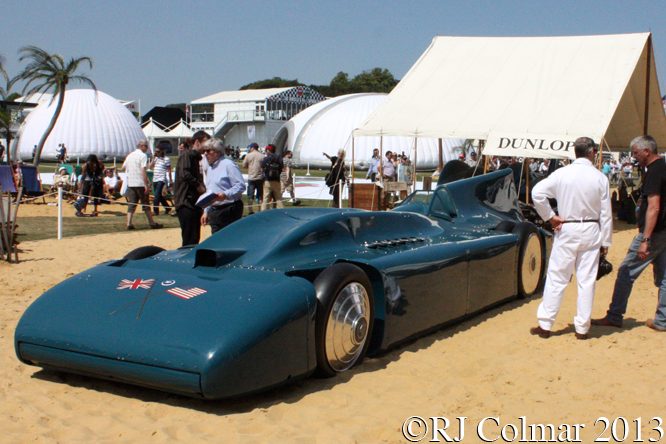
Campbell-Railton Blue Bird, Goodwood Festival Of Speed

Sir Malcom Campbell became the first man on four wheels to exceed 300 mph when he set a new Land Speed Record at Bonneville of 301mph on September 3rd 1935 when driving the 2300 hp supercharged Rolls Royce V12 powered Campbell-Railton Blue Bird. The piece of land on which Blue Bird was displayed normally serves as Lord Marches cricket pitch.
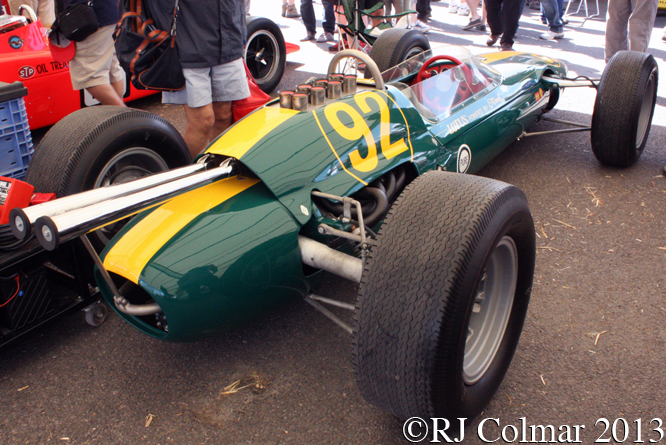
Lotus Ford 29, Goodwood Festival Of Speed

Regular readers will remember that the #92 Lotus Ford 29 driven by Jim Clark at Indianapolis in 1963 was destroyed in a fatal accident with Bobby Marshman at the wheel during a gruesome testing accident at Phoenix at the end of 1964. The car seen above is chassis #29/1 actually driven with a white and blue paint job by Dan Gurney to a seventh place finish at Indy in 1963. The car has been seen at the Indy Museum for many years (decades ?) bearing Jim Clark’s livery. The spare ’63 Lotus 29 chassis #29/2 currently carries the #91 white and blue livery used by Gurney.
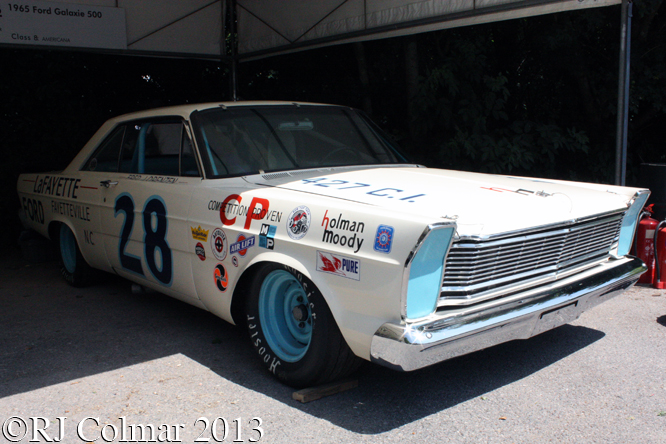
Ford Galaxie 500, Goodwood Festival Of Speed

“According to the programme” the Ford Galaxie 500 above was driven to victory in the 1965 Daytona 500 by Fred Lorenzen and then given a ’66 body for testing at Daytona the following year, however a search on the internet show’s that this might not be the only car sharing the story.
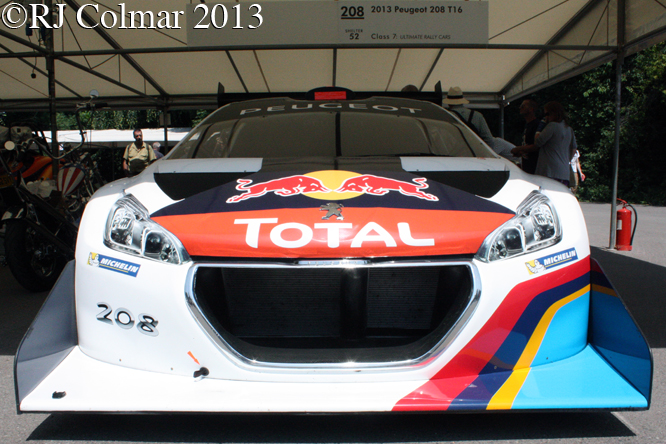
Peugeot 208 T16, Goodwood Festival Of Speed

Another car to arrive at Goodwood from victory lane was the 875 hp twin turbo V6 Peugeot 208 T16 with which Alsatian 9 (nine) time World Rally Champion Sebastian Loeb won this years Pikes Peak race to the clouds hill climb in a mind bending 8m 13.8 seconds an astonishing 95 seconds faster than Rhys Millens 2012 full 12.42 mile course record of 9m 46.1s. Tighten your reality belts to see how Mr Loeb set the record in the film linked here.
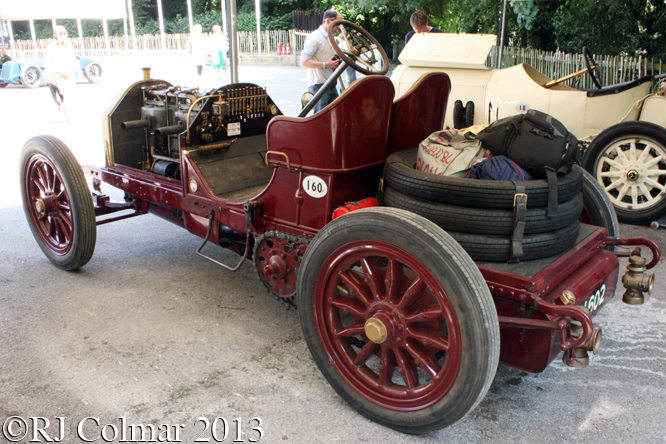
Mercedes 60hp, Goodwood Festival Of Speed

Any one who was reading GALPOT back in January might remember I spent a night and a day on the Exeter Trial being chased by a 4×4 Panda and following this 1903 Mercedes 60 hp Simplex crewed by Ben and Roger Collings, my appreciation of what these vehicles can do rose sharply as a result of the experience.
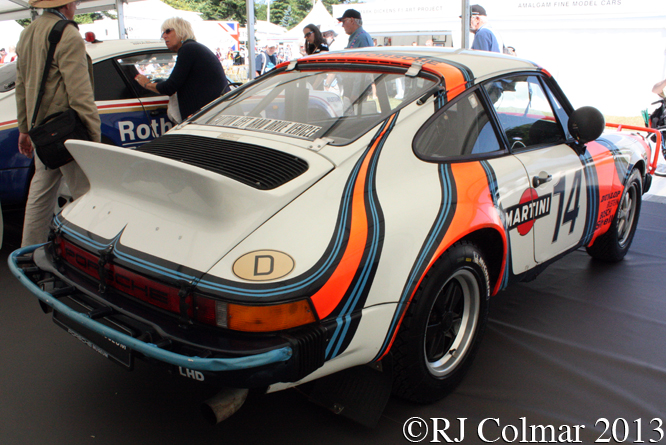
Porsche 911SC, Goodwood Festival Of Speed

Car of the show for me was this 1978 Porsche 911 SC driven by Kenyan Vic Preston Jnr with co driver John Lyall to second place in the 1978 Safari Rally. I always thought if I was going to have a 911 for the road I may as well have one that could survive the rigours of Africa where I learned to drive and this one has a particularly cool paint job.

Over the coming months some of these vehicles will be featured in more depth.

Thanks for joining me on this “20th Anniversary Festival Of Speed” edition of “Gettin’ a li’l psycho on tyres”, I hope you will join me again tomorrow. Don’t forget to come back now !

Check out the latest from the Formula One silly season at Motorsports Unplugged on this link.

Share

Like No Lighter You’ve Known Before – Eagle Mk 1 #AAR104

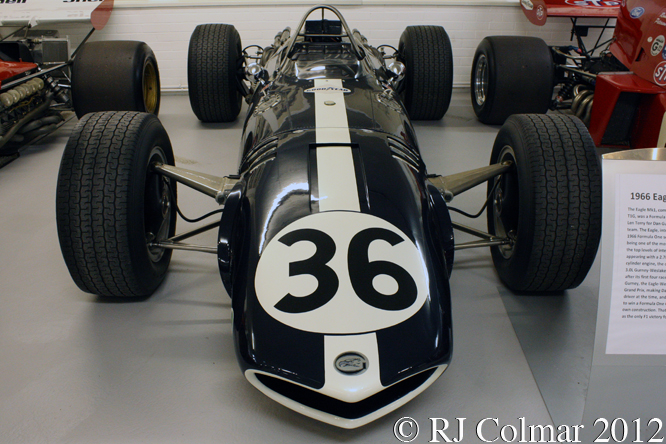
The story of the Eagle Formula One car began when the Goodyear Tyre and Rubber Company asked Carol Shelby and Dan Gurney founders of All American Racers Inc to build an Indy 500 challenger with which to compete against Firestone shod Indy cars. Part of the deal included the go ahead to build a Formula One car “to represent the U.S.A.”

Eagle Westlake Mk 1, Donington Museum

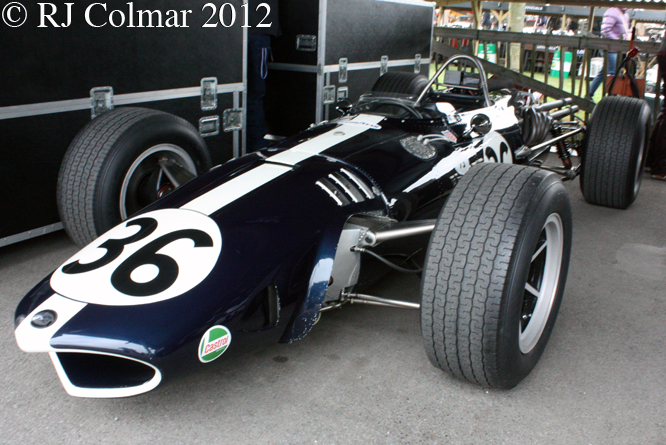
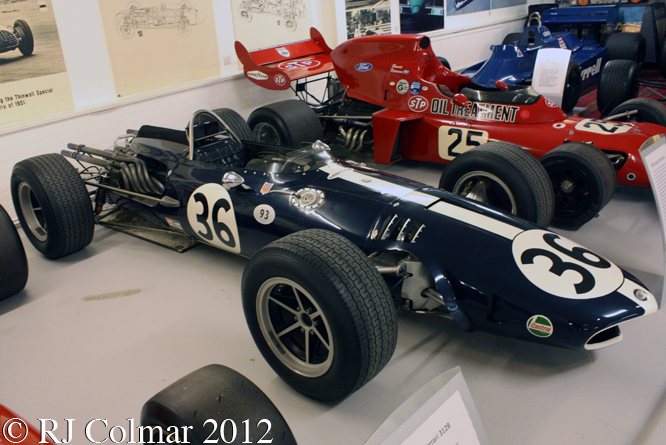
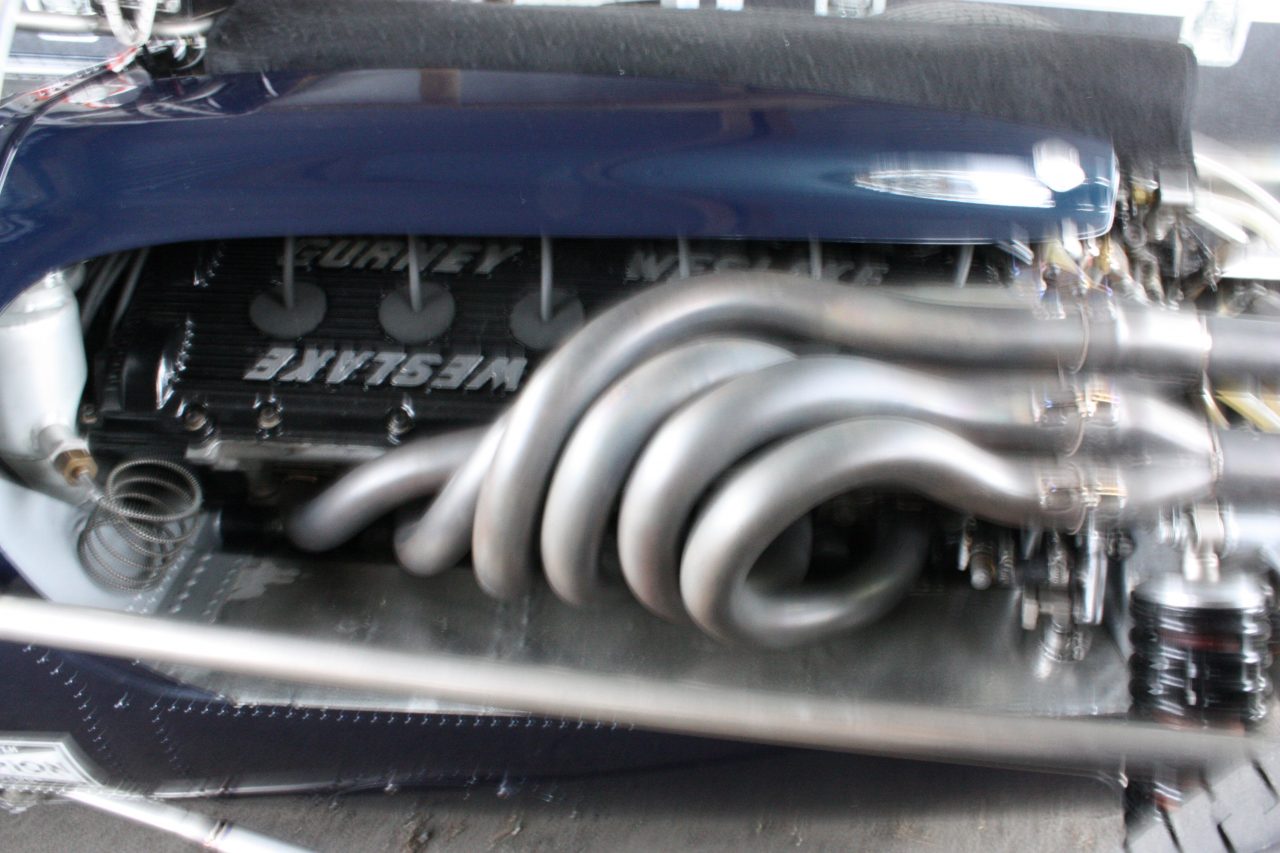
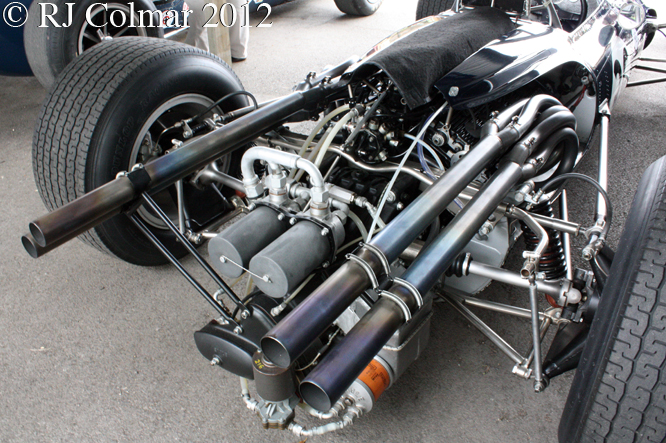
Shelby and Gurney turned to Len Terry to produce a design for a chassis that met both tasks. Terry had been responsible for the design of the Lotus 38 which Clark and Gurney drove in the 1965 Indy 500 which had been convincingly won by Clark who led 190 laps from pole. The Mk 2 was a Ford V8 powered Indy car, while Mk 1 was the Formula One variation featured today which was to be powered by an Aubery Woods designed V12 that was to be built at Harry Westlake’s premisses in Rye, Kent, England.

Eagle Westlake Mk 1, Goodwood Revival

The chassis for both program’s were manufactured at All American Racers premises in Santa Ana, California with the complete Formula One chassis being sent on to a new shop Gurney had set up close to Harry Westlake’s premisses in ‘the ancient pirate town’ of Rye and operated by Anglo American Racers. The Westlake V12’s were only ready midway through the season and to get there project underway Gurney drove his Eagle with a slightly undersized Coventry Climax four cylinder motor.

Eagle Westlake Mk 1, Donington Museum

The origins of the 3 litres / 183 cui Westlake V12 lay in a 500cc /46.25 cui 2 cylinder motor that Aubery Woods had built for Shell Oils funded research project. Gurney heard about the motor from his former BRM colleague Woods and had the motor built with a budget of US$600,000 by Westlake. Westlake’s facilities were a little on the primitive side using military surplus tooling that dated back to the 1914/18 Great War. However despite poor interchangeability of parts from one motor to the other they were more reliable than some of the ancillaries including the electrics and fuel pumps. There was a design flaw in the oil scavenging system which was discovered too late in the development of process that sees the sump fill up with oil during the course of a race which causes a steady loss of horsepower.

Eagle Westlake Mk 1, Goodwood Revival

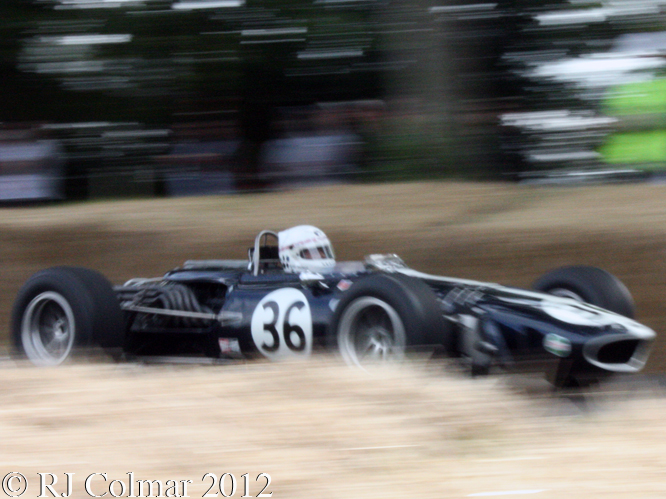
The first three Mk 1 chassis built from aluminium, but the forth car seen here was built with the extensive use of titanium and magnesium alloy in an effort to reduce weight. Gurney commented that driving the 104 was like “driving a Ronson cigarette lighter” as magnesium alloy is exceptionally flamable.

Eagle Westlake Mk 1, Goodwood Revival

Just one week after his victory in the Le Mans 24 hours with AJ Foyt with whom he shared a Ford Mk IV, at the 1967 Belgian Grand Prix Gurney qualified AAR104 on the front row next to Jim Clark in his Lotus 49. Clark led the race until he needed an unscheduled stop to change his spark plugs. Jackie Stewart starting from sixth took over the lead while Gurney also had an unscheduled stop to cure a fuel pressure problem. Gurney resumed in second place when Stewart’s car developed a gear box problem. With 8 laps to go and breaking the 8 year old Spa Francochamps lap record Gurney swept into the lead and the first Grand Prix victory by an American driving and American car since Jimmy Murphy won the French Grand Prix driving a Dusenberg in 1921. He also started the habit of spraying champagne during Grand Prix victory race celebrations, having done so for the first time at Le Mans a week earlier.

Eagle Westlake Mk 1, Goodwood, Festival of Spee

At the German Grand Prix Gurney led and set the fastest lap again when his car retired with half shaft failure with 3 laps to go. That fastest lap on Europe’s most challenging circuit was particularly satisfying. Dan’s only other finish in ’67 was 3rd in the Canadian Grand Prix.

Running out of money the AAR team continued into 1968 at the Nurburgring again, but this time in the fog and rain Gurney had another satisfying if unrewarding drive having recovered from last place after a puncture to a season best, indded only, ninth finish for the Eagle. During that race Gurney became the first man to wear a, Bell, full face helmet in a championship Formula One race.

The Eagle Mk 1 appeared for the last time at the Italian Grand Prix where Dan qualified 12th, but retired with an overheating motor. AAR acquired a Ford Cosworth powered McLaren M7A with which to compete in the last three races of the 1968 season, scoring a best 4th place finish in the US Grand Prix.

Note: The Eagle Mk 1 is often referred to as the Eagle T 1 G which was Len Terry’s designation for the design.

Thanks for joining me on this “Like No Lighter You’ve Known Before” edition of “Gettin’ a li’l psycho on tyres” I hope you will join me again tomorrow for Ferrari Friday. Don’t for get to come back now !

Share

Stirling’s Favourite – Ferguson Climax P99

“Harry” Ferguson was born on Novmeber 4th 1884 in Growell, County Down, Nothern Ireland. He started work with his brother in a bicycle and car repair business in 1902, while there Harry started racing motorcycles in 1904 and on the 31st December 1909, having designed and built a monoplane, he became the first person to fly in Ireland.

Ferguson Climax P99, Goodwood Festival of Speed

In 1911 Harry went into business selling motor and agricultural vehicles. On seeing the short comings of some of the agricultural products he was selling he began devising his own, including a new hydraulic system and three point linkage for attaching ploughs.

Harry entered into a hand shake agreement with Henry Ford Snr for Ford to manufacture the Ferguson patents under license in 1939. In 1947 Henry Ford II, Seniors grandson, reneged on the deal and five years later settled with Harry out of court to the tune of $9 million, around half of which went to Harry’s legal representatives.

Ferguson Climax P99, Goodwood Festival of Speed

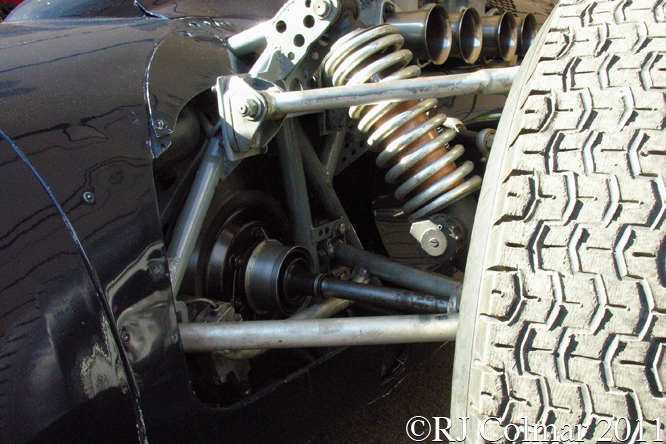
In 1950 Harry employed Aston Martin designer Claude Hill and along with two pre 1939/45 war friends Fred Dixon, who prewar had proposed building an all wheel drive Land Speed Record (LSR) car and former ERA racer Tony Rolt began working on an innovative all wheel drive road car featuring electric windows, disc brakes and access to the rear through a hatchback, all idea’s which were unknown in European passenger car production at the time.

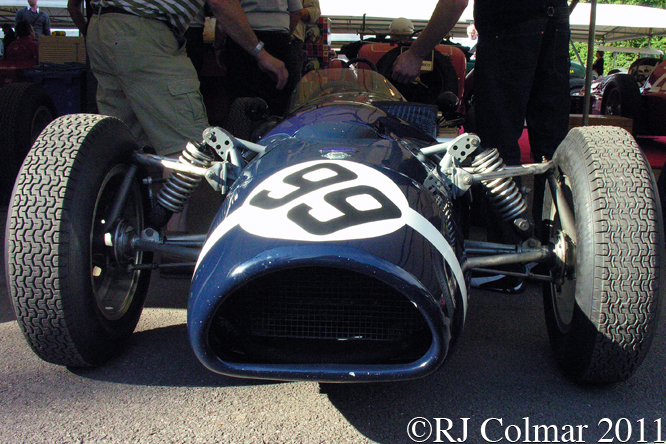
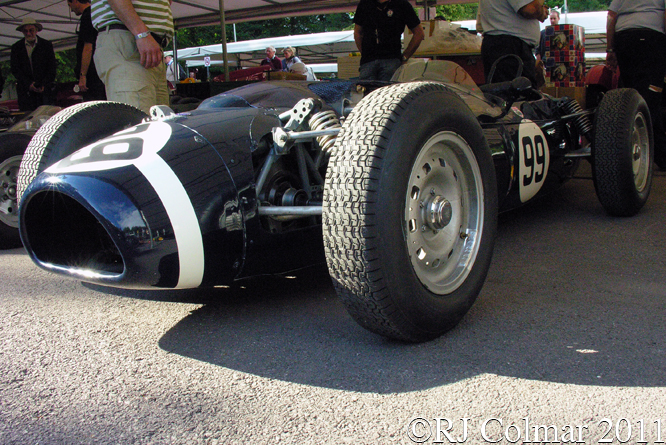
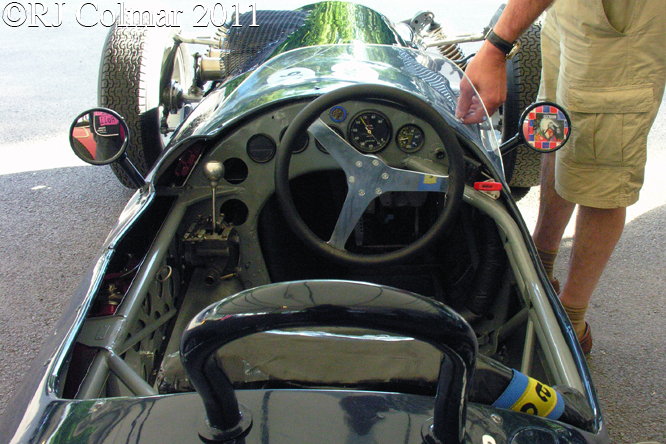
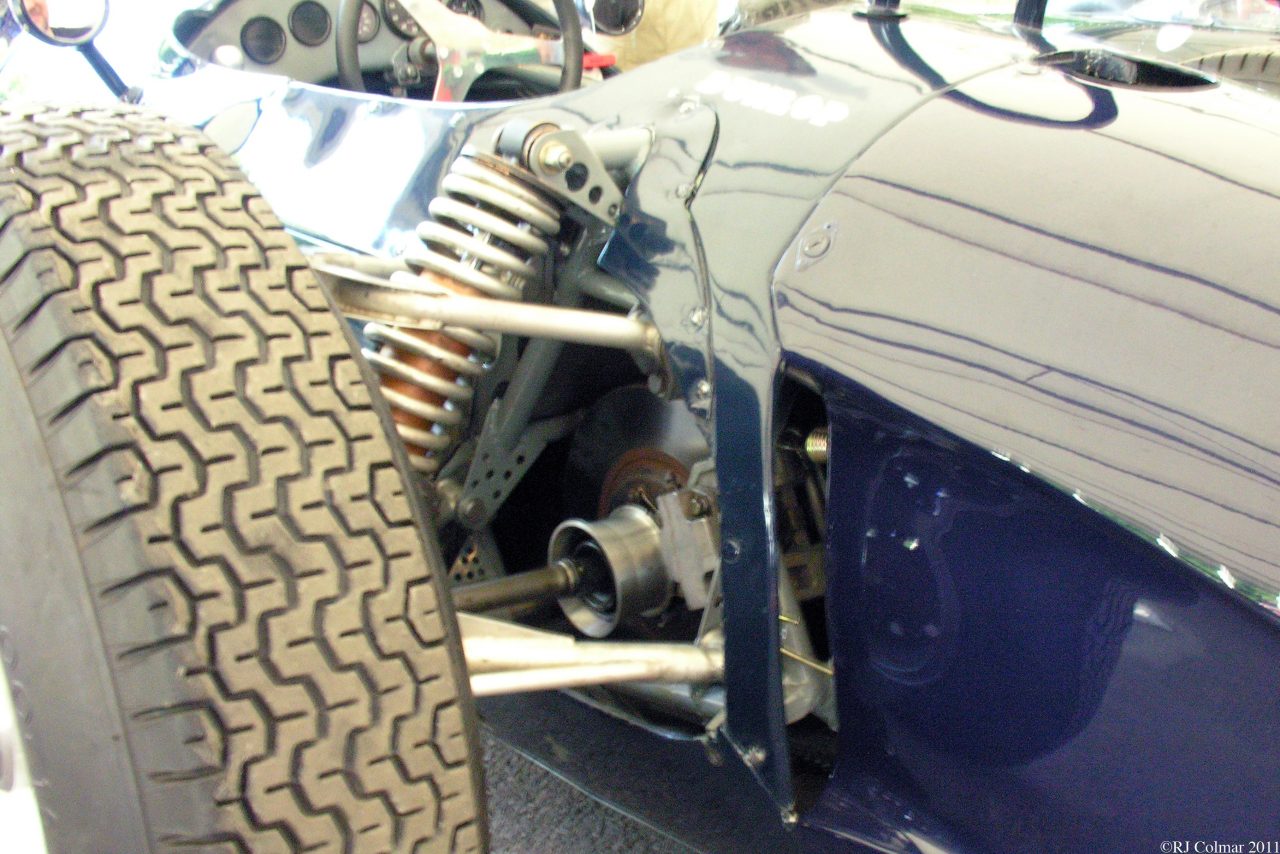
Project 99 a research vehicle, that became the worlds first all wheel drive Formula One car, to promote the all wheel drive concept was given the green light in May 1960, just 6 months before Harry’s death at the age of 75.

Ferguson Climax P99, Goodwood Festival of Speed

The P99 made it’s public debut in an Intercontinental Formula race with a 2.5 litre / 152 cui Coventry Climax motor at Silverstone in 1961 where Tony Rolt’s former entrant Rob Walker entered the car for Jack Fairman alongside Stirling Moss in a similarly powered Cooper.

Fairman retired from the race with a broken gearbox that may have resulted from excessive engine braking in the absence of reliable brakes, while Moss went on to a comfortable victory in the Cooper. At the British Grand Prix, where the Fergusson appeared with a 1.5 litre / 91.5 cui Climax, Fairman qualified 20th but ran into electrical problems, after Stirling Moss had retired his Rob Walker entered Lotus 18 he took over from Fairman in the P99. The car was later disqualified for receiving a push start.

Ferguson Climax P99, Goodwood Festival of Speed

Stirling Moss was entered to drive the Ferguson in the Oulton Park Gold Cup, a non championship race for Formula One cars entered by most of the top teams except Ferrari and Porsche. Stirling won easily to record the first, and only, win of a (non championship) Formula One race with an all wheel drive car and coincidentally the last (non championship) win for a front engined Formula One car.

The Fergusons 1.5 litre / 91.5 cui Formula One motor was uprated to 2.5 litres / 152 cui and subsequently entered in a series of non championship Antipodean Formula Libre, unrestricted, races in early 1963 where Graham Hill drove the car to a second place finish in the Australian rain at Lakeside and a forth place in the sub tropical summer heat of New Zealand at Pukekoe where with a mile to go his gearbox packed up while again running in second place.

Innes Ireland drove the P99 in the next three events finishing third at Leven, but retired from both of the other races. Graham Hill raced the car one more time at Warwick Farm where he came home sixth.

Ferguson Climax P99, Goodwood Festival of Speed

After a conversation with Stirling Moss, who had praised the benefits of the P99’s all wheel drive,Indy 500 entrant Andy Granatelli instigated a test in which Jack Fairman and Bobby Marshman drove the P99 at Indianapolis with the 2.5 litre / 152 cui motor and recorded average speeds of over 140 mph, Marshman claimed he did not need to lift at all for any of the corners, the car was so underpowered. Andy was sufficiently impressed that he employed Ferguson Research to develop all wheel drive for his 1964 Indy 500 challenger the Studebaker STP Special.

Granatelli never won the Indy 500 with an all wheel drive car but kept backing the concept through various incarnations the last of which was the all wheel drive Lotus 64 built in 1969, after which all wheel drive was banned from the brick yard.

Rolt, Fergusson P99, Richmond Trophy, Goodwood Revival

Ferguson Research was also involved with five all wheel drive Formula One projects including the 1969 Lotus 63, Cosworth and McLaren M9A, the last two of which I’ll be looking at in the weeks to come.

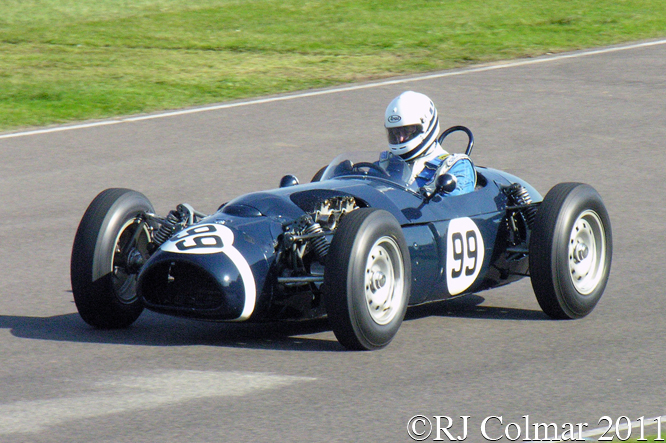
Although not the easiest car to drive Stirling Moss once described the Ferguson P99, which fascinated him, as his favourite racing car. Stuart Rolt, of the same Tony Rolt family is seen driving the P99 in practice for the 2011 Richmond Trophy at Goodwood above.

My thanks to Alan Cox, E.B., Ray Bell, Roger Clark and Michael Ferner at The Nostalgia Forum for their patience answering my questions about the the Ferguson P99.

Thanks for joining me on this “Stirling’s Favourite” edition of “Gettin’ a li’l psycho on tyres” I hope you will join me again tomorrow for a look at the first BRM to win a Grand Prix. Don’t forget to come back now !

08 07 13 Errata, I originally stated that Moss was entered in a Lotus 18 for a non championship race at Silverstone when the Ferguson made it’s debut, when in fact Stirling drove a Cooper Climax to victory in the race run to the Intercontinental Formula as now stated in the amended text. Thanks to Roger Clark for pointing out the error.

Share

Spirit Of ’76 – Chevrolet Corvette Greenwood #007

John and Burt Greenwood were the children of a WW2 fighter pilot who worked at the GM Tech Center. As a teenager John was working paper rounds so that he could build a Briggs Stratton powered kart. From there the Greenwood’s moved into street racing, preparing a car, racing it and then selling it to so that they could build up another.

Around 1968 the Greenwoods set up Auto Research Engineering to build engines and tune suspension and the following year started racing. John won back to back SCCA championships in 1970 and 1971. Over the following two years the Greenwood Corvettes had made trips to the Le Mans 24 hours where they had failed to finish having a best 16th place on the grid in ’72 to show for their efforts.

Chevrolet Corvette, Goodwood Festival of Speed

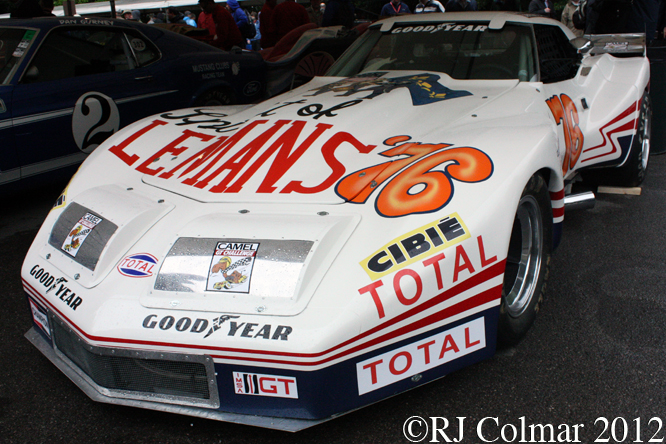
In 1976 John Greenwood was invited to return to Le Mans and this time he brought a wide bodied car to share with Bernard Darniche. Featuring a body that was developed the the aid of ‘Farther of the Corvette’ Zora Arkus-Duntov and aerodynamicist Randy Wittine that covered a 700 hp fuel injected 7 litre / 427 cui motor.

Chassis #007 had been built up for Rick Mancuso a racer from Illinois who entered the car in the ’76 Sebring 12 hours but crashed it in practice so that it did not start, #007 is not to be confused with John Greenwoods “Spirit of Sebring ’76” which started from pole in the same race, but retired after 36 laps with clutch failure.

Chevrolet Corvette, Goodwood Festival of Speed

At his third attempt John’s Corvette, which was timed at over 215 mph on Mulsanne straight, qualified 9th behind a the turbocharged BMW CSl driven by Brian Redman and Peter Gregg and was one of just 12 cars to get below 4 mins in qualifying beating his own previous best time by a clear 20 seconds.

Unfortunately it was not third time lucky in the race as the car was retired with a split fuel cell during the early hours bringing to an end John’s hugely popular presence at the La Sarthe circuit.

Thanks for joining me on this “Spirit of ’76” edition of “Gettin’ a li’l psycho on tyres” I hope you will join me again tomorrow for “Ferrari Friday”. Don’t forget to come back now !

Share

Le Point – Rondeau M379 B/C #003

Le Mans born Jean Rondeau had four cracks at the Le Mans 24 hours with a Chevron, Porsche (twice) and a Mazda RX3 when he decided to build his own 3 litre / 183 cui Ford Cosworth powered cars for the GTP category of the race. In 1976 and 1977 these cars known as Inatera’s the name of his wall paper manufacturing sponsor won the GTP class at Le Mans on both occasions the ’77 class win also netting drivers Rondeau and Jean Ragnotti a 4th place overall finish.

Rondeau 379B, Goodwood Festival of Speed

For 1978 Jean returned to the Le Mans circuit with a car bearing his own name for the first time and sharing his M378 with Bernard Darniche and Jacky Haran scored a third consecutive GTP class win as a manufacturer and his second as a driver coming home 9th overall from 40th on the grid.

Rondeau 379B, Goodwood Festival of Speed

Jean appeared at the 1979 race with updated M379 cars while the GTP entry he shared with Jacky Haran retired at two thirds distance with accident damage. A second car entered in the over 2 litre / 122 chi sportscar class came fifth overall and first in class piloted by well known French Rally drivers Ragnotti and Darniche. Today’s featured chassis M379 #003 came home tenth with Henri Pescarolo and Jean-Pierre Beltoise at the wheel.

Rondeau 379B, Goodwood Festival of Speed

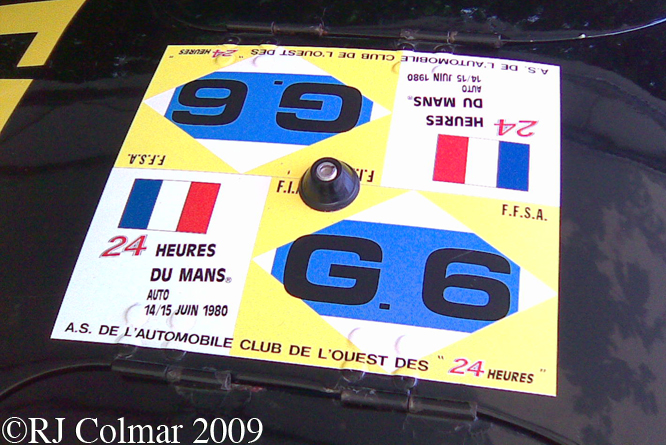
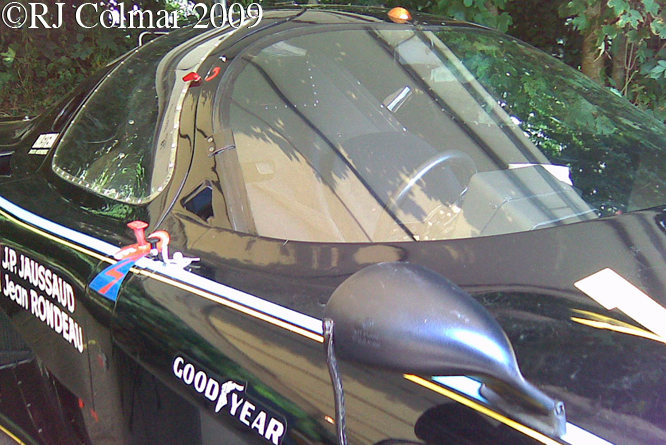
Going into the 1980 Le Mans 24 hours on a roll of four consecutive class wins for his cars Jean upgraded the M379 to b spec and teamed up with 1978 Le Mans winner Jean Pierre Jaussaud.

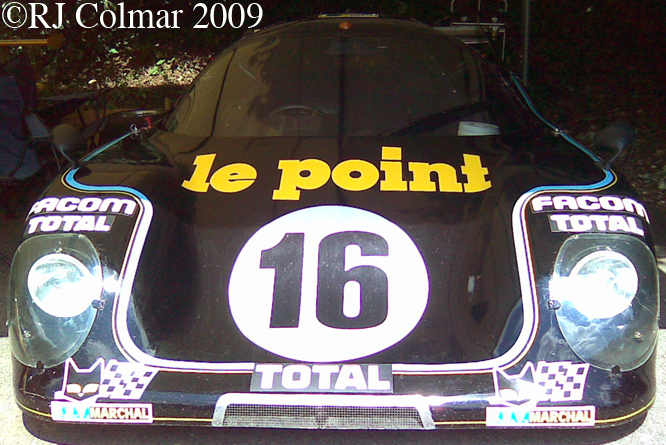
Starting from fifth on a very wet grid the Le Point newspaper sponsored Rondeau maintained a steady pace through out the race while the highly fancied privately entered Porsche 908/80 driven by Jacky Ickx and Reinhold Joest was delayed by an inability to see in the rain from the open cockpit car. When the rain eased the Porsche made up time and hit the front but was then delayed for quarter of an hour when Jacky had to replace the fuel injection pump belt out on the circuit. Jacky and Reinhold had regained the lead for a second time when 18 hours into the race the Porsche required a gearbox rebuild just as the winning Porsche 936 had required in 1977.

This time when the repairs were completed the Porsche had fallen too far behind the leading Rondeau and still had a two lap deficit when the clock turned 4 pm. On the last lap on a wet circuit Jaussaud had a spin while on slicks but managed to avoid hitting anything and crossed the line first in M379 #003 to make Jean Rondeau the only man to win the Le Mans 24 hours in a car he designed and bearing his own name.

Rondeau 379C, Goodwood Festival of Speed

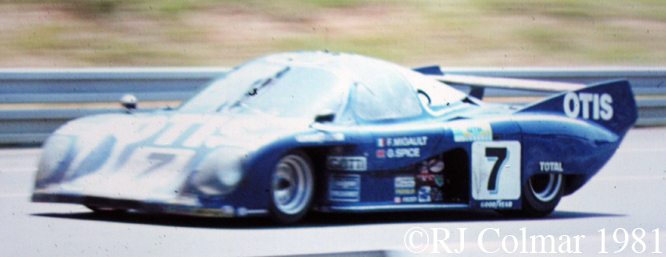
M379 #003 was prepared to C spec, seen above for Francoise Migault and Gordon Spice to race at Le Mans in 1981 they finished 3rd behind the GTP class winning Rondeau M379C #002 driven by Jacky Haran and Philippe Streiff and Jean-Louis Schlesser. M379C #002 had been driven to 3rd overall and 1st in GTP the previous rear by Gordon Spice and the Belgian Martin brother Jean Michele and Philippe.

Todays featured car ran at Le Mans for a fourth and final time in 1982 as a private entry for Pierre Yver, Bruno Sotty and Lucien Guitteny who started 35th and finished 10th.

Thanks for joining me on this “Le Point” edition of “Gettin’ a li’l psycho on tyres” I hope you will join me again tomorrow. Don’t forget to come back now !

Share

Endurance Survivor – Porsche 911 GT1-98 #003

The Porsche 911 GT1-98 was the second evolution GT1 racer that Porsche contested the 1998 FIA GT1 championship with.

Porsche 911 GT1-98, Goodwood Festival of Speed

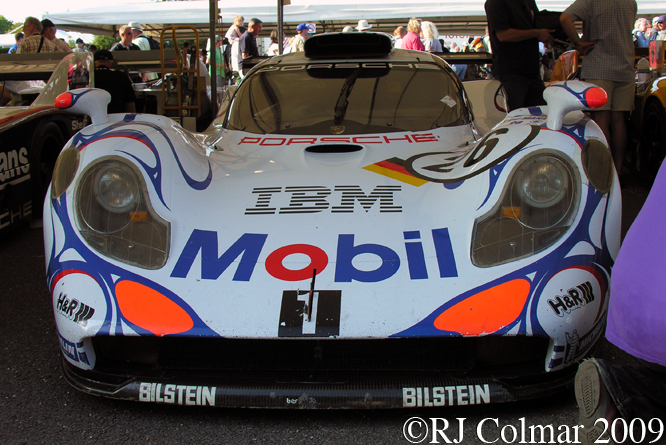
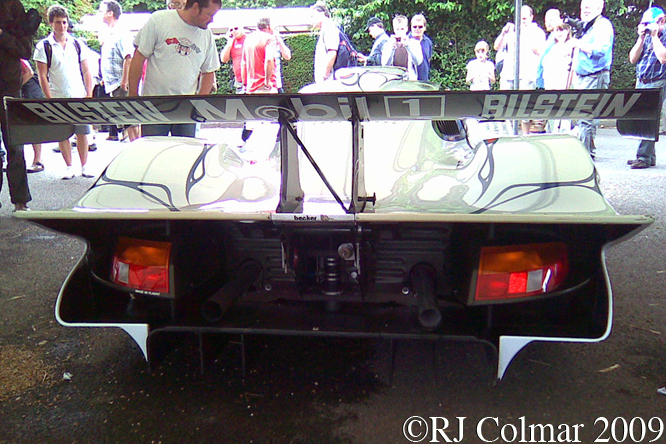
While the front of the new car bears a passing resemblance to the Generation 2 996 version of the Porsche 911 the rest of the car was essentially a prototype fitted with a 600hp twin turbo Group C type 24 valve twin cam water cooled flat 6 of the same type as used by the Porsche 962C with the addition of a sequential gearbox.

Porsche 911 GT1-98, Goodwood Festival of Speed

The 911 GT-98 was built around a tube frame and with carbon fibre bodywork. One road going example of the GT1-98 was built to meet the GT1 regulations.

Porsche 911 GT1-98, Goodwood Festival of Speed

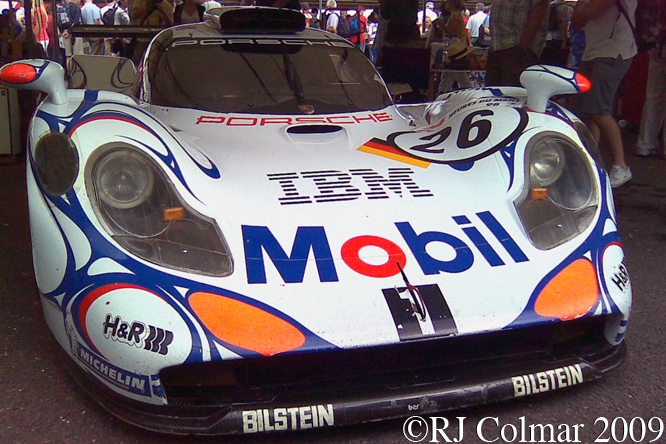
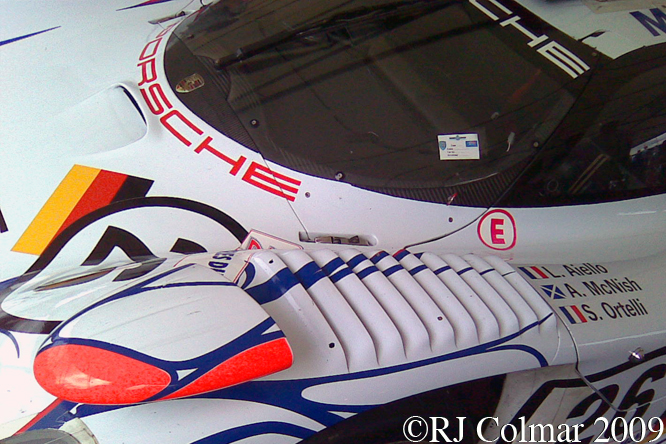
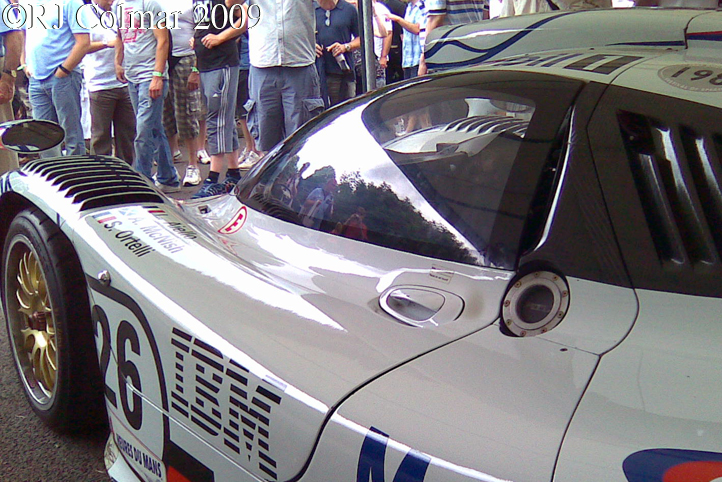
Going into the 1998 Le Mans 24 Hours race two normally aspirated 6 litre / 370 cui V8 Mercedes Benz CLK LM’s prepared especially for the endurance classic qualified 1st and 3rd. The fastest of three turbocharged Toyota GT-One qualified second with the Porsche 911 GT1’s 4th and 5th, the later car being chassis #003 driven by Allan McNish, Stéphane Ortelli and Laurent Aiello.

Porsche 911 GT1-98, Goodwood Festival of Speed

During the race the specially prepared Mercedes Benz CLK LM’s both retired by lap 31 with engine failures while the fastest of the Toyota GT-One’s retired after half distance after an accident which left the two works Porsches at the head of the field.

Porsche 911 GT1-98, Goodwood Festival of Speed

The #26 shared by NcNish, Ortelli and Aiello crossed the line a lap ahead of the sister car driven by Jörg Müller, Uwe Alzen and Brilliant Bob Wollek.

As had occured many times in the past the Le Mans winners did not win the championship which was dominated by Mercedes Benz who clocked up six 1-2 finishes, but it is Porsche who is best remembered from the GT1 championship for surviving to win an unlikely 1-2 at Le Mans.

Thanks for joining me on this “Endurance Survivor” edition of “Gettin’ a li’l psycho on tyres” I hope you will join me again tomorrow when I’ll be looking at a car that is ‘not a green Audi’. Don’t forget to come back now !

Share

Rolling Into Records – Howmet TX #2

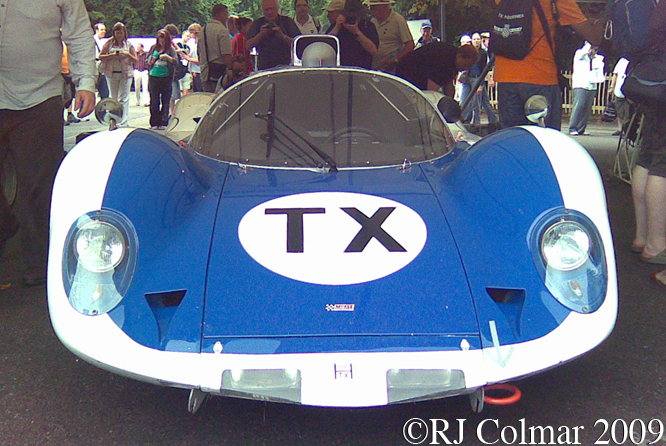
In 1967 Philadelphian sports car racer Ray Heppenstall persuaded his friend Tom Fleming that a conventional sports car with an aircraft gas turbine engine might make a competitive racing car. Fleming, sales vice-president of Howmet a major suppliers of precision castings to the aircraft gas turbine industry, and Heppenstall in turn convinced the board of Howmet that such a program would be a great way to promote their business.

Two spaceframe chassis based on a Can Am design were built and fitted with Continental TS325-1 turboshaft motors that were donated from a batch of ten motors Continental had developed for a failed observation helicopter contract. The motors produced 330 hp and were given a 3 litre / 183 cui equivalency rating by the regulation governing FIA. In order to comply with the reverse gear regulations a separate electric motor drive was employed.

Howmet TX, Goodwood Festival Of Speed

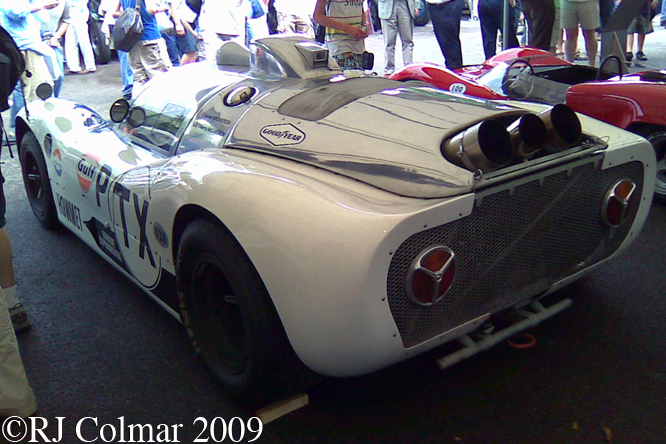
Today’s featured car chassis #2 is the second of the two Howmet’s built with a slightly longer wheel base. The week after Ray had recorded the teams first victory and the first ever for a gas turbine powered car at Huntsville, Dick Thompson repeated the feat driving #2 at Marlboro winning the SCCA Preliminary then sharing the car with Ray to win the 300 mile feature race.

In July ’68 Ray and Dick shared chassis #2 again to come home third overall and first in class at the Watkins Glen 6 hour race behind a pair of 4.7 litre / 286 cui Ford GT40’s.

Howmet TX, Goodwood Festival Of Speed

Ray recorded a third place finish driving chassis #2 at Donnybrook in August ’68 before both Howmet’s were shipped to Europe for the Le Mans 24 Hours, which had been delayed until September from it’s usual June date by civil unrest and strikes involving 11,000,000 French workers.

#2 was the faster of the two Howmets in qualifying for the 24 hour endurance classic Dick and Ray qualifying 20th two seconds faster and four spots ahead of the sister machine driven by Hugh Dibley and Bob Tullis. In the race the cars were hampered on the corners because the single gear was designed to optimise performance on the 4 mile Mulsanne straight.

Dibley / Tullis were disqualified after a three hour pit stop to change a rear hub bearing for covering insufficient distance after seven hours, while #GTP2 had a faulty fuel control which restricted the cars top speed to just 100 mph. During the evening Dick lost control and rolled the car at the slightly banked Indianapolis corner.

Howmet TX, Goodwood Festival Of Speed

Note the rear lights sourced from the original iteration of the Ford Cortina, according to Bob Mckee other proprietary parts used to finish the Howmet included front indicators from a Ferrari, Porsche wipers, modified Triumph steering and Mustang door latches.

Howmet withdrew their support for the project after Le Mans having determined the disadvantages of throttle lag, running the car with a single gear, absence of engine braking and high fuel consumption were insurmountable issues for competitive entries in the long run.

Ray Heppenstall rebuilt #GTP2 with open spyder bodywork and in 1970 timed by IMSA officials recorded six World Records for standing starts over 1/4 mile, 1/2 km and 1 km distances in two weight divisions for vehicles upto and over 1000 kgs. Ray’s fastest speed of 167.97 mph was recorded in the lighter division over 1 km all set on a stretch of open road adjacent to Talladega Super Speedway !

With the motors returned to Continental Ray bought the worlds only gas turbine powered race winning cars for a nominal dollar from Howmet in 1971. Chuck Haynes had Bob McKee restore #2 back into Coupé form in 1996, it is now fitted with an Allison 250C18 turboshaft helicopter motor which is lighter but with a similar power output to the original.

My thanks to Pete Stowe for additional in formation on the Hownet’s regarding the records chassis numbers and a quote from Bob Mckee on the proprietary parts used.

Thanks for joining me on this “Rolling Into Records” edition of “Gettin’ a li’l psycho on tyres” I hope you will join me again tomorrow. Don’t forget to come back now !

PS Push to Pass Latest Formula One news and opinion today at Motorsports Unplugged

Share