Tag Archives: Festival

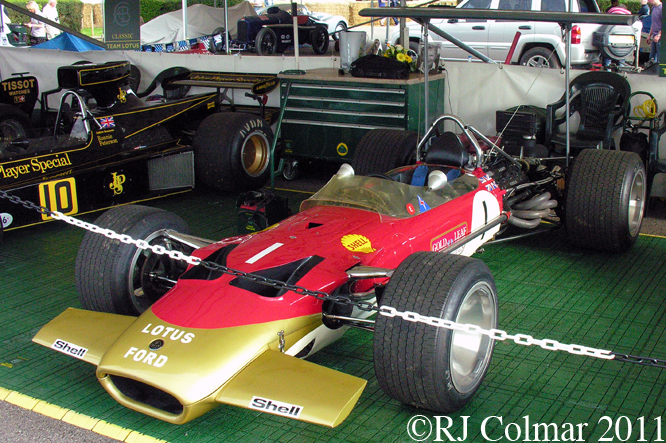
April Fool ? – Lotus 72 B #72/R1

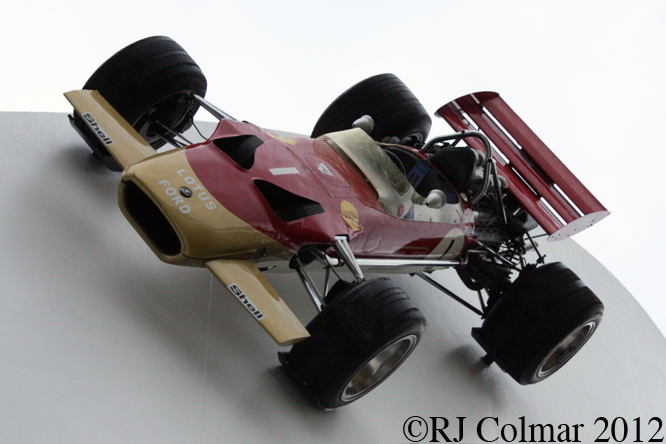
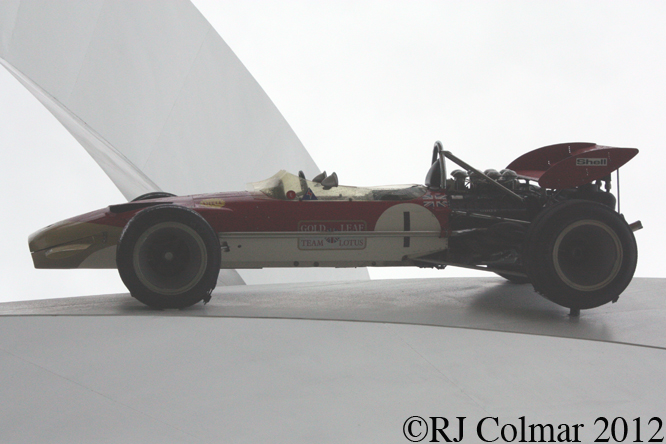
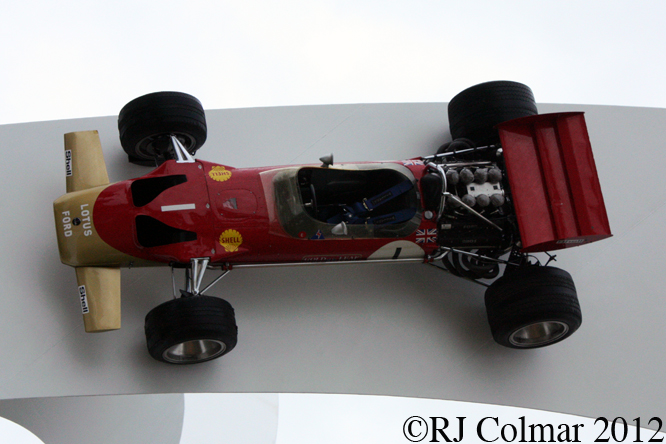
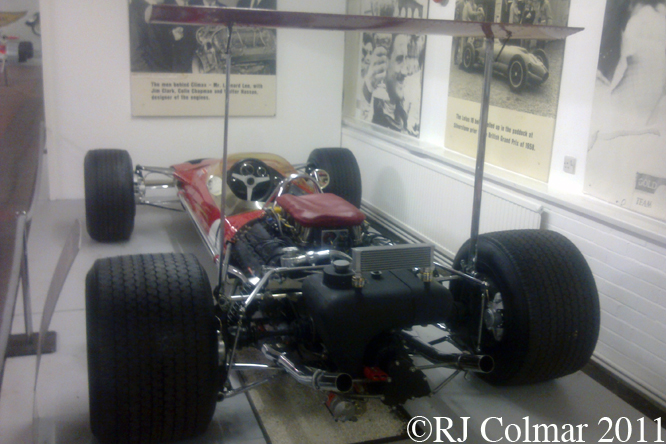
On the 1st of April 1970 the press were invited to see the Lotus 72 for the first time. The clean wedge shape was a return to the theme from the 1968 Lotus 56 Indy Car and Lotus 58 Formula 2/Tasman car.
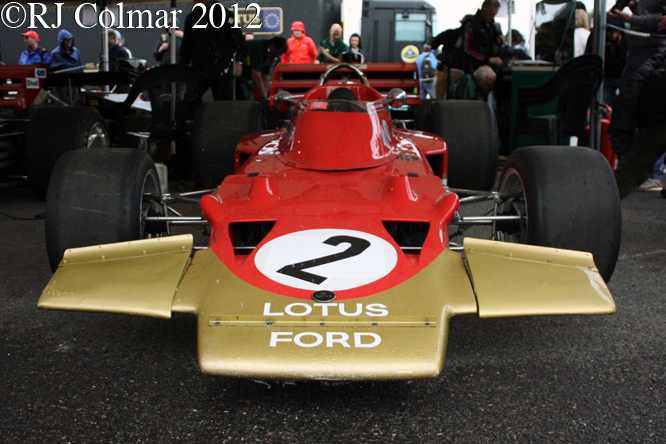
Lotus 72C, Goodwood Festival of Speed

When the car was first tested by works drivers Jochen Rindt, John Miles and John Walkers driver Graham Hill they all reported the cars innovative front anti dive and rear anti squat suspension which aimed to reduced suspension travel under braking and acceleration was difficult to drive on the limit.
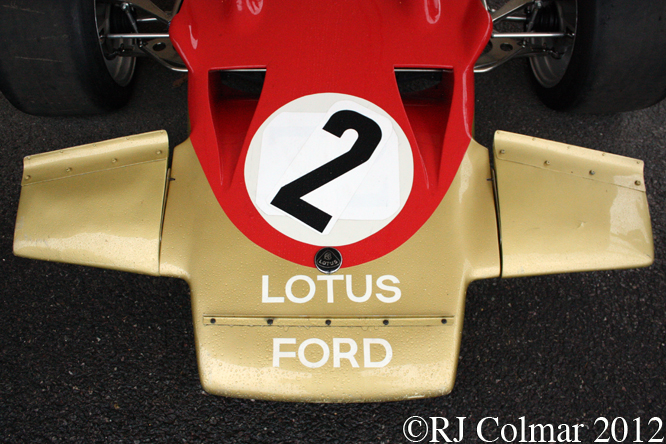
Lotus 72C, Goodwood Festival of Speed

As a result of this Jochen Rindt got his 1970 championship campaign under way with a fortuitous win in Monaco driving an updated four year old design in the form of a Lotus 49 C.
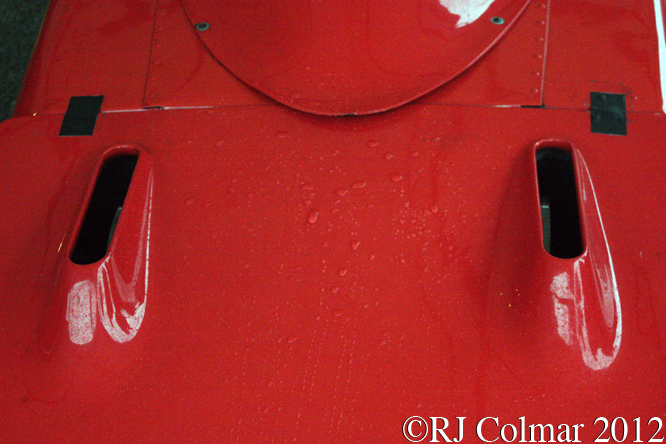
Lotus 72C, Goodwood Festival of Speed

At the 1970 Dutch Prix Lotus arrived with the second 72 chassis #72R2 updated to C-specification, with the anti dive and anti squat features of the suspension removed, for Jochen Rindt to drive which he found much more to his liking and proceeded a sting of four successive wins in Holland, France, Britain and Germany which gave Jochen what would become an unassailable lead in the World Championship.
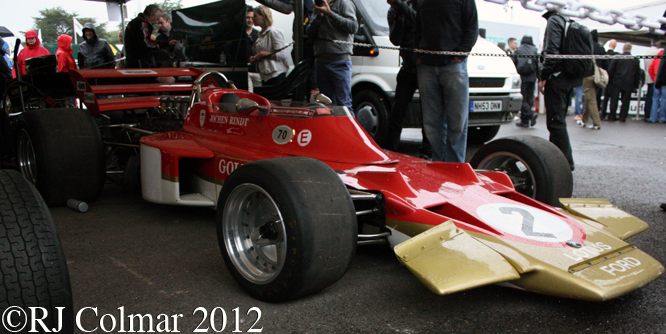
Lotus 72C, Goodwood Festival of Speed

Unfortunately during practice for the 1970 Italian GP when he was testing #72/R2 without any wings, under braking an inboard front brake shaft broke, sending the 28 year old Jochen into a crash barrier post with fatal results.
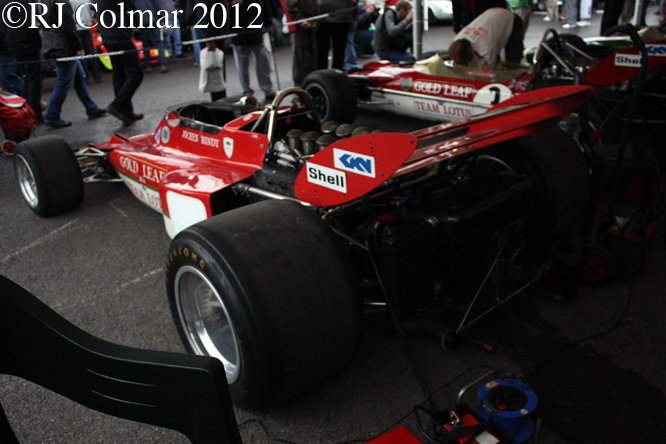
Lotus 72C, Goodwood Festival of Speed

New team leader Emerson Fittipaldi won the last race of the 1970 season driving a new 72 C. Jochen Rindt became the only posthumous World Champion and Lotus won their 4th Constructors Championship. For 1971 the Lotus 72 C proved to be not quite so competitive against Jackie Stewart and the Tyrrell Team, but otus would bounce back with the upgraded Lotus 72 D in 1972.
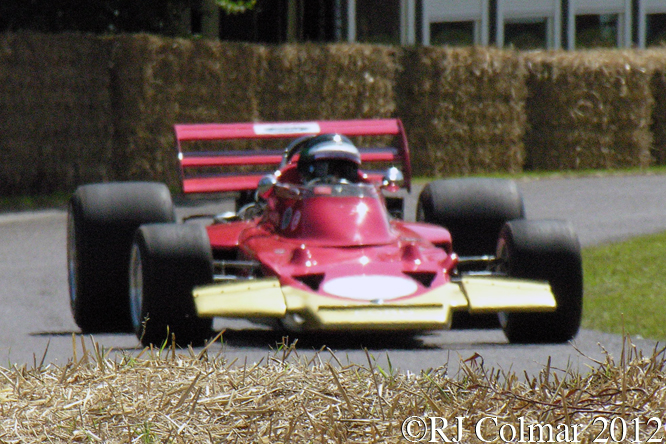
Lotus 72C, Goodwood Festival of Speed

Lotus 72 #72/R1 is the only remaining 1970 spec car left, it was the car shown to the press on April 1st 1970 and subsequently entered and raced for Jochen’s team mate John Miles in original and B spec with only the anti squat removed from the rear suspension. John’s best result was a 7th place finish in the 1970 Dutch Grand Prix.

The Lotus 72 spawned many successful imitations including the McLaren M16 multiple winning Indy car and the McLaren M23 multiple world championship winning Grand Prix car.

Today’s Grand Prix and Indy cars all fitted with side radiators in side pods can all be said to be descendants of the Lotus 72.

Note the cockpit surround of #72/R1 has a shallow perspex screen from a later post 1972 Lotus 72.

Thanks for joining me on this “April Fool ?” edition of “Gettin’ a li’l psycho on tyres” I hope you will join me again tomorrow. Don’t forget to come back now !

Share

Cut and Bury – Lotus Ford 64

After coming close to winning the 1968 Indianapolis 500 with the Pratt & Whitney gas turbine powered Lotus 56 driven by Joe Leonard the powers at Indianapolis decided to ban gas turbine power and all wheel drive for the 1969 season, but eventually relented and allowed all wheel drive vehicles that had wheels no more than 9″ wide all round. Rear wheel drive vehicles were allowed to go to 14″ wide wheels at the rear.

Lotus Ford 64, Goodwood Festival Of Speed

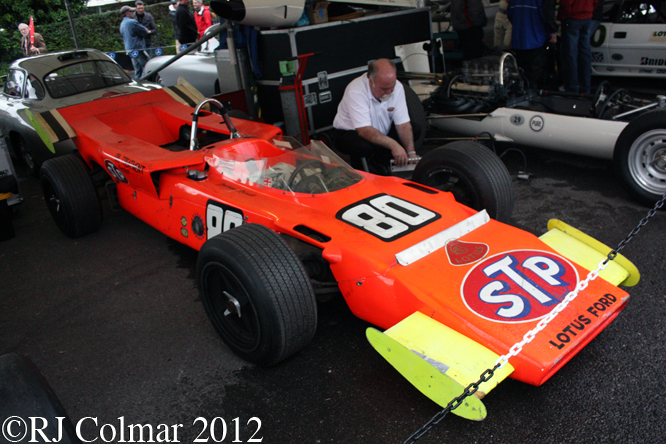
Colin Chapman rose to the challenge of building a car to the new regulations with the financial encouragement from Andy Granatelli’s STP Oil Treatment. The Lotus 64 was a new chassis which was powered by a 700hp turbocharged double overhead cam Ford V8 motor driving an all wheel drive system that was lifted from the Lotus 56 as indeed was much of the rest of the chassis.

In order to connect the motor to the mid mounted gearbox the motor had to be mounted backwards so the drive came from the front, as on the ill feted Lotus Ford 63 all wheel drive Grand Prix car.

Mario Andretti, Graham Hill and Jochen Rindt were lined up to drive the three team cars and a spare was built just in case of unforeseeable eventualities. Straight out of the box the cars were on the pace of the gas turbine Lotus 56 from the year before setting record speeds. However Mario Andretti’s car had a rear hub failure which sent him into the wall. Mario was lucky to get away with superficial burns to his face and after it was determined the failure was due to a design fault that could not be rectified in the available time frame the three Lotus 64’s were withdrawn from the race.

Mario jumped into the #2 Hawk Ford belonging to Granatelli and promptly qualified 2nd to AJ Foyt and then won the race after Lloyd Ruby was knocked out of contention by leaving the pits with his refueling hose still attached.

Andy Granatelli wanted to buy one of the remaining 64’s but when negotiations broke down Colin Chapman is alleged to have ordered the now engineless cars be returned to Hethel, Lotus home base, where he promised to take a hack saw to them personally cut them up and dig a whole and personally bury them. As it turned out all three cars were put in a shed.

Jochen Rindt’s #80 is seen above sans motor, this is the second of the three remaining 64’s to have emerged in recent years the other one has a correct Ford motor installed.

Thanks for joining me on this “Cut and Bury” edition of “Gettin’ a li’l psycho on tyres, I hope you will join me again tomorrow when I’ll be looking at the first car to record a 200 mph average closed circuit lap during a race. Don’t forget to come back now !

Share

OK, But Not Very Fast – Lotus 58

The Lotus 58 was designed with de Dion suspension front and rear, in Colin Chapman’s eternal quest for more grip, to take part in Formula 2 races for the 1968 season.

Lotus 58, Goodwood Festival of Speed

Chapman’s original intention was for the 58 to be used as a development vehicle for the Lotus 57 Grand Prix car which was to have used a similar chassis but fitted with a larger Ford Cosworth 3 litre / 183 cui that powered the various iterations of the Lotus 49.

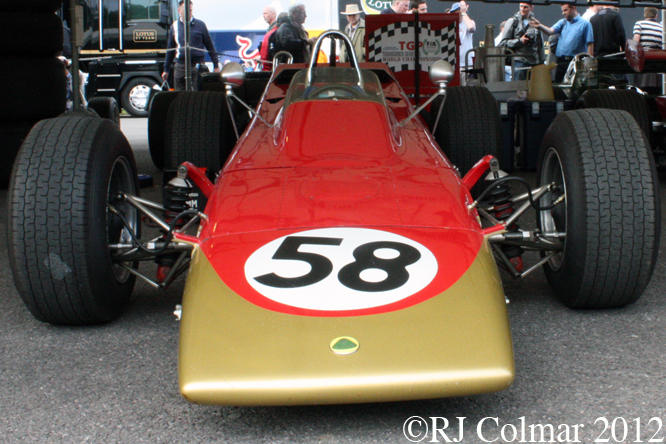
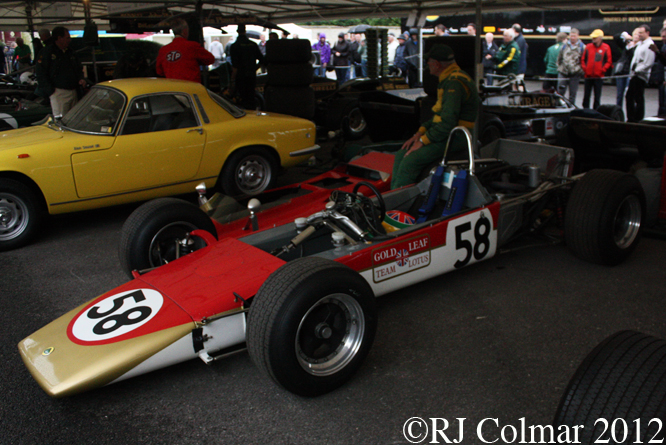
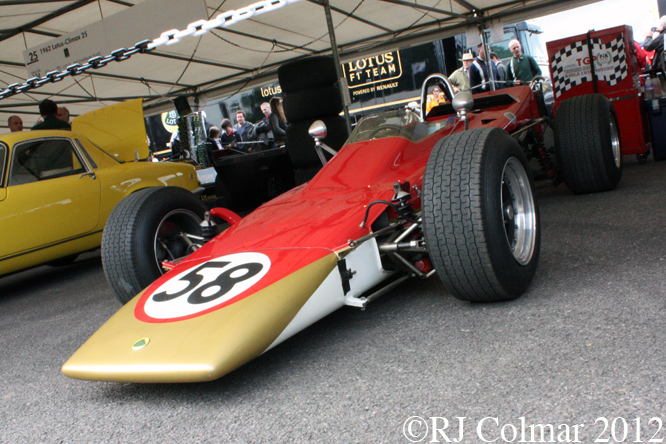
The Lotus 58 chassis and wedge shaped body closely resembles that of the Lotus 56 Indy challenger but is powered by a 225 hp four cylinder 1598 cc / 97.5 cui Ford Cosworth FVA motor which met the requirements of the second tier open wheel Formula 2 regulations.

Lotus 58, Goodwood Festival of Speed

The one and only Lotus 58 chassis was completed the day Jim Clark was killed at Hockenheim, his death along with that of Jim’s replacement Mike Spence at Indy in a Lotus 56 along with numerous crashes that befell Jackie Oliver in his Lotus 49’s meant that development of the Lotus 58 was pushed back until the end of 1968 when Lotus had to decide which cars to take to the Antipodes for the Tasman Series.

Graham Hill thoroughly tested the car with a Tasman Spec 2.5 litre / 152.5 cui Cosworth DFW motor and came to the conclusion that it was “OK, but not very fast”. It would appear the advantages of the de Dion suspension which keep the wheels vertical in the corners and thereby keep a larger tyre footprint on the ground were not obvious enough to pursue. The Lotus 58 was pushed aside never having raced in Formula 2 as originally intended, or in the Tasman series, while the similar Cosworth DFV powered Lotus 57 never even left the drawing board.

Lotus 58, Goodwood Festival of Speed

In 1998 two enthusiasts persuaded Colin’s son Clive Chapman to restore the Lotus 58 and he gave the task to former Hill and Clark engineer at Lotus Eddie Dennis. After some 1500 hours of work Dennis ran the car at the former works Lotus test track at Hethel before handing it over to the new owners Malcolm Ricketts and Don Hands.

Thanks for joining me on this “OK, But Not Very Fast” edition of “Gettin’ a li’l psycho on tyres” I hope you will join me again tomorrow. Don’t forget to come back now !
Share

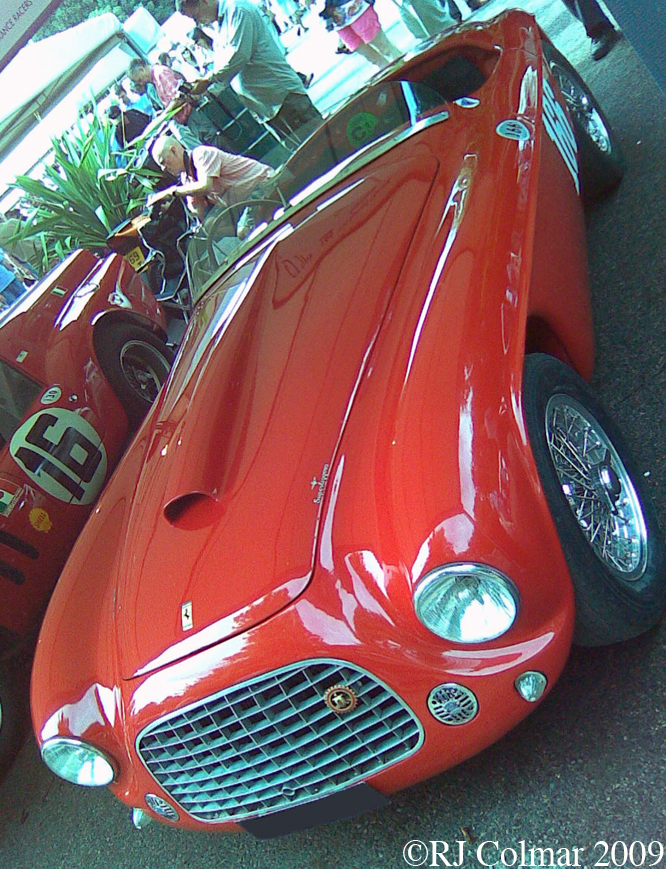
Additions And Corrections – Ferrari 166MM #0040M

Having run well over 50 consecutive Ferrari Friday blog’s I have to confess I have temporarily run out of Ferrari’s to write about, however while I find some more I will recover some of the vehicles that I first blogged about on the much missed rowdy.com website, adding additional information and corrections where ever applicable in the light of new sources of information.

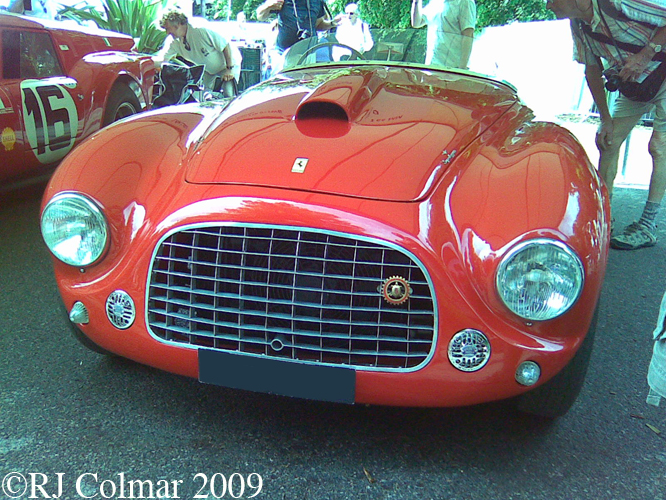
Ferrari 166MM, Goodwood, Festival Of Speed

Only 25 166 MM’s were commissioned by Enzo Ferrari to be built by Carrozzeria Touring who built the roadsters nick named Brachetta’s (small boat) using the patented Superleggra technique of fixing aluminium alloy panels directly to a tubular space frame.

The cars featured a 135 hp 1992cc / 121 cui V12 single overhead cam all alloy engine designed by Gioacchino Colombo. Each cylinder has a displacement of 166 cc / 10 cui from which the model derives its 166 name the MM comes from Mille Miglia, the name of a 1000 mile road race from Brescia to Rome and back which the 166 MM won in 1949.

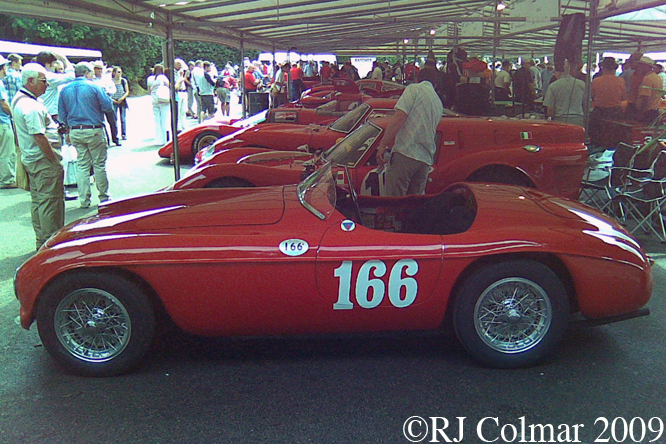
Ferrari 166MM, Goodwood, Festival Of Speed

The 166 in various guises put Ferrari on the the sports car map, a 166 S being driven to victory in the 1948 Milie Miglia by Clemente Biondetti and Giuseppe Navine. In 1949 Biondetti repeated the feat at the wheel of a 166 MM (chassis 0008M) he shared with Ettore Salani.

The same #0008M chassis was then entered by Lord Selsdon, for the 24 hour Le Mans race, who let his team mate Luigi Chinetti drive for an amazing 23 (twenty three) hours en route to victory. Another 166MM, chassis #0010, with Luigi Chinetti and Jean Lucas sharing the driving went on to win the 1949 Spa 24 hour race.

Ferrari 166MM, Goodwood, Festival Of Speed

Today’s featured car chassis #0040M vehicle was driven by Luigi Villoresi and Pasquale Cassani finished 12th overall in the 1950 Targa Florio. Note, some sources using “Targa Florio: 20th Century Epic” by Pino Fondi as reference material suggest that Villoresi did not finish, this is probably because Fondi only lists the top ten finishers.

Several weeks later chassis #0040M was entered in the 1950 Mille Miglia for Aldo Bassi with Aldo Berardi in the co drivers seat. The car left the road in wet conditions and hit a tree outside Ponte San Marco, Bassi succumbed to his injuries later that day.

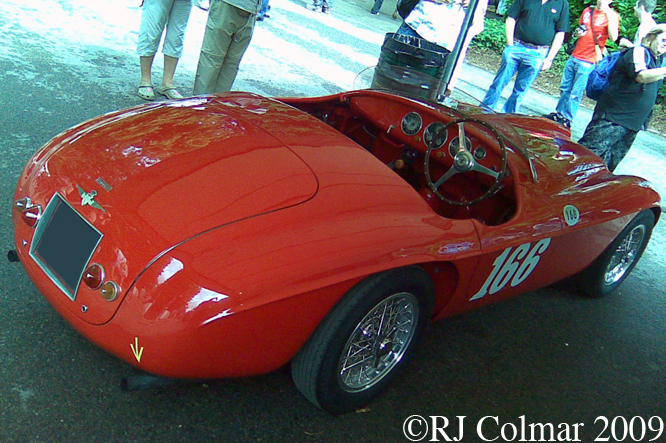
Ferrari 166MM, Goodwood, Festival Of Speed

After repairs which included a replacement body, Touring body #3453, the car went to Portugal where Vasco Sameiro is known to have driven it to 9th place in a race at Vila Real on June 20th 1950. The car remained in Portugal changing hands at least twice before turning up in the UK in 1973.

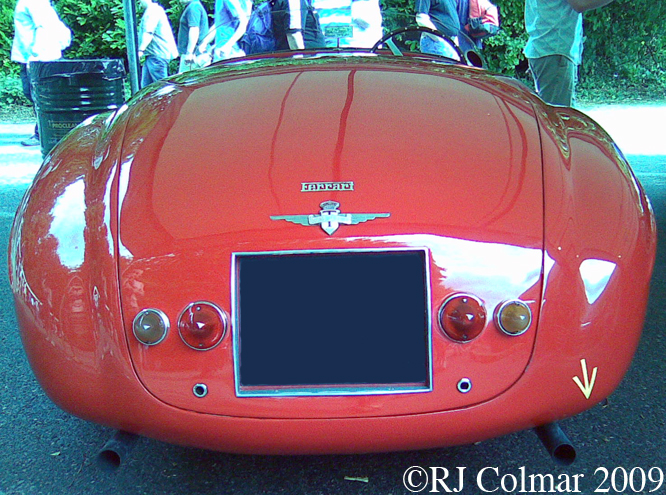
Ferrari 166MM, Goodwood, Festival Of Speed

Ferrari 166 MM #0040M has been owned by the Mason-Styrron family since 1989 who have used it in many classic competitions since. #0040M was restored by the Ferrari factory prior to it’s appearance at the 2009 Goodwood Festival of speed where the car is seen here.

Thanks for joining me on this “Additions and Corrections” editions of “Gettin’ a li’l psycho on tyres”, I hope you will join me again tomorrow. Don’t forget to come back now !

Share

World Wide Racing – Lotus 56B R1

The Lotus 56B is the Formula One version of the “Son of Silent Sam” Lotus 56 Indy challenger that came within a couple of laps of winning the 1968 Indianapolis 500 with Joe Leonard at the wheel.

Lotus 56B, Goodwood Festival of Speed

This Formula One version of the Lotus 56 was a fresh chassis built with additional fuel capacity, it was unusual to make scheduled pits stops of fuel back during Grand Prix races in the 1970’s, and with additional wings front and rear to aid the considerable traction and handling advantages of the the all wheel drive transmission.

Just as at Indianapolis in 1968 the Pratt and Whitney STN6/76 had to be considerably detuned to meet the regulations which tried to keep it competitive with the 3 liter / 183 cui piston motors in use at the time.

56B R1 had four non-championship outings before taking part in three Grand Prix. The upshot was that the car was the class of the field in wet conditions, where it’s weight disadvantage was minimised but it struggled to make the top half of the grid in dry conditions.

Three drivers were given a shot in the car, Emerson Fittipaldi, Reine Wisell, and Dave Walker. Fittipaldi managed the cars only finish at the 1971 Italian Grand Prix where he qualified a lowly 18th on the grid and came home 8th well ahead of expectations for the car which was never to be seen in a Grand Prix again.

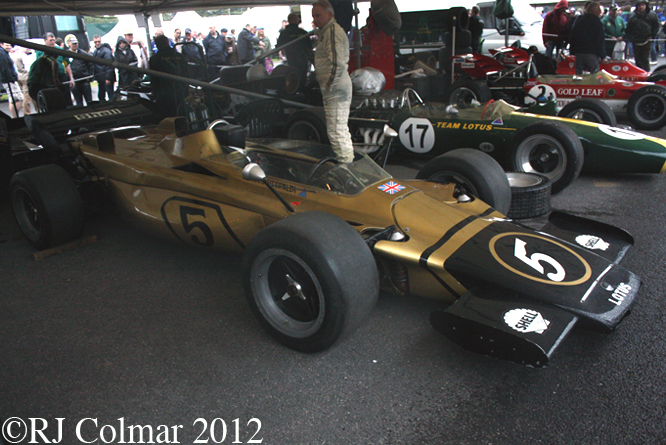
Regular followers of GALPOT maybe wondering why the car is painted Gold and Black instead of the by now traditional Red, White & Gold of the Gold Leaf Team Lotus.

In 1970 Jochen Rindt had been killed in an accident at Monza driving a Gold Leaf Team Lotus 72. Fearing legal repercussions from the notoriously slow and fickle Italian authorities investigating Rindt’s accident Colin Chapman took steps to avoid encumbrance or at worst arrest by opting to keep a low profile by entering just the one car in place of the usual two in the 1971 Italian Grand Prix.

To further keep the Italian authorities off his trail he entered the Lotus 56B under the World Wide Racing banner and had the car painted in Gold and Black, weather this was to obscurely promote the John Player Special brand which was owned by the same, Imperial, tobacco company as Gold Leaf remains unclear, though in 1972 Imperial switched the brand being promoted by Lotus to John Player Special whose black and gold colours are echoed on the current incarnation of Lotus on the Grand Prix grid.

Thanks for joining me on this “World Wide Racing” edition of “Gettin’ a li’l psycho on tyres” I hope you will join me again tomorrow. Don’t forget to come back now !
Share

Fourth Season Swan Song – Lotus 49C #R6/2 & #R10

For 1970 Lotus had planned to have the 4 Wheel Drive Lotus 63 ready to challenge for championship honours however even Mario Andretti could not capitalise on any of the cars supposed advantages during 1969 and so the Lotus 49 was updated for a fourth season of competition with 13 inch front wheels to make use of the latest Firestone Tyres as a stop gap while the design and build of the Lotus 72 was finalised.

Lotus 49C, Goodwood Festival Of Speed

The car seen above is Lotus #R6/2 the second car to carry the #R6 chassis plate. The first incarnation of #R6 was the first 49 to be built to ‘B’ spec. Unfortunately it was written off by Jackie Oliver during practice for the 1968 French Grand Prix, and in order to make use of existing travel documents the eighth Lotus 49 to be built was given the #R6 chassis plate and is known as #R6/2. Some parts of #R6/1 damaged beyond repair by Oliver are thought to have been used in the replacement #R6/2 seen here, Rob Walkers privately entered 49 #R7, and the #R12 show car built for Ford which was donated to the Donington Museum.

In it’s second incarnation #R6/2 still in high wing ‘B’ spec was used by Graham Hill to win the 1968 Mexican Grand Prix which clinched the 1968 World Championships for Graham and Team Lotus. Graham continued to use #R6/2 in 1969 before the car was given to Jochen Rindt to drive. Jochen scored his first two Grand Prix victories with R6/2 the 1968 US Grand Prix with the car in ‘B’ spec and the 1970 Monaco Grand Prix with the car ‘C’ spec with the low triple plane rear wing that was designed for the Lotus 72. Jochens win at Monaco would be the third consecutive win in the Principality and also the 12th and final Grand Prix win for the Lotus 49 type.

Lotus 49C, Goodwood Festival Of Speed

The second Lotus 49C featured today appears to be chassis #R10 which has given me a bit of a mental run around. This car appeared at Goodwood last year in high wing ‘B’ spec.

Lotus 49C, Goodwood Festival Of Speed

As you can see from my heavily revised Lotus 49B blog the car started life as Lotus 49 #R5 and for reasons that are not clear the car was renumbered #R10 and sent to the Antipodes for Jochen Rindt to use in the Tasman Series.

Lotus 49C, Goodwood Festival Of Speed

Graham Hill used #R10 to win the 1969 Monaco Grand Prix as he had done in 1968 when the car carried the chassis #R5. In 1970 Graham drove #R10 in the 1970 Monaco Grand Prix to fifth place when it was loaned out to the Rob Walker team for whom he was driving.

Emerson Fittipaldi made his first three Grand Prix starts in #R10 towards the end of 1970 scoring a best 4th place finish second time out in the 1970 German Grand Prix at Hockenheim.

Thanks for joining me on this “Forth Season Swan Song” edition of “Gettin’ a li’l psycho on tyres” I hope you will join me again tomorrow. Don’t forget to come back now !
Share

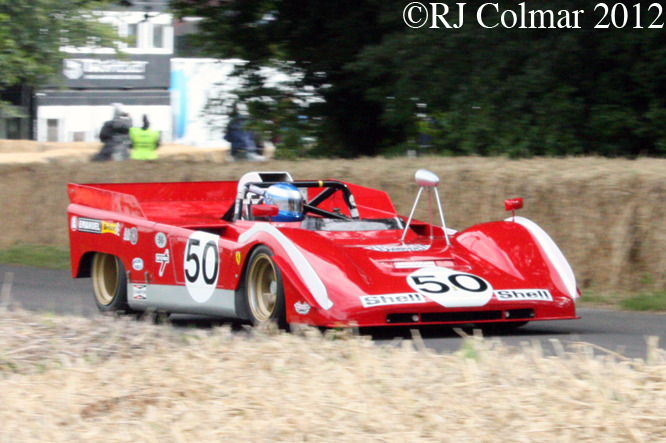
Enzo’s Big Banger – Ferrari 712 #1010

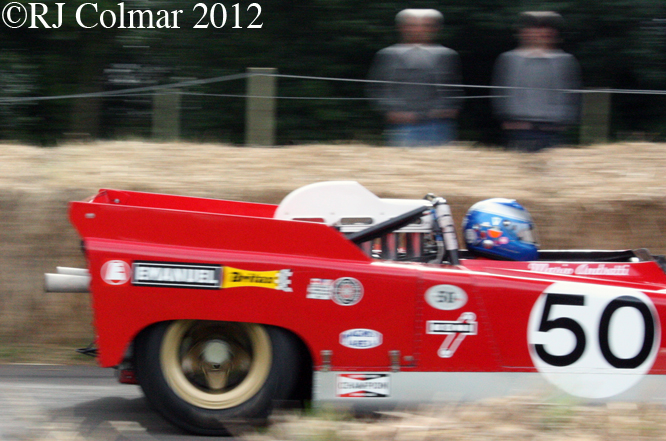
Today’s featured Ferrari began life as a Ferrari 512S chassis #1010 which was qualified on pole for it’s first race by Mario Andretti at the 1970 Sebring 12 hours. Andretti and co driver Art Mezario retired from the race leaving Andretti free to jump into the sister car, chassis #1026, which up to that point had been driven by Ignazio Giunti / Nino Vaccarella, from seventh on the grid. Andretti famously chased down the Solar Productions Porsche 908 which was driven primarily by Peter Revson and shared with Steve McQueen to win the race.

During the remainder of the 1970 season #1010 was driven by the likes of Jackie Oliver, Peter Schetty and Jackie Ickx who teamed up with Giunti won the season finale 1970 Kayalami 9 Hours.

Ferrari 712, Goodwood Festival of Speed

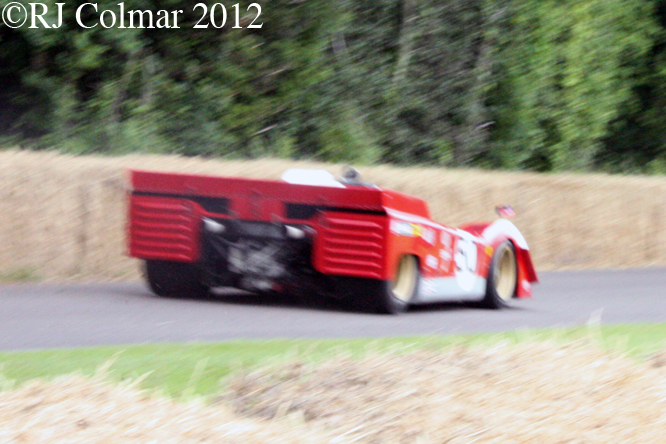
For 1971 a larger 6.3 litre / 384 cui V12 replaced the original 5 litre / 305 cui motor and Art Mezario used it to win the Interserie (Unlimitied Can Am style) race at Imola under the watchful of eye of Enzo Ferrari himself. Later in 1971 #1010 appeared at Watkins Glen with new open body work and now with a 6.86 litre / 418 cui V12 for Mario Andretti to drive in the Can Am Series. Despite a lack of development Andretti managed to qualify 5th and finish 4th only for the car to disappear for the remainder of the season.

Ferrari 712, Goodwood Festival of Speed

For 1972 Luigi Chinetti acquired the largest Ferrari V12 engine ever built along with chassis #1010 in which to run it and entered Jean-Pierre Jarier in for two more Can Am races, he finished 4th from 10th on the grid at Road America where it had become obvious the by now turbo charged Porsche 917’s were in a completely different class from the Ferrari 712 and indeed the rest of the field.

Ferrari 712, Goodwood Festival of Speed

Brian Redman had the honour of driving the car for the last time in the 1974 in the Watkins Glen Can Am round, which almost eliminated all non turbocharged vehicles with a maximum permitted fuel limit, he qualified 19th and retired with broken rear suspension. Today Enzo’s Big Banger chassis #1010 is run by Paul Knapfield and is seen here at the recent Goodwood Festival of Speed.

Thanks for joining me on this “Enzo’s Big Banger” edition of “Gettin’ a li’l psycho on tyres”. I hope you will join me again tomorrow when I shall be looking at the original version of the Lotus 49 that revolutionised Grand Prix Racing in 1967. Don’t forget to come back now !
Share