Tag Archives: Fiat

Tomorrow Another Life – GALPOT Automobilia

I’ve been having a bit of a clear out whilst reorganising my library and the time has come to dispose of a number of items which may be of interest through my lightpress account on e-bay.

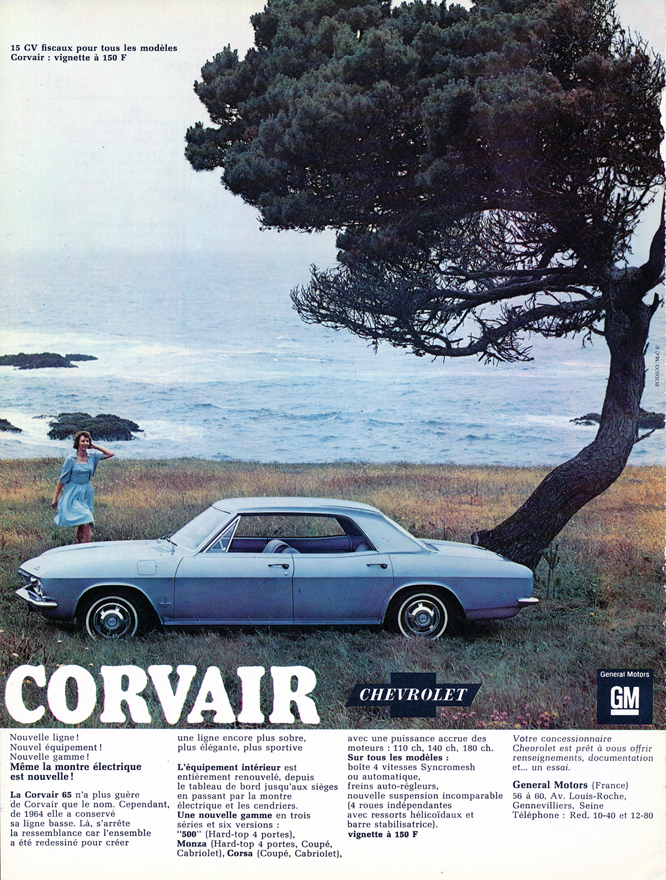
Chevrolet Corvair

From this weeks batch of French car advertisements taken form Connaissance des Arts magazine that I have posted comes this second generation Chevrolet Corvair ad which dates from 1965. Second generation Corvairs featured minor exterior restyling and independent rear suspension in place of the patented swing axle design of the earlier cars.

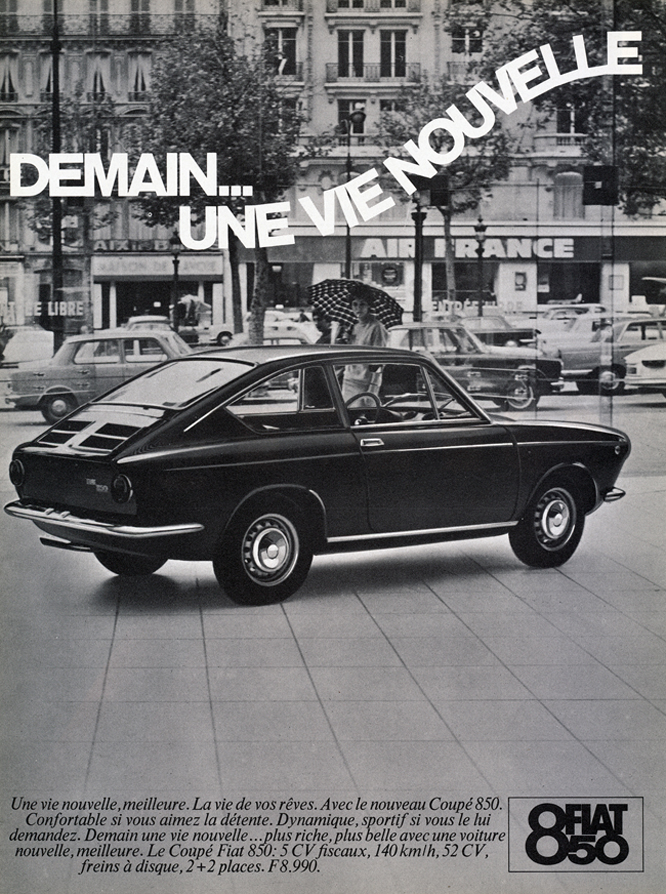
FIAT 850 Coupé

Also dating from around 1965 was this Fiat 850 Coupé ad with the wonderful strap line that translates “Tomorrow Another Life”. Regular readers may remember a FIAT 850 Automatic featured in an early GALPOT blog.

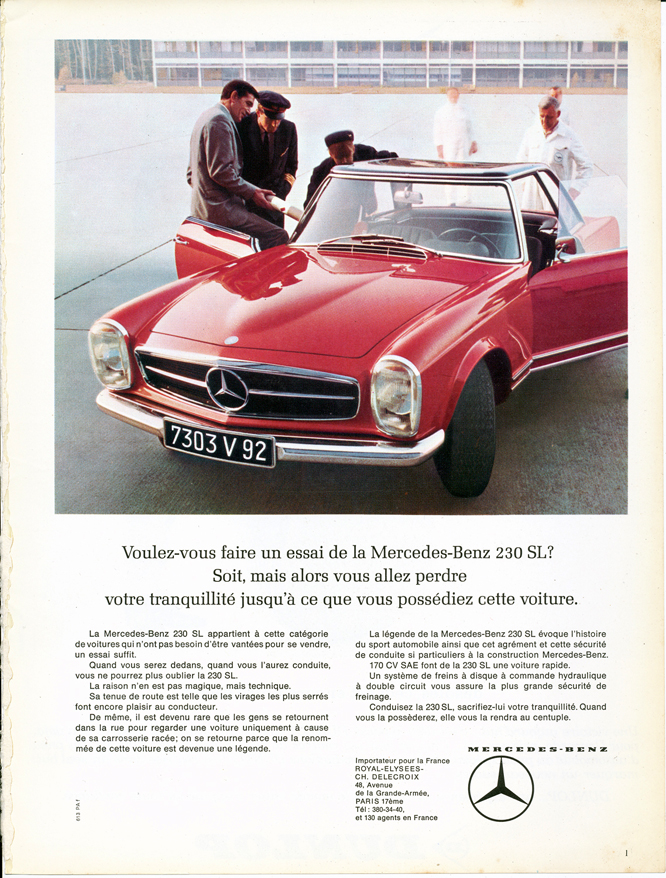
Mercedes Benz 230 SL

This ‘Pagoda’ Mercedes Benz 230 SL ad from 1966 asks “Do you want test the Mercedes Benz 230 SL?” with the reponse “Maybe, but then you will lose the peace you had before trying this car”. The 230 SL replaced the 300SL and was the first Mercedes Benz to be fitted with radial construction tyres as standard.

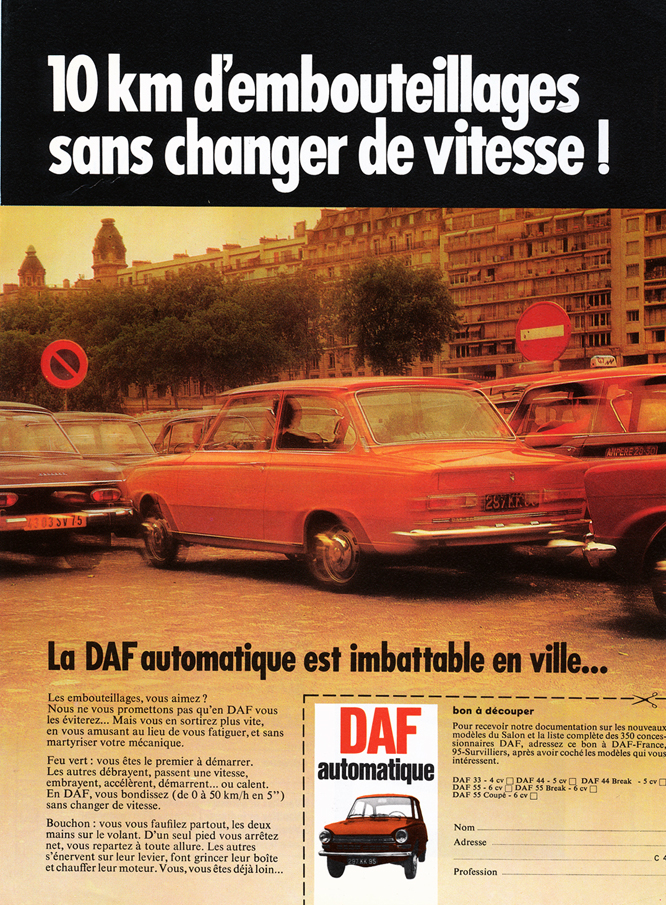
DAF 55 Automatique

Michelotti is probably best remembered for styling numerous Triumphs including Herald / Vitesse, Spitfire / GT6, TR7 / TR8 rare Italia 2000 and exotic SIATA 400F Coupé among many others, unknown to me until I posted this ad on e-bay was the he also styled the Dutch built DAF 55 Automatique powered by a French Renault watercooled motor driving the rear wheels through a continuously variable transmission.

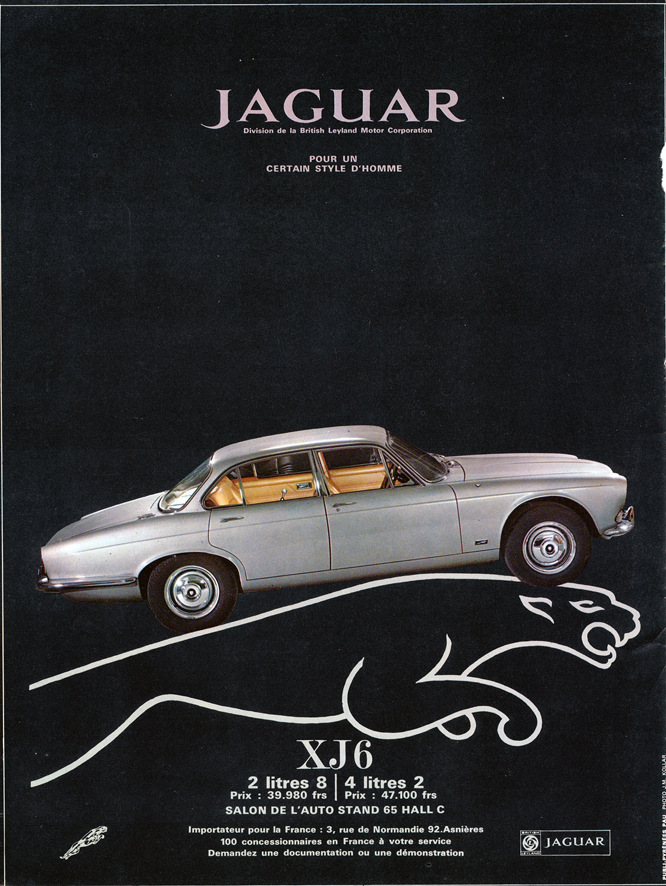
Jaguar XJ6

Finally appealing “for some certain style of man” is this Jaguar XJ6 ad with a photo credited to JM Kollar dating from 1970, I have posted are two further XJ6 ads dating to 1971 and 1973 when production of the Series 1 XJ6 came to an end.

Thanks for joining me on this “Tomorrow Another Life” edition of “Gettin’ a li’l psycho on tyres” I hope you will join me again tomorrow when I’ll be looking at a sample of the vehicles that were on display at the recent Hillsbrough Concours d’Elegance. Don’t forget to come back now !

Share

SF Paddock Car – FIAT 500

As everyone knows attending a race meeting in almost any capacity can involve walking many miles.

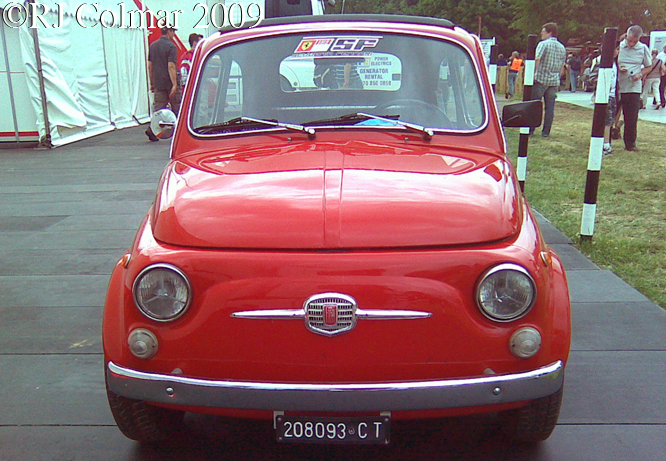
FIAT 500, Goodwood Festival Of Speed

In order to save time and the legs of Ferrari pit personnel for more important tasks Ferrari often employ this FIAT 500 to get around between their Iveco Domino HDH RV to their pits.

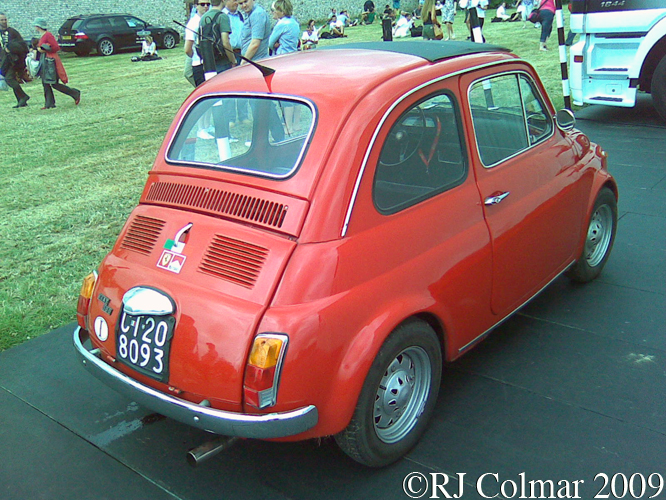
FIAT 500, Goodwood Festival Of Speed

Looking at the front grill trim and bumper and doors it would appear this car was built between 1965 and 1973 and is known as a FIAT 500 F Berlina.

More on the FIAT 500 can be found on this link.

Thanks for joining me on this “SF Paddock Car” edition of “Gettin’ a li’l psycho on tyres” I hope you will join me again tomorrow. Don’t forget to come pack now !

Share

Field Filler – Ferrari 512 S #1006

17 Ferrari 512 S’s and parts for 8 others were built in late 1969 in response to the 25 917’s Porsche had built in early 1969 in order to be allowed to race in the World Sports Car Championship which allowed up to 5 litre / 305 cui engines. These rules were introduced so that a few old Ford GT 40’s could continue racing, it was never imagined that Porsche and then Ferrari would build 25 cars each to take part in the series which was intended to be for new 3 litre / 183 cui cars like the Ferrari 312P and Porsche 908.

Unlike Porsche who planned on using private works supported teams to run and develop the 917’s on it’s behalf, Ferrari planned on using a single works team to build and develop the 512 S, supplying the rest of the 512 S models to private entrants to whom Ferrari gave little by way of support effectively treating it’s privateer teams as little more than field fillers.

Ferrari 512 S, Goodwood Festival of Speed

Ferrari had to sell his road car operation to FIAT in order finance the production to the 512 S model, and as it turned out Porsche’s private partners had snapped up most of the best drivers.

Nonetheless Ferrari took the fight to Porsche with a single championship victory at the 1970 Sebring 12 hours courtesy of Mario Andretti, Nino Vaccarella and Ignazio Guinti driving a 512 S who beat Peter Revson and actor Steve McQueen in their Porsche 908 after Mario famously drove the last 90 mins of the race and chased down an exhausted Peter Revson in what Mario once described as the race of his life.

For most of the rest of the 1970 season the Ferrari 512 S was out classed every where, except at the non championship race run at Kyalami in South Africa, by the Porsche 917’s, particularly those of the JW Automotive team. Ferrari had difficulty selling all of it’s 512 S models, where as Porsche had to build a second run of 25 917’s to meet demand.

Ferrari 512 S, Goodwood Festival of Speed

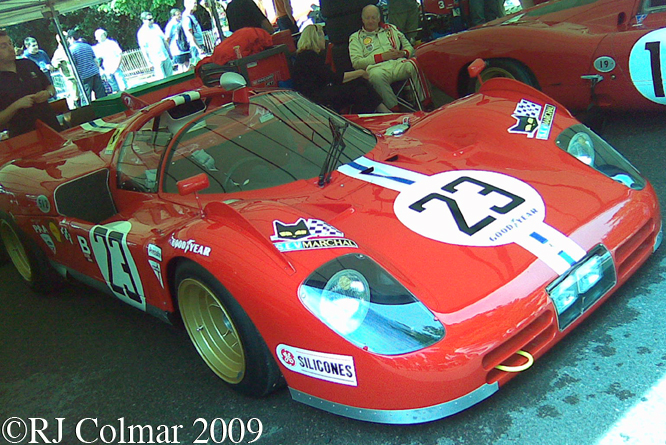
This 512 S spyder, chassis #1006, was developed in order to save 25 kgs by the factory and sold to Luigi Chinetti’s N.A.R.T. team. Ronnie Buchnum and Tony Adamowicz drove it into second place at the 1971 24 hours of Daytona.

#1006 had to have both front and rear bodywork replaced during the course of the race, the body work is as it appeared on #1006 when it started the 1971 Daytona 24 hours with aerodynamic lips on the nose, which were not on the second nose fitted when it finished the race.

Thanks for joining me on this “Field Filler” edition of “Gettin a li’l psycho on tyres” I hope you will join me again tomorrow for a look at a one off Formula One Lotus that never raced. Don’t forget to come back now.

Share

Chased By A Panda – Exeter Trial 2013

A couple of months ago I was offered the opportunity to navigate a unique Parsons Trials car on the Exeter Trial by owner Alan “Spence” Spencer. After Alan kindly agreed to make a few modifications so that I could sit in the car properly by raising the seat and adding four inch screen to afford some protection from the on coming wind I agreed to join him and had been looking forward to the experience ever since.
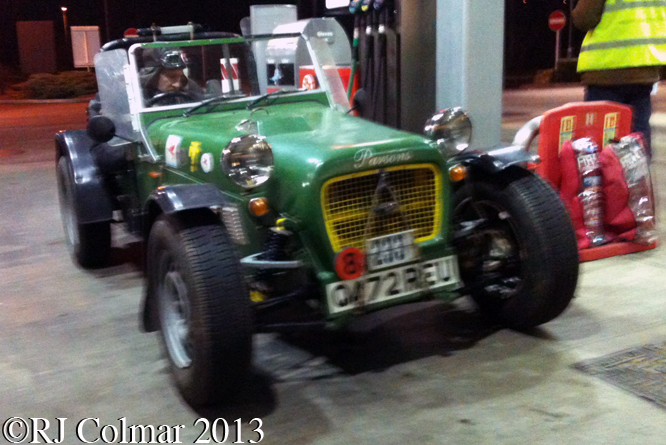
Parsons, Exeter Trial, Cirencester

Alan is seen above strapping himself into the Parsons at the first rendezvous Burford Services, Cirencester where we joined 39 other motor cars at close to midnight. The Exeter Trial was first run on Boxing Day 1910 by the Motorcycle Club from London to Exeter and back. As the roads got better so the trials went off road to maintain some degree of challenge for those taking part. The first part of the 2013 Exeter Trial was a regularity run over an 88 mile prescribed route to the Haynes International Motor Museum with an easy target time of 2 hours, mercifully I had prepared my wardrobe well and was comfortably warm sitting in the Ford Kent powered Parsons despite being exposed to the elements.
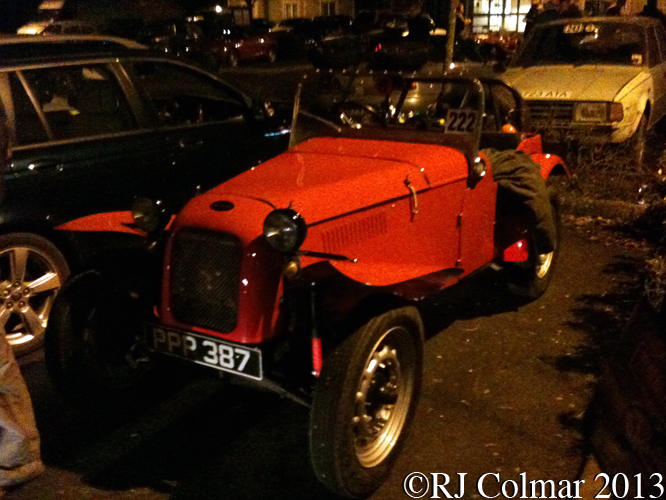
Gregory, Exeter Trial, Cirencester

Among assorted Skoda’s, VW Beetles and an Mazda MX5 with an urban paint job starting from Cirencester was this rare #222 Gregory trials car driven by Josh Moss and Chris Ferin. At the Haynes motor museum there was a compulsory two hour break during which I enjoyed a hearty Full English Heart Attack breakfast and a 1/2 hour flat on my back to ease the inevitable stiffness that occurs after sitting in a confined space for 2 hours in ambient temperatures a couple of degrees above freezing.
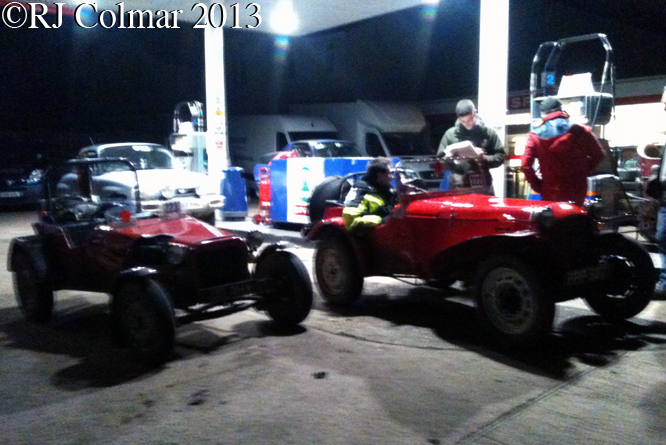
Ford Special, Exeter Trial, Cirencester

Above the #223 Ford Special of Alex Wheeler and Tony Underhill is parked up alongside the #222 Gregory and ahead of a couple of Suzuki X-90’s that were also taking part at the Musbury Garage checkpoint.

After a very quick observed stopping and reversing test at Haynes we headed for the first off road trial at Windwhistle Hill, by now I had a good grip on the abbreviations used in the route notes which Spence had thoughtfully copied and mounted onto a neat illuminated roller box as used by bomber command navigators in WW2 and by Denis Jenkinson to help Stirling Moss to victory in the 1955 Mille Miglia. In the pitch black of the night from the navigators seat of the Parsons at five in the morning the Windwhistle Hill observed section appeared to take place on a very wet and rutted and rocky forestry track, getting down to the start of the time section it was almost as much fun as roaring back up to the top for a clean run which included a compulsory stop and restart halfway up.
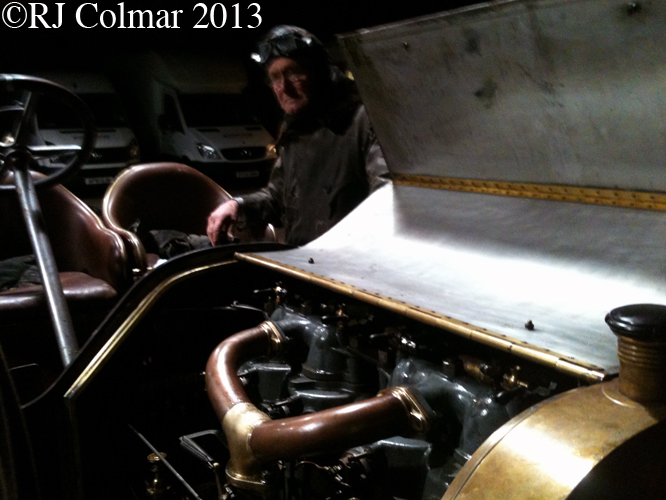
Mercedes Simplex, Exeter Trial, Musbury Garage

From Windwhistle Hill we proceeded 5 miles to the next observed section Underdown II following the magnificent chain driven 1903 Mercedes 60 hp Simplex of Ben and Roger Collings with a burbling 4 cylinder 9.235 litre / 563 cui motor which was being guided by chain drive aficionado Duncan Pittaway and Ant Lucas in a raucous TVR V8S. The Mercedes needed a guide on account of the fact that nominal navigator 70 year old Roger Collings, seen above, was fully occupied holding on to two handles to stay in his completely exposed seat.
Volkswagen Beetle, Normans Hump, Exeter Trial

Above the #238 Volkswagen Beetle of Nicola Butcher completes a clean run of Norman’s Hump.

After another clean run up Underdown II we headed for the Musbury Garage check point, as we were running ahead of scheduled time Spence pulled over for a quick cat nap before we pulled into the Garage to get our route card signed. Day light was appearing as we reached observed Section 3 known as Norman’s Hump where there was a long queue of competitors waiting.
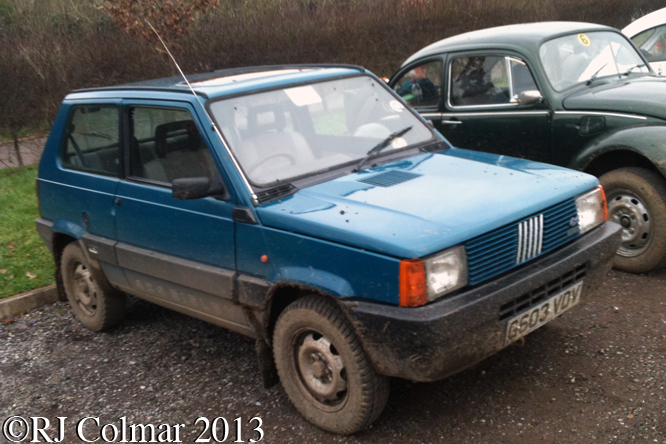
FIAT Panda Sisley, Crealy Park, Exeter Trial

We began to feel like we were on a roll as we cleaned Norman’s Hump and the following observed sections Waterloo, Strets, Core Hill and Bulverton Steep which were all on wet surfaces thanks to the yule tide deluge that had ceased earlier in the week. Over the last few morning sections we were running last on the road with the course closing FIAT Panda 4×4, seen above, on our tail.
Parsons, Crealy Park, Exeter Trial

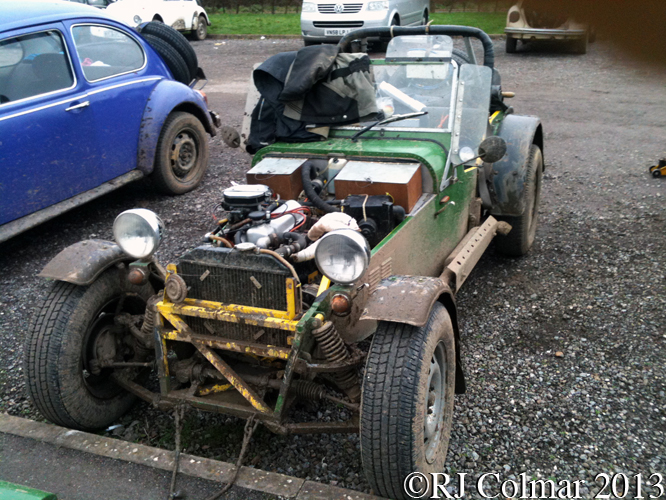
This was not helped by the fact that Spence used an electric pump to inflate his tyres after each section which lost us time, unfortunately the Parsons, seen above at Crealy Park, is not really big enough to carry a time saving gas bottle as many other competitors did. For most of the observed sections we were running between 10 and 15 psi on the rear tyres for extra grip, too low a pressure to be running on the road sections to be safe.
Allard M Special, Crealy Park, Exeter Trial

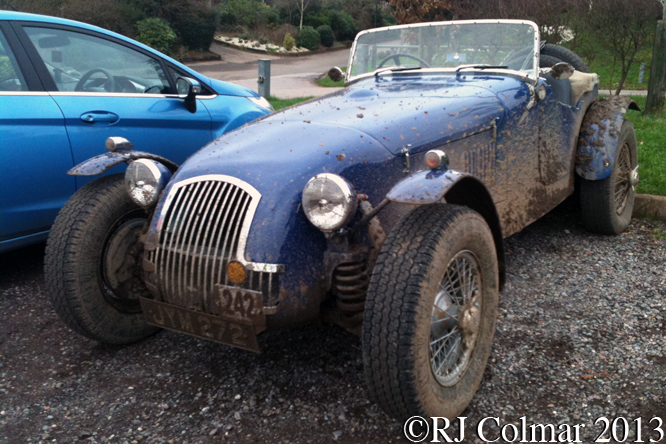
Just after 10 we arrived at the Crealy Park time control where Spence borrowed Duncans jack to swap the rear wheels over because the tyres on both sides had slipped on the rims, he also checked over the levels which were all fine during the one hour compulsory stop while I took a few snaps of some of the other vehicles taking part including the #242 Allard M Type Special of William Holt and Martyn Wyatt above. After a brunch, chicken and fried rice with satay sauce that I bought at our local take away just before setting off from Bristol, we headed into the sunshine towards afternoon sections starting with Tillerton Steep.
Marlin Roadster, Crealy Park, Exeter Trial

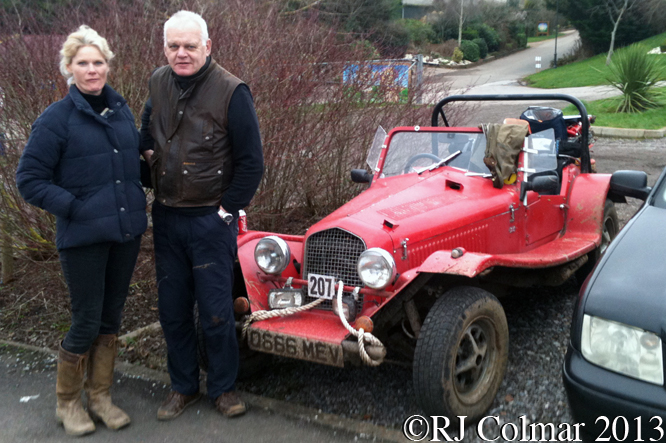
Above Chris Hickling and Wendy Bayless from Falmouth are seen in front of their #207 Marlin which suffered a puncture on Norman’s Hump.

If the morning had proved to be ecstatic with clean runs then Tillerton Steep began a run of drip fed cruel agony as there was a restart on a large slab of wet rock which offered absolutely zero traction. We had failed our first test though we managed to get up the remainder of the course on our second attempt.
BMW 2002, Tillerton Steep, Exeter Trial

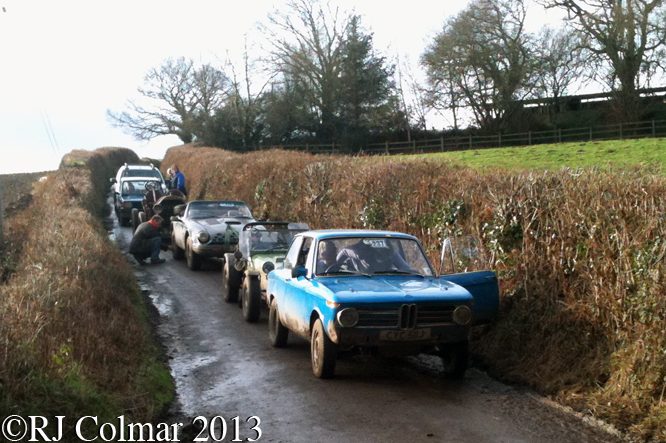
Above the Edna Perryman climbs into the back seat, of the #237 BMW 2002 while Colin awaits to cross the ford prior to their run up Tillerton Steep. Note the course closing Panda behind the Mercedes.

We then followed the Mercedes Simplex to Fingle Hill which we cleaned, with slightly raised spirits we continued the short distance to Wooston Steep behind the 1903 Mercedes Simplex which pulled an awesome handbrake turn to line up for the gates that marked the entrance to the path that led to the observed section. Wooston Steep which had two finishes according to class, being in the toughest class 8 we had to make a run past a left fork up to the top, unfortunately we got caught in the ruts which turned left and lost too much momentum to complete the test. The Exeter Trial is about completing ‘cleaning’ all the sections if one completes all sections no more than ten mins behind schedule one is awarded a Gold medal, if one fails one section but completes all the rest within 20 mins of the target time one earns a silver and a bronze is awarded if all bar two sections are completed within 30 mins of the target time.
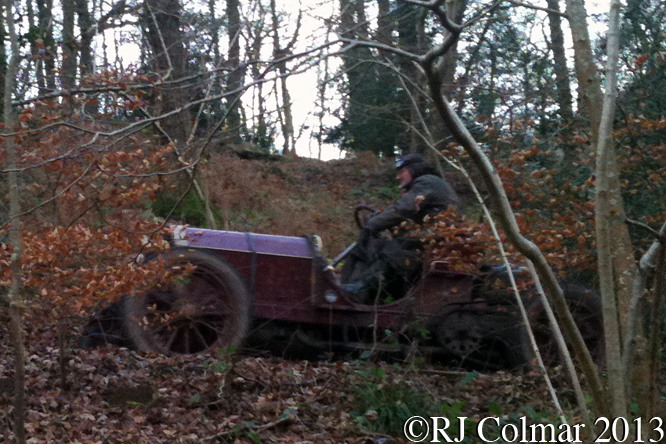
Mercedes Simplex, Fingle Hill, Exeter Trial

Above Ben Collings blasts up Fingle Hill while Roger hangs on to the 1903 Mercedes Simplex as best he can.

After a third observed Autotest at Wooston Steep it was off to Ilsington Parish Hall for another compulsory hour break during which I enjoyed some decaffinated coffee and some lovely cake. Next it was off round the corner to Simms a long wait ensued as many cars failed to get to the top after the restart. We eventually blasted up the first part of the hill but could not manage the second and ended up being carefully guided, who almost manhandled the car back to the corner so that we could reverse down the remainder of the course. Our shot at a medal was over and dissappointed we headed for Tipley Hill where another long queue awaited us. By now it was getting dark and colder again and since we were no longer in with a chance to win a medal we elected to skip Tipley Hill and headed for the final section Slippery Sam a cross between a rock garden and a bomb hole of a hill, again we flew up the first part but needed two attempts to clear the restart after which we flew around the last couple of corners bouncing over ground that would be an easy test for a four wheel drive but was a thriller in the tiny Parsons.
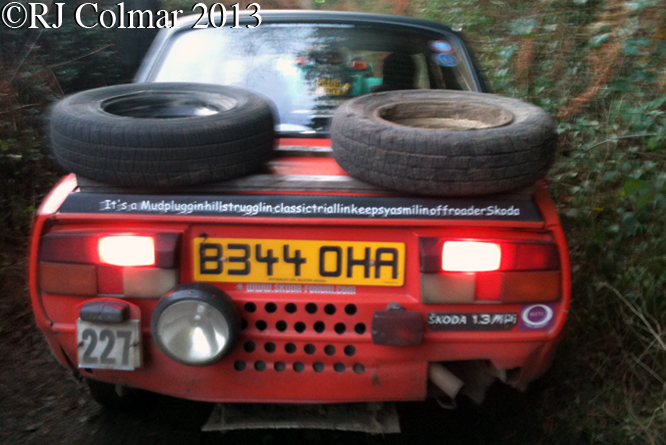
Skoda Estelle, Simms, Exeter Trial

Above part of discipline of the Exeter Trial is having the patience to sit in long queues in narrow lanes, above the #227 Skoda Estelle of Ben & Rosin Giles awaits it’s turn to get to the start of Simms.

We then headed to the Trecarn Hotel Babbacombe where exhausted we handed in our time card for the final time, glad to be in one piece, and that it had neither snowed or rained during the exhilarating 19 hour 250 mile drive. After a shower we joined many of the competing crews for dinner where tails of triumphs and failure were exchanged. I eventually crashed out feeling like I was still moving !

My thanks to Alan Spencer for taking me along on the Exeter Trial in his little Parsons which will be the subject of a future blog, thanks also to all the marshalls and organisers who put the time and effort in to making the event happen, I hope the opportunity to participate comes round again in the not too distant future.

Thanks for joining me on this “Chased By A Panda” edition of “Gettin’ a li’l psycho on tyres” I hope you will join me again tomorrow. Don’t forget to come back now !
Share

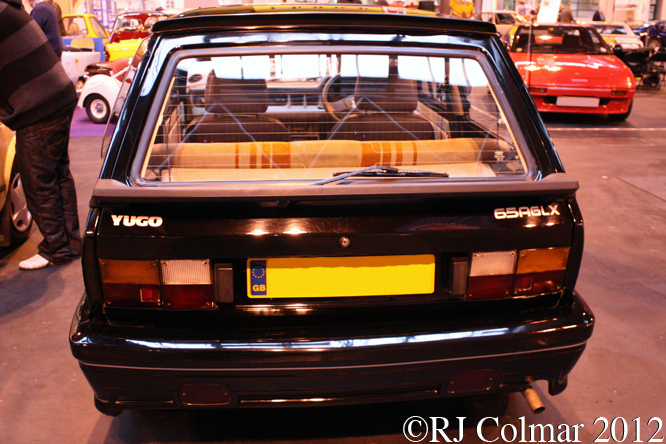
Fully Loaded Rare Breed – Zastava Type 102 / Yugo 65AGLX

Reading through the Zastava history on the zastava-yugo.co.uk website I was surprised to learn that just 83 of all Zastava/Yugo types remain registered on British roads,

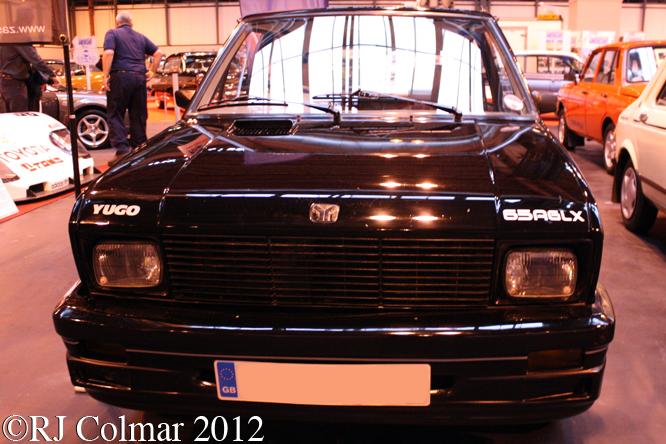
Yugo 65AGLX, The Classic Motor Show, NEC, Birmingham

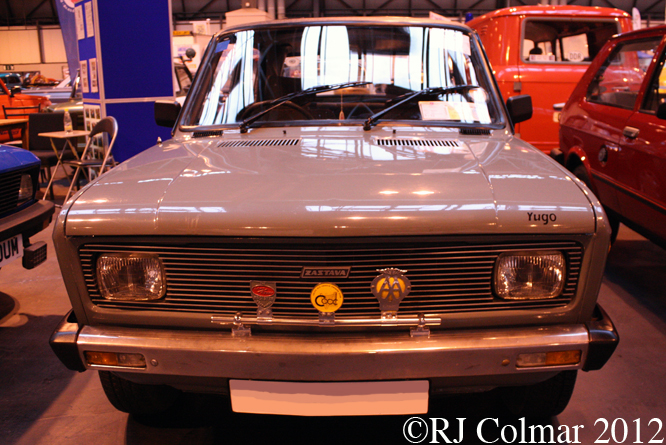
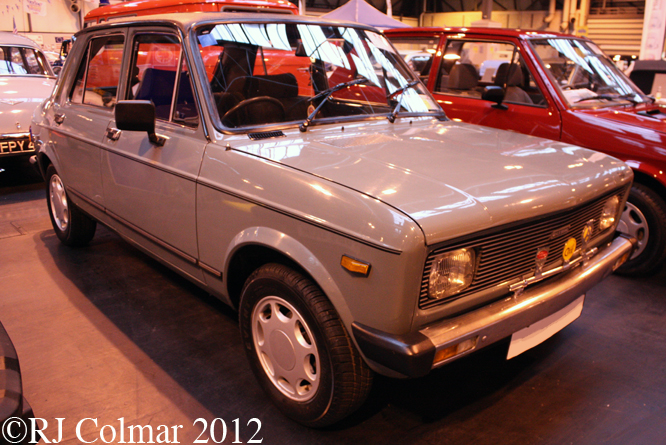
which makes today’s featured 1989 Yugo 65AGLX branded Zastava Type 102 a rare breed in Britain, if not it’s homeland and the area surrounding Serbia where it was built.

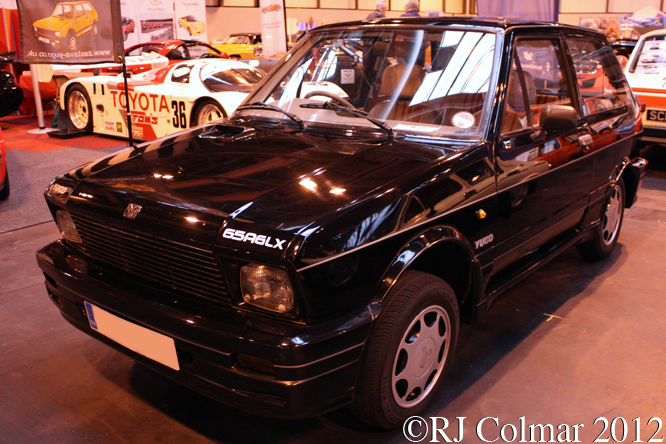
Yugo 65AGLX, The Classic Motor Show, NEC, Birmingham

Today’s featured 1989 model, is the top of the UK range GLX fitted with a 1298 cc / 79 cui motor which could be ordered with either a 5 speed manual or Renault derived 3 speed automatic gearbox.

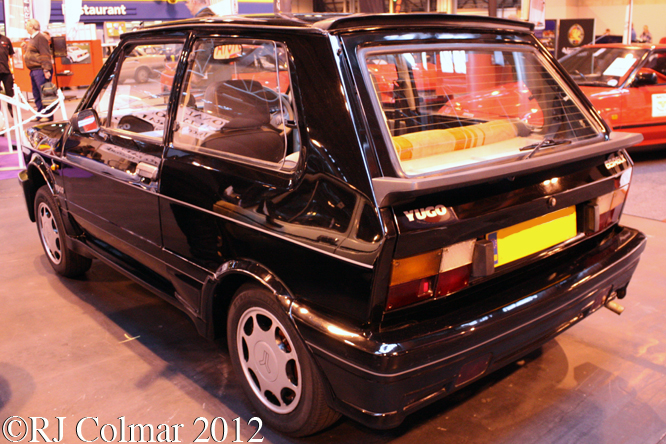
Yugo 65AGLX, The Classic Motor Show, NEC, Birmingham

In the USA where the 65AGLX was known as the GVX (GV = Great Value) along with the spoilers front and rear, side body kit and alloy wheels it was possible to order a GVX with a automatic electro-hydraulic folding/raising cabrio roof. US destined Yugo’s were apparently built on a separate production line manned by an elite staff who were paid a premium wage.

Yugo 65AGLX, The Classic Motor Show, NEC, Birmingham

Despite modest acceleration times of 0-60 mph in 13.5 seconds and a top speed of 85 mph, US spec, production of the Zastava Type 102 survived the violent dissolution of Yugoslavia, the factory at Kragujevac in Serbia survived a bombing, and did not end until 2008 with 794,428 examples built.

Thanks for joining me on this “Fully Loaded Rare Breed” edition of “Gettin’ a li’l psycho on tyres”, I hope you will join me again tomorrow. Don’t forget to come back now !

Share

Modern Style, Top Technology – Zastava Type 102 / Yugo 45

Like the Zastava Type 101 “Stojadin” I looked at last week the Zastava Type 102 is a design unique to Zastava built on a FIAT chassis pan and running gear.

Yugo 45A, Qwara, Malta

The FIAT chassis and engine designs for the Type 102 are from the FIAT 127 hatchback which was manufactured from 1971 to 1983.

Yugo 45A, Qwara, Malta

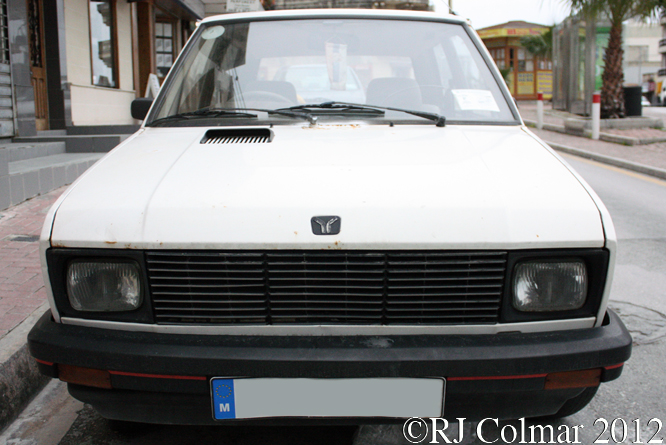
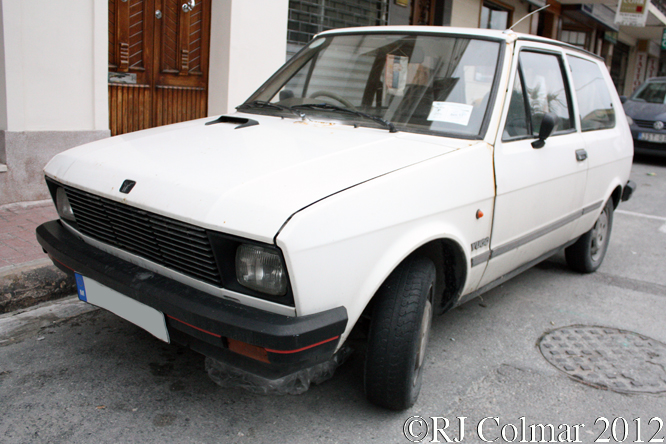
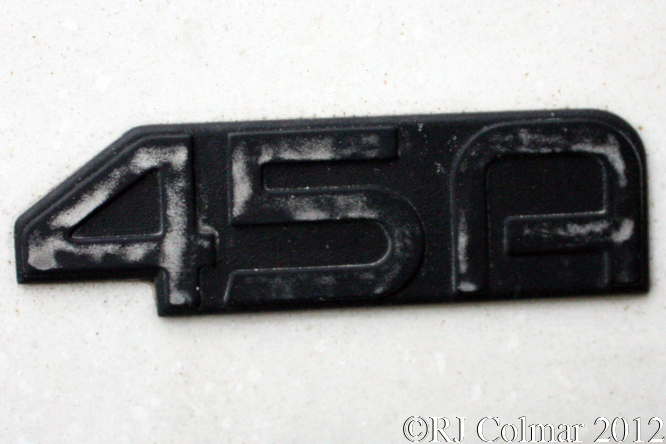
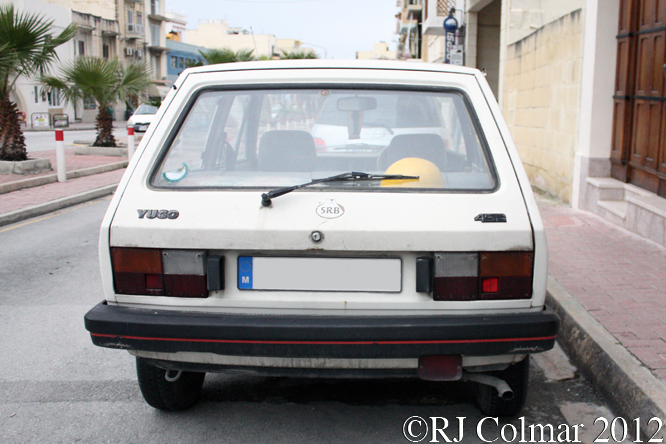
Type 102’s were also marketed with a myriad of different names in different markets, the Yugo 45A seen here in Malta bears no exterior Zastava identification marks at all.

Yugo 45A, Qwara, Malta

Originally sold with a ‘Modern Style, Top Technology‘ strap line, the first Type 102’s were built in 1980 and appear to have been made available for export the following year. the 45 designation indicates this car has a 903 cc / 55 cui motor with a four speed manual gearbox.

Yugo 45A, Qwara, Malta

The red ‘GTi’ pin stripe suggests this particular car dates from somewhere around 1989. Like the Type 101 the Type 102 survived the disintegration of Yugoslavia and was manufactured in Serbia under the Zastava Koral until
FIAT took over the Zastava plant in 2008 and immediately halted all Zastava production, bar a few pick ups.

Thanks for joining me on this “Modern Style, Top Technology” edition of “Gettin’ a li’l psycho on tyres” I hope you will join me again tomorrow. Don’t forget to come back now !
Share

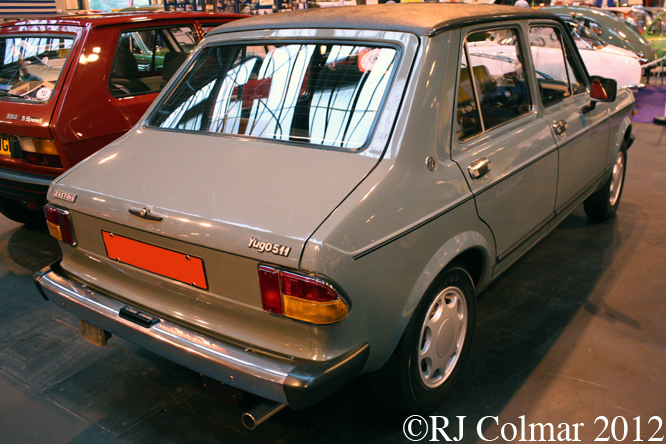
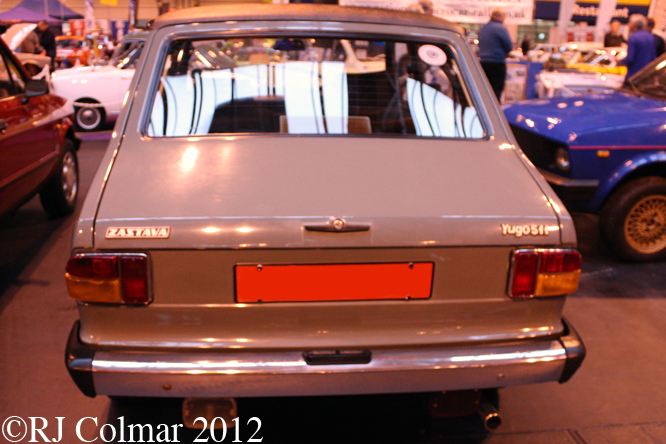
Stojadin – Zastava Type 101 / Yugo 511

Zastava, Serbian for flag according to Google Translator, was a Yugoslavian, now Serbian manufacturer that was born out of a Army Technical Institute founded in 1851 that in turn became a firearms manufacturer in the 1880’s. From 1939 to 1941 the vehicle arm of Vojno-Tehnicki Zavod assembled 400, Chevrolet according to some sources and Ford according to others, trucks before the ’39/’45 war closed operations down. In 1953 the renamed Zavodi Crvena Zastava, Red Flag Institutes 96% of the employees voted to resume vehicle manufacture and 162 Willy’s Jeeps were built. If you know have information pertaining to the first Zastava trucks being Ford or Chevrolet please chime in below.

Zastava Yugo 511, The Classic Motor Show, NEC, Birmingham

In 1954 Zavodi Crvena Zastava entered an agreement to assemble FIAT’s under license which led to the production of FIAT 128’s called Zastava 128’s in 1971. In 1972 a hatchback version of the 128 was introduced and it is a 1986 version of the hatch back known as the Type 101 that is featured today.

Zastava Yugo 511, The Classic Motor Show, NEC, Birmingham

The front end is indistinguishable from the revamped 1976 FIAT 128, voted 1970 European Car of the Year, minor differences to the bumper and manufacturers badges not withstanding.

Zastava Yugo 511, The Classic Motor Show, NEC, Birmingham

Power for todays featured car comes from a 1116 cc / 68 cui with an aluminium cylinder head and overhead cam, originally designed by the legendary Aurelio Lampredi, which produces 55 hp.

Zastava Yugo 511, The Classic Motor Show, NEC, Birmingham

The Zastava 101, known colloquially in Serbia as the “Stojadin”, was sold under a variety of names in different markets, these include Yugo 311/313/511/513 and Skala 55 in its most recent 2008 incarnation when production ceased after 1,045,258 of the hatchbacks had been built. Production of the hatch backs was also licensed by the Polish FSO company and sold as the Zastava 1100p.

Zastava Yugo 511, The Classic Motor Show, NEC, Birmingham

Like just about every other passenger vehicle built under the communist regieme in the 1970’s and 1980’s some Zastava 101’s were used for competition with a class win on the 1973 Tour d’Europe probably counting as it’s most significant achievement.

Thanks for joining me on this “Stojadin” edition of “Gettin’ a li’l psycho on tyres”, I hope you will join me again tomorrow. Don’t forget to come back now !
Share