Tag Archives: Ford

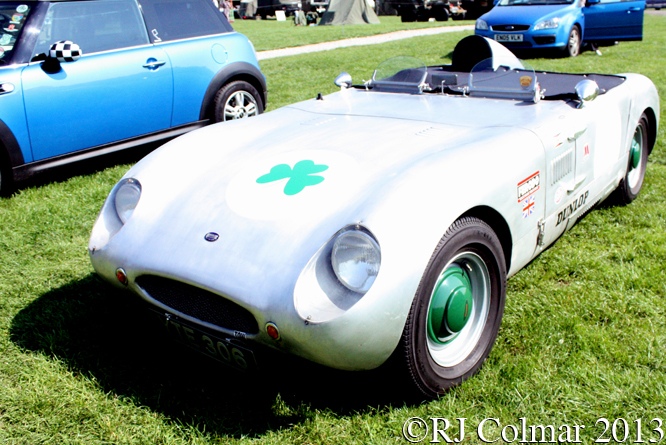
Kiwi Body ? – Buckler Mk 90

From 1953 to at least 1959 a number of Buckler Mk 90’s were manufactured.

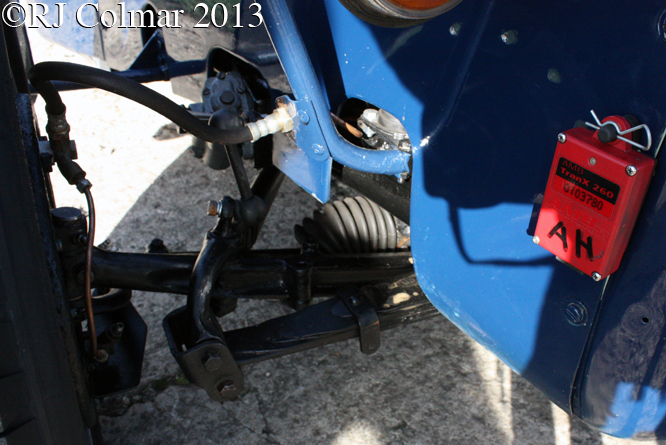
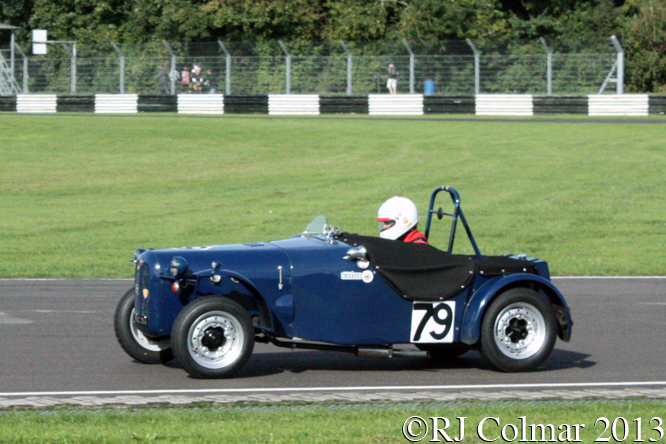
Buckler Mk 90, Gold Cup, Oulton Park

From the Buckler Register it would appear all were fitted with 1172 cc / 71 cui Ford side valve motors as fitted to numerous Fords including the contemporaneous Ford 100E Prefects and Anglia’s.

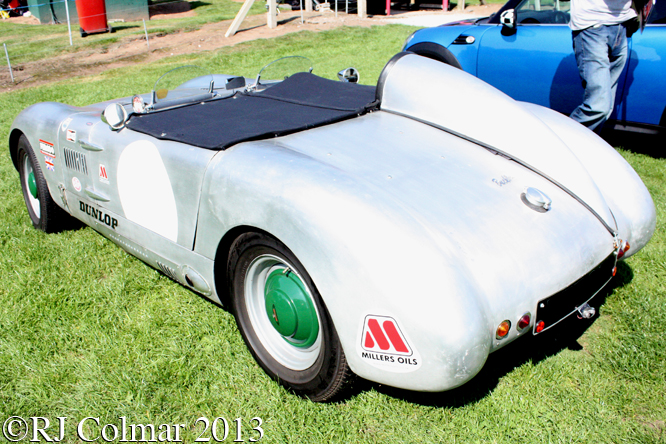
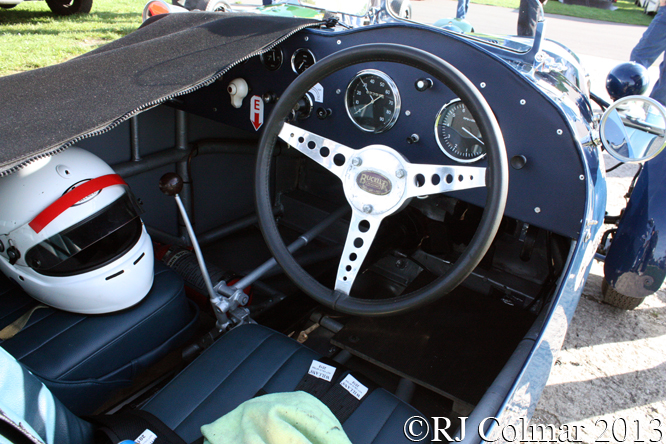
Buckler Mk 90, Gold Cup, Oulton Park

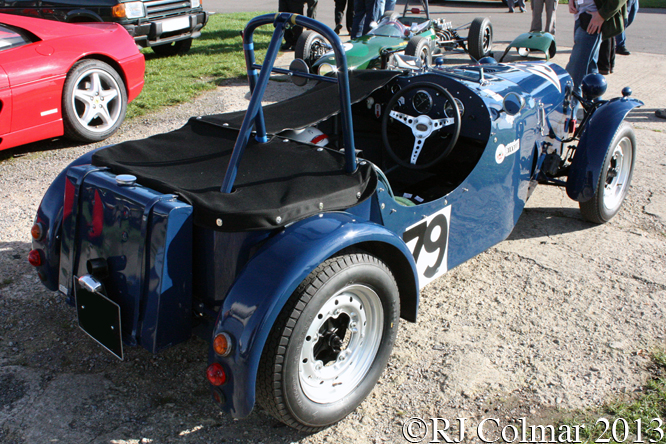
Elsewhere it would appear the body of the Mk 90 was designed by New Zealander Ferris de Joux, although I suspect Ferris may have designed a fiber glass body for at least one Buckler raced in New Zealand, most of the known Buckler Mk 90’s, including the 1956 example featured to day seen at Oulton Park, were fitted with aluminium bodies which leads me to question de Joux’s involvement with the Mk 90 bodies seen in the UK.

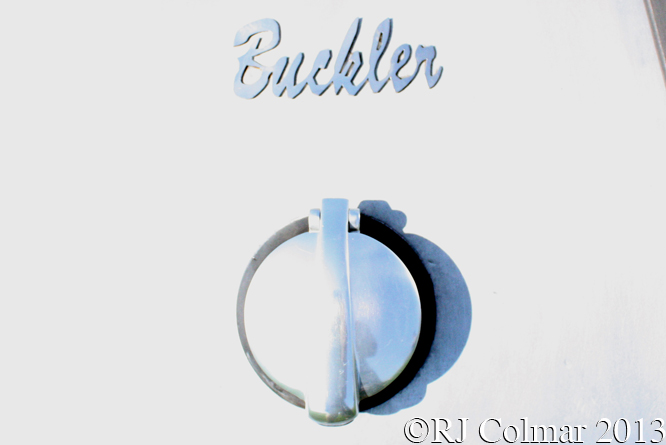
Buckler Mk 90, Gold Cup, Oulton Park

If you know that de Joux’s design made it beyond New Zealand for the UK aluminium bodied cars please do not hesitate to chime in below.

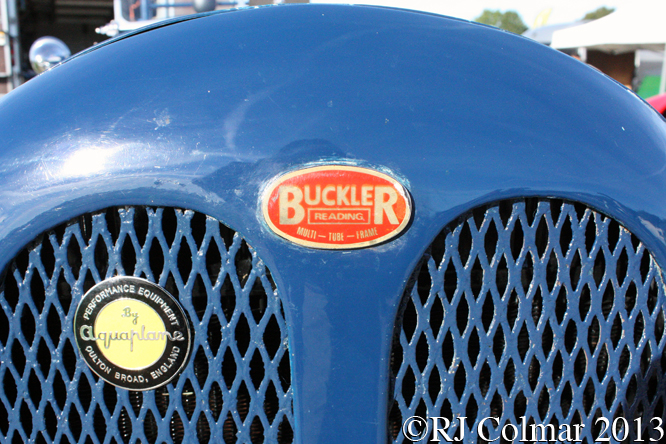
Buckler Mk 90, Gold Cup, Oulton Park

Of the seven races known to racingsportscars in which Buckler Mk 90’s were driven, two of them were won by a Mk 90 with N. Grier-Rees at the wheel including the 1957 Silverstone Relay Race.

Thanks for joining me on this “Kiwi Body ?” edition of “Gettin’ a li’l psycho on tyres” I hope you will join me again tomorrow when I’ll be looking at a . Don’t forget to come back now !

Share

Supercharged 100E – Buckler MK 6

With the sales success of his Buckler MK 5 the earliest example of which was manufactured in 1949 Derek Buckler expanded his range by offering a longer wheel base Buckler Mk 6 in 1953 which could be ordered either as a turn key or car sales tax saving self build model.

Bucker MK 6, Autumn Classic, Castle Combe

In kit form complete with tubular frame chassis, supports and fittings, independent front suspension, radiator, petrol tank, remote gear change, special steering and silencer for less than £200 to which could be added the cost of a motor, gearbox, rear axle and wheels which would typically come out of a wrecked donor Ford, along with the price of a home made body.

Bucker MK 6, Autumn Classic, Castle Combe

The earliest known owner of today’s featured 1953 Buckler MK 6 is believed to have been M Bendall who fitted a motor from a Ford 100E Prefect/Anglia a model first seen in 1953.

Bucker MK 6, Autumn Classic, Castle Combe

At some point the power of the motor in the vehicle as seen today was boosted with the aid of a supercharger.

Bucker MK 6, Autumn Classic, Castle Combe

Stan Hibberd owned the car in 1972 and drove it to the, now at least 200 year old, ciderhouse Coronation Tap in Clifton, Bristol for the the first meeting of the Buckler Register.

Bucker MK 6, Autumn Classic, Castle Combe

Although Stan remembered the meeting and the cider, served in half pints, many years later he did not remember any Bucklers being present although contemporary reports are to the contrary.

Bucker MK 6, Autumn Classic, Castle Combe

Stan’s grandson Andrew drove the car at last years Castle Combe Autumn Classic meeting, unfortunately a problem during qualifying meant Andrew did not take the start.

Thanks for joining me on this “Supercharged 100E” edition of “Gettin’ a li’l psycho on tyres” I hope you will join me again tomorrow when I’ll be looking at another one off Formula One car from 1974. Don’t forget to come back now.

Share

Backyard Hi Tec – Amon Cosworth AF101

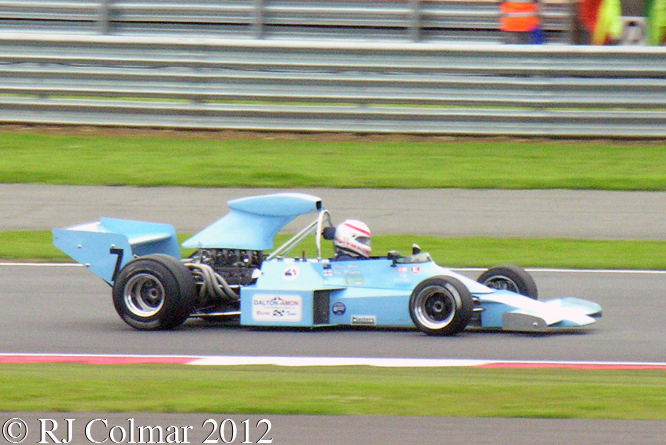
This month’s Sunday posts will feature 5 Formula One cars that ran in the 1974 season for which the then 31 year old Le Mans winner Chris Amon decided to follow in the foot steps of Jack Brabham and Bruce McLaren by building a car bearing his own name.

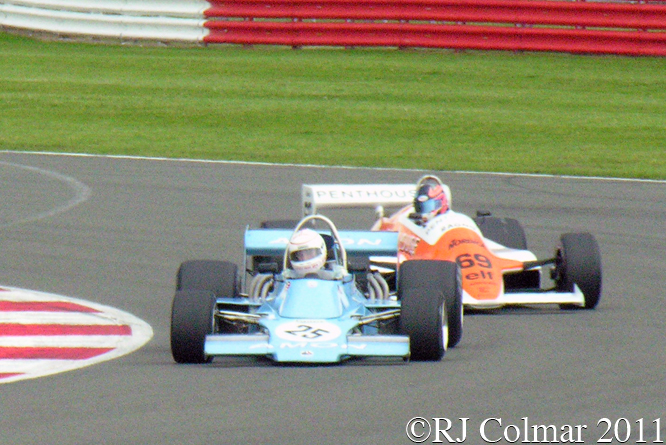
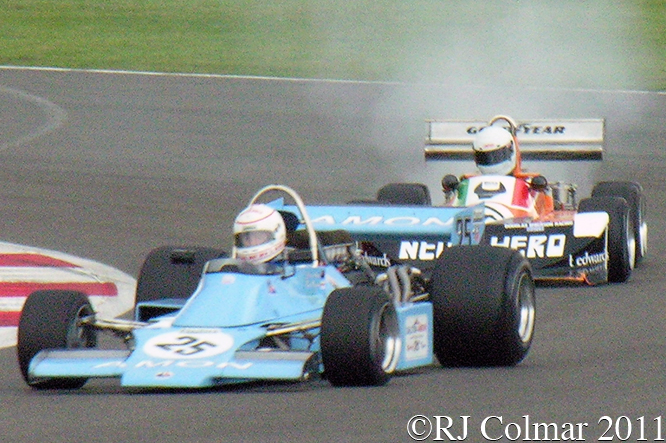
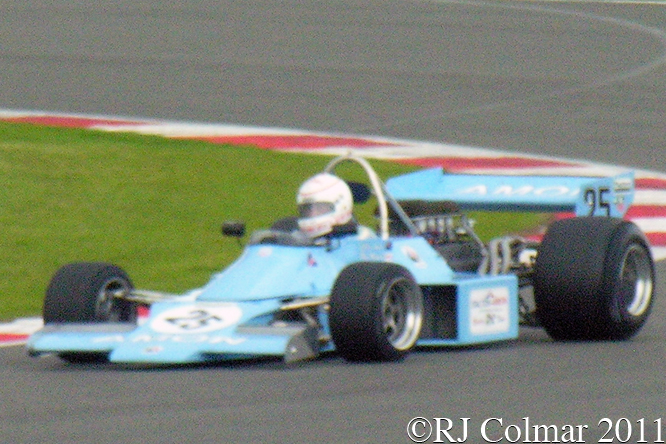
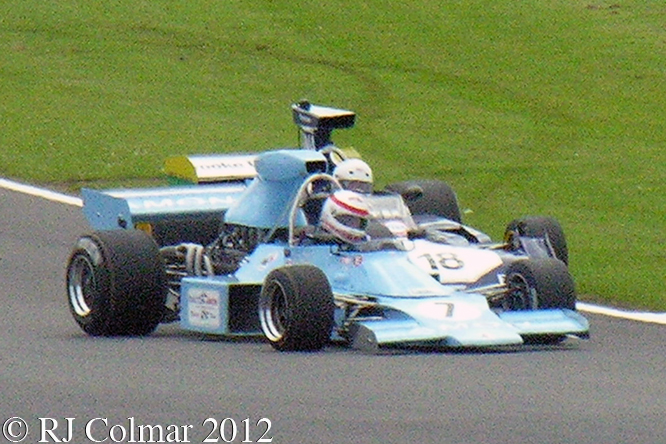
Amon Ford F101, Maydon, Siverstone Classic

It would appear Chris had plans to build both Formula 1 and Formula 5000 cars the latter to race in the lucrative US series with up and coming Australian Larry Perkins; a driver, engineer and sofa surfer who was making his way through the junior ranks in the UK. However despite financial backing from amateur racer John Dalton only the Formula One spec AF101 featured here ever saw the light of day.

Chris commissioned Gordon Fowell to provide him “with a sophisticated chassis” powered by a Ford Corsworth DFV motor driving the rear wheels through a Hewland gearbox. Gordon had designed the attractive, if underpowered, Martini sponsored 1973 Tecno E731 that Chris drove in practice at three meetings in 1973 but had never raced.

Amon Ford F101, Maydon, Siverstone Classic

The AF101 chassis, fabricated by Thompson who were also responsible for fabricating the Tecno E731 and Ferrari 312 B3, was certainly sophisticated with unique, for the time, central fuel cell that would become deriguer once ground effects were better understood with the introduction of the Lotus 79 in 1978. The car also had titanium torsion bar suspension and inboard front brakes, as did the well proven Lotus 72.

Responsibility for the aerodynamics was handed over to Professor Tom Boyce, and almost every time the car appeared it had a different nose including a high wing when it was first tested, a chisel nose in Spain where it first raced, a shovel at Monaco where the car qualified but did not race and then a lower full width wing was tried when the car failed to qualify in Germany and Italy.

Amon Ford F101, Maydon, Siverstone Classic

Unfortunately the AF101 proved a little to sophisticated for Chris’s budget, despite Larry Perkins saving a fortune in hotel bills with his sofa surfing skills, the little team folded having clocked just 22 laps in the 1974 Spanish Grand Prix before a brake shaft broke. Looking back on the project Chris conceded that he had attempted to build, what turned out to be a fragile hi tec vehicle on a backyard budget when he might have achieved more with a vehicle that was a little less ambitious and a little more reliable.

Larry Perkins loyalty was rewarded with an attempt at qualifying the Amon in the German Grand Prix after Chris was taken ill, unfortunately the combination of the Nurburgring, a rookie driver and a fragile car proved too much of a challenge for the team.

Amon Ford F101, Maydon, Siverstone Classic

After out qualifying Ricky von Opel and his works Brabham BT44 in the 1974 Spanish Grand Prix Chris was offered the second works Brabham drive for the rest of 1974, but turned it down out of loyalty to his own employees. Just as in 1973 when Tyrrell stepped in to offer Chris a couple of end of season drives after the demise of the Tecno team, at the end of 1974 BRM stepped in to offer Chris a couple of drives in the wonderful BRM P201, a model I’ll be looking at in a couple of weeks.

Post Italy 1974 the Amon was abandoned, restored and languished in a German Museum before it was restored to running condition in 2005. It is currently owned and raced by Ron Maydon in the Grand Prix Masters Series, Ron is seen driving the AF101 at Silverstone a few years ago.

Amon Ford F101, Maydon, Siverstone Classic

Thanks for joining me on this Backyard Hi Tec edition of “Gettin’ a li’l psycho on tyres” I hope you will join me again tomorrow when I’ll be starting a new GALPOT feature “Maserati Monday”. Don’t forget to come back now !

Share

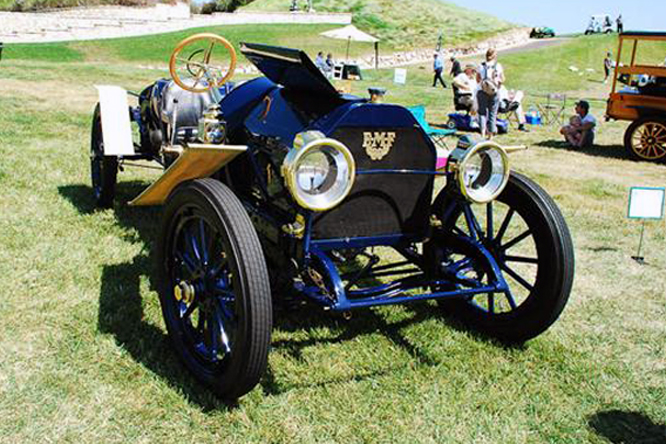
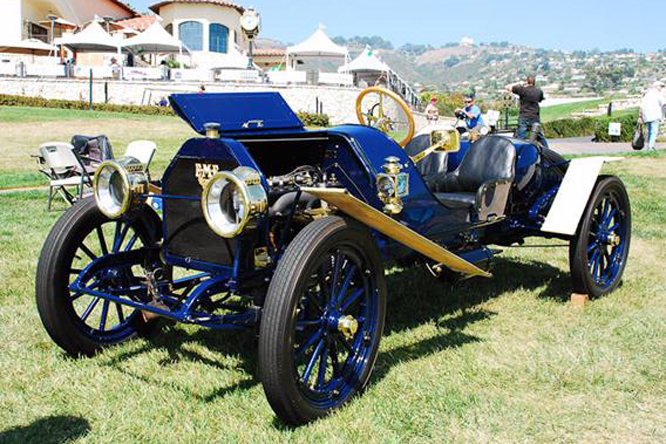
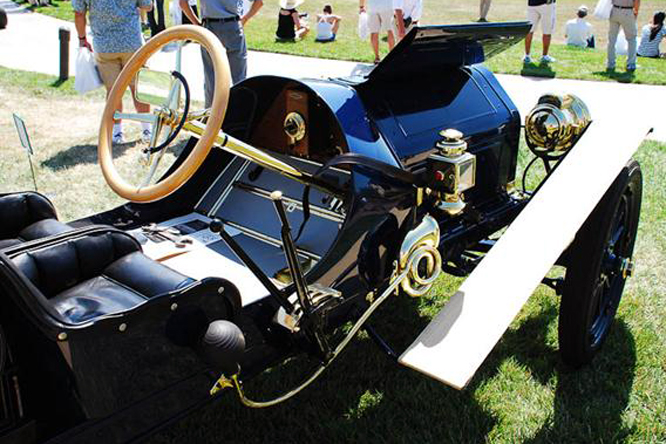
Unbelievably Complicated Story – E-M-F Model 30 Semi Racer #43222

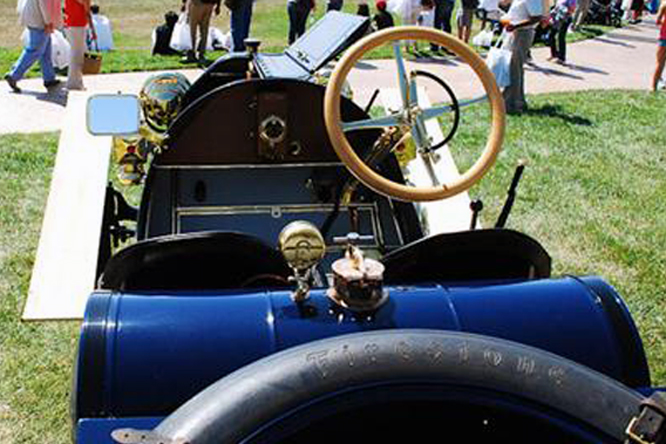
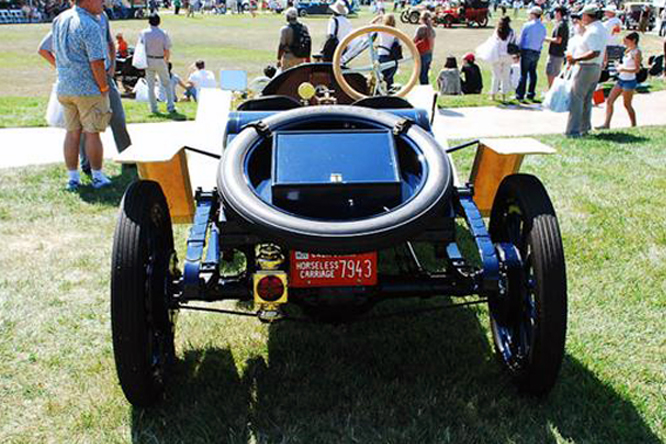
Today’s post features the first of four Edwardian vehicles built in the USA. Reading any standard text on the history of the motor car 1908 is remembered as the year the mass produced Ford Model T went onto the market that it would dominate for nearly 20 years. For those of us born more recently this advent glosses over many other vehicles of that particular age some with no less interesting and almost unbelievable characters. One such is the story of E-M-F which has a strong link to the story of the Model T.

E-M-F Model 20, Palo Verdes, Concours d'Elegance

The initials stand for a wealthy coach builder and financial genius named Byron F. Everitt who did some work for Henry Ford, a super salesman who took 2700 orders for Cadilacs when they had only built three cars by the name of William E. Metzger and a industrial colosus Walter E. Flanders, of whom Henry Ford was fearful, who invented and organised much of the production machinery that was required to build the Model T.

E-M-F Model 20, Palo Verdes, Concours d'Elegance

In June 1908 circumstances brought Everitt, Metzger and Fanders together with E. LeRoy Pelletier, Fords secretary and publicity manager, to celebrate the merger of the Wayne Motor Company, under the control of Everitt and Flanders and the Northern Motor Company of which Metzger was in control to form E-M-F with the aim of mass producing a $2500 car which was to sell at $1250 or “twice the car for half the price”.

E-M-F Model 20, Palo Verdes, Concours d'Elegance

The in many ways, apart from it’s mid price range, unremarkable 4 cylinder Model 30 was launched in September 1908 with Pelletier basing his marketing strategy on “Nothing added-no frills or furbelows. Nothing omitted that experience has proven or convention taught you to consider a necessary part of a first- class motorcar. Not one original feature-not a single novelty-no startling innovations. Not one experiment-not one hair-brained theory or half-baked mechanical idea-not an untried or unproven invention-or metallurgical hallucination-will you discover in the E-M-F ’30’.”

E-M-F Model 20, Palo Verdes, Concours d'Elegance

The “Classy” Model 30 was well received although early examples relied on what turned out to be inadequate thermo-syphon cooling which damaged the new Marques reputation. The early cars were all recalled to have water pumps fitted, while low end Henry Ford went the other way deleting water pumps from the Model T in favour of themo syphon cooling ! Despite becoming, thanks to distribution by Studebaker, the second largest supplier of US automobiles by 1911, behind only Ford, as early as 1909 things started to unravel at E-M-F as the titans of the industry began to fall out. By 1912 Studebaker had taken full control and the E-M-F name disappeared for good though the Model 30 would live on in the Studebaker and parallel Everitt / Flanders Marques. For the full unbelievably complicated rise and fall story of E-M-F I recommend reading John M Daly’s E-M-F website linked here.

E-M-F Model 20, Palo Verdes, Concours d'Elegance

Today’s featured car #43222 was built originally built in 1912 and has recently been restored by Robb Stewart, pictures of the restoration can be towards the bottom of his flickr page linked here..

My thanks to Geoffrey Horton for sharing these photographs which were taken at Palo Verde in 2011.

Thanks for joining me on this “Unbelievably Complicated Story” edition of “Gettin’ a li’l psycho on tyres” I hope you will join me again tomorrow for Ferrari Friday. Don’t forget to come back now !

Share

Doubling Horse Power – Doe Dual Drive 130

This month I thought it would be fun to look at a few farm vehicles I have stumbled across in recent years.

In June 1898 Ernest Doe took out a lease on a blacksmiths shop in Ulting near Maldon in Essex. By 1910 the business of shoeing horses and repairing agricultural equipment had been successful enough for Ernest to by the free hold for the business and a neighbouring farm.

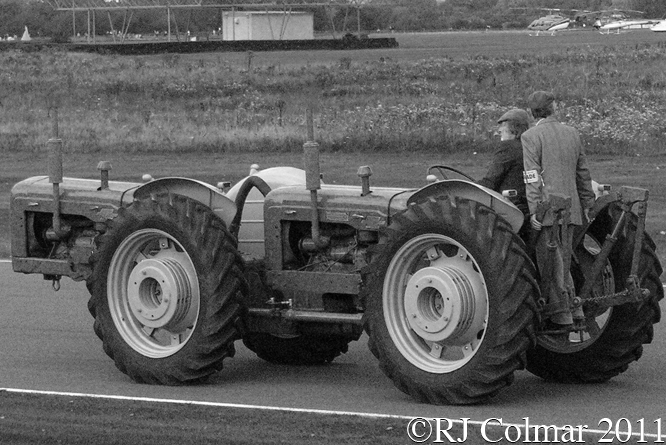
11-Doe Dual Drive 130 4094sc

After the Great ’14-’18 war eldest son Ernest Charles persuaded his father to invest in some of the 6000 tractors which had been sent from by the US to help the Allied war effort. By the ’39-’45 war Ernst Doe were distributing Fordson, David Brown, Allis Chalmers and Case tractors with Ransome machinery.

Doe Dual Drive 130 4095sc

Wanting more power from his tractor Essex farmer George Pryor bought two new Fordsons removed the front wheels of both and linked them with a turntable that allowed the enlarged vehicle to be steered with the aid of a pair of hydraulic rams. In 1958 Ernst Doe built an improved version of Pryor’s tractor linking two Fordson Major tractors. With a combined 100 hp and all wheel drive the vehicle outperformed everything else available in the UK with the bonus that it required special equipment because regular farmyard equipment was too flimsy when operated by the Doe Dual Power.

Doe Dual Drive 130 4096sc

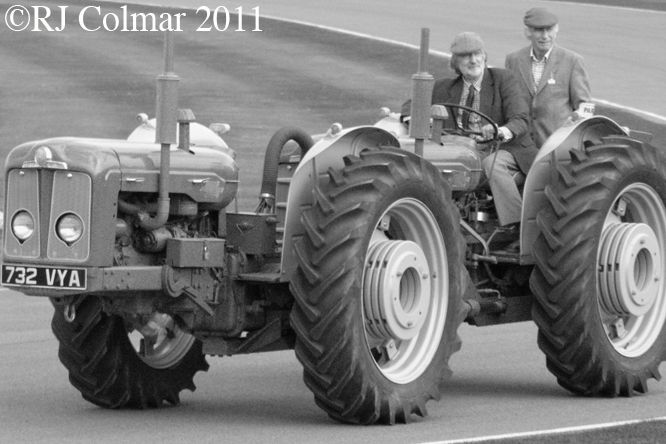
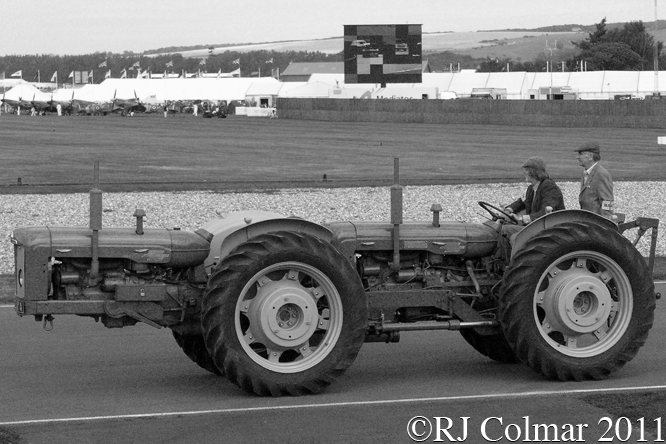
The name was later changed to Doe Dual Drive often abbreviated to Triple D. By 1963 Doe built an even more powerful tractor using to a pair Ford 5000’s like the Triple D 130 seen here at Goodwood. The final Triple D 150 variant was built with a pair of Ford Force 5000 units. Eventually more conventional tractors with more powerful single engines caught up with the performance of the Triple D and rendered it obsolete because of the increased maintenance necessitated by having a vehicle with two motors and two gearboxes.

It is thought around 300 Triple D’s were built and today they can fetch over £50,000 at auction. Today Ernst Doe, still a family business, operates from 19 outlets in the east of England distributing a variety of plant and machinery including New Holland tractors.

Thanks for joining me on this “Doubling Horse Power” edition of “Gettin’ a li’l psycho on tyres” I hope you will join me again tomorrow when I’ll be looking at the first of this months series of Edwardian vehicles. Don’t forget to come back now !

Share

Power Adjustable Pedals – Ford Crown Victoria Police Interceptor

In 1992 the Ford Crown Victoria Police Interceptor also known as the CVPI, P71 and Crown Vic replaced the police package Ford LTD Crown Victoria which had been available to Law enforcement agencies since 1983.

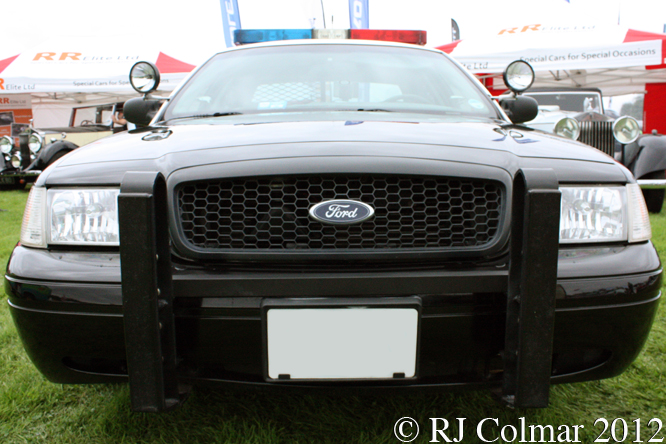
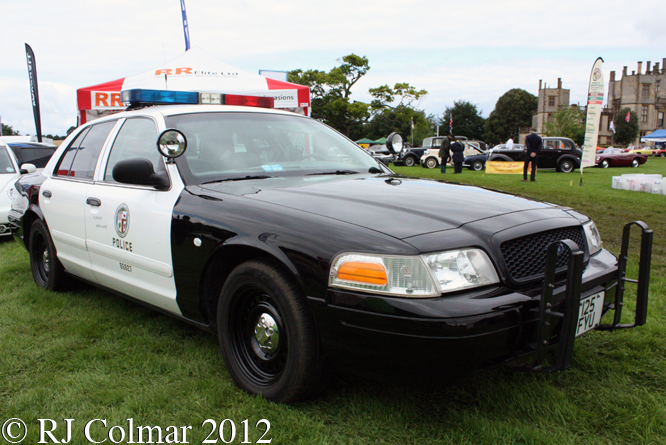
Ford Crown Victoria Police Interceptor, Classics At The Castle, Sherborne Castle

Like it’s LTD Crown Vic predecessor the new model was built with a cheap and easy to maintain separate body and chassis and a 251 hp V8 driving the rear wheels which provided handling characteristics preferred by law enforcement agencies over front wheel drive vehicles.

Ford Crown Victoria Police Interceptor, Classics At The Castle, Sherborne Castle

First generation CVPI’s were built between 1992 and 1997 by which time the CVPI’s closest rival the Chevrolet Caprice was discontinued to be replaced by front wheel drive models.

Ford Crown Victoria Police Interceptor, Classics At The Castle, Sherborne Castle

Despite it’s virtual monopoly on frame over body vehicles Ford introduced an upgraded second generation CVPI with slightly more conservative less rounded styling, in line with it’s other Crown Victoria models in 1997.

Ford Crown Victoria Police Interceptor, Classics At The Castle, Sherborne Castle

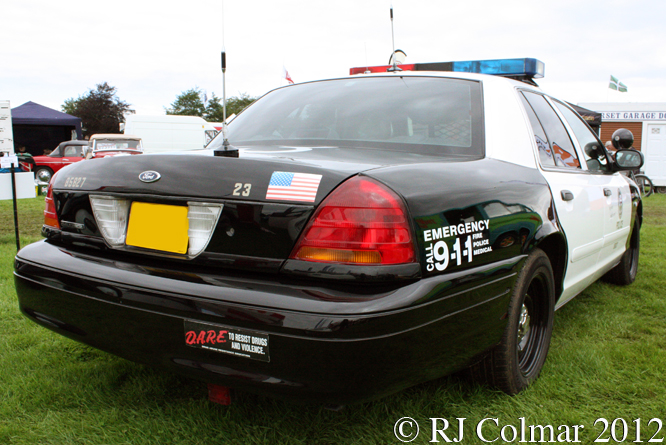
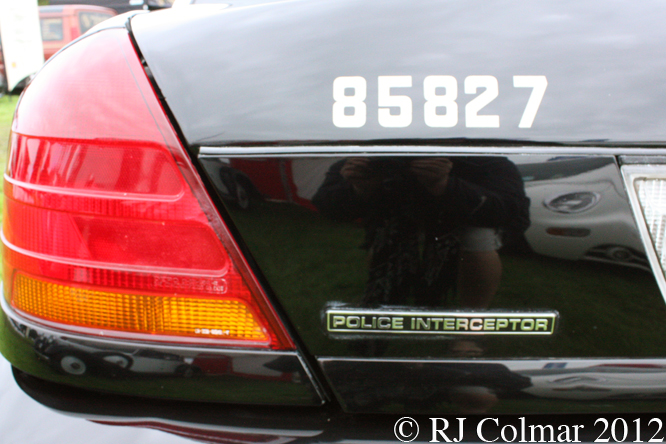
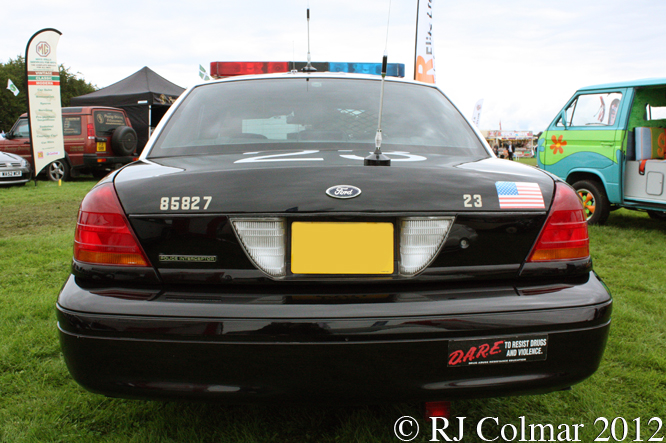
It was not until 1999 that the Police Interceptor badge replaced the Crown Victoria badge on the boot / trunk lid.

Ford Crown Victoria Police Interceptor, Classics At The Castle, Sherborne Castle

For 2001 Interceptors, including today’s featured 2001 example seen at Classics at the Castle in Sherborne, were given Power Adjustable Pedals to more easily accommodate height diversity among Law Enforcement officers using these vehicles. The CVPI model was discontinued in 2010 as was the regular Crown Victoria.

Ford Crown Victoria Police Interceptor, Classics At The Castle, Sherborne Castle

This particular CVPI belongs to RRElite Ltd and is used for weddings, special occasions and Film work. It comes with a chauffeur in full replica LAPD police uniform who will arrest the bride and deliver her safely to the Church on time.

Thanks for joining me on this “Power Adjustable Pedals” edition of “Gettin’ a li’l psycho on tyres” I hope you will join me again tomorrow when I’ll be looking at Some of the Ferrari’s that were on display at the recent Autosport International. Don’t forget to come back now.

Share

The Truck That Jack Built – ROUSH Nitemare F-150

After graduating with a Masters in Scientific Mathematics from Eastern Michigan University in 1966 Jack Roush, born in Covington Kentucky, went to work for Ford until 1970 and after a short spell with Chrysler set up his own engineering business which was to become Roush Enterprises.
ROUSH Nitemare F-150, Thruxton

Roush teamed up with Wayne Gapp to build up a successful Drag Racing team G & R High Performance in Livonia, Mich which amongst other vehicles built a $25,000 150 mph ’73 Ford Pinto pro stocker powered by a Cleveland V8 driven by Ken Dondero and a pro stock Maverik driven by Wayne Gapp called “Juana Taxi”.
ROUSH Nitemare F-150, Thruxton

Building on his success on the Drag Strip Roush entered a partnership with the German Ford tuner Zakspeed to build successful road racing vehicles for Ford in the Trans Am and IMSA GT Series.
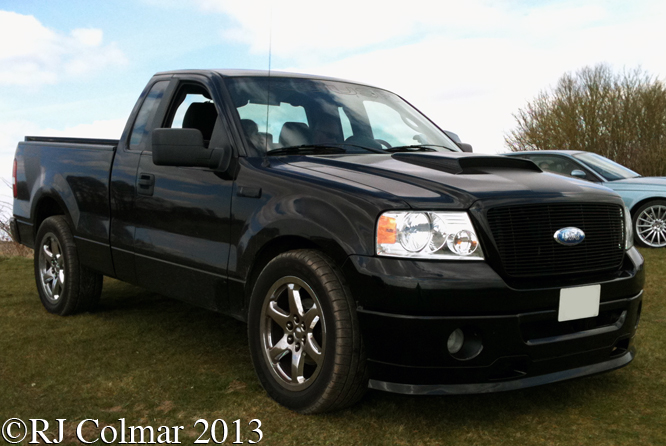
ROUSH Nitemare F-150, Thruxton

In 1988 Jack entered the NASCAR arena with a young Mark Martin and since has survived two aeroplane crashes, in 2002 and 2010, while Matt Kenseth and Kurt Busch won back to back Cup titles, in 2003 ans 2004, for Roush. Matt also won two Daytona 500’s in 2009 and 2011. In the second tier Nationwide Series Gregg Biffle (2002), Carl Edwards 2007, and Ricky Stenhouse Jr 2011 and ’12 have all won driving for “The Cat in the Hat” as Jack is affectionately known. Gregg Biffle also won the 2000 NASCAR Craftsmen Truck Series in a Roush F-150.
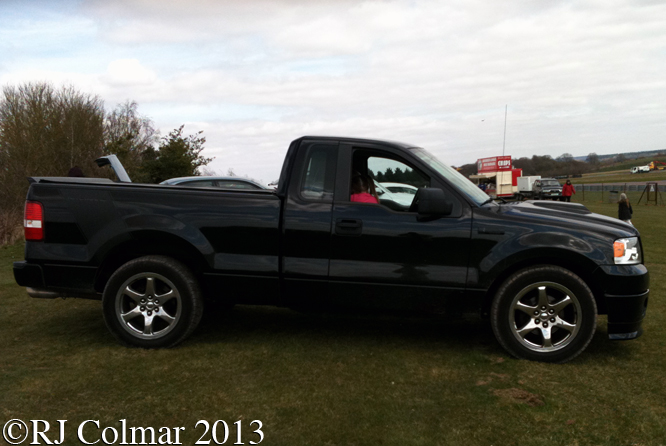
ROUSH Nitemare F-150, Thruxton

Along side all his racing success Roush Enterprises has produced all manner of performance parts under the Roush Performannce banner and in 2004 Jack introduced the first in a trickle of limited edition Roush Mustangs known as the 440A.
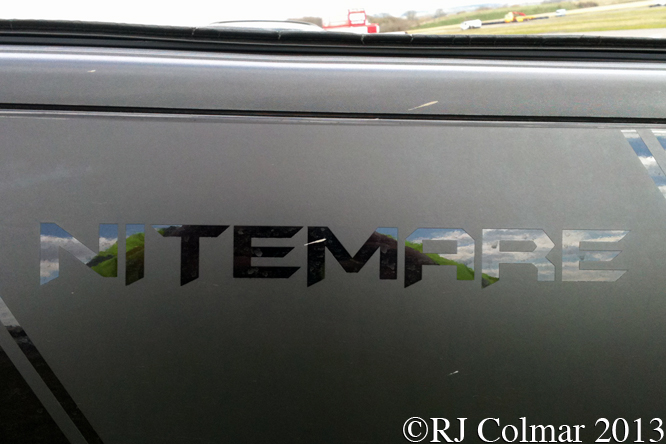
ROUSH Nitemare F-150, Thruxton

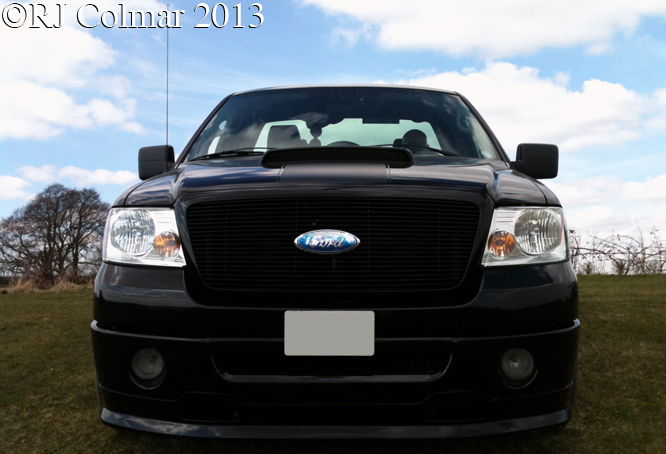
Following the release of the 2007 Black Jack Mustang Roush Performance turned it’s attention to a limited edition truck based on the 2007 11th edition standard cab F-150 with the flaredside bed.

ROUSH Nitemare F-150, Thruxton

Just 100 2007 Roush Nightmares were built and so far as I can tell from the head light cluster and rear wheel arches the example seen here, at Thruxton last year, is one of them. In 2008 a second series of 100 Nightmares was built with less chrome in the head light clusters and larger flares on the rear wheel arches.
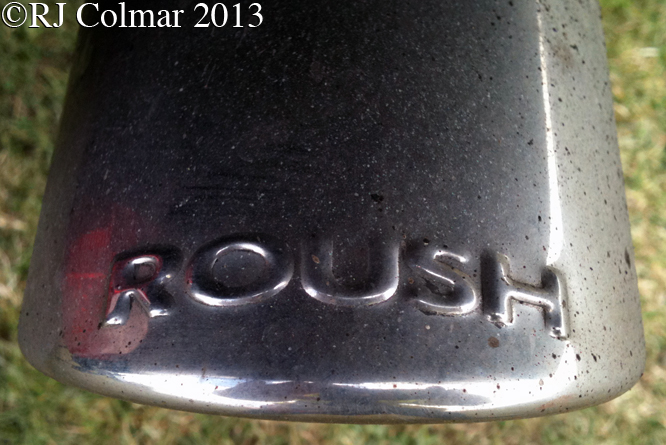
ROUSH Nitemare F-150, Thruxton

Along with the performance enhancing Roushcharger™ the 445 hp 5.4 litre / 329 cui V8 features 3 valves per cylinder, bespoke intake manifolds, intercooler, radiator, and air induction system. The vehicle is fitted with an electronically-controlled speed limiter which restricts the top speed to 105 mph.
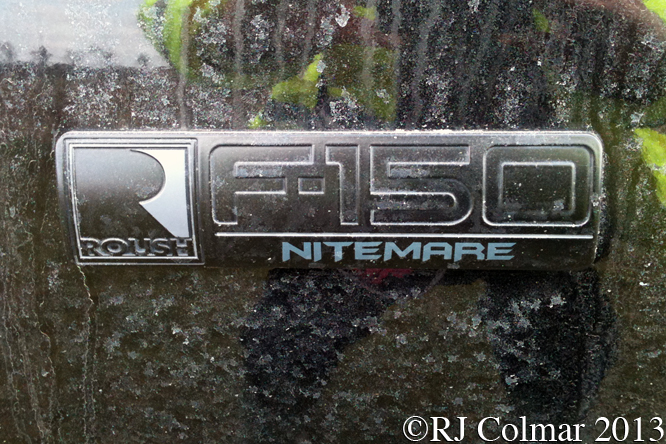
ROUSH Nitemare F-150, Thruxton

Options included the decorative hood scoop, Roush sport lowered suspension, locking lug nuts, GPS and NASCAR inspired rear spoiler seen below.
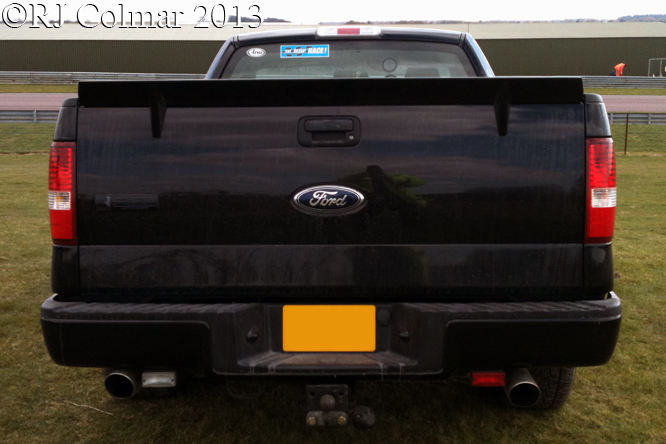
ROUSH Nitemare F-150, Thruxton

Available only from ROUSH-authorized Ford dealers beginning June 2007, the ROUSH Nitemare cost $41,750, comparable to a discounted Dodge SRT 10 performance truck, and was covered by ROUSH’s industry exclusive 3 year/36,000 mile warranty.

Thanks for joining me on this “The Truck That Jack Built” edition of “Gettin’ a li’l psycho on tyres” I hope you will join me again tomorrow when I’ll be looking at a 9.2 litre / 563 cui chain drive Mercedes. Don’t forget to come back now !
Share