Tag Archives: Ford

Henry’s Hot Hatch – Ford Fiesta XR2 Mk I, II & III

The Hot Hatch was a term for class of hatchback that gained currency with the introduction of the performance orientated Volkswagen Golf GTi in 1976, although I would venture to suggest the first real performance hatch back was the rear wheel drive Austin A40 Countryman which won the 1960 British Saloon Car Championship with Doc Shepherd at the wheel, though pedants may quibble about the fact that only the lower boot / tailgate of the Mk 1 A40, that one the championship, opened where as a hatch back is generally considered to have a rear opening that includes the the rear window and most commonly front wheel drive.

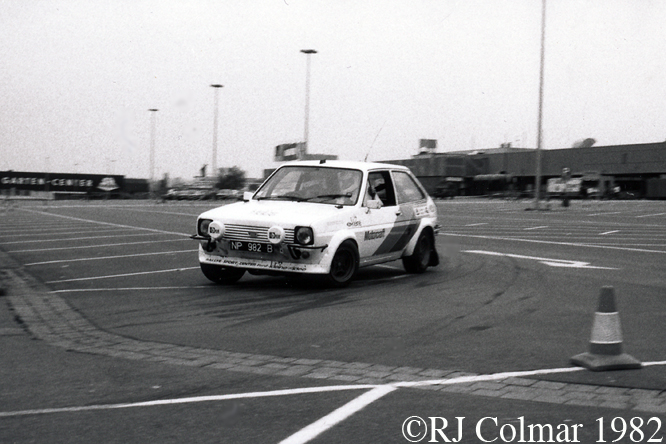
Ford Fiesta XR2, Sudring, Paderborn

Fords entry vehicle into the front wheel drive hatchback market, ‘Project Bobcat’, was first seen at Le Mans in June 1976. The Fiesta range topping performance XR2 was launched in 1981 with an 84hp 1597cc / 97.5 cui over head valve 4 cylinder motor fitted with a carburetor good for a 0 – 60 mph time of 9.3 seconds and a top speed of 105 mph.

The much modified XR2 above with extended wheel arches is seen in the car park of the Südring shopping mall in Paderborn, Germany. The number plate style indicates it belonged to a member of the British Army On The Rhine (BAOR), and is seen competing in an Autotest a sport in which precision driving is the key skill. If you happen to recognise the car or know it’s drivers please chime in below.

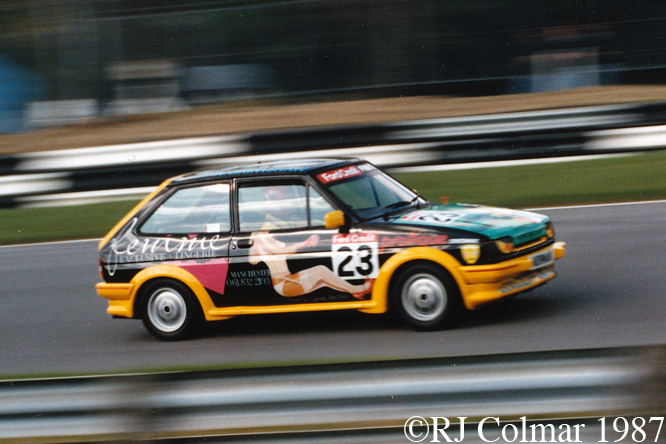
Ford Fiesta XR2, Brands Hatch

The Mk II Fiesta was launched in 1983 was essentially a reskin of the Mk I with the XR2 version being fitted with a 95hp motor as used in the Ford Escort Mk 3 XR3.

Thanks to Roger Lund, Alan Raine and Tim Wilkinson at The Nostalgia Forum we have a consensus that the #23 Goodliff car seen at Brands Hatch above was driven by Norman Grimshaw, and that the car was shared with Barrie (Whizzo) Williams during a two driver race in the Ford Credit Fiesta Championship at Oulton Park.

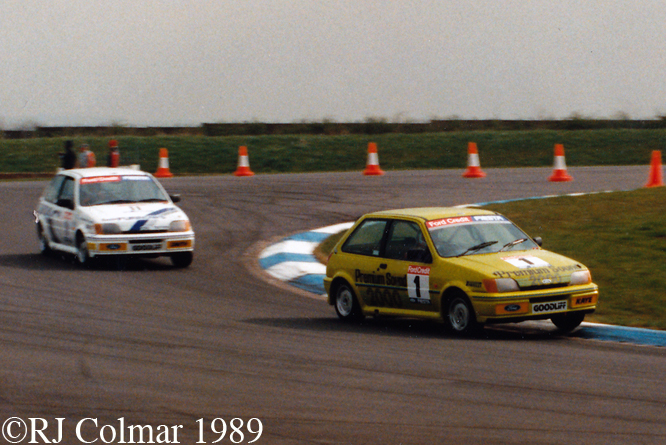
Ford Fiesta XR2i, Donington

In 1989 the third generation Fiesta was launched with a revised chassis pan recognisably similar to the original version and completely new body. Upgraded with a fuel injected 104 hp motor the XR2 became the XR2i, however increased competition in market led Ford to introduce an RS 1800 and RS Turbo versions of the Fiesta which topped and replaced the XR2i name in 1992.

Joining Norman Grimshaw at Goodliff racing in 1989 were ‘one make’ racing specialist James Kaye and Jim Smith in the #1 and #11 respectively seen above heading for a Goodliff 1-2 finish in the Ford Credit Fiesta Championship race at Donington Park on the 16th of May 1989.

Various Fiesta floor pans were used to build Quantum Coupé and Quantum 2+2 convertible kit cars.

Thanks for joining me on this ‘Henry’s Hot Hatch’ edition of ‘Gettin’ a li’l psycho on tyres’, I hope you will join me again tomorrow. Don’t forget to come back now !

Share

A Drivers Dream – Ford Puma

The Ford Puma gained instant kudos when it was launched in 1997 with an award winning TV advert by Paul Street that featured clips from the film Bullitt and it’s star Steve McQueen apparently driving the little new Coupé.

Ford Puma 1.7 16v

The Puma was based around the Ford Fiesta Mk4 chassis pan and running gear and came with four 16 valve engine options with power ranging from 90 to 153 hp.

Ford Puma Millennium

Styling of the Puma followed Ford’s ‘New Edge’ styling theme that was first seen on the Ford Ka and second generation Mondeo 1996.

Ford Puma Millennium

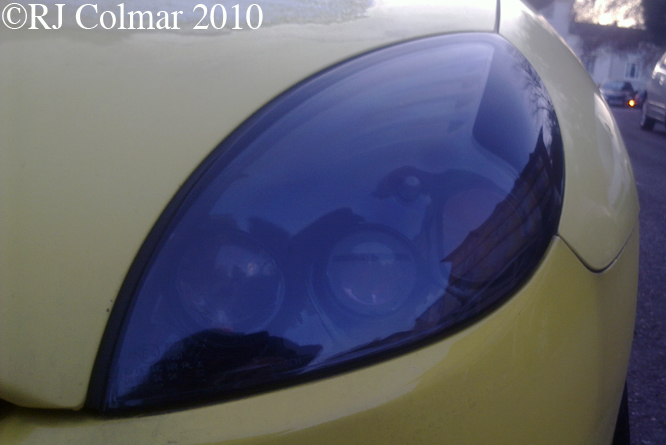
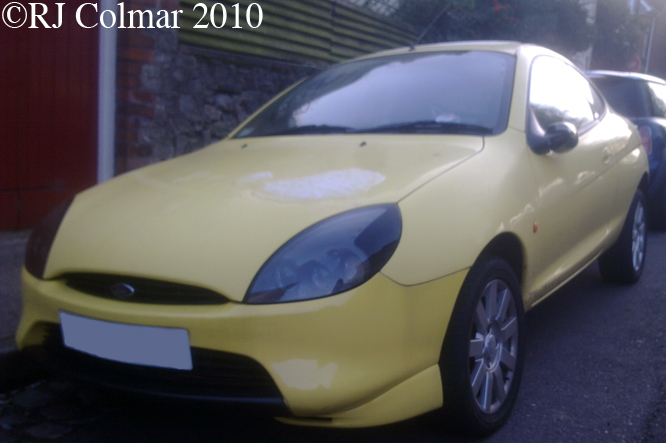
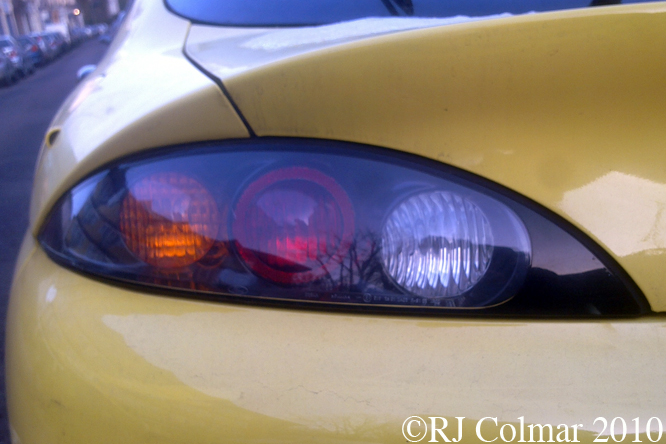
Like the Ford Ka the Puma was also a niche market model, one which generated four special editions and a fifth kit car competition version. The Zinc Yellow of the vehicle seen above indicates the car is one of 1000 Millenium Puma’s built in 2000 of which over 700 are still thought to be on the road.

Ford Puma 1.7 16v Turbo, Regency Sprint, Castle Combe

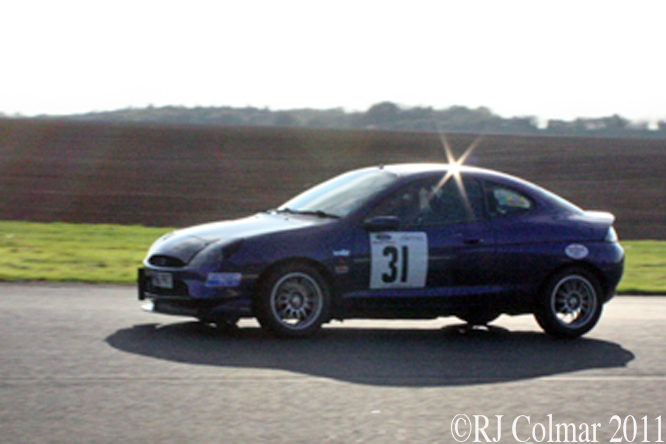
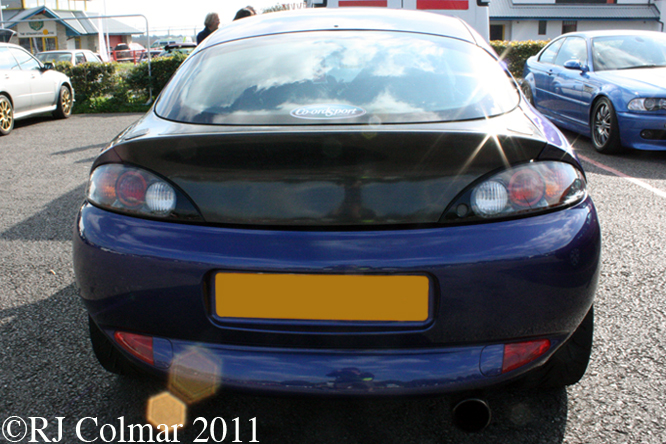
The example above seen competing in the Regency Sprint at Castle Combe last year shared by Toby Harris and Lisa Selby is a 1997 model that has been upgraded with lightweight Carbon Fibre bonnet/hood and boot/trunk lid. The performance of this car has been further enhanced by the edition of a turbocharger.

Ford Puma 1.7 16v

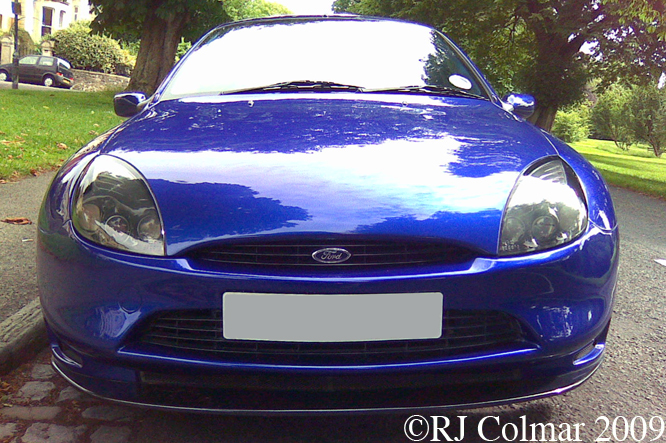
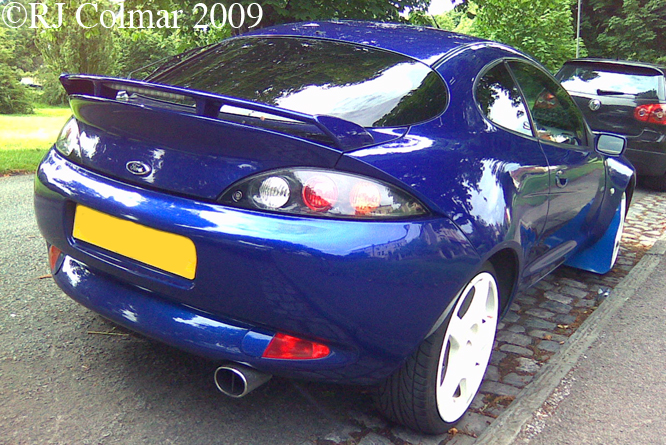
The vehicle featured in the top photo and the one above appears to be one of just 500 wide body 153hp Ford Racing Puma’s that was based on a styling exercise seen in 1999 called the ST160. Like the Ford Sierra RS 500 Cosworth all Racing Puma’s were built by Tickford’s, and were the only Puma’s not to be built at Ford Niehl Plant in Cologne Germany. Note the wheels and rear spoiler on this car appear to be after market items.

Last year the Ford Puma 1.7 was awarded the ‘Best Gem for under £1000’ award by What Car Magazine, the most desirable of all is the Racing Puma which despite losing Ford money on each one of the 500 sold and more than half having to be palmed off on lucky Ford employees at favourable rates are holding values five to seven times that which the lesser models fetch.

Ford Puma 1.7 16v Turbo, Regency Sprint, Castle Combe

Here is what one user, Ophelia, said about her Puma in 2002 “It is not a practical car, so don’t get rid of your Volvo yet but it is fun and it is effective and, all in all I do like it (but don’t tell my husband).”

Thanks for joining me on this ‘A Drivers Dream’ edition of ‘Gettin’ a li’l psycho on tyres’, I hope you will join me again tomorrow. Don’t forget to come back now !

Share

Choice Of Champions – Lotus 49B #R10 & #R12

The story of the Lotus 49 in all of it’s guises is inextricably linked to the one component that was a decade ahead of it’s time the Ford DFV motor, which did not win it’s last race until 1983 and was still being used in 1985 running against turbocharged powered cars.
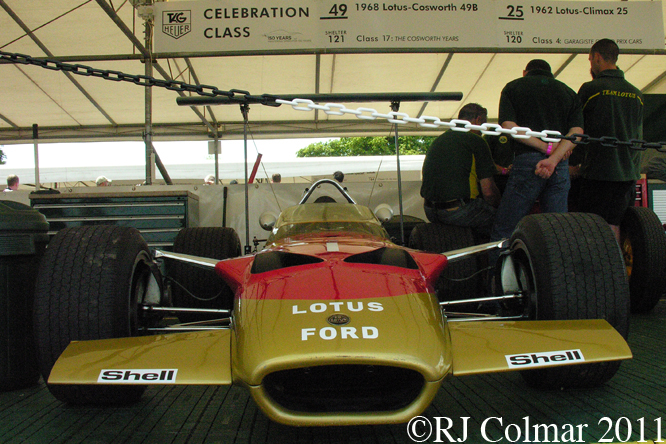
Lotus 49B, Goodwood, FoS

The Lotus 49 was originally built to compete in the 1967 Formula One season for drivers Jim Clark and Graham Hill. Colin Chapman had arranged for Ford to finance the building of the 3 litre / 183 cui Ford Cosworth V8 engine which like the BRM H16 Colin had used in 1966 was to be used as an integral component of the chassis, ie, if you take the motor out of the car the rear wheels would no longer be connected to the rest of the car sufficiently to be able to even push it.
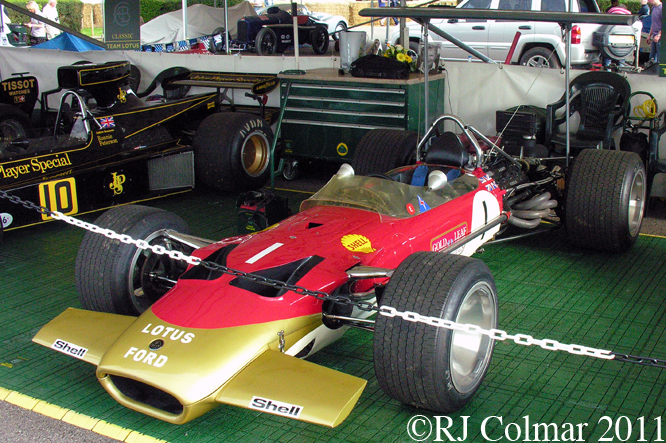
Lotus 49B, Goodwood, FoS

The Lotus 49 design, credited to Maurice Phillipe, was based on the 1965 Indy winning Lotus 38 which Len Terry is credited with being responsible for. Jim Clark drove the Lotus 49 to a debut win in the 1967 Dutch Grand Prix. The Type 49 in all it’s guises won 12 Grand Prix in total the last a lucky last lap win at the 1970 Monaco Grand Prix with Jochen Rindt at the wheel.
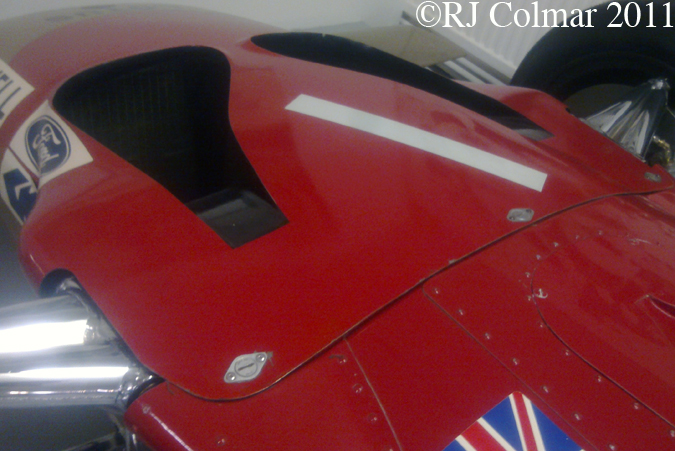
Lotus 49B, Donington Park Museum

These air ducts, introduced on the 49B in 1969, allowed air to pass through the radiator and escape over the top of the car, where as on the original car the air had passed through the nose cone and out the sides of the car ahead of the front suspension units.
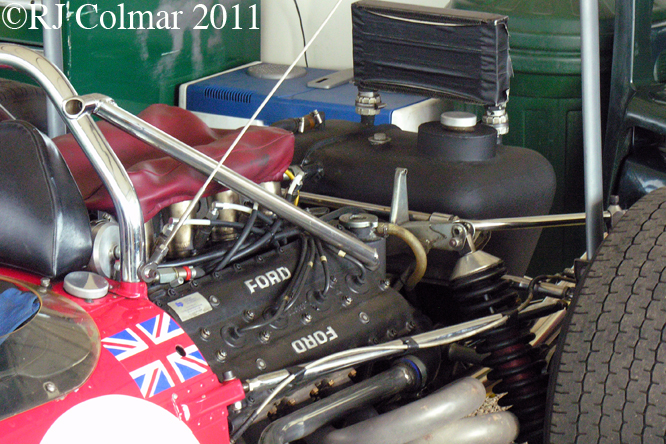
Lotus 49B, Goodwood, FoS

Producing around 400 hp when it first became available, Colin Chapman had an advantage over every other car in the field with the light and reliable Cosworth DFV which had years of development ahead of it that would see it’s output reach just short of 500 hp in 1985. Unfortunately, for Colin Chapman, realising that they needed to be seen running against other competitive teams Ford renegade on it’s exclusive deal with Lotus at the end of 1967 and allowed Ken Tyrrells Matra team to use Ford engines as well in 1968. By the mid 1970’s only Ferrari and BRM were the only regular runners not using Cosworth DFV’s.
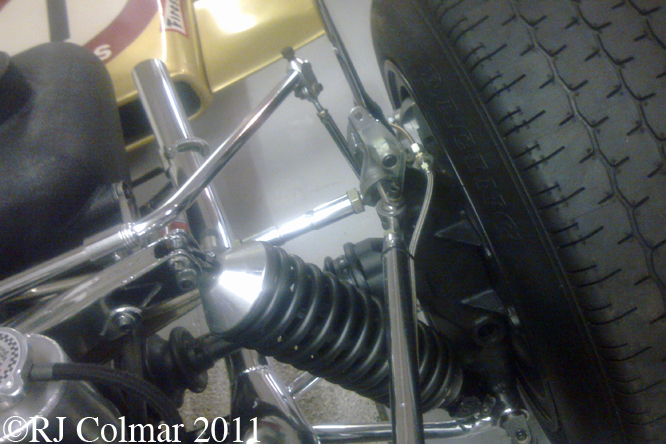
Lotus 49B, Donington Park Museum

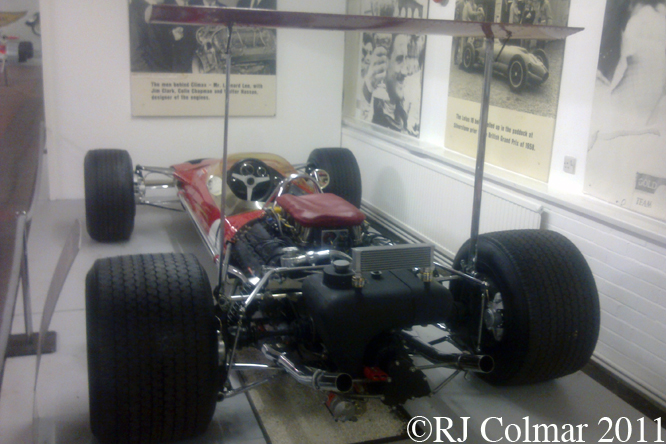
In 1968 Brabham and Ferrari copied the high aerofoil concept first seen on the Chaparral 2E Can Am car in 1966 and on the 1967 Chaparral 2F in the World Prototype championship, a month later the Lotus 49B with new rear hubs to carry the 400 lbs of downforce generated by the rear wing appeared at the French Grand Prix.
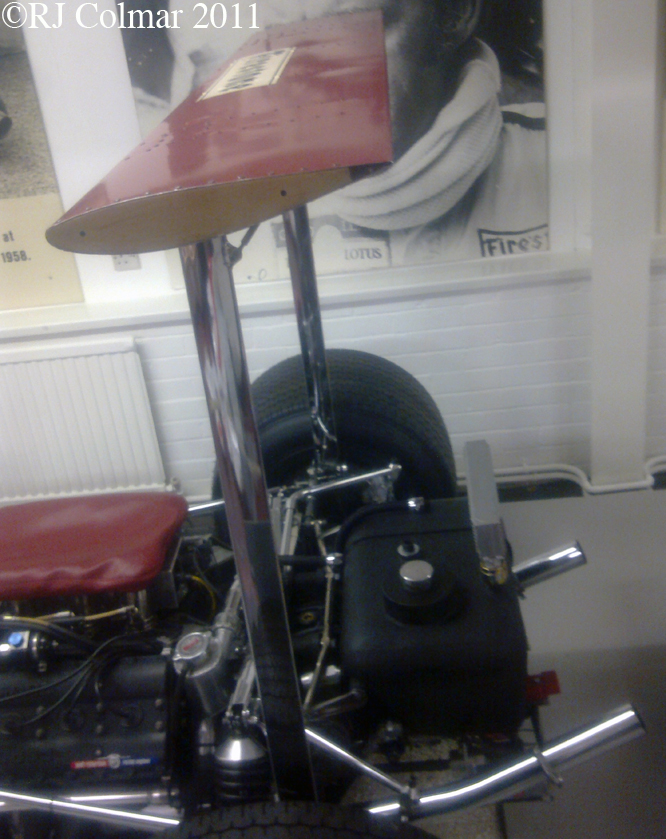
Lotus 49B, Donington Park Museum

This photo shows clearly how big an issue rear grip was back in 1968 not only is their a rear wing but the Hewland gearbox is surrounded by a large oil tank in an effort to distribute as much weight to the rear of the car as possible to improve road holding.
Lotus 49B, Donington Park Museum

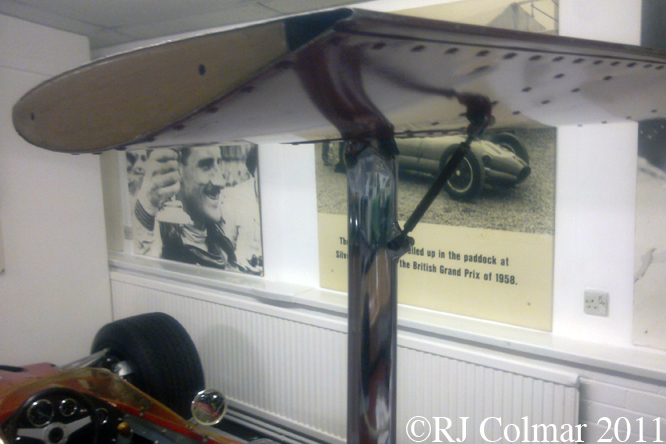
The inverted aeroplane wing shape and light construction of the rear wing can be seen here, in 1969 similar wings were attached to the front hubs as well, but two bad accidents caused by collapsing wings for Lotus Team mates Graham Hill and Jochen Rindt led to these devices being strictly controlled from the 1969 Monaco Grand Prix on.
Lotus 49B, Donington Park Museum

So far as I can tell the chassis seen here, in the first, second and forth photo’s, at Goodwood is #R10. Chassis R10 was probably the original 49 #R5 which for reasons that are not clear was renumbered.

While carrying the #R5 chassis plate the car was raced in his second world championship winning year by Graham Hill to win the 1968 Monaco Grand Prix, #R10 was subsequently used by 1978 World Champion Mario Andretti to win pole for his first Grand Prix start in the 1968 US Grand Prix at Watkins Glen.

Future 1970 champion Jochen Rindt was the first to use running with a 2.5 litre / 152.6 cui version of the Ford Cosworth DFV. Jochen won two Tasman Championship races in #R10.

Reigning 1968 World Champion Graham next used #R10 to win the 1969 Monaco Grand Prix. The following season Graham was driving the Lotus 49 #R7 for the privateer Rob Walker team which he crashed beyond immediate repair during practice at Monaco. Fortunately Lotus number 2 driver John Miles had failed to qualify for the race in #R10 and so it was hastily repainted in Rob Walkers colours the night before the race for Graham to drive. He finished 5th despite having broken his legs in the 1969 season ending US Grand Prix driving the same chassis just 7 months earlier !

1972 & 1974 double world champion Emerson Fittipaldi made his Grand Prix debut in Lotus Ford 49 #R10, at the British Grand Prix in 1970.

Finally the first race I ever recall seeing on TV was the 1968 British Grand Prix which was led by first Graham Hill, then his team mate Jackie Oliver before being won by Jo Siffert all three were driving Lotus 49 B’s Jo’s being the odd one out being entered by Rob Walker, who GALPOT regulars may recall had a lot of success running Stirling Moss in his Lotus 18 during the early 1960’s. Jo’s victory was the last to be recorded by a private entrant in a ‘customer’ non works customer car.

Thanks for joining me on this ‘Choice Of Champions’ edition of ‘Gettin’ a li’l psycho on tyres. I hope you will join me again tomorrow. Don’t forget to come back now !

24 04 12 PS Tim Murray has kindly pointed out that I originally incorrectly attributed the design of the Lotus 49 to Len Terry when it should have been Maurice Phillipe, apologies for any confusion. If you see an error of fact anywhere in GALPOT blogs please do not hesitate to inform me in the comments box. Thanks to Tim for the correction.

03 08 12 Serious Errata further reading of Micheal Olivers “Lotus 49 the story of a Legend” has shown that the car which is seen in the 3rd, 5th, 6th and 7th photo’s above at the Donington Collection is actually chassis #R12 and not chassis #R10 as seen in the 1st, 2nd 4th photo’s above, there are several distinguishing features which should have made this obvious at the time I originally posted this blog including the black ‘Lotus Ford’ lettering on the nose various decals and the chrome exhaust at the rear !

Chassis R12 was built up as a show car, for the Ford Motor Company, using the floor from the Lotus 49B R6/1 which was crashed by Jackie Oliver at the 1968 French Grand Prix. Built as a non runner chassis #R12 is consequently the only Lotus 49 which has never been raced, it was donated to Tom Wheatcroft’s Donington Collection when Ford no longer had a use for it.

Sincerest apologies for this error.

Share

Turbo Erika – Ford Escort RS Turbo

Launched with the strap line “Simple is Efficient” the third generation Ford Escort was code named “Erika” while in development taking the name from Fords Product Planning Dept leader Erick A. Reikert.

Ford Escort RS Turbo, Snetterton

The Escort MKIII went head to head in the market place with the popular Volkswagen Golf which had turned VW fortunes around after the demise of the ‘Beetle’.

Ford Escort RS Turbo, Snetterton

Like the Golf the 3rd iteration of the Escort employed front wheel drive, unlike the Golf the Escort was a conservative hatchback retaining some vestige of a three box shape bodywork at the rear, although the tailgate included the rear sloping window.

Ford Escort RS Turbo, Brands Hatch

The 132hp RS Turbo version of the Escort was launched in 1984 with the 5 speed transmission driving the front wheels through a viscous coupling differential that was a world first for a front wheel drive car. The RS Turbo proved a strong competitor in production saloon racing where it rendered the hitherto dominant Ford Capri 2.8i obsolete in the space of 12 months.

Ford Escort RS Turbo, Silverstone

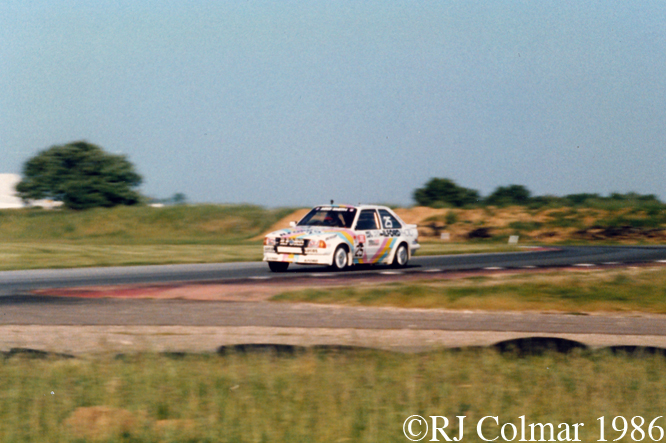
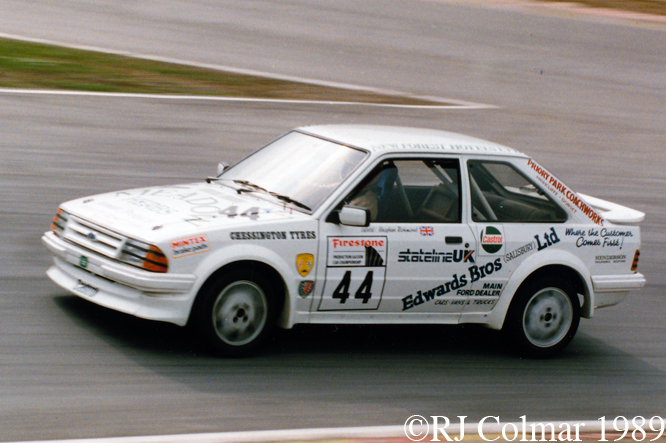
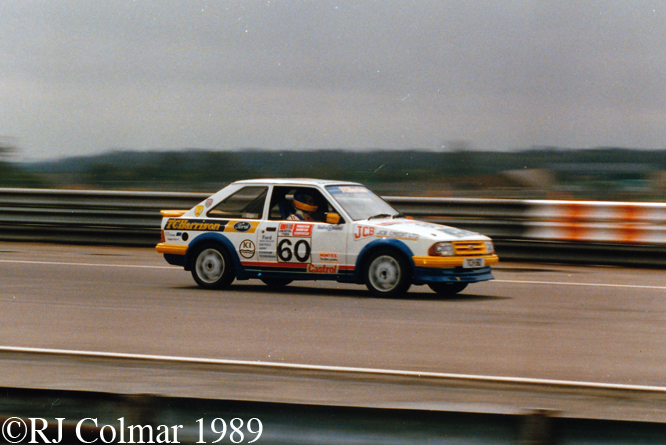
In the top photo national radio DJ Mike Smith and Lionel Abbot shared the #25 to win the 1986 Willhire 24 hour race at Snetterton at their second attempt becoming the first two driver team to win the race since it’s inception in 1980. The #32 was driven by Karl Jones, Patrick Watts and Chris Creswell in the 1987 Willhire 24 hours qualifying 2nd, to a Ford Sierra RS Cosworth, and finishing sixth, third in class after a late driveshaft failure. By 1989 the Escort RS Turbo’s driven by Vaughan Richmond, #44 seen at Brands Hatch and Jonathon Harrison, #60 seen at Silverstone, were overwhelmed in class B by half a dozen faster BMW M3’s.

My thanks to Tim Murray on The Nostalgia Forum for the race details on the #32 at Snetterton.

Thanks for joining me on this ‘Turbo Erika’ edition of ‘Gettin’ a li’l psycho on tyres’ I hope you will join me again tomorrow for Americana Thursday. Don’t forget to come back now !

Share

Hot Business – Ford Business Coupé

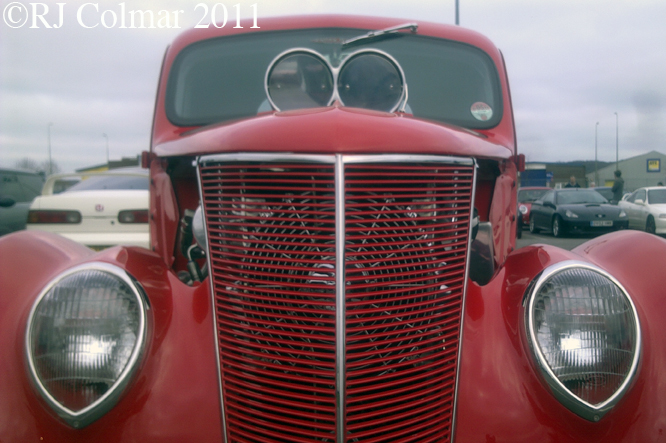
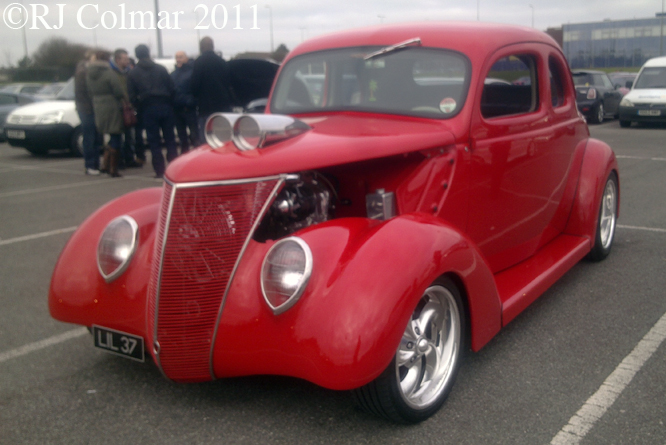
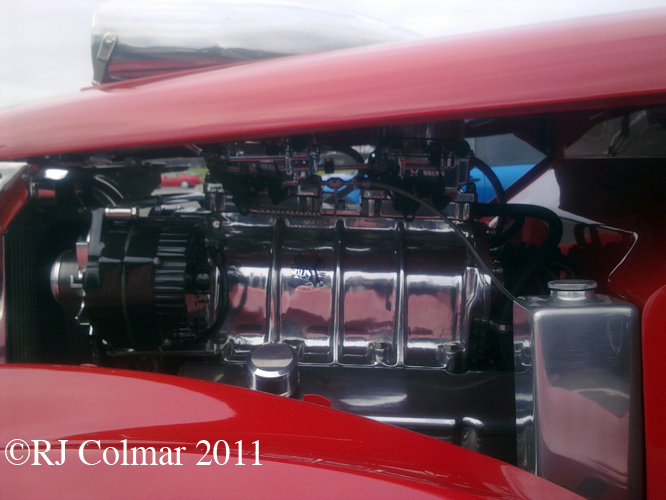
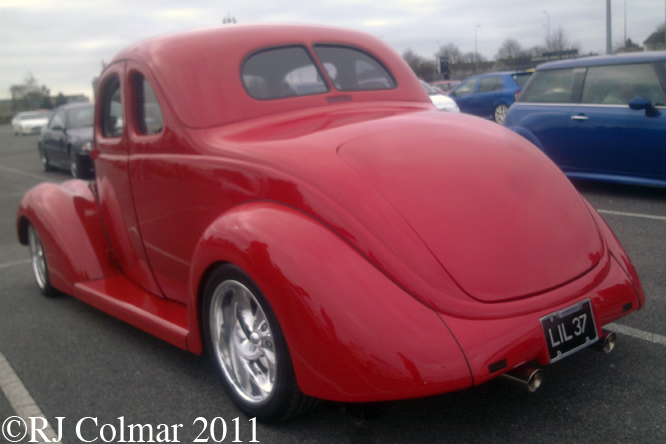
Even after an interest in motoring that goes back over 40 years every once in a while I learn about a Ford model I have never heard of before, such is the case with the 1937 Ford Business featured today which I mistook for a De Luxe.

Ford Business Coupé, BMW Plant

It turns out the Business was a base model range to introduced in 1937 that replaced the Model B and stayed in production only until 1940.

Ford Business Coupé, BMW Plant

Many of the features apart from the V shape grill of the Business were shared with the Standard and De Luxe models.

Ford Business Coupé, BMW Plant

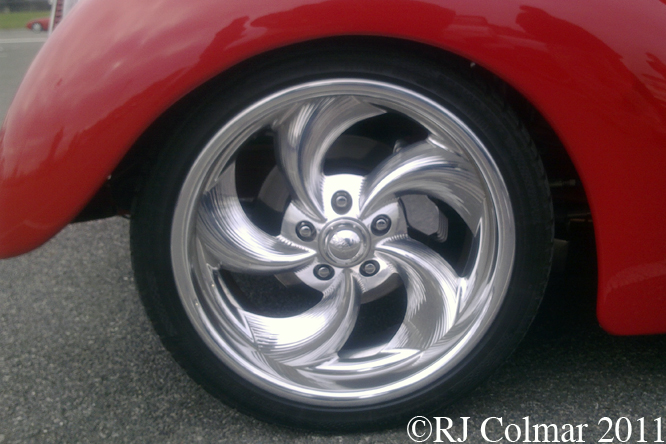
The Business Coupé seen here would have originally been fitted with cable operated drum brakes.

Ford Business Coupé, BMW Plant

Engine options were either 60 hp 2.2 liter / 136 cui or 80 hp 3.6 liter / 221 cui V8’s, the one seen here is listed as fitted with non standard a 5 liter / 305 cui.

Ford Business Coupé, BMW Plant

The Business was available in Sedan, 8 seat station wagon, Coupé and Convertible versions.

Thanks for joining me on on this ‘Pleasure Business’ edition of ‘Gettin’ a li’l psycho on tyres’, I hope you will join me for Ferrari Friday tomorrow. Don’t forget to come back now !

Share

Genk Cosworth Part 2 – Ford Sierra RS Cosworth 4×4

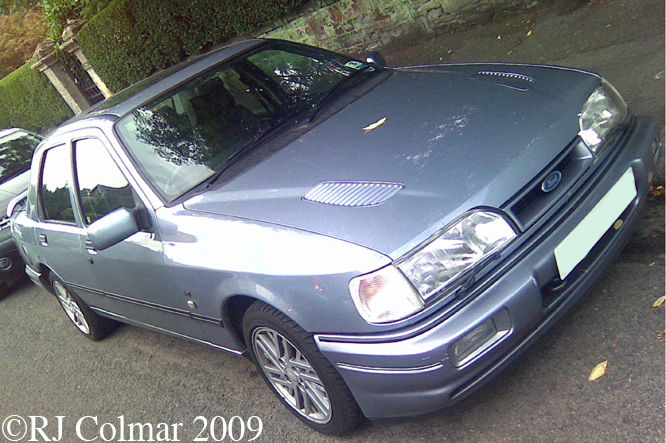
The forth and final incarnation of the Sierra Cosworth was built to overcome the short comings of 2wd in Rally competition which since the introduction of the Audi Quattro in 1980 had became dominated by four wheel drive machines. 12,250 of the Sierra RS Cosworth 4×4’s were built in Genk, Belgium.

Sierra RS Cosworth 4×4

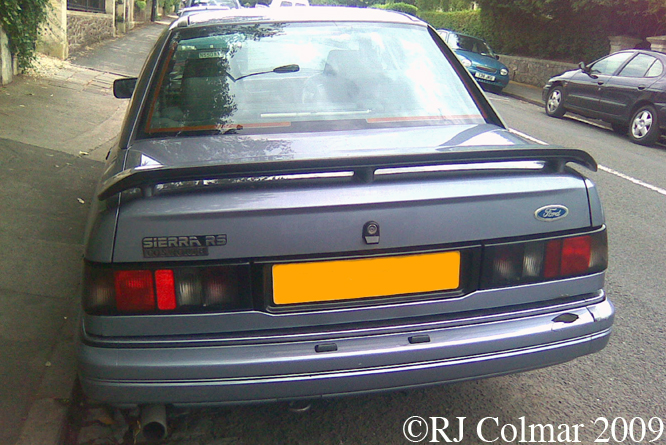
The Cosworth 4×4 was timed to coincide with a minor facelift to the Sierra range in 1990, powered by either 224 hp Cosworth YBG with catalytic converter or YBJ motors, without the converter, coupled to a Ferguson patented all wheel drive transmission. The road going variant is distinguished by the return of the bonnet louvre’s seen on the first two RS Cosworth variants and discreet 4×4 badges on the front wings. Note also the return of the Sierra RS Cosworth name to the boot / trunk lid as on the original 3 door version.

Sierra RS Cosworth 4×4

Unfortunately due to it’s size compared to the competition which included the pint size Lancia Delta & Mazda 323 hatchbacks and Toyota Celica Coupé, all with four wheel drive, none of the four Sierra RS Cosworth variations ever won a World Championship Rally, though Francois Delecour managed a couple of 3rds in Monte Carlo and Spain driving the Cosworth 4×4 in 1991..

Thanks for joining me on this ‘Genk Cosworth Part 2’ edition of ‘Gettin’ a li’l psycho on tyres’, I hope you will join me again tomorrow. Don’t forget to come back now !

Share

Indy 500 Winner & Swiss Hillclimber – Lotus Ford 38/1

Apologies again to GALPOT readers who read my posts at rowdy.com who may have seen these photo’s before, but once again I have found some more interesting information about the Lotus 38 model since my original post nearly 3 years ago.

Lotus 38, Goodwood Revival

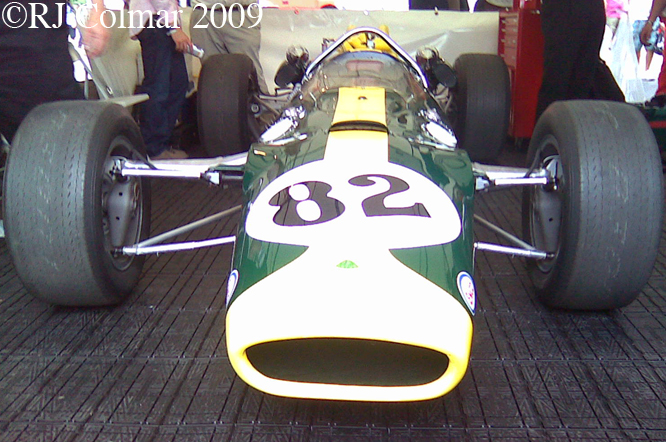
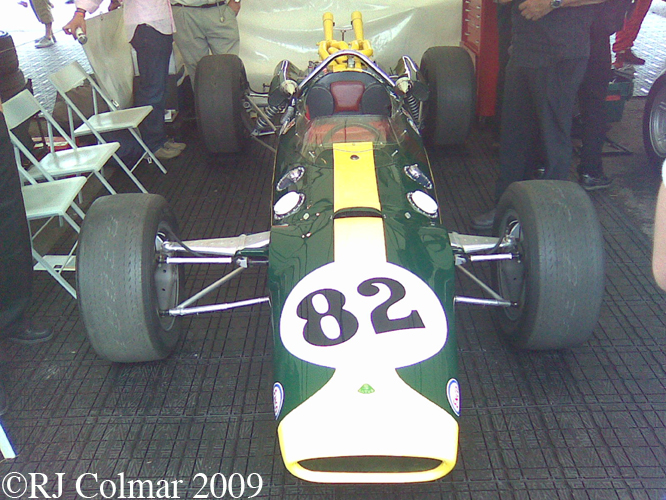
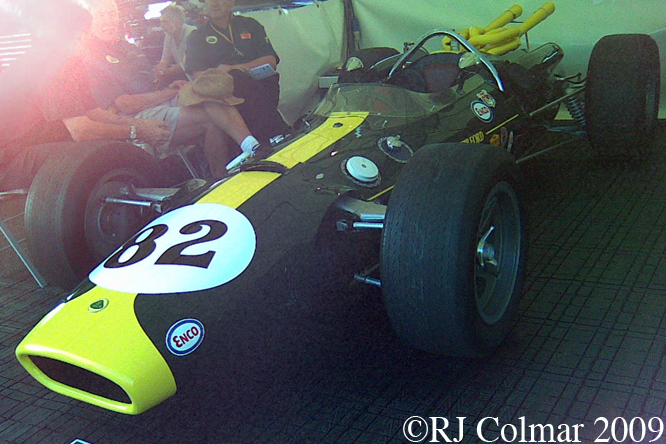
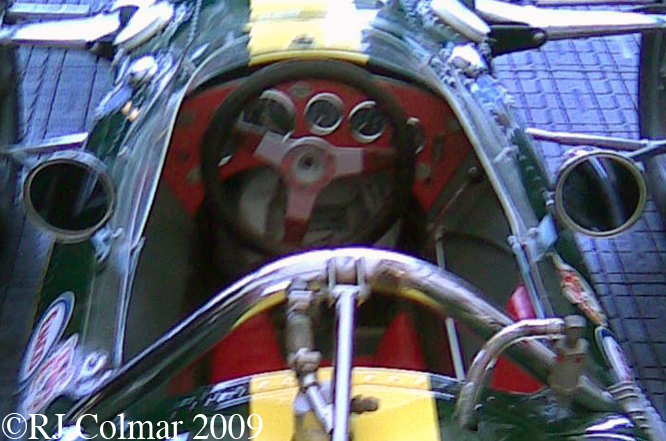
The Lotus 38 was devised by Colin Chapman and designed by Len Terry to win the 1965 Indy 500 on his third attempt with star driver Jim Clark behind the wheel.

Lotus 38, Goodwood Revival

With the aid of the legendary Wood Brothers NASCAR pit crew Clark driving 38/1, seen here at Goodwood a couple of years ago, beat Parnelli Jones, driving Clarks 1964 Lotus 34/3, to win the race. In a reversal of fortunes from their first encounter in 1963, Jim Clark became the first foreign driver to win the Indy 500 since 1916 !

Lotus 38, Goodwood Revival

It turns out that there were eight Lotus 38 eight chassis built all powered by the 500 hp quad cam version of the Ford Fairlane motor, a potted history of each of the 8 cars can be seen on this Nostalgia Forum link.

Lotus 38, Goodwood Revival

News to me since my original post is that after the 1965 Indy 500 Victory a fourth Lotus 38 was built and this car with symmetrical suspension was tested by well known British racer Jack Sears and was then taken on a publicity tour to Switzerland apparently at the behest of Ford’s Swiss agent Mr. Georges Filipinetti, himself a well known racing entrant of a mouthwatering variety of cars.

Lotus 38, Goodwood Revival

While in Switzerland Jim Clark demonstrated the Lotus 38 on at least two hillclimb tracks including Ollon – Villars Hillclimb and Ste Ursanne-Les Rangiers. If you speak French, which I like Jim Clark don’t, you may find this interview with Jo Bonnier Jim Clark and Jo Siffert quite amusing.

The Lotus 38/1 seen in these photo’s has recently been completely restored by Classic Team Lotus and was driven for some demonstration laps last year by Dario Franchitti which can be seen here.

My thanks to Doug Nye and Andrew Kitson at the Nostalgia Forum for their help with uncovering more facts about the Lotus 38 cars.

Thanks for joining me on this Indy 500 winner & Swiss Hillclimber edition of ‘Gettin’ a li’l psycho on tyres’, I hope you will join me again tomorrow, when I’ll be looking at a large Mercedes. Don’t forget to come back now !

Late PS just noticed Paul Chenard has an evocative illustration of the #82 Lotus 38 on his facebook page linked here.

Share