Tag Archives: Ford

English T – Ford Model T

Ford Motor Company started manufacturing vehicles in 1903 and that same year three Model A’s were exported to Great Britian, by 1909 the Ford Motor Company (England) was established and began working from an Office in London on March 8th 1911.
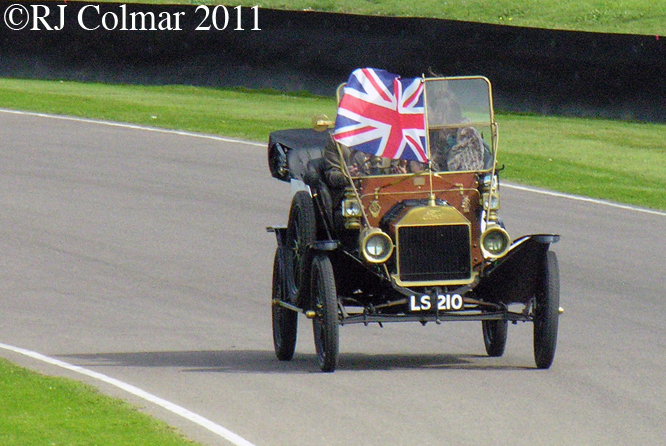
Ford Model T, 1911, Goodwood Revival

Ford’s first overseas assembly plant was opened in 1911 at Trafford Park in Manchester where Ford Model T’s were assembled with imported chassis, mechanical parts and locally manufactured bodies. The 1911 Model T above has the distinction of being the first car to be driven up Ben Nevis.

22 year old Henry Alexander, on the instruction of his father the first Ford dealer in Scotland, spent six weeks preparing a route to the top Britains highest peak 4,409 ft / 1,344 m above sea level. It then took Mr Alexander 5 days to reach the summit along the precarious route he had prepared. Mr Alexander repeated the feat in 1928 and to mark Centenary of the Model T reaching the top of Ben Nevis, earlier this year a team of 71 volunteers carried a replica model T to the summit assembled it and then disassembled it and brought it back down again !
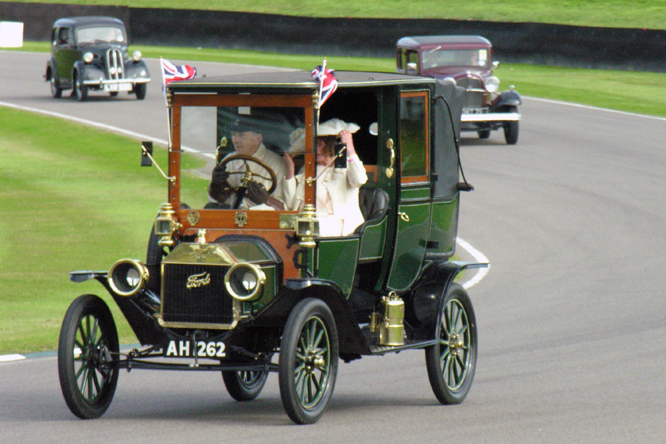
Ford Model T, Landaulet, 1912, Goodwood Revival

Although the three pedal system for operating motor cars as used in most cars to this day was familiar when the first Model T’s were built in 1908 the Model T relied on a hand throttle operated on the steering wheel a left pedal that when fully depressed engaged a low gear, when part depressed disengaged the gear box and when not depressed engaged a high gear. The centre pedal when depressed engaged reverse and the right pedal operated the brakes which were attached to the rear wheel only.

Above is a 1912 Landaulet offering minimal weather protection to the front seat occupants while giving the rear seat occupants a choice of protection thanks to a folding roof. The Landaulet body style was a hangover from the age of the horse drawn carriage and has largely disappeared only Maybach are known to offer a Landaulet option at the time of writing.
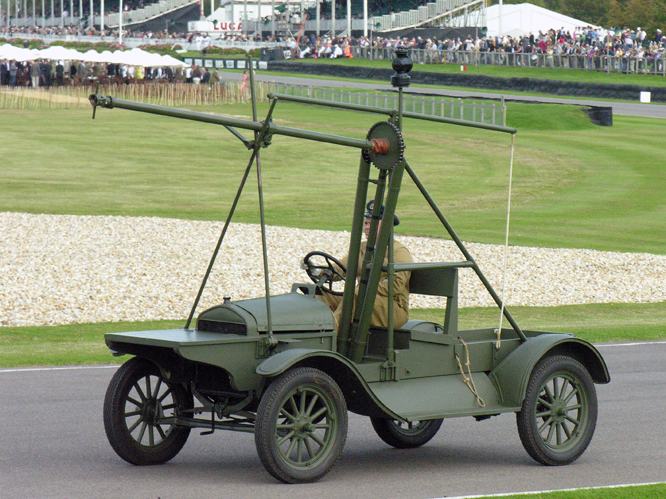
Ford Model T, Huck Starter, 1915, Goodwood Revival

When designing the Model T Henry Ford new that as well as a motor car he wanted his vehicle to be adaptable to the requirements of a great variety of users in agriculture and industry. Amongst the stranger applications of the Model T was the mobile aircraft starter version.

The long pole that extends beyond the front of this 1915 ‘Huck Starter’ Model T can be aligned with the propellor shaft of an aeroplane and then engaged with it. The chain to the left of the operator connects the aeroplane starter shaft to the drive of the Model T which when engaged will rotate the aircraft engine until it fires under its own power.
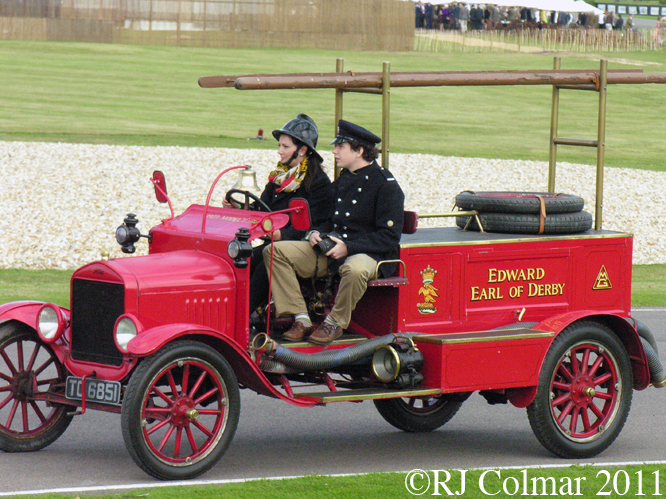
Ford Model T, Fire Engine, 1923, Goodwood Revival

When production of the Model T started it took around 12 and half hours to assemble one. By the outbreak of the Great War in 1914 production time had been slashed to just 93 minutes , at one time nearly half of all the worlds motor vehicles were thought to be Fords, in the UK in 1919 41% of all new cars registered for the road were Fords.

The Model T was easily adapted into trucks and buses above is a 1923 fire engine that served on the estate of the Earl of Derbyshire from 1924 to 1948.
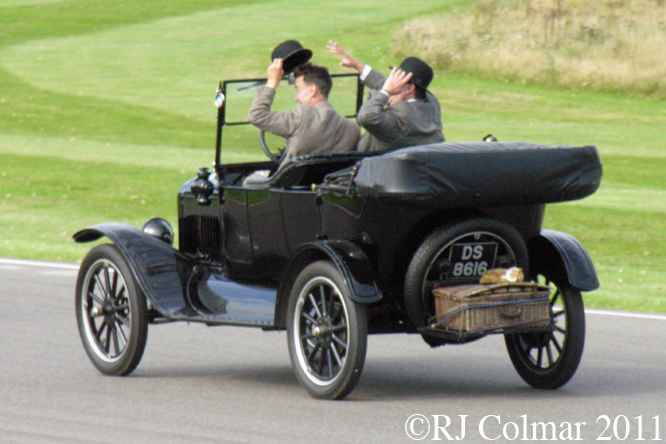
Ford Model T, 1924, Goodwood Revival

One of the great myths about the Model T was that one could have a Model T any colour one wanted so long as it was black. In fact this was only true after 1914, up until then Model’s T’s were not available in black at all, from 1912 to 1914 Model T’s were only available in Midnight Blue with black wings / fenders. After 1914 over 30 different black paints were developed to satisfy the various means of applying the paint to different parts of the cars.

The 1924 Model T above is little changed from the 1911 example seen at the top of the post.
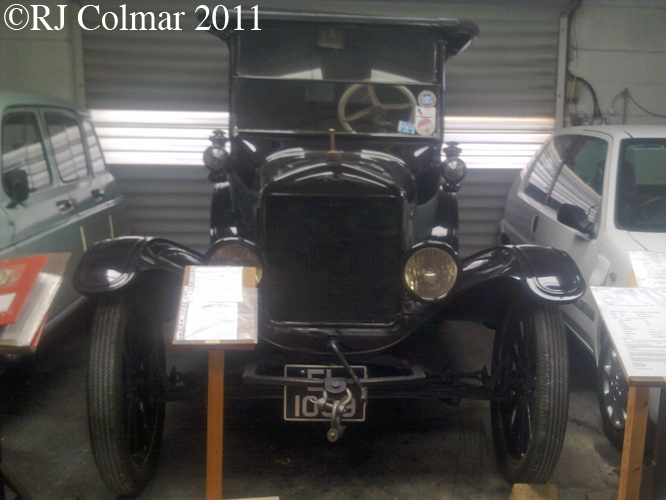
Ford Model T, 1924, Atwell Wilson Motor Museum

With over 15 million examples produced when production of the Model T ceased in 1927, the Model T held the title of the worlds most popular vehicle until 1972 when it was eclipsed by the VW Beetle, though it should be noted the Beetle had undergone many more changes in it’s life time than the Model T.

The 1924 example above can be seen at the Attwell Wilson Museum.

Thanks for joining me on this English T edition of ‘Getting a li’l pysycho on tyres’, I hope you will join me again tomorrow. Don’t forget to come back now !

Share

Designed By An Accountant #1 – Lotus VI #34

In 1942 Peter Kirwan-Taylor was 12 when he returned to England after a temporary evacuation to North America. He accompanied his step father Charles Loraine Hill, a director of Lagonda Cars, on trips to visit Lagonda and Westland the aircraft manufacturer where his interest in design took hold.

After a military career, during which he was member of the British Sking team, Peter settled down to follow his fathers footsteps and trained as an accountant. On the April 13th 1954 in between his 3 nights a week studies Peter found time to purchase and build a new Lotus VI, chassis #34, and decided to design his own body for it.

He provided Williams & Pritchard with the drawings and a claymodel which featured a high crease line and because of the suspension set up when the body was mounted to the chassis the car accidentally had a futuristic wedge appearance due the forward sloping aspect of the crease line.

Peter raced the car several times and as his family and career in finance took off he sold PGP 182 after two years.

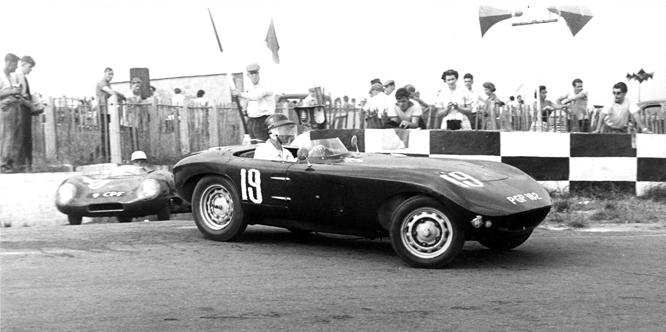
Peter Kirwan Taylor, Lotus VI, Brands Hatch

Peter Kirwan Taylor in his #19 Lotus VI at Brands Hatch Undated,

Photo Beaulieu National Motor Museum

The exact details of the ownership of PGP 182 from 1956 to 1963 are not recorded however as can be seen on this link we do know Peter’s car made an appearance at Silverstone in June 1957 in the hands of Tony Wilson-Spratt. (See postscript below)

Thomas Kikaldy owned PGP 182 from 1963 to 1969 and he removed the unique body and sold it to an Italian restaurant owner in London and it has not been seen in public since.

In 1983 Len Pritchard, who produced the panels for the original Lotus VI kits, fabricated new panels for PGP 182 in the style of original Lotus VI’s with which the car, seen on this link 4th from right, is fitted today.

Peter Ross of the Historic Lotus Register informs me that the whereabouts of the drawings for Peter Kirwan Taylors bodywork are known and his one off body work could be recreated if some one desired.

As we shall see next Saturday Peter Kirwan-Taylor’s friendship with Lotus founder Colin Chapman grew from the time he purchased PGP 182 and he would design another Lotus which made a larger mark on the Lotus Cars story.

My thanks to Paul Rochdale of The Nostalgia Forum for first identifying PGP 182 as a Lotus VI to Peter Ross from the Historic Lotus Register for details about Peter Kirwan-Taylor and PGP 182 and to Ted Walker aka Ferret Fotographics for permission to use today’s photograph.

Thanks for joining me on this accountants edition of ‘Gettin a li’l psycho on tyres’ I hope you will join me again tomorrow. Don’t forget to come back now !
10/10/11 POSTSCRIPT. Peter Ross of the Historic Lotus Register has kindly sent a few comments about this blog it would appear the photograph in the link is of Ian Duncan at the wheel and the photographer was Tony Wilson Spratt.

Peter also informs me that an article ‘The Story of the Kirwan-Taylor bodied Lotus VI’ appeared in the Historic Lotus magazine issue #64 which can be ordered through the HLR website linked here.

Share

For A Few £’s More – Jensen S-V8

After the owner of WJ Smiths & Sons a body works passed away in 1934 two employees, the brothers Richard and Alan Jensen bought the assets and founded Jensen as a coachbuilding firm. Building customised bodies for proprietary chassis supplied by Morris, Singer, Standard and Wolseley. One of their early commissions was for a car based on a Ford V8 for Hollywood legend Clark Gable, this highly acclaimed car facilitated a deal with Ford to produce a limited edition of Jensen Fords.

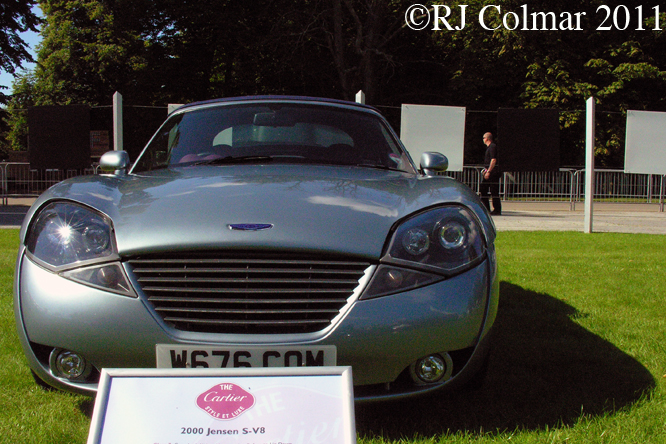
Jensen S-V8, Goodwood Festival of Speed

The following year Jensen launched the Jensen S type also powered by a Ford V8. Jensen diversified into light commercial vehicles marketed under the JNSN brand and during the war were engaged to make tank turrets and specialised vehicles, ambulances and fire engines.

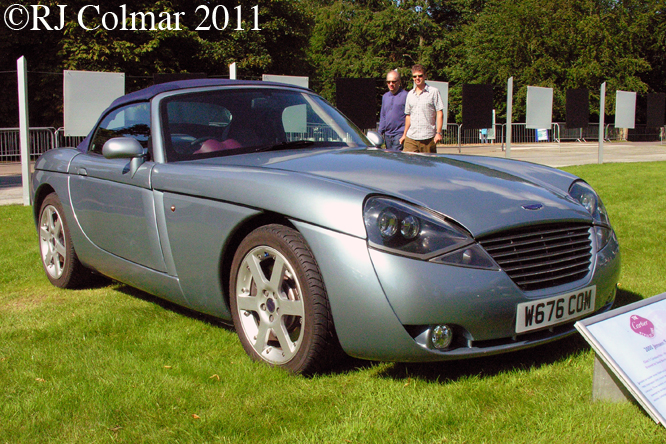
Jensen S-V8, Goodwood Festival of Speed

After the 2nd World War Jensen produced the Jen Tug light truck for hauling trailers around goods yards and won a number of contracts to produce bodies for among others the military all wheel drive Austin Gipsy, the Austin A40 Sports, Austin-Healey 100, Volvo P1800 and Sunbeam Tiger.

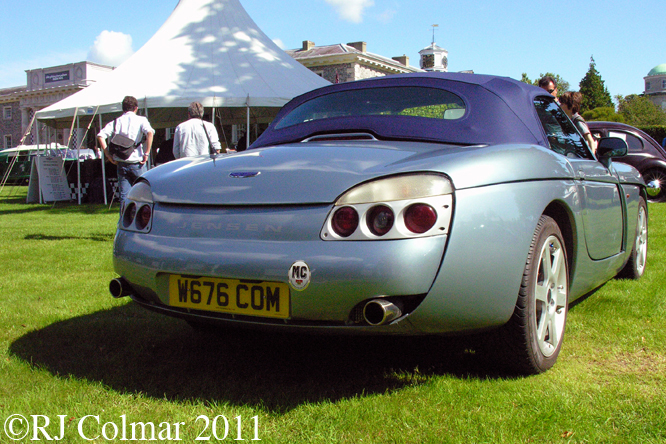
Jensen S-V8, Goodwood Festival of Speed

Concurrently Jensen built an Austin parts bin based Interceptor, and fibreglass bodied 541 Coupé. Perhaps their best known model is the Chrysler powered Interceptor introduced in 1966 with a steel body designed by Carrozzeria Touring and built by Vignale.

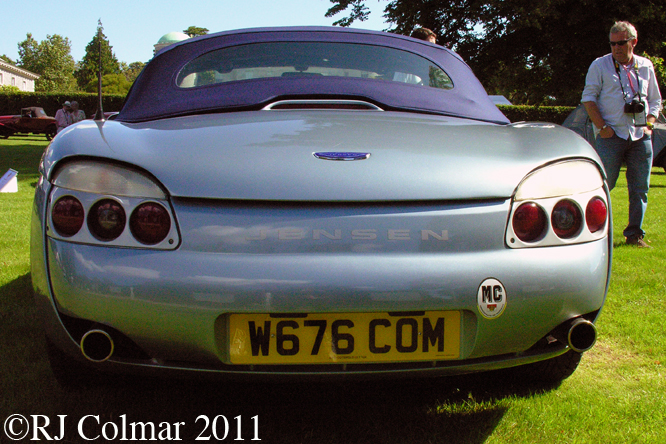
Jensen S-V8, Goodwood Festival of Speed

The Interceptor remained in production until the company folded in 1976, several attempts were made to revive production one resulting in 11 MK4 Interceptors being built. In 1998 the Ford Mustang Cobra V8 powered aluminium bodied Jensen S-V8, harking back to the 50’s and 60’s 541 and CV8 models was shown to the public and 300 orders were taken to build the car at a new £9 million facility at Speke in Liverpool.

Jensen S-V8, Goodwood Festival of Speed

Unfortunately quality problems including the manufacture of the aluminium body panels slowed the expected production rate and only 20 vehicles were produced, including the one seen here at Goodwood Festival of Speed, before the company again went under in 2002. The Oselli company purchased a licence to complete a further 12 cars, all with heavier easier to manufacture steel bodies, and retained the parts from a further 6 vehicles for spares.

Since production of the 20 original £40,000 cars has ceased at an average unit cost to investors of £450,000 it has been claimed that Jensen went under for the want of just £500,000 to see them through.

Thanks for joining me on this underfunded edition of ‘Gettin’ a lil’ psycho on tyres’ I hope you will join me again tomorrow. Don’t forget to come back now !
Share

Awaiting TLC #3 – Lotus Mark 6

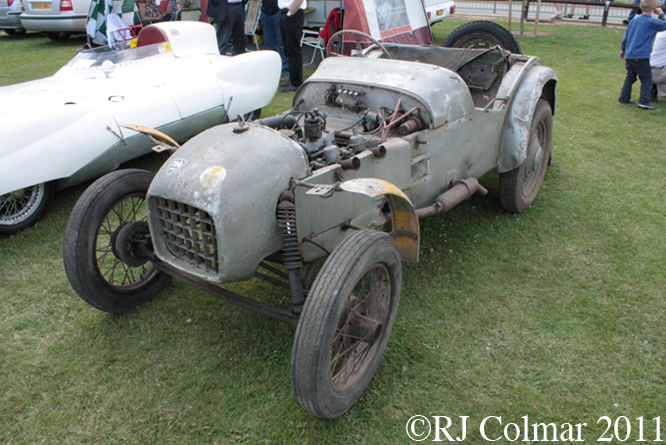
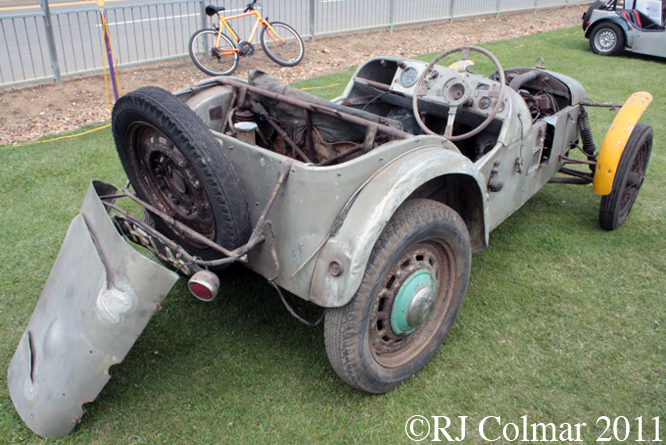
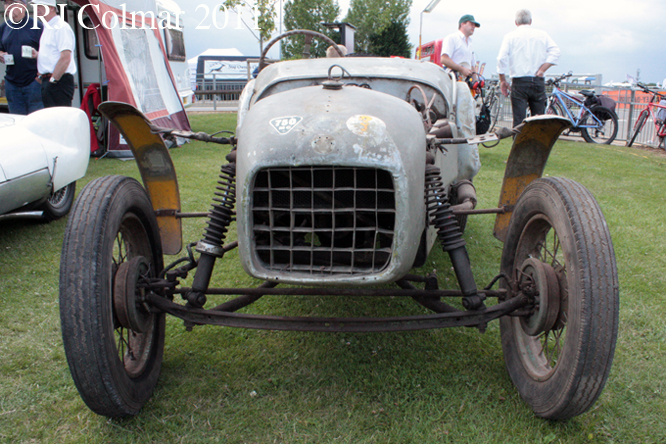
Third in my occasional series of blogs about cars in need of tender loving care is this uniquely ungainly looking Lotus Mark 6 seen earlier this year at the Silverstone Classic.

Lotus XI, Silverstone Classic

The Lotus Mark 6 was the first Lotus design to go into to production and it was sold in kit form saving purchasers a small fortune in new car taxes. The reason this particular vehicle is both unique and ungainly is because it is the only Lotus Mark 6 built as a mud plugging trials car requiring more ground clearance than either the road going or track racing versions.

Lotus VI, Silverstone Classic

The chassis and Williams and Pritchard built body was originally supplied to Mr Horace Sinclair Sweeney in 1953 at a cost of £110. Once Mr Sweeney had finished installing the engine and running gear he entered and won the London Motor Club’s Annecy Spring Sporting Trial on the 7th of June 1953.

Lotus VI, Silverstone Classic

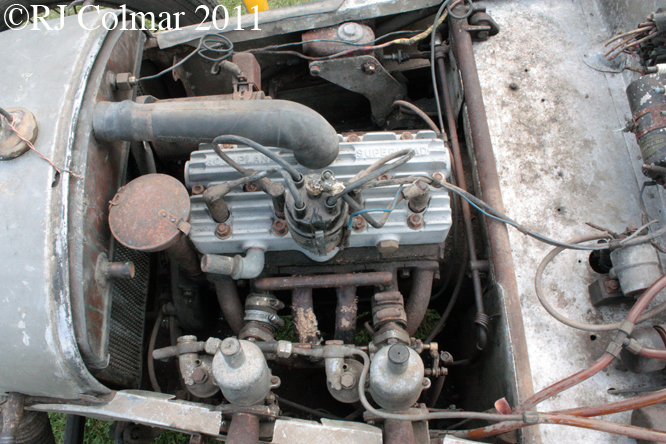
The motor is an Aquaplane tuned 1172 cc / 71.5 cui side valve E93A unit sourced originally from a Ford 10 built in the 1930’s.

Lotus VI, Silverstone Classic

In 1954 Mr Arthur Hay acquired this Mark 6 and over the next ten years won three Motor Cycling Club (MCC) Triple awards for completing the Exeter, Lands End and Edinburgh trials unpenalised in three separate calendar years. Since then car has remained in the Hay family, but unused since 1964.

Lotus VI, Silverstone Classic

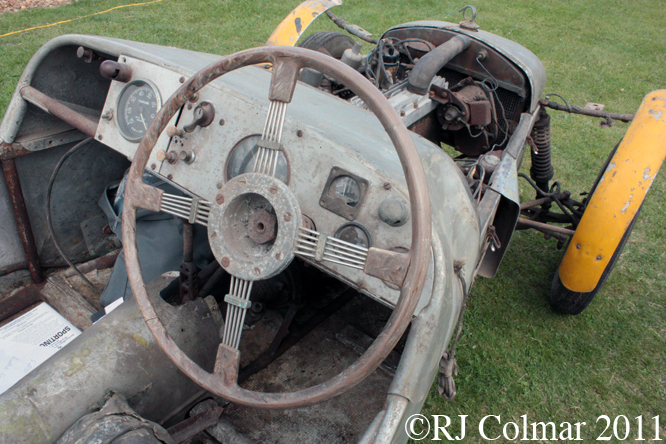
The current owner hopes to restore the car to working order and use it for sporting trials as originally intended by Mr Sweeney.

Thanks for joining me on this mud plugging edition of ‘Gettin’ a li’l psycho on tyres, I hope you will join me again tomorrow when I shall be looking at a Jensen. Don’t forget to come back now !

Share

Killed By A Pony – Ford Falcon Sprint V8

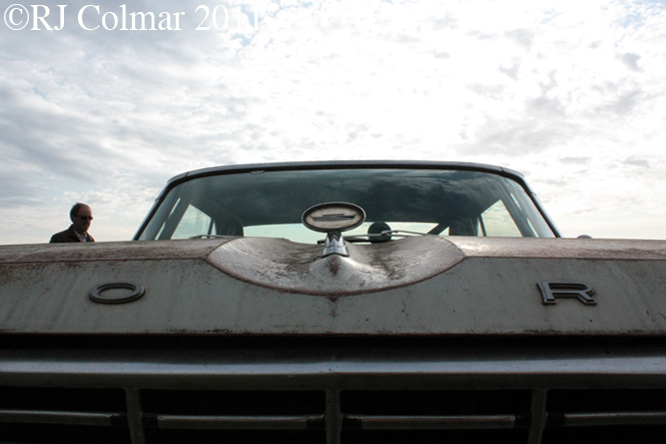
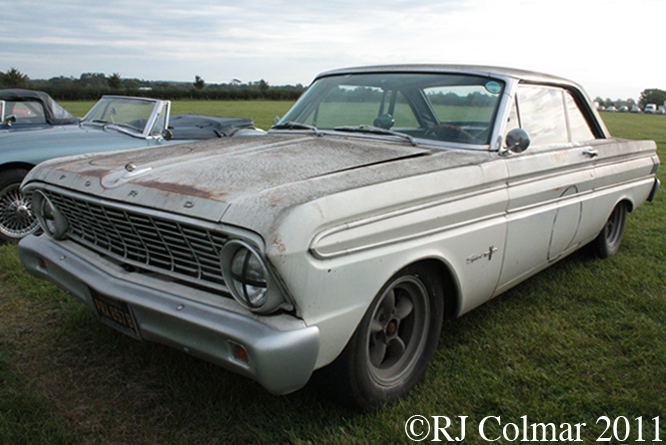
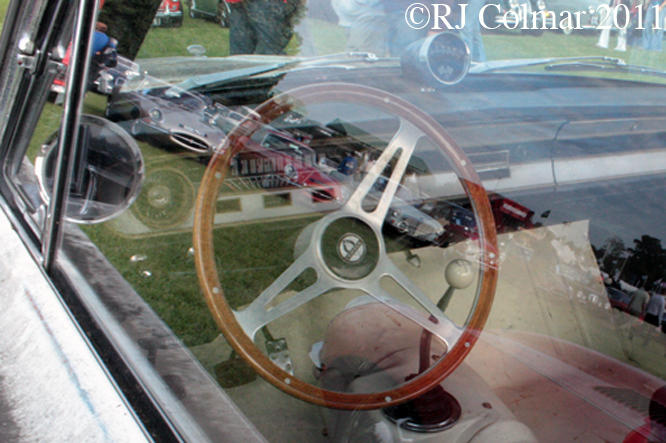
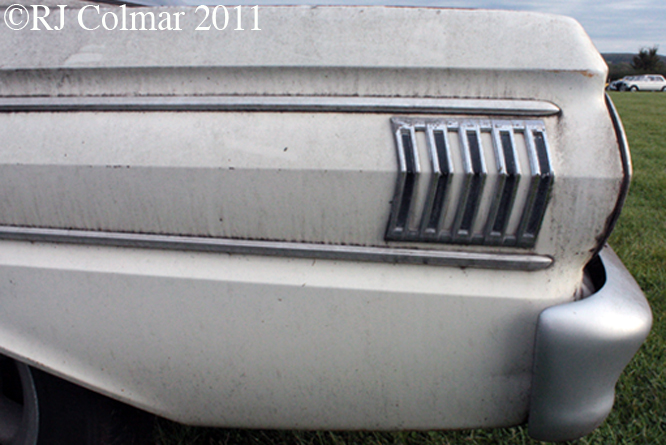
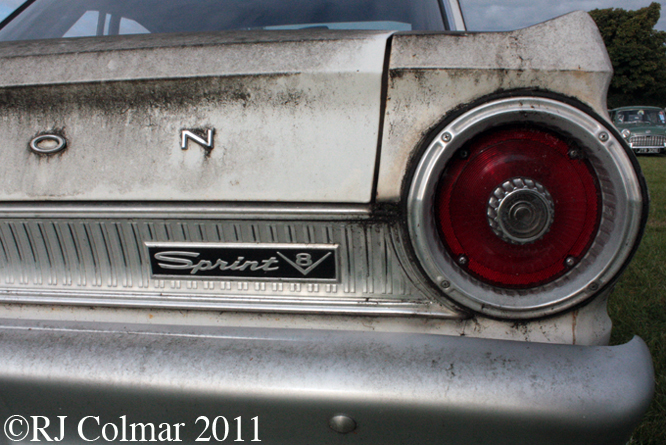
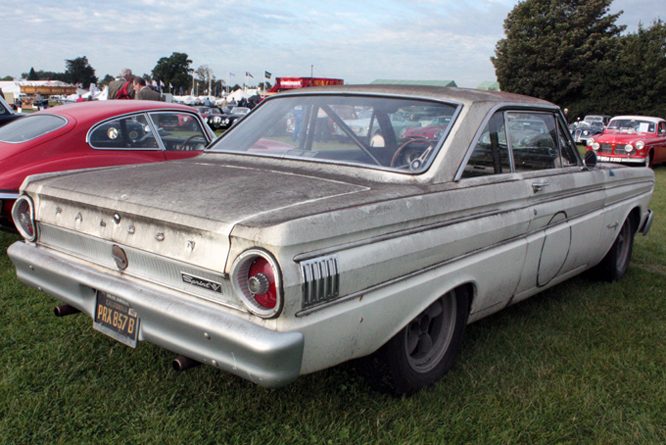
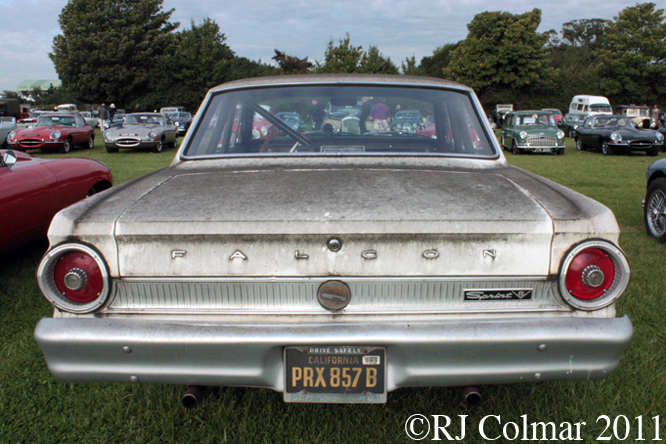
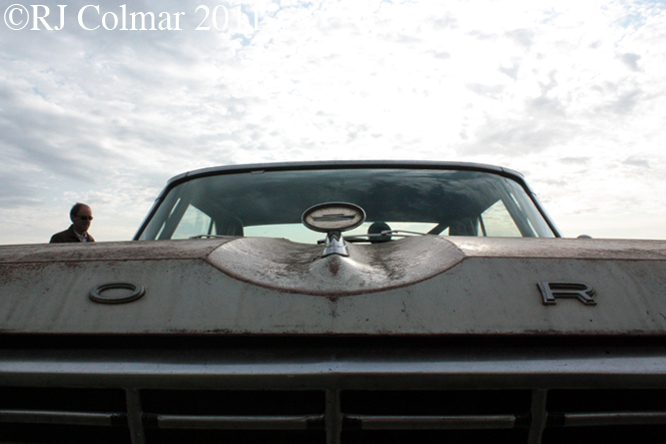
The stand out car in the Goodwood car park last week was this Ford Falcon Sprint V8, there is something about the unmolested patina of old racing cars I simply find irresistible, something all to easy to underestimate that speaks of both achievement and subsequent precarious survival.

Ford Falcon Sprint V8, Goodwood Revival

There are four strands to Ford Falcon history, the US built cars such as the one seen here which were in production from 1960 until 1970, the Argentinian built Falcons in production from 1962 to 1991, the Australian built Falcons which have been in production since 1960 and the US built Falcon ‘E series’ 8 seat vans built from 1961 to 1967.

Ford Falcon Sprint V8, Goodwood Revival

Allegedly Edsel Ford first came up with the Falcon name for the design of a luxury car in 1935, he felt the name did not quite fit and renamed the car Mercury which was launched as a luxury brand in 1938.

Ford Falcon Sprint V8, Goodwood Revival

The Ford Falcon was launched in 1960, like the contemporary Chevrolet Corvair, Chrysler / Plymouth Valiant, Studebaker Lark and AMC Rambler, the design evolved from market research which identified that many US families were in the market for a smaller than full size second vehicle primarily to be driven by women. The first generation Falcons were in production from 1960 -1963.

Ford Falcon Sprint V8, Goodwood Revival

The second generation Falcon was redesigned in 1964 and aimed at a more youthful market. Falcons were available in two door, 4 door, sedan, 2 door coupé like this 1964 model, 2 door convertible, 2 door coupé utility and 3 or 5 door station wagon forms.

Ford Falcon Sprint V8, Goodwood Revival

Six engine options were available from 2.4 litre / 144 cui in line sixes through to 4.9 litre / 302 cui Windsor V8’s along with 4 transmission options 2 speed (ford o matic) auto, 3 speed auto and 3 or 4 speed manual.

Ford Falcon Sprint V8, Goodwood Revival

Despite over a million sales in the first two years of the first generation Falcon, second series Falcon sales tanked thanks in no small part to another vehicle in the Ford range that was based on the second generation Falcon but aimed at an even more youthful market known as the Ford Mustang which was launched in April 1964.

Ford Falcon Sprint V8, Goodwood Revival

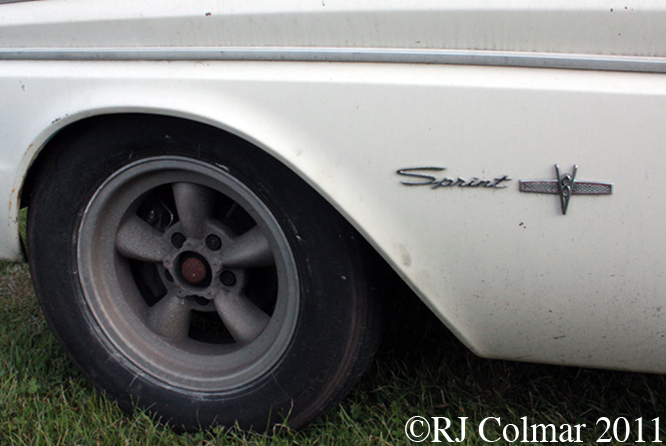
To try and keep sales up the Sprint V8 with 4.7 litre / 289 cui, as seen here, and later even 4.9 litre / 302 cui variations were introduced but the slightly more expensive Mustang with the same power trains was the car everyone wanted.

Ford Falcon Sprint V8, Goodwood Revival

The secrets of this particular cars past remain hidden to me for now, a signature above the lighter on the dash looks like that of two time British Saloon car champion Jack Sears. I have not been able to find any evidence Jack drove such a car after winning the 1963 British Saloon Car Championship driving a Ford Cortina GT, a Lotus Cortina and a Ford Galaxy 500.

Thanks for joining me on this Sprint V8 edition of ‘Gettin’ a lil psycho on tyres’ I hope you will join me again tomorrow. Don’t forget to come back now !
Share

Goodwood Revival #6 – Dress Code

The Goodwood Revival is probably the nations largest annual period dress party covering the years from when Goodwood operated as a second world war airbase to 1966 when the race track around the airfield closed to regular competition.

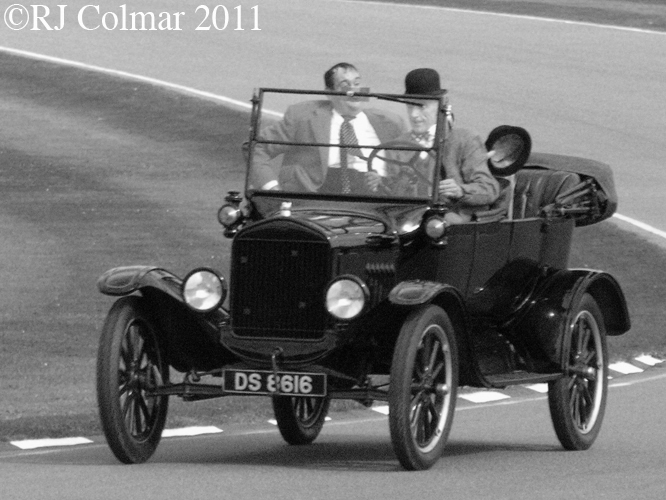
Ford Model T, Goodwood Revival

This year Ford of Britain was celebrating it’s centenary at Goodwood so the period dress on view went right back to 1911. Above Laurel & Hardy look alikes demonstrate a left hand drive 1924 Model T.

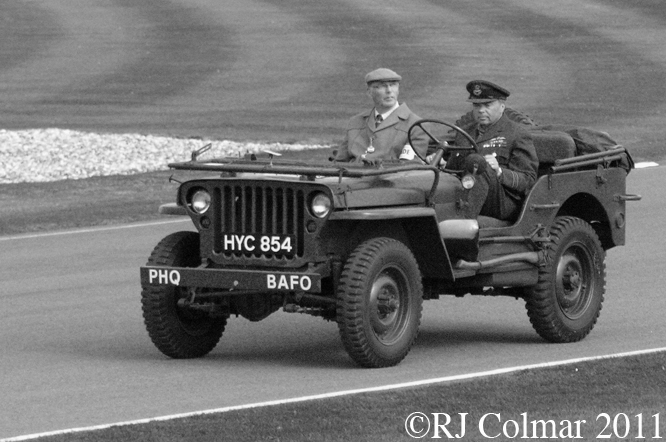
Ford Model T, Goodwood Revival

Willys Jeeps were built under licence by Ford of Britain during WW2, note this is also a left hand drive, presumably because it was foreseen that most of these vehicles would be required for the invasion of Europe. This particular vehicle appeared in the blue as used on airfields by the Royal Airforce and the driver is attired in a Royal Air Force officers uniform.

Land Girls, Goodwood Revival

These two ladies dressed up as land girls part of a huge civilian Women’s Land Army who replaced the male agricultural work force that had gone to war. Typically Land Girls wore somewhat unbecoming if practical trousers in place of skirts and dresses.

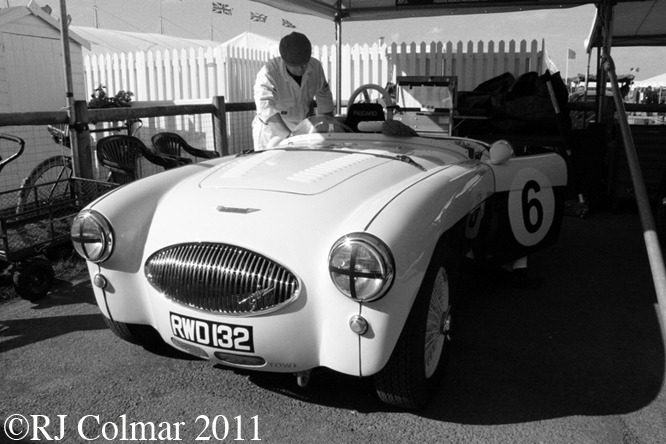
Austin Healey, Goodwood Revival

Moving into the paddock and forward a decade team mechanics are requested to wear period dress in the Goodwood Revival paddock, anyone visiting the pit area is also requested to dress in period. Above a mechanic tends Peter Thorntons 1955 Austin Healey 100 S.

Sir Stirling Moss, Mercedes 300 SLR, Goodwood Revival

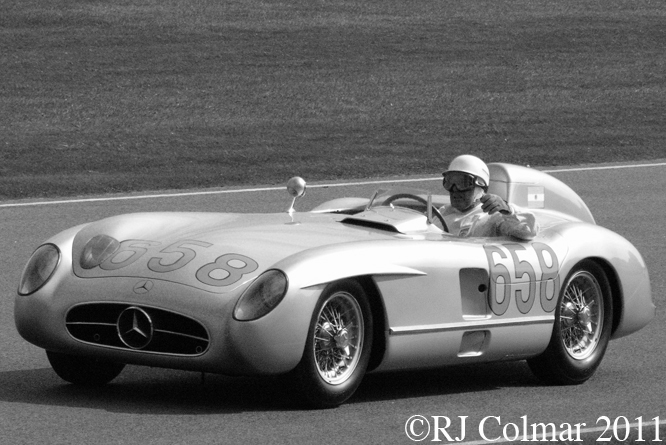
Recently retired from competitive driving Sir Stirling Moss came close to loosing his life at Goodwood in 1962 after an accident that effectively ended his top level career. Stirling is seen here on a demonstration run in perhaps the ultimate Goodwood period accessory a Mercedes Benz 300 SLR raced solo by his team mate Juan Manuel Fangio in the 1955 Mille Miglia to 2nd place 22 minuets behind Moss and Dennis Jenkinson in the #722 300 SLR.

Citroen H Van & DS, Goodwood Revival

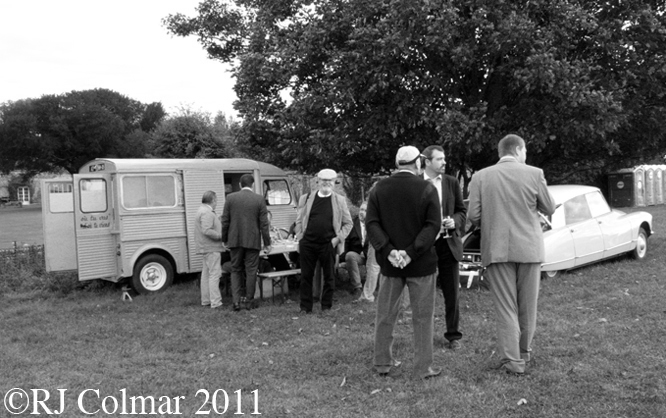
Competitors and spectators from far and wide come to the Goodwood Revival here a party from France who came with a splendid 1950’s Citroen H Van and Citroen DS enjoy breakfast before the racing gets under way.

Goodwood Revival

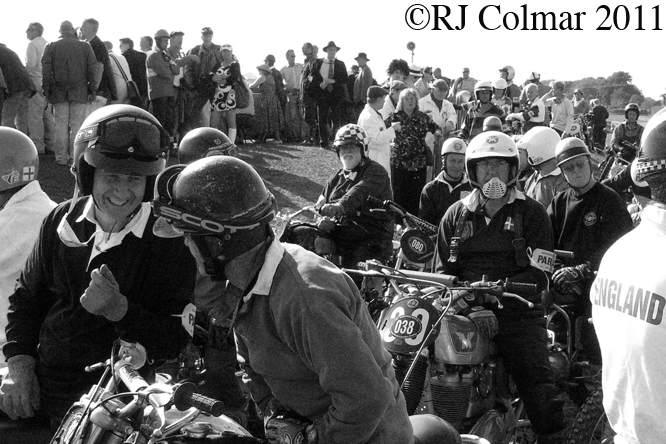
Throughout the three day Revival a scramble event was run for bikes dating from 1957 to 1966. Here the riders in period outfits are waiting to be let loose on a full lap of the racing circuit.

Ford Popular F2 Stock Car, Goodwood Revival

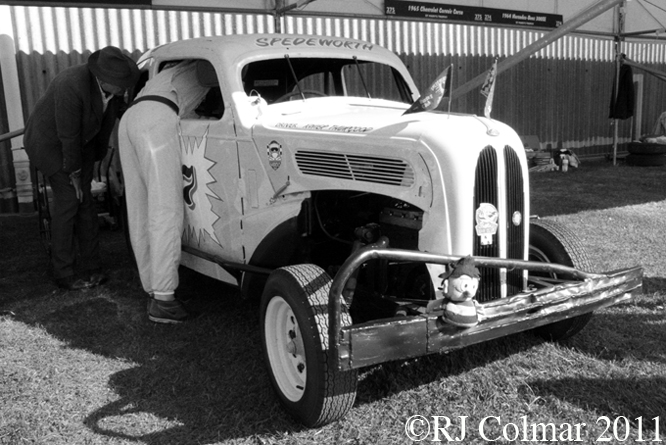
The Ford Popular 103E was in production from 1953 to 1959 by which time early models such as this 1953 model were to be found on the F2 Stock Car circuit. Note the owners period brogue shoes, suit and trilby. Hard to believe this photo was taken last week.

Fiat 600 Multipla, Goodwood Revival

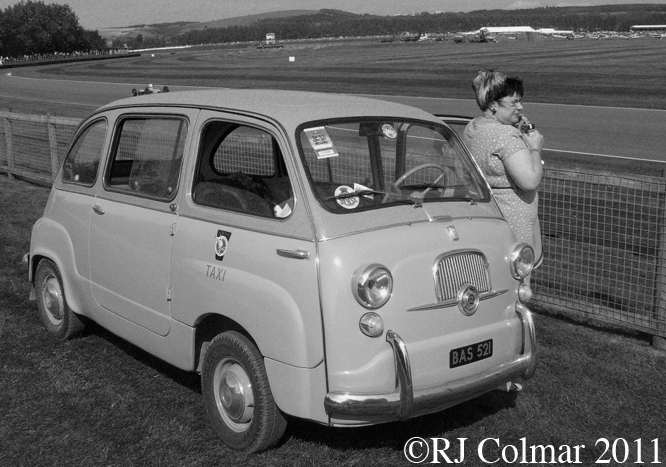
This Left Hand Drive Goodwood Revival Transport Corps Fiat 600 Multipla was built in 1961, when tested in 1956 the 6 seat Multipla was found to be capable of reaching 50 mph from rest in 43 seconds and having a top speed of 57.1 mph. The driver of this taxi wears a patterned dress that matches the lime green colour of the lower half of the vehicle.

Hillman Minx Convertible, Goodwood Revival

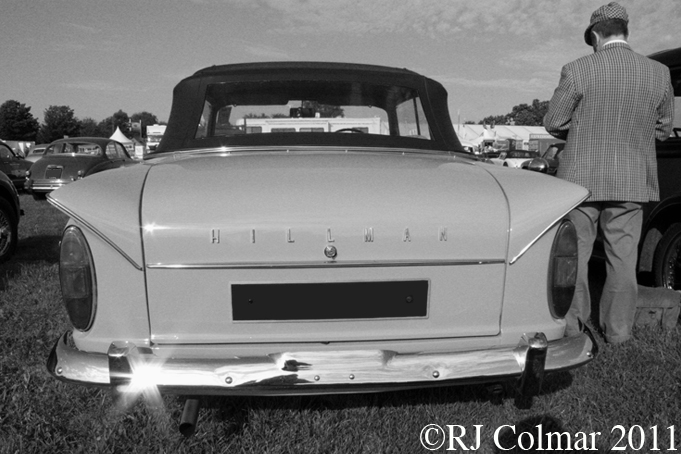
The gentleman to the right of this Hillman Super Minx convertible wears an outfit typical of many Goodwood Revival spectators, check sports jacket though his flat hat has deer stalker ear flaps.

Ford Triple D Tractor, Goodwood Revival

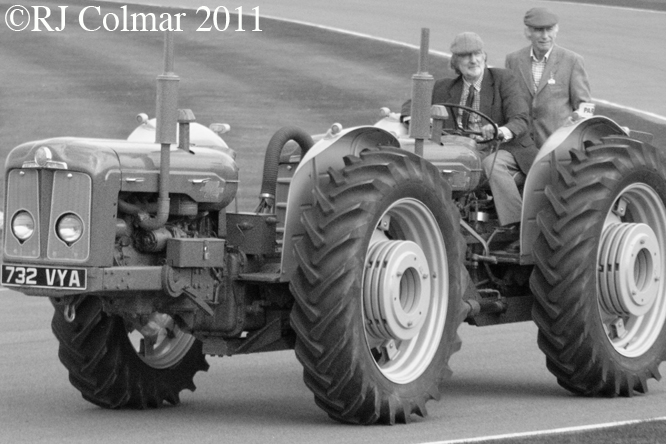
Goodwood is set in a rural area of West Sussex, the ultimate period farming accessory for the Revival has to be the Ford Triple D, Doe Dual Drive, tractor built in 1963. Invented by George Pryor who wanted a more powerful tractor than any of those available to him, he came up with the idea of taking two Fordson tractors and attaching them together with an articulated coupling that with the aid of hydraulic rams could steer the vehicle through a 90 degree turn. This is a latter 130 hp model manufactured by Ernest Doe & Sons using two Ford F5000 tractors. The main draw back of the vehicle was that it was too powerful for most of the existing implements so stronger implements had to also be manufactured by Ernst Doe & Sons. Around 300 of these vehicles were sold in the UK and USA, recently a 1962 Triple D fetched a staggering £61,000 at auction.

Glam Cab Ford Cortina, Goodwood Revival

Carry on Films were a low budget saucey national institution in 1960’s Britain, featuring fairly simple plots of everyday people such as Doctors, Nurses, Policeman, Sailors and such, in 1963 the ‘Carry On’ team, which included a regular cast from one film to the next, released Carry On Cabby a tail of rival cab companies operated by a married couple. 48 years later at Goodwood this period Glam Cab Ford Cortina and its drivers look like they have come straight off set.

Ford Corsair, Goodwood Revival

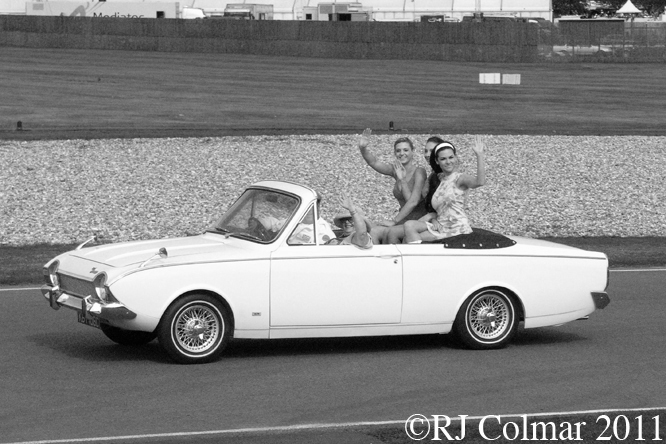
In the 50’s & 60’s if one wanted a convertible or estate / station wagon variant of a Ford one would usually have to take it to a coachworks like Crayford to have the work done, as was the case with this 1963 Ford Corsair, at the time this Corsair was built Mini skirts and boots were all the rage, I remember my English Teacher wearing an outfit like this at my London primary school in 1966 and she was the talk of the school for being so ‘with it’.

Gerhard Berger. Ford Cobra, Goodwood Revival

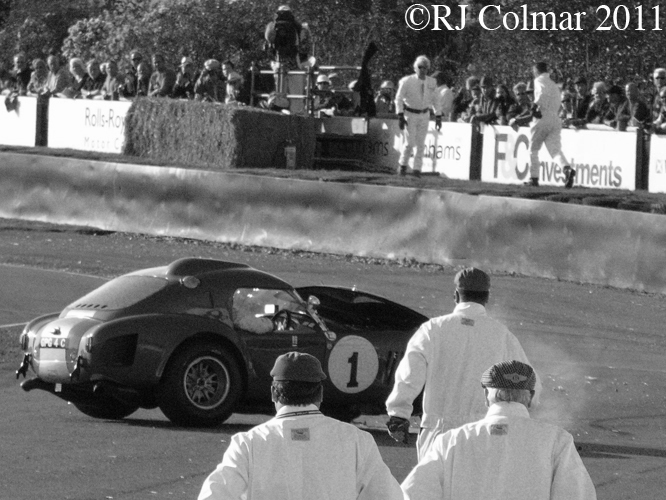
Even the track marshals working along the start / finish straight, seen here rushing to the aid of Gerhard Berger, get into period dress for the Goodwood Revival.

Goodwood Revival

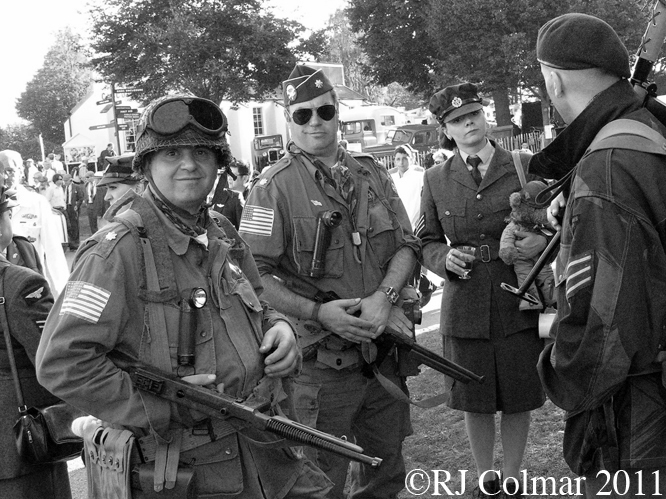
There was a pot puri of military dress code on display at this years Revival covering Allied forces from WW2 through to Vietnam. Here two US personal fraternise with a British Army Sargeant and a Women’s Auxiliary Air Force Sargeant.

Goodwood Revival

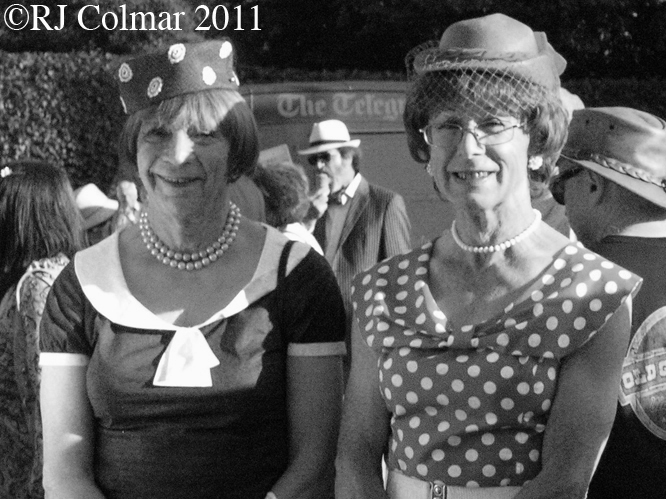
Among the bravest spectators in period costume at an otherwise testosterone fueled Goodwood were these two cross dressers,

Goodwood Revival

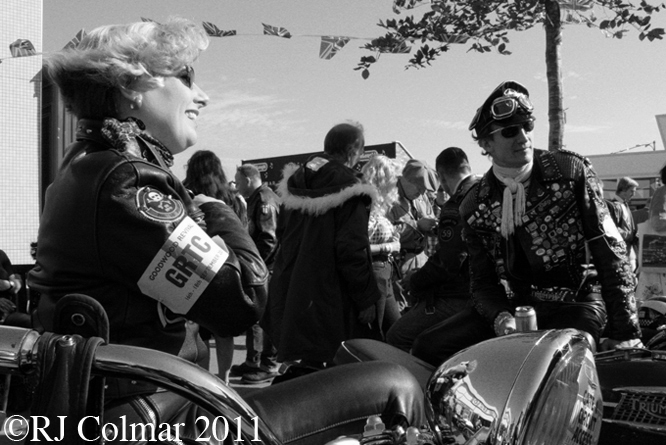
while these two bikers were amongst those enjoying an equally wild side of dress code, note the fur lined parker of the ‘Mod’ in the back ground, back in the day ‘Mods’ and ‘Bikers’ were at each others throats as immortalised in the film Quadrophenia.

Goodwood Revival

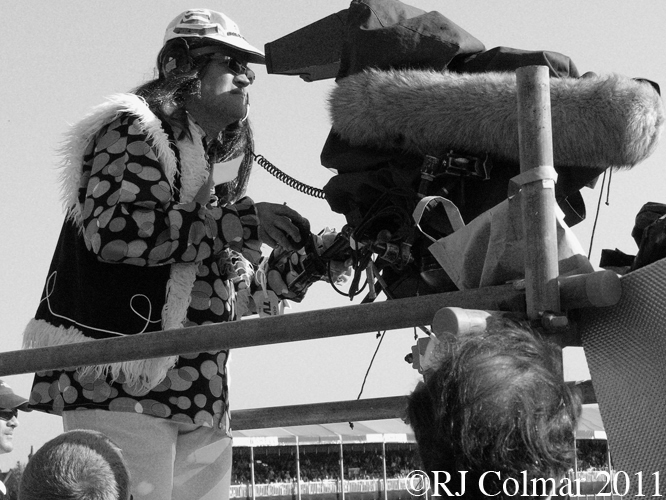
Finally bringing us to the end of the racing era at Goodwood in 1966 this cameraman epitomises the effect the Beatles Sgt Peppers Album had on fashions when it was released on the 1st of June 1966 one month and one day before the Goodwood circuit closed gates for thirty two years.

Thanks for joining me on this Goodwood Dress Code edition of ‘Gettin’ a lil’ psycho on tyres’, I hope you’ll join me again tomorrow when I’ll be looking at an unusual woody that was up for auction at the Bonham’s revival sale. Don’t forget to come back now !
Share

Goodwood Revival #4 – North Americana

Among the many fascinating things to see at the Goodwood Revival last weekend was a fine collection of vehicles and a few drivers from the North American continent here is a small selection of highlights.

Ford Galaxie 500, Goodwood Revival

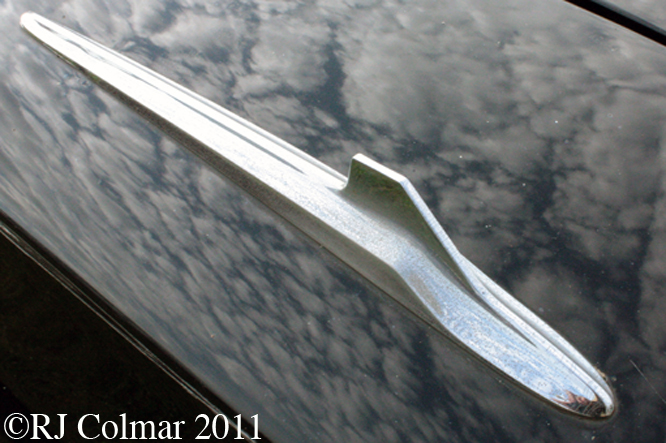
I imagine this front wing / fender trim on a 1964 Ford Galaxie 500 serves a double purpose aiding drivers positioning of the car in a tight maneuver.

Ford Falcon Sprint V8, Goodwood Revival

My vote for Car of the Car Park at Goodwood was this 1964 Falcon Sprint V8 which looks like it has been neglected for a decade or two, more pix of this car next week.

Ford V8 Custom Deluxe Woodie, Goodwood Revival

Bonhams offered a fine selection of vehicles at their auction including this 1950 Ford V8 Custom Deluxe ‘Woodie’ Station Wagon Chassis no. BOEG164430, which was imported to the UK in 2009, the vehicle does not appear to have found a new owner.

Ford Edsel, Goodwood Revival

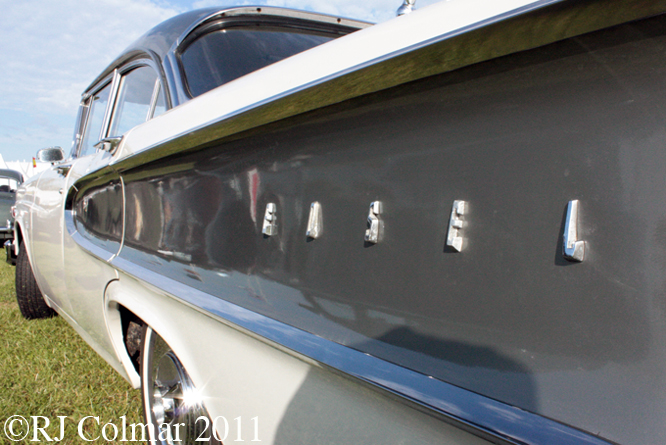
I have not seen an Edsel before, this 1958 model brought home just how colossal a beast an Edsel really is, well suited to the open spaces of North America but a bit like a duck out of water on Englands winding narrow lanes.

Ford Fairlaine 500 Sports Coupé, Goodwood Revival

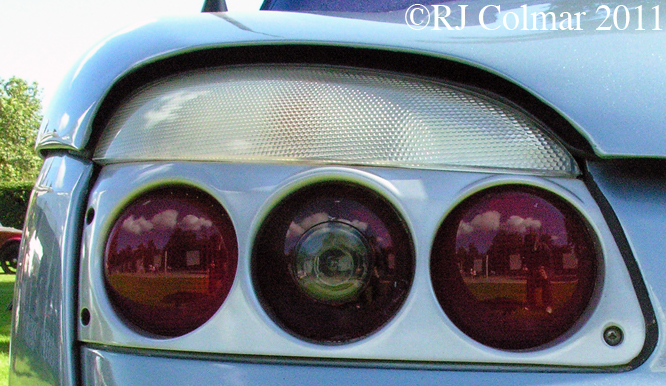
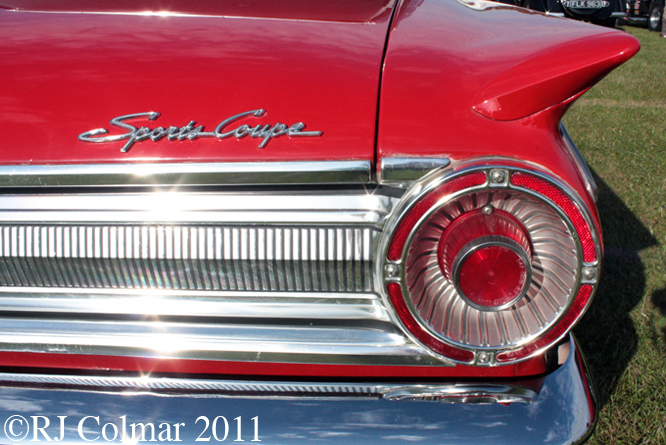
When I was younger I remember being bewildered by the attention to detail of the bright work on some of the 1960’s land yachts, who could fail to be impressed by the jet age rear light cluster of a 1963 Ford Fairlane 500 Sports Coupe.

Cadillac 6200 Sedan Flat Top, Goodwood Revival

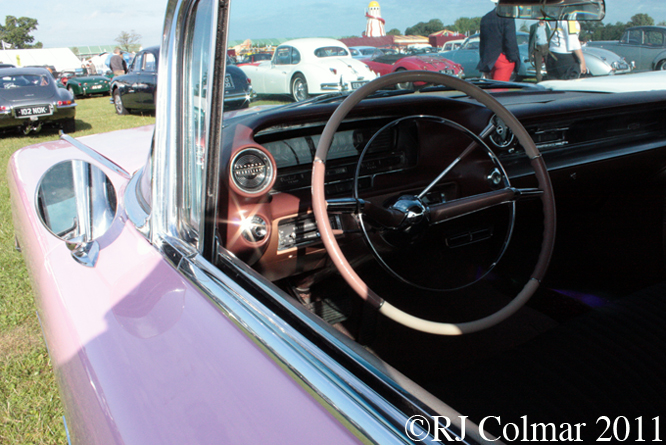
Probably in the running for the largest vehicle in the Goodwood Classic car park was this 1959 Cadillac 6200 Sedan Flat Top, quite simply an awesome automobile, I can just imagine the Chuck Berry hits pouring out of the radio.

Sadler Chevrolet Mk 3, Goodwood Revival

One of several vehicles built in Canada racing at the Revival was this 1958 Sadler Chevrolet Mk3, I am not sure if this was a one off but counting amongst the drivers of a vehicle of this type were Bob Said father of sometime NASCAR racer Boris Said and Eddie Sachs.

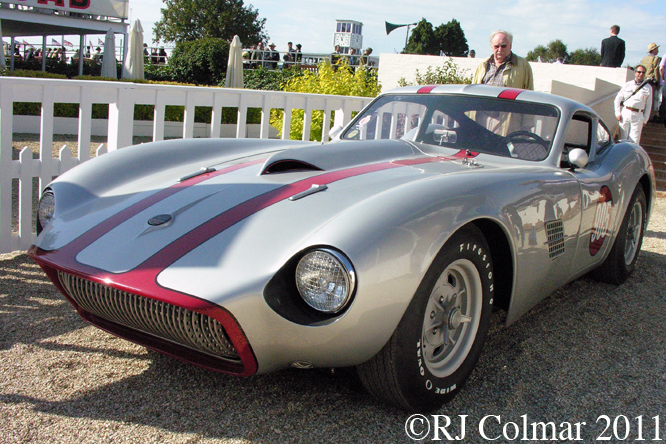
Kellison J6, Goodwood Revival

This 1962 Kellison J6 drew an instant Wow ! reaction when I saw it lurking behind the start grandstand, another vehicle I had not heard of before, Kellison kit cars were the brainchild of Korean Airforce Vet Jim Kellison, this one based on a Corvette C1 chassis. These cars could be fitted with any US proprietary V8 and drive train. The #905 was used on factory Kellison’s at Bonneville where a best speed of 186 mph was recorded in one of these simple but effective devices.

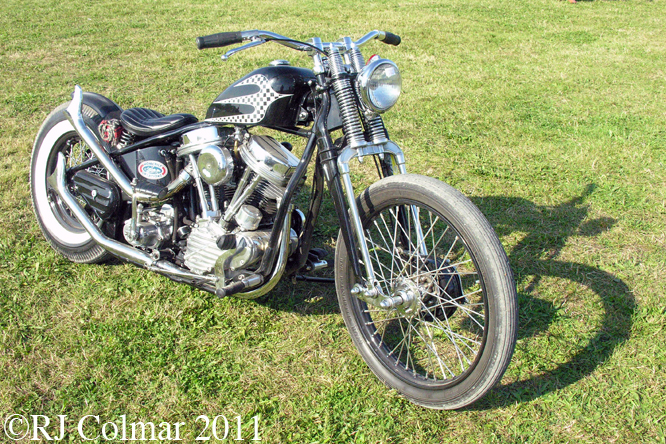
Harley Davidson, Goodwood Revival

I am not really a motor cycle man and if I was I’d go for a café racer like the Triton, but this Harley Davidson looks topically cool with its checkered flame tank, rather like the gargantuan Edsel and Caddy 6200 Series probably not the most suitable of machines for the conditions usually found in West Sussex.

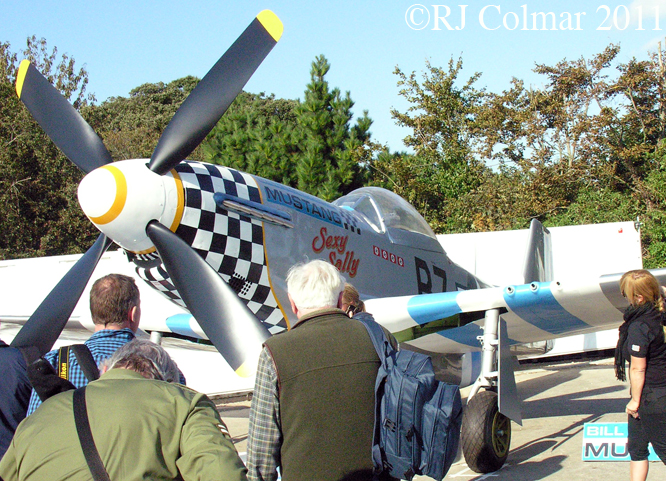
Mustang P51 (Replica), Goodwood Revival

Of all of the WW2 era aeroplanes none says speed quite like the P51 Mustang with its Rolls Royce Merlin V12 motor built under license by Packard. I am not entirely sure if this is an airworthy airframe or just for show but it looked the business surrounded by a B-17 and a host of similarly powered Spitfires.

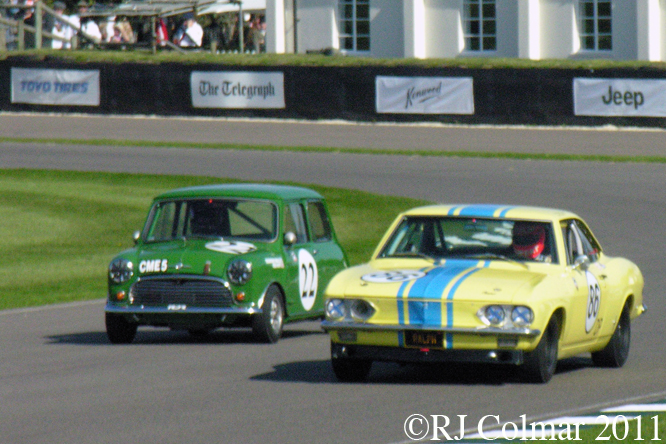
Chevrolet Corvair, Goodwood Revival

Last time I recall seeing the distinctive red helmet of Rupert Keegan was when he drove the #16 Ultramar Newsweek Lola T610 in 1982. After an ill feted attempt to run in CART with the Machinist Union team in the mid 1980’s the 1979 British Formula One Champion, note not a world title but a national one, completely disappeared from my radar until I saw him driving the #85 1965 Chevrolet Corvair Corsa belonging to Bruce Chapman.

Ford Galaxie 500, Goodwood Revival

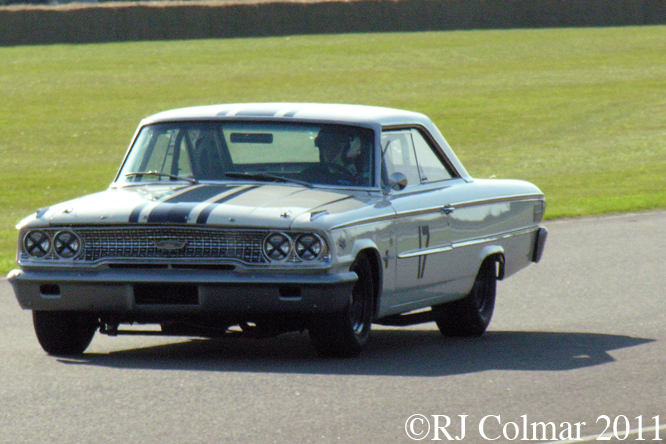
In the same race as the Corvair was the #17 1963 Ford Galaxie 500 pedalled by Kiwi two time winner of the world touring car cup Paul Radisich and owner, seen at the wheel here, Jim Woodley.

Chinook Chevrolet Mk 2, Goodwood Revival

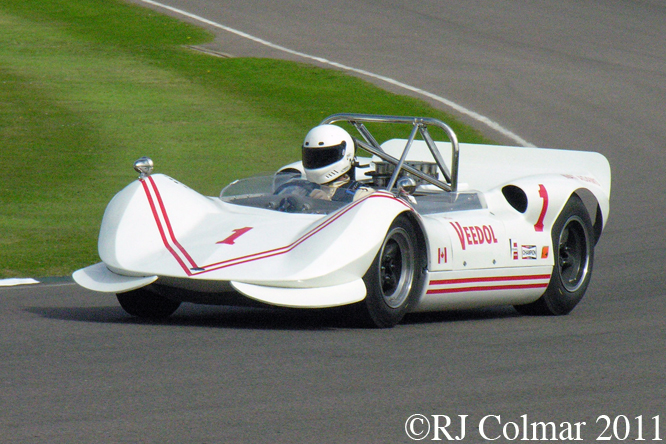
Another vehicle coming from Canada was the 1966 Chinook Chevrolet Mk 2. Built in Toronto by Hungarian Canadian George Frejer. The car is seen here in the hands of rapid F5000 exponent Jay Esterer who won the Whitsun Trophy on Sunday.

Hamill Chevrolet SR3, Goodwood Revival

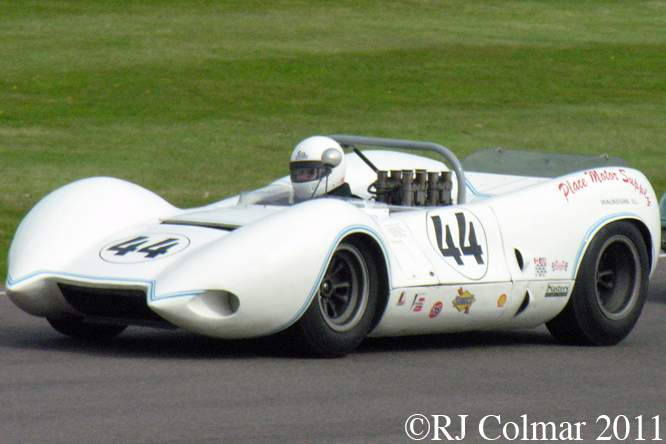
Ed Hamill appears to have built two Hamill Chevrolet SR3‘s one for himself that started with an Oldsmobile motor and a second one for the Tero Corvette Team for Hamills workshop neighbour Roy Kumnick to drive in 1966. So far as I can tell this is the Roy Kumnick car, now driven by Chris Chiles, which if I am correct features a rounded steel tube frame as opposed to the square steel tube frame Hamill used to build his own SR3.

Wolverine Chevrolet LD65, Goodwood Revival

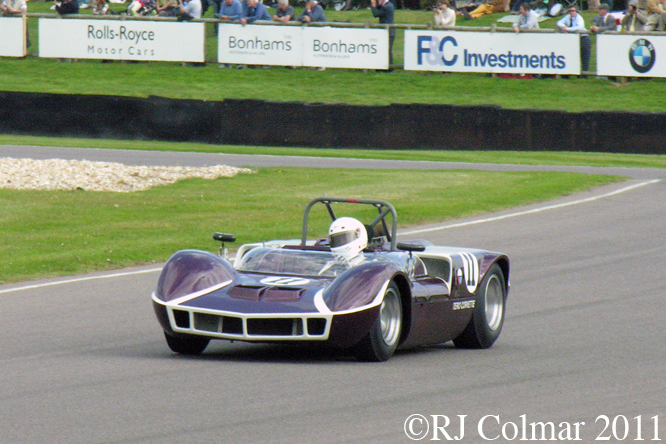
George Anderson was responsible for the design of this 1965 Wolverine Chevrolet LD65 and it was built by Lee Dykstra who went on to achieve much with the Bob Tullis Group 44 Jaguar programme and in the CART Indycar Series. The Wolverine was driven by Jerry Hanson in the 1966 Can Am series, third owner Frank Opalka had the car painted white in 1968 as it is seen here being driven by Mogens Christensen.

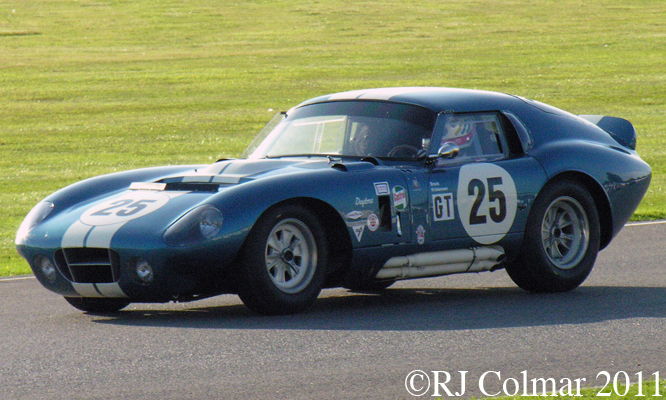
Shelby American Cobra Daytona Coupé, Goodwood Revival

Capable of 186 mph, with a body designed by Peter Brock, the 1964 Shelby American Cobra Daytona Coupé CSX 2300 entered by Daniella Ellerbrock for 1999 Indy 500 winner Kenny Brack and 8 time Le Mans Winner Tom Kristensen, seen at the wheel here, was the second of the five cars finished by Carrozzeria Gransport in Modena. This car le
ased from Alan Mann Racing first appeared painted white with red & blue stipes driven by Bob Bondurant and Jochen Neerpach later to become head of competition at Ford, BMW and Mercedes. The car was repainted in Guards blue when it returned to Alan Mann Racing.

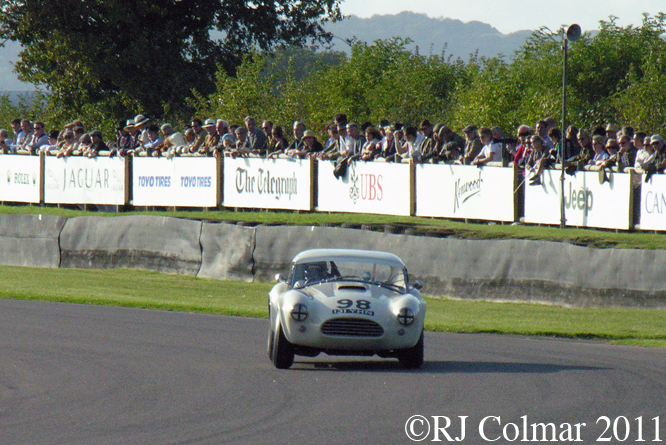
AC 289, Goodwood Revival

The 1964 #98 AC 289 is the English built variant of the ‘Cobra’, a name that belonged to Shelby before he sold it on to Ford. This one was driven by Kevin Kivlochan and 1998 Indy 500 winner Eddie Cheever. Edit 22/09 Bill P has informed me Kevin’s car is chassis #COB6008, which was originally supplied to Bruce Ropener owner of the Croft Circuit in North East England.

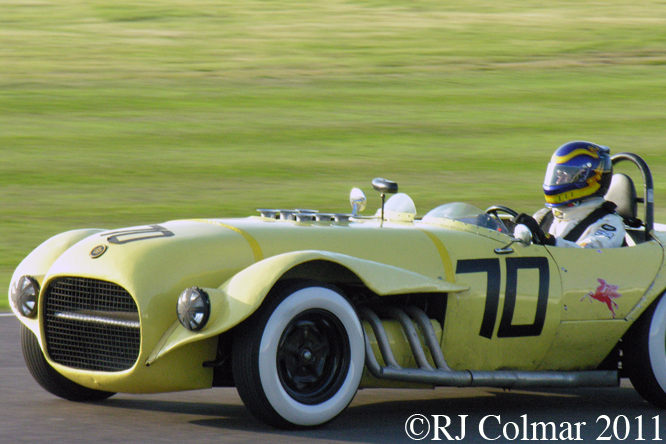
Balchowski-Buick, Ol' Yeller II, Goodwood Revival

Taking it’s model name from a weepy Hollywood film about a stray mongrel 1959 Balchowsky-Buick Ol’ Yeller II this vehicle is also a mongrel with a Studebacker Champion solid rear end, Buick V8, Buick aluminium drum brakes and a Morris Minor steering rack and white wall tyres more commonly found on station wagons. Max Balchowsky chose all these items for the car drawing on his experience with previous race cars and hotrods. When it held together this inexpensive, $1452.76, sports car driven by the like of Max himself, Dan Gurney, Bob Drake, Bob Bondurant, Carrol Shelby and Jerry Entin, could hold it’s own against Ferrari’s.

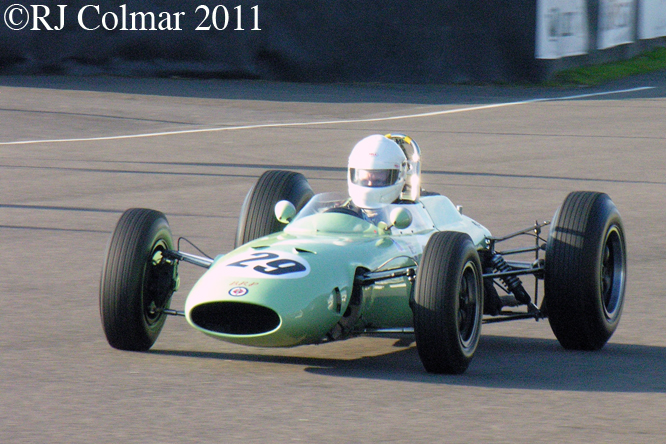
BRP - BRM, Goodwood Revival

My final piece of North Americana is a replica of a 1964 BRP-BRM a British design, faithfully replicated in New Zealand, currently owned and driven by Kurt DelBene who I understand has a day job in Silicon Valley. Great to see someone out racing with one of the more obscure British Formula One manufacturers, helps me to believe that one day I will see the Connew back on it’s wheels and driven with vigour.

My thanks to Tony ‘Giraffe’ Gallagher, Doug Nye, Paul Parker, Jerry Entin, and bill p at The Nostalgia Forum for their valuable contributions to today’s blog.

Thanks for joining me for this North Americana edition of ‘Gettin’ a lil’ psycho on tyres’ I hope you will join me tomorrow for an over view of some of the Ferrari’s at Goodwood last weekend. Don’t forget to come back now !
Share