Tag Archives: GALPOT

OK, But Not Very Fast – Lotus 58

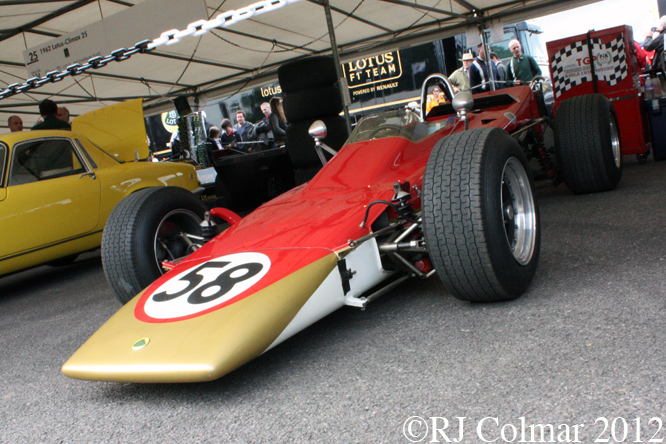
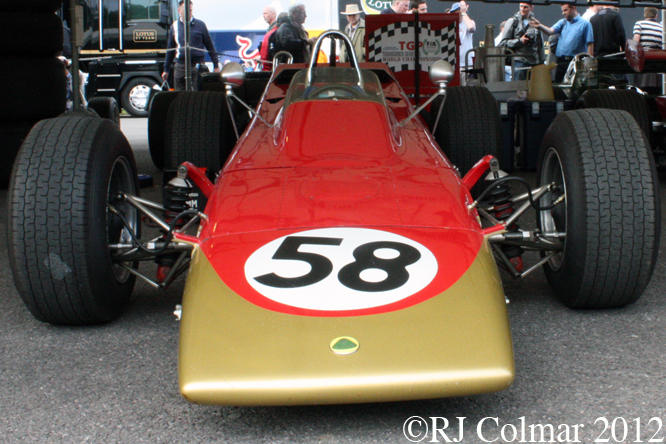
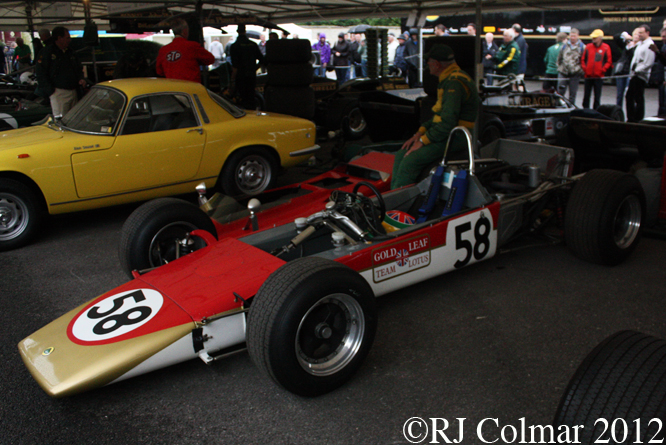
The Lotus 58 was designed with de Dion suspension front and rear, in Colin Chapman’s eternal quest for more grip, to take part in Formula 2 races for the 1968 season.

Lotus 58, Goodwood Festival of Speed

Chapman’s original intention was for the 58 to be used as a development vehicle for the Lotus 57 Grand Prix car which was to have used a similar chassis but fitted with a larger Ford Cosworth 3 litre / 183 cui that powered the various iterations of the Lotus 49.

The Lotus 58 chassis and wedge shaped body closely resembles that of the Lotus 56 Indy challenger but is powered by a 225 hp four cylinder 1598 cc / 97.5 cui Ford Cosworth FVA motor which met the requirements of the second tier open wheel Formula 2 regulations.

Lotus 58, Goodwood Festival of Speed

The one and only Lotus 58 chassis was completed the day Jim Clark was killed at Hockenheim, his death along with that of Jim’s replacement Mike Spence at Indy in a Lotus 56 along with numerous crashes that befell Jackie Oliver in his Lotus 49’s meant that development of the Lotus 58 was pushed back until the end of 1968 when Lotus had to decide which cars to take to the Antipodes for the Tasman Series.

Graham Hill thoroughly tested the car with a Tasman Spec 2.5 litre / 152.5 cui Cosworth DFW motor and came to the conclusion that it was “OK, but not very fast”. It would appear the advantages of the de Dion suspension which keep the wheels vertical in the corners and thereby keep a larger tyre footprint on the ground were not obvious enough to pursue. The Lotus 58 was pushed aside never having raced in Formula 2 as originally intended, or in the Tasman series, while the similar Cosworth DFV powered Lotus 57 never even left the drawing board.

Lotus 58, Goodwood Festival of Speed

In 1998 two enthusiasts persuaded Colin’s son Clive Chapman to restore the Lotus 58 and he gave the task to former Hill and Clark engineer at Lotus Eddie Dennis. After some 1500 hours of work Dennis ran the car at the former works Lotus test track at Hethel before handing it over to the new owners Malcolm Ricketts and Don Hands.

Thanks for joining me on this “OK, But Not Very Fast” edition of “Gettin’ a li’l psycho on tyres” I hope you will join me again tomorrow. Don’t forget to come back now !

Share

Shopping Around #2 – Cadillac 6 Window Sedan

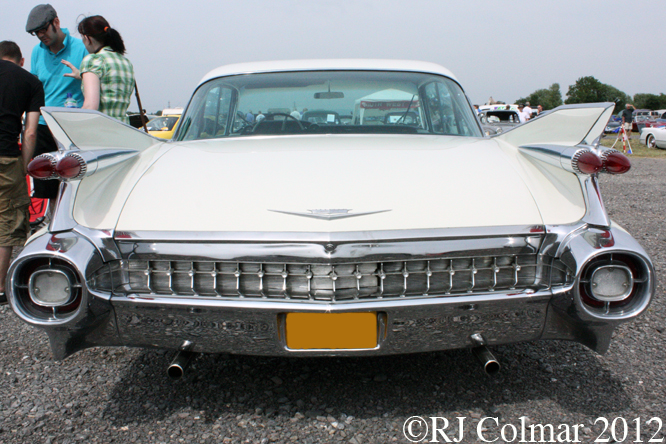
Last week I looked at the Cadillac Series 62 4 Window Hard Top Sedan, by coincidence just after I finished preparing that blog I came across this 6 Window Sedan at Easter Compton.

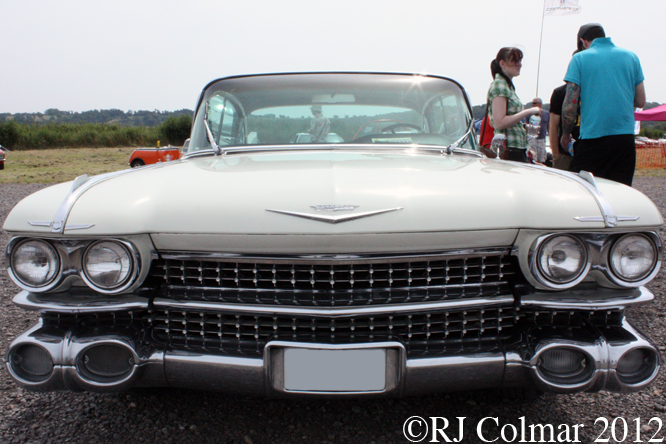
Cadillac, 6 Window Sedan, Summer Classics, Easter Compton

Unsurprisingly from the front the Flat Top 4 window and six window sedans look almost identical.

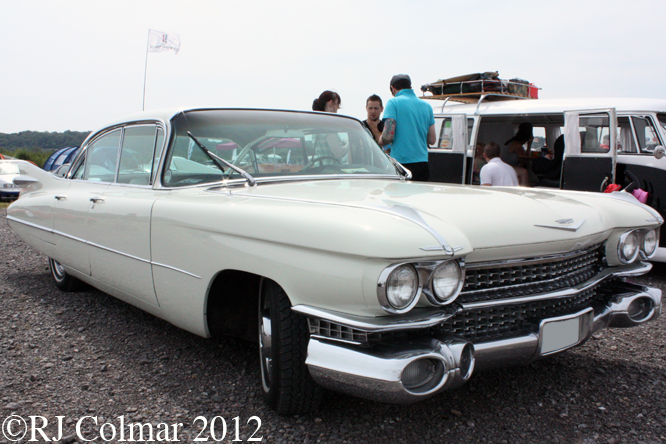
Cadillac, 6 Window Sedan, Summer Classics, Easter Compton

However from the side the difference can be seen in the sloping rear roof line of the six window model.

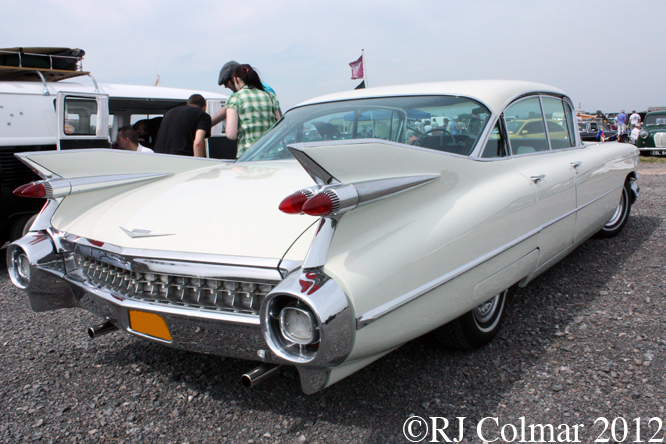
Cadillac, 6 Window Sedan, Summer Classics, Easter Compton

It was only when I got home that I realised that today’s featured car is missing the tell tail the small badge below the arrow behind the front wheel on the front wing / fender which distinguishes a Series 62 ‘6229’ from the ‘6329’ de Ville 6 window Sedan which would be identified by small chrome ‘Cadillac de Ville’ lettering above the chrome arrow on the tail wing / fender.

Cadillac, 6 Window Sedan, Summer Classics, Easter Compton

The difference in the basic price when new between the two models was $418, if you know what the extra cost gave you apart from a difference in the badges already mentioned please chime in below.

Thanks for joining me on this “Shopping Around #2” edition of “Gettin’ a li’l psycho on tyres”, I hope you will join me again for Ferrari Friday tomorrow. Don’t forget to come back now !

Share

Pneumatic Sunroof – Avions Voisin C-25 Aerodyne

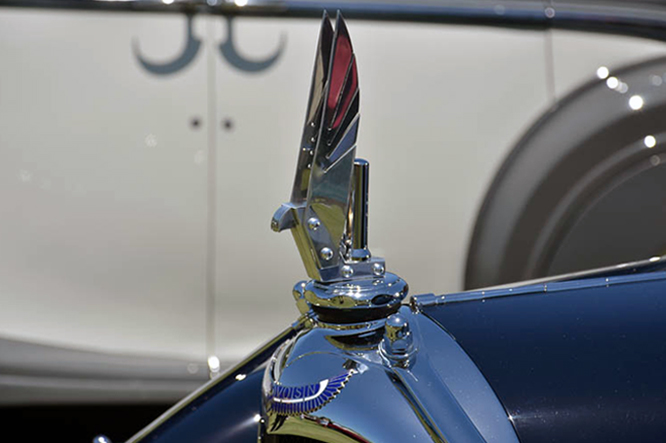
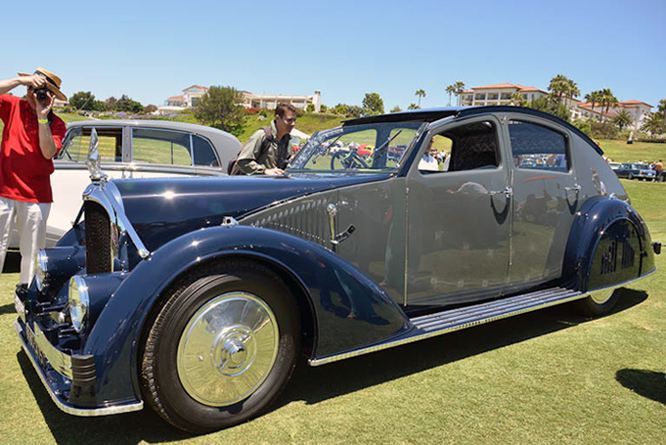
Successful pioneer aviator and aircraft manufacturer Gabriel Voisin turned his back on aviation after the Great War of 1914-1918 to focus on the manufacture of automobiles some of which, including his 1923 C6 Labortoire monocoque Grand Prix car count as some of the most innovative, exotic, distinctive if not plain idiosyncratic and outlandish ever seen.

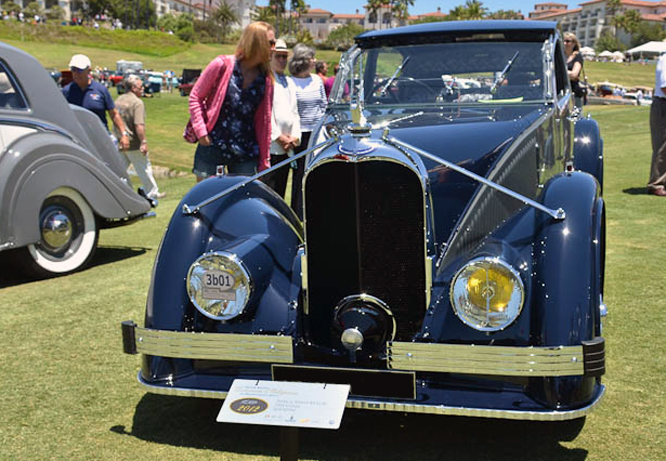
Avions Voisin C-25 Aerodyne, Dana Point Cd'E

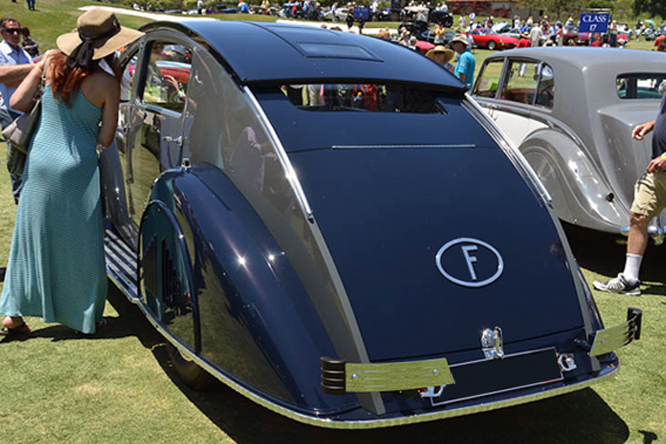
The prototype C-25 first seen in 1934 included a radial 7 cylinder motor that was dropped in favour of a 2994 cc / 182.7 cui straight 6 cylinder motor for the production models such as the one seen in Geoffrey Horton’s photographs taken at this years Dana Point Concours d’Elegance.

Avions Voisin C-25 Aerodyne, Dana Point Cd'E

The aluminium panels of the wings / fenders of the C-25 Aerodyne are not the only ones supported by struts in the Avions Voisin range.

Avions Voisin C-25 Aerodyne, Dana Point Cd'E

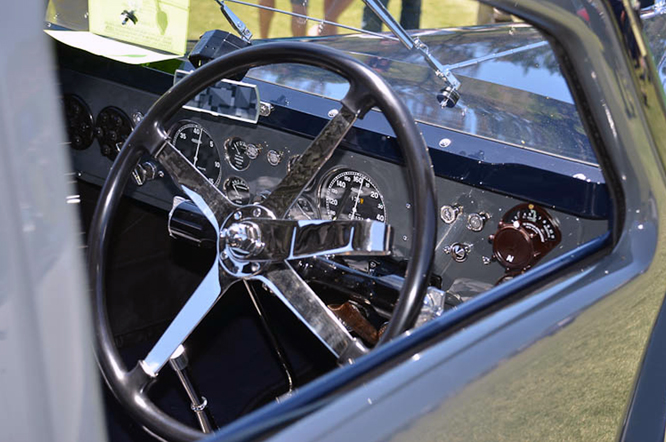
No expense was spared in the interior appointments, the bespoke cloth to a Voisin design is just as distinctive as the rest of the car as are the René Lalique designed ashtrays.

Avions Voisin C-25 Aerodyne, Dana Point Cd'E

The C-25 was also fitted with a pneumatically operated sunroof,

Avions Voisin C-25 Aerodyne, Dana Point Cd'E

the carrier rails for which can be clearly seen in this photograph.

This particular car is one of 3 or 4 known to exist from a total production believed to have been no more than seven. After a six year restoration by the Californian Mullin Automotive Museum the car won Best in show at the 2011 Pebble Beach and 2012 Dana Point Concours d’Elegance, events.

My thanks to Geoffrey Horton for sharing his fabulous photographs.

Thanks for joining me on this ‘Pneumatic Sunroof’ edition of “Gettin’ a li’l psycho on tyres”, I hope you will join me again tomorrow. Don’t forget to come back now !

Share

Hot Cam – 8/45 Double 12 MG Midget

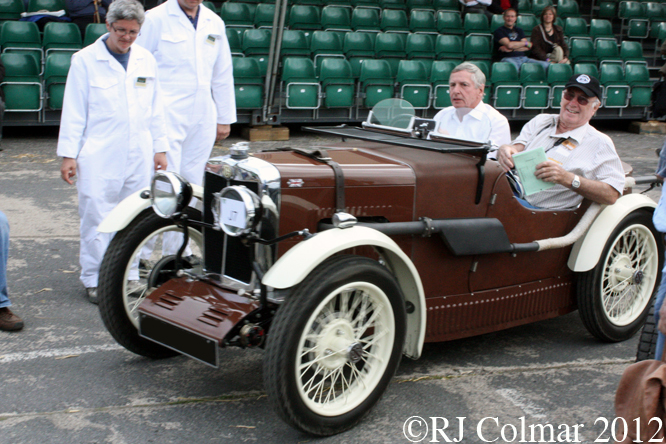
Today’s featured 8/45 Double 12 MG Midget and it’s earlier 8/33 incarnation are credited with saving MG from ruin when sales of it’s larger 18/80 models started to falter in the wake of the great economic depression at the end of the 1920’s and early 1930’s.

8/45 Double 12, MG Midget, Brooklands Double Twelve

For the M-Type as the Midget was known MG returned to it’s roots of manufacturing upgraded Morris vehicles, in this case upgrading a Morris Minor chassis which included lowering the suspension for better road holding and tweaking the brakes to cope with the mildly tuned 4 cylinder Morris Minor motor.

8/45 Double 12, MG Midget, Brooklands Double Twelve

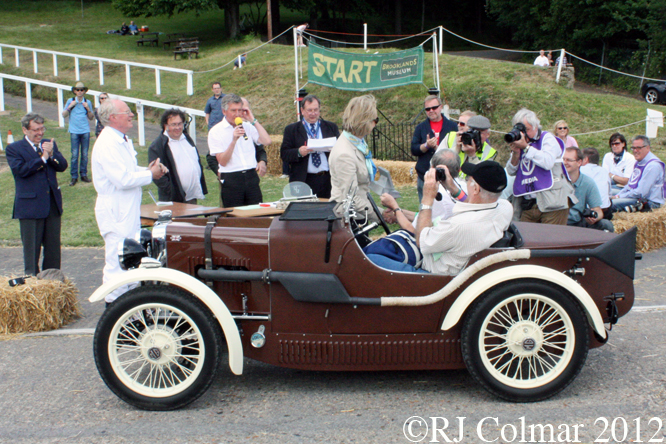
A team of slightly modified midgets with a hot cam won the JCC Brooklands Double Twelve race in May 1930 and subsequently what became known as the Double 12 cam was fitted to production cars such as the 1931 example seen here. 3,235 M-Type midgets are thought to have been built between 1929 and 1931 when the model was superseded by the J-type.

Colin Reynolds, who is seen at the wheel, recorded the fastest overall times in the various tests at the recent Brooklands Double 12 meeting.

Thanks for joining me on this “Hot Cam” edition of edition of “Gettin’ a li’l psycho on tyres” I hope you will join me again tomorrow. Don’t forget to come back now !

Share

Coffee, Croissant & Cars #3 – Avenue Drivers Club

Last Sunday being the second Sunday of the month it was time to amble down St Micheal’s Hill towards Queen Square for another Avenue Drivers club meeting.

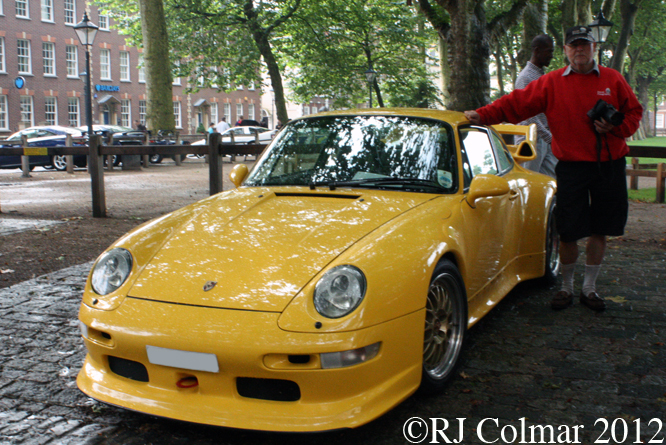
Porsche 993 GT2, Avenue Drivers Club, Queen Square, Bristol

Where I was greeted Ted who brought along his DP Motorsports tuned Porsche 993 GT2 which came complete with matching yellow dash instruments. If your looking for photographs of old competition cars in action Ted’s Ferret Fotographics is a great place to start.

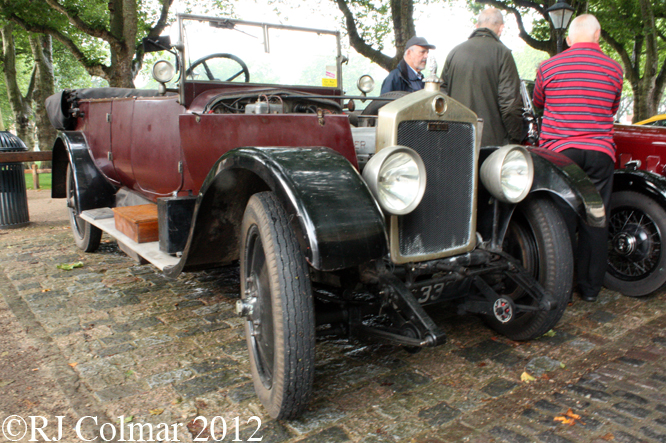
Lanchester, Avenue Drivers Club, Queen Square, Bristol

Keeping the Lanchester flag flying at the Avenue Drivers Club was this 3 liter / 183 cui 1925 Lanchester 21.

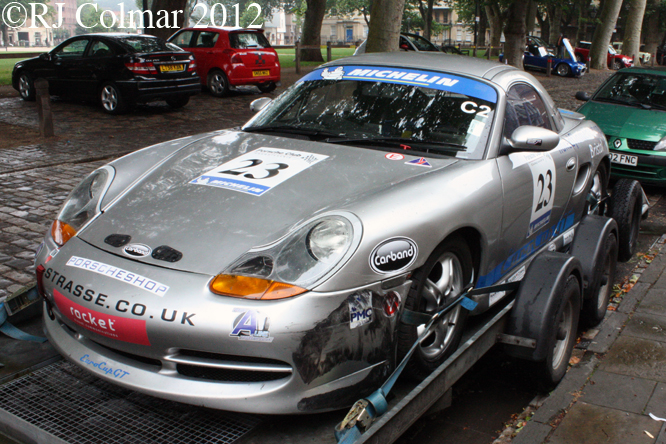
Porsche Boxster, Avenue Drivers Club, Queen Square, Bristol

With signs of tyre rub on both sides to the bumper there was no doubt this Porsche Boxster prepared by Porscheshop and driven by novice driver Stuart Ings. You can see an in car video of Stuart in action at Oulton Park a couple of weeks ago on this link.

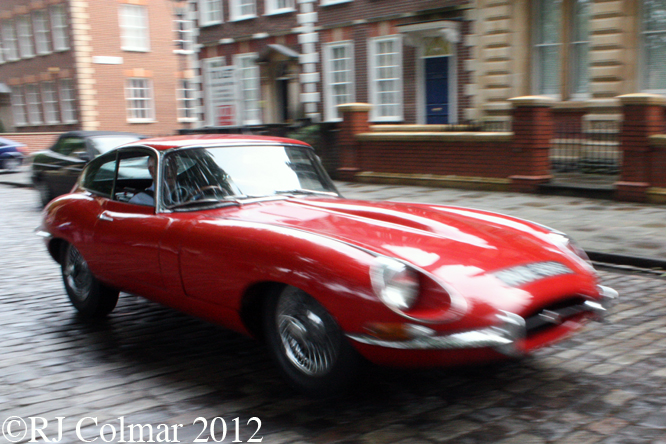
Jaguar E-type, Avenue Drivers Club, Queen Square, Bristol

Flying the flag for Jaguar was this lush E-type.

Austin 10, Avenue Drivers Club, Queen Square, Bristol

This Austin 10 motor powers an Austin 10/24 Ripley sport that is a regular at Avenue Drivers Club meetings and was featured in GALPOT blog early last year.

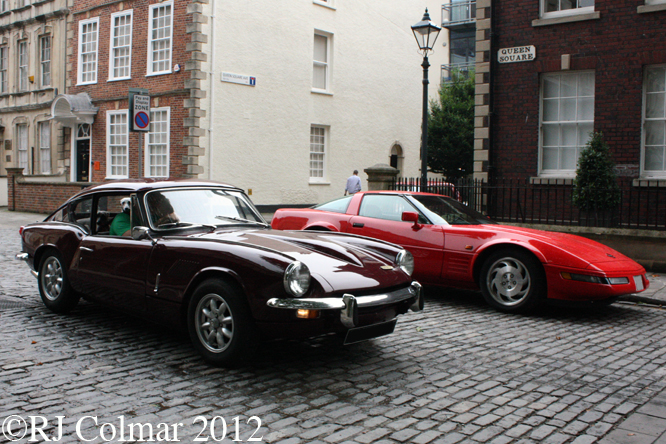
Triumph GT6, Avenue Drivers Club, Queen Square, Bristol

I’ve been meaning to write a blog about this Triumph GT6 Mk II for some time, it was great to see and hear it last weekend.

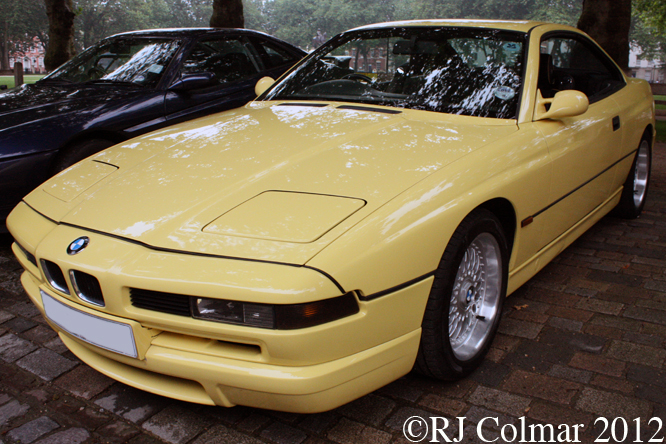
BMW 840 Ci, Avenue Drivers Club, Queen Square, Bristol, Queen Square, Bristol

BMW had originally intended their entry level 8 series cars to be powered by 3 liter motor’s however it would appear they decided better of it by allegedly chopping most of the 18 built up and introducing the 4 liter V8 powered 840 Ci instead. Above is one of the last built in 1999 with a 4398 cc / 268 cui V8 with 5 speed automatic transmission.

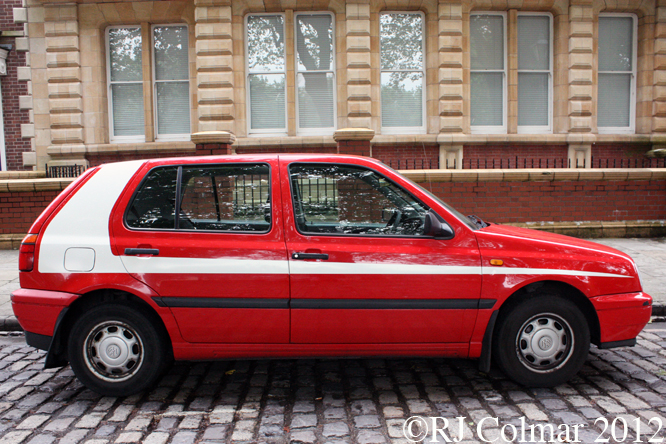
Volkswagen Golf III, Avenue Drivers Club, Queen Square, Bristol, Queen Square, Bristol

The Spirit of Starsky and Hutch is obviously alive and well in Bristol, for the second time in two days I saw a vehicle with a laser stripe ! Above on a humble Golf III.

Vauxhall, Nova, Avenue Drivers Club, Queen Square, Bristol, Queen Square, Bristol

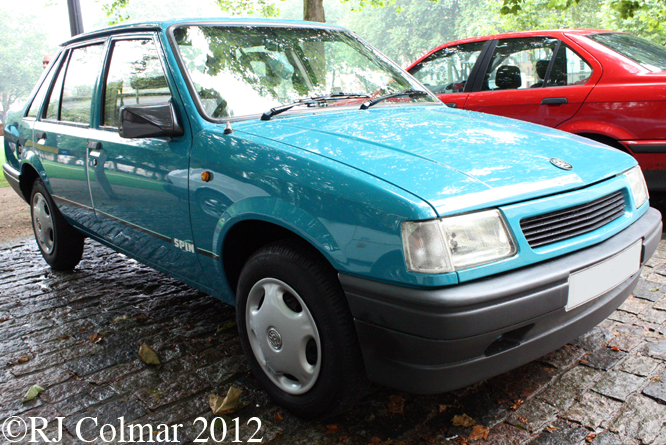
Entering into the ranks of classics, 20 years old this year, is the immaculate Vauxhall Nova Spin above, a badge engineered Opel Corsa which like it’s German badged counterpart was built in Spain.

Ferrari, F430, Avenue Drivers Club, Queen Square, Bristol, Queen Square, Bristol

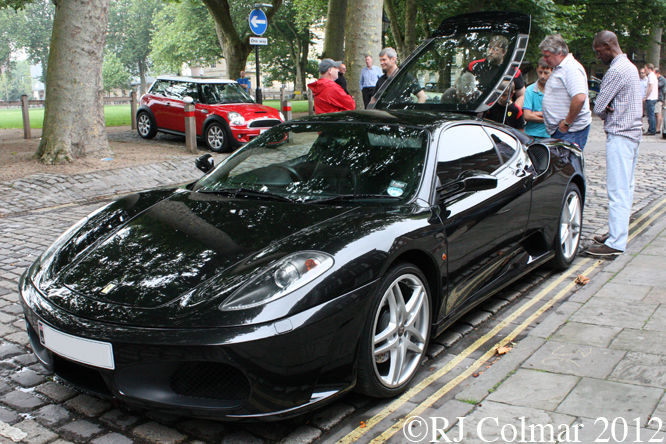
I first came across this wailing Ferrari F430 on my way to Sherborne Castle last month. The owner had just spent a considerable sum on a new exhaust, however the vacuum operated exhaust valve had been plumbed incorrectly and still needs sorting out, meantime the exhaust volume has been set permanently at volume 10 !

Suzuki RV 125 VanVan, Avenue Drivers Club, Queen Square, Bristol, Queen Square, Bristol

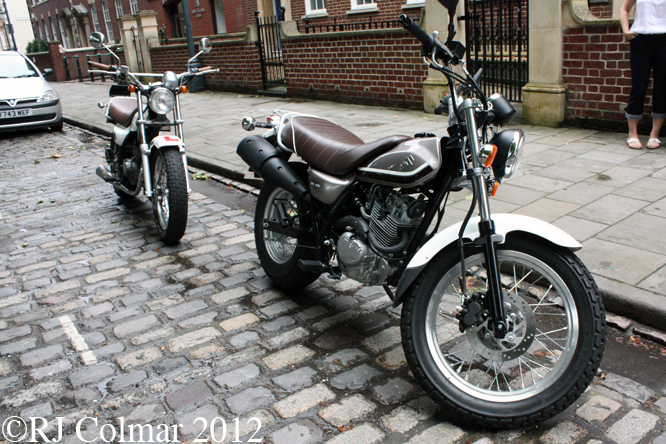
Representation of two wheeled transport was very thin last week, however these matching Suzuki RV 125 VanVan’s reminded me of my schooldays, an older lad had one imported from Japan in the mid 70’s when RV 125’s were powered by two stroke motors.

TVR Cerbera, Avenue Drivers Club, Queen Square, Bristol, Queen Square, Bristol

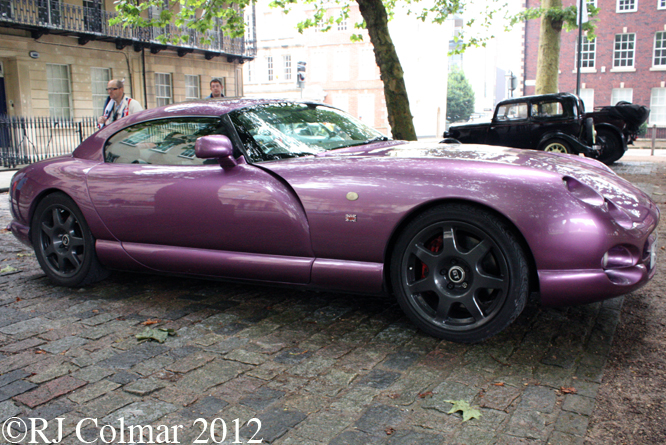
This 1997 TVR Cerbera powered by the larger 4578 cc / 279 cui TVR V8 motor turned up late in the morning just as I was leaving. The Cerebra name is derived from Cerberus the mythical Greek three headed beast that guarded Hades which is fitting for a car that is considered a three plus one thanks to it’s front passenger seat which moves further forward than the drivers seat to afford the rear passenger behind a little more leg room than on the drivers side.

Thanks for joining me on this Coffee, Croissant & Cars #3 edition of “Gettin’ a li’l psycho on tyres” I hope you will join me again tomorrow. Don’t forget to come back now !

Share

Summer Classics – Easter Compton

Halfway between Bristol and the former holiday resort Severn Beach lies Washingpool Farm just outside Easter Compton which played host to Summer Classics at the weekend.
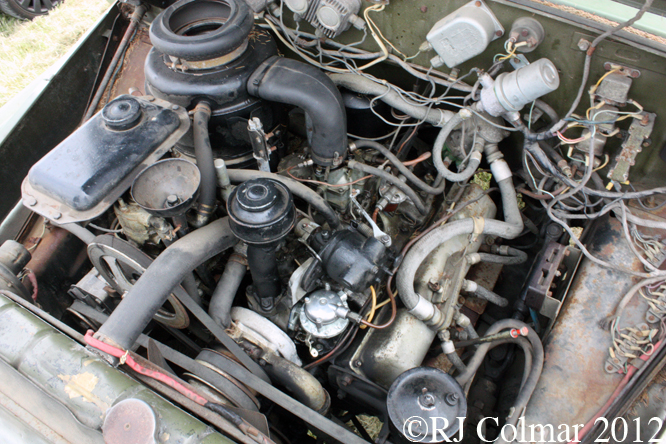
Zil 131, Summer Classics, Easter Compton

By no means the biggest show I have attended this year, what Summer Classics lacked in quantity it more than made up with in quality and good company on Saturday. Above is a 150 hp V8 that took part in a race, possibly the greatest race of all time the nuclear arms race. This 1971 6 x 6 Zil 131 was fitted out as a Zelda R140 mobile radio station designed to be used as a mobile command center. The cabs for the radio operators on the back of the trucks were designed to survive nuclear fall out and thus ensure the possibility of mutual destruction !
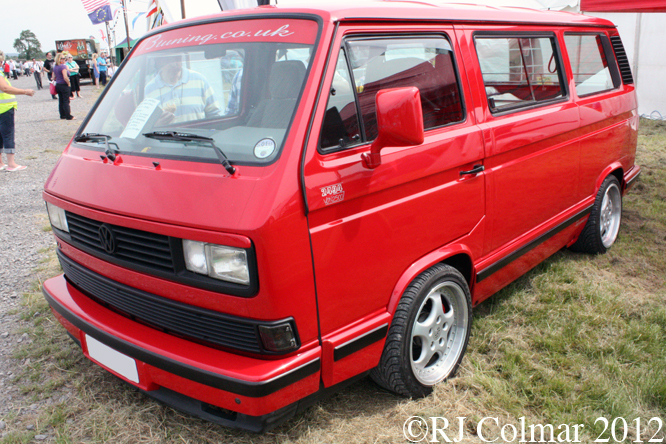
Volkswagen Subaru Multivan, Last Limited Edition, Summer Classics, Easter Compton

The Type 3 Transporter / Multivan above is one of the last 6, 2494 of 2500, Last Limited Edition (LLE) Multivans made in 1992. There was also a Redstar limited edition available to VW employees only and production of the Type 3 continued in Mexico until 2003. This particular LLE Multivan is a particularly quick camper having been fitted with a 230 hp 3.3 liter / 201 cui Subaru flat six motor, Porsche gearbox and brakes and a Scania Shifter.
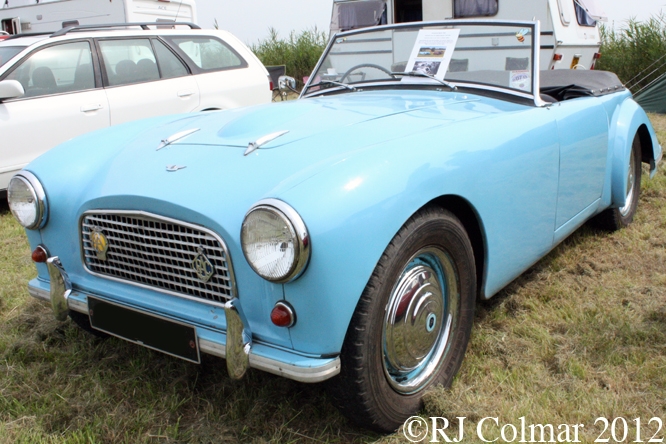
Paramount Sport, Summer Classics, Easter Compton

Saturdays ‘car manufacturer I had never even heard of before’ was Paramount. The 1953 Paramount Sports above featuring an aluminium body on an ash frame is one of only 3 road worthy Paramount vehicles from a total of 80 of all types thought to exist.
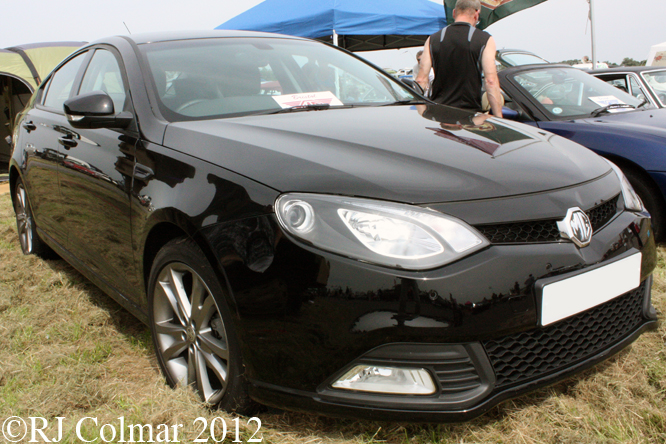
MG6 GT, Summer Classics, Easter Compton

After the MG Rover group disappeared in 2005 the MG marque was revived in 2011 with help from many former employees who were re employed at the MG Motor UK Technical Center by new owners of the MG marque SAIC Motor. The MG6 GT above, built from a complete knock down kit supplied by SAIC was assembled at Longbridge, home to the former MG Rover Group. Despite a successful presence in the British Saloon Car Championship production volumes so far are thought to be small probably not yet reaching a thousand.
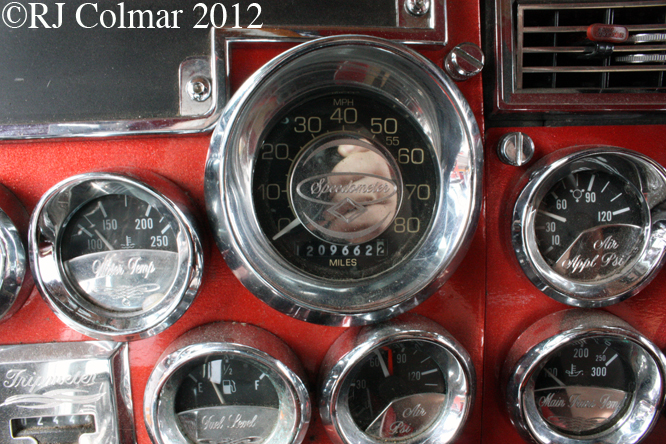
Peterbilt, 8 Seconds, Summer Classics, Easter Compton

I have never sat in a Peterbilt before, nor a TV star nor a vehicle that has 1,000,000 miles, I ticked all those boxes on Saturday when I climbed into the cab of Straight 8 a 1993 Peterbilt which was featured in Trick My Truck in January 2007. As can be seen the truck has over 1.2 million miles on the clock !
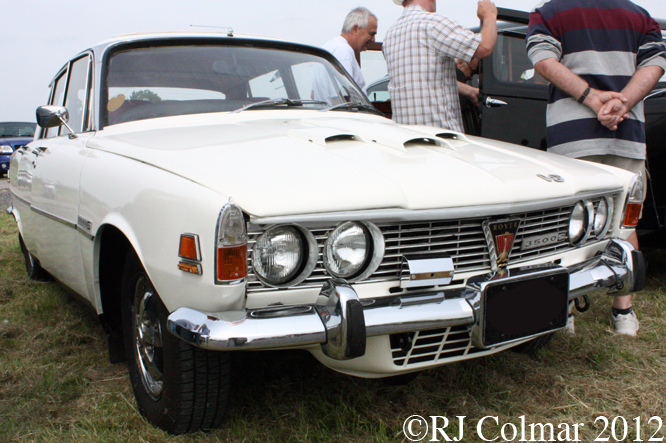
Rover 3500S, Summer Classics, Easter Compton

The Rover 3500S came in two different forms for the UK Market S stood for Synchromesh as used in the four speed manual gearbox while in the US Market all Rover 3500 S models were automatics. Looking at the dash this is clearly a right hand drive vehicle, unfortunately I did not notice if the car was a converted LHD automatic or a UK supplied manual making use of the Rover parts bin with a US spec front number plate mounting, ice warning device seen to the left of the number plate and US spec bonnet with three air intakes. The wipers would suggest this is a UK spec car with some US spec goodies.
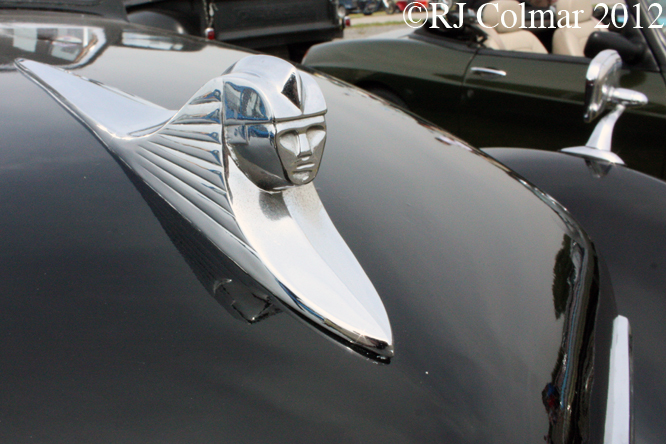
Armstrong Siddeley Whitley, Summer Classics, Easter Compton

Unlike Bristol Cars which refrained from using the names of Bristol Aeroplanes, it’s parent organisation, for it’s vehicles until 1975 Armstrong Siddeley used the names of it’s parent companies WW2 aircraft, including Hurricane and Lancaster upon the the resumption of vehicle manufacture in 1945. The Sphinx mascot is seen above on a 1953 Armstrong Siddeley Whitley which takes it’s name from a twin engined bomber that is named after a suburb of Coventry where Armstrong Siddeley’s were built.
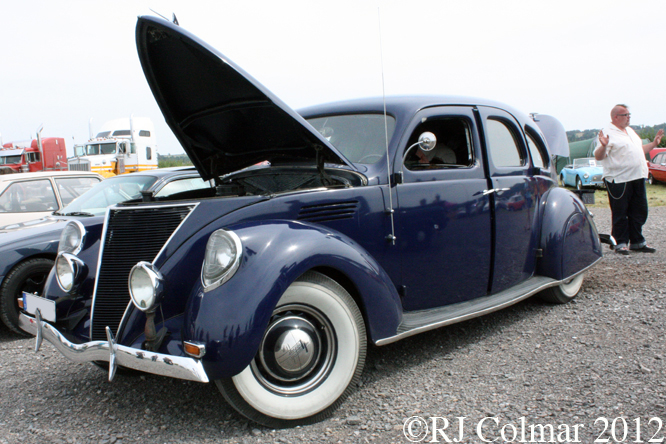
Lincoln Zephyr, Summer Classics, Easter Compton

My personal vote for car of the show goes to this 1936 Lincoln Zephyr. This V12 was occupied by a family of four with an outsize classic TV and was making it’s way on a 1600 plus mile holiday journey from Dresden, Germany at an eye watering 21 mpg imperial / 18 mpg US !
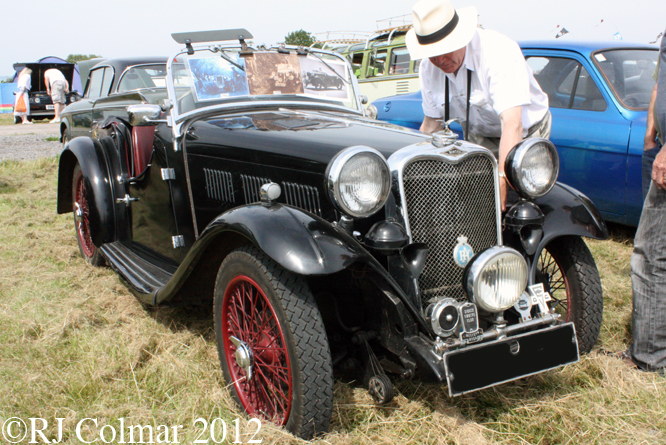
Singer Le Mans, Summer Classics, Easter Compton

Among many storied cars at the Summer Classics Show on Saturday was this Singer Le Mans built in December 1935 it took part in the 1936 Exeter Trials with HD Acres at the wheel as can be seen on this link. By 1939 the Singer had acquired the large centre fog light and was in the hands of RJW Appleton who used it to compete in the Lands End Trial. The present owner spent many years rebuilding the Singer after acquiring a big box of ‘bits’.
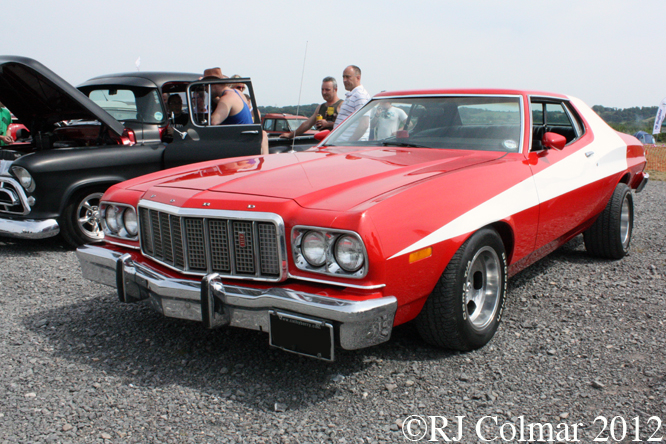
Ford Torino, Summer Classics, Easter Compton

The “striped tomato” 1974 Ford Gran Torino seeen above is one of the first six built in 1973, for the ’74 model year. It was picked up by it’s current owner in San Francisco with a straight body and has been slowly restored since with well over £6k in suspension parts alone. By all accounts Paul “Michael” Glaser took an instant disliking to the car with which he will be forever associated as Starsky from the Starsky & Hutch TV series. He thought the car looked like a ridiculous ride for a supposed undercover cop and referred to it as striped tomato both in private and later in scripts for the show.
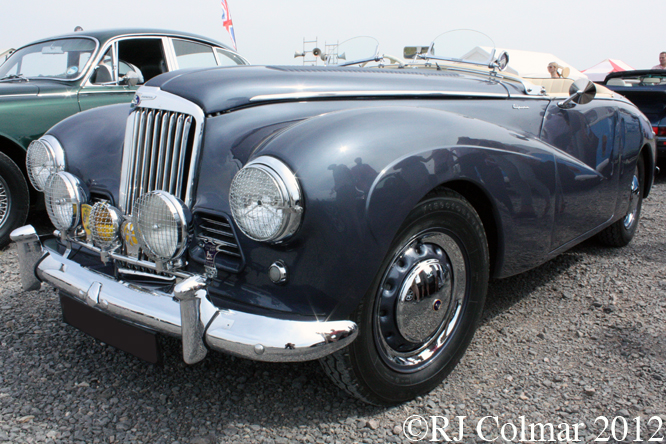
Sunbeam Alpine, Summer Classics, Easter Compton

Fresh paintwork and equally fresh cream leather interior suggest this 1953 Sunbeam Alpine Mk I has been recently restored, love the way the Brooklands Aero screens sets the look of this car apart from it’s 1.582 siblings that were built from 1953 to 1955.
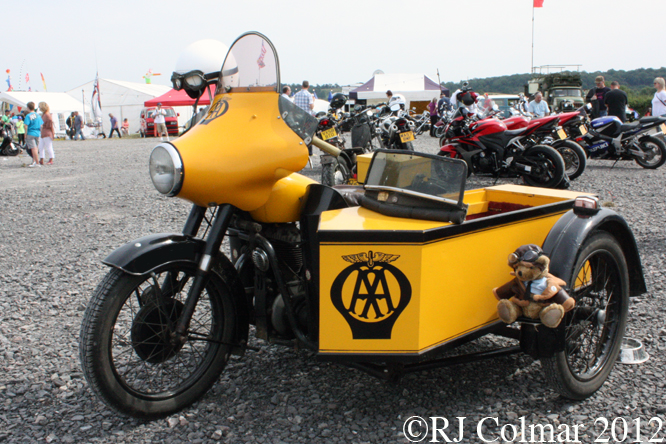
BSA Combination, Summer Classics, Easter Compton

BSA first built the 591cc / 36 cui M21 in 1937, with production lasting until 1963 ! Used by the armed forces and in large numbers with combination sidecars, as seen with the 1951 model above, by the Automobile Association (AA) as roadside assistance units.

Thanks for joining me on this “Summer Classics” edition of “Gettin’ a li’l psycho on tyres” I hope you will join me again tomorrow. Don’t forget to come back now !

Share

World Wide Racing – Lotus 56B R1

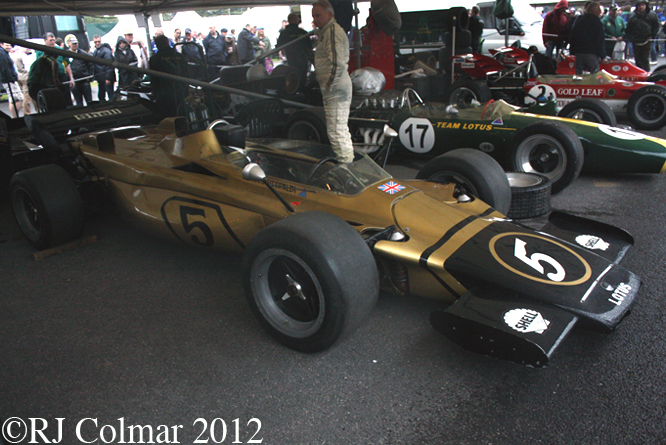
The Lotus 56B is the Formula One version of the “Son of Silent Sam” Lotus 56 Indy challenger that came within a couple of laps of winning the 1968 Indianapolis 500 with Joe Leonard at the wheel.

Lotus 56B, Goodwood Festival of Speed

This Formula One version of the Lotus 56 was a fresh chassis built with additional fuel capacity, it was unusual to make scheduled pits stops of fuel back during Grand Prix races in the 1970’s, and with additional wings front and rear to aid the considerable traction and handling advantages of the the all wheel drive transmission.

Just as at Indianapolis in 1968 the Pratt and Whitney STN6/76 had to be considerably detuned to meet the regulations which tried to keep it competitive with the 3 liter / 183 cui piston motors in use at the time.

56B R1 had four non-championship outings before taking part in three Grand Prix. The upshot was that the car was the class of the field in wet conditions, where it’s weight disadvantage was minimised but it struggled to make the top half of the grid in dry conditions.

Three drivers were given a shot in the car, Emerson Fittipaldi, Reine Wisell, and Dave Walker. Fittipaldi managed the cars only finish at the 1971 Italian Grand Prix where he qualified a lowly 18th on the grid and came home 8th well ahead of expectations for the car which was never to be seen in a Grand Prix again.

Regular followers of GALPOT maybe wondering why the car is painted Gold and Black instead of the by now traditional Red, White & Gold of the Gold Leaf Team Lotus.

In 1970 Jochen Rindt had been killed in an accident at Monza driving a Gold Leaf Team Lotus 72. Fearing legal repercussions from the notoriously slow and fickle Italian authorities investigating Rindt’s accident Colin Chapman took steps to avoid encumbrance or at worst arrest by opting to keep a low profile by entering just the one car in place of the usual two in the 1971 Italian Grand Prix.

To further keep the Italian authorities off his trail he entered the Lotus 56B under the World Wide Racing banner and had the car painted in Gold and Black, weather this was to obscurely promote the John Player Special brand which was owned by the same, Imperial, tobacco company as Gold Leaf remains unclear, though in 1972 Imperial switched the brand being promoted by Lotus to John Player Special whose black and gold colours are echoed on the current incarnation of Lotus on the Grand Prix grid.

Thanks for joining me on this “World Wide Racing” edition of “Gettin’ a li’l psycho on tyres” I hope you will join me again tomorrow. Don’t forget to come back now !
Share