Tag Archives: GALPOT

High End Half Ton – Dodge Ram 1500 Laramie

Ever since my Dad took me to see Vanishing Point way back in the day I have always paid attention when the name “Dodge” crops up, today’s vehicle is a tad more practical than the white Challenger driven by the ‘Soul Hero’ being chased by the ‘blue blue meanies on wheels’ on ‘the maximum trip at maximum speed’, though this 2005 pick up does have something in common with the 1970 Challenger beyond the manufacturers name.

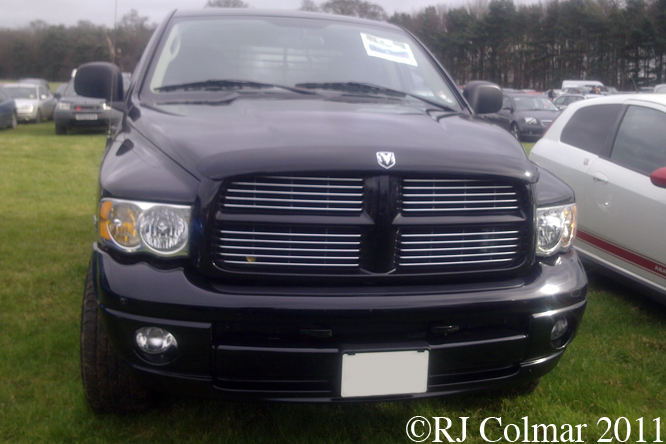
Dodge Laramie,

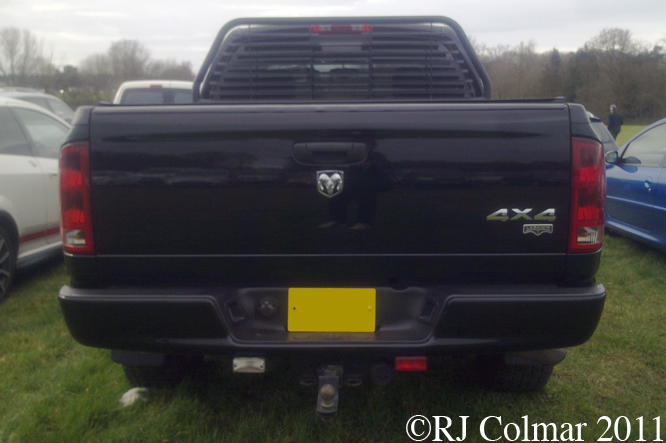
The Dodge Ram name first appeared on a trucks in 1981 with a revamped version of Dodge D Series pickups, since then there have been three further generations of the Ram that appeared in 1994, 2002 and 2009, this is a preface lift 3rd generation Ram 1500 from 2005.

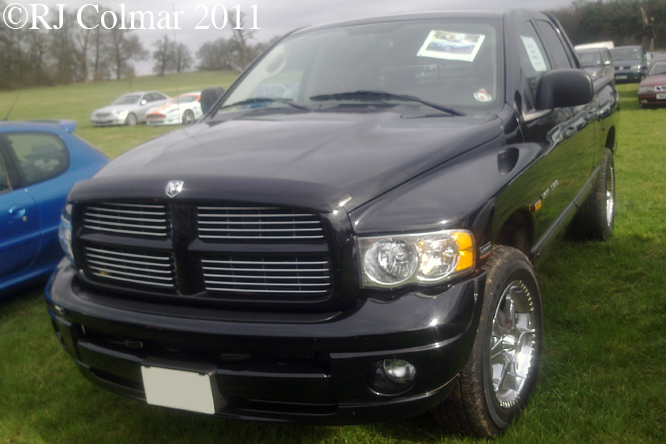
Dodge Laramie,

The built in to the front bumper fog lights are a give away that this might be a ‘fully loaded’…

Dodge Laramie,

… a suspicion underlined by the alloy wheels, not some thing I would expect to find on a four wheel drive work horse …

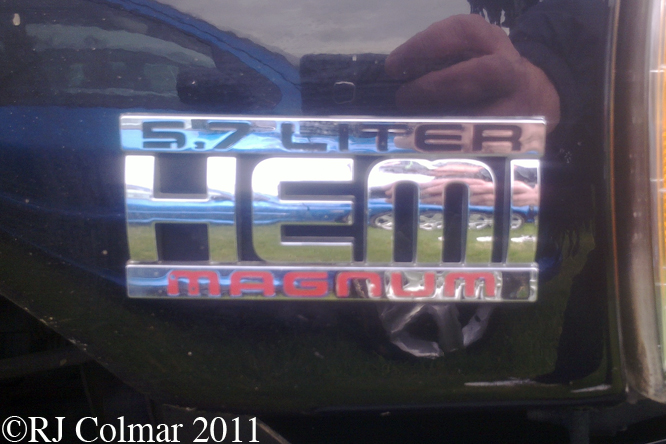
Dodge Laramie,

anymore than I would a 345 hp 5.7 liter / 345 cui Hemi V8, a name I’d more commonly associate with the white Challenger in Vanishing Point, in fact today’s HEMI’s are very different from those installed in the 1950’s, 60’s and 70’s the cylinder heads are now less than hemispherical and today’s HEMI’s feature Multi Displacement System technology which allow’s two cylinders on each bank of four cylinders to be switched off under light loads to improve fuel economy.

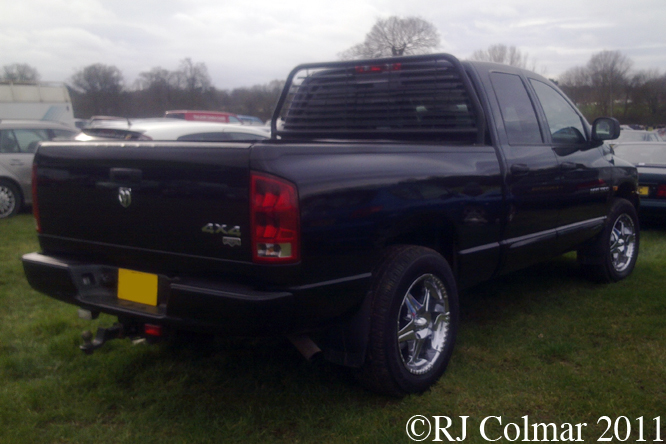
Dodge Laramie,

The suspension on this half ton pick up is classic independent coil springs at the front and live rear axle mounted on longitudinal leaf springs.

Dodge Laramie,

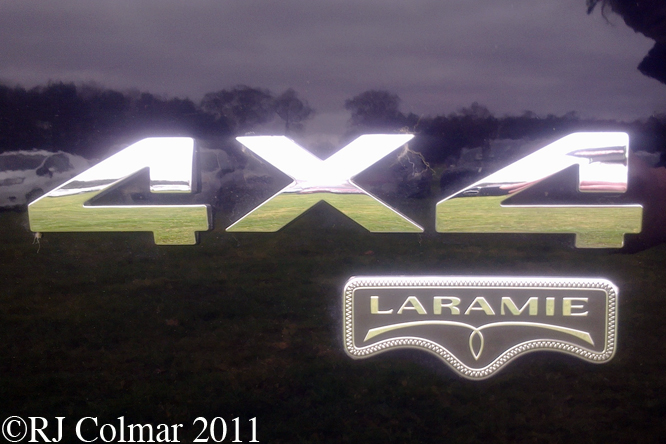
I have to admit that when I saw this truck last year I assumed it had been imported from some where west of Cheyenne Wyoming but it turns out that Larimie is the name given to fully loaded Luxury Spec Doge Ram trucks…

Dodge Laramie,

which are supplied with woodgrain dash and door trim, leather seats, chrome clad wheels, leather seats, autodimming center rear view mirror, Homelink garage door opener, steering wheel mounted audio control and around $5k worth of useful stuff that is not commonly available on the SLT spec Dodge Rams.

My thanks to Dodge Dealership manager James R for his help with today’s blog.

Thanks for joining me on this ‘High End Half Ton’ edition of ‘Gettin’ a li’l psycho on tyres’. I hope you will join me again tomorrow. Don’t forget to come back now !

Share

Tuning Options – Lotus 26R #26-R-20

The Lotus 26, designed by Ron Hickman of Black and Decker Workmate fame, was first shown to the public in October 1962 with the more familiar Elan name. The Elan was Lotus second attempt at making a primarily road vehicle after the all fiberglass unitary bodied Elite, which had proved too expensive for Lotus to manufacture and make a financial return.

Unlike the unitary bodied Elite the Elan’s fiberglass body was mounted on a ‘steel backbone chassis’ a variation on an idea which can be traced back at least to Rover in 1903 and was subsequently examined and or used by among others Morgan (1910), Tatra (1923) who still use the idea on their contemporary heavy military vehicles, Joseph Ganze’s Adler MaiKaefër (1931), Porsche Type 12 (1931) that with Tatra patents and under Ganzes influence became the VW Type 1 (1938), Skoda 420 Popular (1934), Mercedes Benz 170V (1935) and 170 H (1936), MG R-Type (1935), the Polish PZInz 403 Lux-Sport (1937), Clisby Special (1952), fiberglass bodied TVR MK1 / Grantura (1958), Alpine A108 (1959) that evolved into the fiberglass bodied Alpine A110 (1961) and Triumph Herald (1959), a design which was used to form the basic Vitesse (1962), Spitfire (1962) and GT6 (1966) backbone chassis.

Mounted in the, fabricated from sheet steel, back bone chassis was a 1558cc / 96 cui 4 cylinder iron block aluminium head Lotus Twin cam engine, which was matched with independent suspension and disc brakes on all for wheels. The Elan was sold with either soft or removable hard tops. Soon after becoming available racing teams turned their attentions to preparing the nimble Elan for racing with the likes of Lotus works driver Jim Clark, Graham Hill and Jackie Stewart all competing in privately entered Lotus Elan’s.

Lotus 26R

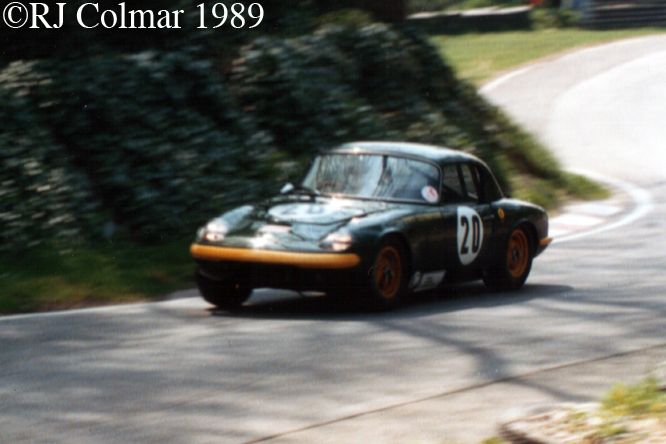
For 1964 Colin Chapman incorporated many of the ideas learned from the Elan privateers into the 26R built specially for racing, such as the example of Tony Thompson seen at Cadwell Park back in 1989 above, of which 97 were built in 2 distinct series between 1964 and 1966.

The hard top roadster only 26R was around 200lbs lighter that the original Elan, had revised suspension and could be ordered with either Cosworth or BRM tuning package for the Lotus Twin Cam motor, whose 116E block can be traced back to the Ford Consul Capri. Legend has it that the best tuning option was the Cosworth block matched with a BRM head, though I cannot rationalize why this might be the case nor have I substantiated this, if you know please do not hesitate to chime in below.

John Miles is credited with being the most successful 26R driver ‘in period’ clocking up 15 wins for the Willment team to secure the 1966 Autosport Championship. It is thought that 97 26R’s were built and supplied either complete or in tax saving kit form between 1964 and 1966.

Race preparation expert and Lotus aficionado Tony Thompson was in the middle of forth and final HSCC Classic & Sports Car championship wining season when I took these photo’s at Cadwell Park where he dominated the race. Tony possibly lays claim to being the most successful R26 exponent in historic events having used this same #26-R-20 chassis to win the HSCC championship from ’85-’87 and finished runner up in ’88/’90/’91 and 1993 before turning his attentions to racing a Formula Junior Lotus 27 in which he won the FIA Formula Junior championships 1996 to 1998 inclusive !

Thanks to Ray Bell, Pete Taylor, Tim Murray, Steve Holter, Roger Lund, David McKinney, willga, AAGR, David Birchall, JtP1, cheapracer, Greg Mackie, Geoff Butcher, Lee Nicole, johnny yuma, Catlina Park, 312f1, and Karl Ludwigsen who kindly responses to the ‘Backbone’ thread at The Nostalgia Forum and helped identify some of the vehicles with backbone chassis prior to the advent of the Elan.

Further thanks to David Birchall, Edward Fitzgerald, Pete Taylor and ‘the Oracle’ for identifying Tony’s chassis number and clearing up a few other aspects of Elan identification.

Thanks on this ‘Tuning Options’ edition of ‘Gettin’ a li’l psycho on tyres’, I hope you will join me again tomorrow when I’ll be looking at a unique Bristol. Don’t forget to come back now !

Share

Stewart’s Nemesis – Ferrari 312 B2 #007

In 1970 Ferrari launched the first in a long line of Grand Prix cars powered by flat 12 motors that would eventually power Niki Lauda to World Championships in 1975 and ’77 and Jody Scheckter to a Championship in 1979.

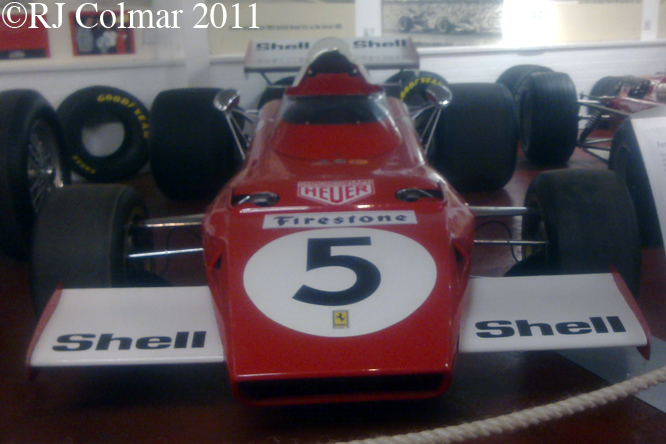
Ferrari 312 B2, Donnington Museum

The initial incarnation of the flat 12 powered Ferrari Grand Prix challenger was known as the Ferrari 312 B, B for boxer although the motor is actually a 180 degree V12 design ie the crank pins operate pairs of pistons rather than individual pistons as on a true boxer motor. The 312 B in the hands of Jacky Ickx and Clay Regazzoni scored 4 championship Grand Prix wins at the end of 1970 in the absence of Jochen Rindt who would be declared the World Champion posthumously.

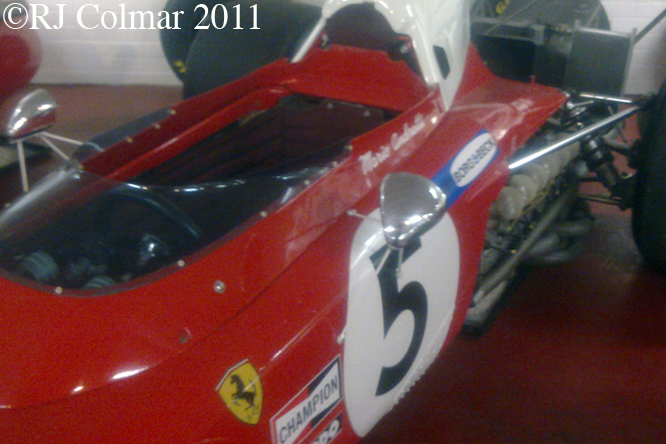
Ferrari 312 B2, Donnington Museum

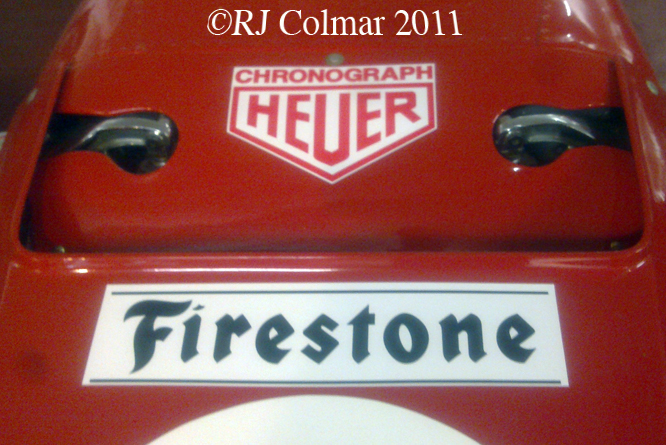
For 1971 Mario Andretti joined Ickx and Regazzoni and won the South African GP in a 312B and a non championship race at Ontario before the team introduced the 312 B2 of the type seen here at the Donnington Park Museum. The new car showed some initial promise with Ickx winning the Dutch Grand Prix second time out in part thanks to the superiority of the Firestone wet weather tyres but there after the B2’s suffered appalling reliability with Ickx and Regazzoni and Andretti scoring points on just 4 occasions from 15 further starts between them in the remaining 1971 season.

Ferrari 312 B2, Donnington Museum

Things did not improve much in 1972 when Lotus and Tyrrell’s now joined by McLaren’s superior reliability left only scraps on the table for forth placed Ferrari who’s highlight of the year was a one two finish at the Nurburgring for Ickx and Regazzoni after Regazzoni was involved in contact with Jackie Stewart’s Tyrrell that all but ended the Scotsman’s 1972 World Championship challenge.

Ferrari 312 B2, Donnington Museum

For 1973 Ferrari would have it’s first ever monocoque chassis, built in England, prepared in the guise of the 312 B3 for what would be an even more disastrous season than 1972, but for the first three races of the season the old B2 wheeled out and driven by Ickx and Arturo Mezario the B2 scored 11 of the teams 12 points that saw Ferrari plummet to 6th in the constructors championship.

This particular chassis appears to be #007, the four B2 chassis numbers carried on where the B finished off and so were numbered 005 to 008. Andretti drove this car to 4th place finishes in Germany ’71 and South Africa ’72 and Clay Regazzoni drove the car at the ’72 German Grand Prix to the 2nd place finish that all but ended  Stewart’s championship run in the process.

My thanks to galbet and Sire Bruno de Losckley at Ferrari Chat for helping to sort out which car this is.

Thanks for joining me on ‘Stewart’s Nemesis’ edition of ‘Gettin’ a li’l psycho on tyres’, I hope you will join me again tomorrow. Don’t forget to come back now !

Share

Beneath The Paint – Ford Capri 3000 GXL Auto

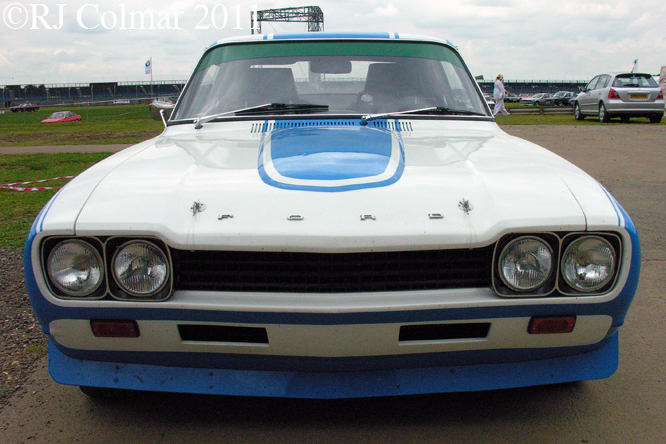
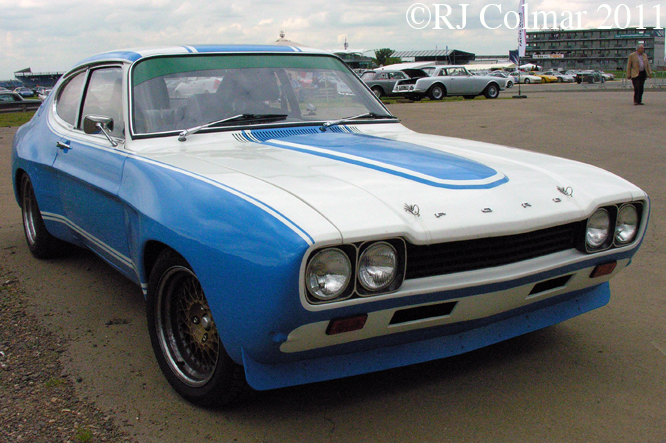
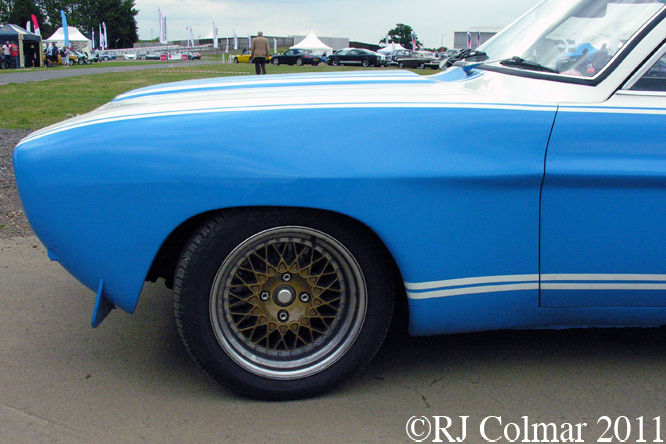
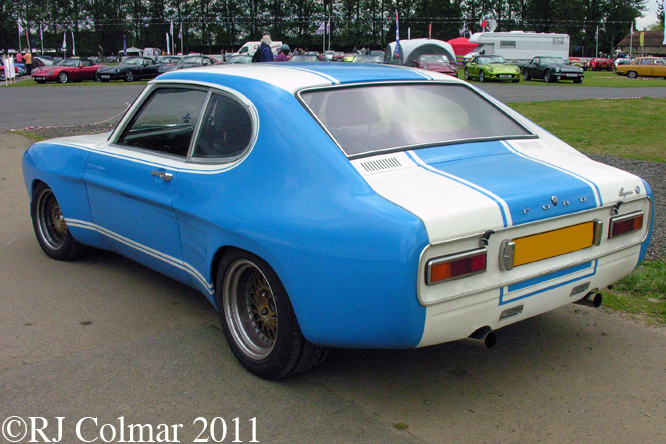
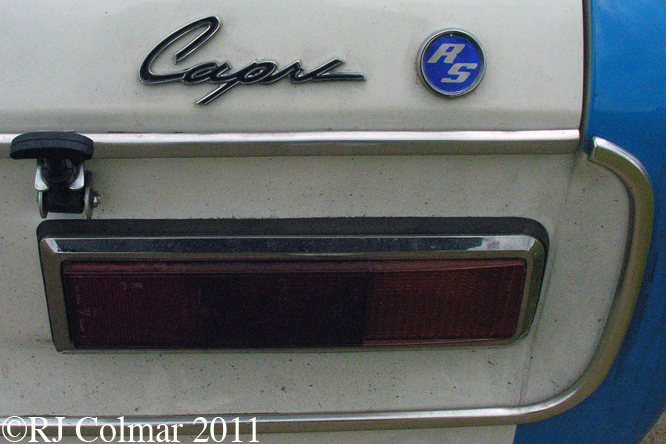
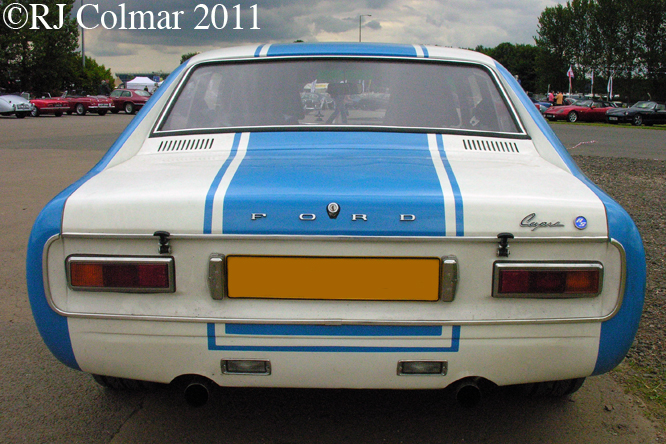
My heart skipped a beat when I saw this fabulous Ford Capri wearing the colours of the early 1970’s works Ford ‘Cologne’ factory racing team, the last time I recall seeing a road going Capri like this in the flesh was around 1974 !

Ford Capri 3000 GLX, Silverstone Classic

In 1970 Ford Germany built 50 RS2600 variants of the Capri to satisfy the FIA minimum build racing requirements (also known as homologation), the flared arches on the vehicle seen here at last years Silverstone Classic suggest that this might be on of those fifty specials who’s build quality was so low that they were not fit to be sold for road use.

Ford Capri 3000 GLX, Silverstone Classic

The fifty homologation RS2600’s featured light weight glass fiber doors, boot and bonnet/hood.

Ford Capri 3000 GLX, Silverstone Classic

Beneath the flared arches the RS 2600’s were fitted with distinctive gold centered BBS wheels, which became as iconic and synonymous with the 1970’s as Minilites had with the 1960’s.

Ford Capri 3000 GLX, Silverstone Classic

The homologation RS 2600’s were also fitted with plastic window’s and painted with fewer coats of paint than their road going siblings all in an effort to save weight.

Ford Capri 3000 GLX, Silverstone Classic

Success came to the works Ford Team managed by Jochen Neerpasch in the form of two European Touring Car Championships for Germans Dieter Glemser in 1971 and Jochen Mass in 1972, although on both occasions Alfa Romeo’s running in the lower Class 2 division secured the manufacturers championships.

Ford Capri 3000 GLX, Silverstone Classic

Unfortunately despite the paintwork this car does not turn out to be one of the homologation specials at all, they were all left hand drive vehicles, a check of the registration reveals this car started out as a Dagenham (UK) built Capri 3000 GLX Auto in 1972 fitted with a 3 litre / 183 cui ‘Essex’ V6, registration details also suggest that this car is now fitted with a 3.5 litre motor which is probably one of the Buick derived Rover aluminium V8’s which are the most readily available for such conversions in the UK.

Thanks for joining me on this ‘Beneath The Paint’ edition of ‘Gettin’ a li’l psycho on tyres’ I hope you will join me again tomorrow when I’ll be going Auburn. Don’t forget to come back now !

Share

Quintessential British Sports Car – MG J2

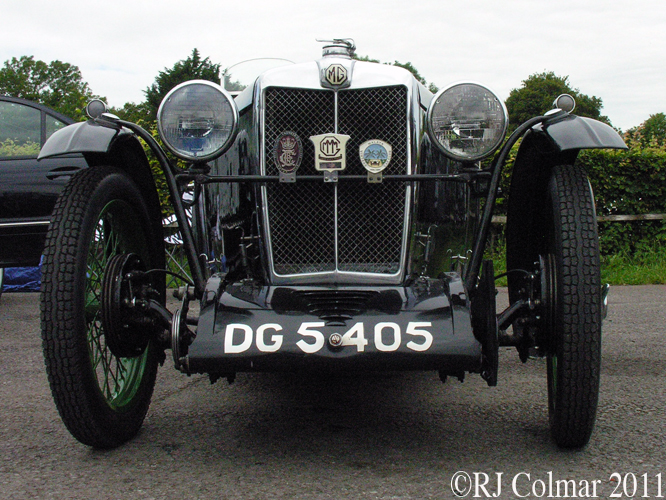
The MG J series produced from 1932 to 1934 came in 4 distinct models the J1 a 2 door 4 seat open or closed sports car with a 847 cc / 51 cui motor, J2 a two seater open only version, as seen in todays blog, of the J1, J3 similar to a J3 but with a 750 cc / 45 cui supercharged motor and the J4 a pure racing version of the J3 with a 72 hp supercharged motor.

MG J2, Castle Combe, Wessex Sprint

The 1932 J2 is easily distinguishable by the front cycle style mud guards which in 1933 were replaced with front mudguards joined by running boards to the rear wings a feature that was to remain with all subsequent MG sports cars all the way through to the TF model which was manufactured until 1955.

MG J2, Castle Combe, Wessex Sprint

The 36 hp motor, was similar to that used in the earlier M-Type looked at last week, featuring a cross flow cylinder head and twin SU carburetors but only a two bearing crankshaft which had a limited life at maximum rpm. The Castrol GTX oil breather catch tank is a relatively recent requirement for competition.

MG J2, Castle Combe, Wessex Sprint

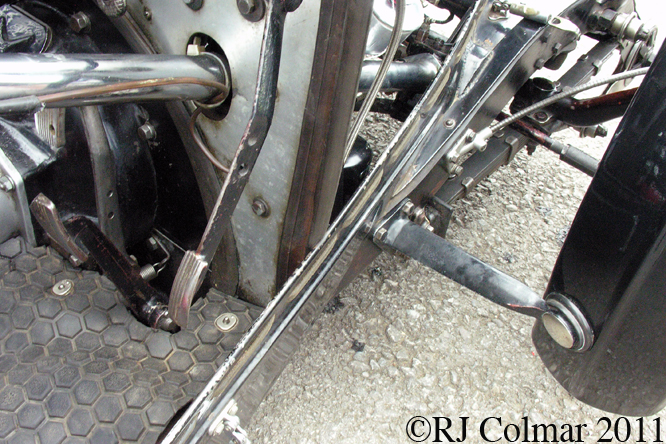
Lifting the side opening bonnet panels of the J2 reveals the four speed gearbox and foot wells. The steering column operates Marles steering gear and the drivers side front brake cable can be seen emerging from the chassis rail above.

MG J2, Castle Combe, Wessex Sprint

The two humped dash scuttle of the J Series would turn out to be another trade mark MG feature that was continually carried forward over twenty years to the 1955 MG TF. Note the how the potential crankshaft saving engine revolution counter dominates the dash board instrumentation.

MG J2, Castle Combe, Wessex Sprint

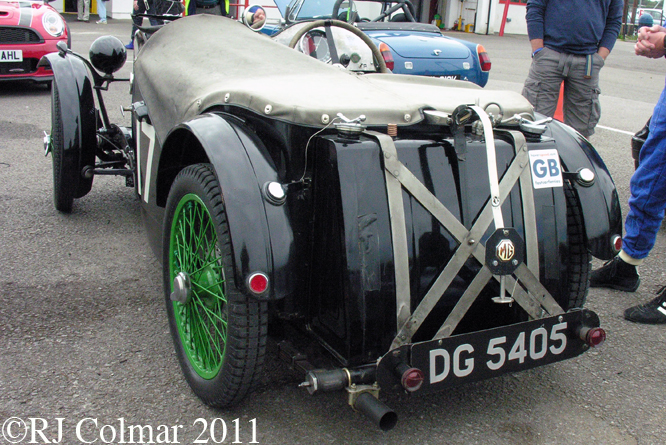
Just over 2000 J2’s were built out numbering the combined total of all the other J series MG’s by more than 2 to 1, this particular example, seen at last years Wessex Sprint, was acquired by Mike Hawke for £85 in October 1953, the car cost just short of £200 new in 1932.

Mike is known to have campaigned this car successfully at both Castle Combe and Silverstone before passing the car on to his son Jeremy who won his class at Castle Combe on the day these photo’s were taken.

Thanks for joining me on this Quintessential British Sports Car edition of ‘Gettin’ a lil psycho on tyres’ I hope you will join me tomorrow when I’ll be featuring a hot version of “The car you always promised yourself. Don’t forget to come back now !

Share

Torino Transformation – SIATA 400F

It would appear that the SIATA 400F is a Coupé version of the SIATA 208S which Steve McQueen referred to as his ‘little Ferrari.

SIATA 400F, Goodwood F o S

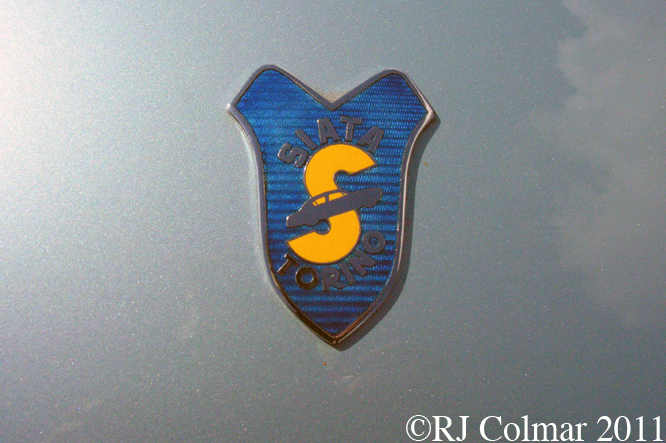
SIATA, Societa Italiana Auto Trasformazioni Accessori, an automotive accessory company was founded in 1926 by Giorgio Ambrosini an amateur racing driver to make and sell performance parts for vehicles manufactured by FIAT.

SIATA 400F, Goodwood F o S

After the Second World War SIATA started manufacturing vehicles with first FIAT 500 cc / 30 cui and then with larger American Crosley Motors.

SIATA 400F, Goodwood F o S

From 1953 to 1955 SIATA manufactured around 35 208’s sports cars and no more than ten 400 F Coupés, of the type seen here at Goodwood Festival of Speed, all powered by Dante Giacosa designed 2 litre / 122 cui FIAT ‘8V’ motors.

SIATA 400F, Goodwood F o S

The chassis design is credited to be the work of Austrian Rudolf Hruska who’s cv includes working on a huge variety of vehicles from the original Beetle, Tiger tank Simca 1000, FIAT 124/128 and a variety of ALFA Romeo’s including the ALFA Sud.

SIATA 400F, Goodwood F o S

The Berlinetta Bodywork of the 400 F is credited to Giovanni Michelotti who was working for Farina at the time, with the body panels manufactured by Carrozzeria Balbo in Turin.

Thanks for joining me on this Torino Transformation edition of ‘Gettin a li’l psycho on tyres’ I hope you will join me again tomorrow when I’ll be announcing the winner of the Automobiliart GALPOT Seasonal Quiz and publishing the answers. Don’t forget to come back now !

Share

Monocoque Revolution – Lotus 25 #R4 & #R5

There are some ideas that have to wait until just the right time in order to have an impact, one such case in point is the idea of using a monocoque shell to build a racing car chassis / body rather than the oft used couple of helfty rails or beams welded together or a more intricate space frame built up of small tubes welded together with a body thrown over the top.

The idea of using a monocoque shell made of fabricated sheets of metal to build a racing car can be traced back to 1912 when Howard Blood built a prototype cyclecar called a Cornelian which in 1915 was prepared by the Chevrolet brothers Louis and Albert for an attempt at the Indy 500. The Cornelian reached 12th place before it’s 33hp Sterling motor dropped a valve causing retirement. Around 100 monocoque chassis Cornelian cyclecars are thought to have been built before production came to a halt.

In 1923 aviation pioneer Gabriel Voisin built a team of four extraordinarily underpowered monocoque racing cars to take part in the French Grand Prix at Tours, giving away over 15 mph in top speed just one car survived to finish fifth and last over 1 and a quarter hours behind the winner over the 496 mile race distance.
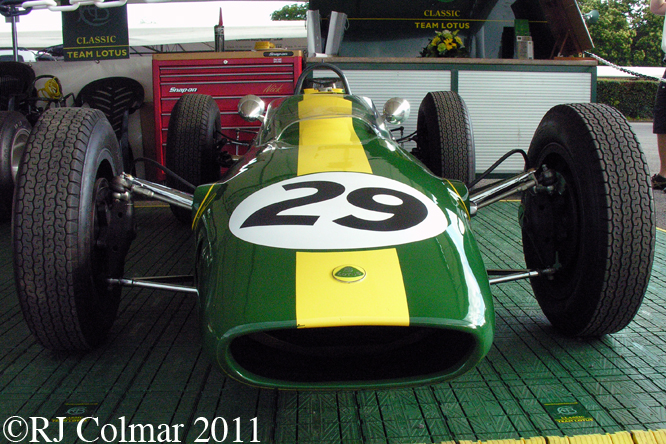
Lotus 25 R5, Goodwood FoS

Despite the success of the D-Type Jaguars at Le Mans in the mid 1950’s which featured a half monocoque design with the engine mounted on a sub frame it was not until 1962 that Colin Chapman revisited the monocoque idea for use in a Grand Prix Car and started to make the advantages of structural rigidity, thanks to the use of innovative steel bulkheads, weight saving and reduced frontal area work in the Lotus 25 design which shares identical suspension and running gear with the 1962 space frame Lotus 24.

The Lotus 25 chassis #R5 was one of seven such vehicles used for Grand Prix Racing from 1962 until models eventual swansong in 1967. The #R5 chassis was completed late in 1962 just in time for Jim Clark to attempt to clinch his first World Drivers title at the South African Grand Prix, unfortunately after starting from pole a tuppenny oil plug came lose and ended Jim’s race twenty laps early allowing Graham Hill to win both the race and the World Championship.

Jim used the car again in 1963 but Trevor Taylor was given #R5 to race at the second event of the season Belgian Grand Prix at Spa Francochamps. During practice for this event #R5’s suspension collapsed and the subsequent damage meant Trevor continued participating in the spare car #R3. Thanks to Roger, Rob of The Nostalgia Forum it has emerged that Trevor retired from the 1963 Belgian GP after 5 laps as the result of a severed thigh muscle.
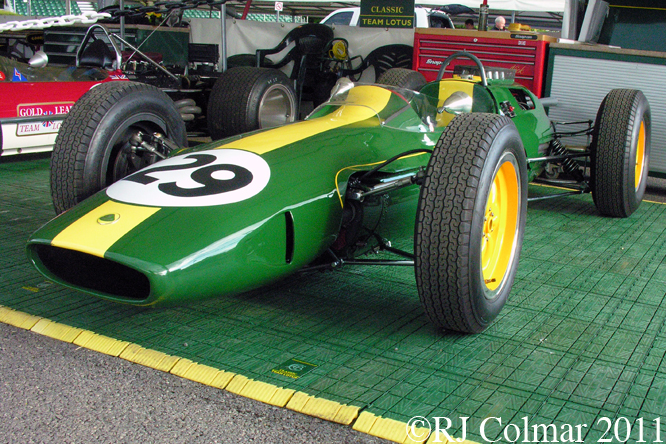
Chassis #R5 was taken back to the Team Lotus Factory and stripped down to the bear monocoque which was put aside awaiting recycling when Lotus mechanic Cedric Selzer was given permission to take the wrecked monocoque, along with some redundant parts, home.

Over the next twenty years Cedric collected enough parts including a correct Coventry Climax V8 engine to ‘recreate’ the written off #R5 in 1984.

With the full knowledge of the story of #R5 being in the public domain this rare vehicle sold for just short of a million US$ at auction in 2007.
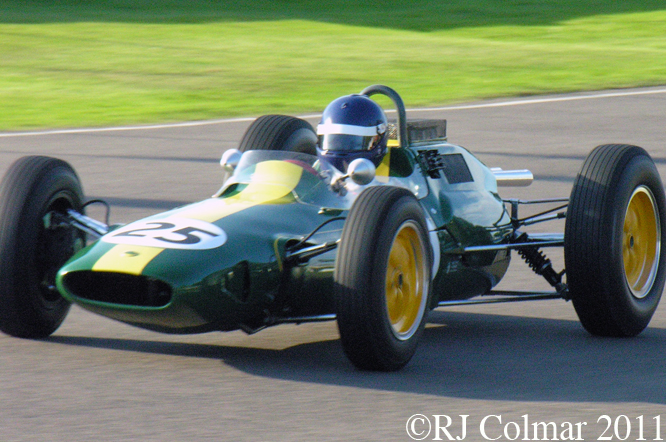
This second Lotus 25, chassis #R4 seen above with Andy Middlehurst at the wheel during the Goodwood Revival meeting has an even more amazing tail to tell, it is the remains of the very car which Jim Clark drove to a, for the period, record setting seven Grand Prix victories on his way to securing the 1963 World Drivers Championship and the World Manufacturers Championship for Lotus.

In 1964 #R4 was driven by Formula Junior sensation Peter Arundell who started his first full season in Grand Prix racing with two third place finishes in the opening two races at Monaco and Zandvoort (Holland) and came home 4th in the French Grand Prix which proved to be his last of the 1964 season thanks to an accident in an open wheel Formula 2 race which effectively ended Peter’s career although he did unsuccessfully return to the wheel in 1965.

#R4 was then sold to Reg Parnell who replaced the Coventry Climax V8 with a BRM V8 and then given first to South African Tony Maggs and then Richard Atwood to drive. Richard crashed the car in the Belgian Grand Prix after which the repaired chassis was given the #R13 chassis number by the Parnnel Team in what might be considered a slight of hand to make the car look like it had a later Lotus 33 type chassis number, the #R13 chasssis number having been passed over by Team Lotus. #R13 also acquired the nickname Percy at this time.

Innes Ireland and Bob Bondurant competed in one further race each with ‘Percy’ towards the end of 1965 and in 1966 Mike Spence took over the driving duties scoring 2 season best 5th place finishes in Percy which was now fitted with a larger BRM P60 V8 motor.

Piers Courage and Chris Irwin both took a championship Grand Prix start each in Percy during 1967 Chris recording a 7th place finish in the cars final Grand Prix in Holland.

Peter Yock became the owner of #R13 in 1968 and he raced the car in the Antipodes passing it on to fellow Kiwi Peter Hughes for 1970, Hughes replaced the by now damaged BRM V8 with a dry sumped V8 sourced from a Daimler and when that proved recalcitrant had a Twin Cam 4 cylinder Ford motor fitted.

#R13 then disappeared until Lotus aficionado John Dawson Damer tracked it down for his Lotus Collection in Australia, when John had the car restored it was discovered that #R13 was not a similar later Lotus 33 spec monocoque at all but that it still had all the identifying monocoque features associated with the Lotus 25 and in particular chassis #R4. Like Cedric John also acquired the correct Coventry Climax V8 type motor to restore #R4 to it’s original splendor and in 1997 #R4 returned to Gooodwood for the first time.

Again with all of the details of this car in the public domain this car sold at an Australian Auction for just short of a million US$ in 2008.

It’s a sobering thought that Jim Clark was entered to drive a Lotus 25 in 30 championship Grand Prix races, he won 14 of them, won one world championship (1963) and but for some cheap engine parts might have won two more (1962 & ’64). One thing was for sure, after the advent of the Lotus 25 the writing on the wall was written large that the days of the space frame racing car particularly in open wheel racing was effectively over.

Finally a well known resource states that Lotus driver Trevor Taylor is credited with ‘inventing’ the yellow stripe that ran the length of some Team Lotus racing cars from May 1963 until the Lotus sponsorship deal with Players Gold Leaf Tobacco came into effect in 1968. There is to the best of my knowledge no evidence to support this myth, it would appear the yellow stripe was first used on Jim Clark’s #92 Lotus 29 Indy Car in May 1963 and next appeared on his, and only his, Lotus 25 at the British Grand Prix in July 1963.

My thanks to Barry, Davids McKinie and Lawson, Vicuna, Roger and Rob at The Nostalgia Forum for their help dispelling the Trevor Taylor myth.

Thanks for joining me on this Monocoque Revolution edition of ‘Gettin’ a li’l psycho on tyres’, I hope you will join me again tomorrow. Don’t forget to come back now !

14/01/12 Amendment it has come to light thanks to Roger Clark that Trevor Taylor had his mishap with #R5 during practice for the Belgian GP at Spa not during the race as originally stated in the text above.
Share