Tag Archives: GALPOT

Get The Fire Brigade ! – Rolls Royce 40/50

Last in the present series of Sunday Rolls Royce blogs comes courtesy of photographs sent to me by Geoffrey Horton of a Rolls Royce 40/50 taken in a car park in California a couple of months ago.
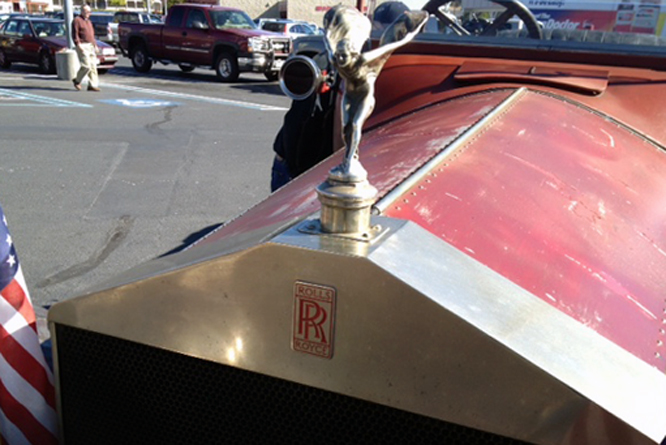
Rolls Royce 40/50, California

Recognising the make was of course relatively easy, a big clue to the model was the absence of any front wheel brakes which did not become ‘optional’ until 1923.
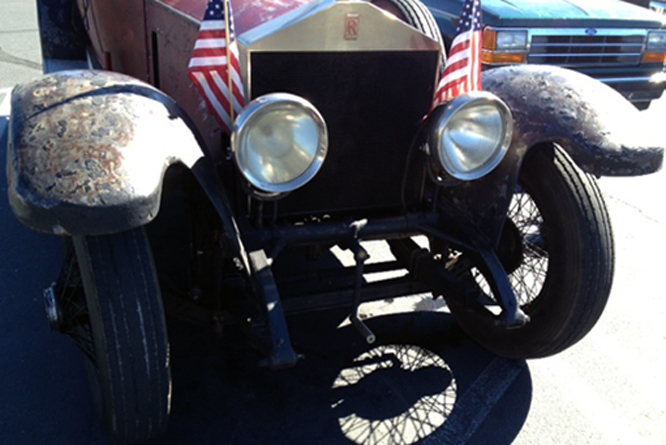
Rolls Royce 40/50, California

Allan Lupton at The Nostalgia Forum found out that the car was almost certainly built at the Derby Factory in the UK because these RAF wheel hubs were only used on a few early Springfield, Massachusetts built 40/50’s in 1921.
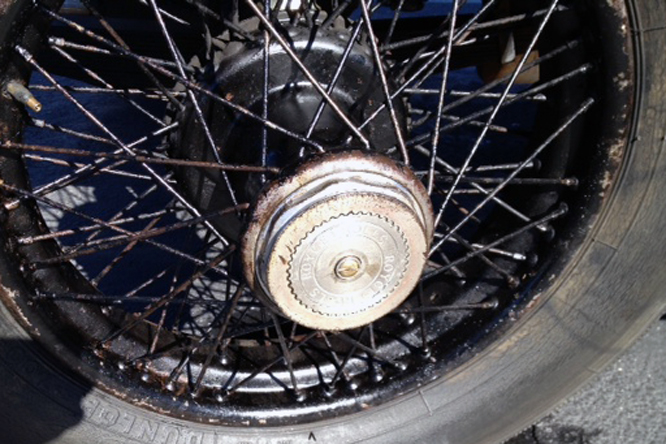
Rolls Royce 40/50, California

Not withstanding the cars general red colour there are several clues that this car has seen service as a fire engine…
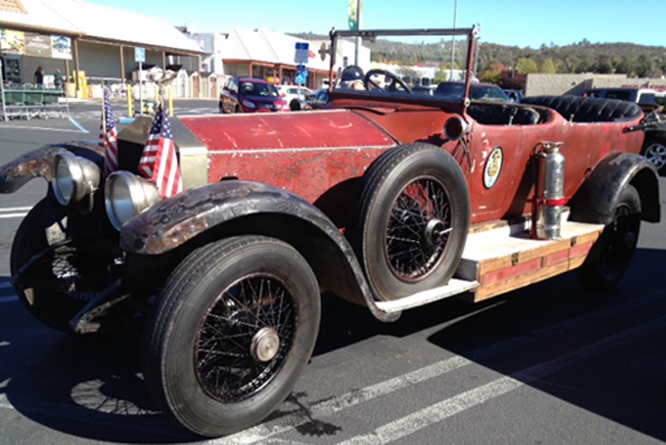
Rolls Royce 40/50, California

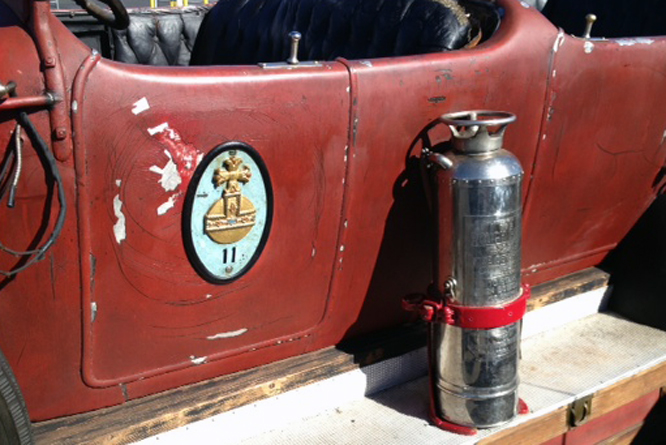
the fire extinguisher was a clue,

Rolls Royce 40/50, California

as was this insignia with what appears to be a fire station number on it.
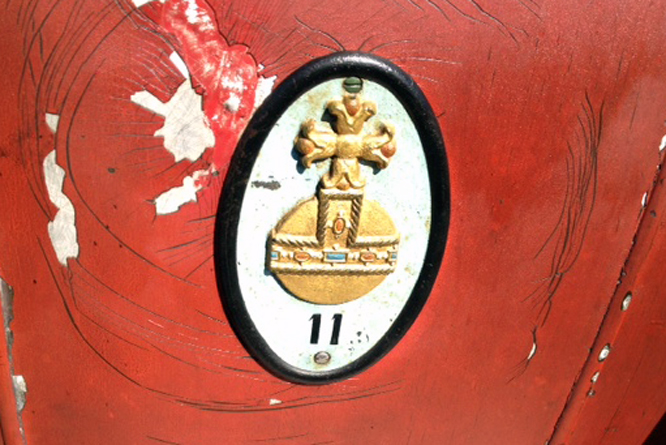
Rolls Royce 40/50, California

Sebastian Tombs of The Nostalgia Forum recognised the dash as being close to the original which again dated the car as early 1920’s.
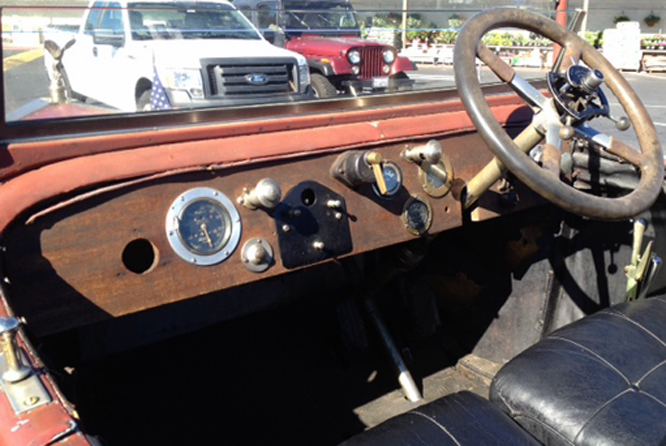
Rolls Royce 40/50, California

The biggest clue to the story of the car in it’s present condition lay in the rear number plate which Jonas at The Nostalgia Forum recognised as Swedish, the C denotes the car was registered in the Uppsala and Jonas found out the Rolls was registered there with the Uppsala Volunteer Fire Brigade on the 31st January 1935 having arrived in Stolkholm probably in 1934. Jonas then identified the insignia on the door as being that of Uppsala, the forth largest city in Sweden that lies 40 miles north of Stockholm.
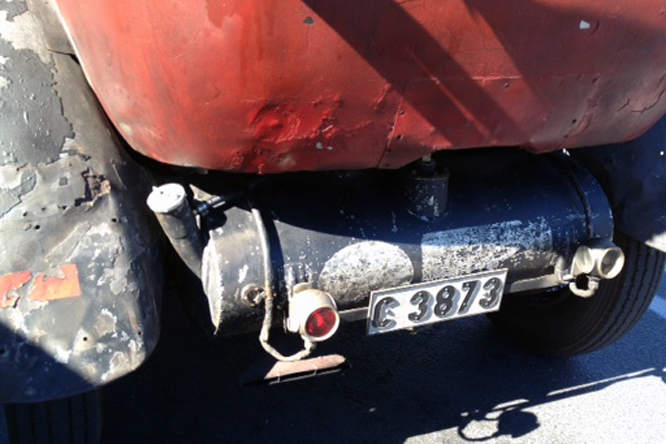
Rolls Royce 40/50, California

Enquires with the local Authorities in Uppsala the Historic Fire Association in Sweden led me to Urbin Duhrin who kindly revealed documentation showing that the Rolls Royce was converted into a Fire Engine by Wattholma who’s proprietor was one ex Fire Captain F W Kylberg who left the Stolkholm Fire Service in 1918 after receiving an injury and started a business converting large imported vehicles into fire engines.
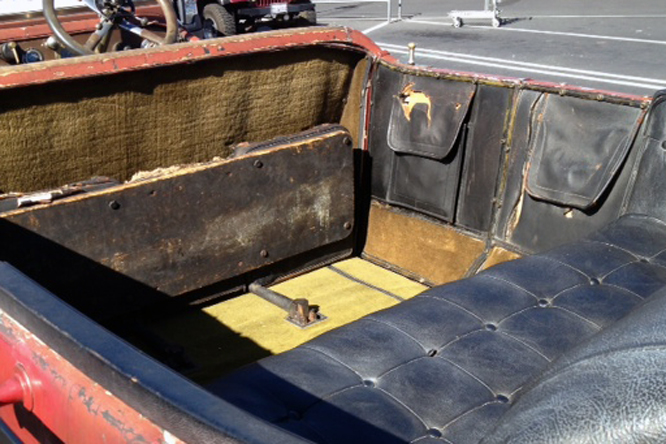
Rolls Royce 40/50, California

Christer Johanson back at The Nostalgia Forum then found an interesting legend relating to Fire Captain Kylberg and this Rolls Royce which as told by active Fire Chief Leif Lofgren translated from Swedish runs something like this, the Swedish Civil Fire defense was not very advanced in 1935 so in order to sell the converted Rolls Royce Fire Captain F W Kylberg allegedly organised some “targeted marketing” by waiting for the end of a meeting of Uppsala alderman which took place in a church. When the meeting showed signs of ending Kylberg lit a small straw fire and as the aldermen alighted from the building they were confronted by the fire and a short while later Kylberg emerged with his fire truck, which had been hidden nearby, to put out the fire, showing by example the usefulness of his fire truck and making a sale !

An example of how unsophisticated the Swedish Fire Defence services were as late as the 1950’s involves two more of Kylberg’s converted vehicles one a 1923 Cadillac the other a Chevrolet of “unknown vintage” after a fire drill at Nortrtälje the Chevrolet broke down and so had to be pushed bumper to bumper from behind back to base by the Cadillac to the rear of which was hitched the Chevrolet’s trailer mounted water pump.
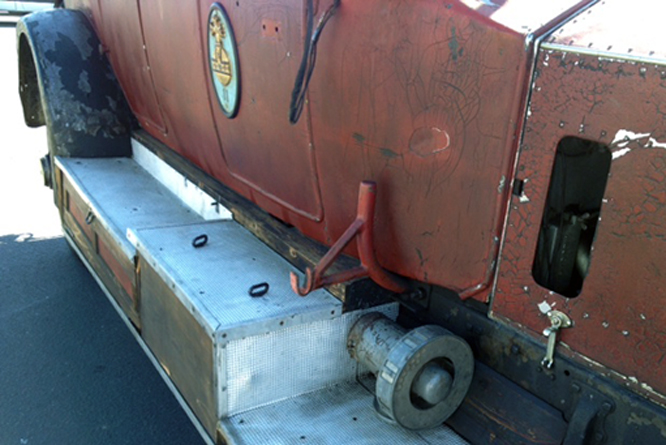
Rolls Royce 40/50, California

Jonas Fröjd tells me that today’s featured Royce remained in service with the Uppsala Fire Brigade until April 24 1944 and was then transferred to the Voluntary Fire Brigade at Vattholma, the same town where Frederick Kylberg had converted the vehicle from a passenger car to a fire engine in 1935. The car remained registered with the brigade at Vattholma until March 12th 1964 when ownership changed to the Swedish Nobleman Per Henrik Gustav von Essen in Friherre who appears to have taken it off the road and off the official records.

Thanks again to Allan Lupton I believe this car was built in 1921 originally with a Hooper body, I have made enquiries with two Rolls Royce owners clubs to see if they can put me in touch with the current owner and find out what happened to the originally Hooper bodied 40/50 between 1921 and 1934. As and when this information comes to light I’ll post a follow up blog.

My thanks to Geoffrey Horton for sharing his photographs, to Lola 5000, Jonas Fröjd, Allan Lupton, Vitesse2, Kayemod, Sebastian Tombs, Duncan Rollo, Tim Murray, David Birchall, Michael Ferner, LittleChris, 275 GTB-4, David McKinney, Micheal Hickey, Bloggsworth, MikeC, and Crister Johanson who all chipped in at The Nostalgia Forum, to Tobias Assiego Archivist at Uppsala kommun and Chief Fire Engineer Mats Sundelius at Uppsala Fire Defence who put me in touch with Urban Duhrin of www.brandhistoriska.se.

Apologies if some of the Swedish spelling is out, all corrections gladly accepted.

Thanks for joining me on this “Get The Fire Brigade !” edition of “Gettin’ a li’l psycho on tyres”, I hope you will join me again tomorrow for a 1000 mph ride into the future world land speed record book. Don’t forget to come back now !

Share

Celebrity Car – Ferrari 550 Maranello GTS

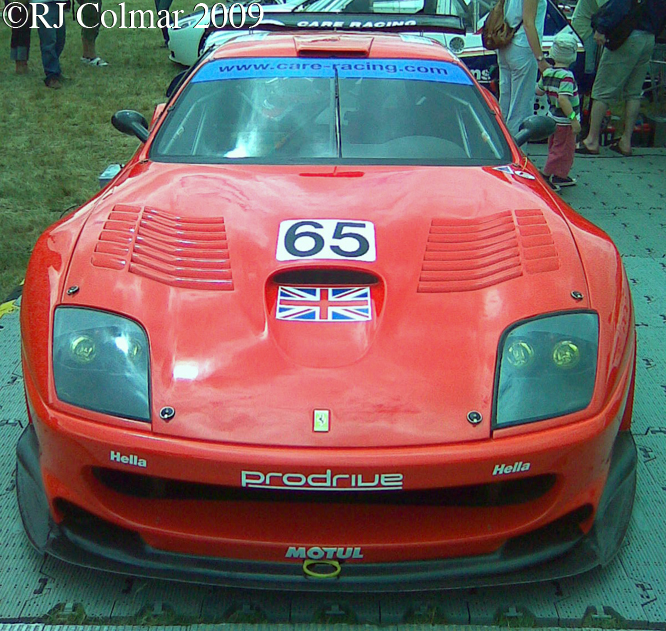
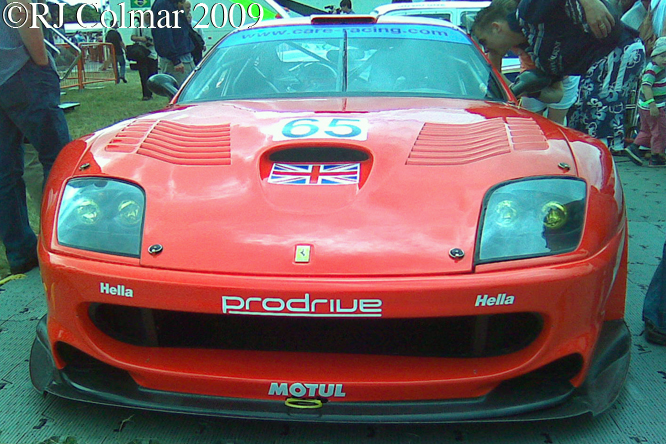
The 200 mph front engine rear gearbox 550 Maranello road model was introduced in 1996 with a 485 hp 5474 cc / 334 cui 4 valve quad cam V12 motor that could take the GT car from zero to 62 mph in 4.5 secs.

Ferrari 550 Maranello GTS, Goodwood Festival of Speed

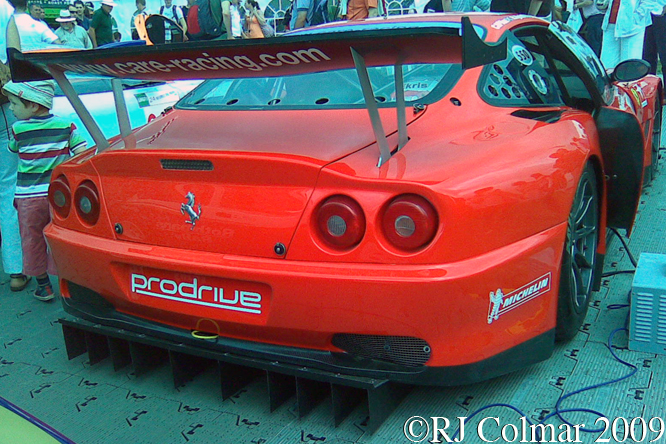
Prodrive prepared a batch of 20 550 Maranello GTS’s for racing in Europe and the States where they were regular winners in the GT/GTS class in 2001.

Ferrari 550 Maranello GTS, Goodwood Festival of Speed

In 2003 another Prodrive 550 Maranello GTS beat the Corvettes by 10 laps at the Le Mans 24 hour race coming home 10th overall.

Ferrari 550 Maranello GTS, Goodwood Festival of Speed

This chassis has taken part in at least 42 Races in the GT/GTS class for at least four different teams from 2002 to 2006 it has never recorded an out right win but has scored several class wins.

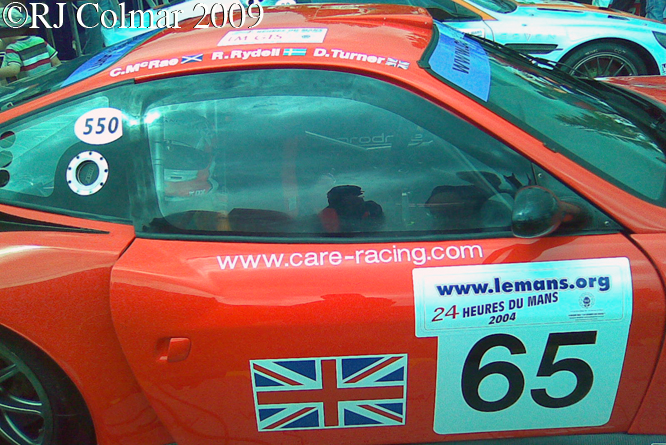
In 2004 this chassis (Prodrive 03) driven by Darren Turner, Rickard Rydell and Colin McRae came in 9th overall at Le Mans but was beaten by two Corvettes which finished 16 and 5 laps ahead respectively.

Ferrari 550 Maranello GTS, Goodwood Festival of Speed

Today’s featured Celebrity Car has been driven by a number of well known drivers including Colin McRae former World Rally Champion, Rickard Rydell former British Touring Car Champion, Alain Menu former British Touring Car Champion, Luc Alphand former World Cup Skiing Champion and Dakar winner, David Brabham, former Japanese GT Champion and Le Mans winner 2009, Jan Magnussen, former Danish Touring Car Champion, Danica Patrick queen of IRL and NASCAR, Darren Manning IRL driver, Christophe Bouchut 1993 Le Mans Winner, and one of my former racing instructors Tim Sugden former British and Asia Pacific GT Champion.

Thanks for joining me on today’s “Celebrity Car” edition of “Gettin’ a li’l psycho on tyres”, I hope you will join me again tomorrow, when I’ll be looking at a Formula One Lotus. Don’t forget to come back now !
Share

Heavy Weight Luxury – Ford Mustang Hardtop

Within three years of it’s introduction sales of Ford’s “secretarial” pony car the Mustang had peaked at over 600,000 units per year and there after they fell sharply to level out at the 120,000 annual sales level.

Ford Mustang Hardtop, Bristol

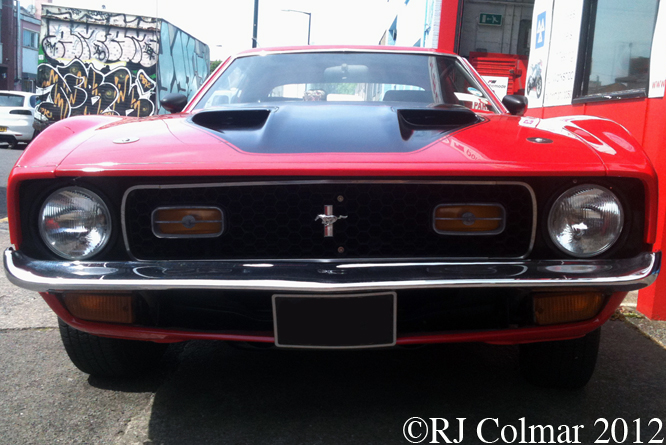
For 1971 the Mustang grew in every dimension except height and gained 800 lbs, under the watchful eye Ford Design Product Manager Semon “Bunkie” Knudsen during his 19 month tenure in between jobs at General Motors and White Motor (Truck) Company. Knudsen is credited with pursuing luxury over the youth and performance culture at which the original Mustang had been targeted.

Ford Mustang Hardtop, Bristol

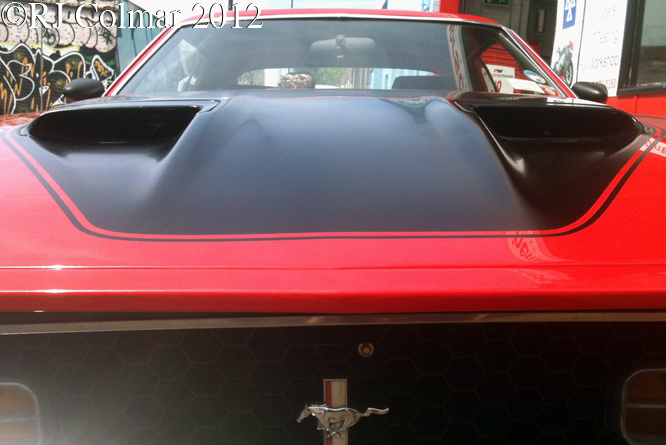
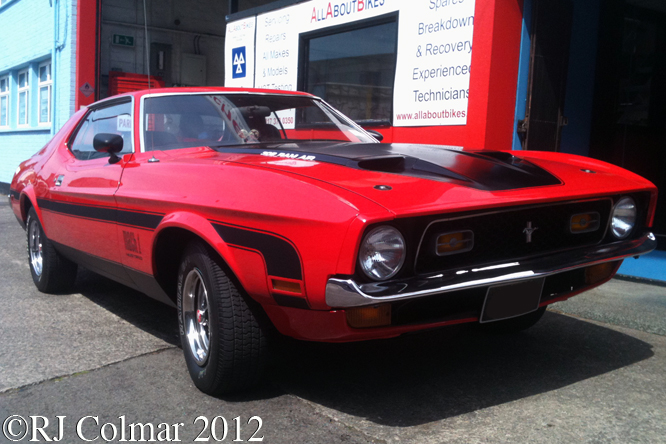
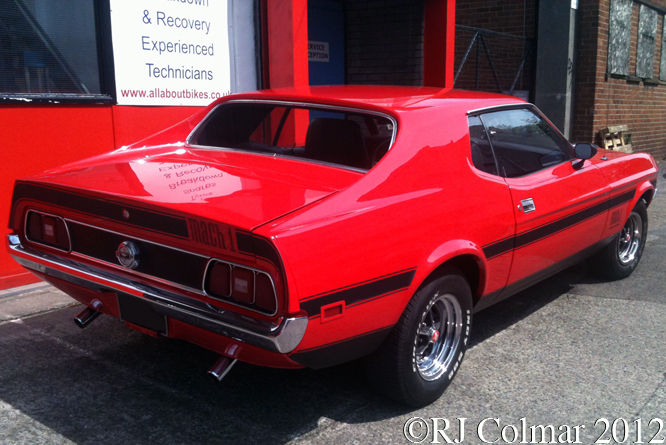
The ’71 Mustangs like the example seen here were 3 inches wider in both body and front and rear wheel tracks which when combined with the inherited height of the original made for a cramped cockpit.

Ford Mustang Hardtop, Bristol

However while the responsibility for the largest and heaviest Mustang of all time was the responsibility of Semon “Bunkie” Knudsen he was merely following the escalation derby that ended up with “option overkill” which saw $2500 vehicles loaded with options that doubled the value and profits of all of the contemporary vehicle manufacturers.

Ford Mustang Hardtop, Bristol

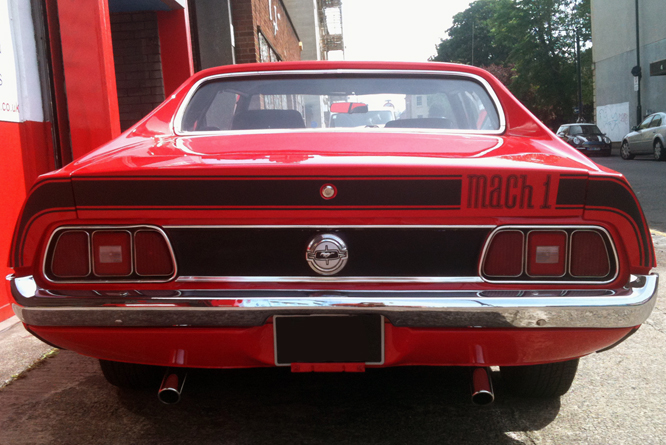
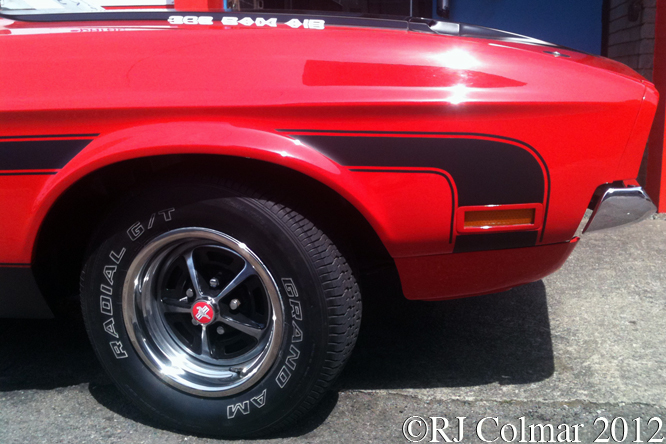
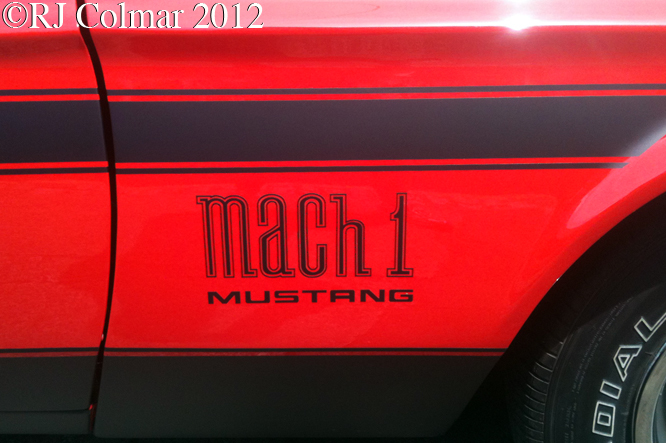
The Mustang Mach 1 performance option included the hockey stick stripes and Magnum 500 wheels, an all time favorite original equipment option.

Ford Mustang Hardtop, Bristol

Part of the justification for the increase in size and weight of the ’71 Mustang was the 7 litre 375 hp Big block Super Cobra Jet 429 cui motor option which could easily be fitted into the engine bay without the costly modifications that had come about from stuffing mid size cars with full size motors, an activity that can be traced back at least as far as the 1964 Pontiac GTO and was dropped on Mustangs from 1972 on. The 5 litre / 302 cui Windsor V8 on this car would produce between 190 and 210 hp depending on the carburetor option chosen.

Ford Mustang Hardtop, Bristol

The Mach 1 name first appeared on a concept Levacar, which offered a Jetsons vision of the future, in 1960. The Mach 1 name first appeared on Mustangs built for the 1969 model year.

Ford Mustang Hardtop, Bristol

Several sources I have read while preparing today’s blog have emphasised that the Mach 1 package was only offered on sportsroof models.

Ford Mustang Hardtop, Bristol

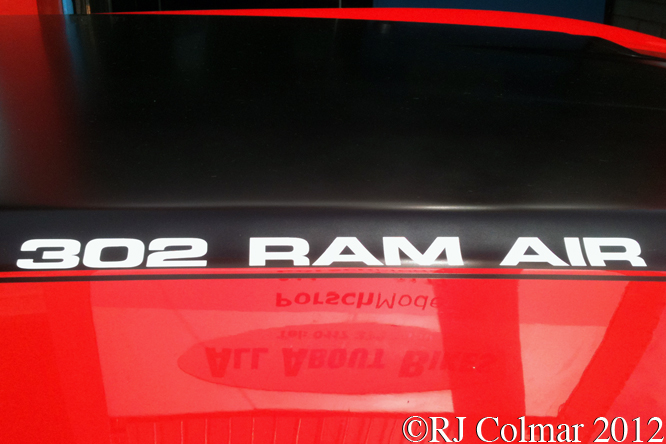
There was a Sports Coupé version of the hard top offered in the Spring of 1971 which included the hockey stick stripes and a black roof without the Mach 1 lettering of which only 500 are thought to have been manufactured.

It is thought that 1971 Mustang sales figures broke down to 83,000 hard tops, 60,000 fastbacks and just 6000 convertibles.

Thanks for joining me on this Ford Mustang Hard Top edition of “Gettin’ a li’l psycho on tyres”, I hope you will join me again tomorrow for a celebrity edition of Ferrari Friday. Don’t forget to come back now !
Share

International Gold Cup Winner – Surtees Ford TS7 #01

After quitting Ferrari midway through 1966 John Surtees joined the Cooper Maserati team and finished the season second to Champion Jack Brabham who became the, first and so far only driver to win the Formula Championship in a car of his own design. At the end of the 1966 season John drove a Lola T70 in the inaugural Can Am championship run by his own team winning three races and beating Mark Donohue to the Championship.

Surtees TS7, Wings & Wheels, Dunsfold

For 1967 ‘Big John’ joined the Honda Grand Prix team which netted a win in the Italian Grand Prix while he returned to defend his Can Am championship but with only a single win he could not keep up with the Bruce and Denny show which was gathering steam taking 5 victories between them in their orange McLaren Chevrolet M6A’s.

Surtees TS7, British Grand Prix, Silverstone

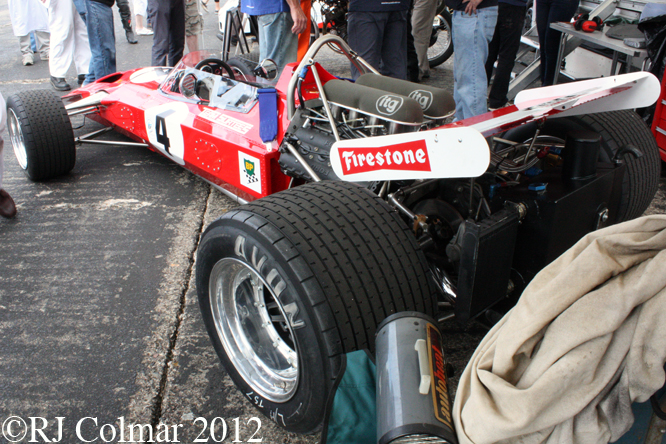
Two unreliable seasons in formula one followed first with Honda in 1968 and then BRM in 1969, but in 1969 John started building his first cars, designed by Len Terry the TS5’s were designed for the stock block Formula 5000 series, Team Elite ran one of these cars and with Trevor Taylor at the wheel it scored four straight victories.

Surtees TS7, British Grand Prix, Silverstone

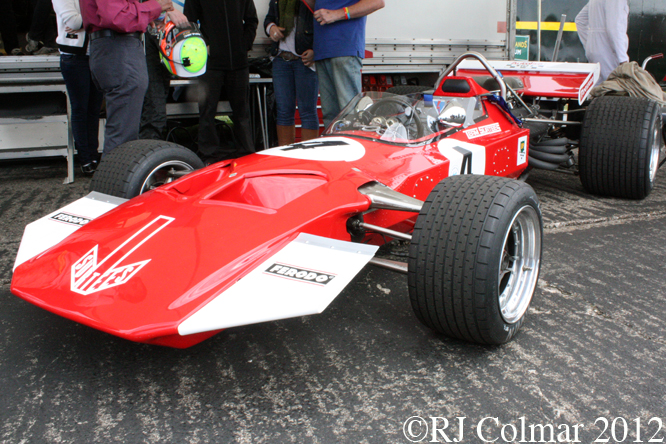
After his poor run of results with the BRM P138 and P139 which netted a season best 3rd place finish John determined he would enter the 1970 season as a constructor designing the TS7 seen here with help from Sahab Ahmed and a plucky draughtsmen with not much Formula One experience but plenty designing consumer electrical goods namely Peter Connew.

Surtees TS7, British Grand Prix, Silverstone

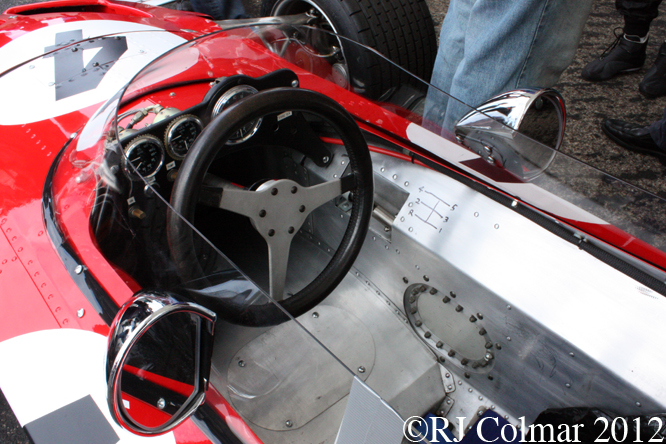
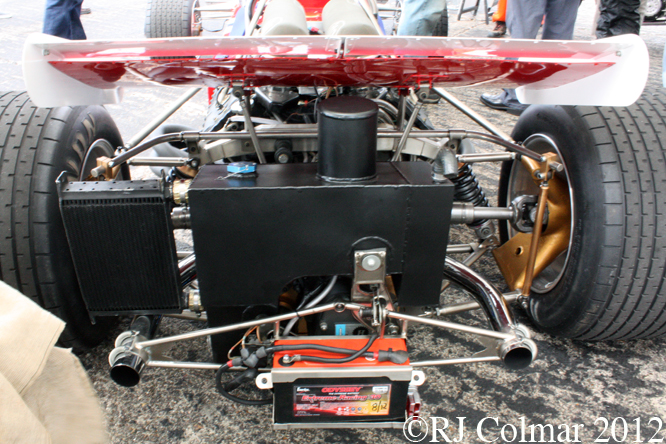
Seen here earlier this year in the Wings and Wheels paddock at Dunsfold Aerodrome, with an 8′ wheel base the Surtees TS7 was a typical period garagistes car with a monocoque held together by three bulkheads, a Ford Cosworth DFV motor acting as stressed member of the chassis with a Hewland DG300 five speed gearbox at the back.

Surtees TS7, British Grand Prix, Silverstone

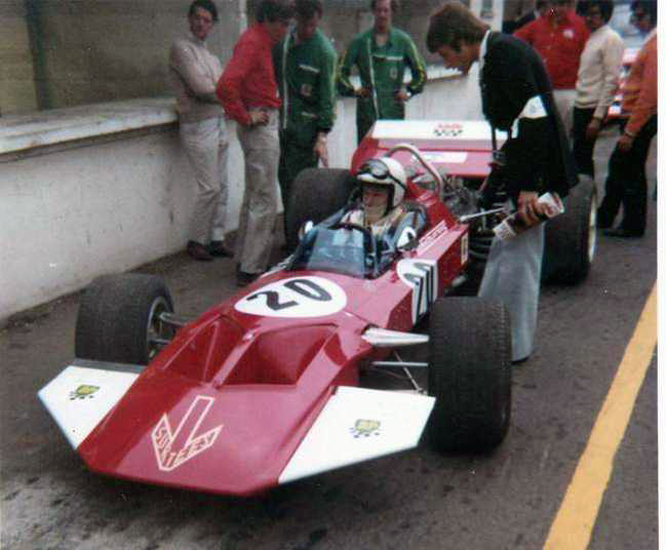
John made his debut with his new car at the 1970 British Grand Prix at Brands Hatch where Peter Connew’s cousin took the photo below. Peter can be seen at the extreme top right of the photo standing next to him is Sahab Ahmed.

Surtees TS7, British Grand Prix, Silverstone

John scored a season high 5th place finish with the TS7 at the Canadian Grand Prix and won the non championship Oulton Park Gold Cup with the same chassis which was restored to it’s present condition in 2010. In 1971 Brian Redman drove this chassis to a seventh place finish in South Africa, Allan Rollinson then drove it to a 9th place finish in the International Trophy at Silverstone and finally a week after wining the 1971 Le Mans 24 Hours with Helmut Marko, Gijs van Lennep drove the car to an 8th place finish in his home Dutch Grand Prix run at Zandvoort.

My thanks to Barry Boor for sharing his photograph.

Thanks for joining me on this “International Gold Cup Winner” edition of “Gettin’ a li’l psycho on tyres” I hope you will join me again tomorrow. Don’t forget to come back now !
Share

150 MPH ex POW – MG K3 #K3007

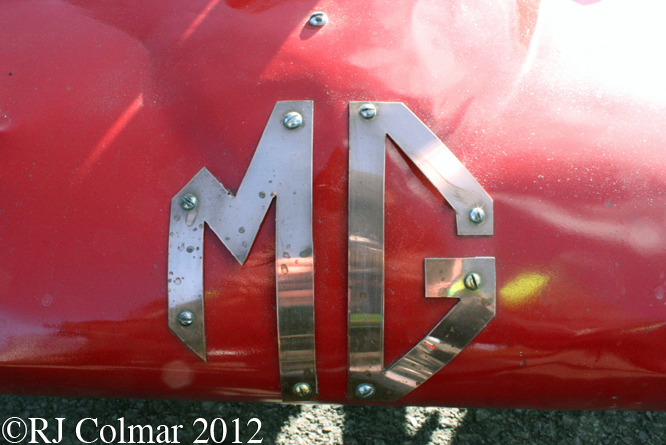
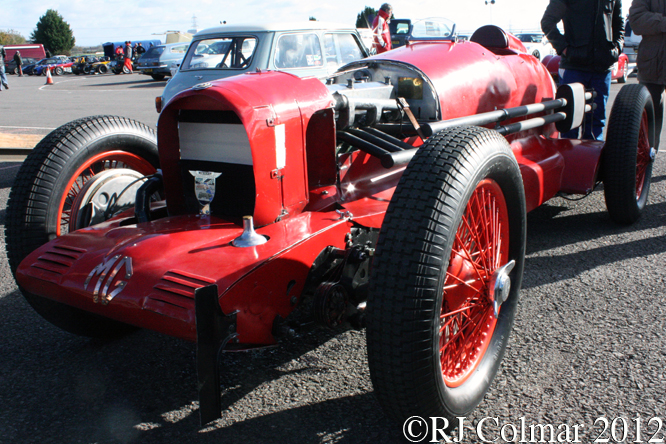
In 1933 today’s featured record breaking MG K3 chassis #K3007 was sold new with a two seater body to successful amateur racer Ron Horton who in 1932 had won a British Racing Drivers Club (BRDC) Gold Star, which would be the same as calling him British Motor Racing Champion in today’s terminology.

MG K3, Sunlight Textile Services Pegasus Sprint, Castle Combe

The car appears to have never been registered for road use but extensively raced and hill climbed. Driving K3007 in 1933 Horton set a 1100cc class Outer Circuit Record at Brooklands of 115.55 mph and class wins on the Shelsley Walsh Hill Climb.

MG K3, Sunlight Textile Services Pegasus Sprint, Castle Combe

For 1934 Ron Horton had an offset single seat body manufactured by Jensen of West Bromwich and made numerous other upgrades. In March 1934 Ron set six international class records, four of which still stand as British class records, at Brooklands from 50 kms to Hour averaging 117 mph with a best lap average of over 119 mph. Unusually Ron received not only a customary letter of congratulation MG’s Cecil Kimber but also another from Lord Nuffield of Morris Motors Ltd who’s Overhead Cam Wolseley 6 Cylinder motors were supercharged and tuned by MG for use in the K3 model.

MG K3, Sunlight Textile Services Pegasus Sprint, Castle Combe

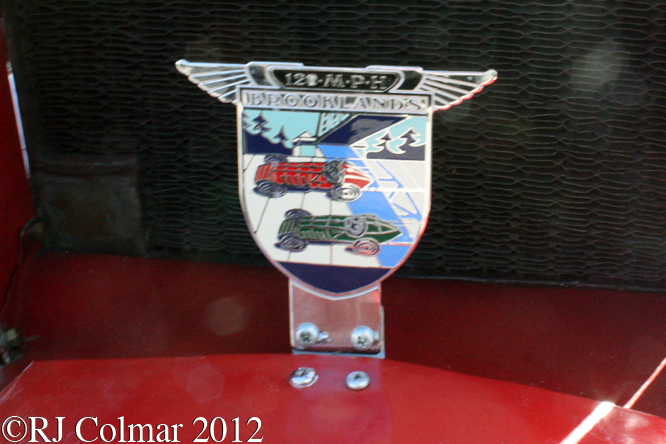
Later in 1934 Ron won a Brooklands Whitsun Meeting race at an average speed of over 110mph and set a new 123.88 mph lap record later the same day which earned him the first 120 mph badge given to the driver of a car fitted with 1100cc / 67 cui motor.

MG K3, Sunlight Textile Services Pegasus Sprint, Castle Combe

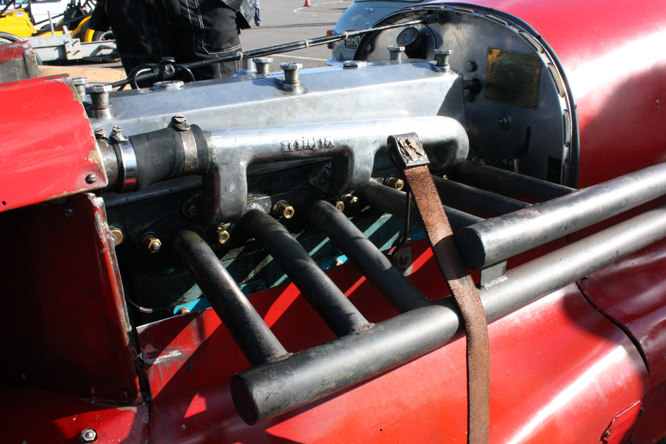
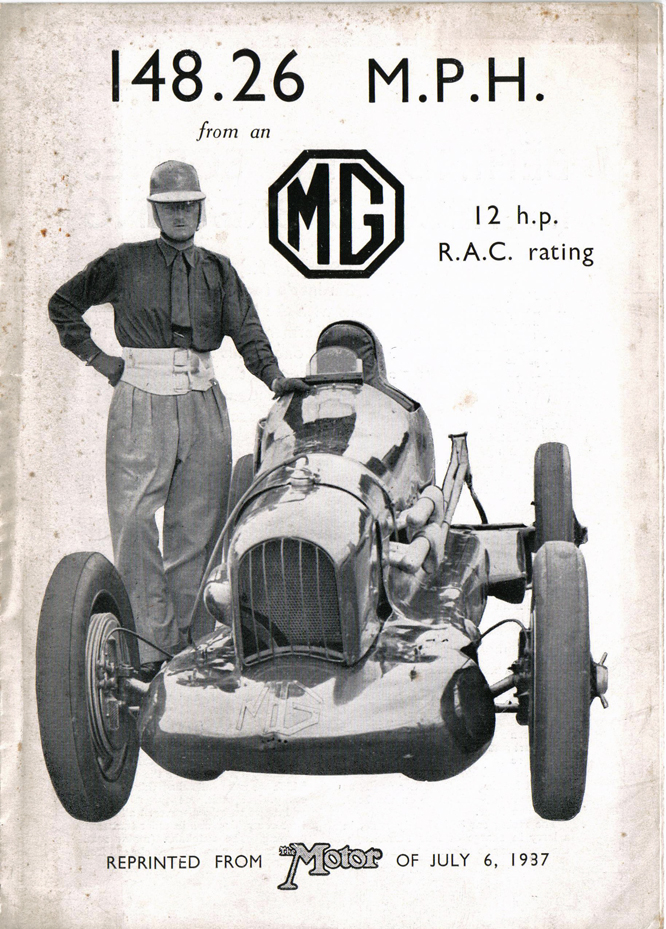
In 1935 Goldie Gardener acquired K3007 and had it continually updated, in 1937 he became the first driver to record a one way 150 mph average in an MG at the October Frankfurt Speed Week with a two way class record breaking average of over 148 mph timed over the flying kilometer and mile distances.

MG K3

In 1939 Gardener had the the motor taken out of #K3007 and fitted in to K3023/EX 135 which had a lower seat thanks to an offset gearbox and had been used by George Easton. Goldie set a 200 mph record with his new bolide. The chassis of K3007 along with the discarded motor from K3023/EX 135 ended up at the Abingdon MG factory and reassembled into a complete car with an ENV Crash gearbox from an MG K1 and sent to Singapore where a contemporary Mercedes Grand Prix single seater style body was fitted for it’s new owner Mic Jennings.

MG K3, Sunlight Textile Services Pegasus Sprint, Castle Combe

After recording fastest lap in the rain shortened 1940 Johore Grand Prix Jennings was forced to abandon K3007 at Singapore Docks while fleeing the incoming Japanese invasion. A Japanese Imperial Army Officer commandeered #K3007, after which it appears to have been liberated by MG racer Lim Peng Han who broke it up and kept in storage ‘for the duration’. Jennings was offered the car back after the war but declined. The original #K3007 motor was destroyed in a bombing raid during the ’39/’45 war.

MG K3, Sunlight Textile Services Pegasus Sprint, Castle Combe

In 1969 MG J2 owner Mike Hawke was sent to Singapore with the Royal Navy and secured the very rusty ex K3023/EX 135 motor with a bottle of whiskey without any knowledge of it’s history. The motor had at one point been buried and then been kept at the bottom of the previous owners garden. It was only when Mike started to dismantle the engine that it’s identity became clear.

MG K3, Sunlight Textile Services Pegasus Sprint, Castle Combe

Having established the identity of his rusty motor Mike recovered the chassis which had the front cut off with the remains being used for a trailer, the ENV gearbox was discovered being used as a door stop at a veterinarian’s surgery.

After many adventures by 1985 Mike had salvaged enough bit’s and pieces to restore #K3007 to something approximating it’s 1934/37 single seat specification and the the car ran for the first time in just over 40 years under it’s own power and has since recorded 125 mph laps at Millbrook.

Mike says he considers himself fortunate to have discovered, recognised and put back together one of the worlds more historic MG’s.

My thanks to Jeremy Hawke for his time and patience retelling the story of the storied K3, found by his father, seen in today’s photographs at the recent Sunlight Textile Services Pegasus Sprint.

Happy Christmas and Best Wishes for the year ahead to all “Gettin’ a li’l psycho on tyres” readers and contributors !

Thanks for joining me on this “150 MPH ex POW” edition of “Gettin’ a li’l psycho on tyres” I hope you will join me again tomorrow when I’ll be looking at the first Formula One car that Peter Connew was involved with. Don’t forget to come back now !
Share

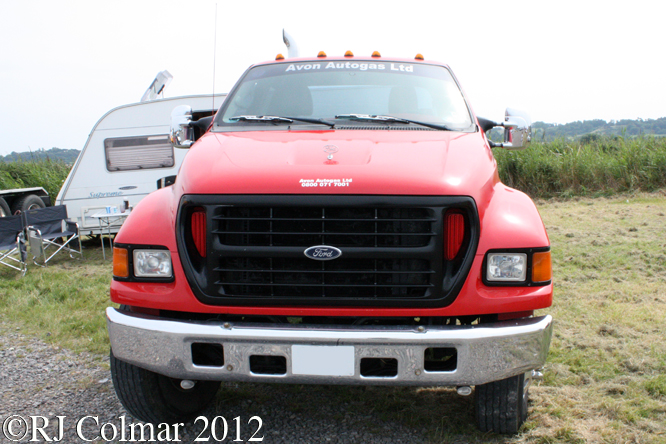
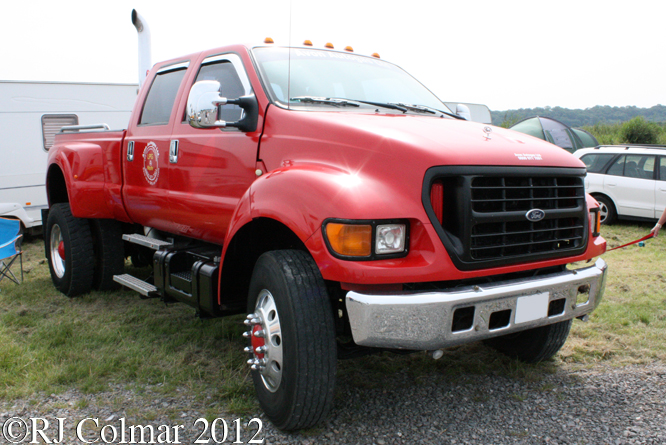
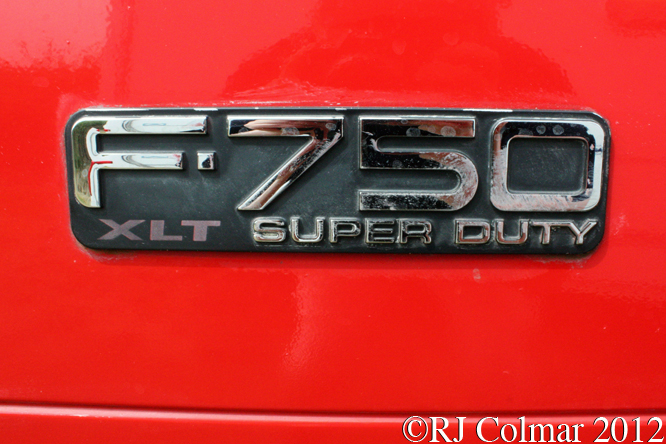
Santa’s Li’l Pick Up – Ford F-750 Super Duty XLT

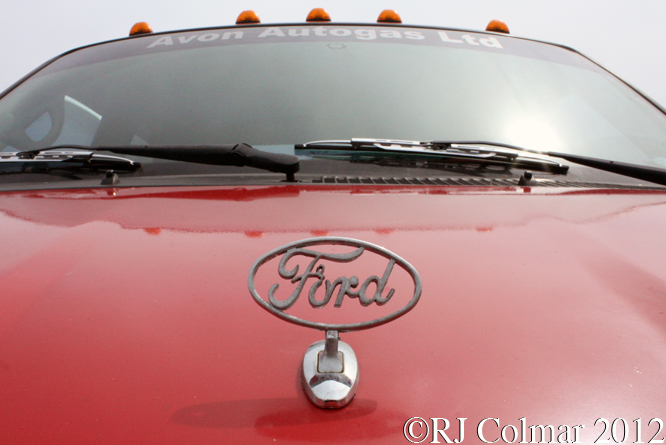
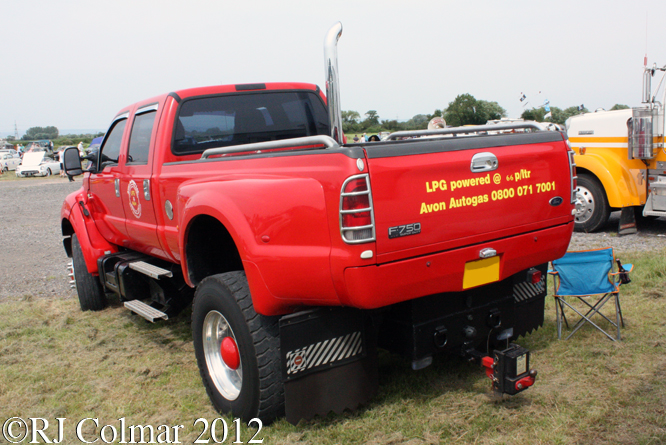
Primarily aimed at businesses and municipalities the F-650/F-750 range replaced the F-600/F-700/F-800 range of vehicles that had been in production since 1980.

Ford F-750 Super Duty XLT, Summer Classics, Easter Compton

Today’s featured vehicle is a 2000 crew cab powered by a 185 hp 5.9 litre / 359 cui turbo diesel Cummins straight 6 and

Ford F-750 Super Duty XLT, Summer Classics, Easter Compton

6 speed automatic transmission, which might come in handy for Santa when he sets off on his annual nocturnal round the world odyssey.

Ford F-750 Super Duty XLT, Summer Classics, Easter Compton

F-650’s and F-750’s were manufactured in a joint venture with Navistar International and Blue Diamond Truck Company LLC at a Navistar factory in Escobedo, Mexico. F-650 production will move to Avin Lake Ohio in 2013.

Ford F-750 Super Duty XLT, Summer Classics, Easter Compton

The ladder chassis is an International ladder frame with an F series body on top.

Ford F-750 Super Duty XLT, Summer Classics, Easter Compton

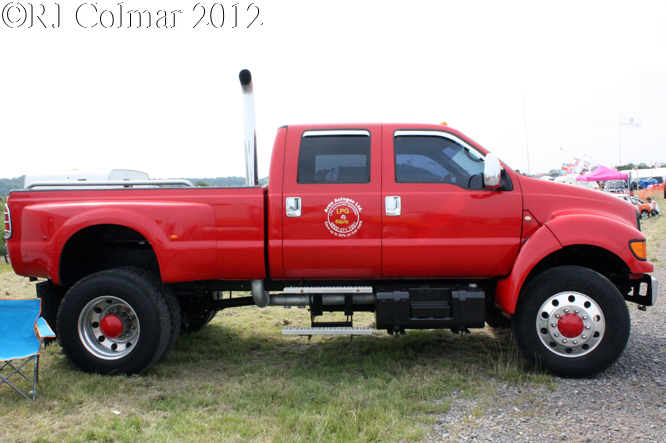
This model is fitted with disc brakes front and rear which have an anti lock braking system, ABS, fitted as standard. Is it me or are the pick up body rear wheel arches too small for the dually rear wheels ?

Ford F-750 Super Duty XLT, Summer Classics, Easter Compton

With a gross vehicle weight of 30,000 lbs and 20,000 lb load capacity there should be plenty of room for Santa’s surprises in the back and if he needs more space there is a substantial towing hitch, maybe Rudolf and his friends will get to take this evening off !

Wishing all GALPOT readers and contributors a Merry Christmans and best wishes for the New Year.

Thanks for joining me on this “Santa’s Li’l Pick Up” edition of “Gettin’ a li’l psycho on tyres” I hope you will join me again tomorrow. Don’t forget to come back now !
Share

Cu Ghost – Rolls Royce Brockman 40/50

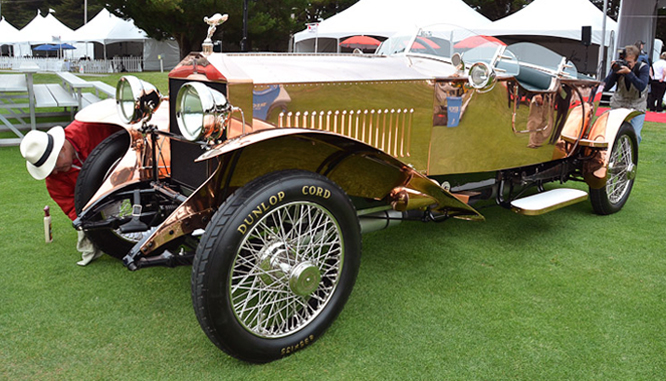
The Rolls Royce 40/50 launched in 1906, dubbed by Autocar the following year as “The best car in the world”, was only ever supplied as a chassis on to which a body would be individually crafted by an independent coach builders.

Rolls Royce Brockman 40/50, Hillsborough Concours d'Elegance

It is not known if, upon completion in Derby of today’s, today’s featured 1921 example was sent to a recommended Coachbuilder or straight to Dick Brockman and Company’s coach building works in Reading west of London.

Rolls Royce Brockman 40/50, Hillsborough Concours d'Elegance

The hand starter was merely a precaution on this chassis as electric lighting and starting was fitted to all 40/50’s from 1919 on.

Rolls Royce Brockman 40/50, Hillsborough Concours d'Elegance

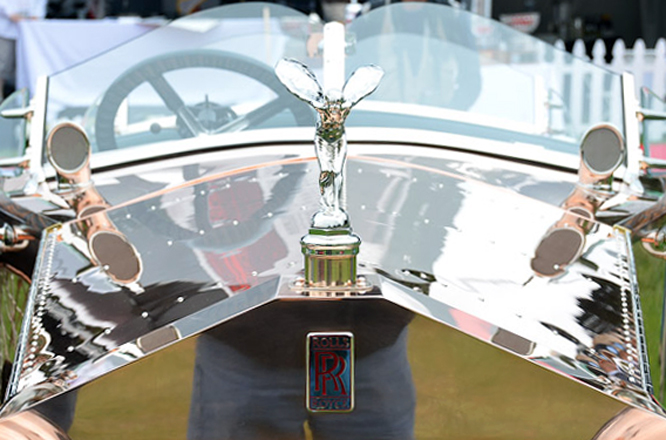
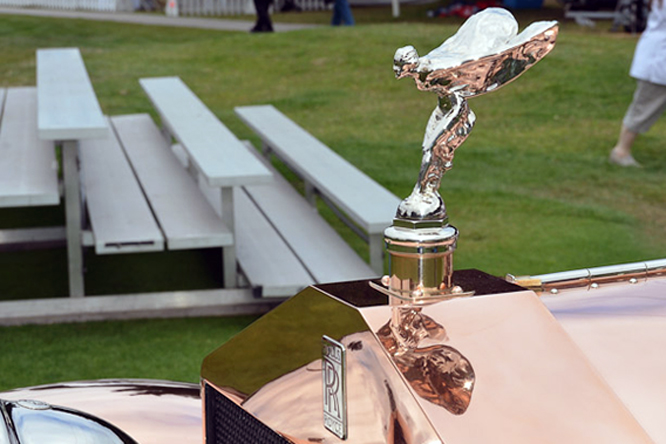
The Spirit of Ecstacy also known as “Ellie in her Nightie”, was originally sculpted by Charles Sykes and made of chrome alloy was not adopted as an option until 1911, by all accounts Henry Royce was not a fan of the mascot and only agreed to it being offered as an option to dissuade his customers from using less suitable ornamentation.

Rolls Royce Brockman 40/50, Hillsborough Concours d'Elegance

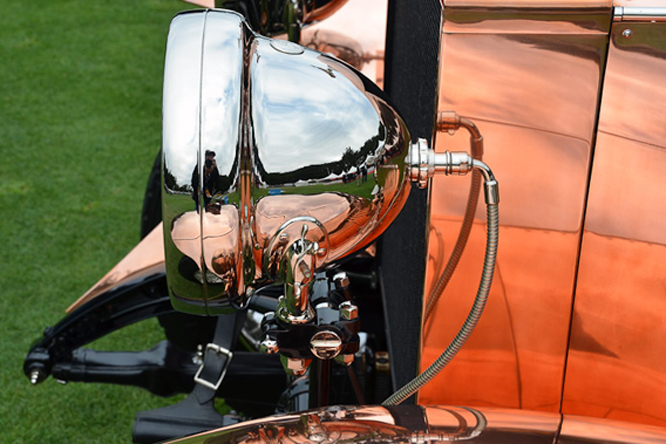
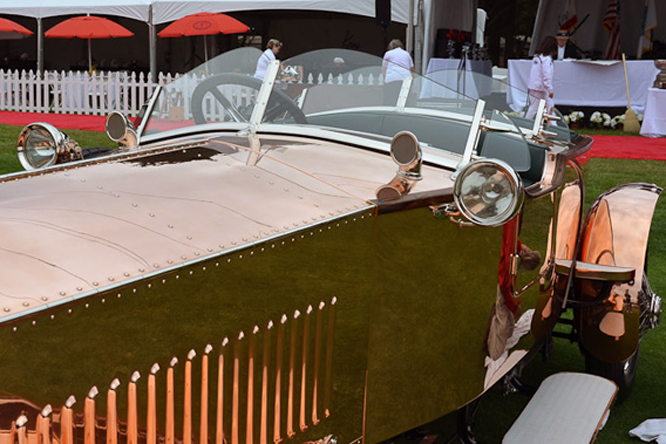
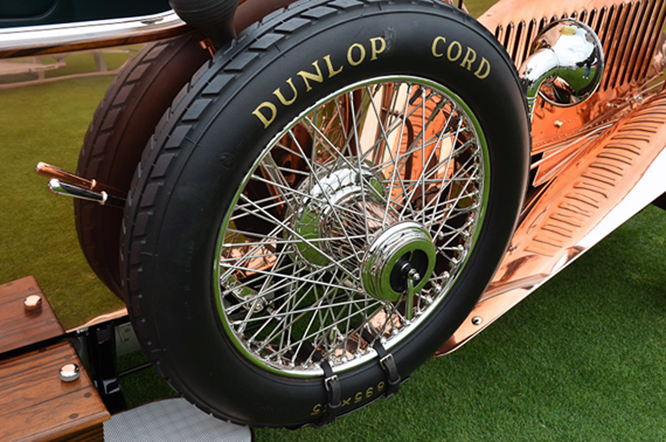
Up until 1915 shiny brass, and nickle fittings were quite common but after the Great 1914/18 War these items tended to be painted.

Rolls Royce Brockman 40/50, Hillsborough Concours d'Elegance

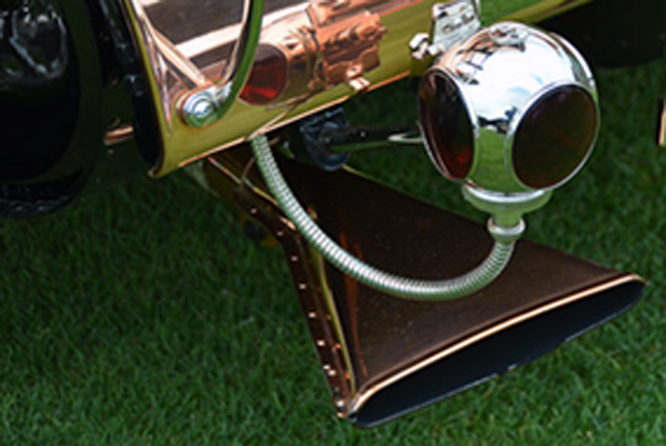
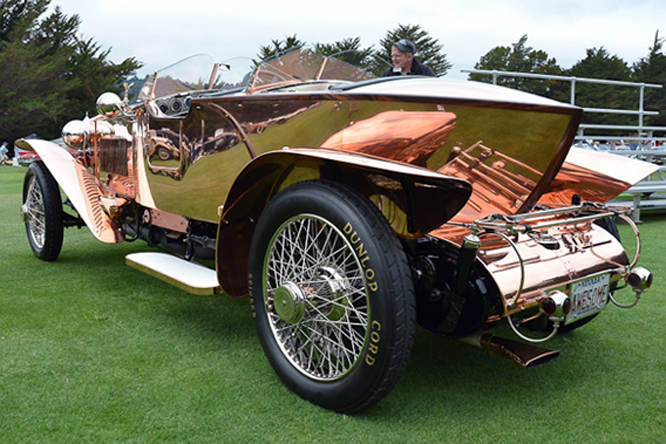
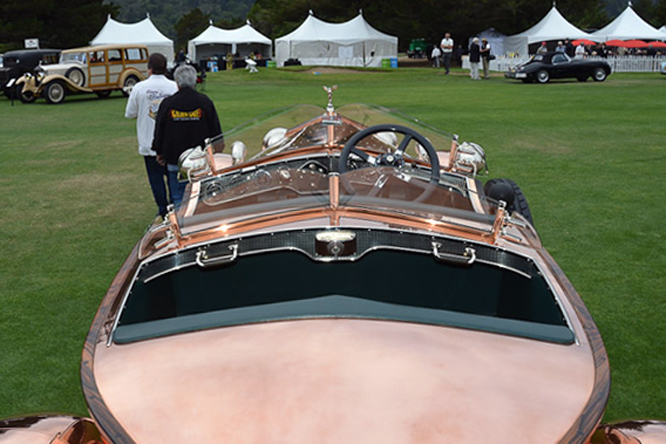
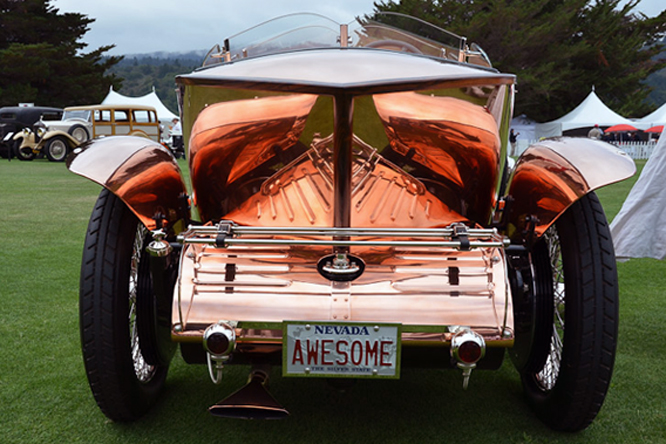
Using .065″ copper sheet Dick Brockman and Company appear to have manufactured the body of this vehicle without resorting to either welding or riveting which would have been common practice.

Rolls Royce Brockman 40/50, Hillsborough Concours d'Elegance

This car, photographed by Geoffrey Horton at Hillsborough Concours d’Elegance earlier this year, is powered by an 80 hp 7428 cc / 453 cui six cylinder motor connected to a 4 speed manual gearbox.

Rolls Royce Brockman 40/50, Hillsborough Concours d'Elegance

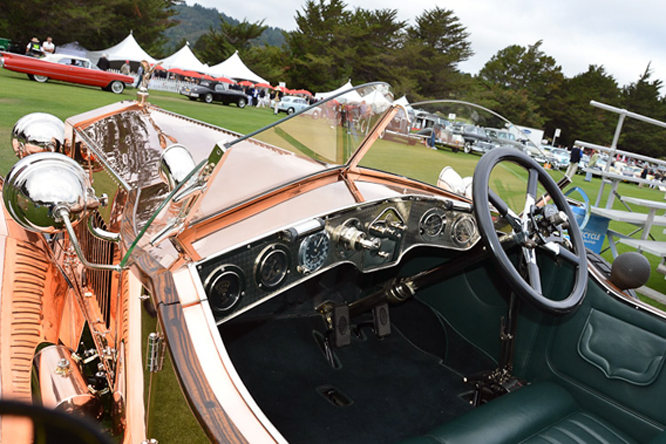
Restoration of the car included replacing the dash board, front and rear screens along with the rear cockpit.

Rolls Royce Brockman 40/50, Hillsborough Concours d'Elegance

Once the restoration was completed the car won the 1991 Concours d’Elegance at Pebble Beach.

Rolls Royce Brockman 40/50, Hillsborough Concours d'Elegance

Many of the fitting were supplied by the Restoration Supply Company, Reno who carried out the restoration.

Rolls Royce Brockman 40/50, Hillsborough Concours d'Elegance

Despite it’s age this vehicle apparently has no problem keeping up with today’s traffic at ‘modern speeds’ with the smooth and silent performance that established the reputation of Rolls Royce as the manufacturers of the finest cars in the world from the beginning.

Rolls Royce Brockman 40/50, Hillsborough Concours d'Elegance

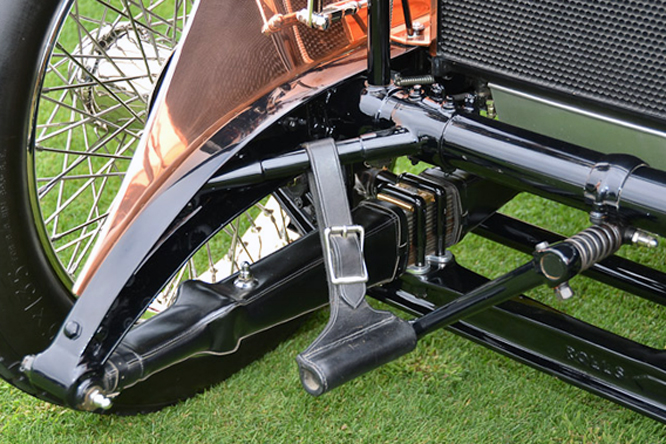
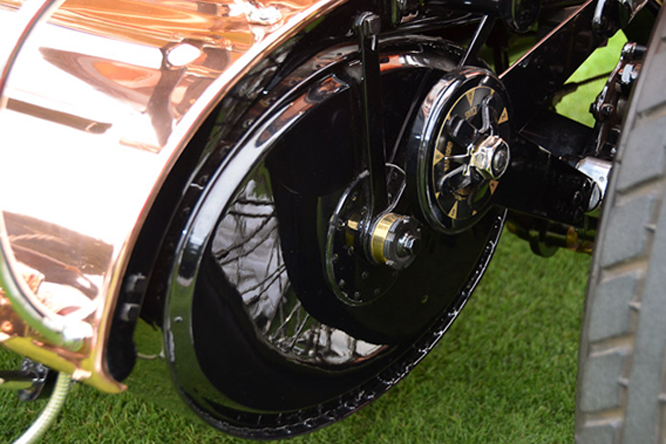
Friction dampers such as the one seen here were in common usage until the second half of the twentieth century when they were replaced with shock absorbing struts.

Rolls Royce Brockman 40/50, Hillsborough Concours d'Elegance

Opulent and refined this 40/50 represents the definition of what a hand crafted from nose to tail Rolls Royce should be, this car is regularly to be found in the National Automotive Museum in Reno.

Rolls Royce Brockman 40/50, Hillsborough Concours d'Elegance

Remarkably this is not the only copper bodied car by Dick Brockman and Company they were also responsible for building the body on a 1930 Rolls Royce Phantom II, Freestone & Wedd also built a copper bodied Rolls Royce on a pre owned 1937 Phantom III, other copper bodied cars include home made hand beaten 1920 Dodge now on view at the Southward Museum in Paraparaumu new Zealand. There are also two copper Cobra bodies one designed by Virgil M Exner in 1965 known as the Mercer Cobra, and the other a Kirkham Replica Cobra. Finally a supercharged rear engined Ford GT was fitted with a retro ’40’s copper hot rod body by Kirkham for the SEMA show in Las Vegas some years ago.

My thanks to Geoffrey Horton for sharing his photo’s of the Copper bodied Rolls Royce Brockman 40/50 copper Ghost.

Thanks for joining me on this “Cu Ghost” edition of “Gettin’ a li’l psycho on tyres” I hope you will join me again tomorrow. Don’t forget to come back now !
Share