Tag Archives: GALPOT

Torrey Canyon – Lotus Ford T86

On March 18th 1967 Shipmaster Pastrengo Rugiati elected to take his charge the 974 ft Torrey Canyon carrying 120,000 tons of crude oil on a disastrous short cut between the Scilly Isles and the Cornish mainland on his way to Milford Haven and ended up causing the worlds largest ship wreck when the boat grounded on the Seven Stones Reef. As the consequent environmental disaster unfolded the ship was bombed sending it 98ft below and the oil spill was repeatedly bombed in a vain effort to keep the oil off the beached of England, France and surrounding islands.

In 1969 Peter Wright was working on the ground breaking BRM P142 which would have introduced aerodynamically induced ground effects to racing car design when John Surtees joined BRM and insisted on opting for a conservative approach and developing the existing BRM P138 and P139 chassis with which Big John scored a season best 3rd place driving the P 139 at the 1969 US Grand Prix before quitting BRM to start his own team.

Peter left BRM and some years later started work for Technocraft to develop a vacuum assisted resin injection composite process which was to be used for the manufacture of body shells for the Lotus Elite, Eclat and Esprit road cars and Colin Chapman’s boat companies.

After the failure of the Lotus 76 in 1975 Colin Chapman asked another ex BRM employee Tony Rudd, now group engineering director at Lotus, to re-think how a Formula One car might be made to make proper use of the front tyres.

Rudd drafted his former colleague Peter Wright in to run the wind tunnel “in his spare time” after his commitments at Technocraft. The fruit of this collaboration was the successful Lotus 78 and world championship winning Lotus 79.

Lotus Ford 86, Goodwood Festival of Speed

The team were not so lucky with the Lotus 80, from which they took a step back with the Lotus 81 before regrouping with their next innovation the twin chassis Lotus 86 seen here.

What Peter had found out was that the Lotus 80 and to a lesser extent the Lotus 81 were suffering from aero flutter causing the cars to porpoise as a result of having springs that were too soft for the aerodynamic loads being put through the wheels and suspension.

By having a twin chassis Peter hoped to use a conventional monocoque chassis in which the driver sat and a separate independently sprung ground effect chassis attached to the first at the outboard ends of the lower suspension. The suspension for the outer ground effect chassis was much stiffer than for the inner monocoque chassis and as a result in theory should not be quite so sensitive to flutter or likely to porpoise.

In order for the car to work not only would the science have to be proven but the rule book scrutinised to ensure the car remained legal. By having the outer ground effect chassis suspended from the bottom suspension links using very stiff rubber bump stops the criteria for having all parts of the car with an aerodynamic influence entirely sprung, was met.

To check the science the team took a 1980 Lotus 81 added a spacer between the engine and the fuel tank through which the central cross member of the outer chassis would pass, made provision for the front cross member of the outer chassis to pass under the driver legs and had had the third rear cross member of the outer chassis pass over the gearbox.

The weight of the outer chassis was kept low using the in house developed carbon fibre process that Peter had been developing for the Lotus road cars and Champman’s boats.
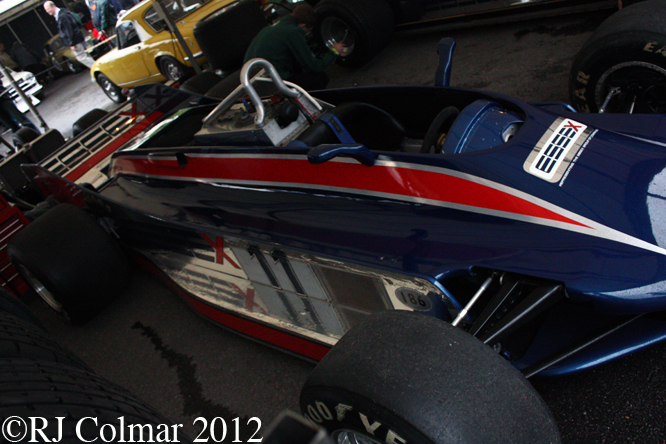
Lotus Ford 86, Goodwood Festival of Speed

Amid much secrecy the Lotus 86 was built and then taken to Jarama for a private test, thanks to the motors heavily revised oil pumps, that were required by the second chassis, a lot of oil was spilled, hence the Torrey Canyon nick name for the car.

Once the leaks had been fixed the Lotus 86 proved that the aerodynamic outer chassis worked providing plenty of down force while the inner monocoque chassis, in which the driver sat, remained free of the porpoising effect that made the car difficult to control.

Upon completion of the test the Lotus 86 which was never subsequently raced was put aside and work started on the Lotus 88 using the same principles.

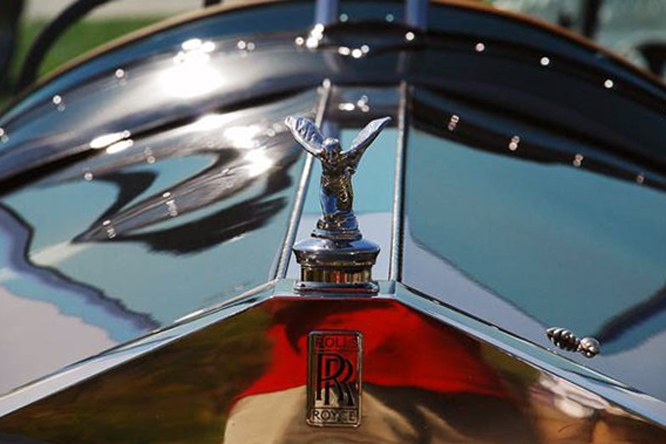
Thanks for joining me on this “Torry Canyon” edition of “Gettin’ a li’l psycho on tyres” I hope you will join me again tomorrow for a look at an old Rolls Royce. Don’t forget to come back now !

Share

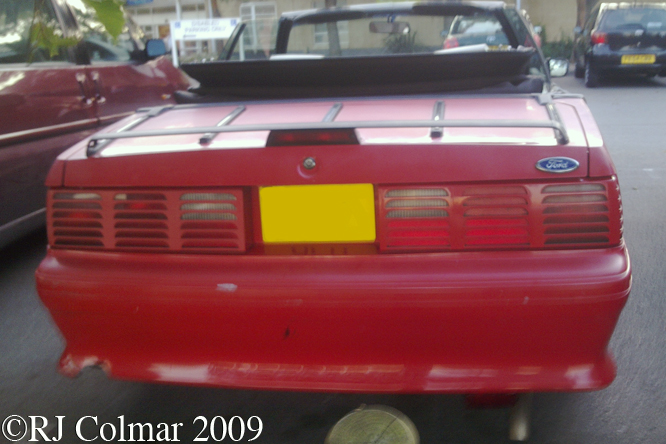
25th Anniversary Aero Airbag – Ford Mustang GT Convertible

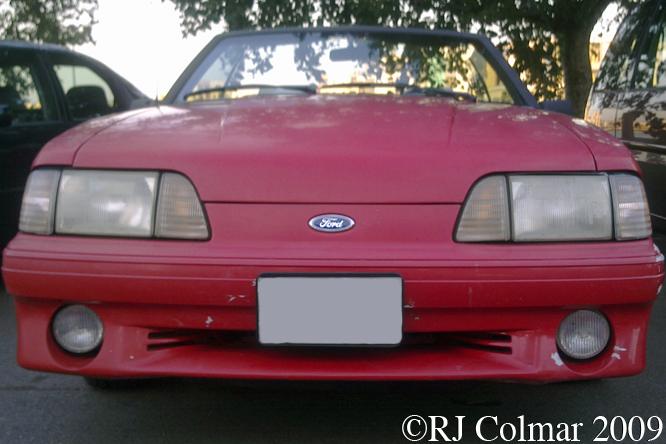
They say beauty is in the eye of the beholder and the few owners of third generation Mustangs, built from ’79 – ’93, that I have spoken too always rave about them, no matter that in some eyes they share the aesthetics with a family pack of lard with no knobs on, you either love these cars or hate them.

Ford Mustang GT Convertible, Portishead

Based on the Ford’s mid size Fox platform, around which contemporary classics as the Ford Granada (US), LTD and Thunderbird, Mercury Cougar and Capri, Lincoln Versailles and Continental Mark VII were also built, the third generation Mustang GT is fitted with a 5 litre / 302 cui V8 produced 225 hp. In 1987 third generation Mustangs received an “aero” style face lift which replaced the earlier 4 eyes look.

Ford Mustang GT Convertible, Portishead

Handling was improved over the other vehicles built on the Fox platform with Fords Quadra Shock rear suspension though the handling still takes some getting used to and is best not sampled in the snow. For 1990 when today’s featured car was built drivers airbags became standard.

Ford Mustang GT Convertible, Portishead

A school friend of mine who used to work in the oil industry out in Houston Texas had one of these 25th Anniversary Mustangs from new and said that the cost of keeping it maintained aside, there was no car he has owned before or since that has given him so much pleasure as his Mustang GT being driven out of Houston on a balmy evening with the hood down and the air conditioning on.

Thanks for joining me on this 25th Anniversary Aero Airbag edition of “Gettin’ a li’l psycho on tyres”, I hope you will join me again tomorrow. Don’t forget to come back now !
Share

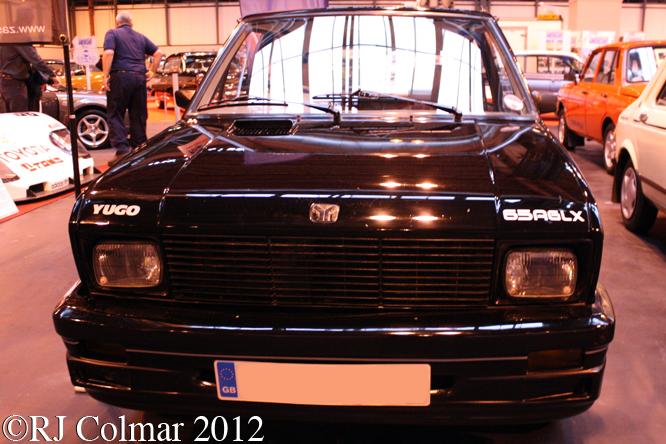
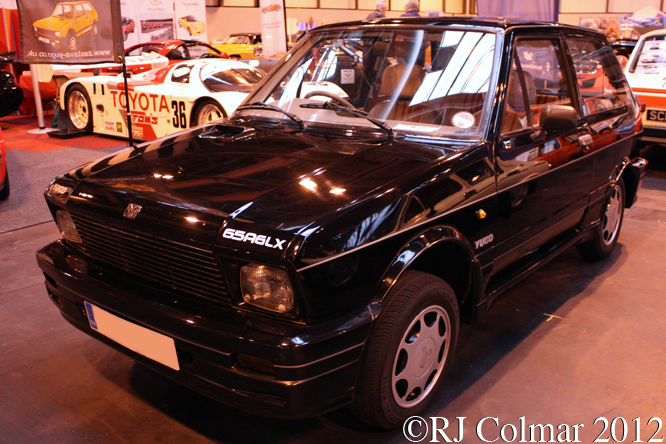
Fully Loaded Rare Breed – Zastava Type 102 / Yugo 65AGLX

Reading through the Zastava history on the zastava-yugo.co.uk website I was surprised to learn that just 83 of all Zastava/Yugo types remain registered on British roads,

Yugo 65AGLX, The Classic Motor Show, NEC, Birmingham

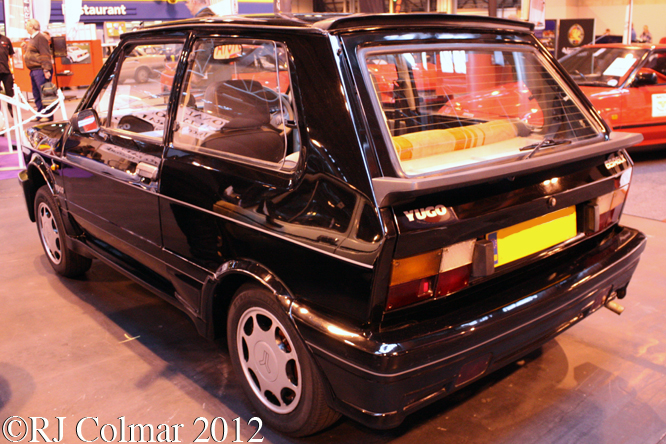
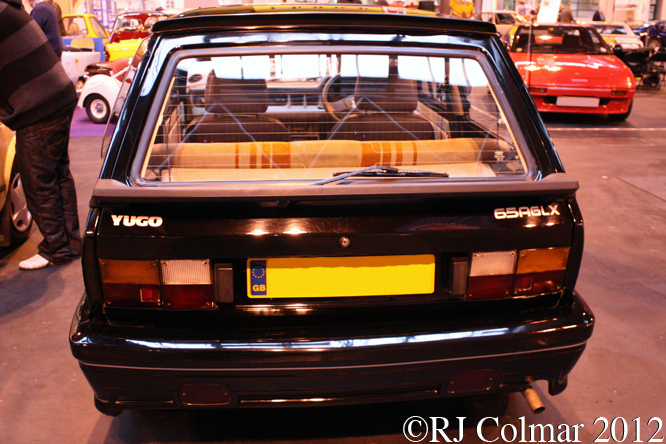
which makes today’s featured 1989 Yugo 65AGLX branded Zastava Type 102 a rare breed in Britain, if not it’s homeland and the area surrounding Serbia where it was built.

Yugo 65AGLX, The Classic Motor Show, NEC, Birmingham

Today’s featured 1989 model, is the top of the UK range GLX fitted with a 1298 cc / 79 cui motor which could be ordered with either a 5 speed manual or Renault derived 3 speed automatic gearbox.

Yugo 65AGLX, The Classic Motor Show, NEC, Birmingham

In the USA where the 65AGLX was known as the GVX (GV = Great Value) along with the spoilers front and rear, side body kit and alloy wheels it was possible to order a GVX with a automatic electro-hydraulic folding/raising cabrio roof. US destined Yugo’s were apparently built on a separate production line manned by an elite staff who were paid a premium wage.

Yugo 65AGLX, The Classic Motor Show, NEC, Birmingham

Despite modest acceleration times of 0-60 mph in 13.5 seconds and a top speed of 85 mph, US spec, production of the Zastava Type 102 survived the violent dissolution of Yugoslavia, the factory at Kragujevac in Serbia survived a bombing, and did not end until 2008 with 794,428 examples built.

Thanks for joining me on this “Fully Loaded Rare Breed” edition of “Gettin’ a li’l psycho on tyres”, I hope you will join me again tomorrow. Don’t forget to come back now !
Share

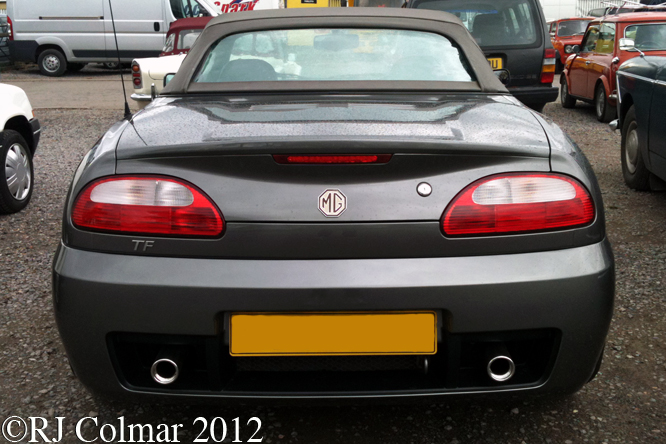
Last British 2 Seat MG – MG TF

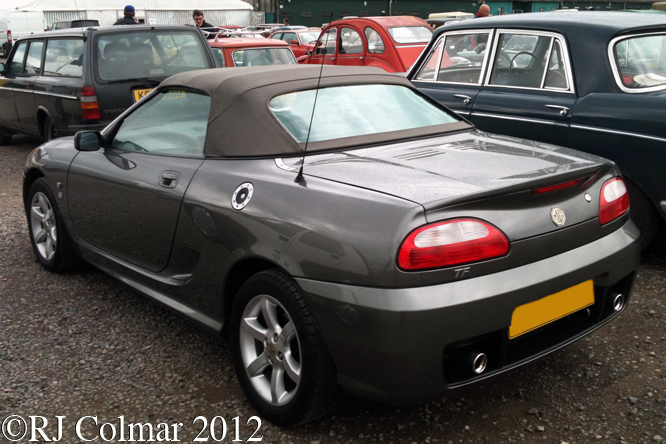
When MG Rover face lifted the mid engined MG F sports car in 2002 they gave it the same TF name as last seen on the 1955 MG TF Midget. Little did they know at the time that this would become the last new British 2 seat MG to reach market.

MG TF, Bristol Classic Car Show, Shepton Mallet

Many of the face lift details were carried over from the MG TF XPower 500 Concept Car first seen at Le Mans in 2001.

MG TF, Bristol Classic Car Show, Shepton Mallet

Despite it’s overall styling which dated back to 1995 the MG TF matched it’s rivals from Mazda (MX5) and Toyota (MR2) in handling, performance and held it’s own in the domestic sales league.

MG TF, Bristol Classic Car Show, Shepton Mallet

However the TF’s mid mounted Rover K series motor was subject to numerous head gasket failures until a new multi layered item was designed which cured this particular issue.

MG TF, Bristol Classic Car Show, Shepton Mallet

Production of MG TF’s ceased when Rover MG went bankrupt in 2005 but restarted in the UK from Chinese supplied Complete Kockdown Kits (CKD) in 2008 after new owners Nanjing had transferred all the TF production assets to China. 906 CKD TF’s were built before production ceased for good in 2011.

Thanks for this “Last British 2 Seat MG” edition of “Gettin’ a li’l psycho on tyres” I hope you will join me again tomorrow. Don’t forget to come back now !

Share

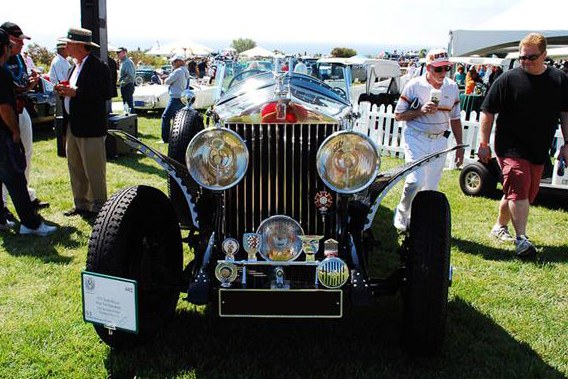
The Welsh Twin Royces – Rolls-Royce Boattail Speedster

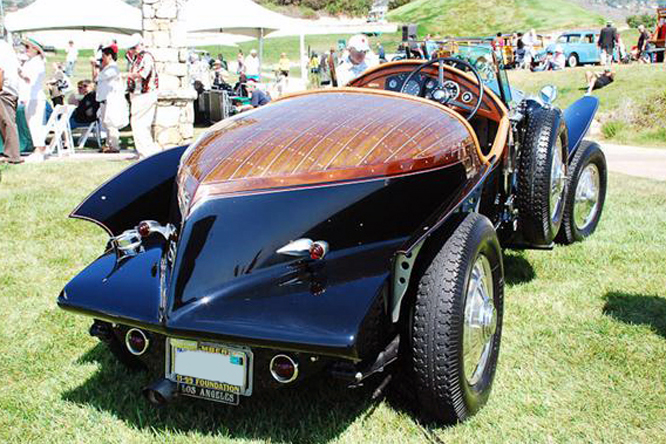
Gary L Wales winner of the 1984 Great American race for ‘antique’ cars is also a prize winning restoration expert who also has penchant for what he calls ‘Retro Design’ with which he aims to put together pleasing and fun vehicles for the road which recombine some of the best ideas stolen from the entire history of motoring.

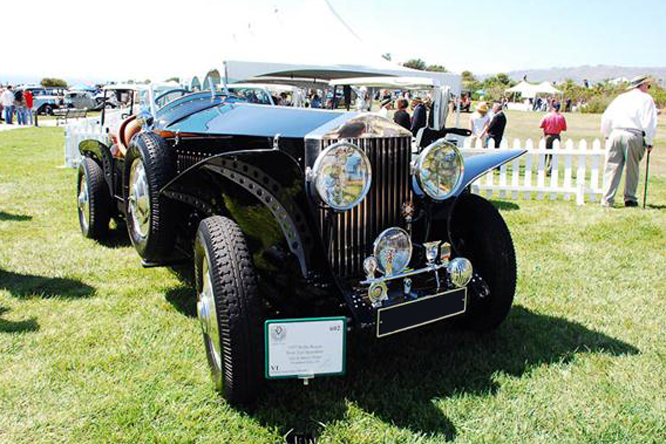
Rolls-Royce Boattail Speedster, Palos Verdes Concours d'Elegance

Today’s featured car started life as a 1937 Rolls Royce 20/25 chassis onto which had been built a Saloon / Sedan body. The car ended up as a termite demolished derelict in Puerto Rico and in the mid 1980’s Gary acquired the chassis which is fitted with a 25/30 4257 cc / 259 cui six cylinder motor. 25/30 motors were introduced to the 20/25 chassis because owners were having bodies fitted to their cars which were too heavy for the 20/25 3699 cc / 225 cui motors. Note Gary has used double hinges for the bonnet / hood which nicely extend the line of the radiator grill.

Rolls-Royce Boattail Speedster, Palos Verdes Concours d'Elegance

Gary who by his own admission “flunked ruler reading” like any artisan turns his remarkable designs from his head into sheet metal using traditional techniques and tools, employing the work shop floor for schematic layout and traditional tools like the English Wheel.

Rolls-Royce Boattail Speedster, Palos Verdes Concours d'Elegance

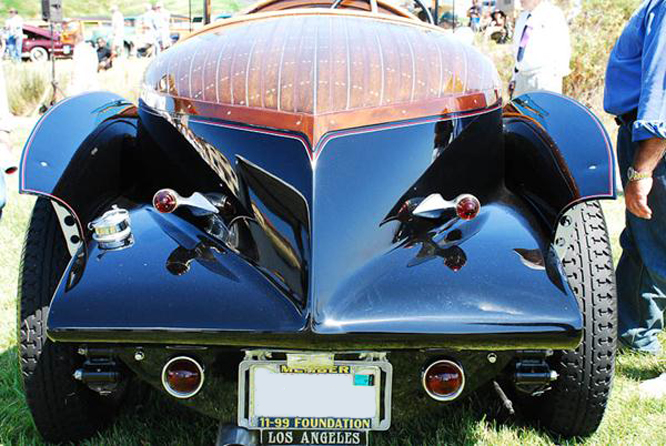
For the Boattail Speedster Gary decided to move the motor, transmission and fire wall back a full 18 inches to give this car a longer bonnet line with the added benefit of improving the handling. The design for the wings / fenders was inspired by the French coach builder Henri Labourdette.

Rolls-Royce Boattail Speedster, Palos Verdes Concours d'Elegance

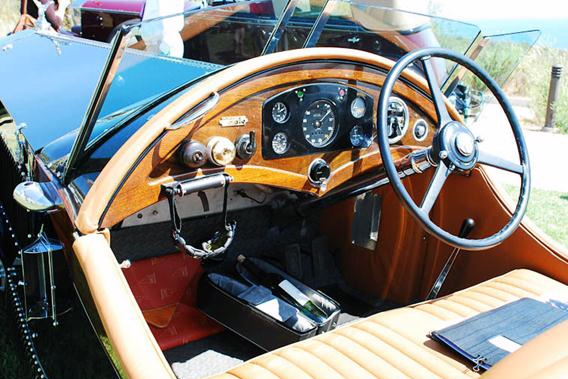
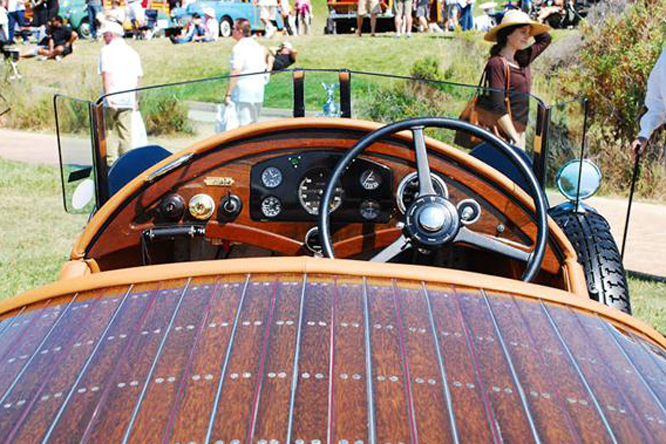
The dash board is original note the goggles are hanging from a map reading light to aid navigation by the passenger at night.

Rolls-Royce Boattail Speedster, Palos Verdes Concours d'Elegance

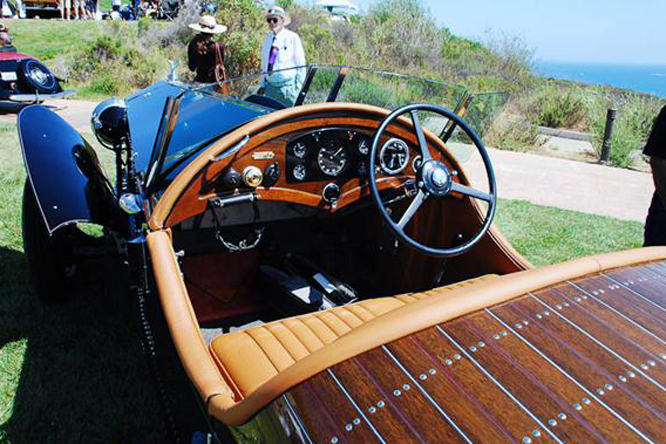
Labourdette also made numerous boattailed bodies back in the day, the wood work for Gary’s Rolls was cut by Gary’s neighbour John Maddocks who happens to be President of an Antique Boat Society.

Rolls-Royce Boattail Speedster, Palos Verdes Concours d'Elegance

The Philippine mahogany with darker Honduras mahogany edging is backed by aluminium from which the rest of the bodywork was also made.

Rolls-Royce Boattail Speedster, Palos Verdes Concours d'Elegance

If one lets ones eye follow the center line of the vehicle from the rear to the front it passes through the centre screen pillars which frame the Spirit of Ecstasy mascot on the radiator grill at the front.

Rolls-Royce Boattail Speedster, Palos Verdes Concours d'Elegance

If it is remarkable that Gary should build one such car it is surely all the more remarkable that around the time he acquired this chassis he acquired a second chassis of the same type and similar age which had served as an Ambulance in London during the ’39/’45 war. Gary made an identical twin of today’s featured Speedster and both are usually seen together. As with much else Gary’s Retro Designed pair of Speedsters have also become award winners.

My thanks to Geoffrey Horton who took these photographs at last years Palo Verdes Concours d’Elegance, and to Gary Wales who kindly confirmed which of his Rolls Royce twins Geoffrey took the photos of.

Thanks for joining me on this “The Welsh Royces” edition of “Gettin’ a li’l psycho on tyres” I hope you will join me again tomorrow. Don’t forget to come back now !

Share

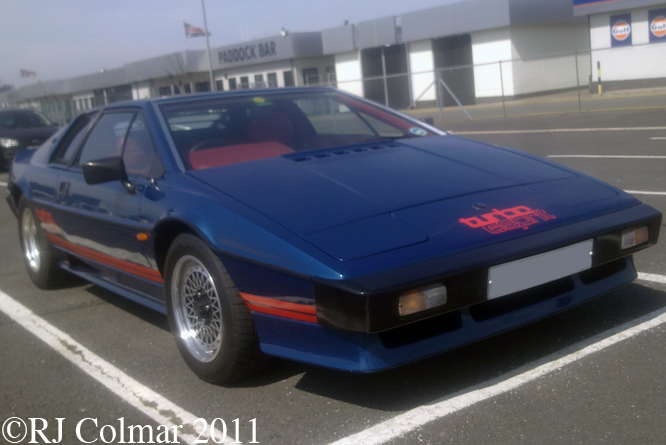
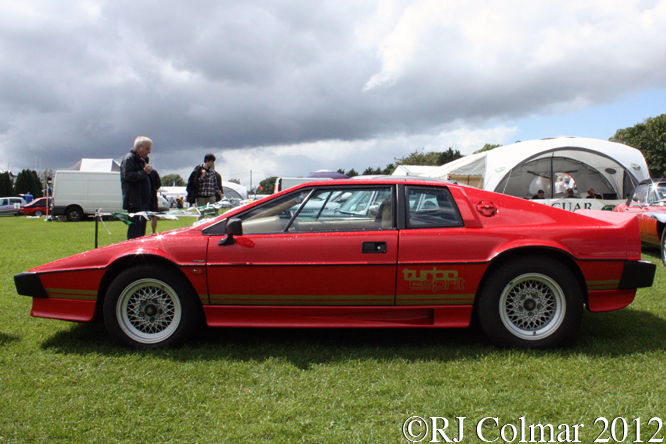
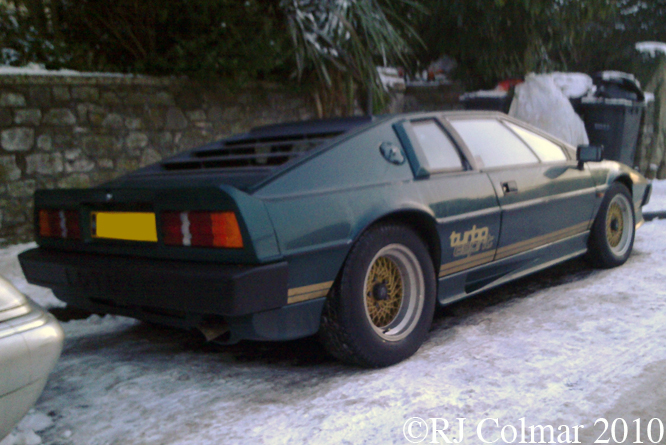
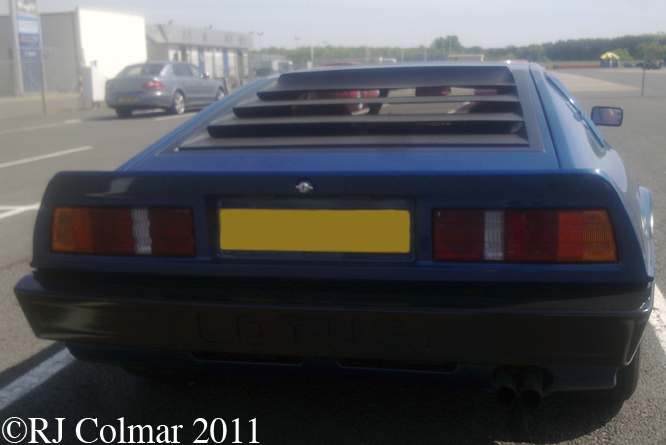
Not A Bolt On – Lotus Turbo Esprit Type 82

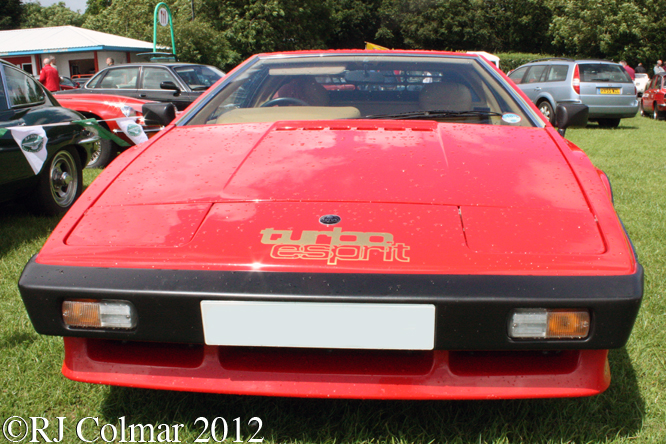
In 1979 Monaco based oil traders Essex Petrolium joined Martini as sponsors of the Team Lotus Formula One team, something that Martini were not too thrilled with as they decided not to pursue there sponsorship for a second year. For 1980 Essex became the teams primary sponsor which carried over into Lotus production car operations with the launch, at the Royal Albert Hall, of the Lotus Turbo Esprit as a limited edition Lotus Essex Turbo Esprit of which just 100 were built in 1980 and 1981.

Lotus Turbo Esprit, Classic and Sports Car Action Day , Castle Combe

Unlike the single carburetor bolt on turbo that Lotus dealers Bell & Colvill had been offering customers since 1978 the official Lotus Turbo Esprit was a substantial upgrade of the normally aspirated Lotus Esprit Type 79, which included a new chassis with a wider engine bay, new front suspension derived from the latest Lotus Elite, new rear suspension and a new 210 hp type 910 development of the 4 cylinder Type 907 motor with twin carburetors and Garrett T3 Turbocharger.

Lotus Turbo Esprit, Silverstone Classic

After the production run of 100 Lotus Essex Turbo Esprit’s had been completed a variation of the originals blue red and silver colour scheme was offered with red leather interior like the one seen above in the Paddock at Silverstone which features rare three piece Compomotive wheels as used by James Bond in the 1981 film “For Your Eyes Only“.

Lotus Turbo Esprit, Classic and Sports Car Action Day , Castle Combe

Most Turbo Esprit’s were supplied with one piece BBS wheels. The Turbo Esprit body work is differentiated from earlier Giorgetto Giugiaro designed Esprit body by the addition of a front below the bumper spoiler and side “skirts” with NACA air ducts for the engine bay.

Lotus Turbo Esprit, Bristol

The significance of the wider engine bay of the Turbo Esprit’s new chassis would not become clear until the launch of the V8 Esprit which although initially developed alongside it’s turbo sibling did not come to market until 1996 having been delayed by numerous other projects including Colin Chapman’s involvement with De Lorean.

Lotus Turbo Esprit, Silverstone Classic

Although well received by the press the Turbo Esprit failed to gain a substantial foot hold anticipated in the USA and the 846 examples built between 1980 and 1984 marked the beginning of a steady decline in the fortunes of Lotus Cars.

Thanks for joining me on this “Not A Bolt On” edition of “Gettin’ a li’l psycho on tyres” I hope you will join me again tomorrow. Don’t forget to come back now !
Share

Rare Spyder – Ferrari 365 California Spyder #9985

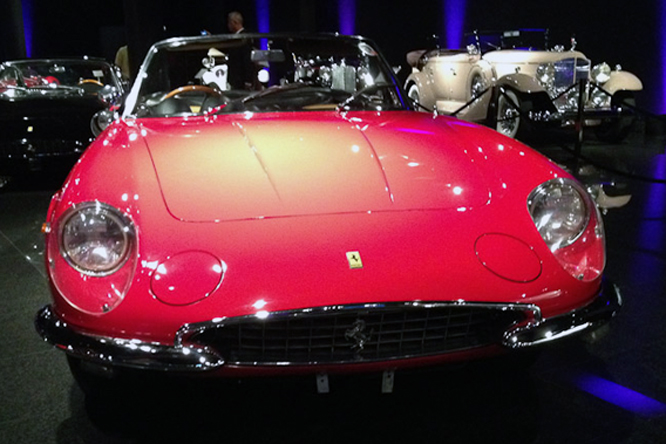
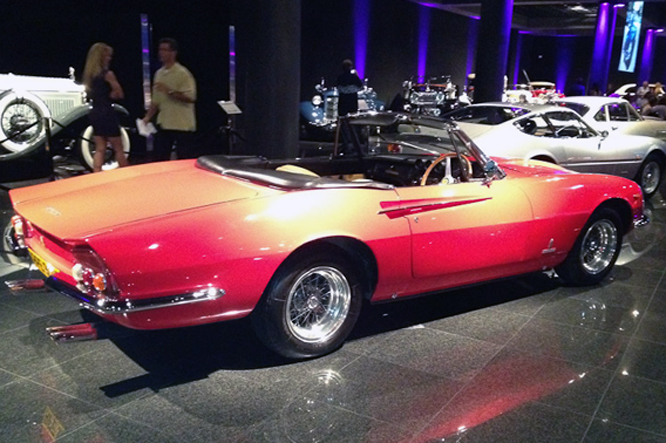
At the 1966 Geneva Motor Show Ferrari revealed two new models the Ferrari 330 GTC and today’s featured car, thanks to Geoffrey Horton’s photographs, the Ferrari 365 California Spyder of which just 14 would be built.

Ferrari 365 California, Danville Concours d'Elegance

The 365 California Spyder is fitted with a 320 hp 4.4 litre / 268 cui V12 which is fitted to a 5 speed synchromesh gearbox and is covered by Pininfarina coachwork which features a split front bumper as first seen on the 500 Superfast Coupé and rear vents behind the front doors which would become a feature of the mid-engined Dino 246.

Ferrari 365 California, Danville Concours d'Elegance

Being equipped with Right Hand Drive this car is easy to identify as chassis #9985, the 10 th of the 14 built and the only one to be so equipped. The expired rear UK plate RPE 909 E which was registered to Mark Tippets when he owned the car in 1986 is also a bit of a give away.

#9985 was sold to Paul Kay in June 1967 painted Blue Sera with a biege interior over the next two years the car had 3 further owners with the registration changing from “NJD 8E”, “L11” to “MNV258E” before Mark Tippets ownership. Since then the car was seen with the number “2UAE” from July 1986 to July 1990, a number still available to the owner if the car ever returns to the UK.

The car was first painted red during a restoration carried out in Florida between 1983 and 1985.

My thanks to Geoffrey Horton for his photographs of this rare and magnificent vehicle.

Thanks for joining me on this “Rare Spyder” edition of “Gettin’ a li’l psycho on tyres” I hope you will join me again tomorrow. Don’t forget to come back now !
Share