Tag Archives: GALPOT

All or Nothing – Hispano-Suiza H6

Aged just 22 French Captain Georges Guynemer is reported as having downed 53 enemy planes before Hisano Suiza powered Spad XIII disappeared on the 11th of September 1917 for the final time somewhere north east of Ypres. The captain, who’s best known maxim was “Until one has given all, one has given nothing”, had already survived being shot down seven times, well before parachutes had become either reliable of issued to pilots. After the Great War of 1914/18 Hispano Suiza adopted the stork symbol of Alsace which Guynemer had painted on the side of his Spad as their radiator mascot.
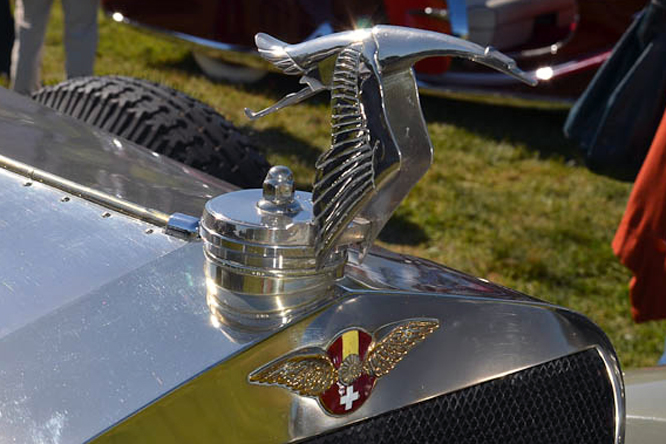
Huispano Suiza H6, Marin Sanoma Concours d’ Elegance

In 1919 Hispano Suiza designer Marc Birkigt brought his Type 41 to fruition which became known as the H6. Having been amongst the pioneers to develop shaft driven overhead cam shafts and amongst the innovators of joined up motor and gearbox housings with earlier models the H6 featured a 135 hp light alloy mono block six cylinder overhead cam motor that, although noisier than the competition in the form of the Rolls Royce 40/50 with it’s push rod operated side valve cast iron twin block straight 6 cylinder motor, produced a full 50 hp more than it’s contemporary from Derby England.
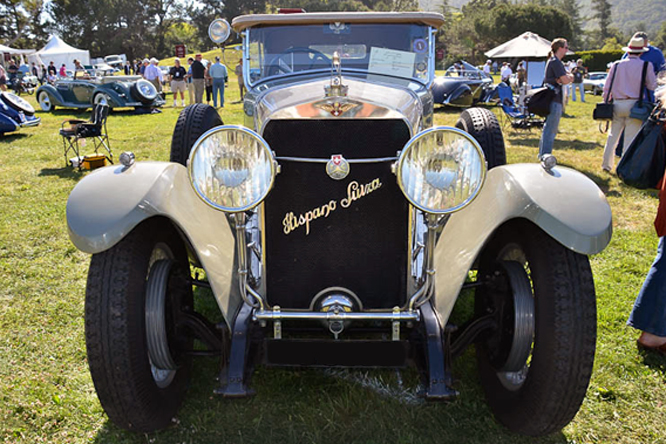
Huispano Suiza H6, Marin Sanoma Concours d’ Elegance

The H6 was not only more powerful than it’s contemporaries but it the first to adopt power assisted four wheel brakes as standard, leaving Rolls Royce, Lanchester and Napier with their unassisted two wheel brakes well behind when in the safety stakes. Indeed Rolls Royce were quick to acquire a license to replicate Birkigt’s power assisted four wheel braking system on their own models. Rolls Royce would continue to use the Hispano Suiza braking system until the introduction of disc brakes on it’s Silver Shadow model in 1965.
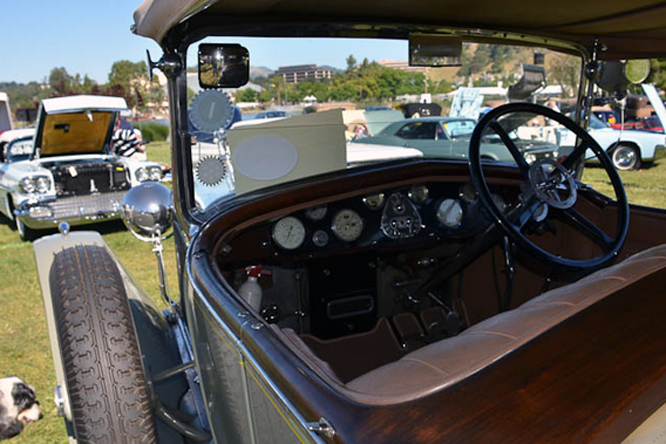
Huispano Suiza H6, Marin Sanoma Concours d’ Elegance

Hispano Suiza counted not only Royalty, including the King of Spain, and the nouveaux riche of Hollywood amongst it’s H6 clientele but also French alcohol heir, Spad XIII flying ace, athlete, inventor and race car driver André Dubonnet who entered his H6 in the 1921 Coupé Boillot sports car race run in Boulogne which he promptly won.
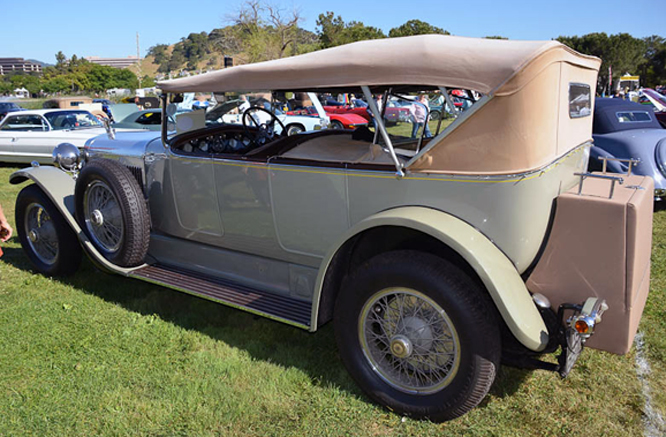
Huispano Suiza H6, Marin Sanoma Concours d’ Elegance

The 6,597cc / 403cui H6 like this 1925 example, which resided in the UK until 2000, gained a larger 8 litre / 488 cui H6B sibling in 1922 with the H6C series in 1924 using only the larger motor. In all 2,350 H6s of all types, including a unique 6 wheel H6 built for feature length film pioneer and director D.W.Griffith, are thought to have been built between 1919 and 1933.

My thanks to Geoffrey Horton for sharing his photographs taken at this years Marin Sanoma Concours d’Elegance.

Thanks for joining me on this “All or Nothing” edition of “Gettin a li’l psycho on tyres”, I hope you will join me again tomorrow. Don’t forget to come back now !

Share

Mario & Ronnie Show – Lotus Ford 79 #79/2 & #79/3

John Player Team Lotus hit the track running in 1978 with Mario Andretti winning the opening race of the season in Argentina and his team mate Ronnie Peterson winning the third race of the season after a thrilling last couple of laps in South Africa. Both of these victories were achieved with the previous seasons Lotus Ford 78 ‘wing car design’ for 1978 Colin Chapman and his engineers came up with something even more refined in the shape of today’s featured car the ‘ground effect’ Lotus Ford 79.

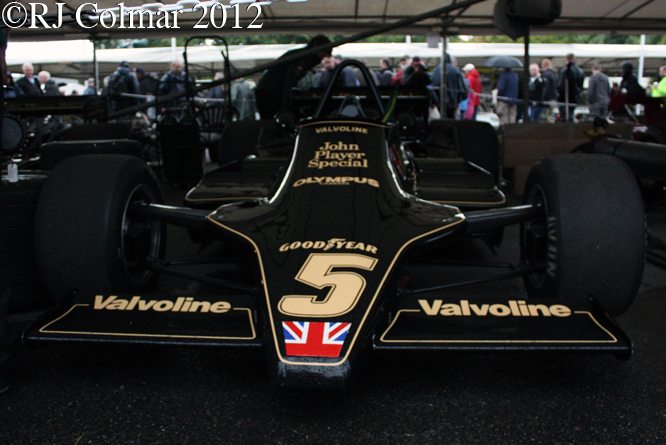
Lotus Ford 79, Goodwood, Festival of Speed

The Mario Andretti first raced a Lotus 79 in the non championship International Trophy race at Silverstone a race well remembered because the front row qualifiers Ronnie Peterson and Niki Lauda both spun of on the warm up lap leaving Andretti and James Hunt to start at the front of the grid despite qualifying 3rd and 4th. Andretti only lasted two laps before he spun out with Hunt spinning out one lap earlier at the same spot.

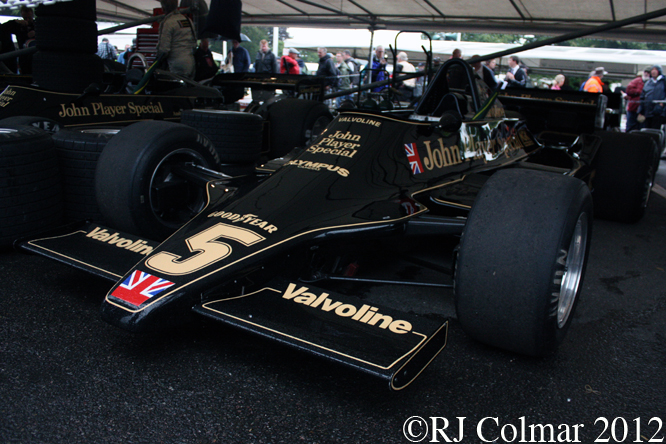
Lotus Ford 79, Goodwood, Festival of Speed

However for the Belgium Grand Prix there were no mistakes Mario qualified on pole and won, driving I believe from Ronnie who started 7th in the older Lotus Ford 78. At the Spanish Grand Prix Mario was I believe given the #79/3 seen above while Ronnie took over Mario’s Belgium winning #79/2 seen below. Mario qualified on pole and Ronnie 2nd and that is how the Spanish Grand Prix finished.

Lotus Ford 79, Goodwood, Festival of Speed

Mario retired from the Swedish Grand Prix after qualifying on pole leaving Ronnie to finish 3rd behind the controversial Brabham fan cars of Lauda and Watson. Bernie Ecclestone chose to withdraw the Brabham BT46 fan cars after just one race. At the following French Grand Prix Mario qualified 2nd and Ronnie 5th, however they finished 1st and 2nd respectively for the 3rd time in the 1978 season.

Lotus Ford 79, Goodwood, Festival of Speed

For the British Grand Prix it was Ronnie and pole and Mario next to him but both cars retired. In Germany Mario qualified on pole with Ronnie sat next to him on the grid and by now unsurprisingly that is how they finished the race. In Austria Ronnie was again on pole with Mario starting second however Mario retired leaving Ronnie to take an unchallenged win which would prove to be his last.

Lotus Ford 79, Goodwood, Festival of Speed

At the Dutch Grand Prix Mario qualified on pole in #79/3 with Ronnie beside him in #79/2 and the pair duly took their fifth and final 1-2 result of the season. This would prove to be Mario’s last Grand Prix win and indeed the last for any American driver and Ronnie’s last ever finish too. Ronnie crashed #79/2 during practice for the Italian GP and started the race from fifth in an older Lotus 78 while Andretti started from pole in the latest #79/4. Ronnie was involved in a start line accident which broke his legs, unfortunately during the night bone marrow from his injuries got into his blood stream and he died the following morning. The race was restarted and a subdued Mario finished sixth which was enough to claim the championship, but in truth Mario was far more concerned for Ronnie with whom he had been good friends since there time as team mates driving Ferrari sports cars in the early 1970’s. Ronnie for the second time in his career finished second in the World Drivers Championship.

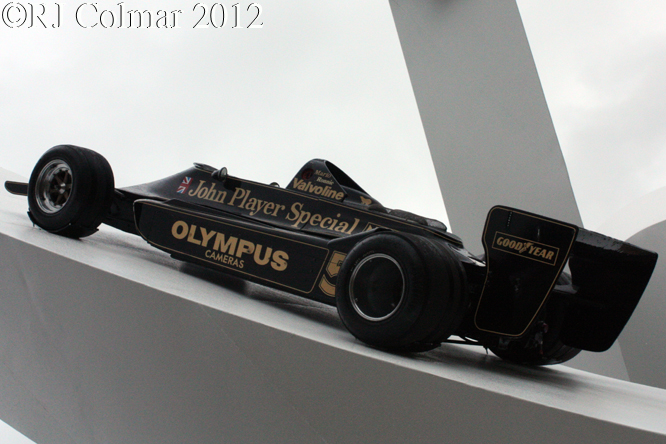
Lotus Ford 79, Goodwood, Festival of Speed

The success of the Lotus 79 was largely due to what was happening to the airflow beneath the bodywork, by building the monocoque just wide enough to hold the driver with fuel tank behind him and the motor behind that, Colin Chapman and his engineers Peter Wright, Geoff Aldridge, Martin Ogilvie and Tony Rudd used the side pods to create venturi by using a low wide neck at the front entrance to the side pods and tall wide exit, with side skirts sealing airflow under the car. When the car was moving air was guided into a partial vacuum created between the venturi side pods under surface and the surface of the road and this had the effect of sucking the car to road which allowed the car to negotiate corners at higher speeds than their competitors, most of whom had still not got to grips with the wing car aerodynamics advanced by the previous years Lotus 78.

For the last two races of the 1979 season perennial Formula One under achiever Jean Pierre Jarrier joined Mario in the team Mario qualified on pole in the USA with J-PJ 8th but neither car finished in the US Grand Prix. The final race of the season was held in Canada where Mario could only qualify 9th and Jean Pierre sat on pole. During the race Jean Pierre looked set for a win until he retired with an oil leak.

Mario finished tenth. The Lotus 79’s were set to be replaced by even more radical Lotus 80’s in 1979 but everything did not go to plan and so the 79’s were pressed into service again for most of the season but were out classed by their competitors who were getting to grips with ground effects aerodynamics.

A little post script courtesy Barry Boor, Mario Andretti was invited to drive the inauguration lap of the next home of the United States Grand Prix at Circuit of the America’s on October 21st, the car he drove was naturally a Lotus Ford 79 with which he won his world Championship, you can see how he got on in this linked youtube clip.

Thanks for joining me on this “Mario & Ronnie Show” edition of “Gettin’ a li’l psycho on tyres, I hope you will join me again tomorrow. Don’t forget to come back now !
Share

No Side Vent Windows – Ferrari 250 GT Pininfarina Series I Cabriolet

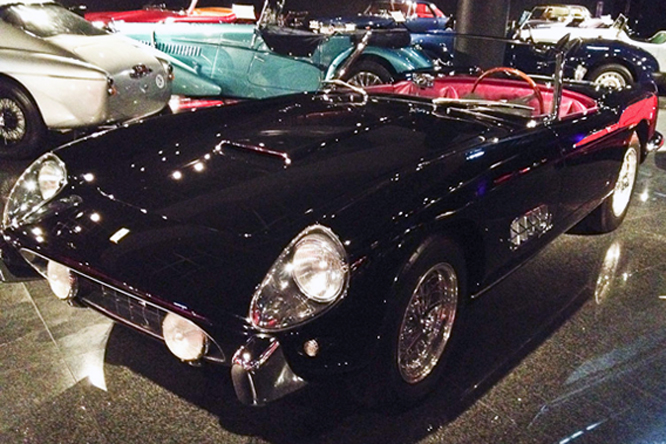
In 1957 Ferrari launched the Ferrari 250 GT Pininfarina Series 1 Cabriolet with a list price if $14,950 over $3,000 more than the Ferrari 250 GT California Spyder.

Ferrari 250 GT Pininfarina Series 1 Cabriolet, Danville Concours d'Elegance

The 250 GT Pininfarina Series 1 Cabriolet was better appointed with more sound proofing and more comfortable than the shorter wheel base 250 GT California Spyder.

Ferrari 250 GT Pininfarina Series 1 Cabriolet, Danville Concours d'Elegance

This car is on of just six Ferrari 250 GT Pininfarina Series 1 Cabriolets to have the fender vents that were a feature of the California Spyder. To tell a Ferrari 250 GT Pininfarina Series I Cabriolet apart from a Ferrari 250 GT Pininfarina Series II Cabriolet one only has to look to see if either of the long wheel base cars has side vent windows, the 42 Series I cars did not have them while the 200 Series II cars did have them fitted.

My thanks to Geoffrey Horton for sharing his photo’s taken at Danville Concours d’Elegance.

Thanks for joining me on this “No Side Vent Windows” edition of “Gettin’ a li’l psycho on tyres” I hope you will join me again tomorrow. Don’t forget to come back now !
Share

From the Good Guys In White Hats – Dodge Charger

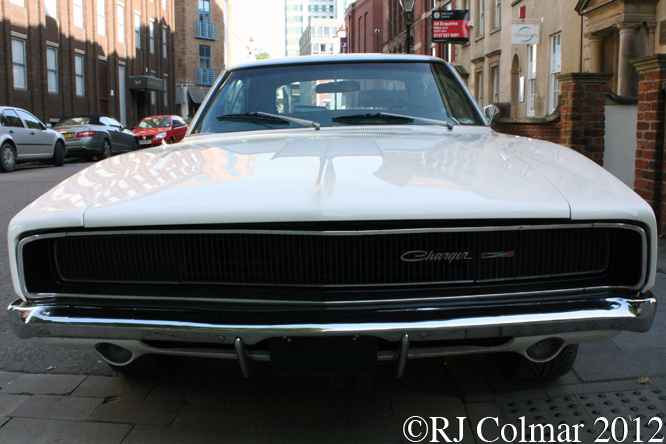
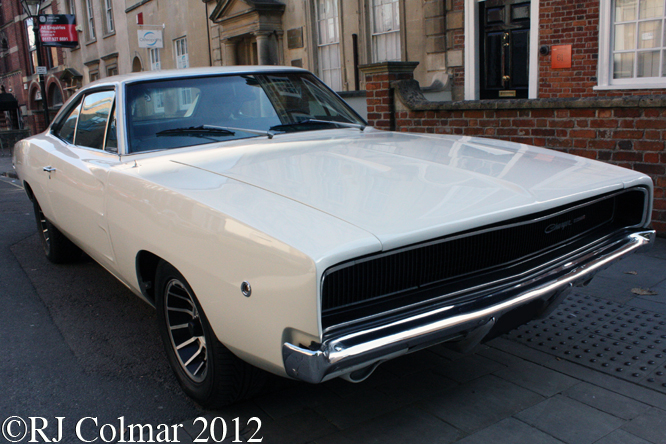
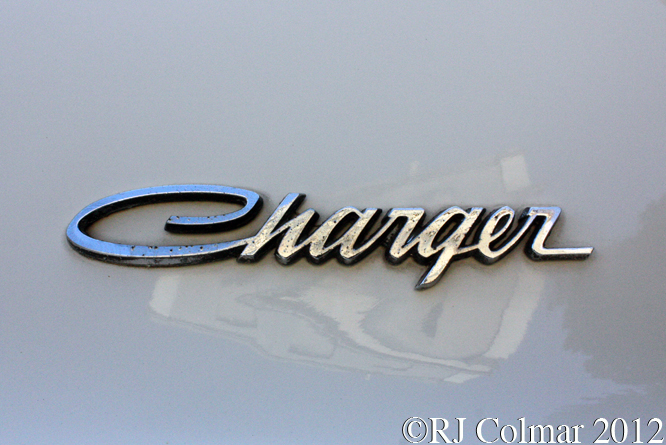
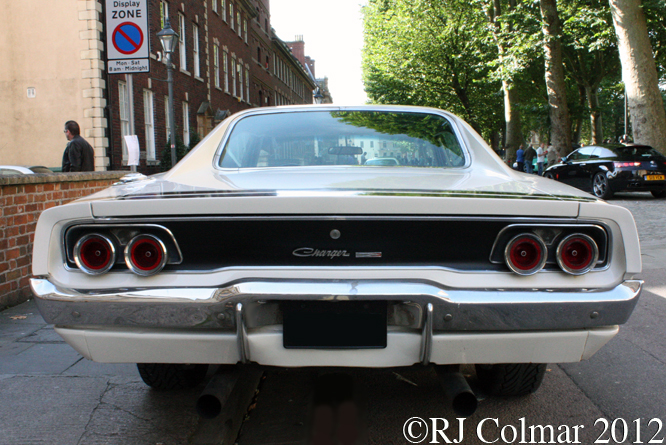
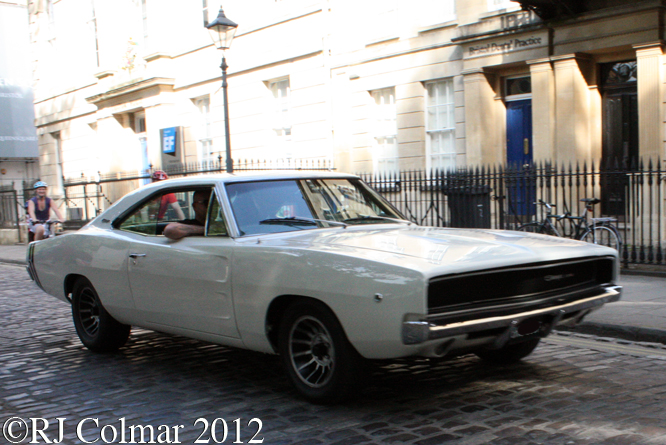
The second generation Dodge Charger was launched in 1968 with a commercial cartoon urging customers to visit “those great Dodge boys they’re the good guys in white hats.”

Dodge Charger, Avenue Drivers Club, Bristol

The new body was designed by a team that included Richard Sias who was responsible for the overall profile.

Dodge Charger, Avenue Drivers Club, Bristol

Engine options included a standard 5.2 litre / 318 cui V8 a 3.7 litre / 225 cui straight six, a 7 litre / 426 cui Hemi or a 7.2 litre / 440 cui Magnum was available for the top of the range R/T versions. This particular car appears to be powered by a 6.3 litre V8 which was available with either 290 hp 2 barrel carburetor or 330 hp 4 barrel carburetor variations.

Dodge Charger, Avenue Drivers Club, Bristol

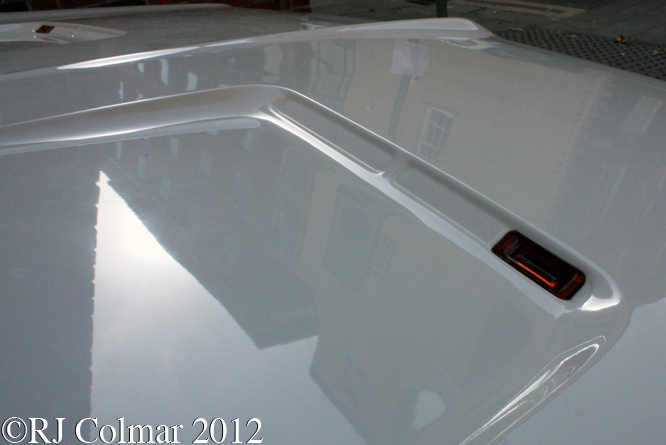
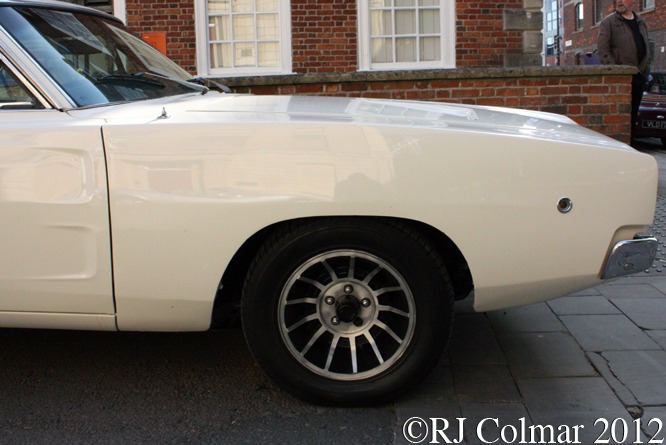
The dual scallops on the bonnet / hood

Dodge Charger, Avenue Drivers Club, Bristol

and front doors added to the performance “Lets stir things up a bit” appearance of the car despite there complete non mechanical or aerodynamic functionality.

Dodge Charger, Avenue Drivers Club, Bristol

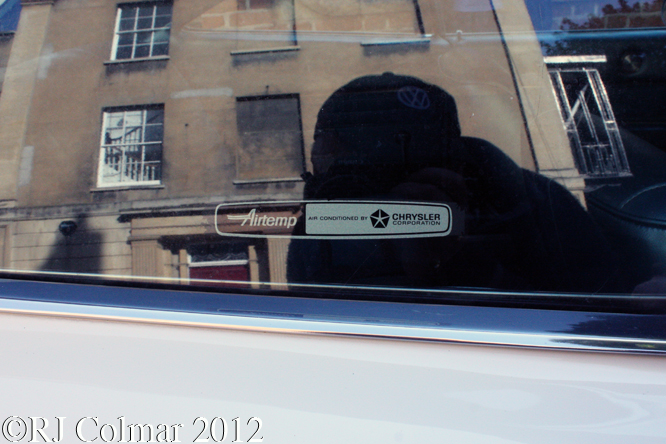
Among the options for the Charger was air conditioning, cruise control, electric door locks, tachometer, rear window demister, and a wood-grain steering wheel.

Dodge Charger, Avenue Drivers Club, Bristol

Safety options included head restraints for the front seats, lap belts for center seat passengers, shoulder belts front and rear and a padded steering wheel.

Dodge Charger, Avenue Drivers Club, Bristol

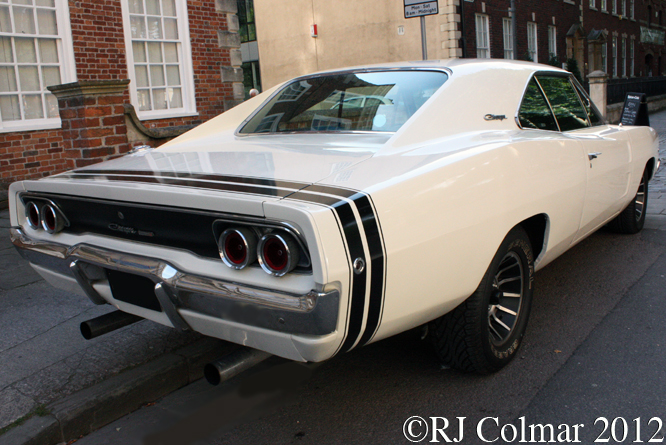
The integrated rear spoiler mimicking aerodynamic devices seen on Can Am and sports car racers of the period further enhanced the competition bred appearance of the Charger, the paired round rear lights were added at the suggestion of Styling Vice President, Elwood P. Engel.

Dodge Charger, Avenue Drivers Club, Bristol

Around 96,100 Chargers were built in the 1968 model year, 75% of which were fitted with factory option Vinyl roofs. 17,000 top of the range R/T Chargers were built of which just 500 were fitted with the fabled 426 Hemi.

Dodge Charger, Avenue Drivers Club, Bristol

The ’68 Charger, which share the same platform with the Dodge Coronet, is probably most famous for it’s movie appearance in Bullitt, which features a couple of hit men in a black Charger R/T dualing for tarmac with Steve McQueen driving his green Mustang GT. By all accounts the R/T was the superior machine.

Thanks for joining me on this “From the Good Guys In White Hats” edition of “Gettin’ a li’l psycho on tyres”, I hope you’ll join me again for Ferrari Friday tomorrow. Don’t forget to come back now !
Share

Wolly Bulli – Volkswagen Type 2 (T2)

In the Autumn turn of 1982 twenty odd college class mates and I made our way from the Untied Kingdom to Paderborn University for the first half of the third year of our European Business Studies course. I overslept on the train and ended up a hundred kilometers further east than intended in Kassel having missed my stop, but I digress.

VW Type 2 (T2) Kombi, Paderborn, Germany

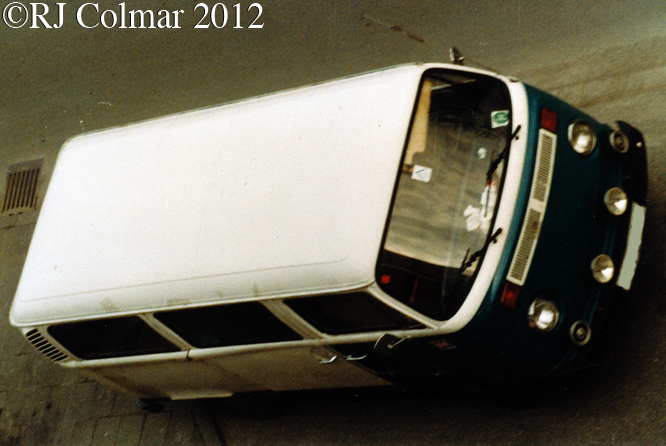
Once in Paderborn we soon made friends with our fellow German students some of whom had banded funds together to buy a late bay VW Type 2 (T2b) Kombi seen above, in Germany these vehicles are known locally as “Bulli”. The Type T2 (T2) was first seen in 1967, it was wider and longer than it predecessor the Type 2 (T1) which I looked at last week. The motor was slightly larger starting at 47 hp wich increased to 70 hp by the mid 1970’s, but the real improvements were in low end torque which helped this heavy vehicle keep pace with the rest of the traffic.

VW Type 2 (T2) Kombi, Paderborn, Germany

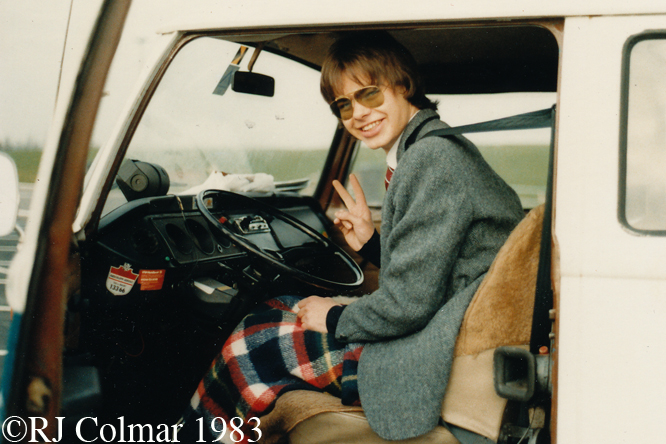
Above I can be seen sitting at the wheel of my friends Type 2 wrapped in a blanket in the middle of February as I was about to return from Wolsburg where I had a placement at Volkswagen to Paderborn. To reduce the intake of exhaust fumes, because the heat exchangers were breaking up, the heating pipes were blocked up and the windows were kept open hence the blanket was necessary to keep warm in the well ventilated unheated bus.

Type 2s went through three distinctive body developments from ’67 to ’71 the early bay T2a was characterised by low front indicators and rear light clusters inherited from the Type 2 (T1), from ’71 to the early 1990’s the late bay Type 2 (T2b) is characterised by high front indicators and larger vertical oblong rear light clusters. By the early 1990’s production in Mexico and Brazil moved to the Type 2 (T2c) which has a raised roof and the latest models now built only in Brazil have duel fuel water cooled engines which run on petrol or ethanol.

Type 2 (T2) Camper, Shakespeare County Raceway

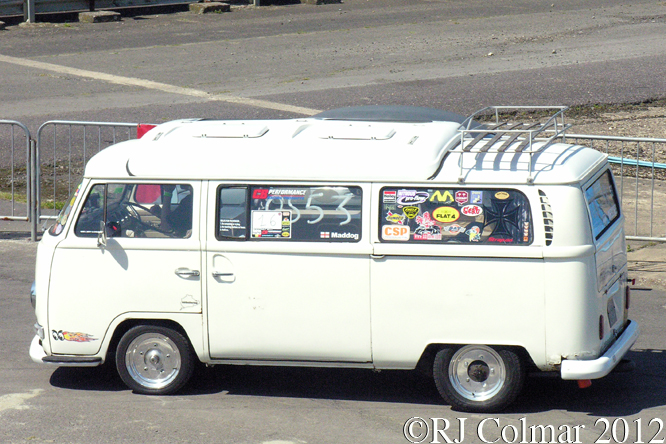
Chris Maddog Antell’s VW Type 2 camper van seen above at Shalespeare County Raceway is an early bay Type 2 (T2a) with low front indicators and small rounded rear light clusters he runs it with a 2276 cc / 138 cui motor of yet to be determined origin, if you know please do not hesitate to chime in below.

Volkswagen Type 2 (T2c), The Classic Motor Show, NEC, Birmingham

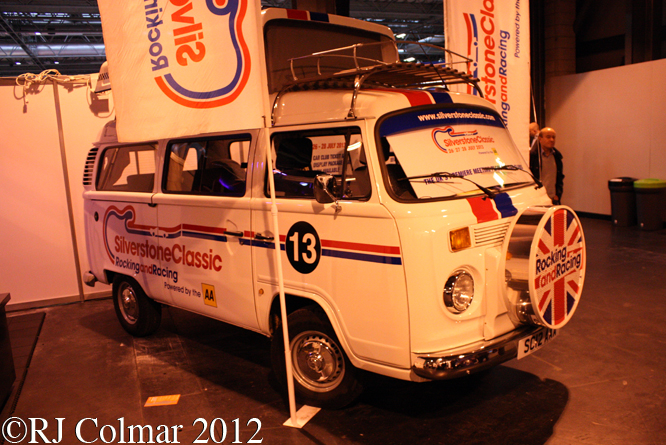
The Type 2 (T2c) as seen above at The Classic Motor Show is still in production in Brazil a couple of years ago they were being manufactured at a rate of 100 a day, some of these vehicles can be seen in Europe where they are often used as camper vans. The latest news courtesy of mariner at The Nostalgia Forum is that Type 2 (T2c) production is planned to come to a halt in Brazil next year.

Thanks for joining me on this “Wolly Bulli” edition of “Gettin’ a li’l psycho on tyres”. I hope you will join me again tomorrow. Don’t forget to come back now !
Share

The Sunlight Textile Services – Pegasus Sprint

Last Saturday I had another 6am start, but this time not to go and spectate at an event but to act as a marshall for the The Sunlight Textile Services Pegasus Sprint run by the Bristol Pegasus Motor Club. Despite a healthy breakfast which included melon, tangerine, kiwi and a banana by the time I got through signing on I was ready to wolf down a traditional Full English Heart Attack in the Castle Combe Canteen. Even with long johns double layer trousers, three fleeces and a coat I was going to get cold under the cloudless skies with temperatures peaking at 8 degress C but with the wind chill factor making it feel like 9 below zero.

Lotus MG Mk 6, Bristol Pegasus MC Sprint, Castle Combe

In between my second breakfast and the marshalls briefing I managed to snap Jack Taylors 1954 Lotus MG Mk VI this car is chassis #6-18 in theory the 24th Lotus ever built, it’s powered by an MG XPAG motor and appears to have a one off body, quite possibly by Williams and Pritchard though I have yet to confirm that.

Lotus Mk 6, Bristol Pegasus MC Sprint, Castle Combe

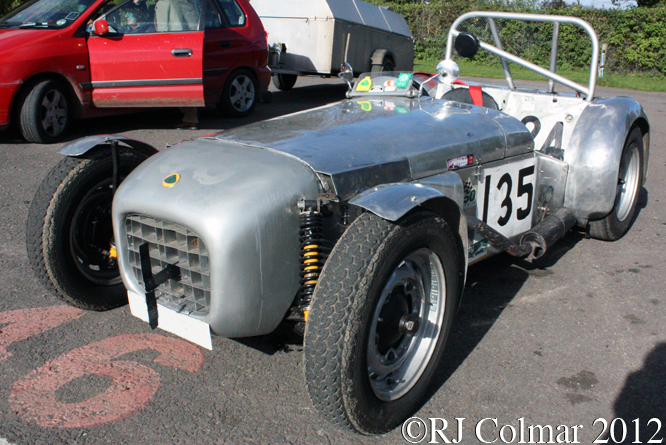
Wondering around the pits during the half hour lunch break I managed to take a few more photo’s including John Marshall’s Lotus Mk VI, followers of my blogs at the much missed Rowdy.com, and I know there are one or two of you, will remember me originally mis recognising this car as a Lotus 7. Many mis recognitions since I have found out it was also originally supplied with an MG motor and gearbox which has since been swapped for a Ford 100E motor and Triumph gearbox. In John’s hands this car has won at least 54 trophy’s most no bigger than egg cups.

MK K3, Bristol Pegasus MC Sprint, Castle Combe

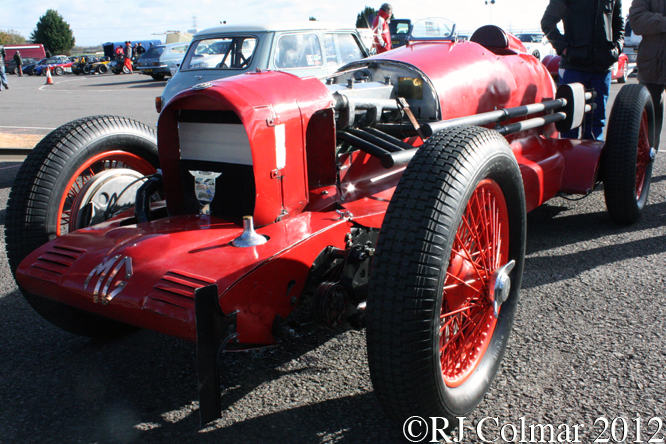
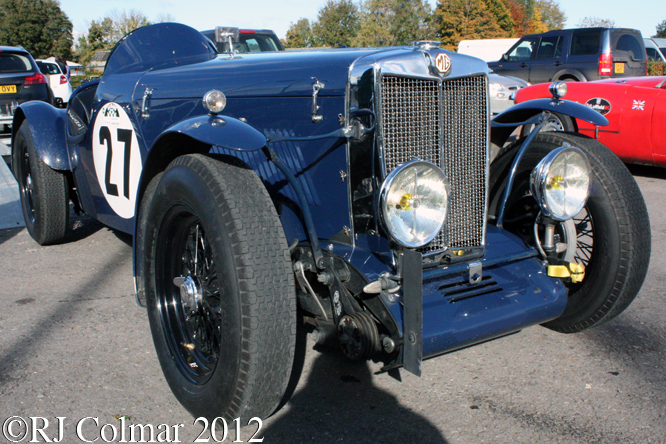
Perhaps the most extraordinary car and for my money cor of the day was Jeremy Hawkes 1933 MG K3, built as on offset single seater to compete at Brooklands where like the 24 litre “Napier Railton” it holds a record in perpetuity, for vehicles up 1100 cc / 67.126 cui having recorded laps in excess of 120 mph.

MG TA Midget, Bristol Pegasus MC Sprint, Castle Combe

Anthony Smith brought his 1937 MG TA along to compete in the production road going A2 class.

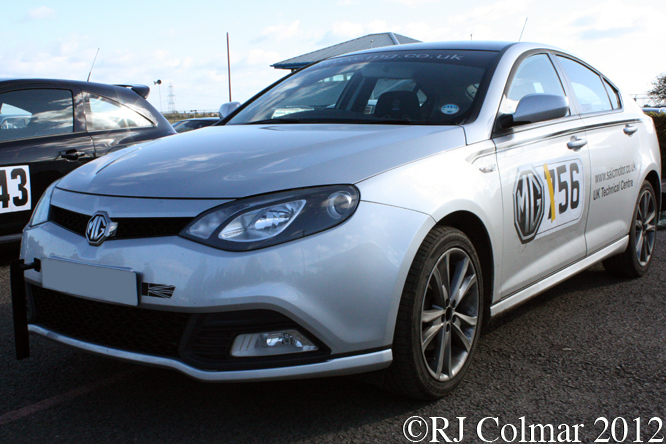
MG A Coupé, Bristol Pegasus MC Sprint, Castle Combe

This was only the second occasion on which I have ever seen a contemporary MG A Coupé this one was driven by Martin Wollacot in Class A2.

Bristol 403, Bristol Pegasus MC Sprint, Castle Combe

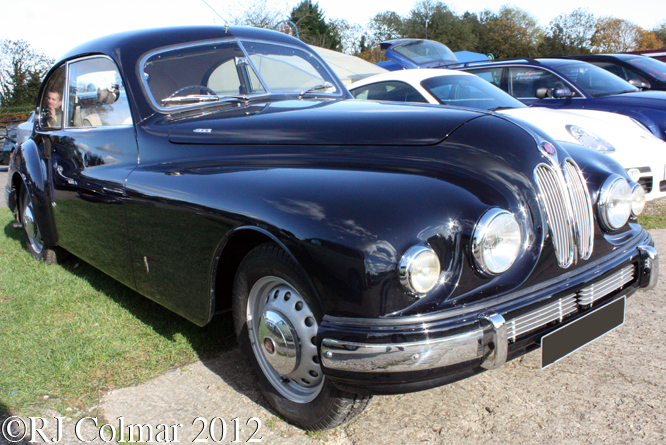
Regular readers might recognise this Bristol 403, which was not competing from the first Coffee Croissant and Cars blog I posted back in April.

SEAT Leon Tdi, Bristol Pegasus MC Sprint, Castle Combe

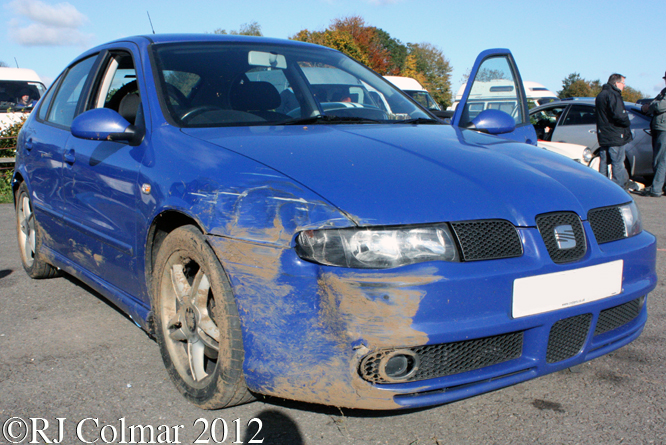
SEAT’s León Cupra R (Typ 1M) was voted 7th best hatch back of all time in a poll conducted by Autocar in 2010, four years after production had switched to the newer Typ 1P. This 2004 Tdi Cupra R shows signs of how tricky the conditions were forcing the brothers who competed with it to go home after the practice sessions were completed to repair the damage which was incurred some where between Avon Rise and Quarry Corner during the second practice runs.

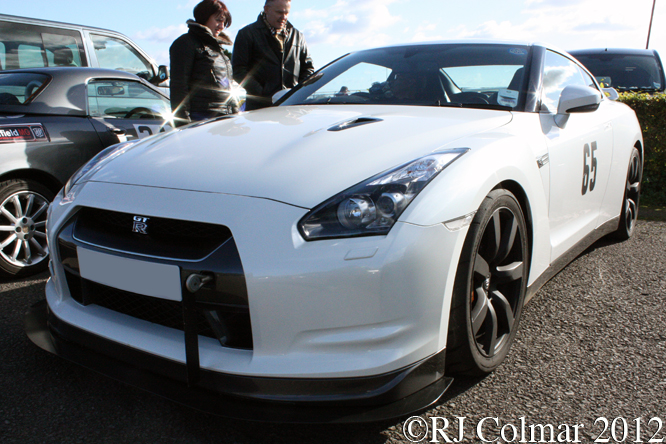
Nissan GTR R35, Bristol Pegasus MC Sprint, Castle Combe

Richard Girling was running his 1st generation 2009 all wheel drive Nissan GTR R35 in the most powerful A4 road going series production class, his car left the factory with 478 hp and a conservative 193 mph capability matched by a rest to 60 mph of 3.2 seconds. Needless to say the car looked quick on the track.

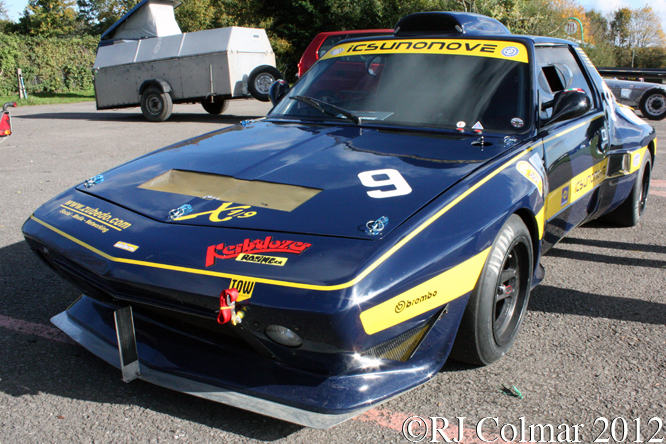
FIAT X1/9, Bristol Pegasus MC Sprint, Castle Combe

Micheal Kason was running his 2 litre / 122 cui FIAT X1/9 in the modified limited prodiction class C3, notice it sits on slick tyres which would not have been easy to heat up in the prevailing conditions.

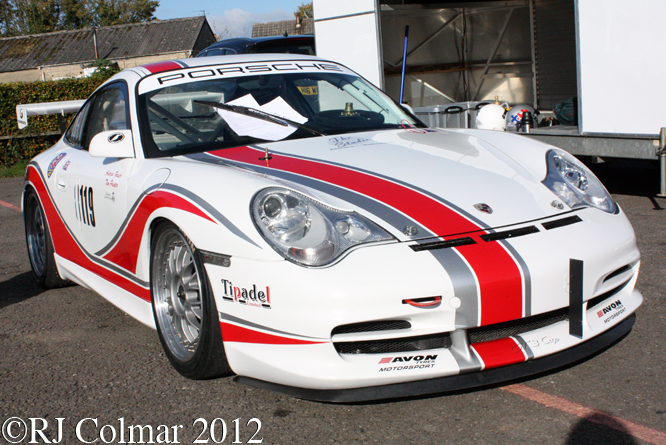
Porsche 911 GT3, Bristol Pegasus MC Sprint, Castle Combe

Running in the largest C4 modified production class were Andrew Fraser and Tim Painter in this 2004 Porsche (996) 911 GT3. This car is for sale at £37,500, if you would like Andrew and Tim’s phone numbers send me an e-mail and I’ll gladly forward the details, usual disclaimers apply.

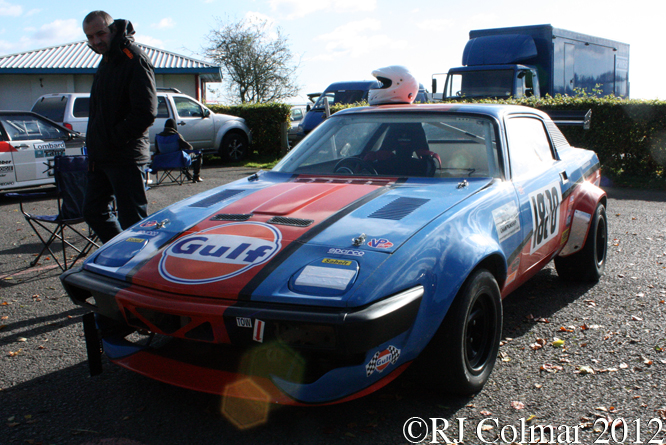
Triumph TR7 V8, Bristol Pegasus MC Sprint, Castle Combe

Last runners of the day were David Hardcastle and Simon Allaby who were competing in the Revington TR / TR Register Sprint & Hillclimb Championship.

Darrian T98-GTR, Bristol Pegasus MC Sprint, Castle Combe

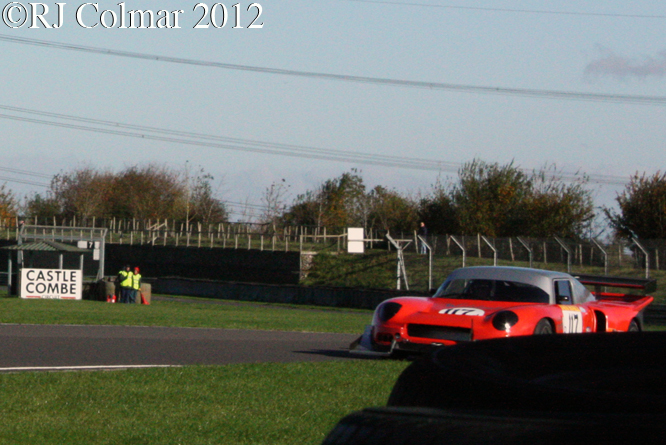
I did not manage to get many photographs of the on track action but while taking a break from marshaling duties I did get a photo of Ian Hall’s 5.2 litre / Darrian T98 GTR which set fastest time of the day by nearly ten seconds.

Thanks to a combination of few too many thrills and spills with short hours of sunlight competitors only got one timed run in before the event started to get too far behind schedule for everyone to get a second time in. Out at Tower we were great full for the hour or so this spared us standing in the delightful sunshine but freezing wind.

Thanks for joining me on this “The Sunlight Textile Services – Pegasus Sprint” edition of “Gettin’ a li’l psycho on tyres”, I hope you will join me tomorrow. Don’t forget to come back now !
Share

Improving The Breed ? – Lotus Elite Type 75

A couple of weeks ago I went to a Q&A session hosted by the voice of British motor sport Murray Walker with Formula One designers Frank Dernie and Niel Oatley, one of the questions was about the carry over of Formula One technology to road car production and both vigorously nodded in the negative. However that does not mean if you win on Sunday you will not sell on Monday anymore than winning on Sunday will guarantee selling on Monday either. If there is any benefit to manufacturers racing on Sunday it is in the commodity of Brand awareness. Similarly by the 1970’s road car manufacturers like Lotus and Ferrari had found that road car manufacture was never going to meet all the expenses of racing in the sports top table, though Enzo Ferrari did his best to keep the toothpaste manufacturers off his cars for as long as possible while Colin Chapman bit the commercial sponsorship bullet at the earliest opportunity in 1968.

Lotus Elite Type 75, Classics at the Castle, Sherbourne

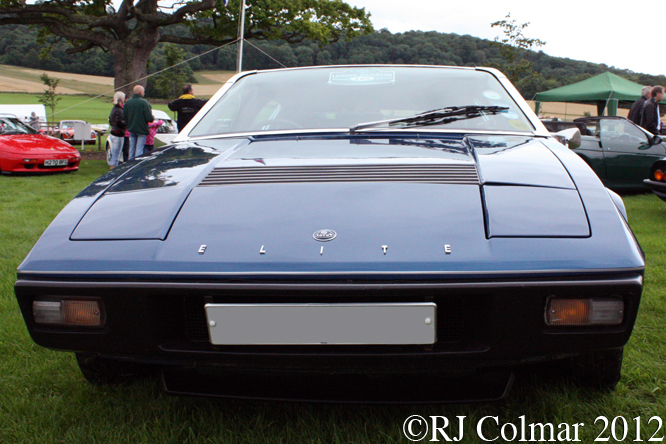
Either way in 1974 Lotus launched it’s new 2+2 Lotus Elite, it is not recorded how or if Ronnie Peterson’s three wins in the ageing Lotus 72 during 1974 aided sales or not. The 907 aluminium bloc motor for the new car was partly developed on the track by the noisy 1969 Lotus 62 sports car which I looked at a couple of months ago.

Lotus Elite Type 75, Classics at the Castle, Sherbourne

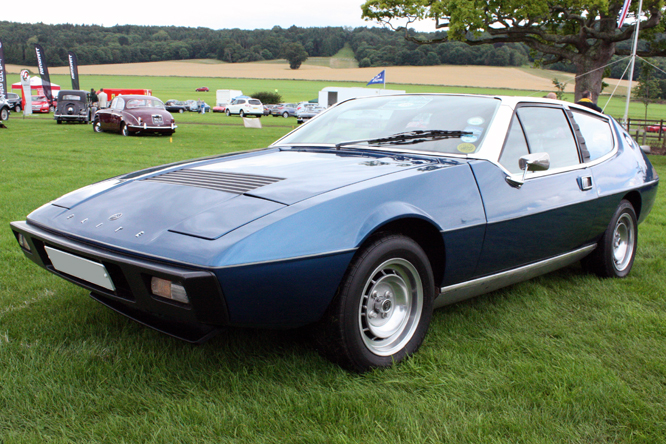
The chassis of the Type 75 Elite was the latest development of the back bone type first seen in the Lotus Elan in 1962 with independent suspension front and rear.

Lotus Elite Type 75, Classics at the Castle, Sherbourne

The only time I have come close to speaking to Mario Andretti was in 1979 while I was ambling along from the pits at Silverstone to the campsite on a beautiful summers evening with a large crowd of people during the 1979 British Grand Prix meeting. Behind me I felt something touch my leg, when I looked round to see what it was there was a blue Lotus Elite and at the wheel was none other than reigning World Champion Mario Andretti at the wheel, I was speechless as I stood aside to let him pass.

Lotus Elite Type 75, Classics at the Castle, Sherbourne

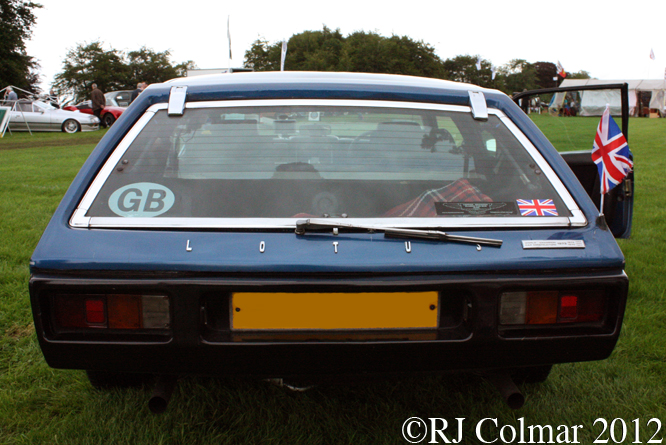
The Lotus Elite Type 75 was phased out in 1982 with 2,820 units built. A second variation, Elite Type 83, was built between 1980 and 1983 with just 153 units built. It is thought that less than 100 Elite type 75’s like this 1976 example are to be found on British roads today.

Thanks for joining me on this “Improving The Breed ?” edition of “Gettin’ a li’l psycho on tyres” I hope you will join me again tomorrow. Don’t forget to come back now !
Share