Tag Archives: Goodwood

ECU Controlled Telescopic Intake Runners – Mazda 787B #002

The news from Mazdaspeed in 1990 was that they had further developed their 4 rotor wankel to include stepped variable telescopic intake runners and three spark plugs per rotor so that their motors could produce a peak 900 hp or 700hp in race configuration.
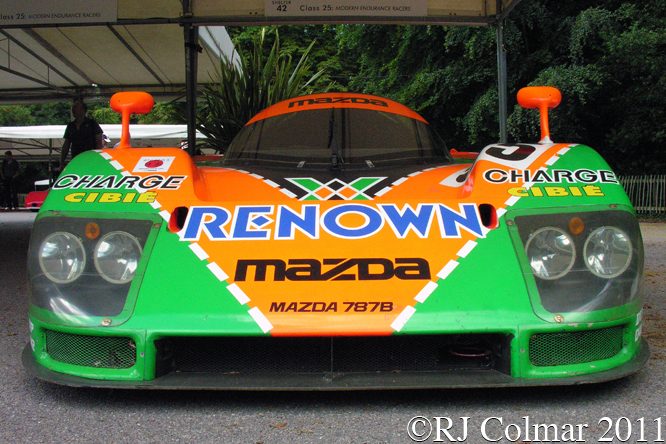
Mazda 787B, Goodwood Festival of Speed,

To cope with the new demands of the more powerful motor Nigel Stroud designed the 787 chassis which most obviously differed from it’s 757 and 767 predecessors by having more forward weight distribution with front mounted radiator with vents in front of the windscreen replacing the previous side mounted radiators.
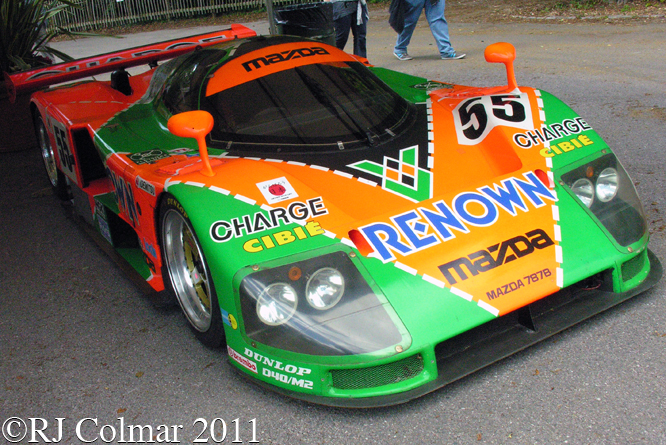
Mazda 787B, Goodwood Festival of Speed,

Two 787’s were built for the 1990 season, both cars retired from the 1990 Le Mans race and the best result for the 787 was recorded in 1991 at the Nurburgring where Maurizio Sandro Sala and David Kennedy finished 5th from 14th on the grid.
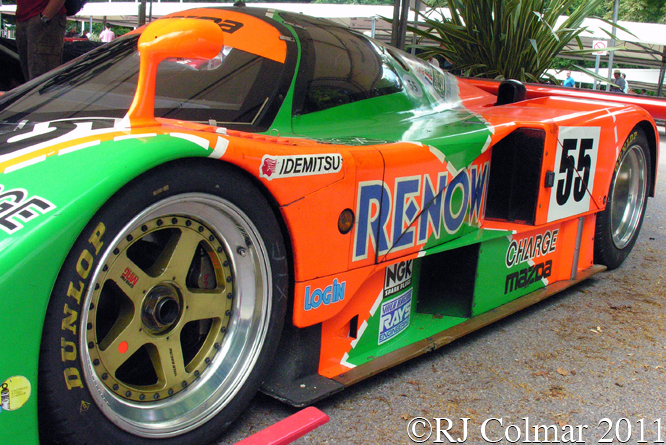
Mazda 787B, Goodwood Festival of Speed,

For 1991 the four rotor wankels were further upgraded with ECU controlled continuously variable telescopic intake runners which optimised engine power and torque at varying rpm.
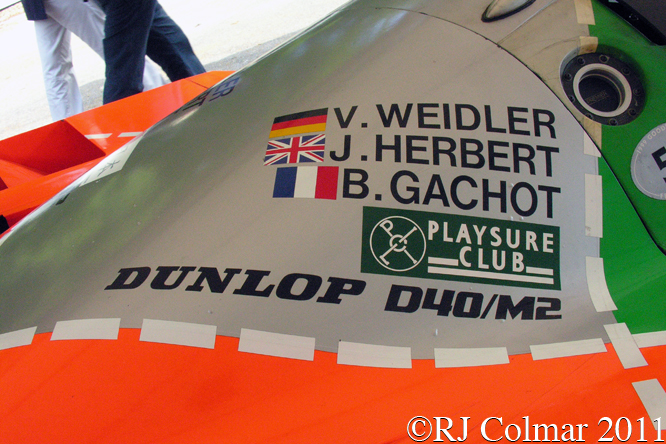
Mazda 787B, Goodwood Festival of Speed,

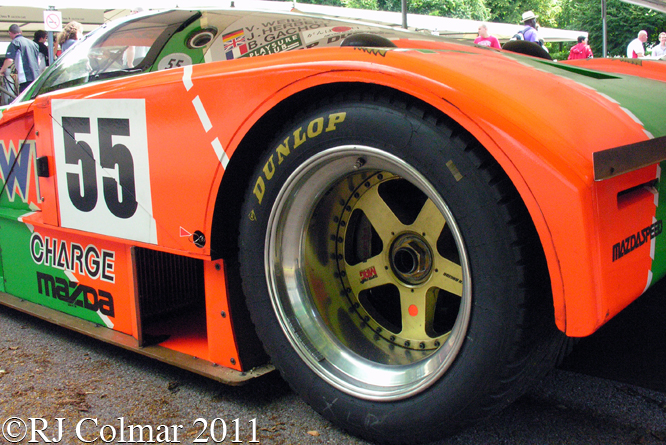
Three new 787B chassis were built for the 1991 season and the two existing 787’s were fitted with the continuously variable intake motors.
Mazda 787B, Goodwood Festival of Speed,

The 787B’s proved far more reliable than the 787 predecessor clocking up two 6th place finishes at Suzuka and Fuji before two 787B’s were sent to Le Mans.
Mazda 787B, Goodwood Festival of Speed,

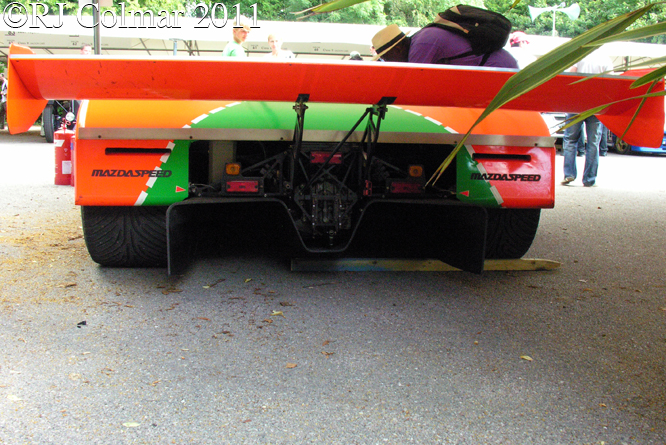
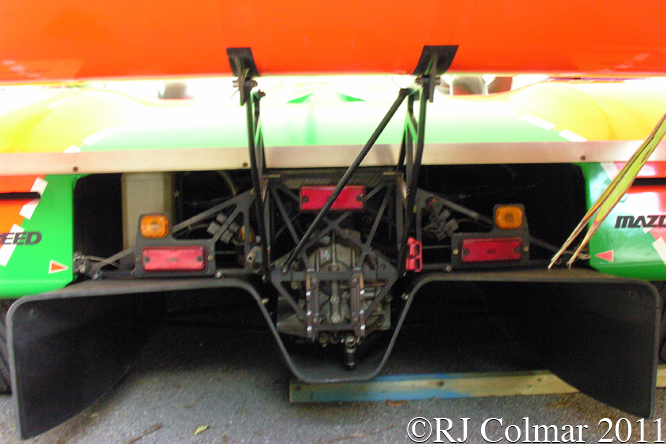
Unlike the old turbocharged Group C cars which had to run a 1000kg weight limit the IMSA GTP spec Mazda was allowed to run at 830 kgs.
Mazda 787B, Goodwood Festival of Speed,

As a consequence the #55 787B chassis #002 featured today driven by Johnny Herbert, Volker Weidler and Bertrand Gachot which started only 19th on the grid, 12th fastest qualifier, came through to score the first Le Mans win for a car powered by a non reciprocating engine and the first and so far only Le Mans win for a Japanese manufacturer after all the faster, but heavier Group C turbo cars had wilted.

Thanks for joining me on this “ECU Controlled Telescopic Intake Runners” edition of “Gettin’ a li’l psycho on tyres” I hope you will join me again tomorrow when I’ll be looking at a French Le Mans challenger. Don’t forget to come back now !

Share

Lowering The Centre Of Gravity – Mercedes Benz C291

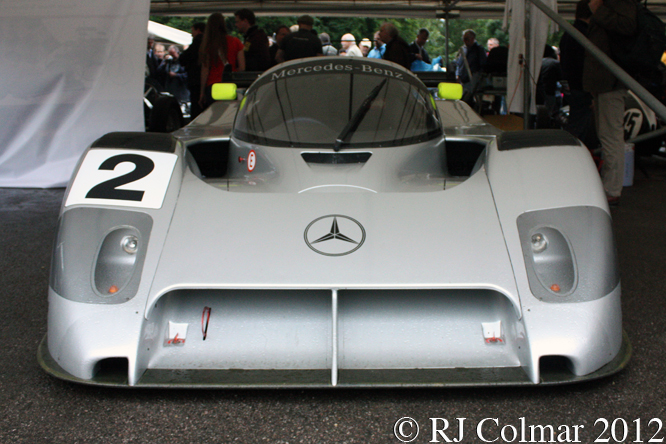
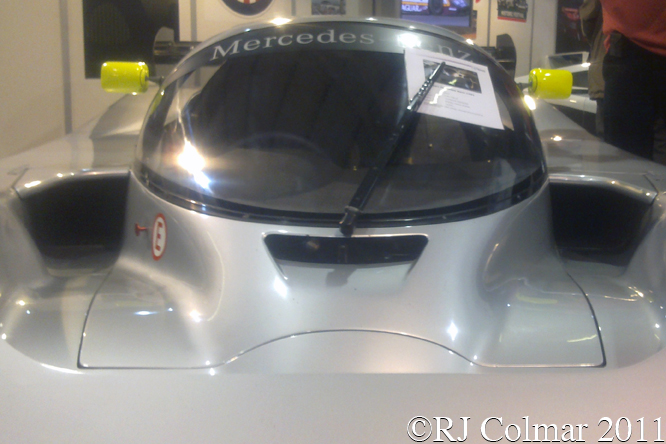
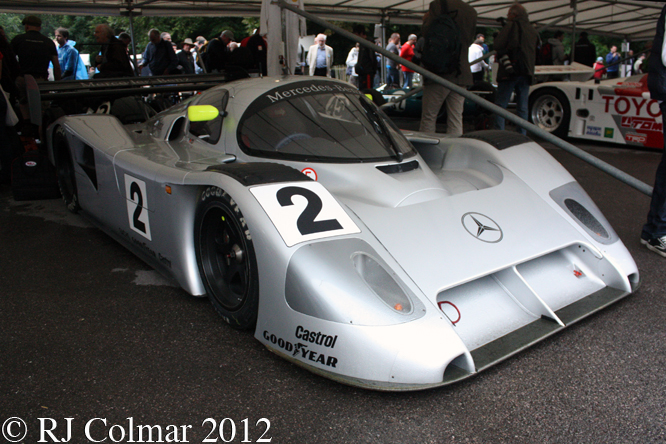
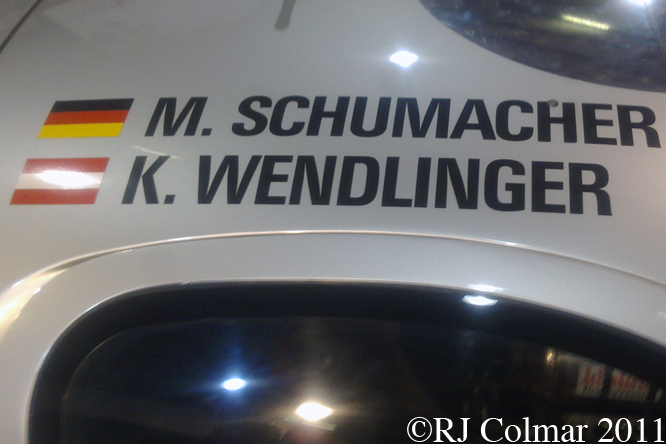
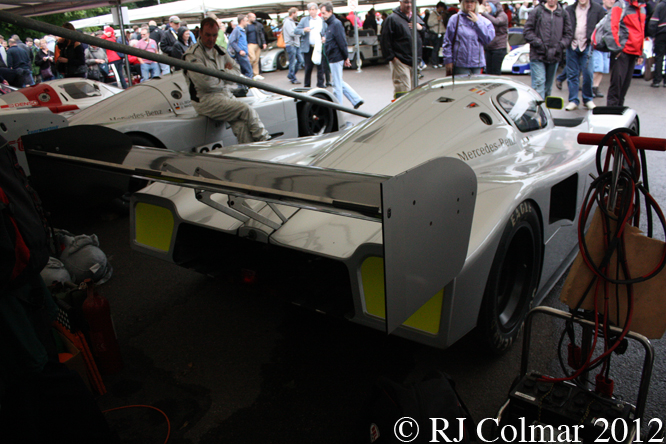
When the rules of the Group C Sports cars were ruined for the 1991 season, to the advantage of Formula One, at the behest of Messrs Ecclestone and Moseley to mandate 750kg vehicles to be powered by 3.5 litre / 213 cui motors of the same size as had been introduced to Formula One in 1989 Dr Hermann Hiereth sat down at Mercedes Benz offices in Stuttgart-Ünterturckheim and devised a flat 12 engine with transverse gearbox that lowered the center of gravity compared to the twin turbo V8 design that was being used to power the Group C Sauber C9 and C11 designs for the 1989 and 1990 seasons.

Mercedes Benz C291, Race Retro, Stoneleigh

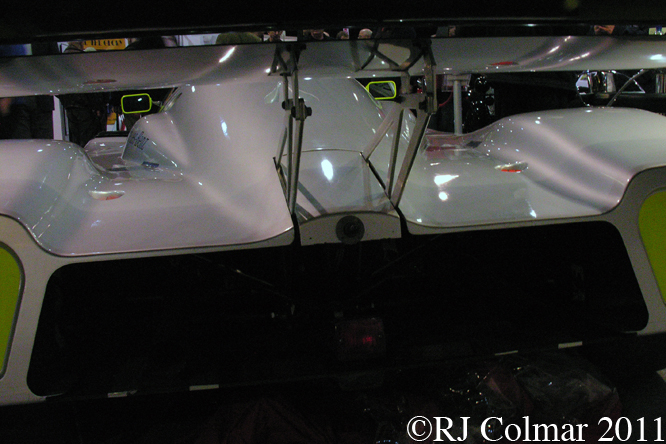
Unfortunately Leo Ress responsible for chassis design at Sauber based in Hinwill, Switzerland was not present at the meeting in Stuttgart when the new engine layout was approved and so he had to make do with a low wide power unit that limited his options for the ground effect venturi that helped to suck the car to the ground as had become de riguer in racing cars since the advent of the Lotus 79 Formula One car.

Mercedes Benz C291, Goodwood Festival of Speed,

Perhaps as a consequence of these restrictions Leo was left with no choice but to design a car that optimised top speed at the cost of handling, the exact opposite of what his rivals at Jaguar and Peugeot were doing with their V8 and V10 powered challengers.

Mercedes Benz C291, Race Retro, Stoneleigh

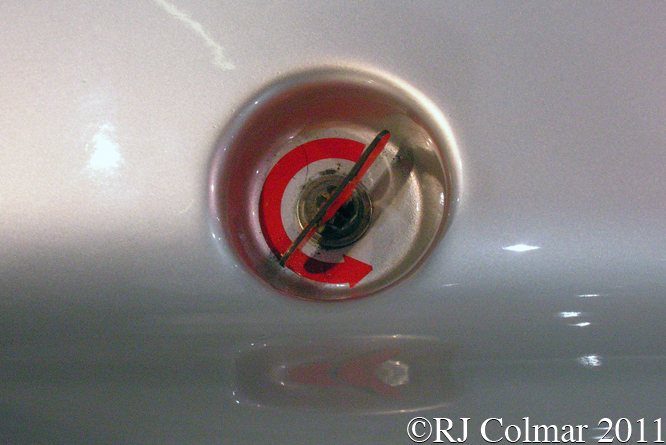
The overweight C291 driven by 22 year old rising stars Karl Wendlinger and Michael Schumacher retired from it’s first race at Suzuka after starting from 3rd on the grid and catching fire during the race after the fuel filler jammed partially open during a pit stop, at Monza the engine failed on the grid from which it was to have started 6th and again during the race which it started one lap down.

Mercedes Benz C291, Goodwood Festival of Speed,

The youngsters recorded an excellent 2nd place finish 1 lap down on the winning Jaguar XJR14 driven by Teo Fabi and Derek Warwick at Silverstone, before a disgraceful lap of 6m 55.969s convinced the team to stick with the heavily ballasted, to the mandated 900kg, but reliable C11 model for the Le Mans 24 Hours.

Mercedes Benz C291, Race Retro, Stoneleigh

At the Nurburgring two C291’s were entered with Jean Louis Schlesser and Jochen Mass qualifying 6th right behind the sister car driven by Wendlinger and Schumacher, both cars retired gearbox and engine failure respectively.

Mercedes Benz C291, Race Retro, Stoneleigh

The two C291 cars qualified in the same order at Magny Cours as in Germany 6th and 3rd respectively, but retired with a broken throttle linkage and water leak respectively.

Mercedes Benz C291, Goodwood Festival of Speed,

Little changed in the C291’s fortunes in Mexico where Wendlinger and Schumacher qualified 2nd but failed to finish due to oil pump problems and where Schlesser and Mass retired from 6th on the grid with electrical issues.

Mercedes Benz C291, Race Retro, Stoneleigh

The C291’s final appearance was at Autopolis in Japan where against form Jean Louis and Jochen translated a 7th place start to a fifth place finish and even more remarkably Karl and Michael translated a sixth place start in to a win.

Much as Ecclestone and Moseley had hoped Mercedes Benz abandoned Group C at the end of the season and entered the Formula One fray as an engine supplier initially to Sauber for whom Karl continued to drive.

Micheal of course after a one off appearance in a Jordan moved to the Benetton Formula One team with whom he won the first two of his eventual seven world championships.

Le Mans was as usual left to pick up the pieces wrought by the wreckless legislation promoted by Moseley and Ecclestone.

At the time of writing it is not exactly clear which C291 belongs to Andrew Haddon who is believed to be the owner of the car shown in these photo’s taken at Race Retro and Goodwood Festival of Speed some years ago.

Thanks for joining me on this “Lowering The Centre Of Gravity” edition of “Gettin’ a li’l psycho on tyres” I hope you will join me again tomorrow for another raucous Mazda Monday. Don’t forget to come back now !
Share

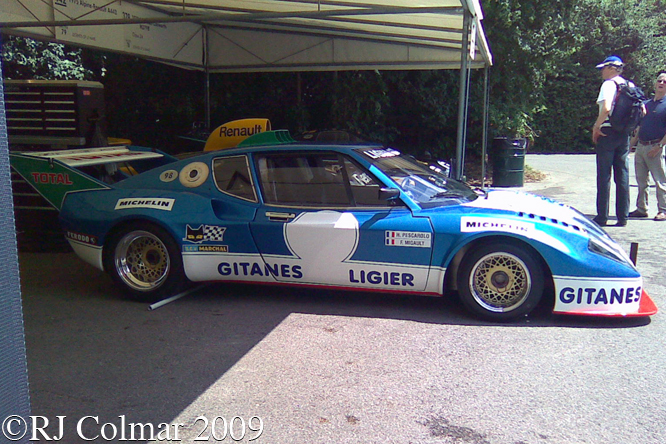
Not Quite A GT – Ligier Cosworth JS2 #2379 72 03

In 1970 former international rugby player and construction magnate Guy Ligier set about founding a sports car manufacturing company bearing his own name.

The original production model was to be the JS2 with a chassis designed by Michel Tetu, who would later be part of the Renault Le Mans and Formula One campaigns and a body designed by Pietro Frua.

The JS2 was originally intended to be powered by a 2.6 litre / 158 cui Ford Cologne V6 but that had to be changed to the 3 litre / 183 cui Maserati V6 as used in the Merak and Citroën SM, when Ford thought it might build a rival in the form of the Ford GT70.

Ligier JS2, Goodwood, Festival of Speed,

Production of the JS2 never reached sufficient numbers for the sporting authorities to consider the car for GT racing so instead racing versions were run as prototypes.

The racing JS2’s were built with aluminium chassis and raced with Maserati V6 engines which proved a tad underpowered and unreliable, although the teams perseverance was rewarded with a victory in the 1974 Le Mans 4 hour race for Guy Chasseuil and in the 1974 Tour de France Automobile where Gérard Larrousse, Jean-Pierre Nicolas and Johnny Rives drove the winning JS2.

A second place finish for today’s featured chassis #2379 72 03 driven by Bernard Darniche and Jacques Jaubert emphasised the team’s mastery of the 1974 mixed discipline event.

Ligier JS2, Goodwood, Festival of Speed,

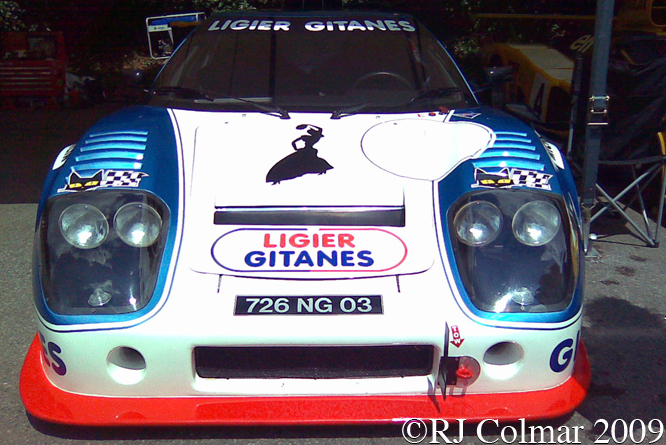
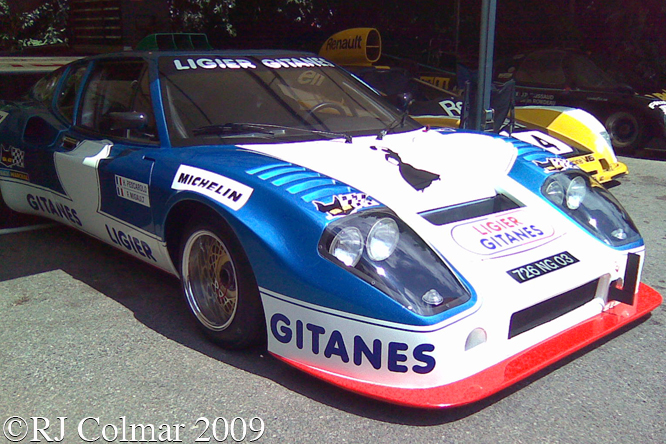
With new sponsorship from Gitanes for 1975 Ligier exploited the Prototype regulations more fully by producing a silhouette JS2 body and fitting more powerful Ford Cosworth DFV motors to two of his three JS2 racing cars including today’s featured chassis.

The two DFV powered JS2s were sent to Mugello and Dijon netting a 7th for Jean-Pierre Beltoise and Jean-Pierre Jarier at the former and 6th for François Migault and Jean-Pierre Jarier at the latter.

Perhaps mindful of wanting to preserve their machinery for Le Mans only single car entries were sent to Monza and Spa where Beltoise and Jarrier finished 21st from 7th on the grid and François Migault and Jean-Louis Lafosse finished 12th from 5th on the grid respectively.

Ligier JS2, Goodwood, Festival of Speed,

At Le Mans the two DFV powered JS2’s were joined by a third Maserati powered JS2 the latter to be driven by Beltoise and Jarier.

Unsurprisingly the Maserati was slowest of the three starting from 9th it was also the first of the three to retire after an accident.

Today’s featured car driven by Henri Pescarolo and François Migault qualified 5th but retired later in the race with a puncture.

The second DFV powered JS2 driven by Jean-Louis Lafosse and Guy Chasseuil qualified an impressive 3rd and survived to finish second only one lap down behind the Gulf GR8 shared by Derek Bell and Jacky Ickx.

After Le Mans 1975 Ligier retired from sports car racing in preparation for it Gitanes sponsored appearance in Formula One the following season.

Thanks for joining me on this “Not Quite A GT” edition of “Gettin’ a li’l psycho on tyres” I hope you will join me again tomorrow when I’ll be paying a visit to the National Motor Museum at Beaulieu. Don’t forget to come back now !
Share

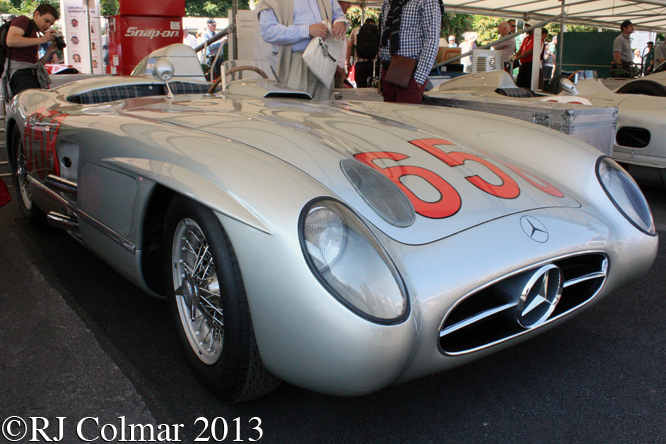
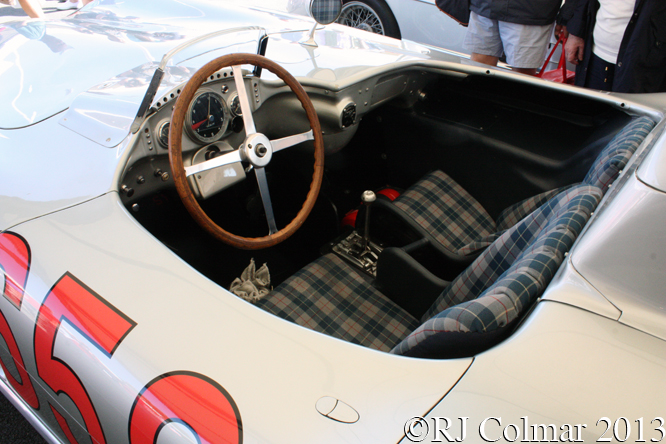
All Time Greatest One-Two – Mercedes Benz 300 SLR # no.3

Due to strained financial circumstances at the Mercedes Benz factory Rudolf Caracciola and Wilhelm Sebastian had only a privately entered Mercedes Benz SSKL with Mercedes approval at there disposal when they became the first foreign team in the first foreign car to win the 1931 Mille Miglia and the first to ever do so at an average speed of over 100 km per hour.

When Mercedes Benz returned to the event in 1955 they left nothing to chance sending a team of 60 technicians based at their event headquarters with spares and sufficient for their four 300 SLR entries.

Mercedes Benz 300SLR, Goodwood Festival of Speed,

Team manager Alfred Neubauer insisted each of the drivers were to drive the 1000 mile course a minimum of five times in preparation for the event, Karl Kling is believed to have driven at least 30,000 miles in his preparations.

Following the death of his co driver Daniel Urrutia in 1948 while competing in Peru Juan Manuel Fangio never drove in a competitive event with a co driver again, and so Juan made his own preparations for the 1955 Mille Miglia driving a FIAT 1100.

Mercedes Benz 300SLR, Goodwood Festival of Speed,

Before the first six hours of the race had been completed both Karl Kling driving solo and the Hans Herrmann / Hermann Eger crewed 300SLR’s had crashed out of the race.

However Stirling Moss aided by directions from 1949 World Champion Motor Cylce side car passenger Denis Jenkinson, who had meticulously made course notes on 15 feet of paper all carefully rolled into a device devised for bomber command during WW2 came home winners covering the 1,000 miles 6 hours faster than Caricciola in just over 10 hours at a record average speed just short of 100 mph, having covered the stretch from Cremona to Brescia at just under 124 mph.

Mercedes Benz 300SLR, Stirling Moss, Goodwood Revival,

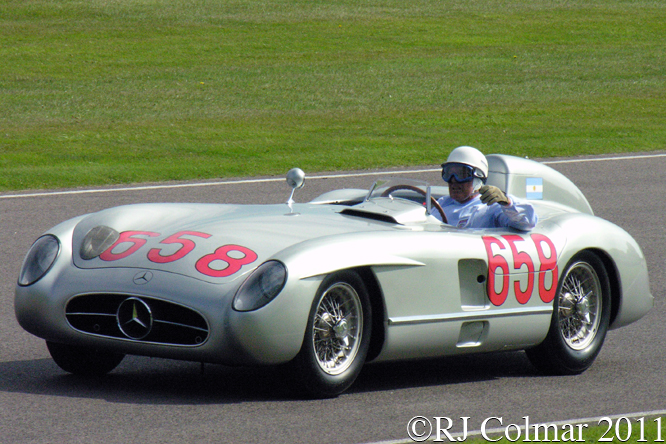
In second place 31m 45 seconds behind the winning #722 came Juan in today’s featured #658 chassis # no.3 despite the fact his eight cylinder 3 litre / 183 cui engine was only firing on 7 cylinders to complete in my humble opinion one of the all time greatest 1-2 finishes in all of sports car racing.

28 days after finishing the Mille Miglia Juan stepped back in to # no.3 to drive it to victory in the Eifelrennen at the Nürburgring.

Mercedes Benz 300SLR, Goodwood Festival of Speed,

In August 1955 having wrapped up his third World Formula One championship due to the cancellation of several Grand Prix in the wake of the 1955 Le Mans disaster Juan drove # no.3 for a third time to with the Swedish Grand Prix run for sports cars.

Wolfgang von Trips, André Simon and Karl Kling all drove this car in the Tourist Trophy in September 1955 run at Dundrod to complete a 1-2-3 victory behind the sister cars driven by Stirling sharing with John Fitch and the second placed car driven by Juan and Karl.

Finally in October 1955 Juan and Karl teamed up again this time to drive # no.3 in the Targa Florio to finish second behind the sister 300SLR driven by Moss and Peter Collins.

Stirling Moss is seen in the photograph above demonstrating #658 at the Goodwood Revival a couple of years ago and the connecting rod seen above was a gift from Mercedes Benz to Denis Jenkinson and comes from the Mille Miglia winning #722.

Thanks for joining me on this “All Time Greatest One-Two” edition of “Gettin’ a li’l psycho on tyres” I hope you will join me for Mazda Monday tomorrow. Don’t forget to come back now !
Share

Letzte Porsche Daimler – Mercedes Benz SSK

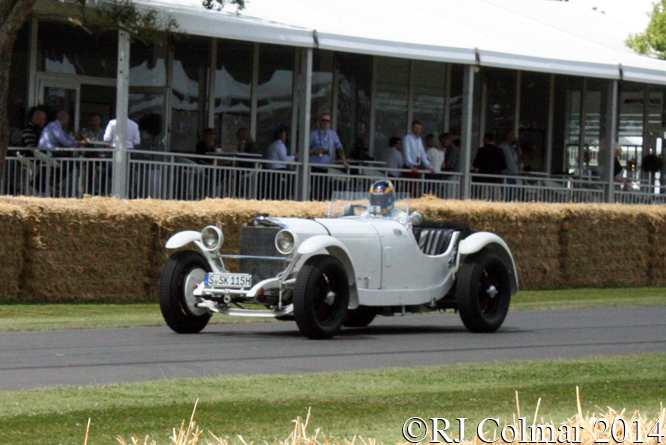
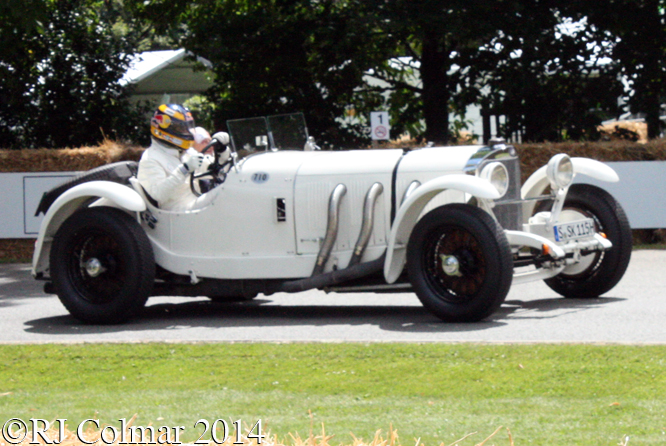
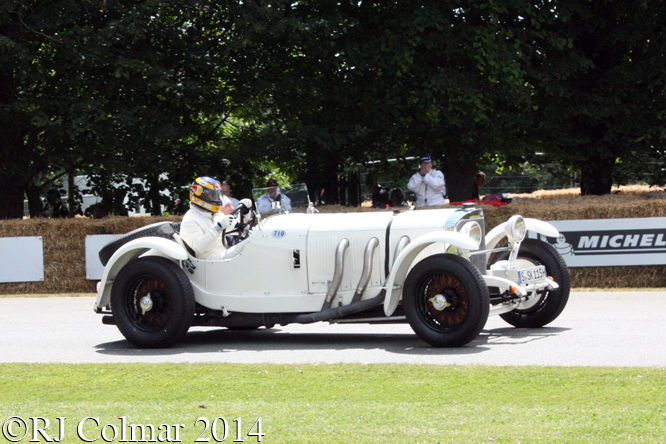
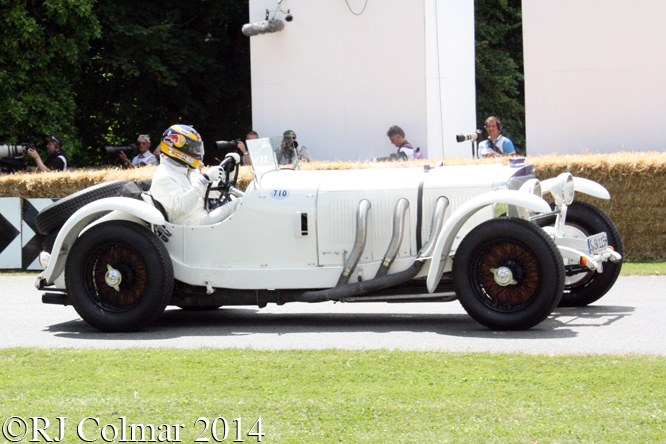
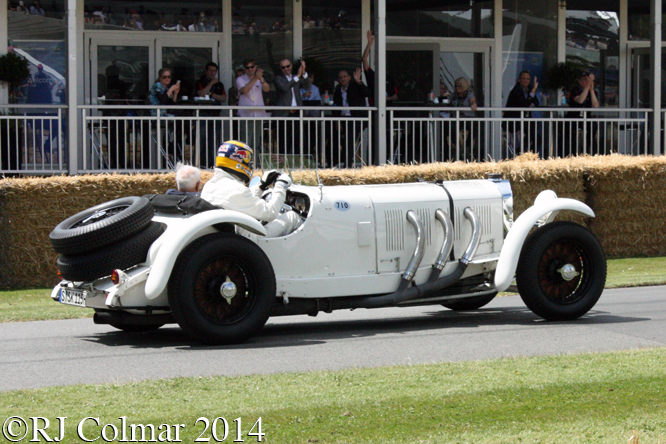
Before leaving Mercedes Benz to set up his own design studio Ferdinand Porsche oversaw the development of a Super Sports Short (Kurz) SSK version of the Mercedes-Benz S Tourer and SS Super Sport models specifically for competition purposes.

Mercedes Benz SSK, Karl Wendlinger, Goodwood Festival of Speed,

The SSK was 19 inches shorter than the S and SS models and fitted with the same 7068 cc / 431 cui super charged 6 cylinder overhead valve engine that produced up to 200hp, depending on the degree of tuning required, as found in the longer SS Super Sport.

Mercedes Benz SSK, Karl Wendlinger, Goodwood Festival of Speed,

Only 35 SSK’s were built between 1928 and 1932 and they experienced a good degree of success between Rudolf Caracciola’s Irish GP Eireann Cup win aboard Capt Malcolm Campbell’s example in 1930 and Jose Fantó’s Argentinian 500 mile Rafaela race win in October 1950, nineteen fifty.

Mercedes Benz SSK, Karl Wendlinger, Goodwood Festival of Speed,

Most significant of the SSK victories would have been on the 1931 Mille Miglia where Rudolf Caracciola and Wilhelm Sebastian won driving an SSKL (Leicht) and the 1931 Spa 24 Hour Race victory for Goffredo Zehender and Dimitri Djordjadze, Rudolf Carraciola’s third place finish in the 1929 Monaco Grand Prix, where more nimble Bugatti’s locked out all six of the remaining top seven places was equally remarkable.

Mercedes Benz SSK, Karl Wendlinger, Goodwood Festival of Speed,

It was left to exiled Russian Imperial Guard Boris Ivanowski to enter an SSK for the Le Mans 24 Hours, he shared his car with Frenchman Henri Stoffel and finished second to a much smaller capacity super charged Alfa Romeo 8C 2300 LM driven by Bentley exiles Earl Howe and Sir Henry Birkin in 1931.

Mercedes Benz SSK, Karl Wendlinger, Goodwood Festival of Speed,

The following year Henri Stoffel entered an SSK for Marcel and Paul Foucret in the Le Mans 24 Hours, but it retired after just 22 laps with piston failure.

An SSK driven by Italian Goffredo Zehender and Russian Dimitri Djordjadze did however win the 24 Hour race at Spa in July 1931.

The exact history of the 1928 SSK driven by Karl Wendlinger and owned by Mercedes Benz Classic as seen in these photographs taken last year at the Goodwood Festival of Speed, is not known at this time, if you can fill in any of the gaps don’t hesitate to chime in below.

Thanks for joining me on this “Letzte Porsche Daimler” edition of “Gettin’ a li’l psycho on tyres, I hope you’ll join me again for an ear splitting Mazda Monday. Don’t forget to come back now !
Share

166 mph From 79 cui – Alpine M65 #1719

In 1963 Alpine started building a series of Renault powered and sponsored prototype race cars that included the M63, M64 and two 1965 M65 prototype racers.

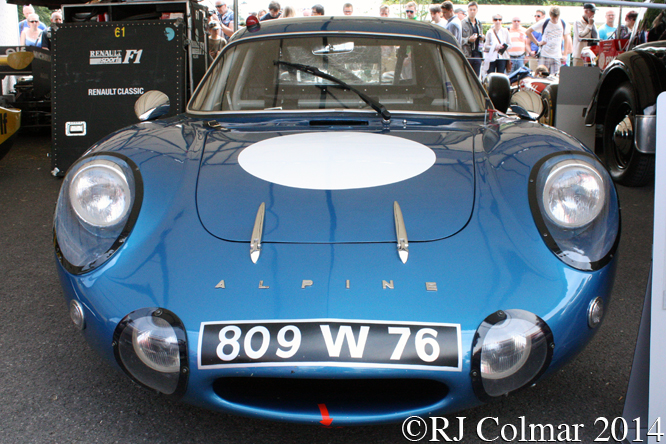
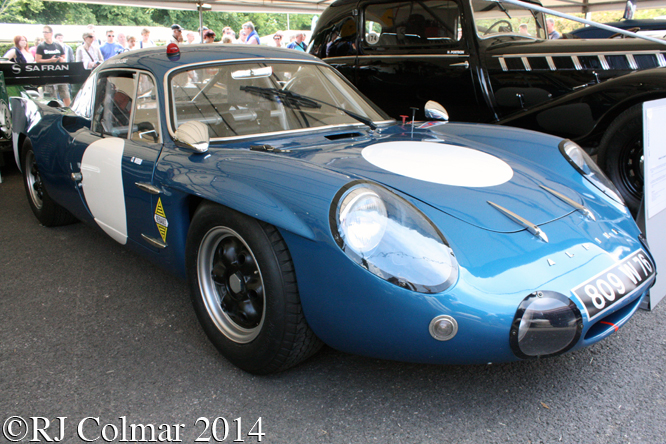
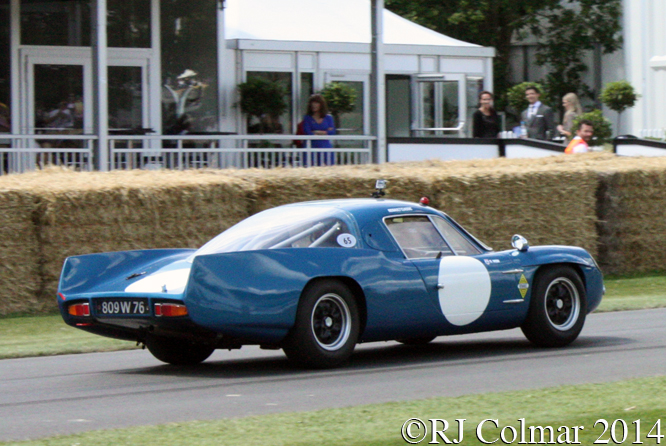
One Len Terry designed M65 chassis, #1718 was powered by a 1149 cc / 70 cui Renault engine and the other today’s featured chassis #1719 was by a 1296 cc / 79 cui engine from the same source.

Alpine M65, Goodwood Festival of Speed,

#1719’s known history covers just eight events in 1965 and 1966 starting with the Le Mans Test weekend in April 1965 when Mauro Bianchi, Roger Delageneste, Jean Vinatier, Roger Masson and Jean-Pierre Hanrioud all took turns at the wheel and recorded 15th best time overall, fastest in the 79 cui class.

#1718 was taken to the 1965 Targa Florio for Mauro Bianchi and Henri Grandsire to drive but they failed to finish after the car was fire damaged as the result of an accident.

Alpine M65, Goodwood Festival of Speed,

Mauro and Henri were entrusted with #1719 for the 1965 Le Mans 24 hours where they qualified 33rd with a time of 4m 20 seconds but retired with gearbox failure after completing just 32 laps.

Mauro was then joined by brother Lucien Bianchi for the 500kms race at the Nurburgring which was restricted to vehicles with engines no larger than 1.3 litres / 79 cui and they won the event.

Alpine M65, Portron/Frankowski, Goodwood Festival of Speed,

At the 1965 Albi GP Mauro drove to a 3rd place finish solo before the car was renamed an Alpine A210 for the 1966 season.

Mauro and Henri Grandsire retired from the 1000km race at Monza with a recalcitrant 1.3 litre / 79 cui engine.

Alpine M65, Goodwood Festival of Speed,

At Le Mans the car was fitted with a 1 litre / 61 cui motor and was driven by André de Cortanze and Jean-Pierre Hanrioud who completed 118 laps before the water pump failed.

#1719’s final appearance was at the 1967 Nurburgring 500kms where Roger Delageneste won the prototype class, but finished second to the similar capacity Abarth 1300 OT of Ernst Furtmayr which was running in the Sports Car class.

At Le Mans in 1965 #1719, seen in these photo’s at Goodwood Festival of Speed last year where Hughes Portron and Piotr Frankowski shared the driving, with just 130 hp recorded a top speed of 268 kph / 166 mph.

Thanks for joining me on this “166 mph From 79 cui” edition of “Gettin’ a li’l psycho on tyres”, I hope you will join me again tomorrow when I will be returning to Hullavington. Don’t forget to come back now !
Share

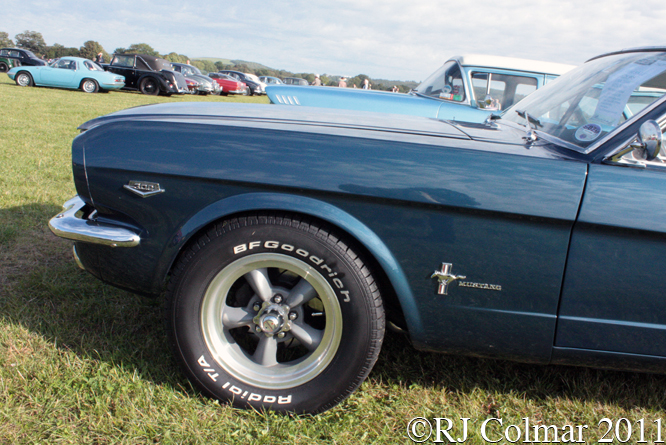
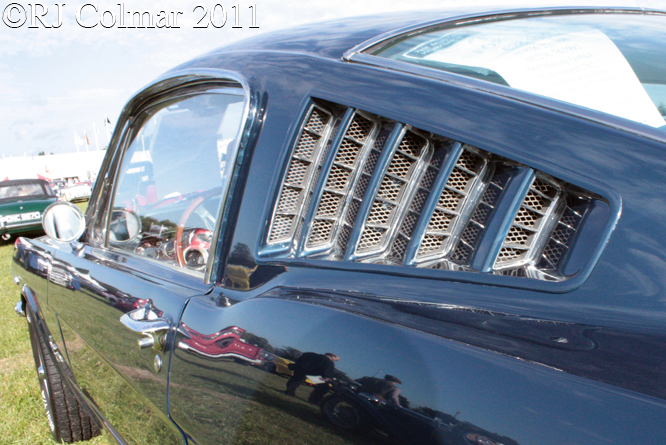
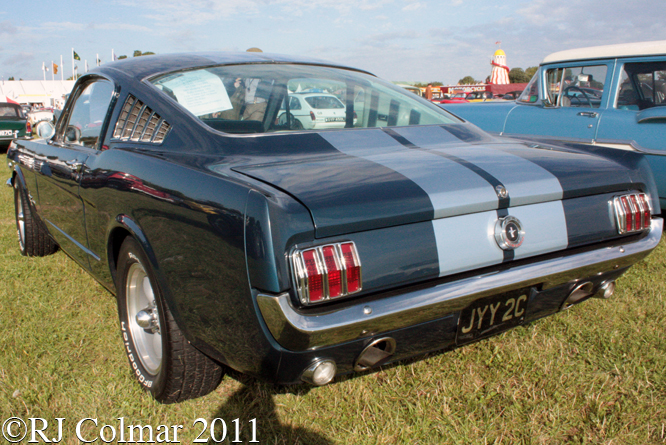
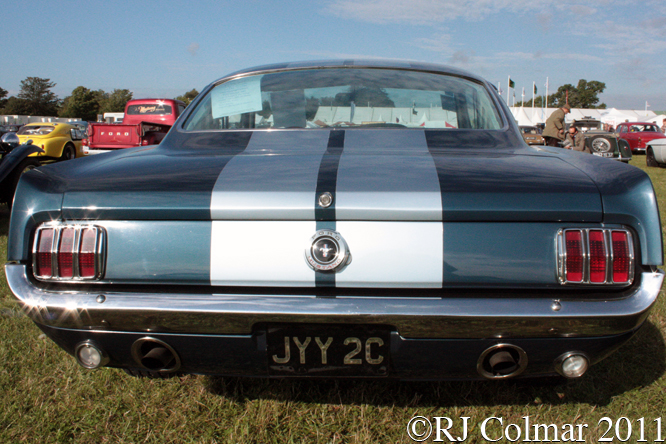
Turning You Into Nuvolari – Ford Mustang 2+2

When Ford announced the Mustang 2+2 in 1965 they claimed, quite rightly that Europe no longer had the monopoly on “four wheeled flair”.

Ford Mustang, Goodwood Revival,

This particular vehicle was advertised as a 1965 ‘Stang at Goodwood Revival a few years ago.

Ford Mustang, Goodwood Revival,

It was described as having had a full restoration in 2002, the same year it was first registered in the UK.

Ford Mustang, Goodwood Revival,

Among the upgrades it received were a 5 litre 302 cui ‘blue printed’ motor only a Mustang option from 1967, replacing the original 4.7 litre 289 cui unit and uprated disc brakes.

Ford Mustang, Goodwood Revival,

This vehicle was described as having been fitted with a ‘Tremec TKO’ 5 speed manual gearbox.

Ford Mustang, Goodwood Revival,

The ride was described by Ford in their contemporary advertising as like “a little cloud” a description which seems at variance with Fords advice to …

Ford Mustang, Goodwood Revival,

“Don’t forget the looks: that’s what turns Main Street into Via Veneto … and you into Nuvolari.

Thanks for joining me on this “Turning You Into Nuvolari” edition of “Gettin’ a li’l psycho on tyres” I hope you will join me again tomorrow when I’ll be looking at a Modern Elegant Fiat. Don’t forget to come back now.

Share