Tag Archives: Goodwood

Movie Star Limo – Ferrari 250 MM Pininfarina #0298MM

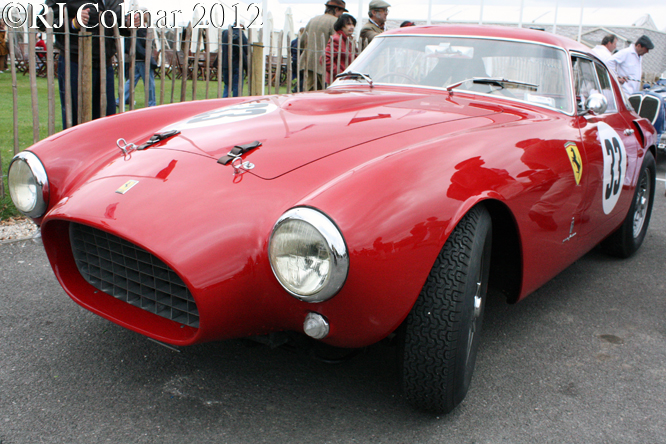
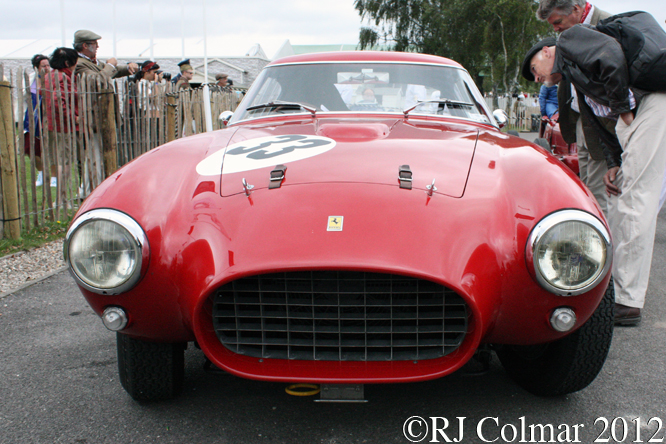
The 31 1953 Ferrari 250 MM chassis built could be specified with open barchetta body or Berlinetta closed body styles most, but by no means all of the open bodies were built by Vignale and the most but by no means all of the closed bodies were built by Pininfarina.

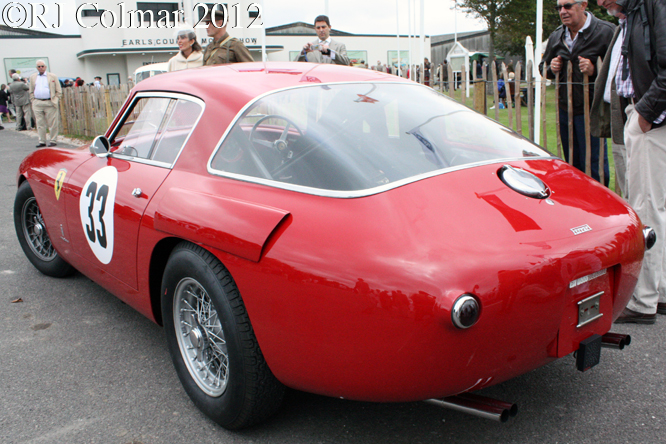
Ferrari 250 MM PF Berlinetta, Goodwood Revival,

Of course being hand built no two bodies are identical and today’s featured Pininfarina Berlinetta body sitting on chassis #0298, has a slightly longer nose than any of it’s siblings, a fore taste of the pontoon Ferraris that were to follow at the end of the decade perhaps.

Ferrari 250 MM PF Berlinetta, Goodwood Revival,

With a 3 litre / 183 cui 237 hp version of Gioacchino Colombo V12 under the bonnet/hood the intention was that these cars were built to be raced, and the likes of Phil Hill, José A. Nogueira Pinto, Luigi Villoresi, Paolo Marzotto, Eugenio Castellotti, Giulio Musitelli, Luigi Piotti and Casimiro de Oliveira all drove 250 MM in Barchetta and Berlinetta forms to victory lane during 1953.

Ferrari 250 MM PF Berlinetta, Goodwood Revival,

#0298MM was purchased by Luigi Giuliano for 3.5 million lira in 1953 and a year later passed through two further owners Incom SpA and Industrie Cinematografiche Sociali, the later is reported to have used the car for chauffeuring movie stars.

Ferrari 250 MM PF Berlinetta, Goodwood Revival,

In May 1955 this car was acquired by Giovanni Ghersi in San Remo for ‘just’ 2.5 million lira. The car is not thought to have been raced at all until it was acquired by German Herbert Ibing in 1984.

Ferrari 250 MM PF Berlinetta, Goodwood Revival,

Since then the car has appeared at many historic events including those at Goodwood, reruns of the Mille Miglia, Nurburgring, Monaco and Monza.

Ferrari 250 MM PF Berlinetta, Goodwood Revival,

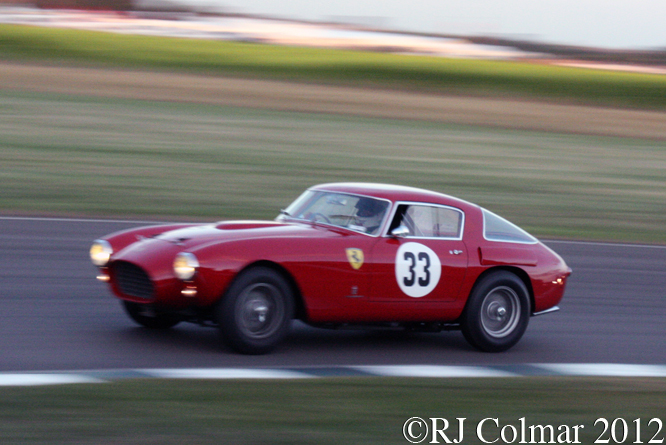
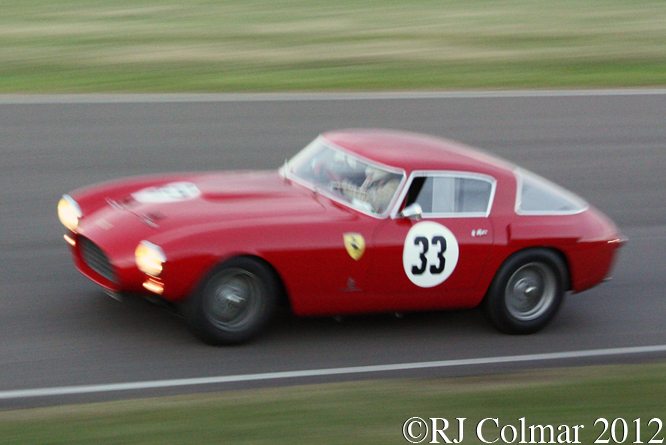
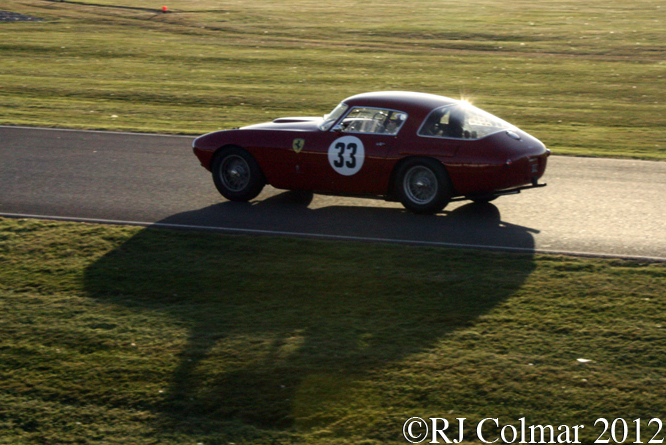
Arnold Meier of Zurich has been the owner of the car since 2002 and was sharing the driving with former British Hill Climb Champion David Franklin when the car was photographed at the recent Goodwood Revival meeting. Starting last on the grid Arnold and David managed a 17th place finish, note for some reason the 33 entry in the Freddie March Trophy is listed as a Mitter BMW in the results of the meeting.

Thanks for joining me on this “Movie Star Limo” edition of “Gettin’ a li’l psycho on tyres” I hope you will join me again tomorrow. Don’t forget to come back now !

Share

Definetly Not The Right One – Lotus Ford 80 #R1

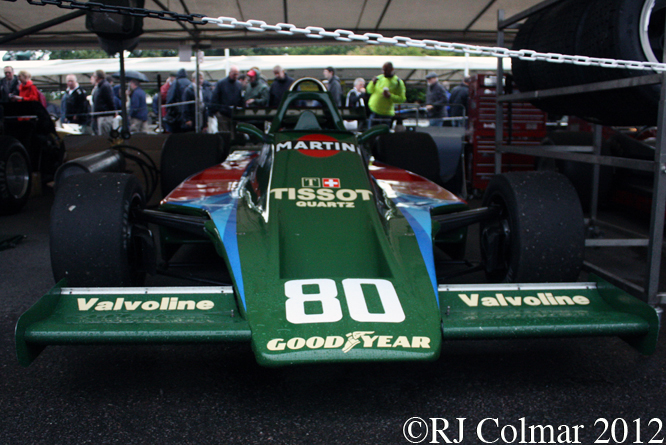
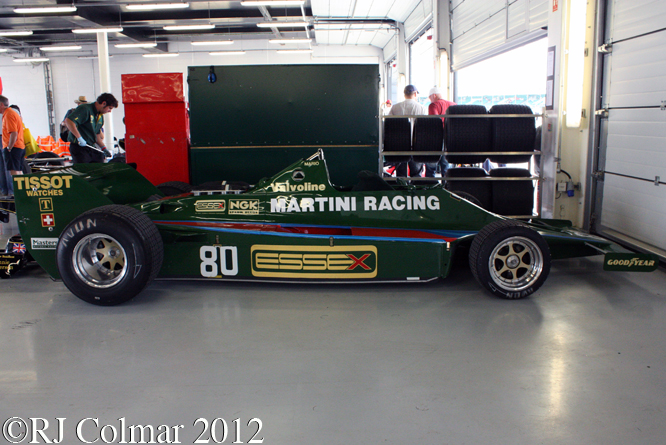
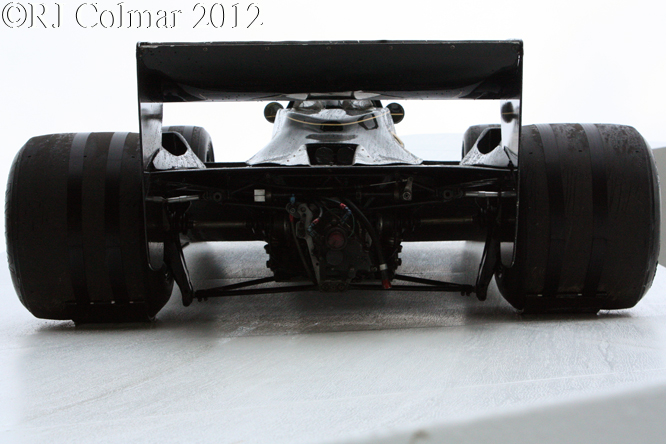
Colin Chapman described the Lotus Ford 80 at it’s launch in the Kentagon at Brands Hatch in 1979 as the best looking Lotus he had ever built. Reigning World Champion Mario Andretti said it would make the Lotus Ford 79 with which he won the 1978 World Championship look like a London Bus.

Lotus Ford 80, Goodwood Festival of Speed

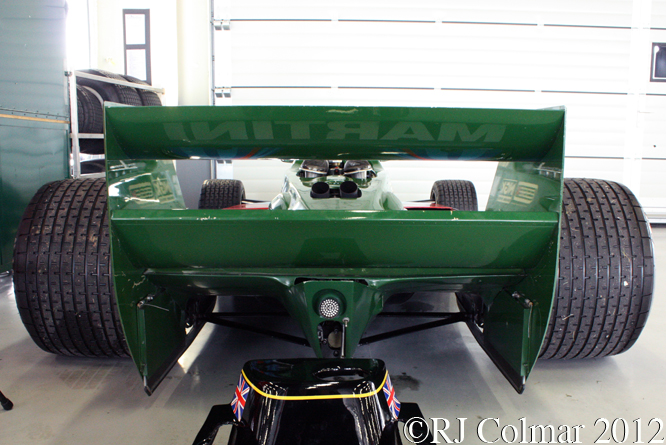
Unfortunately the car with the revolutionary venturi under the nose and a second under the rest of the body and with out the usual wings front and rear proved to be a bit of a handful with unpredictable handling once it started running on the track and it was only a matter of time before Colin Chapman and his engineers were removing the skirts that sealed the airflow beneath the nose and fitting conventional front wings to aid the aerodynamic poise and balance of the car.

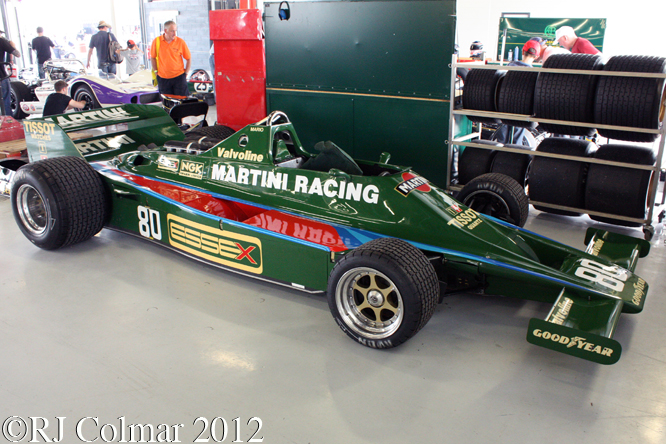
Lotus Ford 80, Silverstone Classic

The whole point of the design was to make the Lotus 80 faster down the straights than the Lotus 79 by not having any wings fitted at all. However all was not lost at Brands Hatch, as seen in Sven Platts photo below, the car was only used as a spare, but in the next race the Spanish Grand Prix Mario Andretti qualified a respectable forth behind the two hitherto dominant Ligiers that were the most effective copies of the previous seasons Lotus 79 and the more powerful Ferrari 312 T4 of Gilles Villeneuve.

Lotus Ford 80, Race of Chapions, Brands Hatch

Patrick Depaillier won the Spanish Grand Prix in his Ligier from Carlos Reutemann, in the Lotus Teams older Lotus 79, who finished ahead of Mario in the Lotus 80. The Spanish Grand Prix turned out to be the highlight of the Lotus 80’s short life, at Monaco Mario could only qualify 13th and at the French GP where a heavily revised second Lotus 80 was tested Mario qualified 12th but he retired with suspension and brake issues from each of these races respectively.

Lotus Ford 80, Silverstone Classic

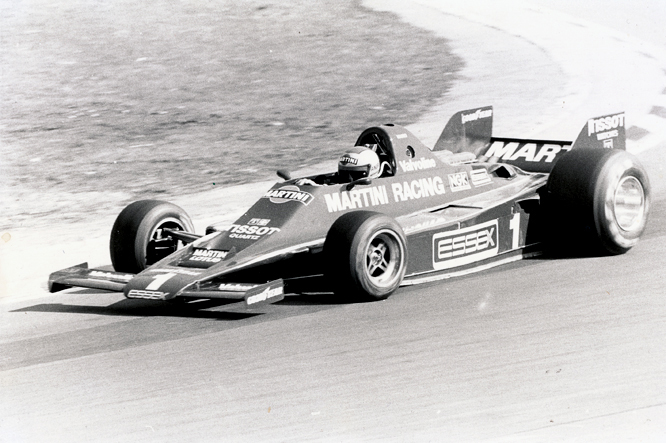
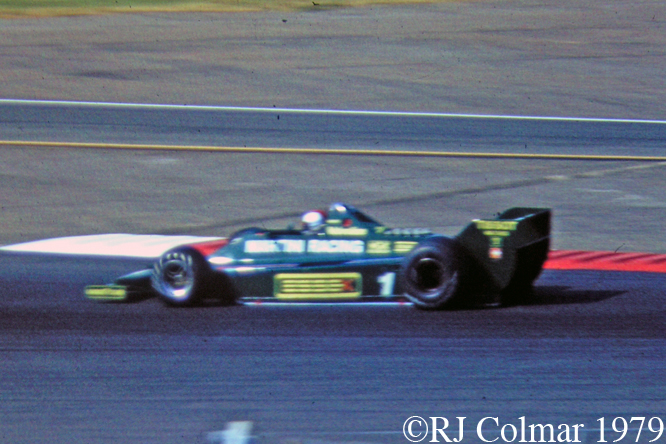
The final appearance of the Lotus 80 was at the British Grand Prix at Silvestone where I took the photograph below. Mario practised in the car but decided he was better off with his year old Lotus 79 which by now was swamped by new designs which emulated it and the more powerful, ultimately 1979 championship winning, Ferrari T4s.

Lotus Ford 80, British Grand Prix, Silverstone

I believe these photographs all show the same chassis namely Lotus Ford 80 R1 which today appears to be owned by Manfredo Rossi a member of the Martini Rossi family that sponsored team Lotus in 1979.

Lotus Ford 80, Silverstone Classic

Thanks for joining me on this “Definitely Not The Right One” edition of ‘Gettin’ a li’l psycho on tyres’ I hope you will join me again tomorrow. Don’t forget to come back now !

Share

Mario & Ronnie Show – Lotus Ford 79 #79/2 & #79/3

John Player Team Lotus hit the track running in 1978 with Mario Andretti winning the opening race of the season in Argentina and his team mate Ronnie Peterson winning the third race of the season after a thrilling last couple of laps in South Africa. Both of these victories were achieved with the previous seasons Lotus Ford 78 ‘wing car design’ for 1978 Colin Chapman and his engineers came up with something even more refined in the shape of today’s featured car the ‘ground effect’ Lotus Ford 79.

Lotus Ford 79, Goodwood, Festival of Speed

The Mario Andretti first raced a Lotus 79 in the non championship International Trophy race at Silverstone a race well remembered because the front row qualifiers Ronnie Peterson and Niki Lauda both spun of on the warm up lap leaving Andretti and James Hunt to start at the front of the grid despite qualifying 3rd and 4th. Andretti only lasted two laps before he spun out with Hunt spinning out one lap earlier at the same spot.

Lotus Ford 79, Goodwood, Festival of Speed

However for the Belgium Grand Prix there were no mistakes Mario qualified on pole and won, driving I believe from Ronnie who started 7th in the older Lotus Ford 78. At the Spanish Grand Prix Mario was I believe given the #79/3 seen above while Ronnie took over Mario’s Belgium winning #79/2 seen below. Mario qualified on pole and Ronnie 2nd and that is how the Spanish Grand Prix finished.

Lotus Ford 79, Goodwood, Festival of Speed

Mario retired from the Swedish Grand Prix after qualifying on pole leaving Ronnie to finish 3rd behind the controversial Brabham fan cars of Lauda and Watson. Bernie Ecclestone chose to withdraw the Brabham BT46 fan cars after just one race. At the following French Grand Prix Mario qualified 2nd and Ronnie 5th, however they finished 1st and 2nd respectively for the 3rd time in the 1978 season.

Lotus Ford 79, Goodwood, Festival of Speed

For the British Grand Prix it was Ronnie and pole and Mario next to him but both cars retired. In Germany Mario qualified on pole with Ronnie sat next to him on the grid and by now unsurprisingly that is how they finished the race. In Austria Ronnie was again on pole with Mario starting second however Mario retired leaving Ronnie to take an unchallenged win which would prove to be his last.

Lotus Ford 79, Goodwood, Festival of Speed

At the Dutch Grand Prix Mario qualified on pole in #79/3 with Ronnie beside him in #79/2 and the pair duly took their fifth and final 1-2 result of the season. This would prove to be Mario’s last Grand Prix win and indeed the last for any American driver and Ronnie’s last ever finish too. Ronnie crashed #79/2 during practice for the Italian GP and started the race from fifth in an older Lotus 78 while Andretti started from pole in the latest #79/4. Ronnie was involved in a start line accident which broke his legs, unfortunately during the night bone marrow from his injuries got into his blood stream and he died the following morning. The race was restarted and a subdued Mario finished sixth which was enough to claim the championship, but in truth Mario was far more concerned for Ronnie with whom he had been good friends since there time as team mates driving Ferrari sports cars in the early 1970’s. Ronnie for the second time in his career finished second in the World Drivers Championship.

Lotus Ford 79, Goodwood, Festival of Speed

The success of the Lotus 79 was largely due to what was happening to the airflow beneath the bodywork, by building the monocoque just wide enough to hold the driver with fuel tank behind him and the motor behind that, Colin Chapman and his engineers Peter Wright, Geoff Aldridge, Martin Ogilvie and Tony Rudd used the side pods to create venturi by using a low wide neck at the front entrance to the side pods and tall wide exit, with side skirts sealing airflow under the car. When the car was moving air was guided into a partial vacuum created between the venturi side pods under surface and the surface of the road and this had the effect of sucking the car to road which allowed the car to negotiate corners at higher speeds than their competitors, most of whom had still not got to grips with the wing car aerodynamics advanced by the previous years Lotus 78.

For the last two races of the 1979 season perennial Formula One under achiever Jean Pierre Jarrier joined Mario in the team Mario qualified on pole in the USA with J-PJ 8th but neither car finished in the US Grand Prix. The final race of the season was held in Canada where Mario could only qualify 9th and Jean Pierre sat on pole. During the race Jean Pierre looked set for a win until he retired with an oil leak.

Mario finished tenth. The Lotus 79’s were set to be replaced by even more radical Lotus 80’s in 1979 but everything did not go to plan and so the 79’s were pressed into service again for most of the season but were out classed by their competitors who were getting to grips with ground effects aerodynamics.

A little post script courtesy Barry Boor, Mario Andretti was invited to drive the inauguration lap of the next home of the United States Grand Prix at Circuit of the America’s on October 21st, the car he drove was naturally a Lotus Ford 79 with which he won his world Championship, you can see how he got on in this linked youtube clip.

Thanks for joining me on this “Mario & Ronnie Show” edition of “Gettin’ a li’l psycho on tyres, I hope you will join me again tomorrow. Don’t forget to come back now !

Share

Action Economy Lean Breed – Dodge Dart

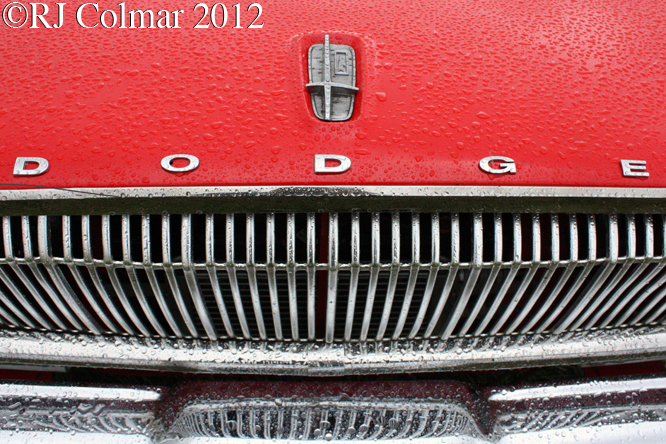
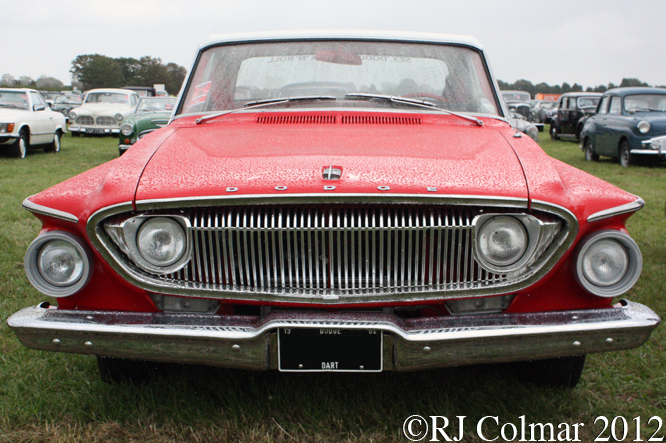
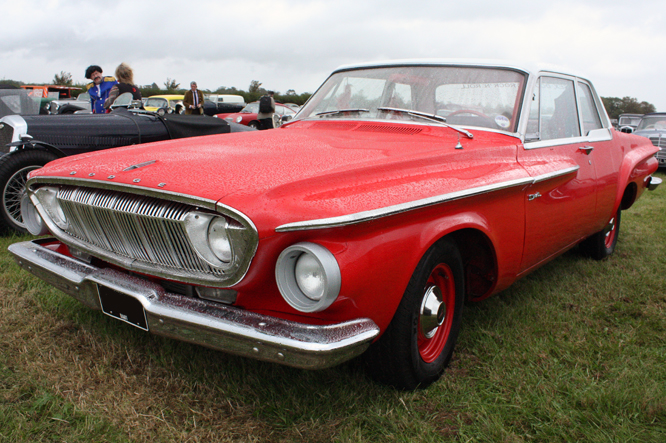
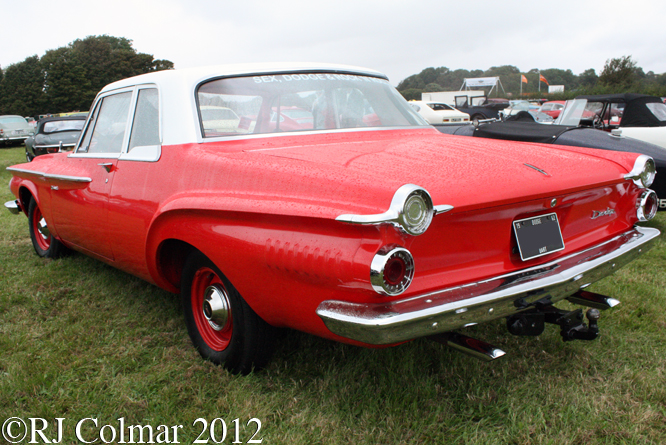
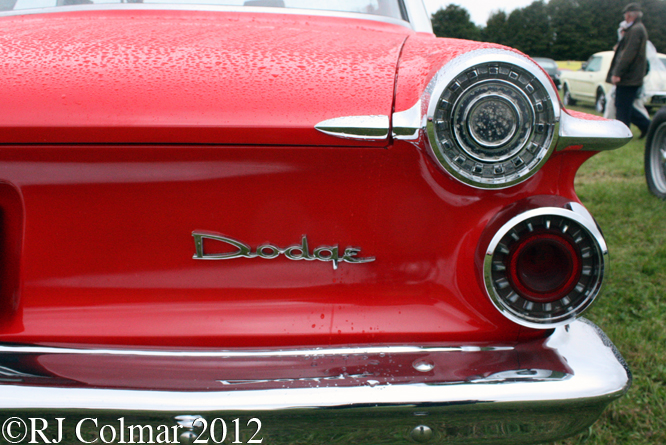
I have always thought the 1962 Dodge Dart looked like an amalgamation of two separate designs the middle top half and

Dodge Dart, Goodwood Revival

lower outer half not quite matching but somehow blending at the broken chrome line on the front and rear wings.

Dodge Dart, Goodwood Revival

The design philosophy behind the Dart was based on a comedic misinterpretation by Chrysler executives of an over heard conversation between Chevrolet executives who were talking about the compact Chevrolet Nova, but which Chrysler executives thought was about downsized large cars like the Impala. As a result of this misunderstanding the second generation Dart became an intermediate and inadvertently left Dodge with nothing to compete with in the full size market segment at the start of the 1962 model year.

Dodge Dart, Goodwood Revival

Launched in 1962 with strap lines that included “First of the action economy cars” and “Come in and drive the new lean breed of Dodge” the range included 2 and four door Sedan and Hardtop models along with a two door convertible.

Dodge Dart, Goodwood Revival

The B platform unibody rode on “Torsion-Aire” torsion bar front suspension and could be ordered with motors ranging from a 3.7 litre / 225 cui inclined straight six to a 6.8 litre / 213 cui V8, the car featured here appears to be registered as having a 7.2 litre / 439 cui motor, a big block 440 Magnum dating from somewhere between 1966 and 1978.

Dodge Dart, Goodwood Revival

With it’s light weight and good handling the ’62 Dart fitted with the 415hp 6.8 litre / 413 cui “Ramcharger” V8 proved a popular record braking drag racer.

Dodge Dart, Goodwood Revival

The B platform remained in production with slight modifications until 1981 while the ’62 Dart body was wholly replaced with no carry over at all by the third generation Dart in 1963.

Thanks for joining me on this “Action Economy Lean Breed” edition of “Gettin’ a li’l psycho on tyres” I hope you will join me again tomorrow for Ferrari Friday. Don’t forget to come back now !

Share

Ben’s Bus – Volkswagen Type 2 (T1)

In 1946 production of the VW Beetle was in full swing at maximum capacity at the Wolfsburg plant when Dutch importer Ben Pon paid the factory a visit and observed an improvised parts transporter which he recognised could be vastly improved upon with a new vehicle using a stock Beetle Type 1 chassis pan. Pons first doodles of his proposed vehicle were dated 1947 and two and a half years later the first type 2 rolled off the production line.

VW Type 2 Transporter, Goodwood Revival

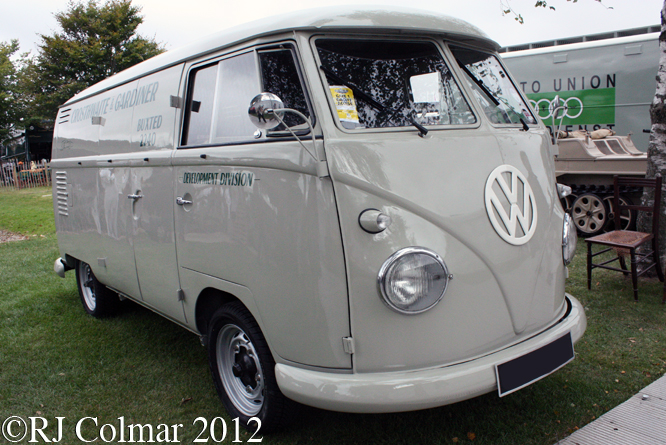
The split windscreen was not part of Ben’s original design but was incorporated to improve the aerodynamic efficiency after wind tunnel testing showed marked improvements of the split screen at the University of Braunschweig. The original Type 2 with just 25 hp were rated to carry 1,500 lbs / 690 kgs. Above is a 1959 Type 2 with hinged rear door used by leading historic race car restoration specialists Crosthwaite & Gardiner who pride themselves on manufacturing everything from a Bugatti nut to an entire Auto Union Grand Prix car.

VW Type 2 Camper, Summer Classics, Easter Compton

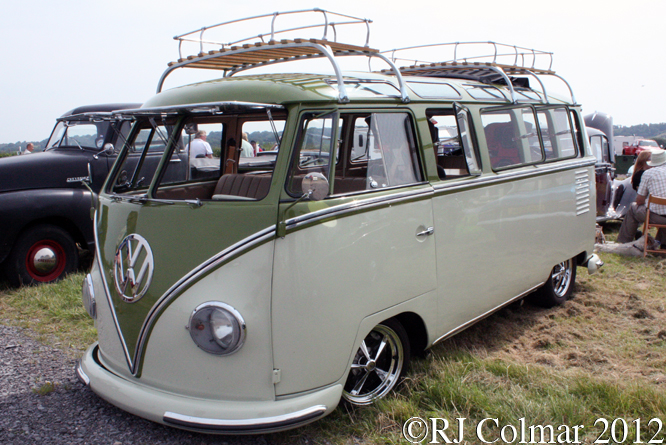
It was not long before the versatility of the Type 2 began to shine through with, panel vans, 2 and four seat pickups, buses, campers being offered while 3rd parties converted Type 2’s to run on railway tracks and a myriad of other applications. It was not long before Type 2s were manufactured in a new dedicated plant in Hannover.

VW Type 2 Transporter, Goodwood Revival

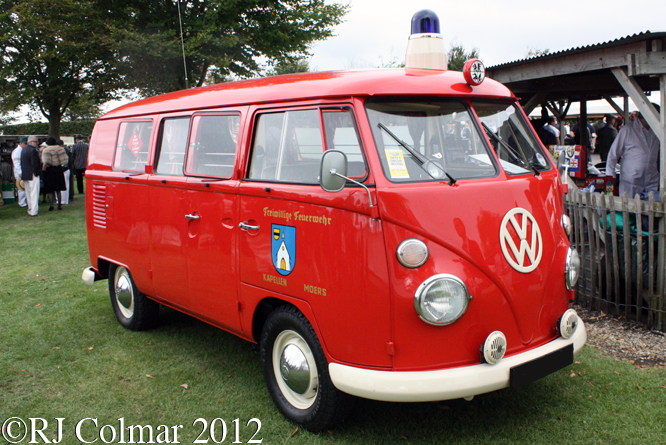
The Type 2’s underwent continuous development by 1967 a larger motor was producing 54 hp and the load capacity had increased to 1000 kgs / 2,205 lbs. production of the Type 2 (T1) ceased in Germany in 1967 but continued in Brazil until 1975. Above is a 1964 Type 2 Transporter that appears to have served the Kapellen Stadt Moers volunteer fire brigade in North Rhine Westfalen. Like all today’s featured Type 2s it’s a left hooker which goes to show just how popular these vehicles still are in the UK.

VW Type 2 Transporter, Rare Breeds, Haynes International Motor Museum

The period from 1947 to 1991 is often referred to as the era of the Cold War between the Western Allies and East Bloc, a period punctuated by tensions in which mutually assured nuclear destruction reared it’s head as a possibility from time to time. What I did not realise was that the Western Allies were not in a particularly harmonious economic relationship at the time.

Each member nation was keen to preserve it’s own industries from the predatory monopolism of it’s neighbours and alleged friends. This culminated in 1963, soon after the Cuban missile crises, in the Germans and French placing restrictive tariffs on imported US chicken, in return to protect it’s automotive industry the US placed restrictive tariffs on Type 2s, designating them as commercial vehicles, which cut US sales by two thirds at a stroke. These tariffs are still in place today and Ford who these tariffs were to aimed at protecting among others has resorted to importing vehicles built in Europe which comply with passenger vehicle ordinances and then taking them to a warehouse in Baltimore for the passenger vehicle compliant items to be stripped and shredded turning said vehicles to commercial applications.

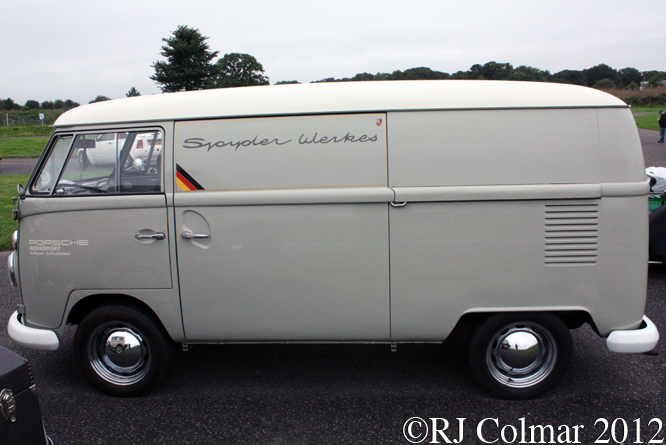
Above is a 1966 Type 2 which unusually has sliding rear doors on both sides, this vehicle served the Fire services at Zurich Airport and then a small Swiss village before being returned to it’s original colours and converted for use as a race car tow and support vehicle. With the introduction of the Transporter (T4) in 1990 all previous Transporter/Kombi’s/Buses were retrospectively given T1 to T3 identities so original iteration Type 2’s built between 1950 and 1975 became Type 2 (T1), 2nd iteration Type 2s with larger bodies built from 1968 to present became Type 2 (T2) and third iteration wedge shape Type 2s became Type 2 (T3) also known as T25.

Thanks for joining me on this “Ben’s Bus” edition of “Gettin’ a li’l psycho on tyres” I hope you will join me again tomorrow. Don’t forget to come back now !

Share

Steel Wheels, 12 Volt Electrics and LHD – MG TD Midget

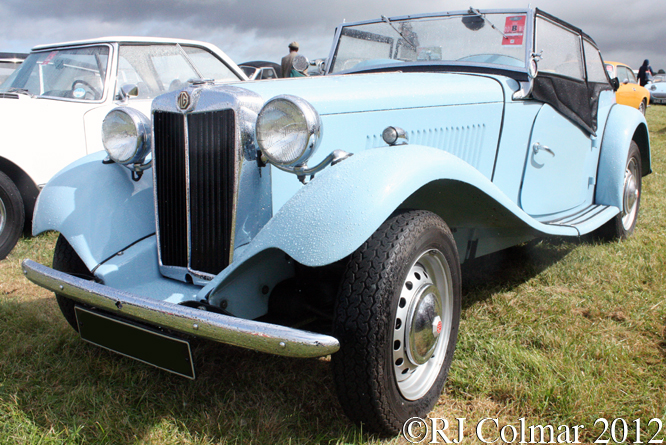
For 1950 MG introduced it’s TD Mideget which inherited the drive train and body style from the MG TC Midget along with the chassis and independent coil spring suspension from the MG Y Type saloon along with 12 volt electrics and steel wheels.

MG TD, Goodwood Revival

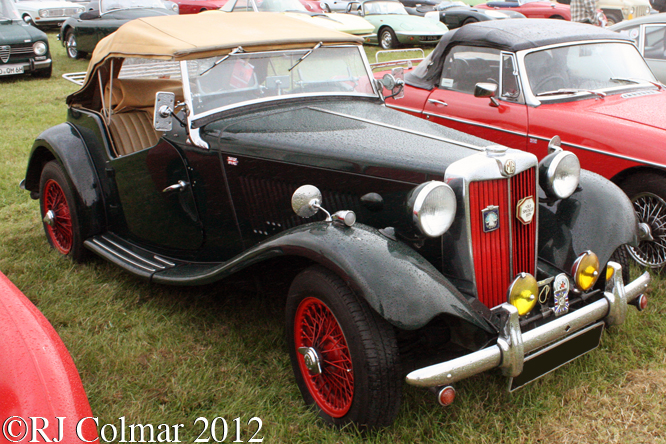
Also introduced with the MG TD were bumpers, note the TD above is not fitted with the standard over riders. As a concession to the Midget’s largest market the USA the cars were also available with Left Hand Drive as was a MK II version of the TD with a higher compression engine and two fuel pumps which would have been wasted in the UK thanks to ongoing rationing of low 72 octane fuel. Of the 30,000 MG TD’s built up until 1953 over 23,000 went to the United States.

MG TD, Goodwood Revival

A small cross section of race winners driving MG TD’s in 1950 includes, John von Neumann (USA), Ken Shipside (GB) and Larry Whiting (USA). TD’s like that driven by Bill Watkins were raced until 1960’s, Buddy Orr was winning races in his TD as late as 1961.

Thanks for joining me on this “Steel Wheels, 12 Volt Electrics and LHD” edition of “Gettin’ a li’l psycho on tyres” I hope you will join me again tomorrow. Don’t forget to come back now !

Share

Ronnie’s Rocket – Lotus Ford 72 E

Lotus went into the 1973 Formula One Championship season as World Champion Constructors with reigning World Drivers Champion Emerson Fittipaldi being joined by a new team mate 1971 Championship runner up Ronnie Peterson.
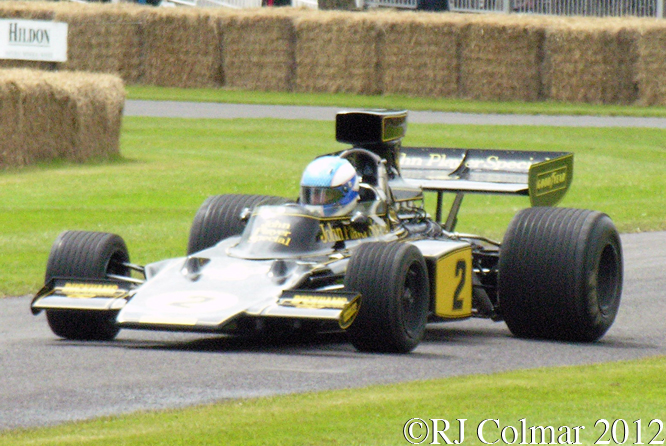
Lotus 72 E, Goodwood Festival of Speed

The team started the season with the same Lotus 72 D model as they had used through out 1972 albeit now running on Goodyear tyres in place of the previous seasons Firestones. Emerson started the season well with 2 wins and a 3rd place from his first 3 starts while Ronnie had only two retirements and an 11th place finish to show from the same three races.
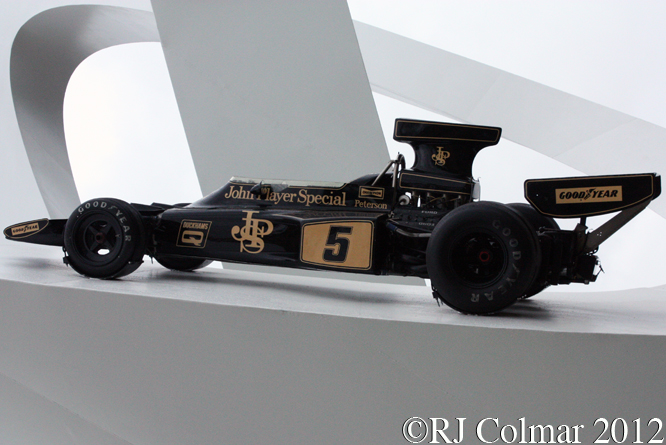
Lotus 72 E, Goodwood Festival of Speed

At the non championship Race of Championship the Lotus 72 D were brought up to E specification which included mounting the rear wing above the oil tank further back from the rear wheels and a wider track for the wheels front and rear. I well remember seeing both of the new cars spectacularly bottoming out on their debut at Brands Hatch as they approached the fearsome off camber and steep drop to Paddock Bend sending a shower of sparks from under the cars.
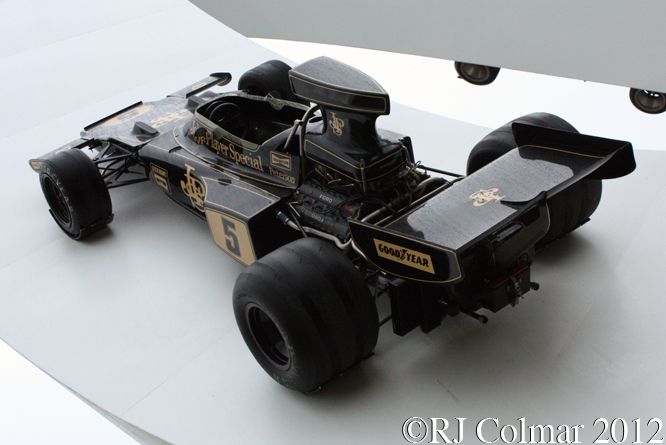
Lotus 72 E, Goodwood Festival of Speed

Both cars retired from the Race of Champions but Emerson won the 1973 Spanish Grand Prix, his last in a Lotus, before scoring three further second place finishes and a third on his way to a distant 2nd place championship finish behind Jackie Stewart and his Tyrrell Ford 006 who had clocked up five wins and two seconds on his way to his third and final title.
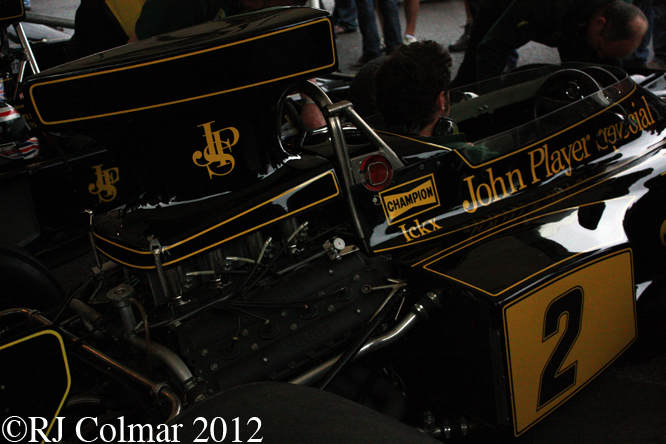
Lotus 72 E, Goodwood Festival of Speed

Ronnie meanwhile scored his first four Grand Prix wins and two second place finishes on his way to third in the championship title, helping Lotus win their second consecutive constructors championship. For 1974 Jackie Stewart retired, Emerson moved to McLaren to drive the M23, based very much on the principles of the Lotus 72, and Ronnie was joined at Lotus by Belgian Jacky Ickx.
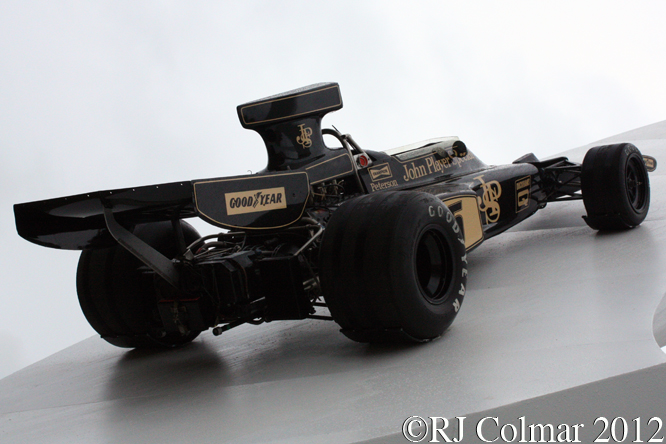
Lotus 72 E, Goodwood Festival of Speed

Lotus started the 1974 season with the 72 E for the first two championship races and then Ickx used a 72E at the non championship Race of Champions and won after pulling off a brilliant overtaking move on Niki Lauda in his Ferrari 312 B3 going into Paddock Bend right in front of my nose. If all had gone to plan this would have been the last ever race for the Lotus 72 which had been introduced in 1970.
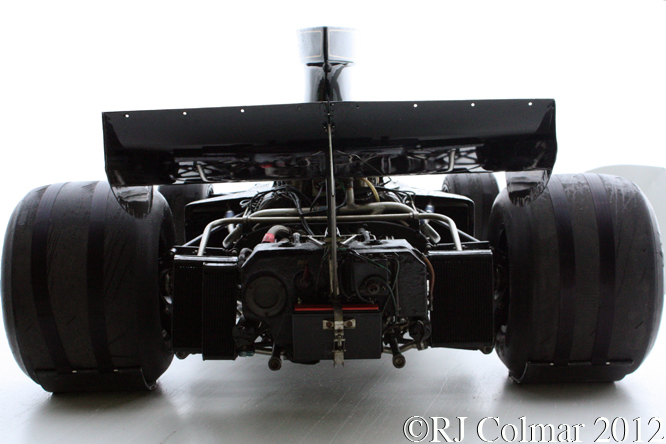
Lotus 72 E, Goodwood Festival of Speed

The Lotus 76 was first raced in the 1976 South African Grand Prix where neither car finished, Ronnie qualified his 76 at the non championship International Trophy at Silverstone and again at the Spanish Grand Prix but getting the car to finish proved impossible and so the Lotus 72 E’s were wheeled out again for the 1974 Monaco Grand Prix where Ronnie won from third on the grid, Ronnie added to more victories to the Lotus 72 E’s tally during the season to finish a distant fifth in the Championship which was won by his former team mate Emerson Fittipaldi in his Lotus 72 copy the McLaren M23.

For 1975 the Lotus 72 E’s were wheeled out again as the Lotus 76 had been abandoned as a failure, it would take a full twelve months for Lotus to build a new challenger such was the lack of financial resources and Lotus commitment to road car and sundry other projects. Ronnie gamely struggled on scoring just three points paying finishes while Jacky Ickx quit the team before the seasons end having scored a single second place finish.

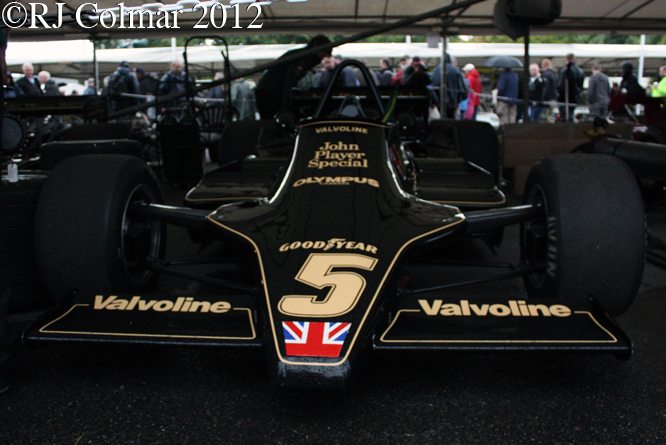
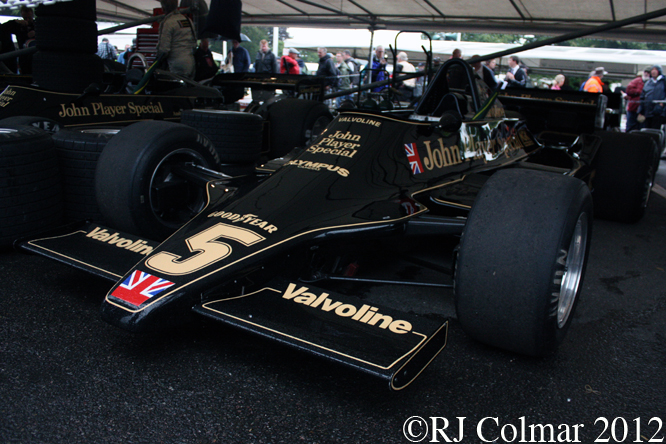
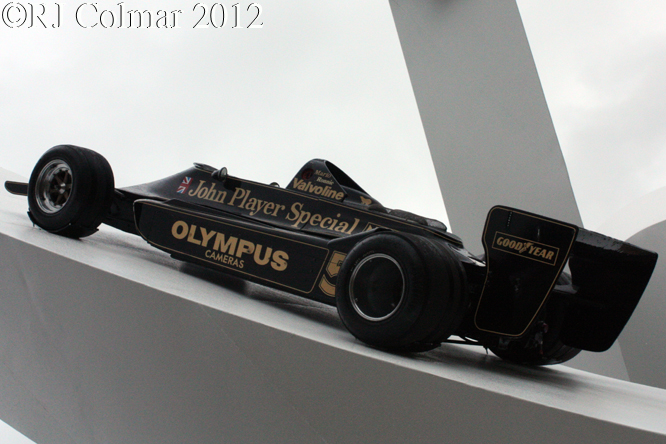
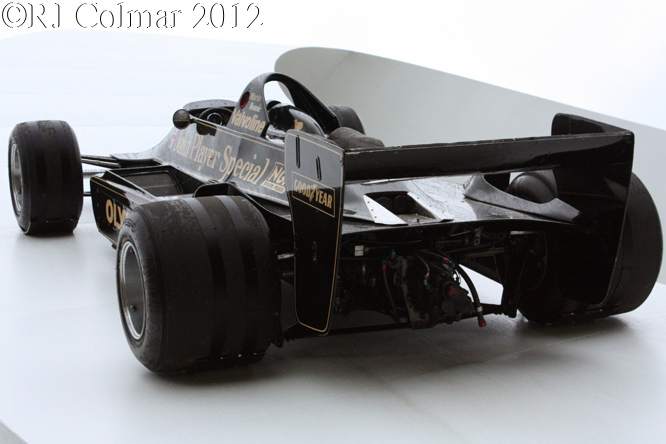
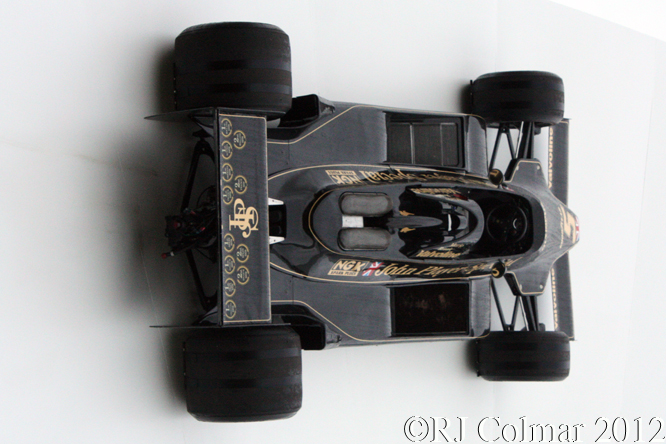
I believe the two cars seen here both belong to Classic Team Lotus with the #2 most likely being a replacement chassis for the wrecked Lotus 72/R5 driven by Emerson Fittipaldi in C spec to victory in the 1970 US Grand Prix and last used in E spec by Brian Henton in the 1975 US Grand Prix.

The #5 appears to be #72/R9 built new for the 1975 season and used exclusively by Ronnie Peterson who scored a best third place finish in the non championship 1975 Race of Champions at Brands Hatch, and three further points paying finishes including a 5th place finish in the 1975 United States Grand Prix which would be the cars final appearance.

Fans of the Lotus 72 in the UK will be interested to know that there will be a 24 min documentary on the story behind the Lotus 72 on Motors TV in December, keep your eye out for it in the schedule. The films director Gary Crichter will also be releasing a full 90 min version with 60 mons of extra’s of the film on dvd in the near future. Keep your eye out on the www.lotus72dvd.com website for further announcements.

Thanks for joining me on this “Ronnie’s Rocket” edition of “Gettin’ a li’l psycho on tyres” I hope you will join me again tomorrow, don’t forget to come back now !

Share