Tag Archives: Goodwood

Mille Miglia Tribute – Goggomobil TS Coupé

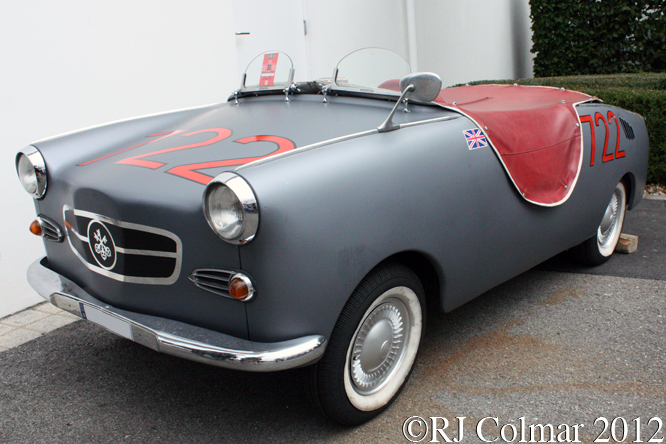
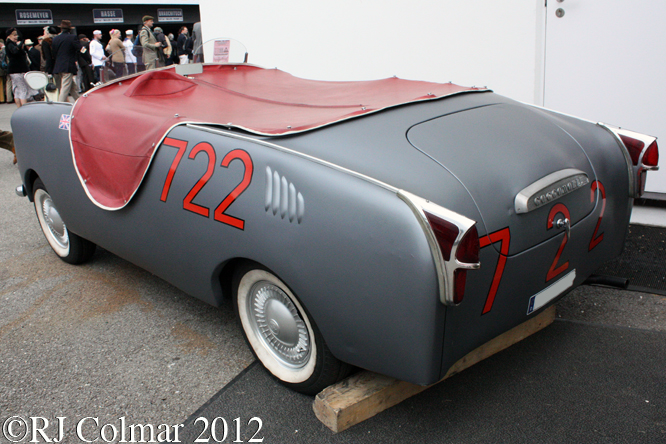
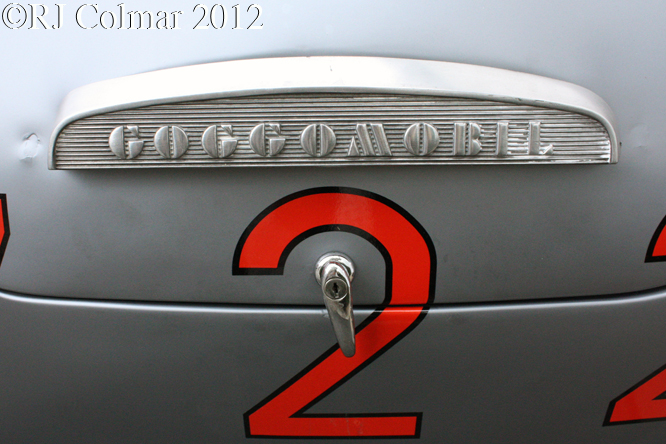
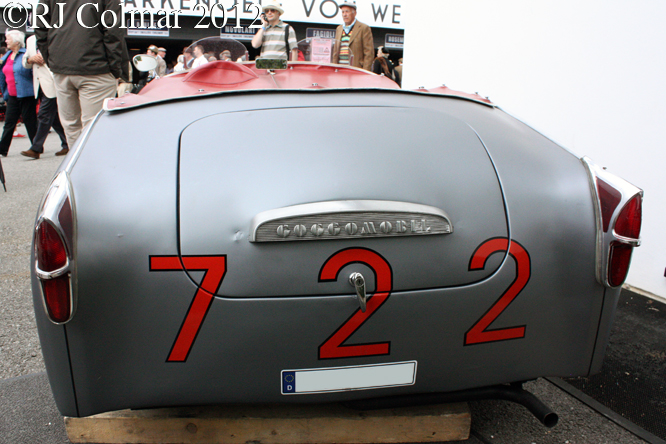
Over the last couple of years here at GALPOT Towers I have seen a few tribute cars from a modest #177 1967 Monte Carlo winning Mini to the enormous #3 1950 Le Mans Cunningham Cadillac Petite Pataud with the occasional odd ball like the #88 Mountain Dew MG B thrown in, but I’d hazard a guess that today’s cut down Goggomobile TS Coupe which stands as a tribute to the #722 1955 Mille Miglia winning Mercedes Benz 300 SLR of Stirling Moss and Denis Jenkinson is the strangest tribute car I have seen yet.
Goggomobil TS Coupe MM Tribute, Goodwood Revival

Goggomobil was a brand belonging to Glas that manufactured 4 different micro vehicles between 1955 and 1966 when Glas was taken over by BMW.
Goggomobil TS Coupe MM Tribute, Goodwood Revival

The car seen here would appear to be a TS Coupé that has had the roof and doors removed while the windscreen has been replaced by two ‘Brooklands’ aeroscreens.
Goggomobil TS Coupe MM Tribute, Goodwood Revival

Because the car is on foreign plates I have not been able to determine either it’s age or the engine size. What ever the exact details the engine will be an aircooled two stroke straight twin of between 250 cc / 15.3 cui and 400 cc 24.6 cui which would give somewhere between 13 hp and 20 hp depending on size.
Goggomobil TS Coupe MM Tribute, Goodwood Revival

The #722 Moss/Jenkinson 300 SLR, which won the 1000 mile street race at an all time record average speed of 97.96 mph, is widely regarded as being the worlds most desirable and expensive car, if Mercedes Benz were to ever make it available. One of the remaining Goggomobil TS Coupés, of the total 66,511 built, could be purchased for anything up to €7,000/£5,800,/USD 9000 depending on condition.

Thanks for joining me on this “Mille Miglia Tribute” edition of “Gettin’ a li’l psycho on tyres” I hope you will join me again tomorrow for a look at a li’l red Corvette. Don’t forget to come back now !

Share

10,000 RHD’s Only – MG TC Midget

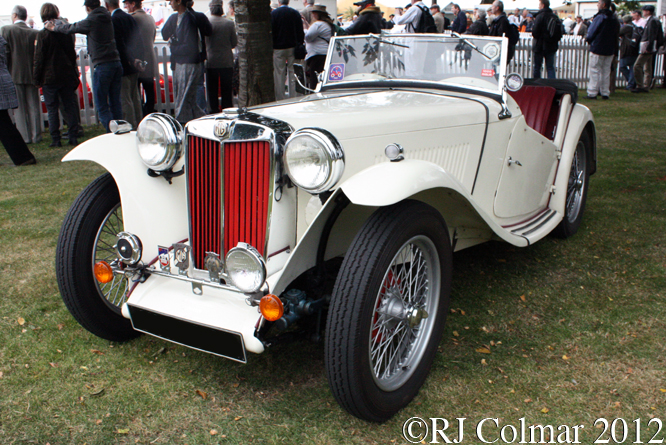
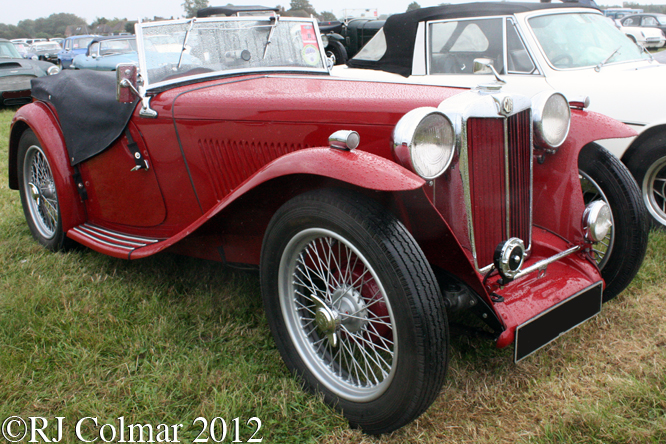
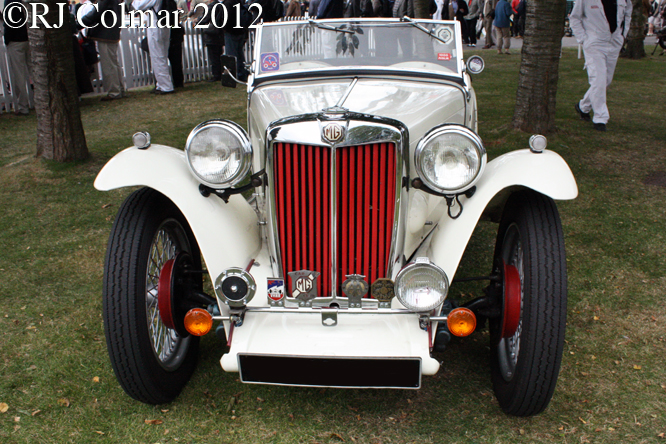
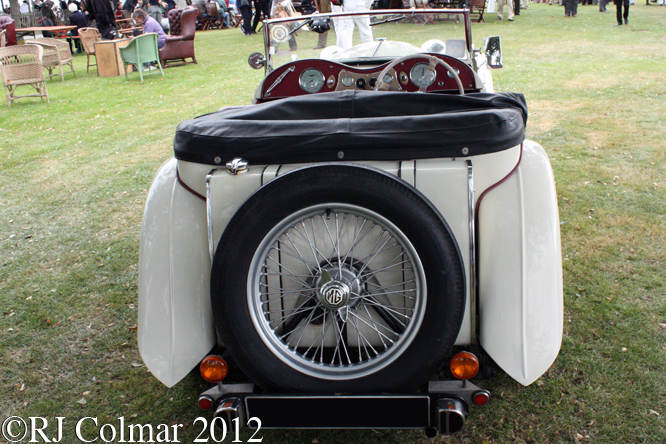
A development of the pre-war 1939 MG TB, of which only 379 were built, the MG TC was launched in 1945. and experienced comparatively huge popularity thanks to large numbers of US service men who served in the UK during the 1939 – ’45 war who fell for the cute li’l pre war MG’s that were still in evidence on the roads during the hostilities.

MG TC, Goodwood Revival

The MG TC experienced comparatively huge popularity thanks to large numbers of US service men who served in the UK during the 1939 – ’45 war who fell for the cute li’l pre war MG’s that were still in evidence on the roads during the hostilities.

MG TC, Goodwood Revival

Powered by a high compression version of the M TB 1250 cc / 76 cui 4 cylinder motor which produced 54 hp in standard trim, the motors could be supplied in different states of tune for specific, competition, purposes.

MG TC, Goodwood Revival

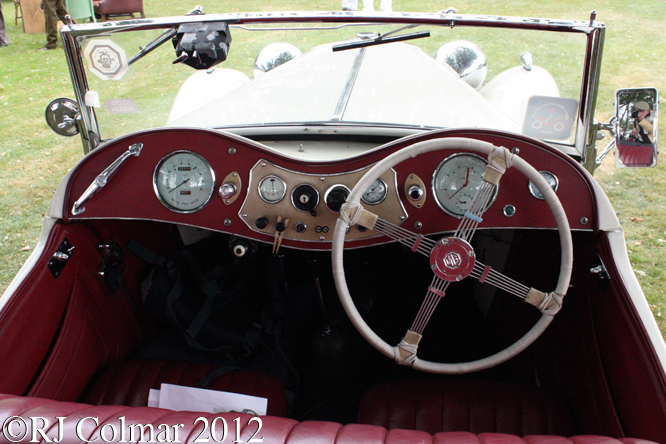
The TC’s cockpit was wider than that of the TB and featured a tachometer mounted directly in front of the driver, particularly useful for competition purposes.

MG TC, Goodwood Revival

TC’s were raced extensively in Europe, Australasia and North America recording many outright and class wins, both Carroll Shelby and Phil Hill raced and won driving MG TC’s, in their early careers, on their way to becoming stars on the world motorsports stage. Bill Bradley is known to have won his, HP, Class in an SCCA sanctioned event at Opelousas as late as July 1963.

MG TC, Goodwood Revival

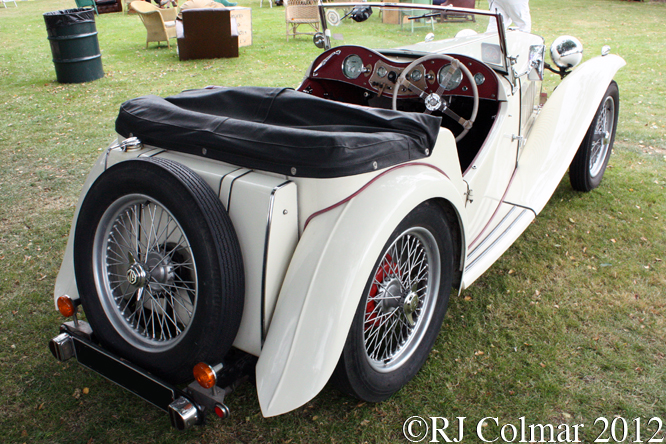
All of 10,000 MG TC’s built between 1945 and 1949 were right hand drive, despite most of them being exported to Left Hand Drive countries particularly the United States.

Share

April Fool ? – Lotus 72 B #72/R1

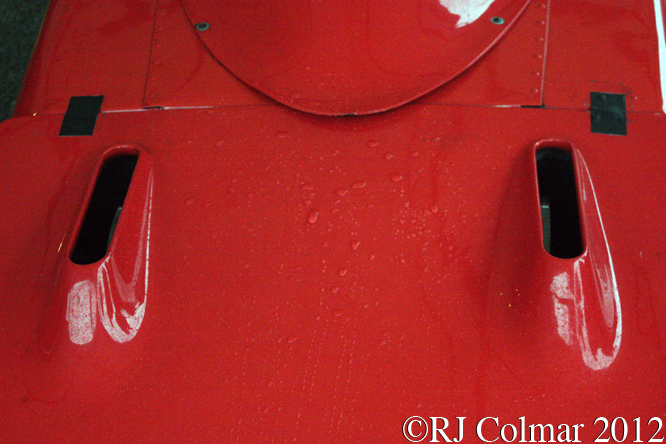
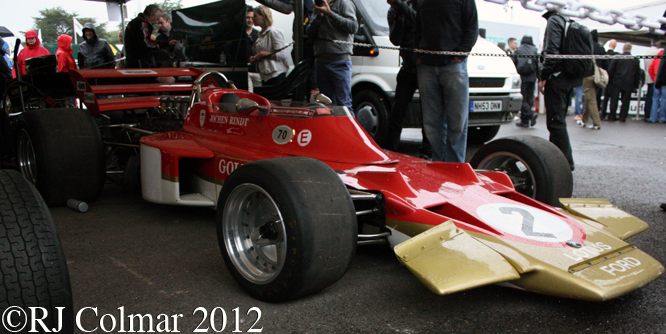
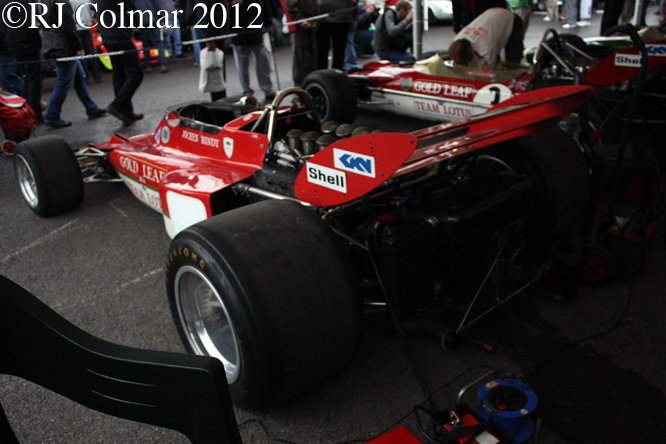
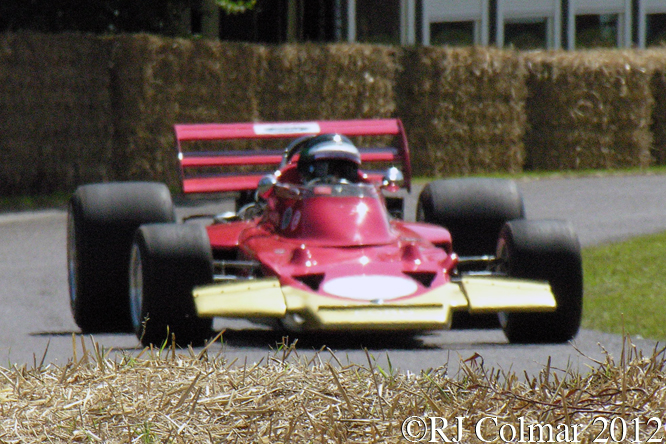
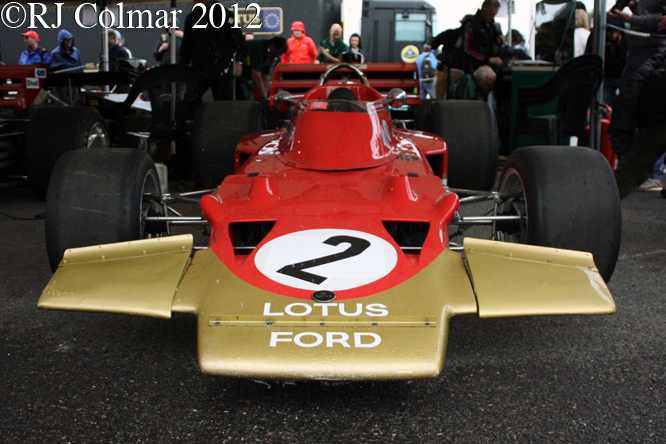
On the 1st of April 1970 the press were invited to see the Lotus 72 for the first time. The clean wedge shape was a return to the theme from the 1968 Lotus 56 Indy Car and Lotus 58 Formula 2/Tasman car.

Lotus 72C, Goodwood Festival of Speed

When the car was first tested by works drivers Jochen Rindt, John Miles and John Walkers driver Graham Hill they all reported the cars innovative front anti dive and rear anti squat suspension which aimed to reduced suspension travel under braking and acceleration was difficult to drive on the limit.

Lotus 72C, Goodwood Festival of Speed

As a result of this Jochen Rindt got his 1970 championship campaign under way with a fortuitous win in Monaco driving an updated four year old design in the form of a Lotus 49 C.

Lotus 72C, Goodwood Festival of Speed

At the 1970 Dutch Prix Lotus arrived with the second 72 chassis #72R2 updated to C-specification, with the anti dive and anti squat features of the suspension removed, for Jochen Rindt to drive which he found much more to his liking and proceeded a sting of four successive wins in Holland, France, Britain and Germany which gave Jochen what would become an unassailable lead in the World Championship.

Lotus 72C, Goodwood Festival of Speed

Unfortunately during practice for the 1970 Italian GP when he was testing #72/R2 without any wings, under braking an inboard front brake shaft broke, sending the 28 year old Jochen into a crash barrier post with fatal results.

Lotus 72C, Goodwood Festival of Speed

New team leader Emerson Fittipaldi won the last race of the 1970 season driving a new 72 C. Jochen Rindt became the only posthumous World Champion and Lotus won their 4th Constructors Championship. For 1971 the Lotus 72 C proved to be not quite so competitive against Jackie Stewart and the Tyrrell Team, but otus would bounce back with the upgraded Lotus 72 D in 1972.

Lotus 72C, Goodwood Festival of Speed

Lotus 72 #72/R1 is the only remaining 1970 spec car left, it was the car shown to the press on April 1st 1970 and subsequently entered and raced for Jochen’s team mate John Miles in original and B spec with only the anti squat removed from the rear suspension. John’s best result was a 7th place finish in the 1970 Dutch Grand Prix.

The Lotus 72 spawned many successful imitations including the McLaren M16 multiple winning Indy car and the McLaren M23 multiple world championship winning Grand Prix car.

Today’s Grand Prix and Indy cars all fitted with side radiators in side pods can all be said to be descendants of the Lotus 72.

Note the cockpit surround of #72/R1 has a shallow perspex screen from a later post 1972 Lotus 72.

Thanks for joining me on this “April Fool ?” edition of “Gettin’ a li’l psycho on tyres” I hope you will join me again tomorrow. Don’t forget to come back now !

Share

One Step Back, Two Steps Forwards – MG TA

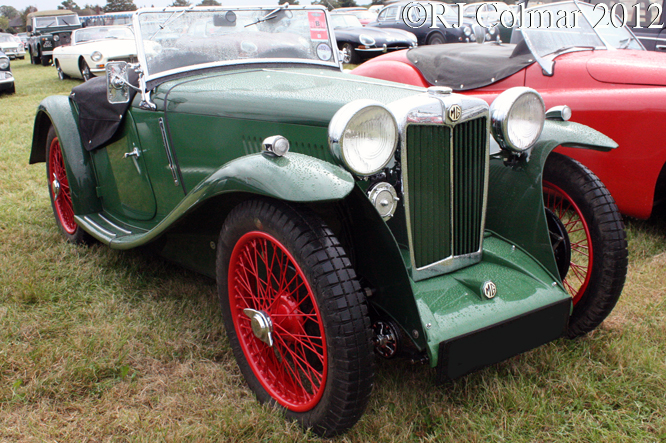
The MG TA Midget replaced the MG PB Midget in 1936 with many, of it’s parent company, Morris components. The TA and following T series variants opened up the appeal of sports cars in general to a huge new market that had remained hitherto untapped thanks to the reputation sports cars had for being temperamental if not plain difficult to drive.

MG TA, Goodwood Revival

Built with a 7″ longer and 3″ wider chassis the TA’s motor was technically a retrograde step from it’s PB predecessor which had an over head cam motor. The Morris 10 based TA motor ‘only’ featured pushrod operated over head valves, but with 2 carburetors this still produced 50 hp with the benefit that the valve clearances were much easier to maintain.

If the motor was a technological retrograde step both the synchromesh gearbox, making changing gear much easier and the hydraulic brakes, which needed much less maintenance, were both technological steps forwards that made the TA a much easier car to drive and maintain, than it’s predecessor and added to the durability of the whole TA package.

Top speed of the TA was around 80 mph with a rest to 60 mph acceleration time of just over 23 seconds. 3,000 TA Midgets were manufactured between 1936 and 1939.

Thanks for joining me on this “One Step Back, Two Steps Forwards” edition of “Gettin’ a li’l psycho on tyres”, I hope you will join me again tomorrow when I’ll be looking at an unusual tribute car. Don’t forget to come back now !

Share

Single Year Production – MG PB

Introduced in 1935 the MG PB was an upgrade of the MG PA featuring a larger 939 cc / 57 cui over head cam motor that produced 43 hp and drove the wheels through a non synchromesh gearbox.

Externally the PA and PB are differentiated only by the radiator grill which features a honeycomb pattern on the PA and vertical slats on the PB, the latter pattern would remain an MG feature right the way through until the early 1960’s.

MG PB’s were entered in the Le Mans 24 hours in 1935, ’37 and ’38 scoring a best 12th place finish in 1938 with Claude Bonneau from Belgium and Mme Anne Itier from France at the wheel of the formers car. Ernest Harewood won handicap events at Goodwood with his PB chassis #PB0528 in 1952 and 1953.

526 MG PB’s were manufactured from 1935 to 1936 when the model was replaced by the easier to drive and maintain MG TA.

Thanks for joining me on this “Single Year Production” edition of “Gettin’ a li’l psycho on tyres” I hope you will join me again tomorrow. Don’t forget to come back now !

Share

Cut and Bury – Lotus Ford 64

After coming close to winning the 1968 Indianapolis 500 with the Pratt & Whitney gas turbine powered Lotus 56 driven by Joe Leonard the powers at Indianapolis decided to ban gas turbine power and all wheel drive for the 1969 season, but eventually relented and allowed all wheel drive vehicles that had wheels no more than 9″ wide all round. Rear wheel drive vehicles were allowed to go to 14″ wide wheels at the rear.

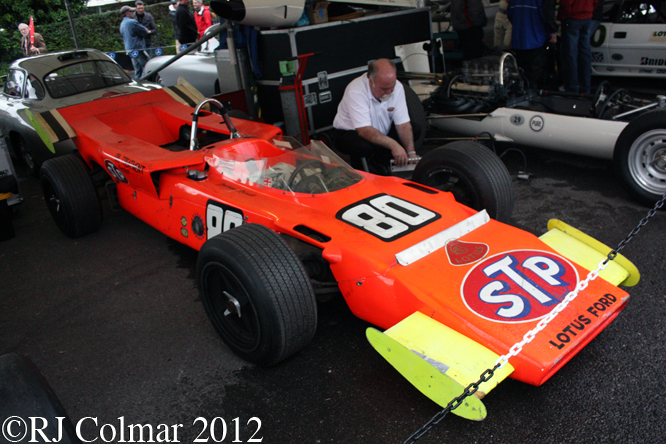
Lotus Ford 64, Goodwood Festival Of Speed

Colin Chapman rose to the challenge of building a car to the new regulations with the financial encouragement from Andy Granatelli’s STP Oil Treatment. The Lotus 64 was a new chassis which was powered by a 700hp turbocharged double overhead cam Ford V8 motor driving an all wheel drive system that was lifted from the Lotus 56 as indeed was much of the rest of the chassis.

In order to connect the motor to the mid mounted gearbox the motor had to be mounted backwards so the drive came from the front, as on the ill feted Lotus Ford 63 all wheel drive Grand Prix car.

Mario Andretti, Graham Hill and Jochen Rindt were lined up to drive the three team cars and a spare was built just in case of unforeseeable eventualities. Straight out of the box the cars were on the pace of the gas turbine Lotus 56 from the year before setting record speeds. However Mario Andretti’s car had a rear hub failure which sent him into the wall. Mario was lucky to get away with superficial burns to his face and after it was determined the failure was due to a design fault that could not be rectified in the available time frame the three Lotus 64’s were withdrawn from the race.

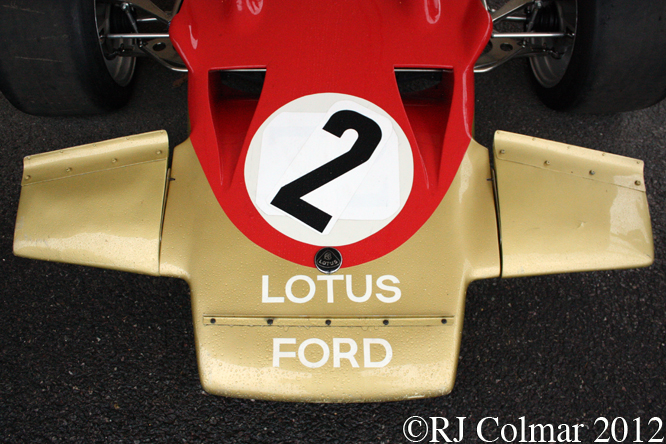
Mario jumped into the #2 Hawk Ford belonging to Granatelli and promptly qualified 2nd to AJ Foyt and then won the race after Lloyd Ruby was knocked out of contention by leaving the pits with his refueling hose still attached.

Andy Granatelli wanted to buy one of the remaining 64’s but when negotiations broke down Colin Chapman is alleged to have ordered the now engineless cars be returned to Hethel, Lotus home base, where he promised to take a hack saw to them personally cut them up and dig a whole and personally bury them. As it turned out all three cars were put in a shed.

Jochen Rindt’s #80 is seen above sans motor, this is the second of the three remaining 64’s to have emerged in recent years the other one has a correct Ford motor installed.

Thanks for joining me on this “Cut and Bury” edition of “Gettin’ a li’l psycho on tyres, I hope you will join me again tomorrow when I’ll be looking at the first car to record a 200 mph average closed circuit lap during a race. Don’t forget to come back now !
Share

The Breadvan – Ferrari 250 GT SWB #2819

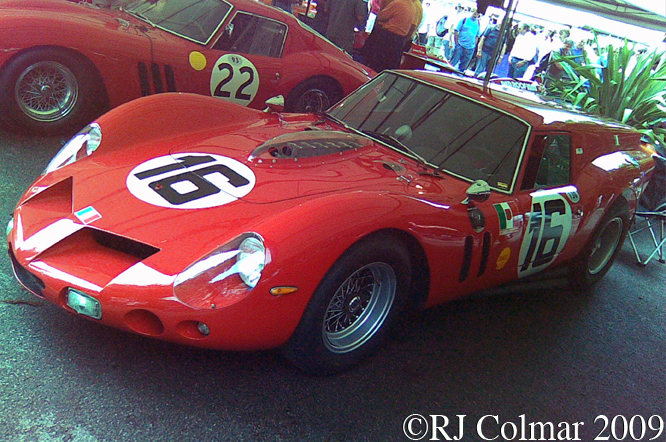
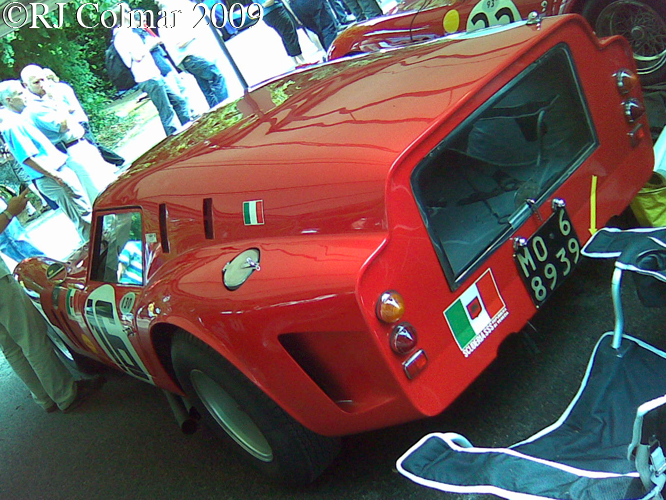
Today’s unique vehicle came to be built after Count Giovanni Volpi di Misurata fell out with Enzo Ferrari for financing a rival Formula One team ATS which employed ex Ferrari personnel Carlo Chiti, Giotto Bizzarrini and World Champion driver the American Phil Hill.

#2819 started life as a regular Ferrari 250 GT SWB and was entered in the 1961 Tour de France by Ecurie Francochamps for Olivier Gendebien and Lucien Bianchi who finished 2nd. The car was then acquired by Count Giovanni Volpi di Misurata who’s Scuderia Serenissima di Venezia entered the 1961 Paris 1000 kms for Maurice Trintignant and Nino Vaccarella who finished 3rd.

Ferrari 250 GT SWB, Goodwood Festival Of Speed

Wanting a third vehicle to enter in his Le Mans team which included one 250 GTO, #3445 and a Ferrari TR/61, #0792TR which won at Sebring, but unable to secure a second 250 GTO from Ferrari, Count Volpi di Misurata had his 1961 250 GT SWB upgraded to 250 GTO spec by the very man responsible for conceiving the original 250 GT SWB and 250 GTO series Giotto Bizzarrini.

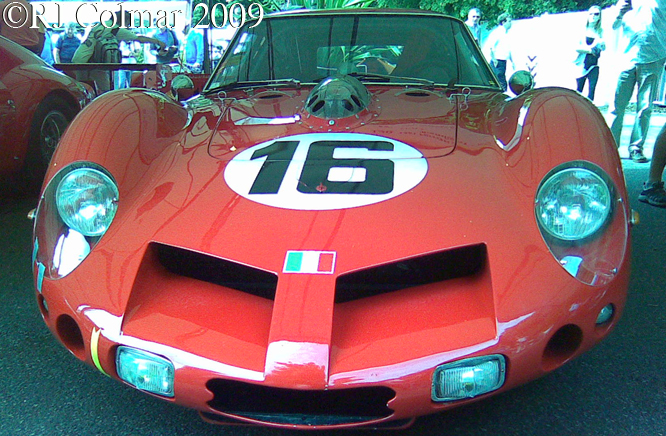
Allegedly in just 14 days Giotto Bizzarrini & Piero Drogo modified Count di Misurata’s 250 GT SWB by moving the dry sumped engine back 5 inches behind the front axle so that it could be mounted lower in the chassis. Piero Drogo came up with a staggeringly beautiful body with a cut off ‘Kamm’ tail which led to the name Breadvan. The finished car was 143 lbs lighter than the 250 GTO and 7 mph faster on the 4 mile Mulsanne straight at Le Mans.

Ferrari 250 GT SWB, Goodwood Festival Of Speed

The body of the 250 GT SWB Breadvan is so low that a plastic bubble was devised for the hood to cover the six Webber carburettors. The 276 horse power 2953 cc / 180 cui V12 engine weighed nearly half that of the contemporary XK straight six used by Jaguar in it’s D & E Type racers.

#2819 driven by Carlo Maria Abate and Colin Davis was leading the works 250 GTO’s in the 1962 Le Mans 24 Hours when it retired after four hours with drive shaft failure. After a 4th place finish at Brands Hatch for Abate, and 3rd place in Paris for Ludovico Scarfiotti and Davis the ‘Breadvan’ was used by Count di Misurata as a road car.

Ferrari 250 GT SWB, Goodwood Festival Of Speed

The original SWB body from #2819 was fitted to chassis #2439 by Scaglietti in 1962 after Gunnar Anderson had a couple of accidents at Falkenberg and Västkustloppet in Scandinavia.

Apparently Count Volpi di Misurata lent The Breadvan to Gianni Agnelli, then head of FIAT, who had the vehicle painted black by his butler because it reminded him of a hearse, it is not noted if this had anything to do with then delicate state of Ferrari finances at the time, the Ferrari road car division was eventually absorbed by FIAT in 1969.

Thanks for joining me on this “The Breadvan Edition” of “Gettin’ a li’l psycho on tyres” I hope you will join me again tomorrow when I’ll be looking at Colin Chapmans 1968 turbo charged all wheel drive Indy challenger. Don’t forget to come back now !
Share