Tag Archives: Hill

What goes around – Ferrari 250 MM Vignale #0260MM

The Ferrari 250 MM was launched with a tube frame chassis carrying a 237 hp V12 in 1953 weighing just 850 kgs / 1874 lbs.

Ferrari 250MM, Vignale

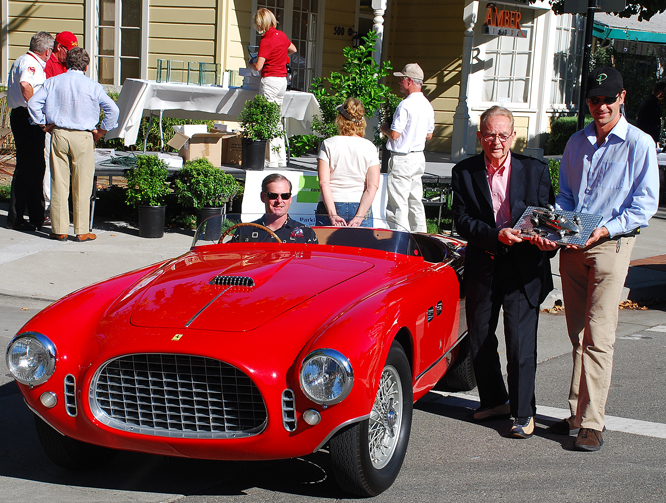
Phil Hill, who is pictured here by Geoffrey Horton at Danville Concours d’Elegance in 2007 was supplied with this vehicle by US Ferrari importer Luigi Chinetti and drove the Vignale bodied 250MM to victories at Pebble Beach and Santa Barbara in 1953 and scored a class victory at Stead AFB Reno, Nevada the same year.

There after the car was sold and continued to be raced up until at least 1957 before resurfacing on the Concours circuit, at Pebble Beach in 1983. Phil appears to have driven the car competitively for the last time at the Monterey Historic races in 1984.

For the 2007 Danville Concours d’Elegance, an annual event which raises money for the Parkinson’s Institute and Clinical Center, Sunnyvale, California, Phil’s former employers Road & Track created the Phil Hill Trophy for the winner of the Concours event.

Phil, who suffered from and died as a result of complications from Parkinson’s disease, may have been understandably a little biased when he selected the Vignale 250MM car he had once owned and raced to victory to be the inaugural winner of the trophy named after him.

My thanks to Geoffrey Horton who kindly sent me this image.

Thanks for stopping by today’s Phil Hill Trophy edition on ‘Gettin’ a lil’ psycho on tyres’, I hope you will join me again tomorrow. Don’t forget to come back now!

Share

Butt Naked – Borg Warner Trophy

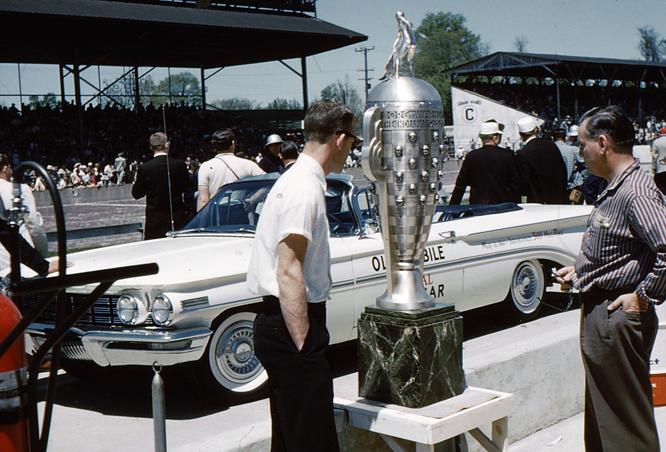
To round out my month of May centenary celebration of the first running of the Indianapolis 500 today I’ll be looking at possibly the most coveted prize in all of motor racing, the Borg Warner Trophy seen here in 1960 courtesy of Ed Arnaudin.

Borg Warner Trophy, Indianapolis Motor Speedway

1960 Photo by Ed Arnaudin

The Indianapolis 500 always run on Memorial Day weekend is full of traditions including the early morning explosion that signals the opening of the gates to The Brickyard at 6 am on race morning, the marching of bands starting at 8 am, which includes the Purdue University All American Marching Band who play the worlds biggest drum.

The National Anthem and Invocation are followed by a rendition of Taps in remembrance of the fallen complete with a military flyover.

Indianapolis Motor Speedway/a>

1961 Photo by Ed Arnaudin

Another traditional highlight since 1972 is Jim Nabors accompanied by the Purdue Marching band for a rendition of ‘Back Home Again in Indiana‘ during the performance of which thousands of balloons are released, a tradition that started earlier in 1946.

Then there is the call for the ‘Ladies and Gentleman’ to start their engines in the build up to the race before the pace car laps and first fall of the green flag that gets the race started.

Once the race is won the winner is ushered into Victory Lane and since 1936 in a tradition started by three time winner Louis Meyer the winner drinks milk, Meyer actually drank buttermilk.

Wilbur Shaw a three time Indy winner and President of the Indianapolis Motor Speedway who was not partial to milk interrupted the milk drinking tradition from 1947 to 1955 with a bowl shaped trophy filled with iced water for the winner to drink.

Since 1956 milk was reinstalled on the winners menu and only Emerson Fittipaldi, owner of several orange groves, in 1993 has broken the tradition by drinking orange juice. The winner is then photographed with the Borg Warner Trophy a tradition which also started in 1936.

The Borg Warner Trophy was designed by Robert J Hill and Gorham Inc of Providence Rhode Island at a cost $10,000 in 1935. A likeness of all the winners faces back dated to first Indy 500 in 1911 adorns the 52 inch 153 lb sterling silver trophy which had to have its base expanded in 1987 to accommodate the faces of the most recent winners.

Bobby Rahal’s face, sans spectacles unlike Tom Sneva, was the last drivers likeness attached to the original trophy since then likenesses of winners have been attached to the base which was last extended in 2004.

The trophy used to be displayed on the roll bar of the winners car however it is now so large and heavy that it is displayed along side the winners car.

Borg Warner Trophy, Indianapolis Motor Speedway

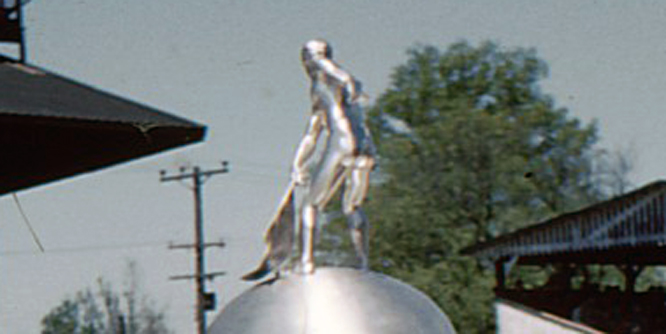
1960 Photo by Ed Arnaudin

One thing I discovered while preparing this blog and is verified by Ed’s photo is that the flag man atop the trophy is cast as a traditional ancient Greek athlete and is in fact butt naked.

Louis Meyer described winning the Borg Warner Trophy like “winning an Olympic Medal”. Prior to 1988 a 24 inch model of the trophy mounted on a walnut base was given to winners since 1988 winners have been given an 18″ replica during preparations for the following years race.

Also since 1936 the winner of the Indy 500 has taken home the Official Pace car, more on which will have to wait until next year.

Wishing all the competitors in today’s centenary running of the Indy 500 the best of luck.

Evidence provided by Tim Murray shows that as of 2005 the Johnny Parsons spelling error I mentioned in my blog on the Wynns Friction Proofing Special had not been corrected. Apologies for any confusion caused.

Thanks to Steve Arnaudin for the scans of his Dad’s slides also to Tim Murray and B² from The Nostalgia Forum for their help clarifying dates concerning the Borg Warner Trophy.

That concludes what for me has been a fascinating month of May looking at a potted history of the Indy 500, thanks for joining me on today’s ‘Butt Naked’ truth edition of ‘Gettin’ a lil’ psycho on tyres’, I hope you will join me again tomorrow. Don’t forget to come back now !

Share

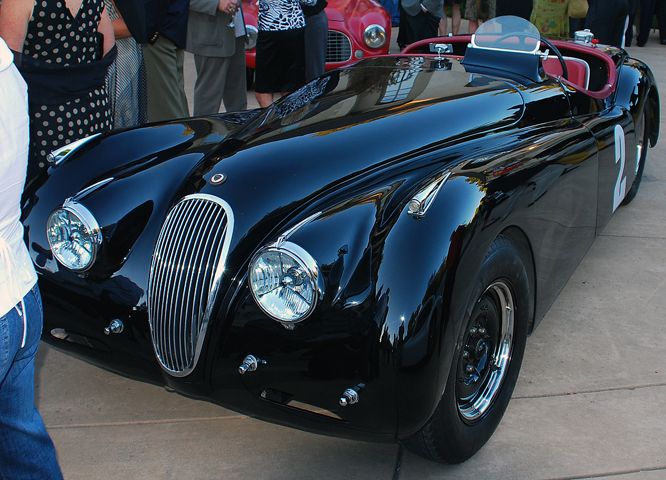
Black Cat – Jaguar XK120 #670138

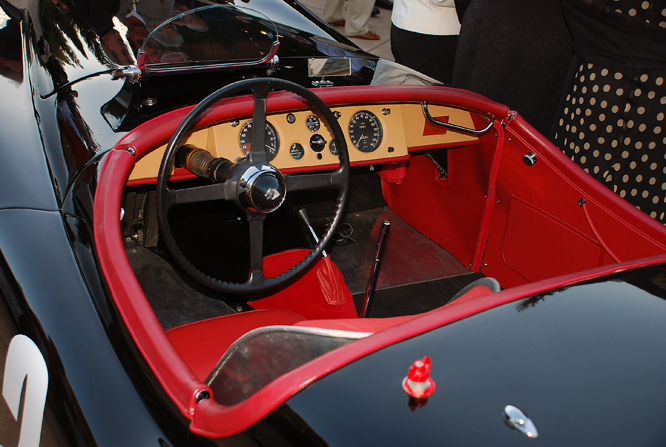
I’d like to thank Geoffrey Horton for sending me these photographs of Phil Hill’s Jaguar XK120 at the 2007 Danville Concours de Elegance.

Danville CC 2007 011s

This chassis #670138 is known to have been raced by Phil, who was guest of honour at Danville in 2007, in at least 3 races in 1950 in which he scored two second place finishes and a win in the 100 Mile race at Pebble Beach in November 1950.

Danville CC 2007 020s

Last week it came to light that I had overlooked something in my original blog on the XK120, namely that while the standard XK 120 took it’s name from it’s 120 mph capability, it has transpired that Norman Dewis was bolted into an XK120 with a streamlined roof and recorded a production car record speed of 172.412 mph on the 21st October 1953 driving along a stretch of Belgian Motorway known as the Jabbeke Straight, between Bruges and Ostend.

My thanks to Terry, Tim, Allan, and Tony at The Nostalgia Forum for the additional details and thanks again to Geoffrey for today’s marvellous photographs.

Hope you have enjoyed today’s Black Cat edition of ‘Gettin’ a lil’ psycho on tyres’ and that you will join me again tomorrow, Ferrari Friday, for a look at my favourite road going V8 Ferrari. Don’t forget to come back now !

Share

Millionaire Mystery – Scuderia Parravano Pt 1 of 2.

Today we are looking at the strange case of west coast entrant Antonio Parravano and his team of Ferrari’s which at it’s height was possibly the equal of any on either coast though ultimately less enduring.

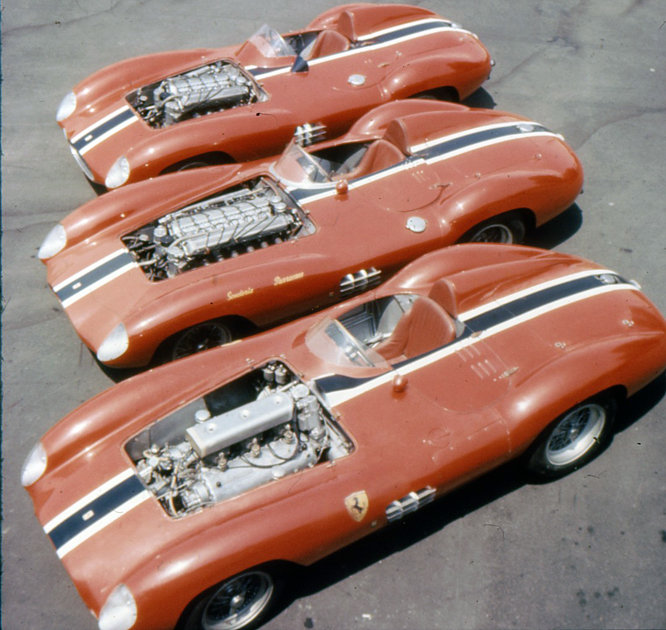
Antonio Parravano born in Italy in 1917 became a millionaire building contractor in Los Angeles and built a fabulous racing team of mostly but not exclusively Ferrari’s including three vehicles seen here in a photograph by Carlyle Blackwell.

Ferrari, 750 Monza, 121 LM, 410S, Parrevano, Carlyle Blackwell

Photo Carlyle Blackwell, Publised Courtesy Blackwell Archive, for sales enquiry’s please e-mail infoATpsychoontyres.co.uk and your contact details will be forwarded to the Blackwell Archive.

From back to front the vehicles are a 750 Monza #0538 the subject of next weeks Ferrari Friday blog, a 121 LM #0484LM, and a 410S #0592CM.

As I said I will come back to the 750 Monza at the back next week. Starting with the 121 LM #0484 this car started life with the smaller 3.7 litre Ferrari straight six motor and was as such was originally designated a type 118 driven to victory lane by Pierro Taruffi in the Giro di Sicilia, a version of the Targa Florio race, in 1955.

Halfway through 1955 chassis #0484 was the only 118 to be upgraded 121 spec with a 4.4 litre straight six.

Parravano acquired the car in late 1955 and entered it for Carol Shelby in the Oulton Park International that August where Shelby recorded a DNF due to driver injury.

In 1957 Phil Hill drove #0484 to victory at Palm Springs in 1957, the car was also driven by well known open wheel legend Roger Ward under different ownership in 1959.

#0484 is thought to be the only one of the three original 118 chassis thought to have survived ironically of course with a 121 spec motor.

The car closest to camera is a 410 S built for the South American road races that got cancelled due to safety fears. Equiped with Ferrari the largest available 4900 cc / 299 cui V12 engine capable of delivering 380 hp in twin plug format. The vehicle seen here, not one of the two fitted with twin plug heads, was raced into victory lane by Carroll Shelby at Palm Springs in 1956.

Next week we will continue with the case of Antonio Parravano and his team much of which vanished in 1957.

My thanks to Carlyle Blackwell, Ed Arnaudin and his son Steve for respectively taking, purchasing and forwarding today’s magnificent photograph and to GTO Freak, and Giotto at Ferrari Chat for their help identifying this weeks cars and the back ground on Tony Parravano.

I hope you have enjoyed today’s triple wammy Ferrari Friday and that you will join me again tomorrow. Don’t for get to come back now !

28 07 12 PS My thanks to Pamela Blackwell who has kindly retrospectively given me permission to post the photo’s her father took.

Share

I’m in the wrong business – Ferrari 860 Monza #0604M

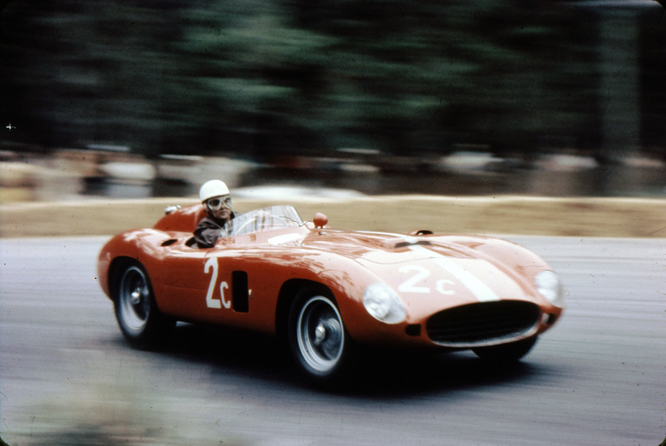
There are photographs and then there are some photographs one could write a book about, today’s photograph by Carlyle Blackwell of then future world champion Phil “I’m in the wrong business” Hill driving a Ferrari 860 Monza to 2nd place overall and first in class at Pebble Beach on the 22nd of April 1956 is without question one of the latter. I’ll do my best to summarise the story here.

Ferrari 860 Monza, Pebble Beach

Photo Carlyle Blackwell, Publised Courtesy Blackwell Archive, for sales enquiry’s please e-mail infoATpsychoontyres.co.uk and your contact details will be forwarded to the Blackwell Archive.

The Ferrari 860 Monza is perhaps the ultimate expression of mid 1950’s sports cars before the regulations governing such vehicles changed in the aftermath of the tragedy at Le Mans in 1955. Mercedes and Jaguar had withdrawn their factory supported entries from the World Championship Sports Car races entirely, though Jaguar supported successful private entries of Ecurie Ecosse at Le Mans in 1956 and 1957.

Ferrari were the only serious contenders left for the World Sports Car Championship in 1956 and the 860 was fully poised to sweep the board with a 280 hp 3432 cc / 209 cui Lamperdi straight 4 engine.

With the withdrawal of the Mercedes team from all forms of racing no less a free agent than reigning 3 time world champion Juan ” El Maestro ” Fangio became the ‘must have’ free agent of the 1956 season if not all time and Enzo recruited him to replace Ascari who had recently died in an accident.

Ferrari did not take the 860’s to Buenos Aries for the first round of the Championship which let Maserati off the hook. For the Sebring 12 Hours chassis #0604 M pictured here was prepared for Fangio and the suave up and coming man Euginio Castellotti and duly took a comfortable 2 lap victory ahead of a sister 860 Monza.

Just one month later the Sebring winning car had changed ownership and now belonged to John von Neuman, himself a competent driver who would take #0604 to victory lane at Santa Maria later in 1956, and entered his new possession for freshly signed works Ferrari driver Phil Hill at Pebble Beach, where we can see him driving to a class victory behind Carol Shelby in an older modified Ferrari 750 Monza.

This turned out to be the last event run at the Pebble Beach venue, Ernie Macafee’s fatal accident during the race was enough to persuade organisers to seek a safer facility which led to the opening of the Laguna Seca track in 1957.

Chassis #0604 M continued to be raced until 1962 with future works Ferrari driver Richie Ginther being one of many to drive her and Lew Florence being the last to take her to Victory Lane at Shelton in 1959.

Since then #0604 M has become a sought after collectors item with former head of the Renault F1 team Jean Sage counting among it’s owners. In 2006 the vehicle was offered for sale at $3.5 million., it is said to currently reside in Italy.

Ferrari won The World Sports Car Championship in 1956 despite a second defeat at the Nurburgring by Maserati.

For those new to the history of motor racing here is a brief introduction to a hugely popular driver. Phil (no relation to the British two time champion Graham) Hill was born in Miami FL and raised in Santa Barbra, California, dropped out of college to pick up a wrench to work on racing drivers cars before becoming a driver himself.

Phil won his first race a 3 lap even at Carrell Speedway driving an MG TC in July 1949. In 1958 he drove a Maserati 250 F in his first Grand Prix and in the same year sharing a Ferrari with Olivier Gendebien won the Le Mans 24 Hours a feat he repeated with Olivier and Ferrari in 1961 and 1962.

In 1960 Phil won the Italian GP driving a Ferrari becoming the first American to win a Grand Prix in nearly 40 years and the following year he won two Grand Prix on his way to becoming the first US World Grand Prix Drivers Champion. Unfortunately a dispute between Ferrari and Grand Prix racing’s governing bodies meant Phil never got to properly celebrate on home turf in fact arguably Phil never got to compete in all the Grand Prix races in a single season.

In 1967 Phil retired after driving a Chaparral to victory in the BOAC 500 at Brands Hatch. He continued working in TV for Road & Track and his own vehicle restoration business Hill & Vaughan until he retired in 1995.

Phil aged 81 succumbed to complications from Parkinsons disease in 2008. He is quoted as saying of his presence on the motor racing circuit, “I’m in the wrong business. I don’t want to beat anybody, I don’t want to be the big hero. I’m a peace-loving man, basically”.

Finally I am reliably informed this photograph made the cover of Road & Track Magazine in September 1956, I have not seen it yet if you have a copy and can scan it please get in touch using the e-mail link on my profile page, I’d love to see it.

My thanks to Ed Arnaudin who purchased this slide, to his son Steve who sent it on, to El Wayne and Miltonian at Ferrari Chat who passed on essential information on the identification of the car, its location, date and details of the publication.

Hope you have enjoyed today’s “I’m in the wrong business” edition of Gettin’ a lil’ psycho on tyres” and that you’ll join me for a look at the Maserati model the Ferrari had to beat to win the 1956 World Sports Car title. Don’t forget to come back now !

28 07 12 PS My thanks to Pamela Blackwell who has kindly retrospectively given me permission to post the photo’s her father took.

Share

Sister doing it for her self – OSCA Tipo S-187

Today we return to Lime Rock in 1959 courtesy of Ed Arnaudin for a look at this OSCA Tipo S-187 belonging to Briggs Cunningham.

Officine Specializzate Costruzioni Automobili – Fratelli Maserati SpA was set up by the three racing mad Maserati brothers Ernesto, Ettore and Bindo after their involvement with the company bearing their own name had concluded with it’s sale to Adolfo Orsi in 1937 and the expiry of their subsequent 10 year consulting contracts in 1947.

The brothers focused on building extremely successful sports cars primarily with engines of 750 cc / 45 cui to 1500 cc / 91.5 cui. Cunningham’s car seen here appears to be one of 17 Tipo S-187’s built from 1956 – 1960 with a 70 hp 749 cc / 45 cui twin cam engine with a, for the time, high 9:1 compression ratio.

The real story behind the #23 OSCA on this day in 1959 however is the driver who took the car to victory lane, one D McCluggage from Kansas, who is well known for breaking down discriminating and prejudicial barriers in journalism and at the race track, simply D stands for Denise.

As well as regularly whooping all the boys on the race track she is a seasoned motor sports journalist who was famously sent to Indianapolis by The Herald Tribune only to find she was barred from the press box, pit lane AND garage area, unperturbed she got her story from elsewhere round the track and published anyway.

Phil Hill later described the prevailing attitude at the time “It’s a bit embarrassing to me, given today’s enlightened attitudes, to admit that in the late 50s I was a bit disturbed by the idea of this woman driver. It wasn’t a matter of feeling threatened, but like many men in that period, I had trouble understanding what kind of statement Denise might be making with her driving efforts. The fact is, gender stereotypes aside, she was holding her own on the track.”

All Denise wanted to do was win and she did often, after her career as a professional driver was over she became a founding light at AutoWeek where her accomplishments are still scene as an example for others to follow.

Denise recently became the only Journalist to ever be inducted into the Automotive Hall of fame and at over 70 she still writes her ‘Drive, She Said’ column syndicated in over 90 newspapers across the US and Canada.

Hat’s off to Denise gentleman, for waking us up to our equals !

Thanks to Steve and Ed Arnaudin for the photograph, and to Terry O’Neil for the race day information.

Hope you have enjoyed today’s prejudice free edition of ‘Gettin’ a lil’ psycho on tyres’ and that you’ll join me tomorrow for a look at a splendid vintage Triumph Dolomite. Don’t forget to come back now !

Share

Two Cats in Hollywood – D-type XKD 531 & C -type XKC 007

Thanks again go to Steve & Ed Arnaudin for providing today’s unusual photograph which Ed purchased somewhere around 1958/59.
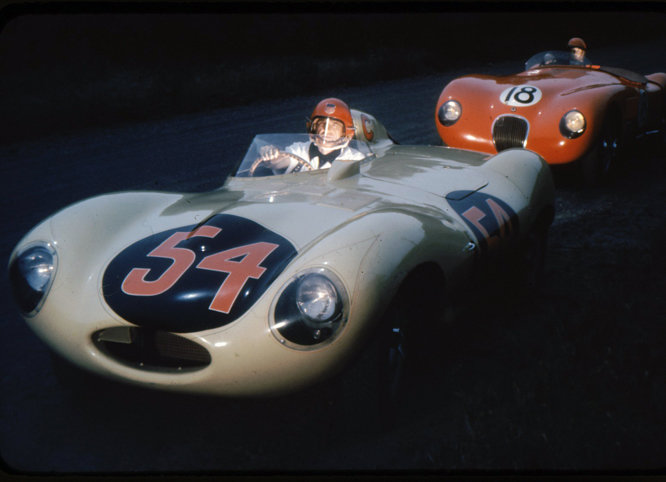
Jaguar D and C types

Photo by Carlyle Blackwell, Publised Courtesy Blackwell Archive, for sales enquiry’s please e-mail infoATpsychoontyres.co.uk and your contact details will be forwarded to the Blackwell Archive.

Extensive research on The Nostalgia Forum has revealed that not only the cars but also the lead driver AND the photograph itself all have stories to tell.

This photograph appears to have been taken in the studio by Carlyle Blackwell around 1956/57, when he was the owner of the red #18 C-Type XKC 007 which he raced between 1955 and 1957. The #54 D-type is thought to be XKD 531 owned and raced by J Douglas.

It should be noted that this blog is a research project in progress and the identification of the chassis numbers is still not definitive. I have tried to reach the copyright holders but so far in vain so it is possible I might have to withdraw this blog at some point.

The D-type Jaguar like the C-Type was a factory built racing car powered by a variation of the same XK engine design as the XK 120, XK 140 and C-type.

Like the late C-Type the D-Type was fitted with efficient disc brakes. It’s debut at Le Mans in 1954 was thwarted by sand in the fuel, once it was removed Duncan Hamilton & Tony Rolt took their D-type back up the field to second place 1 lap down on the winning Ferrari of Jóse Frolián González and Maurice ‘Racing Is Life’ Trintignant.

The following year Mike Hawthorn and Ivor Beub driving a D-Type won a hollow Le Mans Victory after the Mercedes Benz team withdrew following the horrendous crash in which an estimated 83 spectators lost their lives and a further 120 were injured.

D-types entered by the private Ecurie Ecosse team took two further victories in ’56 and ’57.

The #54 XKD 531, which I believe we are looking at here, is one of 53 customer D-types, this one was raced from 1956 to 1957 by J Douglas and then from 1958 to at least 1959 by Ray Seher.

The red #18 C-type XKC 007 was originally owned by Charles H Hornburg Jnr who had future US World Champion Grand Prix driver Phil Hill drive it to two victories in 1952, Phil said of XKC 007 ” It was the first car I ever drove that had a really precise feel about it – it really felt like a racing car.”

Carlyle Blackwell acquired the car in 1955 and raced it through to the end of 1957 before acquiring the D-type XKD 528.
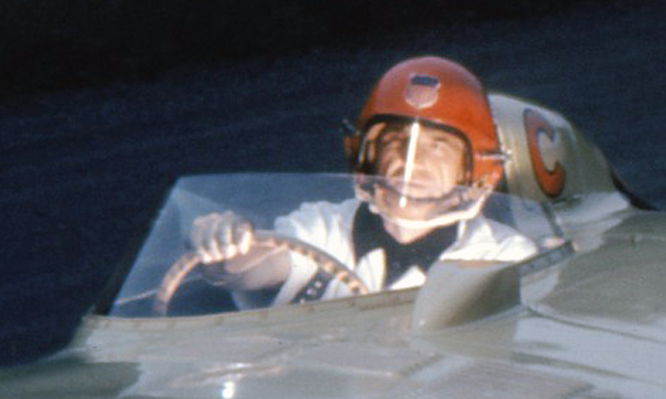
Jaguar D Type

Photo by Carlyle Blackwell, Publised Courtesy Blackwell Archive, for sales enquiry’s please e-mail infoATpsychoontyres.co.uk and your contact details will be forwarded to the Blackwell Archive.

The story of this photo does not stop with the cars however, look closely at the driver of the #54 and some of you might recognise the face as none other than that of Emmy winning writer Jack Douglas.

A detail of this photograph appeared on the cover of Sports Car Graphic in March 1963 the masthead reads “If the face on this month’s cover looks familiar, it should be. It belongs to Jack Douglas, writer, author of among other things, “My brother was an only child”, and sometime race driver. The photo was shot by his friend, Hollywood photographer Carlyle Blackwell.”
Jaguar D Type

Photo by Carlyle Blackwell, Publised Courtesy Blackwell Archive, for sales enquiry’s please e-mail infoATpsychoontyres.co.uk and your contact details will be forwarded to the Blackwell Archive.

The whole photograph as seen at the top of the blog first appeared on the cover of Sports Car Illustrated in February 1957 with a masthead that reads “Carlyle Blackwell shot this Ektachrome of a pair of competition Jaguars booming through the night.”
As can be seen studio lights are used to illuminate both drivers and the front of the #18.

Note how the colour from Ed’s purchased slide has darkened around an apparently ivory car, while the colour of the car as it appears on the cover of Sports Car Illustrated appears yellowish, the colour of Jacks car at the time has been described as ‘mustard yellow’ which only goes to show how unreliable photographs can be when trying to identify vehicles back in the day.

To date this is without doubt one of the most fascinating photographs I have ever come across. My thanks to Steve and particularly Ed Arnaudin who first purchased the photograph. Thanks also to everyone on the Auto Slides by Blackwell thread on The Nostalgia Forum for their invaluable contributions including, RA Historian Tom, Frank Barrett, Jean L, Jerry Entin, Frank Sheffield, Frank Hill, JB Miltonian, and raceanouncer 2003 Vince H.

I hope anyone believing they can improve on the accuracy of my hypothesis about this photo or with contacts leading to the Blackwell estate will chime in below.

Hope you have enjoyed this ‘Carceology’ edition of “Getting a lil’ psycho on tyres’ and that you will join me again tomorrow to see a ‘mystery’ vehicle with a Cat under the hood. Don’t forget to come back now !

28 07 12 PS My thanks to Pamela Blackwell who has kindly retrospectively given me permission to post the photo’s her father took.

Pamela tells me that her brother is seen at the wheel of the #18 Jaguar C-type in the photograph and that the photo was taken in Carlyle Blackwell’s driveway.

Share