Tag Archives: Lola

Driver to Sponsor – Simon Lewis

During the early 1980’s Simon Lewis was a regular spectator at Castle Combe where the biggest attraction used to be Formula Libre events run for any car built to known regulations.

McLaren M30, Castle Combe

At the top end of the entry would be vehicles that had run in Grand Prix like Alo Lawlers McLaren Cosworth DFV M30 resplendent in it’s original colours and bearing the name of it’s original driver Alain Prost,

Lola T330, Castle Combe

or Formula 5000 vehicles like Tony Trimmers Lola Chevrolet T330,

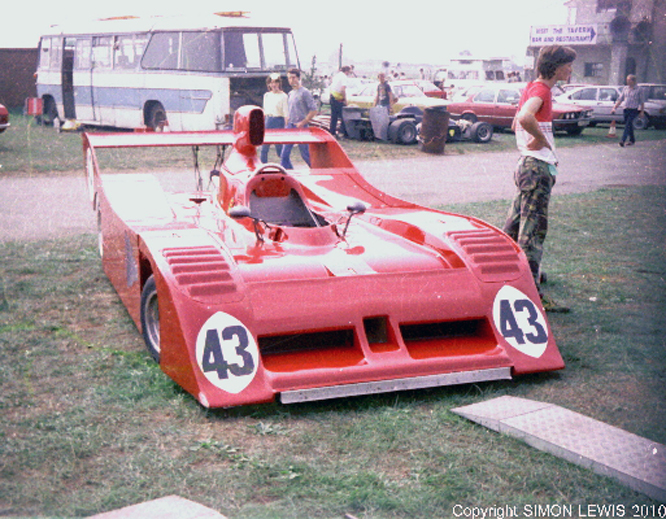
Lola T530, Castle Combe

and once in a while something extremely exotic like a Can Am 2 Lola Chevrolet T530 would appear.

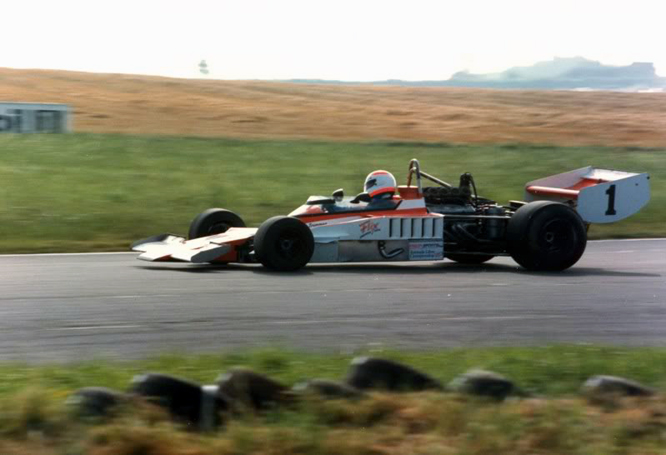
March BMW 822, Castle Combe

A car with a large engine was not a pre requisite to be a contender to win as Eddie McLurg found out when he beat the big boys driving a 2 litre Formula 2 March BMW 822 Formula 2 car to victory in May 1989.

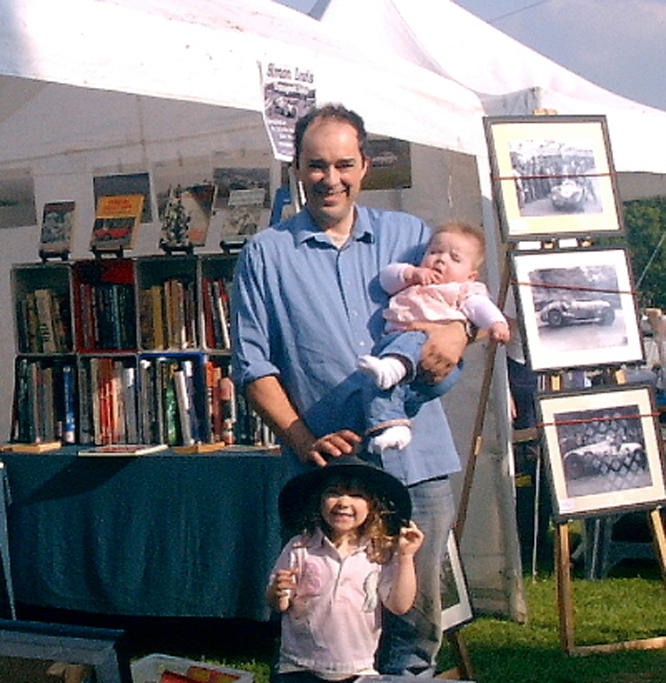
Simon Lewis

When he turned 18 Simon started on the long path to becoming a book mogul, surprisingly he specialised in automotive books with a business called Simon Lewis Transport Book Shop.

Simon Lewis, Rover SD1

As and when resources allowed Simon turned to competing in rally events running against £50,000 Subaru’s in an comparatively archaic gargantuan Rover SDI after three seasons the enlarged to 4.5 litre / 274 cui Rover V8 was put into a Ford Escort shell for a season.

Simon Lewis, Rover 220, Castle Combe

When that project proved fruitless Simon moved to circuit racing at Castle Combe with a Rover Montego Turbo and then with some success he ran the Rover 220 Turbo seen above.

Simon Lewis, MG Maestro

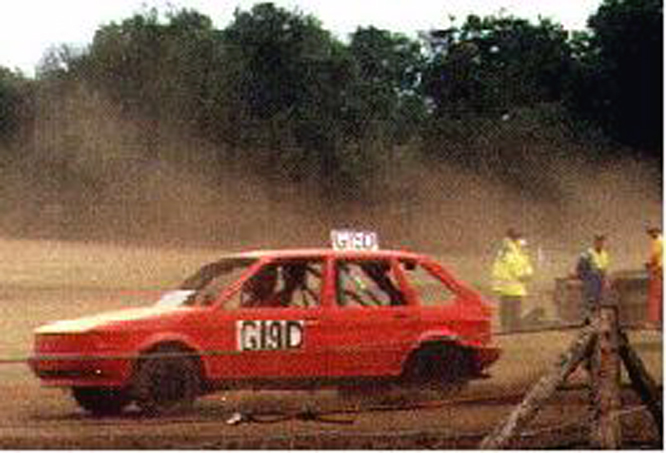
Simon has also tried his hand at Grass Track racing with an MG Maestro, that vibrated so bad in top gear that the bits of roll cage in Simon’s eye line ‘became almost invisible’,

Simon Lewis, Morrish Kawasaki

and at hill climbing with a Kawasaki powered Morrish built in Cornwall.

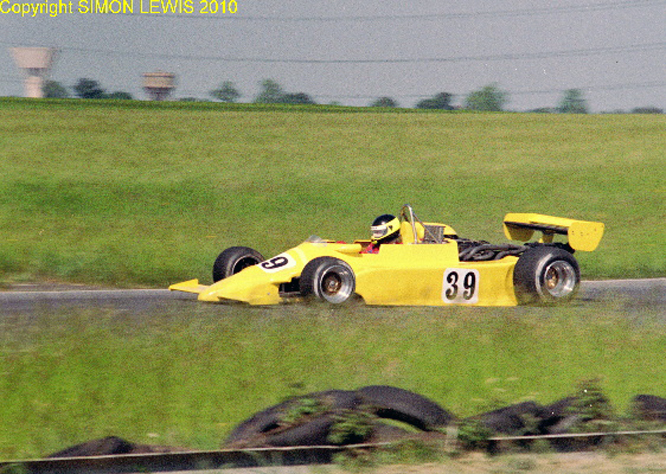
Van Diemen RF00, Swift SC92, Castle Combe

(# 6 Roger Orgee Van Diemen RF00 & #17 Alex Drabble Swift SC92)

Inspired by the reaction to a thread on The Nostalgia Forum Simon has taken a leap of faith and decided to sponsor a new Mono Libre series at Castle Combe in 2011.

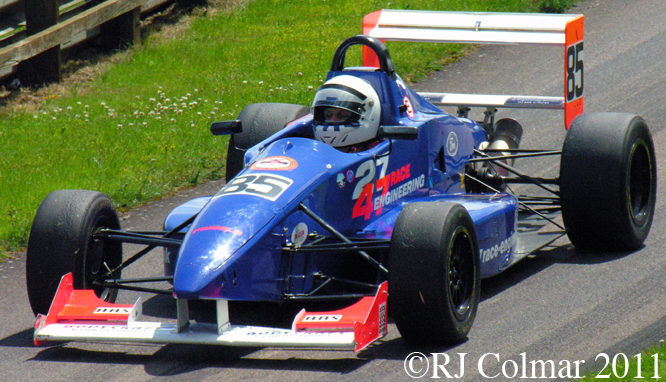
Nemesis Mygale, Castle Combe

(Winner of the first race #85 Peter Bragg Nemesis Mygale)

With a snappy title THE SIMON LEWIS TRANSPORT BOOKS FREE SINGLE-SEATER SERIES is open to any open wheeler that can pass the 108 db noise test.

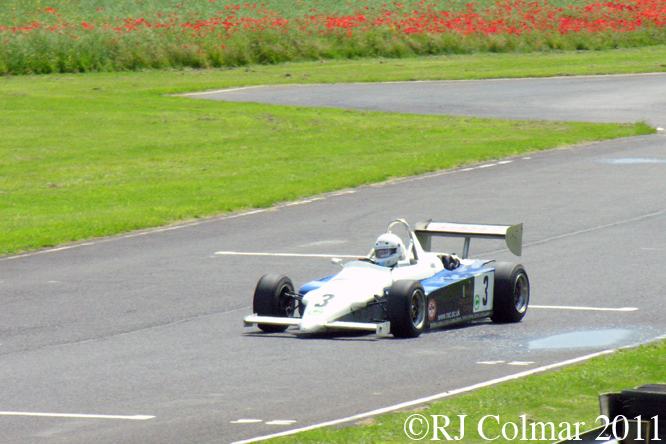
Ralt RT 3, Castle Combe

(# 3 David Cox Ralt RT3)

An interesting array of single seaters took part in the first race was on July the 18th, I caught practice the day before and look forward to seeing the next races on July 24th.

If you have a single seater that can pass the 108 db noise test and is in need of exercise you could do worse than make enquiries at the Castle Combe website.

Hope you will join me in wishing Simon and his series all the best.

Thanks for joining me on this Simon Lewis Transports Books Free Single Seater edition of ‘Gettin’ a lil psycho on tyres’, join me again tomorrow for a Grand Prix edition of Ferrari Friday. Don’t forget to come back now !

Share

Pole Sister – Nissan R90CK

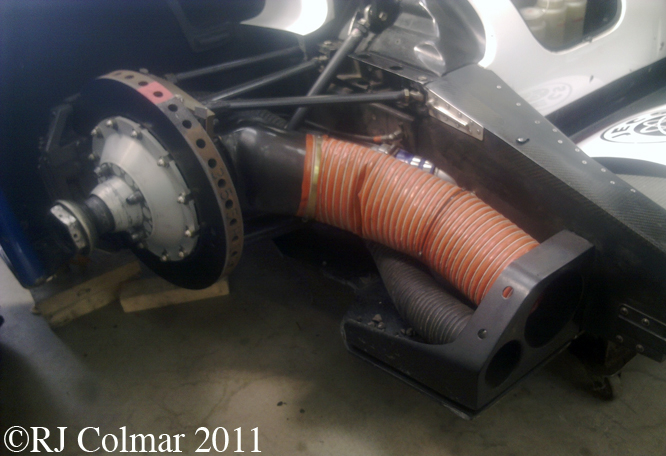
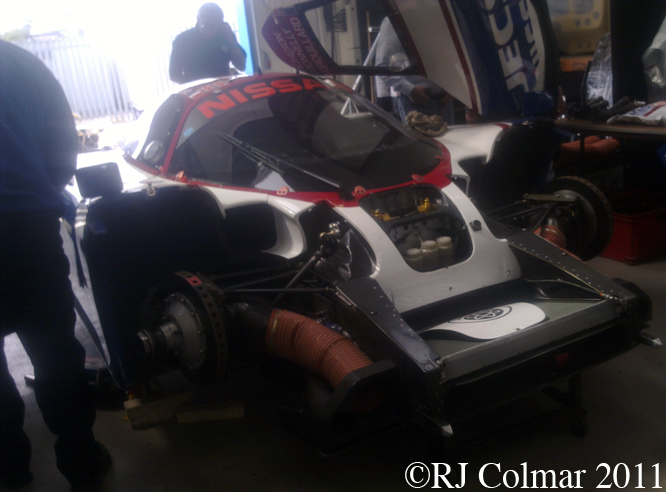
Like the Lancia LC2 seen in Monday’s post the Nissan R90CK seen here at Colin Bennett’s CGA Engineering Workshop is scheduled to appear at the Silverstone Classic for the Group C race next weekend.

Nissan R90CK, CGA Engineering

Three serious works teams gathered to contend the 24 hours of Le Mans in 1990, Jaguar with three cars were the eventual winners, Toyota with three cars did not really figure, but Nissan with 5 front line R90CK cars became the first Japanese manufacturer to sit on pole position at this endurance classic.

Nissan R90CK, CGA Engineering

The Nissan R90CK’s were built around Lola T90/10 chassis

Nissan R90CK, CGA Engineering

and prepared for the World Endurance Championship by Nissan Motorsports Europe.

Nissan R90CK, CGA Engineering

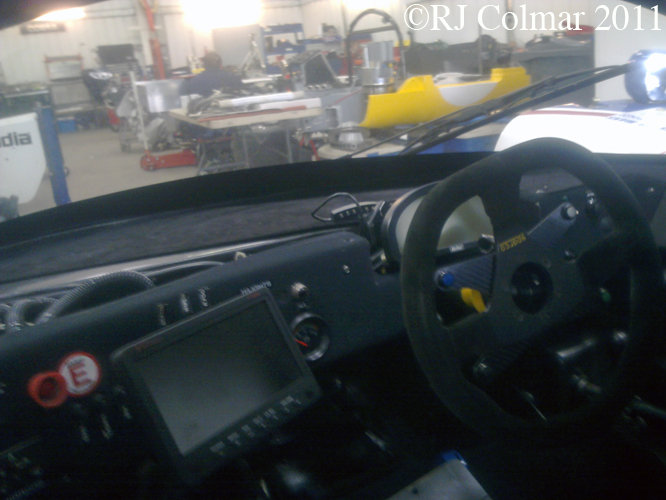
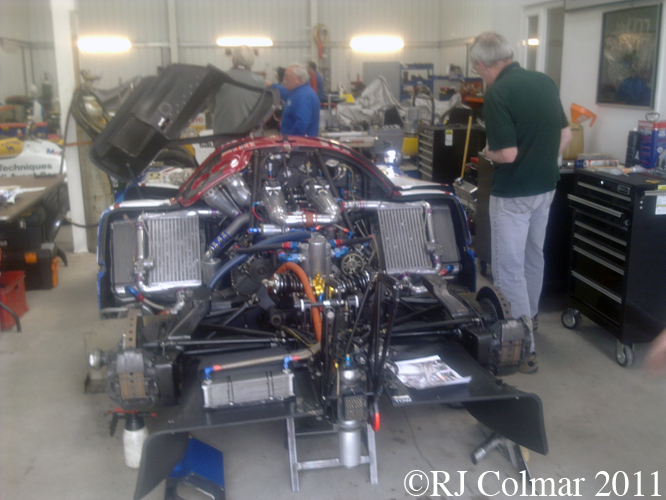
This particular vehicle has a rear facing camera connected to the screen seen here to aid reversing. Mark Blundell’s pole winning 3m 27s Le Mans qualifying lap immortalised with cockpit cam can be seen on this mind boggling youtube clip.

Nissan R90CK, CGA Engineering

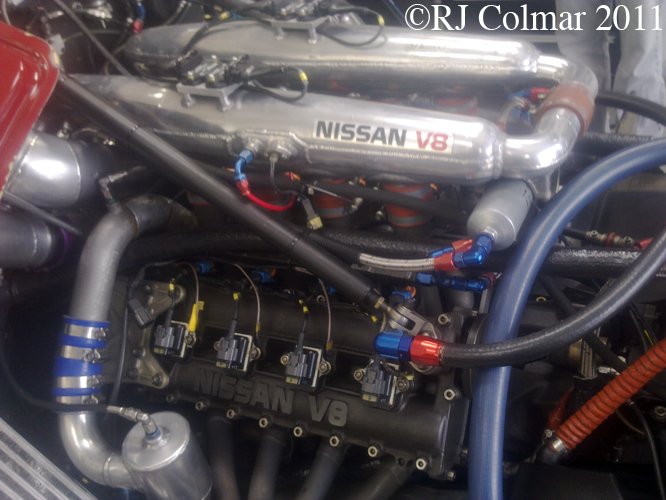
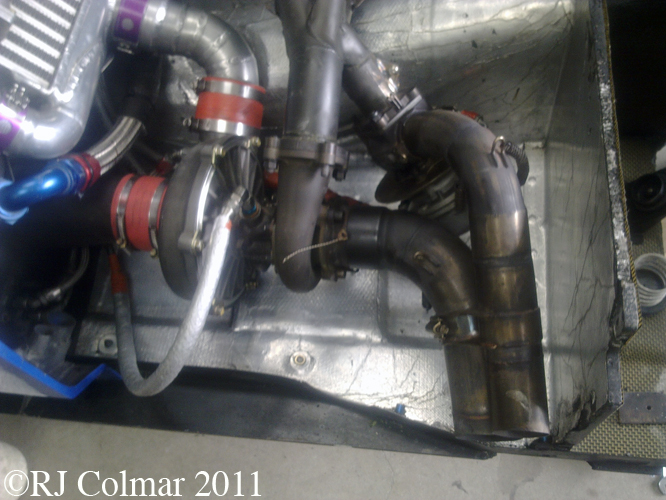
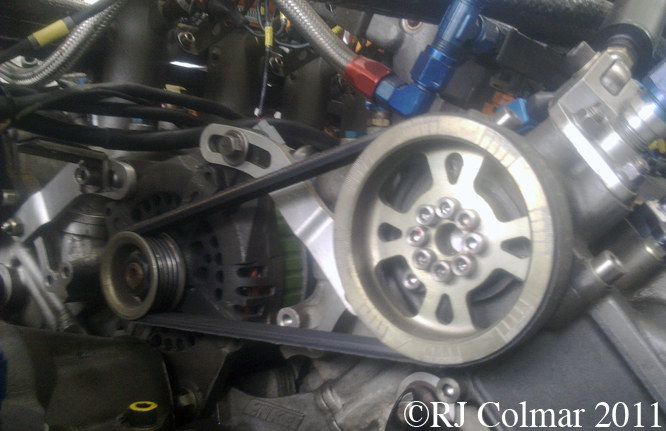
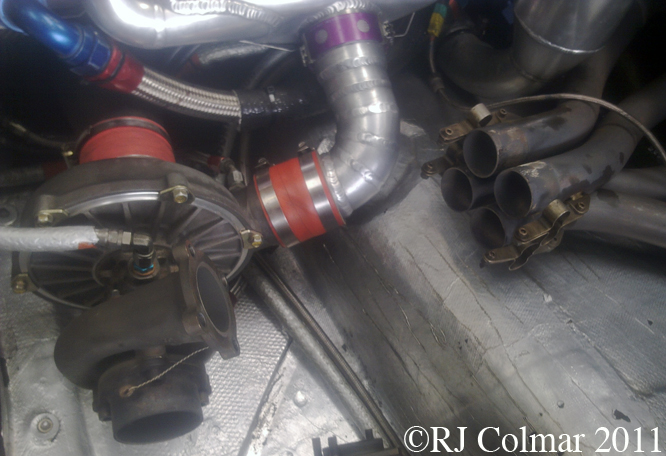
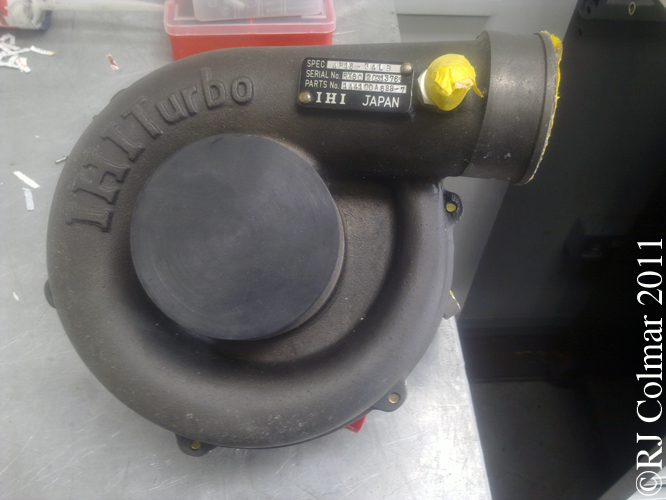
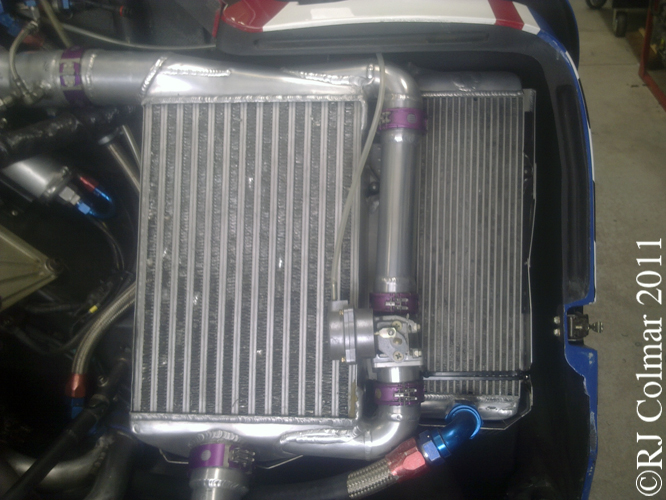
It is said that Mark had over 1000 hp available during his qualification lap from his 3.5 litre / 213 cui Nissan VRH35 V8 motor,

Nissan R90CK, CGA Engineering

thanks to a ceased turbo waste gate.

Nissan R90CK, CGA Engineering

Mark recorded a top speed of 226.9 mph on the Mulsanne Straight speed strap between the two newly installed chicanes a record that apparently still stands.

Nissan R90CK, CGA Engineering

Six months after the unlikely Mazda victory at Le Mans in 1991, a NISMO version of the Lola T90/10 the Nissan R91CP won the 1992 Daytona 24 hour race in the hands of Masahiro Hasemi, Kazuyoshi Hoshino and Toshio Suzuki.

Nissan R90CK, CGA Engineering

At the end of the 1990 season Nissan withdrew from the World Prototype Sportscar Championship but continued to develop the RC90CK cars for the All Japan Sports Prototype Championship which the manufacturer won in 1990,’91 and ’92.

Nissan R90CK, CGA Engineering

This particular car is now owned by Katsu Kubota.

Nissan R90CK, CGA Engineering

While there is still a good supply of parts for these vehicles

Nissan R90CK, CGA Engineering

the cost of running one is expensive.

Nissan R90CK, CGA Engineering

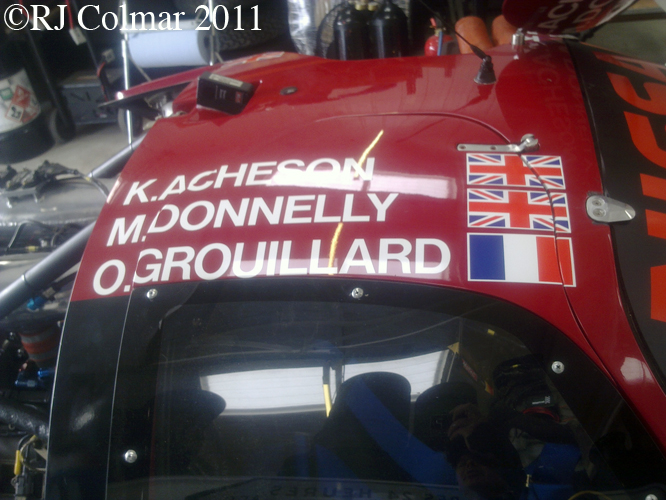
In 1990 the car driven by Kenny Acheson, Olivier Grouillard and Martin Donnelly

Nissan R90CK, CGA Engineering

qualified in 5th place at Le Mans but was eliminated on the opening lap with a gearbox problem.

Nissan R90CK, CGA Engineering

I shall look forward to seeing this car in action, 21 years after I first saw one, at the Silverstone Classic next weekend.

That concludes a series of three Group C blogs, my thanks to Colin Bennett for his hospitality and Tony Gallagher for organising the trip to Colin’s workshop.

Hope you have enjoyed today’s ceased wastegate edition of ‘Gettin’ a lil’ psycho on tyres’ and that you will join me again tomorrow. Don’t forget to come back now !

Share

Thirty Years Ago – Le Mans 1981

This weekend sees the 79th running of the Le Mans 24 hours , unfortunately I will not be there in person but will almost certainly follow the progress of the race on the internet. Thirty years ago I went to Le Mans for the first time.

Porsche 917 K81, Le Mans

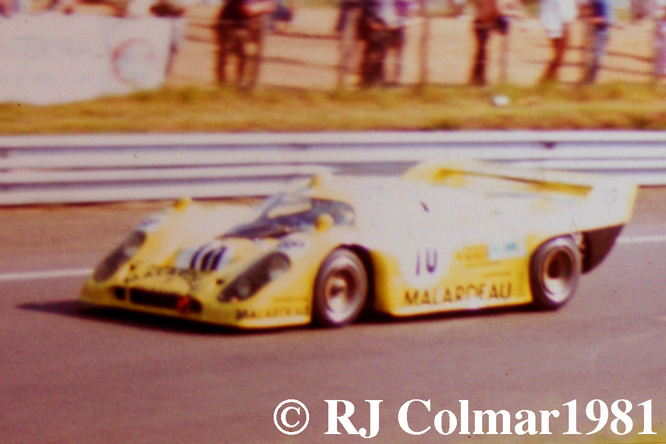
I arrived as practice was already under way, one of the many reasons I had wanted to see this particular race was because the Kremer brothers were running a brand new Porsche 917, see above, that they had built for the 1981 season, ten years after the original 917, immortalised in Steve McQueen’s film that takes its title from the race, had been made obsolete by the FIA.

It looked great sounded even better with a 5 litre / 305 cui flat 12 however it was a disappointment qualifying only 18th. During the race Bob Wollek the cars only professional driver took no further part in the race after his friend Jean-Louis Lafosse driving the #25 Rondeau was killed in an accident. The 917’s remaining drivers Xavier Lapeyre and Guy Chasseuil retired after completing 82 laps.

Le Mans

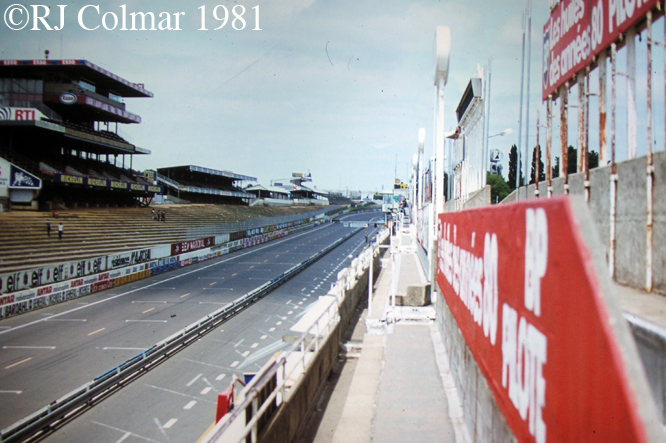
There is no on track action on the Friday before the 24 hours and back in 1981 spectators had access to virtually all area’s while the teams prepared for the race.

Chevrolet Camaro, Le Mans

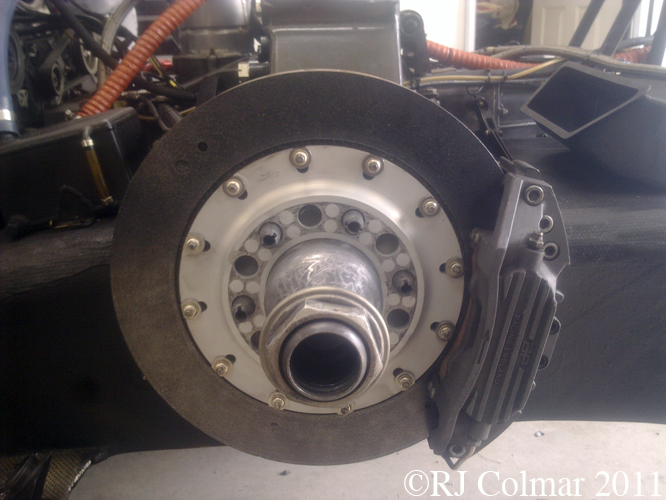
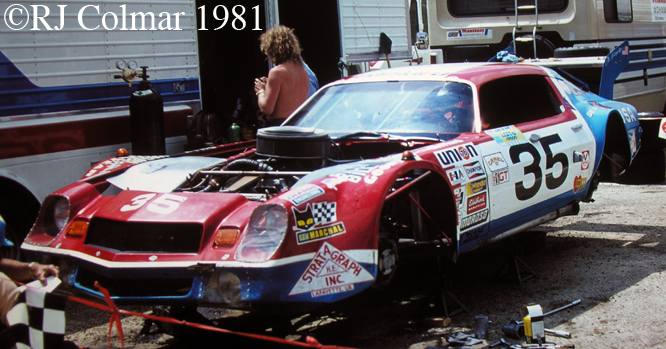
Cale Yarborough joined AJ Foyt and Mario Andretti in becoming one of the few drivers to compete at Le Mans, the Indy 500 and the Daytona 500 in 1981. While his #35 Stratagraph Camaro sounded good, easily the loudest car in the race, and was as fast as any other vehicle in a straight line, topping 200 mph, the Camaro’s brakes were puny compared to the competition and simply not up to the job of slowing, easily the heaviest car in the race, down. After the first hour the brakes gave up and Cale resorted to driving the car into the wall, ironically at the corner called ‘Indianapolis’ in order to bring his car to a stop, without injury to himself or anyone else.

Lola Ford T600, Le Mans

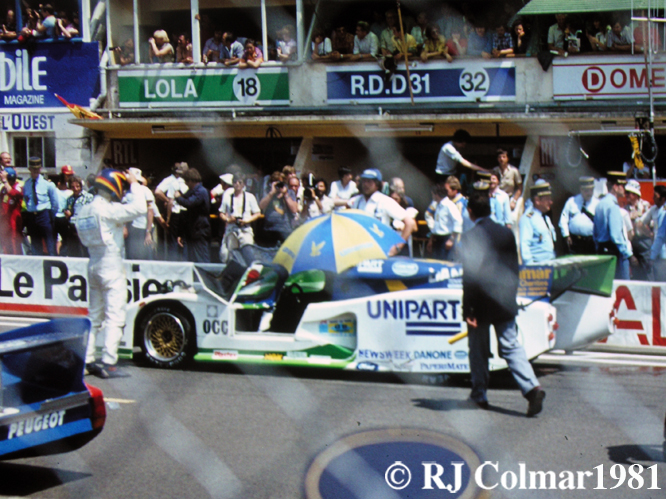
The weekend of the 1981 Le Mans 24 hours was an absolute scorcher, Spaniard Emillio de Vilotta prepares to board his Lola T600 which he shared with Guy Edwards and Juan Fernandez, The Ford DFL powered #18 Lola started 12th and finished 15th after a multitude of problems which included running the last couple of hours in top gear only.

Porsche 936 81, Le Mans

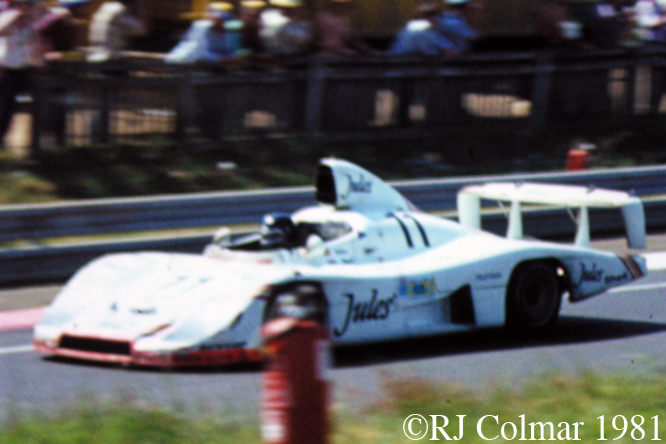
For this race Porsche AG prepared two special 936 models fitted with 2.65 litre / 161 cui twin turbo flat 6 motors that had originally been designed to run on methanol in the Interscope Indy car project. The #11 of Jacky Ickx and Derek Bell was the class of the field qualifying 3 seconds ahead of it’s sister driven by Mass / Schuppan / Haywood and finishing the 24 hour race with a record lead of 14 laps over 112 miles after covering a total distance of 4825 kms / 2998 miles.

Le Mans

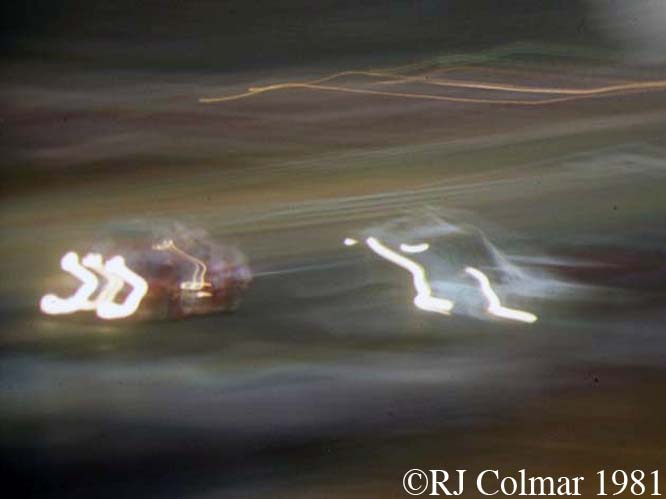
Like many people I enjoyed taking a pictures of the cars at night, unlike many people this led to an all consuming passion for artificial light and film which after many years took me into the realms of art and animation.

Rondeau M379, Le Mans

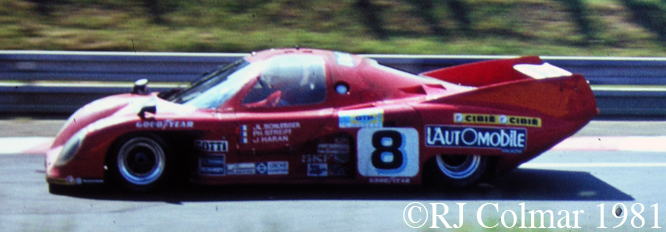
The only challenge to the utter dominance of Porsche at the 1981 race came from the 5 car Rondeau team, it was the teams two slower GTP cars that survived the night with Jacky Haran, Jean Louis Schlesser and Philippe Streiff coming home a distant second in the #8 Rondeau M379 with

Rondeau M379, Le Mans

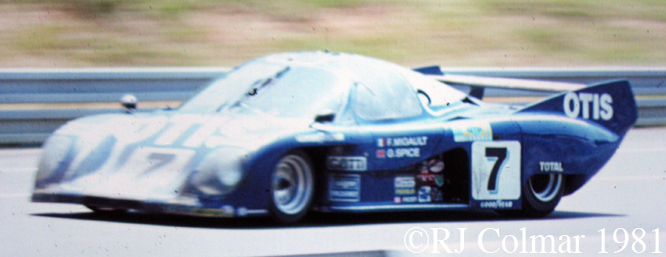
Gordon Spice and erstwhile Connew pilot Francois Migault coming home third in the #7 Rondeau. Both of the Rondeaus were powered by detuned 3 litre / 183 cui Ford DFV motors more commonly found in Grand Prix cars.

Porsche 935 K3, Le Mans

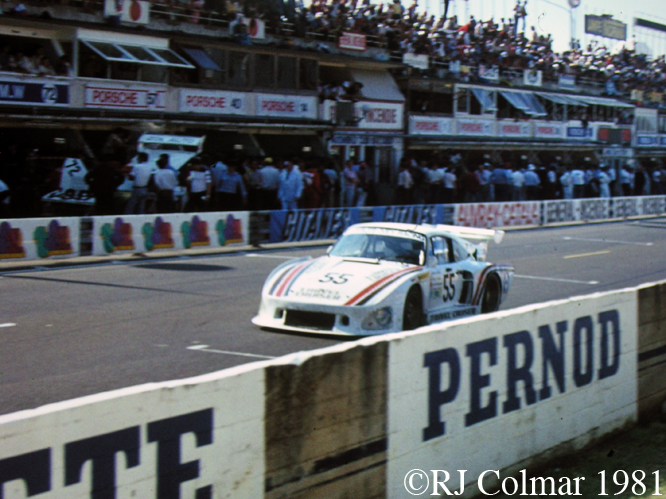
After a couple of hours sleep the relentlessness of 24 hour racing really came home to me on the circuit that used to be known as the world fastest round about. The #55 Porsche 935 K3 of Claude Bourgoignie, John Cooper, Dudley Wood, seen here just after dawn came in 4th overall winning the Group 5 class. I believe this vehicle has passed through the hands of Nick Mason, it may still be in his collection.

Ferrari 512 BB LM, Le Mans

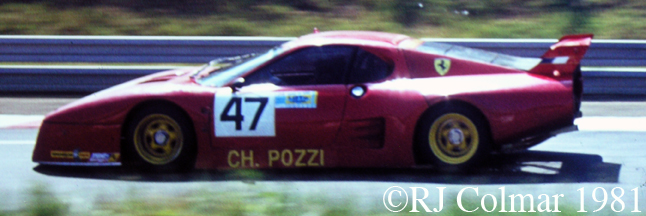
The #47 Ferrari 512BB LM #31589 of Andruet/Ballot-Léna qualified 37th, and finished 5th o/a 1st in IMSA GTX.

WM P79/80, Le Mans

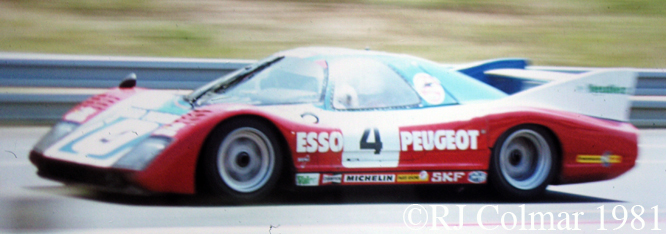
The PRV (Peugeot Renault Volvo) Turbo V6 powered #4 WM 79/80 of Denis Moran, Charles Mendez and Xavier Mathiot started 16th and came in 13th the faster #82 P81 sister car of Thierry Boutsen was not so lucky having an accident on the Mulsanne Straight which resulted in the death of a track worker at the end of the first hour of the race.

Bell & Ickx, Le Mans

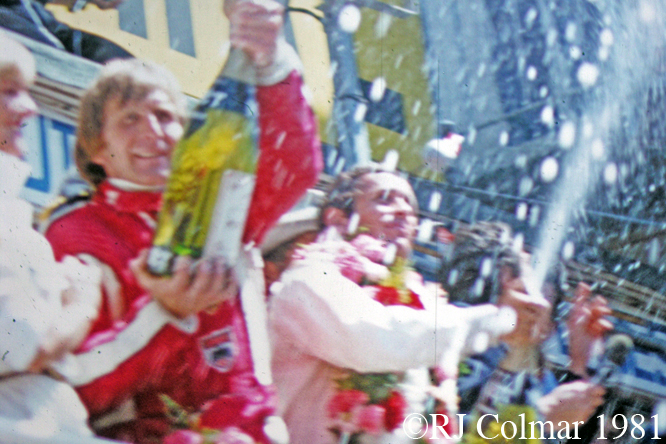
Despite two fatalities during the race victory celebrations went ahead as usual, not sure that would happen today.

Hope you have enjoyed today’s trip into memory lane and that you’ll join me again tomorrow for a look at a unique vehicle called The Farrallac. Don’t forget to come back now !

Share

Added Warrington – CGA Engineering

Thanks to Tony ‘Giraffe’ Gallagher at The Nostalgia Forum I found myself going to Warrington with fellow TNFer and secretary of the Bristol Pegasus Motor Club Tim Murray. The purpose of the journey was to visit Colin Bennett and his sons who run CGA Engineering.

Colin who worked with Emerson Fittipaldi on a Brazilian excursion with the Lotus Formula 2 team in 1970 has run a huge variety of cars including March, Fittipaldi, Surtees, Williams and Ligier in a variety of British and European Series.

Benetton B191, CGA Engineering

After a welcome which included tea and donuts Colin let half a dozen TNFers loose in his workshops to nose and poke around a mouth watering selection of vehicles, amongst the many demonstrations was how easy it would be to fire up an ex Schumacher 3 .5 litre / 213.5 cui Benetton 191 chassis #6 powered by a Ford HB engine, we were one click of a switch away from having our ears blown off !

Lola T70, CGA Engineering

At the opposite scale of the age range Colin was rebuilding a Lola T70 carrying the chassis plate SL76/143, there is something appealingly Romanesque about those knockoff wheel hubs.

March 71B, CGA Engineering

Sitting outside the workshops was a Formula 2 spec March 71B chassis #71BM -08 painted at the behest of current owner Katsu Kubota in the colours carried by one of my hero’s Ronnie Peterson who won the 1971 European Formula 2 Championship for open wheel 2 litre / 122 cui vehicles.

March 761, CGA Engineering

Back in 1976 I was extremely privileged to see this March 761 in action on a wet day of practice at the Nurburgring. The sight of this car driven by Ronnie Peterson in a series of controlled slides through a series of off camber blind apex corners is something I shall never forget. Ronnie qualified 11th and unfortunately was involved in a first lap accident.

Nissan R90CK, CGA Engineering

I was at Le Mans in 1990 when this Nissan R90CK qualified 5th for the 24 hour classic unfortunately the car retired on the opening lap, like the March 71B and 761/6 today this car belongs to Katsu Kubota and is scheduled to appear at the Silverstone Classic meeting I blogged about yesterday.

Williams FW06, CGA Engineering

The design details of the Williams FW06 by Patrick Head won much praise in 1978, although the car did not win any Grand Prix it marked the emergence of Williams Grand Prix Engineering into what would become a dominant force in Formula One in the 1980’s and 1990’s.

I shall look forward to bringing you more detailed blogs of some of these cars after I have seen them running in the weeks and months ahead.

My thanks to Tony, Colin and his sons for a memorable day.

Thanks for joining me on this Warrington edition of ‘Gettin’ a lil’ psycho on tyres’, I hope you will join me again tomorrow. Don’t forget to come back now !

Share

Shaking hands with ‘The Man’ – AJ Foyt Jnr

It is impossible to do a legend justice in a humble blog so for AJ Foyt Day here are ten photos by Ed Arnaudin and I that I hope will give you a glimpse into the legend that is AJ Foyt, a man who quit school to become a mechanic and then raced his way into more record books than I have had hot dinners.
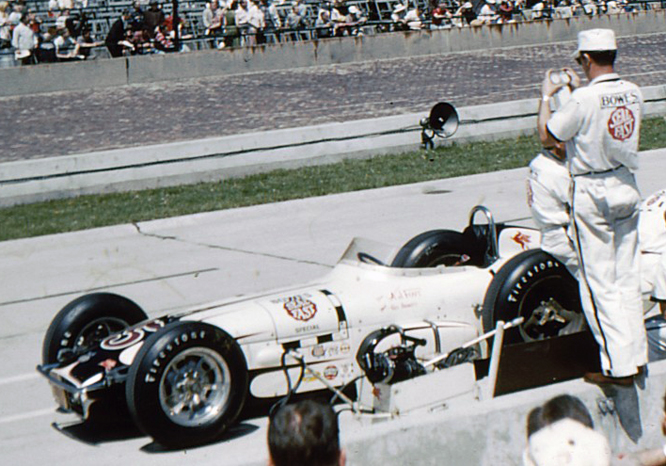
Kurtis Epperly, IMS

1960 Kurtis Epperly Q 16th F 10th Photo by Ed Arnaudin

John Wayne fan AJ Foyt started racing midgets in 1956, his first event win was at Kansas City in 1957. AJ has been quoted as saying of his start in racing, “My dad was very successful running midgets in Texas. Then, his two drivers ran into some bad luck. People started saying that Daddy had lost his touch. That it was the cars and not the drivers. I wanted to race just to prove all those people wrong.”

In 1958 he moved up to Sprint Cars and Championship cars making his first start in the 1958 Indy 500 driving a Kuzuma Offy.

At the end of the 1960 season AJ was crowned with the first of his seven national USAC Championships.
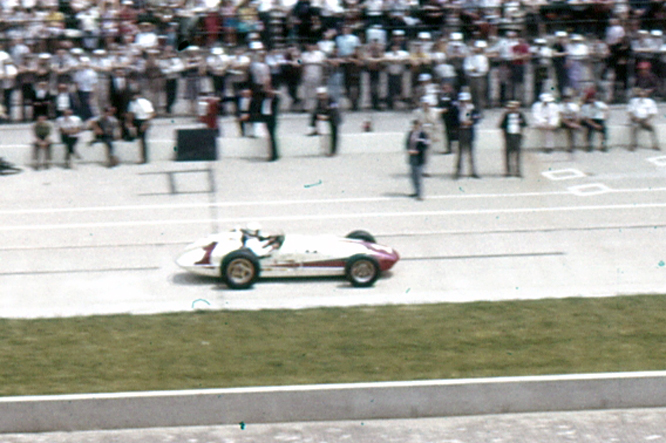
Trevis Offy, IMS

1961 Trevis Offy Q 7th Winner Photo by Ed Arnaudin

The Trevis Offy AJ drove to victory lane in 1961 was built by Floyd Trevis, Bob Alexander and George Bignotti in Youngstown OH. It was allegedly such an accurate copy of the Watson roadsters of the day that it used Watson body panels. It should be noted that Watson started out by upgrading Kurtis designs so the practice of copying and upgrading other successful designs was nothing new and went on until the introduction of the IRL single mandated chassis type.
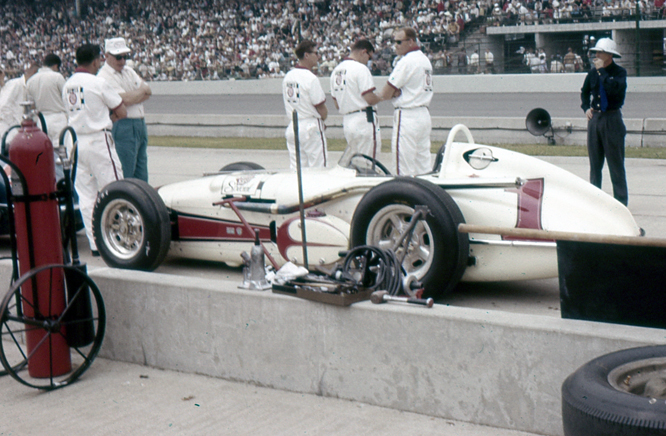
Trevis Offy, IMS

1962 Trevis Offy Q 5th F 25th Photo by Ed Arnaudin

Having won the 1960 and 1961 USAC championships and the 1961 Indy 500 1962 was a comparatively lean year by AJ’s own high standards.
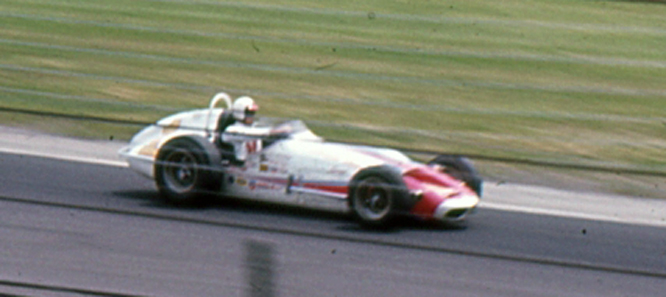
Watson Offy, IMS

1964 Watson Offy Q 5th Winner Photo by Ed Arnaudin

Bouncing back with the USAC title in 1963 AJ returned to his 1961 levels of success with an Indy 500 win and his 4th USAC Championship in 5 years in 1964 driving the #1 Watson Offy. Did I mention AJ also won a USAC Sprint title in 1960 already ?
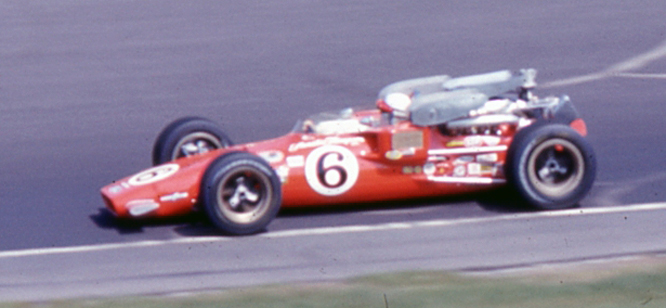
Coyote Ford t/c, IMS

1969 Coyote / Ford t/c Pole F 8th Photo by Ed Arnaudin

By 1969 AJ was a name on an altogether bigger stage. Having qualified on the Indy 500 pole in 1965 and won the Indy 500 in 1967, driving a Coyote a vehicle he built with his Dad as Chief Mechanic, AJ was drafted into the 1967 Ford Le Mans team and with Dan Gurney drove to a rookie, distance record setting 24 hour victory in the classic endurance race.

Of driving the Ford MK IV over the dip on the Mulsanne Straight AJ said, the car “would just sort of fly along for awhile at 214 mph or whatever it was, we just drove ’em that way and didn’t think much about it.”

In what might be considered an almost unrepeatable feat for US racing prestige Dan Gurney continued the run of success by winning the next international race the 1967 Belgian Grand Prix in his Gurney Westlake.

After the Indy and Le Mans victories AJ took his Coyote Indy car to the Ford Wind Tunnel for some tests, afterwards a man in a lab coat told AJ that his self built Coyote had only 7 lbs of downforce, was highly unstable and unsafe to race.

AJ replied “Sir, I don’t know what to tell you. That car just won the Indy 500.”

Demonstrating further versatility AJ won the USAC Stock Car series in 1968.
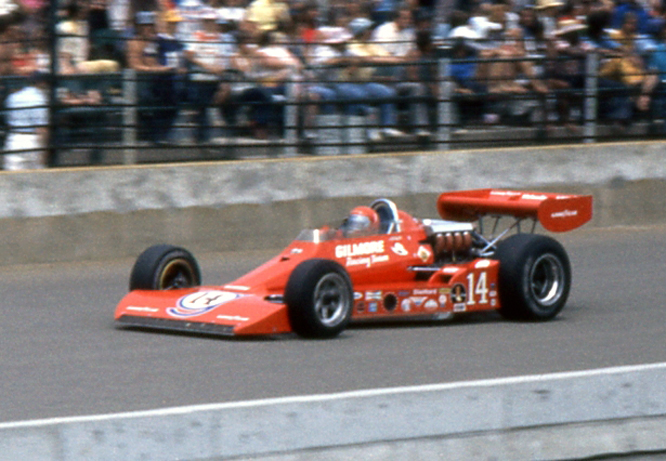
Coyote Ford t/c, IMS

1975 Coyote Ford t/c Pole F 3rd Photo by Ed Arnaudin

AJ started running the #14 in USAC events in 1973 and ran them exclusively ever since including as an entrant, tomorrow the #14 AJ Foyt Enterprises entered Dallara driven by Vitor Meira will be starting the Indy 500 in 11th while AJ’s other entry the #41 qualified in 19th by Bruno Junquiera will be handed over to Ryan Hunter-Reay and start from the back of the grid.

Championships were a little more difficult for AJ to win by 1975 though he added the USAC Silver Crown Championship for front engine open wheelers running on dirt and paved ovals in 1972 and also won the ’72 Daytona 500 in the Wood Brothers #21 Purolator Mercury having narrowly missed out to ‘King Richard’ Petty’ the year before.

In 1975 AJ took his second consecutive, fourth overall, pole at Indy and won both the USAC National Championship and the first of two consecutive IROC championships. He also won the USAC Stock car championship for a second time in 1976.
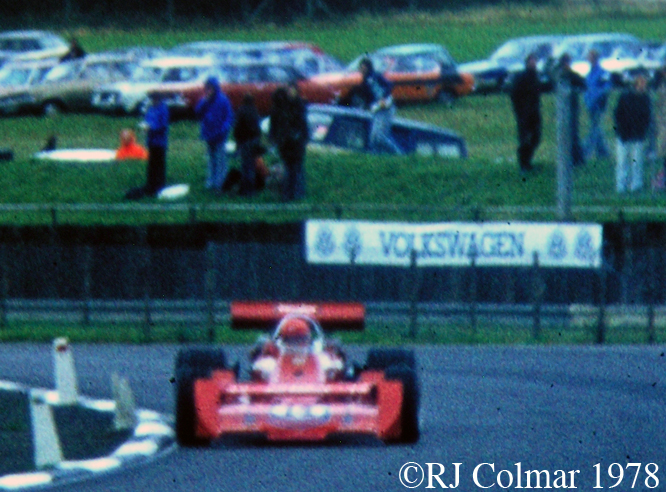
Foyt / Foyt t/c, Silverstone

1978 Foyt / Foyt tc Q10, Winner, Daily Express Indy Trophy, Silverstone, England

Foyt was crowned USAC Gold Crown Champion in 1977 the following year, on his 20th attempt of a record breaking 35 overall, AJ became the first man to win four Indy 500’s in 1977.

In 1978 16 USAC Championship cars visited England for two rounds of the Championship and AJ won the first of them at Silverstone.

Between the two UK races there was a meet and greet held in central London where the 19 year old writer of this blog was lucky enough to shake the hand of the subject of today’s blog, an experience I shall never forget. When I told him I had to abandon my FIAT which would not start in the cold weather he made a suggestion that got it going first time once I got home.

AJ rounded out 1978 with his third USAC Stock Car title.
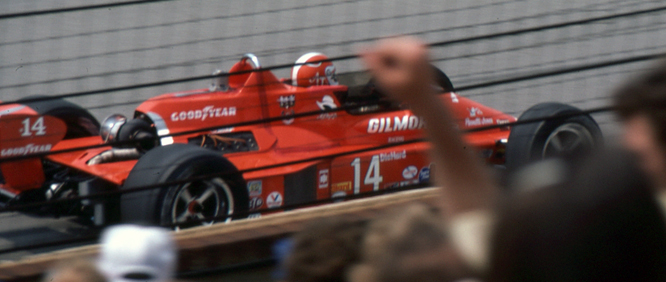
Parnelli Cosworth DFX VPJ6C, IMS

1980 VPJ6C Cosworth DFX Chassis #005 Q 12th F 14th Photo by Ed Arnaudin

In September 1978 AJ decided that his Coyote Foyt with an engine that was his own development of the Ford Quad Cam, introduced by Jim Clark in 1964, used successfully at Silverstone, was getting a little long in the tooth to be a Championship contender.

He acquired this Parnelli Cosworth with which he completed all remaining rounds of the 1978 USAC championship bar the UK rounds.

1979 saw a split between USAC Championship teams and a new group called CART, AJ stayed loyal to the former and won his seventh and final USAC Championship with the Parnelli, he also finished 2nd to Rick Mears at Indianapolis in 1979.
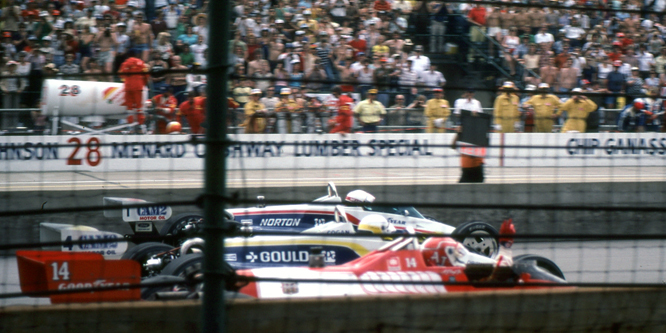
March Cosworth DFX 82C, IMS

1982 #14 March 82C Cosworth Q 3rd F 19th Photo by Ed Arnaudin

Preparing to start from the outside of the front row in 1982 AJ would have had a hard job beating the well prepared Penske PC10‘s inside him, a job not made any easier when the man next to him Kevin Cogan making only his second start at Indy lost control of his car on the start line and speared into AJ’s car. AJ was less than impressed making some choice remarks about Cogan’s head and it being located where the sun don’t shine which do not need repeating verbatim here.
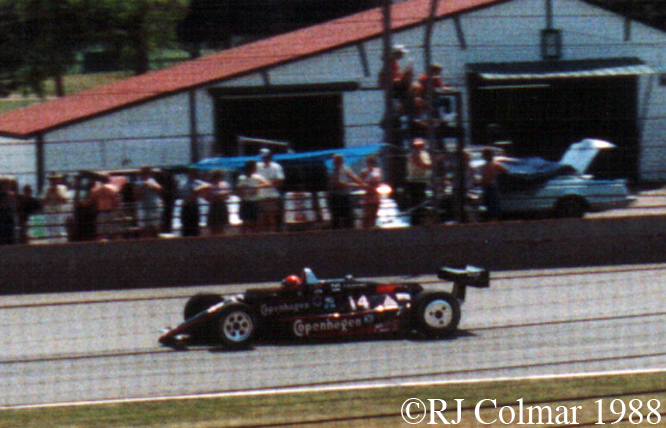
Lola Cosworth DFX T88 00

1988 #14 Lola T88/00 Cosworth Q 26th F 22nd

I finally got to see AJ run at Indy in 1988, by no means one of his better races he wrecked in turn 2 on lap 54, got out the car waved to an appreciative crowd and stepped inside the ambulance which took him to the infield hospital.

AJ has survived a number of serious accidents, at Riverside in 1965 while chasing down Dan Gurney the brakes on AJ’s #00 Ford failed at the end of the long back straight, AJ swerved to the infield to avoid hitting the wall which sent his car flying off the track and into a series of end over end rolls.

The track doctor pronounced AJ dead on the scene but a quick thinking Parnelli Jones saw some movement and immediately started to revive him. Despite sever chest injuries, a broken back and fractured ankle AJ won the 1965 Firecracker 400 just 6 months later !

Footage of AJ’s Riverside accident was used in the concluding scene of the film Red Line 7000, see 4m 20secs.

In 1991 AJ had an equally bad accident when his Lola Chevrolet left the road after a foot pedal broke, despite breaking both legs in the accident and allegedly asking his rescuers to hit him over the head with a hammer to relieve the pain, AJ returned to the cockpit in 1992 to make his 35th consecutive and final Indy 500 start. From 23rd on the grid AJ finished 9th in the race.

AJ continued his involvement in first CART and then the IRL along with NASCAR, as an owner his driver Scott Sharp shared the inaugural IRL championship with Buzz Calkins. Kenny Bräck won the 1998 IRL title in a car owned by AJ and won the Indy 500 in a Foyt Enterprises car the following year.

Not noted for being a good traveller to foreign shores or the easiest of men to work for, like his hero John Wayne, AJ is a tough cookie with a reputation for being a bit of a curmudgeon, in his defence he once said “I’m no where as tough as my father. I really think that I am more open to change than he was.”

One AJ legend is from when he was in semi retirement, invited to be a Grand Marshall at a midget event AJ overheard a whipper snapper sitting on pole saying something about AJ not being able to cut the mustard. An incensed AJ borrowed a spare midget from a friendly owner in time to qualify towards the back of the field.

During the ensuing race AJ caught the aforementioned whipper snapper and as he made his pass for the lead AJ gave the little runt a one finger salute. Probably too good to be true but it makes a great story for this photograph even if it is not entirely in keeping with the legend I once shook hands with.

My thanks to Steve Arnaudin who patiently scanned and sent me the photos his Dad took at Indy between 1960 and 1982 and to the many members of The Nostalgia Forum who provided a wealth of background information.

Thanks for joining me on this AJ Foyt Day edition of ‘Gettin’ a lil’ psycho on tyres’, I hope you’ll join me again tomorrow for a look at the Trophy that may well be the most prized in all motor sport. Don’t forget to come back now !
Share

Indianapolis Excursion – Indy 500 29th May 1988

I was living in Brixton, London in November 1987 when I received an invitation from Rick and Karen, two Canadian friends also living in London, to attend their wedding on May 27th 1988 in Toronto their home town.

The first thing I did after I received the invitation was to check the dates for races in the USA around the wedding date, the Winston 500 was to be run at Talledega on May 1st, the Coca Cola 600 at Charlotte on May 29th as was the Indy 500.

The timing was against me getting to Talladega, a track I finally visited 21 years later, and Indianapolis seemed a lot closer to Toronto than Charlotte so I made my mind up to visit the Indy 500 something I had wanted to do since I read a book by Tommaso Tommasi called from Brands Hatch to Indianapolis in which a precise description of driving around the track is given by Peter Revson.

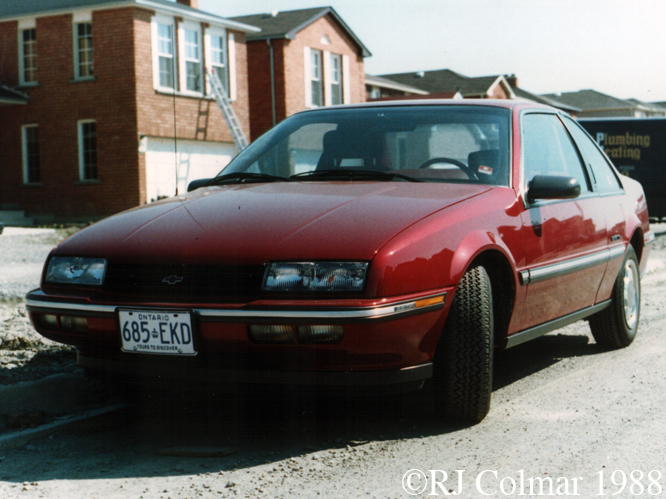
Chevrolet Beretta

The weekend of the wedding I went to Avis and collected this shiny brand new Chevy Beretta, an interesting contrast to the £50 1973 Volvo 144 DL automatic I was driving around London at the time !

Early on the morning after the wedding I packed my stuff and headed around 350 miles west on the 401 which turned into Route 96/94 after I crossed the US border into Detroit and then 200 miles south on Route 69. The only difficulty I had was keeping to the 55 to 60 mph speed limits which seemed excruciatingly slow compared to the 70 mph I was used to in the UK.

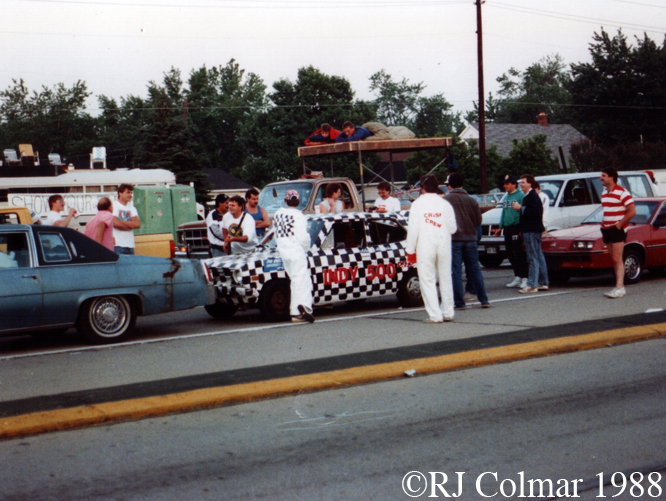
Datsun, Indianapolis

Eleven hours after I had set out I arrived at a mall parking lot (Lafayette Shopping Centre ?) a mile or so north from the track having picked up a ticket for the bleachers from a vendor at face value of $15 (?) right out side the track. I felt very much at home as some lads were having a kick about with a proper round football, turned out they were telephone engineers from Manchester, England !

My plan was to spend the night in the car, I got a shock when I opened the boot/trunk of the car and found I had forgotten to pack two important items one of which was my sleeping bag. I need not have worried the weather was more than warm enough to feel comfortable sleeping on the back seat of the car wearing a T shirt and shorts.

On race day I woke up with the dawn, had a round of salami sandwiches I had packed in advance and my customary breakfast apple and headed off to the track which opened at 6am.

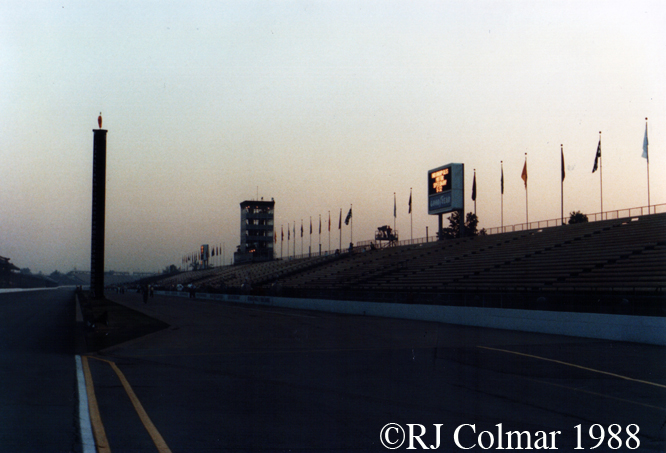
Indianapolis Motor Speedway

I bought a souvenir T-Shirt from a girl, who like me hailed from Germany, on the way in and before I knew it I was standing on the hallowed pavement of Indianapolis pit lane. I was as inspired as I had been by any other tourist sight I had seen, Big Ben, the Eiffel Tower and even the Pyramids, by the Indy timing tower which I had seen in countless photographs over the previous 15 years I had been a racing fan.

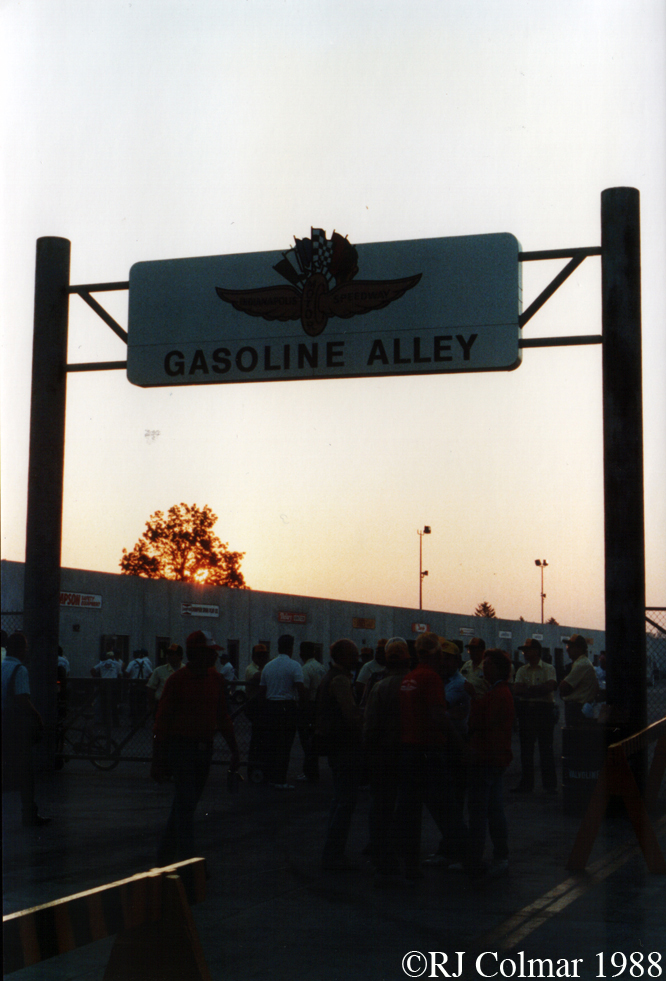
Indianapolis Motor Speedway

Pinching myself standing before the gates of Gasoline Alley, I felt a little like I was standing before the gates of heaven itself as the sun came up.

Indianapolis Motor Speedway

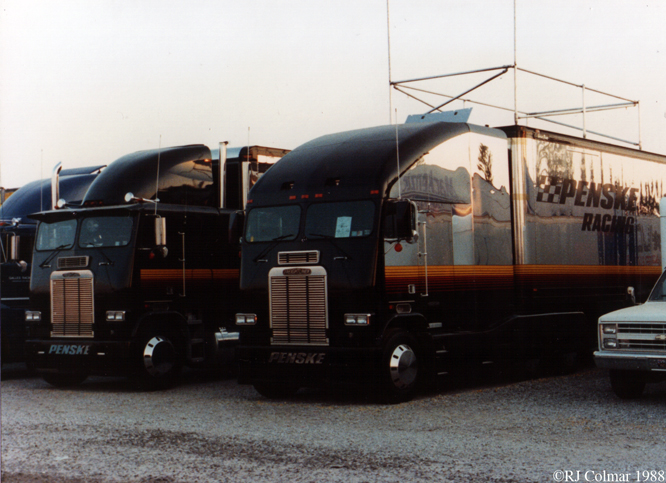
The immaculate team haulers seemed a tad quaint to be carrying 220 mph race cars, but then again a hauler never won the Indy 500.

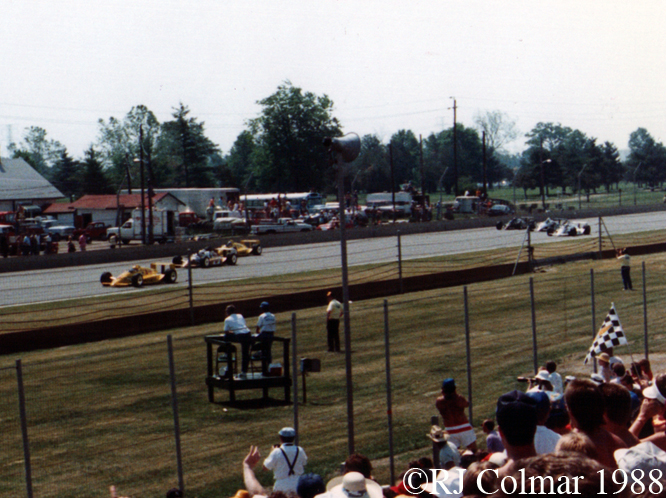
I took a walk all around the infield while the hullaballoo that starts the days proceedings got underway prior to the 11 am start, including a look at the infamous inside of turn 3 hard partying Snake Pit. I saw ‘Supersonic’ Chuck Yeager prepare himself for duties in the pace car and took my seat in the bleachers as Grand Marshall Garfield was driven around the circuit.

Indianapolis Motor Speedway

At this point the fact that I had somehow overlooked packing a telephoto lens I had borrowed specially for the event became painfully obvious.

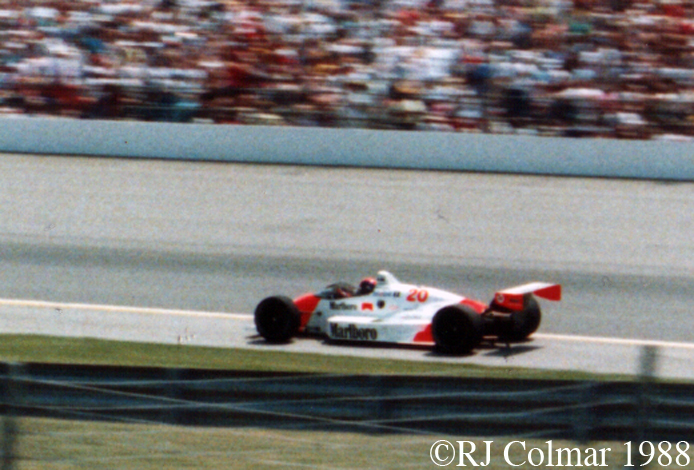
The race was dominated by Rick Mears on pole with Danny Sullivan and Al Unser Snr who locked out the front row of the grid. All three were driving the new Penske PC 17 designed by Penske new boy Nigel Bennett and all three Penske drivers would be 3 of the only 4 drivers to lead a lap of the 72nd running of the Indy 500.

Indianapolis Motor Speedway

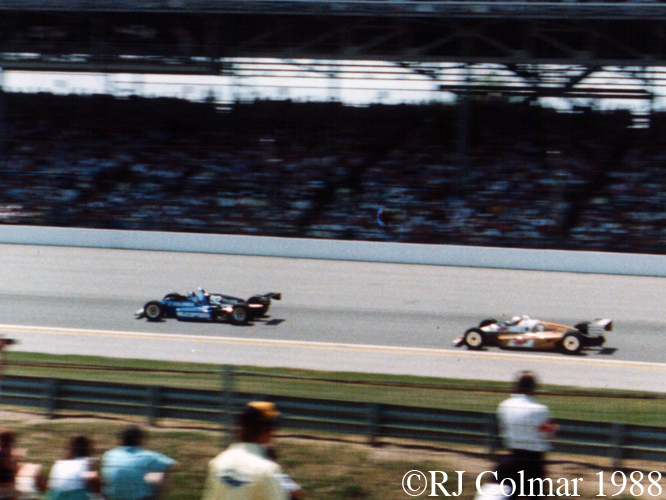
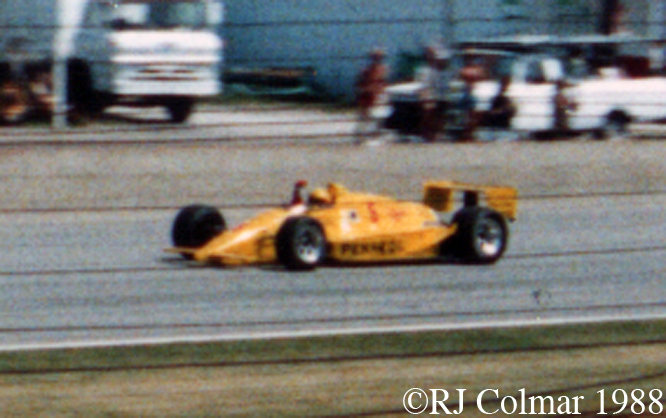
’85 Spinner & Winner Danny Sullivan set a blistering early pace driving the Miller PC17, seen here chasing the #92 of Dominic Dobson, led a race high 91 laps but crashed out on lap 101 leaving Rick Mears to almost run away with the race. Sullivan would end the season as the winner of his one and only CART championship.

Lola T87 00

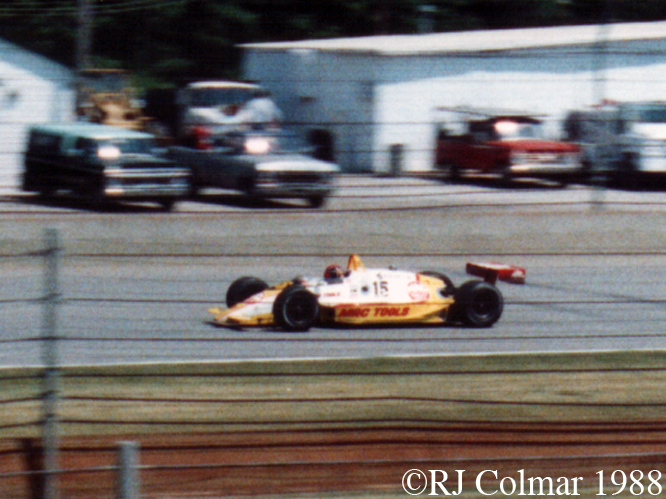
For 8 laps I was beside myself with excitement as Scottish born Brit Jim Crawford became the only non Penske team member to lead the ’88 500 in his year old Buick ‘stock block’ powered Lola T87/00. Jim who just two months earlier had been unable to walk as a result injuries received at Indy in 1987 became a father the following week. Jim retired to become a fishing boat captain and died of liver failure aged 54 in 2002.

March 88C, IMS

Two time world champion Emerson Fittipaldi did not lead a lap but still managed to come home 2nd in his Pat Patrick run March 88C powered by the then relatively new Ilmour Chevy V8. The following year ‘Emmo’ returned to win the fist of his two Indy 500 victories.

Penske PC 17, IMS

Rick Mears ran out the deserving winner of the 1988 Indy 500 a race that ended under yellow flags thanks to a piece of body work that flew off Michael Andretti’s 4th place Kraco March with just 4 laps to go. Ricks third 500 victory marked the first for the Ilmour Chevrolet engine which would dominate at Indianapolis until 1994 when a one off Mercedes push rod engine also designed by Ilmour would take top honours.

After the race I rehydrated and slept in the car for an hour before the 11 hour 550 mile trek back to Toronto. Two weeks later I was back at one of my other favourite race tracks Le Mans, but that story will have to wait for another day.

Thanks for joining me on this Indianapolis excursion edition of
‘Gettin a lil’ psycho on tyres’, I hope you will join me again tomorrow for an Indy Ferrari Friday special. Don’t forget to come back now !

Share

Triple 500 Crown – Lola T500

01 DSCN8489sc

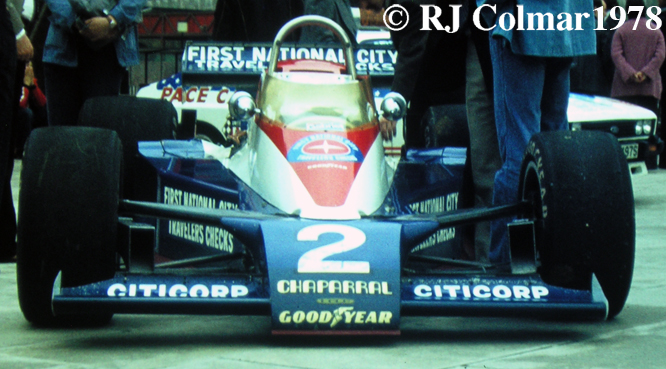
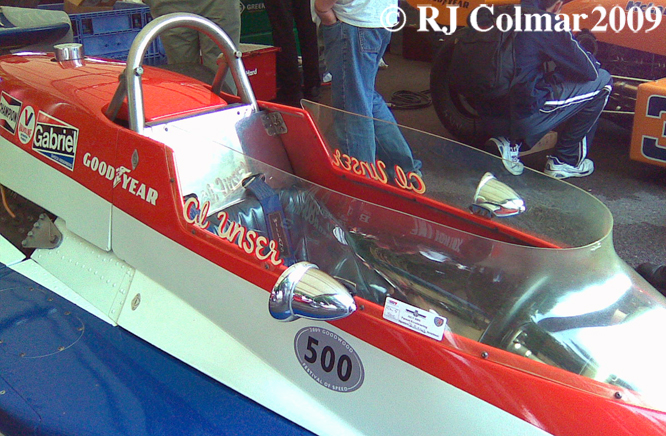
During a run of success that included winning the US Formula 5000 championships from 1974 – ’76 with Brian Redman and Can Am 2 Championships with Patrick Tambay ’77 and ’80, Alan Jones ’78 and Jacky Ickx ’79, Jim Hall turned his attentions to the USAC champ car series in 1977. Hall and partner Carl Hass commisioned Lola to build the T500 a fresh design that was to be driven by Al Unser Snr in 1978.

02 09 07 03 028sc

The design was an instant success at Indianapolis Al qualified 2nd and led 121 laps to go to Victory Lane for the third time. Despite Al bending a front wing in the pit lane 20 laps from home pole sitter Tom Sneva in a Penske ran out of laps to catch the Lola which finished just 8 seconds ahead of Tom.

03 Image349sc

The ’78 Indy 500 was the first of ten that was won by a car powered by a turbocharged development of the 3 litre / 183 cui Cosworth DFV that dominated in Formula One from it’s introduction in 1966 to 1981. To meet the USAC regulations the DFV was downsized to 2650 cc / 161 cui and fitted with a Garrett turbo charger.

04 Image351sc

Engine designer Keith Duckworth described these motors as being like ‘hand grenades with the in pulled’. By the end of the DFX development programme the motors were producing 840 hp. Al Unser was also at the wheel of the last DFX powered car, a Penske, to enter victory lane at Indianapolis in 1987.

05 DSCN8500sc

Having won the 1978 Indy 500 Al Unser also won the two other 500 mile races in the USAC series at Pocono and Ontario becoming the first winner of the ‘Triple 500 Crown’. Al is seen driving the car above in the Daily Express 200 at Silverstone, England battling for the lead with Danny Ongias.

06 DSCN8507sc

Unfortunately the battle only lasted 4 laps, Ongias broke a drive shaft, Al led a good deal of the race but ran out of fuel right in front of me.

07 Indy80 027s

The T500 was used in Penzoil colours in early 1979 before Jim Halls Chaparral 2K was ready. In 1980 Jerry Sneva, seen in this photo by Ed Arnaudin, qualified 5th in this T500 and finished 17th in the Indy 500 two further T500’s were raced in this event driven by Tom Bigelow Q 31st F 8th and Gregg Leffler Q 23rd and F 10th.

My thanks to Steve Arnaudin for the scan of his Dad’s photo.

Hope you have enjoyed Triple 500 Crown edition of ‘Gettin’ a lil’ psycho on tyres’ and that you will join me again tomorrow. Don’t forget to come back now !

Share