Tag Archives: Mass

Goodwood Revival – #7 Silberpfile

At the Berlin Motor Show in 1933 Adolf Hitler announced two new projects the (Kraft durch Freude – strength through joy) KdF- Wagen that would eventually become the Volkswagen Beetle and a state sponsored racing programme for Mercedes Benz. Below is a recreation of a 1936 Mercedes Benz racing department transporter based on a 70 hp petrol engine Mercedes Benz Lo 2570 truck complete with a Mercedes Benz W125 racing car on the back.
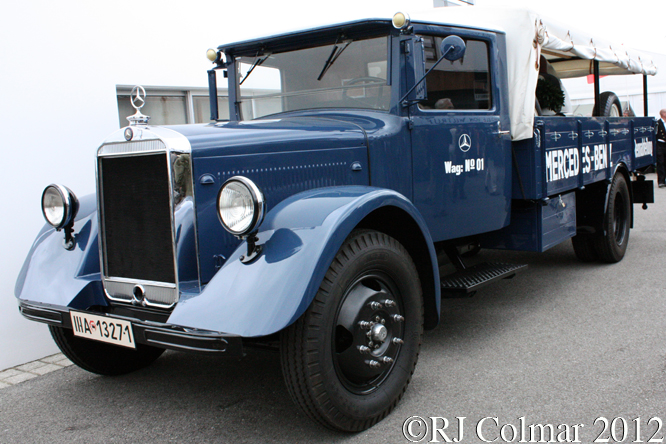
Mercedes-Benz LO 2750, Goodwood Revival

Once it became clear that Hans Stuck would not be joining Mercedes Benz he got together with Chairman of the newly amalgamated Auto Union Baron Klaus von Oertzen and free lance designer Ferdinand Porsche to make a bid to fund a rival for the Mercedes Benz team. Hitler agreed that two rivals would be better than one and so split the funding he had announced in Berlin for Mercedes Benz with Auto Union much to the disgust of the former. Below is a Büssing Typ 300 of the type used by Auto Union to carry their team.
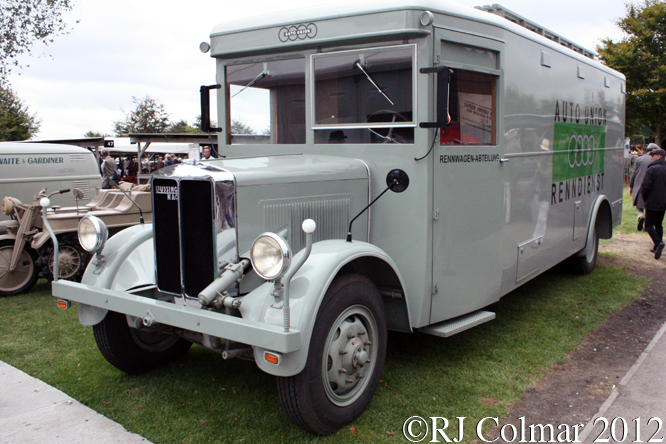
Bussing Typ 300, Goodwood Revival

There are numerous stories about how the Mercedes Benz and Auto Union team cars came to be called collectively the Silver Arrows. Apparently the earliest use to the term was in a 1932 radio broadcast in connection with a streamlined Mercedes Benz SSKL driven by Manfred von Brauchitsch was called a Silver Arrow. When the Auto Unions were prepared in 1934 they were all painted silver and bitter rivals Mercedes Benz, who would probably be loath to admit it, appear to have followed suit.

Auto Union A-Type, Goodwood Revival

For 1934 Auto Union built the A-Type with, for the period, a wholly unconventional mid engine layout which featured a 291 hp super charged V16 motor there was no championship that year, Alfa Romeo won the first two of the seven major races before Hans Stuck won the German Grand Prix for Auto Union, René Dreyfus managed an unlikely win at the Belgian Grand Prix aboard his Bugatti and Mercedes swept the last two races of the season in Italy and Spain. Above is an A-Type of the type Stuck used to win the 1934 German Grand Prix.
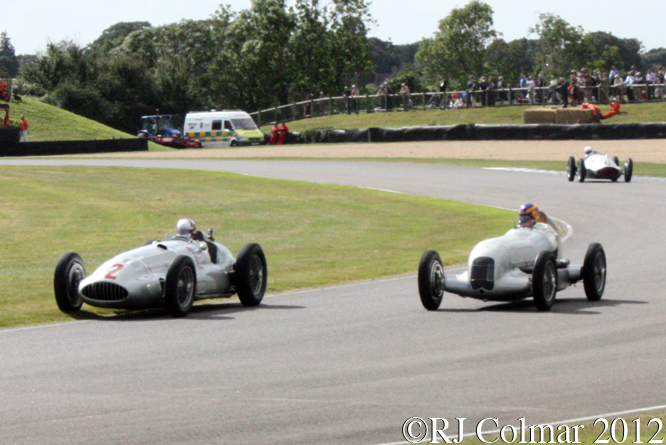
Mercedes Benz W154 and W25, Goodwood Revival

From 1934 to 1937 Mercedes Benz used the W25 powered by a supercharged straight 8 motor that rose from 300 hp in 1934 to 490 hp by the time the W25 was replaced by the W125. In 1935 Rudolf Caracciola won the European Grand Prix Championship with three wins, Stuck one once for Auto Union and Tazio Nuvolari famously upset the Fuhrer by winning for ALFA Romeo in the 1935 German Grand Prix.

Karl Wendlinger had some problems selecting gears with the W25 seen on the left above and when he got a gear on this occasion the car snaked wildly as the narrow power band of his screaming engine kicked in forcing the 1938 W154 onto the grass.

Auto Union C-Type, Goodwood Revival

For 1936 Auto Union introduced the C-Type which produced over 500 hp from it’s supercharged V16. This tipped the scales in favour of Bernd Rosemeyer who won three of the four European Championship rounds to become European Champion in 1936. This left the previous years champion Caracciola with a consolation victory at the start of the 1936 season before the Mercedes Benz team withdrew mid season, after the Auto Unions superiority became obvious, to regroup for 1937.

Five time Le Mans winner Frank Biela is seen at the wheel of the C-type above.
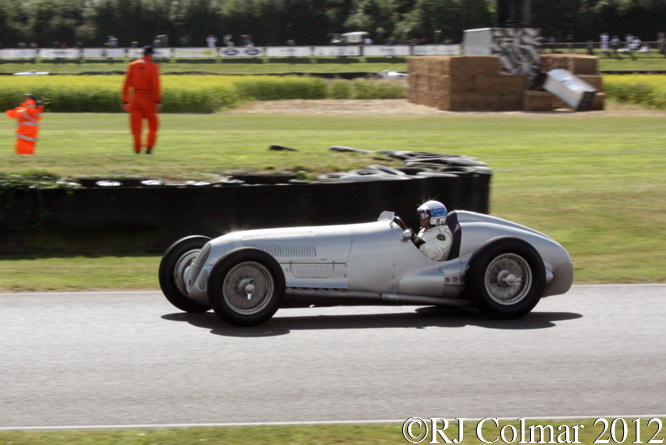
Mercedes Benz W125, Goodwood Revival

For 1937 Mercedes Benz came back with a vengeance upgrading their supercharged straight eight motor with a swept volume 5,662.85 cc / 345.56 CUI which produced 595 hp and a new W125 chassis as seen being handled by Grand Prix and Le Mans winner Jochen Mass above. After a consolation win at the start of the 1937 season for Rudolf Hasse, Caracciola took three wins from the remaining four rounds of the championship to win the 1937 European Championship title for the second time. Only Manfred von Brauchitsch also aboard a W125 interrupted Caracciola’s progress at Monaco. It was not until the late sixties that circuit racers so powerful would hit the tracks again with the emergence of the unlimited Can Am Series in North America.
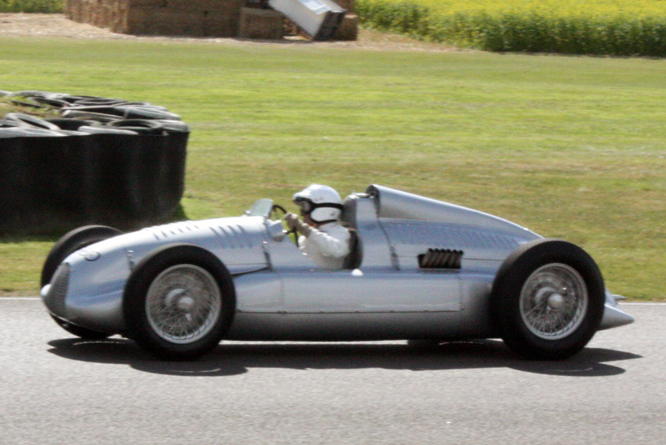
Auto Union D-Type, Goodwood Revival

For 1938 the organisers changed the rules to bring the speeds down by announcing a maximum swept volume of three litres / 183 cui. Auto Union developed the new D-type with “only” 12 cylinders in a Vee configuartaion that with 24 psi boost from the supercharger developed 478 hp and was still capable of over 200 mph ! The Nuvolari drove the D-Type, like the one seen here, to a single championship victory at the season finale at Monza.
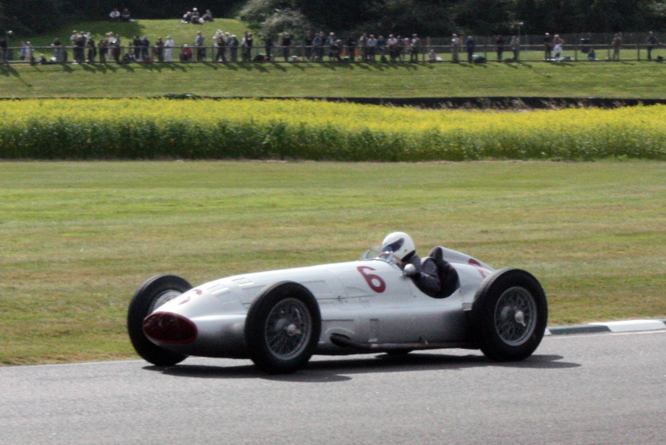
Mercedes Benz W154, Goodwood Revival

Mercedes Benz built the W154 for the smaller capacity formula using an essentially unchanged chassis from the W125 but with a supercharged V12 giving up to 475 hp. von Brauchitsch and Great Britain’s Richard Seaman won the opening 2 races of the four race series. Caracciola won the third round which was enough to secure him a third European Championship title.

For 1939 there were only four rounds of the European Championship Mercedes again winning three of them Hermann Lang winning the first and last and Caracciola winning the 1939 German Grand Prix all for Mercedes. Herman Paul Müller interrupted the Mercedes domination with a win at the French Grand Prix. Two weeks after the final championship round in Switzerland von Brauchitsch drove the #6 seen here driven by Rob Hall to second place in the non championship Belgrade Grand Prix. That same day the Second World War got underway and the European Championship organisers who apparently had never agreed on the points system to be used for the 1939 championship failed to announce a championship winner. Lang or Mülller would have won depending on the scoring system to be used.
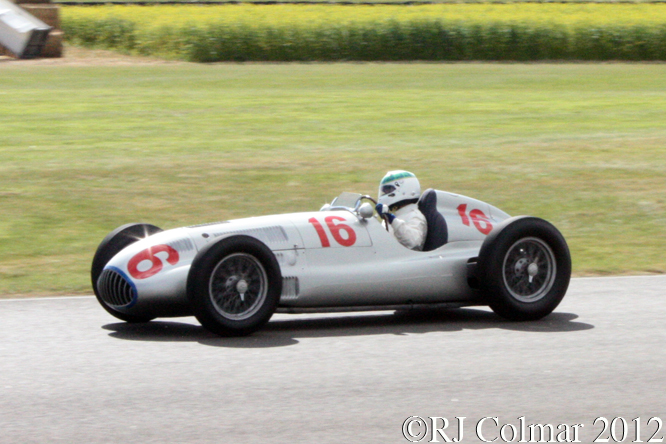
Mercedes Benz W165, Goodwood Revival

Finally Mercedes Benz built the 1.5 litre 91.5 cui supercharged V8 powered W165, as driven by Paul Stewart above, to compete in the more competitive, or at least varied since nearly everyone had abandoned hope of competing against Mercedes Benz and Auto Union, voiturette (small) class. Two cars were entered for Lang and Caracciola in the Tripoli Grand Prix and they finished first and second in that order. The cars were never to be raced again despite Caracciola being invited to compete at Indianapolis in 1946, he could not get the car out of Europe through Swiss customs.

Without doubt these are some of the most fascinating cars ever seen in motor racing, they dominated races that were often 10 hours long, but in the early years they were not invincible. However great the achievements of the teams and drivers these cars were built in an industrial context with the conscripted help of men and women who were not free to do as they liked, and I would venture to suggest these vehicles should be remembered as a testimony to those who endured unimaginable hardships and in the greater scheme of things some of the greatest inhumanities known to man.

Thanks for joining me on this “#7 Siberpfile” edition of “Gettin’ a li’l psycho on tyres”, I hope you will join me again for some California Sunshine tomorrow. Don’t forget to come back now !

Share

Beneath The Paint – Ford Capri 3000 GXL Auto

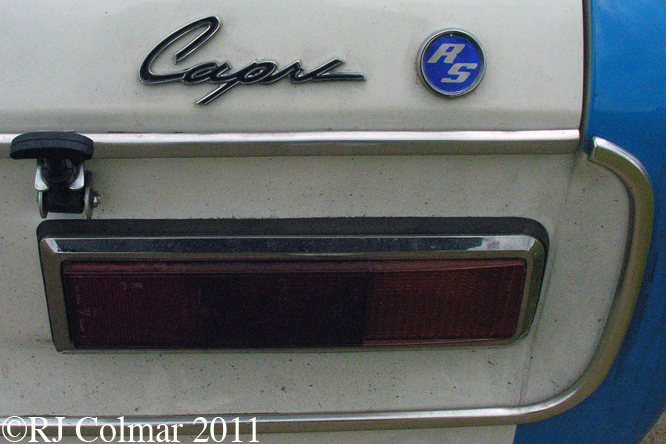
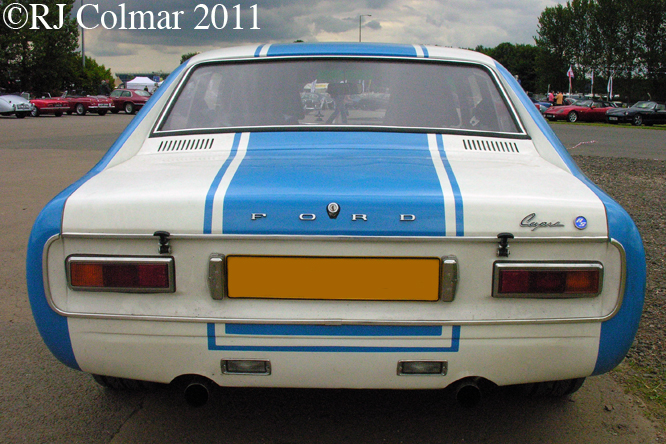
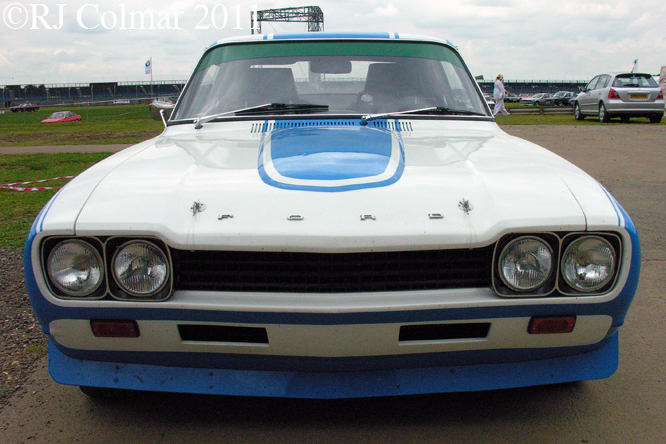
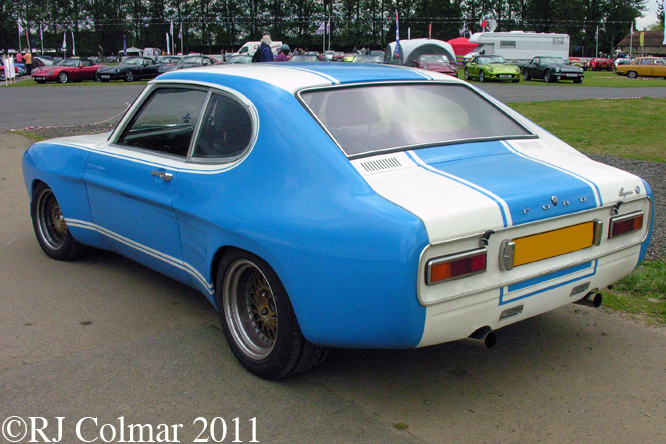
My heart skipped a beat when I saw this fabulous Ford Capri wearing the colours of the early 1970’s works Ford ‘Cologne’ factory racing team, the last time I recall seeing a road going Capri like this in the flesh was around 1974 !

Ford Capri 3000 GLX, Silverstone Classic

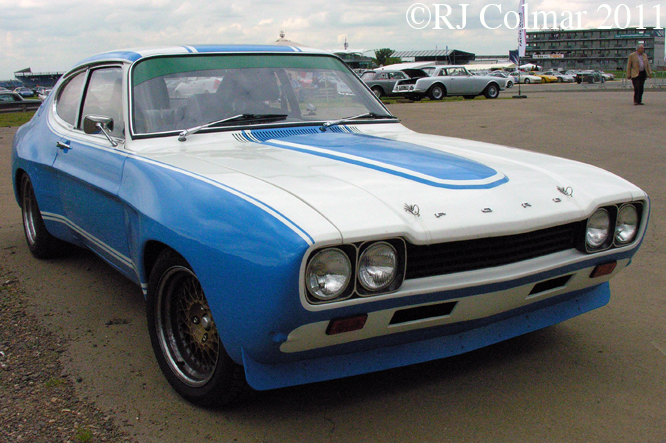
In 1970 Ford Germany built 50 RS2600 variants of the Capri to satisfy the FIA minimum build racing requirements (also known as homologation), the flared arches on the vehicle seen here at last years Silverstone Classic suggest that this might be on of those fifty specials who’s build quality was so low that they were not fit to be sold for road use.

Ford Capri 3000 GLX, Silverstone Classic

The fifty homologation RS2600’s featured light weight glass fiber doors, boot and bonnet/hood.

Ford Capri 3000 GLX, Silverstone Classic

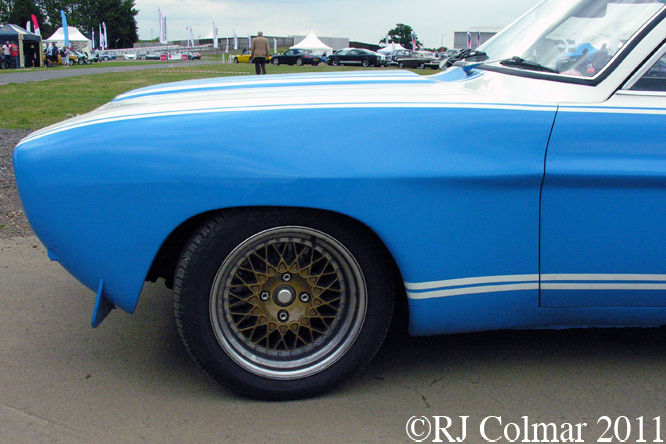
Beneath the flared arches the RS 2600’s were fitted with distinctive gold centered BBS wheels, which became as iconic and synonymous with the 1970’s as Minilites had with the 1960’s.

Ford Capri 3000 GLX, Silverstone Classic

The homologation RS 2600’s were also fitted with plastic window’s and painted with fewer coats of paint than their road going siblings all in an effort to save weight.

Ford Capri 3000 GLX, Silverstone Classic

Success came to the works Ford Team managed by Jochen Neerpasch in the form of two European Touring Car Championships for Germans Dieter Glemser in 1971 and Jochen Mass in 1972, although on both occasions Alfa Romeo’s running in the lower Class 2 division secured the manufacturers championships.

Ford Capri 3000 GLX, Silverstone Classic

Unfortunately despite the paintwork this car does not turn out to be one of the homologation specials at all, they were all left hand drive vehicles, a check of the registration reveals this car started out as a Dagenham (UK) built Capri 3000 GLX Auto in 1972 fitted with a 3 litre / 183 cui ‘Essex’ V6, registration details also suggest that this car is now fitted with a 3.5 litre motor which is probably one of the Buick derived Rover aluminium V8’s which are the most readily available for such conversions in the UK.

Thanks for joining me on this ‘Beneath The Paint’ edition of ‘Gettin’ a li’l psycho on tyres’ I hope you will join me again tomorrow when I’ll be going Auburn. Don’t forget to come back now !

Share

Arrested Development – McLaren M26/1

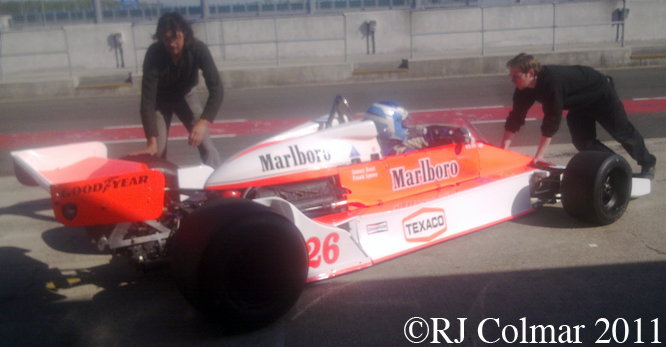
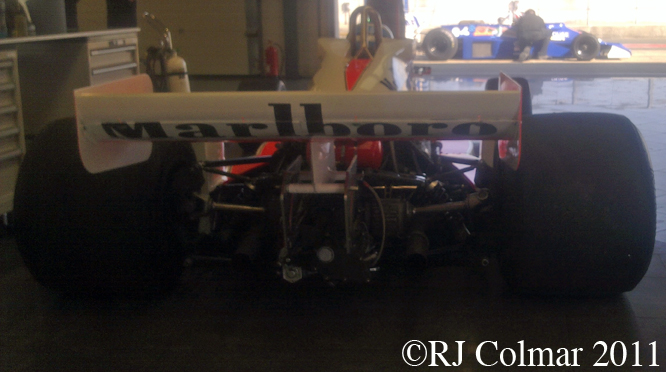
McLaren M26, Silverstone

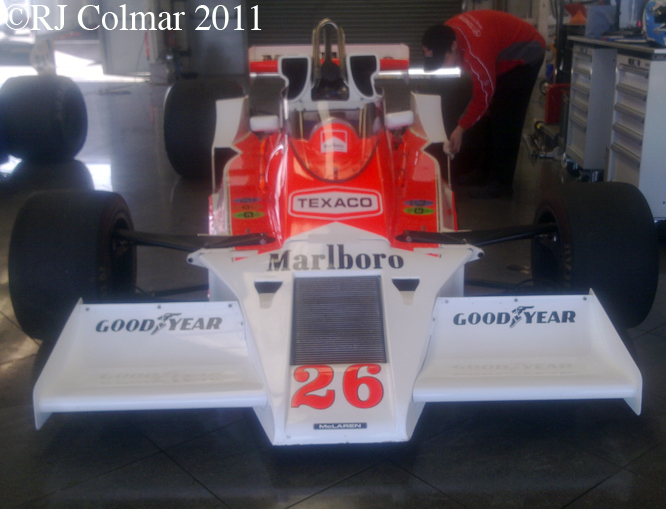
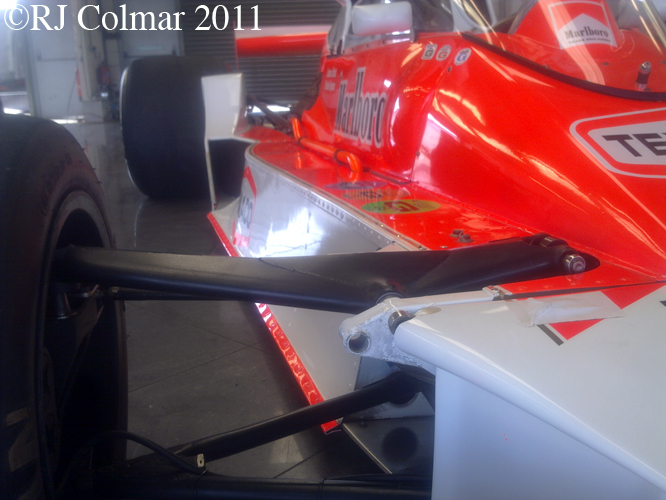
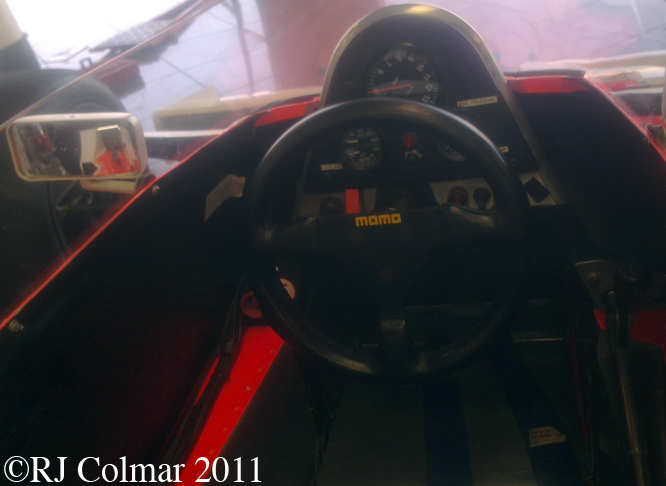
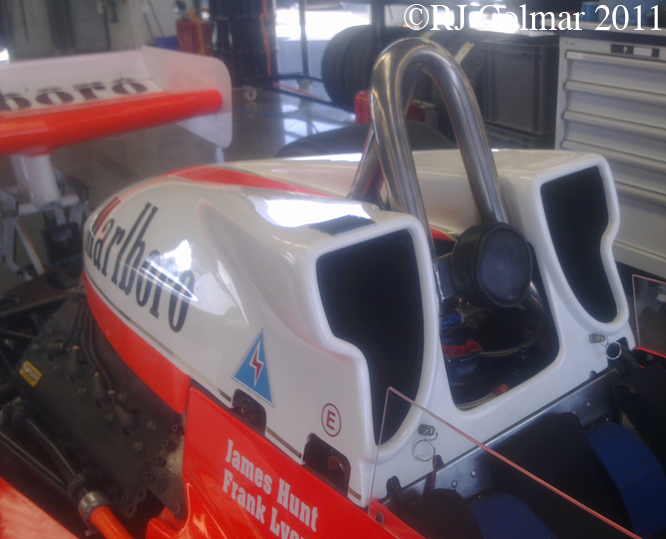
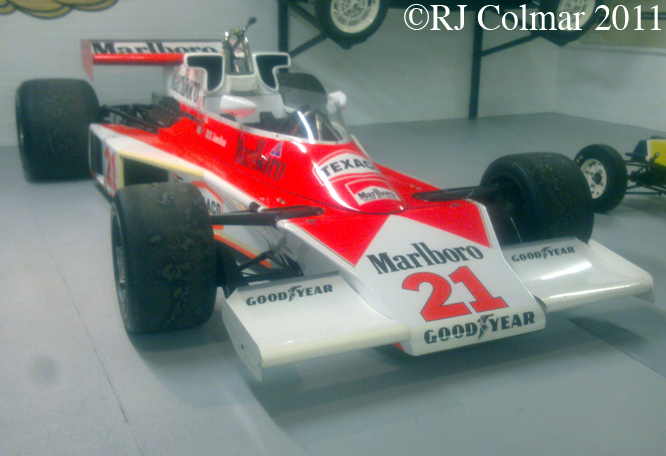
The McLaren M23 was already a four year old design when Gordon Coppucks successor the lower and lighter McLaren M26 was launched in the summer of 1976.

McLaren M26, Silverstone

Unfortunately the development of the M26 was almost immediately stifled as James Hunt in his M23 and the team were waging one of the fiercest championship battles in the history of the World Divers Championship to that point in time.

McLaren M26, Silverstone

The M26 did race at the Dutch Grand Prix driven by Jochen Mass in 1976 but it was quickly decided that the design needed serious development that was best postponed until the end of the season.

McLaren M26, Silverstone

James subsequently won the 1976 World Drivers Championship. I am not sure why the M26 was not ready for the start of the 1977 championship but the older M23 was pressed into a fifth season of competition and it was not until the 10th round of the 17 race Grand Prix schedule that both front line McLaren drivers James Hunt and Jochen Mass had the M26 available to race.

McLaren M26, Silverstone

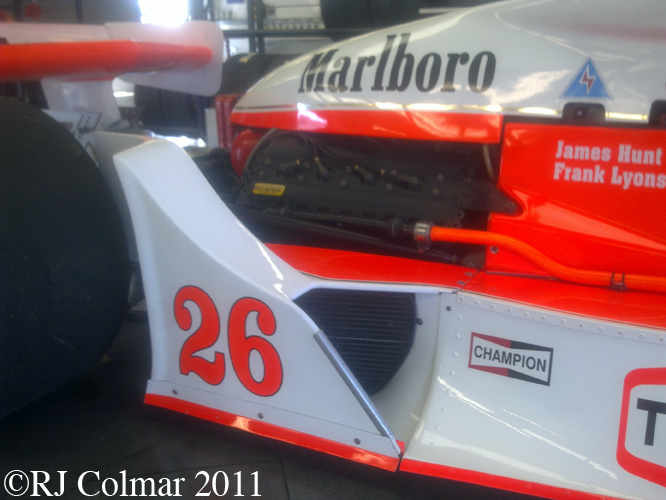
Nearly a year after it was launched, now featuring a radiator mounted in the nose, the car was competitive and at the British Grand Prix in 1977 James recorded the first of three victories driving the M26 model, not enough to defend his World Drivers championship but a respectable achievement none the less.

McLaren M26, Silverstone

James was not known for his testing skills in the same way as the much vaunted Niki Lauda and so it is perhaps no surprise that for the following 1978 season the development of the M26 did not significantly improve performance.

McLaren M26, Silverstone

In 1978 the M26 was, like most of the opposition, simply outclassed by the dominant Lotus 79 design which introduced hitherto unimaginably superior handling to Grand Prix racing thanks to the venturi in it’s side pods. Hunt left the McLaren Team to rejoin former Hesketh designer Dr Harvey Postlethwaite at Wolf Racing for the 1979 season.

McLaren M26, Silverstone

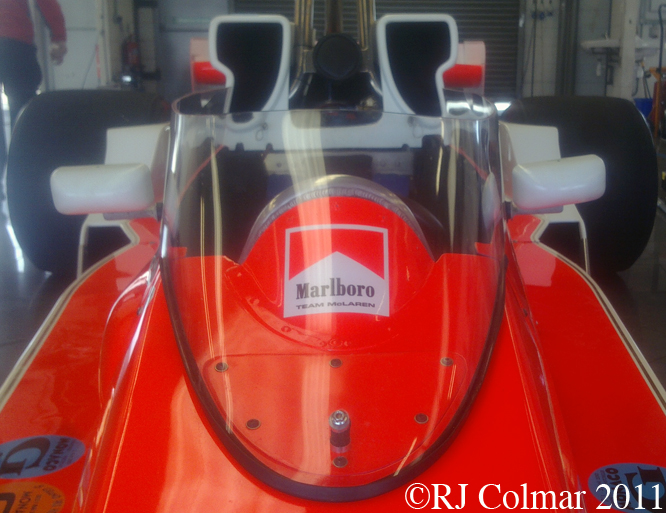
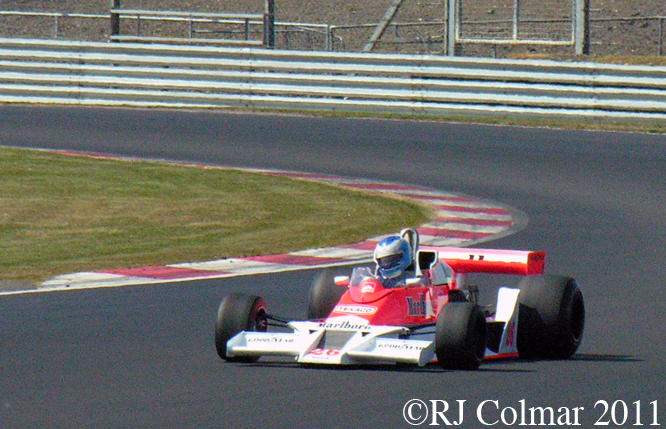
The car featured in these photographs is thought to be chassis M26/1 which was first raced by Jochen Mass in Holland in 1976. The best result for M26/1 was fourth place scored by Jochen Mass behind winner James Hunts similar model at the 1977 British Grand Prix.

McLaren M26, Silverstone

The vehicle is seen here being driven by owner Frank Lyons is expected to take part in this weekends Silverstone Classic race for Formula One cars on Sunday.

My thanks to NZALPA, VINCE H, David Lawson, Tim, Murray, Tony Gallagher, Alan Cox, Pink Snail, David Lawson, hipperson and Geoff Butcher at The Nostalgia Forum for their help identifying the chassis number and driver.

Hope you have enjoyed the Arrested Development edition of ‘Gettin’ a lil psycho on tyres’ and that you’ll join me again for a look at a Fittipaldi in Wolf clothing tomorrow. Don’t forget to come back now !
Share

Caution Wide Vehicle – McLaren M23 M23/6

McLaren M23, Donington

The Ford Cosworth DFV powered McLaren M23 was designed by Gordon Cuppock, based on the lessons learned from the successful McLaren M16 Indy car. The M23 driven by Denny Hulme burst onto the Grand Prix scene in 1973 with a pole position on its debut in South Africa. Denny scored the first win for the model in Sweden and Peter Revson followed that with wins in Great Britain and Canada in 1973.

For 1974 Denny who won his last race in an M23 in the season opening Argentinian GP was joined in the McLaren team by 1972 World Champion Emerson Fittipaldi who won in Brazil, Belgium, and Canada on his way to becoming the 1974 World Champion. McLaren also won the World Constructors title in 1974.

Jochen Mass joined Emerson in the McLaren team in 1975 winning the shortened Spanish GP while Emerson won in Argentina and Great Britain to finish 2nd in the World Drivers Championship.

1976 would prove to be the chassis most successful year in terms of wins with James Hunt, who replaced Emerson in the team crossing the line first in Spain, France, Great Britain, Germany, The Netherlands, Canada and the United States.

However 1976 was a year of high drama and comedy in Formula One first James was disqualified from the Spanish Grand Prix because his car was 1.8cm less than an inch too wide. In 1975 the McLaren had been used as a base model too set the dimensions for the 1976 Formula regulations.

McLaren successfully argued that when the tyres on the car were moving they were taller as a result of the centrifugal force taking up the slack on the side walls of the tyres and that this accounted for the discrepancy. The governing F.I.A. accepted this argument and the win was reinstated with a $3,000 fine, when the M23’s next appeared they had a slightly narrower rear track.

On the first corner, Paddock Bend, of the opening lap of the British Grand Prix James Hunt was the innocent victim in a crash with Ferrari’s Clay Reggazoni. The race was stopped and James who’s car was severely damaged took a short cut to get back to the pits when the race was stopped.

Come the restart the organisers initially refused to allow James to line up on the grid because the team had worked to repair his car while the mess was being cleared up. However people power intervened and fearing a riot from the partisan crowd the organisers relented, James took the win, he and the partisan crowd partied long and hard into the night and later the F.I.A. disqualified both Hunt and Clay Regazzoni from the event for having failed to complete the opening lap.

Up until this point reigning Champion Niki Lauda had dominated the 1976 Championship with four wins three seconds, the last of which became 1st after Hunt’s disqualification from the British GP and a third. The next race was the ill feted German Grand Prix in which Niki was eliminated in an accident that triggered an inferno from which he was lucky to escape with his life.

James won the German Grand Prix and the Dutch GP while Niki recuperated and 39 days after the inferno at the Nurburgring Niki and James met again at the Italian GP. At the end of practice for the Italian GP James and Mclaren team mate Jochen Mass and John Watson at Penske were found to be running with a fuel octane rating that was too high and had their Saturday times disallowed.

Since it had been raining during the first practice sessions on the Friday Hunt, Mass and Watson had effectively failed to qualify, however the 13 second plus off pace Otto Stuppacher was already on his way home to Austria when the announcement and the Marlboro sponsored Art Mezario withdrew as did Englishman Guy Edwards allowing Hunt, Mass and Watson to start.

Hunt crashed trying to make time and was applauded for doing so by the Tifosi and Lauda came home a remarkable 4th in his first race back.

James won both the Canadian and US Grand Prix while the brave Niki could only amass a further three championship points. Going into he last race of the season the Japanese GP Niki had a 3 point lead over James.

For the race James qualified 2nd behind Andretti with Niki just one place further back. I remember getting up at some unholy hour to watch this race live on TV in the UK and remember the disappointment when I saw the monsoon that unfolded on the track.

After much debate amongst the driver the race started and Niki who had lost his eyelids in the German inferno and yet to have them replaced through plastic surgery had little choice but to retire in the near zero visibility conditions. James took an early lead in the race but as the rain stopped and the track started to dry Hunt started losing ground dropping to 5th after a pit stop to replace a punctured tyre with just a few laps to go.

James charged back into the race managing to regain two positions which left him in third position when the flag came out for Mario Andretti to win by just over a lap from Patrick Depailler, with James Hunt, who had no idea what his position was in the race, right on his tail.

Hunt only learned that he had become champion after he got out of the car and stopped shouting at team manager Teddy Meyer for a less than perfect pit stop.

Hunt won the 1976 World Drivers title by just one point and Great Britain had it’s first World Champion since Jackie Stewart had won his last crown in 1973.

The McLaren M23 was pressed into service again in 1977 but its competitiveness was on the wane James winning a non championship race before committing fully to the M26 successor which had gone through a troublesome one year gestation period before coming on song.

The works M23 had a final swan song when it introduced Gilles Villeneuve to the world of Grand Prix racing in Great Britain and Bruno Jack’O’Malley in Italy towards the end of the 1977.

I have done my best to find out exactly which of the 13 M23 chassis this is, The Donington Museum blurb identified this car as McLaren M23/8 and said it was used to win the ’76 Spanish and US GP’s however M23/8 was destroyed in 1975. The car was then given a new tub with the chassis number M23/8-2 and the old tub was apparently eventually repaired to 1975 tall airbox spec and now resides in the United States.

M23/8-2 went on to become one of the stars of the 1976 season being used to win the controversial Spanish GP along with those in Canada and the US GP. M23/8-2 is said to belong to BCE the man responsible for running the the whole Formula Show since 1981.

It is said that the vehicle in my photograph appeared at the 60th Anniversary celebrations of the World Grand Prix Drivers Championship in Bahrain last year, it is also suggested that the M23 which appeared at Bahrain belongs to the brave octogenarian who started a modelling career with Hublot earlier this year however I have no firm evidence of the ownership of the vehicle in the photograph at the top of this post
at this time.

Most likely the vehicle above seen at the Donington Park Museum is M23/6 which seems to meet many of the criteria hinted at on various threads of The Nostalgia Forum and who’s whereabouts is listed as unknown by the respected Old Racing Car site.

M23/6 was used by Denny Hulme to win the Agentine Grand Prix in 1974 then in 1976 James Hunt drove it to win the French Grand Prix, cross the line first in Great Britain only to be disqualified .

At the next race the German Grand Prix I saw James win in this chassis which became one of a rare set of vehicles that crossed the line first in three consecutive races, though it was disqualified from one of them.

In 1977 Emilio de Villota drove M23/6 with little success in Grand Prix events, 2 starts three DNQ’s, but did win two rounds of a British series open to all single seat racing cars.

My thanks to Michael Ferner, Wouter Melissen, Steve Holter, Simon Hadfield, Slurp1955, at The Nostalgia Forum for their valuable contributions to todays blog.

Hope you have enjoyed today’s 1976 edition of ‘Gettin’ a lil psycho on tyres’ and that you will join me again tomorrow. Don’t forget to come back now !
Share

Moby Dick – Porsche 935/78 #006

DSCN9920sc

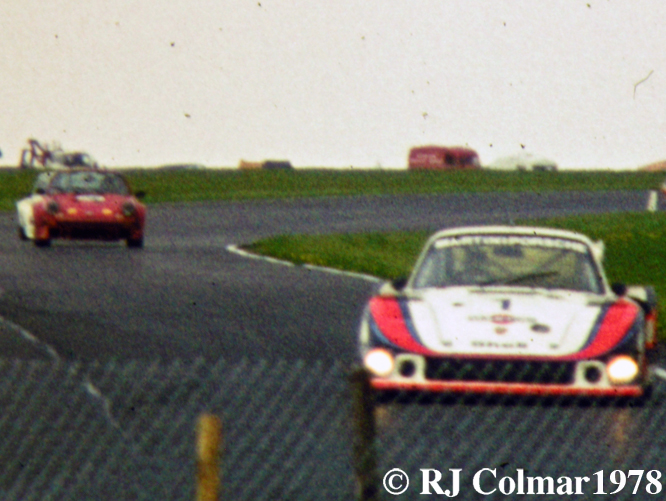
The Porsche 935/78 was a one off vehicle built to win the 1978 Le Mans 24 hours and was the ultimate works development of the, then 15 year old, 911 which would not be topped until the advent of the 911 GT1 built in the late 1990’s. Notice that in preparation for Le Mans the drivers seat was placed on the right hand side optimising weight distribution for a race run on a clockwise track.

Thanks to a rule made at the request of arch enemy BMW the body was lowered 10cm 3.9 inches over the standard 911 by cutting out the standard floor plan with the engine like wise now lowered the gearbox was inverted to raise the drive shafts closer to their original height. Apart of from the front windscreen almost every body panel was optimised to maximise the top speed on the 4 mile Mulsanne straight where 235 mph was eventually achieved.

The 935/78 was equipped with a 750 hp 3.2 litre 195 cui flat 6 with 4 valves per cylinder in water cooled cylinder heads, a first for Porsche who had always raced air/oil cooled motors up until this time.

The car seen here driven Jacky Ickx and Jochen Mass at the 1978 Silverstone 6 hour race, a warm up for the Le Mans 24 hours, romped away from the opposition, mostly private Porsche’s with a single works BMW driven by Ronnie Peterson and Hans Joachim Stuck, finished a ridiculous 7 laps ahead of the rest of the field.

Stommelen/Schurti qualified ‘Moby Dick’, as the 935/78 was known, third on the grid at Le Mans however a silly stunt in which the car was driven on the road from Porsches garage outside the circuit to the circuit on race day went horribly wrong when predictably the car got caught in race day traffic causing the engine to over heat which created an oil leak. The subsequent loss of performance meant the car could only finish 8th.

935/78 #006 appeared twice more in 1978 but disgraced itself with two retirements and has since been consigned to the Porsche Museum. Joest Racing built two further 935/78’s from factory drawings in 1981.

Hope you have enjoyed today’s 235 mph edition of ‘Gettin’ a lil’ psycho on tyres’ and that you will join me again for another turbo charged blog tomorrow. Don’t forget to come back now !
Share