Tag Archives: MG

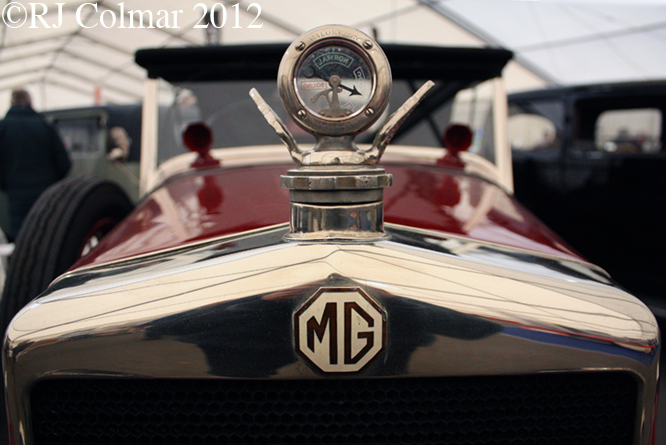
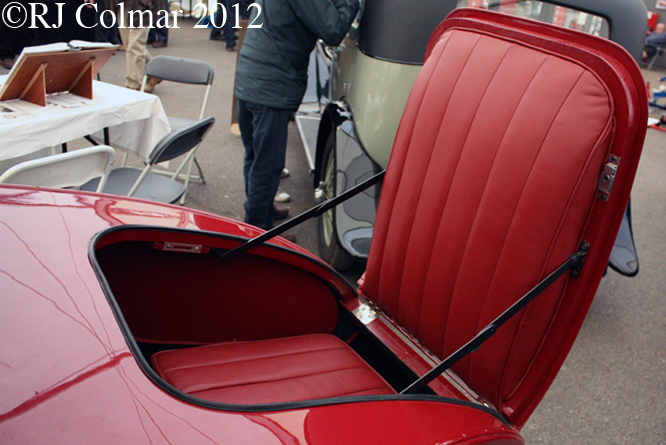
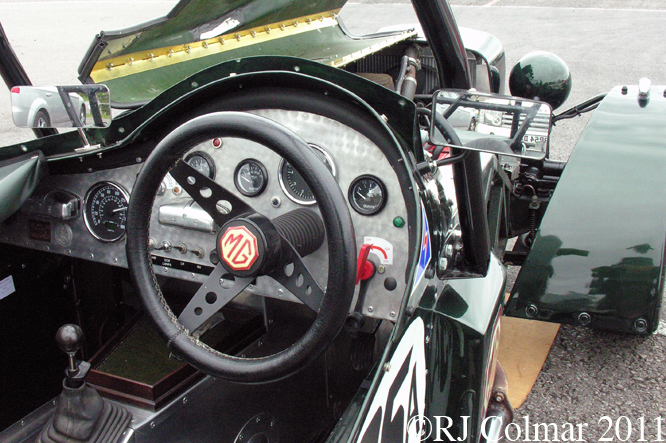
Silver Plated Steering Wheel Boss – MG 18/80 Mk II Prototype

In 1928 MG moved away from it’s original remit of giving Morris Bullnose products wider appeal which culminated in the MG 14/40 and started to manufacture it’s own chassis and engine blocks.

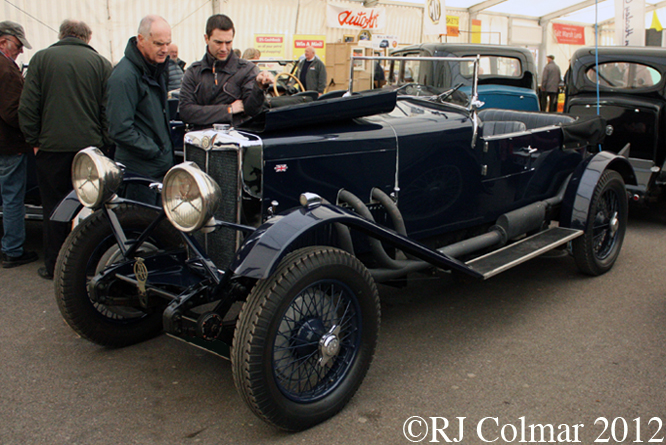
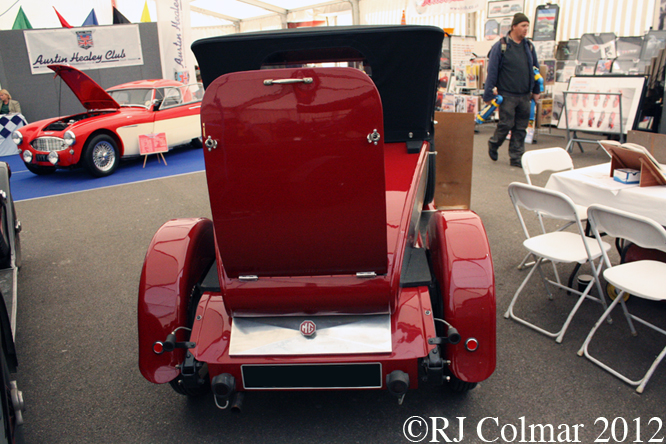
MG 18/80 Mk II Prototype, Bristol Classic Car Show

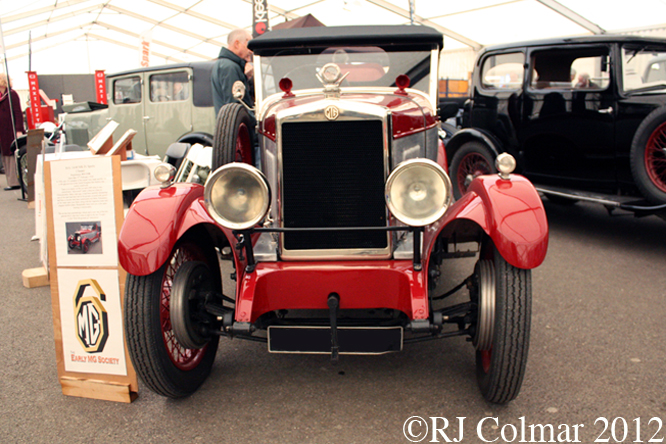
The new 18/80 model featured both a unique MG chassis and engine block both of which had been developed from lessons learned from a Morris Light Six Saloon that never went into production. The new distinctive radiator design would be maintained all the way through to the T Series.

MG 18/80 Mk II Prototype, Bristol Classic Car Show

The 18/80 also featured unique to MG front and rear axles with Rudge Whitworth centre lock wheels an either tourer or saloon body styles.

MG 18/80 Mk II Prototype, Bristol Classic Car Show

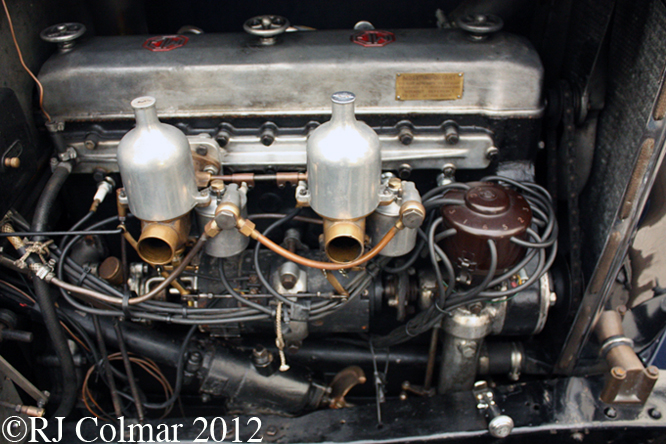
The twin carburetor six cylinder motor featured a four bearing crankshaft with a Duplex chain, see behind the radiator on the right, which drives the camshaft, distributor, water pump, oil pump and dynamo. The MG 80 hp rated six gave the 18/80 enough power to reach 100 mph. The motor seen here has been upgraded with a MK III cylinder head and ignition and drives through a Rover SD1 clutch in place of the original cork in oil unit.

MG 18/80 Mk II Prototype, Bristol Classic Car Show

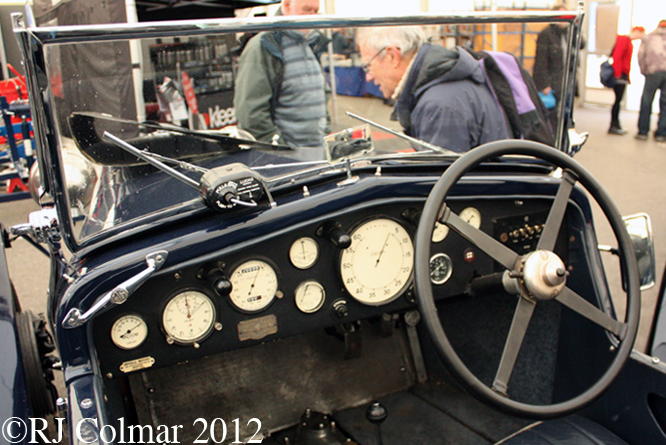
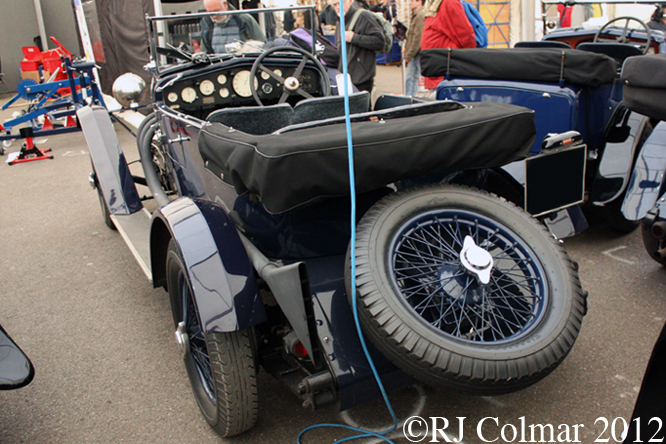
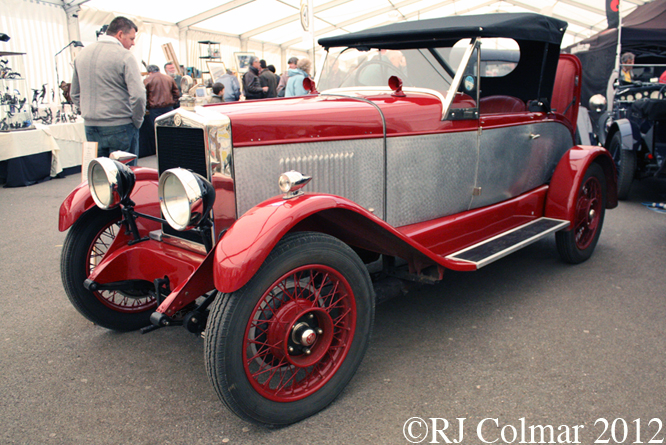
The 1929 chassis of the vehicle featured today was originally built as a prototype for the MK II saloon in 1929 however by the early 80’s the body was in such a poor state that it was replaced with a Mk III 18/100 ‘Tigress’ style body. Note the unique silver plated steering wheel boss from the original Mk II Prototype has been retained, but the dash and instrumentation are from a Mk III Tigress.

MG 18/80 Mk II Prototype, Bristol Classic Car Show

As a result of underwhelming track performance, only five ready to race Mk III ‘Tigress’ vehicles, styled after the contemporary Bentley competion models, were built in period.

Thanks for joining me on this “Silver Plated Steering Wheel Boss” edition of “Gettin’ a li’l psycho on tyres” I hope you will join me again tomorrow when I’ll be featuring a Techno DAF. Don’t forget to come back now !

Share

Buried And Covered In Concrete – MG 14/40 MK IV Sports

Towards 1927 production of MG’s moved to a new factory in Edmund Road, Oxford and production of the MG 14/40 MK IV commenced, with MG Car Company becoming a legal entity in 1928.

MG 14/40 Mk IV Sports, Bristol Classic Car Show

14/40’s were built around bare Morris Oxford chassis, unlike earlier MG’s that were built from completed frames that were striped and rebuilt to MG specifications, as the MG 14/28 had been but were now given MG chassis numbers, MG badges and motors, optimistically, estimated to produce 40hp.

MG 14/40 Mk IV Sports, Bristol Classic Car Show

MG publicity at the 1928, London, Motor Show mentions Land Speed Record Breaker Malcolm Campbell as an owner of a 14/40, a model which was struggling to sell at the time in part due to the age of the Oxford chassis and side valve motor underpinning the car.

MG 14/40 Mk IV Sports, Bristol Classic Car Show

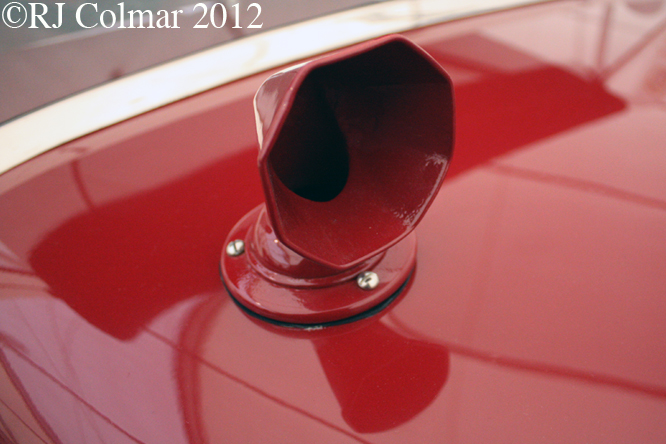
MG founder Cecil Kimber went to great lengths to differentiate his cars from their Morris inheritance before fitting MG bodies, his alleged obsession with octagons is said to have been frequently overdone.

MG 14/40 Mk IV Sports, Bristol Classic Car Show

This Mk IV Sports is one of 135 such vehicles built in 1928 and the only survivor in the UK of a total of just four that are known to exist.

MG 14/40 Mk IV Sports, Bristol Classic Car Show

The winner of Best Vintage Car award at the Bristol Classic Car Show, where it is seen in these photo’s, has no history prior to 1999 when it was found beneath a ripped up concrete base of a shed in Gloucestershire.

MG 14/40 Mk IV Sports, Bristol Classic Car Show

The disassembled car was found carefully preserved beneath a further layer of gravel complete with it’s guarantee plate and original number plates apparently ready for it’s ground up restoration.

Thanks for joining me in this ‘Buried And Covered In Concrete’ edition of “Gettin’ a li’l psycho on tyres’ I hope you will join me again tomorrow when I’ll be going Dutch with a Daf. Don’t forget to come back now !

Share

Imshi Chassis – MG 14/28

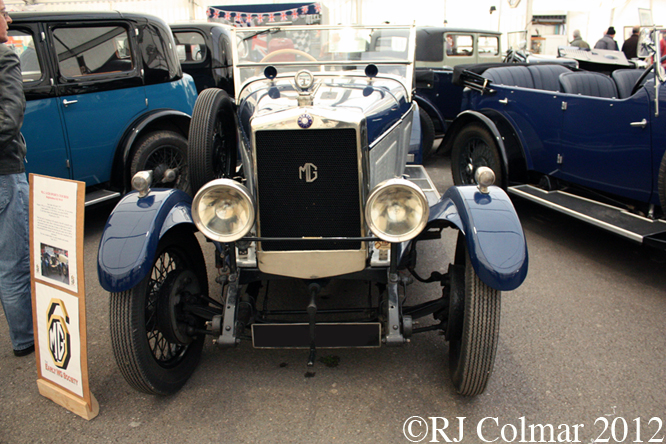
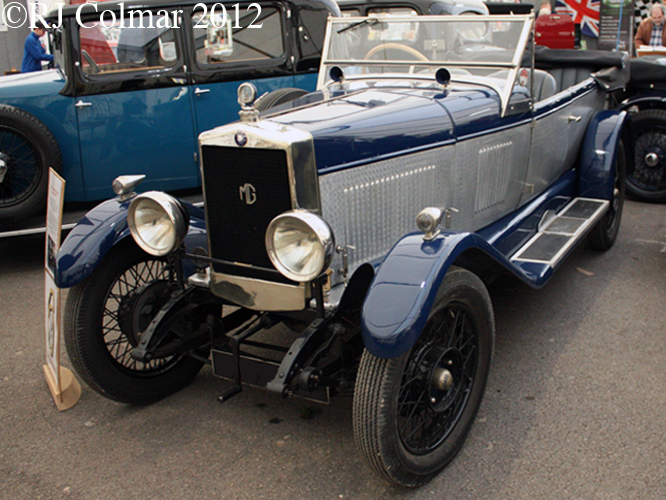
The history of the foundation of MG cars as a manufacturer is closely linked to the development of a vehicle, by Cecil Kimber of Morris dealer Morris Garages in 1923, based on a 14/28 Morris Oxford chassis purchased directly from the Morris Factory. In 1927 Morris Garages started registering their cars for the road with the local council as MG’s advertising one such car as being based on the ‘Imshi chassis’. Imshi, Arabic for ‘get a move on’, refers to a news paper journalists six month expedition through Europe and North Africa in a 14/28 Morris Oxford.

MG 14/28 Classic Car Show, Bristol Classic Car Show

MG badges did not appear on the cars with MG bodies and modifications to Morris chassis and motors until 1928 and the blue radiator badge on the 1927 14/28 seen here bears the ‘Morris Oxford’ name. The car, seen here at the Bristol Classic Car Show, belonging to an Early MG Society member, is one of just 10 of the later 290 flat radiator 14/28’s built, the original 14/28 maintained the bull nose radiator from the original 14/28 Morris Oxford chassis.

MG 14/28 Classic Car Show, Bristol Classic Car Show

This car was found in 1989 and the current owner acquired it in 1996 and since proceeded with a restoration to bring the 65 mph car, which cost £350 new, to it’s current condition.

Thanks for joining me on this ‘Imshi Chassis’ edition of ‘Gettin’ a li’l psycho on tyres, I hope you will join me again tomorrow when I’ll be featuring a Panhard. Don’t forget to come back now !

Share

Patent Monocoque – Killeen K1

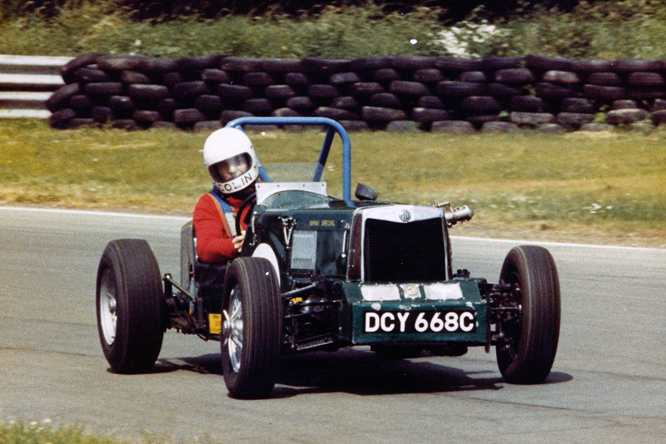
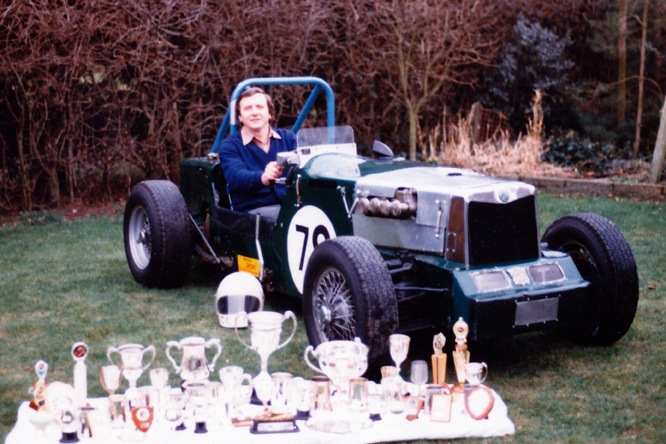
Over the last couple of weeks I have been looking at the three MG powered Kayne Specials built by Colin Cooper, today’s extraordinary Killeen K1 is an MG powered special of which from 1979 to 1985 Colin became the seventh owner.

Killeen K1, Donington Park

The Killen K1 was the brain child of Tom Killeen who during World War 2 was serving on an RAF base, on the island of Malta, now the site of the Maltese national football stadium, where he was impressed by the rugged strength and easy maintenance of the Supermarine Spitfire aircraft which operated there.

In 1950 Tom designed the Killeen K1 using a similar monocoque construction technique to that used in the Spitfire, using three equally spaced steel ‘hoops’ around which Tom attached Hiduminium alloy sheets to end up with a structure that was lighter and more rigid than the traditional ladder or space frame type chassis that were prevalent at the time. This type of monocoque construction which was by no means the first time it had been used in a racing car, that honour is thought to belong to the 1915 Cornelian Indy Car, the K1 just predates the semi monocoque D-Type Jaguar of 1954 and preempted the Lotus 25 by a full decade.

Tom Killeen took out a patent on his design in 1952 and proceeded to build the car with independent front suspension and de Dion rear and an stage two MG XPAG for his friend Jack Newton who subsequently raced the K1 in 1953. In 1954 Tom acquired a special motor for the K1, from John Thornely of MG, that had been built for the 1954 MG EX-179 speed record project. Colin found that this motor featured a separated cylinder head cooling system that was sealed at the top of the engine block.

Killeen K1, Donington Park

Tom Killeen who is known to have worked for Jensen’s from at least 1947 to 1965 is known to have designed at least 19 vehicles including motorcycles all built or to have been built with monocoque structure.

More detailed information and photographs on the Killeen K1, which now resides in New Zealand, and the work of Tom Killeen can be found on Bob Allans’ Killeen dedicated website linked here.

My thanks to Colin Cooper, who is seen at the wheel of the Killeen K1 at Donington above, for sharing some of the stories behind the cars he has owned and built and to Bob Allan who helped me get in touch with Colin.

Thanks for joining me on this ‘Patent Monocoque’ edition of ‘Gettin’ a li’l psycho on tyres’, I hope you will join me again tomorrow. Don’t forget to come back now !

Share

Towing and Competing – Kayne Special III

A couple of weeks ago I was privileged to meet MG Special Builder and Frogeye restorer Colin Cooper. Today I am looking at his third, and final, Kayne Special III.

Kayne Special III & Kayne Special II, Oulton Park

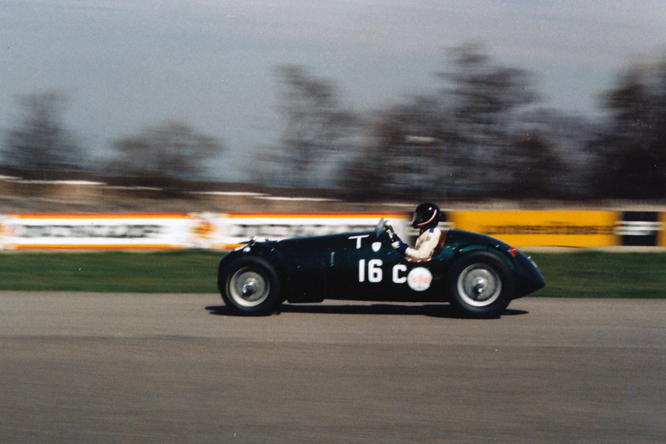
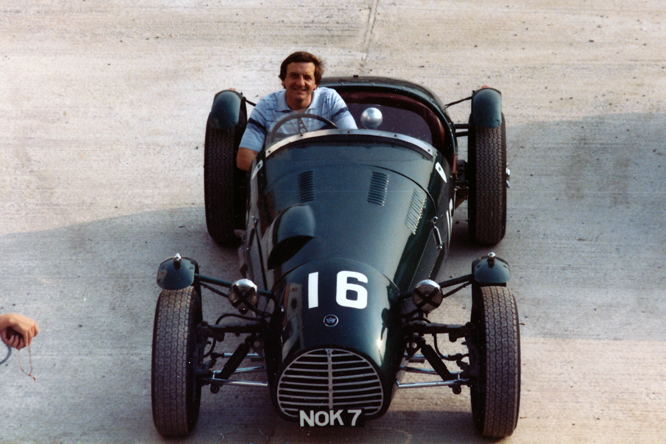
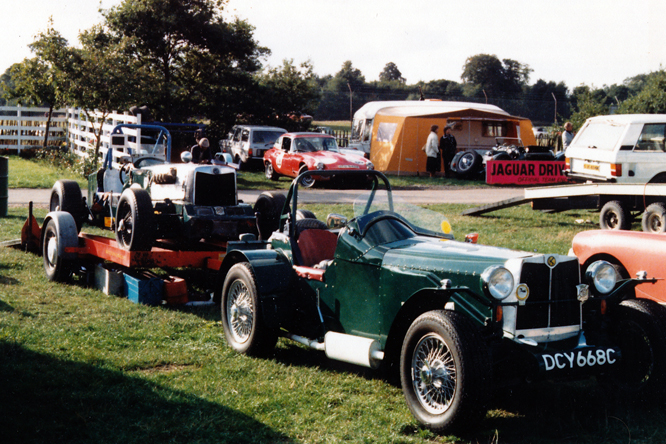
Colin originally conceived the Kayne Special III as a towing car for his Kayne Special II as seen above at Oulton Park in 1983 and his Killeen K1 which I’ll be looking at next Tuesday.

Kayne Special III, Baitings Dam

Photo Copyright Frank Hall 1984.

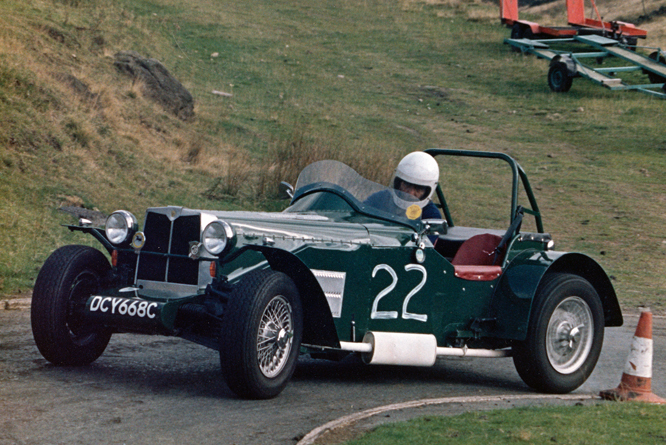
However since he was taking part in events which allowed a driver multiple entries he decided to see what the Kayne Special III could do. Colin is seen above at Baitings Dam in 1984.

Kayne Special III, Castle Combe

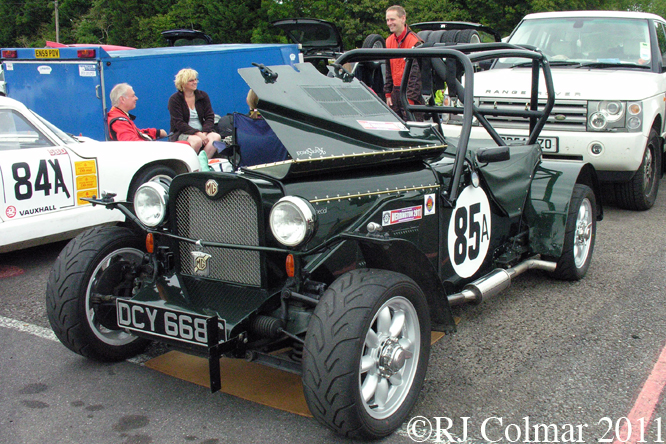
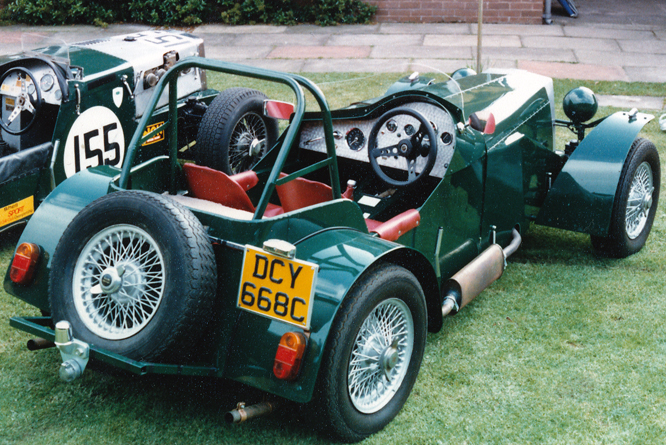
Kayne Special III was designed from scratch to Colin’s own design between 1981 and 1983.The green radiator cowl seen on the Kayne Special III above at Castle Combe like the more substantial safety cage was fitted after Colin sold the car.

Kayne Special III, Castle Combe

Colin cut all of the square section tube chassis members with a hacksaw, no short cuts were taken with angle grinders, tacked all the members together and then had the chassis frame mig welded by a friend.

Kayne Special III, Castle Combe

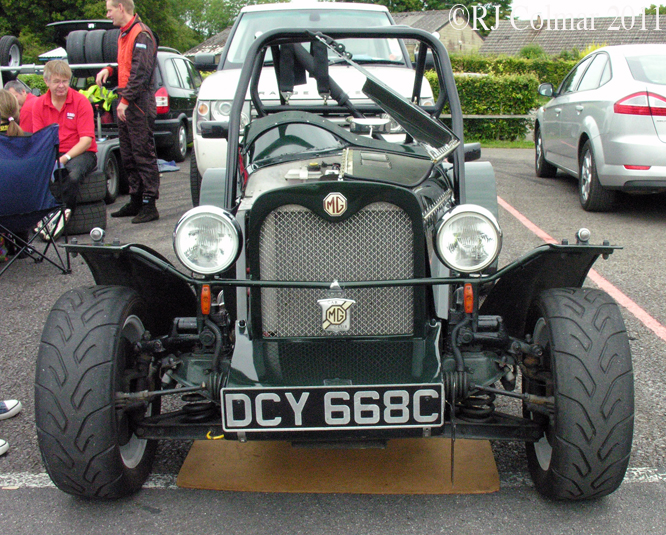
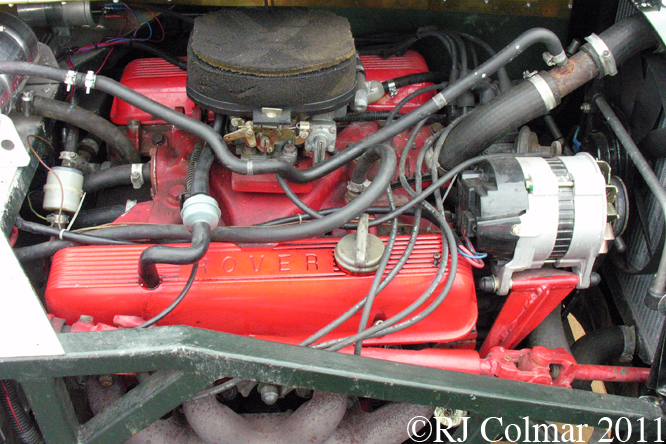
The 3.5 litre / 215 cui V8 motor came from a Rover SD1 complete with an automatic transmission which was attached to a rear axle sourced from an MG B. Note the steering column needs two universal joints to avoid fouling on the right hand bank of cylinders, this feature resulted in the Kayne Special III being unsuitable for anybody to drive with shoes size 7 1/2 or larger.

Kayne Special III, Castle Combe

Running on 14″ MG B wire wheels at the front and 15″ MG C rear wheels at the rear and with a 0-100 mph capability in the region of 15 secs Colin could tease motorcyclists with his beautifully finished Kayne Special III.

Kayne Special III, Castle Combe

With the automatic transmission Colin could drive the car to within 1 second of the times he achieved with the Kayne Special II. By 1984 Colin had fitted a manual transmission.

Kayne Special III,

Colin sold the Kayne Special III when he retired from competition in 1985 for £2,700. The present owners and drivers of the car are John and Jonathon Biggs.

My thanks to Colin Cooper for sharing his memories and providing his photographs and to Chris Winstanley for allowing me to use Frank Halls photograph.

Thanks for joining me on this ‘Towing and Competing’ edition of ‘Gettin’ a li’l psycho on tyres’, I hope you will join me again tomorrow. Don’t forget to come back now !

Share

MGCC Speed Champion – Kayne Special II

After selling the original MG J2 with a PB motor Kayne Special, which I looked at last week Colin Cooper started work on Kayne Special II.

Kayne Special II, Oulton Park, Copyright Frank Hall 1981 C213/9

Photo Copyright Frank Hall 1981

Colin began with a scrap 1965 MG B found in Cheshire from which he cut out the engine sub frame and added a pair of chassis rails around which he built up the rest of the car with an under slung rear axle featuring a limited slip differential. Kayne Special II ran on specially made bespoke wire wheels.

Kayne Special II, Baitings Dam, Copyright Frank Hall 1983

Photo Copyright Frank Hall 1983

The motor was a 4 cylinder MG B unit which was eventually fitted with an HRG Cross Flow cylinder heads and twin 45 Weber Carbs. Colin notes this car, his favorite, was always totally reliable.

Kayne Special II, Colin Cooper

Among many successes were winning the 1981 MG Car Club (MGCC) Speed Championship, 1981 Ellison Trophy at Oulton Park, see Frank Halls top photo, the 1979 Kimber Trophy, 2nd 1983 Kimber Trophy at Baitings Dam, see Frank Halls second photo, named after MG founder Cecil Kimber, and several awards for fastest MG in Sprint and Hill Climb events.

Kayne Special II & III

Colin said of Kayne Special II it was “a bit of a shed but it didn’t half go, (it was) timed at 115 mph at Blackpool Sprint.”

The car was eventually sold to a sprinting novice and is thought to have been eventually broken up with many of it’s parts going into a road going MG B.

Colin’s third special, Kayne Special III, seen towing Kayne Special II in the photo above will be the subject of next Tuesdays blog.

My thanks to Colin for sharing his memories and photographs and to Tony Gallagher for putting me in touch with Chris Winstanley who kindly gave me permission to use Frank Hall’s photographs of Colin in action at Oulton Park and Baitings Dam.

Thanks for joining me on this ‘MGCC Speed Champion’ edition of ‘Gettin’ a li’l psycho on tyres’, I hope you will join me again tomorrow. Don’t forget to come back now !

24 04 12 Added Frank Halls photo’s from Oulton Park and Baitings Dam.

Share

To Shepton Mallet – 33rd Bristol Classic Car Show

Despite living in Bristol for 20 years come autumn I did not hear about the Bristol Classic Car show until last April. One of the reasons for this is that two years before I moved to Bristol the show moved to it’s current venue the Bath & West Show Ground just outside Shepton Mallet a good twenty miles south of Bristol and a similar distance from Bath !
Ford Cortina UREN Savage, Bristol Classic Car Show

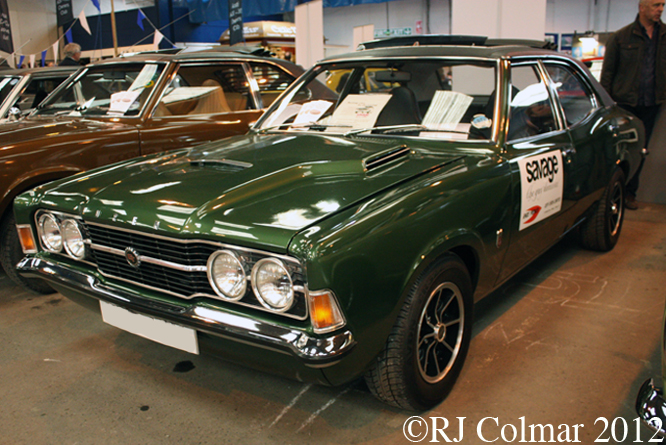
Among the highlights of the show, which I attended for the first time on Saturday and selected from over 700 photo’s that I took was this 1972 Ford Cortina MK III with unusual bulges in the bonnet and bearing the legend ‘UREN’ in place of the usual ‘FORD’. Jeff Uren’s Race Proved company beefed up the mid size Rep Mobile MK III running gear to take a 218hp 3.0 litre / 183 cui Essex V6 motor more commonly found in the large Ford Zodiac to turn this car into 130 mph road burner with a 0 – 60 mph time of 7 seconds.
Ford Gran Torino, Bristol Classic Car Show

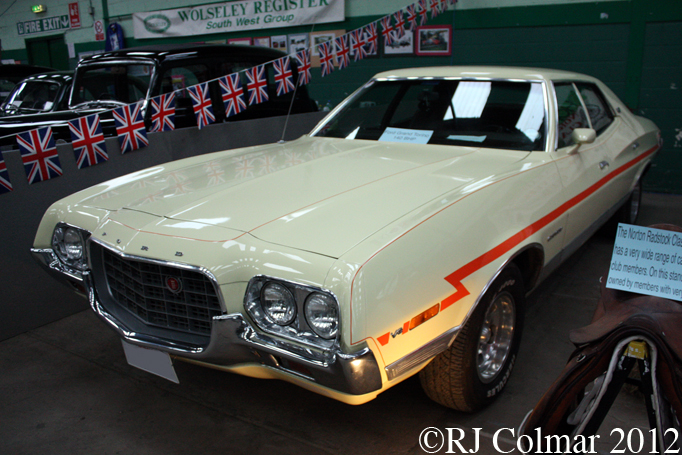
Another 1972 Ford that caught my attention was this 5.8 litre / 351 cui Gran Torino, not sure if that’s a Windsor or Cleveland motor nor even if there is any external way of knowing, if this happens to be your specialist subject please do not hesitate to register and chime in below.
Healey Silverstone Replica, Bristol Classic Car Show

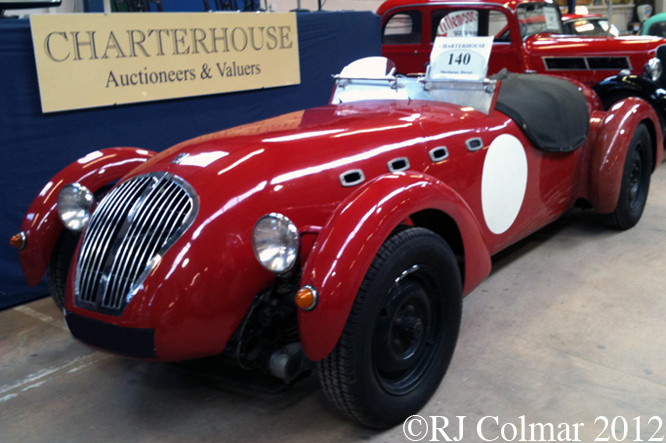
Only 104 Healey Silverstone’s were manufactured between 1949 and 1950 so it was no great surprise to find that the example seen here is a replica, these days more commonly referred to by auction houses as ‘Evocations’, built around a shortened 1951 Healey Tickford Saloon chassis, a model of which only 222 were built from 1950 to 1954. Coincidentally this was lot 104A in the Charterhouse Auction that took place yesterday, Sunday. Lot 104 A was expected to fetch UK £30 – 40,000 about a twentieth of the price of one of the genuine Healey Silverstones still in existence.
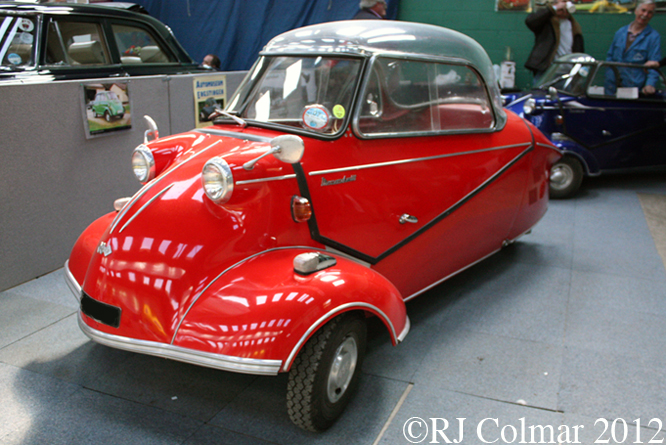
Messerschmitt KR2000, Bristol Classic Car Show

After World War 2 many aircraft companies diversified into automobile manufacture including Bristol & Armstrong Siddeley. German aircraft manufacturers were forbidden to make aeroplanes and so Fritz Fend approached Messerschmitt with the idea of manufacturing a humble Kabinenroller (scooter with cabin) bubble car in 1952. A KR200, 10 hp 200 cc / 12.2 cui like the model seen here but with a modified body managed to average a record 64mph over 24 hours at Hockenheimring in 1955 ! Note the cabriolet version in the back ground.
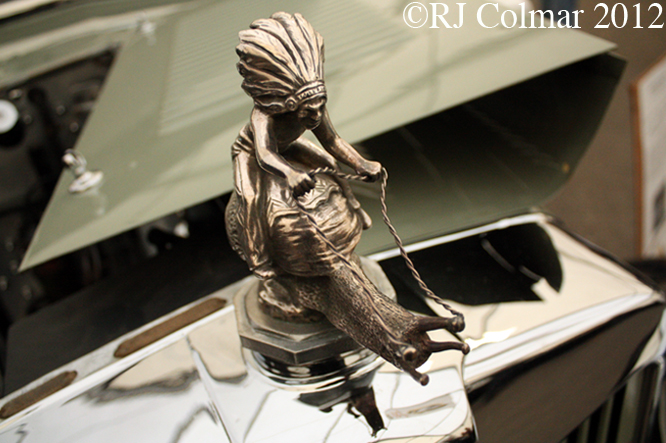
MG 18/80 Six MkII Saloon, Bristol Classic Car Show

When I saw this mascot I thought it ought to belong to a Citroen 2CV powered with a Indian Motor, however it actually sits atop the radiator of a 1930 MG 18/80 Six MK II Saloon that will feature in a Tuesday MG blog in the fullness of time.

Reliant Sabra Prototype, Bristol Classic Car Show

Yitzhak Shubinsky of the Israeli Autocars Ltd saw an Ashley 1172 Special and a new chassis by Leslie Bellamy at a racing car show and came up with the idea of fitting the chassis with body work from the Ashley Special in 1960. He approached Reliant who had previously worked on the Autocar Carmel and Sussita models to build the prototype seen here known as the Sabra. Reliant ended up building the first 100 Sabra models, powered by a 4 cylinder 1703cc / 104 cui usually found in the Ford Consul Mk2, and exported to the USA until Autocars Ltd Israel were ready to start assembling the cars themselves.
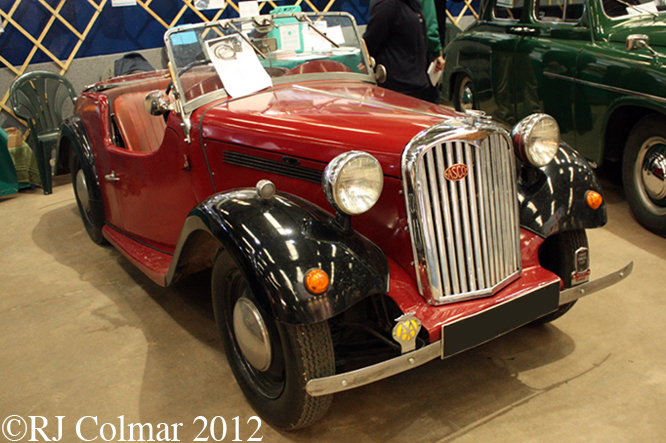
Singer Roadster, Bristol Classic Car Show

When I first set eye’s on this 1951 Singer Roadster my first thought was that it looked just like Noddy’s car familiar to many kids my age born around 1959 from the Noddy’s Car picture book by Enid Blyton. Closer inspection of the book cover linked here reveals a few similarities particularly a two tone paint scheme but beyond that all resemblance is mostly a figment of my imagination.
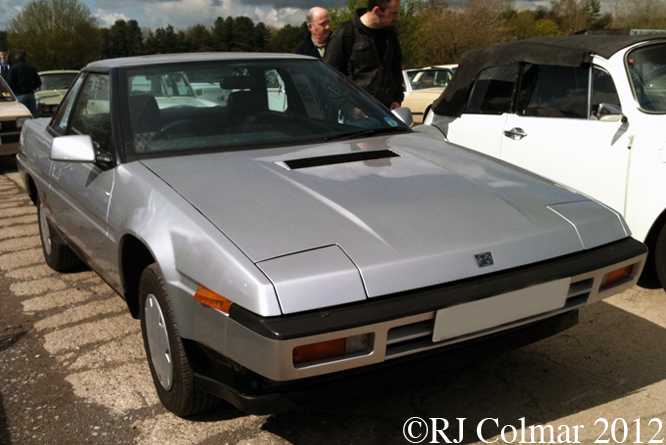
Subaru XT 4WD Turbo Coupé, Bristol Classic Car Show

If ever a car said 1980’s it must be this 1985 Subaru XT 4WD Turbo Coupé which helped transform Subaru from farmers choice into a performance geek choice, the car was brim full of technology that was ahead of most of the opposition including computer controlled air suspension and ‘cybermatic’ steering which varied the amount of power assistance to the steering. Apparently one of these cars went straight from the docks into the Patrick Collection, when the collection was broken up the car was disposed of with out ever being driven on public roads and disappeared with out trace. If you know the where abouts of this XT 4wd Turbo Coupé please get chime in below.
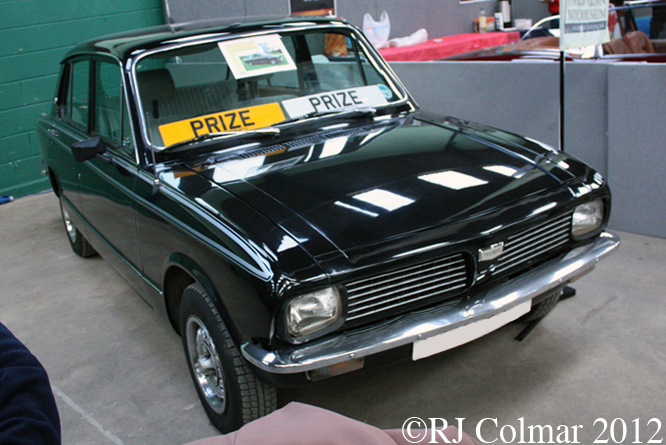
Triumph Dolomite 1500 SE, Bristol Classic Car Show

Regular GALPOT readers will know I am a big fan of the Atwell Wilson Museum in Calne, the Museum are raffling the 1979 Triumph Dolomite 1500 SE seen here, tickets will be available from the Museum until the prize draw in December, I bought my first ticket at the show and hope to purchase a few more in the coming months, only 2163 of a planned 2500 of these ‘black beauties’ fitted with Triumph Spitfire sports car wheels were built.
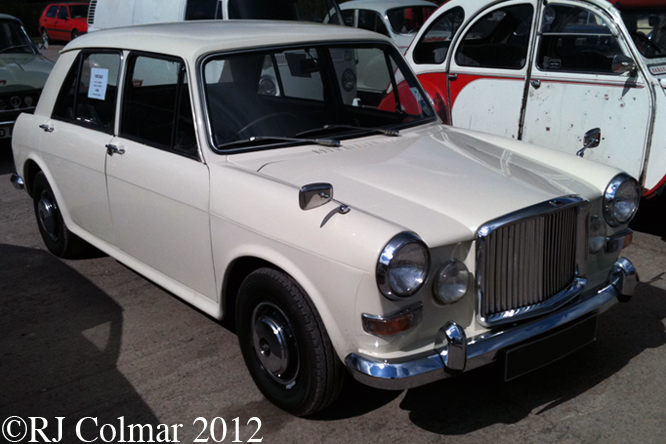
Van den Plas 1300, Bristol Classic Car Show

A large selection of British Motor Corporation / British Leyland front wheel drive vehicles were on view in both the car parks and in the exhibition halls among the rarer was this range topping 1972 Vanden Plas Princess 1300 variation of the BMC ADO 16 vehicle which was also manufactured with Austin, Morris, MG, Riley Kestrel, and Wolseley badges between 1962 and 1974 during period these vehicles were amongst the biggest sellers in the UK until they were toppled by Fords.
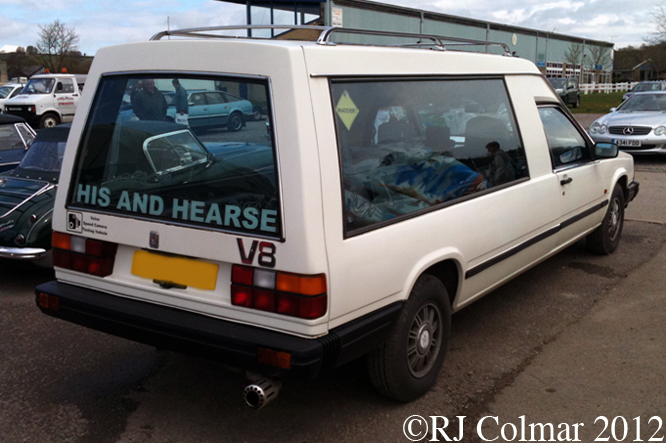
Volvo 740 GL, His & Hearse, Bristol Classic Car Show

Among many stories from my days working at a Volvo dealership some of the funniest stories involve a fleet of hearses we used to look after so this 1988 Volvo 740 His & Hearse naturally raised a possibly macabre smile.
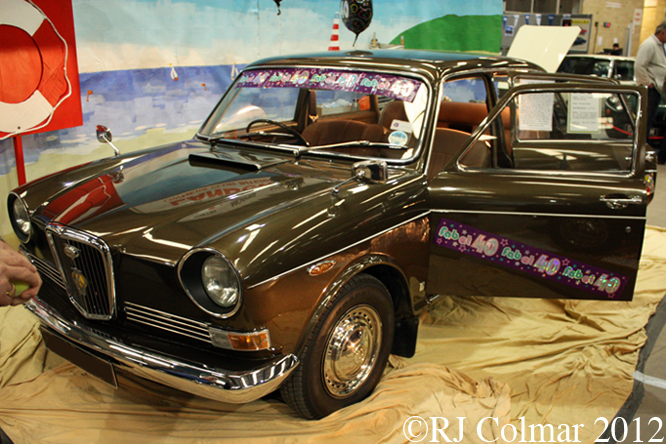
Wolsey Six, Bristol Classic Car Show

I’ll wind up today’s review of the 33rd Bristol Classic Car show, sponsored by Footman James Insurance with this amazing 1973 Wolseley Six “Landcrab” which has been kept in this immaculate condition for 39 years ! It has never been restored and has over 30,000 miles on the clock, a testimony to the rewards of regular servicing and timely repairs.

Thanks for joining me on this ‘To Shepton Mallet’ edition of ‘Gettin’ a li’l psycho on tyres’, I hope you will join me again tomorrow. Don’t forget to come back now !
Share