Tag Archives: Moss

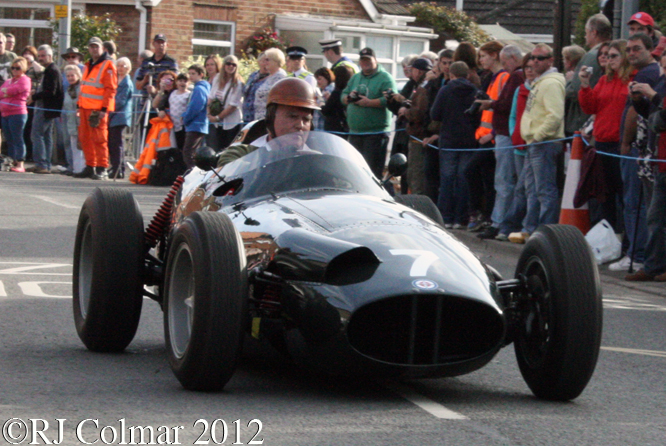
Pressure and Success – BRM Type 25 #258

By 1954 Alfred Owen of the Rubery Owen Group had taken over the running of BRM from the British Motor Racing Research Trust which had been set up nine years earlier to build a British World Beater. The 1.5 litre / 91.5 cui supercharged V16 cars were updated to a short wheel base spec since there were few races for them to compete in that required large capacity fuel tanks necessitated by Championship Grand Prix race distances.

The World Championship started running to 2.5 litre regulations in 1954 and the first two races of the season were won by Juan Manuel Fangio who was entering what turned to be his prime driving a six cylinder Maserati 250F. Fangio then moved as agreed pre season to the Mercedes Benz team who were embarking on their third blitzkrieg on the top echelon of the sport in 60 years. Fangio won the ’54 and ’55 World drivers championships with the German team who successfully applied desmodromic valve and fuel injection technology to their straight eight W196 cars.

Fangio joined Ferrari, who were running V8 powered D50’s gifted from Lancia, in 1956 to win a third straight title and then rejoined Maserati in 1957 to win a forth straight and record fifth title with the Maserati 250F. Fangio retired midway through ’58 and his championship records stood for nearly 50 years until a German called Micheal Schumacher came along and broke them early in the 21st century.
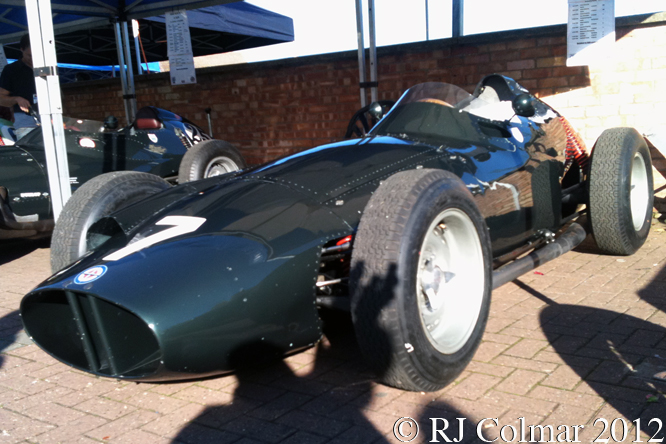
BRM Type 25, BRM Day, Bourne, Lincs

Meanwhile Chez BRM things were progressing at a more leisurely pace a new Type 25 car was being designed with a simple 4 cylinder engine with large valves and an interesting three disc braking system with the rear disc being mounted on the back of the transaxle. Despite being much simpler than the V16 the car did not make it’s first public appearance until September 1955 by which time the Owen Racing Organisation had bought a Maserati 250F and entered it into a couple of World Championship events for Ken Wharton who finished a best 6th in the 1954 Swiss Grand Prix. Peter Collins drove the car in two World Championship events in 1955 but retired from both.

The Type 25’s, chassis type P25 and engine type P27, were supposed make their World Championship debut at the 1956 Monaco Grand Prix but were with drawn after the valves were damaged. Three cars were entered for the 1956 British Grand Prix but none finished however Mike Hawthorn led a BRM 1-2 followed by Tony Brooks for a while before retiring with a suspension problem. Brooks crashed out with a sticking throttle, his car ended up a completely burnt out right off, while Ron Flockhart retired with valve trouble after completing just 2 laps.
BRM Type 25, BRM Day, Bourne, Lincs

The Type 25’s did not appear in the championship again until Monaco in 1957. Nothing substantial was achieved by way of championship results but the Type 25’s did start winning non championship races, Jean Behra scoring the first at Caen.

1958 saw Jean Behra and Harry Schell compete in most of the races with the Type 25. Behra finished a seasons best third in Holland one place behind team mate Schell.
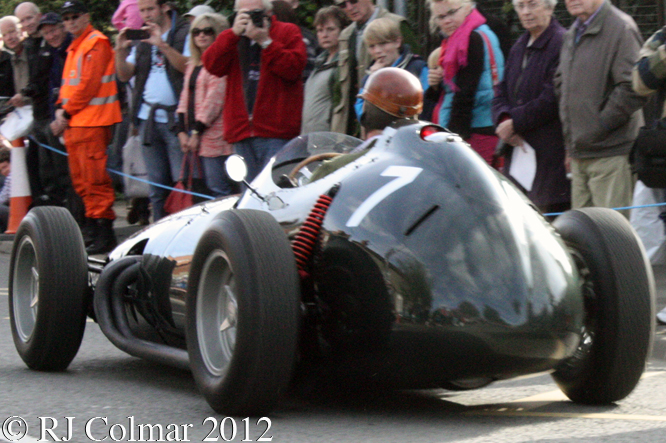
BRM Type 25, BRM Day, Bourne, Lincs

Jo Bonnier replaced Jean Behra who had moved to Ferrari in 1959 and with team owner Alfred Owen having agreed to hand over two cars to the BRP team to run for the remainder of the season prior to the ’59 Dutch Grand Prix the pressure was really on BRM to deliver going into the race. Bonnier arrived at Zandvoort with the disappointment of having almost won the Targa Florio in a Porsche having led most of the way.

The Type 25’s were quick in practice much easier to handle on their 15″ wheels than on the original 16″ with the benefit of much less tyre wear. After a great race with the works rear engined Cooper Climax’s driven by Marsten Gregory, champion elect Jack Brabham and the Rob Walker entered car of Stirling Moss all of whom experienced gearbox issues the smoothly driven BRM Type 25 #258 of Jo Bonnier crossed the line first to win the BRM team’s first Grand Prix 14 years after the team’s announcement in 1945. BRP headed by Stirling Moss’s father offered to reverse the agreement with Alfred Owen and settled for just one car #2510 which they ran in distinctive light green with white wheels livery.

Despite the BRM finishing 3rd in the World Constructors Championship the writing was on the wall that front engined cars were obsolete as the Coopers of Moss and McLaren convincingly won the last three races of the season and Jack Brabham won the first of two consecutive world championships.

Chassis #258 was purchased by Spencer Flack from The Hon. Amschel Rothschild in 2001 for an alleged £1.5 million. The following year while racing the car at Philip Island Spencer sustained fatal head injuries when he was thrown out of it. The car which had split in two and caught fire was rebuilt at the insistence of his widow and now belongs to John Pearson who is seen at the wheel in these photo’s taken at last years BRM Day.

Thanks for joining me on this “Pressure and Success” edition of “Gettin’ a li’l psycho on tyres” I hope you will join me again tomorrow. Don’t forget to come back now !

09 07 13 Errata I originally posted Roy Salvadori won the 1957 Caen GP in fact, as Tim has kindly pointed, out Jean Behra drove BRM Type 25 #253 to victory beating Roy Salvadori.

Share

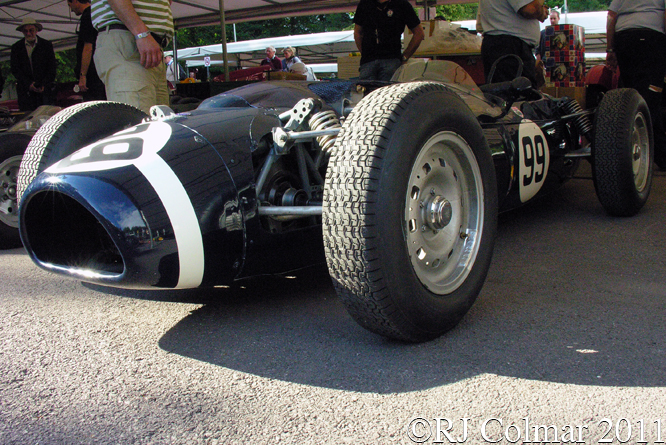
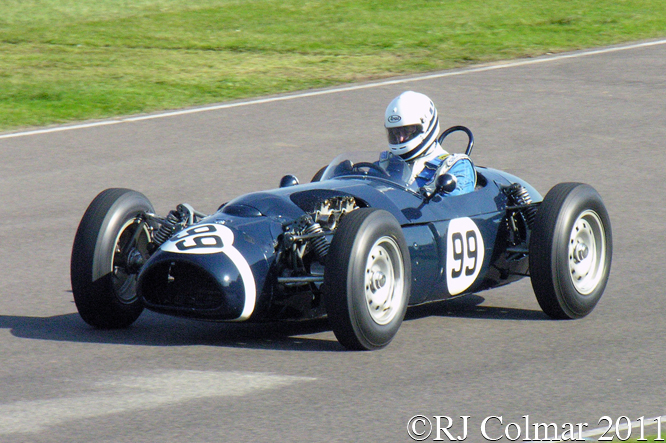
Stirling’s Favourite – Ferguson Climax P99

“Harry” Ferguson was born on Novmeber 4th 1884 in Growell, County Down, Nothern Ireland. He started work with his brother in a bicycle and car repair business in 1902, while there Harry started racing motorcycles in 1904 and on the 31st December 1909, having designed and built a monoplane, he became the first person to fly in Ireland.
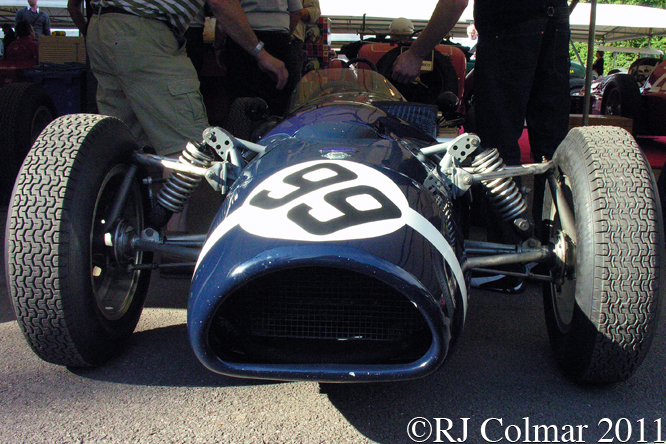
Ferguson Climax P99, Goodwood Festival of Speed

In 1911 Harry went into business selling motor and agricultural vehicles. On seeing the short comings of some of the agricultural products he was selling he began devising his own, including a new hydraulic system and three point linkage for attaching ploughs.

Harry entered into a hand shake agreement with Henry Ford Snr for Ford to manufacture the Ferguson patents under license in 1939. In 1947 Henry Ford II, Seniors grandson, reneged on the deal and five years later settled with Harry out of court to the tune of $9 million, around half of which went to Harry’s legal representatives.

Ferguson Climax P99, Goodwood Festival of Speed

In 1950 Harry employed Aston Martin designer Claude Hill and along with two pre 1939/45 war friends Fred Dixon, who prewar had proposed building an all wheel drive Land Speed Record (LSR) car and former ERA racer Tony Rolt began working on an innovative all wheel drive road car featuring electric windows, disc brakes and access to the rear through a hatchback, all idea’s which were unknown in European passenger car production at the time.

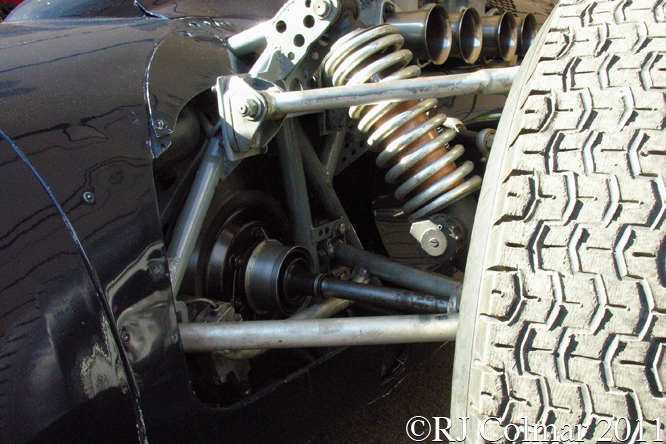
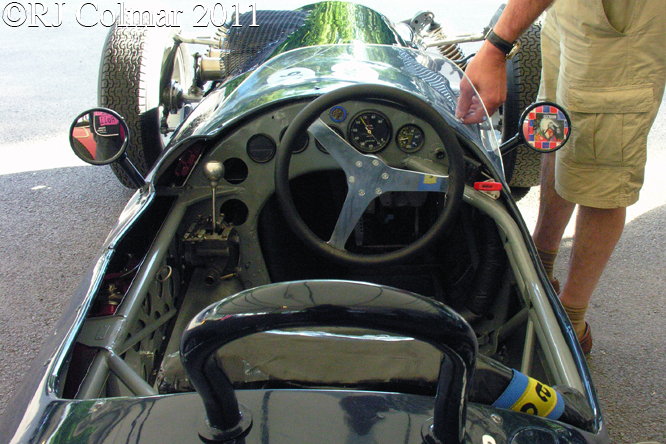
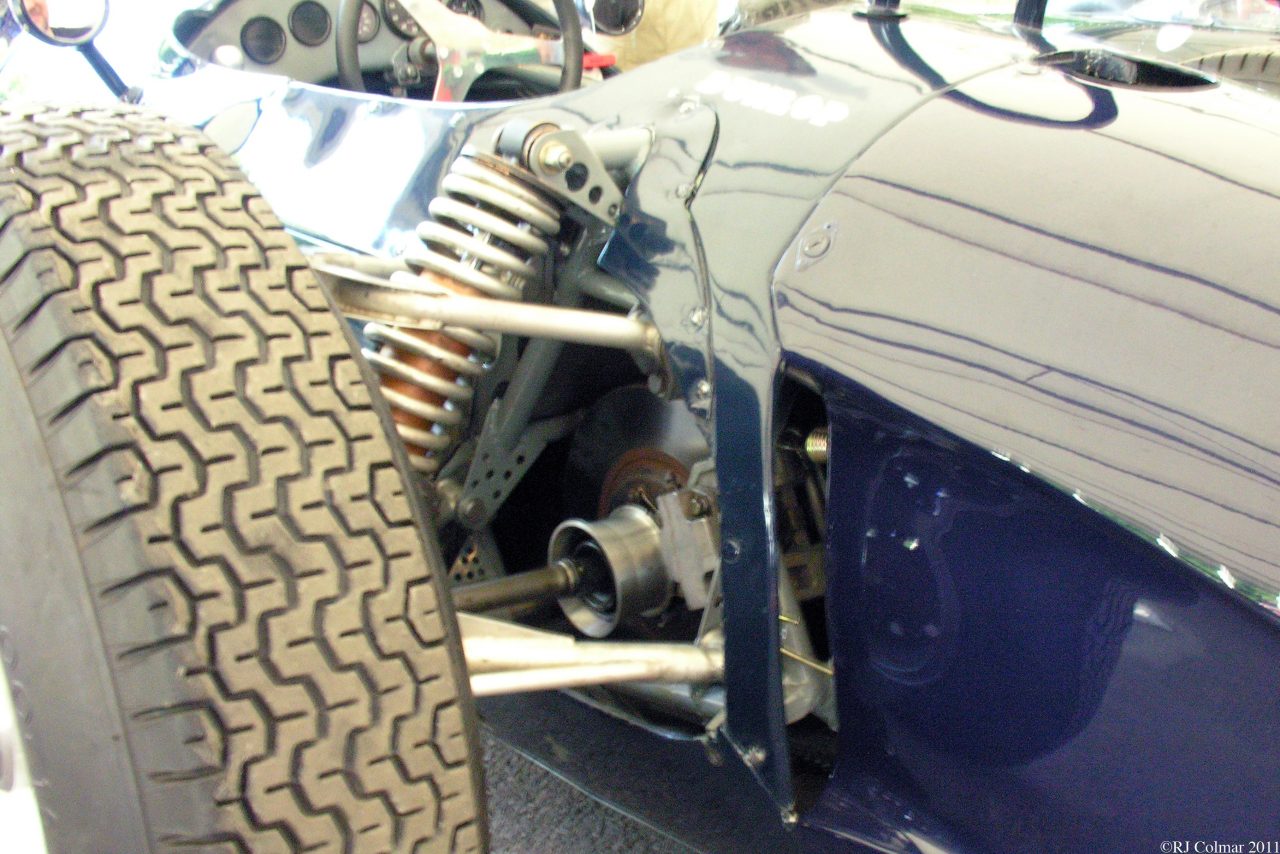
Project 99 a research vehicle, that became the worlds first all wheel drive Formula One car, to promote the all wheel drive concept was given the green light in May 1960, just 6 months before Harry’s death at the age of 75.

Ferguson Climax P99, Goodwood Festival of Speed

The P99 made it’s public debut in an Intercontinental Formula race with a 2.5 litre / 152 cui Coventry Climax motor at Silverstone in 1961 where Tony Rolt’s former entrant Rob Walker entered the car for Jack Fairman alongside Stirling Moss in a similarly powered Cooper.

Fairman retired from the race with a broken gearbox that may have resulted from excessive engine braking in the absence of reliable brakes, while Moss went on to a comfortable victory in the Cooper. At the British Grand Prix, where the Fergusson appeared with a 1.5 litre / 91.5 cui Climax, Fairman qualified 20th but ran into electrical problems, after Stirling Moss had retired his Rob Walker entered Lotus 18 he took over from Fairman in the P99. The car was later disqualified for receiving a push start.

Ferguson Climax P99, Goodwood Festival of Speed

Stirling Moss was entered to drive the Ferguson in the Oulton Park Gold Cup, a non championship race for Formula One cars entered by most of the top teams except Ferrari and Porsche. Stirling won easily to record the first, and only, win of a (non championship) Formula One race with an all wheel drive car and coincidentally the last (non championship) win for a front engined Formula One car.

The Fergusons 1.5 litre / 91.5 cui Formula One motor was uprated to 2.5 litres / 152 cui and subsequently entered in a series of non championship Antipodean Formula Libre, unrestricted, races in early 1963 where Graham Hill drove the car to a second place finish in the Australian rain at Lakeside and a forth place in the sub tropical summer heat of New Zealand at Pukekoe where with a mile to go his gearbox packed up while again running in second place.

Innes Ireland drove the P99 in the next three events finishing third at Leven, but retired from both of the other races. Graham Hill raced the car one more time at Warwick Farm where he came home sixth.

Ferguson Climax P99, Goodwood Festival of Speed

After a conversation with Stirling Moss, who had praised the benefits of the P99’s all wheel drive,Indy 500 entrant Andy Granatelli instigated a test in which Jack Fairman and Bobby Marshman drove the P99 at Indianapolis with the 2.5 litre / 152 cui motor and recorded average speeds of over 140 mph, Marshman claimed he did not need to lift at all for any of the corners, the car was so underpowered. Andy was sufficiently impressed that he employed Ferguson Research to develop all wheel drive for his 1964 Indy 500 challenger the Studebaker STP Special.

Granatelli never won the Indy 500 with an all wheel drive car but kept backing the concept through various incarnations the last of which was the all wheel drive Lotus 64 built in 1969, after which all wheel drive was banned from the brick yard.

Rolt, Fergusson P99, Richmond Trophy, Goodwood Revival

Ferguson Research was also involved with five all wheel drive Formula One projects including the 1969 Lotus 63, Cosworth and McLaren M9A, the last two of which I’ll be looking at in the weeks to come.

Although not the easiest car to drive Stirling Moss once described the Ferguson P99, which fascinated him, as his favourite racing car. Stuart Rolt, of the same Tony Rolt family is seen driving the P99 in practice for the 2011 Richmond Trophy at Goodwood above.

My thanks to Alan Cox, E.B., Ray Bell, Roger Clark and Michael Ferner at The Nostalgia Forum for their patience answering my questions about the the Ferguson P99.

Thanks for joining me on this “Stirling’s Favourite” edition of “Gettin’ a li’l psycho on tyres” I hope you will join me again tomorrow for a look at the first BRM to win a Grand Prix. Don’t forget to come back now !

08 07 13 Errata, I originally stated that Moss was entered in a Lotus 18 for a non championship race at Silverstone when the Ferguson made it’s debut, when in fact Stirling drove a Cooper Climax to victory in the race run to the Intercontinental Formula as now stated in the amended text. Thanks to Roger Clark for pointing out the error.

Share

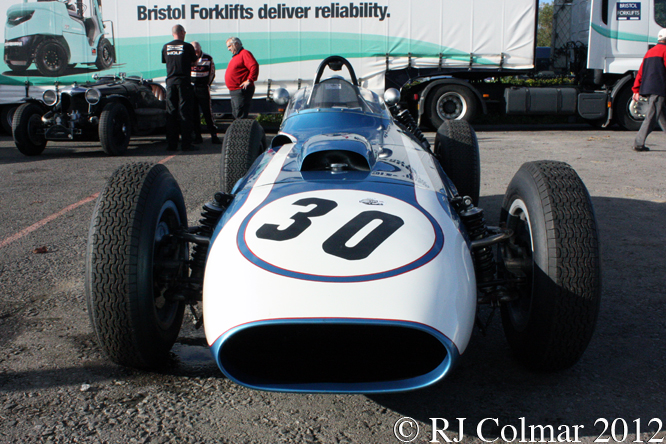
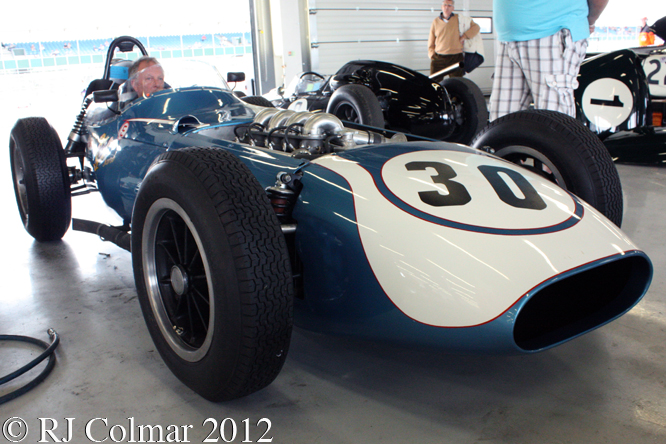
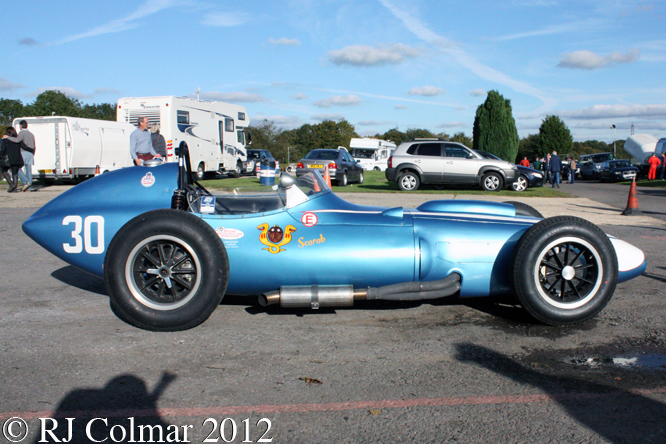
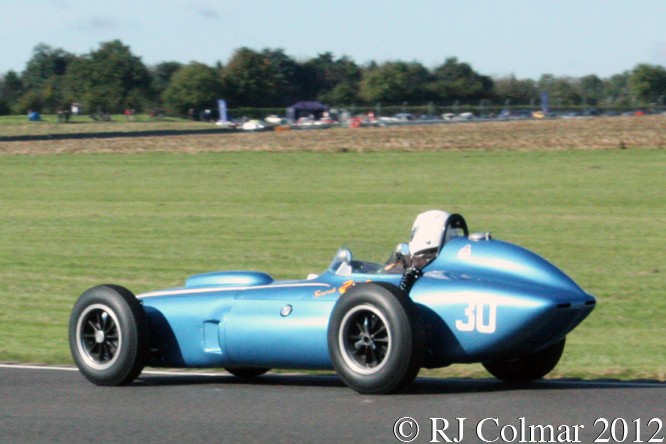
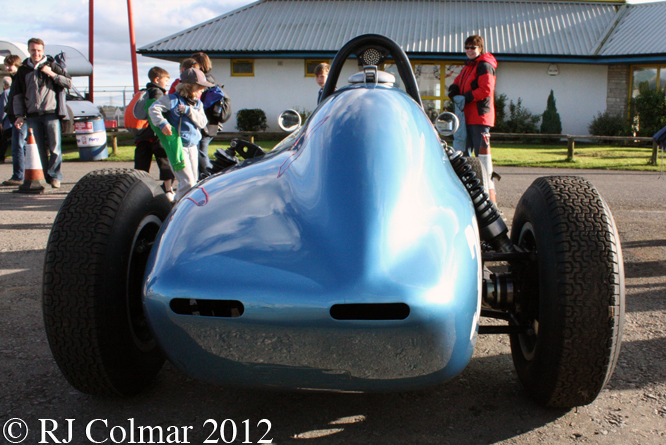
American Beauty – Scarab #3

After writing off a Maserati 200S in a sports car race at Snetterton, having been banned from racing in the USA for racing underage, Woolworth heir Lance Reventlow visited Lister and Maserati in 1957 and was appalled by the apparent backward chaos he found at the factories.

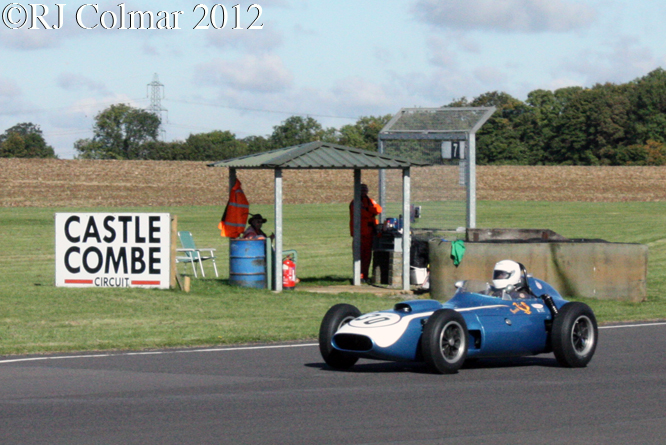
Scarab, Autumn Classic, Castle Combe

Determined that he could do better Lance Returned to the United States and founded Reventlow Automobiles Incorporated and initiated a successful sports car program for 1958.

Scarab, Silverstone Classic,

Encouraged by his success Reventlow Automobiles Incorporated engaged Troutman & Barnes to design a space framed contender for the highest level of the sport, Formula One.

Scarab, Silverstone Classic,

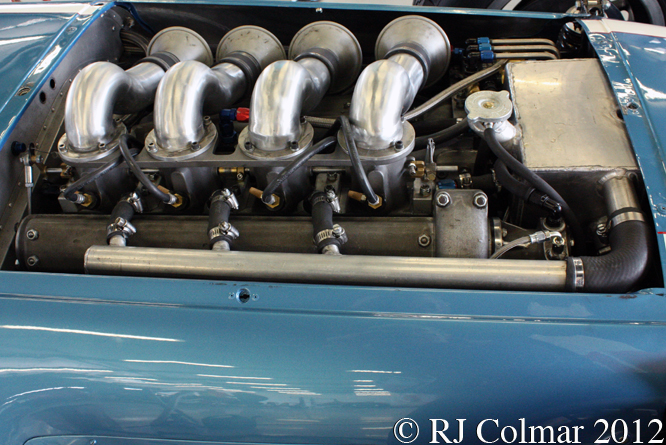
The motor for the new car was designed by Leo Goosens, of Offenhauser fame, who designed a Hilborn fuel injected 2.5 litre / 152 cui 4 cylinder motor with desmodronic, mechanically opened and closed which did away with valve springs, valves as had been favoured by Mercedes Benz during their successful Formula One campaigns from 1954 to 1955.

Scarab, Autumn Classic, Castle Combe

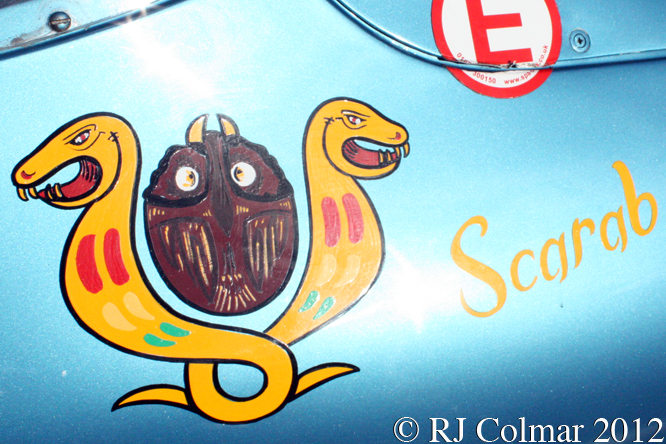
With a wry sense of humour Reventlow deliberately went against the grain of macho exotic names given to racing cars by chosing to call of the cars built by Reventlow Automobiles Incorporated Scarab after a compost beetle.

Scarab, Autumn Classic, Castle Combe

Widely respected for their beauty and build quality the team turned up in Monaco for the start of the World Championship season. Looks were deceiving as the cars proved to be too slow to qualify for the Monaco Grand Prix even after the Goodyear tyres had been replaced with Dunlops, not even Stirling Moss could set a competitive time in a Scarab.

Scarab, Autumn Classic, Castle Combe

Chuck Daigh and Lance Reventlow both qualified for the Dutch Grand Prix however they were both outside the top 15 which meant they did not qualify for start money and so both cars were withdrawn.

Bronson, Scarab, Autumn Classic, Castle Combe

Reventlow qualified 16th for the Belgian Grand Prix and Daigh 18th however Reventlow retired on the second lap and Daigh on the 17th, both with engine problems. In France Richie Ginther replaced Reventlow in the driving seat and qualified 20th with Daigh 23rd and last however neither started because of engine problems.

Scarab, Autumn Classic, Castle Combe

The team did not appear again until the 1960 US Grand Prix where a single car was entered for Chuck Daigh who qualified 18th. Chuck brought the car home 10th, 5 laps down, on what would be the teams final World Championship appearance.

Bronson, Scarab, Autumn Classic, Castle Combe

Chassis # 3 seen here was shipped to Europe in 1960 as the teams spare with out a motor. In 1961 Chuck Daigh drove the car fitted with an Offenhauser Indy type motor in the non championship International Trophy at Silvertone and Lavant Cup at Goodwood where he finished 7th and 8th. At the British Empire Trophy Meeting at Silverstone Daigh was badly injured when he crashed the car on what turned out to be the cars final ‘in period’ appearance.

The Scarab had proved to be underpowered and it’s front engined design rendered obsolete by the rear engined designs from Cooper and Lotus and Lance Reventlow had been deceived by the backward chaos he had seen in Europe which disguised much wisdom and craftsmanship gained from decades of experience.

For many years this Scarab was exhibited sans motor at the Donington Park Museum before it was purchased by Julian Bronson who acquired another Offenhauser motor and can be seen demonstrating the car above at Castle Combe.

Wishing all my readers from the United States a festive Independence Day.

Thanks for joining me on this “American Beauty” edition of “Gettin’ a li’l psycho on tyres”, I hope you will join me again tomorrow.

Share

$20m Winner – Aston Martin DBR 1/2

This month sees the 90th Anniversary of the first running of the 24 Heures du Mans or Le Mans 24 Hour race which is organised by the Automobile Club de l’Ouest and run on the Circuit de la Sarthe much of which today follows the same course as in 1923.

In order to celebrate one of my favourate events in the international motorsports calender I will be posting 26 blogs that cover just a fraction of the Le Mans story, starting with the Aston Martin DBR 1 that coincidentally won the Le Mans 24 Hours in 1959, the year I was born.

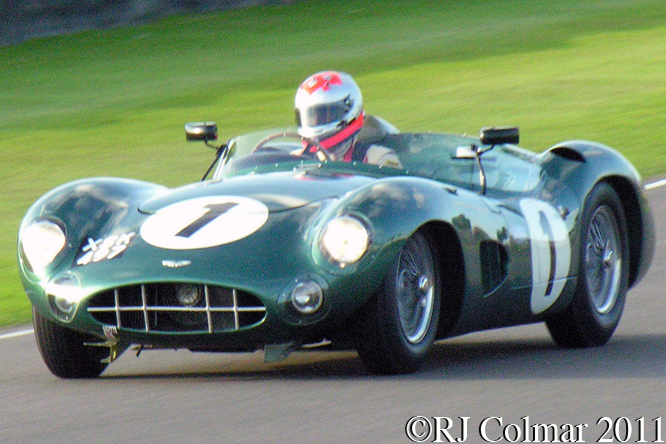
Verdon-Roe, Aston Martin DBR1/2, Goodwood Revival

Today’s featured Aston Martin was the second of a run of five racing cars that were built to more or less the same design between between 1956 and 1959. DBR1/2 was the first to be fitted with a 3 litre / 183 cui 6 cylinder motor from new in 1957. DBR 1/1 built in 1956 was orginally fitted with a 2.5 litre / 152 cui motor which was replaced in 1957.

Tony Brooks and Noël Cunningham-Reid drove DBR1/2 to victory at the World Sports Car Championship round held at the Nurburgring in 1957 two weeks after Tony Brooks had led an Aston Martin 1-2 result driving the same car in the non championship race at Spa. Brooks and Cunningham-Reid shared DBR1/2 again at the 1957 Le Mans 24 hours which they did not finish after being involved in an accident. The same pairing shared DBR 1/2 at a second non championship race at Spa which they won.

Verdon-Roe, Aston Martin DBR1/2, Goodwood Revival

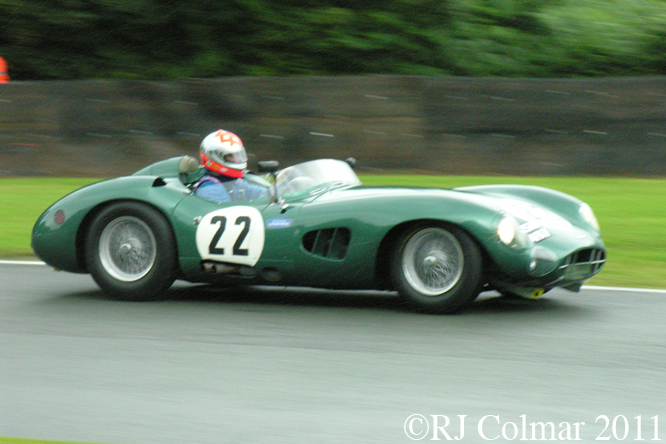
In 1958 Stirling Moss shared this car with Brooks at Sebring where they retired from the 12 hour race with an axle problem. Two more retirements followed at the Nurburgring and Le Mans but at the end of the ’58 season Brooks and Moss won the Tourist Trophy at Goodwood, where the car is seen above with Bobby Verdon-Roe at the wheel.

Verdon-Roe, Aston Martin DBR1/2, Gold Cup, Oulton Park

In 1959 Stirling Moss won a minor race at Silverstone with the Aston before Roy Salvadori and Carrol Shelby took over the driving duties for the 1959 Le Mans 24 Hours to score the Marques only out right Le Mans victory having covered 323 laps one more than the second placed sister car, DBR 1/4 driven by Maurice Trintignant and Paul Frère. At the end of the year DBR1/2 was driven to victory by Salvadori and Shelby in the TT at Goodwood again which secured the World Sports Car Championship for Aston Martin.

In 1960 Major I. B. Bailie acquired the car entering it for the 1000 km race at the Nurburgring where he came 22nd with Edward Greenhall and for the Le Mans 24 Hours with Jack Fairman sharing the driving the car finished it’s forth consecutive Le Mans 24 hour race in 9th place. Bailie scored further podium finishes with the car up to 1961. In 1963 David Ham acquired DBR1/2 and raced it on at least 2 occasions which netted podium results in class but no overall wins.

Last year DBR1/2 which played a leading role in Aston Martin’s 1959 World Sportscar Championship success was offered for sale with an asking price of US$20 million. If DBR1/2 ever does change hands at that price it will become the most expensive Aston Martin ever.

Thanks for joining me on this “$20m Winner” edition of “Gettin’ a li’l psycho on tyres”, I hope you will join me again tomorrow. Don’t forget to come back now !

Share

Double Austrian GT Champ – Ferrari 250 GTO #3505

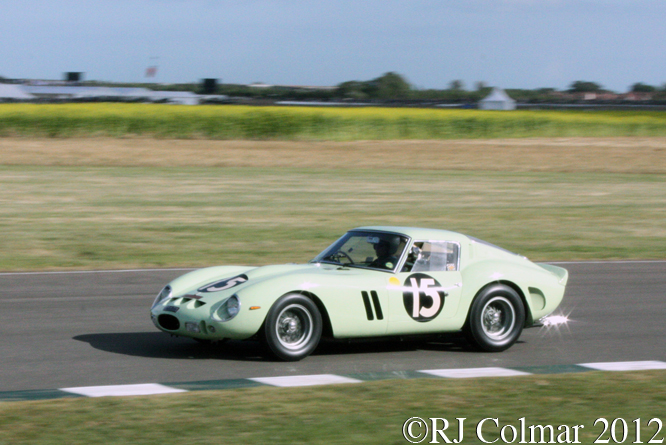
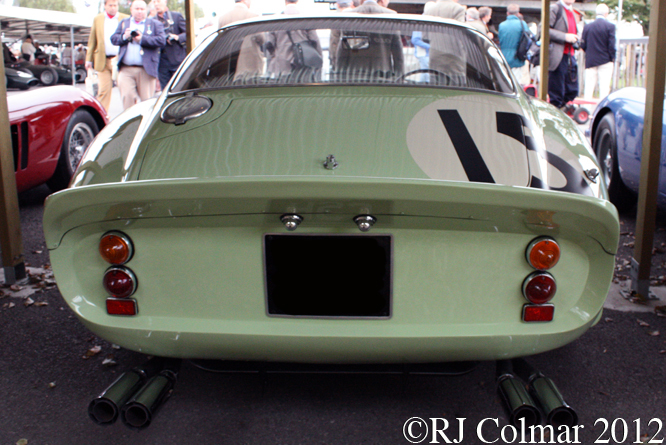
In April 1962 UDT Laystall racing took delivery of a Ferrari 250 GTO chassis number 3505 painted pale green as were all the other cars in the UDT Laystall team run by dentist and one time Indy 500 competitor Alfred Moss father of Sir Stirling Moss and Sir Stirlings former manager Ken Gregory.

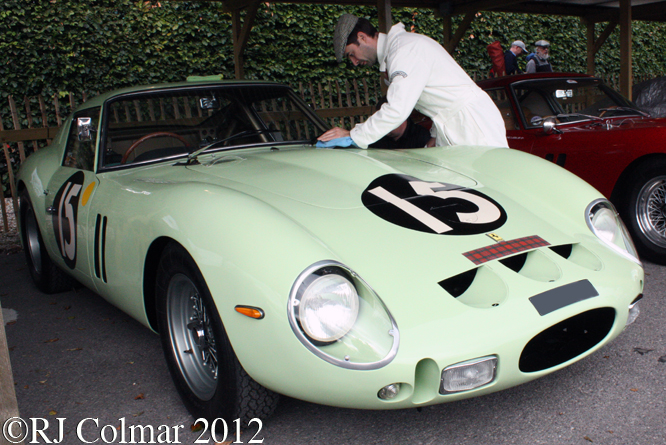
Ferrari 250GTO, Goodwood Revival

The cars first outing was at the 1962 Le Mans test where Willy Marrise recorded 2nd fastest time in #3505, he appears to have driven several other Ferrari’s over the weekend including the fastest car a 250GT SWB chassis #2689. Innes Ireland and Marsten Gregory shared the car for the rest of the season Marsten scored to 2nd place finishes at Silverstone before he and Ireland retired the car at Le Mans with a combination of starter and battery problems after completing just under half the distance of the race.

Innes Ireland drove the #3505 to victories at Brands Hatch and again in the 1962 Tourist Trophy run at Goodwood where the car is seen above fifty years after the event. With just seven events entered the car was sold to Austrian Dr. Gunther Placheta.

Ferrari 250GTO, Goodwood Revival

Dr. Gunther Placheta was an alias for the actor Gunther Philipp who raced under the pseudonym “Giulio Pavesi” and used the #3505 in racing and hillclimbing events in 1963 and 1964 claiming 4 overall victories from nine events known to have been entered claiming the 1963 and 1964 Austrian GT championships in the process.

Since 1964 #3505 has spent most of it’s time with owners in the United Kingdom in 2000 the #3505 sold for $8 million and went to the Matsuda collection.

Ferrari 250GTO, Goodwood Revival

The car was back in the UK with a new Dutch owner by 2005 and last year was sold far a reputed $35 million to it’s current owner wireless billionaire Craig McCaw who by strange coincidence is also the husband of former US Ambassador to Austria Susan Rasinski McCaw. The reputed $35 million price paid makes this car twice as expensive as the most expensive car sold at auction last year the $16 million 1957 Ferrari 250 Testa Rossa Prototype.

It should be noted that #3505 was neither owned by Sir Stirling Moss other than through any financial interest he may have had in his fathers racing team British Racing Partnerships which raced under the UDT Laystall banner in 1962 and nor is there any record that #3505 was ever raced by Sir Stirling Moss in period.

Thanks for joining me on this “Double Austrian GT Champ” edition of “Gettin’ a li’l psycho on tyres” I hope you will join me again tomorrow. Don’t forget to come back now !

Share

Excelsior Twin Carb – Berkeley Sports SE328 Deluxe

Berkeley was Europe’s leading manufacturer of fiber glass caravans when it diversified into car manufacture in 1956 to fill seasonal gaps in it’s manufacturing capacity.

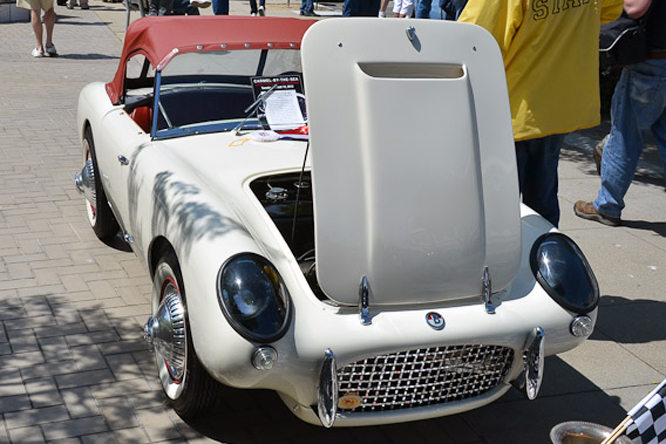
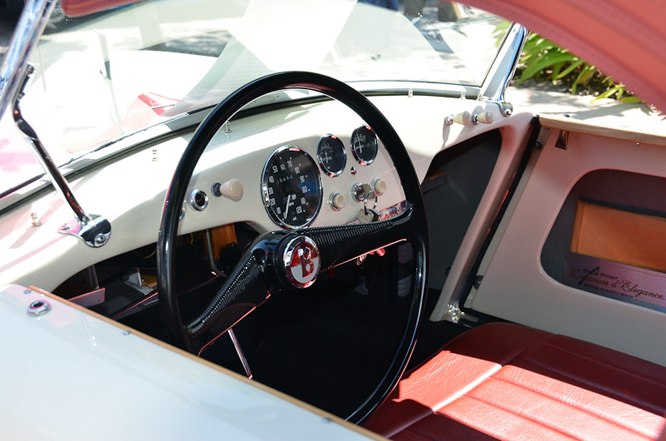
Berkeley SE328, Carmel By The Sea, Concours On The Avenue

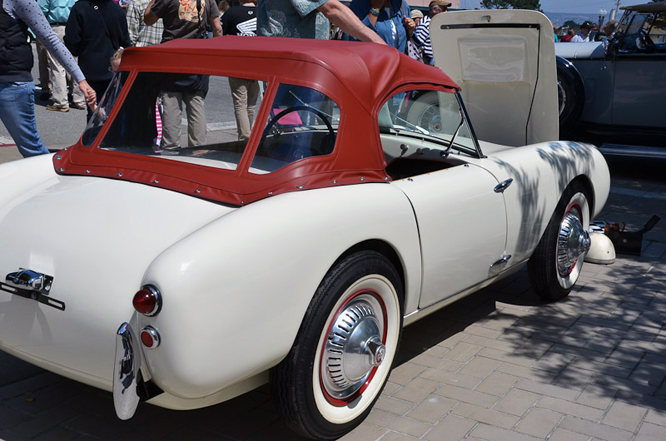
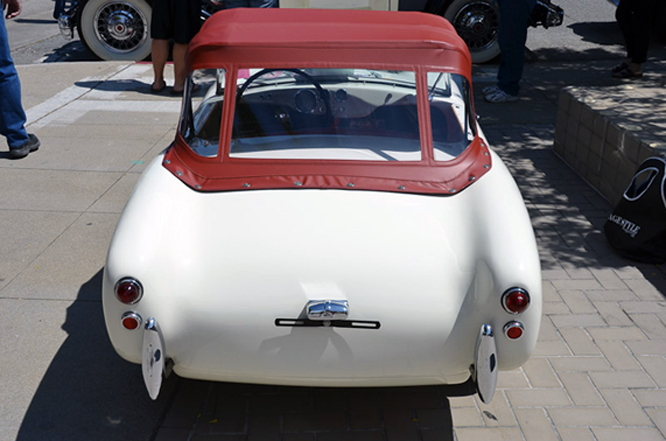
The first Berkeley sports car was the SA322 designed by Lawrence “Lawrie” Bond featured an all fiber glass shell and body beating the Lotus Elite which used similar technology to market by a full year.

Berkeley SE328, Carmel By The Sea, Concours On The Avenue

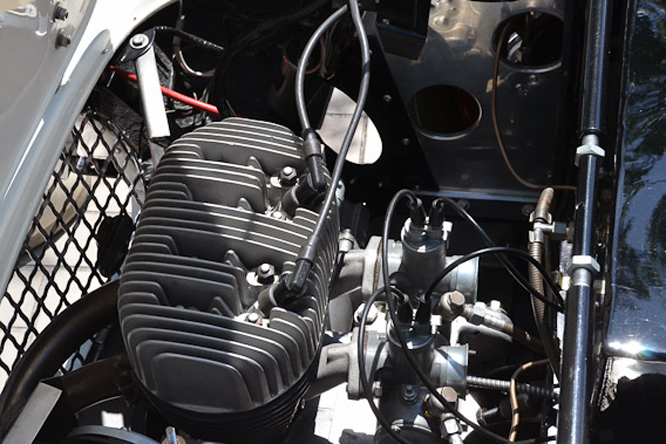
After 163 SA322’s had been built the original 11 hp 322cc/19.65 British Anzani motorcycle engine was replaced by a 18hp 328cc / 20 cui Excelsior motorcycle engine of the type seen above. Today’s featured car is a Delux version distinguished by the twin carburetors. The two stroke motor is started with the aid of a Dynastart electric motor that also served to charge the battery once the 2 stroke motor was set in motion.

Berkeley SE328, Carmel By The Sea, Concours On The Avenue

Fuel gauges were optional extra’s on Berkeley sports cars however the Deluxe models were fitted with tachometers and a fuel gauges as standard. Early Berkeleys were fitted with a column shift for the chain driven three speed gearbox that drives the front wheels.

Berkeley SE328, Carmel By The Sea, Concours On The Avenue

Stirling Moss’s sister Pat drove a Berkeley Sports SE328 in the 1958 Liége-Brescia-Liége Rally as part of a six car works team and was leading as far Slovinia before the heat on the Italian hills took it’s toll and resulted in her being towed by another team car.

Berkeley SE328, Carmel By The Sea, Concours On The Avenue

The diminutive chrome hub caps fitted with ‘spinners’ were another standard feature of the SE328 Deluxe. In all around 1259 SE 328’s that were capable of 70 mph accelerating from rest to 50 mph in just over 30 seconds while achieving over 50 mpg are thought to have been built.

My thanks to Geoffrey Horton for sharing today’s photographs that were taken at last years Concours on the Avenue at Carmel by the Sea.

Thanks for joining me on this “Excelsior Twin Carb” edition of ‘Gettin’ a li’l psycho on tyres” I hope you will join me again tomorrow. Don’t forget to come back now !

Share

Chased By A Panda – Exeter Trial 2013

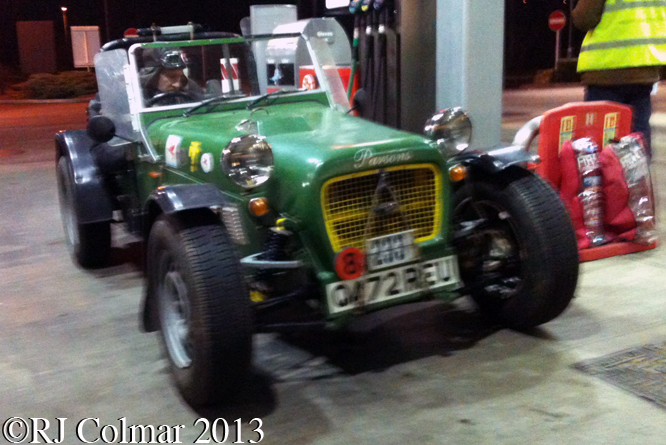
A couple of months ago I was offered the opportunity to navigate a unique Parsons Trials car on the Exeter Trial by owner Alan “Spence” Spencer. After Alan kindly agreed to make a few modifications so that I could sit in the car properly by raising the seat and adding four inch screen to afford some protection from the on coming wind I agreed to join him and had been looking forward to the experience ever since.

Parsons, Exeter Trial, Cirencester

Alan is seen above strapping himself into the Parsons at the first rendezvous Burford Services, Cirencester where we joined 39 other motor cars at close to midnight. The Exeter Trial was first run on Boxing Day 1910 by the Motorcycle Club from London to Exeter and back. As the roads got better so the trials went off road to maintain some degree of challenge for those taking part. The first part of the 2013 Exeter Trial was a regularity run over an 88 mile prescribed route to the Haynes International Motor Museum with an easy target time of 2 hours, mercifully I had prepared my wardrobe well and was comfortably warm sitting in the Ford Kent powered Parsons despite being exposed to the elements.

Gregory, Exeter Trial, Cirencester

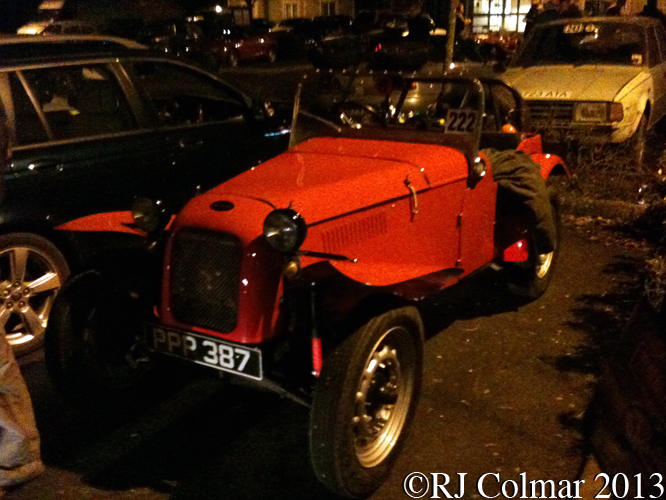
Among assorted Skoda’s, VW Beetles and an Mazda MX5 with an urban paint job starting from Cirencester was this rare #222 Gregory trials car driven by Josh Moss and Chris Ferin. At the Haynes motor museum there was a compulsory two hour break during which I enjoyed a hearty Full English Heart Attack breakfast and a 1/2 hour flat on my back to ease the inevitable stiffness that occurs after sitting in a confined space for 2 hours in ambient temperatures a couple of degrees above freezing.

Ford Special, Exeter Trial, Cirencester

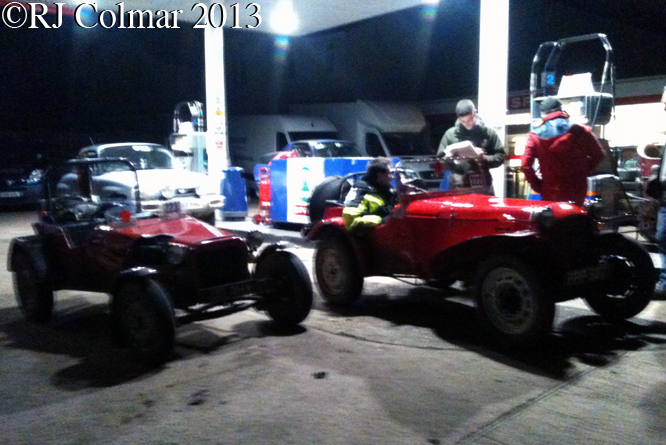
Above the #223 Ford Special of Alex Wheeler and Tony Underhill is parked up alongside the #222 Gregory and ahead of a couple of Suzuki X-90’s that were also taking part at the Musbury Garage checkpoint.

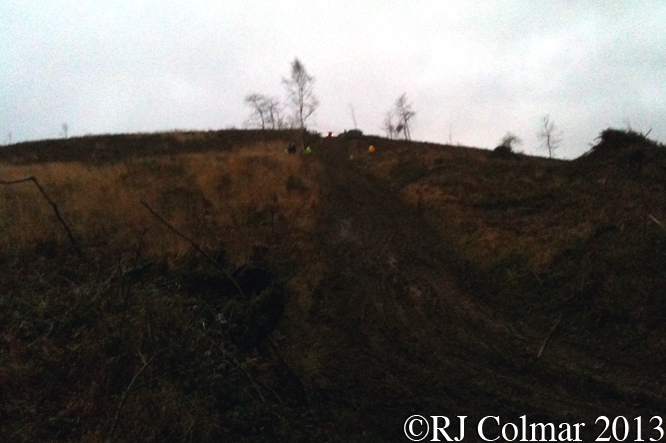
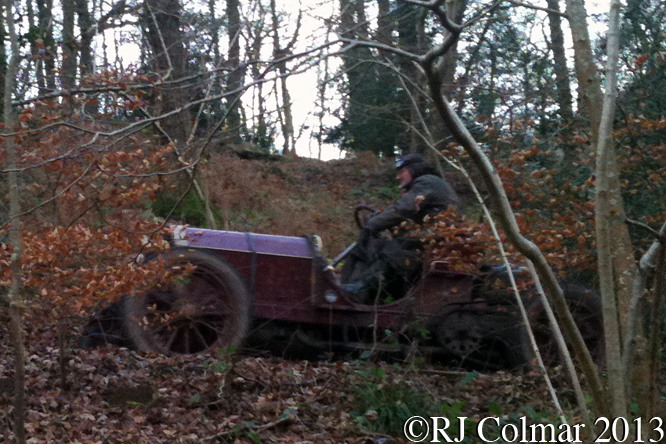
After a very quick observed stopping and reversing test at Haynes we headed for the first off road trial at Windwhistle Hill, by now I had a good grip on the abbreviations used in the route notes which Spence had thoughtfully copied and mounted onto a neat illuminated roller box as used by bomber command navigators in WW2 and by Denis Jenkinson to help Stirling Moss to victory in the 1955 Mille Miglia. In the pitch black of the night from the navigators seat of the Parsons at five in the morning the Windwhistle Hill observed section appeared to take place on a very wet and rutted and rocky forestry track, getting down to the start of the time section it was almost as much fun as roaring back up to the top for a clean run which included a compulsory stop and restart halfway up.

Mercedes Simplex, Exeter Trial, Musbury Garage

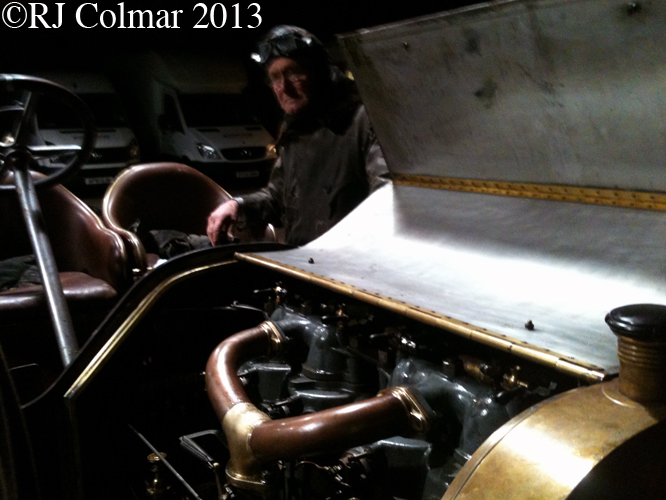
From Windwhistle Hill we proceeded 5 miles to the next observed section Underdown II following the magnificent chain driven 1903 Mercedes 60 hp Simplex of Ben and Roger Collings with a burbling 4 cylinder 9.235 litre / 563 cui motor which was being guided by chain drive aficionado Duncan Pittaway and Ant Lucas in a raucous TVR V8S. The Mercedes needed a guide on account of the fact that nominal navigator 70 year old Roger Collings, seen above, was fully occupied holding on to two handles to stay in his completely exposed seat.

Volkswagen Beetle, Normans Hump, Exeter Trial

Above the #238 Volkswagen Beetle of Nicola Butcher completes a clean run of Norman’s Hump.

After another clean run up Underdown II we headed for the Musbury Garage check point, as we were running ahead of scheduled time Spence pulled over for a quick cat nap before we pulled into the Garage to get our route card signed. Day light was appearing as we reached observed Section 3 known as Norman’s Hump where there was a long queue of competitors waiting.

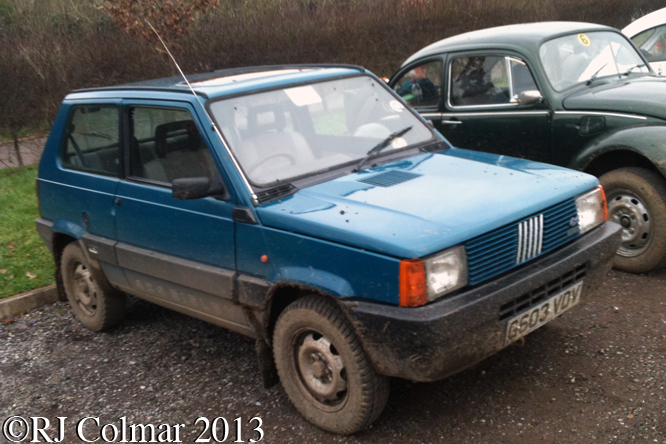
FIAT Panda Sisley, Crealy Park, Exeter Trial

We began to feel like we were on a roll as we cleaned Norman’s Hump and the following observed sections Waterloo, Strets, Core Hill and Bulverton Steep which were all on wet surfaces thanks to the yule tide deluge that had ceased earlier in the week. Over the last few morning sections we were running last on the road with the course closing FIAT Panda 4×4, seen above, on our tail.

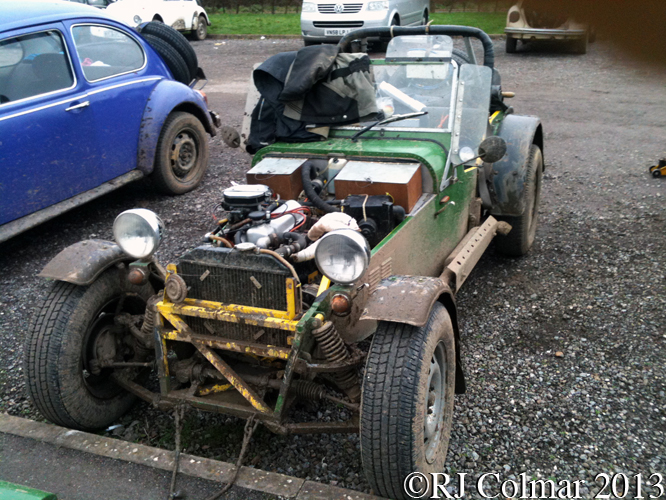
Parsons, Crealy Park, Exeter Trial

This was not helped by the fact that Spence used an electric pump to inflate his tyres after each section which lost us time, unfortunately the Parsons, seen above at Crealy Park, is not really big enough to carry a time saving gas bottle as many other competitors did. For most of the observed sections we were running between 10 and 15 psi on the rear tyres for extra grip, too low a pressure to be running on the road sections to be safe.

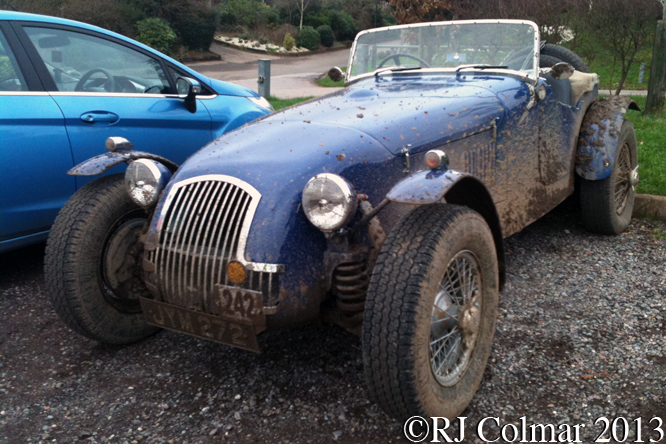
Allard M Special, Crealy Park, Exeter Trial

Just after 10 we arrived at the Crealy Park time control where Spence borrowed Duncans jack to swap the rear wheels over because the tyres on both sides had slipped on the rims, he also checked over the levels which were all fine during the one hour compulsory stop while I took a few snaps of some of the other vehicles taking part including the #242 Allard M Type Special of William Holt and Martyn Wyatt above. After a brunch, chicken and fried rice with satay sauce that I bought at our local take away just before setting off from Bristol, we headed into the sunshine towards afternoon sections starting with Tillerton Steep.

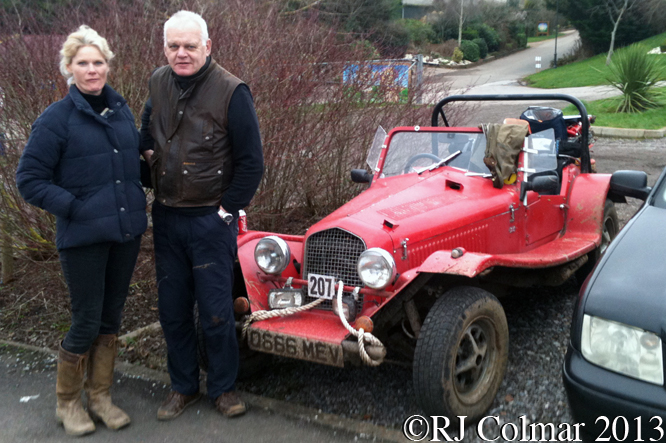
Marlin Roadster, Crealy Park, Exeter Trial

Above Chris Hickling and Wendy Bayless from Falmouth are seen in front of their #207 Marlin which suffered a puncture on Norman’s Hump.

If the morning had proved to be ecstatic with clean runs then Tillerton Steep began a run of drip fed cruel agony as there was a restart on a large slab of wet rock which offered absolutely zero traction. We had failed our first test though we managed to get up the remainder of the course on our second attempt.

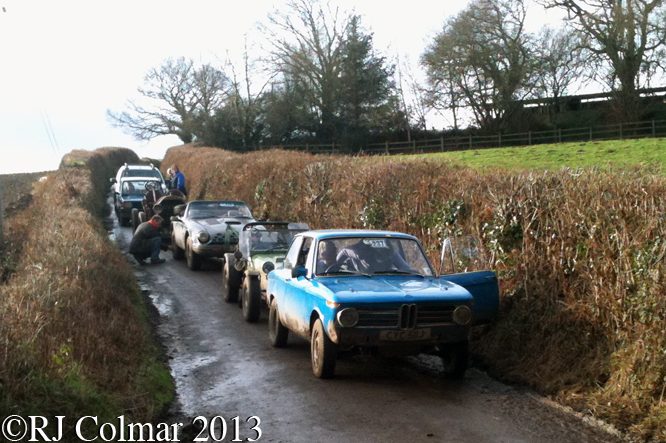
BMW 2002, Tillerton Steep, Exeter Trial

Above the Edna Perryman climbs into the back seat, of the #237 BMW 2002 while Colin awaits to cross the ford prior to their run up Tillerton Steep. Note the course closing Panda behind the Mercedes.

We then followed the Mercedes Simplex to Fingle Hill which we cleaned, with slightly raised spirits we continued the short distance to Wooston Steep behind the 1903 Mercedes Simplex which pulled an awesome handbrake turn to line up for the gates that marked the entrance to the path that led to the observed section. Wooston Steep which had two finishes according to class, being in the toughest class 8 we had to make a run past a left fork up to the top, unfortunately we got caught in the ruts which turned left and lost too much momentum to complete the test. The Exeter Trial is about completing ‘cleaning’ all the sections if one completes all sections no more than ten mins behind schedule one is awarded a Gold medal, if one fails one section but completes all the rest within 20 mins of the target time one earns a silver and a bronze is awarded if all bar two sections are completed within 30 mins of the target time.

Mercedes Simplex, Fingle Hill, Exeter Trial

Above Ben Collings blasts up Fingle Hill while Roger hangs on to the 1903 Mercedes Simplex as best he can.

After a third observed Autotest at Wooston Steep it was off to Ilsington Parish Hall for another compulsory hour break during which I enjoyed some decaffinated coffee and some lovely cake. Next it was off round the corner to Simms a long wait ensued as many cars failed to get to the top after the restart. We eventually blasted up the first part of the hill but could not manage the second and ended up being carefully guided, who almost manhandled the car back to the corner so that we could reverse down the remainder of the course. Our shot at a medal was over and dissappointed we headed for Tipley Hill where another long queue awaited us. By now it was getting dark and colder again and since we were no longer in with a chance to win a medal we elected to skip Tipley Hill and headed for the final section Slippery Sam a cross between a rock garden and a bomb hole of a hill, again we flew up the first part but needed two attempts to clear the restart after which we flew around the last couple of corners bouncing over ground that would be an easy test for a four wheel drive but was a thriller in the tiny Parsons.

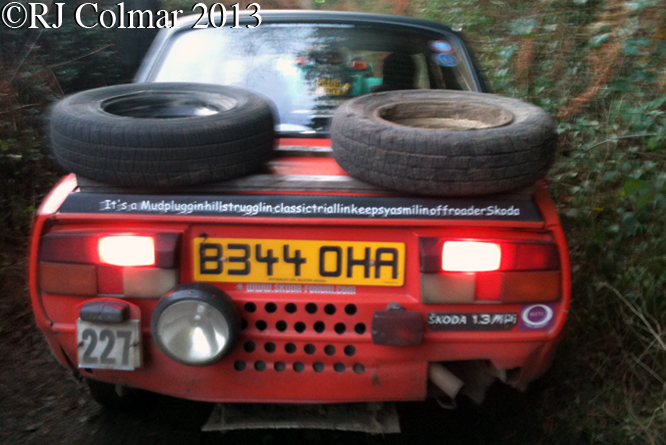
Skoda Estelle, Simms, Exeter Trial

Above part of discipline of the Exeter Trial is having the patience to sit in long queues in narrow lanes, above the #227 Skoda Estelle of Ben & Rosin Giles awaits it’s turn to get to the start of Simms.

We then headed to the Trecarn Hotel Babbacombe where exhausted we handed in our time card for the final time, glad to be in one piece, and that it had neither snowed or rained during the exhilarating 19 hour 250 mile drive. After a shower we joined many of the competing crews for dinner where tails of triumphs and failure were exchanged. I eventually crashed out feeling like I was still moving !

My thanks to Alan Spencer for taking me along on the Exeter Trial in his little Parsons which will be the subject of a future blog, thanks also to all the marshalls and organisers who put the time and effort in to making the event happen, I hope the opportunity to participate comes round again in the not too distant future.

Thanks for joining me on this “Chased By A Panda” edition of “Gettin’ a li’l psycho on tyres” I hope you will join me again tomorrow. Don’t forget to come back now !

Share