Tag Archives: Moss

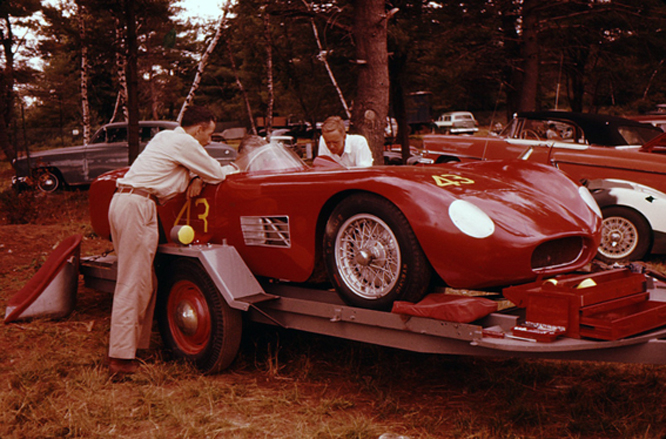
Sweet and predictable – #43 Maserati 150 S #1643

Thanks to again to Ed Arnaudin for today’s photograph of a Maserati 150 S owned by EF Spicer seen here at Thompson CT 20th July 1958.

7 43 27s

By the time the smallest ever Maserati, the 150S, was built in 1955 the Maserati brothers were long gone from the company bearing their name working on their new OSCA vehicles.

The popularity of the 1500 cc / 91.5 CUI sports car class racing led Maserati to fill the gap in the lower end of their range with this vehicle.

Following Ferrari who in turn was inspired by the fuel efficient advantages of an HWM four cylinder Alta engine, Vittorio Bellanti also ditched the prevalent smooth 6 cylinder engine architecture in favour of a new 4 cylinder alloy block, dry sump lubricated engine featuring hemispherical combustion chambers, double overhead cams and twin plug ignition which produced 140 hp at 7,500 rpm.

Valerio Colotti designed the chassis with independent front and de Dion rear suspension originally covered in a 300S derived body by Celestino Fiandri in 1955.

For 1956 the slightly less derivative body seen here was designed by Medardo Fantuzzi. Stirling Moss drove one of the factory entered 150 S’s in a sports car race to second place on the Nurburgring in 1956 beaten by margin of ‘just’ 3 seconds over 100 miles by Hans Hermann in a Porsche 550 A.

Stirling is alleged to have said of the 150 S that it was ” sweet-handling and predictable but overbodied and gutless.”

EF (Edward Farnham) Spicer drove the #43 in the photo to 9th place in the final all comers race on July 20th, 8 spots behind the winning Porsche 550 of Newton Davis.

My thanks and best wishes to Ed Arnaudin and his son Steve for todays photograph, Jerry Entin for vehicle identification and Terry O’Neil for the results.

Hope you have enjoyed today’s sweet & predictable edition of ‘Gettin’ a lil psycho on tyres’ and that you’ll join me again tomorrow, don’t forget to come back now !

Share

Carroll’s Cat faster than a 250 F – Lister Jaguar BHL 128

Moving on 20 years from yesterdays blog but staying with the Lister Jaguar cars of the late 50’s, this one has a proud boast thanks Bobby Bell who is seen here standing in the fire suit, behind the car, at the British Grand Prix meeting where he was competing in the Lloyds & Scottish championship.

Bobby Bell, who kindly shared the details about today’s story is one half of Bell & Covill purveyors of fine, approximately 25,000 at last count, motor cars which have been sold to customers from Twickenham to Tobago.

One might imagine from the BRG and yellow paint job that this vehicle had been raced by Archie Scott Brown to some of the many Lister Jaguar victories, however it transpires that nothing could be further from the truth.

According to Doug Nye’s 2nd edition, reasonably priced, ‘Powered by Jaguar‘ the 1959 Lister Jaguar BHL 128 was originally supplied to Carroll Shelby Sports Cars Inc, Dallas Texas as a rolling chassis built to accept an American made body and Chevrolet V8 engine.

BHL 128 also known as ‘the Boeing Car’ is said to have been part of a Land Speed Record project with input from Boeing and master minded by John Fitch, Doug’s research categorically states John Fitch the former Mercedes Driver and Safety Engineer had absolutely no involvement in such a project.

What ever the outcome of the Boeing project the vehicle has no identifiable ‘in period’ racing history and was recovered to England around 1969 and acquired by Peter Sargent around 1970. Between 1970 and the mid 70’s BHL 128 was fitted with both a 3.8 / 231 cui XK Jaguar motor and a, retrospective, 1958 low frontal area ‘Knobbly’ body in preference to the historically more accurate, but less successful, 1959 Costin body.

Bobby tells me that he acquired BHL 128 in the mid 70’s and raced it to many historic race victories and a Lloyds & Scottish Championship.

However one of his favourite memories was the day he put BHL 128 on pole for the 1978 historic race at Le Mans, with a time that would easily have qualified for the 24 hours race proper, ahead of Stirling Moss and Willie Green one of the best if not the best historic racer of all time.

Bobby tells me that on that day BHL 128 was fitted with a 2.9 high ratio back axle which allowed him to hit approximately 175 mph on the 4 mile Mulsanne straight at 6000 rpm.

Both Willie Green in his D-type Jaguar and Moss driving a far superior handling open wheel Grand Prix Maserati 250 F made up ground on the Lister in the corners but could not keep pace with the Lister on La Sarthe’s long straights.

Unfortunately on the third lap of the race, the crankshaft broke and as Bobby says, ‘that was that’. Stirling might have added “Better to lose honorably in a British car than win in a foreign one”, though if he did, it was not recorded on this particular occasion.

Bobby sold the car in the mid ’80’s and it has since undergone restoration and now belongs to a lucky Steven Gibbs.

My thanks to Bobby Bell for sharing today’s story and to Doug Nye, David Mckinney, Belmondo, Dutchy, Julian Bronson, and Robert Barker at The Nostalgia Forum for additional comments going back to May last year.

Thanks for joining me for a week of Big Cat history, I hope you’ll join me again tomorrow for everyone’s favourite ‘Ferrari Friday’ when I’ll be looking at one of a series of 387 Ferrari’s none of which were sold as new in the United States. Don’t forget to come back now !

Share

Cats with Grace & Pace – Jaguar XK 120

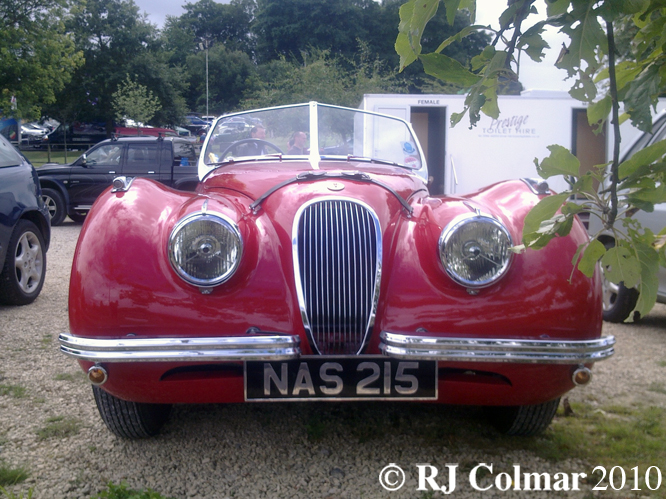
The post war success of the Jaguar Company was built around the twin overhead cam alloy head iron block XK engine which was in various guises from was in production from 1948 – 1992.
The motor was designed by William ‘Bill’ Heyes and Walter ‘Wally’ Hassan prior to the outbreak of WW2 hostilities, during the period of hostilities Jaguar staff realised the design in between duties as fire watchman over the heavily industrialised city of Coventry which was a major target of German bombing raids.
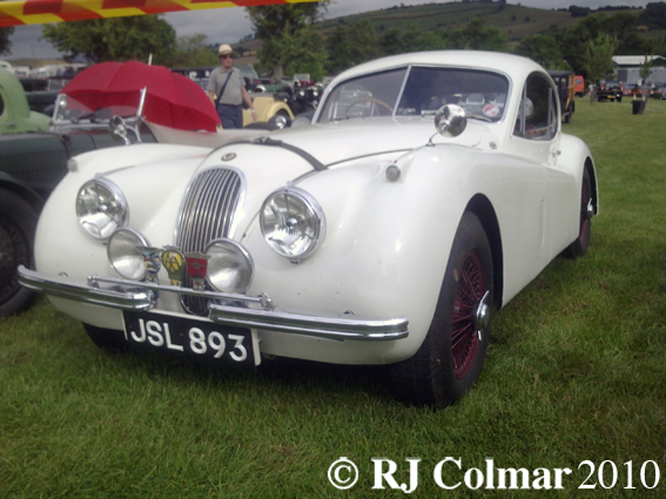
The XK 120 launched at the London Motor Show in 1948 was the first vehicle designed around a 160 hp 3442 cc / 210 cui version of the XK engine, at the time the XK 120 mph capability made it the worlds fastest production car.
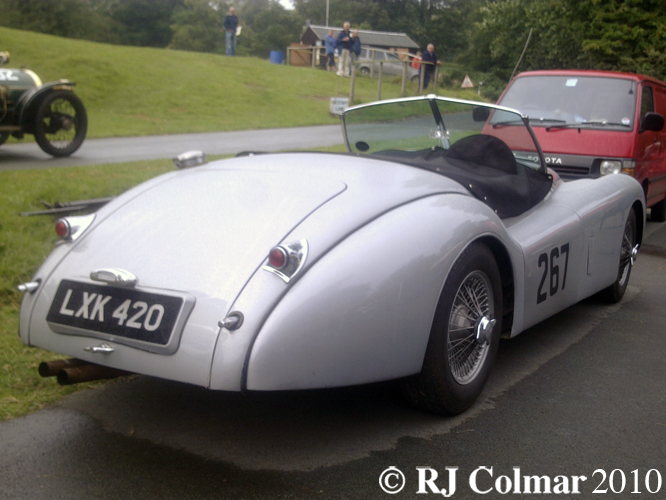
The racing and rallying success of the XK 120 is incalculable including the Daily Express One Hour Race in 1949, Class win at Palm Beach Shores, class win in the Mille Miglia both in 1950 all three with Leslie Johnson at the wheel and a 1,2,3, victory in the 1950 Tourist Trophy. Ian Appleyard took overall wins in the Alpine Rallies of 1950 & ’51 and the first Alpine Rally Gold cup in 1952. An XK 120 driven by Al Keller is also credited with being the only foreign ‘built’ car to win a NASCAR sanctioned event at New Jerseys Linden Airport in 1954 to name but a few.
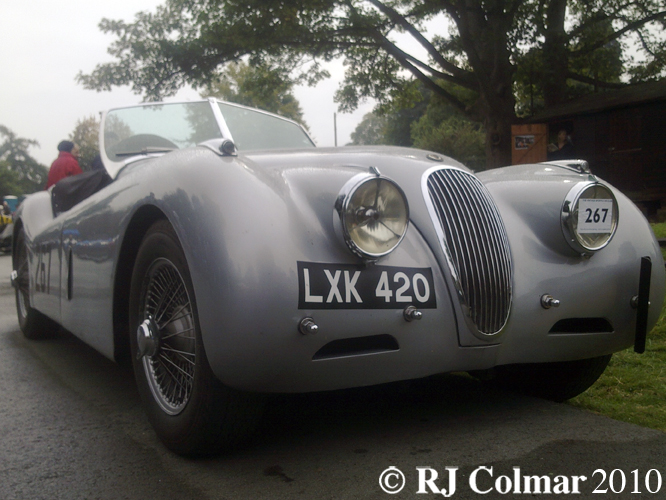
Leslie Johnson started a three year record breaking spree in 1950 at the 1.58 mile L’autodrome de Linas-Montlhéry outside Paris which features 30 degree banking.

Sharing the driving in 3 hour stints with Stirling Moss for 24 hours they averaged 107.46 mph, covering 2579.16 miles in 1950.

The following year ’51 Johnson drove 131.83 miles in one hour saying afterwards ‘the car felt so good it could have gone on another week’ sowing the seeds for the 1952 attack on the week speed record.

In 1952 a four man team comprising Johnson, Moss, Hadley and Fairman only managed 96 hours at their first attempt at the week record, because a spring broke after 85 hours, Johnson drove with the broken spring for a further 9 straight hours to spare his compatriots any additional risk setting 96 hour, 72 hour and 10,000 mile world and class records all at over 100 mph.

After the spring had been replaced the team then set a full seven day & night record of covering 16, 851.73 miles at an average speed of a staggering 100.31 miles and hour.
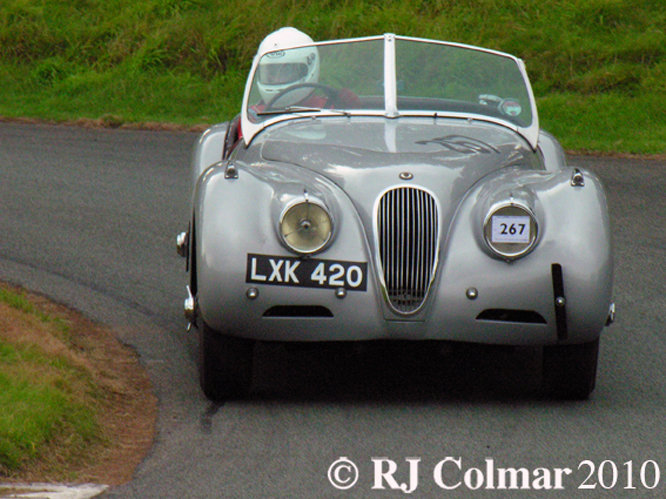
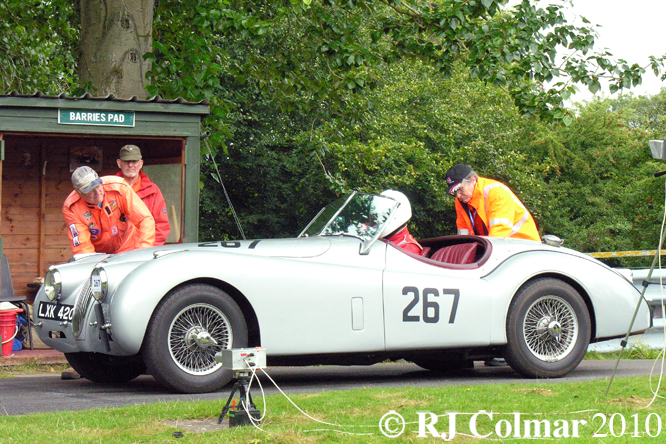
The first 242 roadsters, of which the 1949 #267 driven by Roderick Spollon is one, were hand built with aluminium bodies on ash frames, as demand picked up by 1950 pressed steel bodies were used with aluminium bonnet, doors and boot lid. Production of OTS roadsters (no roof) , DHC (convertible) and FHC (steel roof) XK120 variants came to an end in 1954 when the XK 140 was introduced.

Hope you have enjoyed todays 120 MPH edition of ‘Getttin a lil’ psycho on tyres’ and will join me on a safari looking at some big cats in Africa as I continue my quest for new information about events that occurred long ago. Don’t forget to come back now !

PS
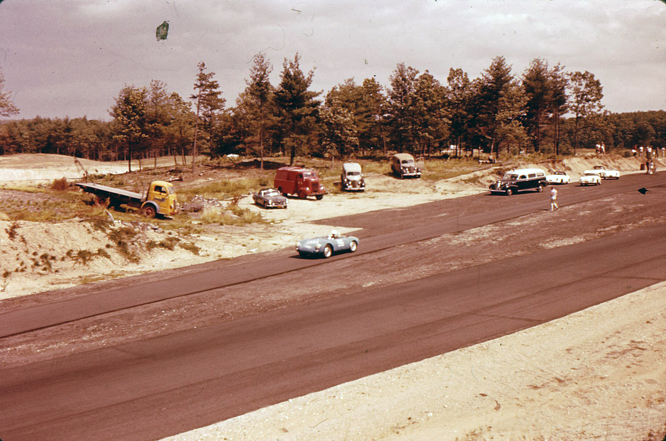
In memory of former XK 120 owner Barbara Weaver wife of ARCA and founding SCCA member George Weaver who recently passed away I am posting this photo by Ed Arnaudin of the pits complex at Thompson CT during it’s construction in July 1958.

Barbara, who’s car carried the licence plate ‘SCCA’ and her husband located the Thompson CT site and with financial assistance from Briggs Cunningham the Weavers built and ran the road circuit until 1967, when land could no longer be acquired for the facility to expand.

She was an affirmed motor sport aficionado allegedly falling in love with the Maserati belonging to her husband to be before falling in love with it’s lucky owner.

Amongst many roles in motor sport she played host to Fangio, Shelby, George Constantine, Jackie Cooper and Joan Fontaine, Bob Holbert, Bob Grossman, the entire Cunningham team, Chuck Daigh, Lance Reventlow, and Walter Cronkite.

A full and proper obituary of this wonderfully decidedly hands on character is linked here.

Sincere condolences to Barbara’s family and friends.
Share

Black Jack & Le Car – Renault 5

The Renault 5 was a versatile super mini launched in 1972, in Europe many countries ran a one make virtually stock Renault 5 Championship which brought many drivers their first taste of semi professional competition including Austrian Formula One driver Gerhard Berger.

In the States this vehicle known as Le Car dominated the 1977 SCCA Showroom Stock class C division and gained added notoriety when La Conner Washington police department traded in one of its full size cruisers for three Le Cars.

In 1980 three time world champion Sir Jack Brabham was persuaded to come out retirement for the first time in 10 years to take part in a British Saloon Car Championship race at Brands Hatch which took place on the same day as the British Grand Prix.

Though the car was giving away 200 cc 12 cui to the class leading Toyotas VWs and Audi 80’s prepared by GTi Engineering, one of which was driven by the equally recently out of retirement Stirling Moss, it must be assumed that Black Jack was game for a laugh with his old sparing partner from the late 50’s early 60’s.

The Renault was woefully uncompetitive having neither the power or the handling to keep up with the class leading Audis but come race day Sir Jack Brabham had an ace up his sleeve, falling further and further behind the pack on the long Brands Grand Prix Circuit much to the amusement and in full view of 80,000 spectators Jack decided to take a 1 mile short cut by using the club circuit link road and so finished ahead of Stirling Moss on the road even though he was of course obviously disqualified.

Hope you have enjoyed today’s Black Jack edition of ‘Gettin a lil’ psycho on tyres and that you will join me tomorrow for a 6 cylinder edition tomorrow. Don’t forget to come back now !

Share

Maserati 250 F

I apologise to all my Rowdy friends who will have seen this car before on rowdy.com but I have expanded on that original post in this blog in honour of Canadian artist Paul Chenard who very kindly helped me out with another project I am working on. If you like drawings and paintings of old racing cars you’ll love his gallery linked here.

The 250 F was first raced in 1954 by 1951 world drivers champion Juan Manuel Fangio who took a maiden outing win in Argentina and then won again, having missed the 1954 Indy 500, at the following race in Belgium.

Juan then went on to become Champion in 1954 driving for Mercedes Benz for the rest of the season. With Mercedes at the height of their power in 1955, Maserati were locked out of the top spot in Formula One but in 1956 the 250 F was again driven to two victories by Fangio’s former Mercedes team mate Stirling Moss.

Having been crowned world champion from 1955 – 56 the now four time world champion Fangio returned to Maserati for 1957 and promptly won four of the eight championship races to set a four peat world championship record that stood until 2003.

In that 1957 season Fangio drove one of the races of all time during the German GP, having failed to out fox the Ferrari team after a disastrous pit stop, Juan Manuel set 7 consecutive lap records on the 14 mile Nurburgring Nordschleife making up over 48 seconds before taking the lead from the Mike Hawthorn’s Ferrari with a lap to spare and record the 250 F’s 8th and final Formula One Championship victory.

Fittingly JMF drove his last ever race in a 250F at the 1958 French GP coming 4th, winner Mike Hawthorn sportingly refraining from lapping him on the final lap.

The 250 F continued to appear ever more uncompetitively until 1960.

This 1957 250F is the last of the 26 built. Complete with a six cylinder 240 hp engine.
This car is differentiated from most by a short wheelbase Piccolo chassis.
The 250 F is recorded as being the most forgiving of the 2.5 litre (152.5 CUI) F1 cars by Willy Green who has driven every type of 2.5 litre F1 car competitively in historic races.

Hope you enjoyed today’s post and will join me again tomorrow.

Share