Tag Archives: Psycho

200 mph Viscous Traction – Lamborghini Diablo VT 6.0

When the Diablo was launched in 1990 it was the first Lamborghini capable of over 200 mph and in the process it relieved the Ferrari F40 of ‘the worlds fastest production road car’ title. The design brief set by then Lamborghini owners the Swiss Mimram brothers for the Lamborghini Countach replacement back in the late eighties was relatively straight forward – Minimum speed capability 315 kph / 196 mph.

Marchello Gandini was responsible for the styling but when Chrysler took over Lamborghini in 1987 they were unimpressed and after the Chrsler Styling Centre in Detroit smoothed out the design Gandini was so unimpressed he took his original drawings which later were realised in the form of the Cizeta-Moroder V16T.

By the time this one of 251 penultimate VT 6.0 variants was built in 2000 Audi had become owners of Lamborghini and the Diablo had; acquired 4 wheel drive (Viscous Traction), an upgraded 547 hp 6 litre / 370 cui V12 and been fitted with made under licence Nissan 300 ZX Z32 head light clusters. The title of worlds fastest production car was short lived and handed on to the 213 mph Bugatti EB110 in 1991.

Hope you have enjoyed the Viscous Traction edition of ‘Gettin’ a lil’ psycho on tyres’ and that you will join me again tomorrow for Ferrari Friday, don’t forget to come back now !

Share

Eminently Fit For Purpose – AEC Routemaster RML 2583 ER

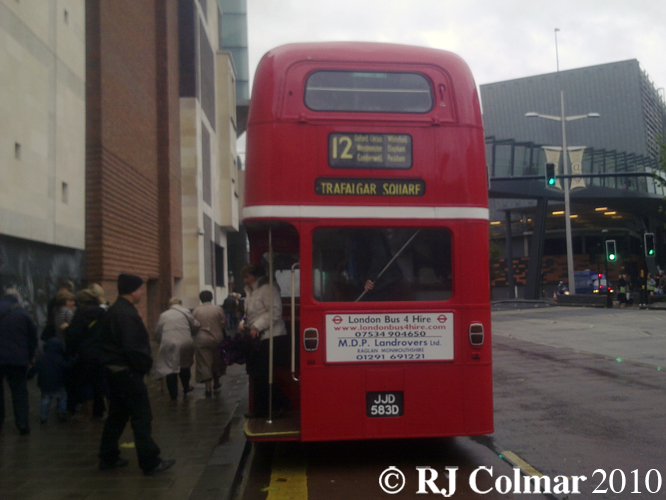
It used to be a right of passage for some lucky small boys and probably a few lucky small girls to receive a big red bus for Christmas some where between the ages of 2 and 4. It is an enormous thrill to share these photo’s on which by far the most popular of these toys was based, namely the iconic red Routemaster more commonly known as a ‘London Bus’ on the 12th and final day of Christmas.
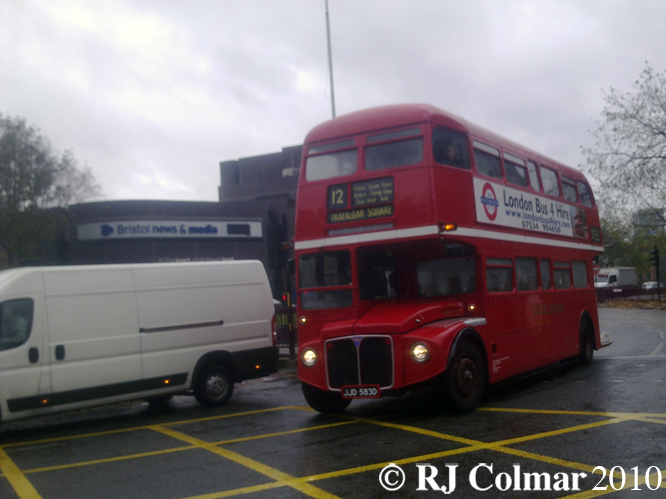
On my way home from a visit to the dentist last month I thought I must have been given a few extra doses of painkiller when this wholly familiar, from my time spent in London variously in the 60’s, 70’s and 80’s, beautiful red bus came into view on a roundabout in Bristol.
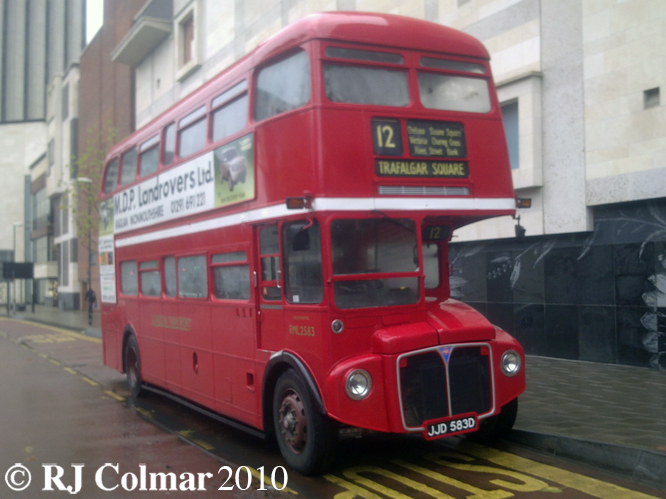
The Routemaster was developed by A.A.M. Durrant, Colin Curtis and styled by Douglas Scott between 1947 and 1956 to replace London’s fleet of 1,891 trolley buses which themselves had started to replace London Trams in 1931.

The first Routemaster was exhibited at Earls Court in 1954 and in 1956 four prototypes went into service prior to full production getting underway from 1958 to 1968.
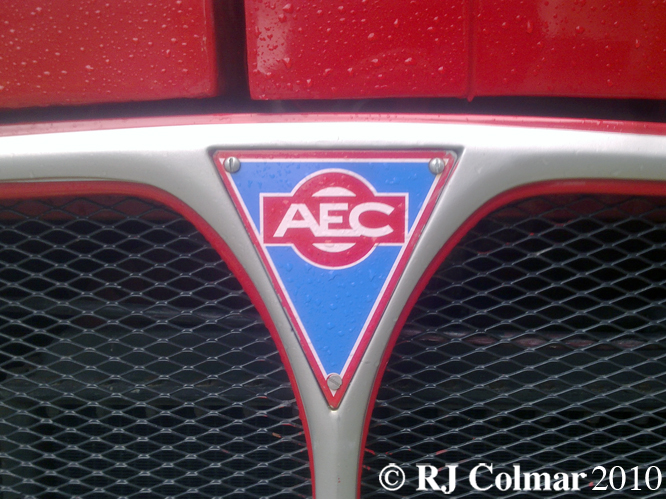
Routemasters were constructed by the Associated Equipment Company, AEC, in Southall, and were completely overhauled every 5 years at the Aldenham Works near Elstree in Hertfordshire up until 1986.
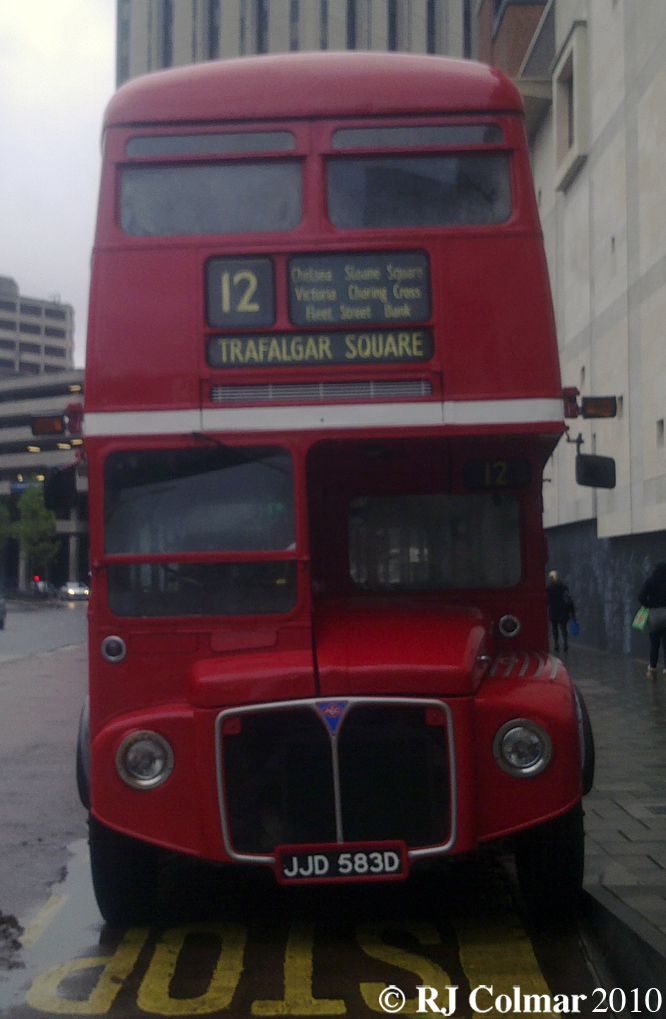
Novel features of the Routemaster, for buses, included the first use independent front suspension, power steering, a fully automatic gearbox and power assisted – hydraulic braking. The construction took its queues from methods of aircraft construction, also similar to the D and E type Jaguar (!), featuring an aluminium (English pronunciation) body with two steel sub frames, one on the front for the engine/suspension and steering gear and one on the rear for the rear suspension and axle.
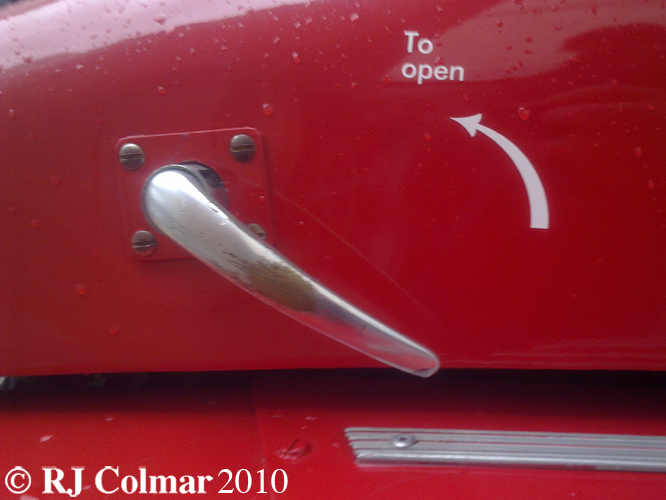
115 hp for the Routemaster was originally provided by either the 9,600 cc / 586 cui AEC AV590 or 9,800 cc / 598 cui Leyland O.600 6 cylinder diesel engines. After the Routemaster had been in service 15 years longer than originally anticipated from 1992 to 1994 many of the AEC and Leyland engines were swapped for Iveco or Cummins units.
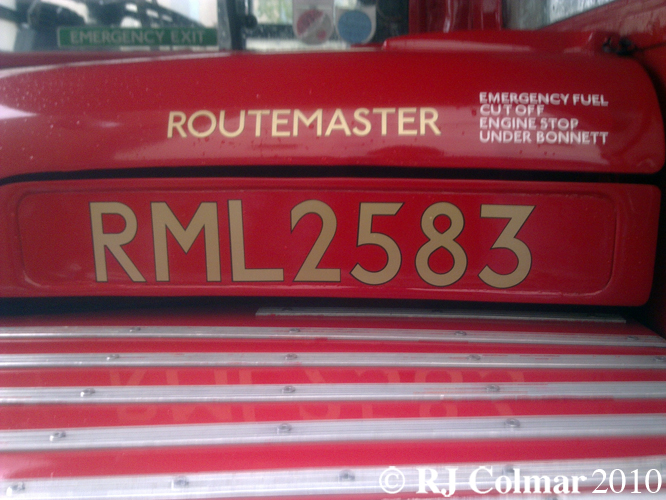
Routemasters came in two flavours standard 27′ 6″ RM or 30′ RML, designed to negotiate the narrow roads of London’s metropolis they are all only 8′ wide and 14′ 4 1/2″ high.
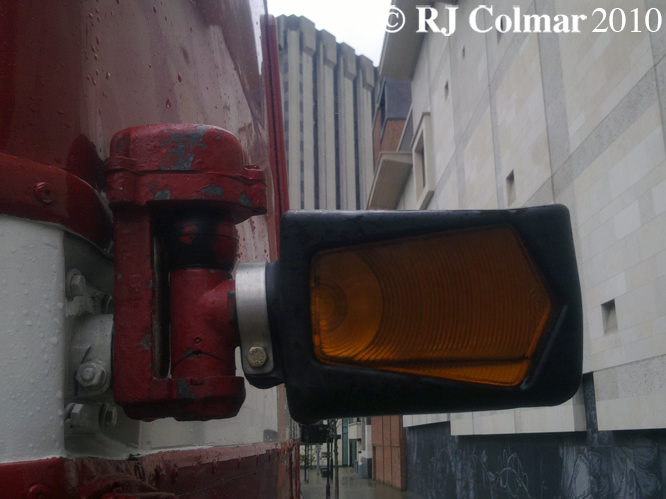
An example of how easy the RM / RML busses were to handle can be seen in this clip from a comedy film ‘On The Buses’ which includes stock footage from the London Transport driver training facility at Chiswick.
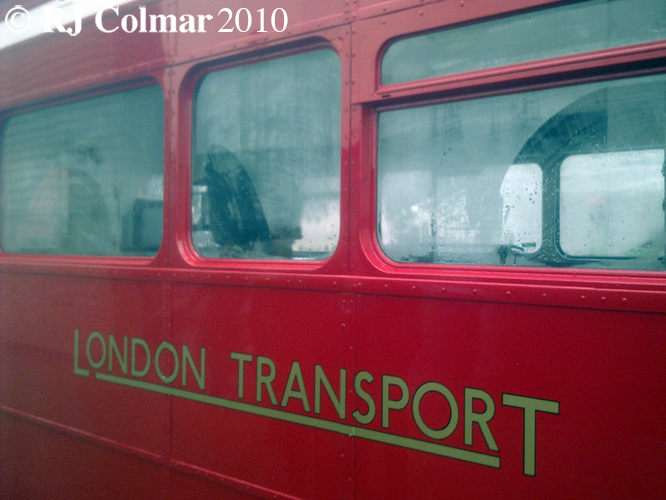
Longer wheel base RML’s are distinguishable by a half size window between the 2nd and 4th window’s of the bus.
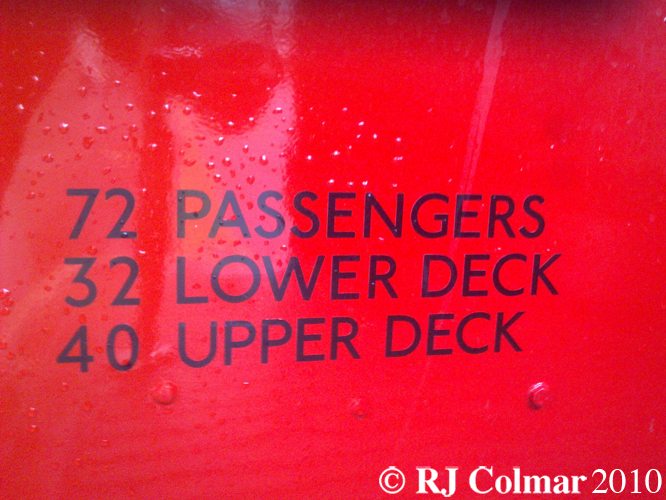
While the official capacity for the long wheel base RML was 72 I have been on these buses when they were so packed getting one more sardine on board would have been impossible.
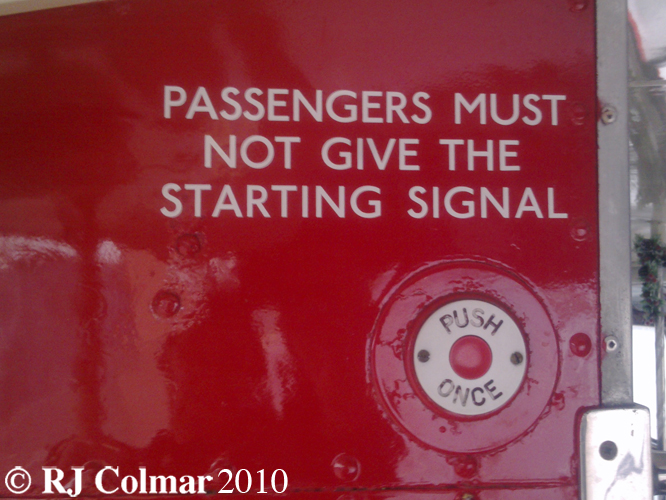
The bus conductor would signal his driver that it was safe to proceed with two rings of the bell operated by this button attached to an easily reached cord that runs the length of the lower deck of the bus. Passengers rang the bell ‘once’ to signal to the driver when they wished to alight at the next stop.
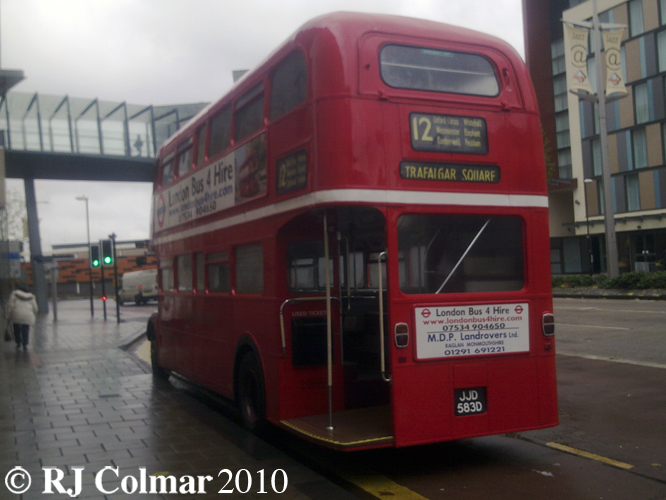
The beauty of having no doors to pass on entry and exit was that the bus would only need to be stationary for as long as it took for people to alight and board no time was wasted waiting for doors to open and close. The disadvantage of having no doors was that in could get a bit ‘parky’ riding on these buses with inclement weather.
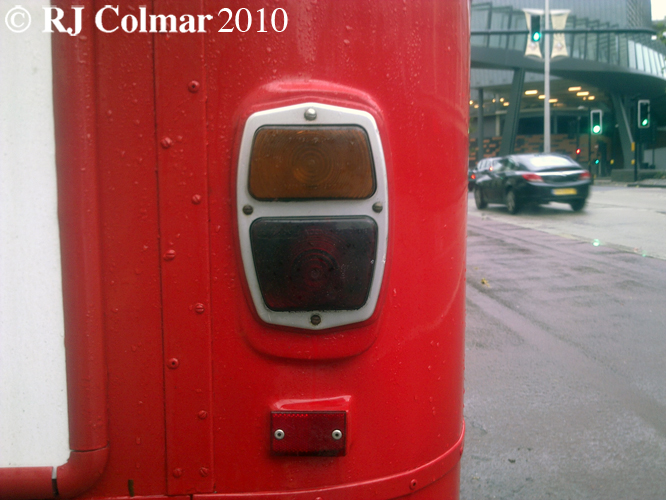
On the 9th of December, 2005 after much trading of Routemasters back and forth between London and other regional operators, having outlasted its intended replacement the Daimler Fleetline by over 20 years these splendidly fit for purpose vehicles were finally withdrawn from service on all but a couple of ‘Heritage’ routes, not even the Mayor of London who said in 2001 that “only some sort of ghastly dehumanised moron would want to get rid of Routemasters” could save them.
Allegedly in October 2008 a Top Gear presenter destroyed a Routemaster in a publicity stunt, presumably to publicise what “ghastly dehumanised moron” he is.

Ding ! Ding ! Any more fares please !

Hope you have enjoyed my 12 vehicles of Christmas series concluding with todays ride on the Routemaster, and that you’ll join me again tomorrow when I’ll be upping the pace with a 200 mph vehicle named after a ferocious bull raised by the Duke of Veragua, famous for fighting an epic battle with ‘El Chicorro’ in Madrid. Don’t forget to come back now !
Share

Choking on a clothes peg – Austin 10/24 Ripley Sport

The Austin 10 produced from 1932 to 1947 was a mid range car fitting between the Austin 7 and Austin 12.

Austin kept the chassis low by dipping the chassis frames 2 3/4 inches between the front and rear axles.

Capable of 55 mph and 34 imperial mpg this 1935 version, originally registered in Derbyshire, would have cost £168 when new. The clothes peg operating the choke is a not a factory fitted item.

In 1939 the Austin 10 was restyled by Argenrtine Ricardo “Dick” Burzi and 53,000 ’10s’ were produced during the course of WW2 for use by the UK armed forces. After the war almost all Austin 10s were exported the first exported to the USA in July ’45, in September ’45 the first cars to be imported into Switzerland after the war were a pair of Austin 10s.

Hope you have enjoyed today’s open top edition of ‘Gettin’ a lil psycho on tyres’ and that you’ll be up for getting down and dirty with me for some grass track fun tomorrow. Don’t forget to come back now !

08 04 12, the full name of this model was added today, I have also found out this car is thought to be the first of an eventual fleet of 7 used by the Derbyshire County Constabulary.

Share

Brotherly love – Riley 9

The chassis of the Riley 9 was designed by Stanley Riley while the hemi head 1087 cc 66 cui was designed by his brother Percy. Riley 9s were produced from 1926 – 1938 with a variety of body styles.

The twin cam engine with short push rods operating the 45 degree inclined valves proved particularly suitable for tuning and Riley 9s were raced with great success into the mid 1950’s. This version, seen at Prescott top and Loton Park bottom, is owned by B Wildsmith and driven in VSCC events by Tim Hopkinson is a Special dating from 1929/34.

Hope you have enjoyed today’s brotherly love edition of Getting a lil’ psycho on tyres and that you’ll join me tomorrow for a look at another quintessentially British motor car. Don’t forget to come back now !

Share

The slowest car they have ever built – Audi R8

For the 8th day of Christmas and first day of the New Year I present this Audi R8.

According to the on line publicity it takes 70 skilled workers to fit over 5,000 unique parts to each vehicle and build 25 of these cars a day.

These vents direct air straight through the car.

The aluminium space frame which includes 99 meters of welds, 782 punch rivets, 308 self tapping screws, and 113 weld studs takes 45 minutes to manufacture.

The R8 rides on a magnetic damping system which provides the the driver with two modes of ride, comfort or sport.

This is the first Audi to compete with Porsche it is not quite as quick to accelerate but has been demonstrated to have slightly better handling than the 997.

Powered by a 420 hp all aluminium dry sump 32 valve V8 with Fuel Stratified Injection, FSI, the R8 is capable of a 12.8 sec 1/4 mile and a top speed in excess of 185 mph.

Audi use 210 exterior LED’s in the R8, 186 of them as brake lights which run at 5,700 degrees centigrade, they are said to use 50% less energy than conventional bulbs.

Expect to see racing versions of the R8 in two wheel drive form make an impact in GT3 racing in the coming year particularly at the annual 24 hour Nurburgring race.

Hope you have enjoyed to today’s LED edition of ‘Getting a lil’ psycho on tyres and that you will join me tomorrow living the life of Riley. Wishing you all a healthy and happy New Year, don’t forget to come back now !

Share

Magnificent Seven – Ferrari F430 GTC

The F430 was in production from 2004 – 2009 starting with side vents harking back to the Ferrari 250 TR 61 Spyder Fantuzzi this car wreaks racing business from it’s nose to Enzo inspired tail lights.

Particularly popular amongst sports stars and minor TV celebrities the F430 was tasked with going up against the teutonic might of Porsche in sports car classes GT2 and GT3.

These 4 litre F430 GTC photos are from the GT2 Class during the Silverstone 1000 kms last year.

Chassis #2408 Bruni/Bell, JMW Motorsport 23rd overall, 1st GT2.

Chassis #2636 Melo/Garcia/L Mansell, 26th overall, 4th GT2.

Chassis #2608 Kaffer/Montanari, Hankook Team Farnbacher, 27th overall, 5th GT2.

Chassis #2402, Rosa/Montermini/Cadei, FBR, 29th overall, 6th GT2.

Chassis # 2476, Basso/Tenchini/Plati, Easyrace, 34th overall, 11th GT2.

Chassis #2450, Daoudi /Hartshorne/Kutemann, JMB Racing, 35th overall, 12th GT2.

Chassis #2612, Farnbacher/Ehret/Beltoise, FBR, Not Classified.

Missing from this set is the Griffin / Bamford, Advanced Engineering car which came in 33rd overall, 10th GT2.

In case you have still not had enough Ferrari’s I have updated last weeks 250 GTO blog with another photo I found of ‘250 GTO #3757’ taken last year.

Wishing everyone a Happy and Healthy New Year.

Hope you have enjoyed my first 103 posts and you’ll join me again tomorrow, don’t forget to come back now !

Share

Black Jack & Le Car – Renault 5

The Renault 5 was a versatile super mini launched in 1972, in Europe many countries ran a one make virtually stock Renault 5 Championship which brought many drivers their first taste of semi professional competition including Austrian Formula One driver Gerhard Berger.

In the States this vehicle known as Le Car dominated the 1977 SCCA Showroom Stock class C division and gained added notoriety when La Conner Washington police department traded in one of its full size cruisers for three Le Cars.

In 1980 three time world champion Sir Jack Brabham was persuaded to come out retirement for the first time in 10 years to take part in a British Saloon Car Championship race at Brands Hatch which took place on the same day as the British Grand Prix.

Though the car was giving away 200 cc 12 cui to the class leading Toyotas VWs and Audi 80’s prepared by GTi Engineering, one of which was driven by the equally recently out of retirement Stirling Moss, it must be assumed that Black Jack was game for a laugh with his old sparing partner from the late 50’s early 60’s.

The Renault was woefully uncompetitive having neither the power or the handling to keep up with the class leading Audis but come race day Sir Jack Brabham had an ace up his sleeve, falling further and further behind the pack on the long Brands Grand Prix Circuit much to the amusement and in full view of 80,000 spectators Jack decided to take a 1 mile short cut by using the club circuit link road and so finished ahead of Stirling Moss on the road even though he was of course obviously disqualified.

Hope you have enjoyed today’s Black Jack edition of ‘Gettin a lil’ psycho on tyres and that you will join me tomorrow for a 6 cylinder edition tomorrow. Don’t forget to come back now !

Share
