Tag Archives: Psycho

Global Scoop – Morgan GC

With recent Internet reports on the eminent return of a Harley Davidson powered three wheeler being according to a Morgan factory spokesman unsubstantiated and merely an internet rumour, I take great pleasure in revealing the new Morgan model the aforementioned spokesman suggested ‘we save or Christmas money for’ – the environmentally friendly Morgan GC.

With the market place for £100,000 / $ 160,000 vehicles shrinking Morgan is striking out into a new and untapped market of the performance electric cart, which will appeal not only to four time Sprint Cup Champions like Jimmy ‘I fell off a golf cart’ Johnson, but also to Britain’s booming ageing population as they downsize from sitting in 12 mph traffic jams to 12 mph shopping trolleys.

With styling cues taken from the Classic Roadster and 4/4 models, as one might expect from a Morgan ‘Perfection’ is key as can be seen by this magnificent steering wheel and sumptuous wood panelled dash.

Among the optional extras will be these £ 2,000 / $ 3,600 electric fold away electric mirrors which have a quick release facility perfect to give hideous hoodies and moody teenagers a good old fashioned ‘clip round the ear ‘ole’ at will.

With leaf springs all round, the standard Union Jack interior and room to carry shopping and a pair of green wellies on the back this should be an attractive package for it’s intended market.

How much will the Morgan GC cost you may well be asking ? Probably no more than the priceless look on your face when your local Morgan dealer tells you, ‘you’ve been had !’

Hope you enjoyed today’s comedy edition of ‘Gettin’ a little psycho on tyres’ , tomorrow back to a real Morgan the little 3 wheel nugget known as the F4.

Thanks for dropping by don’t forget to come back now !

Share

Made with a heart – Morgan 4/4 & Roadster.

Today I’ll be going through the Morgan Factory again looking at the production of the classic 4/4 and Roadster models, which share the same galvanised steel ladder chassis as the old +8.

the Roadster and 4/4 still have a solid rear axle, but now sourced from Holden in Australia.

Framework for the body of a roadster.

Super formed aluminium panels are bonded with the ash frame.

First stage of a Roadsters body awaiting painting by hand.

After painting has been completed a 4/4 has its interior trim fitted.

Roadster nearing completion just over two weeks since it’s chassis was laid.

Roadster awaiting final signing off from the factory floor, powered by a 220 hp US version of the Ford V6 Mondeo engine the car gets to 60 mph in 4.9 seconds and is capable of 134 mph.

A 4/4 powered by a Ford Duratec engine awaiting collection by it’s new owner. As it says on the employees sweat shirts ‘Morgan – Made with a heart’

Hope you enjoyed these factory tours, well worth a visit in person if you get the opportunity.

Tomorrow I’ll be revealing a Morgan scoop made very much with the discerning Jimmy ‘Golf Cart’ Johnson four time Sprint Cup Champion in mind, Don’t forget to come back now !

Share

Perfection In Seven Weeks – Morgan Aero SuperSports

The Morgan Aero Super Sports was launched in 2009, it is a targa version of the limited edition AeroMax I looked at in yesterdays blog.

It takes seven weeks to build a SuperSport starting with the aluminium (clipped British pronunciation) frame.

The 4.8 litre / 293 CUI BMW V8 can be specified with either automatic or six speed manual gearbox. At each stage of assembly only one person is responsible for and works on each vehicle, ensuring job satisfaction for the employee and ‘perfection’ for the customer.

Notice in the assembly process of the Aero SuperSport how the BMW cam cover will magically disappear.

The body panels are super formed and then finished by hand.

The aluminium body panels are bonded around an ash frame, this type of construction is both extremely light and also meets all the global crash standards required of a 21st century vehicle.

Morgan offer customers a choice of 40,000 colours for their hand painted vehicles, if they don’t already have the colour you want they will make it.

The eight vehicles seen here in the Aero SuperSports assembly area will represent an income of over £800,000 pounds / US$ 1.28 million. Seventy percent of Morgans are exported.

As if by magic the BMW cam cover disappears !

Close to complete every detail is double checked to perfection in the Aero SuperSports finishing area.

The next stop for this Aero SuperSports will be either the customer hand over area in the factory or to a dealer.

Chairman Charles Morgan says of this particular model of perfection “ The Morgan Aero SuperSports is a luxurious flamboyant sports car which also remains true to Morgan’s philosophy of lightweight minimalist simplicity. It is a celebration of our love of cars and the romance of travel and is a fitting model to announce during Morgan’s Centenary year.”

Hope you enjoyed today’s trip around the Morgan Motor Company following the production of the Aero SuperSport, tomorrow I hope you’ll join me in looking at the production of classic Roadsters, don’t forget to come back now !

Share

The Boss’s Car – Morgan AeroMax

A couple of weeks ago I was fortunate enough to go on a guided tour of the Morgan Motor Company. To arrange the tour I visited the Morgan website two weeks in advance and made a booking. As I hope you shall see over the next couple of days I had a fabulous time.

The Morgan Motor Company was founded in 1909 by HFS Morgan in Malvern Worcestershire and is the oldest British motor manufacturer in continuous private ownership. Today the company is run by the Grandson of HFS, Charles Morgan and as luck would have it this is his personal one of a limited edition of just one hundred AeroMax models.

The Aeromax is capable of 0 – 60 mph in 4.5 seconds and will take you on to a 170mph.

Every detail of a Morgan is a testament to the genius of craftsmen, as we shall see there are power tools in the factory but there is no mechanised assembly line or machines stamping out parts.

Power for the AeroMax comes courtesy of a BMW V8, so far as I know Morgan has always used proprietary motors.

From the trunk of the Aeromax allegedly is large enough for a couple of Golf bags.

In 1991 the Britain’s first reality TV businessman Sir John Harvey Jones was horrified to find Morgan with a seven year backlog of orders were still crafting their vehicles by hand in the Troubleshooter TV series, he advised Peter Morgan to modernise, increase production and prices. Bravely Morgan ignored this advice and the TV coverage led to the waiting list for new Morgans to extend from 7 years to 10 years. Sir John says he is pleased that Peter Morgan stuck to his guns and ignored his advice.

Hope you enjoyed my introduction to the Morgan Car Company, tomorrow I’ll take you inside the factory to see how these cars are made, wishing everyone a sunny day, don’t forget to come back now !

Share

Top Gear – Lancia Thesis

Lancia was founded by Vincenzo Lancia in 1906 and was run by his wife, son and Vittorio Jano upon Vincenzo’s death in 1937. The company was taken over by Fiat in 1969 and has been run as a Premier Fiat brand ever since.

The Thesis was powered by a variety of straight 5 and V6 engines with horsepower ranging from 170hp to 230hp, the top speed of the 230hp V6 is around 150 mph.

Lancia ceased trading in the UK in 1984 after their Ferrari powered Thema failed to sell beyond double figures, so it is always a surprise to see a contemporary Lancia in the UK. The Thesis was in production from 2002 – 2009.

Amongst Lancia trademarks is the use of the letters of the Greek alphabet for the names of it’s models. Lancia like Alfa Romeo also make a variety of commercial vehicles rarely seen outside Italy.

Innovations introduced by Lancia include the first mass manufactured monocoque vehicle which dispensed with the separate chassis a type of construction prevalent in the motor industry today, they also introduced V6 and V4 engines along with the first 5 speed gear box’s as options for their vehicles.

I was surprised to learn when researching the Lancia Thesis that Lancia was named the greatest car company of all time by the presenters of the 14th series ‘Top Gear’ a motoring TV show produced by Britain’s impartial public broadcaster the BBC.

I’d like to thank everyone from the Rowdy and Cadillac Forums who visited and made the last couple of days here bumper events. Thanks for popping by Gettin’ a lil’ psycho on tyres, don’t forget to come back now !

Share

Standard of the World – 1978 Cadillac Coupe Deville

Rounding out a couple of days looking at Cadillac Coupe de Villes is this 1978 model which appears with number plates suggesting that it was registered before August 1976. Cadillac was born out of the Henry Ford Company on August 22nd, 1902, when mechanic & entrepreneur Henry M. Leland put forward to the investors in the company that continued manufacture was a more profitable than factory liquidation.

In 1977 the Coupe de Ville was downsized 9.8 inches saving 750 lbs in weight over its immediate ancestor, the new package was powered by a 7 litre 425 cui V8.

Leland named the new company Cadillac after his ancestor Antoine de la Mothe Cadillac the founder of Detroit. General Motors acquired Cadillac in 1909. Cadillac appears to have been responsible for setting the V8 as the standard configuration in the US Motor Industry.

This particular model can be identified as a 1978 version by the small vertical tail light insets a feature that would remain with the de Ville until 1999.

Cadillac was twice awarded the Dewar Trophy by the Royal Automobile Club (RAC) in England for advancement of the automobile industry first in 1909 for developing models with full parts interchangeability in 1908, and again in 1913 for developing the electric starter (thank heavens, that saved an a lot of sweat and probably a few broken arms) and electric lights (hallelujhah, imagine if we were all still driving around by naked flame candle light or propane powered lights ?). These successes led to Cadillac adopting the strap line “Standard of the World”.

Slightly off topic, after an amazing Cup race in Texas, kudos to Dangerous Denny Hamlin, there are still three guys in with a chance to win it all, I am glad Happy Harvick managed to pull a 6th place out of the bag, before the last pit stops it looked like he would be lucky to finish in the top 20. It’s looking like the only way to keep his championship hopes alive will be two straight win’s. I hope Happy over turns the record books and pulls them off, should be a little easier after the #48 pit crew was benched mid race by the Evil Genius Knaus in favour of the #24 crew when they became available.

Hope you enjoyed your visit, thanks for dropping by, wishing every one a mellow Monday, don’t forget to come back now !

Share

The father of BMW, Jaguar, Bristol and Lotus cars – Austin 7 Part 2/2.

Today I’ll be looking at the legacy left by the humble little Austin 7 on the European Automotive industry, if you missed my introduction to the Austin 7 here is a link to yesterdays post.

The Austin 7 deserves it’s place in British automotive history simply for being it’s first mass produced car, but it’s real standing becomes clear when one considers the Austin 7 was manufactured under licence by the Automobilwerk Eisenbach car factory.
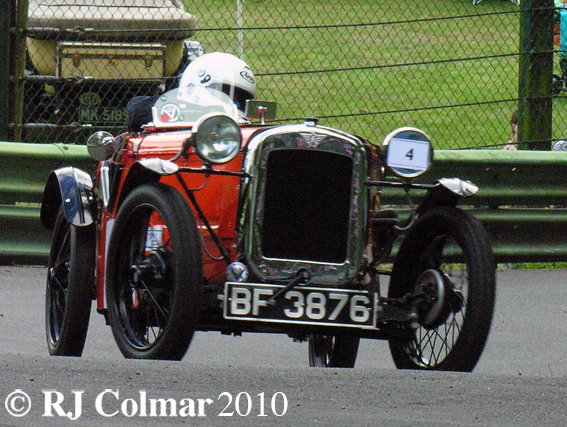
Above Joe Tisdall, 1930, Austin 7 Ulster, VSCC Prescott,

Their Dixi variant of the Austin 7 supplied in kit form initially in 1927 was so successful that within a year BMW bought the company after its own primogenitor vehicles proved less than viable. So the Ausitn 7 saved BMW from ruin as its aeroplane engine manufacturing business began to fail after shady dealings with the USSR came to light.
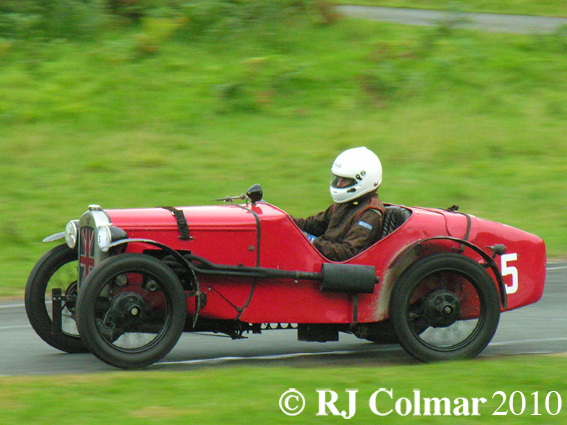
Above Mark Groves, 1930, Austin 7 Ulster, VSCC Loton Park.

This next bit traces the development of engines if you stick with it you’ll see the blood line from Austin 7 through BMW to Bristol.

In 1932 BMW used the 4 cylinder 747 cc / 45 cui Austin 7/ Dixi engine as the starting point for their own 4 cylinder 788cc / 48 cui motor used in their first all in house designed BMW 3/20

By 1933 BMW built a 1182 cc / 72 cui six cylinder version of the 3/20 engine called the M78 for their 303 model.

In 1934 a larger 1,490 cc 90.9 CUI six cylinder engine was developed from the M78 for use in the BMW 315/319 series of vehicles, which was superseded in 1936 by the hemi head 1971 cc / 120.3 cui six cylinder engine for the 328 model of 1936.
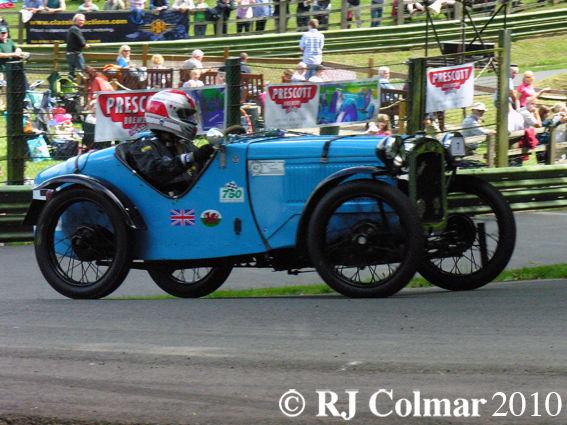
Above Miss Katherine Everett, 1930, Austin 7 Ulster, Prescott.

The plans for the 328’s engine first built in 1936 were appropriated as war reparations by HJ Adlington who was both in the British Army and Managing director of BAC Cars in 1947. The 328 engines designer Fritz Fiedler was also persuaded to move to England where he continued to develop the engine for the Bristol Aeroplane Company cars sold under the new ‘Bristol’ brand, thus the Austin 7 747 cc / 45 cui engine can be seen to be of the great, great, grand father of the Bristol marque which used hemi head 6 cylinder engines derived from the 1936 BMW 328 from 1947 to 1961.

I hope that wasn’t too convoluted or painful.
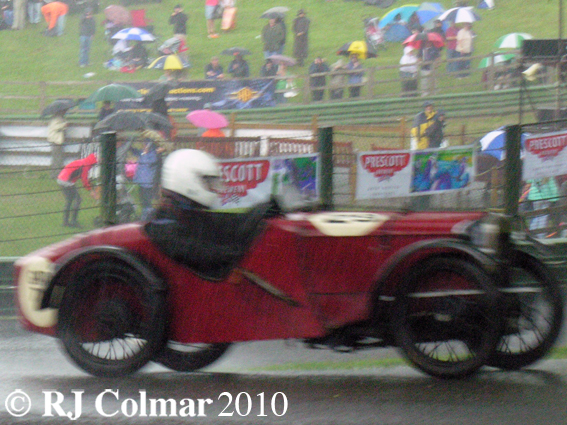
Above Edward Williams, 1930 Austin 7 Rolt Ulster, Supercharged, VSCC Prescott.

Rewinding back to 1927, Sir William Lyons took the basic Austin 7 and made a high end body for it which sold as the Austin Seven Swallow, moving the Swallow Sidecar Company from side car manufacture into motor car manufacture. In 1945 the Swallow Sidecar Company was renamed the Jaguar Car Company.
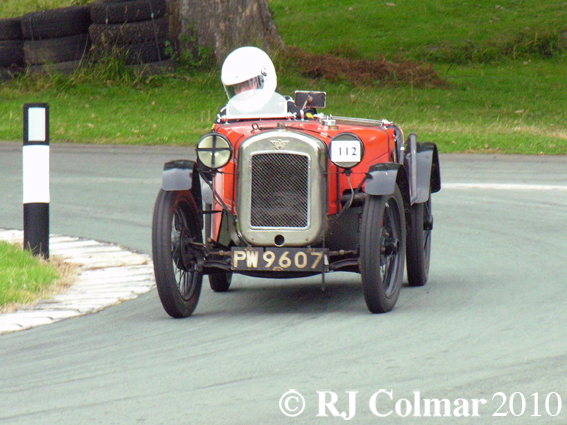
Mark Lance, 1930 Austin 7 Ulster TT Replica, VSCC Loton Park.

After WW2 many Austin 7’s were converted into specials as there were not enough new cars to meet demand in England. One of those converting an Austin 7 into a special was Colin Chapman who gave his special a now popular and familiar name Lotus Mk1.
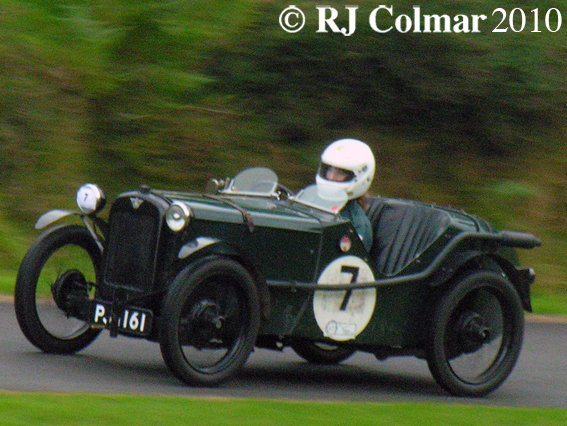
Above Ms Penny Jones, 1931, Austin 7 Ulster Replica, VSCC Loton Park.

The Austin 7 leant it’s name to another influential vehicle the original Austin Mini in 1959 which was originally marketed as the ‘Austin Seven’ and ‘Morris Mini Minor’.
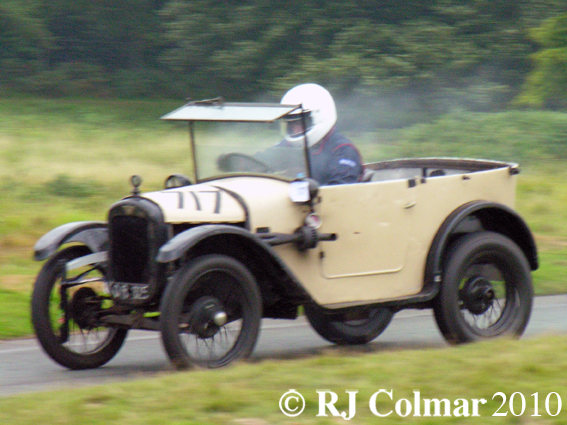
Above Benjamin MARCHANT, 1928 Austin 7 Chummy, supercharged, VSCC Loton Park.

I respectfully suggest that the humble little Austin Seven, which the Austin board only reluctantly agreed to back, became, through it’s role in the development of four prestige automotive manufacturers, one of the most influential vehicles of all time.

Thanks to Roger French and Julian Hunt at TNF for their help identifying a couple of these vehicles, to Tim Murray for his assistance identifying the Chummy and to everyone else for their time and patience, tomorrow I have the first instalment of another two part blog about an absolutely stunning replica of a vehicle which shines in one of my favourite stories about Le Mans, debutantes & underdogs, wishing everyone a fabulous Friday, don’t forget to come back now ! Class Dismissed 🙂

Share
