Tag Archives: Racing Car

Factory Floor Reinforcement – Ferrari 156 #0002R

The 1961 season ushered in the 1.5 litre / 91.5 cui era of Formula One and only one team was fully prepared for what was to follow, namely Ferrari who had developed a suitable V6 motor for the previous Formula 2 rules. The British manufacturer BRM as usual was behind schedule with it’s V8 motor and so resorted to using the four cylinder Coventry Climax motors that most of the remaining British garagiste entrants were forced to use until the Coventry Climax V8’s became available.

Ferrari entered only seven of the eight championship events and won five of them beaten only by Stirling Moss in an outdated Lotus 18 at Monaco and the Nurburgring. Ferrari team leader Wolfgang “Taffy” von Trips won the Dutch and British Grand Prix, Phil
Hill won the Belgian Grand Prix and privateer Giancarlo Baghetti driving an FISA entered won the French Grand Prix, coming off a run of two non championship Formula One Victories to make him the only man to win from his first three Formula One race starts.

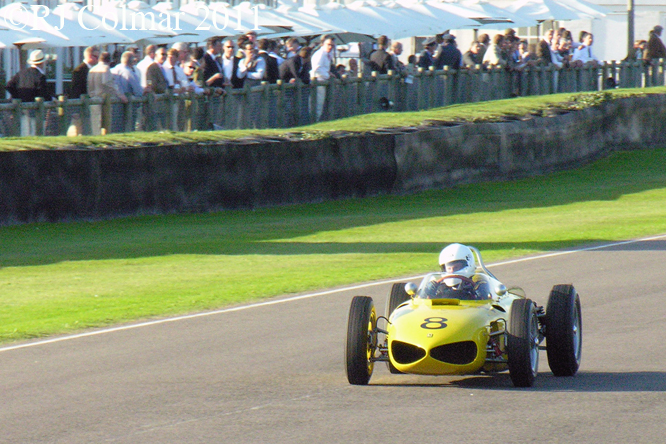
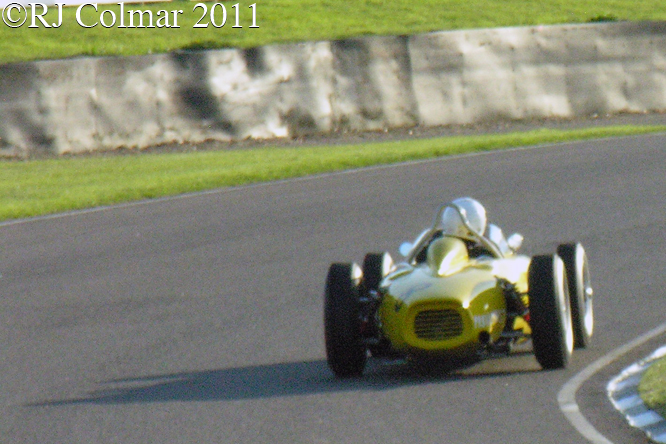
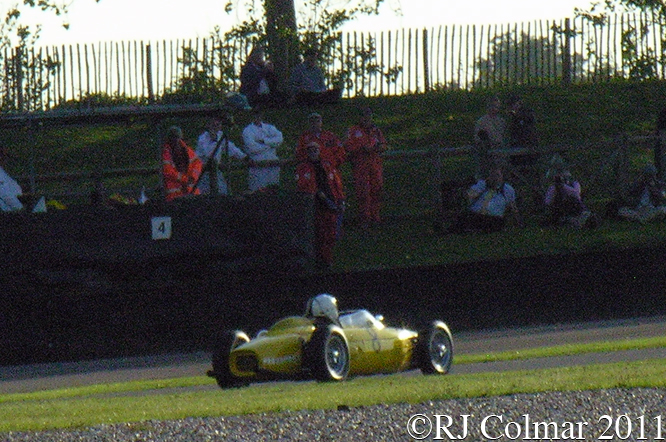
Ferrari 156, Replica, Goodwood Revival

Going into the penultimate race of the championship von Trips lead Phil Hill in points, however despite starting from pole von Trips was involved in an accident with Jim Clark that sent the German’s Ferrari into a collision with a grandstand at the end of the second lap. Consequently Von Trips and 15 spectators were killed and Phil Hill who started forth went on to win both the 1961 Italian Grand Prix and the Championship with one race to go.

Ferrari withdrew from the US Grand Prix, won by Innes Ireland driving a Lotus Climax 21 to record Team Lotus’s first team victory. At the end of 1961 the 156’s designer Carlo Chitti and team manager Romolo Tavoni walked out on Ferrari to found a new team called ATS, leaving Phil Hill and Baghetti joined by rookies Ricardo Rodriguez and Lorenzo Bandini to soldier on with the 156’s in 1962. The cars remained competitive in the opening races of the season but were eclipsed by both the V8 powered BRM P578 and Lotus 25, driven by Graham Hill and Jim Clark respectively, as the season progressed.

Ferrari 156, Replica, Goodwood Revival

At the end of 1962 Enzo Ferrari had all of the 156’s, known as Sharknoses, broken up with reusable parts saved for future use, while the chassis frames were cut up and used to reinforce a new Ferrari factory floor. For 1963 lighter versions of the 156’s were built in anticipation of a new V8 powered car designed by Mauro “Fury’ Forghieri that John Surtees drove to the 1965 World Drivers Championship Title.

The car driven by Jan Biekens featured today replicates the 65° V6 powered chassis #0002 in the colours of Equipe National Belge driven by Olivier Gendebien to a forth place finish with the three 156’s, all using more powerful 120° V6’s of Phil Hill, von Trips and Richie Ginther ahead of him. Von Trips drove the same car painted red at the Monaco Grand Prix where he was classified 4th after crashing on lap 98 of 100.

Ferrari 156, Replica, Goodwood Revival

I believe French GP winner Giancarlo Baghetti moved from the FISA to the Scuderia Sant Ambroeus team for the 1961 British Grand Prix at Aintree where he drove the original #0002 still fitted with the 65° V6 qualifying 19th and retiring after an accident having completed 27 laps. At the German Grand Prix Willy Mairesse drove the original repaired #0002 qualifying 13th on the tortuous Nürburgring and crashing out on the 13th of 15 laps.

For the Italian Grand Prix at Monza the original #0002 was fitted with the latest 120° V6 and given to Phil Hill who drove it to victory in the race and championship as outlined above.

In 2004 Jan undertook the building of this replica with Jim Stokes Workshops Ltd and it was completed some five years later using many original parts, you can see a diary of the work progressing in the ‘News’ pages of Jan’s website.

Thanks for joining me on this “Factory Floor Reinforcement” edition of “Gettin’ a li’l psycho on tyres”, I hope you will join me again tomorrow. Don’t forget to come back now !

Share

Balena Close, Poole, Dorset – Penske PC1 #001

After he had finished fabricating the Len Terry designed Eagle monocoques for All American Racers (AAR) in California, John Lambert returned to the Untied Kingdom and started a new business which was located on a small industrial estate outside Poole in Dorset where the rent was cheap. When Len Terry fell out with Frank Nichols they wound up Transatlantic Automotive Consultants based in Hastings where they had designed the AAR Eagle and Terry went to join Lambert, with whom he had worked at Lotus and AAR, in Poole starting a new business together called Design Auto.

In 1969 Len Terry started to design a series of stock block Formula 5000 open wheel cars called Leda’s, John Lambert looked after the construction of them in a facility off Balena Close on the Creekmore Industrial Estate on the outskirts of Poole, Dorset. When Leda Cars ran into financial difficulty they merged into the Malaya Garage Group in 1970. Three years later Malaya Garage Group did a deal with New Zealand racer Graham McRae selling the Leda Cars premises “lock, stock and barrel” with the cars manufactured now rebranded as McRae’s.

At around this time Roger “The Captain” Penske and Mark “Captain Nice” Donohue were experiencing many successes on the US racing scene which included three Trans Am championships, then only for manufacturers, driving the Captains Chevrolet Camaro in 1969 and AMC Javelins in 1970 and ’71.

In 1972 Mark won the Indy 500 in Roger Penske’s McLaren M16 and at the end of the year drove Penske’s McLaren M19 in the Canadian and US Grand Prix finishing a more than credible 3rd in his debut Grand Prix. The following year Mark and Roger won the Can Am championship with the “Turbo Panzer” Porsche 917/30. Having achieved pretty much everything in the US, including a NASCAR Winston Cup win at Riverside driving a Penske AMC Matador to become the last ‘road ringer’ to win a non oval race in that series back in 1973 Mark announced he would hang up his helmet at the end of the season.

Roger Penske made plans for a Formula One team in 1974 and sent Heinz Hofer to look at Graham McRae’s ‘low profile’ premises on the Creekmore Industrial Estate in Poole, Dorset UK as a possible base and concluded a deal for the premises. The Ford Cosworth DFV powered Penske PC1 was built to a design by Geoff Ferris and Mark Donohue was persuaded to come out of retirement to drive the car on it’s debut in the 1974 Canadian Grand Prix where he qualified 24th and finished 12th 2 laps down.
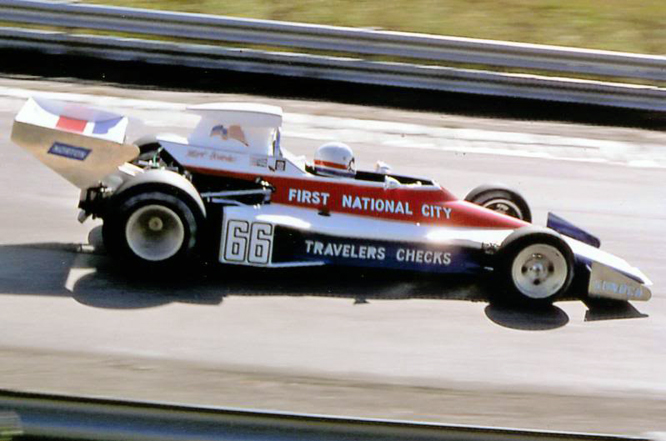
Penske Ford PC1, US Grand Prix, Watkins Glen

At the US Grand Prix, where Mark Donohue and Roger Penske fan, Brian Brown took today’s photograph of Mark in the PC1 at Watkins Glen the car started 14th on the grid, but retired after 27 laps with rear suspension problems. Brian recalls his first visit to a Grand Prix thus :-

“I was of course very excited to be seeing Mark race again, but being that it was my first live Formula One event, I was equally excited to be seeing Mario’s effort with Vel’s Parnelli Jones and the rest of the grid in person. We owned a Ferrari 365 GTB/4 Daytona and a 246 GT Dino at the time, so were very supportive of the Ferrari effort too.

My brother, friends and I spent a great deal of down time in the Kendall Garage watching the teams go about their business of working on the cars. One thing that was apparent was the absolutely professional presentation of the Penske team. Everything was spotless, just like their successful Indy Car counterpart that I’d observed in person since 1969 at Indianapolis. I was then, as now, a huge fan of Mark Donohue and Team Penske, but that aside, I always felt that they had too many positive resources not to be successful in Formula One.

I knew racing well enough to understand how tall the task Mark and the Penske team had ahead of them, but I also had the highest faith in their collective talents that I felt, given time, they would come right. I look back now and remember how I’d call in to our local ABC news tv affiliate to get the results of the races in 1975, always asking about the top six finishers along with Mark and Mario’s results.

Then came Austria and it was over for Mark and eventually Penske stopped the project – I was always appreciative that they carried on to get the victory with John Watson in Austria a year after Mark’s accident, something of a vindication for the mighty challenges that Team Penske faced in their Formula One foray. Watkins Glen 1974 was the last I ever saw Mark in person and despite the nearly 40 years that have passed, it seems like yesterday.”

Penske ended up building 3 chassis to the PC1 design chassis #001 seen here achieved a best 5th place finish, from 16th on the grid in the 1975 Swedish Grand Prix. Three races later Penske ditched the PC1 in favour of a March 751 which was raced until a new challenger until the new Penske PC3 was ready. As Brian alluded to above Mark Donohue was killed during practice for the 1975 Austrian Grand Prix after a tyre deflated pitching him off the track in to an accident which killed a marshal. Although Mark initially survived the incident he died the next day from a cerebral hemorrhage.

The debut of the Penske PC3 was delayed until the 1975 US Grand Prix where John Watson drove it in practice. Due to a misfire with the motor in the new car the team elected to wheel out today’s featured chassis one more time, John qualified 12th, finishing the race in 9th.

The following season Penske entered John in the PC3 and later PC4 models. With the latter the team won the 1976 Austrian Grand Prix, despite this success The Captain closed the Formula One program down at the end of 1976, deciding his future lay in the US racing seen where he would become the dominant force in Indy Car racing, with many of his winning cars being built in Poole, Dorset. Penske maintained facilities in Poole Dorset up until 2006. When the factory was closed one employee, Ivor, remained who had been part of the story going back to the Leda days, through the McRae years and into the Penske era.

In 2012 Brad Keslowski won his first NASCAR Championship driving a Penske entered Dodge a hitherto elusive goal on ‘The Captains’ to do list.

My thanks to Brian ‘ B² ‘ Brown for kindly agreeing to share his photograph; to kayemod, Nigel Beresford, Tim Murray, Tony Matthews, Dogearred and Doug Nye at The Nostalgia Forum for their help in piecing together the story behind Roger Penske’s presence in Poole, Dorset and a tenuous connection in the form of Lambert & Terry and their Leda Cars premises between the AAR Eagle and Penske Formula One efforts.

Thanks for joining me on this “Balena Close, Poole, Dorset” edition of “Gettin’ a li’l psycho on tyres”, I hope you will join me again tomorrow. Don’t forget to come back now !

PS Shortly before this blog was posted some confusion has come to light about which buildings in Poole Penske and McRae occupied and when, local resident kayemod and Nigel Beresford who worked for Penske have confirmed that Penske took over the Balena premises from McRae, while artist Tony Matthews is sure he visited a second facility a couple of miles away on Factory Road to do cutaway drawings for McRae and Penske is not so sure the Balena Close address is correct. If any further developments come forth I shall post them below, and if you know the answer to the riddle please do not hesitate to chime in.

PPS Nigel Beresford has kindly confirmed with another former Penske employee Nick Goozée that the Balena Close facility is the only one Penske purchased from Graham McRae. My thanks to Nigel and Nick for settling the matter so promptly.

PPPS
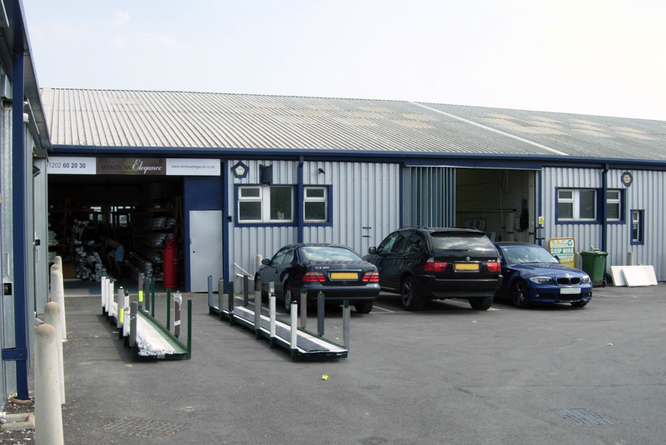
Balena Close, Poole, Dorset

Kayemod Rob from the Nostalgia Forum has kindly sent me this photo showing “how that corner of Balena Close looks today, the small unit to the right is the original Penske UK base, formerly McRae Cars. The three parked cars more or less cover the width of the premises. The ‘Elegance’ unit to the left of Penske was once FKS Fibreglass, later Griffin Design. My ex-Specialised Mouldings chum stylist Jim Clark worked at FKS, and as well as Penske’s stuff, they also did almost everything for the Gulf GT40s and Mirages among others, their unit extended leftwards to fill the corner of the block. Penske later rented an identical unit to the right of the pic, which doubled their floor area, after some of the dividing wall was removed, they used to run their F1 operation out of that.”

Thanks Rob.
Share

Britain’s World Beater – BRM P578 #P578/1 Old Faithful

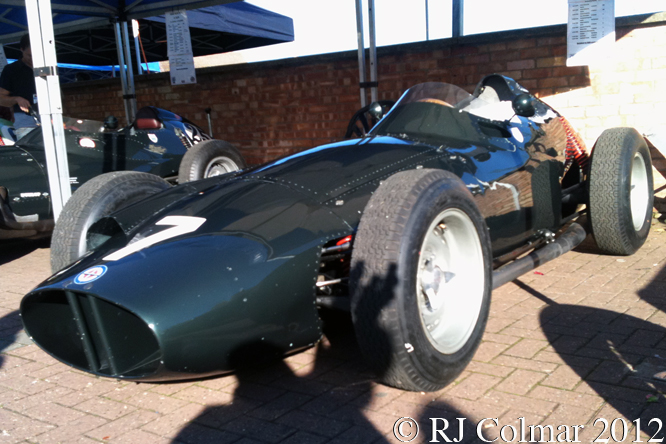
In 1961 BRM were running late with their 1.5 litre 91.5 cui engine program to meet the new Formula One engine regualtions and so came up with an interim design the P48/57 which was powered by a proprietary Coventry Climax engine like most of the British ‘Garagiste’ teams. For 1962 their new V8 was ready and though it was no more powerful than the Coventry Climax the BRM V8 did rev to 11,000 rpm as against only 7,500 for the Climax. The space frame from the 1961 car formed the basis of the ’62 challenger which was known as the P578.

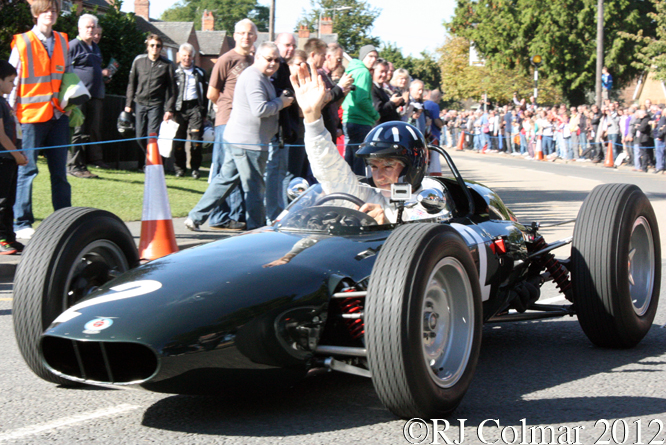
D Hill, BRM P578, BRM Day, Bourne, Lincs

Richie Ginther joined incumbent Graham Hill on the BRM driving strength from ’61 World Champions Ferrari. The main challengers for the 1962 World Drivers and Constructors Championships emerged as BRM and Lotus who had introduced a revolutionary new Climax powered car the Lotus 25 which featured a sheet aluminium monocoque chassis in place of the space frame constructed from tubes as was common practice up to that time.

D Hill, BRM P578, BRM Day, Bourne, Lincs

First blood in the 1962 season fell to Graham Hill in the Netherlands where Jim Clark finished last of the runners in 9th place 10 laps down in the new Lotus 25. Bruce McLaren won the Monaco Grand Prix in his Cooper Climax, the last win for the marque for three years until 1966. Jim Clark won for the first time in 1962 at the Belgian Grand Prix where he was followed home Graham Hill. The French Grand Prix saw a fourth different winner in the form of Dan Gurney who was driving a Porsche 804.

D Hill, BRM P578, BRM Day, Bourne, Lincs

Jim Clark became the first repeat winner of the ’62 season when he won the British Grand Prix from John Surtees driving a Lola Climax Mk 4. Graham Hill then won the German Grand Prix again from Surtees in the Lola. In Italy Graham became the first three time winner in ’62 when he led team mate Ritchie Ginther across the line. At the ’62 US Grand Prix Clark led Hill home by nearly 10 seconds.

Going into the last race of the season the superior reliability of the less radical BRM meant that Jim Clarks only opportunity to win the ’62 Championship was to win the South African Grand Prix held in East London. Clark won pole with Hill alongside him and dominated the race until he developed an oil leak with 25 laps to go. Five laps later Clark retired leaving Graham to claim his fourth victory of the season and his first World Drivers Championship. BRM also won their only World Constructors Championship seventeen years after Raymond Mays had founded the team to build a “British World Beater“.

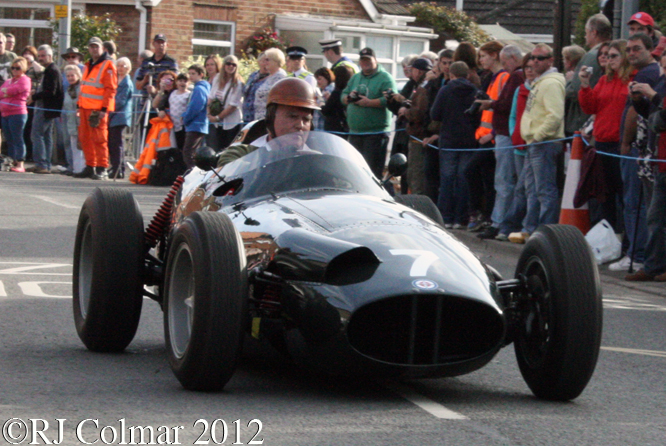
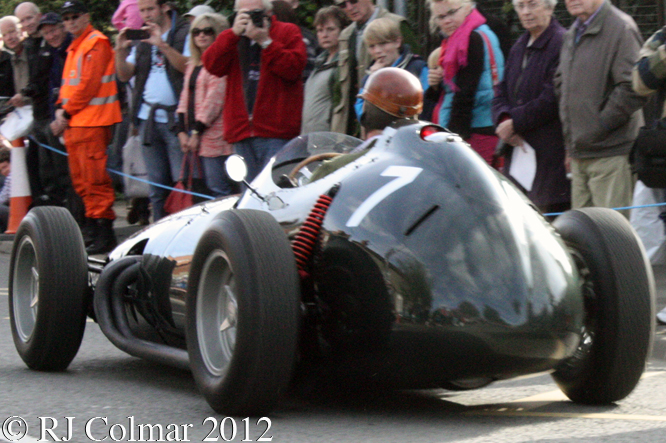
Today’s featured car BRM 578 chassis #P578/1 known as ‘Old Faithful’ was driven for much of the 1962 season by Graham Hill. The car which belongs Collier Collection in Florida is seen here at last years BRM Day being driven by Graham’s son 1996 World Drivers Champion Damon Hill.

Thanks for joining me on this “Britain’s World Beater” edition of “Gettin’ a li’l psycho on tyres” I hope you will join me again tomorrow. Don’t forget to come back now !

Share

Primer Car – MATRA Ford MS9

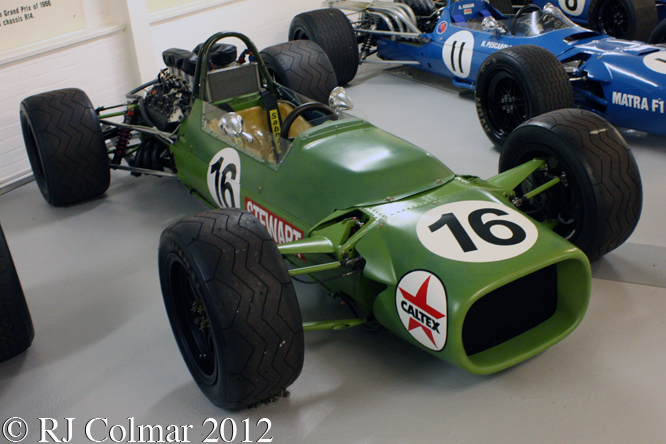
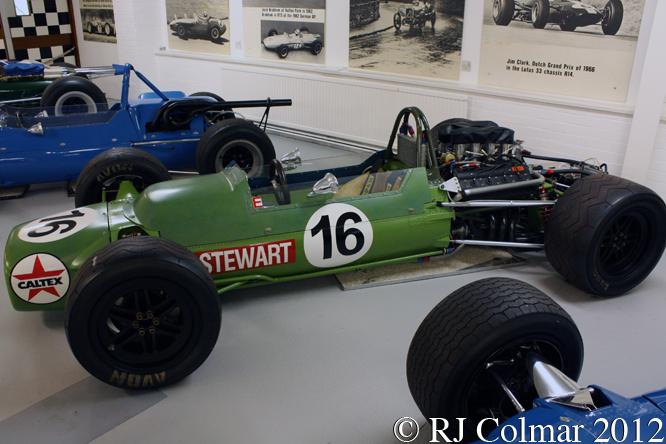
For 1968 Ken Tyrrell joined McLaren and Lotus by electing to buy a supply of Ford Cosworth DFV engines and did a deal with MATRA, who’s chassis he had run in Formula 2, to supply Formula One chassis for Jackie Stewart. While finishing the new MS10 challenger MATRA built the MS9 as an interim development car featuring a shortened MS7 Formula 2 monocoque which was adapted to take the DFV as a stressed member.

MATRA MS9, Donington Museum

The interim car was fitted with suspension adapted from it’s sports car programme to acommodate the larger Formula One wheels. The car was painted in a zinc or other chromate pigmented primer usually found in the aerospace business, MATRA’s prime business, to protect aluminium alloy.

MATRA MS9, Donington Museum

Jackie liked the car in testing and elected to race the primer test car in the 1968 South African Grand Prix in favour of the new MS10. Apparently a late attempt was made to paint the car French blue but the paint chosen did not adhere to the primer.

MATRA MS9, Donington Museum

Finance for the new MATRA International Team was provided by a new natianalised French oil brand Elf, which took over a large number of French Caltex retail outlets in 1968 that were subject to a carefully orchestrated overnight nationwide rebranding program.

MATRA MS9, Donington Museum

Having qualified an impressive third with only the Lotus 49’s of Jim Clark and Graham Hill ahead of him, Jackie Stewart stepped into the MS9 to start the race knowing he did not have enough fuel on board to complete the race without a pit stop.

MATRA MS9, Donington Museum

However on lap 43 the car had to retire with a broken valve spring and dropped valve.

MATRA MS9, Donington Museum

This car was then replaced by the MS10 for the remainder of the season. Note the curved grey bar is part of a subframe that links the rear suspension and gearbox directly to the chassis which kept the rear suspension and gearbox in place when the engine was removed.

Thanks for joining me on this primer car edition of “Gettin’ a li’l psycho on tyres” I hope you will join me again tomorrow. Don’t forget to come back now !

Share

Pressure and Success – BRM Type 25 #258

By 1954 Alfred Owen of the Rubery Owen Group had taken over the running of BRM from the British Motor Racing Research Trust which had been set up nine years earlier to build a British World Beater. The 1.5 litre / 91.5 cui supercharged V16 cars were updated to a short wheel base spec since there were few races for them to compete in that required large capacity fuel tanks necessitated by Championship Grand Prix race distances.

The World Championship started running to 2.5 litre regulations in 1954 and the first two races of the season were won by Juan Manuel Fangio who was entering what turned to be his prime driving a six cylinder Maserati 250F. Fangio then moved as agreed pre season to the Mercedes Benz team who were embarking on their third blitzkrieg on the top echelon of the sport in 60 years. Fangio won the ’54 and ’55 World drivers championships with the German team who successfully applied desmodromic valve and fuel injection technology to their straight eight W196 cars.

Fangio joined Ferrari, who were running V8 powered D50’s gifted from Lancia, in 1956 to win a third straight title and then rejoined Maserati in 1957 to win a forth straight and record fifth title with the Maserati 250F. Fangio retired midway through ’58 and his championship records stood for nearly 50 years until a German called Micheal Schumacher came along and broke them early in the 21st century.

BRM Type 25, BRM Day, Bourne, Lincs

Meanwhile Chez BRM things were progressing at a more leisurely pace a new Type 25 car was being designed with a simple 4 cylinder engine with large valves and an interesting three disc braking system with the rear disc being mounted on the back of the transaxle. Despite being much simpler than the V16 the car did not make it’s first public appearance until September 1955 by which time the Owen Racing Organisation had bought a Maserati 250F and entered it into a couple of World Championship events for Ken Wharton who finished a best 6th in the 1954 Swiss Grand Prix. Peter Collins drove the car in two World Championship events in 1955 but retired from both.

The Type 25’s, chassis type P25 and engine type P27, were supposed make their World Championship debut at the 1956 Monaco Grand Prix but were with drawn after the valves were damaged. Three cars were entered for the 1956 British Grand Prix but none finished however Mike Hawthorn led a BRM 1-2 followed by Tony Brooks for a while before retiring with a suspension problem. Brooks crashed out with a sticking throttle, his car ended up a completely burnt out right off, while Ron Flockhart retired with valve trouble after completing just 2 laps.

BRM Type 25, BRM Day, Bourne, Lincs

The Type 25’s did not appear in the championship again until Monaco in 1957. Nothing substantial was achieved by way of championship results but the Type 25’s did start winning non championship races, Jean Behra scoring the first at Caen.

1958 saw Jean Behra and Harry Schell compete in most of the races with the Type 25. Behra finished a seasons best third in Holland one place behind team mate Schell.

BRM Type 25, BRM Day, Bourne, Lincs

Jo Bonnier replaced Jean Behra who had moved to Ferrari in 1959 and with team owner Alfred Owen having agreed to hand over two cars to the BRP team to run for the remainder of the season prior to the ’59 Dutch Grand Prix the pressure was really on BRM to deliver going into the race. Bonnier arrived at Zandvoort with the disappointment of having almost won the Targa Florio in a Porsche having led most of the way.

The Type 25’s were quick in practice much easier to handle on their 15″ wheels than on the original 16″ with the benefit of much less tyre wear. After a great race with the works rear engined Cooper Climax’s driven by Marsten Gregory, champion elect Jack Brabham and the Rob Walker entered car of Stirling Moss all of whom experienced gearbox issues the smoothly driven BRM Type 25 #258 of Jo Bonnier crossed the line first to win the BRM team’s first Grand Prix 14 years after the team’s announcement in 1945. BRP headed by Stirling Moss’s father offered to reverse the agreement with Alfred Owen and settled for just one car #2510 which they ran in distinctive light green with white wheels livery.

Despite the BRM finishing 3rd in the World Constructors Championship the writing was on the wall that front engined cars were obsolete as the Coopers of Moss and McLaren convincingly won the last three races of the season and Jack Brabham won the first of two consecutive world championships.

Chassis #258 was purchased by Spencer Flack from The Hon. Amschel Rothschild in 2001 for an alleged £1.5 million. The following year while racing the car at Philip Island Spencer sustained fatal head injuries when he was thrown out of it. The car which had split in two and caught fire was rebuilt at the insistence of his widow and now belongs to John Pearson who is seen at the wheel in these photo’s taken at last years BRM Day.

Thanks for joining me on this “Pressure and Success” edition of “Gettin’ a li’l psycho on tyres” I hope you will join me again tomorrow. Don’t forget to come back now !

09 07 13 Errata I originally posted Roy Salvadori won the 1957 Caen GP in fact, as Tim has kindly pointed, out Jean Behra drove BRM Type 25 #253 to victory beating Roy Salvadori.

Share

Room For Two – Maserati 8CTF #3030

In 1937 the Maserati brothers harvested a reputation for building unprofitable but successful racing cars by agreeing a deal Adolfo Orsi in which Orsi took financial control of Maserati in return for the brothers commitment to work for the company that bore their name for at least ten years.

Maserati 8CTF, Palo Alto Concours d'Elegance

For 1938 new rules were introduced for the top echelon of European open wheel racing that had been dominated by Auto Union and Mercedes Benz since 1934. The new rules introduced for the first time a minimum weight depending on engine displacement of either 3 litres / 183 cui supercharged or 4.5 litres / 274 cui normally aspirated.

Maserati 8CTF, Palo Alto Concours d'Elegance

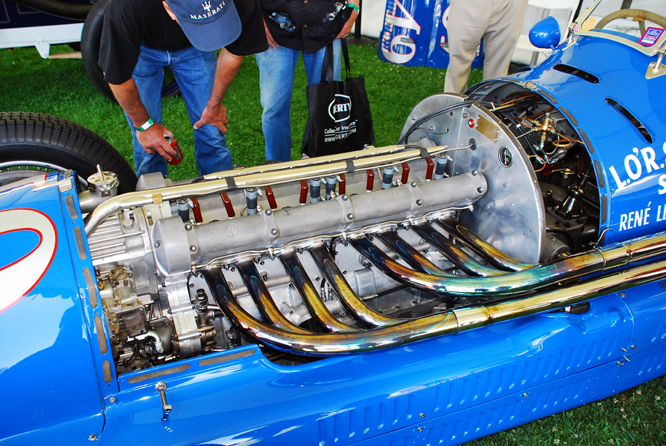
The Maserati brothers decided to go the supercharged route with a 3 litre / 183 cui in line 8 cylinder motor that featured a fixed ‘testa fissa” cylinder head that did away with the need for leaky cylinder head gaskets and allowed the motor to run with high supercharger pressure which was provided by two Roots type superchargers. in all 4 8CTF twin cam two valve motors were built that produced 365 hp. Well down on the 470 plus quoted for the contemporary V12 Auto Union D-type and Mercedes Benz W154.

Maserati 8CTF, Palo Alto Concours d'Elegance

Along with the 4 motors Maserati built 3 8CTF chassis numbers #3030, #3031 and #3032 all of which were entered for races in Europe with the greatest success being recorded by Paul Pietsch who led the 1939 German Grand Prix before six pit stops ensured a best 3rd place finish 1 lap down behind the winning W154 of Rudolf Carraciola and 2nd place D-Type of Hermann Paul Müller.

Maserati 8CTF, Palo Alto Concours d'Elegance

By the time of the 1939 German Grand Prix 8CTF chassis #3032 had been sold to Chicago Electricians Unionist Michael J. “Umbrella Mike” Boyle who had fielded the winning Boyle Products Special/Miller Indianapolis 500 entry for “Wild Bill” Cummings in 1934 eight years after his first entry in the Greatest Race On Earth. For the ’39 Indy 500 the Maserati was prepared by Crew Cheif Harry “Cotton” Henning and renamed “Boyle Special” that driven to Victory Lane by Wilbur Shaw who the following year using the same car became the first back to back repeat Indy 500 winner.

Maserati 8CTF, Palo Alto Concours d'Elegance

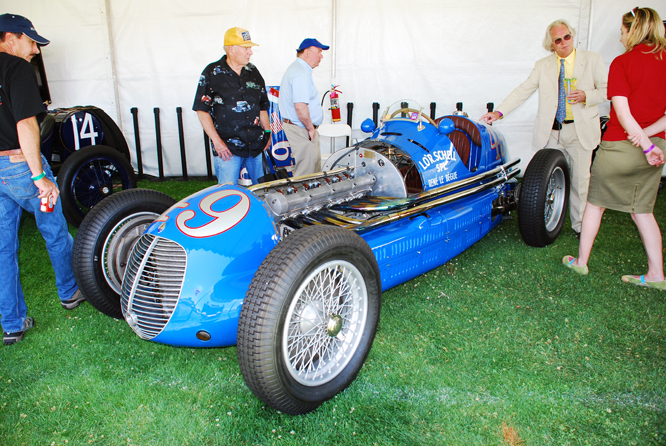
Today’s featured chassis #3030, seen in photographs by Geoffrey Horton at the 2011 Palo Alto Concours d’Elegance, was acquired by owner Lucy O’Reilly Schell along with the sister #3031 chassis who entered both cars in the 1939 Swiss Grand Prix for René Dreyfus and Comte Georges Raphael Bethenod de Montbressieux also known in racing circles as “Raph”. Dreyfus driving #3030 finished 8th in the second heat run in the rain 2 laps down while “Raph” appears not to have taken the start in the sister car.

Maserati 8CTF, Palo Alto Concours d'Elegance

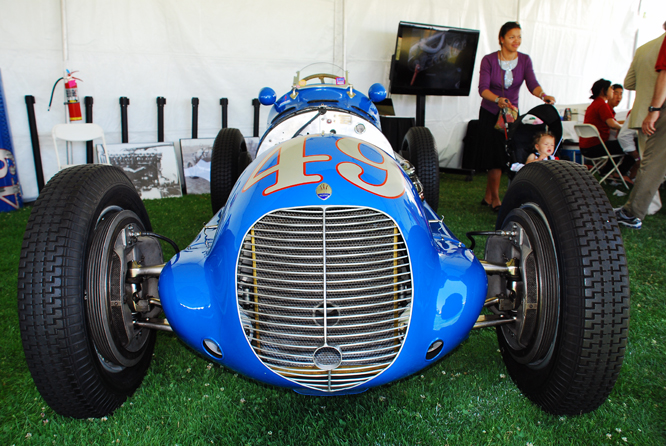
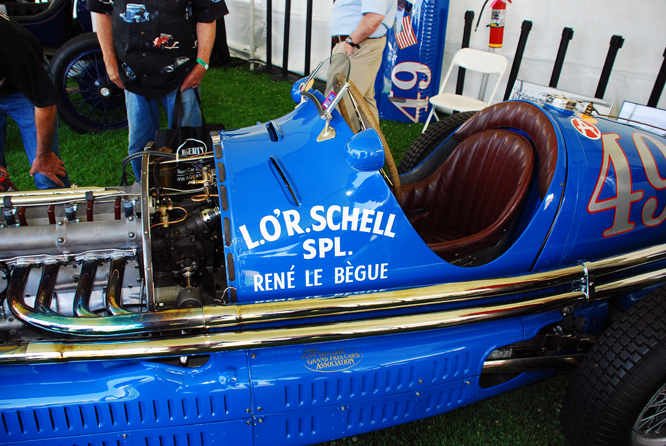
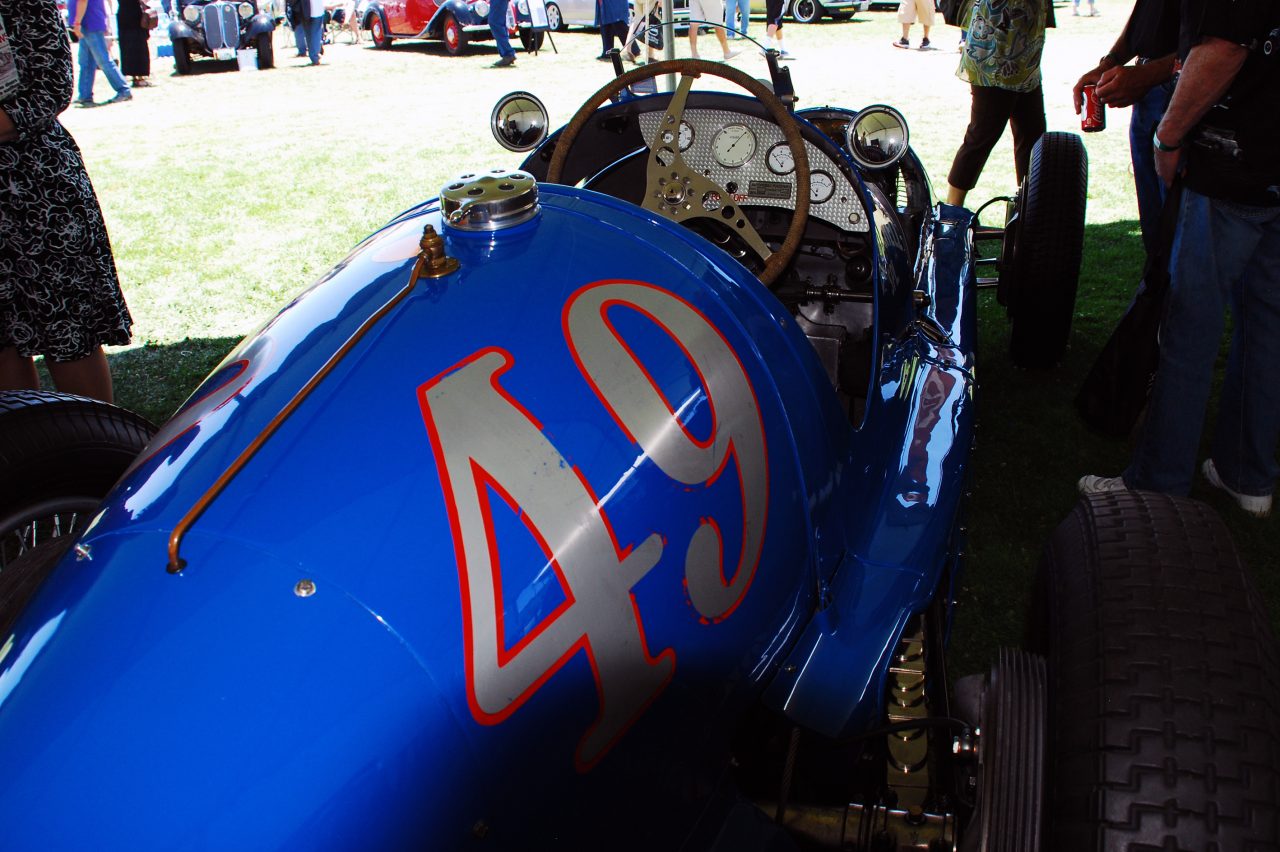
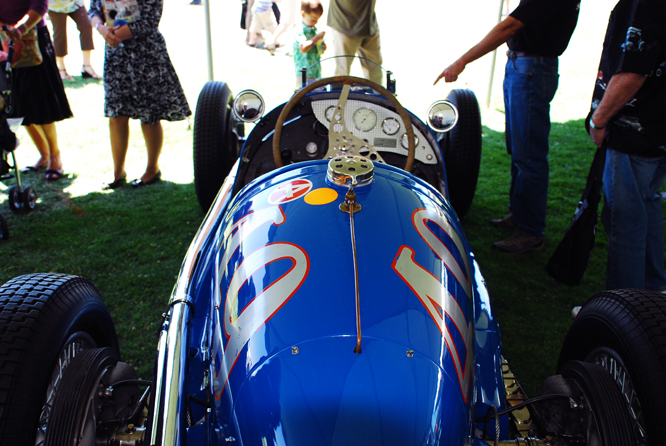
In 1940 all three 8CTF’s were entered in the Indy 500 with the Écurie Lucy O’Reilly Schell chassis #3030 for René Le Bègue and #3031 for Dreyfus joining Wilbur Shaw in the #3032 Boyle Special entry. Unfortunately the Écurie Lucy O’Reilly Schell team did not understand the bump day rules during qualifying so although Dreyfus qualified in the #22 entry on speed this did not exclude him from being bumped off the grid. Despite the protestations of the likes of ’39 winner Shaw. Dreyfus accepted his fate, sportingly Le Bègue offered to share the driving of the #49 chassis 3030 in the race.

Maserati 8CTF, Palo Alto Concours d'Elegance

While familiarising himself with today’s featured #3030 chassis the engine blew, after Dreyfeus had improved on the lap times recorded with his bumped chassis, with the result that the #49 chassis #3030 went to the grid for the 1940 Indy 500 with the engine from chassis #3031 fitted. Le Bègue started the race and handed over to Dreyfus as agreed with the car classified 10th on 192 laps at the races end.

Thanks to the research skills of Michael Ferner, who from contemporary reports has identified at least 21 possibly 23 Maserati’s entered for The Greatest Spectacle In Racing between 1930 and 1957, we know #3030 appeared as an entry at the Indy 500 in ’41, ’46 and ’48 through to ’53 recording a best finish of 4th in ’46 with Emil Andres at the wheel of what was now known as the Elgin Piston Pin one place behind Ted Horn in the Boyle entered #3032 chassis. The car’s last Indy start was in 1948 when Harry McQuinn completed just 1 lap from 26th on the grid to be classified 33rd and last.

Perhaps #3030’s greatest achievement was a 2nd place finish at Pikes Peak with Louis Unser at the wheel in 1949, two years earlier Unser won the Pikes Peak Hillclimb outright in the sister #3031 chassis.

My thanks to Michael Ferner, Alan Cox, David McKinney, VWV, Vitesse2 and fbarratt at The Nostalgia Forum who in one way or another all contributed to my understanding of the history of the Maserati 8CTF’s, finally thanks to Geoffrey Horton without whom today’s blog would be about something else.

Thanks for joining me on this “Room For Two” edition of “Gettin’ a li’l psycho on tyres” I hope you will join me again tomorrow. Don’t forget to come back now !

Share

38.907 sec Champion – Ferrari F2008

After an acrimonious 2007 season in which a Ferrari employee had been caught passing sensitive Ferrari documents to a McLaren employee after the McLaren Employees wife was dobbed in by a photocopy shop the 2008 season was relatively calm. The big story of 2008 being the on track battle between sophomore sensation Lewis Hamilton driving for McLaren and Ferrari’s de facto number two driver Felipe Massa who unexpectedly stepped up to the plate while his team mate reigning Champion Kimi Räikönnen experienced a post championship slump that saw him get bought out of a very expensive contract by the seasons end.

Ferrari F2008, Goodwood Festival Of Speed

Designed by an international team that included Italians Mario Almondo and Aldo Costa, Frenchman Giles Simon and Greek Nicolas Tombazis the F2008 ran with a 2.4 litre 146 cui V8 motor that was restricted, by a newly mandated McLaren Electronic Control Unit (ECU), to a maximum of 19,000 revolutions per minute (rpm).

Ferrari F2008, Goodwood Festival Of Speed

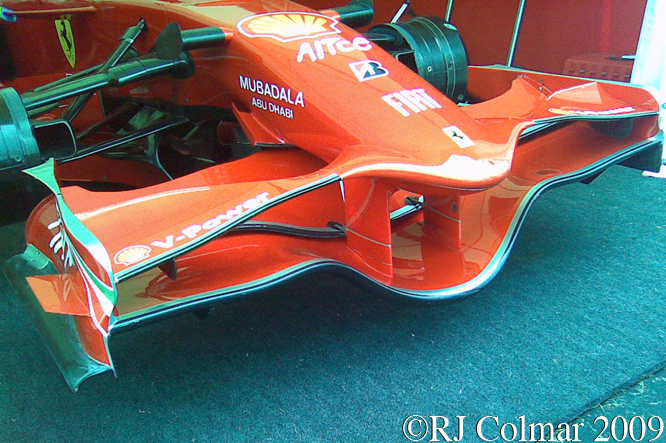
The curious front wing shape was partly a result of regulations demanding certain parts of the wing needing to be a minimum of 5 inches of the ground.

Ferrari F2008, Goodwood Festival Of Speed

This was the last season for which grooved tyres which had been mandated since 1998 to keep cornering speeds in check had been mandated. At the time Ferrari and one or two other well funded teams were running multiple wind tunnels simultaneously 24/7 to seek out the tiniest of aerodynamic advantages.

Ferrari F2008, Goodwood Festival Of Speed

Going into the Brazilian Grand Prix, last race of the season, Lewis Hamilton had five wins and led the championship with 94 points, while Felipe Massa had also scored 5 wins but only had 87 points due to his inferior placings, so there were multiple possibilities for Lewis to claim the championship but Felipe had to win with Hamilton finishing sixth or lower to claim the championship. Felipe started well by claiming his sixth pole position of the year, to Hamilton’s seven pole starts, and led the race which was delayed by rain and run in slippery conditions to cross the line first.

Ferrari F2008, Goodwood Festival Of Speed

Hamilton meanwhile had started from third on the grid was involved in a battle for 4th position with the Ferrari powered Torro Rosso of Sebastion Vettel going into the final pitstops, during which the dry shod Toyota of Timo Glock overtook the pair of them. Lewis and Sebastian both opted for intermediate tyres. Vettel was the first to catch and pass Glock to reclaim 4th place for good. Hamilton meanwhile only managed to pass Glock who’s dry tyres were struggling for grip on the damp track going into the very last corner of the very last lap to claim the necessary fifth spot crossing the finish line 38.907 secs behind Felipe Lewis relived the Ferrari driver of the World Drivers Championship title. Ferrai did however have the consolation of winning the Constructors World Championship for a record 16th time.

Thanks for joining me on this “38.907 sec Champion” edition of “Gettin’ a li’l psycho on tyres” I hope you will join me again tomorrow. Don’t forget to come back now !

Share