Tag Archives: Racing

A Drivers Dream – Ford Puma

The Ford Puma gained instant kudos when it was launched in 1997 with an award winning TV advert by Paul Street that featured clips from the film Bullitt and it’s star Steve McQueen apparently driving the little new Coupé.
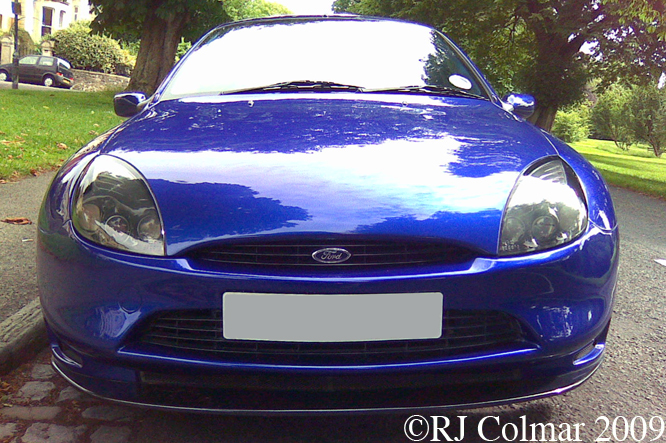
Ford Puma 1.7 16v

The Puma was based around the Ford Fiesta Mk4 chassis pan and running gear and came with four 16 valve engine options with power ranging from 90 to 153 hp.
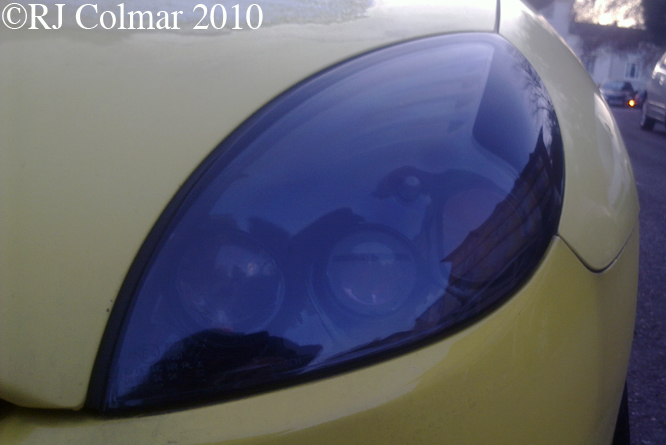
Ford Puma Millennium

Styling of the Puma followed Ford’s ‘New Edge’ styling theme that was first seen on the Ford Ka and second generation Mondeo 1996.
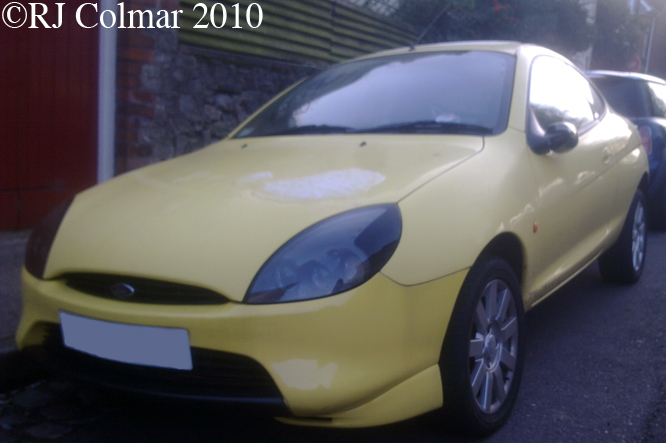
Ford Puma Millennium

Like the Ford Ka the Puma was also a niche market model, one which generated four special editions and a fifth kit car competition version. The Zinc Yellow of the vehicle seen above indicates the car is one of 1000 Millenium Puma’s built in 2000 of which over 700 are still thought to be on the road.
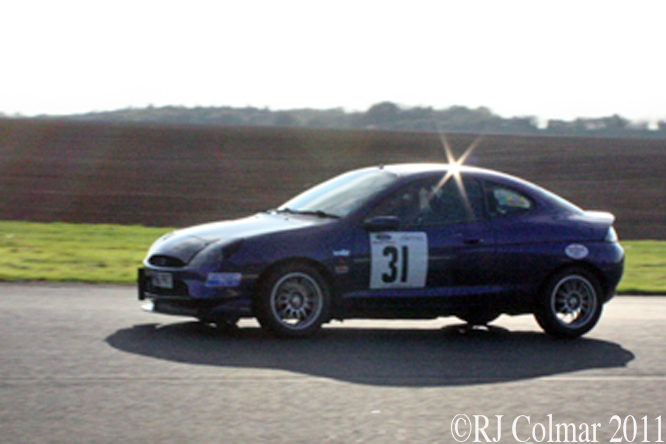
Ford Puma 1.7 16v Turbo, Regency Sprint, Castle Combe

The example above seen competing in the Regency Sprint at Castle Combe last year shared by Toby Harris and Lisa Selby is a 1997 model that has been upgraded with lightweight Carbon Fibre bonnet/hood and boot/trunk lid. The performance of this car has been further enhanced by the edition of a turbocharger.
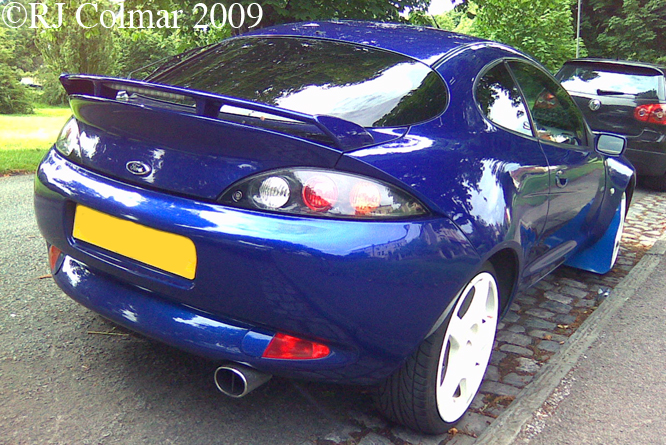
Ford Puma 1.7 16v

The vehicle featured in the top photo and the one above appears to be one of just 500 wide body 153hp Ford Racing Puma’s that was based on a styling exercise seen in 1999 called the ST160. Like the Ford Sierra RS 500 Cosworth all Racing Puma’s were built by Tickford’s, and were the only Puma’s not to be built at Ford Niehl Plant in Cologne Germany. Note the wheels and rear spoiler on this car appear to be after market items.
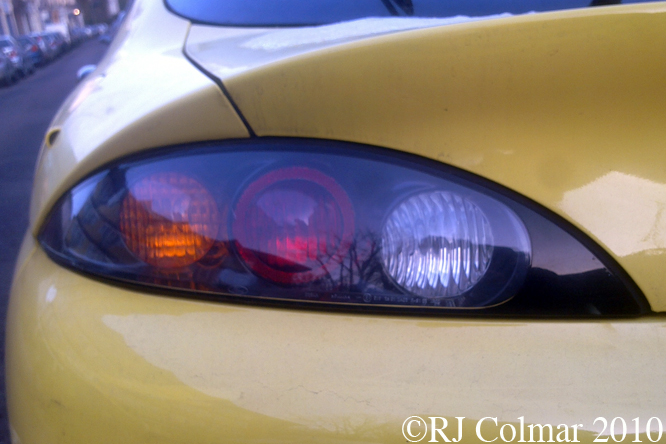
Last year the Ford Puma 1.7 was awarded the ‘Best Gem for under £1000’ award by What Car Magazine, the most desirable of all is the Racing Puma which despite losing Ford money on each one of the 500 sold and more than half having to be palmed off on lucky Ford employees at favourable rates are holding values five to seven times that which the lesser models fetch.
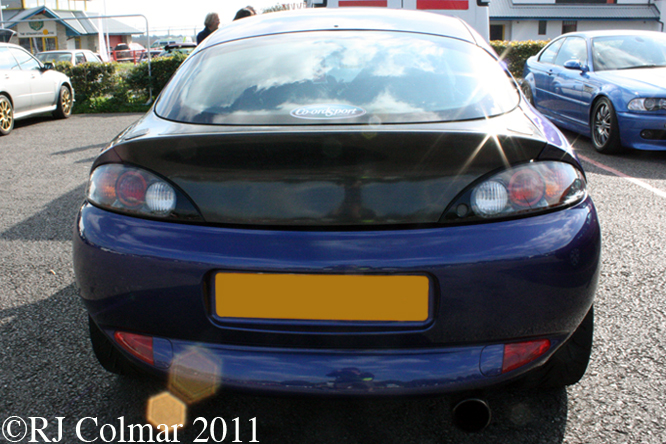
Ford Puma 1.7 16v Turbo, Regency Sprint, Castle Combe

Here is what one user, Ophelia, said about her Puma in 2002 “It is not a practical car, so don’t get rid of your Volvo yet but it is fun and it is effective and, all in all I do like it (but don’t tell my husband).”

Thanks for joining me on this ‘A Drivers Dream’ edition of ‘Gettin’ a li’l psycho on tyres’, I hope you will join me again tomorrow. Don’t forget to come back now !

Share

Hire Car – MG Bellevue Special

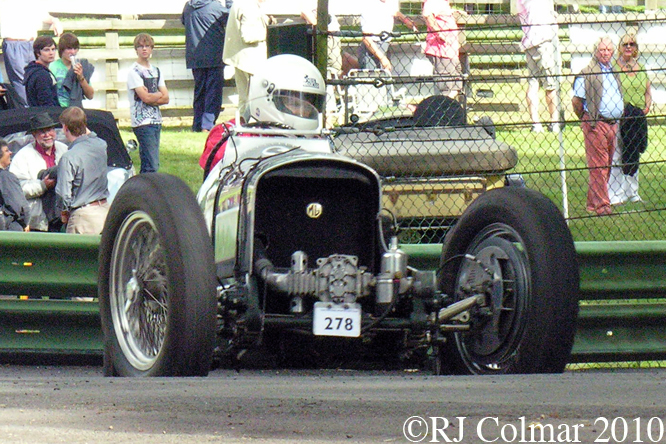
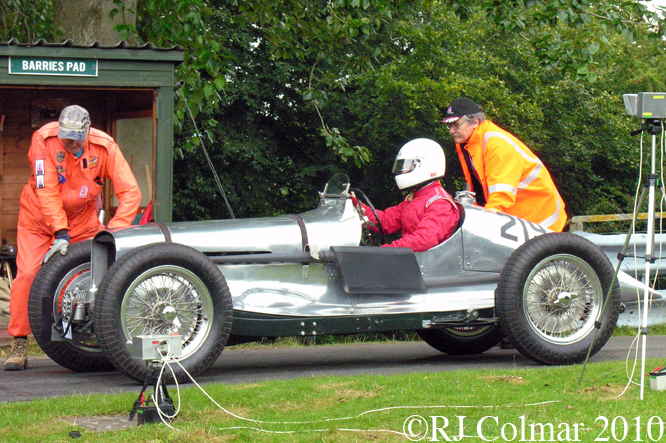
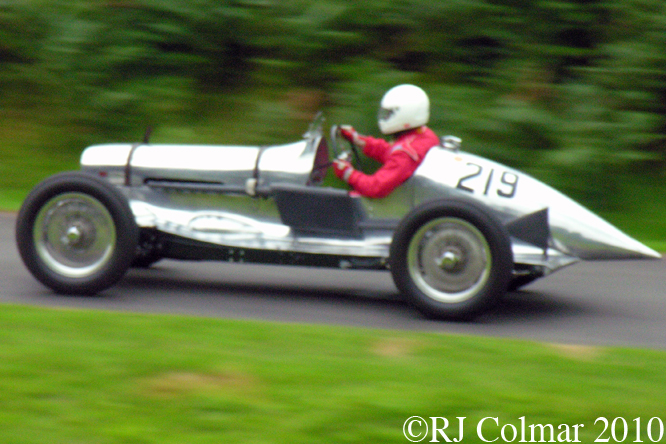
The MG Bellevue Special appears to have started life as one of the 745 MG N series sports cars built from 1934 to 1936. The first NA series chassis around which this particular vehicle was built was originally supplied with a twin carburetor 56 hp six cylinder motor upgraded from the Wolseley Hornet.

MG Bellevue Special, Prescott

In two seater guise this car was prepared by Walter ‘Wilkie’ Wilkinson of Bellevue Garages in Wandsworth London as a racing hire car for use at Brooklands in the 1935/36 seasons.

MG Bellevue Special, Loton Park

In 1937 Walter converted the car into an ‘offset’ single seater using earlier MG K-Type axles, brakes and wheels and the sleek aluminium body along with a rack of six Amal carburetors. The six carburetors were later replaced with a supercharger.

MG Bellevue Special, Loton Park

Wilke Wilkinson, a founder member of the British Racing Mechanics Club, went on to prepare the Le Mans Winning ‘D-Type’ Jaguars of Eccurie Eccose in 1956 & 57 and moved on to work with the BRM Grand Prix team where Graham Hill and Jackie Stewart were the drivers in residence. This car seen driven by Ian Baxter at Prescott and Luton Park has recently been sold, the asking price was £175,000.

Thanks for joining me on this ‘Hire Car’ edition of ‘Gettin’ a li’l psycho on tyres, I hope you will join me again tomorrow. Don’t forget to come back now !
Share

A tale of two chassis frames – Lotus Climax 19 Monte Carlo #952

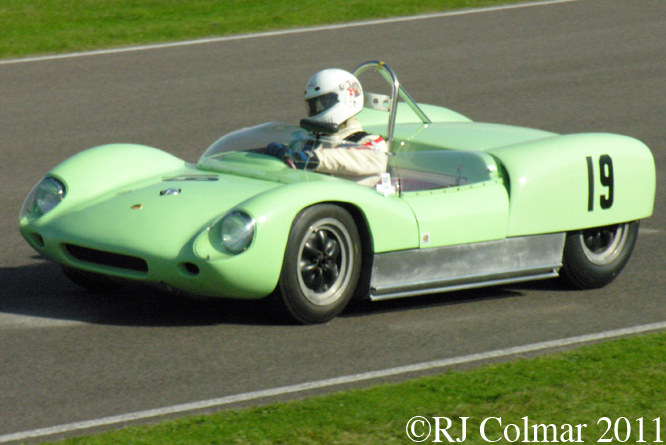
The Lotus 19 was a two seat version of the Lotus 18 mid engine Formula One car that Stirling Moss drove to an unexpected first marque Grand Prix victory for Lotus at Monaco in 1960.

In a case of history repeating itself, two years earlier in 1958 Moss had driven a Cooper to record that marques first Grand Prix victory and Cooper dubbed their 1958 sports car the Cooper Monaco, Colin Chapman dubbed the 19 the Lotus Monte Carlo in honour of Stirling’s achievement.

Lotus 19, Goodwood Revival

The Lotus 19 chassis #952 was originally purchased along with two others, #950 & #953, by the British Racing Partnership (BRP) team #952 & #953 were both acquired in 1961 and #950 in 1960.

BRP, co founded by Stirling’s Dad and Stirling’s ex manager entered the car under sponsors UDT-Laystall banner. The exact racing history of #952 from 1960 to 1962 is not known to me but by 1962 it was acquired by the Rosebud Racing Team in the USA and was successfully raced in the USA by Marsten Gregory and Innes Ireland.

By the end of 1963 the Rosebud Racing Team had managed to attach a 3 litre Ferrari V12 to #952 in place of the usual Coventry Climax 4 cylinder.

Innes Ireland sustained severe injuries when he crashed the now Ferrari powered #952 during practice at Pacific Raceways, Washington for the Pacific Northest GP.

Rescue workers had to cut Innes, who had a broken leg and hip, out of the wreck while he was still fully conscious on account of his morphine allergy.

Rosebud Racing replaced the chassis on their Ferrari powered racer while retaining the #952 chassis number, see second photo in this link and Innes Ireland bravely stepped in to drive it again.

Many years later, after ownership of #952 along with a Ferrari 250 GTO (!) was transferred to Victoria High School in Texas, #952 eventually ended up back in England with the Higgins brothers who rebuilt #952 in the 1980’s replacing the Ferrari V12 motor with a 2 litre / 122 cui 4 cylinder Coventry Climax.

The second chassis frame incarnation of chassis #952 is seen above driven by the Danish Baron Otto Reedtz-Thott at the Goodwood Revival.

Footnote this car should not be confused with a Lotus 21 Grand Prix car belonging to Alex Morton that carries the chassis number 939/952, apparently after 939 was damaged a replacement Lotus 21 chassis with the number 952 was sent to repair 939 and the frame has carried the 939/952 number ever since.

My unreserved thanks and congratulations to the many contributors on the Case history: Lotus 19 Monte Carlo thread on The Nostalgia Forum which has been attempting since 2004 to piece together the histories of all 17 of the Lotus 19 Monte Carlo’s that left the factory. Particular thanks to Micheal Oliver, David Birchall and David McKinley who kindly answered specific questions.

Thanks for joining me on this Carceaology Edition of ‘Gettin’ a li’l psycho on tyres’, I hope you’ll join me again tomorrow. Don’t forget to come back now !
Share

Thunder In The Hills – Mendips Raceway

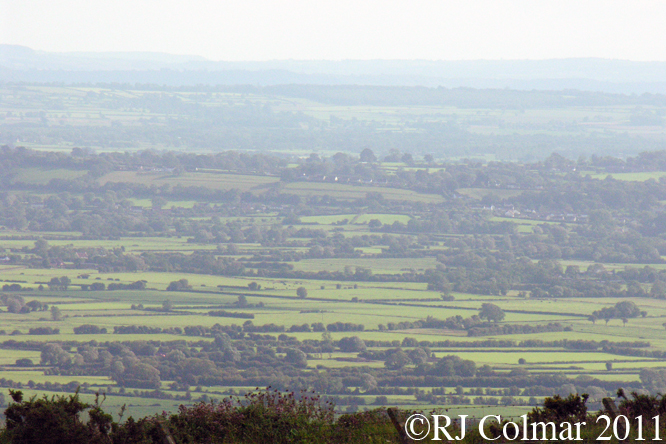
Last Sunday after I had dropped friends off at the airport I found myself with some unscheduled time on my hands. Normally I might have sauntered home to watch what remained of the Belgian GP but when I got to the roundabout of decision I headed in the opposite direction from home and went on a little drive through Somerset.

Somerst

After a couple of deviations from the main road I came to a tiny sign saying ‘STOCK CAR RACING’, I needed no encouragement to follow it and ended up at Mendips Raceway.

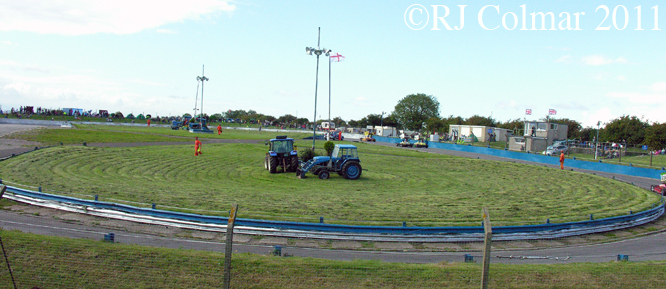
Mendips Raceway

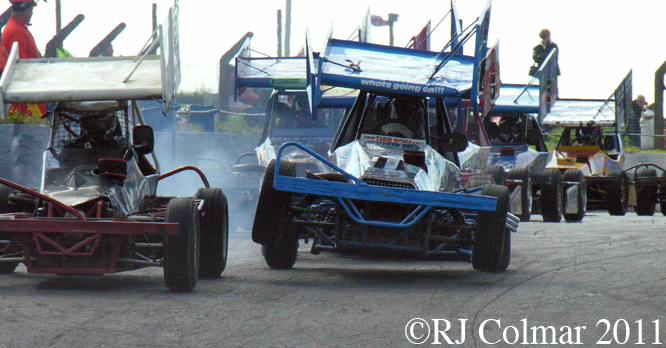
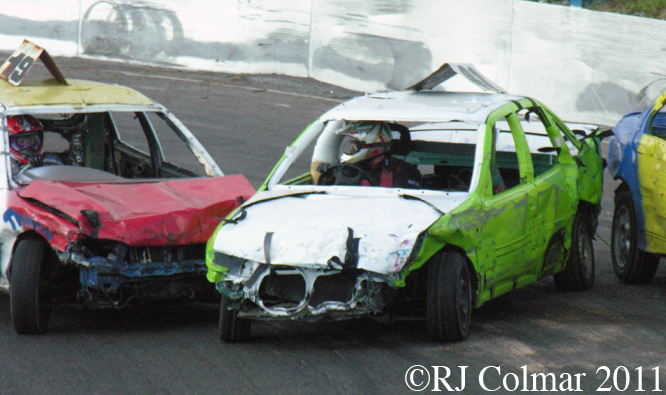
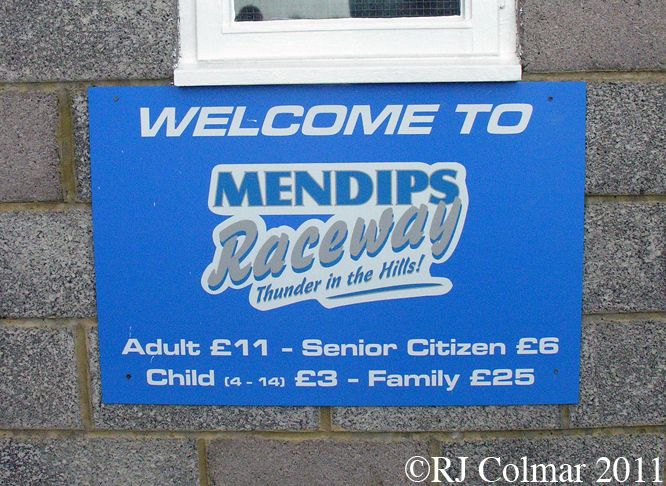
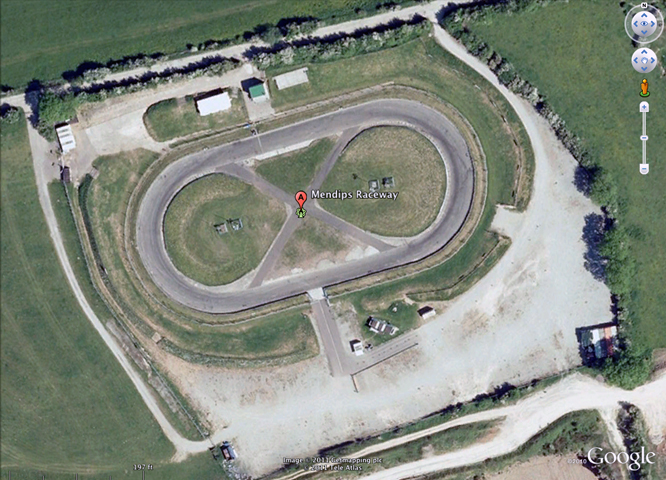
Mendips Raceway turns out to be my local paved oval located between Shipham and Charterhouse it caters for the four formulae which collectively are often referred to as Banger racers.

Mendips Raceway

The Mendips Raceway oval, opened in 1969, dips to the east with an optional figure of 8 configuration. This year fourteen dates comprised the fixture list.

Mendips Raceway

Races are started behind a pace car with drivers starting positions usually in reverse championship or reverse previous race order.

Ford Mondeo, Mendips Raceway

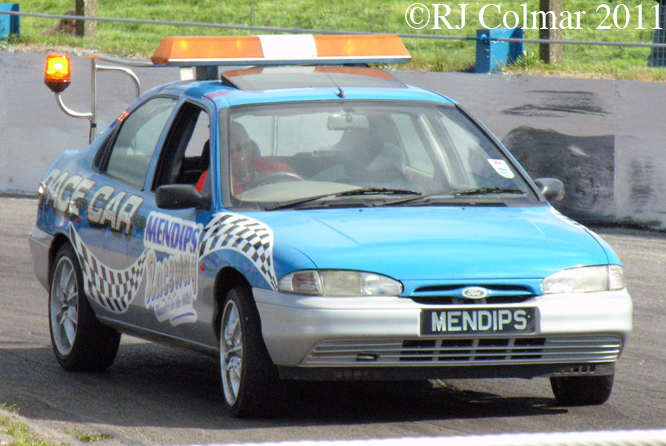
This series I Ford Mondeo served as both Pace Car and Victory Parade car on Saturday.

Andy Russel, Aaron Charles, Mendips Raceway

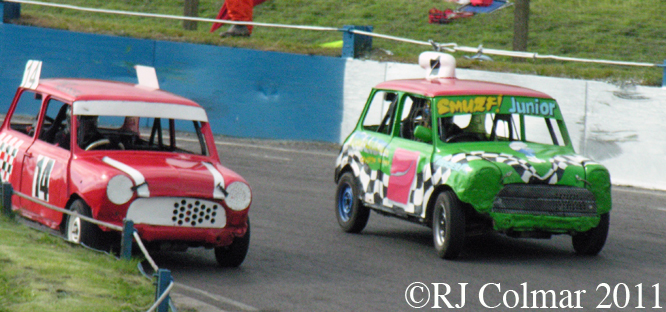
The entry level into banger racing is known as Junior Rods featuring vehicles with engines up to 1000cc / 61 cui such as the Mini’s of #14 Andy Russell and #7 Aaron Charles. Junior Rods are a strictly non contact form of banger racing aimed at attracting competitors aged 11 -16.

Liam Rowe, Mendips Raceway

BriSCA Formula 2 can trace it’s origins back to 1960 when a formula for heavily armoured, usually self built cars weighing 650 kgs / 1430 lbs was introduced. Today these cars maybe powered either by Ford Pinto or Ford Duratec motors. Contact between vehicles is permitted in F2 though Liam Rowe was probably wondering if it was worth it as his front wheels get airborne. Note unlike the closed wheel cars which turn right F2 cars turn left.

#14 Sam Holdings, Mendips Raceway

Finally there were several heats and a final for Rookie Bangers in which almost anything appears to go as #41 Sam Holdings finds out on the way to winning the Rookie Bangers trophy.

Thunderbird 1 & 4,  Mendips Raceway

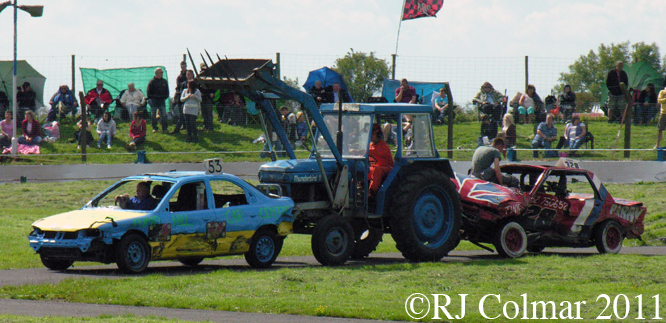
After the races four tractors, named Thunderbirds 1 to 4 were used to clear up the mess. Thunderbird 1 is seen pushing Adrian hearts Mondeo and pulling Lee Dalton’s Ford Cortina to the paddock, where repairs were made, and both cars started further races !

Mushwacker, Mendips Raceway

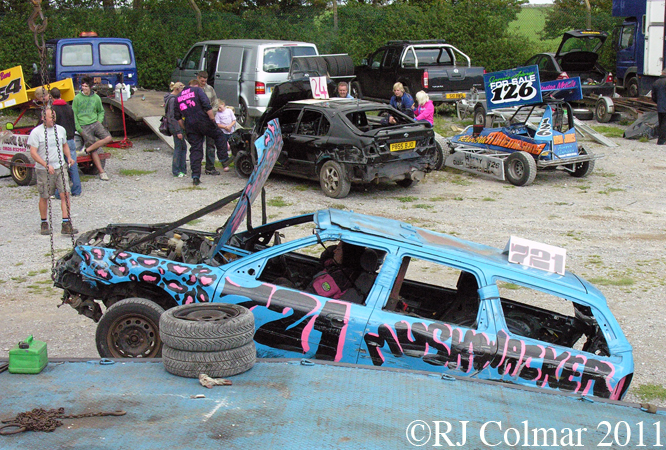
Having a lifting crane on your transporter can make access to vehicles for routine maintenance and repairs easier tasks. Note the driver of the #721 Mushwacker is powered down ‘a la’ Jimmy Johnson at Texas in Fall 2010.

Austin A40 Countryman, Mendips Raceway

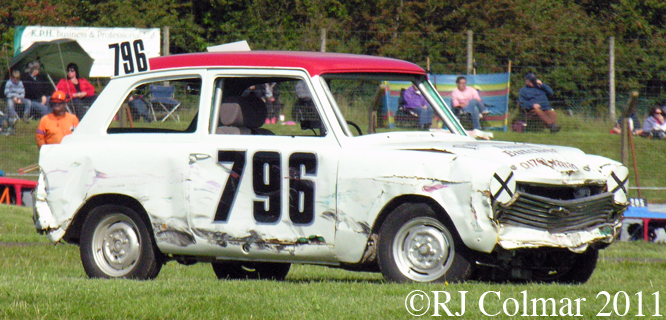
Car of the day for me was this Pininfarina designed Austin A40 Countryman, a car of the type I first steered on a beach while sitting on my old mans lap aged all of 5, this one being a tad over enthusiastically pedalled by Dan Steeds who got himself black flagged from one of the Junior Rods races for avoidable contact.

Thanks for joining me on this Banger edition of ‘Gettin’ a lil’ psycho on tyres’ I hope you will join me again tomorrow. Don’t forget to come back now !
Share

Stepping Stone – Dallara Renault F304

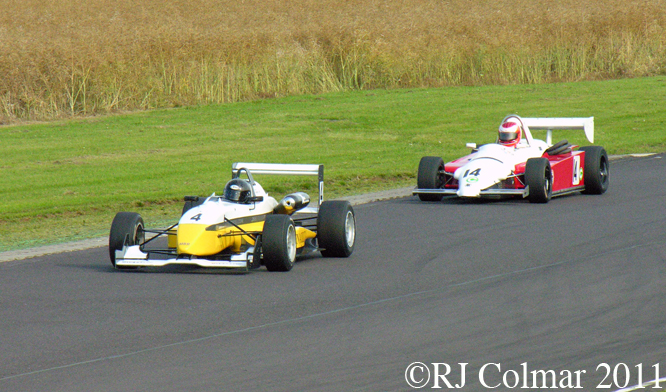
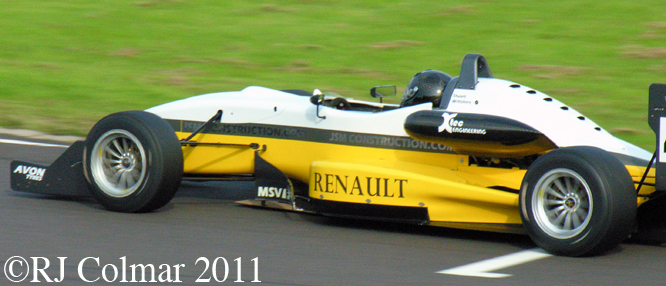
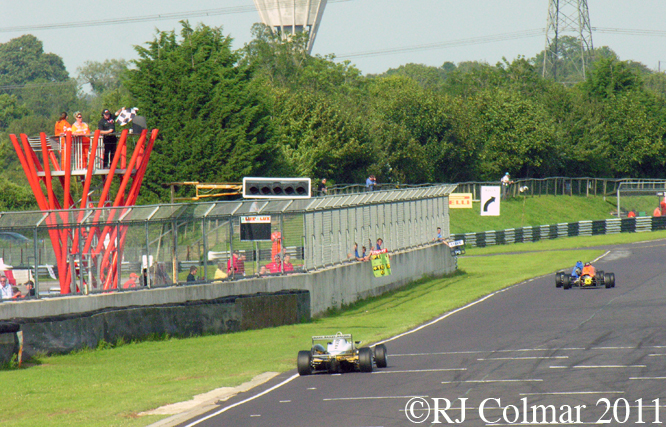
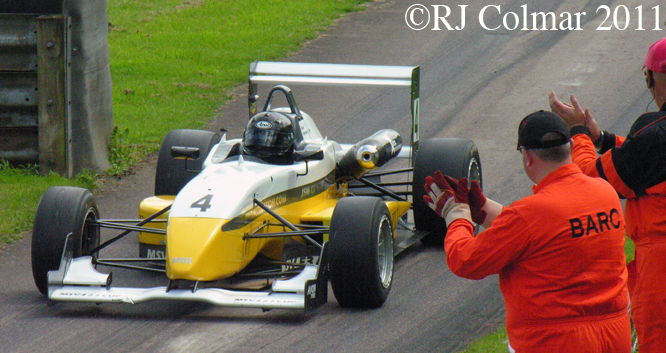
The winner of the last two rounds of the Free Single Seater Series at Castle Combe was the aptly named Stuart Wiltshire in his Dallara Renault Xtec F304, though it turns out that Stuart is actually an Essex Boy born and bred.

Dallara F304, Castle Combe

Dallara was founded by Gian Paolo Dallara near Parma Italy in 1972 specialising in building sports racing and hillclimbing cars . After penning one of the wilder body work configurations for Walter Wolf‘s Can Am team in 1977, Dallara was commissioned by Wolf to build a third tier open wheel Formula 3 car. Built to similar regulations as the F304 seen here, the Wolf F3 car was driven by Bobby Rahal at Monaco.

Dallara F304, Castle Combe

During the 1980’s Dallara Formula 3 cars started winning championships in Italy then France and Germany before going on to dominate the most competitive series of all in Britain during the 1990’s.

Dallara F304, Castle Combe

Today Dallara is known world wide having briefly competed in Formula One and built a variety of sports cars for teams including Lancia, Ferrari, and Audi. More recently Dallara were one of the original suppliers of chassis to the Indy Racing League and now have an exclusive deal to supply IRL chassis and they have built a near monopoly in every series used as an entry by drivers trying to reach Formula One.

Dallara F304, Castle Combe

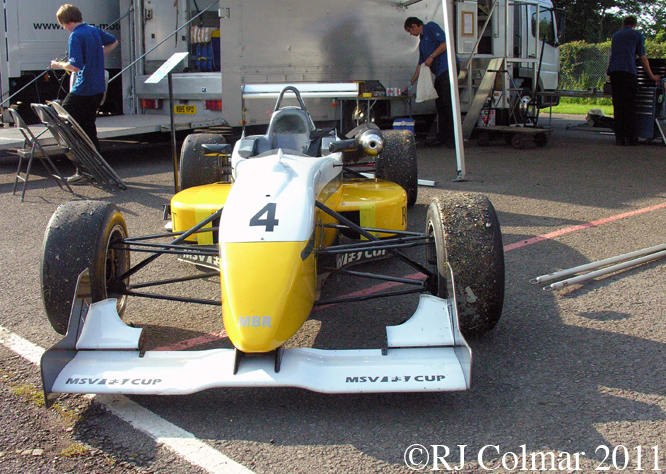
In 2004 the British Formula 3 Series was dominated Dallara F304 chassis like the one in these photo’s most were powered by Mugen Honda motors but Renault and Opel, the German GM division were represented with multiple entries.

Dallara F304, Castle Combe

Among those driving Dallara F304’s when they first appeared were British 2004 Champion Nelson Piquet Jr who after a brief tormenting career in Formula One today drives in the NASCAR Trucks division, Lucas di Grassi the Pirelli F1 tyre tester who last year drove for the Virgin Grand Prix Team and in 2004 drove a Renault powered F304 identical to the car featured today, Australian Supercar V8 contender Will Davison, fellow Aussie Will Power who today is part of the Penske IRL team, Venezuelan IRL driver EJ Viso and Karun Chandock who became the first driver to record a finish for the HRT Grand Prix team last year and is an occasional driver for the Team Lotus Grand Prix team this year.

Dallara F304, Castle Combe

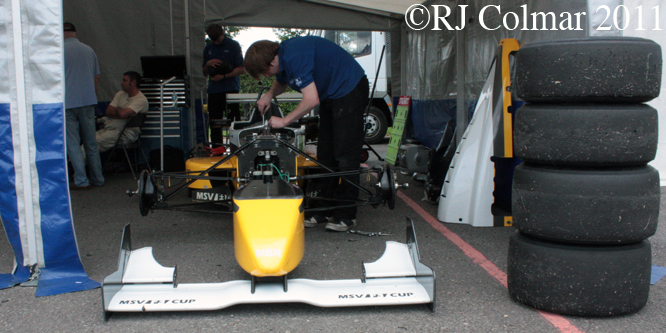
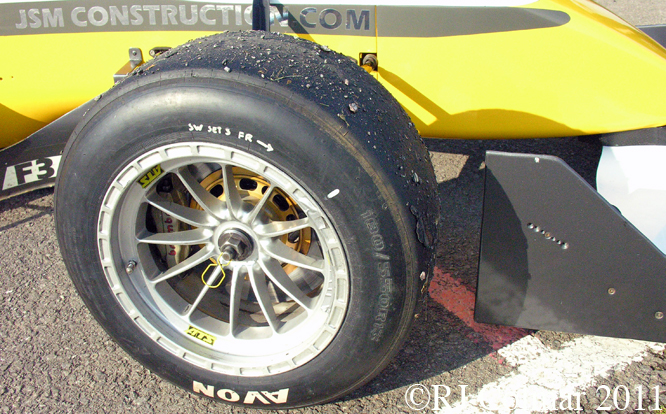
Seven years on from it’s first appearance Stuart Wiltshire is competing in the MSV F3 Cup with his JSM Construction sponsored car being prepared by Mark Bailey Racing who started off in the Toyota Formula 3 Championship in 1989, with Mark Bailey taking the championship spoils and have participated in World Sports Car Championships with their own design the MBR 972.

Dallara F304, Castle Combe

Stuart a director of a construction company has competed in Formula 3 championships for older vehicles on and off since 2003 the highlight of his career was leading into the first bend at Donington Park earlier this year.

Dallara F304, Castle Combe

With a couple of wins behind him at Castle Combe, I wish Stuart all the best as he returns to the MSV F3 series and look forward to future appearances of Stuart and the immaculate Mark Bailey Racing Dallara Renault F304 at Castle Combe for the Free Single Seater Series.

Thanks for joining me on this stepping stone edition of ‘Gettin’ a lil’ psycho on tyres’, I hope you’ll join me again tomorrow for Ferrari Friday. Don’t forget to come back now !
10 11 11 Post Script – Since posting this blog it has been brought to my attention that Stuart Wiltshire has a Dallara F302 with 04 updates for sale. I can’t say for sure this is the same car as featured in this blog. The car in the blog was definitely described as an F304 in the MBR team blurb at Castle Combe when I saw it.

Share

Last of the line – ERA R14B

English Racing Automobiles was founded by driver Raymond Mays, designer Peter Berthon and financier Humphrey Cook in 1933 to manufacture racing cars capable of upholding British prestige in Continental European races.

Without the financial or engineering resources made available to Mercedes Benz and Auto Union in top flight Grand Prix races, ERA focused their efforts one step down, in the GP2 or Indy Lights of its day known as voiturette racing for vehicles with supercharged motors from 1.1 litres / 67 cui to 2 litres / 122 cui.

The ERA engines came in three sizes and were based on a 6 cylinder Riley production block with a stronger crankshaft and entirely new aluminium cylinder head.

Chassis design was by Reid Railton and the body work was by George and Jack Cray to a design by a Mr Piercy who like Railton had been responsible for the design of Malcom Campbells land speed record breaking vehicle ‘Bluebird‘.

ERA R14B seen here is the 14th and final original ‘sit up and beg’ originally a pale blue vehicle built in 1938 with a 1.5 litre /91 cui Zoller supercharged engine for Johnnie Wakefield who won the 200 mile race at Brooklands and finished third in the 1938 Bern GP.

Bob Gerard acquired the car after WW2 and scored third and second place finishes at the British Grand Prix of 1948 and 1949, he continued to race the car successfully until 1956.

Current owner Donald Day purchased ERA R14B in 1958 and has raced it with a 2 litre / 122 cui motor in place of it’s original 1.5 litre 91 cui unit. In 1990 14B appeared for the first time in British Racing Green.

This same vehicle was driven to victory in the pre 1959 Historic Grand Prix at Monaco by Julian Bronson in 2002.

All photo’s bar the penultimate one from the September VSCC meet at Loton Park, the penultimate one was taken at the August VSCC meet at Prescott.

Thanks to David Hodgkinson for back ground information on ERA 14B.

Hope you have enjoyed todays British Racing Green edition of ‘Gettin’ a lil’ psycho on tyres’, and will join me tomorrow for a look at a high flying special. Don’t forget to come back now !
Share