Tag Archives: Ralph

Big John Burns Rubber – Edenbridge Fun Day

On Bank Holiday Monday I popped over to Edenbridge, Kent, just south of London, where John Surtees was due to take part in the Edenbridge Fun Day with a demonstration of his first Formula One Car the Surtees TS7.
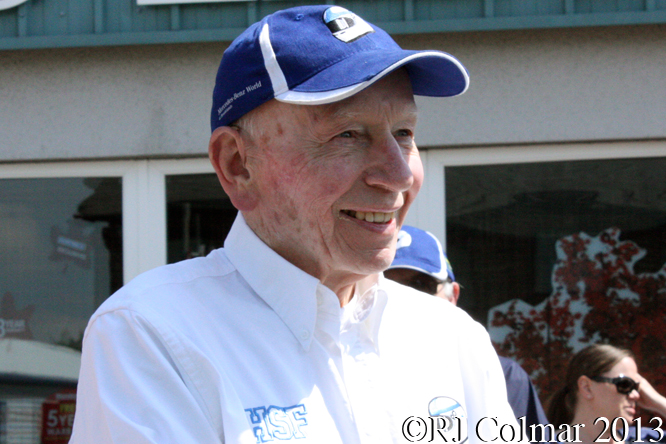
John Surtees, OBE, Edenbridge Fun Day

John was in good form and delighted to be promoting Edenbridge the town in which he based his racing team and the Henry Surtees Foundation that John set up in memory of son to give young people an opportunity to experience the emotion, disciplines and learning that the world of motorsport can offer.
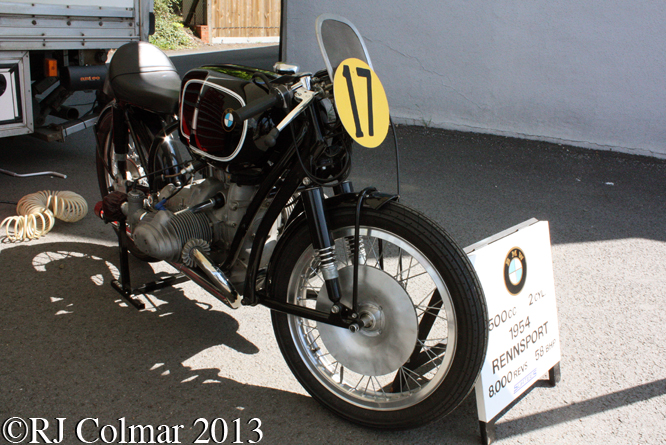
BMW 500 Rennsport, Edenbridge Fun Day

Taking part in the demonstration were two of John’s bikes, he was seven time world motor cycle champion in 350 and 500 classes locking both out from 1957 to 1960, above a 1954 58p 500cc BMW Rennsport.
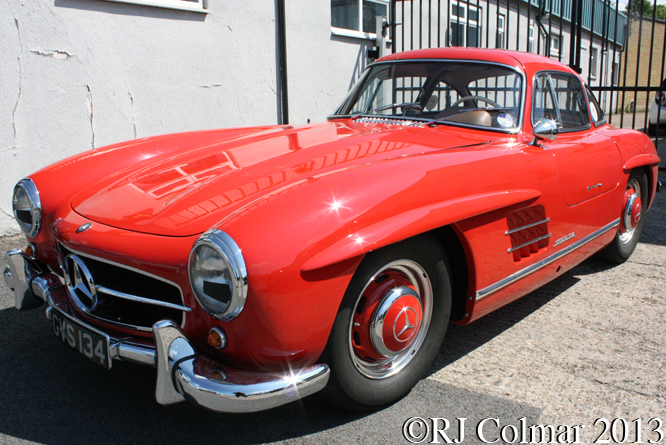
Mercedes 300SL, Edenbridge Fun Day

John’s 1956 Gullwing Mercedes 300SL also took part in the parade.
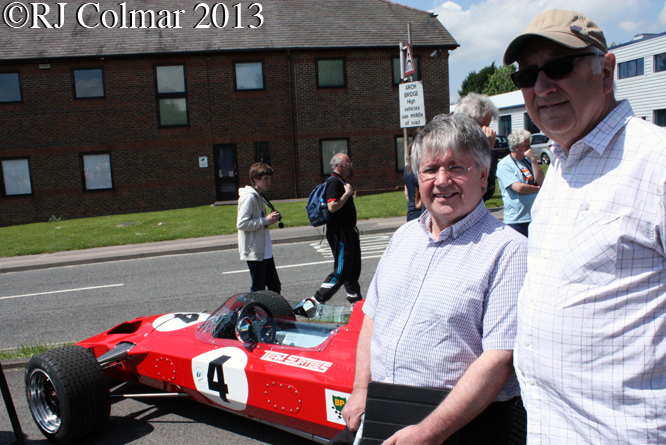
Connew, Eddington, Surtees TS7, Edenbridge Fun Day

Among the former Surtees employees Peter Connew, who went on to design his own Formula One car after the Surtees TS7 seen in the background was finished and Bob Eggington who was workshop foreman at the Surtees factory.
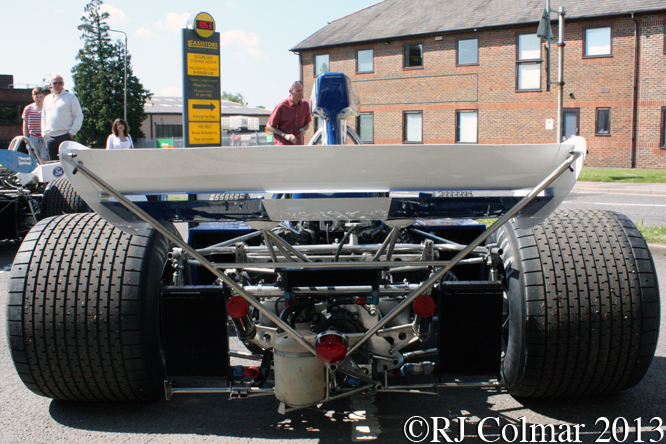
Surtees TS14, Edenbridge Fun Day

Half way through the 1973 season Mike Hailwood joked with reporters that his Surtees TS14 was so unreliable that he used to take a book with him in the car to read while he was waiting to be towed back to the pits. Chassis #04 seen here lived up to it’s reputation when it developed a fuel leak just as Oliver Turvey was about to fire it up for the parade.
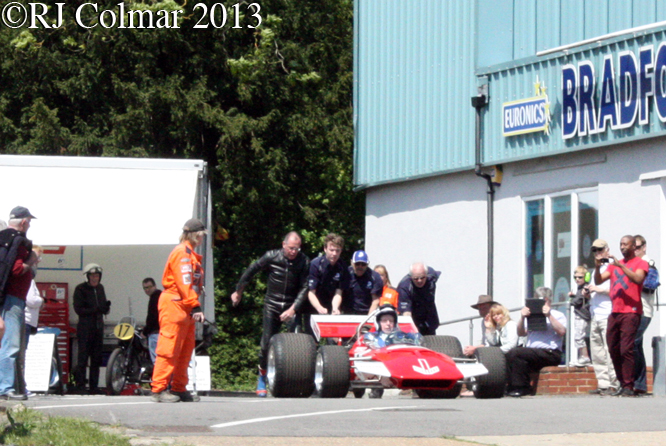
Surtees TS7, Edenbridge Fun Day

The Surtees TS7 chassis #01 also nearly blotted it’s copybook when it ejected an important piece of rubber from it’s starter motor meaning John needed a push start before joining the parade.
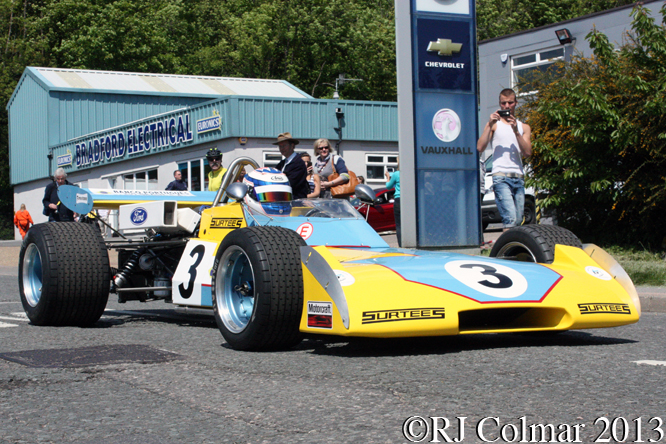
Kerr, Surtees TS15, Edenbridge Fun Day

The Formula 2, second open wheel tier, Surtees TS15 of the type, and probably the same chassis, which Carlos Pace used to win a non Championship race in Brazil at the end of 1972, was driven by 2002 British Formula 3 Champion Robbie Kerr. In the background is the former Surtees factory building which is soon to be replaced by a supermarket.
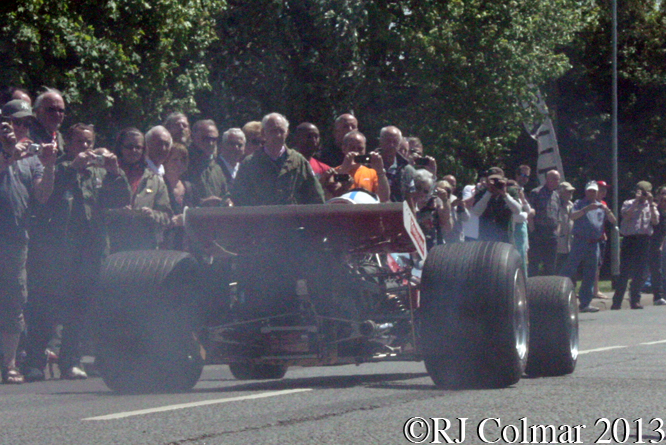
Surtees TS7, Edenbridge Fun Day

You would not believe John was a man of 79 when he unleashed the 400 horsepower from the Ford Cosworth DFV, engine number 050, and smoked his tyres as he set off down the B2026 from Edenbridge Station in to town.
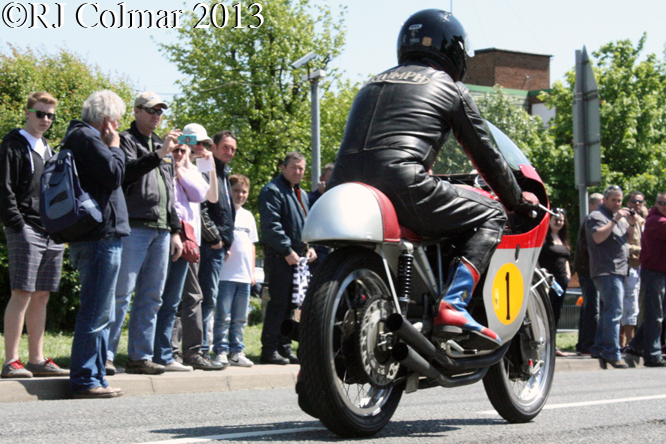
MV Augusta 500, Edenbridge Fun Day

Surprisingly the 1960 4 cylinder 500 cc / 45 cui MV Augusta, on which John won the last of his seven motorcycle championships was even noisier than the 3 litre / 183 cui V8 Cosworth.
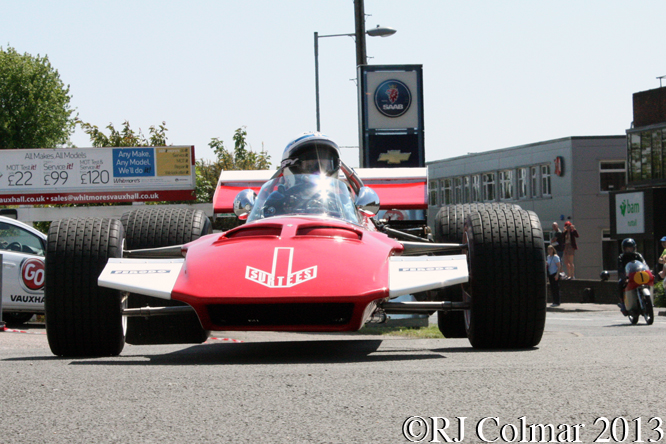
Surtees TS7, Edenbridge Fun Day

Above John is seen returning to the site of his former factory with his MV behind. As I learned last year when I attended the BRM Day a chance to see a Grand Prix car on the streets is never one to be missed.

Thanks for joining me on this “Big John Burns Rubber” edition of “Gettin’ a li’l psycho on tyres”. I hope you will join me again tomorrow. Don’t forget to come back now !

Share

One Shift Short Of A Hero – Talbot Lago T26 GS #11056

In 1947 Anthony F. Lago and Carlo Marchetti designed the Talbot T26C Grand Prix open wheeler which featured a 4.5 litre / 274 cui straight six cylinder motor with triple carburetors which made it’s racing debut at Monaco in 1948. Despite requiring less fuel and fewer tyres during the course of races than the more powerful supercharged cars built by Maserati, Alfa Romeo and Ferrari the T26C was considered out dated but they did win two Grand Prix races in 1949.

In 1950 3 Talbot Lago Grand Prix cars, fitted with crude 2 seat bodies, cycle wings over the wheels and the necessary lighting for night driving, were entered in the Le Mans 24 hour race. The #5 driven for 23 and a quarter hours by Louis Rosier and the remainder by his son Jean-Louis came home first one lap ahead of the similar #7 driven by Pierre Meyrat and Guy Mairesse.

Six Talbot Lago’s were privately entered, as they had been in 1950, at Le Mans for 1952 but this time the French cars were comprehensively beaten by the Peter Walker entered Jaguar XK 129 C, C-Type, driven by Walker and Peter Whitehead who finished 9 laps ahead of Pierre Meyrat and Guy Mairesse who’s Talbot Lago completed three laps more than the previous year with the same overall result.

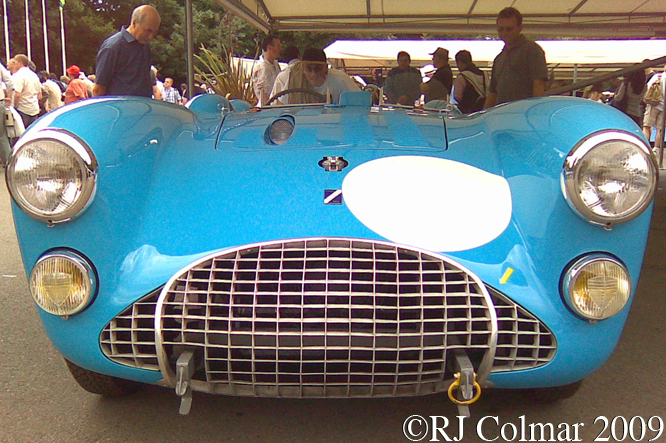
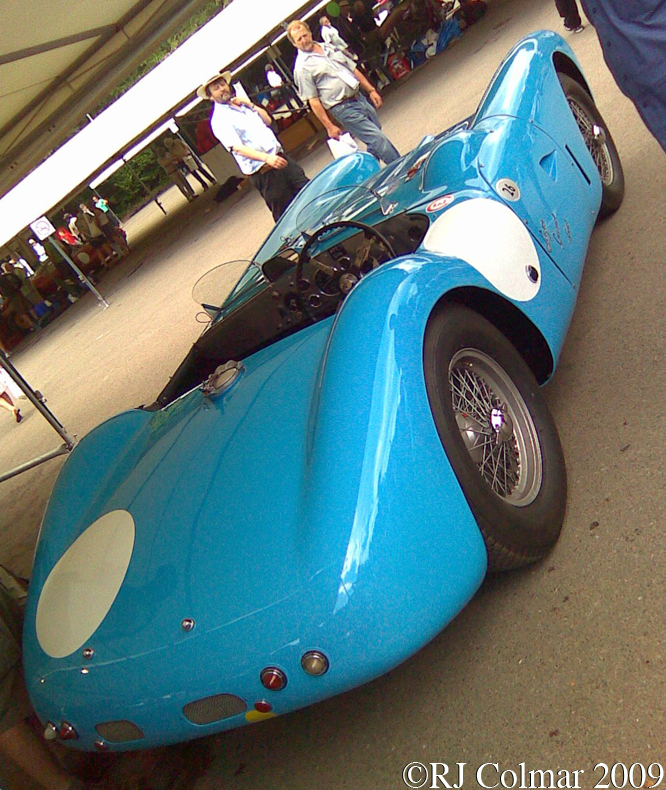
Talbot Lago T26 GS, Goodwood Festival Of Speed

All six Talbot Lago’s were rebodied as a result of a change in body work regulations which effectively outlawed cycle winged cars at Le Mans in 1952. Pierre “Levegh” Eugène Alfred Bouillon took it upon himself to stay in his car chassis #11056 that he was supposed to be sharing with René Marchand for over 22 hours. While leading the pursuing Mercedes Benz cars by 4 laps “Levegh” missed a gear selecting 2nd instead of 4th with terminal consequences for his engine that caused his retirement, with just over an hour to go, handing an unpopular 1-2 victory to the Mercedes Benz team.

So far as I have been able to ascertain today’s featured car seen at Goodwood in 2009 is chassis #11056 raced in 1951 at Le Mans by the Argentinians Froilan Gonzales and Onofre Marimon who retired before half distance with a broken radiator.”Pierre Levegh” acquired the car in 1952 and body work by Charles Deutsch was fitted to comply with the new regulations effectively outlawing cycle wings over the wheels.

Talbot Lago T26 GS, Goodwood Festival Of Speed

In 1953 “Levegh”, racing under the name of his uncle a racer who died at the wheel of a racing car in 1904, returned to Le Mans for a second time with #11056 now sharing the car with Charles Pozzi to finish a distant 8th 400 kms behind the winning C type Jaguar of Tony Rolt and Duncan Hamilton. Lino Fayen joined Levegh in 1954 but this time #11056 retired after just 33 laps.

Pierre Levegh raced this car in at least a dozen other events between 1952 and April 1955 winning two of them in 1952 and 1954 at Montlhéry. On the 11th of June 1955 Pierre Levegh was invited to join the returning works Mercedes Benz team at Le Mans, on lap 34 he was involved with a collision with a slower car that saw him and his blazing 300SLR fatally land on barriers while parts of his car were hurled into the crowd and killing 82 spectators and injuring 100 more.

During the 1970’s the Deutsch body work was abandoned and the car was refitted with cycle wing bodywork as used by Gonzalez and Marimon in 1951. In 2006 11056 appeared at Pebble Beach with a likeness of the Deutsch bodywork as used by Pierre Levegh but there are significant differences not least the wider radiator grill than seen in 1952 and the curious addition of a NACA submerged duct in the spare wheel cover on the right side of the vehicle. So far as I know such ducts did not appear on Talbot Lago’s until 1953 on chassis #11055 and certainly not on chassis #11056.

If this outline is at variance with your understanding of today’s featured car please do not hesitate to chime in below.

Thanks for joining me on this “One Shift Short Of A Hero” edition of “Gettin’ a li’l psycho on tyres” I hope you will join me again tomorrow. Don’t for get to come back now !

Share

Hooded Fuel Consumption – Bentley 3 litre #1138

Le Mans is not so well remembered by numerous teams for quirky rules which have seen them retire if not be outright disqualified from the 24 hours of Le Mans endurance race.

Bentley 3 litre, Brooklands Double 12, Brooklands Museum

1925 saw the organisers of the third running of the 24 hour endurance classic introduce a rule that cars had to run the first 20 laps of the race with the hood, convertible roof, up.

Bentley 3 litre, Brooklands Double 12, Brooklands Museum

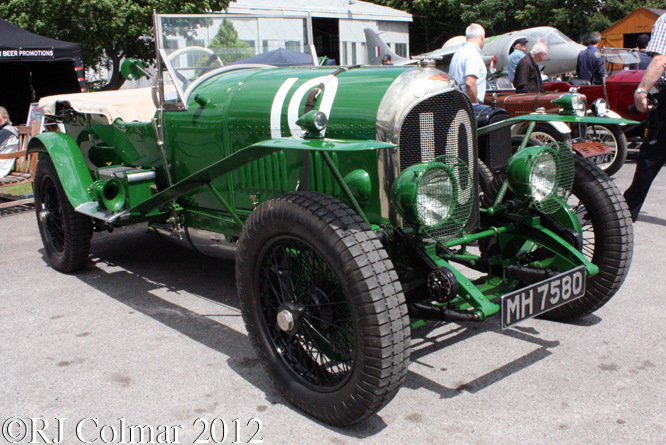
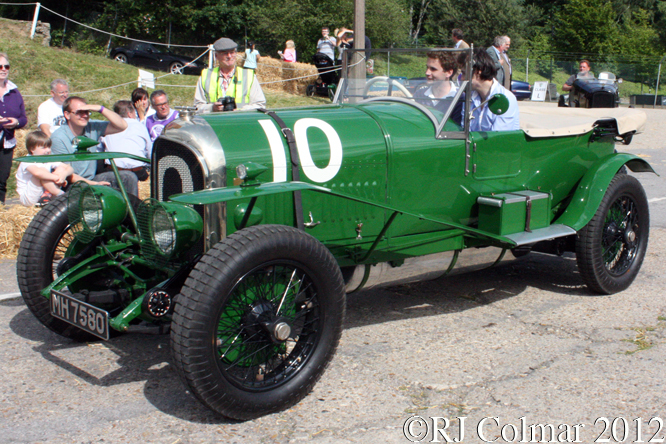
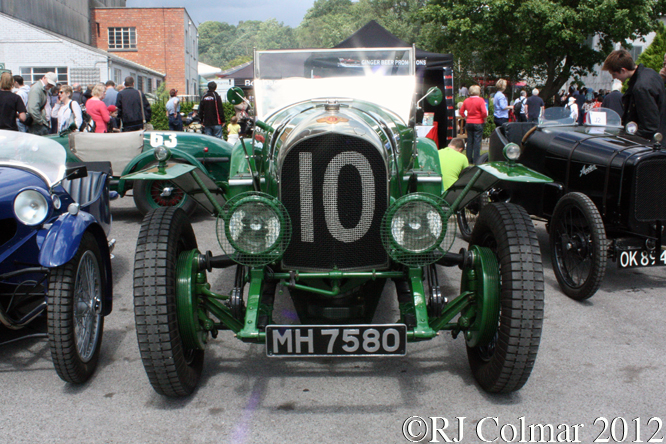
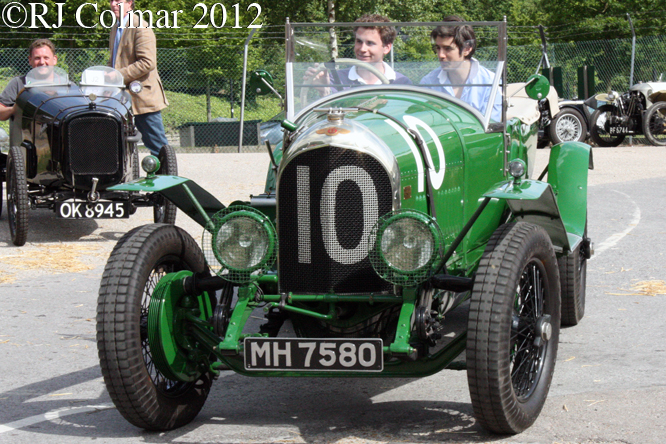
After winning the twice round the clock race in 1924, Bentley Motors Ltd had two 3 litre cars entered in the 1925 event one of which is chassis #1138, seen here at last years Brooklands Double 12 meeting, which was to have Herbert Kensington-Moir and Dudley Benjafield at the wheel.

Bentley 3 litre, Brooklands Double 12, Brooklands Museum

It appears that Bentley aimed to make their fuel stop at 20 laps to coincide with being able to lower the hood and put in just enough fuel to cover the distance. Herbert Kensington-Moir is said to have made a good start and was timed at speeds of over 90 mph, however on the 19th lap the car ground to a halt out of fuel.

Bentley 3 litre, Brooklands Double 12, Brooklands Museum

It would appear no one had factored in the additional fuel consumption created by the additional drag created by the hood and so Dudley Benjafield never got to race the car. The sister car chassis #1040 driven by 1924 Le Mans winners Captain John Duff and Frank Clement ground to a halt just short of half distance after a carburetor fire.

Bentley 3 litre, Brooklands Double 12, Brooklands Museum

The following year Bentley returned to Le Mans with 3 cars but all three retired but in 1927 Dudley Benjafield joined Sammy Davis and their 3 litre Sport known as Old No. 7 delivered Bentley a second victory in the French endurance classic.

Thanks for joining me on this “Hooded Fuel Consumption” edition of “Gettin a li’l psycho on tyres” I hope you will join me again tomorrow. Don’t for get to come back now !

Share

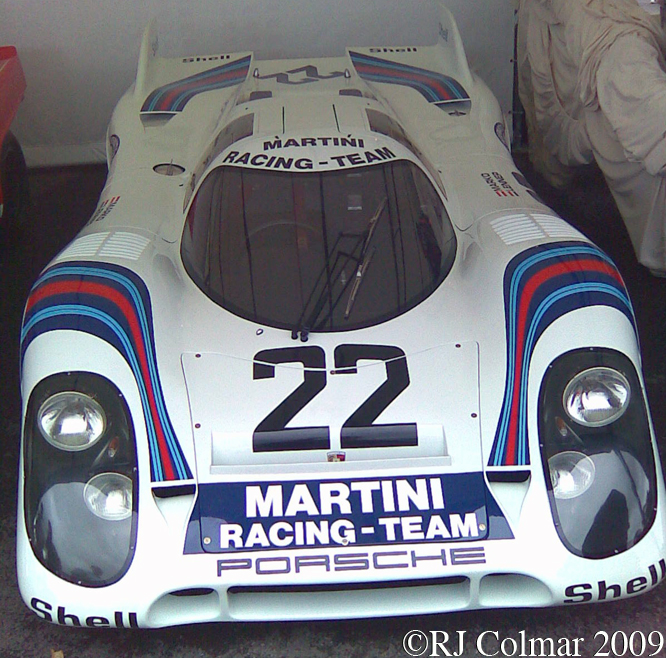
Ultimate Cars Ultimate Race – Porsche 917K #053

If there is one race I’d love to be able to turn the clock back for in order to attend it would be the 1971 Le Mans 24 hours which for my money was the ultimate road race with the ultimate cars.

Porsche 917K, Goodwood Festival Of Speed

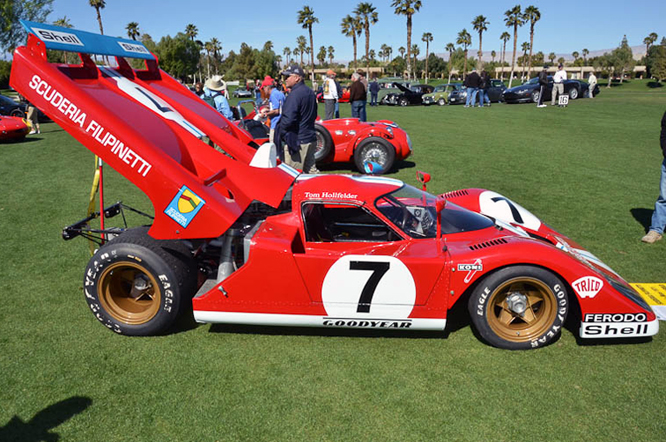
Lined up on the grid were seven Porsche 917’s with a variety of body configurations against 9 Ferrari 512s in both closed M spec, earlier open S Spec and two unique 512’s one from the Penske team which had a large rear wing and the F spec car of Scuderia Filipinetti that had a narrow cockpit built around a Porsche 917 windscreen.

Porsche 917K, Goodwood Festival Of Speed

The race was an uneven contest between the Porsches as the Ferraris suffered from inferior reliability and top speeds were down on the Porsche’s 230 mph plus capabilities. However it was the fastest to be run at the circuit until 2010.

Porsche 917K, Goodwood Festival Of Speed

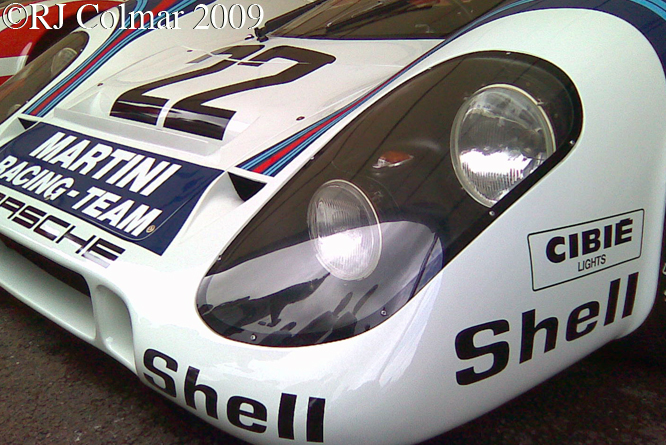
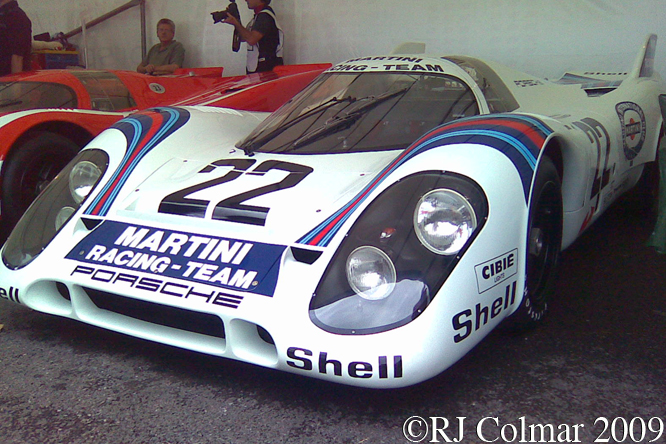
The winning car chassis #056 seen here at Goodwood Festival of Speed featured a special lightweight magnesium chassis built only for the works supported Porsche Salzburg team much to the annoyance of Porsche’s other works supported team run by John Wyer who’s employees had developed the Porsche body work in short (K Kurz) and long (LH Lang heck) tail forms and shared them freely with all the other teams running 917’s.

Porsche 917K, Goodwood Festival Of Speed

Gils van Lennep and Helmut Marko shared the winning 600 hp 4.9 litre 299 cui aircooled flat 12 powered #22 car which traveled 3,107.7 miles in 24 hours covering 397 laps at an average speed of 138.6 mph the equivalent to five consecutive Coke 600’s !

They beat the next car driven by Richard Attwood, Herbert Muller and Brian Redman in a Gulf Porsche 917 by two laps, 16 miles, and the third finisher the Ferrari of Sam Posey and Tony Adamowicz by 31 laps.

After the race chassis #053 was immediately retired and so has a 100% winning record.

Thanks for joining me on this “Ultimate Cars Ultimate Race” edition of “Gettin’ a li’l psycho on tyres”, I hope you will join me again tomorrow when I’ll be looking at a 1925 3 litre / 183 cui Bentley. Don’t forget to come back now !

Share

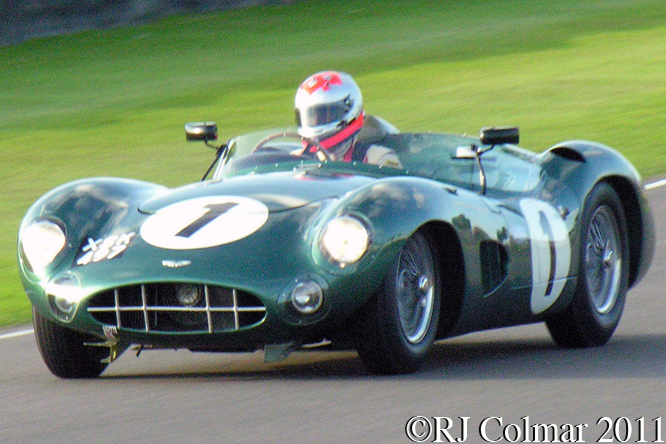
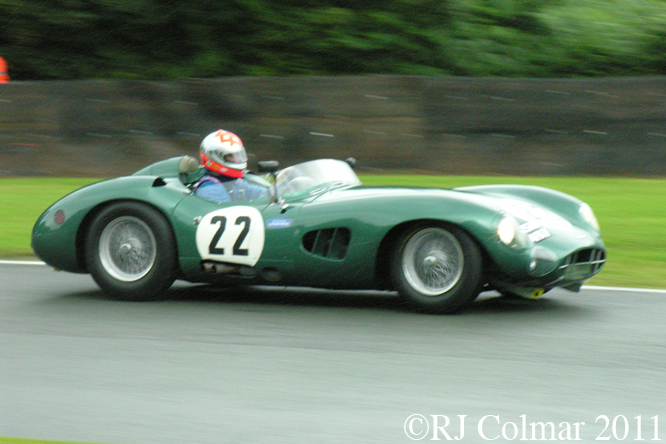
$20m Winner – Aston Martin DBR 1/2

This month sees the 90th Anniversary of the first running of the 24 Heures du Mans or Le Mans 24 Hour race which is organised by the Automobile Club de l’Ouest and run on the Circuit de la Sarthe much of which today follows the same course as in 1923.

In order to celebrate one of my favourate events in the international motorsports calender I will be posting 26 blogs that cover just a fraction of the Le Mans story, starting with the Aston Martin DBR 1 that coincidentally won the Le Mans 24 Hours in 1959, the year I was born.

Verdon-Roe, Aston Martin DBR1/2, Goodwood Revival

Today’s featured Aston Martin was the second of a run of five racing cars that were built to more or less the same design between between 1956 and 1959. DBR1/2 was the first to be fitted with a 3 litre / 183 cui 6 cylinder motor from new in 1957. DBR 1/1 built in 1956 was orginally fitted with a 2.5 litre / 152 cui motor which was replaced in 1957.

Tony Brooks and Noël Cunningham-Reid drove DBR1/2 to victory at the World Sports Car Championship round held at the Nurburgring in 1957 two weeks after Tony Brooks had led an Aston Martin 1-2 result driving the same car in the non championship race at Spa. Brooks and Cunningham-Reid shared DBR1/2 again at the 1957 Le Mans 24 hours which they did not finish after being involved in an accident. The same pairing shared DBR 1/2 at a second non championship race at Spa which they won.

Verdon-Roe, Aston Martin DBR1/2, Goodwood Revival

In 1958 Stirling Moss shared this car with Brooks at Sebring where they retired from the 12 hour race with an axle problem. Two more retirements followed at the Nurburgring and Le Mans but at the end of the ’58 season Brooks and Moss won the Tourist Trophy at Goodwood, where the car is seen above with Bobby Verdon-Roe at the wheel.

Verdon-Roe, Aston Martin DBR1/2, Gold Cup, Oulton Park

In 1959 Stirling Moss won a minor race at Silverstone with the Aston before Roy Salvadori and Carrol Shelby took over the driving duties for the 1959 Le Mans 24 Hours to score the Marques only out right Le Mans victory having covered 323 laps one more than the second placed sister car, DBR 1/4 driven by Maurice Trintignant and Paul Frère. At the end of the year DBR1/2 was driven to victory by Salvadori and Shelby in the TT at Goodwood again which secured the World Sports Car Championship for Aston Martin.

In 1960 Major I. B. Bailie acquired the car entering it for the 1000 km race at the Nurburgring where he came 22nd with Edward Greenhall and for the Le Mans 24 Hours with Jack Fairman sharing the driving the car finished it’s forth consecutive Le Mans 24 hour race in 9th place. Bailie scored further podium finishes with the car up to 1961. In 1963 David Ham acquired DBR1/2 and raced it on at least 2 occasions which netted podium results in class but no overall wins.

Last year DBR1/2 which played a leading role in Aston Martin’s 1959 World Sportscar Championship success was offered for sale with an asking price of US$20 million. If DBR1/2 ever does change hands at that price it will become the most expensive Aston Martin ever.

Thanks for joining me on this “$20m Winner” edition of “Gettin’ a li’l psycho on tyres”, I hope you will join me again tomorrow. Don’t forget to come back now !
Share

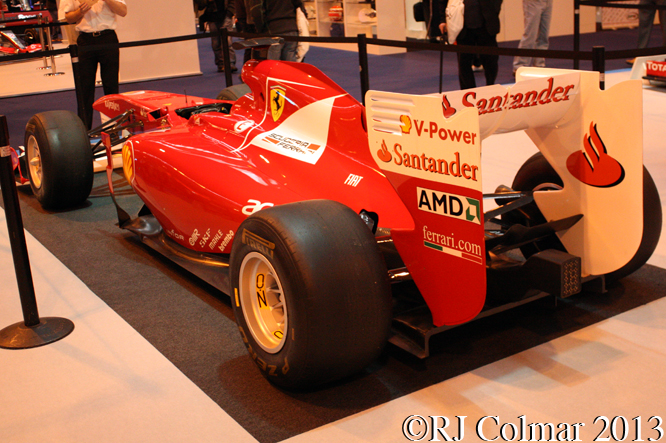
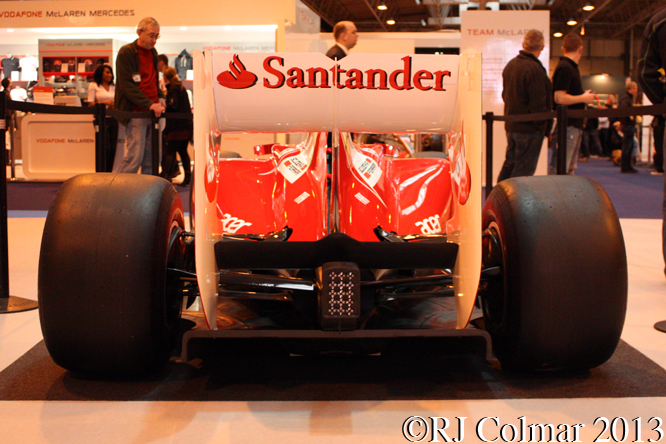
It’s Not A Pick Up Truck – Ferrari 150° Italia

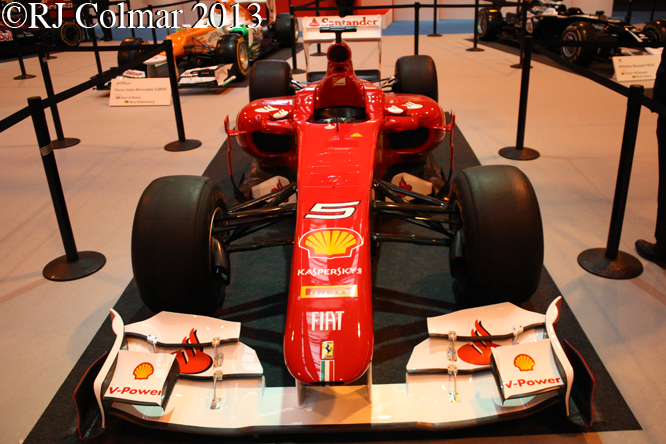
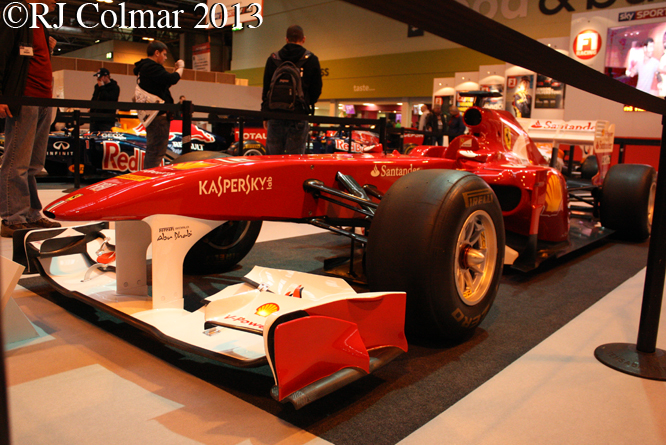
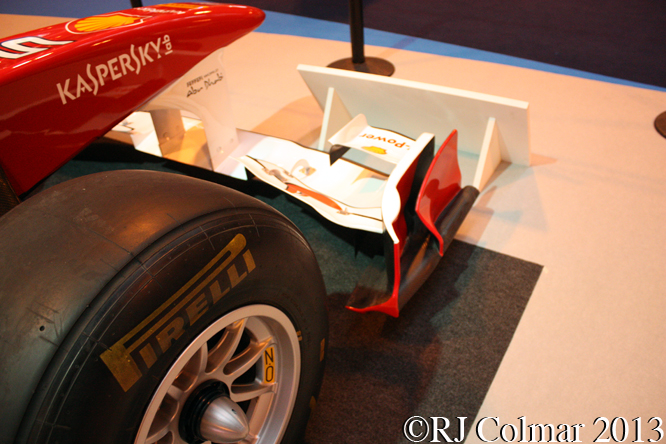
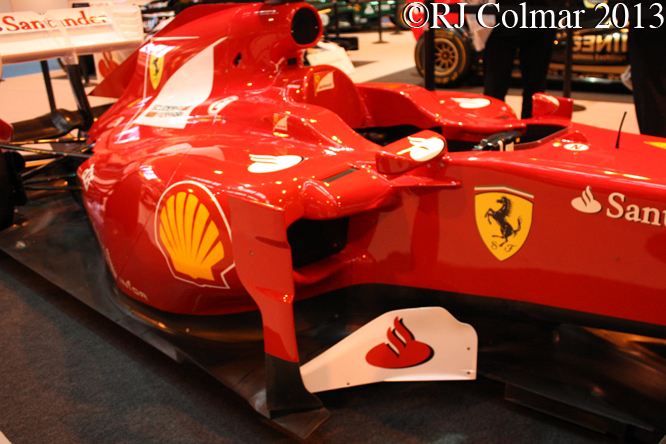
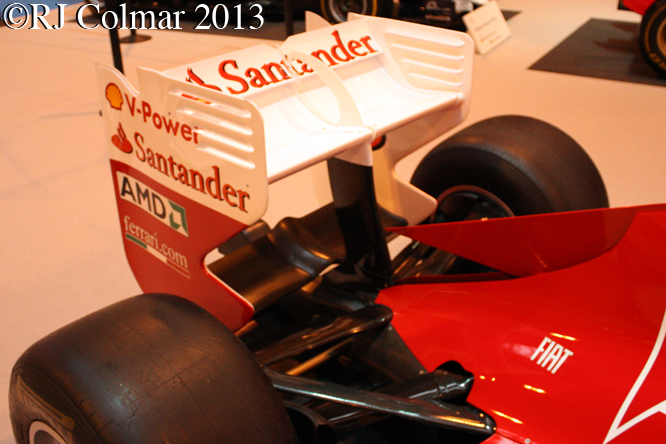
Having snatched World Drivers Championship defeat from the jaws of Victory at the Abu Dahbi Grand Prix in 2010, where Fernando Alonso went into the last race of the season with a 15 point lead over third placed Sebastian Vettel but left 4 points in arrears to the German in the final Championship standings, Ferrari regrouped for 2011 building a new vehicle with the design credited to Aldo Costa and Nicholas Tombazis which was known at its launch as the F150 in celebration of Italy’s 150th unification anniversary.

Ferrari 150° Italia, Autosport International, NEC, Birmingham

Formula One attracts controversy like flies to jam and a large number of jokes by even the most technical minded Formula One anoraks aside it was not long before Ford objected to Ferrari’s use of the trade marked F150 name and eventually Ferrari settled on the 150° Italia in which the ‘°’ stands for the ordinal cento cinquantesimo or one hundred and fiftieth in English.

Ferrari 150° Italia, Autosport International, NEC, Birmingham

Technically Ferrari’s 2011 2.4 litre/146 cui V8 powered challenger was caught on the hop having failed to spot the potential handling benefits of off throttle blown diffusers, a failure which echoed Enzo Ferrari’s assertion that aerodynamics are for teams that cannot build engines.

Ferrari 150° Italia, Autosport International, NEC, Birmingham

As a consequence Alonso was rarely in contention for podium finishes as Red Bull and McLaren who had refined their off throttle blown diffusers, won the opening 8 races of the 2011 season with Sebastian Vettel in the Red Bull winning 6 and Lewis Hamilton and Jenson Button driving McLarens winning the remaining two.

Ferrari 150° Italia, Autosport International, NEC, Birmingham

For the ninth race of the season the British Grand Prix Ferrari had managed to persuade all the teams that they should run without off throttle blown diffusers, which basically hooked up an electronic engine programme to wind up the engine speed when the driver was off throttle to force hot air through the exhaust into the diffusers which produced additional downforce when running off throttle through the corners.

Ferrari 150° Italia, Autosport International, NEC, Birmingham

In the prevalent wet conditions which dried through the race Alonso, starting third, managed to beat the Lewis Hamilton driving a McLaren and Sebastian Vettel in his Red Bull to score the Ferrari teams only victory in 2011.

Ferrari 150° Italia, Autosport International, NEC, Birmingham

By the next race the teams despite objections from Ferrari and the Ferrari powered Sauber team reverted to running off throttle blown diffusers in anticipation of a ban on these devices for 2012.

Ferrari 150° Italia, Autosport International, NEC, Birmingham

Ferrari ended up a distant third in the manufactures championship behind Red Bull who scored six further victories to take their 2011 total to 12 and McLaren who scored four further victories in the 19 race season.

Fernando finished the 2011 championship 4th behind Vettel, Jenson Button and Mark Webber who scored just one point ahead of the Spaniard. De facto Ferrari number 2 driver Felipe Massa was lucky to keep his Ferrari seat for 2012 after he finished 6th in the championship 99 points behind Lewis Hamilton having failed finish any higher the 5th all season.

Thanks for joining me on this “It’s Not A Pick Up Truck” edition of “Gettin’ a li’l psycho on tyres” I hope you will join me again tomorrow. Don’t forget to come back now !
Share

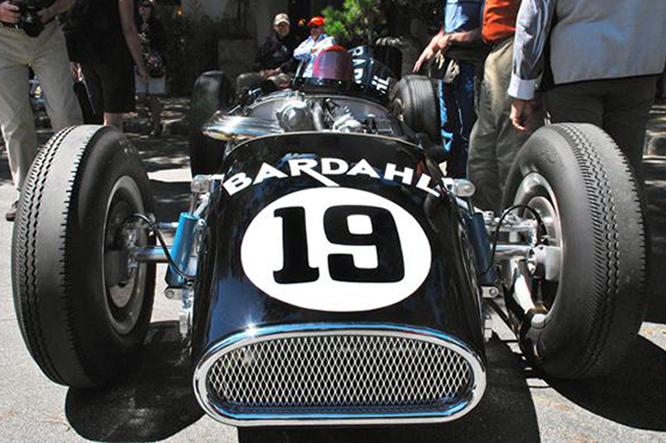
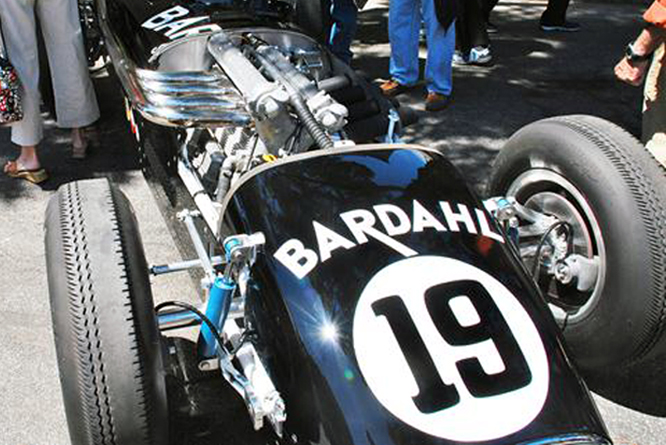
Bardahl Special – Kurtis Offenhauser 500G

Ole Bardahl was the embodiment of the American dream aged 20 he arrived in Seattle from Norway in 1922 with $32 in his pocket and unable to speak a word of English, by 39 he had become a millionaire building contractor and went on to found the Bardahl Oil Company in Ballard Seattle.

Kurtis Offy 500G, Concours on the Avenue, Carmel by the Sea,

From 1950 to 1959 Bardahl sponsored Offenhauser powered Kurtis cars started in every Indy 500, two third places from Sam Hanks in 1952 and 1953 were the teams best results in this period. In 1956 a Bardahl showed up with the unique Ferrari powered Kurtis for Giuseppe Farina but the car proved too slow.

Kurtis Offy 500G, Concours on the Avenue, Carmel by the Sea,

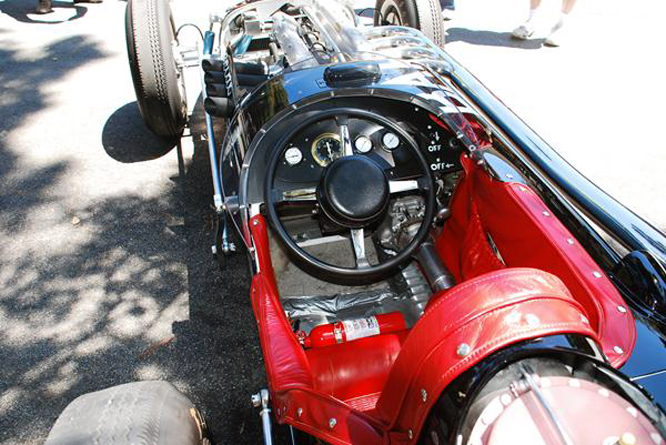
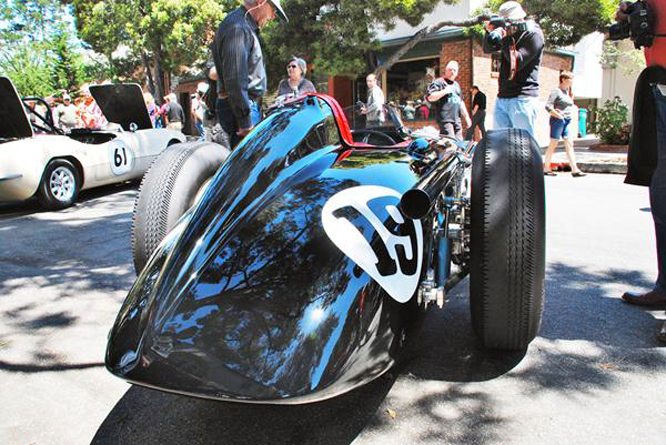
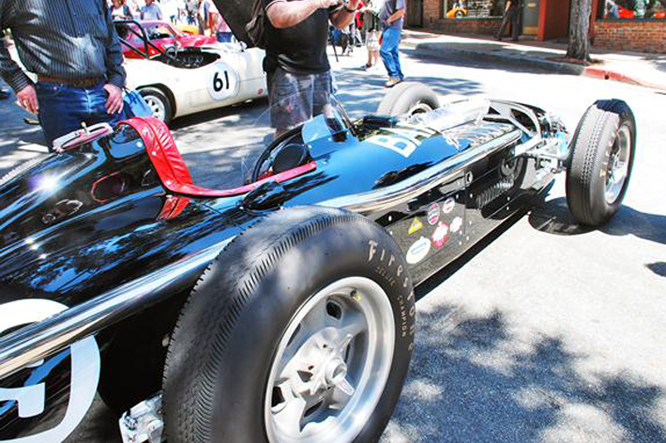
For reasons that have not been determined during the research for this blog for 1957 Bardahl had Kurtis build two left hand drive Offenhauser powered 500G’s,all the other ’57 Kurtis Indy cars were right hand drive so far as I have been able to determine the #16 was driven by Al Keller and the #19 seen here by Jack Turner. Al Keller started the ’57 Indy 500 from 8th on the grid but crashed on lap 75 and was classified 27th, while Jack Turner started 19th and classified 11th last car on the lead lap.

Kurtis Offy 500G, Concours on the Avenue, Carmel by the Sea,

The ’57 Bardahl Kurtis Offy was by no means the only left hooker Indy car the manufacturer built, regular readers will remember that the Ross Page Special I looked at a couple of weeks ago was also a left hand drive machine, but the question remains as to why so few left hookers were built at all when almost all the other vehicles that participated in the Indy 500 at the time featured either a central driving position or a right side driving position ? If you have any references for an answer please do not hesitate to chime in below.

Kurtis Offy 500G, Concours on the Avenue, Carmel by the Sea,

For the 1958 Indy 500 Al Keller, perhaps best known as the first driver of a foreign car, Jaguar, to win a NASCAR sanctioned race, Linden, in 1954, took over the car seen in today’s photographs taken by Geoffrey Horton at the Concours on the Avenue in Carmel By The Sea a couple of years ago. Renumbered #52 Al qualified 21st completed all 200 laps and was classified 11th as had the cars previous driver Jack Turner in 1957.

Kurtis Offy 500G, Concours on the Avenue, Carmel by the Sea,

For 1959 Bardahl returned to the 500 with a conventional right hand drive Kurtis for Paul Russo who finished 9th. Through the 1960’s Bardahl entered Kurtis, Watson and Eagle cars with a best result of 3rd for Bobby Unser who drove a Bardahl entered Lola in the 1969 Indy 500 which appears to have concluded the teams participation in “The greatest spectacle in racing”.

My thanks to Geoffrey Horton for sharing his photographs which I have used in all of this months Indy 500 blogs, and to E.B. at The Nostalgia Forum for confirming today’s featured car was driven by Al Keller in the 1958 Indy 500.

Finally congratulations to Tony Kanaan for winning the 2013 edition of the Indy 500.

Thanks for joining me on this “Bardahl” edition of “Gettin’ a li’l psycho on tyres” I hope you will join me again tomorrow. Don’t forget to come back now !
Share