Tag Archives: Riley

Firing Up 2012 – Race Retro

Thanks to my membership of the Bristol Pegasus Motor Club I enjoyed my second trip to Race Retro over the past weekend.
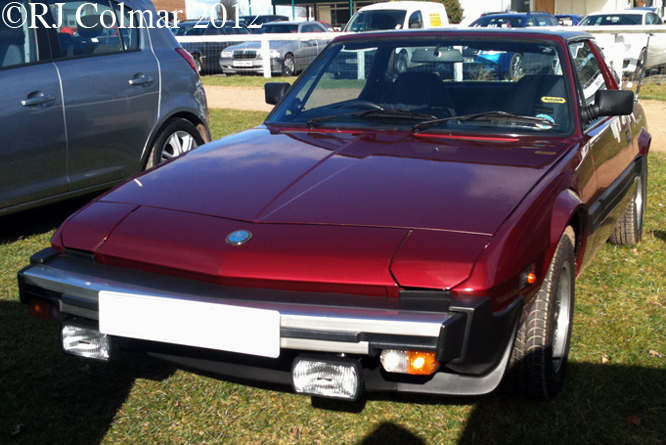
Bertone X1/9

Just like last year I had trouble getting out of the car park thanks to the fabulous collection of sports cars fellow enthusiasts had brought out for a spin in the glorious sunshine. This Bertone X1/9 particularly caught my eye, I spent many years lusting after an X1/9 when I left school. I eventually ended up with a slightly more practical , cheaper to insure FIAT 128, I’ll be taking a closer look at the X1/9 on Sunday.
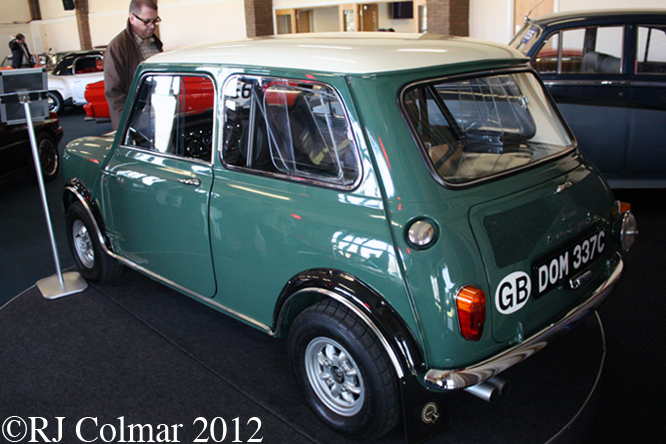
Twini Cooper S, Race Retro

Silverstone Auctions have taken the place of H&H Auctions as Race Retro’s Auctioneer partners, among the unusual gems scheduled to go under the hammer was this Twini Austin Cooper S a replica of two experimental works cars originally built in 1963 that raced in the Targa Florio. This replica was built on a 1965 chassis with two Cooper S motors, gearboxes and disc brakes all round.
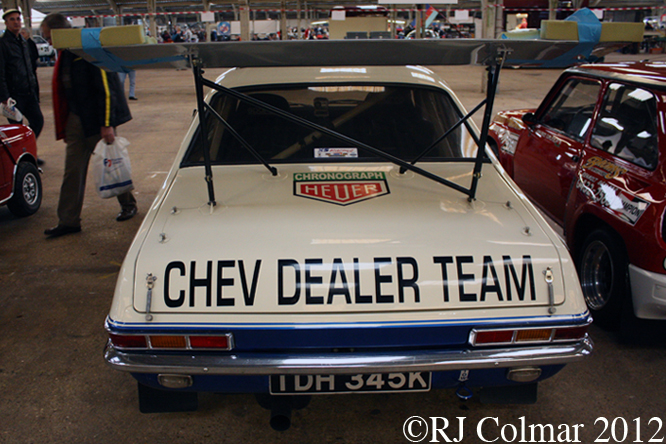
Chevrolet Can Am, Race Retro

In the Rally shed it was nice to see the replica South African Chevrolet Firenza CanAm now fitted with a huge rear wing reminiscent of Formula 1 & Can Am cars in 1968 and as used in the original Chev Dealer Team car in 1974.
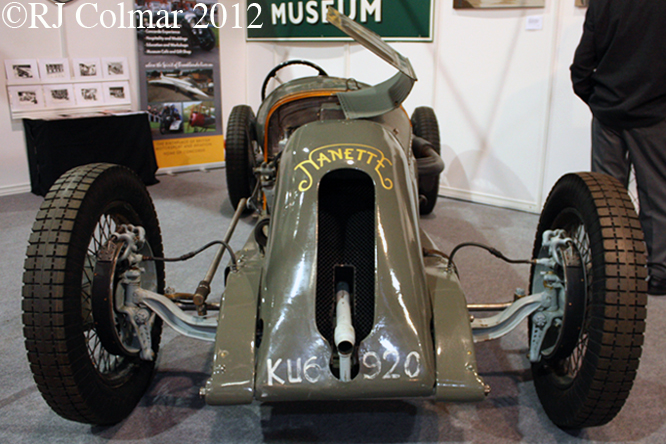
Nanette, Race Retro

Nanette seen above on the Brooklands stand was a special built by Felix Scriven in 1925, it was originally fitted with an unreliable Sage motor, which contributed to this car originally being called, Mother Goose until a 4 cylinder Hooker motor that originated from the Marlborough Thomas special and which could be configured as either a 1.5 litre / 92 cui or 1.75 litre / 107 cue motor according to which of two crankshafts was used.
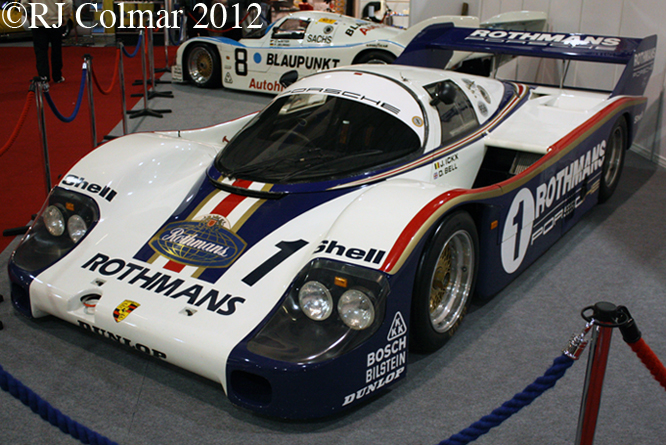
Porsche 956, Race Retro

Among the anniversaries being celebrated at Race Retro was the 30th anniversary of the Porsche 956 which evolved into the 956B and 962 and 962 C series that dominated Le Mans, the Daytona 24 hours, Group C and IMSA from 1982 until 1987. The #1 above appears to be a 956 with distinctive 1982 paintwork while the #8 in the background carries the 1988 bodywork of the 962 C commonly carried by chassis #116.
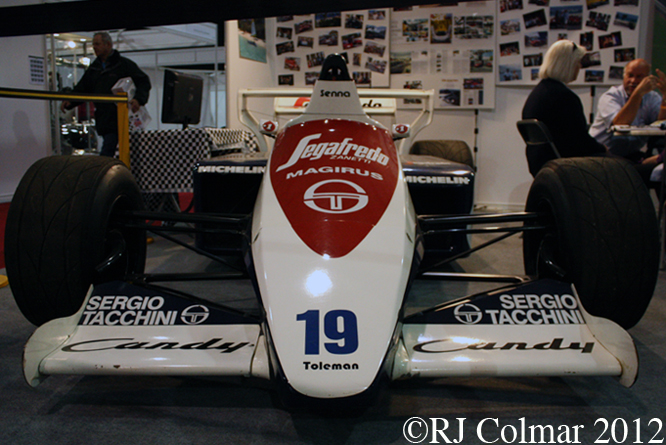
Toleman TG 184, Race Retro

The multiple award winning success of “Senna” the documentary on the Brazilian Triple World Champion has focused interest in his cars, the Toleman TG184 was of the type that Senna drove once his team had secured a supply of Michelin tyres after the first two races of Senna’s 1984 rookie F1 season.
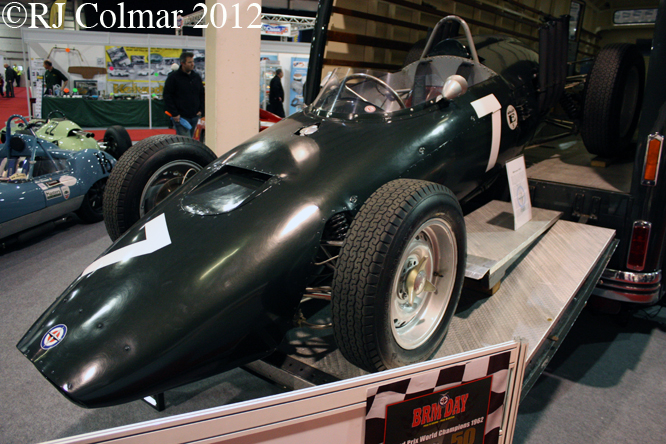
BRM P57, Race Retro

The town of Bourne in Lincolnshire will be celebrating the 50th anniversary of BRM’s World Championship year on October 7th. Graham won the championship driving a BRM P57 with a BRM V8 similar to the #7 in the photo above, though after all these years BRM are probably still at least as well remembered for building a supercharged 1.5 litre 92 cui V16 in 1949 and possibly the most complex racing motor of all time the 3 litre / 183 cui H16, which is said to make so much noise the first time it was opened up in anger every one in the pits at Riems dived for cover as it came down the start finish straight for the first time ! I’ve made it a mission to try and hear the H16 in action this year and hope to be at BRM Day at Bourne in October.
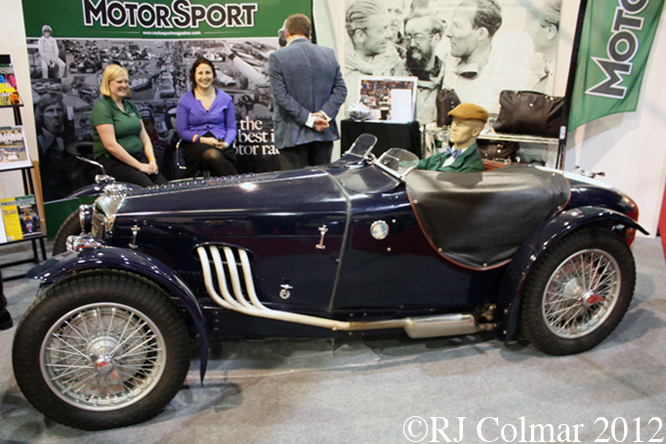
Riley Ulster Imp, Race Retro

Finally on a personal note it is 40 years since I bought my first copy of Motor Sport, the December 1972 edition was packed with the details of the 1972 Canadian and US Grand Prix’s which Jackie Stewart won in anticipation of an extremely successful final 1973 season. On the Motor Sport stand above is the 1934 Riley Ulster Imp in which after a successful post WW2 competition history the car was acquired by Leslie Hawthorn the proprietor of the Tourist Trophy Garage in Farnham who gave it to his son Mike who raced this car on his competition debut at the Brighton Speed Trials where he won his class and drove it in his first race which ‘The Farnham Flyer’ also won on his way to becoming the first ten British World Champions.

I’ll be posting more blogs featuring vehicles seen at Race Retro 2012 in the coming days and weeks, starting tomorrow with an unusual MG-B.

Thanks for joining me on this ‘Firing Up 2012’ edition of ‘Gettin’ a li’l psycho on tyres’ I hope you will join me again tomorrow. Don’t forget to come back now !

Share

Fatal Firebird – Lotus Ford 29 #29/3

In May 1961 a piece of successful Formula One technology percolated into the environs of Indianapolis which started a whole sale revolution in the layout of the cars that would dominate the Indy 500 hence forth in the form of the Kimberly Cooper Special driven by Jack Brabham.

The Kimberly Cooper Special was the smallest car in the field and possibly with the least powerful motor, but what everyone present learned from the car that started 19th and came in 9th was that the li’l funny car with the engine in the back could handle the corners so much better than the hitherto dominant front engine Roadster machines that the lack of 150 hp made little or no difference.

Lotus 29 Ford, Indianapolis

Imagine just putting the engine in the back of your car giving a 150 hp advantage ! It was a no brainer, but in 1962 only the Californian Speed King Micky Thompson and ’55 & ’56 Indy winning owner John Zink had rear engined cars prepared for the Indy 500.

Rookie Dan Gurney who passed his Rookie test in a Roadster was keen to drive either of the rear engined cars in the race in an effort to impress Lotus boss Colin Chapman whom he had invited over from Europe at his own expense in an effort to entice Colin into building Lotus indy cars for 1963. Dan gave up on the turbine powered John Zink Track Burner but did manage to qualify 8th in the under powered Thompson Buick and come home in 20th.

Lotus 29 Ford, Indianapolis

Chapman was sufficiently impressed with the Indy 500 and it’s potential rewards to build the Lotus 29 seen here for the 1963 race. The Lotus 29 featured a monocoque chassis, as campaigned in Chapman’s successful 1962 Lotus 25 Grand Prix car, in place of the usual tube space frame and it had a powerful version of a Ford stock block V8 in place of the almost ubiquitous 4 cylinder Offy that had been winning at Indy since the mid 1930’s and could trace their ancestry back to the Millers of the 1920’s.

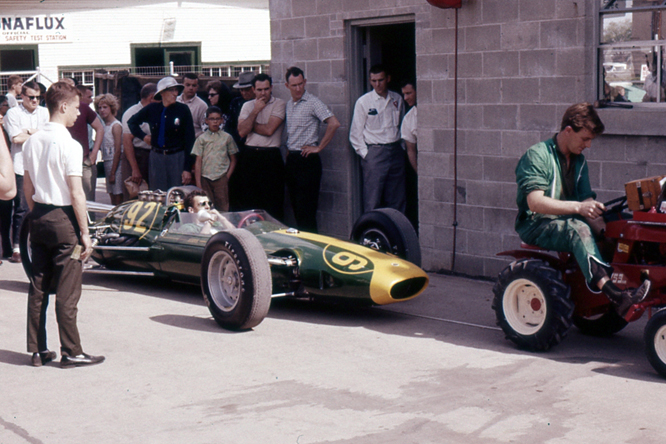
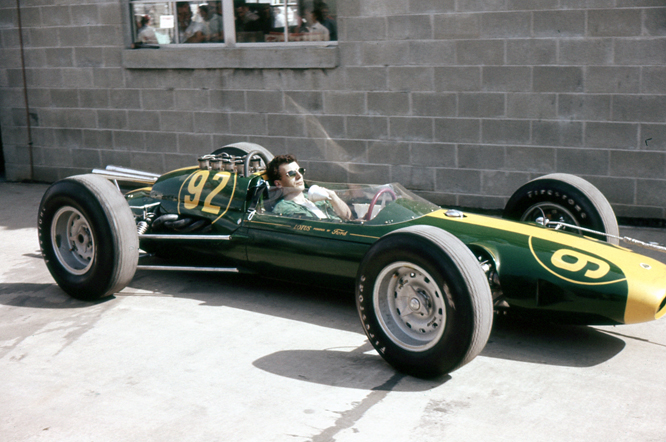
Jim Clark and Dan Gurney were to race the Lotus challengers Clark qualified chassis 29/3 5th and Gurney chassis 29/1 12th. Towards the end of the race Clark was challenging Parnelli Jones for the lead when Jones Watson developed an oil leak, but the USAC officials managed to refrain from black flagging Jones before the oil stopped leaking which allowed Parnelli to take his one and only Indy 500 victory ahead of the Rookie Clark. Dan came in 7th also completing the full 200 laps. Dan’s chassis #29/1 today sits in the IMS museum painted in the green and yellow colours of Jim Clark’s #92 chassis 29/3.

Indy 1964, Ed Arnaudin

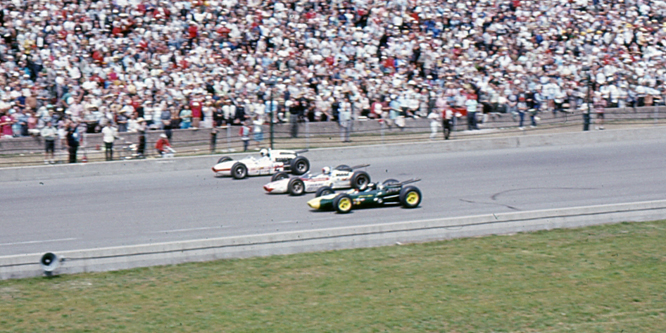
The following year Bob Marshman put #29/2 now known as the Pure Firebird Special on the middle of the front row for 1964 Indy 500 right next to pole sitter Jim Clark in his newer Lotus Ford 34, see above. Bob lost an oil plug going low on the apron while in the lead on lap 37 trying to avoid the slower Johnny White, Bob was eventually classified 25th.

Bob crashed #29/2 at Milwaukee and his owner Lindsey Hopkins bought Clark’s #29/3 as a replacement which Bob drove with no more success than he had with #29/2.

Despite the fireball at Indy in 1964 Bob tested chassis 29/3 at the seasons end wearing nothing but the usual, for the period, t-shirt and jeans at Phoenix. During the session Bob’s car was involved in an accident which ruptured the fuel tank, a week later Bob died of the burns he subsequently sustained.

Ed Arnudins photo’s show Lotus Mechanic Colin Riley at the wheel of Jim Clarks of #92 Lotus 29 Ford being towed through the Indianapolis garage area by another Team Lotus mechanic Dave Lazenby who is at the wheel of the dinky li’l towing tractor in the top photograph.

My thanks to Ed and Steve Arnaudin for the photo’s, Tim and B Squared at The Nostalgia Forum informing me of which chassis is featured in today’s post for identifying Colin and Dave in the photo’s.

Thanks for joining me on this ‘Oil Leak ? What Oil Leak ?’ edition of ‘Getting’ a li’l psycho on tyres’ I hope you will join me again tomorrow. Don’t forget to come back now !
05 02 12 ps Thanks to Brian for pointing out the now corrected Bobby Marshman spelling error and pointing out that Bob did not spin out of the 1964 Indy 500.

12 05 14 Since writing this piece it has come to my attention that Bobby Marshman signed his autographs ‘Bob Marshman’ and it seems fitting and respectful to have removed the references to “Bobby”.

It has also come to my attention that Bob drove #29/2 on the paved surfaces of USAC’s Champ Car Series up until Milwaukee in ’64 and not #29/3 as originally suggested. He also appears to have lost an oil plug rather than damaged an oil line at Indy as originally suggested.

I hope you’ll accept my sincerest apologies for any unintentional confusion caused.

Share

Brotherly love – Riley 9

The chassis of the Riley 9 was designed by Stanley Riley while the hemi head 1087 cc 66 cui was designed by his brother Percy. Riley 9s were produced from 1926 – 1938 with a variety of body styles.

The twin cam engine with short push rods operating the 45 degree inclined valves proved particularly suitable for tuning and Riley 9s were raced with great success into the mid 1950’s. This version, seen at Prescott top and Loton Park bottom, is owned by B Wildsmith and driven in VSCC events by Tim Hopkinson is a Special dating from 1929/34.

Hope you have enjoyed today’s brotherly love edition of Getting a lil’ psycho on tyres and that you’ll join me tomorrow for a look at another quintessentially British motor car. Don’t forget to come back now !

Share

Last of the line – ERA R14B

English Racing Automobiles was founded by driver Raymond Mays, designer Peter Berthon and financier Humphrey Cook in 1933 to manufacture racing cars capable of upholding British prestige in Continental European races.

Without the financial or engineering resources made available to Mercedes Benz and Auto Union in top flight Grand Prix races, ERA focused their efforts one step down, in the GP2 or Indy Lights of its day known as voiturette racing for vehicles with supercharged motors from 1.1 litres / 67 cui to 2 litres / 122 cui.

The ERA engines came in three sizes and were based on a 6 cylinder Riley production block with a stronger crankshaft and entirely new aluminium cylinder head.

Chassis design was by Reid Railton and the body work was by George and Jack Cray to a design by a Mr Piercy who like Railton had been responsible for the design of Malcom Campbells land speed record breaking vehicle ‘Bluebird‘.

ERA R14B seen here is the 14th and final original ‘sit up and beg’ originally a pale blue vehicle built in 1938 with a 1.5 litre /91 cui Zoller supercharged engine for Johnnie Wakefield who won the 200 mile race at Brooklands and finished third in the 1938 Bern GP.

Bob Gerard acquired the car after WW2 and scored third and second place finishes at the British Grand Prix of 1948 and 1949, he continued to race the car successfully until 1956.

Current owner Donald Day purchased ERA R14B in 1958 and has raced it with a 2 litre / 122 cui motor in place of it’s original 1.5 litre 91 cui unit. In 1990 14B appeared for the first time in British Racing Green.

This same vehicle was driven to victory in the pre 1959 Historic Grand Prix at Monaco by Julian Bronson in 2002.

All photo’s bar the penultimate one from the September VSCC meet at Loton Park, the penultimate one was taken at the August VSCC meet at Prescott.

Thanks to David Hodgkinson for back ground information on ERA 14B.

Hope you have enjoyed todays British Racing Green edition of ‘Gettin’ a lil’ psycho on tyres’, and will join me tomorrow for a look at a high flying special. Don’t forget to come back now !

Share

Nothing can extinguish the Olympic Flame – Rochdale Olympic Phase I

This comes under the category of cars I had not heard of before I took the picture.

Rochdale Motor Panels and Engineering were beased in Rochdale, Greater Manchester between 1948 and 1973, best known for making fibre glass bodied kit cars .

In 1959 they designed the glass fibre monocoque for the Olympic the only other such monocoque at the time was the Lotus Elite. After a factory fire the car went into production in 1960.

The Olympic was designed by Richard Parker to take a variety of engines including the twin cam 1.5 litre 91.5 cui Riley, Morris Minor, MGA and Ford 109E, unusually for kit cars of the time it featured wind down door windows.

With the Riley engine the car was capable of 0-60 mph in 11.9 secs and could reach 102 mph.

It is estimated that 250 of these vehicles were built of which 100 survive.

Remarkably the Olympic flame is still kept alive by a group of enthusiasts who own the original moulds making it technically possible to build a new Rochdale Olympic.

Hope you enjoyed this Mancunian edition of Gettin’ a lil’ psycho on tyres, don’t ferget to come back now !

Share

On the Origins of Brands – Riley & Wolseley

Today I am looking at two storied brands Riley & Wolseley born out of industrial diversification which were woven into that DNA of the nationalised merger British Motor Corporation in 1952.

From 1961 – 1969 they marketed top end 3 box versions, featuring wood veneer dashboards, of the Mini known as the Elf and Hornet respectively.

In 1896 William Riley jr purchased the Bonnick Cycle Company of Coventry which was born out of the cycling craze that swept England in 1890 and renamed it Riley Cycle Company.

Williams son Percy secretly built his first car, featuring an engine with the the worlds first mechanically operated inlet valve, in 1898 aged just 16.

Percy who also patented the detachable wheel went into business with his brothers forming the Riley Engine Company in 1903 supplying motorcycle engines and in 1905 they built their first car.

During restructuring in 1918 Riley car manufacture was transferred to Riley Motor Manufacturing which went into receivership in 1938 and was absorbed into the Nuffield Organisation along with Morris and MG, which in 1952 would merge with Herbert Austin’s companies into the nationalised BMC.

By 1947 Riley had ceased manufacturing it’s own designs and became a top end brand for shared designs in the Nuffield and later BMC organisations.

The Riley brand is easily identified by its blue diamond badge originally designed by Harry Rush with the strap line ‘As old as the industry, as modern as the hour’, was discontinued in 1969 and currently belongs to BMW.

Between 1961 and 1969 30,912 Riley Elfs were built.

In 1896 Herbert Austin working for the Wolseley Sheep Shearing Company made a copy of a Leon Bollee vehicle that he had seen in Paris. By 1899 he had built a Voiturette that went into production in 1901 with Herbert Austin in charge of the Wolseley car division that had by now been spun off as an independent concern.

In 1905 Herbert Austin left to set up his own Austin Motor Company.

After several mergers and changes of ownership the Wolseley Motor Company came into existence in 1914 in the hands of Armstrong Siddeley. At this time operations were started in Toronto and Montreal which became British and American Motors after WW1.

In 1918 Wolseley started a joint venture with Ishikawajiama Ship Building and Engineering for the production of Wolseley models under license, in 1947 this venture became Isuzu.

In 1927 William Morris (Lord Nuffield) purchased Wolseley outbidding his rival Herbert Austin and General Motors using his own money.

Woseley became another top end brand for shared designs after WW2 and would become part of the merged BMC a combination of the assets of William Morris and Herbert Austin who between them had been responsible for the rise of much of the British motor industry.

The brand disappeared in 1975 the last model being a wedge shape forerunner of the Austin Princess which was in production for just 7 months.

Today the brand is owned by Nanjing Automobile Group along with the assets of the MG Rover Group. The Wolseley Sheep Shearing Company is today known as Wolseley plc.

28,455 Wolseley Hornets pictured above were built between 1961 and 1969.

Hope you have enjoyed today’s post, don’t forget to come back now !

Share