Tag Archives: Special

Trading Places – 1960 Watson Roadsters

Thanks to Ed Arnadin‘s photos today we will be continuing our 100th anniversary of the first running of the Indianapolis 500 by having a behind the scenes look at Indianapolis in 1960.
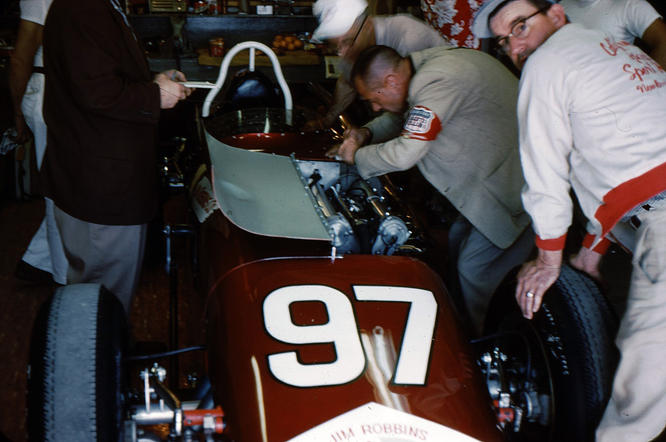
Watson, Indy 1960

Our story begins with an invitation from a mutual friend of Ed Arnaudin and the Indy car owner Jim Robbins to visit the garage of the #97 Jim Robbins Special, where a Watson Roadster powered by an upright 4178 cc / 255 cui twin overhead cam Offenhauser is being prepared.

AJ Watson shares the record for building the most cars that won the ‘Indy 500’s’, seven, with Roger S Penske. Watson built his first car ‘City of Glendale’ in 1950, Dick Rathmann qualified 18th on the grid driving the ‘City of Glendale and retired from the race with a stalled motor after 25 laps. After working on aircraft assembly lines for Lockheed Watson was hired as Chief Mechanic by John Zink in 1954.

Watson modified Zinks Kurtis KK500C roadster and Bob Swiekert duly won the 1955 Indy 500 with it, in 1956 AJ built the first of 23 Watson Roadsters for John Zink, these iconic vehicles were to win a further six Indy 500’s in 9 years.

The Watson chassis was narrower than the Kurtis, featured extensive use of 4130 chromoly tubing in place of the steel used by Kurtis, innovative use of magnesium in the drive line and body panels saved further weight. The Offenhauser engine was mounted upright on the left side of the chassis to increase weight bias on the corners of the car closest to the inside of the track rather than tilting the engine at 36 degrees as Kurtis had done and later Eperly / Salih would do with engines 18 degrees off horizontal.

With a 220 lb weight saving the 1,640 lb Watson Roadster design remained fundamentally unchanged from 1956 until 1963, AJ Foyt drove a Watson into Victory Lane at Indianapolis for the last time in 1964.

The car, seen being worked on above was one of three entered in the race owned by Safety Belt manufacturer Jim Robbin’s, the #97 was driven by the man who first put a Watson on the grid of the Indy 500 in ’53, Dick Rathmann. In 1960 Dick qualified for fourth spot on the grid and retired from the race in 31st place after 42 laps with defective brakes.

Dick Rathmann had a varied career spanning 1949 – 1964 encompassing the AAA Championship, NASCAR (13 wins, all in Hudsons, from 128 starts) and latterly the USAC Championship. He started from the Indy pole in 1958 but was collected in an accident on the opening lap by fellow front row starter Ed Elisan, the ensuing 15 car pile up cost Pat O’Conner his life.

As a result of that fatal accident Dick Rathmann became the first man to start from pole not to complete a lap of the race, a stat that has since been emulated by Roberto Guerrero and Scott Sharp. Rathmann’s best Indy 500 finish was 4th in 1956.

Now this story enters the racing twighlight zone, ever since races were organised teams and drivers have made it there business to pull the wool over organisers eye’s. ‘Dick’ Rathmann was actually born James. James had a brother, younger by four years, called Richard and when underage Richard wanted to go racing in 1946 James and Richard simply swapped names, James became ‘Dick’ and Richard became ‘Jim’ a change that ended up sticking for life.
Indy 500, 1960

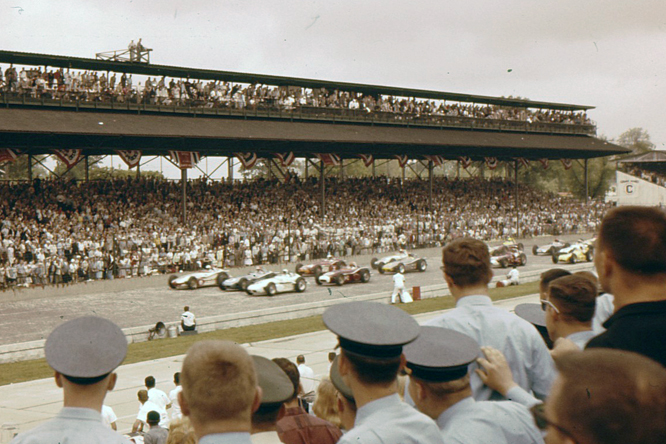
In 1960 Jim Rathmann was the driver of the #4 Ken Paul Special a Watson Offenhauser Roadster MK2, Jim qualified 2nd and can be seen in the blue car in the middle of the front row as the cars cross the 100 yards of bricks at the start of the 1960 Indy 500 above, his brother ‘Dick’ in the #97 is on the inside of the second row.
Rathman and Sachs, Indy 500, 1960

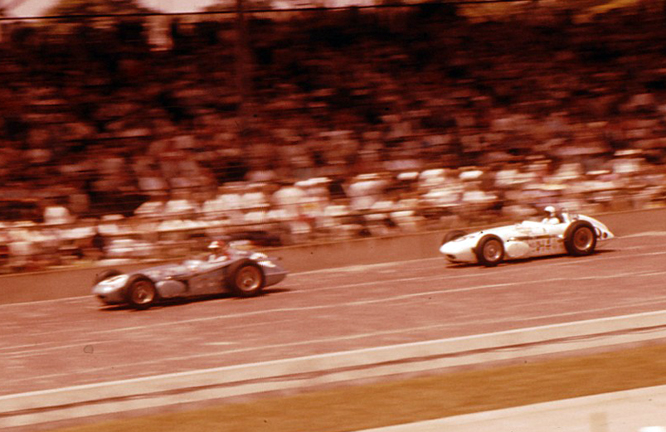
Jim seen here battling with Eddie Sachs went on to win the 1960 Indy 500, a race memorable because the lead changed a record 29 times. Last year (2010) Jim became the sixth Indy 500 winner to celebrate their 50th Anniversary of the Indy 500 win, Ray Harroun, Jules Goux, Rene Thomas, Peter DePaolo and Louis Meyer were the others.

Three time Indy winner Johnny Rutherford presented Jim with a trophy to commemorate the 50th anniversary of his win, Rutherford who was present at Indy as a spectator for the first time in 1960 remembered the race thus ” We had seats in the North grandstands of the infield on the backstretch. The duel between Jim and Rodger [Ward winner of the 1959 Indy 500] was one for the record books. Little did we know that some 50 years later [the 29 lead changes] would still be an Indy 500 record.”

Jim said of the 1960 Indy 500 “That was a great duel with Rodger. Ward was one of the toughest drivers out there and beating him meant a lot to me, and winning the Indy 500 changed my entire life. Winning the ‘500’ was and still is the all-time highlight of my racing career. To win that day, in that race against Ward means so much to me.”

Slightly off topic after retirement Jim became a Cadillac dealer in Melbourne, Florida and is credited with convincing GM president Ed Cole that GM should set up a deal to supply his friends the astronauts on the NASA space programmes with a pair of new cars each year.

My thanks to Steve Arnaudin for the scans of his Dad’s slides, to B² and Indycar Nation for additional information.

Hope you have enjoyed today’s 1960 edition of ‘Gettin’ a lil psycho on tyres’ and that you will join me again for a celebration of the 50th anniversary of the first running of the Indianapolis 500. Don’t forget to come back now !

Share

Shoestring Winner – Epperly Belond Exhaust Special

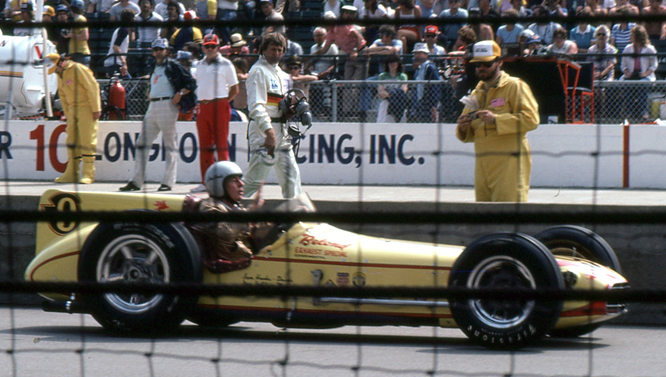
Today’s photograph by Ed Arnaudin of the two time winning Belond Exhaust Special, seen here with Sam Hanks at the wheel, was taken in 1982.

Indy82011s

The success of the Belond Exhaust Special is a testament to three men who persevered, (Gordon) Howard Gilbert a 1949 Indy 500 winning mechanic with the Blue Crown Spark Plug Special team, Howard’s neighbour George Salih a foreman at Meyer & Drake which produced the prevalent 16 valve twin cam 4 cylinder Offenhauser ‘Offy’ engine and Sam Hanks a driver who after 12 races at the Brickyard had yet to win his first Indy 500.

Salih and Gilbert came up with the brilliant idea of replicating the best features of the 1952 Pole Winning Cummins Diesel Special but without the bulk of the 3,100 lbs diesel powered vehicle.

In 1952 Frank Curtis built two cars with the engines inclined the Cummins Diesel with its engine inclined 5 degrees off horizontal and The Fuel Injector Special belonging to Howard Keck with the engine inclined 36 degrees.

Gilbert and Salih decided to build their car with a compromise between the two ’52 Kurtis Kraft chassis with the engine inclined at 18 degrees off horizontal which decreased the frontal area and lowered the centre of gravity of their car without inducing the lubrication problems that would accrue by inclining the engine at 5 degrees from horizontal, the Cummins diesel was not capable of the high crankshaft revolutions of the gas powered Offenhauser and so was easier to keep lubricated at 5 degrees from horizontal.

In order to build their engine Salih obtained cosmetically flawed Offenhauser parts on credit, and both took out mortgages on their homes to build the chassis, an operation that took place during nights and weekends between day jobs.

Having completed their chassis Quin Epperly built the bodywork in exchange for part ownership, the car is officially known as an Epperly. Exhaust manufacturer Belond got the naming rights for $2500 in sponsorship.

A contingency fund was secured for the #9 Belond Exhaust Special by equipping it with British Blue Lodge Spark Plugs as against the Champion items used by everyone else taking part in the 1957 Indy 500.

Salih got 1953 AAA Champ and 12 time Indy 500 veteran, Sam Hanks, with whom he had worked in 1956, to drive what at the time was the lowest and smallest vehicle of it’s type to a debut victory, at a record speed of 135 mph, whereupon Hanks immediately announced his retirement from racing.

The Belond Special became the first car to head to victory lane twice with different drivers in 1958 when 3 time champ Jimmy Bryan repeated Hanks achievement. In 1959 Bryan retired the Belond Special with a broken engine after just one lap.

Gilbert and Salih continued building cars until 1967, Jimmy Bryan died soon after the linked photo was taken as a result of injuries sustained in an accident at Langhorne in 1960.

Howard Gilbert built further vehicles until 1970 scoring a shock win with George Follmer at the wheel of a stock block Chevy powered Cheetah at Phoenix, in the Jimmy Bryan 150.

From 1970 to 1990 Howard built engines for AJ Foyt which took 25 champ car wins including the 1977 Indy 500, fourth victories at Indy for Gilbert and Foyt, along with USAC championships in 1975 and 1979.

With thanks to Steve Arnaudin for scanning his Dad’s photos to and Kevin Triplett for additional information.

Hope you have enjoyed the Belond Exhaust Special edition of ‘Gettin’ a lil’ psycho on tyres’, and that you will join me again tomorrow. Don’t forget to come back now !
Share

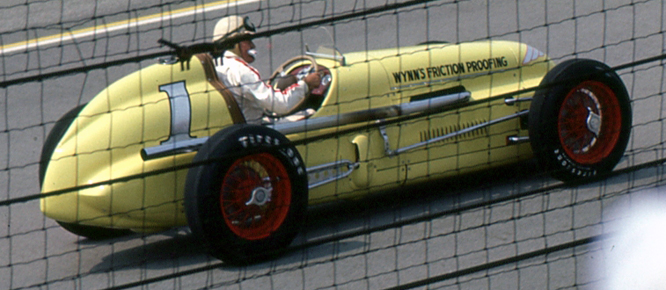
Winning in the rain – Wynn’s Friction Proofing Special

To accommodate Ferrari Friday I got a little out of sequence with my posts celebrating the Centenary of the first running of the Indianapolis 500, today we are looking at the 1950 Wynn’s Friction Proofing Special, thanks to a photograph taken by Ed Arnaudin in 1980.

Indy80 016s

Frank Kurtis the designer of extremely successful midget, 1/4 midget, sports and sprint cars also designed and built some 120 Champ cars for the Indianapolis 500, marketed and manufactured under the Kurtis Kraft name.

His creations took five victories between 1950 to 1955, so it is no stretch to say Kurtis dominated at Indianapolis in the first half of the 1950’s.

The first Indy 500 winner Kurtis Kraft built was the Wynn’s Friction Proofing Special seen in today’s photograph, the car was powered with a ubiquitous, for the period, 4,424 cui / 270 cui 4 cylinder twin overhead cam Offenhauser motor.

Driving the Wynn’s Friction Special in 1950 was Johnnie Parsons who won the rain shortened ‘Indy 500’ on just his second attempt. Due to an engravers error, Johnnie’s name was spelt incorrectly on the Borg Warner trophy, an error that was not corrected until the trophy was refurbished in 1991. Until then I am sure Johnnie’s son Johnny probably enjoyed having his name on the trophy even though it was next to his Dad’s face.

Johnnie took part in 10 Indy 500’s from 1949 – 1958, his best finishes beside the win were 2nd in 1949 and 4th in 1956. Parsons also won the Turkey Night Grand Prix for midgets in 1955, a race won more recently by NASCAR drivers Jason Lefler in 1999 and Tony Stewart in 2000.

My thanks to Steve Arnaudin for scanning his Dads photograph.

Hope you have enjoyed today’s rained out edition of ‘Gettin’ a lil’ psycho on tyres’ and that you will join me again tomorrow. Don’t forget to come back now !
29 05 11 Errata, thanks to evidence provided by Tim Murray it turns out that as of 2005 the Johnny Parsons spelling error had not been corrected. Apologies for any confusion caused.

Share

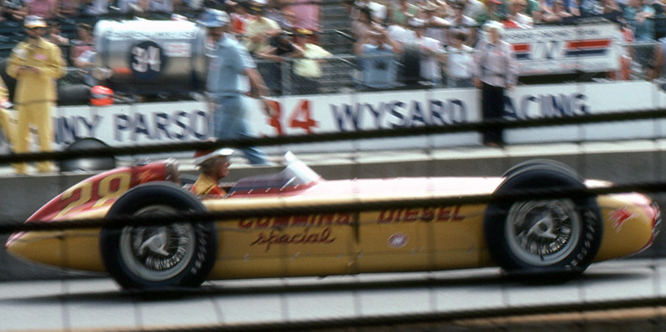
Fearless Freddy and the Cummins Diesel Special

Staying with the 1952 Indy 500 which I started to look at yesterday today we are looking at the Cummins Diesel Special, thanks to a photograph taken by Ed Arnaudin in 1982.

Cummins Special, Indianapolis Motor Speedway

The history of Cummins the diesel engine manufacturer dates back to 1919 Clessie Cummins set out to exploit the hitherto unrealised commercial potential of Rudolf Diesels high compression thermal engine which takes it’s name from it’s inventor the diesel engine.

Based in Colombus Indiana Cummins a self taught engineer was also quick to spot opportunities to promote his products through events like the Indy 500 and in 1931 entered a car built around a Duesenberg road car chassis fitted with an 85 hp Cummins deisel marine engine which started last but thanks to it’s fuel economy came home 13th and in the process became the first car ever to complete the Indy 500 without making a pitstop.

This car was subsequently prepared for use on the road and used by Cummins and his marketing manager WG Irwin on a promotional tour of Europe.

In 1934 Cummins returned with a two car entry the #5 powered by a two stroke diesel which went the distance coming in 12th and the #6 by a 4 stroke diesel which retired with transmission failure.

In 1950 Cummins returned to the Brickyard with the #61 Cummins Deisel ‘Green Hornet’ a 340 hp supercharged diesel sitting in a Kurtis Kraft chassis driven by Jimmy Jackson who started 32nd and retired after 50 laps of the rain shortened race. The Green Hornet would take the diesel land speed record at Bonneville after it was timed at 165 mph on the famous salt flats.

For 1952 Cummins held nothing back from their Indy 500 programme working again with Kurtis Kraft the chassis now accommodated a 380 hp 6.6 litre / 401 cui six cylinder turbocharged engine, mandated at twice the size of the gasoline powered vehicles in the race.

The motor featured an aluminium block and head with a magnesium crank case, this unit was lain 5 degrees off flat which gave the #28 three advantages, reduced centre of gravity, reduce the frontal area and thanks to the offset engine some of it’s weight could be distributed so that the car was heavier on the left (inside) wheels.

Fearless Fred Agabashian was hired to drive the Cummins Diesel Special on the recommendation of Kurtis. After the car was tested for the first time the team, comprising almost entirely regular Cummins employees who worked as engineers and mechanics apart from the driver, knew they had a veritable ‘Rocketship’ on their hands.

Fred sandbagged for much of the month of May until Pole day by lifting off on the back straight one lap cruising through a turn on another never completing a whole lap under full power so as not to draw attention to the ‘Rocketship’ capability of the car and risk having the rules changed.

Come 5:45 pm on pole day Fred and the heavy, 3,100 lb, Cummins Diesel Special fitted with a fresh engine made their mark on the world of motor sport by setting an individual lap record of 139 mph and a record 4 lap average of 138 mph.

Qualifying over 1 mph faster than the next nearest competitor in one of the most famous races in the world with a vehicle powered by what was in essence a truck engine subsequently repaid Cummins investment many times over in the volume of publicity this feat generated.

Having shredded their tyres in qualifying the Cummins team needed a different strategy in the race and planned to run a half a tank of diesel and make one pit stop for fuel and tyres. The heavy Cummins Diesel Special was in good company with Ascari and his heavy Ferrari, both cars bogged down at the start but climbed through the field.

Agabashain in the Cummins was running as high as fifth when the car probably claimed a world first, retirement due to…. turbo failure after 71 laps, the air intake for the turbocharger, placed low in the nose, had sucked up debris into the turbine housing damaging the blades.

Cummins however were not in the least disappointed they remain the only manufacturer of truck engines to have recorded an Indy 500 pole. An achievement possibly only eclipsed recently by the 4 victories Audi Diesels in the Le Mans 24 hours since 2006, interrupted by a Peugeot Diesel victory in 2009.

A small post script allegedly in 1953 a spark plug manufacturer was advertising its wares, in the 1953 Indy 500 programe, with a picture of the 1952 Cummins Diesel Special, the only car in the 1952 field without need of them.

My thanks to Steve Arnaudin for scanning and forwarding his Dad’s photograph.

Hope you have enjoyed today’s “Fearless Freddy” edition of ‘Gettin’ a lil, psycho on tyres’ and that you will join me again tomorrow. Don’t forget to come back now !
Share

Grant Piston Ring Special – Ferrari 375 No: 2

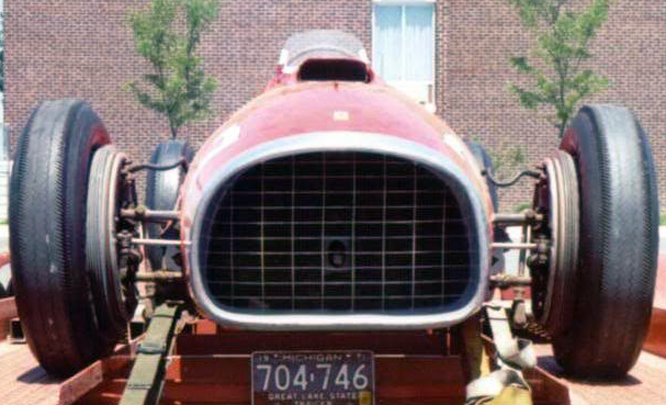
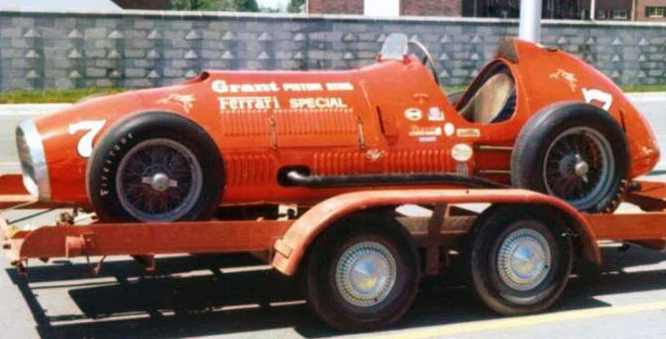
For Ferrari Friday I hope readers of my Indianapolis series will forgive me getting a little out of sequence by a year or two in order to present the 1952 Grant Piston Ring Special, a Ferrari 375 captured in these photographs by my Nostalgia Forum acquaintance B² from Indiana who saw this vehicle in a Holiday Inn car park Dearborn, MI around 1971.

Ferrari 375, Holiday Inn, Dearborn, MI

The Ferrari 375 was originally conceived as a Formula One car to take advantage of the normally aspirated engine regulations that allowed for engines up to 4.5 litres / 274.6 cui as opposed to the maximum 1.5 litres /91.5 cui maximum capacity allowed for supercharged engines.

The 375 evolved through three stages, the first stage was the 275 which featured a new Lampredi designed 3322cc / 202 cui V12 which made its debut in Jume 1950, in July 1950 the 340 made its debut with a longer wheel base de Dion rear suspension and a 4101cc / 240 cui version of the Lambredi V12.

Finally in September 1950 the 375 with a 335 hp 4493 cc / 274 cui made its debut at Monza, by 1951 Jose Froilan Gonzalez driving a 375 scored Ferrari’s first formula one Grand Prix victory in Britain to begin cementing Ferrari’s place in the top echelon of motor racing.

There were so few contenders in races run to formula one regulations that in 1952 and 1953 the World Drivers Championship was run to Formula 2, 2 litre / 122 cui regulations both won by Alberto Ascari driving a nine race winning streak for Ferrari, making the 375 essentially obsolete. When the World Championship returned to a championship for drivers of formula one regulations the maximum mandated 2.5 litre 152 cui normally aspirated engines and the large Lamperdi V12’s were consigned to being
used in sports cars only.

Ferrari 375, Holiday Inn, Dearborn, MI

With the Ferrari 375 being obsolete in the top echelon of European racing allegedly US importer Luigi Chinetti convinced Enzo Ferrari to develop the car further with a stronger longer chassis.

Ferrari was represented at the 1952 ‘Indy 500’ by four cars 1 works and 3 customers, No: 1 ‘Ferrari Special’ for his works driver Alberto Ascari, No: 2 Grant Piston Ring Special for drivers Jonnie Parsons and Danny Oakes, No: 3 ‘Kennedy Tank Special’ for driver Johnny Mauro, and No: 4 ‘Mobil Special’ for driver Bobby Ball.

Outwardly the Ferraris appearance at Indianapolis in 1952 showed Ferrari lacking finesse preparing their cars for oval racing and that the ‘Yanks’ had little idea of how to coax the most out of what was essentially a beefed up road course car at Indianapolis.

However in his description of the 1952 race (scroll half way down), fuel injection manufacturer Stuart Hilborn shows that at the very least Ferraris disdain of many things American and his legendary machiavellian gamesmanship had come into play.

In brief Hilborn discovered that the #38 Mobil Specials cylinder head fuel inlet ports had been tampered with resulting in the ports being undersize, thus reducing the power output and it was found that the power output had been further reduced by Ferrari not fitting the high compression pistons which had been specified by Hilborn during a meeting at the Ferrari factory and presumably paid for owner Howard Keck ! (Note only one Ferrari qualified for the 1952 race not two as Hilborn asserts.)

The four 375’s were around 200 lbs over weight in part due to the drum brakes being too large and more suited to road course racing.

Despite these problems Ascari drove some of the smoothest and most consistent qualifying laps ever seen at Indianapolis, which unusually possibly due to incorrect gearing, included changing down a gear for both the first and third corners to secure 19th place on the grid.

Parsons in the second 375, even after trying magnesium wheels, opted for a more powerful Offy powered vehicle and well known midget racer Danny Oakes also failed to qualify the Grant Piston Ring Special.

Mauro allegedly really only wanted his 375 for the Pikes Peak hill climb and did not take the ‘500’ seriously and never got near a qualifying time, his car today resides in the IMS Hall of Fame now painted red.

Bobby Ball like Parsons also opted for an Offy powered machine after he had tried the forth car with Hilbourn fuel injection in place of the usual Weber carburetion. This car was restored in the 80’s destroying it’s original patina and is now thought to be in the care of a New York collector.

Ascari fancied his chances in the race switching, pre race, from a one stop strategy to a three stop strategy to accommodate higher than expected tyre wear. During the race Ascari planned to keep the revs low for the first two segments in order to benefit from the tendency of his US competitors ‘win or bust’ strategies.

Due to his weight handicap Ascari got a slow start but rose from 21st to 7th when on lap 41 the right rear wire wheel collapsed causing his instant retirement. Ascari is generally acknowledged to have given a good account of himself with a possible race contending performance up to the point of his retirement.

The No: 1 375 appeared at the 1953 ‘500’ with a 3 litre 183 cui engine, new body and side tanks but was withdrawn from the race. In 1954 it appeared again with original body and 4.5 litre 274 cui engine but failed to qualify. Ascaris 375 is currently thought to reside in Hong Kong.

Which brings us back to the car in the photograph which is thought to be the No.2 Grant Piston Ring Special unsuccessfully qualified by Parsons and Oakes,

This car was seen around 1970 on former owner Lindley Bothwell’s estate in 1970. By 1998 this 375 belonged to a Brazilian Carlos Monteverde who allowed Ludovic Lindsey to demonstrate it at Imola in Italy. During the demonstration the car suffered heavy broadside impact with a track side wall which wrote off two Borani wheels, smashed the respective brake drums, and destroyed the differential casing.

Ferrari 375, Goodwood, Festival of Speed

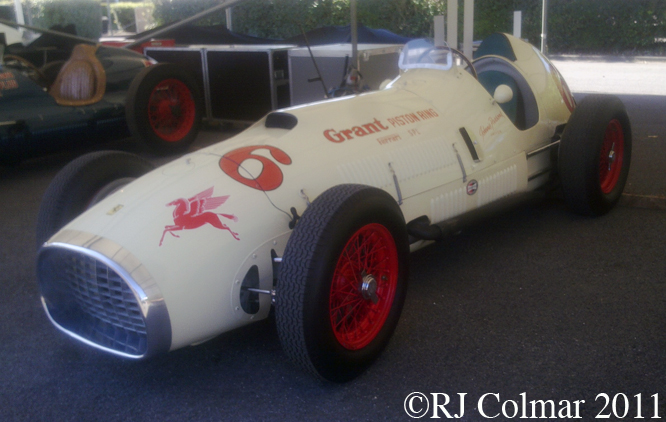
In August 2000 the No.2 375 now repaired was purchased by a Dutch owner and has been displayed in it’s white 1952 #6 Grant Piston Ring livery in the Netherlands at the Louwiman Museum and at festivals, above at Goodwood Festival of Speed in 2006, ever since.

My thanks to B² for todays photographs, and to everyone on the Ferrari 375 Indycar thread at Ferrari Chat for additional information.

There is some mystery alluding to the chameleon nature of the paint work of the Grant King Piston Ring website shows period photo’s of this car in white with cockpit wrap around screen with Johnny Parsons at the wheel and also a photo of Danny Oakes at the wheel of a red car with small screen,
if you know the correct sequence of colours and dates this car has appeared in, when it left the factory, ran in the hands of Parsons and Oakes and when it was returned to it’s current livery please do not hesitate to chime in below.

Hope you have enjoyed Ferrari Friday Indy Special edition of Gettin’ a lil’ psycho on tyres’ and that you’ll join me again tomorrow. Don’t forget to come back now !

Share

Special Kit – Lenham Healey ALFA Romeo Special

Continuing yesterdays ‘one off’ theme today’s photo’s are of what is so far as I know a unique vehicle based on a Lenham Healey kit car. Built to use Austin Healey 100 motor and running gear the original kit vaguely resembled an Allard at the front and a boat tailed Bugatti at the back. The owner of this one installed a twin cam Alfa engine and completely reworked the nose as a homage to 1930s vintage racing ALFA Romeo’s.

I understand that Lenham manufactured a variety of kit cars starting in the 1960’s, the best known of which is probably the Lenham Sprite a Fast back GT fibre glass body built to accept Austin Healey Sprite or MG Midget running gear, they are also well known for making hard tops for Austin, MG and Triumph convertibles.

Lenham also made an outstandingly attractive sports prototype racing car the Lenham P70 in the late 60’s early 70’s which Vincent Mausset’s Darnval Cars brand became involved with the intention of manufacturing a road going variant. Darnval went on to become named entrants of the Connew Grand Prix car featured a couple of months ago.

My thanks to ‘trashbat’ at the ALFA owners forum without whom I might have spent months trying verify the identity of the kit upon which today’s special is based.

Hope you have enjoyed today’s unique special and that you will join me again tomorrow for a look at another home built car. Don’t for get to come back now !

Share

Halloween Special – Fafnir Machtigen Werke Special

To put you into the mood for the weekends festivities here is Oliver Way driving BR Thompsons Fafnir Machtigen Werke Special with a non automobile 10 litre / 610 CUI engine seen here at Loton Park.

The car does does always appear with the scary radiator cover, as can be seen here at Prescott.

Fafnirs in production from 1908 – 1927 had in line 4 cylinder engines no bigger than 3990 cc 243 cui.
I am wondering if anyone knows where the huge engine came from, or what type of circa 1918 chassis, with only rear wheel brakes this is?

Thanking you in anticipation of your responses.

Thanks for dropping by, wishing everyone a scary Halloween weekend, don’t forget to come back now !

Share