Tag Archives: Tyres

Halloween Special – Fafnir Machtigen Werke Special

To put you into the mood for the weekends festivities here is Oliver Way driving BR Thompsons Fafnir Machtigen Werke Special with a non automobile 10 litre / 610 CUI engine seen here at Loton Park.

The car does does always appear with the scary radiator cover, as can be seen here at Prescott.

Fafnirs in production from 1908 – 1927 had in line 4 cylinder engines no bigger than 3990 cc 243 cui.
I am wondering if anyone knows where the huge engine came from, or what type of circa 1918 chassis, with only rear wheel brakes this is?

Thanking you in anticipation of your responses.

Thanks for dropping by, wishing everyone a scary Halloween weekend, don’t forget to come back now !

Share

Adding Lightness 50 years on – Caterham 7 Superlight

The Caterham 7 Superlight comes in two sizes regular S3 as the original Lotus 7 and the SV which is 4.3″ wider to accomodate those of us who were not born with jockey size hips.

Colin Chapman’s guiding principle when conceiving his vehicles including the Lotus 7 of which the Caterham 7 is the direct descendent was to add lightness, which in his day meant extensive use of aluminium and on the Superlight shown here means extensive use of carbon fibre including the mudguards and dashboard.

Engine options for the Superlight are 150 hp Ford Sigma, 210 hp or 263 hp Ford Cosworth Duratec. The latter option should be able to propel you from 0 – 60 in 2.88 seconds and if your head is still attached to the rest of your body on to 150 mph.

I’d like to finish by wishing my fellow ‘The Prisoner‘ fan and ‘Rowdy‘ buddy from Brevard, North Carolina, Steve Arnaudin a very Happy Birthday.

Thanks for dropping by, don’t forget to come back now ! BSY !

Share

The Spirit that never breaks down – Rolls Royce Silver Spirit.

The radiator grill design and tragic Spirit of Ecstasy mascot makes Rolls Royce one of the few instantly recognisable brands no matter what age or model. The mascot on this model instantly retracts if dislodged allegedly preventing injury to pedestrians and making the item much harder to collect by even the most determined fans of the Beasty Boys.

The Silver Spirit was a development of the Silver Shadow with a new body and suspension that brought RR into the 1980’s.

Sufficiently powered by a 6750cc / 411 cui V8 the Silver Spirit and slightly longer Silver Spur no longer featured the Citroen licensed self levelling suspension of the Silver Shadow but one using a Girling automatic hydraulic ride height control system riding on gas charged shock absorbers.

The Registration of this vehicle suggests that this might be a 1984 model but the alloy wheels to my not so well trained eye look to be of a more recent vintage. The Silver Spirit/Spur series is the twin of the Bentley Mulsanne / Eight series.

The Silver Spirit is the only Rolls Royce model that has ever come in to my hands, albeit briefly in my capacity as quality controller at a Volvo Garage, it certainly is an impressive machine to be seen driven around in, the ride quality is superb but the feel of the car with its spindly steering wheel and column shift left me feeling I was driving a very well appointed 1972 Volvo 144.

It should always be remembered that a Rolls Royce never ‘breaks down’, but if not looked after properly it might ‘fail to proceed’.

Erratum: in response to a question about the Citroen SM suspension on October 20th I stated that ‘Rolls Royce / Bentley took out licenses to use similar (Citroen hydropneumatic self levelling) systems on the Silver Shadow/T, Silver Spur/Mulsanne’ in fact as I have written above the Silver Spirit/Spur have a Girling self levelling systems. Apologies for any confusion that arose.

Hope you have enjoyed your stay, don’t forget to come back now !

Share

Bristol’s big seller – Bristol 401

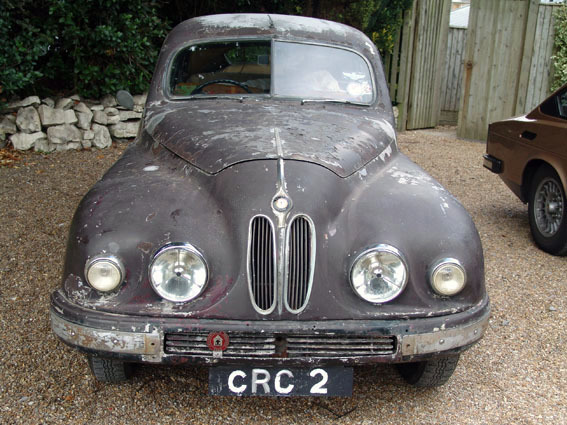
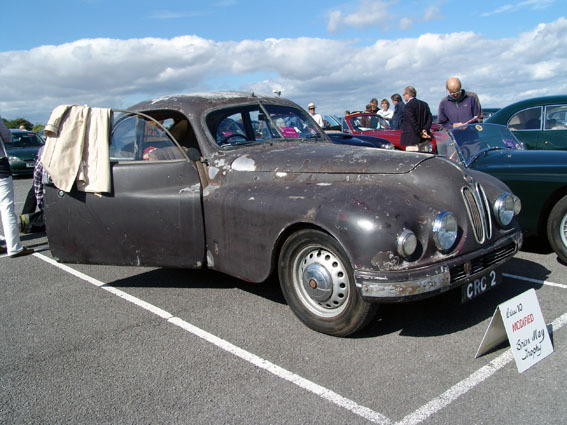
28 10 10 Erratum this blog was originally posted with pics I thought were of a Bristol 401 in good faith, however it has transpired thanks to Sinclairstinton & Geoffrey Hawkins at BOCForum@yahoogroups that the car pictured was in fact a Bristol 403.

Since the information posted on the 401 has proved useful and interesting to at least one Bristol owner I have decided to remove the original pictures from the text and write a new blog to cover the Bristol 403, and post new photo’s of 401’s kindly sourced from the archive of Teb Marius and taken by John Lomas. The original text remains with additions in italic :-
Source Teb Marius

Continuing the 100th anniversary of the Bristol aeroplane company todays vehicle is the Bristol 401, which took its styling direction from a prototype by Carrozzeria Touring in 1948. The big external change from the Bristol 400 was the addition of large side lights in the front wing and hidden door handles.
Source Teb Marius

Internally the BMW based 6 cylinder engine was upgraded from 80 to 85 hp with the use of improved carburettors.
Source Teb Marius

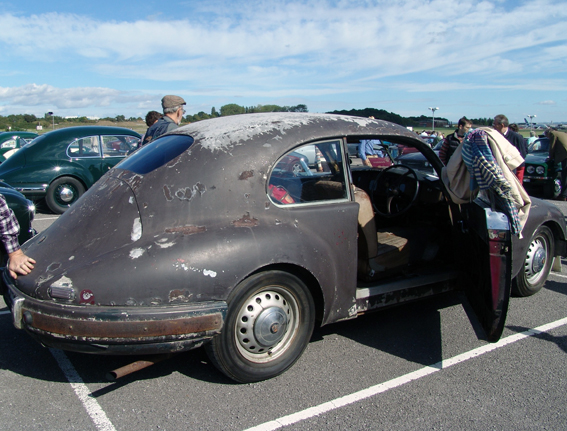
The 401 had a very low drag coefficient of the order of 0.36 comparable to many modern vehicles, which helped the vehicle reach 97.3 mph. Between 1948 and 1953 611 of these vehicles were built making it Bristol’s all time best seller !

The model was so popular that in 1955 Mr. and Mrs. Glasby in a Bristol 401 with a total of 1497 points won class B of the second Ndola Rally in Northern Rhodesia now known as Zambia.

Note: Teb did offer some photos of 401’s in concours condition however I am a huge fan of original patina and will always show vehicles on this blog with original patina over re sprayed vehicles where I have the choice.
Photobucket

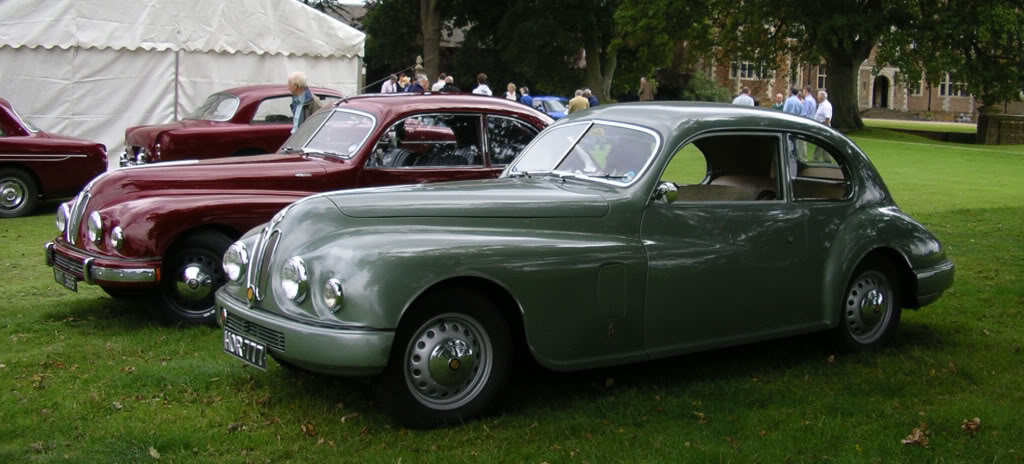
Posted with kind permission of the copyright owner John Lomas.

As can be seen from the fabulous photo above the 401 (green closest to the camera) and 403 are almost indistinguishable if like me your not an expert, the 403 has a small chrome numeral badge to the rear of the bonnet, the bumper grill is chromed on the 403, there is a chrome numeral badge on the boot of the 403 and the roundel on the 403 Bristol badges are dark red as opposed to the orange on the 401.

Apologies for any confusion arising from my original post thanks to everyone who helped correct the error.

Thanks for popping by, wishing everyone a thriving Tuesday, don’t forget to come back now !

Share

Born out of an Austin Maxi – AC 3000 ME

Born out of an Austin Maxi – AC 3000 ME

Stumbled across this lovely little AC 3000 ME at Silverstone many, many moons ago.

Auto Carriers (AC) can trace it’s roots back 1903, but is probably best known to my generation for two cars that it did not design, namely the AC Ace a design which started life as a Weller engined Tojero and was purchased by AC before eventually morphing into the brutal AC Cobra.

Similarly the AC 3000 ME started out as an Austin Maxi, I’ll repeat that for the more incredulous reader Austin Maxi (!) powered special built by Peter Bohanna and Robin Stables which after AC took it over became a Ford, top of the UK range, 3 litre / 183cui Essex V6 powered vehicle.

AC made just 71 of these vehicles starting in 1979 until production was halted at the Thames Ditton works in 1984. A further 30 3000 ME’s were produced under license by AC (Scotland) including a unique Alfa Romeo V6 prototype. One for collectors to look out for one would imagine.

No AC’s of any kind were built between 1985 and 1996.

Wishing you all a relaxing Sunday and hoping Kevin Harvick can put one over the #48 and #11 at Matinsville tonight. Hope springs eternal for this ‘Happy’ fan 🙂

Don’t forget to come back now !

Share

A Spider for the sqeamish ! – FIAT 124 Spider

Way back in the Dark Ages I learned to drive in a FIAT 124 Special T, the car I’d rather have been driving is the shorter wheelbase 124 Spider.

With body work designed by Pininfarina the Spider was introduced in 1966 and production continued until 1985.

This particular model was sold as the 2000 Spider between 1979 and 1982 before production moved from FIAT to Pininfarina for three final years.

Thanks to everyone who has joined me this week, wishing you all a fabulous weekend, don’t Forget to come back now !

Share

Superleggera ! A Q car to leave Mr Bond eating dust – Aston Martin DB4 GT

Anybody who thinks of them selves as any kind of a car enthusiast will have to admit a visit to a VSCC meeting at Prescott is worth it just to see the mouth watering vehicles in the car park.

The vehicle above is a case in point. When I first saw it I thought it was a DB5 or DB6 those faired in lights were a bit of a give away… but boy was I ever wrong ! The clue as to the identity of this vehicle is the ‘egg box grill’ which predates the horizontal bars of the grill of a DB5 or DB6, making this model a DB4 of series 3 or earlier.

The red and white badge in the centre of the grill indicates that the owner is a member of the Institute of Advanced Motorists.

The car bears the legendary Superleggera badge on the side of the bonnet indicating it is built using the light weight tubeframe duraluminium construction pioneered and licensed by Carrozeria Touring of Milan.

At 5 inches shorter than the 1110 regular DB4’s this car is one of only 75 DB4 GT’s sharing the same short wheel base chassis as the 20 original DB4 GT Zagato’s (plus 4 Sanction II’s and 2 Sanction III’s). The DB4 GT also has thinner body panels than the standard DB4 and an upgraded 302 hp 3750 cc / 228 cui in line 6 cylinder engine distinguishable by a twin spark plug head. It was capable of 153 mph (8 miles and hour faster than Mr Bonds DB5) and 0 – 60 in just 6.1 secs, not bad for 1959 !

The final give away that this model is a DB4 GT are the clearly visible bulky racing fuel filler caps. If like me you like your performance vehicles to be slightly understated, relative to say the DB4 GT Zagato then you’ll absolutely love this car.

Thanks for dropping by, don’t forget to come back now !

Share