A Wedding Gift – Bugatti Type 57C Van Vooren Cabriolet #57808

Mohammad Rezâ Šâh Pahlavi third child, eldest son of Reza Pahlavi and his second wife, Tadj ol-Molouk aka the first Shah of the Iranian Pahlavi dynasty, himself acceded to the thrown to become the Royal head of Iran aged a month short of 22. His father abdicated rather than commit Iran to the allied war effort with support for an Iranian Corridor for the supply of allied weapons and provisions to the Russians who were engaged in a fierce conflict with the German forces on the Russian front.
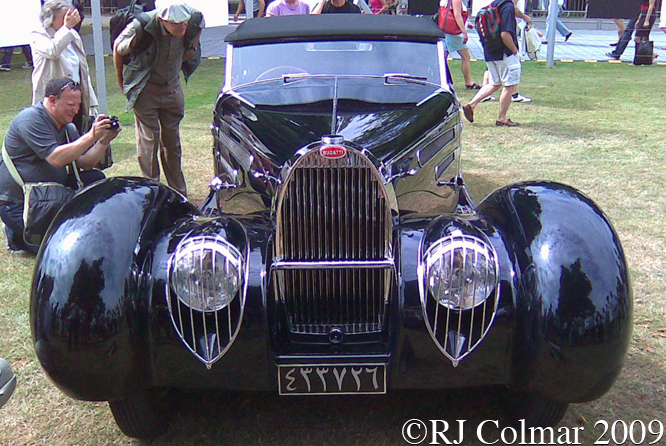
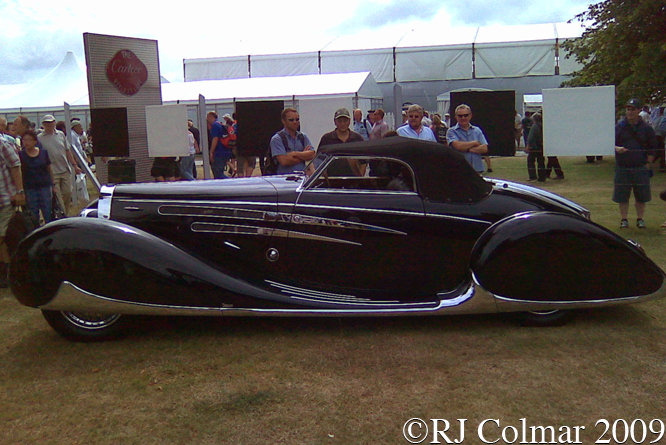
Bugatti Type 57C Van Vooren Cabriolet, Goodwood Festival of Speed

Two years earlier Mohammad Rezâ Šâh Pahlavi married Egyptian Princess Fawzia Fuad daughter of King Fuad I of Egypt and Sudan until he was deposed 1952. As was and still is the custom, the marriage of a head of state in waiting gave numerous governments the opportunity to ingratiate themselves for future eventualities by presenting often unique wedding gifts showcasing the skills and talents of their citizens.
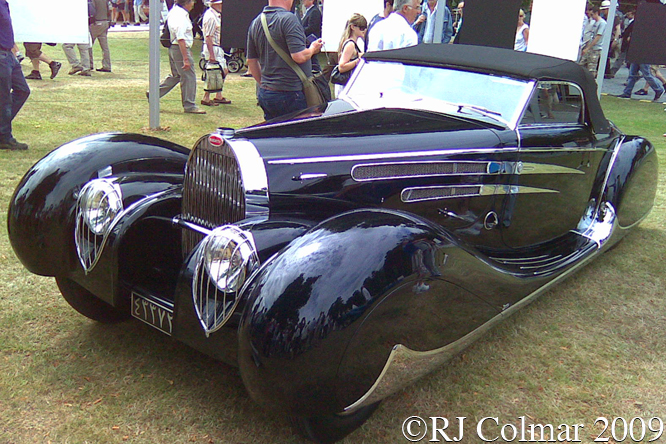
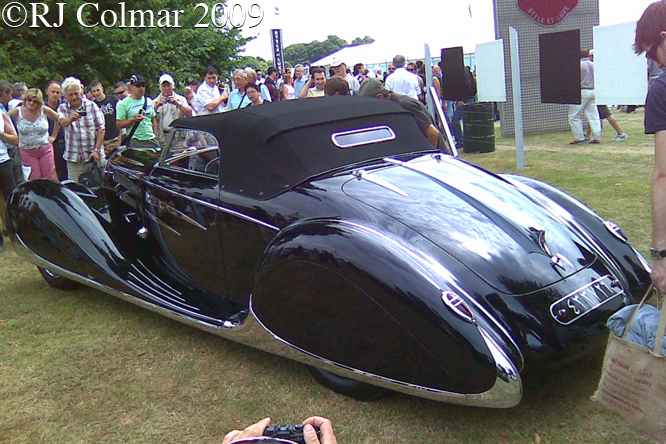
Bugatti Type 57C Van Vooren Cabriolet, Goodwood Festival of Speed

The French Government did this by commissioning Bugatti to build a supercharged 160hp Type 57C chassis #57808 and supplying it to the coach builders Van Vooren who were commissioned to build a 2 seat Cabriolet body for it.
Bugatti Type 57C Van Vooren Cabriolet, Goodwood Festival of Speed

The body designed by, French domiciled Ukranian, Jacques Saoutchik, with it’s closed in wheels appears to have been heavily inspired by the other noted French coach building house Figoni et Falaschi, but had some original features including a windscreen that could be lowered into the front bulkhead and the roof which folded away completely from view below a rear interior panel.
Bugatti Type 57C Van Vooren Cabriolet, Goodwood Festival of Speed

In January 1979 the by now self styled Shah of Iran fled the peacock throne and the gathering Iranian Revolution which sought to place the exiled Ayatollah Ruhollah Khomeini as de facto head of state. The Shah left his Bugatti in the Royal Court of Iran and it was sold, allegedly for less than $300 by the Ayatullahs who found it and could easily have ordered it’s destruction.

The purchaser sent the car to the USA where it was fitted with an American V8 before #57808 found it’s way to experts in restoration Rod Jolly Coachbuilding in the UK where former Bugatti employee octogenarian Louis Giron is credited of taking care of the mechanical restoration.

I believe #57808, seen in these photographs at the Goodwood Festival of Speed is currently part of the Petersen Automotive Museum in Los Angeles.

Thanks for joining me on this “A Wedding Gift” edition of “Getting a li’l psycho on tyres” I hope you will join me again tomorrow. Don’t forget to came back now !

Share

Sig. Nuvolari’s Replacement – Maserati 8CM #3018

On the 9th of July 1933 Tazio Nuvolari made his Maserati debut at the Belgium Grand Prix driving a Maserati 8CM chassis #3007. He continued to race the #3007, scoring two more wins, at Ciano and Nice in 1933, until mid way through 1934 when he broke his leg in it at Alexandria.

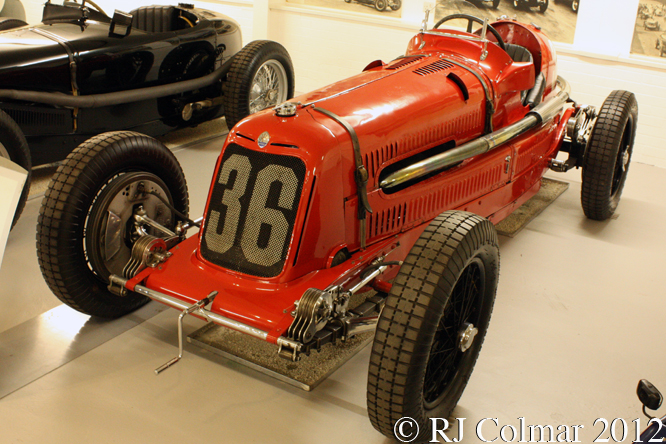
Maserati 8CM, Donington Park Museum

By June 1934 Maserati had supplied Tazio with today’s featured 8CM chassis #3018 which he drove in the Eifel GP at the Nurburgring where he retired. Two more retirements followed until he scored a 4th place finish in the 1934 German Grand Prix which was followed by successive 3rd and 2nd place finishes at Vivorno and Pescara respectively.

In August 1934 the original 3 litre / 183 cui 8 cylinder motor was replaced with a 1.5 litre / 91.5 cui 6 cylinder unit for voiturette races, making the car the first Maserati 6CM a full 18 months before the 6CM went into production in 1936. Tazio drove #3018 in voiturette spec to victories in the at Modena and Naples.

Tom Wheatcroft founder of the Donington Park Museum where the car is seen here owned the car for over thirty years before he passed away in 2009.

Thanks for joining me on this “Sig. Nuvolari’s Replacement” edition of “Gettin’ a li’l psycho on tyres” I hope you will return tomorrow when I’ll be looking at a Bugatti built for royalty. Don’t forget to come back now !

Share

The Export Drive – Type T-51 Lester ‘MG’

One of many successful post ’39 – ’49 war specials builders was Harry Lester who ran a number of modified MG’s from his garage on the Bath Road in Thatcham, Berkshire.

Lester MG T51, 5th Tony Marsh Memorial, Gurston Down

In 1949 he built his first twin tube ladder frame chassis which formed the basis of the first Lester MG using proprietary MG motor, gearbox, axles, suspension and brakes.

Lester MG T51, 5th Tony Marsh Memorial, Gurston Down

The success of this car led Harry to build his first Type T-51 chassis in 1951, which he described at the time as “developed through practical research and sports car racing and is now being built in limited quantity for almost 100% export purposes.”

Lester MG T51, Penfound, 5th Tony Marsh Memorial, Gurston Down

Not all of his cars were exported as intended with many success being recorded in the UK by the ‘Monkey Stable’ founded by Harry and Jim Mayers who’s drivers included Pat Griffith, Mike Keen, Ken Ruddock, Les Leston and others, their outstanding achievement being a Team award in the 1952 Goodwood 9 Hours where they finished 1st 2nd and 3rd in the 1500 cc / 91.5 cui class.

Lester MG T51, Penfound, 5th Tony Marsh Memorial, Gurston Down

It would appear many different body styles were fitted to the Lester’s which included two coupes one powered by an MG XPAG motor and another by the emergent Coventry Climax motor.

Lester MG T51, 5th Tony Marsh Memorial, Gurston Down

It is thought somewhere between 10 and 18 Lesters of all types were built up to September 1955 when Harry Lester lost interest in racing and building racing cars after the death of Monkey Stable co founder Jim Mayers at the wheel of a Cooper at Dundrod.

Stewart Penfound’s example seen here at Gurston Down last year was possibly one of the last T 51’s to be completed, it is listed as being first registered in June 1955.

Thanks for joining me on this “The Export Drive” edition of “Gettin’ a li’l psycho on tyres”, I hope you will join me again tomorrow for Maserati Monday. Don’t forget to come back now !

Share

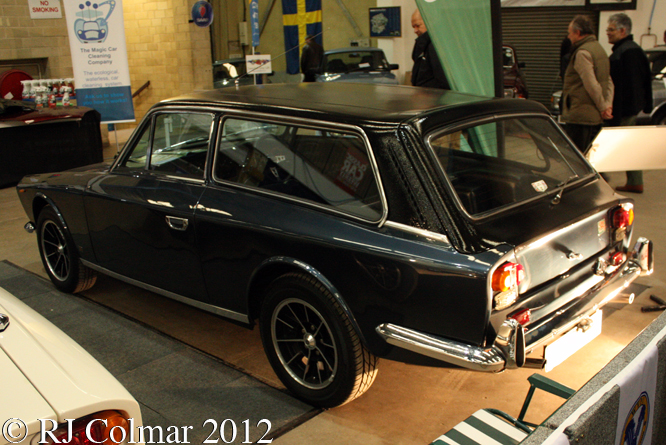
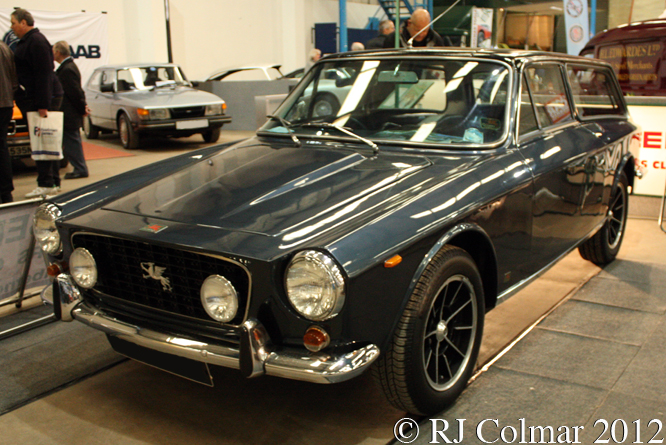
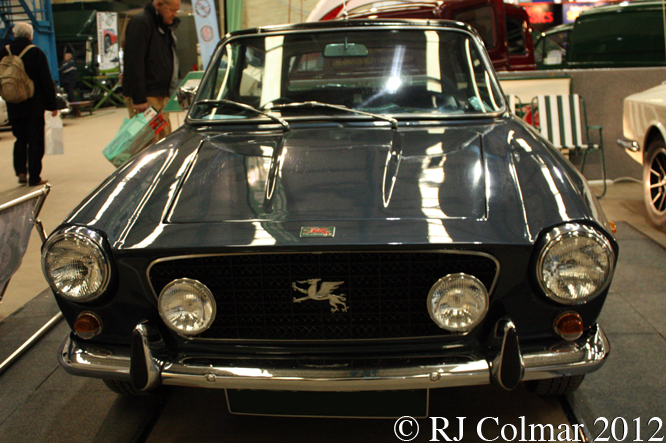
Welsh Shooting Brake – Gilbern Invader Estate Mk II

In 1969 Gilbern launched the first of series of Invaders which were improved versions of the Gilbern Genie larger brakes and only powered by the larger 140 hp 3 liter / 183 cui of the Ford Essex V6 motor.

Gilbern Invader Estate, Bristol Classic Motor Show, Shepton Mallet

In 1970 the first Estate / Station Wagon or more correctly shooting brake versions of the Invader began to appear and in 1971 a Mk II version of Invader was built of the type featured today which was built in 1972 with a with stiffer chassis and MG C front axle.

Gilbern Invader Estate, Bristol Classic Motor Show, Shepton Mallet

During the period of Invader production owners Ace Capital Holdings Ltd, whose primary business was in slot machines, were sold to Mecca whose portfolio included a large stake in the Bingo Hall and related gambling operations and the Miss World Franchise.

Gilbern Invader Estate, Bristol Classic Motor Show, Shepton Mallet

Car manufacture did not fit in with Mecca’s business plan and so Gilbern was sold in a management buyout to first Maurice Collins 1970 and then to his former co director Mike Leather in 1972. For a very short period in 1972 production reached a break even point of 4 cars a week. In all 212 GT and 104 Estate Invader Mk II’s were built up until September 1972 making the MkII the most successful of all Gilbern models.

Share

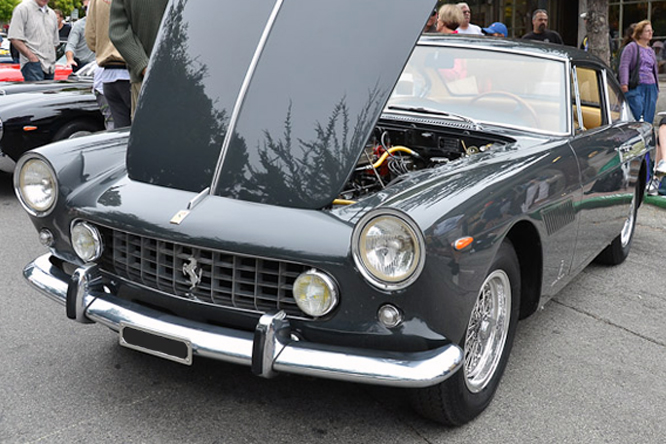
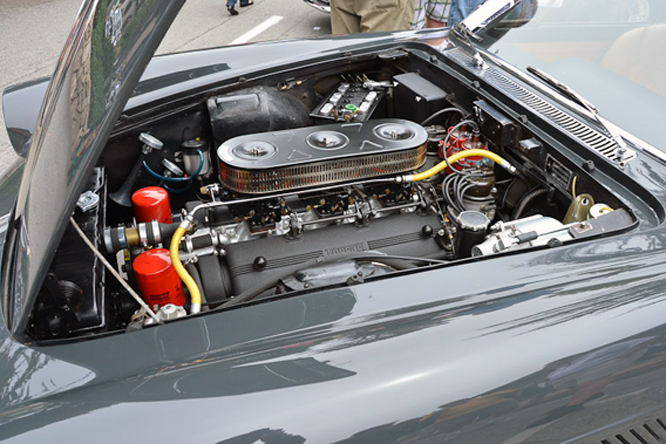
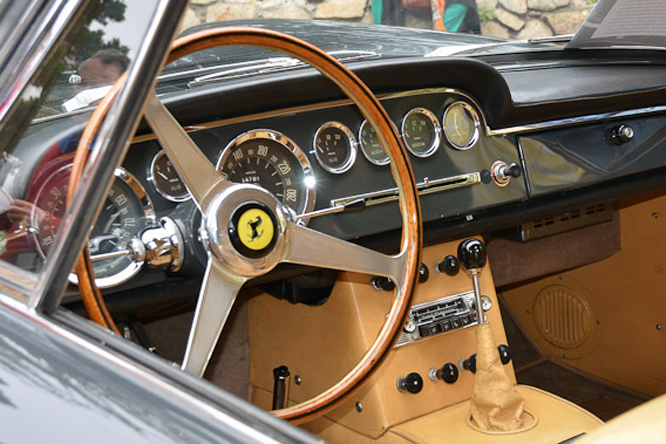
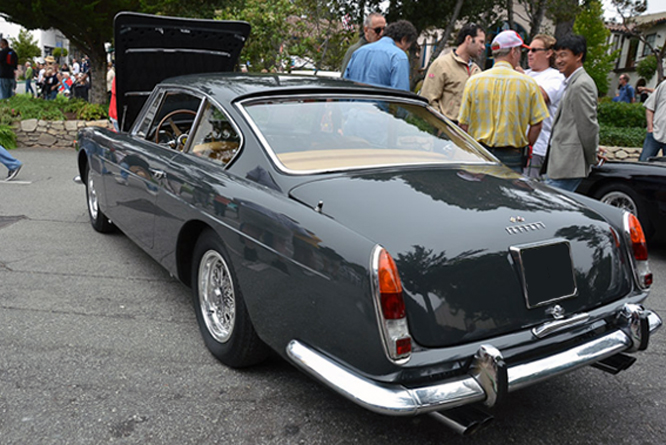
Wendy’s Indoor Playground – Ferrari 250 GT/E #2259 GT

Like some Bristol cars there are some Ferrari’s you either love or see as opportunities to tear apart for recycling into more desirable models or heaven forbid turn into complete replica’s of more illustrious models, in the UK these vehicles are known as “Marmite” cars, you either love, or love to hate them.

One such is the first production model, as opposed to special order model, Ferrari to be fitted with a rear seat and useable boot / trunk as standard like today’s featured Ferrari 250 GT/E.

Ferrari 250GT/E, Concours on the Avenue, Carmel by the Sea

The practicalities of the 250 GT/E made it a huge, by Ferrari standards, seller with 955 cars built in 3 series between 1959 and 1963. Today’s featured car chassis #2259 GT, seen by Geoffrey Horton at Carmel by the Sea some years ago, is one of the 302 Series I vehicles built between 1960 and 1961.

Thanks to the intervention of Tom Yang, pronounced Young, and a deal cut in the privacy of a Wendy’s indoor play area #2259 is a two owner car.

Ferrari 250GT/E, Concours on the Avenue, Carmel by the Sea

The first owner was Carlo Durante who bought the car in Milan in 1960, Carlo who runs his own auto shop Alfa of Tacoma in Washington drove the car for nine years before some bad fuel clogged up a carburetor causing one of the pistons to run too lean and get holed.

Carlo got his 63,000 mile car back to his shop striped the engine out and for next 40 years nothing more happened as the pressure of work meant Carlo did not have time to attend to his pride and joy.

Ferrari 250GT/E, Concours on the Avenue, Carmel by the Sea

Fast forward to the Autumn of 2009 and California Ferrari preservation expert Tom Yang got wind of Carlo’s car and through a mutual friend built up a friendship that culminated in Tom introducing Carlo to a potentially sympathetic new owner. After they had been to visit Carlo and his 250 GTE all three went to a Wendy’s and a deal was struck.

Tom who would take care of the recommissioning of #2259 GT received it at his workshop on the last day of March 2011 and fourteen months later it was back, in not just working order, but Concours condition as can be seen in these photo’s taken by Geoffrey in August 2012.

Ferrari 250GT/E, Concours on the Avenue, Carmel by the Sea

Most of the car is still original, including the paintwork, despite having the 3 liter / 183 cui V12 motor painstakingly rebuilt, the rear differential resealed, brakes overhauled to better than original condition and the carpets replaced. The seats were saved and repaired as was the original wood rimmed Nardi steering wheel which has been beautifully preserved.

The new owner was awarded the FCA Pacific Region Vintage Concours Preservation Award at Concorso Italiano, Laguna Seca Golf Ranch just 3 day’s after these photo’s were taken. Coincidentally the man responsible for the preservation of #2259 GT, Tom Yang is seen in the bottom photo wearing the grey blazer on the right.

My thanks to Geoffrey Horton for sharing today’s featured photographs and to Tom Wilson, not only for his lightening quick response to my enquiry about today’s featured Ferrari at Ferrari Chat, but also for recommending Tom Yang’s excellent website which documents it’s preservation and recommissioning.

Thanks for joining me on this “Wendy’s Indoor Playground” edition of “Gettin’ a li’l psycho on tyres” I hope you will join me again tomorrow for a look at the last of this month’s Gilbern series. Don’t forget to come back now !

Share

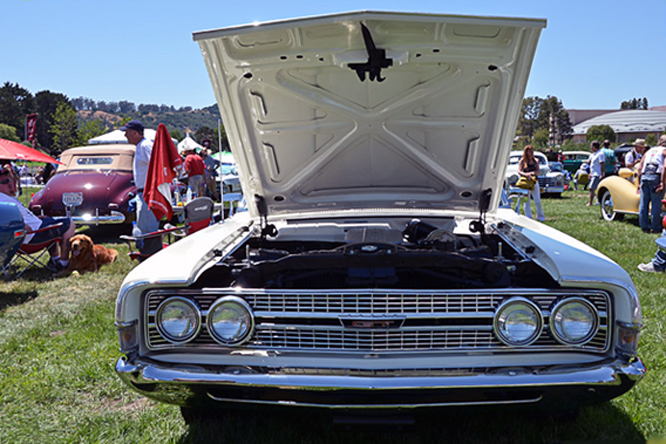
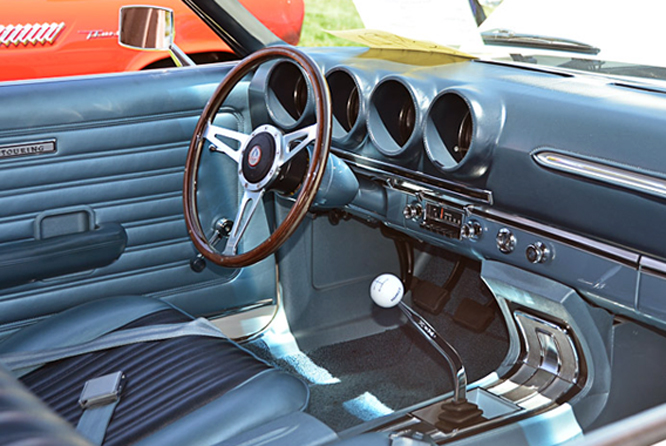
Winning Pace Car ? – Ford Torino GT Convertible

For 1968 Ford launched a new mid size model with a 116″ wheel base called the Torino which was placed over the previous Fairlane’s attracting a predictable price hike in return.

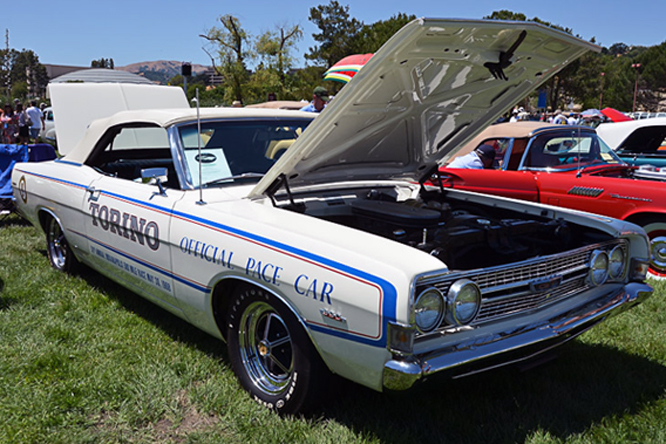
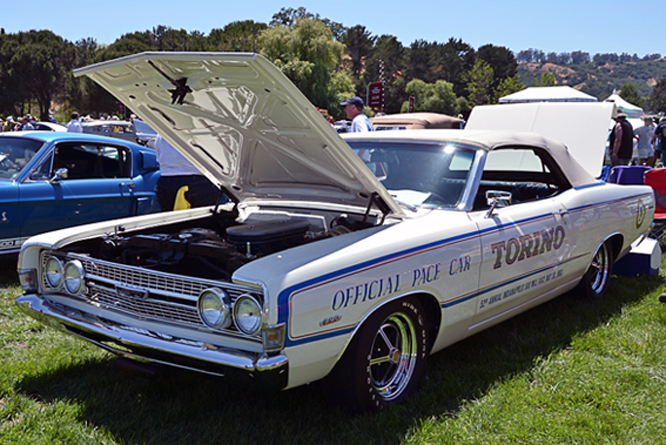
Ford Torino GT Convertible, Marin Concours d'Elegance

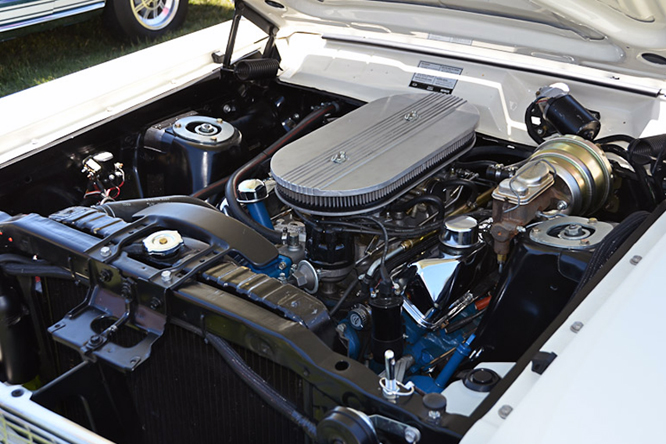
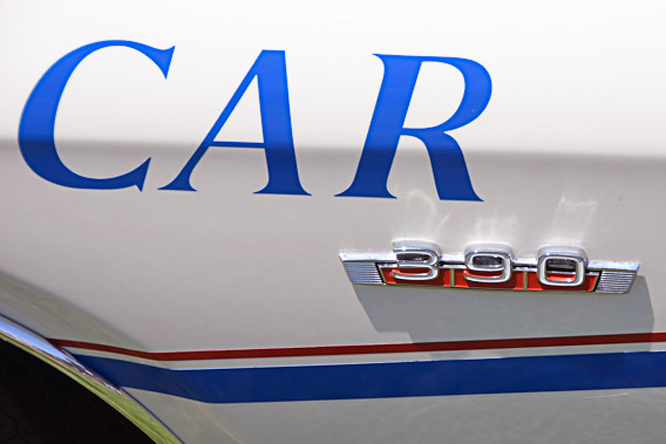
To promote the new model Ford did a deal with the organisers of the Indy 500 to provide a fleet of Torino GT Convertible pace cars for the use of event officials which included two 428’s, one 390 and one hundred and fifty six 302 Automatics known as ‘festival cars’.

Ford Torino GT Convertible, Marin Concours d'Elegance

Additionally Ford dealers could order a limited edition ’68 Pace Car spec Torino GT convertible. It is thought 709 of these limited edition vehicles were built with around 90% percent having the lower spec 302 motor fitted.

Ford Torino GT Convertible, Marin Concours d'Elegance

It is possible, with a little room for scepticism in the absence of any number of confirming details, that today’s featured example seen by Geoffrey Horton at last years Marin Concours d’Elegance is the 309 Pace Car used at Indy.

Ford Torino GT Convertible, Marin Concours d'Elegance

The give away evidence that this might be the 390 GT Torino Convertible used at Indy are the bonnet / hood pins which are unlikely to have been fitted to any of the Dealer ordered Limited Edition pace cars.

Ford Torino GT Convertible, Marin Concours d'Elegance

The ’68 Indy 500 was won by Bobby Unser driving a turbocharged 4 cylinder Offenhauser powered Eagle from team owner Dan Gurney in a Ford V8 powered Eagle. The ’68 race was also used as a backdrop for the film ‘Winning’ which introduced Paul Newman to Motorsport and led to his participation as a driver and successful team co owner.

Ford Torino GT Convertible, Marin Concours d'Elegance

‘Winning’ brought some no doubt welcome additional coverage for the GT Torino Pace Cars which also featured in the film. If you have evidence to either confirm or refute the notion that this car is one of the cars supplied to Indianapolis Motor Speedway in 1968 please do not hesitate to chime in below.

Thanks for joining me on this “Winning Pace Car ?” edition of “Gettin’ a li’l psycho on tyres”, I hope you will join me for Ferrari Friday tomorrow. Don’t forget to come back now !

Share

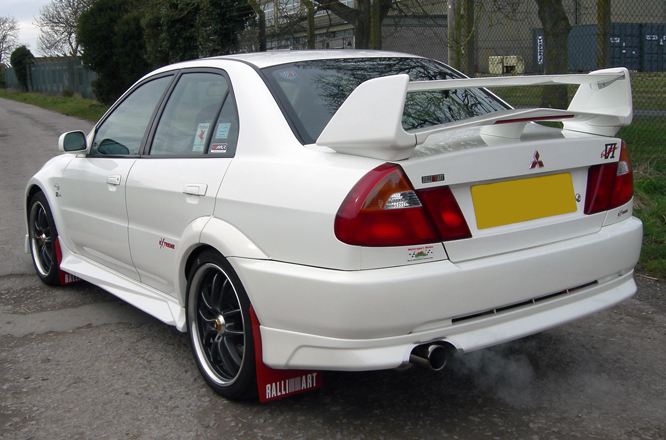
A Psychotic Car ? – Mitsubishi Lancer Evolution VI eXtreme RS450

In 1973 Mitsubishi launched one of it’s most successful vehicles in the form of the 4 door tin top Lancer of which 6 million examples had been built by 2008. Spanning 5 model generations name variations according to specific markets included; Colt Lancer, Dodge/Plymouth Colt, Chrysler Valiant Lancer, Chrysler Lancer, Eagle Summit, Hindustan Lancer, Soueast Lioncel, Mitsubishi Mirage, Mitsubishi Galant Fortis and Mitsubishi Lancer Fortis.

Mitsubishi became the second Japanese manufacturer to win the East African Safari Rally in 1974 when Joginder Singh and David Doig beat Björn Waldegård and Hans Thorszelius driving a much faster but unreliable Porsche 911. Joginder and David won the Safari Rally, as it had by now become known in 1976, again driving a 1600 Lancer GSR.

In In the 1980’s Mitsubishi’s officials motorsport programmes were placed in the hands of Ralliart with former Rally Driver Andrew Cowan playing a prominent role. In 1996 Ralliart signed Tommi Mäkinen to drive it’s works Mitsubishi Lancer Evolution III Rally cars and the combination won not only the 1996 Safari Rally but also the 1996 World Rally Drivers Championship.

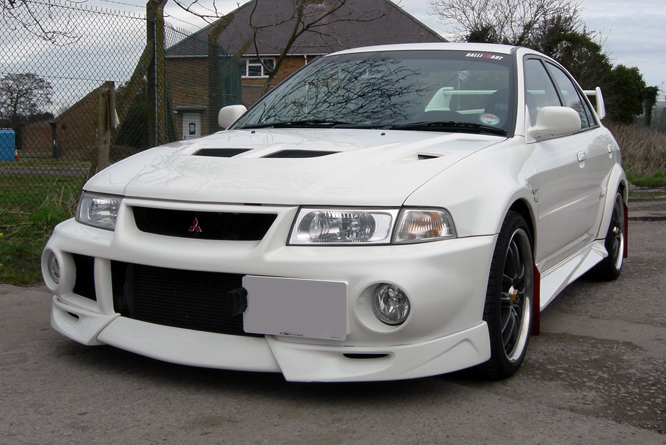
Mitsubishi Lancer Evolution VI eXtreme RS450

Driving successive Evo IV, V and VI models Tommi won 3 more consecutive World Championships with Mitsubishi also winning the manufacturers title in 1998. By the end of 2001 Tommi had racked up 22 World Rally wins in Ralliart prepared Lancers.

Alongside it’s rally preparation business Ralliart also upgraded cars for customers and sold a range of performance goodies and today’s featured car, owned by fellow Bristol Pegasus Motor Club member Trevor Hartland is one that was upgraded by Ralliart.

Today’s featured car started life as a Mitsubishi Lancer Evolution VI RSII, a model close to the top of the factory finished performance tree with the Anti Yaw Control (AYC) and Anti Lock Brakes (ABS) deleted to save weight and give the driver maximum control.

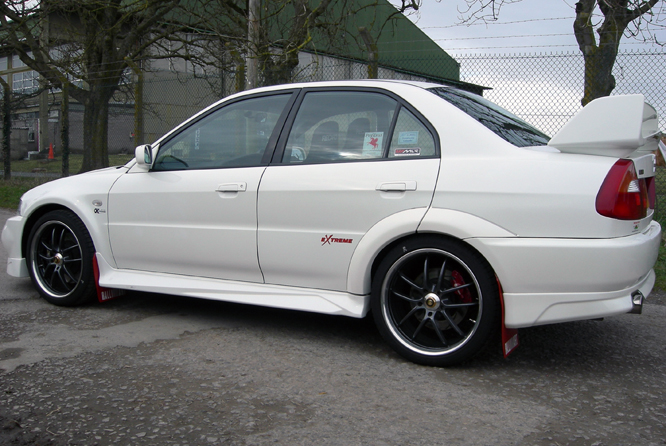
Mitsubishi Lancer Evolution VI eXtreme RS450

The Ralliart Evolution VI RSII “eXtreme” upgrade package included 18 inch wheels, lowered suspension with new bushes and top mounts, high ratio steering rack (just two turns lock to lock), plenty of interior and exterior carbon fiber.

A special Electronic Control Unit boosted the power up to 340hp with 303lb/ft torque at 3000 rpm enough to take one from rest to 60 mph in just 4 seconds, only 26 Evo VI RSII’s were upgraded to “eXtreme” spec plus an additional older Evo V. Today’s featured car is the 11th of the 26 Evo VI RSII “eXtreme” models.

The RS450 was a UK spec only upgrade on the “eXtreme” which was fitted to just four vehicles of which only three remain. The more or less competition RS450 spec includes among many more items a Ralliart blue printed motor with competition spec crankshaft,connecting rods, forged pistons, with high lift cams competition gasket, lightened valves.

Mitsubishi Lancer Evolution VI eXtreme RS450

For swift gear changes a phosphor bronze gear linkage bush kit was fitted, while the suspension is Group N, National competition spec with Ralliart strut braces front and rear and the brakes are to match.

The RS450 name was chosen because it was intended that the model would produce 450 lb per foot torque but the final figure was just over 380 lb per foot torque, enough described as “psychotic” by one commentator, to reach 60mph from rest in just 3.8 seconds and 100 mph in 8.8 seconds, not bad for a vehicle that cost £45,000 new in 2000.

Trevor’s car was the only white RS450 built and uniquely does has a colour coded rear wing at the original owners request after he was less than enamoured with the original red one. In 2001 this car covered the 1/4 mile Brighton speed trials in 12.53 seconds for a class winning 119mph run.

When Trevor last had his pride and joy tested on a rolling road the motor was conservatively mapped to produce 449 hp and 469 lb per foot torque with 1.8 bar of boost !

My thanks to Trevor Hartland for sharing these photo’s of his rare Mitsubishi Lancer Evolution VI eXtreme RS450.

Thanks for joining me on this “A Psychotic Car” edition of “Gettin’ a li’l psycho on tyres” I hope you will join me again for Americana Thursday tomorrow. Don’t forget to come back now !

Share