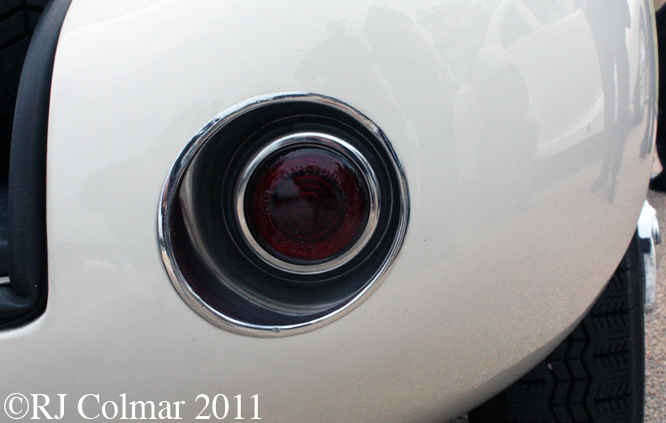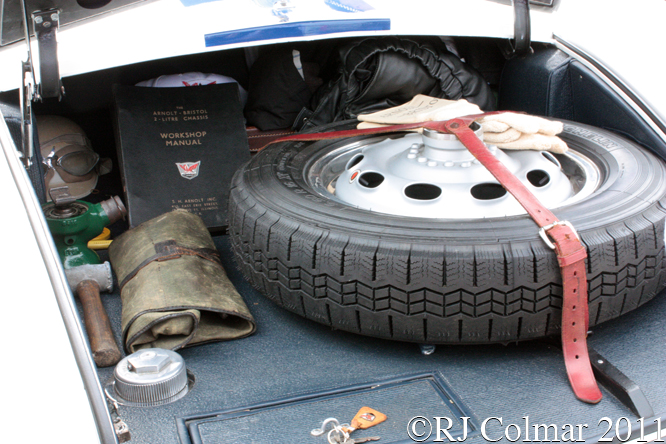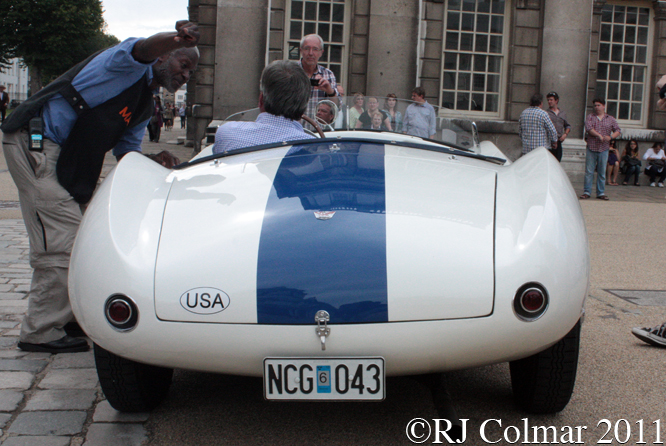
Creme de Menthe – Bugatti Type 57 Aerolithe Recreation #57104

The chassis for today’s featured Bugatti Type 57 #57104 was the fourth Type 57 to be built and the oldest known to have survived. In 1934 it was delivered to Bugatti’s agent in Paris Lamberjack. Somewhere around the mid to late 1940’s the car lost what is believed to have been it Van Voren body, but the chassis and major mechanical items apart from the front axle remained as a ‘flock of parts which passed through many owners including Tom Barrett, co-founder of the Barrett-Jackson auction house.

When Tom realised he needed a low slung Type 57SC chassis, on which to build a recreation of the famous Atlantique, he sold the flock of Type 57 parts along with a consignment of Bugatti Type 59 parts to David Grainger of The Guild of Automotive Restorers of Bradford north of Toronto, Ontario.
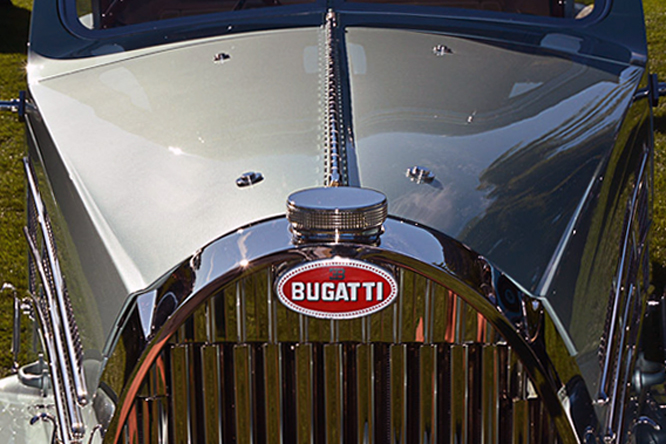
Bugatti Type 57, Quail Concours d'Elegance,

David spent 3 years restoring the Type 59 from little more than half of the original parts before turning his attention to what he might do with #57104. At some point David came across some images of Jean Bugatti’s masterpiece, the Aerolithe which featured center stage of Bugatti’s stand at the 1935 Paris Auto Show.

The Aerolithe, French for meteor, disappeared after it had been road tested by two British enthusiasts in the United Kingdom and returned to the factory in 1936. There is no documentation as to what became of the car but it is presumed to have been broken up not least because it’s body was crafted out of magnesium alloy otherwise known as Elektron a valuable material that the Germans used in the production of it’s World War Two aircraft.
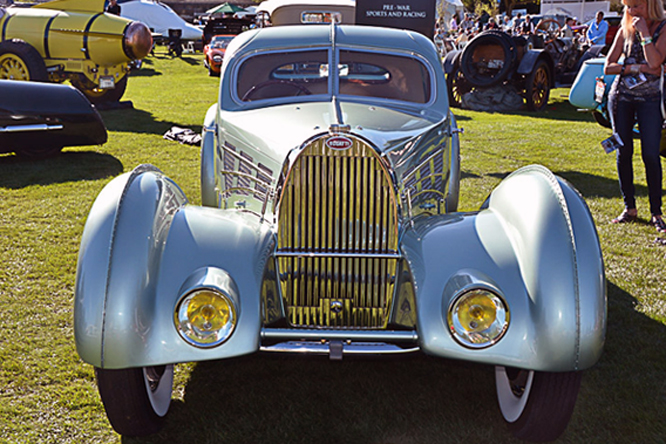
Bugatti Type 57, Quail Concours d'Elegance,

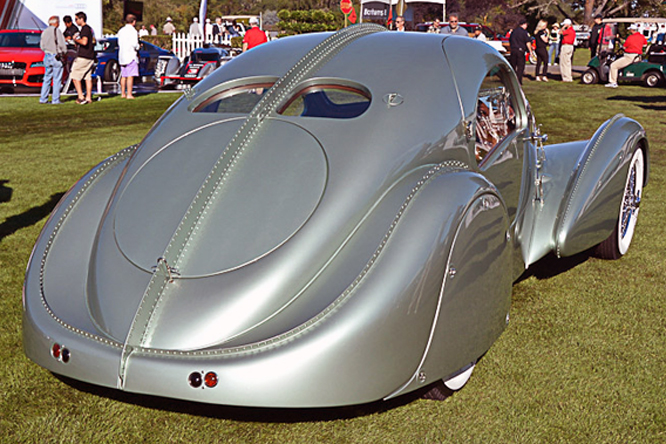
When Jean Bugatti revealed to the press that the signature riveted joins which stand proud of the compound curved body work came about as a result of the use of Elektron the car is said to have become known as the Elektron Coupé.

Once David had come to the inescapable conclusion that the Aerolithe had almost certainly built on an early Type 57 chassis because; it’s low slung variants 57 S and 57 SC were either not available in the time frame prior to the 1935 Paris Show, the bulges in the body work to accommodate the early Type 57 steering box and because there was no obvious way to mount the fuel tank and spare wheel with the later low slung type 57 chassis, he knew the body he wanted to recreate for #57104 was that of the Aerolithe.
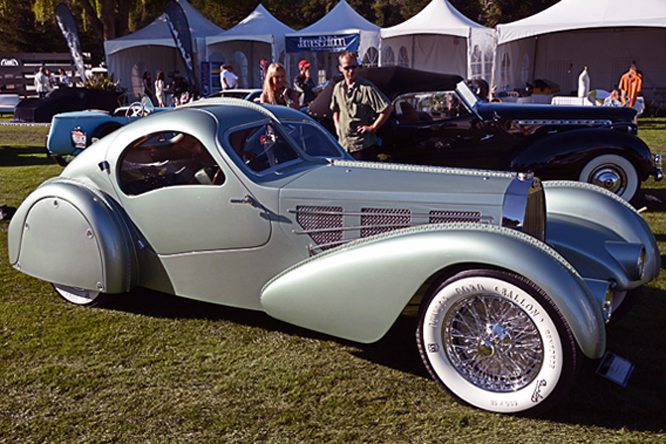
Bugatti Type 57, Quail Concours d'Elegance,

Not only did David want to recreate the car he wanted to do so using the same materials and tools that were available at the Bugatti factory in 1934/5. To undertake such a project David found someone to underwrite the project who not only had the astronomical bank balance required, but crucially also the same vision regarding the materials, tools and techniques to be used, in the form of Christopher Ohrstrom who amongst his other hobbies is chairman of the World Monuments Fund which aims to preserve architectural sites like Angkor Wat in Cambodia.

Once David had found a backer his next problem was to work out the original shape he was trying to recreate from just 11 black and white photographs and two drawings from the Bugatti Trust in the UK, one of the radiator grill and the other of a foot pedal.
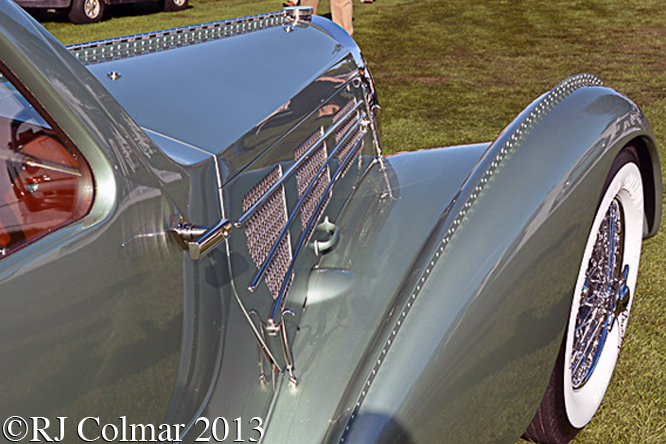
Bugatti Type 57, Quail Concours d'Elegance,

Eventually two more photographs were found and a set of drawings produced, safe in the knowledge that anything that did not look absolutely correct would be rejected and the part remade until it looked a perfect match to what could be discerned from the reference material.

The employees at The Guild of Automotive Restorers next had to find out all about working with magnesium alloy. Magnesium is thought to constitute around 11% of the earths naturally occurring minerals however the metal does not occur naturally rather it occurs in the form of salts.
Bugatti Type 57, Quail Concours d'Elegance,

When it is liberated from salts by electrolysis it is incredibly light, extremely brittle, difficult to turn into compound shapes with an English Wheel, has a good memory for it’s original shape, is extremely reactive with other elements like oxygen and to make maters worse it melts at the relatively low 650 degrees centigrade has a high specific heat making it useful for fireworks and flares and reacts explosively with water !

It was deemed wise to be wearing something akin to a space suit when working with Magnesium alloy, blended with materials that make it a little less reactive and flamable or likely to erupt on contact with water.
Bugatti Type 57, Quail Concours d'Elegance,

The curves were achieved by heating the material to between 850 degrees F and 1000 degrees F, before the alloy caught fire and then using the English Wheel in the time honoured manner. However for the most complex shapes smaller pieces were made and then riveted together with time sapping hidden rivets.

Preparation of the chassis required moving the engine back less than 4 inches so that the 3.3 litre 198.8 cui 8 cylinder motor could be mounted lower in the chassis as can be seen in the original photographs.
Bugatti Type 57, Quail Concours d'Elegance,

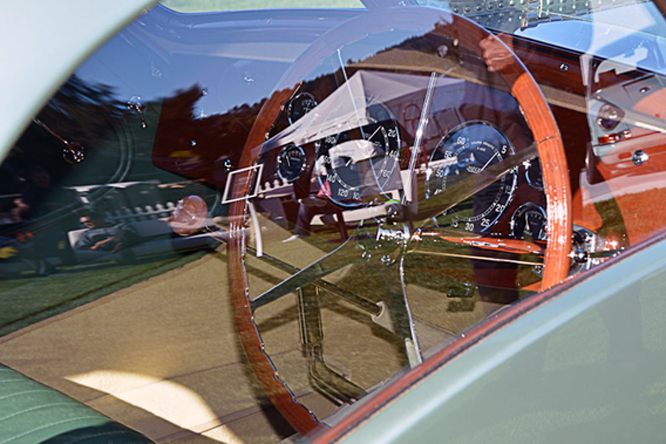
The interior details were partially available from a single photograph which showed a familiar Bugatti pattern to the dash instruments and interior equipment. The car was built as a show car rather than one to order so there is a logic to the conventional interior layout.

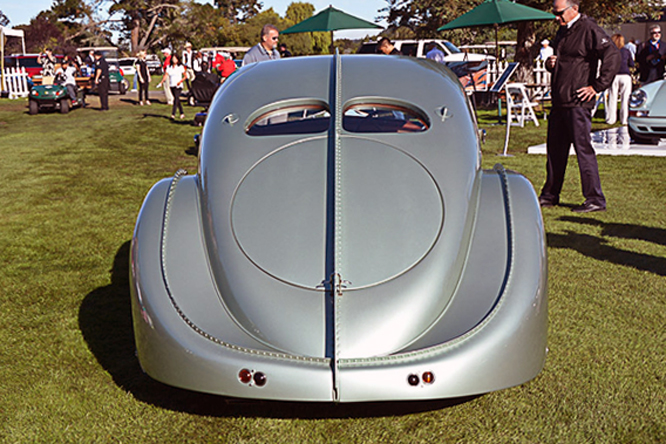
Most perplexing was the colour of the original car, it seemed unlikely that the original was silver as it appeared in the black and white photographs and this was confirmed through an interpreter when David met an ex Bugatti employee who told David that the car was known in the factory by the name “Creme de Menthe” or cream of mint. Some time later David acquired a painting of “Creme de Menthe” by one of the employees who had worked on it’s design and it also clearly showed the car was indeed Mint coloured, apt because silver were the German national racing colours and so would have been very out of favour in Alsace where it was built but also because magnesium is one of the constituents of chlorophyll, which of course give mint leaves, and all other green plants their pigment.

Finally David went to Goodyear and Goodrich who own the Dunlop brand an got permission to recreate the Dunlop logos on white rubber which was then vulcanised into groves cut into the inner and out walls of original Dunlop 90 series tyres so that they too appeared exactly as they had at the Paris Show.

My thanks to Geoffrey Horton for sharing today’s photographs of this magnificent vehicle which took well over 7000 hours to recreate.

Thanks for joining me on this “Creme de Menthe” edition of “Gettin’ a li’l psycho on tyres” I hope you will join me again tomorrow, when I shall be looking at a car painted up in tribute to one of Ayrton Senna’s sponsors. Don’t forget to come back now !

Share

Twice Mille Miglia Class Winner – Maserati 4CS #1126

In 1931 Maserati built a prototype supercharged 4 cylinder 2 seat racer to compete in the Mille Miglia 1,100 cc / 67.1 cui class called the 4CTR (cilindi testa riportata) with twin overhead camshafts and a detachable cylinder head.

01 Maserati 4CS_2364sc

The supercharged motor produced nearly 100 hp / per litre and was fitted to a modified Maserati 26M single seater chassis and a two seat body. Giuseppe Tuffanelli and Guerino Bertocchi drove the car on the Mille Miglia to victory in the 1100cc class finishing 22nd overall.

Based on this success Maserati built a series of 5 4CS models and they won the 1100cc class at the Mille Miglia in 1932, ’34, ’35 and ’36.

02 Maserati 4CS_2365sc

So far as I know chassis #1126 seen here was the square nosed #15 car driven by Ettore Bianco and Guerino Bertocchi to class victory and 7th overall on the 1935 Mille Miglia.

Owner Ettore Bianco then drove #1126 to victory at the Circuito Varese in July 1935 and a second in class in the 1935 Coppa Ciano.

03 Maserati 4CS_2366sc

For 1936 Ettore teamed up with M. Boccali for the Mille Miglia in which they finished 6th overall and 1st in class one spot behind the 4CS, fitted with a 1500cc 91.5 cui version of the 4 cylinder motor, driven by Omobono Tenni and Ettore’s 1935 team mate Guerino Bertocchi which took 1500 cc honours.

Later in 1936 #1126 was sold to Ignazio Radice Fosatti who recorded a second in class run on the Coppa Mercanti run on the Stelvio hillclimb before going to Monza for an attempt at the 1100cc 12 hour distance record. Unfortunately Ignazio was killed in the 9th hour of the attempt after hitting a dog that strayed onto the track.

04 Maserati 4CS_2367sc

Scuderia Ambrosiana bought the wrecked car and had it repaired for Giovanni Lurani & Luigi Villoresi to drive in the 1937 Mille Miglia from it retired. Later in the year Luigi recorded a 7th overall and class win on the Colle del Moncenisio in France before the car headed East to new owners in Singapore.

Joshua Lee was the unfortunate owner of #1126 in 1942 when it was confiscated by the Japanese Army and he was murdered.

05 Maserati 4CS_2368sc

The last in period race for #1126 is recorded as the 1950 Johore Grand Prix with the car now registered in the entry list as an LA Special, with 3.5 Litre Jaguar SS 100 motor, by Lim Peng Han who did not finish the race after an accident.

The car then made it’s way to the UK via the United States where it was briefly fitted with a Do Soto V8 motor as part of an uncompleted project. Ken Painter bought #1126 in 1969 and by 1985 had completed it’s restoration.

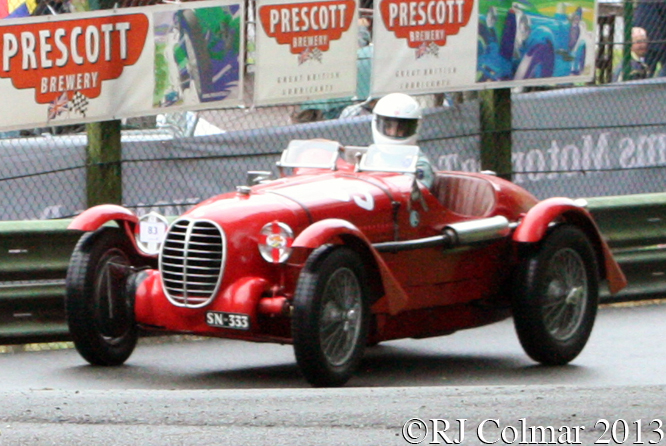
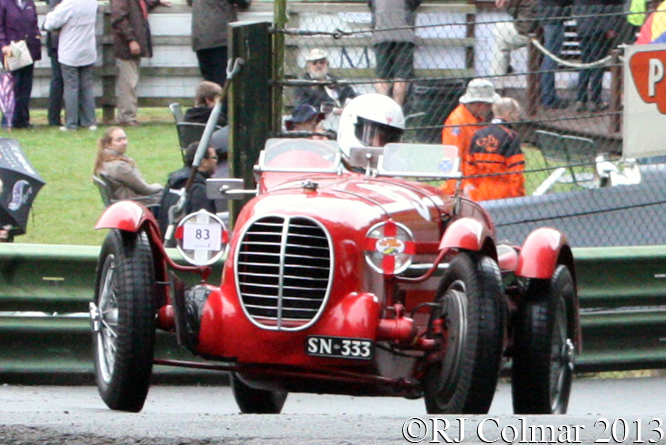
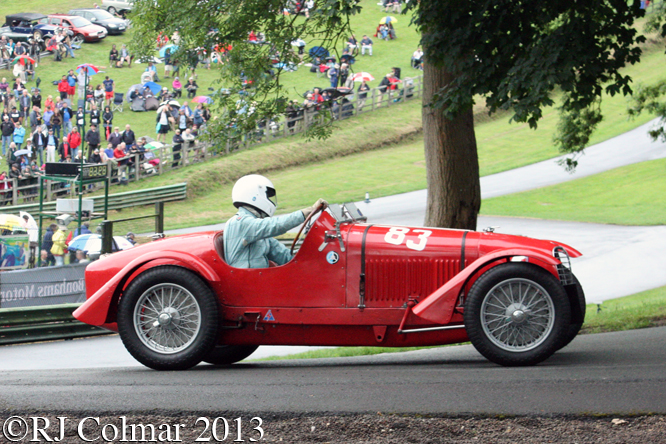
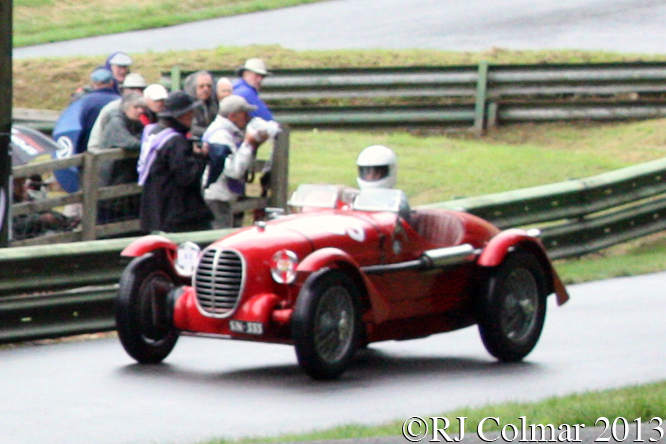
Adam Painter is seen driving #1126 in these photo’s taken at Prescott where the car was listed as having a supercharged 1500cc motor.

Thanks for joining me on this “Twice Mille Miglia Class Winner” edition of “Gettin’ a li’l psycho on tyres” I hope you will join me again tomorrow for a look at a slippery bodied Bugatti. Don’t forget to come back now !

Share

Wonder Bread Special – Rigling #0113S

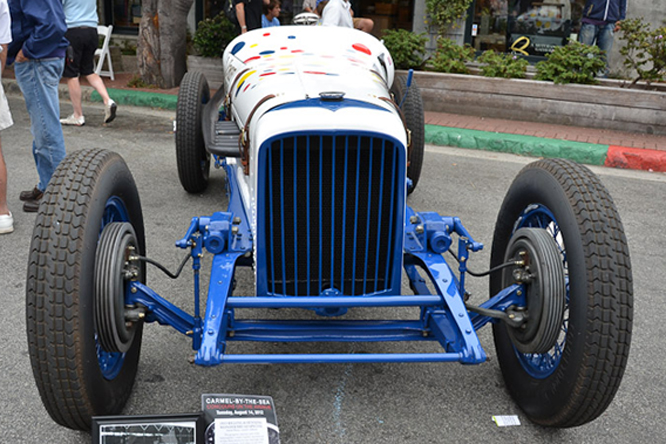
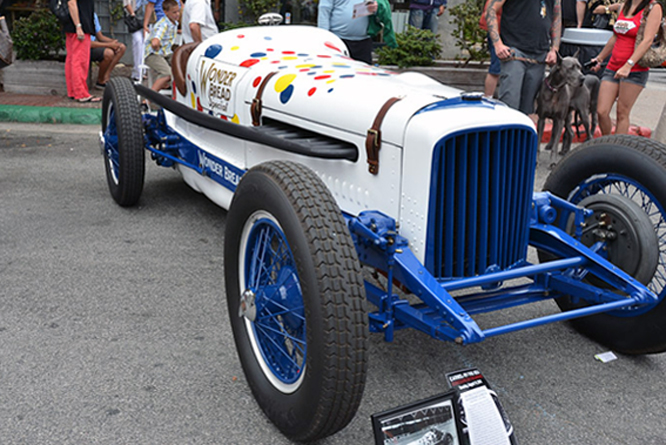
It’s the month of May where the focus of open wheel racing fans traditionally descends on Indianapolis of the “Greatest Spectacle In Racing” run, inclement weather not withstanding, on Memorial Day weekend. As in years passed this months Sunday blogs will look at some of the vehicles from Indy’s 103 year history starting with this 1933 Rigling.

Rigling & Henning Buick, Wonder Bread Special, Concours on the Avenue, Carmel by the Sea

Getting the story of US built cars that participated in the Indy 500 up to 1964 right is probably one of the more difficult challenges a motor historian can undertake, in part because the open wheel scene was largely a cottage industry with only a hand full of people in the know and in part because naming rights were sold in return for sponsorship. Identification and histories of cars from the low tech low cost so called Junkyard Formula of the post depression years 1930 – 1939 are particularly hard to discern because of the low budgets and many unannounced deals that took place to keep the grids full.

Rigling & Henning Buick, Wonder Bread Special, Concours on the Avenue, Carmel by the Sea

So far as I know the earliest appearance of a chassis credited to Herman Rigling was in the 1931 Indy 500 when 8 of the 40 starters are credited with being built by Rigling. The Rigling built cars were powered by either Buick, Miller, Studebaker, Clemons or Dusenberg motors. Top Rigling finisher was Phil Shafer in his Buick powered example known as the Shafer 8 he was classified 12th.

Rigling & Henning Buick, Wonder Bread Special, Concours on the Avenue, Carmel by the Sea

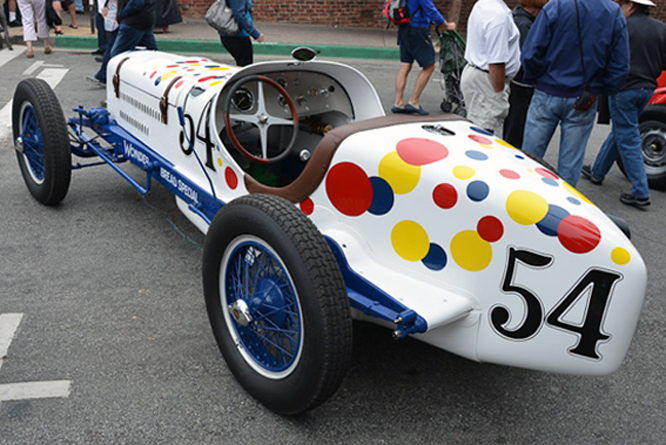
There is a photograph showing what appears to be today’s featured car, the #54 Wonder Bread Special, at Indianapolis Motor Speedway in 1933 with rookie George Barringer at the wheel with Earl Allen his riding mechanician. George and Earl appear to have failed to qualify for the race.

Wonder Bread, a brand invented by the Indianapolis based Taggart bakery, did however sponsor the #18 Duesenburg driven by Joe Russo who classified 17th and running with 192 laps completed, while H.W. Stubblefield driving the #8 Abels and Fink Auto Rigling Buick did finish 5th in the The 21st International 500-Mile Sweepstakes Race.

George Barringer made his first Indy start in 1934 driving the #18 Boyle Products Miller being classified 15th completing 161 laps before a front axle problem intervened. His best Indy 500 result came in 1939 when he finished 6th driving Bill Whites Well Offy.

Some of the above is at variance with the information displayed with the car at Concours on the Avenue in Carmel by the Sea some years ago, if you have evidence to show my information is incorrect please do not hesitate to chime in below.

My thanks to Geoffrey Horton for sharing his photo’s of the #54 Wonder Bread Special seen at Concours on the Avenue, Carmel by the Sea in 2012.

Thanks for joining me on this “Wonder Bread Special” edition of “Gettin’ a li’l psycho on tyres”, I hope you will join me for Maserati Friday tomorrow. Don’t forget to come back now !

Share

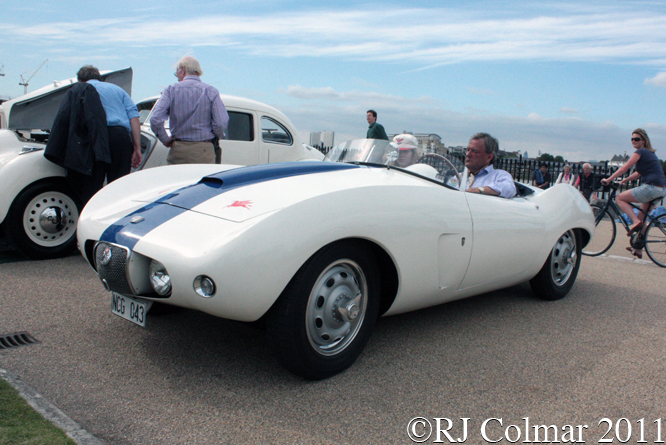
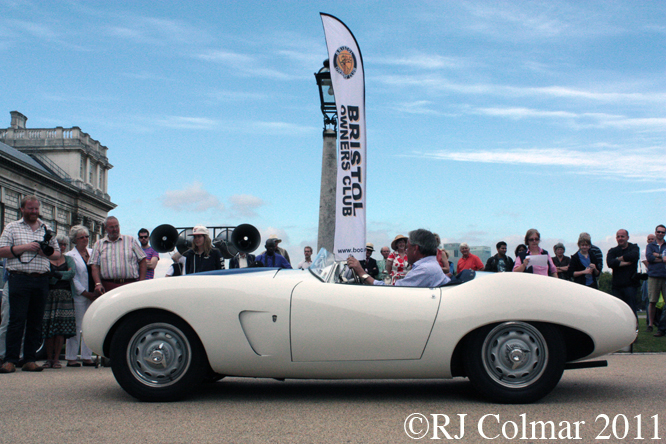
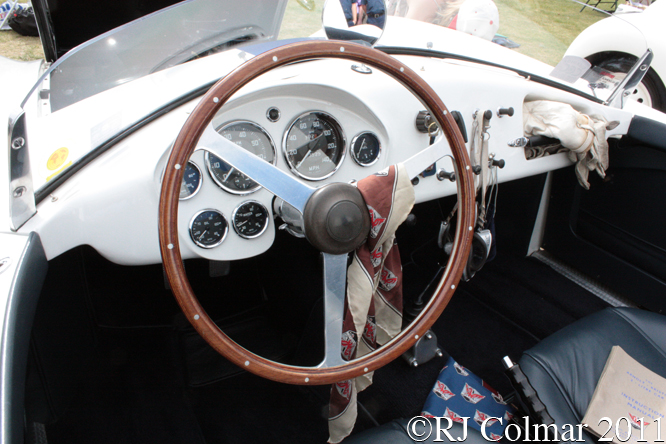
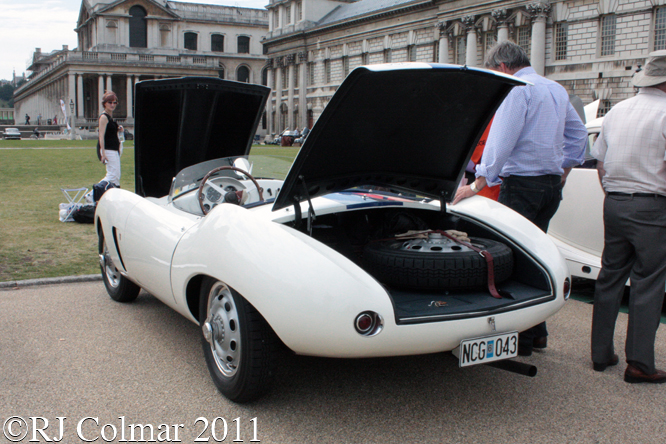
Wacky and Bertone – Arnolt Bristol Bolide #404X3086

In 1906 Stanley Harold Aranoff was born into a family of bookbinders living in Chicago. After studying engineering he changed his name to Arnolt as part of an unsuccessful bid to break into the motor industry in 1936.

Arnolt Bristol Bolide, Bristol Concours d'Elegance, Greenwich

While looking for business opportunities he bought the rights to the Sea Mite Marine engine which he attached to a 13 ft rowing boat and sailed from St Joseph in Michigan across Lake Michigan to Chicago as part of a publicity stunt which earned him his “Wacky” nickname.

Arnolt Bristol Bolide, Bristol Concours d'Elegance, Greenwich

The Sea Mite proved a wise purchase after “Wacky” Arnolt won a contract to supply the motors to the US NAVY for their small vessels during the ’39-’45 war.

Arnolt Bristol Bolide, Bristol Concours d'Elegance, Greenwich

After the war “Wacky” held franchises to distribute MG, Riley and Morris cars and at the 1952 Turin motor show a MG TD with bodywork designed by Franco Scaglione form the financially struggling Bertone Coachworks caught his eye.

Arnolt Bristol Bolide, Bristol Concours d'Elegance, Greenwich

Wacky immediately placed an order for two hundred of the distinctive Bertone MG’s and Mr Bertone apparently nearly fainted. Only 103 Arnolt MG’s were built because MG switched production to the new TF model.

Arnolt Bristol Bolide, Bristol Concours d'Elegance, Greenwich

Impressed with the sales of the Bertone MG Arnolt, “Wacky” commissioned Bertone to develop a body for an Aston Martin and a total of eight these cars are thought to have been built by which time Aston Martin has long pulled the plug on the project.

Arnolt Bristol Bolide, Bristol Concours d'Elegance, Greenwich

Wacky then commissioned a one off Bertone Bentley for his personal use before entering an agreement with Bristol to supply 200 type 404 chassis with 125 hp six cylinder Bristol motors which would then be shipped to Bertone for the bodywork as seen on today’s featured 1954 example chassis #404X3086.

Arnolt Bristol Bolide, Bristol Concours d'Elegance, Greenwich

Today’s featured car, which is seen at the 2012 Bristol Concours d’Elegance at Greenwich, was the original European demonstrator and was displayed at the 1954 Motor Shows held in Geneva, Turin, Brussels, Munich, and finally Paris where it was sold to an American owner.

Arnolt Bristol Bolide, Bristol Concours d'Elegance, Greenwich

To help market the Arnolt Bristol “Wacky” entered three cars in the 1955 Sebring 12 hours and they finished 1st, 2nd and 4th in the 2 litre / 122 cui class with John Panks and Ernie Erickson sharing the honours. The following year the team finished second in the Sebring 12 hours to a Ferrari and in 1957 the team withdrew from the race after team member Bob Goldrich was killed during the race.

Arnolt Bristol Bolide, Bristol Concours d'Elegance, Greenwich

In 1960 Max Goldman and Ralph Durbin shared a second Sebring 12 hour class win driving an Arnolt Bristol which finished 14th overall. Other class and race winners driving Arnolt Bristol’s included team owner Wacky himself, Ed Rahal, Carl Grassman and Tom Payne.

Arnolt Bristol Bolide, Bristol Concours d'Elegance, Greenwich

Production of the Arnolt Bristol is thought to have come to an end in 1959 with 142 vehicles built, of those 12 were destroyed on Wacky’s premises in a warehouse fire.

Arnolt Bristol Bolide, Bristol Concours d'Elegance, Greenwich

Three versions of the Arnolt Bristol were built striped down Bolide like the one seen here, several Bolides also had aluminium bodies, Deluxe Roadster with Connolly hide seats full windscreen and full weather protection and a couple of coupes. At least one Arnolt Bristol is known to have been sold new as late as 1966.

Thanks for joining me on this Wacky and Bertone edition of “Gettin’ a li’l psycho on tyres” I hope you will join me again tomorrow when I’ll be looking at the first of this months Indy Cars. Don’t forget to come back now !
Share

2014 WEC LMGTE Ferraris – Ferrari 458 Italia GT2s

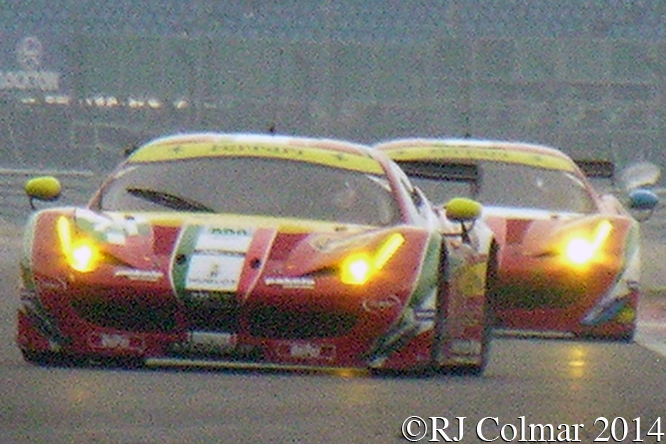
Seven entries in the 27 car field for the 6 Hours of Silverstone on Easter Sunday were GT2 spec Ferrari 458 Italias, 3 of which were running in the LMGTE Pro class and the remainder in the LMGTE Am class, here is a quick overview of how they fared.

Ferrari 458 Italia, 6 Hours Of Silverstone, 6 Hours Of Silverstone

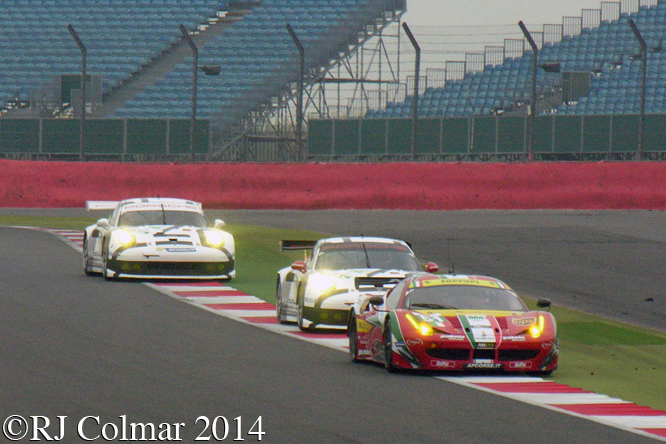
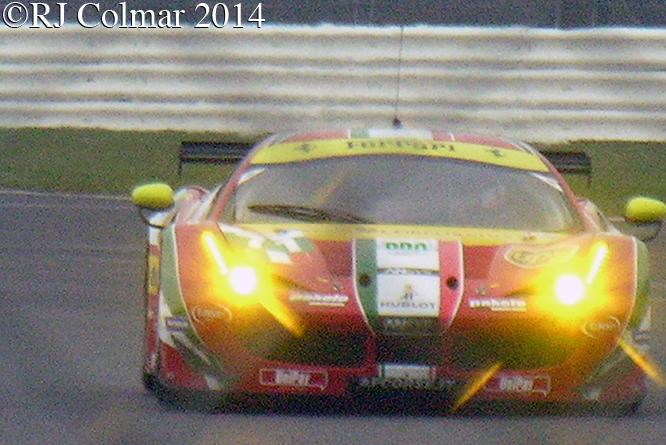
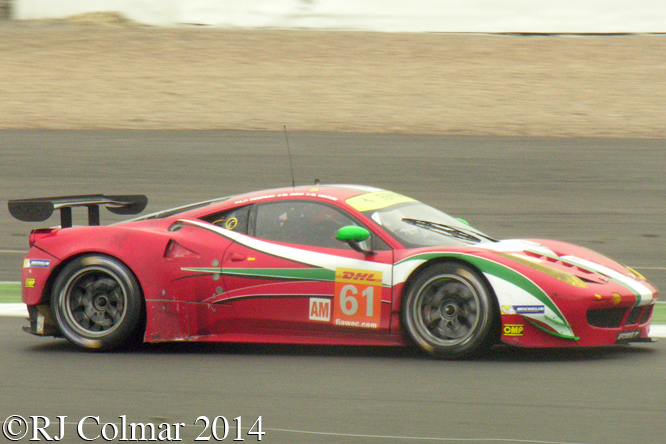
Fastest of all seven was the AF Corse entered #51 driven by Gianmaria Bruni and Toni Vilander which secured class pole position, but could not keep pace with the Porsche RSRs during the race when the conditions turned damp and were completely outclassed when the track was completely soaked. Gianmaria and Toni eventually finished 4th in class, 10th overall, behind the two works RSRs and an Aston Martin Vantage V8.

Ferrari 458 Italia, 6 Hours Of Silverstone, 6 Hours Of Silverstone

AF Corse team mates Davide Rigon and James Calado driving the #71 Italia followed the # 51 home in 11th place overall.

Ferrari 458 Italia, 6 Hours Of Silverstone, 6 Hours Of Silverstone

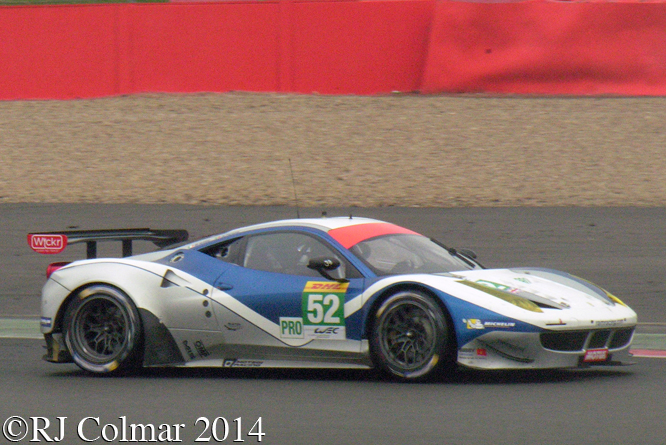
RAM racing were making there WEC debut, with entries in the LMGTE Pro and Am classes having run a GT2 spec Italia to win the European Le Mans series in their first full season of competition last year. 2013 ELMS drivers co champion Matt Griffith was paired with Alvaro Parente in the Pro #52 Italia seen above and they came home 12th overall and 6th in class.

Ferrari 458 Italia, 6 Hours Of Silverstone, 6 Hours Of Silverstone

Pole in the LMGTE Am class was also won by AF Corse with Stephen Wyatt, Michele Rugolo and Sam Bird at the wheel of the #81 Italia. However they could not keep pace with the Aston Martin Vantage V8s during the race and so finished 3rd in class 17th overall.

Ferrari 458 Italia, 6 Hours Of Silverstone, 6 Hours Of Silverstone

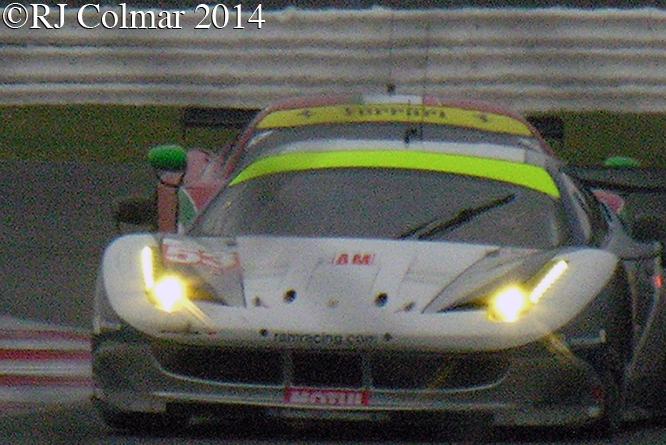
The RAM racing LMGTE Am entry was driven by 2013 ELMS drivers co Champion Johnny Mowlem, Mark Patterson and Ben Collins who finished 19th overall and 5th in class.

Ferrari 458 Italia, 6 Hours Of Silverstone, 6 Hours Of Silverstone

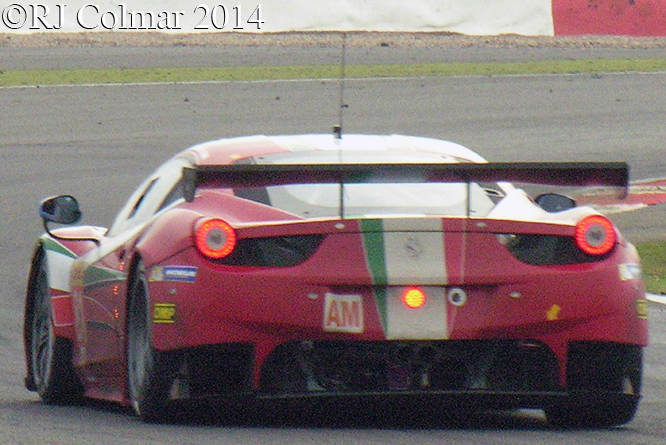
The second AF Corse LMGTE AM entry was driven by Luis Perez-Companc, Marco Cioci, Mirko Venturi it finished 20th last of the cars still running at the end.

Ferrari 458 Italia, 6 Hours Of Silverstone, 6 Hours Of Silverstone

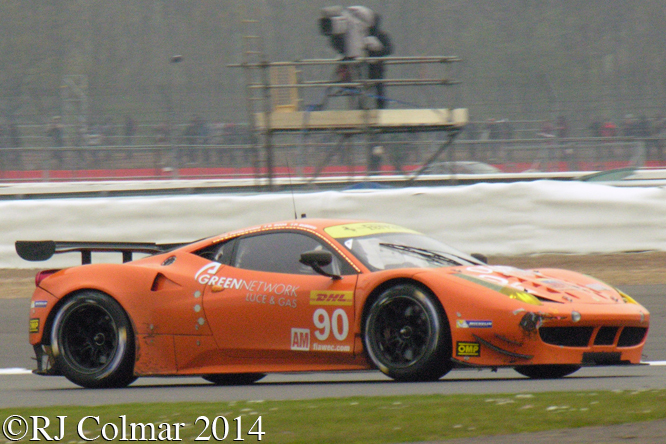
The races only ‘recorded’ retirement was filed by 2013 LMGTE Am debutants and champions 8 Star Motorsports who’s #90 Italia was driven by Vicente Potolicchio, Gianluca Roda, Paolo Ruberti. After attracting three penalties for speeding in the pit lane, due to a faulty rev limiter, a drive shaft broke just over half way through the race and the #90 recorded 118 laps. For some as yet unknown reason none of the six other unclassified finishers that were not running at the finish of the race bothered to officially retire.

My thanks to Victor R0 at the Racing Comments forum for enlightening me as to some of the anomalies of retiring from an endurance race.

Thanks for joining me on this “2014 WEC LMGTE Ferraris” edition of “Gettin’ a li’l psycho on tyres” I hope you will join me again tomorrow. Don’t forget to come back now !
Share

Ford Mustang Man – Ford Mustang Fastback

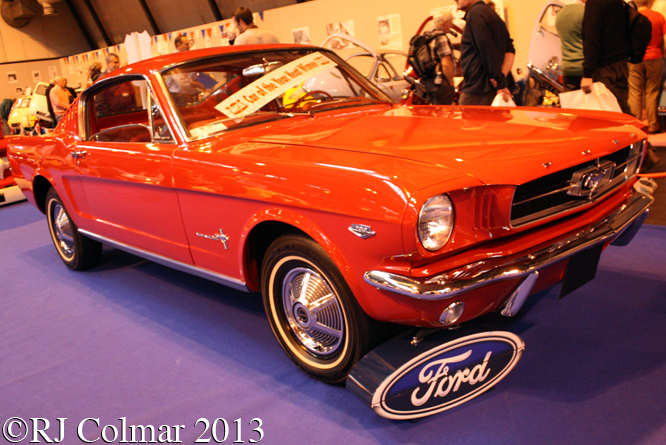
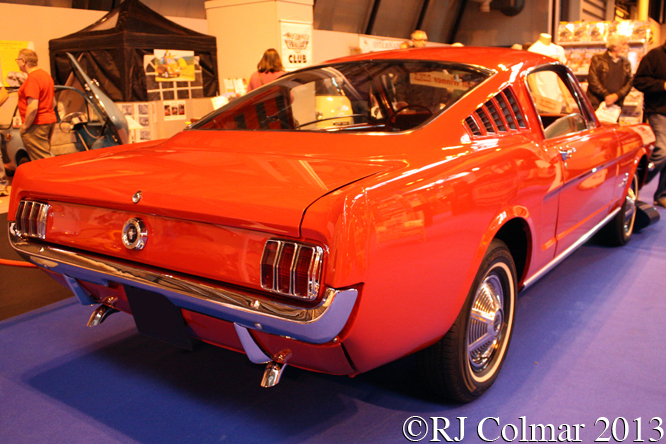
Half way through the 1964 Model year Ford launched it’s sensational personal luxury Mustang and in the process created the Pony Car class which swept aside hitherto performance favourites like the Ford Falcon with which the Mustang shared many components including much of the chassis pan, drive train and even the original dash instruments of it’s older sibling.

Ford Mustang Fastback, Classic Motor Show, NEC, Birmingham

The power unit’s offered on the original Mustangs offered from 105 hp from the Thriftpower straight six to 271 hp from the 4 barrel Windsor 289. The motor in today’s featured car is officially quoted as 4929 cc a fraction over 300 cui suggesting it might be either over bored or from an altogether later period.

Ford Mustang Fastback, Classic Motor Show, NEC, Birmingham

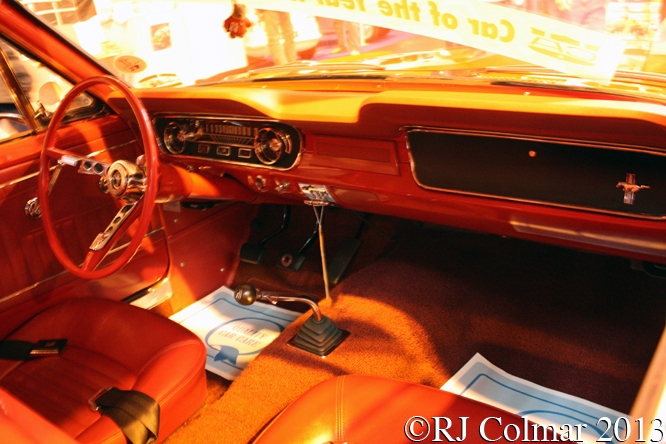
The Falcon strip speedometer was replaced in 1966 with a six round instrument cluster, seat belts were standard in the front, but optional extra’s in the rear.

Ford Mustang Fastback, Classic Motor Show, NEC, Birmingham

This particular vehicle is registered as and I quote from the DVLA, Driver and Vehicle Licensing Agency – GOV.UK website, a 1968 “Ford Mustang Man” however the grill bearing the chromed cross motif only seen on ’65 models, absence of trim on the faux ducts ahead of the rear wheels, the wheel trim, Falcon style instrument panel and altogether less aggressive styling compared with the mildly face lifted ’68 Fastback immortalised by Steve McQueen point to this car being at least a ’65 car if not an early ’64 and a 1/2 model.

Thanks for joining me on this “Ford Mustang Man” edition of “Gettin’ a li’l psycho on tyres” I hope you will join me again for Ferrari Friday tomorrow. Don’t for get to come back now !

Share

Prelude To Le Mans – 6 Hours of Silverstone

Easter Sunday emerged gray and overcast at dawn but nothing was going to dampen my enthusiasm for getting to Silverstone just in time for the gates to open because Porsche were due to make their first official appearance in top line sports car racing since 1998 Le Mans winning Porsche GT1-98 was retired from competition.

Dallara F312, Ocon, Verstappen, Silverstone

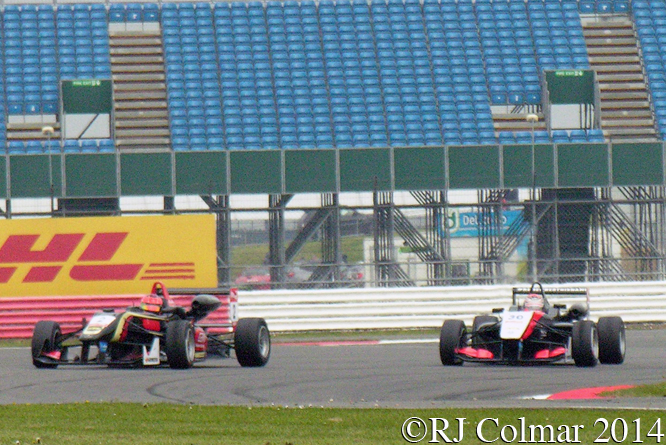
Before the pits walk about which would give spectators an opportunity to see the new Wundercar the third FIA Formula 3 race of the weekend was run. The cars were all mandated 2012 Dallara F312 but now running motors which are sealed and have to last a whole season. Much to the delight of his vocal fan club Ferrari’s protege Antonio Fuoco won the event by just under five seconds from sixteen year old Max “Son of the Boss” Vertappen who is seen above being gifted second place by third place finisher Esteban Ocon who wound up the weekend with the championship lead having finished 2nd and then 1st in the weekends earlier races. Max is son of former Formula One Racer Jos ‘The Boss’ Verstappen perhaps best remembered as the driver sitting in the Benetton which erupted into a fireball at the 1994 German Grand Prix and winner of the 2008 LMP2 Le Mans series title.

Porsche 919, 6 Hours Of Silverstone

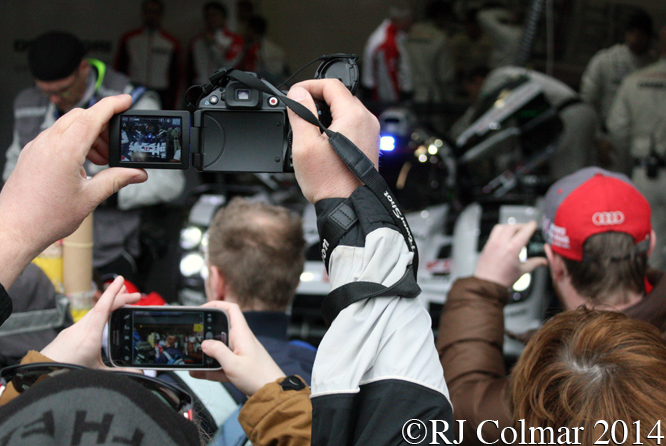
By the time I got to the pit lane for the walkabout the queue was already enormous but within a couple of minuets it was moving and unsurprisingly spectators were standing 6 deep trying to get a glimpse of the Porsche 919 Hybrid which was started from scratch, leaving the past behind, as evidenced by the turbocharged 2 litre V4 and and two energy recuperation systems that has been developed over the last 30 months.

The #14 driven by Romain Dumas, Neel Jani and Marc Lieb and the #20 driven by Timo Benhard, Mark Webber and Brendon Hartley showed phenomenal speed in free practice being over 10 mph faster than their rivals in a straight line. They lined up 3rd and 6th on the grid respectively despite being the only runners in low down force Le Mans spec.

Anthony Davidson, 6 Hours Of Silverstone

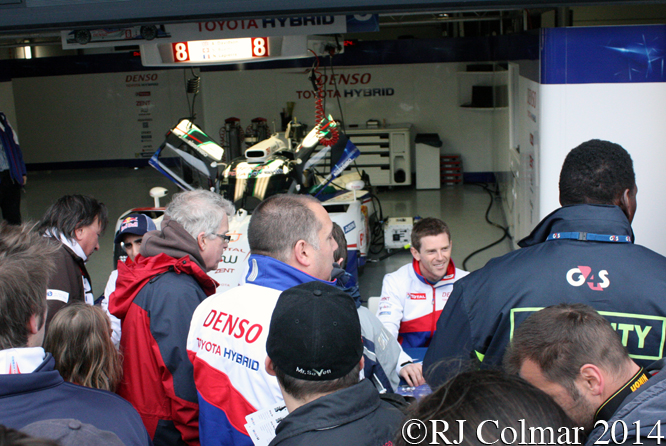
The #7 Toyota TS 040 Hybrid driven by Alexander Wurz, Stéphane Sarrazin and Kazuki Nakajima was on pole ahead of the #1 Audi R18 e-tron quattro driven by Lucas di Grassi, Loïc Duval and Tom Kristensen. Forth on the grid was the #2 Audi of Marcel Fässler, André Lotterer and Benoit Tréluyer ahead of fifth place Anthony Davidson, seen seated above right, who shared the #8 Toyota with Nicolas Lapierre and Sebastian Buemi, seated above right. Less than half a second covered the qualification times of the 6 work LMP1 cars.

Toyota TS 040, Audi R18, 6 Hours Of Silverstone

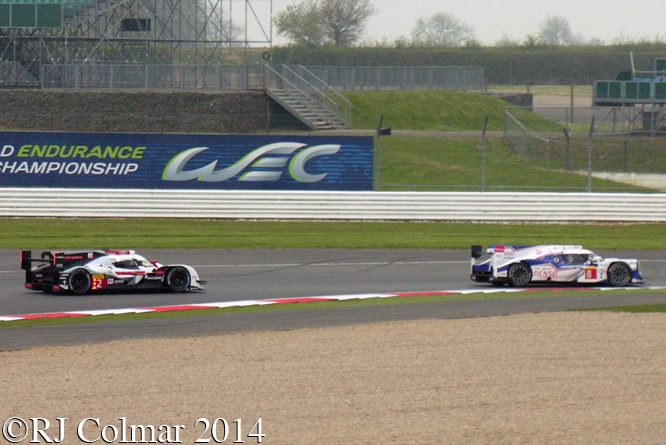
Toyota led the opening laps of the race but it was not long before André Lotterer in the #2 Audi, seen above about to relieve the Sebastian Buemi of third place, got to the front of the field. As the first hour of the race unfolded rain started to fall that would, unknown to anyone at the time decide the outcome of the race. Buemi pitted from fourth to take on a set of intermediates, Wurz pitted from second to take on full wets as Toyota wisely split it’s strategy between its cars while the ever optimistic Audi Team elected to stay on slicks.

Porsche 911 RSR, Holzer, 6 Hours Of Silverstone

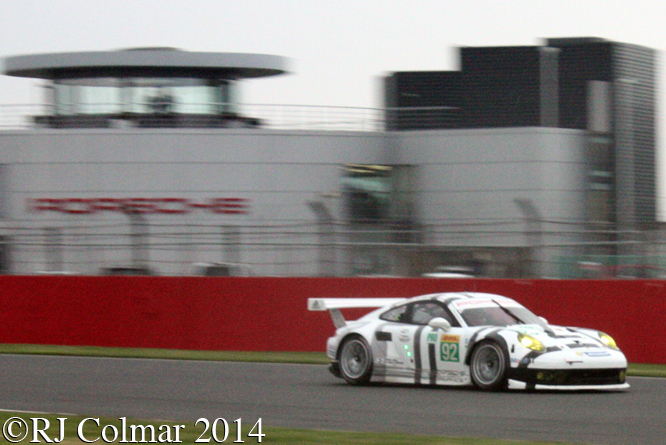
The Porsche 919’s were running comfortably in 5th and 6th places until the #14 first lost a wheel and then returned only to experience a drive problem and retire after completing only 30 laps. In the LMGTE Pro class however the works 911 RSR’s were comfortably running 1st and 2nd with the #91 driven by Patrick Pilet, Jörg Bergmeister and Nick Tandy easing away from the #92 seen above driven by Marco Holzer, Frédéric Malowiecki and Richard Lietz. With less than an hour to go the #91 pulled into pit for full wets but when the #92 was about to follow suit the pit lane was closed, and was to remain so until the race was called nearly half an hour early handing the LMGTE Pro class win and 7th place overall to the #92 of Holzer, Malowiecki and Lietz who finished just over 40 seconds ahead of their team mates.

Morgan Nissan, Pla, 6 Hours Of Silverstone

The LMP2 class pole was won by Roman Rusinov, Oliver Pla and Julien Canal driving the #26 Morgan – Nissan, seen with Oliver Pla driving through Becketts above, from the similar #47 Oreca 03 badged example driven by Mathew Howson, Richard Bradley and Tsugio Matsuda. On their way to a 5th place finish overall the #26 had to change their nose twice, to repair damage the first time and then fit one with the correct dive planes the second, but managed to catch and pass the #47 which received a 10 second penalty for speeding in the pit lane and was later penalised a lap for unsafe release from a pit stop.

Porsche, Toyota, Aston Martin, 6 Hours Of Silverstone

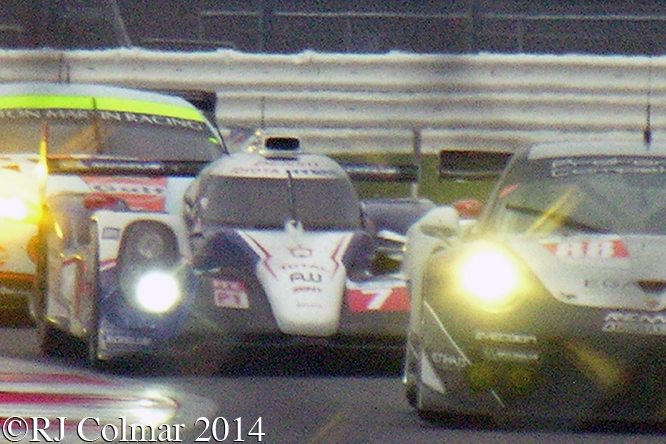
Meanwhile the #7 Toyota, seen above about to overtake the #88 LMGTE Am Porsche RSR driven by Christian Ried, Claus Bachler and Khaled Al Qubaisi, on the full wets was struggling and fell behind the sister #8 car of Davidson,Lapierre and Buemi on intermediates which inherited the lead after the #1 Audi which di Grassi crashed into the barriers on slicks in the wet at Woodcote had to retire with a broken suspension pick up point and the #2 Audi also on slicks lost four laps and five places when Lotterer went off at Stowe.

Ferrari F458 Italia, 6 Hours Of Silverstone, 6 Hours Of Silverstone

While the #2 was making up lost time the #71 LMGTE Pro Ferrari F458 Italia, seen above was being driven by Davide Rigon and James Caldo to an eventual 5th in class finish ahead of the #81 F458 Italia driven by Stephen Wyatt, Michele Rugolo and Sam Bird which recorded a third place class finish in the LMGTE Am division behind …

Aston Martin Vantage V8, Silverstone, 6 Hours Of Silverstone

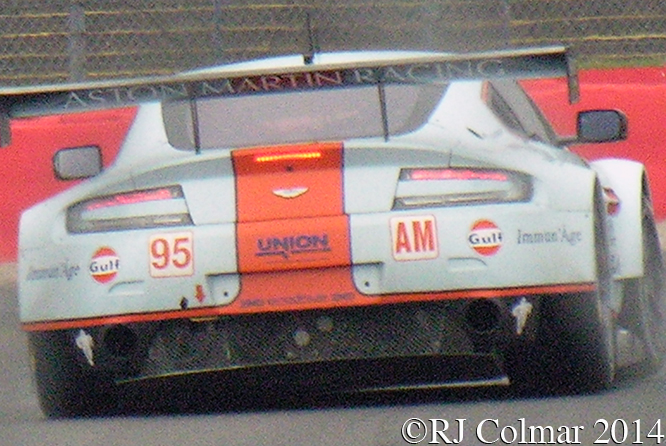
two works Aston Martin Vantage V8’s. On this occasion #95 Aston Martin seen above brought home the GTE Am bacon with Danes Kristian Poulsen, David Heinemeir Hansson, Nicki Thiim recording a 15th place overall along with class honours.

Audi R18 e-tron quattro, Treluyer, 6 Hours Of Silverstone

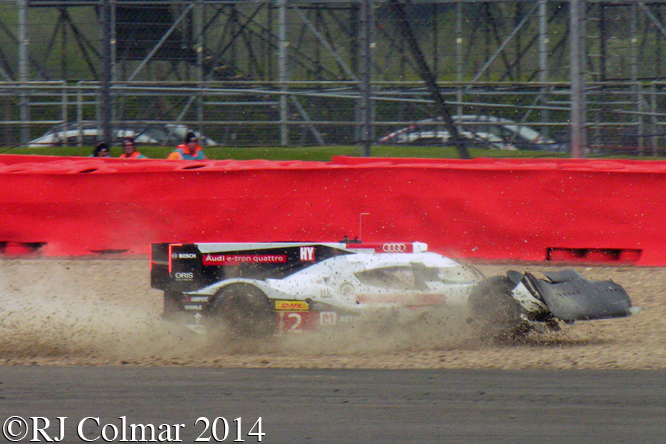
On intermediate tyres Benoit Treluyer recovered to 4th place in the #2 Audi when just after the 3 hour mark he appears to have locked a wheel braking for Copse corner, clouted the inside barrier and then went sailing over the kitty litter to come to rest on solid ground against the barrier, which he hit hard enough for the front wheels to be facing in different directions. Benoit valiantly cleared up the worst of the mess, against the marshals better judgement, jumped back in the car fired it up and got it going all of 5 yards before the Audi steered its self into the gravel trap and retirement. For the first time in 18 races going back to 2011 neither Audi finished which “may” yet have effectively handed not just the race but also the World Endurance Championship to Toyota.

Porsche 919, Hartley, 6 Hours Of Silverstone

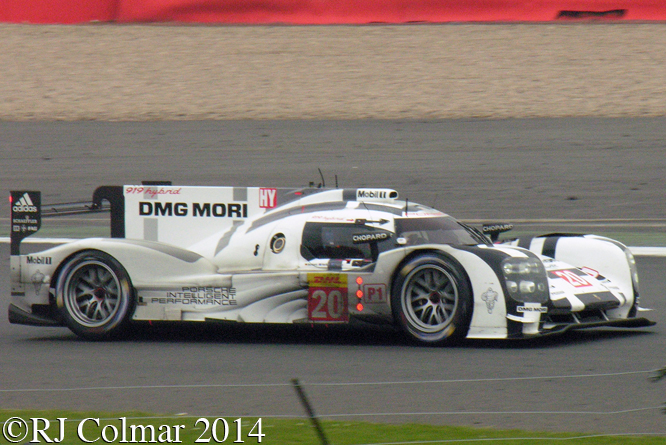
On his LMP1 debut New Zealander Brendon Hartley meantime kept the #20 Porsche 919 Hybrid on the black stuff as it progressed to a third place with Timo Bernhard and Formula One™ refugee Mark Webber sharing the podium finish. Porsche will be keeping their Le Mans low down force spec bodywork for the next round of the WEC championship at Spa where they will continue their preparations for Le Mans which they are obviously very keen to win on their return to top flight endurance racing.

Lola B12/60 - Toyota, Heidfeld, 6 Hours Of Silverstone

“Quick Nick” Heidfeld was the immediate beneficiary of the #2 Audi’s misfortune as he was handed back 4th place in the race driving a triple stint in the long in the tooth Toyota powered Rebellion Racing Lola B12/60 which by Le Mans should be replaced by a pair of Oreca built Toyota powered R-One LMP1 Coupés. Quick Nick with team mates Nicolas Prost and Mathias Beche came home fourth overall a distant 8 laps behind the winning #8 Toyota.

Safety Car, 6 Hours Of Silverstone

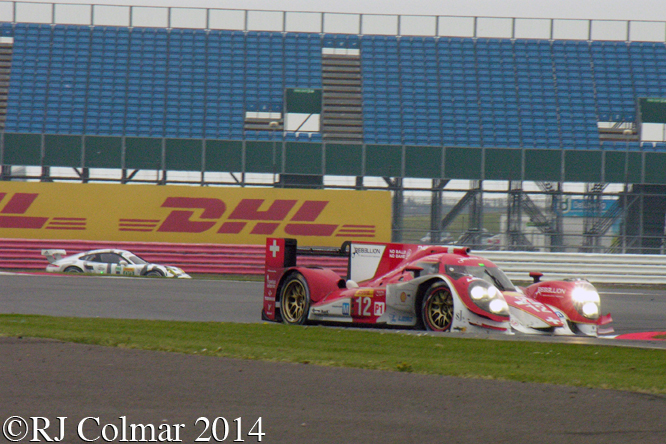
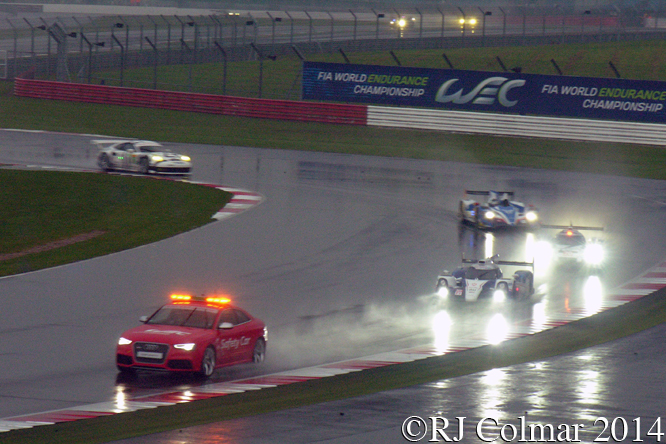
With an hour to go the rain returned getting ever more heavy, this led to the Pace Car being brought out and for twenty odd minuets we had a curious situation where, other than those immediately behind the pace car when it came out, none could maintain anything like the pace necessary to actually catch it. For some like the #12 Rebellion Lola this may well have been because cockpit was steaming up reducing visibility, for others like the #91 Porsche RSR it was because they were on the wrong tyres and the pit lane was closed, because the pace car was out and so with twenty six mins to go the race director sensibly called the race.

The Wing, 6 Hours Of Silverstone

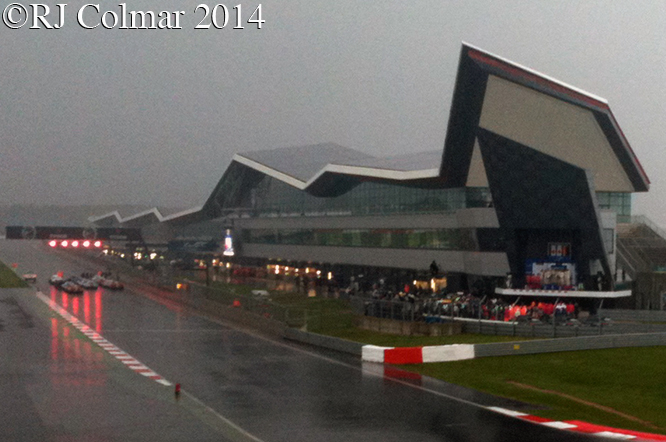
Anthony Davidson is seen above celebrating Toyota’s 6th WEC victory with his team mates and the third place Porsche crew on the podium built into The Wing, while the rest of the cars are seen in Parc Ferme on the start finish straight.

The Silverstone 6 Hours, the 2014 edition of which can be seen on this link, has often been used by the works Porsche team as a prelude to it’s assault on the Le Mans 24 hours, on this occasion one of the cars performed well enough to show that the team should be in the ball park for victory in the 24 hour classic, while Toyota cleverly split their tyre strategy during a period of weather uncertainty to secure a victory for one of it’s cars leaving the other well placed.

Last years 6 Hours of Silverstone, Le Mans and World Endurance Championship winners completely dropped the ball when the weather threw a curve ball leaving both of their entries on the wrong tyres at the wrong time showing that not even the very best of teams over the last 15 years always has things to learn and room for improvement.

I am not sure that I’ll be able to make it to Le Mans or indeed any of the rest of the WEC rounds but I’ll be following it with keen interest until the end of the season.

Thanks for joining me on this “Prelude To Le Mans” edition of “Gettin’ a li’l psycho on tyres”, I hope you will join me for Americana Thursday tomorrow ! Don’t forget to come back now !
Share