Mini Bora – Maserati Merak SS

The Maserati Merak was conceived while the company was in the ownership of Citroen as a more affordable version of the Maserati Bora launched in 1971.
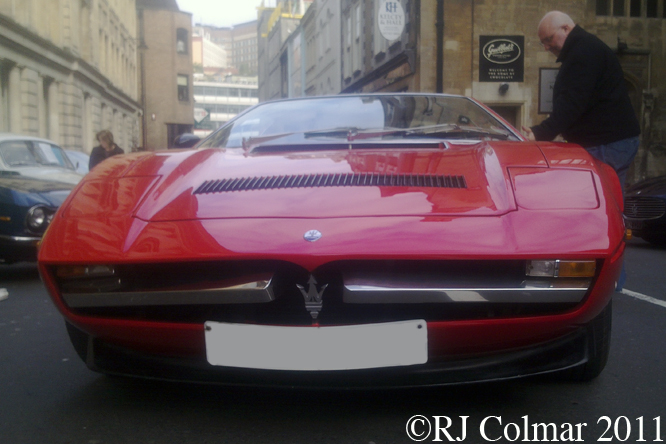
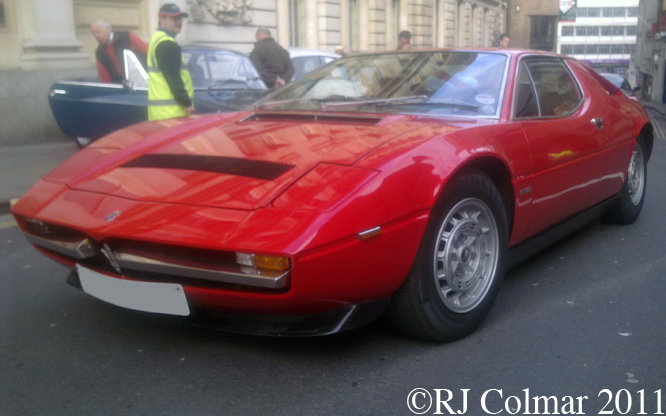
Maserati Merak SS, Bristol Italian Auto Moto Festival

Like the Bora the Merak was penned by Giorgetto Giugiaro of Ital Design and featured many similarities in the body panels ahead of the mid mounted motor though the chassis pan featured many differences thanks to the lighter weight of the Meraks 3 litre / 183 cui motor which was first seen in the 1970 Citroen SM with a slightly smaller displacement.
Maserati Merak SS, Bristol Italian Auto Moto Festival

The Merak went through 3 phases of development when first launched in 1972 the Merak used many interior Citroen fixtures and fittings including a single spoke steering wheel, dash panel, instrumentation, gearbox along with brakes actuated by Citroen’s high pressure hydraulic system.
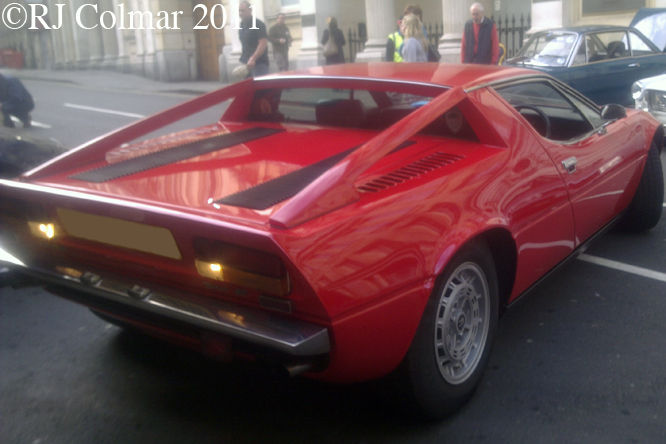
Maserati Merak SS, Bristol Italian Auto Moto Festival

In 1975 Maserati fell under the Control of de Tomaso and for 1975 most of the Citroen interior derived components were replaced including the high pressure hydraulic operated brakes which became vacuum assisted and the Citroen gearbox which was swapped for a ZF gearbox. The revitalised 220 hp model, like the 1980 vehicle seen here at Bristol’s Italian Auto Moto Festival last year, was lighter than the original and given Merak SS branding to distinguish it from the original.
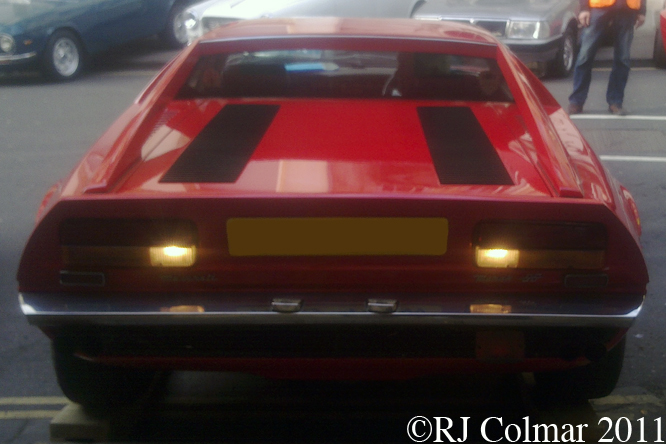
Maserati Merak SS, Bristol Italian Auto Moto Festival

In 1976 the third and final version the Merak 200OGT aimed at avoiding the 38% purchase tax cars in the Italian market attracted if they were fitted with engines over 2 litres / 122 cui. Consequently the 170 hp 2000 GT had an engine measuring 1999 cc 182.986 cui cc.

The Merak was discontinued in 1983 having outsold the Bora by better than 3 to 1 with 1860 being built of which the Merak SS was the most common with around 1000 units built.

The 2012 Bristol Italian Auto Moto Festival will be held this coming Saturday April 28th and will be celebrating not only the 40th Anniversary of the Maserati Merak and Khamsin but also the 40th Anniversary of the Lancia Beta and 50th Anniversary of the Alfa Romeo Giulia along with the 100th anniversary of the founding of Bertone. Motorcycle fans will be able to see a large selection of Italian bikes with MV Agusta being the featured manufacturer, an interesting selection of Lambretta’s and Vespa’s will also be in attendance. Best of all the event is free and can be found in the streets around St Nicholas Market.

I have arranged to meet David Roots at 11 am near his unmistakeable Lenham ALFA Romeo, SEE THIS LINK, if your visiting why not pop by and say hello ?

Thanks for joining me on this ‘Mini Bora’ edition of ‘Gettin’ a li’l psycho on tyres’, I hope you will join me again tomorrow. Don’t forget to come back now !

Share

White Elephant – Lotus 63

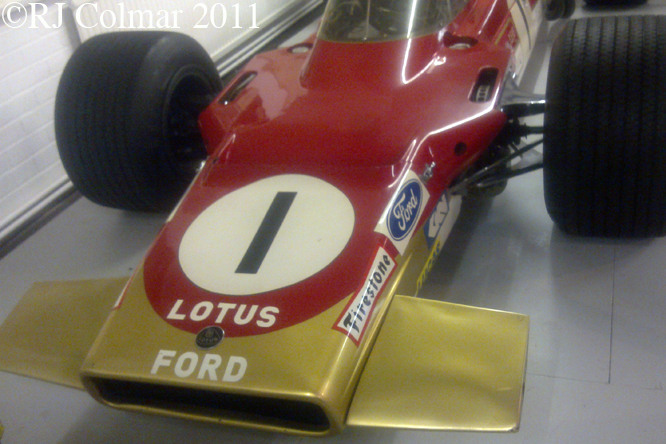
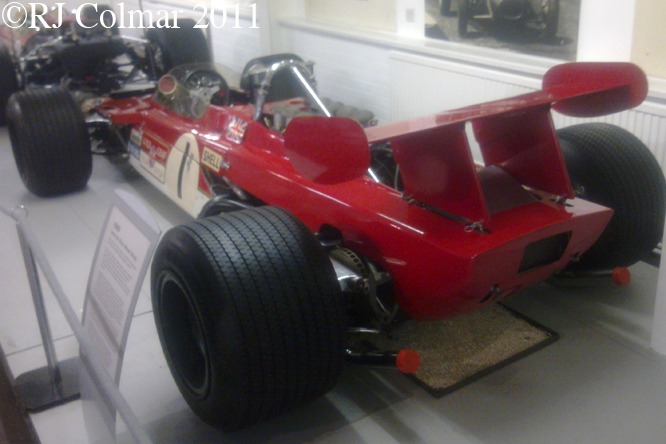
The thinking behind the Lotus 63 intended to capitalise on the lessons learned from the all wheel drive Lotus 56 Champ Car, which nearly won the Indy 500 in 1968, and replace the Lotus 49 for the 1969 Grand Prix season.

Lotus 63, Donington Park Museum

Colin Chapman recognised that the 3 litre / 183 cui Ford Cosworth DFV V8 which he had been responsible for commissioning with Ford finance had more power than the Lotus 49 could properly utilise even with the aid of wings which generated downforce on the wheels when in motion.

Lotus 63, Donington Park Museum

Having learned about the benefits of all wheel drive from the Lotus 56 Indianapolis programme Colin Directed Maurice Phillipe to design an all wheel drive car for Grand Prix racing, this was by no means the first such Grand Prix vehicle the 1961 Ferguson P99 featured such a transmission and won the non championship 1961 Oulton Park Gold Cup with Stirling Moss at the wheel.

Lotus 63, Donington Park Museum

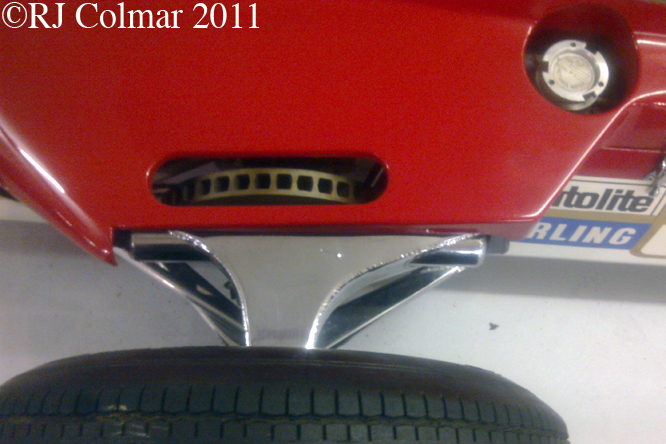
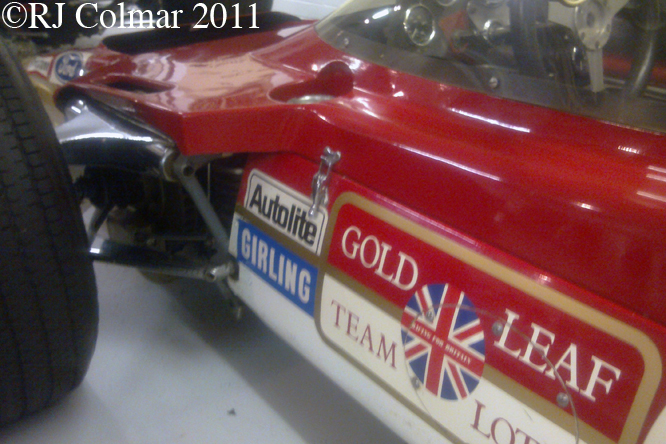
The fuel cells for the 63 were built into the sides of the car and under the drivers seat !

Lotus 63, Donington Park Museum

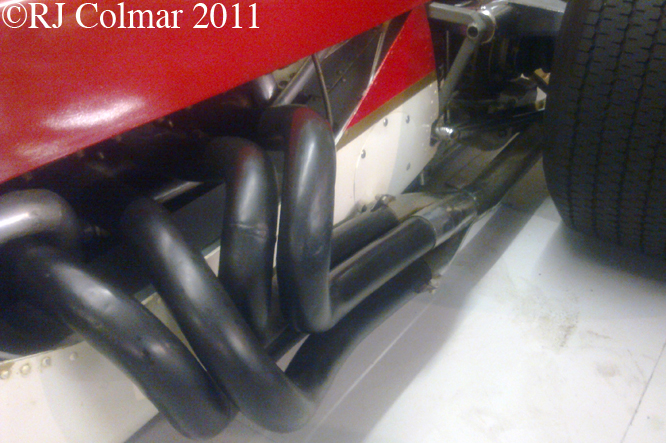
The mounting of the Cosworth DFV broke with tradition having the clutch at the front driving the four wheels through shafts mounted in tunnels on the left hand side of the car. The second pipe from the left in this photo is connected to the radiator at the front.

Lotus 63, Donington Park Museum

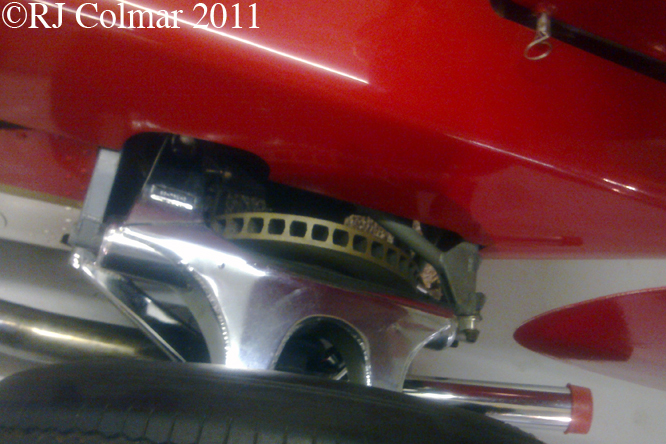
To reduce unsprung weight and improve handling the ventilated disc brakes were mounted in board front and rear.

Lotus 63, Donington Park Museum

Graham Hill tested the Lotus 63 once and refused to race it feeling the car was unsafe, Jochen Rindt managed a best second place in the non championship 1969 Oulton Park but like Hill was not keen on driving a car with his feet ahead of the front axles and his legs beneath them !

Grand Prix novice John Miles who did the bulk of the testing for the model, because Chapman thought he would lack any preconceptions to hinder development, managed one non points finish from four starts and Mario Andretti crashed in both races he started with the Lotus 63. By the end of 1969 the car was running with a heavy drive bias to the rear thus negating the advantages of four wheel drive and so the car was abandoned as a white elephant in favour of the new Lotus 72 design which would set the Grand Prix world alight in 1970.

The Lotus 63 featured today is regularly on view at the Donington Park Museum.

Owner driver Roger Dawson – Damer lost his life in an accident while driving his Lotus 63 at the 2000 Goodwood Festival of Speed.

Thanks for joining me on this ‘White Elephant’ edition of ‘Gettin’ a li’l psycho on tyres’, I hope you’ll join me again tomorrow when I’ll be celebrating the 40th Anniversary of the Maserati Merak. Don’t forget to come back now !

PS I hope you will join me in wishing GALPOT contributor Ralf Pickel a speedy recovery from a nasty accident at Hockenheim in which he broke both legs last week.

Share

Company Car – Ferrari 360 Spider

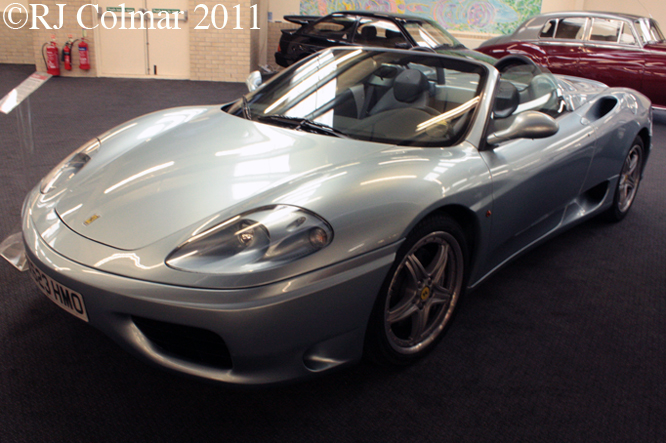
GALPOT regulars may remember me posting a blog on the Ferrari 360 Spider last year, I have revisited this model, built in 2000, in honour of the original owner of this car, Ross Brawn team principle of Mercedes AMG Formula One team who’s driver Nico Rosberg won his and the teams first victory in China last weekend.

Ferrari 360 Spider, Haynes IMM

Ross, from Manchester England, became interested in engineering at the Belle Vue Stadium, Britain’s first oval track dating back to 1926, where he attended a variety of short track events.

After a spell with the Atomic Energy Research Establishment in Harwell Oxfordshire where he studied instrumentation, Ross joined the race car manufacturer March Engineering where he worked as a milling machine operator and later as a race mechanic.

In 1978 Ross joined Williams as a machinist progressing through the Williams R&D and aerodynamics departments.
After spells with the Haas Lola and Arrow’s Grand Prix teams Ross moved to the Jaguar Sports Car team and was credited as the lead designer of the Jaguar XJR 14 which won the 1991 World Sports Car Championship.

Later in 1991 Ross became technical director at Benetton where he was joined by rising star Micheal Schumacher with whom he designed strategies to win the 1994 & 1995 World Drivers Championship and 1995 World Constructors Championships.

Towards the end of 1996 Ross joined Micheal at Ferrari, along with Benetton’s designer Rory Bryne to form a ‘Dream Team’ that won World Constructors Championships from 1999 to 2005 and the World Drivers Championships for Micheal Schumacher from 2000 – 2004.

After taking a sabbatical in 2007 Ross Brawn joined the under performing Honda team and spent the 2008 season developing the teams 2009 challenger only for Honda to withdraw from Grand Prix racing at the end of 2008 amidst global economic chaos.

Incredibly Ross managed to put together a deal to save the Honda team with a management buyout and secured a deal to use Mercedes engines for his newly rebranded Brawn GP team. The new car was a cracker right out of the box winning no less than six of it’s first seven races in the hands of Jenson Button who won the 2009 World Drivers title and with two additional wins from Rubens Barrichello Brawn secured the 2009 constructors title.

The following year Daimler Benz bought into Brawn GP and the team was rebranded again to Mercedes GP. The team, with Ross Brawn remaining as team principle, managed to tempt Micheal Schumacher out of a three years of retirement to join Nico Rosberg. After two years of relative under performance Mercedes finally won it’s first race the Chinese Grand Prix last weekend.

The victory was the first for a Mercedes vehicle since the 1955 Italian GP won by Juan Manuel Fangio.
Ross Brawn’s Ferrari 360 Spider can be seen at the Haynes International Motor Museum.

Thanks for joining me on this ‘Company Car’ edition of ‘Gettin’ a li’l psycho on tyres’, I hope you will join me again tomorrow. Don’t forget to come back now !
Share

Fireball Dyna Flow – Buick Roadmaster Coupé

From 1936 to 1996 Buick manufactured eight generations of Roadmaster, with an interruption from 1959 to 1990, Roadmasters were Buicks flagship model from 1946 to 1957 sharing underpinnings with contemporary entry level Cadillacs and senior Oldsmobiles.

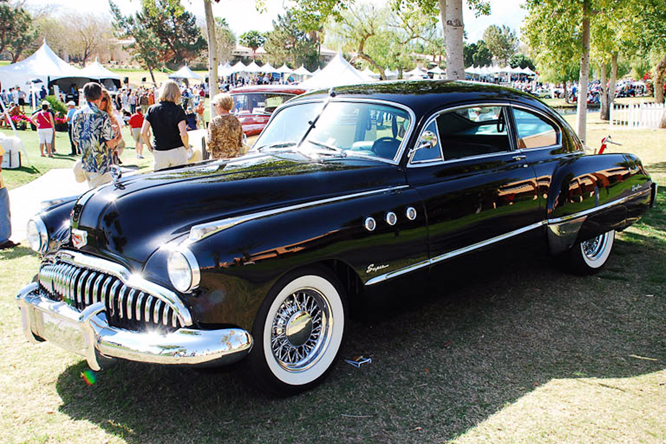
Buick Roadmaster, Desert Classic, Palm Springs

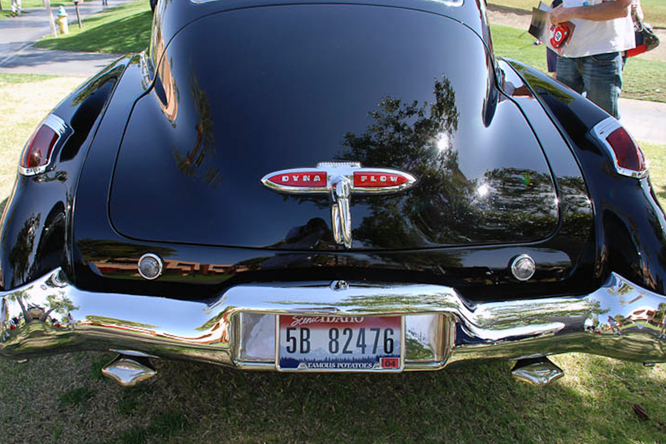
The car seen in Geoffrey Horton’s photo’s seen here at the 2012 Ranchero Mirage Desert Classic Concours d’Elegance feature a 1949 Roadmaster from the first year of production of the fifth 1949 -1953 generation which were the first to feature a two part curved ‘observation car’ windscreen. Note the bombsite mascot is a feature of all post 1946 Roadmasters.

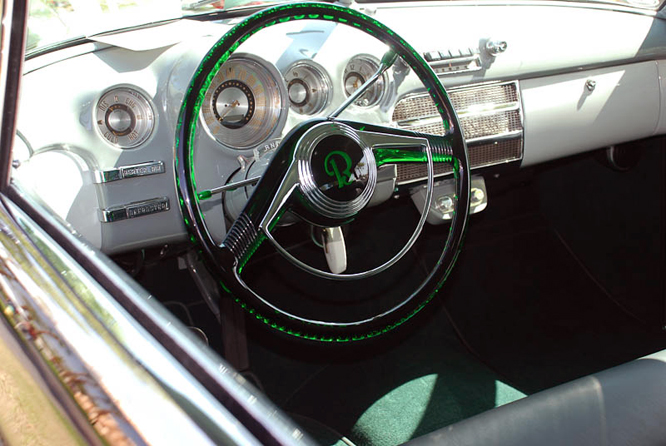
Buick Roadmaster, Desert Classic, Palm Springs

The three Ventiports on front wing / fender of this Roadmaster indicates that is probably powered by a 5.2 litre / 320 cui ‘Fireball’ straight eight motor originally good for 165 hp, which following a change in carburation dropped to 144 hp in 1946 but was raised again in 1949 to 150 hp by increasing the compression ratio.

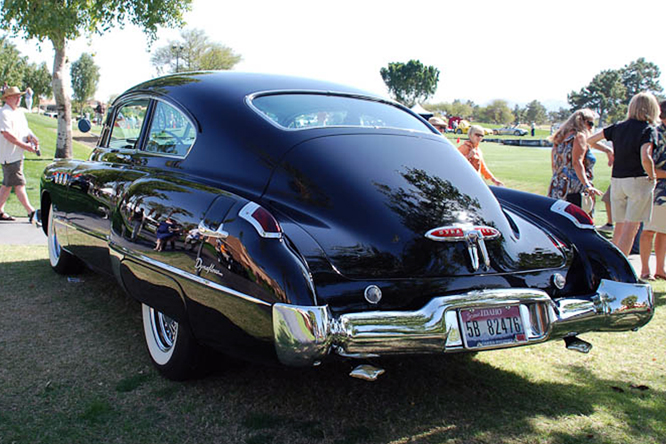
Buick Roadmaster, Desert Classic, Palm Springs

New for 1948 was a two speed Dyna Flow transmission developed from Buicks tank manufacturing program during the Second World War, making this the first model ever to be sold with a torque converter. For 1949 Dyna Flow became the mandatory transmission on all Roadmasters.

Buick Roadmaster, Desert Classic, Palm Springs

When the Roadmaster was first launched in 1942 the Coupé featured the same fastback Sedanette styling that had been a sensational feature of the 1941 Buick Century and Special models.

Buick Roadmaster, Desert Classic, Palm Springs

During 1949 the Roadmaster accounted for 27% of Buicks production with around 88,130 units sold.

My thanks to Geoffrey Horton for sending me his photographs.

Thanks for joining me on this ‘Fireball Dyna Flow’ edition of ‘Gettin’ a li’l psycho on tyres’, I hope you will join me again tomorrow. Don’t forget to come back now !
Errata this vehicle was originally incorrectly identified as forth generation 1948 model, however since then it has become apparent that 1948 Roadmasters had a flat windscreen and did not feature the VentiPorts in the wings / fenders. This text has been updated to reflect details of the ’49 Roadmaster. Apologies for any confusion caused.

Share

Henry’s Hot Hatch – Ford Fiesta XR2 Mk I, II & III

The Hot Hatch was a term for class of hatchback that gained currency with the introduction of the performance orientated Volkswagen Golf GTi in 1976, although I would venture to suggest the first real performance hatch back was the rear wheel drive Austin A40 Countryman which won the 1960 British Saloon Car Championship with Doc Shepherd at the wheel, though pedants may quibble about the fact that only the lower boot / tailgate of the Mk 1 A40, that one the championship, opened where as a hatch back is generally considered to have a rear opening that includes the the rear window and most commonly front wheel drive.

Ford Fiesta XR2, Sudring, Paderborn

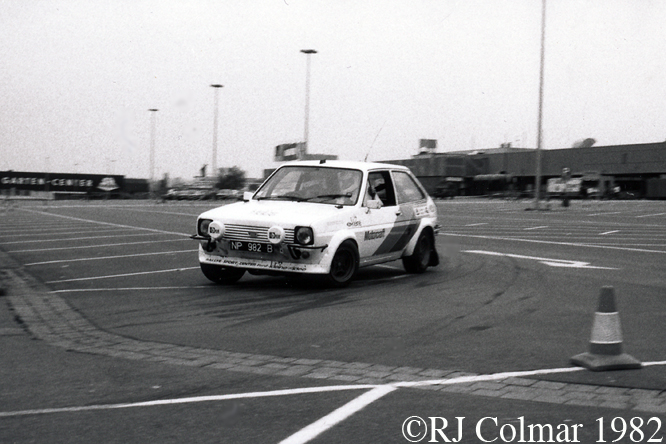
Fords entry vehicle into the front wheel drive hatchback market, ‘Project Bobcat’, was first seen at Le Mans in June 1976. The Fiesta range topping performance XR2 was launched in 1981 with an 84hp 1597cc / 97.5 cui over head valve 4 cylinder motor fitted with a carburetor good for a 0 – 60 mph time of 9.3 seconds and a top speed of 105 mph.

The much modified XR2 above with extended wheel arches is seen in the car park of the Südring shopping mall in Paderborn, Germany. The number plate style indicates it belonged to a member of the British Army On The Rhine (BAOR), and is seen competing in an Autotest a sport in which precision driving is the key skill. If you happen to recognise the car or know it’s drivers please chime in below.

Ford Fiesta XR2, Brands Hatch

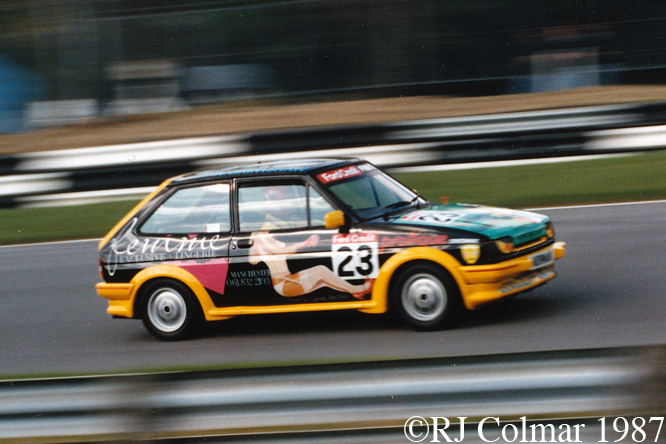
The Mk II Fiesta was launched in 1983 was essentially a reskin of the Mk I with the XR2 version being fitted with a 95hp motor as used in the Ford Escort Mk 3 XR3.

Thanks to Roger Lund, Alan Raine and Tim Wilkinson at The Nostalgia Forum we have a consensus that the #23 Goodliff car seen at Brands Hatch above was driven by Norman Grimshaw, and that the car was shared with Barrie (Whizzo) Williams during a two driver race in the Ford Credit Fiesta Championship at Oulton Park.

Ford Fiesta XR2i, Donington

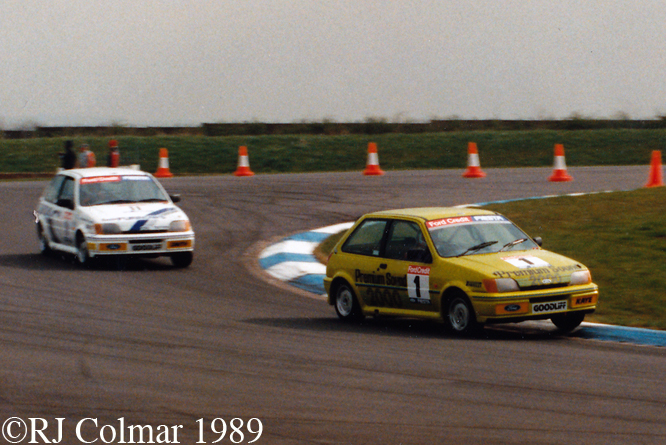
In 1989 the third generation Fiesta was launched with a revised chassis pan recognisably similar to the original version and completely new body. Upgraded with a fuel injected 104 hp motor the XR2 became the XR2i, however increased competition in market led Ford to introduce an RS 1800 and RS Turbo versions of the Fiesta which topped and replaced the XR2i name in 1992.

Joining Norman Grimshaw at Goodliff racing in 1989 were ‘one make’ racing specialist James Kaye and Jim Smith in the #1 and #11 respectively seen above heading for a Goodliff 1-2 finish in the Ford Credit Fiesta Championship race at Donington Park on the 16th of May 1989.

Various Fiesta floor pans were used to build Quantum Coupé and Quantum 2+2 convertible kit cars.

Thanks for joining me on this ‘Henry’s Hot Hatch’ edition of ‘Gettin’ a li’l psycho on tyres’, I hope you will join me again tomorrow. Don’t forget to come back now !
Share

Bump Start Only – Kayne Special

Following yesterdays blog about Colin Cooper here is the first of 4 blogs on MG powered specials that Colin has built, raced and or owned.

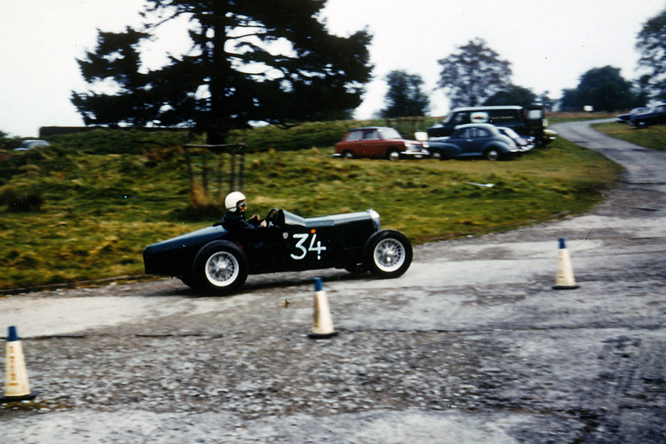
Kayne Special 1, Loton Park

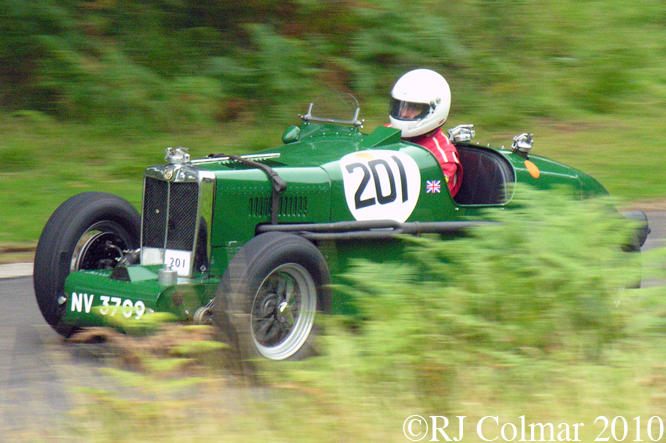
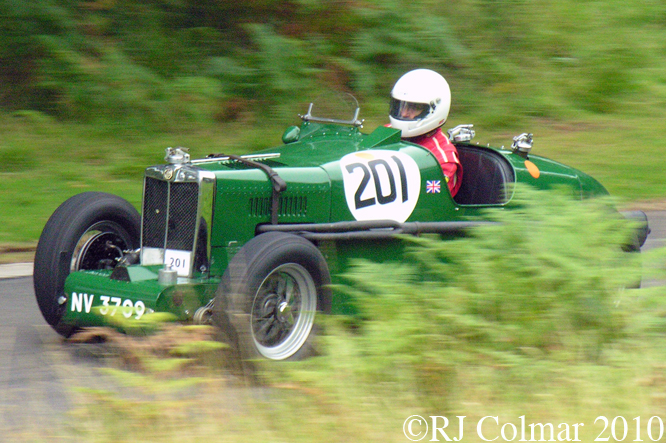
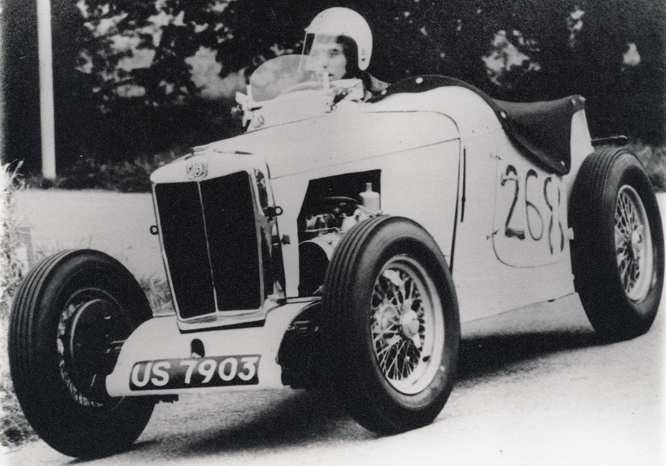
The Kayne name is derived from Kay, and Neil his children. Colin’s first special was built in the ’72 – ’73 off season on an MG J2 chassis thought to be chassis number J4326. The Colin is seen driving the car above on it’s first outing at Loton Park in 1973.

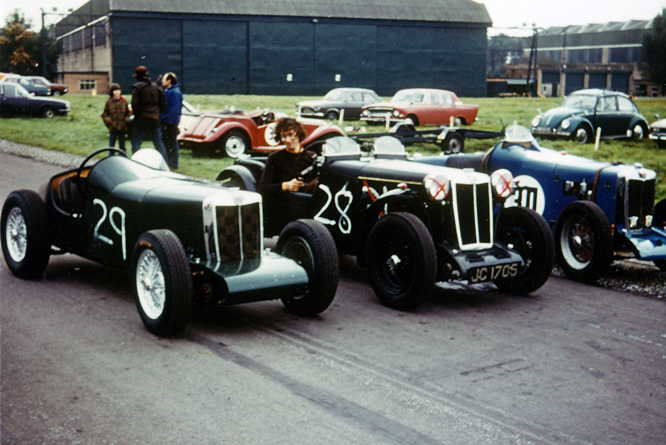
Kayne Special 1, MG L, MG PB, RAF Topcliffe

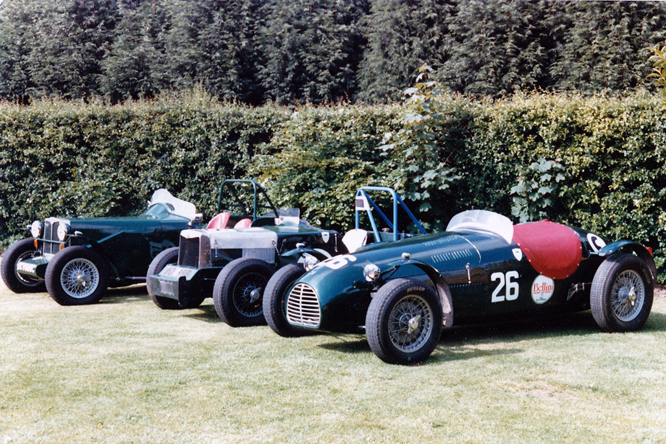
For 1973 Colin ran the Kayne Speacial 1 with a 939 cc / 57 cui 4 cylinder MG PB motor. To save weight car built the car without a starter motor, so it always had to be bump started ! The Kayne Special is seen above at RAF Topcliffe alongside the #28 MG L Type of Maurice Gleeson and the #30 an ex Nigel Musselwhite MG PB belonging to Colin’s friend Trevor Goodwin.

Kayne Special 1, Oulton Park

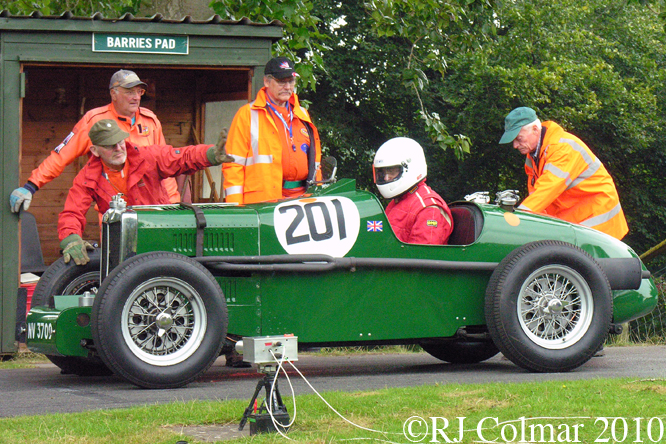
For the 1974 season Colin fitted a Shorrock S/C directly driven off the nose of the crank, the car is seen Curborough Sprint driven by current owner Mike Painter in the early 1980’s with the super charger fitted, you can tell by the single carburetor popping out of the bodywork ahead of the front wheels.

Kayne Special 1, Loton Park

Colin secured many class victories with the Kayne Special before selling it on 1976.

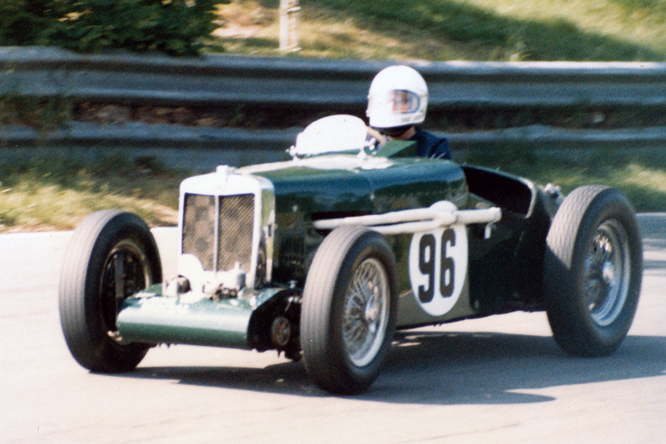
Kayne Special 1, Loton Park

Mike Painter bought the Kayne Special, seen more recently at Loton Park above, soon after Colin sold it.

I’ll be looking at Colin’s second special the Kayne Special II next Tuesday.

My thanks to JMH for the chassis number and Allan Lupton for his comments on The Nostalgia Forum.

Thanks for joining me on this ‘Bump Start Only’ edition of ‘Gettin’ a li’l psycho on tyres’, I hope you will join me again tomorrow. Don’t forget to come back now !
24/04/12 Added chassis number.

Share

Specials & Restorations – Colin Cooper

A couple of months ago I set out to find who built an MG that will feature in tomorrow’s blog called the ‘Kayne Special’, see below. Thanks to some help from my friends paulg at the MG Car Club Forum, The Nostalgia Forum, Bob Allan and his friend Peter Croft in New Zealand I have learned that the Kayne Special was built by Colin Cooper and a couple of weeks ago Colin invited me to visit him and discuss his pursuit of speed.

Kayne Special Mk I, Loton Park

Colin Cooper hails from Bolton at 15 he and a school friend purchased an Austin Seven for £2 10s (£2.50) at auction. They drove the car home sans driving licence and between them they built up a special but could not afford to run it and sold it on.

MG VA Tourer,

Colin started driving legally when his Dad bought a 1955 Ford Popular in 1958 which was sold the following year. For his 20th Birthday Colins Mum bought him a £75 MG VA 4 seat tourer seen above around 1960 which seeded his affinity for MG’s.

MB PA, Kinmel Park,

Colin’s interest in cars was primarily a hobby, with a few deals to ease the financial pain, in 1972 he started racing a 1934 MG PA shared with his friend Trevor which is seen above at Kinmel Park near Rhyll in Wales.

Kayne Special Mk I & Mk II, Killeen KI

Having squirrelled various bits pieces away including an MG J2 chassis and MG PB motor Colin set about building the first, see to top photo, of what would be come three Kayne Specials built between 1973 and 1982. The name is derived from Kay, and Neil his children. Above on the left is the Kayne Special 3 in the middle the Kayne Special 2 and the Killeen K1 built by Tom Killeen in 1953 all 3 of these cars will be looked at in greater detail in the coming weeks Tuesday MG blogs.

Lotus Ford 18, Curbrough

In between building and racing his three specials and racing the Kileen K1 Colin acquired, restored, raced and sold numerous fascinating vehicles including a bevy of Lotus 18’s of which the one above, seen at Curborough in 1977 featured some radical bodywork a standard Ford 1500 cc motor with a 4 speed Renault Dauphine gearbox.

Daren Mk 2B, Longridge, Lancs

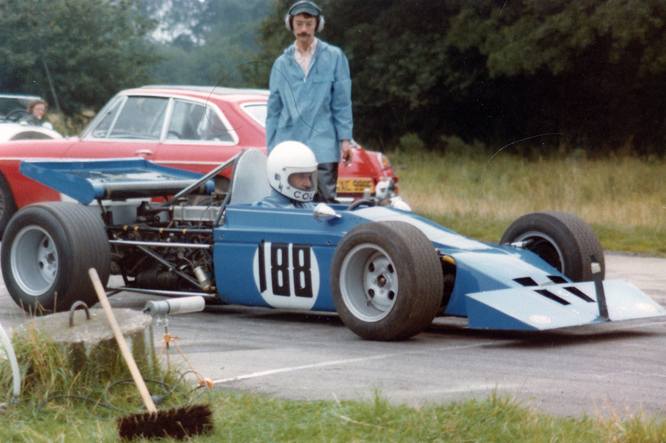
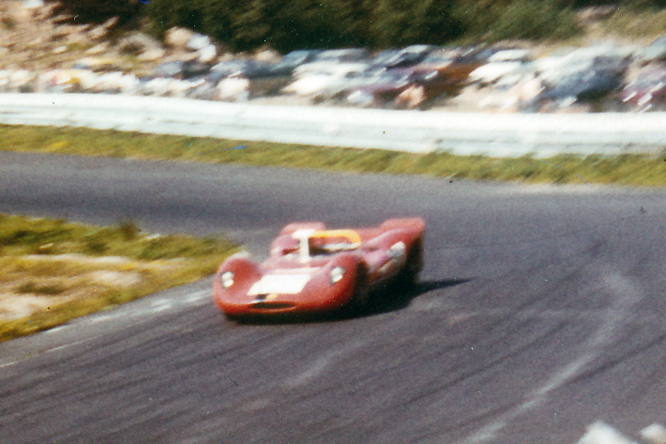
Some where around 1978 Colin acquired an Ex Targa Florio Daren Mk 2B one of only 8 Mk 2’s built, seen here at Longridge in Lancashire.

Mallock Mk III, Blackpool, 1985, Copyright Frank Hall

Photo Copyright Frank Hall 1985.

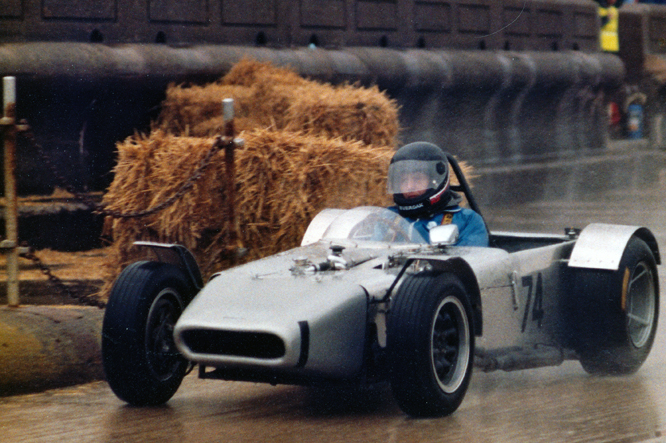
Frank Halls photo above taken in 1985 shows Colin competition career drawing to a close at Blackpool, where he drove a Mallock Mk III, one of many early Mallocks that Colin owned over the years.

Colin Cooper, Trophies

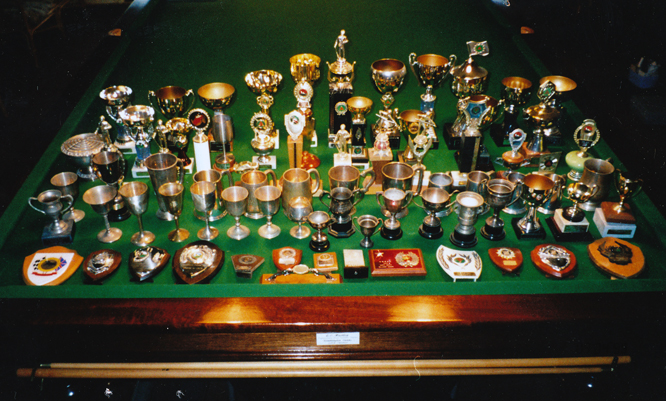
Above are some of the trophies Colin won over a span of 15 years in competitive driving, Colin is also a snooker champion, he still uses the same Joe Davis cue he was given on his 13th birthday.

Central England Sports Cars

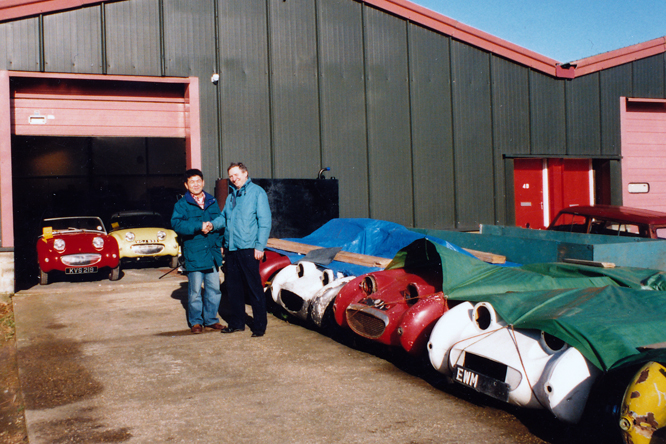
When Colin retired from his professional career he started a Frogeye restoration business called Central England Sports Cars in 1993, soon after setting up a Mr Ogawa seen on the left signed the first of several deals for batches of six restored Frogeye’s to be exported to Japan paying 50% upfront and the balance when the cars were ready for dispatch to the docks. The business declined with the stagnation of the Japanese economy in 1998 and became the Frogeye Spares Company which was sold in 2000 and is still going strong.

Central England Sports Cars

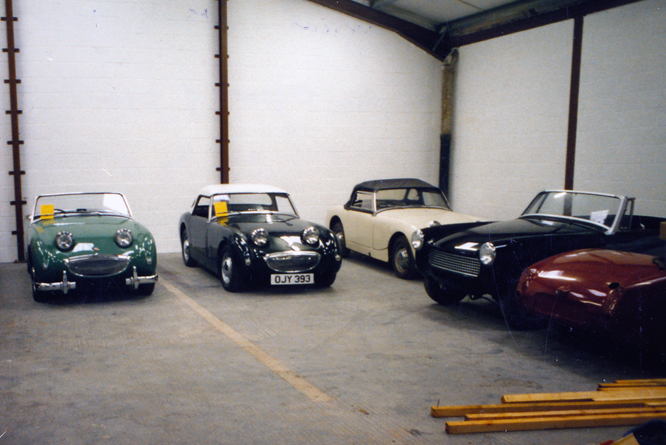
Before I left, Colin he asked if I could help track down the black Midget seen in the corner of the CESC workshop above. The car registered WHP 94S is still thought to be on the road, it is a MG Midget identifiable by a Sprite grill 1500 cc motor, rear anti tramp bars Frogeye Windscreen and hood with 9 lift of fasteners. Colin sold the car to a policeman for approximately £2000 and he believes the PC bought it for his sister. Colin would like to get in touch with the current owner if you can help please leave a message below, on my fb page or e-mail me direct infoATpsychoontyres.co.uk please type MIDGET in the subject box.

My thanks to Colin for generously giving me the time to discuss his fascinating story and cars, to paulg at the MGCC Forum, to everyone at The Nostalgia Forum, Bob Allan and Peter Croft who helped me find Colin. Thanks also to Tony Gallagher for putting me in touch with Chris Winstanley who kindly granted permission to use Frank Halls photograph.

Thanks for joining me on this Specials & Restorations edition of ‘Gettin’ a li’l psycho on tyres’, I hope you will join me again tomorrow when I’ll be taking a look at Colin’s first Kayne Special. Don’t forget to come back now !
24/04/12 Photo of Colin driving the Mallock at Blackpool added.

Share