Keep turning right – 2010 Somerset Grand Prix

Yesterday I took a couple of hours off to visit Oak Tree Arena home of Somerset Raceway. Finding it was none to easy as the track, which opened in 2008 has yet to be photographed for Google Earth, however it’s off Junction 22 of the M5 on the A38 heading for Bridgewater, a tad south of Burnham Without.

I didn’t spot the signage first time but a local resident kindly pointed me in the right direction.

Above Dan Lewis Class 5 Mini.

This weekends event was billed as the Somerset Grand Prix, a round of the 2010 National Autograss Championship, hosted by the South Somerset Auto Grass Club under the National Autograss Sport Associations governance.

Above Otis Williams, Class 1 (Junior), Mini.

NASA promotes Autograss as a family sport catering for Juniors aged 12

Above, Paul, Fackerells, Class 10, Special.

with Seniors starting at 16 and allegedly running up to and over 70 !

Above, John Gays Class 7 Suzuki SC100.

Cars run in 10 classes which split into bodied

Above open wheel Specials.

and space frame open wheel specials.

Above Peugeot 205 & Vauxhall Nova.

NASA Autograss racing is a non contact sport run professionally for amateurs, the racing is close, and atmosphere friendly. I look forward to watching how the the Oak Tree Arena develops as a venue in the future. One things for sure I’ll certainly be going back.

Further NASA fixtures can be seen here. Information about the South Somerset Autograss Club can be found here.

Don’t forget to come back now ! Hear ?

Share

Don’t get mad get even – Replica Revenge Mini.

Today’s featured vehicle is a replica of ‘The Revenge Mini’ which won the 1967 Monte Carlo Rally in the hands of Rauno Aaltonen and Henry Liddon. Unusually the car is probably most famous because of the events that took place on the 1966 Monte Carlo Rally.

There has always been a bit of an edgy competition between France and Britain in just about every field of endeavour, I guess no one wants to be first loser against their immediate neighbour. Evidence of this can be seen in the Monte Carlo Rally of 1966. The Mini Cooper S had been the winning car on the Monte Carlo Rally in 1964 in the hands of Paddy Hopkirk and Henry Liddon and again in 1965 with Timo Mäkinen and Paul Easter at the wheel. Timo and Paul crossed the line in first place in 1966 with Roger Clark in a Lotus Cortina second followed by Aaltonen and Hopkirk both driving Mini’s in third and forth.

However much to the surprise of everybody the top four and two other British cars were disqualified for cheating. Their crime was running non standard (performance enhancing ?) single filament headlight bulbs. It transpires that when teams had entered they had done so on the understanding that these bulbs would be legal as they had been over the previous two years but then the rules were changed after entries had closed making these bulbs illegal because the models of the disqualified cars did not have single filament bulbs fitted as standard.

Curiously the car declared as the winner Pauli Toivonens Citroen was allowed to and did run with these bulbs because some ID19’s were fitted with the single filament bulbs on the normal production lines. Naturally the result upset everyone Prince Rainer snubbed his own prize giving ceremony , Pauli Toivonen, declared the winner, swore he would never drive a Citroen again, and kept his word, and the British Motor Corporation protested the result which 10 months later was declared final and stood.

Uploaded with ImageShack.us

Of course better than getting mad is to get even so in 1967 BMC came back and Rauno Aaltonen with Henry Liddon co driving the #177 took the Mini’s third and final Monte Carlo Victory. Observant fans of Michael Caine and the original 1969 film ‘The Italian Job‘ will remember Crocker making reference to the ’66 Monte disqualification in the workshop where the Minis are being prepared and some one is checking the head lights Crocker says ‘I hope their dual filament bulbs, we wouldn’t want to be caught doing anything illegal now, would we ?’

Wishing everyone a fabulous weekend. ‘Don’t forget to come back now. Hear ?’

Share

What to do if your Mini Cooper S isn’t fast enough ? The Castle Combe variations.

Although designed as a motorised shopping basket on wheels the Mini platform provided incredible handling characteristics and soon became the target of highly respected performance companies, none more so than John Cooper who’s cars Jack Brabham had taken to successive Formula One Championships in 1959/60.

John Cooper was friends with Mini designer Alex Issigonis but still had to go behind his back to appeal to the BMC management direct inorder to get the go ahead to develop the Mini Cooper into an extremely popular performance model. It was also extremely competitive winning the Monte Carlo Rally in 1964 ’65 & ’67 and was famously disqualified after winning in 1966!

Budding entrepreneur and custom car aficionado Geoff Thomas thought he could improve the Mini Copper S by producing a lighter Mini Cooper variant with a seemless body 3 inches shorter than the original.

One day in 1965 Geoff was at Castle Combe Circuit and met fellow racer Neville Trickett who prepared his own lightweight Mini racer with extensive engine modifications, impressed with the quality of Neville’s work Geoff discussed his idea for manufacturing the Minisprint and after a ‘ridiculously brief discussion’ Neville agreed to work for Geoff and the production of Minisprints began eventually settling at Rob Walkers Garage Nr Warminster, Wiltshire.

The model shown above is registered in France, and might possibly, with the emphasis on possibly, belong to Normandy resident Neville Trickett himself ? Notice this vehicle is fitted with highly unusual triple screen wipers.

I am not sure where the square headlights idea came from nor where they were sourced ? They were not part of the original spec, but seem to have been introduced before production of Mini Sprints moved from Wiltshire to Stewart & Arden in London.

Like Cooper, ERA came form a racing background, primarily known for it’s pre WW2 voiturettes powered 1.5 litre 91 CUI supercharged Riley 6 based engines. By the late 1980’s ERA were primarily engaged as consultants to the motor industry.

In 1989 The ERA Mini Turbo, ERA type M (?) was conceived as a replacement for the Mini Cooper S which was out of production between 1971 and 1990. The interior of the car featured unparalleled levels of refinement including Connelly hide seats.

The fastest ever production Mini ERA Turbo used a 1300cc /79 cui Mini Metro Turbo engine capable of being serviced at regular Austin Rover Mini dealers. The suspension and brakes were also upgraded using many parts from the Metro, surprisingly the cars handling characteristics were first tested and tuned at Castle Combe prior to going into production.

Finally I’d like to welcome all new readers to this blog who are now coming from UK, USA, Canada, Netherlands, Austria, Denmark, Croatia, Saint Kitts and Nevis (!) and Sweden.

Wishing you all a fabulous day where ever you are, ‘don’t forget to come back now ! Hear !’

Share

On the Origins of Brands – Riley & Wolseley

Today I am looking at two storied brands Riley & Wolseley born out of industrial diversification which were woven into that DNA of the nationalised merger British Motor Corporation in 1952.

From 1961 – 1969 they marketed top end 3 box versions, featuring wood veneer dashboards, of the Mini known as the Elf and Hornet respectively.
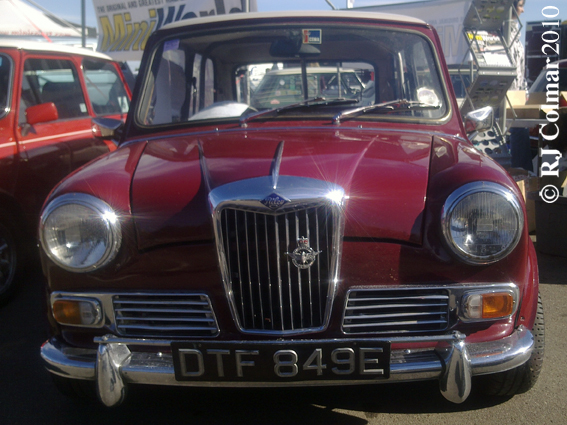
In 1896 William Riley jr purchased the Bonnick Cycle Company of Coventry which was born out of the cycling craze that swept England in 1890 and renamed it Riley Cycle Company.

Williams son Percy secretly built his first car, featuring an engine with the the worlds first mechanically operated inlet valve, in 1898 aged just 16.

Percy who also patented the detachable wheel went into business with his brothers forming the Riley Engine Company in 1903 supplying motorcycle engines and in 1905 they built their first car.

During restructuring in 1918 Riley car manufacture was transferred to Riley Motor Manufacturing which went into receivership in 1938 and was absorbed into the Nuffield Organisation along with Morris and MG, which in 1952 would merge with Herbert Austin’s companies into the nationalised BMC.

By 1947 Riley had ceased manufacturing it’s own designs and became a top end brand for shared designs in the Nuffield and later BMC organisations.

The Riley brand is easily identified by its blue diamond badge originally designed by Harry Rush with the strap line ‘As old as the industry, as modern as the hour’, was discontinued in 1969 and currently belongs to BMW.

Between 1961 and 1969 30,912 Riley Elfs were built.
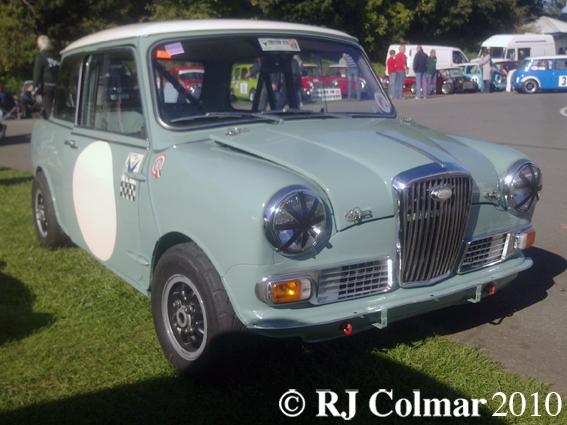
In 1896 Herbert Austin working for the Wolseley Sheep Shearing Company made a copy of a Leon Bollee vehicle that he had seen in Paris. By 1899 he had built a Voiturette that went into production in 1901 with Herbert Austin in charge of the Wolseley car division that had by now been spun off as an independent concern.

In 1905 Herbert Austin left to set up his own Austin Motor Company.

After several mergers and changes of ownership the Wolseley Motor Company came into existence in 1914 in the hands of Armstrong Siddeley. At this time operations were started in Toronto and Montreal which became British and American Motors after WW1.

In 1918 Wolseley started a joint venture with Ishikawajiama Ship Building and Engineering for the production of Wolseley models under license, in 1947 this venture became Isuzu.

In 1927 William Morris (Lord Nuffield) purchased Wolseley outbidding his rival Herbert Austin and General Motors using his own money.

Woseley became another top end brand for shared designs after WW2 and would become part of the merged BMC a combination of the assets of William Morris and Herbert Austin who between them had been responsible for the rise of much of the British motor industry.

The brand disappeared in 1975 the last model being a wedge shape forerunner of the Austin Princess which was in production for just 7 months.

Today the brand is owned by Nanjing Automobile Group along with the assets of the MG Rover Group. The Wolseley Sheep Shearing Company is today known as Wolseley plc.

28,455 Wolseley Hornets pictured above were built between 1961 and 1969.

Hope you have enjoyed today’s post, don’t forget to come back now !
Share

Why does the sight of a little Mini Moke make every body rock ?

Today’s blog is dedicated to Rowdy Mini Moke fan club member ‘Archidude‘ of Brevard NC, who sent me a link to this interesting Mini Moke video.

Designed as a vehicle with military applications in mind the Mini Moke made use of BMC Mini mini parts bin, including the engine, drive train and 10″ wheels which rendered the vehicle useless for military off road purposes because the Moke did not have much ground clearance.

However the vehicle produced between 1964 – 1993 did find a niche as a recreational vehicle in the sunny climate of many former British Colonies and was the first vehicle ever used on Pitcairn Islands, of HMS Bounty Fame, becoming the remotest vehicle on earth.

Correction Edited 29 09 19 The above vehicle is an AMC Andersen Cub not a Moke. Thanks to Dean and every one at www.moke.org who helped me correct this error.

Of the 50,000, Mokes made in Britain, Australia, and Portugal some have a competition history which includes Hans Tholstrup and John Crawford who nursed their Moke from London to Sydney in the 1977 Marathon and most unlikely of all Charlie Smith and Barry Seaton who gallantly jumped in their Moke to take on a field of Ford GT40’s and Ferrari 250 LM’s including winner Andy Buchanan,seen here , co driven by none other than Jacky Stewart at Surfers Paradise in 1966.

Finally Mini Mokes were used as Taxi’s in the surreal television series the Prisoner, a catch phrase of which was; Be Seeing You !

Share

Mini SUV’s

On Saturday I went to the ‘Mini Festival’ at Castle Combe Circuit 20 miles outside Bristol.

Drivers of a variety of models were offering rides round the track to raise money for the Jay Ryles Fund, in aid of rehabilitating Jay Ryles 18 year old Jay Jyles who collapsed with Brain Damage after a school rugby match earlier this year.

Amongst my favourites, all being driven with great gusto was this circa 1980 Mini Pick Up. Just 11′ long nose to tail and weighing in at just 1500 lbs (680 kg) with a full 6 imperial gallons of fuel ! Optional extras back in 1961 included, recirculatory heater, passenger side sun visor and seat belts. 58,179 of these are thought to have been built.

Also being driven with great joie de vivre was this Mini Van coincidentally also a circa 1980 and like the pick up above fitted with a grill from the passenger car version. The van had a 1/4 ton capacity and was a popular alternative to the passenger car because as a commercial vehicle it carried no sales tax. 521,494 examples of this model are known to have been built.

Off topic observations.

NASCAR

Jimmy Johnson took the win at Dover leading most laps blah ! blah ! blah ! back in contention in the drive for five blah ! ! Congratulations to the #48.

If you want to know why I am indifferent to His Majesty Jimmy Johnson, NASCAR is built on drivers infinite patience with their fans except now one man seems to have run out of patience with a ‘return all fan mail unopened policy’.

It was great to see AJ Almendinger leading the first half of the race, shame a flat tyre forced him to stop early.

Racing on concrete is good at Dover because the cars are always loose on the edge of over steering into the wall calling on drivers to display immense car control skills, several drivers likened it to driving on ice towards the end of longer runs.

It was a less than stellar day for my man Happy Harvick, I expected nothing more after the playground silliness displayed on Friday, to wit my man of the meeting award goes to Coach JD Gibbs who seems to have called his man ‘Denny four Cups Hamlin’ to order over the remarks he made that set Kevin off in the first place.

Formula One

Fernando Alonso took a well judged win in the Singapore GP last night, Sebastian Vettel had absolutely nothing for him, Mark Webber came in 3rd with a good recovery drive after an early pit stop.

McLaren drivers Jenson Button and Lewis Hamilton appear to be slipping out of contention for the World Championship both now 20 points behind with 4 races to go.

An hour into this race I found my self cutting the lawn despite the amazing night landscape in which the race was run.

Hope you have enjoyed todays blog and that you’ll join me again tomorrow.

Share
