Presidential Speed King – Renault 40CV NM Montlhéry Coupé

The Renault 40CV was launched in 1911 powered by a 7.6 litre / 460 cui straight six and could be ordered with either an 3.6m / 11′ 9″ or 3.9m / 12′ 9″ chassis.

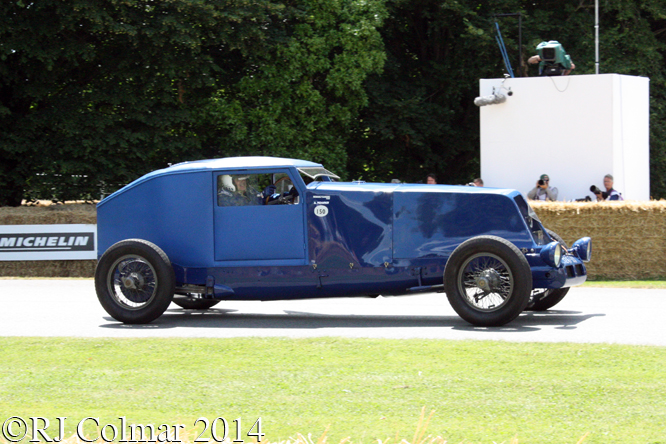
Renault 40CV Montlhéry Coupé, Jean-Louis Pichafroy, Goodwood Festival of Speed,

With the introduction of the 40CV Type HF in August 1920 the engine was upgraded to a 9.1-litre 9,120 cc / 557 cui straight six.

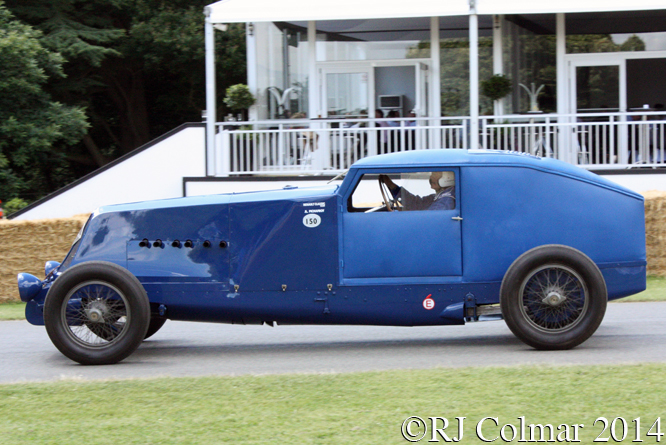
Renault 40CV Montlhéry Coupé, Jean-Louis Pichafroy, Goodwood Festival of Speed,

From 1920 to 1928 the Renault 40CV replaced the Panhard 20CV as the French Presidential vehicle of choice.

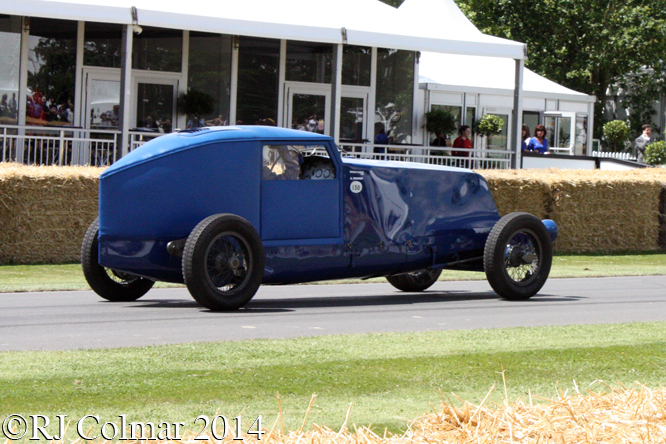
Renault 40CV Montlhéry Coupé, Jean-Louis Pichafroy, Goodwood Festival of Speed,

François Repusseau drove a 40CV to victory in the 1925 Monte Carlo Rally and the following year a vehicle similar to today’s featured 40CV MN was modified and fitted with a single seat Coupé body and taken to the Montlhéry Oval outside Paris for a record braking 24 hour run.

Renault 40CV Montlhéry Coupé, Jean-Louis Pichafroy, Goodwood Festival of Speed,

Facilitated by a pit crew of 14 who could complete a pit stop including changing all four tyres in 50 seconds every hour and a team of unnamed drivers the 40CV set a new 50 mile average speed record of 190.013 kmh / 118 mph and a 24 hour record of 173.649 kmh / 107.9 mph, by comparison the fastest average speed on the road course at Le Mans for the 24 hours race in 1926 was just 106.35 kph / 66 mph set by Robert Bloch and André Rossignol in their 3.4 litre / 207 cui Lorraine-Dietrich B3-6.

Jean-Louis Pichafroy is seen at the wheel of an exact replica of the 40CV MN Montlhéry Coupé, built in the 1970’s by Renault, at last years Goodwood Festival of Speed,

Thanks for joining me on this Presidential Speed King edition of “Gettin’ a li’l psycho on tyres” I hope you will join me again tomorrow when I’ll be revisiting the Monterey Rolex Reunion. Don’t forget to come back now !

Share

Heck Motor – Mercedes Benz 130 H Cabriolet

After designing the first Nesselsdorfer-Wagenbau, later Tata, Präesident in 1897, patenting the first rear swing axles in in 1903 while working for Adler and designing the first motor with a built in gearbox Austrian Edmund Rumpler founded the first German aircraft manufacturer Rumpler Flugzeugwerke GmbH with August Euler in 1908 which in 1909 gave birth to the Rumpler Luft Verkehr department.

Following the 1914-18 war Rumpler Luft Verkehr was reconfigured as an airline that in 1926 became part of Deutsche Luft Hansa AG.

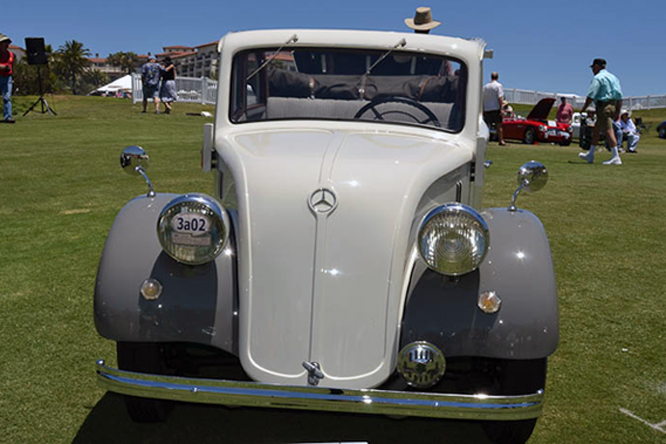
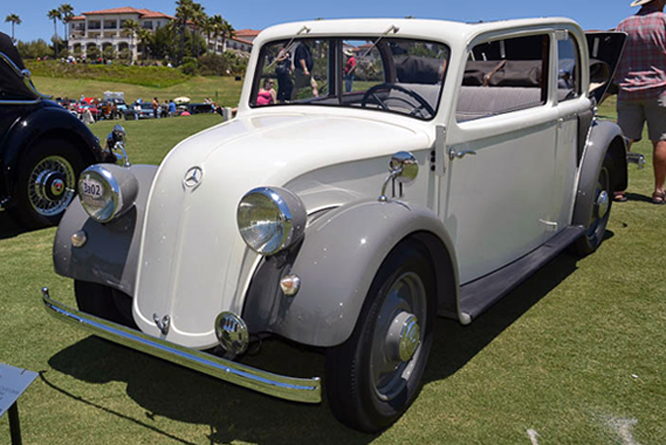
Mercedes Benz 130 H Cabriolet, Dana Point Concours d'Elegance

Meanwhile Edmund turned his attention to the design and manufacture of automobiles again and well over a decade before the streamlined Tata T77 and Chrylser Airflow went into production in 1934 and designed the sensation of the 1921 Berlin Auto Show known as the Rumpler Tropfen, droplet, Wagen.

It is believed that around 100 of these 5 seat vehicles; with a 36 hp W6 motor mounted ahead of the rear axle, capable of 70 mph, who’s body design was inspired by aerodynamic principles of the day were built. Many served as taxi’s and were immortalised as such in Fritz Lang’s 1927 epic expressionist master peace Metropolis.

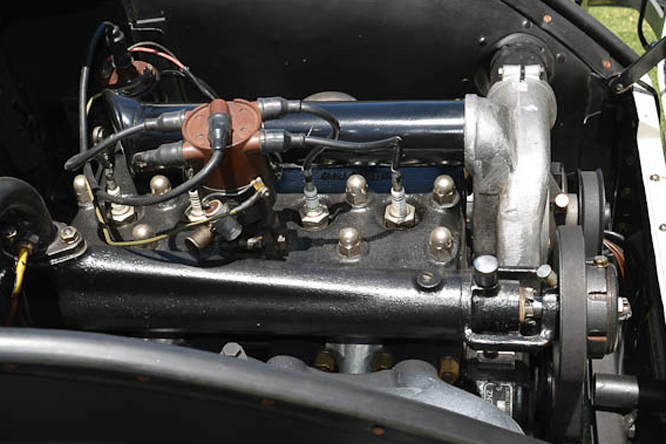
Mercedes Benz 130 H Cabriolet, Dana Point Concours d'Elegance

Chief Benz engineer Hans Nibel was so impressed with the chassis design of the Rumpler he convinced Benz to use a virtually unchanged Rumpler chassis to construct their own single seat Grand Prix racing car which was powered by an 80hp 2 litre 122 cui double overhead cam straight six in 1923.

The Benz Tropfenwagen was not a great success and was abandoned after the merger of Daimler with Benz in 1926, Auto Union under the direction of Dr Ferdinand Porsche would be the next team to progress the concept of the mid engined racing car.

Mercedes Benz 130 H Cabriolet, Dana Point Concours d'Elegance

In 1931 Hans Nibel set to work designing a small 4 seat two door car which again was inspired by the Rumpler, but this time he put the 25 hp 1.3 litre / 79 cui 4 cylinder side valve motor behind the rear axle in the heck, hither to boot / trunk with the 4 speed synchromesh transmission in front of both the engine and rear axle.

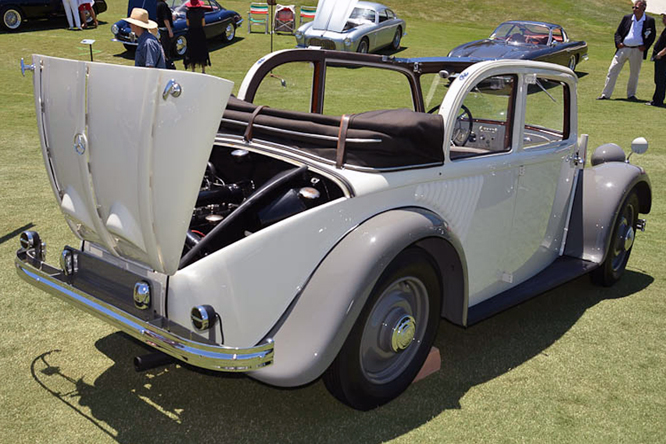
From 1934 to 1936 130 H (Heck) was sold as a two door hard top saloon/sedan, soft top as seen here or convertible with out the side windows, while the ride was considered good for the passengers the handling was only adequate for contemporary conditions and described as awkward for the driver.

Mercedes Benz 130 H Cabriolet, Dana Point Concours d'Elegance

Nibel had Daimler’s Max Wagner design a new chassis for the more powerful 55hp, but similarly laid out, 150 H 2 seat roadster which had the petrol tank moved from the back as in the 130 H to the front meaning the new model had virtually no storage space, this second model was only offered and sold in limited numbers in 1936.

My thanks to Geoffrey Horton for sharing these photographs of the Mercedes Benz 130 H taken at Dana Point Concours d’Elegance a few years ago.

Thanks for joining me on this “Heck Motor” edition of “Gettin’ a li’l psycho on tyres” I hope you will join me again tomorrow when I’ll be revisiting this years Monterey Rolex Reunion. Don’t forget to come back now !

Share

Tyre Contract For Sale – Spirit Cosworth 101D

There is no room for sentimentality in sport even if one has designed a triple Indy 500 winning Indy Car and a car that has secured one constructors World Championship and two world drivers championships after 4 year of steady decline to the bottom of the top ten one must expect ones sponsors to either walk or agree a merger with an up and coming team.

Such was the situation Gordon Coppuck found himself in at McLaren at the end of the 1980 season when sponsors Phillip Morris agreed to fund a merger between the upstart Project Four hither to Formula Two team headed by former Brabham mechanic Ron Dennis and McLaren who had not won a race since the Japanese Grand Prix in 1977.

Part of the deal would include Ron hiring John Barnard to design a new car with a fully composite chassis leaving Gordon little alternative to seek employment else where. Gordon joined his former colleague and McLaren employee Robin Herd at March for 1982 and after a year there became a founding member of a new Formula 2 team with March Formula 2 team manager John Wickham which was funded by Philip Morris and was to be powered by potent 2 litre Honda V6 engines with Belgian Thierry Boutsen and Swede Stefan Johansson as drivers.

Thierry won three races and finished third in the 1982 F2 championship behind March BMW drivers Corrado Fabi and Johnny Cecotto but more importantly for the Spirit team they had outscored the similarly powered Ralts of Kenny Acheson and Dr Jonathon Palmer so that when Honda was deciding on which team to partner in their planned for 1983 entry into Formula One it was easy to go with Spirit.

Withdrawing completely from Formula 2, having won the championship with Geoff Lees in 1981, Honda developed it’s turbocharged 1.5 litre V6 engine while Spirit adapted one of it’s Formula 2 chassis to take the engine while simultaneously working on today’s featured design the 101 from scratch.

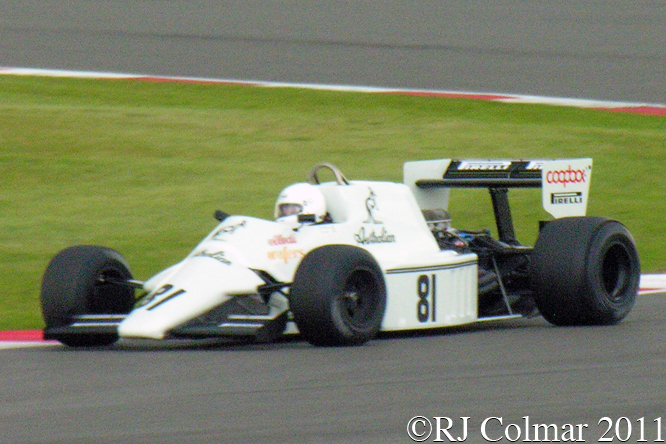
Spirit Cosworth 101D, Mark Williams, Silverstone Classic,

Spirit entered a limited programme of six races mid way through the 1983 season and Stefan Johansson managed to qualify the adapted Formula 2 201 and later 201C for all the races entered retiring from three of them and finishing a season best 7th in Holland. The 101 was ready for the last two of this programme but was left unraced.

For 1984 the team had hoped to retain the Honda Engines and attract 1972 and 1974 World Champion Emerson Fittipaldi out of retirement, but Honda decided to go with the more established Williams team who had the slightly younger 1982 World Champion Keke Rosberg already on their books.

Wickham and Coppuck wasted little time and did a deal to run the 4 cylinder turbocharged Hart 415T engines, that had hitherto been developed exclusively with Toleman since 1980 and Spirit adapted the unraced 101 in time for Emerson to test before the season got underway.

Emerson decided that this was not what he really wanted and so Mauro Baldi was entered for the first six races of the season scoring 8th places finishes in South Africa and San Marino before Huub Rothengatter was entered for the next eight races. With Hart motors in short supply Huub failed to qualify with a Cosworth DFV installed in Detroit but finished a best 8th in the Italian Grand Prix at Monza on his final start in the car.

Mauro returned to the seat for the final two races of the 1984 season finishing 8th in the European Grand Prix at Brands Hatch.

For 1985 Mauro was retained to drive the 101, now in D spec with longer side pods, as was a supply of Hart engines and Pirelli tyres, which would become significant because fellow Hart powered team Toleman had switched from Pirelli to Michelin part way through the 1984 season and when Michelin withdrew from Formula One at the end of 1981 neither Goodyear or Pirelli were prepared to step in and supply tyres to the team.

Without tyres Toleman had to withdraw from the first three races of the 1985 season while Mauro could do no better than qualify 24th for the first two races of the season, after qualifying last at San Marino nearly 10 seconds off the pace and posting it’s third consecutive retirement Spirit decided to call it a day and sold their contract for a supply of Pirelli Tyres to Toleman who could do no better than post one 12th and one 14th place finish all season though Teo Fabi did qualify on pole in Germany which helped secure the teams take over by sponsor Benetton at the end of the season.

Mark Williams is seen at the wheel of the 101D powered by a Cosworth DFV motor at Silverstone Classic a couple of years ago.

Thanks for joining me on this “Tyre Contract For Sale” edition of “Gettin’ a li’l psycho on tyres” I hope you will join me again tomorrow. Don’t forget to come back now !

Share

Gold Cup Stars – Oulton Park

For today’s post I thought it would be fun to revisit the Gold Cup meeting and see some of the stars who were not first to the checkered flag but nonetheless contributed significantly to the weekends entertainment.

AEC Reliance, Oulton Park, Gold Cup,

As Tim and I arrived at the circuit two AEC buses were being driven around the circuit with gusto, one even had Autosport club editor Marcus Pye entertaining passengers with a commentary, above a Devon General liveried 1963 AEC Reliance exits the Britten’s Chicane.

AC Greyhound, Oulton Park, Gold Cup,

Car of the day in the car park was this 1963 Ford Zephyr straight six powered AC Greyhound one of just 83 built.

Jaguar XJR9, Andy Wallace, Gold Cup, Oulton Park,

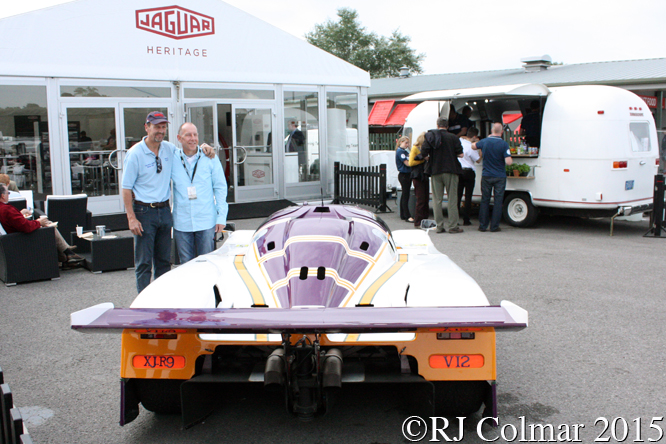
The day after our visit 1988 Le Mans winner Andy Wallace, on the right in the photo, gave a demonstration of the 1988 Le Mans winning #2 Jaguar XJR9 in front of him, this time completing his lap of honour unlike a previous visit in 2010.

de Tomaso Mangusta, Michael Eagles, Gold Cup, Oulton, Park

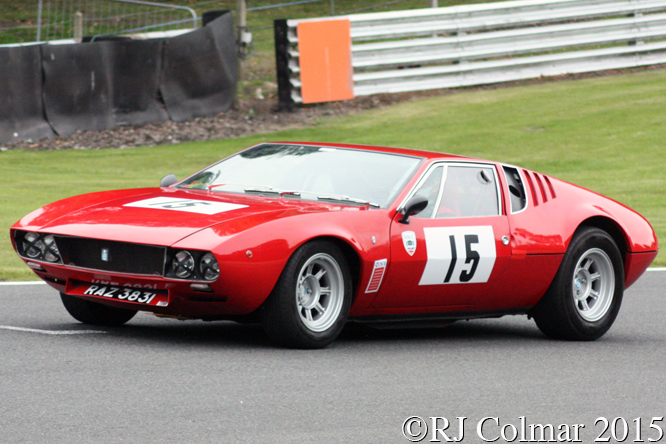
One of the cars that tempted me to visit on the Sunday rather than the usual Monday was Michael Eagles de Tomaso Mangusta, Michael started the Oni Plc Historic Road Sports race from 8th on the grid and got as high as 7th in the race before dropping back to finish 16th.

Sunbeam Alpine, Mike Foley, Gold Cup, Oulton Park

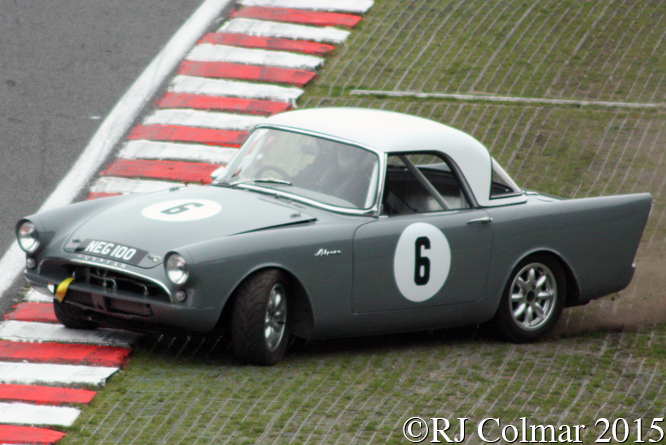
In the same race back marker Mike Foley produced the save of the day, after going into Old Lodge too fast and running wide his Sunbeam Alpine went into a nasty tank slapper upon regaining the track, just after this photo was taken, but some how Mike kept the car from spinning or hitting the barriers and continued to finish the race.

 Mallock Mk 20/21, Mark Charteris, Gold Cup, Oulton Park

The Giant Killer of the weekend award goes to Mark Charteris who qualified his Mallock U2 Mk20/21 Clubmans car for the first Derek Bell Trophy race fourth ahead an impressive collection of four more powerful Formula 5000 cars and was in third when the race was red flagged after Ian Ashley’s accident, the following day in damp conditions Mark beat both Neil Glover and Mark Dwyer aboard a Formula 5000 Chevron and Formula 2 March respectively that had finished ahead of him the day before.

Jaguar C-type, Ben Cussons, Gold Cup, Oulton Park,

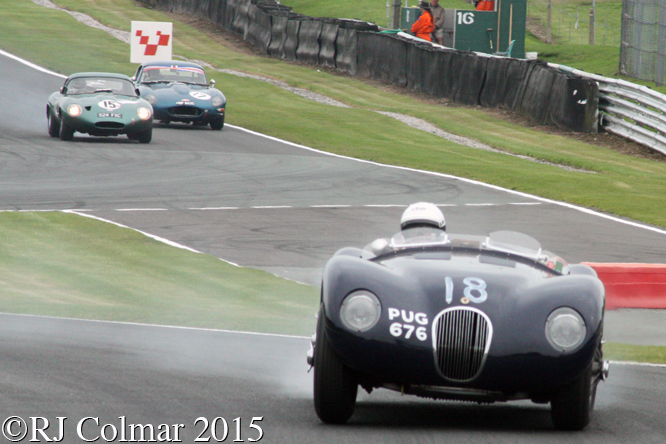
Just finishing the Jaguar Challenge race proved a challenge too far for five of the 20 starters, smoke was seen issuing from beneath several cars including the #18 C-type driven by Ben Cussons who was classified 9th a lap down and the #15 E-type in the back ground driven by Paul Castaldini who managed to hang on to finish 2nd over 90 seconds down on the winning E-Type driven by Michael Wilkinson and John Bussel.

Ginetta G12, Chris Blewett, Gold Cup, Oulton Park,

Wheel lifter of the day went to back marker Chris Blewett driving the #44 Ginetta G12 in the Guards Trophy supported by Dunlop Tyres race whose car struggled to keep four wheels on the ground in the corners.

MG Arkley, Chris Fisher, Gold Cup, Oulton Park,

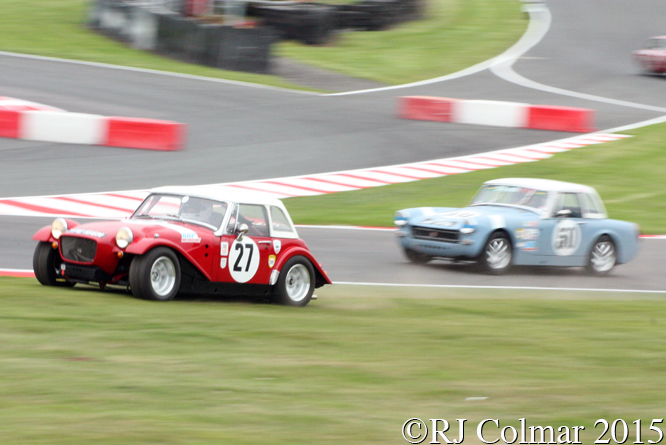
By 1970 there were loads of Austin Sprites and MG Midgets knocking about with seriously rusted bodies when John Britten in Barnet North London came up with the idea of recycling them with the aid of a retro look fibre glass front and rear ends that could easily be fitted to donor cars, thus the Arkley S with standard wheels and Arkley SS with wide wheels were born. Lawn Mower of the day award went to #27 Arkley SS driver Chris Fisher who during the 70’s Road Sports Bob Trotter Celebration race came out of the appropriately named Britten’s Chicane a tad wide and opted for the shortest route, with the least grip, before rejoining the track on the ascent to Hill Top.

Thanks for joining me on this “Gold Cup Stars” edition of “Gettin’ a li’l psycho on tyres” I hope you will join me again tomorrow. Don’t forget to come back now !

Share

Fury, Gravity And Inertia – Ferrari 312T #024

When the new 3 litre / 183 cui Formula One regulations for 1966 were announced most teams were caught on the hop not least because when Colin Chapman went to meetings to negotiate new post 1.5 litre regulations with the sports authorities he expected that if he asked for 3 litre engines he and the authorities might reasonably settle on a maximum 2 litre / 122 cui size, instead the authorities simply rubber stamped the 3 litre suggestion.

Ferrari 312T, Goodwood Festival of Speed,

At this time Ferrari were in the process of securing their second Formula One World Constructors Championship with John Surtees and caught in a ferocious spending war with Ford in the World Sports Car series, short of funds having turned down an offer from Ford, Ferrari were left with little choice to adapt a sports car V12 engine to meet the new regulations and fit it to the 1966 Ferrari 312.

Ferrari 312T, Goodwood Festival of Speed,

An internal squabble stymied what should have been a successful couple of years with the 312, as until the arrival of the Ford financed Cosworth DFV in 1967, there were few 3 litre engines of equal power, but without John Surtees the Ferrari team lost out to the reliable Repco powered Brabhams in both 1966 and ’67.

Ferrari 312T, Goodwood Festival of Speed,

After Ferrari were thoroughly beaten by Ford at Le Mans in 1966 and 1967 the sporting authorities rashly announced that future sports cars would also be restricted to a maximum 3 litre capacity and Ferrari’s technical Director Mauro “Fury” Forghieri at last time and funding to turn his attentions to building an uncompromised 3 litre / 183 cui racing engine.

Ferrari 312T, Rob Hall, Goodwood Festival of Speed,

His intentions with the new motor were to keep the centre of gravity low and so he chose a 180°, also known as flat, V12 architecture, not a true boxer despite the 312 B, 312 B2 and 312 B3 designations of the first 3 Formula One designs to which they were to be fitted from 1970 to 1974.

Ferrari 312T, Goodwood Festival of Speed,

By 1972 “Fury” had turned his attention to reducing the polar moment of inertia to improve the handling of his designs by moving the front radiators behind the front axle line on the unraced curiosity known as the Spazzaneve, snow plough, however Enzo Ferrari’s failing health led to FIAT executives demoting Mauro when taking over the running of the Formula One team and a most disastrous season followed in 1973 until Il Commendatore returned to work midway through the season.

Ferrari 312T, Goodwood Festival of Speed,

Enzo immediately reinstated Mauro who set about turning the poorly conceived and executed 1973 Ferrari B3 into a winner for the 1974 season.

Ferrari 312T, Goodwood Festival of Speed,

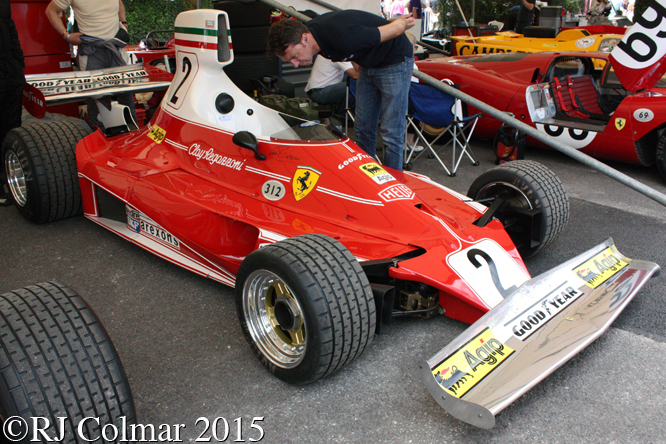
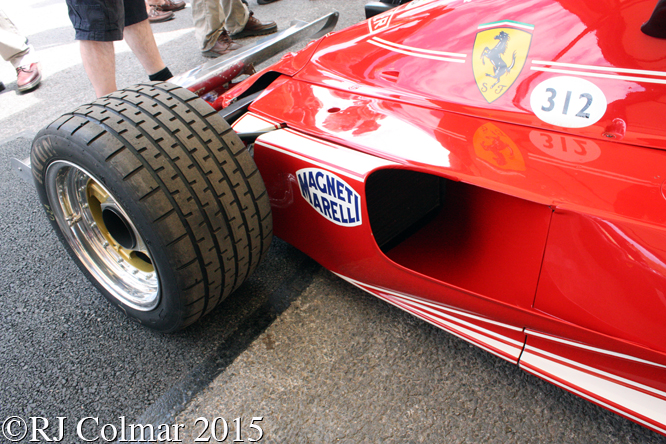
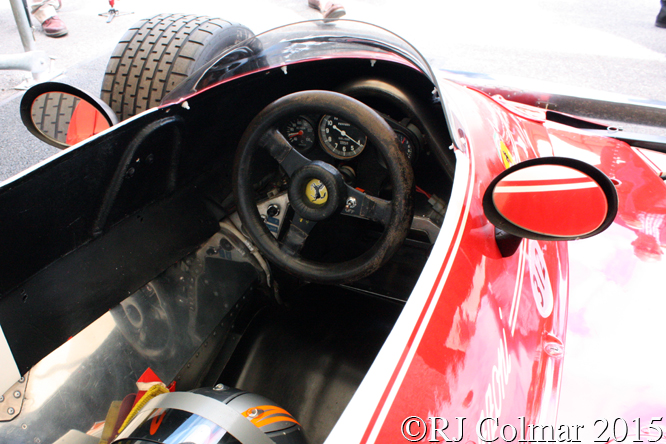
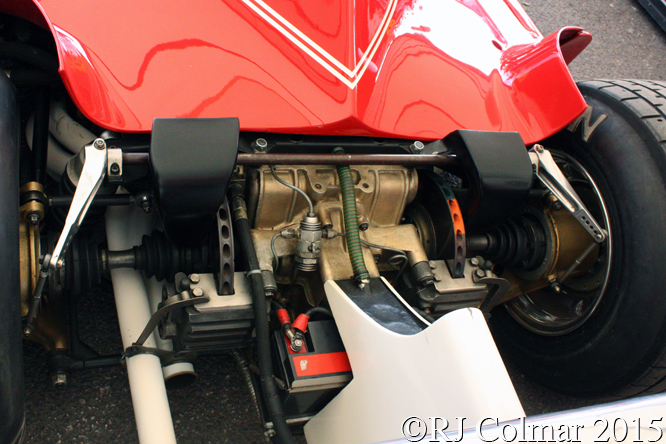
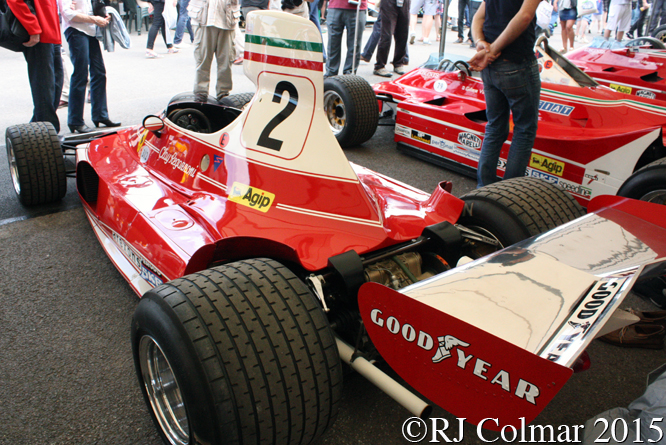
For 1975 “Fury” started with a clean sheet and designed today’s featured reliable 510 hp flat 12 powered 312 T that not only had the front radiators mounted behind the front axle, but also had the gearbox mounted transversely ahead of the rear axle so that only the front and rear wings, used to aerodynamically balance the car, protruded from the axles of the car, which when developed with Niki Lauda at the wheel resulted in a superior handling.

Ferrari 312T, Goodwood Festival of Speed,

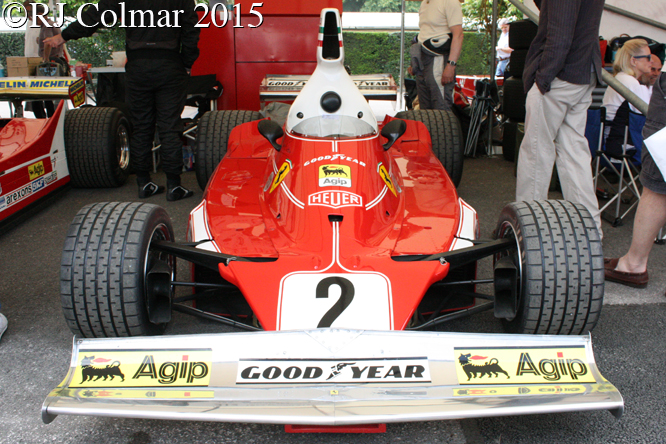
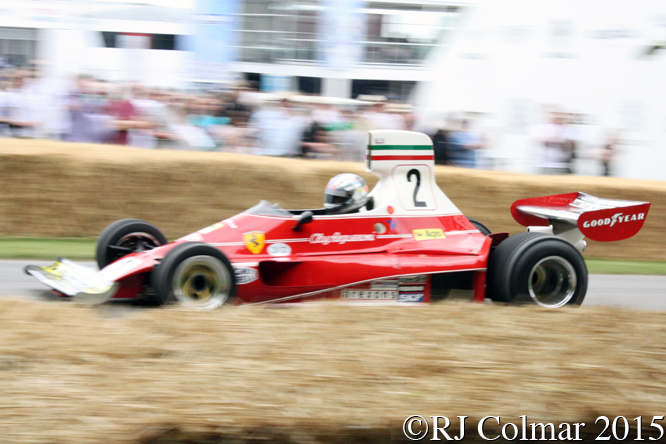
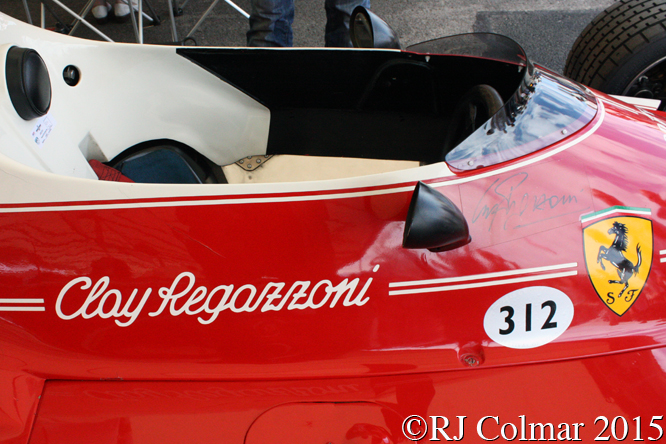
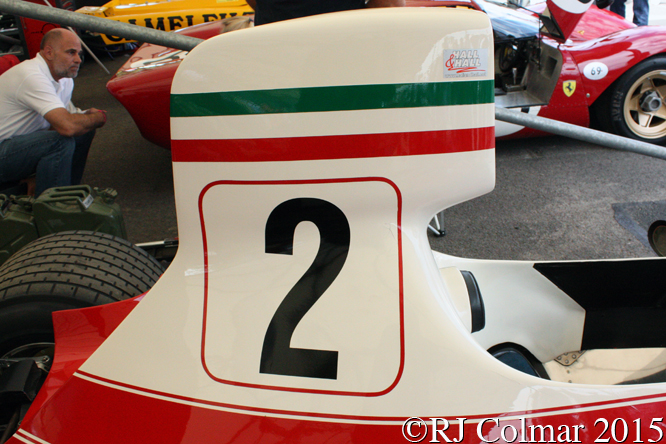
After starting the 1975 season with the older B3 design, the 312T was introduced at the South African Grand Prix, after all of the bugs of the new car had been ironed out Niki Lauda went on a winning streak in Monaco, Belgium and Sweden, finished second to James Hunt in Holland and won again in France and at the season ending US Grand Prix, having rapped up the Drivers World Championship with a third place finish at Monza where team mate Clay Regazzoni took a popular win in today’s featured car chassis #024, which helped Ferrari win their first Formula One Constructors Championship since 1964.

Ferrari 312T, Goodwood Festival of Speed,

Chassis #024 was the last of of five 312T’s to be built prior to his win at Monza Clay drove this car in France, where he retired, Britain where he finished 13th and Austria where he came home 7th. Subsequent to the race at Monza Clay drove the car to a seventh place finish at the 1976 season opening Brazilian Grand Prix before winning the inaugural US Grand Prix West at Long Beach.

New rules were mandated after this final appearance and the 312T’s were superseded by the 312T2, this particular chassis ended up with British computer leasing magnate John Foulston before his death in 1987 and is seen with Rob Hall of Hall and Hall at the wheel at Goodwood Festival of Speed earlier this year.

Thanks for joining me on this “Fury, Gravity And Inertia” edition of “Gettin’ a li’l psycho on tyres” I hope you will join me again tomorrow when I’ll be returning to Oulton Park to wrap up this years Gold Cup coverage. Don’t forget to come back now !

Share

Americana – Rolex Monterey Motorsports Reunion

Last month Geoffrey Horton kindly asked Karl Krause to take some photo’s of the Rolex Monterey Motorsports Reunion festivities at Laguna Seca, I’ll be running a couple of blogs featuring a selection of the vehicles that were present starting with five American vehicles and one from Canada today.

Ford Model T Speedster, Rolex Monterey Motorsports Reunion

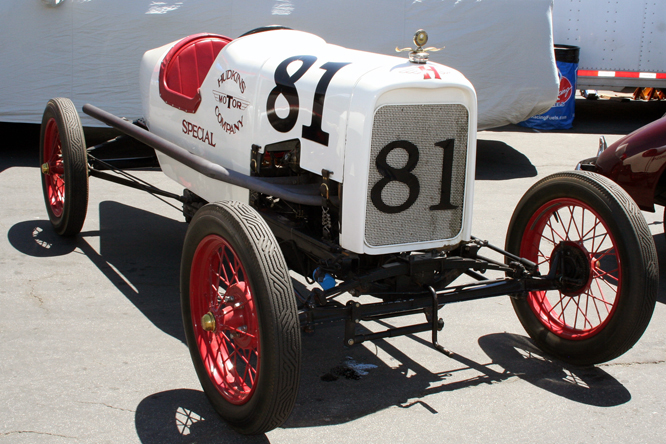
First up is a the #81 1922 Ford Model T Speedster known as the Hudkins MoTor Special in deference to Bruce Hudkins who built the immaculate boat tail body.

Caballo de Hiero, Rolex Monterey Motorsports Reunion

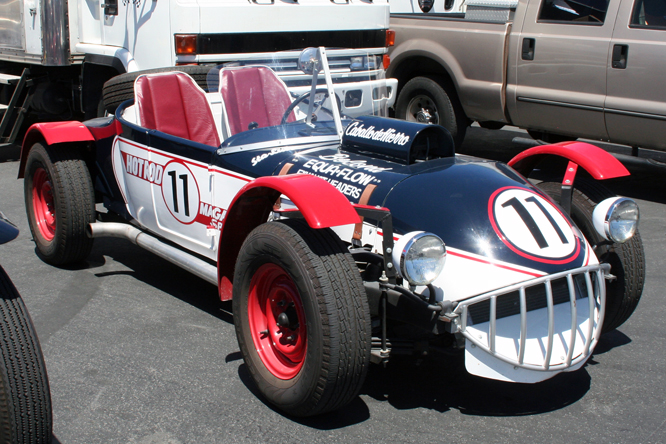
Fast forward 31 years to 1953 when a pioneering Hot Rodder Akton Miller took it upon himself to build the #11 “Caballo de Hiero”, Iron Horse, above using a Ford Chassis and an Oldsmobile motor to take on the might of Europe from Lancia, Ferrari, Talbot Lago and Jaguar in the 1953 Carrera Panamerica in which he and co driver Douglas Harrison finished a respectable 14th overall, the following year they returned and came home an even better 7th overall covering the 1921 mile route at an average speed of 94.1 miles per hour.

Bocar XP5,  Rolex Monterey Motorsports Reunion,

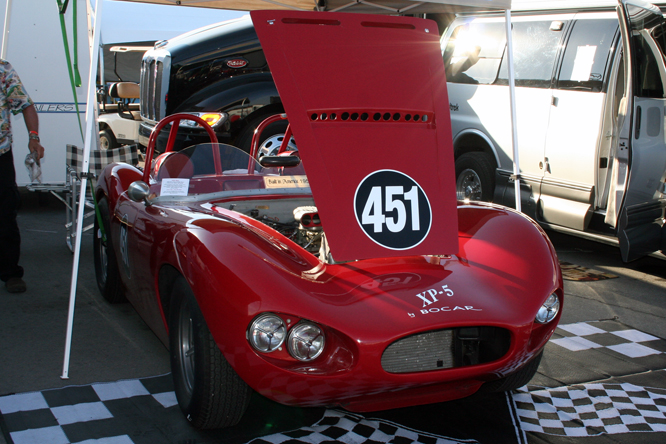
In the late 1950’s BOb CARnes set out to design and build the fastest and safest sports car in the world that would be both fully operable on ordinary roads and track, at a price within the reach of ordinary people. By 1959 he was on his 5th design the XP5 like the example owned by Wesley Abendroth above which I believe is chassis XP5043, that when powered by a 290 hp Corvette V8 was easily capable of 160 mph.

Dailu Mk2, Rolex Monterey Motorsports Reunion, Laguna Seca,

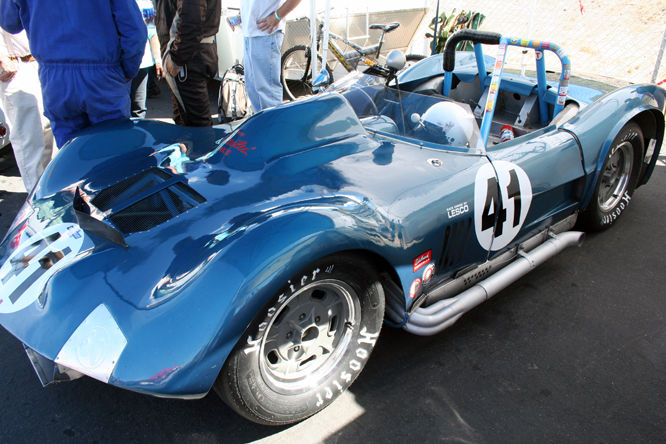
Even more obscure and rare than the Bocar XP5 is Greg Meyer’s Dailu Mk2 built by DAvId Greenblatt and LUigi Cassiani in Canada. After the pair turned constructors and successfully built the Chevrolet powered Dailu Mk1 to improve upon Davids 1960 Sadler Mk IV, they built the Dailu Mk2 with a coupé fiberglass body, Jaguar XKE rear suspension, and a 430hp Ford Traco engine. John Canon drove it to victory on it’s debut and owner Peter Lerch continued the cars winning ways even after electing to remove the roof.

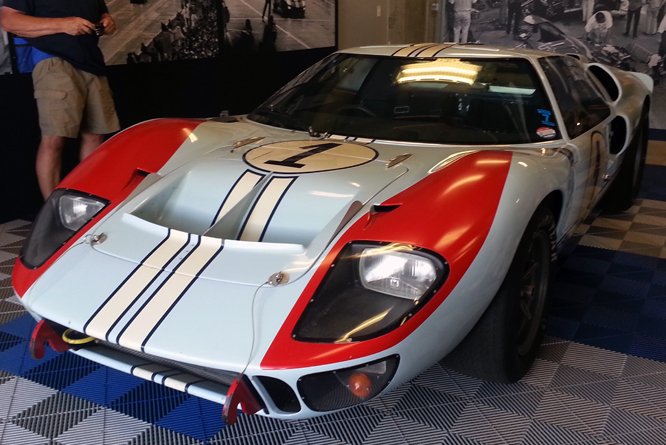
Ford GT40 MkII, Rolex Monterey Motorsports Reunion, Laguna Seca,

Probably best known of today’s featured cars is the Ford GT40 MkII chassis P/1015 which Ken Miles and Lloyd Ruby drove to victory on it’s debut in the 1966 Daytona 24 Hours and was then driven by Ken and Denny Hulme to a second place finish in the Le Mans 24 Hours, subsequent starts in the same events in 1967 yielded no finishes.

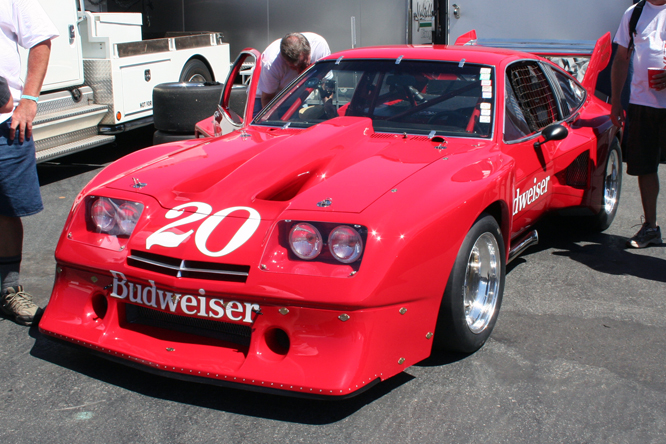
Chevrolet Monza, Rolex Monterey Motorsports Reunion, Laguna Seca,

Fourteen years further down the line and Chris Cord Racing were entering the second of their DeKon Engineering built Chevrolet Monza’s for Jim Adams in the IMSA GTX series. Other drivers of chassis #1012, seen above now owned by Ken Epsman, in the 1980 – 81 time frame included team owner Chris Cord, Rick Koop and a chap, or these days I believe more correctly a chapess, called Bruce Jenner who is apparently a darling of the moment in the media .

My thanks to Geoffrey Horton for organising these photographs for me and to Karl Krause for their execution, more will follow next week.

Thanks for joining me on this “Americana” edition of “Gettin’ a li’l psycho on tyres” I hope you will join me again tomorrow when I’ll be looking at a 1975 World Constructors Winning Ferrari. Don’t forget to come back now !

Share

Ian’s Great Escape – Oulton Park Gold Cup

At the weekend I took a break from attending the Gold Cup on Monday as in recent years and went on the Sunday, my decision was influenced by slightly larger grids for the races and slightly better weather, I was rewarded with a short lie in and a great day’s racing which kicked off when Tim Murray and I visited the press office where we were greeted with a warm welcome and great cup of coffee by friends made over several years on The Nostalgia Forum.
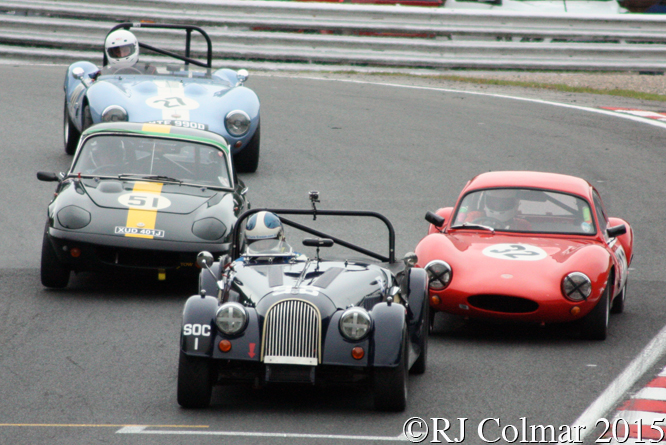
Morgan, Kivlochan, Ginetta, Ward Booth, Lotus, Barter, Ginetta Boland, Gold Cup, Oulton Park,

After a quick visit of the pit area we made our way to Deer Leap for the 10 lap Oni Plc Historic Road Sports race which was led on the opening lap by front row starter Kevin Kivlochan in the #98 Morgan Plus 8 seen above already in second place on lap two. Pole starter Julian Barter driving the #51 Lotus Elan S4 completed the opening lap in 4th but recovered to relieve the races second leader Roger Waite in another Lotus Elan on lap 5, the red #32 Ginetta G4 driven by Patrick Ward Booth finished 3rd ahead of Kevin’s Morgan and the blue #27 Ginetta G4 driven by Dave Boland.
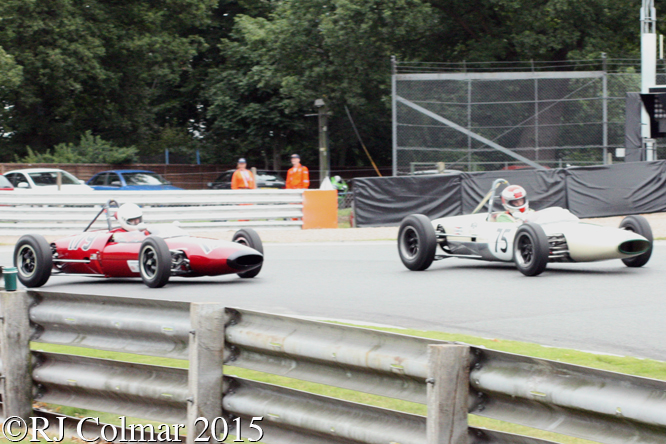
Lightening Envoyette, Peter Moreton, Lotus 22 Andy Hibberd, Gold Cup, Oulton Park,

We moved to the inside of Lodge for the next couple of races. Above Peter Moreton had an electric opening lap in the first of the two Silverline Historic Formula Junior races leading the field from 4th on the grid in his #75 Lightening Envoyette, front row starter Andrew Hibberd in the #179 Lotus 22 completed the opening lap in third and is seen above lining up to relieve Peter of the lead for good at the end of lap 3, John Fyda driving a Brabham BT6 finished second ahead of Peter with less than 6 seconds covering the top three after 20 mins of close racing.
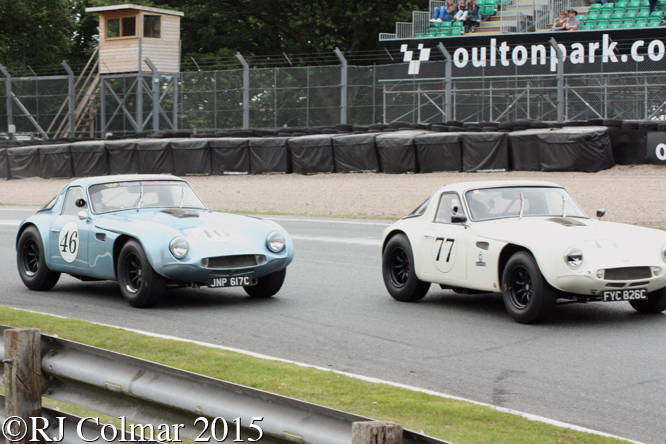
TVR Griffith, Gardner/Cox, Mike Whitaker, Gold Cup, Oulton Park,

Mike Gardiner and Dave Cox qualified their #77 TVR Griffith on pole for the HSCC Guards Trophy supported by Dunlop Tyres GT Race but there was no stopping Mike Whitaker in the similar #46 TVR seen above about to take the lead at the end of the 2nd lap which he would hold onto until pitting on lap 11 handing over the lead to the similarly Ford 289 powered AC Cobra driven by Robert Bremner. After the pit stops had cycled through Mike Whitaker led until the end of the race ahead of the Gardiner / Cox TVR and Robert in the over steering (loose) AC.
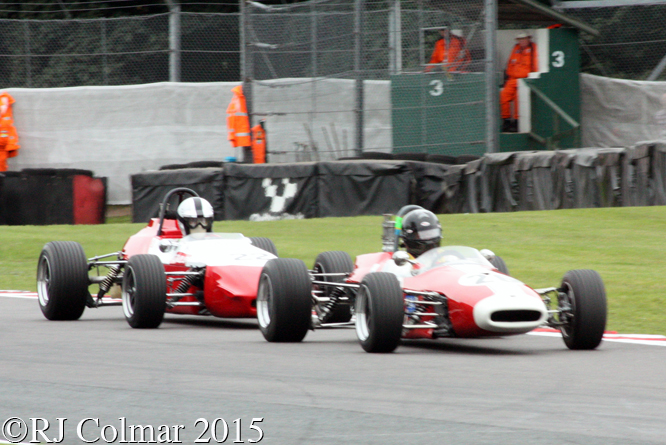
Brabham BT21, March 703 Simon Armer, Gold Cup, Oulton Park,

By the end of the 40 min GT race Tim and I had made our way over to the inside of Old Hall from whence we watched the start of the first of two The Cubicle Centre Historic Formula 3 races. Fourth place starter Steve Seaman in his #26 Brabham BT21 nipped through to lead the opening 4 laps of this race from pole man Simon Armer driving the #22 March 703 who is seen above about to pass Steve to claim the lead which he held onto to take the flag a gnats over 17 seconds ahead of Micheal Scott’s Brabham BT28. Steve came home forth behind clear championship leader Leif Bosson driving another Brabham BT28.
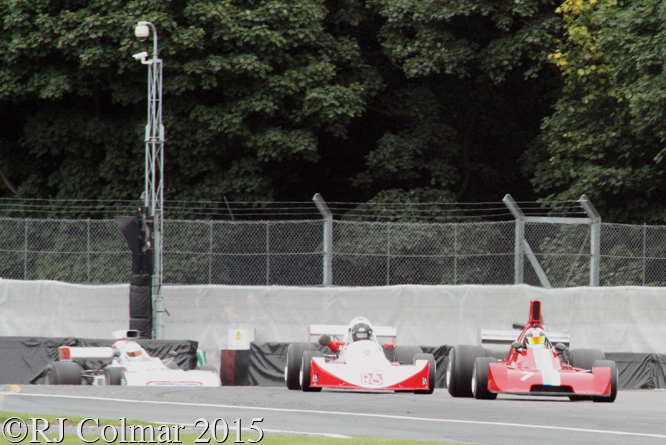
Chevron B37, Neil Glover, March 742, Mark Dwyer, Gold Cup, Oulton Park,

One of the highlights of the weekend was seeing Neil Glover driving the one off 5 litre / 302 cui 1976 Chevron, celebrating it’s fiftieth anniversary this year, B37 F5000 car which he qualified second for the first of the weekends Derek Bell Trophy races behind the 2 litre / 122 cui 1974 March 742 Formula 2 car driven by Mark Dwyer. Neil snatched the lead for the opening 3 laps of the race with Mark snapping at his heals in the nimble March who finally grabbed the lead on the third lap and pulled out a nearly six second advantage when a major incident between Denton’s and Cascades required the red flag to be shown on the 8th lap.
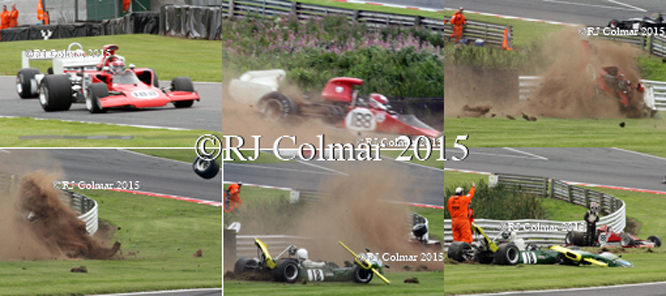
Ian Ashley, Derek Bell Trophy, Gold Cup, Oulton Park,

5th place starter 67 year old former Grand Prix driver Ian Ashley driving the #188 Lola T300 Formula 5000 car came down the chute between Denton’s and Cascades for the 8th time in 4th place behind the Clubmans Mallock driven by Mike Charteris when he came across a hapless lapped Brian Cullen driving a 1970 1600 cc Formula 2 spec #18 Crosslé 19F. Just after the Denton’s right hand kink Ian clipped the left rear wheel of the Crosslé with his right front and went flying down the track until his rear end hit the retaining barriers which sent the car into a barrel roll before landing on it’s right side and then came to rest miraculously the right way up. Fortunately Ian was able to release himself from the remains of his Lola unaided and gave spectators a thumbs up to a good dose of applause, neither driver suffered any injury that I know of.
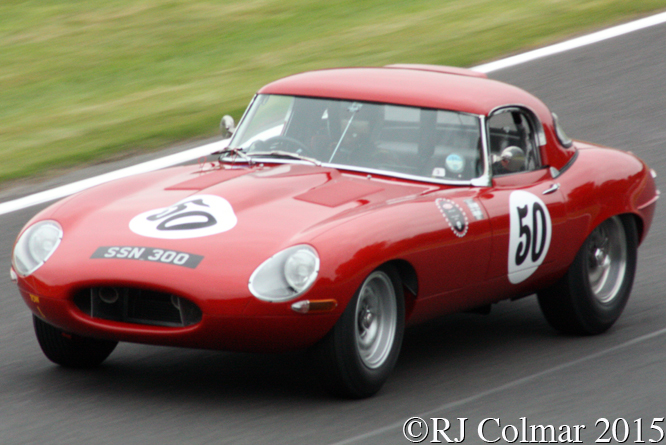
 Jaguar E-type, Micheal Wilkinson, Gold Cup, Oulton Park,

After the dramatic low’s and high’s of the incident the 40 min Jaguar Heritage race passed by in relative tranquility. The third place starting #50 E-type of Michael Wilkinson and John Bussel took over a commanding lead with 6 laps to go, when Martin O’Connel’s pole winning E-type retired 1 lap after his compulsory pit stop, to finish over a minuet and a half clear of Paul Castaldini who was just third placed pairing of Dave Coyne and Robert Gate who made it an all E-type podium as several of the cars struggled to the end with smoking brakes, exhausts and or transmissions.
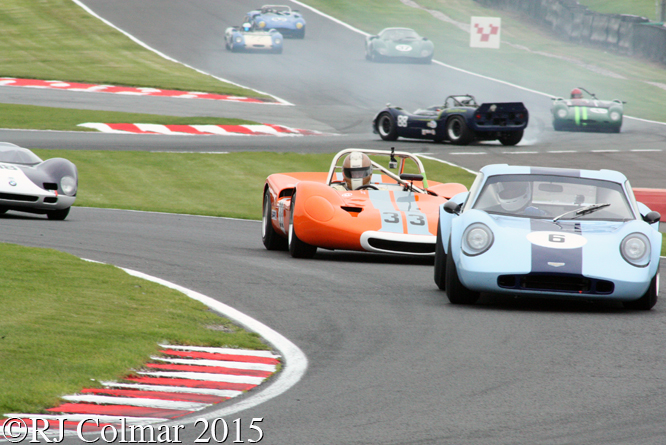
Lenham P69 Waggitt/Needham, Gold Cup, Oulton Park

Normal service returned with the Guards Trophy supported by Dunlop Tyres Sports Racing cars race. On the opening lap 5th place starter Jon Waggitt was the man on the move with the #33 Lenham P69 seen here followed by the pole sitting and eventual winning #18 Elva Mk 7, driven by Maxim Bartel and Callum Grant, ready to pounce by the front row starting #6 Chevron B6 driven by Nick Thompson and Sean McClurg. Jon kept the lead for all of two laps before the #18 reasserted qualifying form and went on to win the 40 min race by over 8 seconds from the #33 Lenham that Jon shared with Peter Needham that finished a further 5 seconds ahead of the Chevron B8 driven by Charles Allison. In the back ground seventh place starter Marcus Mussa spins his #88 McLaren Elva M1B going into the Hislops chicane.
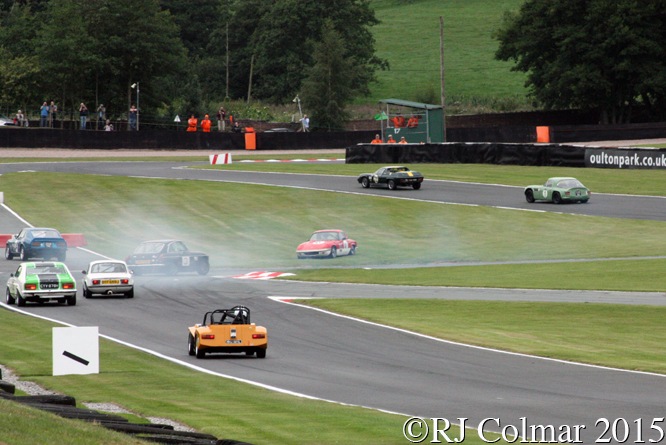
70's Road Sports, Gold Cup, Oulton Park

The 20 min 70’s Road Sports Bob Trotter Celebration Race may have been shorter than some, but provided the most closely contested victory as second place starter Jim Dean made the running over the first five laps in his little green #72 Lotus Europa, eventual winner, by just .089 of a second, was Charles Barter whose powerful blue #24 Datsun 240Z started 3rd but had to take to the escape road going into Hislops on the opening lap in order to avoid the spinning 5th place starting Lotus Elan driven by Iain Daniels. Jim finished 2nd just under 5 seconds ahead of the light green #1 TVR Tuscan driven by Peter Shaw.
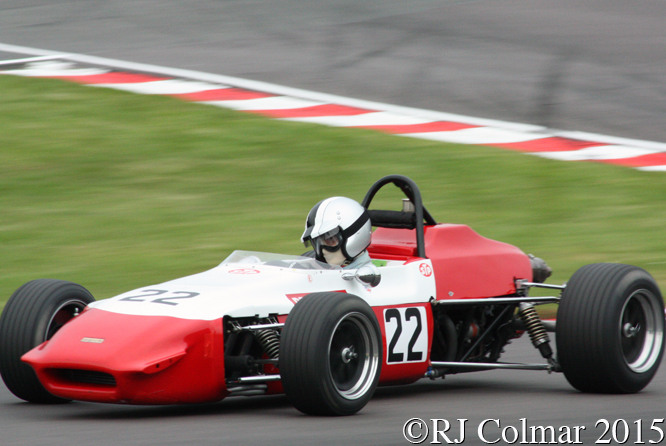
March 703, Simon Armer, Gold Cup, Oulton Park,

The starting grid for the second Cubicle Centre Historic Formula 3 race was exactly the same as the first, unusually the finishing order of the first race played no part in the starting order for the second, once again it was third place starter Steve Seaman in the Brabham BT21 who went into the lead on the opening lap, but this time he held onto it until lap 6 before a determined Simon Armer found away past for the final two laps of the race which he finished just over half a second ahead of Steve and nearly 8 seconds ahead of Michael Scott.
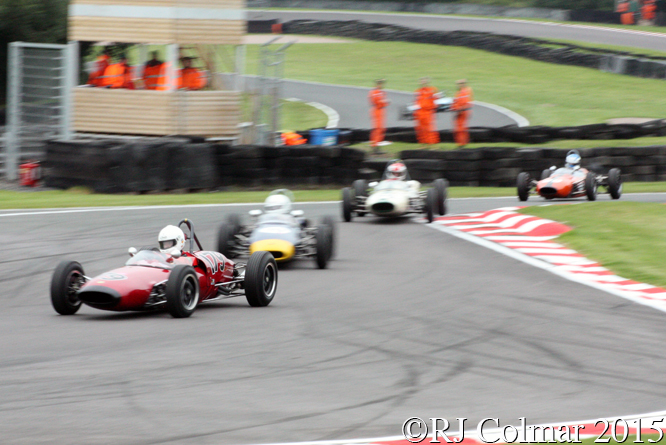
Historic Formula Junior, Gold Cup, Oulton Park,

The grid for the final race of the day, second Silverline Historic Formula Junior race was determined by the finishing order of Junior race one, but pole sitter Andrew Hibberd finished the opening lap in third as the electric Peter Moreton again led with John Fyda between them. Andrew is seen above having just taken the lead from Peter who was demoted to third as John followed Andrew to take second on lap 3. The order remained the same until the end of the race with the top three again finishing less than six seconds apart with plenty of entertaining battles through the field to keep the results uncertain until the very end of a great day’s racing.

Thanks for joining me on this “Ian’s Great Escape” edition of “Gettin’ a li’l psycho on tyres” I hope you will join me again tomorrow when I’ll be visiting the Rolex Monterey Motorsports Reunion. Don’t forget to come back now !
Share